Pro-Palestinian activists disrupt German Armed Forces Day events in Munich, Unna
Pro-Palestinian activists on Saturday disrupted German Armed Forces (Bundeswehr) Day events in the cities of Munich and Unna, staging protests against Germany’s military support for Israel and arms exports, Anadolu reports.
“Supporters of ‘Peacefully against Genocide’ staged peaceful protests today in Unna and Munich on German Armed Forces Day,” organizers said in a statement sent to Anadolu.
They said military equipment displayed during the events was primarily manufactured by Rheinmetall, a German defense company that supplies weapons and ammunition to Israel and “plans to open a new factory RIGHT IN THE MIDDLE OF BERLIN in July.”
READ: German firm Bosch closes artificial intelligence, research and development center in Israel
Video footage shared on social media showed activists climbing onto a tank and unfurling a banner reading “Genocide with German weapons.”
One activist, identified as Hannes, said the demonstrations were intended to draw attention to the use of German-made weapons in conflicts abroad.
“Here on Bundeswehr Day, equipment and weapons are put on display. The Bundeswehr is celebrated; killing machines are glorified. And all this while the weapons on display here are exported to kill,” Hannes said.
“By supplying weapons to the Israeli state, the German federal government and arms industry are complicit in every crime Israel commits,” he added.
READ: Israeli strike on tent sheltering displaced Palestinians kills 6 in Gaza City
Kosovo to hold another parliamentary election amid deadlock over new president
Kosovo will hold a parliamentary election on Sunday, its third in just 18 months, after its political parties failed to reach a compromise on choosing a new president.
The tiny Balkan nation, Europe’s youngest, has aspirations to join the European Union but has had no functioning government for much of the last year as its fractured parliaments failed to elect first a speaker and then a new head of state.
No opinion polls have been conducted recently but analysts predict victory again for Prime Minister Albin Kurti’s Vetevendosje party. However, he will still need to reach a compromise with opposition parties to secure the two-thirds majority required to elect a new president, they say.
Kurti’s party won 51.1% of the vote in the last election in December but could not agree with other parties on a candidate for the largely ceremonial presidency, triggering the dissolution of parliament in April and another snap election.
“We can have 10 rounds of elections, but if there is no political will to sit down and find a deal, there is no solution. I don’t see that will among the parties,” said Eugen Cakolli, a researcher at Kosovo’s Democratic Institute (KDI).
DEADLOCK TO CONTINUE?
Cakolli said Kurti’s party would need to win more than 60% of the vote to secure the election of its preferred candidates for parliamentary speaker and president, adding that this was an unlikely scenario.
“This Sunday’s election may not be the only one this year and holding four rounds within two years would be the worst scenario imaginable,” he added.
The EU has urged politicians in Kosovo – which declared independence from Serbia in 2008 – to create strong institutions that can deliver the reforms needed to join the bloc.
“The EU can support Kosovo, but it cannot do Kosovo’s homework,” European Council President Antonio Costa said during a visit to Pristina on Wednesday.
Kurti’s party first came to power in 2021 with a more nationalist, welfare-focused agenda. Like all parties in Kosovo, it has a pro-Western orientation. It also opposes further concessions to Serbia, with which relations remain strained.
Kosovo’s election commission has said more than 900 candidates from 17 parties and three coalition groups are competing for seats in the 120-seat parliament.
About 2.1 million voters are registered – more than Kosovo’s 1.6 million resident population due to a large diaspora, which is based mostly in western Europe and tends to favour Kurti’s party.
Many Kosovars just want political stability.
“I am tired of voting,” pensioner Sadri Alija said in the capital Pristina. “May Allah unite our politicians – they are only thinking of themselves.”
Veteran Actor Killed in Horror Stabbing Outside Home
Veteran actor James Handy, best known for his work in Top Gun: Maverick, Jumanji and a long list of hit TV crime dramas, was killed in a shocking stabbing outside a Los Angeles-area home.
Handy, 81, was allegedly stabbed in the chest on the front lawn of his girlfriend’s home in Tarzana, California, before later dying at a hospital.
Now, disturbing new details have emerged about the moments after the attack.
According to reports, the suspected killer, Michael Gledhill, 44, was captured on a neighbor’s doorbell camera walking calmly down the street away from the scene.
Gledhill is the adult son of Handy’s girlfriend and reportedly lived at the home with his mother.
The chilling footage, first obtained by Fox 11 Los Angeles, allegedly shows Gledhill strolling away from the house moments after Handy had been stabbed and left dying in the front yard.
But in a bizarre twist, Gledhill later returned to the home.
A police report states that the suspect “flagged down nearby responding officers” and told them he was the person they were looking for.
Officers had already been called to the area after a disturbing 911 call reported violence at the home.
According to reports, the unidentified caller told dispatchers: “I am the son of man, I just killed the man of sin.”
Authorities have not confirmed whether Gledhill was the person who made that call.
When officers arrived, they found Handy unconscious in the front yard with a stab wound to his chest.
Los Angeles Fire Department paramedics rushed the actor to a nearby hospital, but he could not be saved.
Gledhill was arrested and charged with murder.
Police said the motive remains under investigation, but detectives believe the stabbing was an isolated incident. Authorities also said there does not appear to be any continuing danger to the public.
The brutal killing has stunned those who knew Handy, a longtime working actor whose career stretched across nearly five decades.
His agent, Pam Ellis-Evans, confirmed his death and paid tribute to him in an emotional statement.
“With great sadness I can confirm that the gentleman who was attacked and killed on Wednesday in Tarzana was the actor James Handy,” she said.
She added: “I could not have asked for a more talented, humble or gracious client and friend than James Handy.”
Handy was born in New York and began his acting career in 1977 with a role on the soap opera Ryan’s Hope.
His big-screen debut came in the 1981 military drama Taps, which starred Tom Cruise, Sean Penn and Giancarlo Esposito.
Over the years, Handy became a familiar face to movie and TV fans.
He appeared as an exterminator in the 1995 family adventure film Jumanji and had a role in the 1990 horror-comedy Arachnophobia.
He also played a doctor in the 2017 Wolverine film Logan.
More recently, Handy appeared in the 2022 blockbuster Top Gun: Maverick, starring Tom Cruise, where he played the bartender Jimmy.
His television credits were just as impressive.
Handy appeared in NCIS: Los Angeles, CSI: NY, NYPD Blue, Law & Order, The Closer, Cold Case and The X-Files.
For decades, he was the kind of actor audiences recognized instantly, even if they did not always know his name.
Now, fans and colleagues are mourning a respected performer whose life ended in a horrifying act of violence.
Gledhill remains accused of murder as investigators continue working to determine what led to the deadly confrontation.
EU Green Transition Sparks Fears of Factory Closures and Employment Losses
EU countries risk mass job losses in the coming years as high energy costs, industrial restructuring and the green transition weigh on the economy, the European Commission is set to warn.
The figures, seen by POLITICO, will appear in the European Semester Spring Package, which sets out the Commission’s economic and policy recommendations for EU countries and is due to be presented Wednesday. They underscore growing concern in Brussels about the scale of the economic challenges facing the bloc.
“Europe’s competitiveness will not be built by technology, capital or financial regulation alone,” Commission Executive Vice President for Skills Roxana Mînzatu told POLITICO. “It will be built by people, the skills they develop and the opportunities we create for them to contribute fully to our economies and societies.”
With the U.S.-Israeli war in Iran showing no sign of ending and continuing to affect oil prices, the Commission projects that energy price pressures in 2026 will put as many as 560,000 jobs at risk. The sectors most exposed include construction, metals, chemicals and transport.
Weaker economic activity has forced the Commission to revise its joblessness projections. Last autumn, the Commission predicted that unemployment would stand at 5.9 percent in 2026 and 5.8 percent in 2027. It now believes it will be 6 percent in both years.
The Commission also expects governments to take on more debt, with the general government balance for all 27 EU countries widening from -3.1 percent of GDP in 2025 to -3.5 percent in 2026 and -3.6 percent in 2027.
The package will seek to shift attention toward the workforce, arguing that the EU’s competitiveness agenda can’t succeed without addressing mounting labor shortages and skills gaps.
The Commission identified the sectors facing employment pressures.
In Europe’s automotive sector, key to Germany’s economic success, the Commission will say that 600,000 jobs are at risk as the industry grapples with the transition away from combustion-engine vehicles and strong competition from China.
In the battery industry, some 85,000 jobs are in jeopardy. The solar manufacturing sector accounts for nearly 59,000 jobs affected by market pressures, while low-carbon measures could affect another 4,500 positions in the steel industry.
The concerns reflect a broader debate in Brussels about whether Europe is losing ground in strategic industries to rivals like China and the United States, despite plans to boost domestic manufacturing.
Boosting skills
At the same time, employers across the bloc continue to report difficulties in finding workers with the right qualifications.
According to the Commission’s figures, 68 percent of medium-sized companies reported skills shortages in 2023. By 2024, 77 percent of firms said labor and skills shortages were acting as a barrier to investment.
The findings reinforce the central message of this semester package: Economic resilience increasingly depends on investing in human capital.
For the first time, the EU recommendations accompanying the package will include a dedicated focus on putting education, vocational training, adult learning, STEM skills and reskilling closer to the heart of the EU’s economic governance framework.
“Investing in people is Europe’s strongest competitiveness strategy and the foundation of a Union that can out-innovate, out-compete and withstand any challenge,” said Mînzatu. “This is what changes with this European Semester: Human capital is now treated as a core driver of competitiveness, with country-specific guidance for each member state.”
The employment challenges outlined in the document extend beyond job losses.
The Commission will warn that low-income households could face a disproportionate burden from higher transport fuel prices, costing them an additional 1.4 percent of their income. It will highlight persistent labor market inequalities, noting that non-EU citizens remain significantly more likely to be overqualified for the jobs they hold than native workers.
Brussels will also point to concerns about job quality, saying one in five workers are trapped in low-wage jobs in sectors with weak productivity growth, while one in 12 face a risk of in-work poverty.
Against that backdrop, the Commission will use the package to push EU countries toward reforms aimed at boosting skills, improving job quality and strengthening social protection systems.
As part of Wednesday’s package, Brussels will also put a red flag on Bulgaria’s financial health after scrutinizing its spending habits. Germany, Estonia, Latvia and Slovenia have undergone similar scrutiny but emerged from the Commission’s assessment unscathed — for the time being.
Israeli forces enter 2 villages in southern Syria in second incursion within 24 hours
Israeli forces entered two villages in Syria’s southern Quneitra province on Saturday in what Syrian state media described as the second incursion into the area in less than 24 hours, Anadolu reports.
Earlier Saturday, SANA said an Israeli force consisting of four military vehicles entered the Abu Madhra farm area west of Sayda al-Golan shortly after midnight.
According to the agency, the troops raided a house, detained a civilian and took him into Israeli-held territory. No reason for the detention was immediately known.
Another Israeli force, also consisting of four military vehicles, entered the village of Al-Asha in southern Quneitra on Saturday morning, SANA reported.
The agency said the troops searched several homes before withdrawing from the area.
READ: Israeli forces bulldoze land during incursion into Syria’s Quneitra countryside
Israeli forces have carried out near-daily incursions and military operations in southern Syria, including raids, checkpoints, house searches and detentions, according to Syrian media reports.
Following the fall of Bashar al-Assad’s regime on Dec. 8, 2024, Israel declared the 1974 disengagement agreement with Syria no longer valid and moved into the buffer zone separating the two sides. Syria’s new administration has repeatedly said it remains committed to the agreement.
Despite the absence of direct threats from Syria’s new leadership, Israel has continued carrying out airstrikes and military operations in the country, resulting in civilian casualties and damage to military sites and equipment.
READ: Israeli strike on tent sheltering displaced Palestinians kills 6 in Gaza City
Beijing vows to retaliate as EU warns of China Shock 2.0
Beijing has threatened to retaliate after the European Union’s executive body called for a more robust response to the surge in cheap Chinese goods flooding its markets.
Amid fears that a new wave of Chinese exports was gutting European manufacturing, the European Commission said on May 29 that the current trade situation was “not sustainable” and that EU economic and security interests required a coherent strategy to counter what some officials have called “China Shock 2.0.”
The term is a reference to the disruption cheap Chinese imports are inflicting on European industry.
The spokesperson of the China’s Commerce Ministry waited only a day before warning that if the EU pressed ahead with new unilateral trade tools or discriminatory restrictions, China would respond firmly and take effective measures to defend its own interests.
Widening trade gap
Europe’s trade gap with China has widened sharply in recent years. The deficit hit €359 billion (US$418 billion) in 2025, more than twice the level recorded before the Covid-19 pandemic, as Chinese goods worth nearly €560 billion poured into the bloc, according to data published by Eurostat in February this year.
Beijing has increasingly redirected exports toward Europe to offset weakening demand elsewhere, including from the United States.
Brussels has responded with a growing number of anti-dumping cases, seven in 2024, 17 in 2025 and more than 50 ongoing this year, targeting Chinese electric vehicles, solar supply chains, steel and other goods.
Yet the bloc remains divided. France, Spain, the Netherlands, Italy and Lithuania have jointly called on the Commission for tougher trade tools and faster investigations.
Germany has refused to sign on, instead pushing for stronger industrial ties with Beijing
Chinese commentators said the real drag on European business was not Chinese competition but a combination of high energy costs, excessive regulation and a failure to invest in industrial renewal.
“Europe’s economic troubles are fundamentally self-inflicted. It over-invested in traditional industries like automobiles and chemicals while missing the waves of internet, digital and artificial intelligence development from the 1980s and 1990s onward,” said Ding Chun, director of the Center for European Studies at Fudan University and president of the Shanghai Society for European Studies. “In the competition with China and the United States, Europe has fallen visibly behind.”
He said Europe’s old-growth model had collapsed amid the Russia-Ukraine conflict and US protectionism, leaving its manufacturers unable to compete with China or the US on either technology or cost.
“Europe has responded by erecting a wall of trade protection tools to shield its industries, but that is the wrong prescription,” Ding said. “China has shown restraint and repeatedly urged the EU to take a clear-eyed view of the situation. Europe should be raising its competitiveness through stronger domestic innovation, not through market-distorting measures.”
He added that China had already put in place countermeasures covering supply chain security and extraterritorial jurisdiction, and retained the tools needed to respond if the situation escalated. He said all parties should work to avoid a further slide into trade friction.
Others said the prospect of all 27 EU member states agreeing on joint trade measures against Beijing remained slim, given the deep commercial ties many capitals had built with the world’s second-largest economy and their reluctance to jeopardize them.
Trade war fears mount
Over the years, the EU has imposed anti-dumping and anti-subsidy duties on a broad range of Chinese goods, from electric vehicles and steel to solar components, chemicals and industrial materials, in an effort to shield European producers from cheaper competition.
In June 2025, the European Parliament said in a research report, requested by its International Trade (INTA) committee, that the EU’s traditional anti-dumping and anti-subsidy investigations were too slow and fragmented to counter structural foreign overcapacity. Because probes currently take between nine and 14 months to conclude, cheap or state-subsidized imports often inflict severe damage on local industries before any defensive tariffs take effect.
“The European Commission should initiate anti-dumping investigations within one month of receiving a complaint, ensuring a swift response to potential unfair trade practices,” it said. “Provisional measures should be implemented within a maximum of six to seven months when justified, in line with WTO recommendations.”
The report singled out the US, China and India for deploying aggressive industrial subsidies to boost their manufacturing and export sectors.
Since 2026, the situation has changed. China posted a record global trade surplus of US$1.19 trillion last year, driven by a manufacturing machine that has increasingly redirected exports to Southeast Asia, Africa and Latin America to sidestep US tariffs. The figure is the largest ever recorded by any single economy.
The surplus also reflects weak import demand and domestic consumption in China. With excess industrial capacity finding fewer outlets in the US, more Chinese goods have flowed toward Europe, intensifying what Brussels is now calling “China Shock 2.0” and fueling debate over whether the current trade order is sustainable.
“The six sectors, including automobiles, electric machinery, general machinery, rubber and plastics, special machinery, and medicines, saw rising export shares and accounted disproportionately for China’s export growth to the EU,” the European Parliament’s researchers said in a report titled “Industrial Overcapacities, with a Focus on China” in March 2026.
“While our empirical analysis does not allow for a precise assessment of the role of active state involvement in industrial overcapacity, the findings point to indicative patterns including state-owned enterprises (SOEs)’ role in adjustment mechanisms,” it added.
The report concluded that:
The EU’s trade defense instruments (TDI) must be paired with industrial upgrading policies, or companies will simply pocket tariff protection without modernizing;
Anti-dumping investigations should be expanded, with importers required to disclose full value chain ownership data;
The yuan’s depreciation against the euro since 2022 has significantly widened the EU’s trade deficit, and exchange rate rebalancing measures should be considered;
Blanket measures targeting overcapacity across all sectors would invite large-scale retaliation and should be avoided in favor of targeted, sector-specific instruments;
China’s own efforts to curb overcapacity remain uncertain, meaning competitive pressure on European firms is likely to persist or intensify.
EU-China trade tensions continued to escalate after European Commission President Ursula von der Leyen said on May 29 that the current state of the trade and investment relationship was “not sustainable.”
Speaking after an orientation debate among commissioners dedicated to reviewing EU-China relations, she said economic and security interests had become increasingly intertwined and required a more robust and coherent response.
She stressed that the Commission’s overarching approach remained de-risking rather than decoupling, and that China was still considered a critical partner. The debate’s conclusions will feed into discussions at the G7 summit on June 15-17 and a European Council meeting of all member state leaders on June 18-19.
Tu Xinquan, director of the China WTO Institute at the University of International Business and Economics, said two EU bills introduced this year shared the same goal: systematically excluding companies from certain countries from core positions in the EU market.
The Industrial Accelerator Act would push Chinese technology out of critical infrastructure supply chains, requiring investments from a country controlling more than 40% of global capacity in a given sector to meet at least four of six criteria for approval:
Equity: foreign ownership capped at 49%;
Structure: mandatory joint venture with an EU entity;
Technology: licensing of intellectual property to European partners;
R&D: minimum investment committed within the EU;
Workforce: more than 50% local employees;
Procurement: at least 30% of inputs sourced from the EU.
The second, a draft revision of the EU Cybersecurity Act, would for the first time write the “high-risk supplier” concept into a legally binding EU instrument, blocking Chinese capital from strategic industries through equity caps and localization conditions, requiring exclusion across 18 critical sectors and giving mobile operators 36 months to phase out affected equipment.
“Regardless of the final form these two bills take, the fact that the Commission chose to introduce them at this moment sends a clear policy signal,” Tu said. “The EU is prioritizing local industry protection and imposing conditional restrictions on foreign investment from specific countries.”
Pot calling the kettle black?
“China and the EU are equal partners with important and mutually beneficial trade and economic ties,” the spokesperson of China’s Commerce Ministry said in the ministry’s official statement May 30. “We hope the EU will abide by World Trade Organization (WTO) rules, uphold free trade and fair competition, and firmly oppose protectionism and unilateralism.”
He added:
Communication channels between China and the EU remain open. Both sides are exploring the establishment of a trade and investment consultation mechanism and will carry out relevant dialogues. We hope the EU will work in the same direction as China to implement the consensus reached by our leaders and resolve differences through dialogue and consultation, so as to promote stable and healthy development of China-EU economic and trade relations.
While Beijing’s Commerce Ministry condemned the arrangements as discriminatory investment barriers that violated WTO principles of most-favored-nation and national treatment, some observers noted similarities between the Industrial Accelerator Act’s six criteria and the conditions Beijing itself imposed on foreign automakers seeking to enter the Chinese market between 1994 and 2018.
Since China joined the WTO in 2001, the opening of some sectors has remained limited.
In telecoms, foreign ownership in basic services is capped at 49%, while value-added services are generally limited to 50%, with 100% foreign ownership permitted only in select pilot zones. In energy, power grids must remain under Chinese majority control, oil and gas exploration requires joint ventures, and foreign investment in nuclear power is restricted.
In banking, a single foreign investor may hold no more than 20% of a commercial bank, with total foreign participation capped at 25%. Foreign ownership in securities and fund management is limited to 51%, while life insurance is capped at 50%. Foreign investment in rare earths exploration, mining and processing is outright prohibited, as is investment in strategic metals, including tungsten, tin, antimony and graphite.
Scientists ejected from diabetes conference for distributing journal reprints
Five leading scientists were ousted from the annual meeting of the American Diabetes Association (ADA) in New Orleans on Friday. Their crime: handing out copies of an editorial, published in the journal Diabetes Care on April 29, sharply criticizing the Trump administration’s ongoing attacks on scientific research.
Those ousted were Steven Kahn, professor of medicine at the University of Washington and editor-in-chief of Diabetes Care, who co-authored the published editorial; former ADA president Desmond Schatz of the University of Florida, Gainesville; Aaron Kelly, pediatrics processor at the University of Minnesota; Justin Ryder of Northwestern University; and Irl Hirsch, also of the University of Washington. The five were handing out reprints of the editorial outside a room where NIH director Jay Bhattacharya had been scheduled to speak. Bhattacharya cancelled and another NIH official spoke in his stead.
“They physically grabbed us, forced us out of the conference center, and now are telling us we can no longer attend this meeting,” Kelly told MedPage Today, which first reported the incident. “They’re taking our lanyards. It really has come to this in America. Censorship is real. America needs to stand up. Scientists, stand up. Physicians, stand up.”
The ADA confirmed to MedPage Today that five registered scientists had been removed from the meeting, claiming the scientists had violated the organization’s code of conduct for conferences. “These attendees were escorted out by our onsite event security because they demonstrated behavior not consistent with this code of conduct,” the ADA media team said in a statement. “They were respectfully given the opportunity to cease this behavior and chose not to which is why they were escorted out.”
“All attendees will conduct themselves in a professional and respectful manner, free from any form of discrimination, harassment, or intimidation,” the code of conduct states. “Inappropriate conduct, including but not limited to harassment; threatening or unwelcome physical or verbal actions; or disorderly or disruptive conduct such as protesting, will not be tolerated.”
Online backlash to the ADA’s actions spread rapidly on both Twitter/X and BlueSky, and sharply increased the number of page views for Kahn et al.’s April editorial. According to Kahn, the editorial was published with a disclaimer, added by ADA leadership, insisting that the ADA had nothing to do with developing or writing the article. He has written to the ADA seeking re-admittance to the conference, since he is slated to speak and chair a session.
Some questioned how handing out reprints of an editorial published in the ADA’s own journal, at the ADA’s own annual conference, could be construed as a violation of that code. The scientists were not disruptive or disorderly in their conduct, based on the videos posted by MedPage Today, although the fact that they were handing out reprints just before an NIH representative was scheduled to speak might be construed as a form of protest. But it could just as easily be argued that such actions fall under valid scientific dissemination and discussion, the conference’s stated objective.
“It is no longer enough to stand idly by or work behind the scenes with lawmakers,” the authors wrote in their editorial. “Moreover, it is no longer appropriate to fret about political backlash. Now is the time to recognize and fight to reverse the spiraling fall of the United States of America’s status as the foremost nation in health care innovation. As a nation, we must continue to believe in ensuring better health for all. A few brushes of a pen, some clearly visible through budget requests, others less so through internal machinations, are rapidly destroying what generations have built. We can no longer afford complacency and fear. We must all act now!”
White House, Israeli Embassy Reject New York Times Report That Israel Is Spying on US Officials
The Israeli Embassy in Washington and the White House have rejected a New York Times report alleging that Israeli is spying on US officials.
An Israeli Embassy spokesperson described the allegation that Israel spies on the United States as “completely false.”
“Israel does not gather intelligence on American entities, let alone US government officials,” the spokesperson said. “Israel intelligence collection efforts are aimed at its enemies, not its allies. Any claims to the contrary are either misinformed or politically motivated.”
A White House official also disputed the report, stating: “This entire story is false and sourced to someone who doesn’t have any knowledge of what’s going on.”
The responses followed a New York Times article citing a prior NBC report that Pentagon’s Defense Intelligence Agency recently elevated its counterintelligence assessment of Israel to the highest category, “critical.”
According to the report, the assessment was communicated internally in recent weeks and reflected concerns that Israeli intelligence services could be seeking access to confidential US deliberations related to conflicts in the Middle East.
Those who were allegedly surveilled included Steve Witkoff, President Trump’s top negotiator, Elbridge A. Colby, the Pentagon’s top policy official, and one of his main deputies, Michael P. DiMino IV, and others.
The report said Pentagon officials were concerned that sensitive information not intended for sharing could be obtained by Israeli intelligence, despite the close alliance between the two countries.
One official cited by The New York Times said the internal assessment rated Israel’s capabilities in both human espionage and technical intelligence collection at a “critical level.”
The report also said the document cited several incidents that contributed to the heightened assessment, though no details about them were disclosed.
Zelenskyy proposes face-to-face meeting to discuss end of war in open letter to Putin
Ukrainian President Volodymyr Zelenskyy proposed a face-to-face meeting with Vladimir Putin in an open letter to the Russian leader on Thursday, saying he was ready for a “full ceasefire.”
The letter marks one of the few times Zelenskyy has appealed directly to Putin since Russia’s 2022 full-scale invasion and the first time he has ever sent a letter directly to the Russian leader.
“The choice is yours now. Enough of war. Ukraine proposes to end this war,” Zelenskyy wrote, adding “Ukraine proposes ending this war through direct engagement between us — and you. I am proposing a meeting.”
“It is leaders who resolve the key issues. That has always been the case, and it always will be,” Zelenskyy wrote, suggesting that Putin “set a clear date for such a meeting.”
“Do not be afraid to take the path out of this war. That is the main thing that is required of you now.”
“After 26 years in power, age is beginning to take its toll. And with time, the fatigue with you will only grow.”
The Ukrainian presidential office confirmed that although the letter was sent to Moscow, it was also shared with Kyiv’s partners, including the US.
‘This war is your personal choice’
Zelenskyy opened the letter saying when Vladimir Putin came to power over 26 years ago “many people in Ukraine viewed you positively.”
“That is how it was. But that is now in the past.”
Zelenskyy said now the “overwhelming majority of Ukrainians view it positively that our long-range drones paid a visit to the opening of your forum in St. Petersburg, covering a distance of more than 1,000 kilometers.”
“As you know very well, that distance is not the limit of our capabilities.”
“You have spent nearly half of your 26 years in power in Russia waging war against Ukraine,” Zelenskyy said adding that whatever Putin may have said about NATO, geopolitics, or the Russian language, this was a false pretext for the war.
“This war is your personal choice — a war without a real cause. That is how history will remember it.”
Zelenskyy said that even if Russia does not care about its military casualties, Ukraine does.
“We are losing our people, and every loss is painful to us. Even when the ratio of Ukrainian losses to Russian losses is one to five or one to six, it still matters greatly.”
“We in Ukraine do not want a permanent war,” Zelenskyy stated in the open letter.
“We know very well that life without war is infinitely better. And we want to achieve that.”
Zelenskyy also said he is “convinced that the majority of Russians would respond positively to this as well — and you know it.”
“Many did not believe that Ukraine would be able to hold out for so long. You did not believe it. And those who advised you did not believe it either. That was a mistake.”
Zelenskyy has repeatedly called for a meeting with Putin, saying only face-to-face talks will yield an agreement on territory.
The Kremlin said on Thursday evening that Zelenskyy is welcome to meet Putin in Moscow “any time.”
“Zelenskyy can come at any time to Moscow,” state media quoted Kremlin spokesman Dmitry Peskov as saying, adding that Putin had not yet been shown Zelenskyy’s letter.
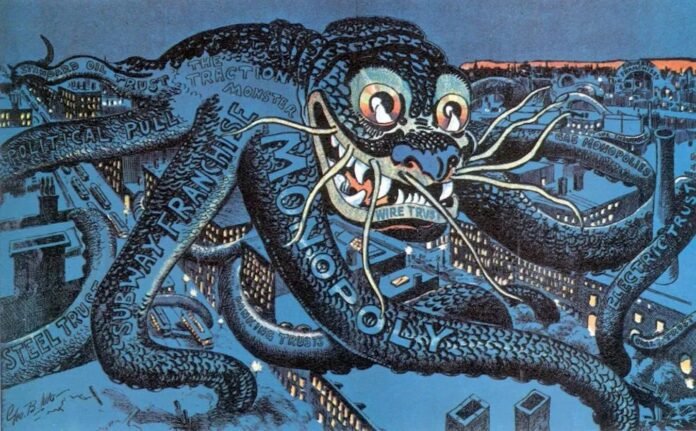
How I learned to stop worrying and love American monopolies
For many years, I was a big proponent of the idea that increased market power was harming the US economy in various ways. In the 2010s, in the economics world, circumstantial evidence began to pile up, implicating increased industrial concentration as the culprit behind a variety of recent negative trends.
[B]asically I see the case of the Market Power Story – or any big economic story like this – as detective work. We’re collecting circumstantial evidence, and while no piece of evidence is a smoking gun, each adds to the overall picture. IF the economy were being throttled by increased market power, we’d expect to see:
1. Increased market concentration (Check! See Autor et al.)
So, as I see it, the evidence is piling up from a number of sides here.
Some of this is micro evidence, demonstrating some of the pieces of the causal chain that some economists think leads from lax antitrust to bad economic outcomes. The Azar et al. (2017) paper shows that labor market concentration hurts wages. The Blonigen and Pierce (2016) paper shows that mergers raise prices.
The rest is macro evidence and macro theory. Economists see some trend in the economy — a lower labor share of national income, or decreased business investment, or fewer new companies being formed — and they think about whether something like monopoly power could explain those trends.
Just because a single story can explain the trends, of course, doesn’t mean it does. Ultimately, you need a whole lot of micro evidence — not just a few papers — to prove each link in the chain of causality from weak antitrust enforcement to higher prices, lower output, lower wages, and so on.
But in this case, the market power explanation was very tantalizing, because it had the power to explain so many of 21st-century America’s dysfunctions at the same time.
When Biden was elected, I was optimistic. His appointment of people like Lina Khan showed that antitrust was finally being taken seriously in Democratic Party circles. Finally, it seemed, the growing clamor of economists was going to result in some real efforts at reform.
In that post, I revisited some of the important recent papers about market power, and I also noted that prominent economists were increasingly putting their reputations on the line by writing popular books advancing the thesis that market power was hurting our economy:
(Update: I was remiss in not mentioning Jason Furman’s briefs on market power when he was chair of the Council of Economic Advisers under Obama! They were very influential. I also neglected the interesting and often-overlooked role of sports economists, who have been complaining about market power for quite a while!)
I concluded that the Biden administration’s shift toward antitrust was a healthy example of ideas making their way from academic economics to the halls of power:
Economists have been suspicious of excess profits ever since Adam Smith complained about “the bad effects of high profits” and declared that “people of the same trade seldom meet together…but the conversation ends in a conspiracy against the public, or in some contrivance to raise prices.”
The idea that competition should reduce profits to a low level in a well-functioning economy is Econ 101, as is the theory of monopoly. Biden’s tweet about capitalism and competition might sound like bold populist rhetoric, but it also could have come right out of an econ textbook…
What this means is that economists are included in the vanguard of this revolt against American corporate power…Economists make unlikely crusaders, but here they are, taking on the biggest companies in the country.
I wasn’t always happy with the Biden administration’s antitrust actions — the government lost most of its cases against Big Tech, and the vendetta against Meta seemed misplaced.
But overall, a lot of action seemed to be happening in the prosaic, boring sectors of the economy where market power has probably been eroding the foundations of capitalism for years.
In meat processing (multiple times), in publishing, in insurance brokering, in pharma, in medical care provision, and so on, Biden’s Federal Trade Commission (FTC) and Department of Justice (DOJ) notched up real wins — not enough to reverse the US economy’s trend toward greater concentration, but possibly enough to create a “chilling effect” that would restrain the trend toward megacorporations-in-everything.
And yet over the last couple of years, I’ve had increasingly serious doubts about the antimonopoly movement. I’m still concerned about corporate power itself — in fact, in many ways, I’m more concerned than I was a decade ago, because of the advent of AI and the unprecedented corruption of the Trump administration.
But I’m increasingly unenthusiastic about the ability of the antimonopoly movement, as it currently exists in the Democratic Party, to make useful headway in curbing or balancing corporate power. Antimonopoly is simply too important to leave to the antimonopolists.
Antimonopoly should be a tool, not an obsession
Speaking about Milton Friedman, Robert Solow once quipped: “Everything reminds Milton of the money supply. Well, everything reminds me of sex, but I keep it out of the paper.” I am starting to feel that way about the antimonopoly folks.
Jonathan Chait has a long and very damning article about the antimonopoly movement, focusing on its crusading founder, the former journalist Barry C. Lynn.
Until I read Chait’s article, I had never even heard of Lynn; this demonstrates that I’m very much out of the loop when it comes to D.C. policymaking and thought leadership, but it also shows how Lynn has escaped scrutiny compared to more popular figures like Lina Khan, Elizabeth Warren, and Matt Stoller.
In any case, from Chait’s description of Lynn, he is not the type of person whose movement I would want to follow. First of all, he seems monomaniacally obsessed with monopoly power:
“It is vital to understand,” Lynn wrote in his 2020 book, “Liberty from All Masters”, “that monopoly is not one of many economics problems but rather the political economic problem of our time,” causing “just about every ill in our society today.”
When he says that he holds corporate consolidation responsible for just about every problem, he means it. A list of social ills Lynn has attributed to monopolists includes not just the cost of goods and services but also: “The vast and growing inequality of wealth, political power, and control. The rise of the radical right. The surge in racism and homophobia. The attacks on reproductive choice and marriage. The collapse of our news media.”…
Anti-monopolization, Lynn argues, is “an all-encompassing framework for seeing and shaping power in every corner of our democratic republic.”…Lynn sees American history as a struggle against monopolization…A profound crisis must have profound causes, and Lynn was offering a totalistic account of social decay.
This monomania is obviously just silly. A lot of these links are just incredibly tenuous, requiring heroic leaps of assumptions about society, politics, culture, and economics. If you want to say that corporate concentration is responsible for racism, for example, you have to believe that:
the rise in racism, if it exists, is caused by economic factors (doubtful)
those economic factors are primarily — not just slightly — due to corporate concentration (highly doubtful)
Even the economics papers that find measurable effects of corporate concentration on low wages, for example, find that the effect differs enormously by geographic location.
If monopsony power is responsible for low wages, then minimum wages should increase employment rather than decreasing it; in some areas, this does seem to happen, while in other areas minimum wages decrease employment, consistent with a greater amount of competition in the latter areas.
Furthermore, several credible research teams — Rossi-Hansberg et al. (2021), Rinz (2022), Autor et al. (2023) and others — have found that employer concentration has actually decreased in local markets in recent decades. This means that not just racism, but any social ill that Barry C. Lynn and his followers want to ascribe to labor monopsony, should have decreased over that period.
Another example is inflation. Antimonopoly crusaders like Elizabeth Warren were quick to blame corporate greed for inflation in 2021-22. There was extremely little data to back this up. Here’s what I wrote at the time:
Alvarez et al. (2025) found that markups — i.e., the amount that companies charge for things above and beyond what those things cost to produce — stayed constant during the post-pandemic inflation, meaning that companies weren’t actually able to use the inflation to gouge consumers…Leduc et al. (2024) and Bouras et al. (2023) found the same. And Jose Azar found that industries with higher markups — implying more market power — actually passed on less of their costs to consumers during the post-pandemic inflation…Greedflation, in other words, is not a real thing.
These are just two examples of the shaky chain of reasoning and evidence that backs up expansive claims like Lynn’s. There are many more, if you want to go looking for them. More sober antitrust types absolutely know that monopoly power is not a Grand Theory of Everything Bad in America. From Chait’s article:
Diana Moss of the Progressive Policy Institute [and] a former head of the American Antitrust Institute…told me the neo-Brandeisians’ error is to view antitrust policy “not as law enforcement but as a broad policy tool for fixing a lot of problems—economic, political, and social.” Antitrust enforcement isn’t that powerful, for the simple reason that corporate concentration is not the root cause of every problem.
This is good. But this reasonable, moderate perspective doesn’t seem to be what’s animating the modern antimonopoly movement. Chait details a telling exchange between Ezra Klein and Zephyr Teachout:
Last year, the New York Times columnist Ezra Klein asked Teachout on his podcast if she could think of any issues that cannot be solved by smashing corporate concentration. At first she ventured, “I don’t think that anti-monopoly can solve significant problems of racism in this country,” but quickly retracted even this concession. “Having said that,” she continued, “there’s a reason that Frederick Douglass and [W. E. B.] Du Bois were so concerned about monopoly power.”
Admittedly, these are words, and not actions. Chait may have also cherry-picked them from among antimonopoly movement leaders’ more reasonable statements, in order to make his point.
But when you look at the movement’s actual actions, you can clearly see the obsessive, all-encompassing nature of the belief system. For example, consider the movement’s choice of targets. These include some industries with high profit margins, but also some with very lowmargins.
These include grocery stores, airlines and health insurers. Grocery stores and health insurers both consistently have much lower profit margins than American corporations in general, often hovering near the zero mark. Airlines are a cyclical industry that sometimes sees some very profitable years, but generally hovers below the average:
Sources: NAIC, FMI/Food Industry Association, BEA/FRED, BLS/FRED via GPT-5.5
The causal chain that runs from weak antitrust to all sorts of social harms necessarily runs through profits. If companies aren’t making profit, they aren’t controlling the market.
Yet Elizabeth Warren blamed high food prices on grocery stores’ market power during the post-pandemic inflation, despite the fact that these stores make very little profit, and their margins actually declined as inflation accelerated. You could see that exact same misplaced focus in Lina Khan’s blockage of the Kroger/Albertsons merger.
As for airlines, the Biden administration’s blockage of the Spirit/JetBlue merger resulted in Spirit Airlines simply going out of business entirely. Corporate concentration was achieved after all — but it was achieved with disorder, corporate failure, and 17,000 unemployed workers rather than with an orderly merger that would have preserved some of Spirit’s routes and workers.
Not exactly a resounding success for the antimonopoly movement — but that’s what happens when you try to use antitrust tools against companies in low-margin industries.
Then there’s the case of housing. The antimonopoly people have eagerly embraced the idea that corporate landlords buying up rental properties and jacking up the price is a major cause of high rent.
The movement’s obsessive monomania — its conviction that corporate concentration is the root of all of America’s problems — is causing it to pick the wrong targets and hurt workers. That doesn’t mean bigger corporations are better, or that there aren’t industries where we need stronger antitrust.
But the antimonopolists’ totalizing obsession causes them to ignore the evidence of where and when their ideas are needed, because they assume that their ideas are always the top priority in every situation and should be applied in a blanket way to any target they choose.
The science on monopoly power isn’t settled
Richard Feynman once said of science that “Of all its many values, the greatest must be the freedom to doubt.” Now you can respond that economics and politics aren’t “science”, but that makes the freedom to doubt even more important; the less conclusively that any one data set can answer your questions, the more important it is to look at a wide variety of data sets and consider a variety of explanations and theories.
From Jonathan Chait’s description of Barry C. Lynn, he doesn’t seem like the kind of guy who’s inclined to look at evidence that goes against his ideas:
[Lynn] believes that “most prices are entirely arbitrary and political in nature.”…More expansively, Lynn believes that “market forces”—which he places in scare quotes—do not exist. His indictment of economics is neither mild nor limited. He has compared the discipline to Lysenkoism, a pseudo-scientific fad under Stalin. “The ‘science’ of economics today … ,” he wrote in his 2011 book, “Cornered”, “has become a form of madness, a dream of human imagination we mistake for a pattern of the world.”
Lina Khan has also written that “There are no such things as market ‘forces’.” Statements like this certainly don’t do much to refute Chait’s allegation that the antimonopoly belief system “is more like a religion than an economic theory.”
First of all, as an aside, we should consider what it would mean for market forces not to exist and prices to be determined by politics. It would mean that grocery stores carefully calculate exactly how much they can charge for a cucumber or a package of napkins without Senators giving them an angry call or the working class rioting, or something like that.
That’s kind of preposterous. It would also mean that small businesses would charge lower prices, because they’re less politically powerful than big businesses. But in fact, it’s big businesses that charge lower prices for the same goods. So the “prices are determined by politics” idea is just abjectly ridiculous, except maybe in a few special cases or where explicit regulation is involved.
But more to the point: Market forces obviously do exist. When you include sales taxes on price tags — reminding people that prices are higher than they had thought — they buy less, proving that demand curves exist and slope downward. When there is bad weather at sea, the price of fish goes up. When you charge electricity customers more, they use less electricity.
And so on. Market forces are not easy to observe in all cases, and they’re not always the most important determinant of prices. But their existence has been proven so thoroughly, by so much careful empirical observation, that to deny their existence requires a deep level of mysticism and blind faith.
If you’re not the kind of person to believe in empirical economics, then of course you’re not going to care if economists find evidence against your worldview. But once we move out of the realm of willful faith-based belief and into the real world of evidence and observation, we find that the science on monopoly power is far from settled.
First of all, there is the evidence I cited before about decreasing concentration in local labor markets (even as concentration increases nationwide). The monopsony wage penalty might be very high, but it was probably even higher in the past; this leaves room for antitrust action to help workers, but it should make us question whether monopoly power is at the root of slow wage growth.
But more fundamentally, the entire story about creeping market power being responsible for a bunch of different ills in the modern American economy is under serious dispute.
For example, the whole story about monopoly power increasing in recent decades relies on the idea that price markups have increased — if companies can’t charge higher prices relative to their costs, they must not be very powerful.
Economists like De Loecker and Eeckhout find that markups have increased a lot, but there are plenty of economists who disagree with that finding! There are tons of measurement issues involved in trying to estimate markups across the whole economy. Some economists claim that essentially the entire increase in markups is due to the finance sector.
There are plenty of other pieces of the monopoly power story that are also disputed. Shapiro and Yurukoglu (2024) summarize a bunch of these. It’s hard to define what each “market” is over time, because the boundaries of the categories are arbitrary, and the nature of products themselves keeps changing.
It’s hard to choose the region over which local concentration should be measured (when is one store in the same “market” as another?). Companies’ costs are hard to measure for many reasons — for example, companies sell lots of different things, and researchers don’t necessarily have the data to determine which costs are for which products.
Profits are hard to measure because the cost of risk is hard to assess. And so on. In general, choosing a different set of assumptions can get you wildly different results regarding how much monopoly power has actually risen in America.
The point here is not that De Loecker and Eeckhout, or the other economists who concluded in the 2010s that monopoly power is a big deal, were wrong. Maybe they were, maybe they weren’t. Nor should you conclude that economics is just a game of “he said, she said” where everyone contradicts each other and nobody really knows anything.
The correct takeaway here is that these questions are very subtle and difficult, and the most careful, serious researchers will take a long time to hash out the correct answer. In the meantime, we must live with uncertainty.
A big problem with the antimonopoly crusaders is that they don’t just refuse to live with uncertainty — they insist that you don’t live with uncertainty either. If you say, “Hey dudes, maybe corporate landlords actually lower rents”, they won’t debate the finer points of causal estimation with you — they’ll simply label you as a corporate shill and dismiss you.
Don’t let the factionalists win
It’s this last bit — the anathematization of anyone who disagrees with them — that really warns me away from the antimonopoly movement. Chait describes in his article how anyone who tries to buck the antimonopoly people gets accused of being a paid corporate hack:
“We’ve largely won the intellectual debate,” [Lynn] told me matter-of-factly, allowing that the only remaining liberals who disagree with him are “those who are paid to do so.”…
When Biden considered appointing Susan Davies, a former deputy White House counsel under President Obama, to the Justice Department’s top antitrust post, a slew of articlessavagedher as a corporate shill. Her candidacy died.
This tactic was clearly on display when the antimonopoly people leapt to savage Ezra Klein and Derek Thompson’s book “Abundance.” Matt Stoller wrote a post entitled “An Abundance of Sleaze: How a Beltway Brain Trust Sells Oligarchy to Liberals.” Dylan Gyauch-Lewis[1]called the Abundance movement
“The new centrist push to regain control of the Democratic Party, with corporate money.” Barry C. Lynn said that Abundance wants “to cozy up to good oligarchs, so they can shelter us until the MAGA storm blows over.”
First of all, claiming that anyone who disagrees with your ideas must be on the payroll of nefarious forces is blatant intellectual dishonesty. It also signals how weak your argument is if you have to accuse every critic of being a bad actor.
But beyond that, the antimonopoly crusaders’ reaction to “Abundance” shows how utterly factionalist they are. They could have simply said, “Yes, we want abundance too. Guess how you get abundance? By breaking up monopolies!”
Or something like that. They could have easily tried to co-opt the energy behind “Abundance” and treated Ezra Klein and Derek Thompson as potential allies. Instead, they leapt instantly to the attack with maximum savagery.
This is the behavior of factionalists, for whom ideas and policy are less important than building power for a clique of favored allies and fellow-travelers within the Democratic Party.
Klein and Thompson were a threat not because their ideas contradicted those of the antimonopoly clique, but simply because they were not beholden to the patronage or the intellectual legacy of that clique. They were not on the team, so they were the enemy.
In my view, it is very dangerous for any political party to allow itself to be entered and captured by a clique or faction like this. I’ve spent a long time being very favorable to the ideas being put forward by the antimonopoly people, but their behavior with regards to the Abundance liberals — and the shoddy reasoning, baseless accusations, and backroom arm-twisting that they employ in these debates — has given me what the Zoomers call “the ick.”
A problem with economic policy is that it is very vulnerable to intellectual pseudo-cults. Economics research is very hard to understand, isn’t always useful, and rarely offers clear-cut answers.
So policymakers and writers seeking certainty and a reason for decisiveness often fall victim to charismatic gangs of intellectuals who claim that economics is solved and that they have it all figured out. On the GOP side, these include the “supply-siders” in the 1980s and the “national conservatives” today. On the Democratic side, it includes the Modern Monetary Theory (MMT) people.
But MMT failed — essentially no one listens to people who say infinite deficits are good. The antimonopoly faction, on the other hand, appears to have succeeded in winning enormous power and prestige within an increasingly epistemically closed progressive movement.
Elizabeth Warren was basically a one-woman Organization Department[2] for the Biden administration, popular Democrats like AOC are going around claiming that “market power” is what produces billionaires, and every major progressive publication now platforms the antimonopoly people’s intellectual output.
Given my writings about the problems of corporate power in the past — and my fear of the overwhelming power that AI companies might achieve — it would be relatively easy for me to join this movement. But I can’t, because monomaniacal obsession, epistemic closure, anti-empiricism, and intense factionalism are the kinds of things I just can’t sign on to.
Corporate power is a real problem in our society. But we need more reasonable programs and more reasonable people to fight it effectively. Banning corporate landlords, calling for price controls, attacking the grocery store industry, forcing airlines out of business and making accusations against anyone who calls for deregulation of housing supply are just signs of an approach that’s going to lead nowhere good.
Notes
1 When I had GPT proofread this post before publication, it flagged the name “Dylan Gyauch-Lewis”, but its only comment was: “This unusual spelling appears to be correct.”