16 C
London
Tuesday, June 16, 2026
Home Blog

Users cry foul after AMD stripped memory crypto from its consumer CPUs

0
users-cry-foul-after-amd-stripped-memory-crypto-from-its-consumer-cpus
Users cry foul after AMD stripped memory crypto from its consumer CPUs

A decade ago, AMD added a protection to its high-end CPUs to protect them against cold boot attacks and other types of physical exploits that siphon sensitive data out of the connected memory chips. Short for Transparent Secure Memory Encryption, TSME encrypts the entire contents stored in memory, making the data useless to physical attackers.

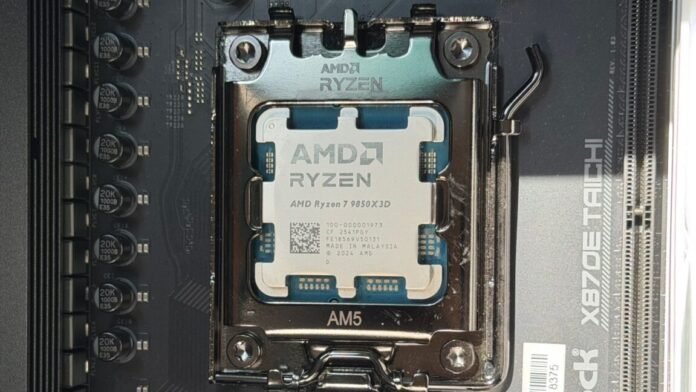
Over time, AMD added TSME to lower-end processors, including the consumer version of its Ryzen chips, a CPU that costs less than the Pro version. Over the years, users of these lower-end chips have gotten used to the added security. Recently and without warning or notice, this lower-end line of AMD chips suddenly dropped the protection, and did so in a way that was impossible to detect on Windows machines and required a fair amount of technical work when using Linux.

Now you see it, now you don’t

AMD has yet to say why TSME worked on these CPUs, or even to confirm the change. AMD declined to answer questions sent by email other than to say TSME “is a security feature only applied to PRO CPUs as part of AMD PRO Technologies.” The statement is the first known time the chipmaker has explicitly made this restriction public.

In April, Ben Kilpatrick, who describes himself as a “privacy-conscious Linux hobbyist,” was installing a new OS on his machine running a Ryzen 7 9700X from the Zen 5 architecture. To check that all security protections were enabled, he had his machine run Host Security ID (HSI), an auditing feature that evaluates the firmware and hardware security configurations.

To his surprise, HSI showed TSME was no longer possible, as indicated by the “encrypted RAM: not supported” line near the bottom of the screenshot below. A few lines lower, the HSI indicates that previously, TSME had shown as “encrypted.” This made no sense to Kilpatrick because he had enabled TSME in his BIOS settings all along.
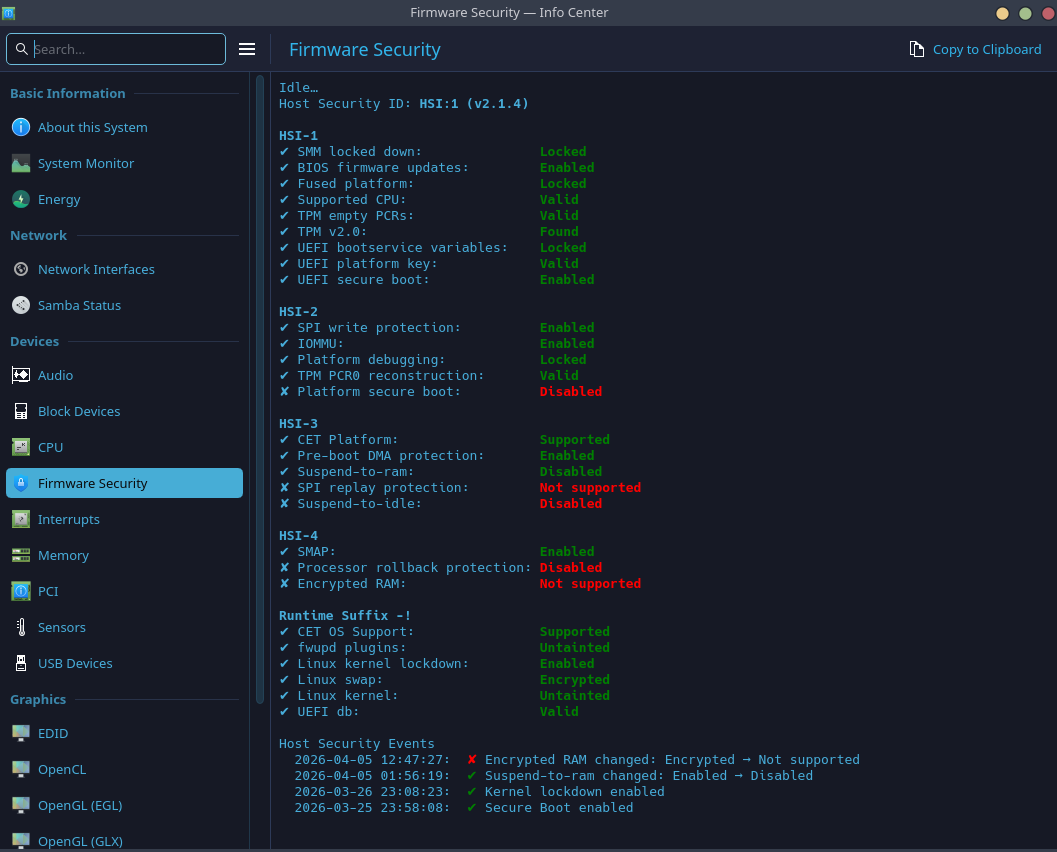
HSI output showing that his Ryzen CPU once provided TSME but no longer does. AMD pulled the feature for consumer CPUs without notice or an easy means for users to know.

HSI output showing that his Ryzen CPU once provided TSME but no longer does. AMD pulled the feature for consumer CPUs without notice or an easy means for users to know. Credit: Ben Kilpatrick

This sent Kilpatrick into a monthslong investigation to figure out what had happened. After sending an inquiry to both the support and engineering teams at MSI, the manufacturer of his motherboard, he finally convinced company engineers to run tests.

They found that consumer versions of Ryzen running on MSI and Gigabyte motherboards had TSME enabled when an older firmware version, available exclusively through the AMD Generic Encapsulated Software Architecture (AGESA), described here, was used during the boot process. When the firmware in a newer AGESA, specifically version 1.2.7.0, ran instead, TSME showed as “not supported.” Pro versions of the Ryzen CPU supported TSME across both motherboards and AGESA versions.

“The big outstanding question is whether this is a deliberate policy decision by AMD to restrict TSME to PRO chips, or an unintentional regression that was introduced in AGESA 1.2.7.0,” Kilpatrick told Ars. He continued:

The reason that distinction matters is that if it is deliberate policy, AMD made a conscious decision to remove a working feature from consumer hardware and restrict it to enterprise customers. If it is an accidental regression, it is a firmware bug that AMD should fix. Either way the silicon is capable, either way the change happened in AGESA, and either way AMD has declined to explain it. But the two scenarios imply very different things about exactly what happened.

As part of his investigation, Killpatrick filed a bug report on AMD’s public engineering GitHub repository. Two AMD engineers engaged directly.

Tom Lendacky, an AMD fellow software engineer, replied that he didn’t know what caused the change. He suggested disabling and then re-enabling the option in the BIOS. “If that doesn’t work, my guess would be that it is a BIOS issue and you would want to contact MSI,” (It was this suggestion that led Kilpatrick to prevail upon MSI engineers to run the tests mentioned earlier.)

Mario Limonciello, AMD senior principal software engineer and maintainer of the fwupd version of HSI, then chimed in. He, too, suggested disabling and re-enabling the BIOS settings. “If it still doesn’t work; then yes please report it to your board vendor to debug,” he said.

I have nothing more to share, AMD engineer says

Six weeks later, Kilpatrick resumed the discussion. After getting the results of MSI’s investigations, he reported them to the AMD engineers.

“MSI’s product marketing team has informed me that AMD officially communicated to MSI that TSME is exclusively supported on PRO series processors,” he wrote. “They [MSI support personnel] also conducted controlled testing on an Asus X870E motherboard with a Ryzen 9800X3D (consumer) and a Ryzen 9945 (PRO), finding tsme_status = 1 on the PRO processor and tsme_status = 0 on the consumer processor with the same board and BIOS.”

A setting of 1 indicated TSME was enabled. A status of 0 meant it was off.

Next, Kilpatrick turned the engineers’ attention to results from memory captures from the AMD Boot Loader. Typically abbreviated as ABL, it’s a component within AGESA that initializes the hardware prior to the OS loading. MSI’s engineering team found that a string indicating the status of TSME early in the boot process was never enabled.

The memory capture showed that DfIsTsmeEnabled, an internal AGESA flag that controls whether TSME is activated during the firmware initialization process, showed that it was not turned on. The ABL memory dump comparisons returned different values depending on whether the Pro or consumer CPU version was used. The flag showed FALSE for consumer processors and TRUE for PRO or EPYC processors when TSME was enabled in the BIOS.

“Their BIOS engineer also provided ABL dump comparisons showing DfIsTsmeEnabled returning FALSE for the 9800X3D regardless of whether TSME is set to AUTO or ENABLED in BIOS,” Kilpatrick reported, “while the 9945 returns TRUE when TSME is ENABLED.”

Kilpatrick went on in the thread to remind Lendacky that in 2020, the engineer had confirmed TSME was supported on a Ryzen 3700X (a consumer CPU). After more back-and-forth discussion, Kilpatrick asked bluntly: “is DfIsTsmeEnabled being set to FALSE on consumer SKUs a silicon-level limitation, or is it a firmware policy decision within AGESA? The distinction matters quite a bit from a user perspective, since one is fixed and the other is potentially changeable.”

Limoncello promptly replied: “My apologies; but I don’t have any more information to share on this topic.” With that, the discussion and Kilpatrick’s inquiry were over.

The Lendacky comment in 2020 Kilpatrick referred to came in this thread discussing encryption features available in AMD CPUs. Lendacky said that the Ryzen 3700x, a consumer CPU, “should support TSME.” In a 2025 comment in the same thread, the engineer followed up on his comment concerning the 3700x.

“I recommend using TSME (Transparent SME), but it is a BIOS option that needs to be exposed by your BIOS provider,” Lendacky said in response to the question about the consumer chip.

There’s no indication that AMD ever advertised or marketed TSME as being available in consumer CPUs. AMD has long said that a related memory protection, Secure Memory Encryption (SME), is available only in the Pro and Epyc CPU tiers. SME is OS-managed. It uses a single key and allows the OS to selectively encrypt individual memory pages. TSME is firmware-managed. It encrypts all RAM with no OS involvement. When active, it provides protection against physical attacks, including cold boot exploits, DRAM interface snooping, and memory module removal. It activates silently when enabled in the BIOS, making it the more practically useful of the two protections.

AMD engineers’ comments, such as those mentioned above, and the years of TSME working just fine in the lower-cost tier processors, have understandably conditioned Kilpatrick and other users to reasonably regard it as an expected part of the chip package. AMD quietly removing it and providing no acknowledgment or explanation strikes these users as something of a betrayal.

“They could have not realized they did it leading to their cagey responses, or they could have done it intentionally and tried to get away with it, leading to the same cagey responses,” Joe Fitzgerald, an expert in silicon-level security, said in an interview, referring to AMD’s potential motivations for withdrawing TSME. “But I really feel like an explanation should be in order, even if it was ‘TSME was never supposed to be supported. We did ship some firmwares that erroneously enabled it, but you shouldn’t use them since we can’t guarantee it’ll work properly.’”


Beyond oil: Iran war may have transformed Asia’s trade architecture

0
beyond-oil:-iran-war-may-have-transformed-asia’s-trade-architecture
Beyond oil: Iran war may have transformed Asia’s trade architecture

The initial market reaction to US and Israeli military strikes on Iran was familiar: Brent crude surged in early Asian trading, equity markets slipped and headlines focused on the energy shock to come.

But months later, the conflict appeared to become much more than an energy disruption — it served as a stress test for Asia’s trade architecture, exposing vulnerabilities that run far deeper than elevated oil prices alone.

For corporates, logistics providers and policymakers across the Association of Southeast Asian Nations (ASEAN), the seemingly more consequential story unfolded in shipping lanes, compliance departments, export control registers and trade finance desks.

How the region responds could influence not just its near-term economic outlook, but the structure of Asian trade for years to come.

When Hormuz closes, Asia is among the first affected

The closure of the Strait of Hormuz — through which roughly a third of global seaborne crude oil and around 20% of global liquefied natural gas shipments pass — had near-term consequences for Asia’s most commodity-dependent economies.

Japan, South Korea, Taiwan, Singapore and Hong Kong all import more than 80% of their domestic energy needs. Nearly 90% of liquefied natural gas (LNG) exported through the Strait flows to Asian buyers. Asia generates two-thirds of global GDP growth and accounts for 40% of world trade while remaining heavily dependent on imported energy.

The disruption extended well beyond energy. A third of global seaborne fertilizer trade passes through the Strait of Hormuz, meaning that as gas prices rise, fertilizer costs follow and food prices with them. Some Asian exports have also faced delays or rerouting. India’s agricultural exports to Gulf markets have reportedly slowed as freight and insurance costs spike.

In addition, Qatar is the world’s second-largest producer of helium — a critical input for semiconductor manufacturing — and reports of disruptions at LNG facilities have raised the risk of interruptions in helium production.

A prolonged disruption could have tightened global helium supply and raised costs for the semiconductor industries of Taiwan, South Korea and Japan, adding a technology-supply-chain vulnerability for a region that anchors global electronics output.

Singapore: exposed hub, strategic position

Like its Asian counterparts, Singapore felt the strain from the disruption caused by the conflict. About 95% of the country’s electricity is generated from imported natural gas, and more than 40% of its LNG supply came from Qatar last year.

Singapore’s Energy Market Authority had warned that fuel prices will likely remain elevated in the foreseeable future. Business and market sentiment have declined, with companies across manufacturing, services, transportation and construction pulling back on investment and expansion decisions. Inflation pressures are building, raising the prospect of a tighter monetary policy response.

As one of the world’s leading trade, shipping, commodities finance and bunkering hubs, Singapore sits at the operational center of several supply chains currently under pressure. Its energy and chemicals sector is the country’s second-largest manufacturing industry.

Singapore’s financial institutions provide trade finance, commodity hedging and logistics credit to counterparties across Asia and the Gulf. As a result, disruptions affecting the Strait can be transmitted through Singapore’s logistics and financial ecosystem, with pressures likely to increase if the conflict persists.

Pivot away from Gulf dependency

For manufacturing-intensive economies in Asia, the conflict may accelerate a strategic recalibration that, in some cases, was already underway.

Some governments with large industrial bases — South Korea being a prominent example — have begun to explore alternative energy sources in response to Gulf supply disruptions.

As part of a longer-term strategy, this may create additional impetus to diversify reliance on a single source of energy amid heightened volatility. The environment may also contribute to a rise in demand for defense equipment and heightened security investment among regional governments, particularly those with close security ties to Washington, as evolving risks to US-linked assets and facilities sharpen threat calculations.

The policy responses emerging across the region illustrate the scale of the adjustment now underway. South Korea has imposed its first fuel price cap in nearly three decades. Japan has begun releasing oil from national reserves. Taiwan has spent over $600 million securing spot LNG cargoes.

Meanwhile, governments from Thailand to Indonesia are introducing fuel subsidies, price caps and demand management measures to cushion their populations from the shock. For many Asian economies, a medium-term priority may be to accelerate diversification across energy sourcing, trade routes and supplier relationships.

A shifting compliance landscape

Beyond the immediate risk to oil and gas supplies from the Gulf, one broader concern is how the conflict may influence trade behavior across Asia. As military actions intensify, countries may, in some cases, align their trade and export control policies more explicitly with geopolitical positioning.

The implications are significant. Exporters and logistics providers across ASEAN could face a tightening environment for dual-use goods controls, as governments respond to heightened secondary sanctions risk.

Customs scrutiny could intensify. Informal boycotts and selective export restrictions — driven not by formal policy but by geopolitical signaling — could disrupt established trade relationships.

Financial institutions may encounter growing pressure around counterparty transparency, including more rigorous requirements to identify and verify ultimate beneficial ownership across complex supply chains.

Over time, these non-tariff barriers could, for some sectors, prove as disruptive to regional supply chains as any physical interruption to the supply of oil and gas from the Gulf.

For Singapore-based trade finance providers, commodity traders and logistics companies, this presents an operational challenge that will likely place additional strain on compliance infrastructure, legal resources and risk appetite in the months ahead.

Singapore’s strategic moment

In this environment, Singapore’s role as a regional hub represents both a point of exposure and a source of strategic value.

The country’s deep institutional relationships, its sophisticated legal and regulatory framework, and its expertise in trade finance and compliance position it to play a stabilizing role for businesses navigating a more fragmented global trade environment.

Singapore’s LNG terminal infrastructure and fiscal buffers are also critical advantages, allowing the city-state to access world markets even as supply tightens, although they offer little buffer against the inflationary consequences of elevated global prices.

A key question for Singapore’s policymakers and business community is not simply how to absorb the shock, but whether and how to use this period to deepen the capabilities — in compliance, risk management, energy transition and supply chain resilience — that could shape the next era of Asian trade.

Doing so will likely require clear-eyed leadership and a willingness to pursue structural change that outlasts the current crisis. While transit through the Strait of Hormuz may soon normalize, the broader fragmentation pressures it has exposed may prove harder to unwind.

Choon Hong Chua is a senior director at Moody’s.

UK Court of Appeal Upholds Palestine Action Terrorist Designation 

0
uk-court-of-appeal-upholds-palestine-action-terrorist-designation 
UK Court of Appeal Upholds Palestine Action Terrorist Designation 


The UK Court of Appeal has ruled that the government’s designation of Palestine Action as a terrorist organization is lawful, reversing a previous High Court decision and concluding that the group’s activities fall within the definition of terrorism under British law. 

The ruling overturns a February judgment in which the High Court found the proscription unlawful. At the time, judges determined that the ban on the direct-action group was “disproportionate.” 

In its latest decision, the Court of Appeal found that the Home Secretary acted lawfully when proscribing the organization. Lady Chief Justice Baroness Carr and fellow appeal judges concluded that Palestine Action openly promoted violence amounting to terrorism and operated through covert, cell-like methods rather than transparent civil disobedience. 

The British government first designated Palestine Action as a terrorist organization in July 2025 under the Terrorism Act 2000 following direct-action protests and property damage at defense-related sites. 

Anne Herzberg, Legal Advisor of NGO Monitor, welcomed the decision. 

“The Court of Appeals made the right decision to uphold the government’s proscription of Palestine Action as a terrorist organization. Since October 7, the group has gotten more and more extreme, vandalizing insurance companies, the BBC, and defense company offices.” 

The group broke into the offices of Israeli military technology company Elbit Systems, Herzberg recounted, causing more than a million pounds of damage and fracturing the spine of a policewoman. Four of the perpetrators were sentenced last week to years in prison. 

In addition,  a year ago, Palestinian Action broke into a UK air force base, damaging planes at a critical juncture in Western security defense, Herzberg explained: “The group has long had shadowy organizing structure and financing. Their actions go far beyond any definition of peaceful protest. It is no surprise that those defending the group and decrying the court decision are also some of the loudest voices promoting antisemitic rhetoric and apologizing for the terrorism of Hamas and Hezbollah.” 

The Court of Appeal’s ruling reinstates the government’s position that the group’s activities justify proscription under the Terrorism Act 2000. 

A Chinese rocket breaks apart dangerously close to the Starlink constellation

0
a-chinese-rocket-breaks-apart-dangerously-close-to-the-starlink-constellation
A Chinese rocket breaks apart dangerously close to the Starlink constellation

The upper stage from a commercial Chinese rocket that launched last week has broken apart in space, spreading debris in a heavily trafficked part of low-Earth orbit home to the International Space Station and a significant portion of SpaceX’s Starlink broadband network.

The breakup occurred shortly after the Zhuque-2E rocket reached orbit on June 9 with two satellites providing direct-to-cell communications, perhaps around the time the upper stage was expected to perform a disposal burn. The US Space Force confirmed the breakup event in a post on space-track.org, a website used by the military to distribute orbit data to the public.

“The tracked pieces are being incorporated into routine conjunction assessment to support spaceflight safety,” the Space Force wrote in an advisory. “There are currently no threats to human spaceflight. Analysis is ongoing.”

Counting the pieces

So far, the Space Force has not added any of the debris fragments to the official catalog of human-made space objects. Darren McKnight, a senior technical fellow at the orbital intelligence company LeoLabs, told Ars the fragmentation event likely generated 100 to 150 pieces of debris.

In one piece, the second stage of the Zhuque-2E rocket, made by a Chinese company called LandSpace, measured between 25 and 30 feet (about 8 meters) long and 11 feet (3.35 meters) in diameter. The main body of the rocket’s upper stage is now orbiting between 208 miles and 263 miles (335-by-424 kilometers) at an inclination of 54.5 degrees to the equator.

The uppermost part of this orbit crosses the orbit of the International Space Station, but aerodynamic drag will quickly pull all the debris fragments below the ISS. The debris could pose a greater threat to hundreds of Starlink satellites, particularly those providing direct-to-device connectivity and newly launched satellites, which fly at lower altitudes than the bulk of the Starlink constellation.

The good news is that this altitude is low enough for aerodynamic drag to cause most of the Zhuque-2E debris to reenter the atmosphere within a matter of months. Most of the material will burn up during reentry. The worst-case scenario is a debris-generating event over 400 miles (650 kilometers), where it will take decades or longer for an object to naturally fall back into the atmosphere.

The bad news is that the Zhuque-2E’s breakup is the latest chapter in China’s growing contribution to the space junk problem. After decades of leaving spent rocket bodies in orbit, launch operators in most countries now reserve enough fuel to steer their upper stages back to Earth for controlled reentries. Rocket bodies attributed to Russia and the former Soviet Union account for the bulk of the launch-related debris in long-lived orbits, followed by China and the United States.

But the Russian and American numbers are declining or holding steady, while the mass of Chinese rocket bodies in these long-lived orbits has grown by more than 150 percent in the past five years, according to a new analysis by Space Domain Awareness expert Jim Shell. The increase comes as China ramps up launches of its own megaconstellations designed to compete with SpaceX’s Starlink. Ars reported on these numbers last month.

Rocket bodies are the most concerning sources of space debris because they are typically fairly large in size and mass, often with residual propellant and high-pressure gases that can trigger an explosion. There is no way to maneuver or dispose of them if left abandoned in orbit after releasing their payloads.

McKnight characterized the recent breakup of the Zhuque-2E rocket as a “slight space safety issue,” but the trend is not good. China’s Long March 6A rocket has an especially bad track record, including two explosions that littered a higher-altitude low-Earth orbit with more than 1,000 debris fragments, where they will remain for decades or centuries.

“Three of the top four breakup events in LEO are of Chinese origin, with two of these events being from Chinese (rocket body) explosions in the last four years,” McKnight said.

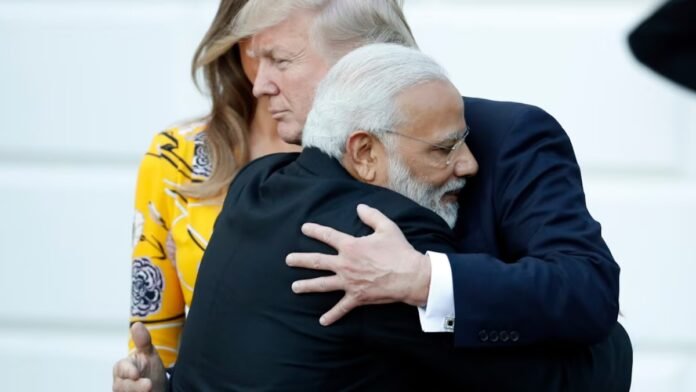
US-India relations aren’t as abysmal as they seem

0
us-india-relations-aren’t-as-abysmal-as-they-seem
US-India relations aren’t as abysmal as they seem

I’ve read that the Indian commentariat and foreign policy establishment are more wary of the United States than at any time this century.

Maybe so. But 26 years is not a particularly long time, and it often seems that there’s a “manic” aspect on the Indian side when considering the bilateral relationship.

Perhaps people get a little too excited when things are going well, and a little too depressed when the occasional hiccups happen. But is the India-US relationship really off track? Even if it’s currently in a “down” moment, look back 40 years, and things still look pretty good. Here are a few things to consider:

First, the US ambassador to India is a lot better than his predecessor. Ambassador Sergio Gor chose India out of any number of possible postings — or positions within the Trump administration. He’s not in India for a three-year holiday. Even more, Ambassador Gor can call the White House and President Trump will answer. Very few ambassadors can do this.

Second, it’s not as if the US has forgotten about India or is giving it the cold shoulder. Notice Secretary of State Marco Rubio visited last month. He didn’t choose India at random.

And Rubio is not only the most consequential Secretary of State since George Schultz, but he’s also the National Security Advisor. His visit is a gauge of the importance the Trump administration assigns to India.

Third, the India-US military-to-military prelateship is stronger than ever. The two forces conduct frequent exercises, India has become a maintenance and logistics hub for the US Navy and arms sales are robust.

India also gets a degree of special treatment regarding technology exports — although there is room for improvement.

As for trade? A bilateral trade deal is in the works, which might assuage the shock felt by many countries of having blanket tariffs imposed on them.

Yes, it would have been nice if tariffs had been applied more carefully, but the Trump administration was dealing with a problem that had built up over many decades, and felt a sledgehammer was needed to shift things in the right direction.

India’s resentment is understandable, but it’s not unique. Indeed, Japan could feel even more aggrieved — given its 70 years as a loyal treaty ally and the deep military and economic ties with America — and the consistent political support it has provided.

Instead, Tokyo bit its tongue, ensuring that resentment didn’t get the better of strategic interests. “Biting one’s tongue” is perhaps sometimes the better part of statesmanship —provided one reckons the relationship is valuable enough.

And at the end of the day, Indian and American strategic interests align — as the world enters a struggle between free, consensually governed nations and expansionist totalitarian ones.

Yes, it’s China that I’m mostly talking about. India, in fact, recognized the “China threat” far earlier than did the US, which has belatedly woken up. Regardless, by their very existence, India and the United States are a rebuttal of China’s dictatorship and repression.

However, from some Indian quarters its claimed Trump doesn’t see China as a threat and is aiming to “sell out” to Beijing.

Trump’s maneuvering room is constrained by US dependence on China for critical minerals, pharmaceuticals and manufactured goods. But the president has no illusions about the People’s Republic of China as a rival, if not an enemy, and Xi Jinping is clearly unhappy about US policies towards the PRC.

But isn’t Trump “transactional”— as often said as an insult? I should hope so. And Trump isn’t unique in this regard.

Every president, and one might suggest every world leader, including Prime Minister Narendra Modi, is “transactional.” They all expect some benefit for whatever they do, and their citizens do as well.

What about the US and Pakistan?

I understand why India is irked — though this issue has existed in the India-US relationship for many years, even while it improved over the last couple of decades.

The Pakistanis played a double game against the United States from the beginning of its time in Afghanistan. And Pakistan is too close to China for comfort, and indeed is effectively a PRC proxy state.

Even more, the evidence is conclusive that Pakistan has and does sponsor and direct terrorism against India. Perhaps keep in mind that while it’s not a perfect comparison, in some respects India’s ties with Russia are similarly exasperating to the United States.

Is the US challenging India’s ‘strategic autonomy’?

This expression is used a lot, and all nations want to have “strategic autonomy”, but sometimes it seems more an excuse for India to avoid doing anything it doesn’t want to do — even if it should do it.

The Japanese use “the Constitution” in a similar fashion to beg off complying with US requests when it suits themselves.

A few suggestions

Make yourself “useful” — and distinguish yourself from the crowd.

Do this no matter who is in the White House. Trump is just more likely than his predecessors to openly ask what a particular country has done for the US.

India already has one huge selling point for the Trump administration: It is serious about its defense and is willing to fight — indeed, it is fighting — to defend itself.

This is almost a litmus test with the Trump administration and India has passed it. Few other countries have. Remind the Americans of this — repeatedly.

India might also help out in the Indian Ocean. The US is finally paying closer attention to the region, having woken up in recent months when the British attempted to hand over Diego Garcia and its strategic military base (America’s only one in the region) to Mauritius.

The US has few good options from a basing and access perspective in the region. Give it some. India might even get the Americans to pay for it, including Indian port refurbishments.

And keep the Quad going. This writer doesn’t believe that head-of-state Quad meetings are essential. Rather, solid continuous ties at lower and working levels and actually accomplishing things matter more than get-togethers between the Quad’s top dogs.

India’s recent agreement with Australia on maritime security is a good one, as are deepening Indian defense ties with Japan. Not everything has to be a “four-way” effort. Perhaps consider moving ahead with increased Quad use of the Andaman Islands for maritime patrol and security, and anti-submarine warfare operations.

The Americans would also appreciate India’s help in the Pacific Islands that are currently facing sustained Chinese political warfare. India can make useful contributions in areas such as medical, tourism, education, scholarships and investment.

And help the US break the Chinese stranglehold on rare earth minerals and pharmaceuticals, while diversifying energy sources. In other words, buy more US oil and gas — and less from Russia.

If you want to get noticed by the Trump administration, explain yourself — and not just to the DC think-tank crowd. Have the ambassador and his staff regularly head out to “flyover country” outside Washington and explain why India matters to Americans.

This advice applies just as much to more longstanding allies such as Japan, Great Briain, and Australia, though they seldom follow it.

A few final notes

This piece is written as a US perspective of what India ought to do to improve the India-US relationship. This is, of course, a two-way street.

The writer believes most Indians in the commentariat and official class can rattle off a dozen things America must do to fix the relationship. The American side’s perspective may not get heard so often.

And some final advice to any foreigner (and even other Americans) when it comes to Trump: Always remember that Trump is a New Yorker, on top of being a real estate man.

I am from Virginia. And even we have to brace ourselves when dealing with New Yorkers. Grow an extra layer of skin. It’s nothing personal on their part. Remember this and you can avoid getting wrapped up in resentments — even if not entirely avoiding them.

Grant Newsham is a retired US Marine officer and former US diplomat. He was the first Marine liaison officer to the Japan Self Defense Force, and is a fellow at the Center for Security Policy and the Yorktown Institute. He is the author of the book, “When China Attacks: A Warning To America.”

This article first appeared on The Sunday Guardian and is republished here with the author’s kind permission

Imperial Iran in the Eighteenth Century: Identity and State Formation under Nader

0
imperial-iran-in-the-eighteenth-century:-identity-and-state-formation-under-nader
Imperial Iran in the Eighteenth Century: Identity and State Formation under Nader

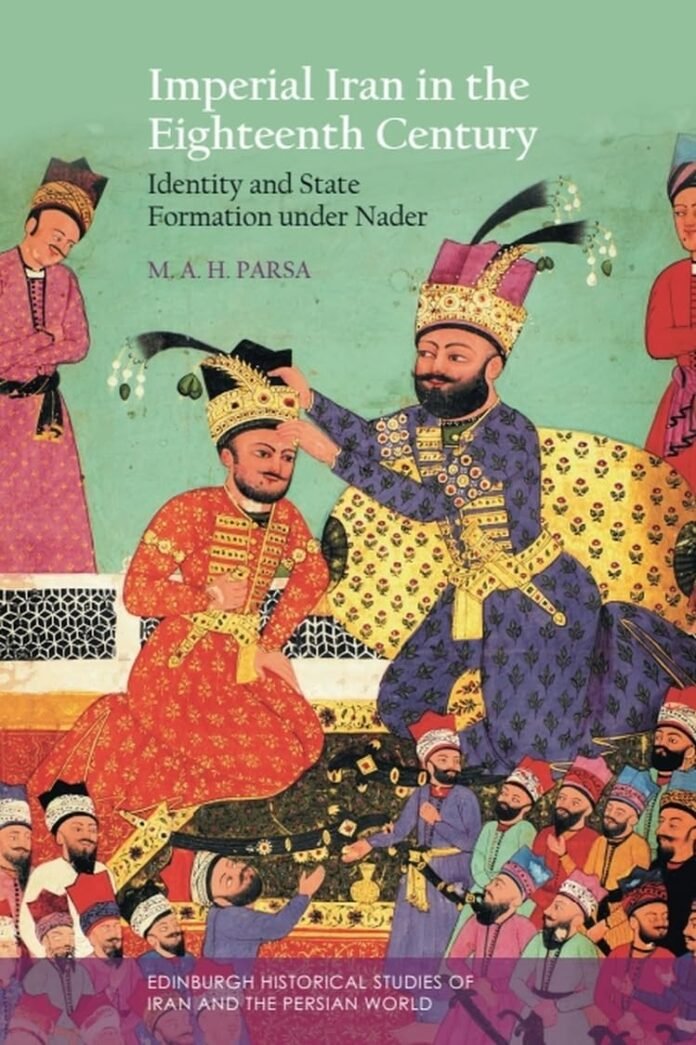
In July 1732, Nader Shah Afsharid, established a religious endowment in the Afghan city of Herat shortly after conquering it. In the preface to the deed, it was written that Nader was a ‘loyal servant of Ali’s household and…the defender of Shi’i lands (belad) and of the Shi’a, Nader-Qoli Khan, viceroy of Khorasan and ruler of the realm of Iran.’ What is striking about the passage is who it doesn’t mention, the Safavid ruler Tahmasp is missing from the excerpt and more brazenly, the text asserts that the lands of Iran belong to Nader himself. Nader Shah had no rightful claim to the throne when viewed through the lens of classical kingship, he had no royal bloodline and was born a commoner, who climbed the ranks of the Safavid military and found himself in an increasingly powerful position. The fateful Afghan invasion of Isfahan in 1722, not only proved pivotal in bringing Nader Shah to power, but also triggered a general existential crisis among Safavid elites who began to think about what Iran is and what Iranianness meant. This new book by Mohammad Amir Hakimi Parsa Imperial Iran in the Eighteenth Century: Identity and State Formation under Nader tells the story of how a new idea of Iran came to be. 

The Afghan Hutakids, who had sacked the Safavid capital in Iran, sought to subdue much of the empire and emphasised the shared Iranianness of both Sunni Afghans and Shia Iranians. The Hutakids also sought to govern in much the same way as the Safavids before them and create a continuity in rulership. Crucially, they seceded certain Safavid territories to the Ottomans, which would anger the elites whom the Hutakids wanted to control. The reaction of the elites created a number of intellectual camps who would go on to define what Iran ought to be. One discourse that emerged called for the restoration of a Shia state in Iran with some even calling for the removal of the Safavids altogether. One work produced in 1726, the Mokafatnameh, mourned the loss of Iran’s honour and blamed the Safavids for its demise. ‘The Mokafatnameh strove to ideologically dismantle it [the Safavid state] and those identities loyal to it.’ A core concept of the work was the restoration of Shiism and the guidance of the prophetic household as the key component of Iranianness. The author prayed for the Prophetic Imams to place a legitimate ruler to govern Iran. Mirza Zaki Mashhadi, a poet, went much further than this and wrote that Imam Ali should be the legitimate sovereign himself. The Safavid supporters had to respond by producing their own tracks, where they emphasised the Shia identity of Iran and their right to rule. 

BOOK REVIEW: A Daring Enterprise: A US-Egyptian Partnership and the Case for Soft Power

Nader Shah appeared during this timeframe initially as a servant of the Safavids and whose conquests temporarily restored Safavid rule. But Nader also gained power himself, and his supporters began to build the base for his legitimacy. As a commoner, his rise to prominence bore a resemblance to Timur’s rise as a vassal to the Mongol Chaghatayid Chinggisid line. He was keen to utilise Mongol traditions and connections to Timur for his own ends. Much like Nader Shah, Timur gained legitimacy through his conquests, which was seen as divine favour. The reporting of dreams that connected Nader Shah to Timur was also used to help cement his legitimisation. In one dream, Nader discovered Timur’s hidden treasure in Kalat Fortress, after a light emanating from the foot of a hill appeared leading Nader to confronting a dragon stationed near a well. Upon killing the dragon, Nader found the well was full of treasure and an inscription left by Timur himself, which read that whoever entered this location would be his prodigy and a world conquer. Timur as well as the Shia Imams fused together as part of Nader Shah’s legitimising claims.  

When Nader Shah finally ended Safavid control and established himself the ruler of Iran, his coronation ceremony wielded new concepts of Iranianness. The ceremony made clear, ‘Nader’s kingship would save Iran by restoring its faith through the non-sectarian Ja’fari creed, reconciling Shi’i and Sunni, and thus achieving a lasting peace with fellow Muslims.’ This move established himself as a legitimate Shia ruler to satisfy the old religious elites, but also enabled him to appear a legitimate ruler in the eyes of the Sunnis in his domain and also positioned them as part of the new Iran too. The most interesting aspect of the ceremony was the signing of the mochalga, a document that binds the signatories to loyalty to Nader Shah. The document uses the first-person plurals and uses words like ‘we’ and the people of Iran. The document was signed during a public ceremony, where both nobles and commoners gathered to elect Nader as the new shah. What was significant is that the attendees got to debate what was in the document and for the first time in Iranian history, sovereignty was given a popular mandate. ‘The result was the election of a low-born man to imperial sovereignty.’ 

Imperial Iran in the Eighteenth Century offers a fascinating view on the pivotal moment in Iranian history, where the old notion of right to rule breaks down and a new idea of Iranianness emerges. As today’s Iran reflects on the relationship between the government and its people, war and legitimacy, looking back at a previous existential crisis that altered the way the country identifies itself offers us a sense of where Iran has been in the past. Those interested to understand Iran’s past and how it emerged as a nation will find this book insightful and worth a read. 

BOOK REVIEW: Private Sins, Public Crimes: Policing, Punishment, and Authority in Iran

Chipmaker Nvidia seeks to raise over $25B in first bond deal since 2021

0
chipmaker-nvidia-seeks-to-raise-over-$25b-in-first-bond-deal-since-2021
Chipmaker Nvidia seeks to raise over $25B in first bond deal since 2021

Chipmaker Nvidia is planning to sell $25 billion of investment-grade debt in the US on Monday, its first bond sale in five years, in a test of investor appetite for further exposure to the AI sector.

In a marquee seven-part bond offering, the company will issue a wide range of maturities from two years to 30 years, according to a term sheet seen by the FT.

The issuance was upsized from $20 billion after receiving more than $85 billion in orders by early afternoon in New York, according to people familiar with the deal.

Thanks to robust demand, the 10-year portion of the bond was expected to yield 0.5 percentage points above US Treasuries, down from 0.75 percentage points during initial discussions, one of the people said.

Favorable market conditions after the US-Iran deal are allowing Nvidia to raise debt at a relatively low cost, said Lauren Wagandt, a portfolio manager at T Rowe Price.

“It’s a very high-quality company at the end of the day,” said Wagandt. “And it doesn’t come to the market as often as the other tech names.”

The issuance by the semiconductor group, the biggest beneficiary of Big Tech’s trillion-dollar spending spree on AI infrastructure, comes as tech groups race to secure funding amid an intensifying AI arms race, but also as Wall Street faces a torrent of new equity and debt issuance, including SpaceX’s record $75 billion initial public offering.

“We intend to use the net proceeds from this offering for general corporate purposes, including repayment and refinancing of outstanding notes,” Nvidia said.

Monday’s offering is at least three times larger than Nvidia’s previous bond sale in 2021 during the coronavirus pandemic, when it raised about $5 billion. When completed, it will more than triple Nvidia’s debt outstanding to about $30 billion from the current level of $8.5 billion.

Early signs of market fatigue have prompted some tech companies to find alternative avenues for financing.

Anthropic has turned to private credit investors to seal a $35 billion deal backed by Broadcom. Google’s parent Alphabet decided to issue equity for the first time in more than two decades, bringing in $85 billion in fresh capital earlier this month.

Nvidia’s position as the AI industry’s go-to supplier of the powerful chips needed to build large language models such as OpenAI’s GPT has proven extremely lucrative for the Silicon Valley company, with its free cash flow in the year to January leaping 59 percent to $96.6 billion.

However, after its valuation peaked at about $5.7 trillion in May, its shares have fallen alongside the wider semiconductor market in recent weeks, with its market capitalization dropping below $5 trillion at the end of last week.

While reaping huge profits from AI spending, Nvidia has also become a significant investor in AI companies, committing a total of more than $90 billion to developers, including OpenAI, Anthropic, and xAI, and suppliers, including Coherent, Marvell, Lumentum, and Corning. In some cases, it has also agreed to act as a backstop or financial guarantor to customers building cloud computing services using its chips, including CoreWeave and Nscale.

The increasing use of financial guarantees and the interdependence of AI companies have raised concerns about concentrated risks among bond investors, said Tom Murphy, global head of investment-grade credit at Columbia Threadneedle Investments.

“The market has started to get worried about these circular financings, because if somebody in that ecosystem is having a problem, then the whole thing could be a problem,” Murphy said.

Nvidia has a double-A credit rating, the third-highest score. More indebted AI player Oracle sits just two notches above a junk rating.

Goldman Sachs, JPMorgan, and Morgan Stanley are active bookrunners of the transaction.

© 2026 The Financial Times Ltd. All rights reserved. Please do not copy and paste FT articles and redistribute by email or post to the web.

Epstein ‘Bribed’ Jail Officers with Cash and Disneyland Tickets

0
epstein-‘bribed’-jail-officers-with-cash-and-disneyland-tickets
Epstein ‘Bribed’ Jail Officers with Cash and Disneyland Tickets


Jeffrey Epstein’s former assistant has dropped a bombshell new claim about the sick predator’s time behind bars, alleging he bought special treatment in jail with cash and Disneyland tickets.

Sarah Kellen, who worked for Epstein for nearly 20 years, told the House Oversight Committee the disgraced financier allegedly arranged for gifts to be delivered to a Palm Beach sheriff’s deputy while he was locked up in Florida.

And according to Kellen, those alleged favors may have helped Epstein get access to a computer — which she claimed he then used to continue tormenting her from jail.

Kellen made the stunning allegation after Rep. Maxwell Frost, a Florida Democrat, asked if she knew of any ways Epstein received special treatment while in custody.

“I know that he arranged to have cash and, like, Disneyland tickets, taken to one of the officers in the jail and I’m not sure what he received with that,” Kellen testified.

Kellen said she first learned about the alleged payoff from Epstein’s paralegal, Story Cowles, who allegedly complained about having to drive a long distance to personally deliver the cash and tickets.

The claim adds even more fuel to years of outrage over Epstein’s 2008 Florida jail sentence, which critics have long blasted as a disgracefully soft deal for a convicted sex offender.

Kellen also gave chilling testimony about what she says Epstein did to her behind closed doors.

She said the wealthy predator groomed, manipulated and psychologically controlled her for years after hiring her in the early 2000s.

“He groomed me, sexually and psychologically abused me, controlled me, manipulated me, dominated me, and gaslit me until I could no longer tell which thoughts were mine and which were his,” Kellen testified.

She compared the experience to “living with a permanent virtual-reality headset on.”

Kellen, now 46, was granted immunity from prosecution in Florida as part of Epstein’s controversial non-prosecution agreement, the same deal that has outraged victims and watchdogs for years.

Kellen claimed Epstein’s abuse did not stop when he was finally put behind bars.

In one of the most disturbing parts of her testimony, she said Epstein allegedly used a computer inside the Palm Beach County Stockade to contact her.

“He even Skyped me from a computer inside the Palm Beach County Stockade and ordered me to undress for him on camera,” she told lawmakers.

Kellen said years of abuse, sleep deprivation and coercive control left her emotionally damaged and unable to fully separate her own reality from the one Epstein allegedly created around her.

She also placed blame on Ghislaine Maxwell, Epstein’s longtime associate, saying the psychological conditions caused by both Epstein and Maxwell “crippled” her ability to make decisions or assert herself when it mattered most.

Kellen identified the Palm Beach sheriff’s deputy as Michael Fox.

But the Palm Beach County Sheriff’s Office has denied the claims. A spokeswoman told the Miami Herald that Fox retired from the agency in 2020 and said the allegations did not come up during the Epstein investigation.

“The Epstein investigation did not reveal these allegations, and they were never investigated in connection with that case,” spokeswoman Therese Barbera said.

Barbera also said a 2021 investigation by the Florida Department of Law Enforcement found no inappropriate or criminal activity by sheriff’s office members connected to Epstein’s work release or permit detail.

Still, Kellen’s testimony is already raising fresh questions about how Epstein, one of the most infamous predators in America, allegedly managed to keep getting perks even after he was locked up.

The world agreed to protect 30% of the ocean by 2030 – but marine protection can’t be judged by area alone

0
the-world-agreed-to-protect-30%-of-the-ocean-by-2030-–-but-marine-protection-can’t-be-judged-by-area-alone
The world agreed to protect 30% of the ocean by 2030 – but marine protection can’t be judged by area alone

The ocean is home to some of the richest biodiversity on Earth. From coral reefs and mangrove forests to the deep sea, marine ecosystems sustain countless species, support coastal communities, regulate the climate and underpin global food security.

But these systems face growing pressure from overfishing, habitat loss, pollution and climate change.

In response, nations have adopted an ambitious global goal to conserve at least 30% of the world’s ocean by 2030 – known as 30×30. This target has expanded marine protection worldwide, particularly through marine protected areas.

But what happens after protection is announced?

Decades of experience have shown that effective marine protection requires consistent rules, regulations and oversight, along with financing and meaningful collaboration with local governments, industries and communities. Without it, these areas risk becoming paper parks: lines on a map without real-world impact, where marine life may continue to face overfishing and other threats.

A sea turtle swimming underwater

A sea turtle swims in Bunaken National Park, one of Indonesia’s first protected marine areas. Claus Giering/Unsplash, CC BY

Two new reports we led, one from Oregon State University and the other from the Smithsonian Tropical Research Institute, offer an important reality check on where marine conservation stands today and what must be done to achieve the goal of protecting 30% of the ocean.

Together they argue that the primary barrier to realizing the 30×30 ocean conservation goal is no longer ambition to protect the ocean, but effective action that can make it real.

A decade of commitments

The 30×30 goal is often promoted at global ocean meetings, including the 11th Our Ocean Conference, being held in Kenya on June 16-18, 2026.

According to the Oregon State analysis, the conservation commitments announced at past Our Ocean Conferences have helped establish more than 3.88 million square miles (10 million square kilometers) of marine protected areas, or about 2.8% of the global ocean.

In all, marine protected areas now cover nearly 10% of the global ocean. But only about 3.5% of that is fully or highly protected.

The reach of protected areas shows that voluntary pledges can translate into tangible conservation gains when progress is consistently tracked and publicly reported. However, the findings also point to a key challenge: the growing difference between the extent of protection and its effectiveness.

In other words, ocean protection cannot be judged by area alone.

The implementation gap

The Smithsonian report takes a closer look at what is needed to turn such commitments into effective conservation.

Since the Kunming-Montreal Global Biodiversity Framework was approved in 2022, with almost every country agreeing to protect at least 30% of Earth’s land and waters, marine protection has expanded considerably. However, global numbers show that at least half of existing marine protected areas remain unimplemented or inoperable, with rules and regulations not in place or even allowing destructive activities like bottom trawling.

Achieving the 30×30 goal still requires protecting an additional 20% of the ocean over the next four years. The challenge is twofold: expanding coverage, while also ensuring that the areas are actually benefiting marine life and people.

A map showing lots of marine protected areas scattered largely around islands

The World Database on Protected Areas maps both land and marine protected areas around the world. Marine protected areas are in blue. World Database on Protected Areas

Effective, long-lasting conservation depends on management plans, trained personnel, monitoring systems, enforcement capacity, sustainable financing and community participation. Without these elements, legal designation alone does not lead to biodiversity protection, thriving ecosystems and benefits to people.

Yet, across regions, the Smithsonian report found a troubling pattern: Countries’ ambition to create protected areas is outpacing their capacity to help those areas succeed.

We found two key constraints: lack of coordination around capacity development – the strengthening of skills and tools needed to effectively achieve a goal – and applying a one-size-fits-all approach to distinctly different regional contexts.

Divers with a measuring tape on a reef

Divers from the Mayotte Marine Natural Park between Madagascar and mainland Africa check the health of a protected coral reef. Alexis Rosenfeld/Getty Images

Many countries and communities are committed to marine protection, but they often need better continuous governance and policy, stakeholder engagement and inclusion, data and technology, socio-ecological integration, and communication for effective implementation of marine protected areas over time.

Similarly, securing funding for marine conservation remains a persistent challenge. When we spoke with groups and communities involved in marine conservation, they often cited complex application processes and funding structures that often do not match their local realities or priorities. This creates a mismatch between how conservation is funded and how it is implemented.

There are efforts to close this gap. The Bali-based Coral Triangle Center’s Coral Triangle Initiative on Coral Reefs, Fisheries and Food Security Capacity Building Roadmap works to conserve ocean areas in a region that harbors the richest marine biodiversity on the planet. Through regional training hubs, leadership programs, internships and digital platforms, it has trained over 8,200 government officials, community leaders and private-sector representatives in science-based marine conservation practices.

The Sustainable Finance Coalition, a group of nonprofits and international organizations, is using its expertise in another way: finding creative ways to secure money for projects in Africa and the South West Indian Ocean to protect key habitats on land and sea. To date, the coalition has tapped into more than US$43 million to protect nature and support the effective management of 170,500 acres (69,000 hectares).

Beyond lines on a map

The two reports found that political momentum for ocean protection is strong. Governments, Indigenous peoples, local communities, scientists and conservation organizations have rallied around the 30×30 target, creating a global movement of support.

The challenge now is delivering on this momentum.

Achieving the conservation goals behind the 30×30 plan will depend less on announcing new protected areas and more on investing in the capacity, finance, enforcement and long-term institutional support needed to help these protected areas function as planned.

As 2030 approaches, the central question is becoming sharper. It is no longer simply how much of the ocean can be protected — but whether that protection can be made real, durable and effective.

Britain announces sweeping social media ban for under-16s

0
britain-announces-sweeping-social-media-ban-for-under-16s
Britain announces sweeping social media ban for under-16s


British Prime Minister Keir Starmer said on Monday he would ban social media ‌sites for under-16s and impose restrictions on gaming and live-streaming platforms, in a fightback against big tech that goes further than any other country.

The sweeping changes will “give kids their childhood back”, Starmer said, outlining measures against platforms including Snapchat, TikTok and Instagram, as well as gaming sites that allow strangers to communicate with children.

“It is ​clear to me a full ban is the right choice,” he told a press conference.

“It will make a huge difference, ​it will make our children safer, it will make our children happier, it will give them more time, ⁠more security, more freedom to grow up, more opportunity”.

Britain will use a similar model to Australia, which enacted a ban last December, ​the government said.

It will cover platforms that also include YouTube, Facebook and X, but messaging services such as WhatsApp and Signal will ​not be included in the ban.

Britain will also introduce “world-leading blocks” on harmful functions such as livestreaming and stranger communication with children for under-16s.

“Is there a situation in the offline world where you would just let your child pair up with a stranger, an adult that you don’t know anything about? No, so we’re taking action ​on that,” Starmer said.

BAN IN PLACE BY NEXT SPRING?

The government already has the powers to take the first steps in any ban, he ​said, with regulation to follow by the end of the year and a prohibition in place around next spring.

Britain has increasingly toughened its approach to tech companies ‌in recent ⁠years, urging or forcing them to impose age verification, adapt their algorithms and, most recently, prevent children from circulating nude images taken on mobile phones.

But with a growing awareness of the mental health risks posed by children spending too much time online, Starmer has decided to go further after speaking to parents and considering the evidence from Australia.

Starmer, who is likely to face a leadership challenge in the coming weeks, said people rightly ​expected action.

Australia was the first country ​to ban social media for ⁠children under 16, blocking them last December from platforms including TikTok, Alphabet’s YouTube and Meta’s Instagram and Facebook.

Since then a raft of countries have said they are looking to regulate access to social media amid mounting ​concerns over the impact on children’s health and safety.

EXTENSIVE CONSULTATIONS

Britain has consulted teachers, parents and young ​people on new restrictions, ⁠including a possible ban for under-16s, as well as curfews, app time limits and curbs on what the government has described as addictive design features.

It received more than 116,000 responses from parents, industry and young people. More than 83% of parents who responded said risks from social media outweighed ⁠benefits, while ​90% backed a minimum age of 16 to access social media platforms.

While many parents ​and politicians back a ban, some psychologists and researchers have said there is no proof that it would work, and a group of school children in London told ​Reuters they had a conflicted relationship with the technology.

Source:  Reuters

0FansLike
0FollowersFollow
0FollowersFollow
0SubscribersSubscribe
- Advertisement -
Google search engine

Recent Posts