12.9 C
London
Saturday, June 6, 2026
Home Blog

North Carolina Democrats Propose Changes to Block GOP Power Transfers and Secrecy

0
north-carolina-democrats-propose-changes-to-block-gop-power-transfers-and-secrecy
North Carolina Democrats Propose Changes to Block GOP Power Transfers and Secrecy

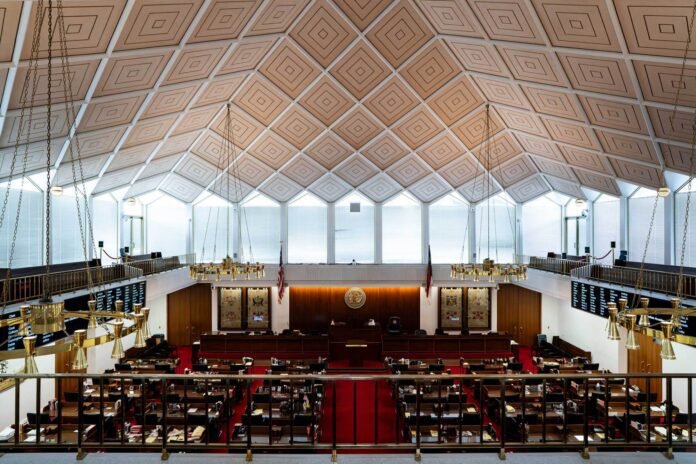
Democratic lawmakers in North Carolina introduced a trio of constitutional amendments this week aimed at protecting traditional powers of the state’s governor and reforming oversight of its court system.

The effort was prompted in part by ProPublica’s reporting, including an investigation that found that over nearly a decade, Republican lawmakers had pushed through law after law shrinking the powers of North Carolina’s governor, always a Democrat during that time.

At a press conference on Wednesday, the bills’ sponsors readily acknowledged that the initiatives are unlikely to pass, at least in the current legislative session: Republicans hold majorities in North Carolina’s House and Senate.

But in proposing the measures as changes to the state constitution, the group of eight Democrats said their goal was to make them less vulnerable to the persistent partisan warfare that has engulfed the narrowly divided swing state.

Republicans “won’t always be in the majority,” said Rep. Phil Rubin, the primary sponsor of one bill. “And when they’re not, they’re going to suddenly think these are great rules. So let’s do them now.”

Republican leaders in the House, Senate and court system did not respond to requests for comment on the bills.

Experts have long maintained that Republican power grabs have thwarted the will of North Carolina voters, removing the Democratic governor’s control or partial control over numerous boards, entities and executive prerogatives and leaving him the nation’s weakest. (Republican officials have defended the shifts, pointing out that voters also elected a GOP legislative majority.)

Rubin’s measure would bar the legislature from stripping away additional gubernatorial powers, as well as block majority leaders from what he called “government by ambush” — springing major legislation on the minority and public without notice.

“ProPublica’s reporting shows the perils of not having this law,” Rubin said. Voters should have “the opportunity to secure their constitution, demand absolute transparency in lawmaking and ensure that people, not backroom deals, have the final say.”

The two other constitutional amendments unveiled this week target aspects of the judicial system.

The first, authored by House Rep. Marcia Morey, would make disciplinary hearings and sanctions by the courts’ internal watchdog, the Judicial Standards Commission, public.

GOP rules currently cloak the commission’s work in secrecy. Behind closed doors, ProPublica revealed, the majority-Republican state Supreme Court quashed the commission’s recommendations that two Republican judges who’d admitted to committing egregious conduct violations be publicly reprimanded. (Spokespeople for the North Carolina Supreme Court and the Judicial Standards Commission declined to comment or respond to a detailed list of questions about the matter.)

Morey’s bill would also change who appoints the commission’s members, a step she called critical to preventing the “weaponization” of its work.

Currently, Republican legislative leaders and Paul Newby, the state’s conservative chief justice, appoint a majority of the commission’s members. As ProPublica has reported, in 2023 Newby encouraged the commission to investigate a Black Democratic justice who’d criticized his decision to effectively shut down a racial equity commission. (Newby, as well as spokespeople for the court and the Judicial Standards Commission, declined to comment for the story.)

Morey’s measure would divide commission appointments equally among the chief justice, the governor and the North Carolina State Bar. “Who makes decisions about discipline and who appoints the decision-makers,” she said, are critical to making the system “fair and effective.”

The second bill, sponsored by Rep. Deb Butler, would disqualify state Supreme Court justices from hearing cases in which family members are parties. Justice Phil Berger Jr. has caused controversy by ruling in multiple cases in which his father, the leader of the state Senate, is a defendant in his legislative capacity. (Berger referred recusal requests on these cases to the Republican majority on the Supreme Court, which ruled he could participate.)

Butler’s measure would also compel justices to disclose more information about large stock transactions, outside sources of income and sponsored travel. A ProPublica investigation found Newby didn’t disclose a trip to a luxurious Hawaiian resort, paid for by a conservative judicial education program. Newby and court spokespeople did not respond to requests for comment about his decision not to disclose the trip.

Butler described her bill as an effort to restore public trust. “People deserve complete confidence in the integrity of their court,” she said.

In the unlikely event that the bills pass, the public would then have the chance to vote on them in November. If not, the sponsors said, they’d revive them in the next session, by which time even some Republican strategists think that a blue wave may have flipped the North Carolina House.

“We’re committed to following through on these bills to ensure fairness and impartiality in our courts and legislature,” Morey said. “This should be the norm, not the partisan bias we have now.”

JonBenét Ramsey Housekeeper Dead at 82

0
jonbenet-ramsey-housekeeper-dead-at-82
JonBenét Ramsey Housekeeper Dead at 82


A former Ramsey family housekeeper who was once pulled into the never-ending mystery surrounding JonBenét Ramsey’s murder has died.

Linda Hoffman-Pugh, who worked for John and Patsy Ramsey before the 6-year-old beauty queen was found dead in the family’s Boulder, Colorado, home, died on May 2 at age 82.

Her death closes another chapter in one of America’s most haunting unsolved murder cases.

Hoffman-Pugh was once looked at by investigators after JonBenét was found dead in the basement of her parents’ home on Dec. 26, 1996. She was later cleared by authorities and was never charged in connection with the killing.

But her name remained tangled in the case for years.

The former housekeeper later sued John and Patsy Ramsey after they raised questions about her in their book, The Death of Innocence: The Untold Story of JonBenét’s Murder and How Its Exploitation Compromised the Pursuit of Truth.

Her attorneys claimed at the time that the Ramseys made “deliberate false statements” that made Hoffman-Pugh look as if she may have been involved in the child’s murder.

A federal court dismissed the lawsuit, and the decision was later upheld on appeal.

Despite the legal battle, John Ramsey later defended Hoffman-Pugh and said his late wife Patsy did not believe the housekeeper would have harmed their daughter.

He previously said Patsy told him, “If Linda was involved, she would never hurt JonBenét.”

Hoffman-Pugh also publicly questioned why Patsy would have treated her warmly after JonBenét’s death if she really believed the housekeeper had anything to do with it.

In a 1999 interview with The Daily Camera, Hoffman-Pugh said, “Why would she think I’d do something like that and then invite me to the memorial service? Why would she hug me at the service?”

Her death comes as more and more people connected to the decades-old case have passed away.

Earlier this year, Dr. Henry Lee, the forensic expert who searched for DNA evidence during the early stages of the case, died at age 87.

Patsy Ramsey died of ovarian cancer in 2006, still not knowing who killed her daughter.

Retired detective Lou Smit, who was hired by John Ramsey and became convinced an intruder was responsible, died in 2010.

Detective Tom Haney Jr., who once questioned Patsy Ramsey during the investigation, died in 2025 at age 77.

A neighbor who claimed she heard a terrifying scream the night JonBenét was killed also died before the case was ever solved.

One source told RadarOnline that the deaths are making the already difficult case even harder.

“These people are dying, and justice is just fading away,” the source said. “With all these witnesses dying, they are going to have a tough time prosecuting this case if and when they make an arrest.”

JonBenét was just 6 years old when she was found murdered in the basement of her family’s home the day after Christmas.

Her death became one of the most infamous cold cases in American history.

Nearly 30 years later, no one has ever been convicted.

John Ramsey, now in his 80s, has continued to push for answers and has repeatedly criticized the Boulder Police Department for how the case was handled in the beginning.

He has accused investigators of focusing too quickly on the family instead of properly exploring other leads.

In a previous interview, John claimed police made up their minds “day one” that he and Patsy were somehow responsible.

He said the district attorney later told the family that investigators believed the Ramseys “didn’t act right” on the morning JonBenét was reported missing.

John has also pushed for advanced DNA testing and investigative genetic genealogy, the same kind of technology that helped crack other long-cold cases, including the Golden State Killer case.

He has said he would even help raise money to pay for the testing if needed.

“I am absolutely convinced that’s the gold standard today,” John previously told Fox News Digital. “So I’ve been pushing that pretty hard in terms of what I think ought to happen.”

He added, “To me, it’s a no-brainer that it would be done, but I don’t know how to make it happen. All I can do is ask.”

Kenny Beck, a former Alabama deputy sheriff and patrol officer turned detective, has since joined the effort to try to solve the case.

But with Hoffman-Pugh now gone, another person tied to the mystery has taken her secrets to the grave.

And for JonBenét Ramsey’s family, the central question remains just as chilling as it was in 1996.

Who killed the little girl in the basement?

Germany living on yesterday’s success

0
germany-living-on-yesterday’s-success
Germany living on yesterday’s success

Subscribe now with a one-month trial for only $1, then enjoy the first year at an exclusive rate of just $99.

Stagnation problem is worse than it looks for Berlin
Diego Faßnacht argues that Germany’s weak economic performance has been masked by inherited wealth, rising government spending and demographic trends that temporarily cushion the effects of stagnation. These buffers are concealing deeper structural problems that could become far more visible once they are exhausted.

Japan’s yen defense runs up against financial limits
Scott Foster examines Japan’s struggle to defend the yen amid rising energy costs, growing fiscal burdens and continued Middle East disruption. With currency intervention proving costly and oil risks mounting, Tokyo faces difficult choices between supporting growth, containing inflation and preserving financial stability.

Ukraine’s drone war fuels Russian calls for escalation
James Davis reports that Ukrainian long-range drone strikes are strengthening Russia’s hardline “party of war,” which argues that Moscow should abandon restraint and adopt a more aggressive strategy against Ukraine and its Western backers. As battlefield fighting grinds on, risks of broader escalation continue to grow.

Baby botulism outbreak: FDA still doesn’t know cause—or how to prevent it

0
baby-botulism-outbreak:-fda-still-doesn’t-know-cause—or-how-to-prevent-it
Baby botulism outbreak: FDA still doesn’t know cause—or how to prevent it

The Food and Drug Administration this week posted what critics call an “underwhelming” epilogue to the devastating outbreak of botulism in babies, which was linked to spore-contaminated formula made by ByHeart. Despite clear tracking of the contamination, the regulator still doesn’t know how the bacteria arrived in the formula—or how to prevent it from happening again.

“The FDA’s investigation into the root cause is ongoing with a focus on ingredients,” the agency reported.

In the void, three companies at the center of the investigation are left pointing fingers at each other, with none publicly taking responsibility for the contamination.

The outbreak was identified in early November and was declared over by the FDA and Centers for Disease Control and Prevention on February 26. In the end, 48 infants across 17 states were sickened and hospitalized. Some are still recovering months after the life-threatening infection.

The FDA’s investigation provided a detailed trace of the bacteria behind the outbreak, Clostridium botulinum, which can produce hardy spores that are found in soil and sediments. If the spores reach an amenable environment—such as the vulnerable, underdeveloped guts of infants—they begin to grow and produce a neurotoxin that causes flaccid paralysis.

Strains of C. botulinum isolated from some of the sick infants were genetically linked to strains found in ByHeart’s formula, which were also linked to strains found in powdered whole milk used in the formula. The powdered whole milk was dried from liquid milk at a Nevada facility run by Dairy Farmers of America, and the liquid milk came from the supplier Organic West, based in California. Organic West sold the resulting powder to ByHeart.

Specifically, the FDA traced contaminated formula and milk powder back to eight whole milk lot powders that came from 33 fluid milk lots from Organic West, according to an incident summary.

Still, the FDA could not determine where in the production chain the bacteria entered or how.

“Even though there are several hypotheses, investigational findings could not identify the source or root cause of contamination of the powdered infant formula,” the agency concluded.

Finger-pointing

Bill Marler, a lawyer specializing in food poisoning who is also representing 25 of the sickened infants in litigation, told Ars that the conclusion is “a little underwhelming to put it mildly.” The epilogue that the FDA posted this week, titled the “Post-Outbreak Response Activities,” provided a summary “without any real clear guidance for consumers or for the companies going forward.”

In the meantime, each of the three companies is shirking blame. ByHeart released a statement this week saying “FDA has shared that it did not identify any deficiencies in ByHeart’s facilities that could explain the root cause of this outbreak.”

Bill Van Ryn, an owner of Organic West Milk, previously stressed in media reports that “nothing has been proven about our milk yet.” Likewise, Dairy Farmers of America blamed Organic West, saying its processing met all required tests. “Manufacturers of end-use consumer products have a responsibility to properly process ingredients to ensure product safety,” Dairy Farmers of America said in a statement.

While Marler wants to see more investigation and action by the FDA to understand and prevent another outbreak from happening, the blame ultimately lies with ByHeart, he says. It’s “not only an ingredient problem that happened to pass through ByHeart. That is ByHeart’s product, in ByHeart’s can, with ByHeart’s name on it, fed to a baby,” he wrote in a recent blog post. “Sourcing, verifying, and testing what goes into infant formula is the job.”

Marler also noted that this is not the first time infant botulism has been linked to infant formula.

In its statement this week, ByHeart said it is working to resume infant formula production. The company is now working with a lab to develop more sensitive testing for C. botulinum in its products.

Socialist group presses defector to relinquish Parliament leadership role

0
socialist-group-presses-defector-to-relinquish-parliament-leadership-role
Socialist group presses defector to relinquish Parliament leadership role


The European Parliament’s Progressive Alliance of Socialists & Democrats wants Pina Picierno, who recently quit their group, to resign from her post as Parliament vice president.

“While we acknowledge that EP rules technically allow her to keep the vice-presidency, doing so would be politically incoherent,” said Andrea Maceiras, spokesperson of the S&D group’s chair, Iratxe García.

Maceiras said that the positions “are the result of negotiations during the constitutive process and reflect the weight of the political groups, meaning that [Picierno] is holding a position that belongs to the S&D.”

Picierno announced Thursday morning that she would defect from the S&D group over disagreements with Italy’s center-left Democratic Party leader, Elly Schlein, and what she says is the Italian party’s ambiguous stance on Russia and Ukraine and populist drift.  

The 14 Parliament vice presidents are elected at the beginning of the term by secret vote in the plenary. The positions will go up for grabs again at the start of 2027 when political groups will need to agree on a new Parliament president.

The S&D group has four vice presidents, down from five since Picierno’s defection.

Source: Politico

‘Thank God You’re All Here’: Jerusalem Prayer Breakfast Draws Foreign Delegations Despite War, Flight Disruptions

0
‘thank-god-you’re-all-here’:-jerusalem-prayer-breakfast-draws-foreign-delegations-despite-war,-flight-disruptions
‘Thank God You’re All Here’: Jerusalem Prayer Breakfast Draws Foreign Delegations Despite War, Flight Disruptions


Foreign delegations reached Jerusalem despite limited flights, giving this year’s prayer gathering a sharper message of faith, politics and support for Israel

Two weeks before Christian leaders and foreign politicians filled a Knesset auditorium for the Jerusalem Prayer Breakfast, Israeli lawmaker Ohad Tal thought the event might have to wait.

He had just come out of a Foreign Affairs and Defense Committee meeting, where lawmakers had heard updated intelligence briefings. Flights into Israel were scarce, the region was still tense, and the annual gathering, which draws pro-Israel Christian delegations from around the world, looked vulnerable to the same uncertainty shaping much of Israeli public life.

When Albert Veksler, one of the organizers, later came to speak with him, Tal suggested postponing the event. Tal recalled telling him, “Listen, Albert, I’m telling you, I don’t know. Maybe let’s delay it a month or something.” Veksler, he said, was unmoved. “Ohad, it’s going to happen,” Tal recalled him saying. “You’ll see. And thank God you’re all here.”

Albert Veksler, global director of the Jerusalem Prayer Breakfast, addresses participants in the event at the Knesset, May 27, 2026. (Courtesy Jerusalem Prayer Breakfast)

By the time Tal spoke, the room was full. Christian leaders, foreign politicians, and pro-Israel activists had made it to Jerusalem despite limited flights and a travel environment several speakers described as unusually difficult. That fact shaped the mood of the 10th Jerusalem Prayer Breakfast as much as the speeches themselves.

The Jerusalem Prayer Breakfast is an annual gathering of Christian supporters of Israel, Israeli lawmakers, foreign politicians, faith leaders, and activists centered on prayer for Jerusalem and public support for Israel. This year, its usual mix of religion and politics carried sharper meaning: The guests had come during war, regional uncertainty, and growing concern among Israelis that their country was becoming more isolated abroad.

Tal, a Religious Zionism lawmaker closely involved in the gathering, thanked participants for coming “from the four corners of the earth to pray for the peace of Jerusalem,” but his remarks quickly moved from welcome to warning. The conflict Israel has faced since October 7, 2023, he said, is “a war for Jerusalem” because its enemies launched it under the name Al-Aqsa Flood.

Knesset member Ohad Tal addresses participants at the Jerusalem Prayer Breakfast in the Knesset, May 27, 2026. (Courtesy Jerusalem Prayer Breakfast)

“Their Jerusalem is one in which Jews and Christians are not welcome, where we cannot gather to pray,” Tal said. “Their Jerusalem is Jerusalem of death and bloodshed, and our Jerusalem is Jerusalem of life and peace.”

Iran and regional diplomacy ran through the morning. Tal praised recent Israeli and American operations against the Iranian regime, saying they showed “courage, precision, intelligence, but above all, faith.” He called the Iranian regime “perhaps the greatest force of evil in our time” and rejected conditioning normalization between Israel and Saudi Arabia on the establishment of a Palestinian state, arguing that such a state would bring “further violence and bloodshed.”

“As long as the Iranian regime survives, any deal is temporary,” Tal said. “Any ceasefire just delays the resumption of war. Israel will not surrender to terror and we will not surrender to evil.”

The uncertainty surrounding the event was not only logistical. Welcoming the delegations to the Knesset, opposition parliamentarian Tatiana Mazarsky of Yesh Atid said Israel had been living “under continuous attacks” for a long time. She cited threats from Hezbollah in Lebanon, Hamas in Gaza, radical groups in Judea and Samaria, Yemen, and Iran, as well as “modern ballistic missiles” and what she called “an unresolved nuclear danger.”

According to Mazarsky, the battlefield was not limited to borders or missiles. Israel also faced “another front,” she said, “the international media, which spreads distorted information and portrays Israel as an aggressor.” Israeli children, she said, continue to hide under tables, lie on the floor, and cover their heads because explosive drones penetrate Israeli territory “every single day, several times a day.”

Speaking later with The Media Line, Mazarsky said events such as the Jerusalem Prayer Breakfast give Israel something it badly needs at a time of isolation. “It is strength, it is faith, and so much love,” she said. “When the whole world stands against us, here come people who continue to be our pioneers and tell the true Israeli story. I am simply grateful for their support, for the prayers.”

A similar sense of improbability ran through the Knesset gathering. Former Knesset member Yehuda Glick looked out at the foreign guests and said he could hardly believe the room was full. “I don’t know if you guys know, but there are no airlines barely coming into this country,” he said, praising those who had changed routes, taken complicated connections, or arrived despite the uncertainty. Without their determination to come to Israel and pray in Jerusalem, he said, the event “wouldn’t happen.”

Robert Ilatov, a former Knesset member and one of the figures associated with the Jerusalem Prayer Breakfast from its early years, said organizers had feared that security conditions would cancel flights and had also wondered whether the Knesset itself would remain in session. “The miracle that we are here, because it was many difficulties,” Ilatov said. “It’s very complicated to come to Israel today with flights, especially from United States and Canada and Australia and Asia.”

Inside a parliament often marked by sharp political confrontation, the event also produced moments of unusual Israeli unity. Knesset member Michael Biton of National Unity stood alongside Tal to sing and pray for Jerusalem. Biton said the Jerusalem Prayer Breakfast was “building the walls of Jerusalem all over the world,” explaining that Zion referred not only to a city but also to a nation and a state.

That image of coalition and opposition figures sharing a stage in prayer returned later in the remarks of Orit Farkash Hacohen, a former Blue and White lawmaker who recently resigned from the Knesset to join Gadi Eisenkot’s new Yashar party. She said she is “a very vocal critic of this government,” but that domestic political arguments lose their meaning when it comes to defending Israel and the Jewish people. Recalling her participation in a previous Jerusalem Prayer Breakfast event at Mar-a-Lago, she said the atmosphere of prayer and support had allowed her and Tal, from opposite sides of Israeli politics, to put aside their disagreements. “We felt as one,” she said.

The reason, she suggested, was not abstract. Farkash Hacohen spoke about her daughter Tamara, whose life changed after two childhood friends were killed on October 7, 2023. One was Aner Shapira, who threw grenades back at terrorists at the Nova festival until he was killed. Another was Hersh Goldberg-Polin, who was kidnapped to Gaza after losing his arm and later murdered in captivity. The trauma, she said, led her daughter and many other young Israelis to suspend ordinary plans and return to military service.

“When you go back to your communities, and I know that it is not very popular today, keep up the voice of protecting the State of Israel no matter what,” Farkash Hacohen told the audience. “Because you know the truth, and you know what we represent, and we will prevail.”

Foreign support also carried emotional weight in the remarks of Knesset member Simon Davidson of Yesh Atid. He recalled a previous Jerusalem Prayer Breakfast event in Stockholm, where he said he felt surrounded by people who loved Israel, “maybe more than Israelis love Israel.” That support, he said, had become essential at a time when many Israelis feel hatred from abroad.

Davidson described a recent vacation in Cyprus with his wife. In a taxi, he said, the couple began speaking English so they would not be recognized as Israelis. More than 80 years after the Holocaust, he said, Jews were again removing kippahs, hiding mezuzahs, and feeling afraid to speak Hebrew in public. “It’s crazy,” he said. “So I just want to finish my words by saying thank you.”

If Israeli lawmakers spoke of isolation and gratitude, former US Rep. Michele Bachmann gave the gathering its most explicit religious frame. “This isn’t just another conference,” she told participants. “This isn’t just another year. This is a pivotal moment in world history, in God’s history, in biblical timing.”

In an interview with The Media Line, Bachmann insisted that the Jerusalem Prayer Breakfast was not meant to be political in the usual sense, even though it deals directly with political realities. “We’re not here to be political. We’re here to be biblical,” she said. “There’s a big difference. So we pray about political things that are happening, but we’re praying with a biblical purpose in mind.”

Former US Rep. Michele Bachmann addresses Jerusalem Prayer Breakfast participants at the Friends of Zion Museum, May 2026. (Courtesy Jerusalem Prayer Breakfast)

Representatives from 38 countries had come to Jerusalem, Bachmann said, many of them praying not only for Israel but also for their own nations. She also described the confrontation with Iran as a defining moment. “The whole world is on a knife’s edge,” she said. “The question is, what’s going to happen with Iran? The world is going to go one way or another.”

Support for the United States, and particularly for President Donald Trump, was not limited to Bachmann. Speaking on behalf of the Israeli government, Minister Amichai Chikli thanked “the American nation and the American president” for what he described as the courage “to do what’s needed” against Iran. He contrasted that approach with Europe, which he said had “forgot how to fight,” and warned that Jews in some European countries can no longer safely preserve their identity.

For Joshua Waller, president of The Israel Guys, the physical act of coming to Jerusalem is central to the event’s purpose. Speaking with The Media Line, he said the Jerusalem Prayer Breakfast brings Christians into Israel’s story through “sovereign Israel,” Jerusalem as Israel’s capital, and global Christian support beyond the United States.

“They misrepresent this place,” Waller said. “But just by coming, being a part, walking the streets, meeting the people, you can understand what’s actually happening here.” Participants, he said, can then return to their countries and challenge “the false media narrative” that demonizes Israel and the Jewish people.

Concern over information also appeared in an interview with Brad Young, a biblical scholar from Tulsa, Oklahoma. Young said misinformation is fueling hostility toward Israel and Jews, especially when people consume news only from sources that reinforce what they already believe. “It really troubles me that there’s so much misinformation,” he told The Media Line. “People are not going to reliable news outlets.”

Young said many people seek confirmation rather than facts. “This may explain why you have certain understandings,” he said, describing conversations with people about where they get their news. The result, he added, is that “anti-Jewish sentiment” is often based on “a lot of false information.”

Not all participants came only through the language of prayer or advocacy. Mike Speedy, secretary of business affairs for the state of Indiana, told The Media Line that he sees the Jerusalem Prayer Breakfast as a platform for educating policymakers and strengthening practical relationships between Israel and the United States.

“Israel needs as many friends as it can have all throughout the world,” Speedy said. “Why not use faith as that bridge?” Indiana, he said, already has an Israel-focused investment program, and he hopes to expand cooperation in areas such as drone technology and rare earth metals. “We know that that’s important for lots of different reasons, business and national defense,” he said.

Participants in the Jerusalem Prayer Breakfast gather at the Waldorf Astoria Jerusalem, May 2026. (Courtesy Jerusalem Prayer Breakfast)

The question of land and biblical legitimacy was voiced most directly by Yossi Dagan, head of the Shomron Regional Council. Speaking with The Media Line, Dagan said many people around the world are looking for “justice” and “truth,” and that the Jewish relationship to the land is both ancient and current.

“We cannot find another nation with so long and strong relationship between the people and the land,” Dagan said. “Since the days of the Bible, God promised to Abraham, our great-grandfather, that he will bring his sons and grandsons and great-grandsons to the land of Israel.” Building in Jerusalem, Judea and Samaria, and across Israel, he said, is “justice” because “this is our homeland.”

Several speakers and interviewees also presented Europe as a warning sign. Edda Fogarollo, an Italian lecturer in modern and contemporary history, told The Media Line that antisemitism in Italy had changed quickly after October 7. At first, she said, many people expressed sympathy for Israel. But after Israel began defending itself, public hostility grew, especially in universities, conferences, and civic spaces.

“If you would like to organize a conference dedicated to Israel or some topic about Israel, you can’t publish, because you can have problems,” Fogarollo said. “You must hide the flag of Israel. You must hide everything, every symbol of Israel. That is not freedom.”

The change, she said, could be felt in ordinary public life. Fogarollo recalled once wearing shirts saying “Help Israel” and “Stand with Israel” openly in the street. Today, she said, even the word Israel can provoke accusations. “Now you can’t use the word Israel because people are looking at you,” she said. “You are a criminal. It’s amazing. It’s terrible.” Italy, she said, had reached a point where “the false became true, the true became false.”

For Martin Helme, the leader of Estonia’s Conservative People’s Party and a member of the Estonian parliament, the change in Western opinion after October 7 was difficult to comprehend. In his Knesset remarks, he said he had come to Jerusalem because those who stand with Israel during hard times are its true friends. Speaking with The Media Line, he called it “mind-boggling” that after what he described as the most horrific mass killing of Jews in recent history, part of Western public opinion had come to blame Israel.

Helme attributed the shift to migration from Muslim-majority countries, media and academia, and what he described as selective censorship in Europe. “We have entirely, completely, irreparably corrupt media and academia,” he said. “They are peddling horrendous lies and constructing absurd narratives.”

His criticism also included a message to Israel. In Helme’s view, the Israeli establishment had long assumed that right-wing parties were more likely to be antisemitic, while left-wing parties were safer partners. “In fact, it’s the other way around,” he said. “The realization in the Israeli establishment that your true friends are actually on the right is only now starting to give results.”

The Jerusalem Prayer Breakfast’s political and religious character was also reflected in remarks by Mike Evans, founder of the Friends of Zion Museum, who described support for Israel as a struggle over language, perception, and influence. “He who defines the terms controls the debate,” Evans said, arguing that Israel had too often allowed its adversaries to shape the language through which the conflict is understood.

Dr. Mike Evans, founder of Jerusalem’s Friends of Zion Museum, presents the Hineni Award to Dr. Billye Brim, Jim (not pictured) and Rev. Rosemary Garlow, and Michele Bachmann (not pictured) during the 10th Jerusalem Prayer Breakfast, May 2026. (Courtesy Jerusalem Prayer Breakfast)

Evans described conversations with diplomats who, he said, receive official papers from Iran and the Palestinians but not enough official Israeli material to counter misinformation. Israel, he argued, spends too much time defending its brand after others have already poisoned it. “Perception is reality,” he said. “It’s not truth, it’s reality.”

The concern over narrative also entered the realm of journalism and technology. Felice Friedson, president and CEO of The Media Line, said artificial intelligence can help journalists work faster, organize information, and identify patterns across large amounts of material, but warned that media institutions, social platforms, and AI are also reshaping how the public absorbs conflict, often before facts are fully understood. She asked whether media today is “contributing to the problems that we see at large and abetting hate,” arguing that the public needs better tools to distinguish journalism from opinion, advocacy, sourcing failures, and algorithmic amplification.

Friedson described what she called the “AIEffect,” in which headlines, slogans, framing, and repetition can harden one version of events into the reality most people receive. “People need to consume facts and not narratives which are orchestrated,” she said. “Journalists must verify facts, be careful of headlines which merely aim for clickbait, ensure all narratives are present and ask tough questions.”

By the end of the gathering, the day’s central message was less about any single speech than about the decision to come. Foreign delegations had traveled despite flight disruptions and regional uncertainty. Israeli lawmakers from opposing parties had found, at least briefly, a setting in which shared support for Israel could stand above domestic political divisions. Christian leaders spoke of carrying the experience back into churches, parliaments, and public debates abroad.

Support for Israel, under those conditions, was not only something to declare from a distance. It was something to bring physically into the room.
US territories have a voice in Congress but no vote – here’s why

0
us-territories-have-a-voice-in-congress-but-no-vote-–-here’s why
US territories have a voice in Congress but no vote – here’s why

As the United States celebrates its 250th anniversary, millions of Americans who live outside the 50 states are excluded from full participation in its democracy.

Roughly 3.6 million residents of US territories – including Puerto Rico, Guam, American Samoa, the Northern Mariana Islands and the US Virgin Islands – have no senators and only nonvoting representation in the House. These Americans, who can vote in presidential primaries but not the general election, are excluded because of where they live.

This year marks the 125th anniversary of the Insular Cases, a notorious series of Supreme Court decisions beginning in May 1901 that indelibly shaped the nation’s democracy. In these cases, the court decided that some territories were not, and would never be, equal parts of the US.

As political scientists who study the history of Congress, we’ve researched how lawmakers wrestled with the question of what rights to extend to the residents of overseas territories. Their answer shapes American democracy today.

The Insular Cases

After the Spanish-American War, fought over four months in 1898, the US acquired vast new territories from Spain – including Guam, Puerto Rico and the Philippines – increasing its population by some 8 million people overnight with new residents thousands of miles from the mainland.

Suddenly, the country was faced with a constitutional conundrum: What political status should these new residents have? Should they be fully integrated into American democracy – or should they be governed as colonial subjects, with no elected representation in the halls of Congress?

In a series of cases, the Supreme Court distinguished between “incorporated” US territories destined for eventual statehood and “unincorporated” territories not destined for statehood, like Puerto Rico and Guam. Part of the impetus was economics: Congress had applied tariffs to Puerto Rican goods, despite knowing that this would be unconstitutional if Puerto Rico was indeed part of the US. It then tasked the Supreme Court with sorting out the rest.

In turn, the Supreme Court decided these new territories belonged to the US but were not part of it. This meant that 8 million new residents – a contingent nearly equal in size to the black American population at the time – would exist outside the constitution. Chief Justice Melville Fuller, dissenting, warned they would exist “like a disembodied shade, in an intermediate state of ambiguous existence for an indefinite period.”

The exclusion of the territories was explicitly tied to race. Justice Henry Billings Brown, in the opinion of the court, wrote that “if those possessions are inhabited by alien races, differing from us in religion, customs, laws, methods of taxation, and modes of thought, the administration of government and justice according to Anglo-Saxon principles may for a time be impossible.”

Unequal representation

Since 1794, Congress had included nonvoting delegates, generally tasked with representing territories en route to statehood. That changed in 1898.

Members of Congress overwhelmingly opposed statehood for these newly acquired places, in part because the largely nonwhite populations of Puerto Ricans and Filipinos were considered racially and culturally inferior and incapable of fully participating in a democracy.

Representative John Dalzell, a Republican from Pennsylvania, articulated this argument in 1900 on the floor of the House, said “the methods of government prescribed by the principles of Anglican liberty as practiced in the United States would be grotesque in the Philippine Islands and would bring to their people no advantage.”

For territories that would never achieve statehood, Congress designed a new position: the resident commissioner to the United States. At first, the position was more like an ambassador than a member of Congress. The resident commissioner, for example, was not allowed to access the House floor, much less speak on it.

Eventually, the position became almost indistinguishable from that of a territorial delegate, gaining the right to debate but never to vote. Resident commissioners would go on to represent Puerto Rico and the Philippines in Congress.

Today, the resident commissioner is a second-class lawmaker. Like the delegates from the other territories and Washington, the resident commissioner may introduce legislation, serve and vote on committees and speak on the House floor – but a commissioner cannot vote on whether a bill becomes law. Even though Puerto Rico is more populous than over a dozen states, it has just one lawmaker, the resident commissioner.

125 years later

The Insular Cases have faced increasing public criticism in recent years including from Supreme Court Justice Neil M. Gorsuch, who wrote that they “have no foundation in the constitution and rest instead on racial stereotypes. They deserve no place in our law.”

A growing body of legal scholarship and activism has echoed Gorsuch and urged the Supreme Court to overrule the Insular Cases, to no avail.

Less attention, however, has been paid to the legacy of post-1898 territorial expansion in the halls of Congress. Puerto Rico is still represented by a resident commissioner, serving the only four-year term in Congress – as compared with the two-year terms for representatives and delegates.

The resident commissioner – alongside delegates who represent Guam, the US Virgin Islands, American Samoa, the Northern Mariana Islands and Washington, DC – serves with a voice but not a vote.

Elliot Mamet is a postdoctoral research associate and lecturer, Princeton University. Austin Bussing is an assistant professor, political science, Trinity University.

This article is republished from The Conversation under a Creative Commons license. Read the original article.

US CENTCOM commander visits Middle East, meets regional leaders

0
us-centcom-commander-visits-middle-east,-meets-regional-leaders
US CENTCOM commander visits Middle East, meets regional leaders

US Central Command, CENTCOM [@CENTCOM/Twitter]

US Central Command, CENTCOM [@CENTCOM/Twitter]

Adm. Brad Cooper, commander of US Central Command (CENTCOM), traveled across the Middle East to meet with senior regional leaders, the command said Friday, Anadolu Agency reports.

During the trip, Cooper held meetings with senior officials from Bahrain, Qatar, Kuwait and Jordan.

“He also met with deployed U.S. service members, recognized exceptional performers, and presided over the leadership transition for U.S. Army Central,” CENTCOM said on US social media company X, without giving further information about the date of the visit.

Regional tensions have escalated since late February after the US and Israel launched strikes on Iran. A Pakistan-brokered ceasefire took effect on April 8, while indirect contacts over a broader understanding have continued.

READ: Israel, US launch talks to draft new security cooperation framework

Belgian judge orders bank to reimburse phishing victims after couple lose their life savings

0
belgian-judge-orders-bank-to-reimburse-phishing-victims-after-couple-lose-their-life-savings
Belgian judge orders bank to reimburse phishing victims after couple lose their life savings


A Belgian court has ordered a bank to immediately reimburse nearly €50,000 to an elderly couple who lost their savings in a phishing scam, in a ruling that could have significant implications for how banks handle fraud victims.

According to Belgian newspaper L’Echo, the case involves a couple aged 90 and 93 who were deceived by fraudsters posing as bank employees. After being manipulated over the phone, the couple transferred a total of €49,958 to a bank account in Portugal.

The bank refused to compensate the couple, arguing that they had personally authorized the transfers and had therefore acted negligently.

However, an Antwerp judge ruled on May 26 that the bank must first reimburse the disputed amount. The court said that if the bank believes the customers were negligent, it can subsequently initiate legal proceedings to recover the funds.

The ruling comes amid increasing political scrutiny in Belgium over how financial institutions deal with phishing cases.

Belgian Consumer Protection Minister Rob Beenders recently criticized banks for what he described as an almost systematic refusal to reimburse fraud victims. Responding to a parliamentary question in late May, he argued that such an approach was not consistent with the intention of the law.

“I clearly confirm that the principle of the law remains: first reimburse, then discuss responsibility on the basis of a serious investigation conducted by the bank,” Beenders told the Federal Parliament.

Beenders also said that the use of a PIN code or the Belgian digital identification application itsme does not automatically prove that a customer consented to a transaction, particularly in phishing cases where such credentials may have been obtained fraudulently.

Read more via The Brussels Times/L’Echo

Quick Pumpkin Oatmeal

0
quick-pumpkin-oatmeal
Quick Pumpkin Oatmeal

This Quick Pumpkin Oatmeal is warm, creamy, cozy, and ready in just 5 minutes. Made with rolled oats, pumpkin puree, coconut milk, chia seeds, maple syrup, and cinnamon, it is the perfect vegan and gluten-free breakfast for fall mornings.

The pumpkin adds natural creaminess and seasonal flavor, while chia seeds help thicken the oatmeal and make it extra satisfying. Add your favorite toppings like banana, nuts, pumpkin seeds, granola, or a drizzle of maple syrup for a comforting breakfast that feels like pumpkin pie in a bowl.

Why You’ll Love This Pumpkin Oatmeal

  • Ready in 5 minutes
  • Vegan and gluten-free
  • Warm, cozy, and perfect for fall
  • Made with simple pantry ingredients
  • Thick and creamy from coconut milk and chia seeds
  • Naturally sweetened with maple syrup
  • Easy to customize with toppings
  • Great for busy mornings
  • Filling and satisfying

What Makes This Pumpkin Oatmeal So Good?

This oatmeal is simple, but it tastes rich and comforting. The pumpkin puree adds a creamy texture and earthy sweetness, while coconut milk makes the oats extra smooth. Chia seeds help thicken everything into a hearty bowl that keeps you full longer.

A pinch of cinnamon brings cozy pumpkin spice flavor, and maple syrup adds just the right amount of sweetness.

Ingredients

  • ⅔ cup rolled oats
  • ½ cup pumpkin puree
  • ⅔ cup lite coconut milk
  • 1 cup water
  • 2 tablespoons chia seeds
  • 1 tablespoon maple syrup, optional
  • Pinch of cinnamon, for garnish
  • Toppings of choice

Ingredient Notes

Oats

Old-fashioned rolled oats work best because they create a hearty, creamy texture. Quick oats can be used, but the oatmeal will be softer.

Pumpkin Puree

Use plain pumpkin puree, not pumpkin pie filling. Pumpkin pie filling already contains sugar and spices.

Coconut Milk

Lite coconut milk makes the oatmeal creamy without being too heavy. You can also use almond milk, oat milk, soy milk, or any dairy-free milk.

Chia Seeds

Chia seeds help thicken the oatmeal and add fiber, texture, and healthy fats.

Maple Syrup

Maple syrup adds natural sweetness and pairs beautifully with pumpkin. You can add more or less depending on your taste.

Cinnamon

Cinnamon gives the oatmeal a warm fall flavor. Pumpkin pie spice also works well.

How to Make Pumpkin Oatmeal

Step 1: Add Ingredients to a Saucepan

In a small saucepan, add the oats, pumpkin puree, coconut milk, water, chia seeds, and maple syrup.

Stir everything together until combined.

Step 2: Simmer

Place the saucepan over medium-low heat.

Bring the mixture to a gentle simmer.

Step 3: Cook Until Creamy

Stir often and cook for about 3 minutes, or until the oatmeal thickens to your preferred consistency.

If it becomes too thick, add a splash of water or milk.

Step 4: Serve

Divide the oatmeal between two bowls.

Top with cinnamon and your favorite toppings.

Serve warm and enjoy.

Topping Ideas

This pumpkin oatmeal tastes delicious with:

  • Sliced banana
  • Chopped pecans
  • Chopped walnuts
  • Pumpkin seeds
  • Almond butter
  • Peanut butter
  • Maple syrup
  • Coconut yogurt
  • Granola
  • Brown sugar
  • Cinnamon
  • Nutmeg
  • Dried cranberries
  • Raisins
  • Chocolate chips

Tips for the Best Pumpkin Oatmeal

Use Rolled Oats

Rolled oats give the best texture. They are creamy but still hearty.

Stir Often

Stirring helps the oats cook evenly and prevents sticking.

Adjust the Thickness

If the oatmeal is too thick, add more water or milk. If it is too thin, cook it for another minute.

Sweeten to Taste

Pumpkin is not very sweet on its own, so adjust maple syrup based on your preference.

Add Toppings Right Before Serving

This keeps crunchy toppings like granola and nuts from getting soft.

Variations

Pumpkin Pie Oatmeal

Use pumpkin pie spice instead of cinnamon and top with whipped coconut cream.

High-Protein Pumpkin Oatmeal

Stir in vanilla protein powder after cooking. Add a splash of milk if it thickens too much.

Chocolate Pumpkin Oatmeal

Add 1 tablespoon cocoa powder and a few chocolate chips.

Nut Butter Pumpkin Oatmeal

Stir in peanut butter, almond butter, or cashew butter for extra richness.

Sweet Potato Oatmeal

Use mashed sweet potato instead of pumpkin puree.

Extra Creamy Version

Use full-fat coconut milk for a richer bowl.

Storage Instructions

Store leftover pumpkin oatmeal in an airtight container in the refrigerator for up to 3 days.

The oatmeal will thicken as it sits.

Freezing Instructions

You can freeze pumpkin oatmeal for up to 3 months.

Let it cool completely, then transfer it to a freezer-safe container.

Thaw overnight in the refrigerator before reheating.

Reheating Instructions

Reheat in the microwave or on the stovetop.

Add a splash of water or milk to loosen the oatmeal and stir until creamy again.

Frequently Asked Questions

Can I Use Quick Oats?

Yes. Quick oats work, but the texture will be softer and less chewy.

Can I Use Steel-Cut Oats?

Not for this quick version. Steel-cut oats need a longer cooking time.

Is This Recipe Vegan?

Yes. This pumpkin oatmeal is naturally vegan when made with coconut milk and maple syrup.

Is This Recipe Gluten-Free?

Yes, if you use certified gluten-free oats.

Can I Make This Without Coconut Milk?

Yes. Use almond milk, oat milk, soy milk, cashew milk, or regular milk if you are not vegan.

Can I Make It Sweeter?

Yes. Add more maple syrup, brown sugar, coconut sugar, or a drizzle of honey if you are not vegan.

Recipe Information

Prep Time: 2 minutes
Cook Time: 3 minutes
Total Time: 5 minutes
Servings: 2

Nutrition Information

Approximate nutrition per serving:

  • Calories: 264
  • Carbohydrates: 37g
  • Protein: 6g
  • Fat: 10g
  • Fiber: 9g
  • Sugar: 8g

Nutrition may vary depending on toppings and milk used.

Final Thoughts

This Quick Pumpkin Oatmeal is the perfect breakfast when you want something warm, healthy, and comforting without spending much time in the kitchen. It is creamy, lightly sweet, full of fall flavor, and easy to customize with your favorite toppings.

Whether you make it for a busy weekday morning or a slow cozy weekend breakfast, this pumpkin oatmeal is simple, nourishing, and delicious.

Pinterest Description

🎃🥣 This Quick Pumpkin Oatmeal is creamy, cozy, vegan, gluten-free, and ready in just 5 minutes! Made with rolled oats, pumpkin puree, coconut milk, chia seeds, maple syrup, and cinnamon, it’s the perfect warm fall breakfast. Top with banana, nuts, pumpkin seeds, or granola for a satisfying morning meal.

#PumpkinOatmeal #VeganBreakfast #GlutenFreeBreakfast #FallBreakfast #HealthyOatmeal #PumpkinRecipes #OatmealRecipe #CozyBreakfast #EasyBreakfastIdeas #ChiaSeeds #DairyFreeBreakfast #HealthyFallRecipes #PumpkinSpice #BreakfastBowl

0FansLike
0FollowersFollow
0FollowersFollow
0SubscribersSubscribe
- Advertisement -
Google search engine

Recent Posts