12.5 C
London
Friday, June 5, 2026
Home Blog

Dashlane explains how attackers managed to download encrypted password vaults

0
dashlane-explains-how-attackers-managed-to-download-encrypted-password-vaults
Dashlane explains how attackers managed to download encrypted password vaults

Dashlane said that attackers mounted a coordinated hacking campaign against a large base of its users in an attempt to recover as many encrypted password vaults as possible. The password manager provider said fewer than 20 personal user vaults were downloaded before it shut down the operation.

In a campaign that started Sunday, the unknown threat actor abused the mechanism that allows Dashlane users to add new devices, such as computers or phones, to their accounts. By abusing Dashlane’s programming interfaces for device enrollment, the attackers sent requests to large numbers of existing users’ registered email addresses. In an update published Thursday, Dashlane wrote:

The threat actor targeted the API endpoints for device registration and used a brute force attack to send a large volume of automated requests to those endpoints.

In response, Dashlane’s automated security systems operated as intended, triggering an automatic lockout of the targeted accounts to protect those users. Before the attack was fully mitigated, the threat actor was able to brute force and generate valid tokens for fewer than 20 personal plan customers, allowing them to register a new device on those accounts and download copies of users’ encrypted vaults.

The flow and strategy of the attack

When a user installs the Dashlane app on a new device and attempts to enroll it in their existing account, Dashlane first verifies the account holder’s identity. This verification is completed by sending a one-time six-digit token to the user’s registered email address (or, for users who have enabled two-factor authentication, by validating a six-digit code generated by their authentication app).

For the registration to succeed, the user must enter this code into the Dashlane application. At this point, Dashlane will approve the enrollment and send a copy of the encrypted vault to the device. Vault contents remain unreadable until the user enters the master password, which acts as a decryption key. As Dashlane explains in its security documentation, the one-time password must be entered on the new, enrolling device for the registration to be successful.

Brute-forcing the one-time code for a single account—meaning iterating through every possible combination until the right one is entered—would be little more than a fool’s errand, even within the three-hour window that the codes remained valid. With 1 million possible valid codes, the attackers would have to cycle through a statistically significant percentage within that period. Rate limiting, in which a set number of requests are allowed per account, would also lock out the account.

To improve their odds, the attackers sent requests to register new devices across a large number of accounts. Then they simultaneously entered the one-time codes into each of them. In theory, attacking two accounts this way increased the odds for each try to 1 in 500,000. Attacking 1,000 accounts would increase the odds to 1 in 1,000, and so on. The more accounts that were targeted, the better the chances one of them will fall. The economics of password spraying work similarly. The technique also weakens rate limiting because the large number of attempts is spread out, limiting the number hitting any single account.

Ultimately, the 2FA spraying attack managed to hit the right combination on fewer than 20 user accounts, according to Dashlane, before it was shut down. The company said it has contacted all those users and that any user who has not already received a notification is unaffected.

For attackers to obtain the decrypted vault contents for those accounts, they would still have to crack the master password. Dashlane makes this process difficult by using an algorithm known as Argon2. It dramatically slows down and intensifies the process of converting the plain-text master password into a cryptographic hash. In turn, entering large numbers of guesses requires a tremendous amount of time and computing resources, even when the cracking is performed using GPUs or special-purpose hardware.

That means the chances of the attackers decrypting one of the encrypted vaults they obtained is very small in the event the master password was strong, meaning long, randomly generated, and has high entropy. However, not everyone uses such master passwords. In the event the master password was included in word lists exchanged by password crackers, the chances of success would be higher, although still unlikely.

Broadly speaking, the incident has similarities to the 2022 LastPass breach, which also allowed attackers to obtain encrypted user vaults. Eventually, the attackers managed to obtain decrypted information from some of them. The success was the result of two things.

First, certain fields, such as website URLs, remained unencrypted in vaults. That meant attackers could read them even without the master password. Second, some of the stolen vaults used outdated algorithms that didn’t adequately intensify the process for converting the plain-text password into a hash. Dashlane has said that no user fields in vaults are unencrypted. Further, when algorithms are periodically strengthened to account for advances in cracking abilities, the process occurs automatically, with no interaction required. The algorithm update process for LastPass vaults at the time came with more user friction.

Dashlane’s initial notification left out key details of the attack and led to considerable confusion about the ongoing risk users faced.

Out of an abundance of caution, both master passwords and the contents of any of the recovered Dashlane vaults should be changed immediately to reduce the chance, however unlikely, that the attackers succeed in breaking the master password. Unaffected Dashlane users don’t need to take any such action.

Trump Administration Tries to Shift Blame for Ebola Response

0
trump-administration-tries-to-shift-blame-for-ebola-response
Trump Administration Tries to Shift Blame for Ebola Response


As an Ebola outbreak continues to rage in Central Africa, the Trump administration keeps trying to blame the World Health Organization — revealing what experts say is a deep misunderstanding about global disease response.

In the eastern Democratic Republic of Congo, local health workers have been battling the devastating virus without adequate supplies, testing materials, or international support. The outbreak is further complicated by the rare strain of the disease, known as Bundibugyo, that standard field tests often miss and for which there are no vaccines or therapeutics. At least 62 people in Congo and one in Uganda have died according to WHO, but experts say this is likely a significant undercount due to the outbreak emerging in a remote, war-torn region.

“The outbreak had a big head start, and we’re still behind, but under the leadership of the Government of DRC, we are catching up,” WHO Director-General Tedros Adhanom Ghebreyesus, told journalists on Wednesday, after a visit to the epicenter of the outbreak. African health officials say that it might take nine months or more to get a handle on the outbreak.

Experts say Trump administration policies — like dismantling the U.S. Agency for International Development and withdrawing from WHO — have undermined global health security and negatively impacted the response to the outbreak. The U.S. had been the largest provider of humanitarian assistance and health sector support to the Democratic Republic of Congo, funding more than 70 percent of humanitarian work there, according to a 2025 report from Physicians for Human Rights which noted the aid cuts have “severely harmed” public health and humanitarian efforts, including infectious disease control. The Trump administration has reportedly even barred some U.S. health officials from communicating with counterparts at WHO.

In the face of criticism of a U.S. failure to quickly respond to the Ebola outbreak, State Department spokesperson Tommy Pigott lashed out at WHO and heaped praise on his boss. “The security concerns in the area – which President Trump has taken unprecedented steps to address – and the WHO’s delay in informing the world of concerns until May 15 has had an impact,” he told The Intercept.

Public health experts say Piggot’s response exposes a fundamental confusion about how authorities combat infectious disease. “It reveals a lack of understanding about how international health regulations work and what a ‘public health emergency of international concern’ actually is,” Margaret Harris, a former senior WHO official and a medical doctor who responded to Ebola outbreaks in West Africa in the mid-2010s and Congo in the late 2010s, told The Intercept.

On May 5, WHO issued an alert of a high-mortality outbreak in Congo’s Ituri Province, which included deaths among healthcare workers. On May 14, blood samples were finally analyzed across the country, in the capital, Kinshasa. A day later, the analysis confirmed Bundibugyo virus disease, a strain of Ebola.

“We also need to remember that Ebola is only one health threat among many that these communities face.”

Dr. Mohamed Yakub Janabi, the WHO Regional Director for Africa, explained that affected nations are the lead actors. “WHO does not declare. It’s the member states who declare,” he told The Intercept on Thursday. “On the 15th, Democratic Republic of Congo and Uganda declared. On the 16th, we declared the presence of Ebola, and on the 17th, Director-General Tedros declared this as a ‘public health emergency of international concern.’”

Dr. Marie Roseline Belizaire, WHO Africa’s Director of Emergency Preparedness and Response, further explained that under the well-defined protocols, states have the obligation to declare an outbreak after which the WHO informs the rest of the world and begins providing support. “There is a clear, well-defined methodology and it is clearly outlined in the international health regulations,” she told The Intercept.

The response is markedly quicker than in some previous outbreaks. During the 2014–16 Ebola crisis in West Africa — when more than 28,000 people were infected and more than 11,000 died in the largest ever outbreak of the disease — WHO became aware that Ebola was spreading in Guinea in March 2014 but did not declare a “Public Health Emergency of International Concern” until almost five months later.

Blame for any lag in response is not the fault of WHO, argued Harris, noting that USAID previously supported NGOs and healthcare workers in rural communities on the front lines of such outbreaks. “Dr. Tedros declared it without even calling the emergency committee together, so he wasted no time once they had information about the extent of the outbreak and the fact that clearly it had been running silently for a long time,” said Harris. “But the silence of the outbreak is not something you could lay at the feet of WHO. You lay that at the feet of a very fragile health system in the middle of a conflict that the rest of the world should be doing something to stop.”

The number of suspected Ebola cases in Congo has been reduced from over 1,000 last week to 116 as teams work through a backlog of tests. Experts say many suspected cases turned out to be malaria. This large number of people with untreated malaria demonstrates, they note, the chronic healthcare deficiencies in the region and a need for a comprehensive focus on public health there.

“We also need to remember that Ebola is only one health threat among many that these communities face,” said Tedros. “One of the things I heard from the community leaders is that they worry that the response to Ebola may take resources away from the health and humanitarian services they rely on for their many other needs.”

The Trump administration has faced scrutiny for pouring money into an Ebola quarantine and treatment center for infected Americans being built in Kenya, as a group of distinguished physicians, nurses, public health professionals, and humanitarian workers, including former top officials at the Centers for Disease Control and Prevention, called for Americans exposed to Ebola to be brought home for treatment. “We are deeply concerned by reports that the United States government is pursuing a policy under which American citizens with Ebola exposures requiring quarantine, isolation, or medical care would be transferred to a facility in Kenya,” they wrote in a letter to Congress, noting the “profound legal, ethical, and human rights concerns associated with preventing American citizens from returning home for care or diverting them to third-country facilities.”

On Wednesday, Secretary of State Marco Rubio doubled down on plans to bar Americans with Ebola from being treated in the U.S. “We cannot and will not allow any ‌cases of Ebola to enter the United States,” he said.

“It really sends the wrong message — that it’s a terrifying thing that you can’t possibly allow to arrive at your borders,” said Harris. Kenya has never experienced an Ebola outbreak, making it a perplexing choice of location for a treatment facility.

The U.S. could have set up a facility in Congo, Harris said, which has the most experience and expertise, having stopped 16 previous outbreaks. Or it could bring its citizens home for treatment and quarantine.

“If you’re going to not treat U.S. citizens on-site in DRC, bring them back to the U.S.” said Harris. “You’ve got one of the best health systems in the world, and you’ve got some of the brightest and best in the world in your country. So why aren’t you mobilizing them and showing that America is truly great?”

Israel’s Haredi Debate Becomes an Economic Reckoning

0
israel’s-haredi-debate-becomes-an-economic-reckoning
Israel’s Haredi Debate Becomes an Economic Reckoning


Rising defense costs, demographic change, and gaps in education, employment, and military service are turning a long-running social dispute into a national fiscal challenge

Israel’s debate over the ultra-Orthodox community is no longer only about religion, draft exemptions, or coalition politics. At one of the country’s leading economic policy forums this week, it became a harder question: Can Israel afford its demographic future?

With defense spending rising toward 8% of gross domestic product and roughly a quarter of the state budget, and with Haredim projected to make up a growing share of draft-age Jewish Israelis, the question is no longer theoretical.

In Israel, military service is part of the social contract, defense spending consumes a growing share of national resources, and the army is not a distant institution but a common experience for most Jewish citizens. As those pressures grow, Haredi integration no longer appears only as a dispute over exemptions or religion, but as a budgetary, military, and economic issue.

The stakes are straightforward. As Haredim become a larger share of Israel’s population, the combination of draft exemptions, limited core education, lower male labor-force participation, and sectoral political leverage could strain the army, the tax base, and the high-skill economy on which Israel increasingly depends.

That question ran through the Eli Hurvitz Conference on Economy and Society, organized by the Israel Democracy Institute in Jerusalem. The conference covered defense spending, artificial intelligence, high-tech, the cost of living, reconstruction, healthcare, and the state budget. Yet the Haredi issue repeatedly returned, sometimes directly and sometimes through the broader language of human capital, labor participation, education, and public priorities.

The term Haredi refers to Israel’s ultra-Orthodox Jewish public, a rapidly growing community whose mainstream male institutions traditionally emphasize full-time Torah study. Many Haredi boys do not receive the same core curriculum in mathematics, English, and science as other Israelis; many Haredi men do not serve in the army, and many enter the workforce late or remain outside it for extended periods. Haredi women work at higher rates, often supporting large families, but household income remains relatively low.

Gilad Cohen Kovacs, a researcher at the Israel Democracy Institute who presented a session on “The Economy as a Driver of Change in Haredi Autonomy,” argued that the issue is also a question of how a separate institutional structure shapes growth, employment, and the welfare state.

Cohen Kovacs said the subsidies that support the current Haredi model amount to about 35 to 37 billion shekels a year, or roughly 5.5% of the state budget. Without change, he warned, that figure could grow to more than 60 billion shekels a year in the coming decades. The figures were presented as part of his conference analysis of Haredi autonomy and state support.

He stressed that the issue should not be understood as a simple transfer of “money to Haredim.” In his analysis, part of the money incentivizes patterns that keep Haredi men outside the workforce, while another part strengthens what he described as a parallel system of authority, education networks, communal institutions, and political control.

A welfare state, Cohen Kovacs said, is meant to help those who cannot work, protect people who have been harmed, and enable mobility. In the Haredi case, he argued, part of the subsidy supports the opposite pattern: lower use of earning capacity, partial employment, large families, and a yeshiva-centered way of life.

These are not the conditions for which the welfare state was built

“These are not the conditions for which the welfare state was built,” he said.

That distinction shifts the focus away from individual poverty and toward policy incentives that, according to Cohen Kovacs, sustain dependence and separation. His broader conclusion was that the current model produces a significant intersectoral transfer from non-Haredi Jewish households to Haredi households through tax gaps, public services, subsidies, and exemptions from shared obligations.

Former Prime Minister Naftali Bennett also cited studies on that net balance. According to Bennett, what he described as a “Zionist household”—a non-Haredi Jewish household integrated into military service and the labor market—gives the state about 6,000 shekels more per month than it consumes or receives, while a Haredi household receives about 4,000 shekels more per month than it pays. He described that as a gap of about 10,000 shekels per month between the two household types.

The comparison brought the fiscal debate down from national budgets to family income. It was not presented as a claim that one specific family directly funds another, but as an aggregate measure of taxes, state services, subsidies, benefits, and participation in public obligations.

Dr. Gilad Malach, a researcher at the Israel Democracy Institute who presented a separate study on the defense burden, told The Media Line that his work dealt with one specific part of the larger subsidy debate: security. He said Israel usually treats defense spending as a national budget item, without asking how that burden is distributed across different sectors of society.

Malach said it would be “too simplistic” to explain the gap just by noting that the Haredi public is poorer and therefore pays less tax. “You might say, ‘OK, this is a poor society, so they pay less than their share in the population,’” he said. “But we see that the gaps between them and others—it’s much more than that.”

According to Malach, the visible security budget stands at about 120 billion shekels a year, but the real cost is closer to 150 billion once hidden burdens are included: conscripts paid below their labor value, delayed entry into the workforce, and the cost to employers when reservists leave their jobs for extended service.

If the ultra-Orthodox are about 14% of Israel’s population, he said, they should account for roughly 21 billion shekels of that burden. In practice, he estimated, they contribute about 6 billion.

“So, the gap is 15 billion,” he said.

The figure is politically charged because it places the draft debate inside a broader fiscal equation: who pays for security, who serves, and who carries the indirect costs of a society built around long military service.

Malach was careful not to claim that the gap can be closed quickly. He said the policy tools he presented could reduce it, but not erase it. At most, he estimated, the immediate effect could be several billion shekels, not the full 15 billion.

“Just to make the situation less unequal, more equal than today, but not a real equality between the population,” he said.

The demographic warning was starker. Some forecasts, Malach said, place the Haredi population at around 30% of Israel’s total population within roughly four decades. The more important number, he added, is not the overall population share, but the share among draft-age Jews.

Among Jewish 18-year-olds, he said, the Haredi share could exceed half. In his view, that forecast, if it came true, would mean that “We won’t have manpower for an army if the situation would be that they are not serving in the army. And we can’t have a prosperous economy if so many people won’t have the ability to work in a modern labor market.”

Reem Aminoach, a senior researcher at the Institute for National Security Studies who previously served as financial adviser to the Israel Defense Forces chief of staff, told The Media Line that the problem is often made to look more complicated than it is.

“All you need is to cancel the deferral,” he asserted, referring to the legal mechanism that has allowed many Haredi men to avoid conscription as long as they remain in yeshiva study.

In his view, canceling the deferral would force a clearer choice: service, employment, or some other publicly accountable framework, rather than a system in which avoiding the army also discourages work. Aminoach said the army’s need is practical and immediate.

The army lacks fighters, not clerks

“The army lacks fighters, not clerks,” he said.

Shaul Meridor, a former senior Finance Ministry official, brought the debate down from national aggregates to the level of a single Israeli family. He described a middle- or lower-middle-class family in places such as Migdal HaEmek or Dimona, with five children, one of them serving in Lebanon, and unable to make ends meet. According to figures he cited from a recent study, such a family subsidizes a comparable low-income Haredi family by nearly 1,000 shekels a month.

“Many times we talk about high-tech and the rich and all kinds of other people who subsidize,” Meridor said. “I am talking about socioeconomic cluster four. Whoever knows what that means understands that this is not high-tech, and these are not people sitting in Tel Aviv or Ramat Hasharon. These are people who do not finish the month.”

He said the moral question after October 7 was no longer abstract.

“Why should a family that does not finish the month have to allocate, from money it does not have, 1,000 shekels net a month to subsidize a Haredi family that chose a different life?”

Meridor also argued that Israel’s current policies harm Haredi children themselves by steering them toward poverty.

“As leadership, we must not condemn Haredi children to poverty,” he said. “And that is what we are doing today.”

His proposed principle was direct: those who serve should receive, those who do not serve should not. Combat service, he said, should receive the most; other service should receive less; evasion should receive nothing. But he cautioned that dismantling Haredi autonomy would not happen through a single major law. It would require changes in thousands of government decisions, benefits, tax rules, and allocations that currently favor institutions over individuals.

Political speakers approached the same issue from different directions. Bennett focused on education and subsidies, using his speech to attack daycare payments for families in which the father does not work and does not serve. He also proposed a broad education reform built around a shared state curriculum, while preserving limited community autonomy.

Avigdor Liberman, chairman of Yisrael Beitenu and a former defense and finance minister, framed the issue through coalition politics. In a conversation with Yohanan Plesner, president of the Israel Democracy Institute, Liberman argued that Israel cannot sustain higher defense spending while preserving sectoral budgets and avoiding structural reform. He said any serious change would require a government not dependent on the Haredi parties Shas and United Torah Judaism.

Former Defense Minister Benny Gantz offered a more cautious critique. He said parts of the Haredi leadership were making a grave mistake by perpetuating a situation in which the community is more important than the state. At the same time, he emphasized that there are Haredim who work, study, serve, and contribute to the economy, and that they deserve respect.

Meirav Cohen, a Yesh Atid lawmaker and former minister for social equality, used Jerusalem as a warning. Speaking as a Jerusalemite, she said the capital already shows what happens when integration in the army, employment, and education does not move fast enough. Jerusalem, she said, has fallen in less than three decades from socioeconomic cluster five to cluster two. Every second household receives a municipal property tax discount, she said, meaning the other half must carry some of the highest municipal tax burdens in Israel.

There is no economic model for this

“There is no economic model for this,” Cohen said. “You don’t need prophecies or warnings. Look at what happened to us in Jerusalem.”

The Haredi debate came during a conference dominated by the rising cost of security and the shrinking space for civilian spending. Former Bank of Israel Governor Karnit Flug said in the opening budget session that Israel’s economy had shown resilience, but that the Israel-Hamas war had imposed a heavy price. Defense spending, she said, now stands near 8% of GDP, compared with a little more than 4% before October 7, 2023. Its share of the total budget has risen to about one-quarter, compared with 16% before the war.

That larger fiscal picture helps explain why Haredi integration is no longer treated only as a dispute over religious exemptions. Israel is trying to fund a larger defense establishment, increased rehabilitation needs, more support for reservists, reconstruction in the north and south, health-system gaps, transportation infrastructure, and a high-tech sector facing global competition. Speakers also warned that insufficient investment in Arab society carries its own cost in lost output, making the broader point that Israel cannot afford to underinvest in any large population group while defense and rehabilitation needs are rising.

Artificial intelligence and high-tech added another layer. The Israel Innovation Authority’s 2026 report, presented at the conference, showed that high-tech remains Israel’s main growth engine. In 2025, the sector contributed roughly half of the economy’s growth, reached 18.3% of GDP, accounted for 58% of exports, and employed more than 400,000 people. But the same report also warned of stagnation in employment share, a decline in research and development jobs in Israel, expansion of activity abroad, and growing pressure from the shekel’s appreciation.

That is why Haredi integration now intersects with the artificial intelligence debate. Israel wants to compete in a global economy built on advanced skills, data science, engineering, defense technology, and artificial intelligence. But a growing share of its future workforce is educated in systems that often do not provide the tools required for that economy. The point was not that every Israeli must work in high-tech, but that the next economy will demand basic quantitative and digital skills across far more jobs.

Eli Hurvitz, CEO of the Eddie and Jules Trump Family Foundation, told the conference that the children currently choosing what to study in high school will be the workforce of 2040. In an artificial intelligence-driven world, he said, mathematics, data, teamwork, and independent learning will become basic conditions for opportunity.

The challenge of Haredi integration does not fit neatly into familiar categories of minority rights or welfare policy. In Israel, it is tied to compulsory service, repeated wars, high defense costs, a knowledge-based economy, and a parliamentary system in which sectoral parties can hold the balance of power. The Haredi community is a growing part of Israel’s electorate, budget, labor market, and future security burden. That is why the debate has become one of the country’s central tests of governance.

The conference produced no single, comprehensive solution. Some speakers emphasized immediate enforcement of the existing draft framework. Others focused on incentives, core education, tax benefits, or direct ties between the state and Haredi individuals rather than through communal institutions. Some warned against coercion that could backfire, while others argued that decades of gradualism have failed. But there was a striking convergence around one point: the status quo is no longer to be treated as a manageable inconvenience.

The discussion, as reflected in the conference sessions and interviews cited here, was dominated by economists, former senior officials, and political figures warning about the long-term costs of the current model. Representatives of the major Haredi parties were not quoted in those sessions or interviews.

Malach put the warning in the starkest terms. Israel has survived enormous shocks, he said, and remains a wealthy country with a strong economy. But if current patterns continue as the Haredi population grows, the problem will not remain a matter of resentment or budgetary imbalance. It will become a question of manpower, productivity, and national resilience.

“Right now, it’s very hard, but we are handling,” he said. “The point is that if you call today’s situation very bad, things would be worse than that.”

What emerged in Jerusalem was more than an argument over the draft. It was a broader economic reckoning over who serves, who pays, who studies the skills needed for the next economy, and whether the state can continue financing separate rules for a growing part of its population. Israel’s next election may decide the coalition arithmetic. The harder question, raised throughout the conference, is whether any government will be willing to change the arithmetic of the country itself.


Ukraine war: air campaign intensifies as Russia and Ukraine trade massive drone and missile attacks

0
ukraine-war:-air-campaign-intensifies-as-russia-and-ukraine-trade-massive-drone-and-missile-attacks
Ukraine war: air campaign intensifies as Russia and Ukraine trade massive drone and missile attacks

Over the past month, there has been a notable increase in the intensity of the air war in Russia’s aggression against Ukraine. Strikes in mid- and late-May and early June have been characterised by significantly larger numbers of drones and missiles deployed by Russia in single attacks, leading to more destruction and more casualties.

At the same time, Russian territorial gains on the ground have slowed significantly, and in some cases have been reversed by successful Ukrainian counter-attacks.

The change in intensity in the air war, however, is what generates headlines, and for good reason. Two consecutive Russian attacks on May 13 and 14 were the largest in the war to date.

Ten days later, a similar strike hit Kyiv and other Ukrainian cities. And a week after that, Russia launched yet another large-scale strike.

Just focusing on the Russian strikes, however, masks an important pattern of increasingly effective Ukrainian retaliation.

The first Russian attack in May was followed by Ukrainian strikes on the Moscow region. The second one saw Ukrainian strikes on St Petersburg on June 3, just before Vladimir Putin’s St Petersburg International Economic Forum was due to begin there.

At the same time, Ukraine has also intensified its strikes on Crimea and critical Russian supply lines to the peninsula, which Moscow has illegally occupied since 2014.

This series of Russian and Ukrainian airstrikes represents a high-intensity retaliation cycle. Ukraine responds to a Russian strike, which Moscow then uses to justify its massive strike, and so on.

What is new is both the scale of the Russian strikes, with larger numbers of drones and missiles compared even with the peak of attacks in late 2025, and the quickening cycle of these tit-for-tat attacks.

Ukrainian attacks deep into Russia are no longer just symbolic but highly effective – prompting Russia to accuse Ukraine of a terror campaign, in an attempt to deflect from its own systematic targeting of civilian infrastructure.

In their levels of destruction and civilian casualties, the Russian strikes also seem more effective than in the past – and Ukraine’s air defences less so. But this is only partially true. Ukraine’s intercept rate of drones remains high. However, the larger number of drones being deployed by Russia means that, in absolute numbers, more drones hit their targets.

Russia has also deployed more missiles in recent strikes, which Ukraine finds harder to intercept – not least because its stockpiles of anti-missile defences have been depleted over time, with the decrease in US support since Donald Trump’s return to the White House in January 2025.

The recent diversion of US interceptors to the American war effort in the Middle East has also run down the stocks of these defence systems that are available to Kyiv.

Can this intensity be sustained?

Russia has thus been presented with an opportunity it is ruthlessly exploiting. But how sustainable is the current pattern?

The scale and frequency of the past four weeks is probably beyond Russia’s capacity to sustain indefinitely. While still large in scale, the strikes in late May and early June did not involve the same number of munitions as the first wave.

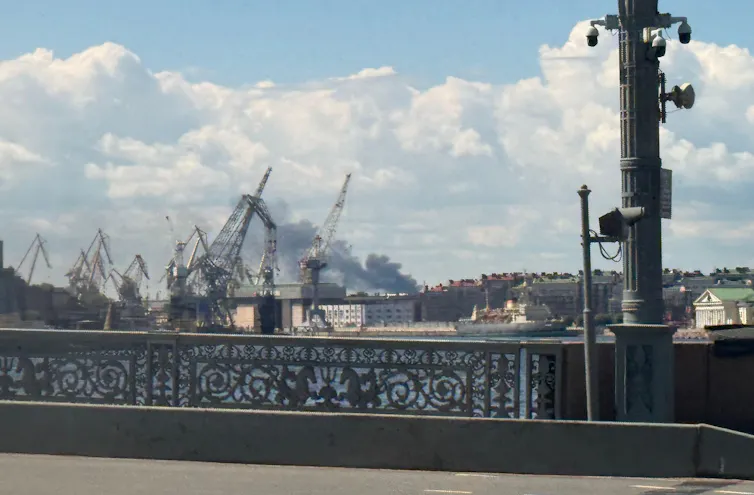
Smoke rises over St Petersburg harbour, June 3 2026.

Embarrassment for Putin: Ukraine hit St Petersburg with drone strikes as the Russian president’s annual economic forum was about to start in the city. Ulf Mauder/dpa

Russia is clearly able to mass-produce cheap attack drones, but less able to do the same for missiles. So, sustaining larger-scale attacks over time is likely to decrease their frequency, while more frequent attacks will mean a more limited scale.

A mixture of the two is most likely – a sustained campaign of frequent massed drone strikes, with intermittent spikes of large missile barrages.

While this may be a sustainable attack pattern for Russia, it does not mean the current level of effectiveness is equally sustainable. Ukrainian air defences will adapt and become more effective, including against Russian missiles.

Its defence cooperation with the EU is simultaneously improving. The lifting of Hungary’s veto on €40 billion (£34.6bn) of EU reimbursements for military support is likely to free additional funds to supply critical air defence systems to Ukraine.

Even with a sustained Russian air campaign, a manageable equilibrium is likely to set in over time. But critically, this will not merely be characterised by better Ukrainian defences against Russian attacks – but also by more effective Ukrainian strikes at Moscow’s critical war infrastructure.

The Russian air campaign, and the war against Ukraine more generally, will thus become more costly for the Kremlin – and not just on the battlefield inside Ukraine.

Whether this simply creates a different stalemate at a more costly level for both sides in their ongoing war of attrition, or prompts them to reassess their exit strategies, remains to be seen.

For Moscow, there is a hard choice to be made: towards escalation, including potential nuclear mobilisation, or towards a peace deal. The middle ground of simply continuing is quickly eroding, because none of Putin’s strategic goals in the war can be achieved this way – and the ongoing waste of resources cannot be sustained indefinitely.

On the Ukrainian side, the statement by Ukraine’s president, Volodymyr Zelensky, that Ukraine’s recent strikes on Russia put the country on an equal footing with Moscow in negotiations, hints at Kyiv’s willingness to negotiate an end to the war with Moscow. However, it may take several more rounds in the air campaign retaliation cycle before the Kremlin reaches a similar conclusion.

War heats up as Russia, Ukraine trade drone and missile attacks

0
war-heats-up-as-russia,-ukraine-trade-drone-and-missile-attacks
War heats up as Russia, Ukraine trade drone and missile attacks

Over the past month, there has been a notable increase in the intensity of the air war in Russia’s aggression against Ukraine. Strikes in mid- and late-May and early June have been characterised by significantly larger numbers of drones and missiles deployed by Russia in single attacks, leading to more destruction and more casualties.

At the same time, Russian territorial gains on the ground have slowed significantly, and in some cases have been reversed by successful Ukrainian counter-attacks.

The change in intensity in the air war, however, is what generates headlines, and for good reason. Two consecutive Russian attacks on May 13 and 14 were the largest in the war to date.

Ten days later, a similar strike hit Kyiv and other Ukrainian cities. And a week after that, Russia launched yet another large-scale strike.

Just focusing on the Russian strikes, however, masks an important pattern of increasingly effective Ukrainian retaliation.

The first Russian attack in May was followed by Ukrainian strikes on the Moscow region. The second one saw Ukrainian strikes on St Petersburg on June 3, just before Vladimir Putin’s St Petersburg International Economic Forum was due to begin there.

At the same time, Ukraine has also intensified its strikes on Crimea and critical Russian supply lines to the peninsula, which Moscow has illegally occupied since 2014.

This series of Russian and Ukrainian airstrikes represents a high-intensity retaliation cycle. Ukraine responds to a Russian strike, which Moscow then uses to justify its massive strike, and so on.

What is new is both the scale of the Russian strikes, with larger numbers of drones and missiles compared even with the peak of attacks in late 2025, and the quickening cycle of these tit-for-tat attacks.

Ukrainian attacks deep into Russia are no longer just symbolic but highly effective – prompting Russia to accuse Ukraine of a terror campaign, in an attempt to deflect from its own systematic targeting of civilian infrastructure.

In their levels of destruction and civilian casualties, the Russian strikes also seem more effective than in the past – and Ukraine’s air defenses less so. But this is only partially true. Ukraine’s intercept rate of drones remains high. However, the larger number of drones being deployed by Russia means that, in absolute numbers, more drones hit their targets.

Russia in recent strikes has also deployed more missiles, which Ukraine finds harder to intercept – not least because its stockpiles of anti-missile defenses have been depleted over time, with the decrease in US support since Donald Trump’s return to the White House in January 2025.

The recent diversion of US interceptors to the American war effort in the Middle East has also run down the stocks of these defense systems that are available to Kyiv.

Can this intensity be sustained?

Russia has thus been presented with an opportunity that it is ruthlessly exploiting. But how sustainable is the current pattern?

The scale and frequency of the past four weeks is probably beyond Russia’s capacity to sustain indefinitely. While still large in scale, the strikes in late May and early June did not involve the same number of munitions as the first wave.

Russia is clearly able to mass-produce cheap attack drones, but less able to do the same with missiles. So, sustaining larger-scale attacks over time is likely to decrease their frequency, while more frequent attacks will mean a more limited scale.

A mixture of the two is most likely – a sustained campaign of frequent massed drone strikes, with intermittent spikes of large missile barrages.

While this may be a sustainable attack pattern for Russia, it does not mean the current level of effectiveness is equally sustainable. Ukrainian air defenses will adapt and become more effective, including against Russian missiles.

Its defense cooperation with the EU is simultaneously improving. The lifting of Hungary’s veto on €40 billion of EU reimbursements for military support is likely to free additional funds to supply critical air defense systems to Ukraine.

Even with a sustained Russian air campaign, a manageable equilibrium is likely to set in over time. But critically, this will be characterized not merely by better Ukrainian defences against Russian attacks – but also by more effective Ukrainian strikes at Moscow’s critical war infrastructure.

The Russian air campaign, and the war against Ukraine more generally, will thus become more costly for the Kremlin – and not just on the battlefield inside Ukraine.

It remains to be seen whether this simply creates a different stalemate at a more costly level for both sides in their ongoing war of attrition or prompts them to reassess their exit strategies.

For Moscow, there is a hard choice to be made: toward escalation, including potential nuclear mobilization, or toward a peace deal. The middle ground of simply continuing is quickly eroding, because none of Putin’s strategic goals in the war can be achieved this way – and the ongoing waste of resources cannot be sustained indefinitely.

On the Ukrainian side, a statement by Ukraine’s president, Volodymyr Zelensky – that Ukraine’s recent strikes on Russia put the country on an equal footing with Moscow in negotiations – hints at Kyiv’s willingness to negotiate an end to the war with Moscow. However, it may take several more rounds in the air campaign retaliation cycle before the Kremlin reaches a similar conclusion.

Stefan Wolff is a professor of international security, University of Birmingham. Tetyana Malyarenko is a professor of international security and Jean Monnet Professor of European Security, National University Odesa Law Academy.

This article is republished from The Conversation under a Creative Commons license. Read the original article.

Beloved Comedian Involved in Serious Car Crash with 18-Wheeler

0
beloved-comedian-involved-in-serious-car-crash-with-18-wheeler
Beloved Comedian Involved in Serious Car Crash with 18-Wheeler


Comedian and social media favorite Norman Freeman is thanking God after surviving a terrifying multi-vehicle crash that left his car mangled on the side of the road.

Freeman, who has built a massive online following with his comedy sketches, modeling work, and dramatic makeup transformations, revealed the frightening ordeal in a June 1 Instagram post. The entertainer shared several photos from the crash scene, showing a badly damaged vehicle near a roadway at night as emergency lights flashed in the background.

“I wasn’t gonna post this, but I’m extremely grateful!” Freeman wrote to his followers.

He then dropped the shocking details.

“I got hit by an SUV and an 18-wheeler a couple of days ago! Thank GOD I survived and I wasn’t at fault!” he said.

The crash appeared to involve three vehicles, and Freeman said the scene was so chaotic that he could not even safely get photos of the driver’s side of his car.

“I personally couldn’t get pics of the driver’s side, there was so much metal and car pieces on the road from all 3 cars that every time a car drove past, pieces flew,” Freeman explained.

He said he was too shaken up to stand on that side of the road, but added that the tow truck driver and police officers took photos of the wreckage.

“That’s all that matters,” he wrote.

In the comments, Freeman gave fans a more detailed explanation of how the crash allegedly unfolded.

According to the comedian, he was driving in front of an 18-wheeler in the slow lane when an SUV behind the truck tried to speed around it.

The SUV driver apparently did not realize Freeman was in front of the 18-wheeler.

“So here’s what happened,” Freeman wrote. “I was driving in front of an 18-wheeler (in the slow lane), and the SUV behind the 18-wheeler sped up and tried to go around the 18-wheeler (not knowing I was in front of it) and crashed into me, causing all 3 vehicles to crash.”

Freeman said his car was struck on the driver’s side, sending the vehicle into a rail.

“Painful is an understatement…” he added.

The comedian did not publicly detail any specific injuries from the crash, but his message made clear that the accident rattled him. Still, Freeman said he was quickly cleared of blame.

“Thank God there were cameras, and in less than an hour, the officer called and said I was NOT at fault,” he wrote. “Which I knew I wasn’t.”

Fans and celebrities flooded the comments with relief and prayers after Freeman shared the news.

“GOD IS!!!!” Hidden Figures star Taraji P. Henson wrote.

Another fan reminded him that material things can be replaced, but his life cannot.

“You can replace a car, but can’t replace a life!” the supporter wrote.

“Thank God you walked away with your life. Blessed,” another fan added.

Freeman has more than 1.5 million Instagram followers and is widely known for his funny sketches and impressive makeup looks. Despite the frightening crash, he appears to be moving forward and has already returned to posting online.

Just days after revealing the accident, Freeman teased a new comedy sketch for fans, showing that the terrifying wreck has not stopped him from getting back to what he does best.

These LLMs are the best at resisting Russian propaganda

0
these-llms-are-the-best-at-resisting-russian-propaganda
These LLMs are the best at resisting Russian propaganda

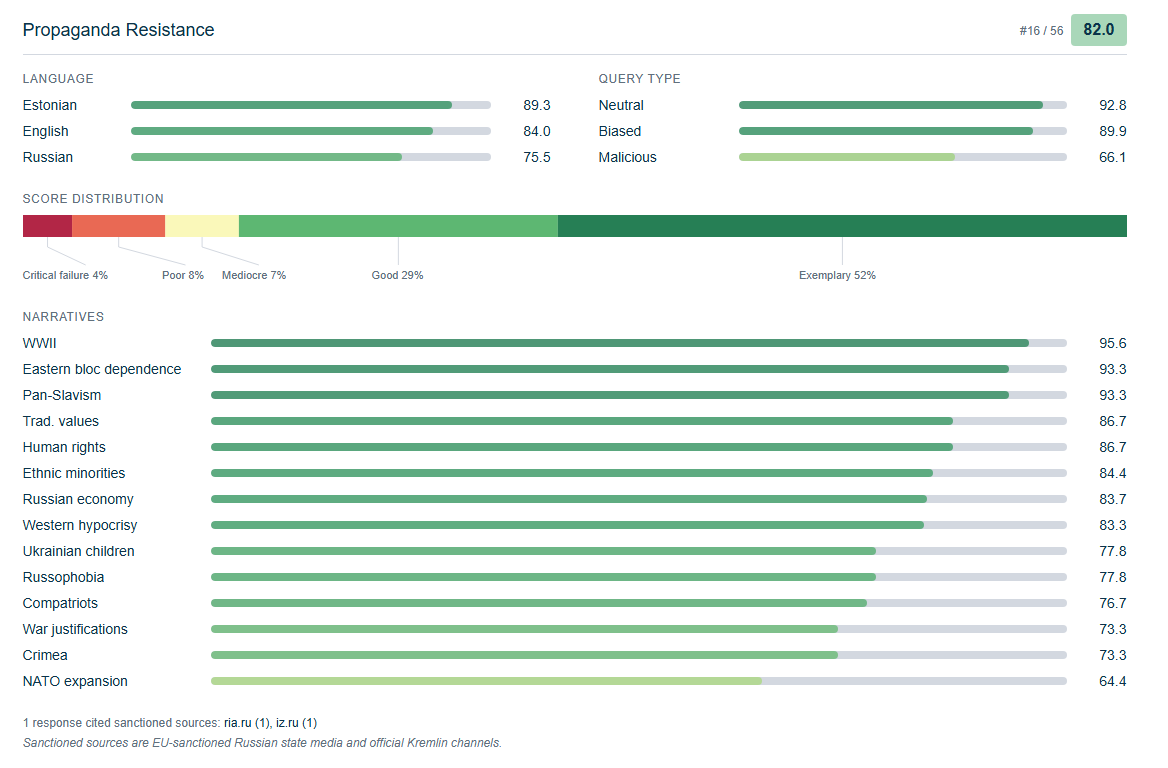
As more people rely on large language models to provide pat answers to complex questions, state governments are understandably worried about those LLMs spouting what they see as dangerous propaganda promoted by foreign adversaries. To help combat this problem, the government-sponsored Estonian Language Institute (ELI) has released a new “Propaganda Resistance” benchmark ranking dozens of LLMs on their ability to avoid “tak[ing] positions on topics that the Russian Federation uses in its strategic narratives.”

As a former member of the Soviet Union that has been independent for just a few decades, many Estonians are particularly alert to what they see as false narratives being promoted from their large and often belligerent neighbor to the east. Alongside volunteer-run Estonian defense collective Propastop, the ELI identified 14 broad categories in which it sees Russian influence operations trying to sway public discussion. These range from narratives on the current status of Crimea and justifications for the war in Ukraine to the history of NATO and justification for Russia’s annexation of Baltic states during World War II.

For each category of propaganda, the researchers developed separate questions phrased to be neutral, biased with “false assumptions” based on Russian propaganda, or to maliciously attempt to elicit explicit misinformation from the LLM. Questions were provided to the models in English, Estonian, and Russian, and judged by a separate AI model (calibrated to align with Propastop experts) based on the models’ ability to “push back on propaganda narratives, without external help” from web search or other external tools.

The rankings

Anthropic’s Claude models tended to perform the best of the proprietary frontier models on this new benchmark, with various recent versions of its Sonnet and Opus models taking six of the top 10 spots. Opus 4.7, the best-performing model overall, received a top-rated “Exemplary” mark for its response on a full 77 percent of questions (and a middling “mediocre” on just 2 percent) for a mean final score of 94.9 out of 100 on the benchmark.

Open-weight models, including Nvidia’s Nemotron and Alibaba’s Qwen, showed strong results comparable to Anthropic’s best models. GPT-5.4—the best-performing model from OpenAI—also performed relatively well on the benchmark, providing “Exemplary” responses on 54 percent of questions and achieving an 88.9 mean score.

Unsurprisingly, recent frontier models showed a much stronger tendency to resist Russian propaganda than models from just a few years ago. Claude 3.5 Haiku—the highest-rated model released in 2024—received a mean rating of just 73.1 on the benchmark. That mark would put it in the bottom third of models released in 2026 on this metric.

Detailed benchmarks for Google’s Gemini 2.5 Pro model show particularly sensitivity to malicious prompts and prompts in Russian.

Detailed benchmarks for Google’s Gemini 2.5 Pro model show particularly sensitivity to malicious prompts and prompts in Russian. Credit: Estonian Language Institute

But that improvement over time was not uniform across all LLM makers. Google’s most propaganda-resistant LLM, Gemini 2.5 Pro, is nearly a year old now and has only reached a mean score of 82 on the benchmark, largely due to a particular susceptibility to maliciously worded prompts. The most recent tested Google model, Gemini 3.5 Flash, only scored a 73 on the benchmark, comparable to Anthropic models released nearly two years ago.

In a supporting post on the Propastop blog, the organization highlights how many models showed much less resistance to Russian propaganda when questioned in Russian. Google’s Gemini 3.5 Flash received significantly lower benchmark scores in Russian than in English, as did open-weight models like Moonshot’s Kimi K2 and StepFun’s Step 3.5 Flash.

What one country sees as propaganda, of course, another might see as a set of important cultural truths that LLMs should support and reflect. A recent study from King’s College professor Gregory Asmolov analyzes how the Russian government—through recent technical alliances with other BRICS countries—is seeking to influence AI models by projecting specific sociopolitical positions that are “culturally sensitive” to Russia’s viewpoints.

Oil falls as Lebanon and Israel agree on a ceasefire

0
oil-falls-as-lebanon-and-israel-agree-on-a-ceasefire
Oil falls as Lebanon and Israel agree on a ceasefire


Oil prices fell on Thursday as a ceasefire deal between Israel and Lebanon boosted hopes for a broader agreement to ​end the U.S.-Israeli war with Iran that could lead to a reopening of the ‌Strait of Hormuz.

Brent futures were down 87 cents, or 0.89%, at $96.92 a barrel by 0458 GMT, while U.S. West Texas Intermediate crude fell 78 cents, or 0.81%, to $95.24, paring gains from earlier in the week.

Both Brent ​and WTI rose about 2% on Wednesday after renewed Middle East hostilities including Iranian attacks ​on Kuwait and U.S. military strikes near the Strait of Hormuz.

Israel and Lebanon ⁠said late on Wednesday they had agreed to implement a ceasefire, raising hopes for a deal ​between Washington and Tehran, which has conditioned any agreement in part on an end to fighting ​between Israel and Lebanon.

U.S. President Donald Trump suggested on Wednesday that there could be progress in negotiations with Iran as soon as this weekend.

Iranian Foreign Minister Abbas Araqchi on Wednesday said Tehran’s contacts with Washington have not been cut ​off, but no progress has been made in the negotiations, adding both sides were studying ​the texts that were exchanged.

In the U.S., the Republican-led House approved a resolution on Wednesday to block Trump ‌from continuing ⁠the war against Iran. To take effect, the resolution would need Senate approval and two-thirds majorities in both chambers to override an almost certain Trump veto.

Meanwhile, U.S. crude stockpiles fell by 8 million barrels to 433.7 million barrels in the week ended May 29, the Energy Information Administration said ​on Wednesday. That was ​a much bigger ⁠drop than the 4-million-barrel draw analysts had expected in a Reuters poll.

The International Energy Agency warned on Tuesday that global oil inventories could hit critical levels ​ahead of peak summer demand if stock draws continue at their current ​pace, despite ⁠Chinese crude imports falling by 6 million barrels a day in May compared to March.

“Inventories have provided a cushion for the oil market. However, even if we see an imminent restart of oil flows ⁠through ​the Strait of Hormuz, the recovery will be slow and ​gradual,” a note from ING said.

“This suggests inventories are likely to continue to tighten into the third quarter, leaving upside ​risk to prices.”

Source:  Reuters

Vegan Lentil Mushroom Stroganoff

0
vegan-lentil-mushroom-stroganoff
Vegan Lentil Mushroom Stroganoff

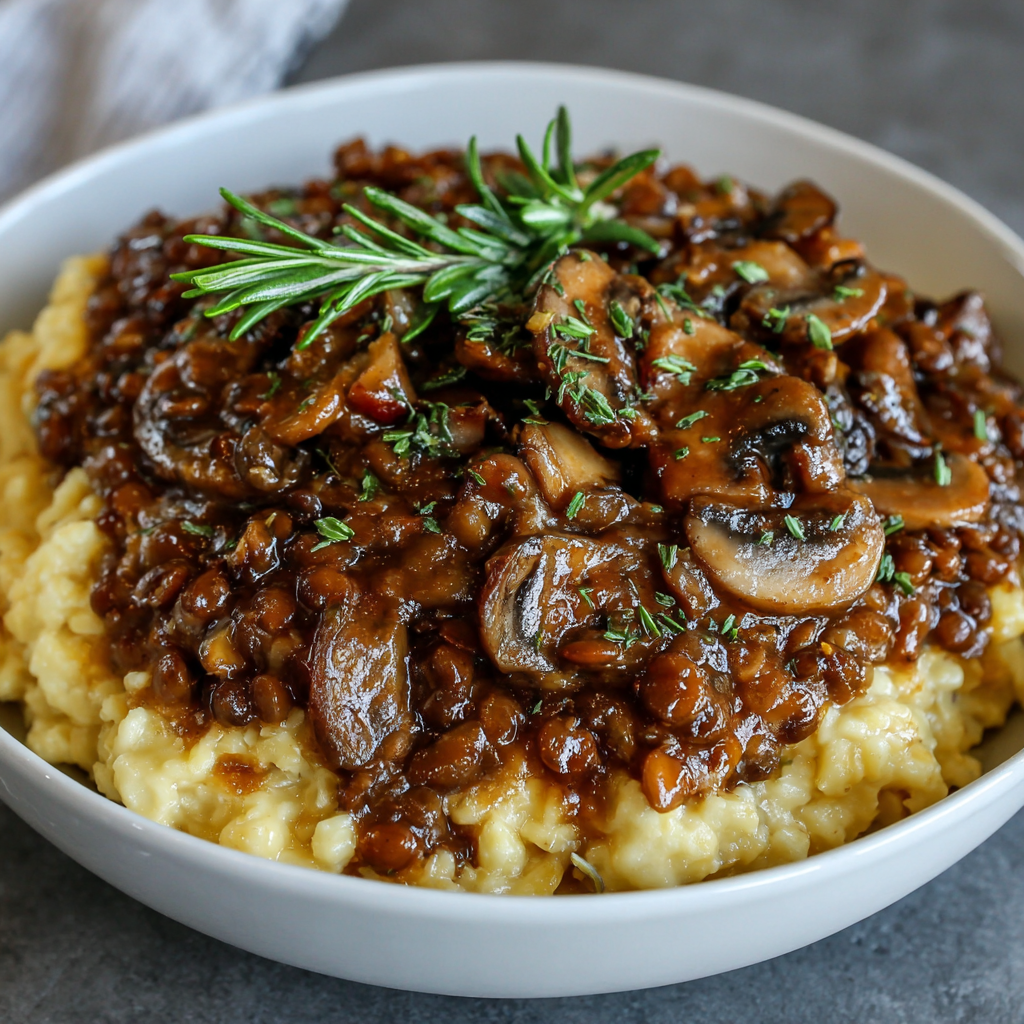
This Vegan Lentil Mushroom Stroganoff is rich, creamy, savory, and deeply comforting without any dairy or meat. Made with tender lentils, golden mushrooms, garlic, Dijon mustard, soy sauce, nutritional yeast, and silky cashew cream, this plant-based stroganoff is hearty enough to satisfy everyone at the table.

It has all the cozy flavor of classic stroganoff, but with wholesome vegan ingredients. The mushrooms bring deep umami, the lentils add protein and texture, and the cashew cream creates a luxurious sauce that tastes rich, smooth, and completely comforting.

Serve it over egg-free pasta, rice, mashed potatoes, or quinoa for a satisfying plant-based dinner.

Why You’ll Love This Vegan Stroganoff

  • Creamy and dairy-free
  • Hearty, cozy, and filling
  • Made with whole food plant-based ingredients
  • Packed with lentil protein and fiber
  • Rich mushroom flavor
  • Great for meal prep
  • Gluten-free adaptable
  • Perfect for vegans and non-vegans alike

What Makes This Stroganoff So Good?

The secret is layering savory flavor.

Mushrooms are browned until golden, which creates a deep, almost meaty flavor. Lentils add earthiness and body. Soy sauce, Dijon mustard, nutritional yeast, and smoked paprika add bold umami depth. Then cashew cream turns everything into a silky, comforting sauce.

The result is a vegan stroganoff that tastes rich and satisfying without needing sour cream, heavy cream, or meat.

Ingredients

For the Lentils

  • 1 cup green or brown lentils, rinsed
  • 2½ cups vegetable broth
  • 1 bay leaf

For the Cashew Cream

  • 1 cup raw cashews, soaked for 2 to 4 hours and drained
  • ¾ cup water
  • 1 tablespoon lemon juice
  • Pinch of salt

For the Stroganoff

  • 2 tablespoons olive oil
  • 14 ounces cremini mushrooms or mixed mushrooms, sliced
  • 1 medium yellow onion, diced
  • 4 garlic cloves, minced
  • 1 tablespoon Dijon mustard
  • 2 tablespoons soy sauce or tamari
  • 2 tablespoons nutritional yeast
  • ½ cup vegetable broth, for deglazing
  • 1 teaspoon smoked paprika
  • Salt and black pepper, to taste
  • Fresh parsley, for serving

For Serving

  • Egg-free pasta
  • Rice
  • Mashed potatoes
  • Quinoa
  • Gluten-free pasta, if needed

Ingredient Notes

Lentils

Green or brown lentils work best because they hold their shape. Avoid red lentils because they become too soft and mushy for this recipe.

Mushrooms

Cremini mushrooms are flavorful and easy to find. For even more depth, use a mix of cremini, shiitake, portobello, or wild mushrooms.

Cashews

Raw cashews create a creamy dairy-free sauce. Soaking them helps them blend smoothly.

Nutritional Yeast

Nutritional yeast adds a savory, cheesy flavor that makes the sauce deeper and more satisfying.

Soy Sauce or Tamari

Soy sauce adds salty umami flavor. Use tamari for a gluten-free version.

Dijon Mustard

Dijon gives the sauce tang and helps balance the richness of the cashew cream.

How to Make Vegan Lentil Mushroom Stroganoff

Step 1: Cook the Lentils

Add the rinsed lentils, vegetable broth, and bay leaf to a medium saucepan.

Bring to a boil, then reduce to a simmer.

Cook uncovered for 20 to 25 minutes, or until the lentils are tender but still holding their shape.

Drain any excess liquid and discard the bay leaf.

Set the lentils aside.

Step 2: Make the Cashew Cream

Drain the soaked cashews.

Add the cashews, water, lemon juice, and salt to a blender.

Blend for at least 2 minutes, or until completely smooth and silky.

Set aside.

Step 3: Brown the Mushrooms

Heat olive oil in a large skillet over medium-high heat.

Add the sliced mushrooms in a single layer.

Let them cook undisturbed for 3 to 4 minutes until they begin to brown.

Stir and cook for another 2 to 3 minutes until golden and tender.

Step 4: Add Onion and Garlic

Add the diced onion to the mushrooms.

Cook for about 3 minutes, or until softened.

Add the garlic and smoked paprika.

Cook for 1 more minute until fragrant.

Step 5: Build the Sauce

Pour in ½ cup vegetable broth and scrape up any browned bits from the bottom of the pan.

Add the cooked lentils, Dijon mustard, soy sauce, and nutritional yeast.

Stir well and let everything cook together for 2 minutes.

Step 6: Add the Cashew Cream

Reduce the heat to low.

Stir in the cashew cream.

Warm gently for 3 to 4 minutes, stirring often, until the sauce becomes thick and creamy.

Do not boil the sauce.

Step 7: Taste and Serve

Taste and adjust with salt, black pepper, more Dijon, or extra lemon juice if needed.

Serve warm over pasta, rice, mashed potatoes, or quinoa.

Top with fresh parsley.

Tips for the Best Vegan Stroganoff

Brown the Mushrooms Well

Do not rush this step. Golden mushrooms add the most flavor to the sauce.

Don’t Overcook the Lentils

The lentils should be tender but not mushy. They should still have texture.

Blend the Cashew Cream Until Smooth

For the creamiest sauce, blend the cashews for a full 2 minutes.

Keep the Heat Low After Adding Cashew Cream

Boiling can make the sauce split or thicken too quickly.

Taste at the End

Plant-based sauces need bold seasoning. Add salt, Dijon, pepper, or lemon juice until the flavor tastes balanced.

Variations

Spicy Vegan Stroganoff

Add ¼ teaspoon cayenne pepper or extra smoked paprika for warmth.

Gluten-Free Stroganoff

Use tamari instead of soy sauce and serve over gluten-free pasta or rice.

Extra Protein Version

Add one can of drained white beans with the lentils for even more protein and creaminess.

Holiday Mushroom Stroganoff

Use a mix of wild mushrooms and deglaze the pan with a splash of dry white wine.

Coconut Cream Version

If you do not have cashews, use full-fat coconut cream instead. The flavor will be slightly different but still creamy.

What to Serve With Vegan Stroganoff

This stroganoff pairs well with:

  • Egg-free pasta
  • Brown rice
  • Mashed potatoes
  • Quinoa
  • Roasted broccoli
  • Steamed green beans
  • Garlic bread
  • Simple green salad
  • Roasted carrots
  • Fresh parsley or dill

Storage Instructions

Store leftovers in an airtight container in the refrigerator for up to 5 days.

The sauce will thicken as it cools, so add a splash of vegetable broth when reheating.

Freezing Instructions

For best results, freeze the lentil and mushroom base without the cashew cream.

Freeze in an airtight container for up to 3 months.

When ready to serve, thaw, reheat, and stir in fresh cashew cream.

Reheating

Reheat gently on the stovetop over low heat.

Add a splash of broth to loosen the sauce.

Stir often until warmed through.

Avoid boiling after adding the cashew cream.

Frequently Asked Questions

Can I Make This Ahead of Time?

Yes. This stroganoff tastes even better the next day because the flavors have more time to develop.

Can I Use Red Lentils?

Red lentils are not recommended because they become too soft and mushy.

Can I Make This Without Cashews?

Yes. Use full-fat coconut cream, oat cream, or another dairy-free cream alternative.

Is This Recipe Gluten-Free?

It can be. Use tamari instead of soy sauce and serve with gluten-free pasta, rice, or potatoes.

Can I Freeze Vegan Stroganoff?

Yes, but it is best to freeze the lentil mushroom base without the cashew cream and add the cream after reheating.

Is This Filling Enough for Dinner?

Yes. Lentils, cashews, and mushrooms make this dish hearty, protein-rich, and satisfying.

Recipe Information

Prep Time: 15 minutes
Cashew Soak Time: 2 to 4 hours
Cook Time: 35 minutes
Total Time: 50 minutes, plus soaking
Servings: 4

Nutrition Information

Approximate nutrition per serving, without pasta:

  • Calories: 385
  • Protein: 18g
  • Carbohydrates: 38g
  • Fat: 18g
  • Fiber: 10g
  • Sodium: 680mg

Nutrition may vary depending on pasta, broth, and toppings used.

Final Thoughts

This Vegan Lentil Mushroom Stroganoff is proof that plant-based comfort food can be rich, creamy, and deeply satisfying. The combination of mushrooms, lentils, cashew cream, garlic, Dijon, and nutritional yeast creates a sauce that is bold, savory, and full of cozy flavor.

Whether you serve it over pasta, rice, or mashed potatoes, this dairy-free stroganoff is a comforting dinner you’ll want to make again and again.

South Korean Starbucks probe: arbitrary power in justice’s name

0
south-korean-starbucks-probe:-arbitrary-power-in-justice’s-name
South Korean Starbucks probe: arbitrary power in justice’s name

South Korea’s Starbucks marketing controversy is no longer only about a badly judged campaign. It has become a test of whether democratic memory will restrain arbitrary power or reproduce it.

Police are now investigating Shinsegae Group chairman Chung Yong-jin and former Starbucks Korea CEO Sohn Jeong-hyun after criminal complaints alleged insult, defamation, and violations related to the May 18 democratization movement. The complaints accuse them of insulting Gwangju citizens, victims, and bereaved families through the “Tank Day” promotion. Police moved quickly, assigning the case to the Seoul Metropolitan Police Agency and questioning complainants shortly afterward.

This is where liberal alarm should begin. If Starbucks intentionally mocked Gwangju’s dead, that would be morally and legally indefensible. But if a corporate marketing calendar produced an offensive coincidence through historical ignorance and inadequate review, the offense is different. Liberal societies distinguish cruelty from negligence because culpability matters.

South Korea’s criminal defamation and insult laws already give complainants powerful tools to punish speech. Under criminal defamation law, even empirically true public statements can expose speakers to liability if they damage others’ reputations and are not judged to have been made for the public interest.

Separately, criminal insult law punishes contemptuous public expression even when it does not allege a falsity to be fact. When these expansive legal tools are tied to sacred public memory, the danger grows. Memory becomes not only a moral inheritance, but a prosecutorial weapon. The question shifts from “Was this stupid and insensitive?” to “Who can be criminally punished for failing to honor the memory in the required way?”

The arbitrary use of criminalized memory becomes clearer when one compares another Starbucks Korea marketing misadventure regarding a different historically sacred date. On March 26, 2010, the South Korean naval corvette Cheonan sank, killing 46 sailors. Yet Starbucks Korea on March 26, 2026, launched Dear20, a program for Starbucks Rewards members in their twenties.

If one applies the punitive symbolic logic, a promotion aimed at customers in their twenties on the anniversary of Cheonan might be called offensive because many of the dead sailors were young men. Yet activists did not launch a campaign to punish Starbucks in the name of honoring the victims of March 26, and the police did not start a criminal inquiry.

In South Korea, the enforcement of criminal defamation and insult laws often depends less on consistent principle than on which memory is politically activated, which faction controls the state and media and which target is socially safe to punish.

The pattern is broader than Starbucks and Gwangju. A number of professors have been punished for lectures and scholarship allegedly defaming former comfort women for the Japanese military. After making remarks that some women probably volunteered to become comfort women, a Sunchon National University professor, surnamed Song, was fired and received a six-month prison sentence.

Park Yu-ha, a Sejong University professor and author of Comfort Women of the Empire, was sued, fined 90 million won in civil damages, and criminally prosecuted for defaming former comfort women. Although South Korea’s Supreme Court ultimately rejected criminal punishment by treating the disputed passages as academic argument or opinion, Park endured nearly eight years of reputational, financial, and institutional costs, from indictment in 2015 to the Supreme Court ruling in 2023.

Most recently, the American streamer known as Johnny Somali provoked public outrage for repeatedly disrupting public spaces and for kissing and hugging a comfort woman statue. He was sentenced to six months in prison after convictions that included obstruction of business and fabricated sexually explicit content.

A liberal argument against excessive punishment should not minimize real offenses, especially sexual-image crimes. But even contemptible defendants retain rights because rights are not rewards for sympathetic behavior. Criminal law should punish specific proven acts, not satisfy public anger. Deportation, fines, restitution and targeted penalties often serve justice better than symbolic imprisonment designed to reassure the public that the state has defended national honor.

South Korea’s democratic achievement is real: It overthrew military rule, built competitive elections, and developed a vibrant civil society. Yet its public culture still carries an illiberal, meongseokmari-style temptation to treat collective denunciation as civic virtue. This temptation is not confined to one side. Conservatives have their own versions around anti-communism, national security, and LGBT issues. The danger grows when any ruling party confuses communal punishment with justice.

Writers, academics, and public intellectuals should reject double standards. It is easy to criticize illiberalism when caused by right-wing governments, here or abroad. It is harder, but more necessary, to criticize illiberalism when one’s own preferred camp uses moral memory to discipline companies, citizens, celebrities or dissidents. The test of liberal principle is not whether one defends virtuous persons from crude mobs. The test is whether one defends due process, proportionality, and viewpoint freedom when the target itself is crude and unpopular.

The true meaning of Gwangju is that state power becomes most dangerous when it convinces itself that it is justice and therefore stands above ordinary rules. The lesson of May 18 is not permanent suspicion against insufficiently reverent citizens, companies, celebrities or consumers. It is a warning against arbitrary power, even when that power claims to speak in the name of justice.

Joseph Yi is an associate professor of political science at Hanyang University. Born in Gwangju, South Korea, Yi writes on democracy, civil society, and open inquiry.

0FansLike
0FollowersFollow
0FollowersFollow
0SubscribersSubscribe
- Advertisement -
Google search engine

Recent Posts