13.7 C
London
Friday, June 5, 2026
Home Blog

South Korean Starbucks probe: arbitrary power in justice’s name

0
south-korean-starbucks-probe:-arbitrary-power-in-justice’s-name
South Korean Starbucks probe: arbitrary power in justice’s name

South Korea’s Starbucks marketing controversy is no longer only about a badly judged campaign. It has become a test of whether democratic memory will restrain arbitrary power or reproduce it.

Police are now investigating Shinsegae Group chairman Chung Yong-jin and former Starbucks Korea CEO Sohn Jeong-hyun after criminal complaints alleged insult, defamation, and violations related to the May 18 democratization movement. The complaints accuse them of insulting Gwangju citizens, victims, and bereaved families through the “Tank Day” promotion. Police moved quickly, assigning the case to the Seoul Metropolitan Police Agency and questioning complainants shortly afterward.

This is where liberal alarm should begin. If Starbucks intentionally mocked Gwangju’s dead, that would be morally and legally indefensible. But if a corporate marketing calendar produced an offensive coincidence through historical ignorance and inadequate review, the offense is different. Liberal societies distinguish cruelty from negligence because culpability matters.

South Korea’s criminal defamation and insult laws already give complainants powerful tools to punish speech. Under criminal defamation law, even empirically true public statements can expose speakers to liability if they damage others’ reputations and are not judged to have been made for the public interest.

Separately, criminal insult law punishes contemptuous public expression even when it does not allege a falsity to be fact. When these expansive legal tools are tied to sacred public memory, the danger grows. Memory becomes not only a moral inheritance, but a prosecutorial weapon. The question shifts from “Was this stupid and insensitive?” to “Who can be criminally punished for failing to honor the memory in the required way?”

The arbitrary use of criminalized memory becomes clearer when one compares another Starbucks Korea marketing misadventure regarding a different historically sacred date. On March 26, 2010, the South Korean naval corvette Cheonan sank, killing 46 sailors. Yet Starbucks Korea on March 26, 2026, launched Dear20, a program for Starbucks Rewards members in their twenties.

If one applies the punitive symbolic logic, a promotion aimed at customers in their twenties on the anniversary of Cheonan might be called offensive because many of the dead sailors were young men. Yet activists did not launch a campaign to punish Starbucks in the name of honoring the victims of March 26, and the police did not start a criminal inquiry.

In South Korea, the enforcement of criminal defamation and insult laws often depends less on consistent principle than on which memory is politically activated, which faction controls the state and media and which target is socially safe to punish.

The pattern is broader than Starbucks and Gwangju. A number of professors have been punished for lectures and scholarship allegedly defaming former comfort women for the Japanese military. After making remarks that some women probably volunteered to become comfort women, a Sunchon National University professor, surnamed Song, was fired and received a six-month prison sentence.

Park Yu-ha, a Sejong University professor and author of Comfort Women of the Empire, was sued, fined 90 million won in civil damages, and criminally prosecuted for defaming former comfort women. Although South Korea’s Supreme Court ultimately rejected criminal punishment by treating the disputed passages as academic argument or opinion, Park endured nearly eight years of reputational, financial, and institutional costs, from indictment in 2015 to the Supreme Court ruling in 2023.

Most recently, the American streamer known as Johnny Somali provoked public outrage for repeatedly disrupting public spaces and for kissing and hugging a comfort woman statue. He was sentenced to six months in prison after convictions that included obstruction of business and fabricated sexually explicit content.

A liberal argument against excessive punishment should not minimize real offenses, especially sexual-image crimes. But even contemptible defendants retain rights because rights are not rewards for sympathetic behavior. Criminal law should punish specific proven acts, not satisfy public anger. Deportation, fines, restitution and targeted penalties often serve justice better than symbolic imprisonment designed to reassure the public that the state has defended national honor.

South Korea’s democratic achievement is real: It overthrew military rule, built competitive elections, and developed a vibrant civil society. Yet its public culture still carries an illiberal, meongseokmari-style temptation to treat collective denunciation as civic virtue. This temptation is not confined to one side. Conservatives have their own versions around anti-communism, national security, and LGBT issues. The danger grows when any ruling party confuses communal punishment with justice.

Writers, academics, and public intellectuals should reject double standards. It is easy to criticize illiberalism when caused by right-wing governments, here or abroad. It is harder, but more necessary, to criticize illiberalism when one’s own preferred camp uses moral memory to discipline companies, citizens, celebrities or dissidents. The test of liberal principle is not whether one defends virtuous persons from crude mobs. The test is whether one defends due process, proportionality, and viewpoint freedom when the target itself is crude and unpopular.

The true meaning of Gwangju is that state power becomes most dangerous when it convinces itself that it is justice and therefore stands above ordinary rules. The lesson of May 18 is not permanent suspicion against insufficiently reverent citizens, companies, celebrities or consumers. It is a warning against arbitrary power, even when that power claims to speak in the name of justice.

Joseph Yi is an associate professor of political science at Hanyang University. Born in Gwangju, South Korea, Yi writes on democracy, civil society, and open inquiry.

The skeptic’s guide to humanoid robots going viral on the Internet

0
the-skeptic’s-guide-to-humanoid-robots-going-viral-on-the-internet
The skeptic’s guide to humanoid robots going viral on the Internet

It may appear that humanoid robots capable of handling any task have almost arrived—especially when tech companies showcase them performing acrobatic feats or handling household chores. But there is still a significant gap between these robot demonstrations and proving that the same robots can reliably and repeatedly manage such tasks in the real world.

The latest wave of robot videos can be particularly tricky, given the human tendency to anthropomorphize objects with a humanoid figure. A robot arm doing a dance move may simply seem “cool,” but a humanoid robot doing the same dance move can trigger more misleading assumptions, said Jonathan Hurst, cofounder of Agility Robotics and a robotics researcher at Oregon State University.

“People automatically extrapolate and assume that the robot that looks like a person can do all the things that a person who can dance could do—which is not true,” Hurst told Ars. “But a lot of the startup companies do kind of prey on that for being able to raise a lot of money.”

One of the biggest challenges is developing robots that can generalize their skills across many different conditions and environments in the same way that humans can, said Sergey Levine, a computer scientist at the University of California, Berkeley, and cofounder of the AI and robotics company Physical Intelligence. But that degree of generalization is practically impossible to capture within a single robot demonstration.

“Maybe the robot can pour a glass of wine, but can it pour it out of any bottle and into any glass in any environment?” Levine said. “That’s actually a lot harder than having a robot do a backflip in one stage demo.”

The real measure for robotic capabilities involves conducting “quantitative, large-scale evaluations” in real-world environments, Levine explained. “There’s always a gap between the kind of things that somebody can show in a demo and what the real capability of the robot is,” he said.

What to watch out for

There are several things to keep in mind when watching the surge of robot demonstration videos and even livestreams. First, such robotic demonstrations are not necessarily indicative of robots operating autonomously without human control or oversight, said Dipam Patel, a PhD candidate in computer science at Purdue University and a research assistant at the US Army DevCom Army Research Lab. Many demonstrations still rely on human operators directly controlling the robots’ actions through teleoperation.

“Unless a research paper or a company is explicitly mentioning that [the robot] is completely autonomous, you should take it with a very big pinch of salt,” Patel told Ars.

Another question to consider is whether the demonstration shows robots tackling a completely new test environment for the first time, or whether the robots are simply repeating a task they had already learned to do in that specific training environment. The new test environment would be significantly more impressive at showcasing robots capable of doing tasks autonomously in a generalized way, Patel said.

It is also worth checking the video playback speed for any robot demonstration, because “usually the robots are very slow” for safety and other reasons, Patel said. Companies may sometimes disclose that a robot demonstration video is running at two times or four times normal speed—meaning the robot could be taking twice as long or four times as long as a human to do the same task.

Robot demonstration videos can also vary wildly in their informative value and transparency. Some are clearly intended to be performative entertainment clips that can go viral on social media, or polished promotional videos from companies seeking new clients and investors. Others may provide more of a behind-the-scenes look at the robot training process while acknowledging robot mistakes along the way.

But even if a robot demo video appears incredibly impressive and authentic while coming from a more reputable company or research lab, just keep in mind that it’s still a small glimpse of the bigger picture. The real indicators of progress in robotic capabilities are not so easily packaged for Internet audiences.

Where peace talks between the US and Iran currently stand

0
where-peace-talks-between-the-us-and-iran-currently-stand
Where peace talks between the US and Iran currently stand

To understand where talks on ending the war between the US and Iran currently stand, all we can confidently assume is that Donald Trump’s pronouncements offer no guide. The US president said an agreement had been “largely negotiated” on May 23.

That proposal would have reopened the Strait of Hormuz in exchange for sanctions relief and the unfreezing of Iranian assets. But it would not have immediately extracted concessions on Iran’s nuclear activities and ballistic missile capabilities. In response to backlash from Republican hawks, Trump subsequently toughened the US position.

The following week, Trump again claimed he was “on the verge” of approving a peace deal and US officials started briefing that Iran had made critical concessions. Iranian officials denied reports they had accepted major concessions on uranium enrichment or the future of their nuclear programme.

Talks were then suspended on June 1 after Iran protested Israel’s offensive in Lebanon, and the US and Iran exchanged military strikes. Trump declared he “couldn’t care less” if the talks were over, but by the evening, was once again insisting negotiations were continuing “at a rapid pace”.

According to Iranian media, the current situation is that Iran is studying the latest US proposal but communications between the two countries are paused. The US and Iran have also traded military strikes in recent days. So why are the two sides seemingly unable to close the gap between their respective positions?

One obvious obstacle is the dysfunctional conditions under which negotiations are taking place. The simple act of communicating through intermediaries creates delays and complications. The fact that messages must then be considered by a reordered and fractured political system that is reluctant to use even basic communications technology for fear of revealing officials’ whereabouts adds another layer of complexity.

But even a more unified Iranian regime operating in peacetime would still have to contend with the message incoherence, unpredictability and unprofessionalism that masquerades as statesmanship in Washington. Iranian officials do not believe Trump has the attention span to negotiate a complex agreement, nor do they believe he can be relied upon to honour any agreement he signs.

In June 2025 and then again in February 2026, Iranian diplomats believed they were engaged in serious negotiations and were already working through the technical details of a potential agreement, only for US and Israeli military strikes to follow shortly afterwards.

This has important implications for the choreography of any deal to end the current hostilities. Iran wants Washington to make concessions – on sanctions relief, ending the US maritime blockade and unfreezing Iranian assets – first before it reciprocates. It also wants any agreement to be legally binding on future US administrations. The former is politically very difficult for Trump and the latter is constitutionally impossible.

Iranian fishermen steering a boat past ships stuck in the Strait of Hormuz.

Iranian fishermen steering a boat past ships stuck in the Strait of Hormuz off the coast of southern Iran on June 1. Amirhossein Khorgooei / ISNA News Agency / EPA

Trump himself has made a very unconvincing case that he can force Iran to accept his maximalist demands. These include strict limits on Iran’s ballistic missile programme, an end to its support for proxy groups such as Hezbollah and Hamas and the dismantling of Tehran’s nuclear activities.

And yet he appears desperate to avoid signing a deal that could be compared to Barack Obama’s 2015 nuclear agreement with Iran (known as the Joint Comprehensive Plan of Action or JCPOA). Trump recklessly vandalised the JCPOA by withdrawing the US from the deal in 2018.

The JCPOA contained 159 pages of commitments and technical annexes. It took 20 months for a small army of diplomats and nuclear experts to negotiate. Currently, American diplomacy is being spearheaded by Trump’s son-in-law, Jared Kuschner, and a billionaire real estate magnate, Steve Witkoff. And Trump himself seems unsure on what would qualify as reasonable safeguards for preventing Iran from building a nuclear weapon.

At the same time, Iran’s enriched uranium is thought to be lying in highly hazardous gas form mostly buried under collapsed facilities bombed in the 12-day war of 2025. So the initial process of verifying how much enriched uranium Iran has poses a far greater technical challenge than it did in the lead up to the JCPOA. This in turn affects the negotiations because sanctions relief would be based on how much enriched uranium Iran ships out.

Iran’s strengthened hand

The US is also engaging in talks with greatly diminished leverage. By using military force against Iran, it has already played its ultimate coercive card. Both domestic and international opinion largely views the outcome as a failure.

Iran, by contrast, believes it has survived the conflict. It is now ruled by a generation of leaders shaped by the experiences of this war and by a renewed confidence that hard power and the strategic use of Iran’s geography can be used to reshape the regional order.

This has emboldened Iran to introduce demands that lay well beyond the scope of the JCPOA, most notably its insistence that any wider settlement addresses Israeli military operations against its ally Hezbollah in Lebanon.

It seems highly doubtful that a comprehensive deal can be reached that adheres to Trump’s proclaimed red lines. More realistically, though by no means assuredly, a deal may emerge that sees Iran reopen the Strait of Hormuz in return for financial incentives, with the other issues kicked into the long grass and postponed to an uncertain second phase of negotiations.

The lesson of this war is that the Gulf states will surely have much diminished faith in Washington’s ability to achieve a stable regional order. Its inability to contain Iran, prevent escalation or protect its allies from the consequences of its own failed military intervention is likely to accelerate efforts to build alternative security arrangements within the region.

‘Soccer’ is a fine term for the beautiful game – don’t let any ‘football’ snob or president tell you otherwise this World Cup

0
‘soccer’-is-a-fine-term-for-the-beautiful-game-–-don’t-let-any-‘football’-snob-or-president-tell-you-otherwise-this-world-cup
‘Soccer’ is a fine term for the beautiful game – don’t let any ‘football’ snob or president tell you otherwise this World Cup

At the 2026 World Cup draw, FIFA Peace Prize recipient and U.S. President Donald Trump announced that the game should really be called “football.”

“There’s no question about it. We have to come up with another name for the NFL. It really doesn’t make any sense,” said Trump, an apparently new convert to the round-ball game.

He isn’t alone. The word “soccer” is, in some parts of the world, shunned by some fans.

Indeed, as a scholar of the sport who teaches a course called Soccer and Global Politics, I am bombarded with comments that the word “soccer” does not make any sense, and that people who use that term obviously know nothing about the beautiful game.

To me, this disparagement of the word “soccer” is not only petty and tiresome – it is also incorrect. It ignores the roots of the sport and the development of the language of the game.

Rather than making the word taboo, the football ecosystem should embrace it. To understand why, let’s go back to the beginning.

Associated to ‘assoc’ and then ‘soccer’

The game has been around in various forms for centuries, but it began to be codified in the mid-19th century.

“Association Football” was coined in 1863 to distinguish the game from rugby football, which, somewhat ironically, is played largely with the ball in hand.

British university students created their own slang at the time by abbreviating words and adding “-er” to them. Thus, “rugby” became “rugger” and “association football” was shortened to “assoc” and slanged to “soccer.”

And this term “soccer” was freely and proudly used in the British press and in public for nearly a century, until the 1980s.

Soccer fans in English and USA garb celebrate together.

United by a common love of the game (whatever you call it). Phil Cole/Getty Images

In countries with other established codes of football – American football, Australian rules football and Gaelic football in Ireland – “soccer” became the dominant term. But British fans began abandoning the word in the 1980s, largely as a response to the embrace of the term in the States. And now, in the U.K. especially – but also among fans in the U.S. and Canada who present as “true” fans of the game – there are attempts to shame those who use the very term that the British invented and proudly used.

And that’s a pity. After all, using the word “soccer” has benefits. The British press continues to use “soccer” and “football” interchangeably to avoid repetitive writing. The shorter word is useful for tabloid editors when creating tight headlines. And using both words does not reveal that a person is ignorant but rather cosmopolitan.

The widespread use of “soccer” in Britain is still evident in the ongoing success of authoritative magazine World Soccer, founded in London in 1960; the TV show “Soccer AM,” which ran every Saturday from 1994 to 2023; the annual British charity match Soccer Aid; and Sky Sports’ “Soccer Saturday.” All document the enduring legacy of the term in Britain, despite the naysayers.

A shared vernacular

The beautiful game is also a universal one with a language shared by some 4 billion people.

Language evolves, and fans today equally understand “football,” “soccer,” “calcio,” “futebol” or “fútbol.”

Embracing all the variations of the beautiful game enriches the conversation. It illustrates the sport’s globalization and universal language, a shared vernacular that cuts across identities.

And besides, nobody wants the war that would ensue if American football fans were forced to find another name!

Most people in 36 countries hold unfavorable views of Israel: Poll

0
most-people-in-36-countries-hold-unfavorable-views-of-israel:-poll
Most people in 36 countries hold unfavorable views of Israel: Poll

A majority of people in 36 countries hold unfavorable views of Israel and lack confidence in Prime Minister Benjamin Netanyahu, according to a new survey Thursday by the Pew Research Center.

The survey, conducted Feb. 8 – May 13, 2026, found that a global median of 67% of adults view Israel unfavorably, while 25% hold a favorable view.

Views were particularly negative in Muslim-majority countries that were surveyed, including Bangladesh, Indonesia, Malaysia, Pakistan, Turkiye, the West Bank and East Jerusalem.

The majority in most surveyed countries said they have little or no confidence in Netanyahu to do the right thing regarding world affairs, it said.

Kenya and the Philippines were the only countries where more than half of the public expressed confidence in the Israeli prime minister, it added.

Unfavorable views of Israel increased in 13 of the 24 countries where trend data were available since 2025, said Pew.

READ: Israel becomes world’s most disliked country, global survey finds

Capt. Eitan Shmuel Lamberg Killed in Anti-Tank Missile Attack in Southern Lebanon 

0
capt.-eitan-shmuel-lamberg-killed-in-anti-tank-missile-attack-in-southern-lebanon 
Capt. Eitan Shmuel Lamberg Killed in Anti-Tank Missile Attack in Southern Lebanon 


Capt. Eitan Shmuel Lamberg, a 21-year-old armored corps officer from Mishmar HaShiv’a, was killed Thursday during operations in southern Lebanon, the IDF announced. 

Lamberg served in the 75th Battalion of the 7th Armored Brigade and was operating with the Golani Brigade combat team north of the Litani River when the attack occurred. 

According to the military, a terrorist fired an anti-tank missile at his tank at approximately 4 p.m., killing him.  

Following the incident, Israeli forces launched air and artillery strikes against Hezbollah infrastructure in the area. 

Prime Minister Benjamin Netanyahu paid tribute to Lamberg, describing him as “a courageous commander who led his soldiers on the front lines of battle to safeguard Israel’s security.” 

“All of our hearts ache over the fall of armored corps officer Capt. Eitan Shmuel Lamberg, of blessed memory, who was killed in combat in southern Lebanon,” Netanyahu said. “Together with all the citizens of Israel, my wife and I send our deepest condolences to his family and share in their profound grief.” 

He added: “We will forever remember his bravery and his sacrifice. May his memory be blessed and forever preserved in our hearts.” 

Lamberg is the fourth IDF fatality cleared for publication within the past week amid ongoing operations in southern Lebanon. 


Indonesia’s rupiah rout is not just about the dollar

0

The wave of currency depreciation that battered Indonesia’s foreign exchange market throughout April and May 2026 has pushed the rupiah to record lows, dangerously close to a new psychological threshold of 18,000 against the US dollar.

When the currency broke past 17,000 in early April, it stoked painful public memories of the 1997–1998 Asian financial crisis and the rupiah’s collapse. The crisis exposed deep structural problems at the core of Indonesia’s economy, and the general public was forced to pay the price.

In theory, exchange rates in the long run are largely determined by purchasing power parity, a principle that accounts for inflation differentials between countries. Judged by historical inflation gaps between Indonesia and the United States, the rupiah’s new slippage could fall within what could be considered a reasonable long-term adjustment.

Yet the exceptionally sharp slide over the past two months points to something far more severe: an extreme overshooting phenomenon. The currency’s collapse no longer reflects underlying purchasing power fundamentals, but rather a market disequilibrium driven by panic, massive capital flight and an acute shortage of dollar liquidity in the domestic spot market.

The budding crisis has been aggravated by Bank Indonesia’s delayed response to mounting market stress. The central bank had become overly comforted by moderating domestic inflation, which fell to 2.42% in April 2026.

That decline created the misleading impression that monetary tightening was not urgent, even though the softer inflation figures were largely temporary, driven by post-Eid seasonal effects and the annual harvest cycle.

Keen to maintain strong economic growth and credit expansion, Bank Indonesia postponed defensive action and kept benchmark interest rates unchanged for seven consecutive months through April 2026. Before eventually raising rates, the central bank attempted to stabilize the rupiah through various non-interest-rate instruments.

That included aggressive triple-intervention measures in the foreign exchange market, tightened rules on foreign currency conversion without underlying transactions and the issuance of short-term monetary securities.

Yet the policy mix failed to halt the rupiah’s decline. Under the logic of monetary quantity theory, absorbing dollars from the market can only be effective if accompanied by tighter control of the domestic money supply.

Instead, Bank Indonesia continued to allow domestic liquidity creation to remain loose, with base money growth remaining in double-digit territory in an effort to sustain economic expansion. Combined with the rapid growth of digital transactions that accelerated money circulation across the economy, this abundance of cheap rupiah liquidity created a perverse incentive.

Market participants borrowed cheaply in local currency, converted the funds into dollars and moved capital offshore in pursuit of higher yields abroad.

Interest rate paradox

As the rupiah weakened further toward 17,700 per dollar in mid-May, Bank Indonesia caught markets off guard by finally making an aggressive move, raising its benchmark rate by 50 basis points to 5.25 percent.

The dramatic hike was designed to create a shock effect at a time when foreign exchange reserves were under pressure and geopolitical tensions in the Middle East were disrupting trade flows through the Strait of Hormuz. Indonesia, despite rich stores of oil and gas, is a net energy importer, adding to the strain on the rupiah.  

Global crude oil prices surged toward $96 per barrel, while US Treasury yields climbed to 4.66%, sending powerful tremors across emerging-market financial systems.Yet instead of calming investors, Bank Indonesia’s rate hike triggered more disorientation in domestic financial markets.

Indonesia’s stock market plunged more than 2% almost immediately amid fears of rising corporate financing costs, while government bond prices also came under intense pressure.This is where Indonesia’s monetary paradox is becoming starkly apparent.

In theory, according to the uncovered interest parity principle, higher domestic interest rates should strengthen a currency by making local assets more attractive to foreign investors. But such textbook assumptions often break down during periods of extreme market anxiety.

The 50-basis-point increase proved insufficient to offset expectations of further rupiah depreciation and the rapidly rising risk premium attached to Indonesian assets. Global investors chose to ignore the additional yield and instead fled to safer overseas assets amid growing perceptions of panic in the Indonesian government.

Market pessimism gained further justification when Indonesia’s external fundamentals deteriorated sharply. The country’s current account deficit in the first quarter of 2026 widened to $4 billion, equivalent to 1.1% of GDP, marking the widest deficit since the end of the pandemic.

At the same time, the capital account deficit deepened as large volumes of private-sector external debt matured. Indonesia’s overall balance of payments recorded a historic deficit of $9.1 billion, the worst quarterly figure in more than two decades.

The figures sent a clear message to global fund managers: Indonesia is facing a structural shortage of dollars.

Regulatory shock

At a moment when external conditions were already fragile, poorly calibrated domestic regulations have added another blow.

The government’s decision to introduce new rules governing the repatriation of export earnings under Government Regulation No. 21 of 2026, scheduled to take effect on June 1, has triggered widespread anxiety among exporters. The regulation requires non-oil-and-gas exporters to repatriate and retain all export earnings within state-owned banks for a minimum of 12 months.

At the same time, the establishment of new entities such as PT Danantara Sumberdaya Indonesia, a sovereign fund created under the Prabowo administration known generally as just Danantara, as the sole strategic commodity export management agency, has added more uncertainty to the business climate.

Rather than strengthening foreign exchange reserves, the state interventions have sparked a private-sector backlash. Exporters say the requirement to immobilize funds for a full year is a major disruption to their corporate cash flow management, particularly for firms dependent on rapid liquidity turnover to sustain daily operations.

Facing the prospect of their funds becoming trapped once the regulation came into force, exporters adopted defensive strategies by withholding dollar-to-rupiah conversions and moving foreign currency liquidity into offshore accounts before the policy deadline.

The result was a severe drying up of dollar supply in the domestic foreign exchange market, parching the rupiah of one of its natural stabilizers in the spot market. The dollar shortage then collided with seasonal corporate demand pressures.

Every May, Indonesian corporations typically require substantial dollar purchases to pay dividends to foreign shareholders and service maturing external debt obligations. Because these payments are legally binding, the demand for foreign currency is highly inelastic, meaning companies must acquire dollars regardless of the prevailing price.

When this surge in demand collided with a supply freeze driven by regulatory trepidation, the price of dollars in local markets soared, dragging the rupiah down to 17,900 per greenback by the end of May.

Path to stabilization

Given the complexity of the crisis, stabilizing the national currency can no longer rely solely on short-term measures such as raising interest rates. It is fundamentally contradictory for the central bank to tighten rates on one side while simultaneously allowing domestic liquidity to remain excessively loose in pursuit of growth.

Domestic money creation must be tightened in a measured but credible manner so that liquidity conditions align with the high-interest-rate regime. By genuinely reducing the supply of rupiah circulating in the financial system, the currency would gain stronger support through the natural scarcity of domestic liquidity.

The government should also rethink the operational framework for retaining export earnings. The requirement to retain 100% of export proceeds for 12 full months should be replaced with a more business-friendly mechanism, such as a tiered system based on company size and shorter holding periods.

To bridge exporter liquidity needs while their dollar deposits remain parked domestically, Bank Indonesia and the banking sector should provide efficient liquidity swap facilities. Under such a mechanism, exporters could use their dollar deposits as collateral to obtain low-interest rupiah financing for operational expenses, reducing incentives to hoard foreign currency offshore.

The government would also be wise to provide much greater legal clarity and communication transparency regarding the operational structure of the Danantara wealth fund to avoid market misinterpretation and investor panic.

At the same time, coordination between monetary and fiscal authorities must be strengthened to prevent the emergence of twin deficits that could undermine national economic resilience. State spending must also be managed with far greater discipline, avoiding wasteful expenditures on non-productive programs at a time when commodity-related revenues are weakening.

Through a stricter macroprudential policy mix aimed at strengthening export-oriented industries and import substitution, Indonesia can gradually repair the structural weaknesses in its current account balance rather than remaining dangerously dependent on volatile short-term capital inflows that disappear whenever global shocks intensify.

Only then will markets stop dumping the rupiah.

Ronny P Sasmita (PhD) is senior analyst at Indonesia Strategic and Economic Action Institution, a Jakarta-based think tank.

AT&T and Verizon lose Supreme Court case over fines for selling location data

0
at&t-and-verizon-lose-supreme-court-case-over-fines-for-selling-location-data
AT&T and Verizon lose Supreme Court case over fines for selling location data

AT&T and Verizon lost an attempt to overturn fines for selling users’ real-time location data without consent, as the Supreme Court ruled today that the Federal Communications Commission process for issuing financial penalties did not violate the right to a jury trial.

AT&T convinced the US Court of Appeals for the 5th Circuit to overturn its fine last year, while Verizon lost in the 2nd Circuit. The Supreme Court took up the case to resolve the circuit split and reversed the 5th Circuit decision in today’s ruling, which was 8-1 with Justice Clarence Thomas dissenting.

AT&T and Verizon were fined a total of $104 million by the FCC in 2024 for violations revealed in 2018. The carriers paid their fines and challenged them in circuit appeals courts, where judges’ panels ruled on the cases. Carriers claimed this system deprived them of the Seventh Amendment right to a jury trial.

But in a majority opinion written by Chief Justice John Roberts, the court accepted the FCC argument that carriers could have obtained jury trials if they refused to pay the fines and the government tried to collect. Carriers could either pay the fines and challenge them in circuit appeals courts, or not pay the fines and wait for the government to collect in a process that ultimately would result in a jury trial for each carrier.

“The FCC’s forfeiture proceedings fit comfortably within” the Supreme Court’s Seventh Amendment precedents, Roberts wrote. “The orders at issue did not settle the carriers’ legal obligations because, stated simply, they did not create an obligation to pay. And the orders did not reflect the ultimate determination of any fact because, before the carriers could have been made to pay, the Government was required to prove its case to a jury.”

During oral arguments, justices expressed skepticism of AT&T and Verizon’s claims and seemed to agree that FCC fine decisions are nonbinding until enforced by a court. Justice Brett Kavanaugh described the case as a victory for carriers either way, because the government acknowledged its orders are nonbinding without a jury trial.

“It seems like you’ve won on the law going forward, one way or the other,” Kavanaugh told the attorney representing the carriers.

Carriers “tried to dodge all accountability”

Today’s decision is important for upholding the FCC’s ability to investigate and propose penalties that can be enforced in court, said John Bergmayer, legal director at advocacy group Public Knowledge.

“The Supreme Court got this one right,” Bergmayer said in a press release. “AT&T and Verizon sold access to their customers’ location data, then failed to stop bounty hunters and even a rogue sheriff from using it to track people who had no idea they were being followed. The FCC investigated, found the carriers liable, and proposed penalties—which the carriers were always free to challenge in court.”

AT&T and Verizon “tried to dodge all accountability by claiming the FCC’s established process denied them a jury trial,” but the Supreme Court confirmed that this isn’t true, Bergmayer said. “This decision keeps the FCC able to do the job Congress gave it. An agency that cannot investigate carriers and propose penalties would lose one of its best tools for protecting consumers and enforcing the law,” he said.

Regarding Kavanaugh’s point during oral arguments, Bergmayer told Ars today that “you can debate the framing, but that was already the law anyway. The FCC can only enforce through the courts.” The FCC would have lost if it had argued differently, he said.

AT&T and Verizon “argue that FCC forfeiture orders cause reputational and practical harms entitling them to a jury,” the Supreme Court wrote today. “They contend that the Seventh Amendment applies to such harms, ‘even where no money is at stake.’ This argument is hard to square with the text of the Seventh Amendment, which applies only to suits ‘where the value in controversy shall exceed twenty dollars.’”

Besides what the court called the “textual implausibility” in the carriers’ legal theory, justices said the risk of reputational harm does not “exact an unduly high cost for exercising their jury right.” Reputational harm may befall any party in the preliminary stage of a legal proceeding, and “this has never been thought to pose a Seventh Amendment problem,” the ruling said.

During oral arguments, the carriers’ attorney said “legitimate parties” always pay the fines and that “it had occurred to no one for decades that these orders are not binding.”

FCC “powerless” without court backing

“Refusing to take yes for an answer, the carriers insist that they actually must pay,” the court wrote. “They point out that [Section 503 of the Communications Act] uses words that sound in a mandatory register—the Commission ‘determine[s]’ whether a forfeiture is appropriate, ‘assesse[s]’ the ‘amount’ of such a penalty, and ‘impose[s]’ that penalty.”

But those words by themselves “tell us little about whether a §503(b)(4) order truly settles the carriers’ rights and duties,” the court said. When the legal phrases are put in the proper context of the overall statutory scheme, it’s clear that the FCC “is powerless to visit any adverse consequences on a regulated party who receives a forfeiture order,” the court said.

The carriers’ case relied on the Supreme Court’s June 2024 ruling in Securities and Exchange Commission v. Jarkesy, which held that the SEC system for issuing fines violated the right to a jury trial. In its ruling today, the Supreme Court said that “Jarkesy only proves our point.”

In Jarkesy, “we held that the Securities and Exchange Commission (SEC) could not impose civil penalties using its in-house administrative process,” the court said. “Those penalties were immediately enforceable; the SEC could garnish the recipient’s wages or deduct a portion of the forfeiture from his tax return. And if the SEC were required to resort to judicial means of enforcement, no jury was available—at least as to the underlying legal violation.”

By contrast, government lawyers demanding payment of an FCC fine must prove to a jury in a de novo trial that the company violated the law. “Thus, for the purpose of a §504 trial—the only means by which the Government can collect a penalty—it is as if the Commission never found any facts at all. Before a regulated party can be made to pay, the jury gets the last word,” the Supreme Court said.

Dissent by Clarence Thomas

The dissent by Thomas said the FCC “performed its own adjudications” instead of initiating a court proceeding against the carriers. Thomas argued that the FCC asserted in its fine orders “that it could impose these penalties without involving an Article III court,” but changed its position later, during litigation.

“The Commission now agrees that AT&T and Verizon would have been entitled to a jury trial de novo in an Article III court had they declined to pay,” Thomas wrote. The majority, Thomas said, “accepts the Government’s newfound account that under the Act, the Commission’s self-styled ‘orders’ were mere nonbinding notices that the regulated parties were free to ignore.”

Thomas supports this interpretation and said it “should govern future proceedings so as to bring the Commission’s enforcement practices into harmony with the Constitution.” But as for the case involving AT&T and Verizon, Thomas argued that the FCC did not comply with the limits described in today’s Supreme Court ruling.

“If AT&T and Verizon did not pay, they arguably were subject to immediate statutory penalties for defying Commission forfeiture orders,” Thomas wrote. “The procedure for judicial review of the orders that is the basis for this Court’s jurisdiction treated them not as requests for voluntary payment, but as ‘final orders.’”

Thomas wrote that “AT&T and Verizon did what courts ordinarily encourage: They paid under protest and filed suit to get their payments back. Today, the Court punishes AT&T and Verizon for complying with a government order that they in good faith believed was obligatory, diligently preserving their objection to that order, and then litigating that objection so effectively as to cause the Government to change its position years later.”

Defending the government during oral arguments, Assistant to the Solicitor General Vivek Suri described the fine orders as being like indictments rather than final penalties. He pointed out that the FCC’s AT&T forfeiture order said that “after the Commission issues a forfeiture order, AT&T is entitled to a trial de novo in federal district court before it can be required to pay the forfeiture.”

Despite that, Suri said the government might have been able to avoid the litigation altogether if the FCC had made the nonbinding nature clearer in the section of the forfeiture order that contained ordering clauses. “The most we’d have to do is change the language of the order,” he said.

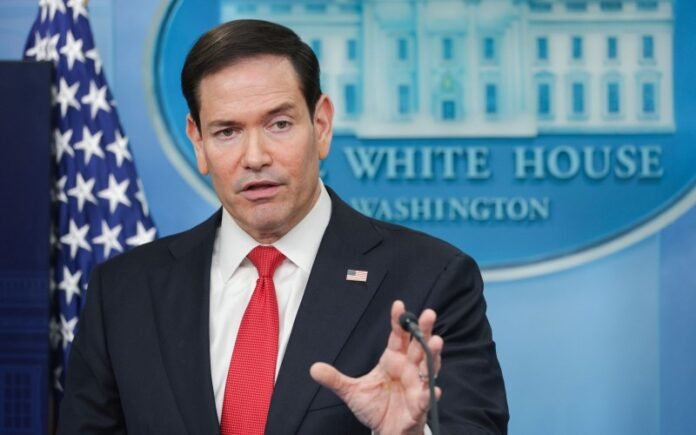
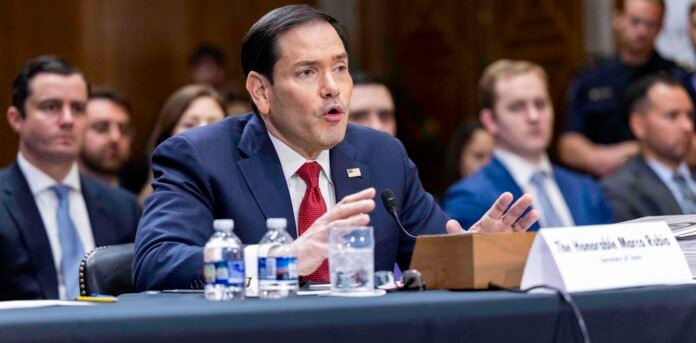
US Secretary of State Marco Rubio says Greenland is part of Denmark ‘for now’

0
us-secretary-of-state-marco-rubio-says-greenland-is-part-of-denmark-‘for-now’
US Secretary of State Marco Rubio says Greenland is part of Denmark ‘for now’


US Secretary of State Marco Rubio has reignited the flame over the US’s continued pursuit of Greenland.

While testifying before the House Foreign Affairs Committee on Wednesday, he was asked by congresswoman Sarah McBride whether he was “aware that Greenland is indeed part of Denmark”.

“For now,” Rubio replied.

Greenland has been a hot topic since US President Donald Trump’s return to the White House, with the president repeatedly arguing that Washington needs to acquire the Danish territory to bolster national defence.

“This enormous unsecured island is actually part of North America,” Trump said of Greenland while speaking at the Davos World Economic Forum in January. “That’s our territory. It is therefore a core national security interest.”

Trump has also warned that China or Russia could take control of the island if the US did not act.

On Wednesday, Rubio told the committee that the administration was involved in talks with both Greenland and Denmark over using the island for “collective defence,” saying that it was key to missile defence.

“We’re involved in those talks right now. I think we’re in a good place on it,” Rubio said.

The US is reported to have had 17 military facilities and more than 10,000 troops on Greenland at the height of the Cold War. It currently operates just one base on the island, the Pituffik Space Base, the US Department of Defense’s northernmost installation.

The US Space Force says Pituffik is used for missile warning, missile defense and space surveillance missions.

It comes after Trump’s special envoy to Greenland, Jeff Landry, said in May that he believed it was the time for the US to “puts its footprint back” on the island.

The Republican governor had previously sparked backlash among Greenlanders after he said his goal as envoy was to make the territory a part of the US.

The leaders of five political parties in Greenland’s parliament released a joint statement in January on the matter, making their position clear to both Washington and Copenhagen.

“We do not want to be Americans, we do not want to be Danes; we want to be Greenlanders,” it said.

The Real “Divide” Among Democrats Over Israel Is Between Party Leadership and Voters

0
the-real-“divide”-among-democrats-over-israel-is-between-party-leadership-and-voters
The Real “Divide” Among Democrats Over Israel Is Between Party Leadership and Voters


Adam Johnson is co-host of the Citations Needed podcast and author of “How to Sell a Genocide: The Media’s Complicity in the Destruction of Gaza,” out April 21 and available for preorder now.

As Israel’s standing in the U.S., and among liberals in particular, continues to crater, the mainstream American media is vaguely taking notice. But when they report on this increasingly potent political dynamic, national publications continue to frame it as a tension among Democratic voters — rather than a tension between Democratic voters and their party leadership. 

“A Democrat’s Dodge on AIPAC Points to the Party’s Tensions Over Israel,” read one recent New York Times headline. “Tensions over pro-Israel lobbying group highlight rifts in Democratic primaries,” read another Reuters headline. “Israel’s subsequent military campaign in Gaza has driven a significant, deeper-than-ever divide among Democrats,” NBC News reported last week. “The U.S.-Israel alliance has rapidly gone from a point of bipartisan consensus to a wedge issue dividing both parties,” opined the Washington Post.

All of those were just last month, but the false equivocation goes back further. “The Democratic primary electorate,” The Hill informed readers in March, “is increasingly divided over Israel.” “Israel tensions threaten Dems’ midterm plans,” Politico announced in a January headline, which continued in the piece: “Just as Democrats are finding their footing by focusing on affordability, their differences on Israel are threatening to tear them apart.” “New York City’s annual Israel Day Parade has long been considered a bipartisan tradition — but this year, the event is becoming a symbol of the growing divide within the Democratic Party over Israel,” Sinclair’s National News Desk reported last week. 

There’s only one problem with the “tensions,” “divided,” and “wedge issue” framing: It is not supported by any polls. The “divide,” such as it is, is increasingly not among Democrats or even liberals; it is between the supermajority of Democratic Party voters and party leadership. While party leaders such as House Minority Leader Hakeem Jeffries and Senator Minority Leader Chuck Schumer, and big Democratic donors, are pro-Israel, actual Democratic voters have moved on from Israel with remarkable speed and consistency. Let’s take a look at the polling:

  • According to an August 2025 Quinnipiac poll, 77 percent of Democrats think Israel is committing genocide in Gaza versus 11 percent who say it is not.
  • According to a May 2026 New York Times/Siena poll, 74 percent of Democrats oppose “providing additional economic and military support to Israel,” while 20 percent support doing so.
  • According to a June 2026 Institute for Global Affairs/YouGov poll, 67 percent of Democrats think the U.S. relationship with Israel does more to hurt the U.S. than help it, and only 5 percent think it does more to help than hurt. 
  • According to a May 2026 NBC News poll, 67 percent of Democrats now sympathize more with Palestinians than Israelis (17 percent). Just 13 percent of Democrats have a positive view of Israel, and 57 percent, a majority, have a negative view.

To contextualize that 13 percent — which is down from 34 percent of Democrats who said they viewed Israel positively back in 2023 — it’s even lower than the number of Democrats who say they support traditional right-wing stances, such as:

  • Allowing teachers to lead children in Christian prayers in public schools (18 percent, Pew 2024)
  • Making all abortions illegal (14 percent, Pew 2024)
  • Not mandating MMR vaccines in schools (14 percent, Pew 2025)

The media justifiably treats all of these issues as Republican or conservative-coded views. Yet support for Israel is still treated as a mainstream, if contested, liberal value.

In reality, it’s simply not: It’s overwhelmingly a Republican, right-wing view not backed by a supermajority of Democrats. So why has this consistently misleading narrative in U.S. media been allowed to persist? 

The Israel “divide,” such as it is, is increasingly not among Democrats or even liberals; it is between the supermajority of Democratic Party voters and party leadership.

There’s an obvious tension over Israel and the U.S. role in supporting it, which has been writ large in high-profile battles, from Democratic Senate campaigns to debates over the Democrats’ platform. The media has to cover that tension, but describing it more accurately — as a divide between party elites and the rank and file — is an awkward narrative, one that requires a deeper class and material analysis.

So instead, it’s just indexed under the misleading and generic label of “party divisions.” Naturally, Israel is not a 100–0 issue in favor of Palestine among voters, but no issue is that one-sided. A minority of Democrats support all kinds of relatively fringe, right-wing opinions. Here are some of them compared alongside the issue of Israel–Palestine. The percentage of Democrats who: 

  • Support sending military aid to Israel: 20 percent
  • Believe teachers should be allowed to lead children in Christian prayers in public schools: 18 percent
  • Say all abortion should be banned: 14 percent
  • Have a positive view of Israel: 13 percent
  • Support a ban on same-sex marriage: 11 percent
  • Believe Israel is not committing genocide in Gaza: 11 percent
  • Believe there is solid evidence of “widespread voter fraud in the 2020 election”: 10 percent

Polls are not a perfect snapshot of political beliefs and can be somewhat contradictory (a profile of the 2 percent of Democrats who think Israel is committing genocide and have a positive view of the country would make an interesting read). But polls over the past three years, and the last few months in particular, show a very clear trend that support for Israel is now an increasingly fringe belief among Democrats. It’s worth emphasizing that the issue of Democratic voters souring on Israel is not particularly sectarian, either, with Jewish Democrats, especially those under the age of 35, steadily abandoning Israel. A Washington Post poll from October found that among Jewish Americans ages 18 to 34, only 36 percent claimed to have an “emotional attached to Israel,” and half agree with the broad liberal consensus that Israel is committing genocide in Gaza.

But if watching how Democratic leadership and the party’s funders continue to back Israel to the hilt was your only barometer, you might assume there’s been no shift in public sentiment at all.

The dynamic is playing out over efforts to push a war powers resolution to end U.S. support for Israel’s bombing and occupation in Lebanon. On Wednesday, Axios, citing “numerous” anonymous “House Democrats” and “aides,” attempted to paint a Rep. Rashida Tlaib-led bill to end U.S. support as a provocation dividing Democrats. “An impending House vote to constrain the Trump administration from joining Israel’s war in Lebanon has some Democrats fuming that one of their own members is forcing them to take an agonizing vote,” reporter Andrew Solender lamented.

But what Solender fails to note is that Tlaib’s bill is overwhelmingly the majoritarian position among Democrats. A recent Arab American Institute commissioned poll found that 62 percent of Democrats “believe the U.S. should take more steps to pressure Israel to stop bombing and leave southern Lebanon,” and only 17 percent disagree. The substance of Tlaib’s bill is the Democratic voter position by almost 4 to 1. The tension in this story, such as it is, is between anonymous “Democratic leadership” and rank-and-file Democrats. And we know this because every single source in the Axios article opposing the war powers resolution had to be anonymous, while everyone supporting it proudly put their name on their quotes. What does this tell us about how popular support for Israel’s boundless violence in the Levant is? 

Democratic leadership, like its Big Donor base, is entirely out of sync with the current sentiment within the party.

Meanwhile, the American Israel Public Affairs Committee and other majority pro-Israel groups are well aware of the existential shift that’s underway and have responded by intervening in primaries at an unprecedented clip. Already in this midterm cycle, as Donald Shaw at Sludge reported, “four major pro-Israel committees — AIPAC’s PAC, its outside spending arm United Democracy Project (UDP), the closely aligned Democratic Majority for Israel (DMFI) super PAC, and the Republican Jewish Coalition’s Victory Fund — have poured nearly $50 million into congressional races nationwide.” Receiving money from AIPAC has become politically toxic for Democrats, so much so that the lobbying group is deploying an elaborate web of shell organizations to funnel money to their preferred candidates.

Still, AIPAC is heading into the midterms bigger than ever, and its allied super PAC has a staggering war chest of nearly $100 million on hand — up from $35 million in 2022, when AIPAC first began directing funding in congressional campaigns. Since then, it has spent over $221 million, not including the $100 million set aside for the 2026 midterms.

The two most powerful Democrats in the country, Jeffries and Schumer, are prominent and consistent backers of Israel, despite their party’s sizable shift. Jeffries was the largest recipient of pro-Israel money in the House last election cycle out of 435 voting members. And Schumer, who has explicitly said his “job” is to “keep the left pro-Israel,” spent last weekend marching in a pro-Israel parade in New York City alongside war criminals and self-identified “fascists.” Leadership, like its Big Donor base, is entirely out of sync with the current sentiment within the party.

It’s not just pro-Israel donors driving this “wedge.” Backing Israel and the endless arming of its military has been, and continues to be, a boondoggle for the broader U.S. military–industrial complex that captures the Washington consensus. Of the some $22 billion in military aid that Israel has received since October 7, 2023, roughly 75 percent has gone to U.S. arms companies that themselves employ an army of lobbyists and think tank boosters to promote Israel and its sprawling, seemingly never-ending expansionism and mass violence.

Despite 77 percent of Democratic voters saying Israel has committed genocide in Gaza, only 8.5 percent of Democrats in Congress have. Despite Democratic voters sympathizing more with Palestine than Israel at a ratio of 4 to 1, the number of Democrats in Congress who put the rights of Palestinians ahead of the interests of Israel could likely be counted on one hand. How long will our media continue to act like there is meaningful disagreement among Democrats, as such, when — among the rank and file — it’s an issue as settled as prayer in public schools, abortion, and climate change?

As the gap between the will of Democratic voters and its leadership grows more and more apparent, our media will continue to vaguely acknowledge this “division” without identifying the actual source of it. It’s not between the voters themselves, whose opinions are measurable and consistent, but between the voters and the leaders they elected — in theory — to represent their interests.

0FansLike
0FollowersFollow
0FollowersFollow
0SubscribersSubscribe
- Advertisement -
Google search engine

Recent Posts