Italians who took part in a humanitarian aid flotilla for Gaza said Wednesday that when the Israeli army attacked them last month in the Mediterranean in violation of international law, they abducted some activists, and subjected them to ill-treatment amounting to torture, Anadolu reports. “This time, the Israeli army responded to the flotilla much more violently” than in past humanitarian efforts, Antonio La Piccirella, who took part in the Global Sumud Flotilla’s 2026 Spring Mission, told a press conference in Rome. “There were two attacks, one of them off the coast of Europe. In the attack between Italy and Greece, they abducted two of our members, further violating international law. The other intervention was carried out in broad daylight and […]
Netanyahu’s Lawyer Michael Rabello Wins State Comptroller Post Amid Voting Controversy
Attorney Michael Rabello, the longtime personal lawyer of Prime Minister Benjamin Netanyahu, was elected Israel’s next state comptroller on Wednesday following a closely contested and controversial vote in the Knesset.
Rabello secured the position in a second-round vote after neither candidate met the required threshold in the initial ballot.
In the first round, retired Supreme Court justice Yosef Elron received 60 votes, while Rabello won 57. Under Knesset rules, a candidate must obtain 61 votes in the opening round to be elected.
The runoff ended with Rabello defeating Elron by a margin of 61 votes to 57.
The election process was overshadowed by over issues involving the secrecy of the ballot. Reports emerged that Likud lawmakers had been pressured to photograph or film their ballots to demonstrate support for Rabello, despite legal requirements that the vote remain secret.
The allegations triggered sharp criticism from opposition parties, which accused the ruling Likud party of operating like a “crime organization.”
According to reports, ministers suspected of supporting Elron were summoned to Netanyahu’s office during the vote.
Amid the controversy, Knesset Speaker Amir Ohana ordered the second round of voting to be restarted in its entirety. Ohana said any instruction requiring lawmakers to photograph their ballots was “illegal and invalid.”
The final tally differed from the earlier vote, indicating that some lawmakers changed their votes between rounds.
Opposition parties are expected to petition the High Court of Justice to overturn the election due to alleged irregularities.
Rabello has represented Netanyahu in numerous legal proceedings and has also acted on behalf of Netanyahu and his wife, Sara Netanyahu. In addition, he has participated in political negotiations connected to the prime minister.
The state comptroller serves as an independent oversight authority that reports directly to the Knesset. The office is responsible for auditing government ministries, monitoring local government activities, reviewing the financial affairs of political parties, and protecting the public interest.
Possible flesh-eating screwworm infection detected in South Texas, USDA says
A possible case of New World screwworm has been reported in South Texas. If confirmed, it would be the first detected breach of the US-Mexico border by the ravenous flesh-eating flies, which have been making their way up through Central America for the past several years.
In a social media post Wednesday afternoon, the US Department of Agriculture said a “sample is now at USDA’s National Veterinary Services Laboratories (NVSL) in Ames, lowa for confirmatory testing. We will provide updates the moment results are available.” It added that “We have already activated personnel on the ground and are working with local partners.”
Chatter of a screwworm detection had already been building this week, rattling the US cattle industry.
Although many animals, including humans, can be victims of the parasite, the screwworm is especially dangerous to livestock. Female screwworms lay hundreds of eggs in the wounds and openings of warm-blooded creatures, allowing their larvae to feast on the living animals, causing deep, festering, life-threatening wounds. Although the screwworm was once endemic to the US, it was eradicated amid a yearslong control effort in the 1960s. The USDA estimates that keeping screwworms out of the US has saved the livestock industry $900 million each year.
But the fly has broken through control efforts in Central America and has been inching closer. On May 28, a case was found 25 miles from the border in a 5-year-old goat in Coahuila, Mexico, according to the USDA. The case was one of many detected in recent days, including a case in a calf just 39 miles from the border, also in Coahuila.
Disputed detections
In a media call on Tuesday, Agriculture Secretary Brooke Rollins said, “There is no doubt that this is a very, very serious threat to our livestock.” But she also made disputed claims that the fly is closer or even already in the US.
On Monday, state Rep. Don McLaughlin (R-Texas) claimed on social media that a screwworm case was found just one mile from the Texas border, which Rollins and the USDA denied.
On Wednesday, Reuters reported that McLaughlin suspected the fly was now here. He said samples taken Tuesday from two calves on a ranch in La Pryor, Texas, were being tested as possible screwworm infections, including one infection on the umbilical cord wound of one of the calves. McLaughlin said he had seen images and videos of the animals and that the larvae seen in them looked like screwworm larvae.
Reuters was shown one of the photos, which it reported as showing “multiple larvae resembling the screwworm inside a bloody circular wound on an animal,” but said it “could not immediately verify the photo.”
“At this point, it’s unconfirmed that it’s the New World screwworm,” McLaughlin told the outlet. “It looks like it, but it’s unconfirmed.”
It is unclear, for now, whether the sample the USDA reported was one of the ones McLaughlin had reported. We will update this story if additional information is reported.
Screwworm comeback
Screwworms were once endemic to the US, but were eradicated in the 1960s amid a concerted effort to annihilate their population. This is done with aerial bombings of sterile male flies, which is the most effective weapon against the parasites. The mass release of dud studs elbows out fertile males, preventing them from mating with females, which generally only mate once.
With this method, called Sterile Insect Technique, the flies were eradicated not just from the US, but from all of Central America. They were declared eradicated from Panama in 2006.
Until recently, the screwworm population was kept at bay via a biological barrier along the Darién Gap at the border of Panama and Colombia. The USDA partnered with authorities in Panama to build a sterile fly production facility at the gap to regularly release sterile flies and hold the line. But in 2022, the barrier was breached, and the flies have been relentlessly buzzing northward since.
In response, the US has expanded surveillance and trapping efforts in Texas. It is also constructing a $750 sterile fly production facility in South Texas. USDA says it is currently dispersing 100 million sterile insects per week in Mexico and along the US-Mexico border to prevent the flies from advancing further.
European Parliament and Council Seek Compromise on Passenger Rights Package
Co-legislators from the European Parliament and the Council of the EU paused negotiations on the air passenger rights reform on Wednesday morning without reaching a deal, but agreed to resume talks in the afternoon.
Negotiations ended at 5 a.m. after 16 hours of inconclusive discussions on several parts of the reform, including the delay threshold granting the right to compensation and the level of compensation passengers would receive.
Council and Parliament tried unsuccessfully to agree on a flat compensation amount, regardless of flight distance. But the idea failed to convince many countries, while MEPs pushed to raise the amount to €350 and include an inflation-adjustment mechanism, making the proposal even less attractive to governments already skeptical of higher compensation costs.
Besides compensation, co-legislators must also decide on the introduction of pre-completed forms that airlines could be required to send passengers in the event of delays and/or cancellations.
The forms, intended to make it easier to claim compensation, are expected to increase costs for airlines, given that currently only around half of eligible passengers submit claims.
Co-legislators could provisionally agree to require airlines to include a carry-on bag in the basic airfare, in addition to the personal item stored under the seat. Passengers would then be allowed to opt out of the second bag in return for a discount.
Talks on the reform — being conducted through trilogues and the conciliation procedure — were set to resume on Wednesday at 1 p.m.
On any given night, thousands of people sleep on the streets in Portland, Oregon. They seek shelter in tents, bushes and overpasses in a city that has struggled with one of the worst housing crises in the country.
Portland, like many cities, has raced to increase its supply of affordable housing by turning to a federal program that’s existed since the 1980s: the Low-Income Housing Tax Credit. It provides up to $15 billion worth of tax credits a year nationally to help developers build apartments. Portland supplemented the federal construction money with local dollars, creating incentives that were hard to turn down.
But to meet the affordability requirements, all the developers needed to do in most cases was put rents within reach of someone earning 60% of median income, an earnings threshold that equates to about $75,000 annually for a family of four. It turns out that this amount of rent is now close to what the typical Portland landlord charges without any subsidy.
The result of the federal tax credit has been a glut of apartments costing renters on the order of about $1,400 a month for a one-bedroom. That’s a manageable outlay for a family making $75,000 but nearly half the monthly income of someone who earns $35,000 at the local minimum wage.
Economists and other academic researchers have been warning for decades that this was precisely the sort of problem that the Low-Income Housing Tax Credit was likely to create.
Studies have concluded that the program, which currently supports nine out of every 10 subsidized units built in America, is an expensive and ineffective way to house people who can’t afford it. Researchers have said it doesn’t subsidize housing deeply enough to reach truly low-income renters, so it produces housing in markets and at income levels that already have a surplus instead of filling a shortage.
Independent researchers have found little evidence it’s expanded the overall housing supply beyond what the market would have produced without it. Its complexity has birthed an industry of affordable-housing-focused developers, investors, lawyers and accounting specialists who profit off the tax credit. Between 1991 and 2024, a dozen studies concluded that many more people could benefit if the money were spent on rental vouchers, which let consumers, rather than the government, decide which landlords get tax subsidies. Estimates went as high as twice the impact for the dollar.
“The evidence is telling us this program is lacking its reason to exist,” said Kirk McClure, an emeritus professor of urban planning at the University of Kansas and a leading critic of the tax credit. “We should reform the program to make it work better.”
McClure and others have brought their concerns to Congress. He recommended diverting the money into rental vouchers for tenants, or else changing the tax credit’s rules to reward only developers who build units in genuinely short supply: those affordable to people at the very bottom of the income ladder.
The ideas never went anywhere. Instead, money for the tax credit has grown at a much faster rate than rental assistance vouchers since 2000, data from the U.S. Department of Housing and Urban Development and the U.S. Treasury shows. Rock-solid support from industries that benefit from the tax credit and both parties in Congress has made it the linchpin of U.S. housing policy.
“The program leverages housing market forces, entrepreneurial innovation and private accountability to increase housing supply,” former HUD Secretary Ben Carson told the House Committee on Oversight and Government Reform in 2025.
Among the tax credit’s other prominent backers are two Northwest Democrats on the Senate Committee on Finance, Ron Wyden of Oregon and Maria Cantwell of Washington. Cantwell has introduced bills to increase funding for the existing tax credit, and Wyden has proposed expanding the target of the credits to benefit not just low-income families, but also middle-income households — the opposite of what McClure says needs to happen.
Both Wyden and Cantwell say Congress should hold more hearings to ensure the program is run efficiently, but they also defended it in written statements to Oregon Public Broadcasting and ProPublica.
“There isn’t any silver bullet to the housing crisis in Oregon and around the country,” Wyden’s statement said, “but the low-income housing tax credit has been the most successful federal housing construction program on the books for decades and is the only housing program Republicans haven’t tried to gut.”
Oregon Sen. Ron Wyden has proposed expanding the target of the credits to benefit not just low-income families, but also middle-income households — the opposite of experts’ advice.Francis Chung/Politico via AP Images
Indeed, President Donald Trump has sought to cut housing programs such as rent assistance. But as part of his spending package last year, Congress approved the biggest expansion of the Low-Income Housing Tax Credit in decades.
“That’s a mistake,” McClure said.
It won’t alleviate homelessness or the housing shortage for people at the lowest incomes, he said. It will just create more buildings that compete with the market and with one another for the same pool of renters.
McClure recounted seeing a brand-new affordable housing complex near his home in Kansas not long ago with a sign enticing tenants of another government-backed complex down the street, promoting newer units at the same price.
“So the taxpayers of the United States subsidized the creation of this new property to help bankrupt another federally subsidized property,” he said. “That is stupidity 101. We have got to be better stewards of the American taxpayer’s dollar.”
Subsidized Vacancies
Oregon’s affordable housing production has skyrocketed in recent years. So have rents and homelessness.
Over the past decade, Oregon lawmakers doubled funding for the state’s affordable housing tax credit and started offering low-interest and deferred loans for construction.
Voters in the Portland area, meanwhile, passed housing bonds totaling more than $900 million. Developers can use that money to secure federal housing tax credits. The state went from building about 1,800 affordable units a year pre-pandemic to nearly 5,000 last year.
Industries that benefit from the tax credit say it’s the engine that makes that kind of building boom possible.
The Affordable Housing Tax Credit Coalition, representing lenders, developers and others in the industry, has called the program “the most effective tool we have to meet the affordable housing needs in rural, suburban, and urban areas.”
Jennifer Schwartz, director of tax and housing advocacy for the National Council of State Housing Agencies, which advocates for the tax credit and other housing programs administered by states, said the housing market by itself won’t produce a big enough supply of housing within reach for low-income renters. That goes for even those who receive federal rent vouchers, she said.
“It costs too much to build housing to turn around and rent it to households who are low-income households,” Schwartz said, “unless you have some sort of incentive like the housing credit.”
But in Portland, all that new construction hasn’t made a dent in the city’s affordability crisis. A report from the Portland Housing Bureau in 2025 found that rent and home sale prices were growing faster than incomes, even as the city’s vacancy rate was also rising.
The vacancy rate was roughly 7.6% as of May, according to Aaron Kirk Douglas, director of market intelligence at the Portland-based brokerage HFO Investment Real Estate. Vacancies are even higher for ostensibly affordable units: 11%, leaving nearly 2,000 units unused. Housing industry experts consider 5% vacancy to be a baseline for ordinary turnover.
The time it takes to verify that a tenant’s income meets the tax credit’s requirements and prep units for move-in played a role in the struggle to fill vacant units built with the federal subsidy. But housing advocates say the biggest barrier is price.
The gap between market-rate rents and affordable housing rents has shrunk, and not just in Portland.
By one industry estimate, in more than a dozen U.S. cities at least 40% of affordable housing was competing with market-rate buildings rates in 2025.
In the Portland suburb of Gresham, federal rules cap a two-bedroom apartment built with the Low-Income Housing Tax Credit at $1,675 a month. Zillow puts the equivalent market-rate apartment at $1,525.
Operators of a new $53.8 million development in northeast Portland, built with the tax credit and the local housing bond, had trouble filling studio and one-bedroom apartments whose affordable rents were near market rate. They began offering a month of free rent for new tenants, according to a March report from the committee that oversees the region’s housing bond.
Affordable housing providers, which in Portland are predominantly nonprofit organizations, are also increasing their marketing budgets to attract renters away from market-rate buildings.
“The idea that we’re competing with the market would have been unfathomable a few years ago,” said Margaret Salazar, CEO of Reach Community Development Corporation, one of Portland’s largest affordable housing providers.
Salazar, who led Oregon’s state housing agency during the COVID-19 pandemic and later worked as a regional director for HUD, is a longtime proponent of the Low-Income Housing Tax Credit. But she said the people who can afford to rent apartments the tax credit has produced would rather move into a market-rate apartment for similar money and with fewer rules and restrictions.
“It’s becoming a slimmer and slimmer slice of residents” that Reach can serve, she said. “Suddenly we’re competing for this little slice of people.”
Meanwhile, a substantial group of Portland-area residents remain priced out.
HUD data shows more than 90,000 households in Multnomah County earn less than the 60% of median income that a family would typically need to afford a federally subsidized unit. (The precise number of families who can’t afford “affordable” units is unclear because it depends on variations in household size, actual rent levels and other subsidies that might reduce rents further.)
Salazar said that right now Reach can rent to people at lower income levels only if it can find additional subsidies such as housing vouchers — and funding for vouchers is so limited that only 1 in 4 people who qualify are able to get them.
Despite the convergence of rent levels in market-rate and subsidized housing, supporters of the tax credit say it remains valuable because the units it subsidizes are constrained from raising rents faster than incomes — and there’s no guarantee market-rate rents will remain at this level in the future.
But Steve Rudman, who ran the local housing authority in the Portland area for more than a decade, said the fact that the tax credit is now delivering market-rate housing rather than housing for the poorest households raises an existential question for the federal program.
“What is this thing really doing?” Rudman said. “What is the Low-Income Housing Tax Credit?”
A Stopgap Takes Off
Criticism of the federal construction credit has been a near constant since it began.
In the Reagan era, housing experts began to worry rents would become unaffordable amid deep cuts to housing programs and the drafting of the Tax Reform Act, which eliminated several tax shelters for real estate.
McClure, an economist for the city of Boston at the time, worked with others to design a tax credit that would reward affordable housing production.
“It was meant to be a three-year stopgap until we came up with something better,” he said.
The idea was to incorporate low-income housing into market-rate housing construction that was already taking place. Developers could receive a tax credit if they capped rents for a certain portion of the apartments in their building, and they could continue to rent the rest at any amount they chose.
McClure crafted letters for Boston’s mayor to send Congress in support of the idea. His analysis helped decide the subsidy amount. Developers could offset 70% of the cost of new builds or 30% of the cost of a rehab. Congress signed off in 1986.
Almost immediately, the program diverged from the outcomes McClure had envisioned.
Kirk McClure, one of the drafters of the Low-Income Housing Tax Credit. For decades, he’s been calling for reforms to the policy.Arin Yoon for ProPublica
He and other drafters of the tax credit had thought developers would use it to offer deep discounts on a small number of units, allowing them to charge market rate on the rest. But developers found it more profitable to subsidize 100% of their units at the smallest allowable discount, a rent affordable to households at 60% of median income.
In 1992, as lawmakers considered making the 6-year-old Low-Income Housing Tax Credit permanent, an analysis by the Congressional Budget Office declared the program “unlikely to substantially increase the supply of affordable housing” and “more suited to the needs of investors than poor renters.”
For one, the tax credits cost a lot to administer, congressional economists said. They also pointed to evidence that subsidized housing production dampened market-rate construction.
Congress was preparing to give developers $3 billion through the tax credit as of 1992. Putting that money into housing vouchers instead, the CBO concluded, would help 550,000 households, more than twice as many as would benefit from the construction tax credit. The numbers echoed findings from an earlier HUD evaluation of tax credits vs. vouchers.
Congress made the tax credit permanent a year later.
As time wore on, McClure’s emerging doubts about a program he originally expected to be temporary only deepened.
When the Fannie Mae Foundation hired him in 1997 to analyze how the tax credit was doing, he concluded it was a “very inefficient subsidy delivery mechanism” that didn’t produce as much housing as it should have.
Other studies came to similar conclusions as McClure, HUD and the Congressional Budget Office. At least five found the tax credit does little to increase the overall housing supply.
The Government Accountability Office noted problems with the program in 2015, 2016, 2017 and 2018, finding it lacked basic oversight to show the federal funds worked as intended. A 2017 investigation by NPR and Frontline documented numerous examples of waste and fraud, including one developer pocketing tax credits without building the required housing.
“Given the available evidence on program performance, we should certainly not expand the tax credit program,” Edgar Olsen, professor emeritus of economics at the University of Virginia, wrote in a 2017 article for the American Enterprise Institute. “The existing evidence argues for terminating it.”
There are some critics within Congress. Rep. Glenn Grothman, a Republican from Wisconsin, introduced a bill to kill the program last year, calling it a “cash grab for developers and banks.” But the bill went nowhere.
Olsen, like McClure, remains adamant today about what he considers the tax program’s uselessness. In a recent interview, he told OPB and ProPublica that he’s urged policymakers, in academic articles and in testimony, to re-examine whether the program has any value at all.
“How often do they talk to people like me or like Kirk McClure? The answer is almost never,” Olsen said. “What they hear from are people who represent the financial interest of the industry, and so they want more money to be spent on this.”
Princess Diana’s Heartbreaking Letter to William and Harry Revealed
Princess Diana once hoped her two sons would grow up learning how to speak to each other in a deeper, more meaningful way.
Now, nearly three decades later, those words feel more heartbreaking than ever.
A never-before-seen letter written by the late Princess of Wales in November 1995 has revealed Diana’s private hope for Prince William and Prince Harry, long before the brothers’ relationship collapsed into one of the most talked-about royal feuds in modern history.
The two-page handwritten letter was sent to a fan named Michael Barratt, who had reached out to Diana with words of support after her explosive BBC Panorama interview.
That interview, which aired in 1995, stunned the world. Diana spoke openly about the breakdown of her marriage to then-Prince Charles, including the now-infamous line about there being “three of us” in the marriage.
According to Reeman Dansie’s “Royalty, Antiques & Fine Art” auction, Diana wrote in the letter that she had been deeply touched by Barratt’s message and his words about self-knowledge and moving forward in life.
But one detail in the letter now stands out in a painful new light.
The auction house said Diana wrote about looking toward the future and “sharing with and teaching William and Harry the importance of communication on a deeper level.”
It was a mother’s wish for her boys.
Today, that wish appears tragically unfulfilled.
William, now 43, and Harry, now 41, are reportedly no longer on speaking terms after years of tension, public accusations, and royal drama.
Diana ended the letter simply, writing, “With my best wishes, Yours sincerely, Diana.”
The letter, which comes with its original envelope featuring Diana’s handwritten name and address, is expected to sell for between $4,000 and $6,000.
Diana died in a car crash in Paris in August 1997. She was just 36 years old.
The resurfaced letter comes as the feud between William and Harry remains one of the saddest and most sensational chapters in the royal family’s recent history.
Royal author Christopher Andersen, who wrote “KATE! The Courage, Grace, and Power of the Woman Who Will Be Queen,” recently told Page Six that tension between the brothers went all the way back to childhood.
He claimed the two had friction “ever since they were small children, wrestling in the back of the car.”
Andersen also said it had been made clear to Harry from a young age that he was “lesser than” William because William was the future king.
That, Andersen claimed, “left a real mark” on the brothers and helped doom their relationship.
The royal rift exploded after Harry and his wife, Meghan Markle, stepped back from royal duties in 2020 and moved to North America with their son, Prince Archie.
The fallout only deepened after Harry and Meghan made allegations about royal life, including claims of racism within the royal household, and later released their Netflix series detailing their struggles behind palace walls.
Then came Harry’s 2023 memoir, “Spare,” which sent shockwaves through the monarchy.
In the book, Harry claimed William physically attacked him during an argument over Meghan.
While Harry has taken some steps toward repairing his relationship with his father, King Charles, including an almost-hour-long meeting last September, his bond with William appears frozen.
For royal watchers, Diana’s newly revealed letter is a haunting reminder of what she wanted most for her sons.
Long before the headlines, interviews, lawsuits, books, and palace drama, Diana hoped William and Harry would learn to communicate from the heart.
Instead, the brothers she once held so close are now living separate lives on opposite sides of a bitter royal divide.
Between assurances from President Donald Trump that a peace agreement is all but wrapped up and renewed skirmishes, the price of oil rises and falls. Even at recent lows, crude’s price is 40% higher than in late February when the Iran war began.
Someday – tomorrow? next week? next month? – the United States and Iran may announce an agreement to end the war. Odds are it will leave decisions on gnarly issues like Iran’s uranium stockpile and the lifting of sanctions for later talks.
Still, an agreement could be good news for farmers, who’ve been squeezed by higher fertilizer and diesel prices, and drivers, who’ve been experiencing shell shock at the pump. I say “could” rather than “would” for two important reasons.
First, the Strait of Hormuz is Iran’s main leverage in the continuing talks. No one should expect the Iranians to give it up entirely. Even if they agree to “open” the strait and promise not to charge tolls, they could maneuver to retain at least some control. And having demonstrated the ability to close the strait, they can always close it again.
Second, even if the Iranians don’t play games with the opening, oil shortages are likely to continue. It will take weeks to sweep the mines. It will take months to resume production at shut-in oil wells. It will take years to repair the damage to Middle East refineries, pipelines and other oil and gas facility casualties of the war.
Talk of a peace agreement pushes oil prices down, renewed hostilities push them up, but even when they’re down, they’re much higher than they were a few months ago. Chart: DTN ProphetX
And all this assumes an agreement will be reached soon. It could take longer. The negotiations have been difficult, at least in part because each side is convinced it holds the cards and can wait the other out.
President Donald J. Trump’s team thinks the pummeling we’ve given Iran’s economy has left it in such catastrophic shape that the Iranians will have to sweeten their terms. The Iranians think Trump can’t afford to go into the midterm elections with gas prices high. Which side has the greater tolerance for pain?
By all accounts the president wants an end to the war. There have been reports that he’s “bored” with it. Frustrated is perhaps more accurate. The war hurts him politically. It’s beginning to feel like a quagmire, the kind of thing candidate Trump promised to keep the country out of.
It’s unlike quagmires past, however. It’s only lasted three months, and more than half of that period has been a ceasefire. Earlier quagmires went on for years and took thousands of American lives.
Still, this war qualifies for inclusion on a different dishonor roll. It’s yet another demonstration of how difficult it can be for a great power to triumph over a seemingly much weaker power.
Among the other examples are the US failure to defeat Vietnam, the Soviet Union’s inability to subdue Afghanistan and the agonizing US wars in Iraq and Afghanistan this century. And then there’s Russia’s invasion of Ukraine, which has now gone on longer than the Soviet Union’s World War II.
A digression:
The Russians have been aiding Iran with intelligence and materiel. Trump’s critics cite this as an example of how little the US benefits from the president’s bromance with Vladimir Putin.
The critics have a point but, if Trump were to push Putin, Putin could respond that he’ll stop helping Iran when we stop helping Ukraine – which we still are doing, though not anywhere near as much as in the past.
The Chinese, meanwhile, are aiding everyone, though some more than others. The drones that all of the parties use in both wars – the Russians, the Ukrainians, the Iranians and, yes, even the US – contain critical Chinese components.
End of digression.
If Trump tires of the ceasefire failing to produce a deal, he can renew the bombing. It’s far from clear that would make the Iranians buckle, though. He could try to steal the Iranians’ uranium – or help the Israelis do it. But if that heist were easy to pull off, it would already have been tried.
Yet another military option is to try to open the Hormuz Strait by force, using US Navy ships and planes to escort non-Iranian commercial shipping. This would involve bloodshed; success wouldn’t be guaranteed.
If it did succeed, though, it would undermine Iran’s negotiating leverage – its ability to keep world oil prices high by keeping the strait bottled up. Iran would be unable to ship its oil, improving the odds that a starved-out Iran is forced to give up its nuclear ambitions.
For now, Iran has a chokehold on the strait – and the effects are felt ’round the world.
Google’s new Gemma 4 12B model is designed to run on any laptop with 16GB of RAM
The generative AI boom has driven the cost of memory into the stratosphere, and Google is a key part of that trend. So it’s only fitting that Google should offer some less RAM-hungry local AI models. The company has announced the release of a new Gemma 4 model that fills a gap in the lineup that launched earlier this year. The new model is efficient enough that you may be able to run it on a pretty average consumer laptop.
In April, Google released four models in the Gemma 4 family, which also marked the shift to a more open Apache 2.0 license. The initial models included two mobile-optimized options (E2B and E4B) along with a pair of models for more serious work (26B Mixture of Experts and 31B Dense). That left a rather large unserved space in the middle, which is right where the new model falls.
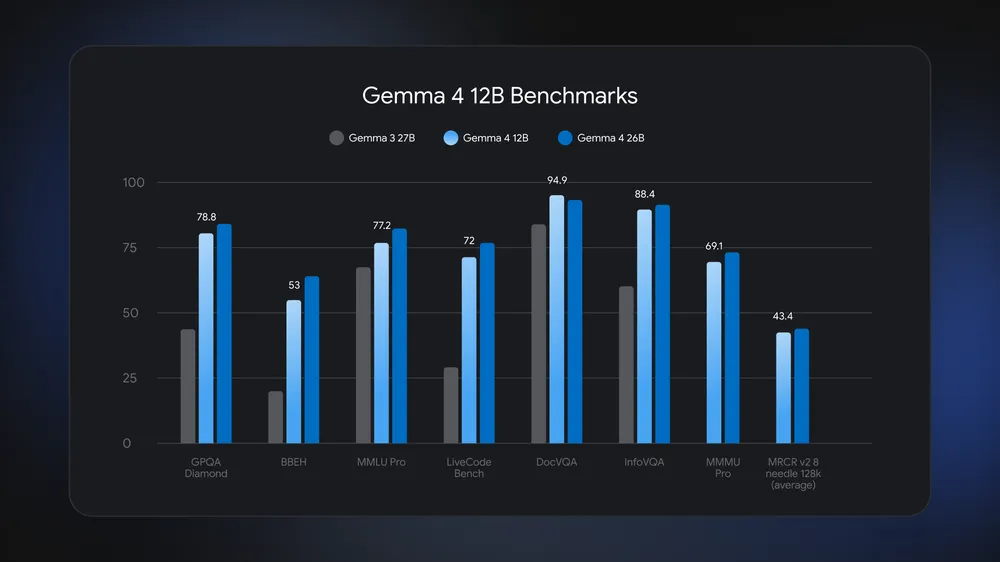
Gemma 4 12B is considerably more capable than the mobile versions, but it won’t require a $20,000 AI accelerator to run locally. Google says Gemma 4 12B is unique in that it can run on many consumer laptops without sacrificing quality. As long as you’ve got a computer with 16GB of system RAM or VRAM, the 12-billion-parameter model will work. That’s about half the total memory footprint of Gemma 4 26B MoE, and Google claims the new model is almost as capable, at least as far as benchmarks go.
Gemma 4 12B is almost as capable as the version with 26 billion parameters.
Credit: Google
Gemma 4 12B is almost as capable as the version with 26 billion parameters. Credit: Google
Google says the new model is capable of complex multistep reasoning and agentic workflows that previously required the larger Gemma variants. Despite the smaller parameter count, Gemma 4 12B comes with the newly devised Multi-Token Prediction (MTP) drafters, which take advantage of unused processing cycles to calculate possible future tokens. The result is greater speed and efficiency. Google has released optional MTP versions of the other Gemma 4 models, but this is the first one to have MTP out of the box.
Gemma 4 12B is also more efficient thanks to a new approach to multimodality. The Gemma 4 family is natively multimodal, accepting text, audio, or images as inputs. Most gen AI models—including the other Gemma 4 variants—use dedicated encoders to process non-text inputs and pass that data to the LLM. This works well enough, but it increases latency and memory usage.
With the new mid-weight model, Google has implemented a streamlined embedding module for vision, featuring single-matrix multiplication and positional embedding, which allows the data to pass to the LLM with proper spatial awareness. This eliminates the need for a bulky middleman encoder. For audio, there’s no encoding at all. The developers worked out a method of projecting the raw audio signal into the same vectors used for text tokens.
Gemma 4 12B Demo
If you want to check out the new Gemma 4 model, it’s accessible without a download via tools like LM Studio, Google AI Edge Gallery, and more. But the whole idea with Gemma 4 12B is that you can run it locally and on your own terms. If you’ve got the RAM, the model weights are available for download immediately on Kaggle and Hugging Face. It’s just shy of 18GB.
New York backtracked on its climate goals. Here’s why.
Last week, New York became the first state in the country to weaken a mandatory climate law passed by its own legislature.
The change comes at the behest of Governor Kathy Hochul, a moderate Democrat who has often criticizedclimate action for increasing consumer costs. After months of backroom negotiation, the legislature reached a deal that weakens the 2019 law in several different ways — most notably by giving the state an additional decade to meet legally-required emissions targets.
The original law, one of the most ambitious in the U.S., required the Empire State to reduce its greenhouse gas emissions by 40 percent before 2030. (The state used its 1990 emissions as the baseline for comparison, per standards set by the United Nations.) Thanks to the law’s uniquely strict accounting rules, the only way for the state to meet this target was to shift away from natural gas, which provides most of the state’s electricity and almost all its heating fuel.
But as the 2020s progressed, New York failed to wean itself off of gas. The reason for that depends on who you ask. Some argue that President Donald Trump’s attacks on renewable energy have slowed the state’s progress, and others believe that state politicians have backed natural gas when they could have invested in more clean energy. Either way, the state fell way behind schedule, and it stood no chance of meeting its 2030 goal without dramatic action that would have taxed or banned consumption of fossil fuels.
Besides delaying the 2030 deadline by 10 years, the deal will also change the law’s accounting to give less weight to natural gas, and it will slow the rollout of a cap-and-trade system, which would force polluters to bargain with each other to stay below a hard limit on total emissions. Hochul has defended these changes as an attempt to protect New Yorkers from rising costs, blaming Trump for the state’s slow progress. She has warned that meeting the state law’s ironclad emissions target — something a court ordered her to do last year — would require huge pollution taxes that would end up inflating utility bills and gasoline prices, imposing thousands of dollars on the average household. (The budget deal also includes language that would require the state to consider the impact of its climate regulations on household budgets.)
Legislators and climate activists who support the original climate law said Hochul pushed the changes without giving lawmakers a chance to discuss a path forward for climate action in the state.
“This really came out of nowhere, it was sprung on us, and it was difficult even to understand what was happening,” said Marcella Mitaynes, a progressive state assembly member who represents a swath of waterfront neighborhoods in Brooklyn with many working-class residents.
Some experts who study decarbonization in New York said that the state’s legally binding emissions target had become virtually impossible to hit given broader headwinds against a national or global transition away from fossil fuels.
“It was going to be really difficult to meet, because the economy wasn’t cooperating,” said Al McGartland, who served as the chief economist at the Environmental Protection Agency from 2005 to 2025. McGartland, an expert on carbon taxes, said that the change to the law is “not all bad because I think it does buy time to think this thing through carefully, and do it right.”
The biggest change is delay. The budget deal sets a new target of reducing the state’s emissions 60 percent by 2040, a number that the governor’s office says is far more achievable than the 40 percent originally required by 2030. It also delays the launch of a “cap-and-invest” system, which was supposed to launch last year, until 2028. This system would assess new fees to polluters such as power plants and oil terminals and would funnel that revenue toward climate projects such as electric-vehicle chargers and heat pumps. Many climate experts believe such systems are the most efficient way to nudge an economy away from fossil fuels, but Hochul had grown concerned that the system would raise gas prices and utility bills at a time when many consumers are already struggling with fuel prices.
The deal also makes two important changes to the way the state counts its emissions. Under the old system, New York had to account for the climate pollution associated with extracting the fossil fuels that it imports from other states. For instance, when a natural gas field in Pennsylvania leaked planet-warming methane before piping the gas to New York, the latter state had to count those leaks as its own pollution, in addition to that caused by burning the fuel for energy. Most other states don’t do this. Once New York makes this change, it will reduce its apparent emissions by about 15 percent overnight — a result of the fact that the state imports most of its natural gas.
This dynamic was compounded by the fact that the state’s old accounting system also gave extra weight to methane, which is the second most common greenhouse gas after carbon. Methane warms the Earth about 80 times faster than carbon dioxide, but it disappears from the atmosphere after around 20 years. Most countries evaluate their greenhouse gas emissions by considering the warming that will take place over 100 years, but New York only considered 20 years of warming, which makes methane look much worse compared to carbon.
The 20-year outlook benefited certain polluting sectors and disadvantaged others. Under the new system, for instance, the warming impact attributed to the state’s livestock industry and its landfills will fall by two-thirds. Unlike the accounting change for imported fuels, however, the change to a 100-year framework can be defended as ultimately more climate-conscious: The 100-year framework is the standard used by the United Nations climate secretariat that administers the Paris Agreement, and many climate scientists have criticized the state’s 20-year framework for distorting the true costs of warming. (The reason, in short: If you have a system that prioritizes methane over carbon, you may limit some warming in the short-term while baking in much more in the long run.)
But even with these changes, the state still won’t be on track to meet its original 2030 goal. That’s because it has made little progress on the biggest sources of carbon: cars, power plants, and residential buildings.
Natural gas provides around 50 percent of the state’s electricity, and it is the heating fuel for almost all the big apartment buildings in New York City and its suburbs. In order to fully ditch fossil fuels, the state will have to convert all those buildings to electrical systems like heat pumps. And then it will still have to replace all its natural gas-fired power plants with emissions-free sources like wind and solar.
These are both very difficult tasks. For one thing, electrifying a place like New York is expensive. The cost of replacing gas boilers with electric heaters in a century-old apartment building can run into the tens of millions of dollars, and landlords have been struggling to find that money without bankrupting their tenants. The New York City Council has passed its own law, Local Law 97, that requires large buildings to make the switch by 2030 or face steep fines. But some building owners have said the fines might still be cheaper than the cost of making the switch.
The law’s 2030 target provides an powerful spur to decarbonization even if some buildings will struggle to meet the deadline, said John Foley, an executive vice president at First Service Project Management.
“The goals may be difficult to reach, but they’re important to have,” said Foley, whose firm handles construction projects for a large portfolio of multifamily buildings. He said that while new heat pump technology has made decarbonization easier for some buildings, meeting the Local Law 97 target will depend on the state’s grid.
“The solution seems to be going towards electrification a lot more, and in order for electrification to be the answer, then you have to produce energy in a cleaner way,” he said.
Steam rises from the smokestacks of the Ravenswood Generating Station, the largest power plant in New York City. The state has struggled to build out enough clean power to replace its natural gas power plants. Photo by Andrew Lichtenstein / Corbis via Getty Images
Finding clean sources of electricity to replace gas-fired power plants has also been an uphill battle. A new transmission line carrying clean power from hydropower dams in Canada down to New York City will come online this month, but it was delayed for years by litigation and environmental permitting. Two major offshore wind farms, Empire Wind and Sunrise Wind, will also come online this year, despite the Trump administration’s attempts to block them. But they will only displace a fraction of the state’s gas supply, and won’t provide much power in the summer when demand is highest. (Coastal winds tend to be calmest in the summer when the oceans are hot and there are fewer storms.) Plus, developers have shown little interest in building more offshore wind farms due to Trump’s opposition.
Some of the challenges, however, are of the state’s own making. The state made its own electricity grid much more polluting when it closed the Indian Point nuclear power plant in 2011 due to environmental concerns. After the plant closed, the state had to import more gas to make up the loss.
The borough of Brooklyn, where residents who live near seasonal power plants complain of asthma and respiratory conditions, shows just how difficult this transition is. The state has been trying for almost a decade to close the particularly dirty “peaker” gas plants that turn on to provide power during the hot summer months when electricity demand is highest and not enough power is available from other sources. But even once the new Hudson transmission line and Empire Wind come online, the state’s independent grid operator says New York City could still need those peaker plants to avoid blackouts come 2031.
“To me, the heart of the climate law was really to invest in our communities and reverse this legacy of pollution,” said Mitaynes, the Brooklyn assembly member who represents residents who live near such peaker plants, like the Gowanus Generation Station. She said that the delayed cap-and-trade system would have funneled 35 percent of its revenue toward disadvantaged communities. That money could help address poor air quality and support the buildout of an offshore wind manufacturing facility on the waterfront. “This law really set us up as leaders, and [Hochul] has taken this opportunity to dismantle it,” she said.
Hochul spokesperson Ken Lovett said the changes are “commonsense reforms” and that the governor “remains committed” to climate action.
“Governor Hochul has made clear her top priority is keeping the lights on and costs down for all New Yorkers,” he told Grist.
The state is still making investments in decarbonization: One state agency is investing heavily in large batteries that could store clean energy and thereby replace some natural gas capacity, and another will purchase $100 million in new renewable power this year. The state budget also increased a tax credit for New York City landlords that electrify their buildings. The budget deal also ups the proportion of future cap-and-trade revenues that will go to disadvantaged areas.
But other than that, Hochul has shown little interest in a plan for the state’s transition off of gas. Indeed, she appears to have decided that the state will need gas for the long run. Last year she approved water permits for a new Trump-backed pipeline project that will carry natural gas from Pennsylvania to Queens. The pipeline endorsement was part of a deal to protect the Empire Wind project from Trump’s interference, but Trump’s Interior Department attempted to stop Empire Wind a few months later anyway.
The new gas pipeline broke ground in April at a ceremony in Brooklyn attended by Trump administration Secretary of Energy Chris Wright, Interior Secretary Doug Burgum, and Environmental Protection Agency head Lee Zeldin. Hochul herself did not attend.
Oil ‘powder keg’: Trump says Hormuz blockade may last all summer
Image: AOL.com
US President Donald Trump on Wednesday tried to project optimism about reaching a deal to end the illegal war he started against Iran, even while acknowledging the crisis could last for several more months.
In an interview with The New York Post, Trump was asked whether the current blockade of Iran would last until Labor Day, which falls on September 7 this year.
“I don’t know,” Trump said. “I mean, I think it could be, but I think it’s unlikely.” He added, “I think this will resolve itself fairly quickly.”
The president for the last several months has managed to keep oil prices from spiking to disastrous levels by dropping hints that his illegal war will soon be over, even though it has continued with no end in sight.
And while the Trump administration has insisted that its ceasefire deal is still in effect, CNN reported on Wednesday that Iran launched attacks against US military bases in Kuwait and Bahrain after US forces fired a Hellfire missile at a Botswana-flagged oil tanker that was heading toward an Iranian port.
Iran also launched drone and missile strikes at Kuwait’s international airport, killing one person and leaving dozens injured, according to Al Jazeera.
Oil industry expert Patrick De Haan on Tuesday warned that the price of oil will soon shoot back up if the Strait of Hormuz remains closed because US petroleum supplies, which have been drained at a rapid pace since the start of the war, are about to hit their lowest level in over two decades.
“US distillate inventories will likely fall under 100 million barrels for the first time in over 20 years, exacerbated by high exports due to the closure of the Strait of Hormuz,” De Hann wrote in a social media post. “This is a powder keg waiting to go off if a deal to reopen the strait doesn’t happen soon.”
In an analysis published Wednesday, The American Prospect’s Ryan Cooper similarly warned that the tricks used by nations around the world to keep a lid on oil prices, such as releasing petroleum reserves, would soon be ineffective thanks to hard supply constraints.
“As storages dwindle and run out, the only way to match demand to supply will be for the price to rise high enough to destroy something like 10 to 20% of global oil consumption,” Cooper wrote. “And because a great deal of oil demand is obligatory and therefore not very price-sensitive, that price will likely be north of $150 per barrel.”
This would lead to not just an explosion in gasoline and diesel fuel prices, Cooper continued, but a “corresponding price hike for anything that needs to be transported, or involved in plastic in some way, which is to say basically everything.”
![Italian activist Antonio La Piccirella speaks in a press conference in Rome, on 3 June 2026 [Screengrab/Anadolu Agency]](https://www.middleeastmonitor.com/wp-content/uploads/2026/06/Screenshot-2026-06-03-at-22.09.49-scaled-e1780521070857.png)