Oil ‘powder keg’: Trump says Hormuz blockade may last all summer
Image: AOL.com
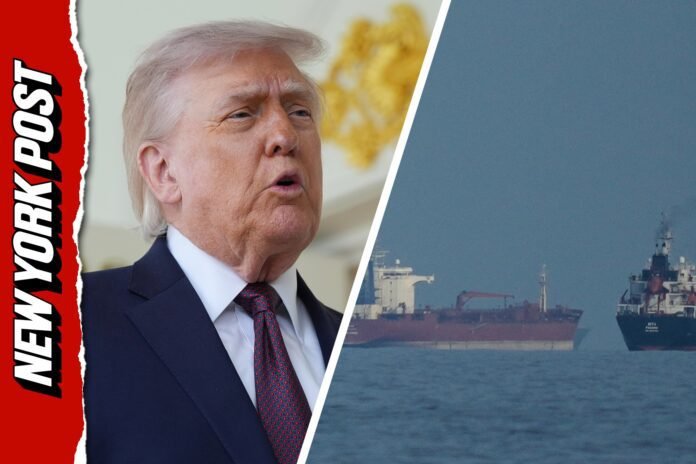
US President Donald Trump on Wednesday tried to project optimism about reaching a deal to end the illegal war he started against Iran, even while acknowledging the crisis could last for several more months.
In an interview with The New York Post, Trump was asked whether the current blockade of Iran would last until Labor Day, which falls on September 7 this year.
“I don’t know,” Trump said. “I mean, I think it could be, but I think it’s unlikely.” He added, “I think this will resolve itself fairly quickly.”
The president for the last several months has managed to keep oil prices from spiking to disastrous levels by dropping hints that his illegal war will soon be over, even though it has continued with no end in sight.
And while the Trump administration has insisted that its ceasefire deal is still in effect, CNN reported on Wednesday that Iran launched attacks against US military bases in Kuwait and Bahrain after US forces fired a Hellfire missile at a Botswana-flagged oil tanker that was heading toward an Iranian port.
Iran also launched drone and missile strikes at Kuwait’s international airport, killing one person and leaving dozens injured, according to Al Jazeera.
Oil industry expert Patrick De Haan on Tuesday warned that the price of oil will soon shoot back up if the Strait of Hormuz remains closed because US petroleum supplies, which have been drained at a rapid pace since the start of the war, are about to hit their lowest level in over two decades.
“US distillate inventories will likely fall under 100 million barrels for the first time in over 20 years, exacerbated by high exports due to the closure of the Strait of Hormuz,” De Hann wrote in a social media post. “This is a powder keg waiting to go off if a deal to reopen the strait doesn’t happen soon.”
In an analysis published Wednesday, The American Prospect’s Ryan Cooper similarly warned that the tricks used by nations around the world to keep a lid on oil prices, such as releasing petroleum reserves, would soon be ineffective thanks to hard supply constraints.
“As storages dwindle and run out, the only way to match demand to supply will be for the price to rise high enough to destroy something like 10 to 20% of global oil consumption,” Cooper wrote. “And because a great deal of oil demand is obligatory and therefore not very price-sensitive, that price will likely be north of $150 per barrel.”
This would lead to not just an explosion in gasoline and diesel fuel prices, Cooper continued, but a “corresponding price hike for anything that needs to be transported, or involved in plastic in some way, which is to say basically everything.”
New social features further Plex’s evolution from media server business
Plex is adding new social features to the platform.
As of today, users can make and share “personalized lists on Plex of any movie, show or episode,” the company said in an announcement. Later this year, users will be able to import lists from other streaming services and react to other people’s lists.
This month, Plex will also launch a community forum that will allow people to “post and comment directly on any movie, show, season, or episode.” Later this year, Plex will introduce “Match Scores” based on a viewer’s history and past ratings to predict how much they’ll like a show or movie, Plex said.
Plex already lets people rate content, and this year it will also allow them to react with emoji. Similarly, Plex will also enable people to respond to reviews and discussions with images. The goal, per Plex’s announcement, is to bring “a new layer of expression to every conversation.”
Finally, a “Follow Anything” feature coming this year will provide users with alerts around movies, shows, actors, and crew members that they follow.
Plex’s announcement claimed that its users have already “made over 100 million watching decisions a month and created more than 45 million watchlists,” making the new capabilities relevant to how people use Plex today.
“The addition of these features marks the next step in Plex’s vision to unify entertainment discovery and help users navigate an increasingly fragmented streaming landscape,” Plex’s announcement said.
Plex is targeting a common challenge for streaming users: finding stuff worth watching across streaming services.
“We believe the future of entertainment discovery is social and trust-driven,” Scott Olechowski, co-founder and chief product officer at Plex, said in a statement.
Plex’s evolution
The new capabilities highlight Plex’s focus on features that go beyond its media server business.
In 2019, Plex started offering free ad-supported streaming television (FAST) channels. By 2024, Plex was selling movie rentals, a stark contrast to its original business, which focused on letting people share their own media with friends and family. The California-headquartered company has since added the ability for users to leave reviews on movies, as well as to comment on other users’ reviews.
Meanwhile, Plex’s changes have raised concerns among some users about its commitment to self-hosting. For instance, Plex last year began removing users’ ability to remotely access a personal media server without paying a subscription fee. Plex also got rid of its Watch Together feature and redesigned its app to look more like a streaming service. And starting next month, the price for a lifetime subscription to Plex’s media server features will increase from $250 to $750. When launched in 2012, the Lifetime Plex Pass cost $75.
Plex’s evolution from its legacy business seems to be paying off. The company’s marketing VP, Scott Hancock, said in 2023 that Plex has had more people using its online streaming service than its media server features since 2022. Ad-supported streaming has also been a top revenue driver for the company, which is key as it seeks profitability.
This all suggests that Plex’s expanding interest in streaming and rentals won’t end anytime soon.
Hotel Guests Warned After Hackers Access Reservation Information Across Netherlands
Hotel guests in the Netherlands are being targeted with convincing fake payment requests after criminals obtained reservation details through a data breach affecting at least 100 hotels, according to a hotel services provider.
Hospecs, a company that operates hotels and supplies services to the hospitality sector, confirmed the breach on Tuesday. The company told Dutch broadcaster NOS that stolen data includes guests’ contact details as well as their arrival and departure dates.
The source of the breach has not yet been identified. Hospecs Managing Director Tim Vissers said the vulnerability likely lies in software used by multiple hotels rather than in the hotels’ own systems.
“Between making a reservation and confirming it, there are several layers,” Vissers told NOS, referring to systems used to log bookings and set prices. “The leak seems to be in one of those.”
Hospecs said the affected hotels appear to share certain booking, channel-management or property-management systems, although it has not identified a supplier while the investigation continues.
Vissers said at least 100 hotels in the Netherlands have been affected, with additional reports coming from Belgium and Ireland. He estimated the number of impacted guests could eventually reach hundreds or thousands as investigators continue to assess the scope of the breach.
“The reports are pouring in,” he said, adding that dozens of phishing messages are being sent daily to hotel customers requesting payment for reservations.
The Dutch data protection authority, AP, said it is investigating the incident. Hospitality industry organization KHN urged travelers to carefully verify the sender of any messages related to hotel bookings.
The breach is the latest in a series of cybersecurity incidents affecting organizations in the Netherlands this year. Travel platform Booking.com warned customers of a reservation data breach in April.
Hackers have also stolen data this year from telecom company Odido, medical software firm ChipSoft and nearly all residents of the Dutch municipality of Epe.
In an earlier scam, Booking.com customers were targeted through the platform’s own messaging system using similar payment-demand tactics.
Guests with active reservations are being advised not to respond to payment requests received through messages and instead contact their hotel directly through official channels to verify whether any payment is required.
Iran war: ordinary Israelis and Lebanese remain trapped by the false promises of their leaders
When the United States and Israel began their conflict against Iran, the Islamic Republic retaliated – as it has done in the past – by launching missile strikes against Israel as well as US military basis in the region. In addition, Iran targeted military and civilian locations across several Arab Gulf states.
Iran’s proxy in Lebanon, Hezbollah, drew the country into the war on March 2 by responding to the US-Israeli attack on Iran with widespread rocket attacks on northern Israel. In turn, Israel bombarded Beirut’s southern suburbs, where Hezbollah has its power base, as well as sending troops across the border into southern Lebanon.
Lebanon’s prime minister, Nawaf Salam, reacted swiftly. He banned Hezbollah’s military wing calling its activities “illegal” and ordering the Lebanese security forces to “prevent any attacks originating from Lebanese territory”. Hezbollah ignored his call and continued to pound northern Israel, while engaging with the Israel Defense Forces (IDF) on the ground.
Both sides – the Israeli government and Hezbollah – have framed the use of military force as necessary to protect their respective communities. This is nothing new. When referring to Hezbollah during his speech at the 2024 annual gathering of the United Nations general assembly, Israel’s prime minister, Benjamin Netanyahu explicitly made this link. “Israel has every right to remove this threat,” he declared, “and return our citizens to their homes safely, and that is exactly what we are doing”.
Hezbollah’s secretary general, Hassan Nasrallah (since assassinated in an Israeli strike on Beirut in September 2024) made a similar case of using military force to defend communities across Lebanon earlier that same year. After Israel assassinated Hamas’ deputy political leader, Salah Al-Arouri, in Beirut, in January that year he said that “we cannot keep silent about a violation of this seriousness because this means that all of our people will be exposed. All of our cities, villages, and public figures will be exposed.”
Two years on, both sides continue to justify the use of military force to defend their respective communities. But this claim does not bear scrutiny. As of June 2026, communities on both sides of the Israel-Lebanon border remain highly insecure. This is despite the supposed US-brokered ceasefire between the two sides declared by Donald Trump on April 7.
Hezbollah’s attacks on Israel have resulted in civilian and military casualties as well as severe disruption to everyday life. The situation on the Lebanese side of the border is worse. Since Hezbollah drew Lebanon into the war between the US and Israel on the one side, and Iran on the other, the IDF has significantly expanded its ground offensive, reportedly resulting in more than 3,000 people killed and more than 1 million displaced.
Nevertheless, Nasrallah’s replacement as Hezbollah secretary general, Naim Qassem, has continued his predecessor’s aggressive line against Israel. Upon the onset of the current hostilities he pledged, on March 5, to “continue the fight against Israel”. In addition, he has rejected the Lebanese government’s order to refrain from attacks on Israel and refused to disarm.
In a statement on May 25 to mark Resistance and Liberation Day, the Lebanese holiday marking the anniversary of Israel’s withdrawal from Lebanon in 2000, Qassem said disarmament would destroy Lebanon’s “defensive capability and the capability of the resistance and its people, as a prelude to extermination”. He added: “Disarmament is extermination, and this is something we cannot accept.”
Ordinary lives under threat
Having clearly learned a lesson from Ukraine’s defence against Russia, Hezbollah has taken to using fibre-optic drones as their main weapon. Apart from the military and civilian casualties inflicted by these attacks, they severely threaten everyday life across the north of Israel, forcing workplaces and businesses to close and disrupting schools.
Overwhelmed and insecure, residents in northern Israel have described themselves as becoming “invisible” in the eyes of the Israeli government. A spokesperson for Lobby 1701, a northern Israel residents’ group named after UN Security Council resolution 1701, which ended the last Israeli occupation of southern Lebanon and was supposed to ensure the demilitarisation of the region, told Israeli news outlet Ynet Global that people in northern Israel felt abandoned by their government: “Why does no one care even a little when a drone hits a children’s bus stop in Shomera, compared with if that same drone had, God forbid, hit a children’s bus stop in Tel Aviv?”
Israeli civilians take refuge from Hezbollah reocket attacks in a shelter in Kiryat Shmona, near to the Israeli-Lebanon border, March 2026.EPA/Atef Safadi
Hezbollah’s pledge to “defend” its communities through its military operations have clearly utterly failed and a majority of Lebanese people favour the group disarming. One Lebanese politician from a party which opposes Hezbollah, told journalists: “I have never seen a so-called resistance movement that is supposed to liberate the country from the occupier, do everything it can to give the occupier a pretext to send even more troops and create a buffer zone. If they want to commit suicide, let them go to their master in Tehran, far from Lebanon.”
Captives of conflict
Thus, ordinary Israelis and Lebanese remain captive to the false promises of their leaders. The continued reliance on military force has brought neither side greater security. Instead, it has deepened their vulnerability.
The only sustainable path out of this deadly cycle is a diplomatic and political settlement along the lines laid down in resolution 1701 – but with stronger security guarantees – which people on both sides of the border need and deserve.
Yet the government of Israel and Hezbollah’s leadership remain committed to rigid ideologies and political calculations – domestic and international – that prevent such an agreement. Meanwhile, their communities continue to bear the cost.
Bennett Pitches ‘From Tribes to a People’ Education Reform Ahead of Election
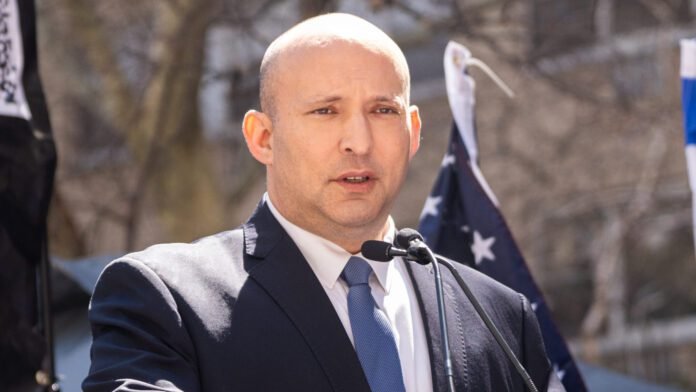
Former Prime Minister Naftali Bennett unveiled a proposal for a unified national education framework on Tuesday, describing it as a plan to create a shared educational foundation for all children in Israel.
Speaking at the Israel Democracy Institute’s Eli Hurvitz Conference on Economy and Society, Bennett presented what he called the “From Tribes to a People” plan, which he said would be implemented under a future government led by him.
Naftali Bennett and Yair Lapid currently lead Together, a joint political alliance formed ahead of Israel’s next election. Bennett heads the alliance, which was created through the merger of his Bennett 2026 party and Lapid’s Yesh Atid.
Israel’s next Knesset election is currently scheduled to be held by October 27, 2026, although ongoing efforts to dissolve the Knesset could move the vote forward by several weeks.
Under the “From Tribes to People” proposal, all students would study a common curriculum that includes Hebrew, English, mathematics, civics, Torah, and Jewish and Zionist tradition. Bennett said Muslim students would have the option of studying the Quran instead of the Torah.
“I am proud to unveil before you the most important plan that we will implement in my government: the ‘From Tribes to a People’ plan, to establish one state (public) education system for all the children of Israel,” Bennett said.
“This will work according to a 60–40 method: 60 percent will be the shared subjects that everyone studies, and 40 percent — each community will be able to expand according to its wishes,” Bennett said.
According to Bennett, schools and local authorities would receive greater autonomy over the portion of the curriculum not included in the shared core, while the Education Ministry would focus on policy and oversight.
Bennett said the initiative goes beyond traditional discussions surrounding core educational requirements.
“For all these years we said, ‘Let them study mathematics and English.’ No—that is not enough. They need to receive both the tools and the values to be part of a Jewish and democratic state,” he said.
The former prime minister said the proposal would seek to create a common civic and cultural foundation across Israeli society.
“The children of Israel will study both Einstein and Maimonides. All Israeli children and all Israeli citizens will have a shared story,” Bennett said.
“This will turn us from tribes into a people: one people, diverse, colorful, and wonderful, very opinionated, but a people that has a shared story. And this is how Israel will develop resilience for generations to come.”
Lawmakers Demand Answers After the White House Initiated a $620M Loan to a Firm Tied to Donald Trump Jr.
A group of lawmakers demanded answers from the White House this week following a ProPublica investigation revealing that a top aide to the president intervened to secure a $620 million Pentagon loan to a startup linked to the president’s eldest son.
ProPublica’s reporting “reveals a staggering level of corruption and influence peddling that superseded this process, enriching the President’s son at the expense of U.S. national security and taxpayer dollars,” wrote the group of Democratic lawmakers, including Sens. Elizabeth Warren of Massachusetts, Richard Blumenthal of Connecticut and Mazie Hirono of Hawaii as well as Reps. Jason Crow of Colorado and Mike Levin of California.
Read More
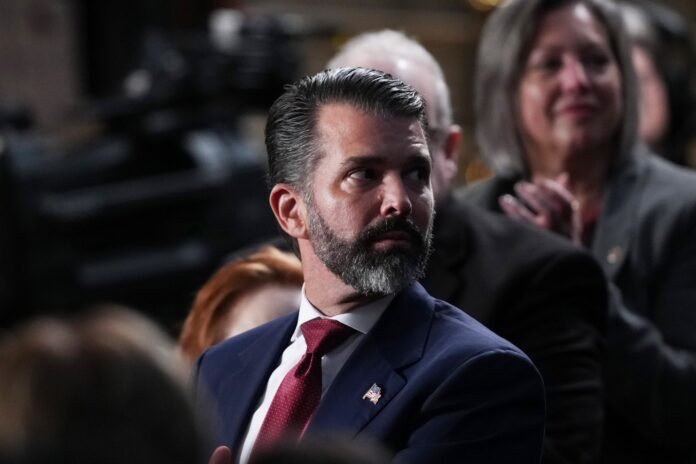
Last year, the Pentagon announced the loan to Vulcan Elements, a small North Carolina startup, about three months after Donald Trump Jr.’s venture capital firm took a stake of undisclosed size in the rare-earth magnet company.
Interviews and Defense Department records reviewed by ProPublica show that the request to lend to the firm was made by Peter Navarro, who serves as the president’s senior counselor for trade and manufacturing and is a friend of Trump Jr.’s.
Of the dozens of companies the Pentagon was considering funding at the time, Vulcan’s was the only deal initiated by a top aide to the president, an official at the Pentagon who was not authorized to speak publicly told ProPublica.
After defense officials got the White House request, they asked Pentagon staff to move at an unusually rapid pace, said another person who was involved in the deal at the Pentagon but not authorized to speak about it.
“The call came from the White House: We have to get this done,” the person said.
In their letter, addressed to White House Chief of Staff Susie Wiles, the lawmakers asked a series of questions about Navarro’s involvement in the deal, including whether he intervened at someone else’s direction, if the president was aware or involved, and who Navarro communicated with at the Pentagon.
They also asked more broadly about whether White House officials have communicated with federal agency officials about other companies linked to the Trump family.
“The American public — and service members that are in harm’s way — expect that the DoD contracting process is fair, unbiased, and competitive to ensure that only the best companies, providing only the best products, receive taxpayer dollars,” the lawmakers wrote.
Navarro, who served as trade adviser in the president’s first term, and Trump Jr. have formed a close bond in recent years. The president’s son visited Navarro in prison while he served time for defying a subpoena from lawmakers investigating the Jan. 6, 2021, riot at the U.S. Capitol. Trump Jr. was one of the small group of people Navarro dedicated his latest book to for having “my back when it was against the wall.” And a week before the Vulcan deal was announced, Trump Jr. hosted Navarro on his streaming show, encouraging his nearly 2 million subscribers to buy Navarro’s book. That interview was not long after word came down from Navarro to Pentagon staff to make the massive loan to Vulcan, one of the defense officials involved in the deal said.
Asked to respond to the lawmakers’ allegations and ProPublica’s reporting, Navarro in a text message wrote “Staggering level of hyperbole. More fake news” but did not elaborate. The White House did not immediately respond to a request for comment on Tuesday.
Navarro did not respond to questions from ProPublica sent to him directly before the initial article was published. But in a post on X afterward, he called the story “fake news on steroids.”
Vulcan has not commented. A White House spokesperson had said in a statement that the administration is working “in the best interest of the American people,” adding, “The President’s entire team, including Senior Counselor Navarro and officials at the Department of War, is working together and with private industry to secure America’s critical mineral supply chain at Trump Speed.” Trump Jr.’s spokesperson said last week that the president’s son does not discuss companies he has invested in with federal government officials and did not speak to Navarro about Vulcan. He “has no knowledge about how this deal came together,” the spokesperson said. A spokesperson for 1789 Capital, the venture firm where Trump Jr. is a partner, said it also played no role in Vulcan getting the loan and did not learn about the deal before it was public.
“No company receives preferential treatment,” a Pentagon spokesperson said. “Outside affiliations, investors, or political connections play absolutely no role in the Department’s funding decisions.”
The loan was part of the Pentagon’s effort to fund companies that could help the U.S. reduce dependence on China’s critical mineral supply chains. It represented a big win for Vulcan and its investors. Estimates of the company’s valuation grew tenfold after the deal was announced.
The deal is one of many actions by the administration of President Donald Trump that have helped companies in which his family holds stakes. Government contracts and other benefits have gone to various Trump-linked companies. But ProPublica’s reporting on the Vulcan loan represented the first time the awarding of a contract from a federal agency was directly linked to White House intervention.
A number of other lawmakers also criticized the Vulcan deal following ProPublica’s investigation.
Sen. Raphael Warnock, a Georgia Democrat, called it “corruption to the highest degree,” alleging on X: “They are looting this country. Dismantling it, selling it for parts, and lining their own pockets.”
Sen. Patty Murray, a Washington Democrat, called for a congressional investigation. “It’s just nonstop corruption from this White House, and Republicans in Congress are content to twiddle their thumbs and look right in the other direction,” she posted on X. “Congress should be investigating and putting a stop to this kind of crooked self-dealing—not enabling it.”
It won’t take long to understand what lies ahead for Iraq—and for the Iran‑aligned militias—after President Donald Trump appointed Tom Barrack as his Special Presidential Envoy for Syria and Iraq. All one needs is the paragraph Barrack published just hours after the announcement. He wrote that “the balance of power around which the United States operates works best when allies become more self‑reliant and share the burden—always within a framework that preserves American influence, stability, and alignment with core U.S. strategic objectives.”
That single sentence makes something unmistakably clear: Washington no longer views Iraq as a political file requiring relationship management, but as a security file requiring decision management.
The irony is that the focus on Barrack’s name obscures the real shift. The issue is not the replacement of one envoy with another, nor the illusion—long cultivated by Iraq’s militias—that U.S. policy changes every time Washington rotates a mid‑level official. That illusion fed a false sense of victory for years, as if Iraq’s fate hinged on the temperament of a bureaucrat. But Barrack is not that type. He is not a practitioner of soft diplomacy. He calls things by their real names. He insults publicly. He speaks without silk gloves.
American media have repeatedly described him as the “man for the dirty jobs” in U.S. foreign policy—one of the few capable of convincing Trump to take on complicated files personally.
Before his appointment, Politico and Axios reported that Barrack had been pushing for a “merged‑file approach” to the region: treating Iraq, Syria, and Lebanon as a single interconnected arena rather than three separate problems. Today, it seems we have moved from “quiet execution” to “execution with audible slaps.” Barrack is not a diplomat who smiles for the camera. He is the man who once described Iraq as a “failed political experiment,” Lebanon as a “farce,” and journalists in terms unfit for print. Imagine that language becoming part of U.S. policy toward the Green Zone and the militias surrounding it.
But the fixation on Barrack’s personality hides something deeper: Washington no longer sees Iraq as a political partner. It sees a malfunctioning security file. And once Iraq becomes a security file, the language shifts from negotiation to surgery—excision, not maneuvering; control, not accommodation.
This explains the panic among Iran‑aligned factions the moment Barrack’s name surfaced. He embodies a shift that is too blunt to be misread and too sharp to hide behind slogans of sovereignty.
For Iran’s parties and militias, the picture is even clearer: they are the inevitable losers. The U.S. decision to curb their dominance is not a personal whim; it is an institutional choice. Barrack is merely the executor—armed with a dose of diplomatic cruelty he is well known for.
Militias accustomed to whispered diplomacy will now face diplomacy that shouts, delivered by a man who writes messages in bold and reads them aloud.
READ: US envoy welcomes Iraqi move to place weapons under state control
Washington now treats Iraq as part of a regional network, not a standalone case that can be indulged or excused. In the eyes of the current administration, Iraq is one link in a chain stretching from Tehran to Baghdad to Beirut. The tighter the interconnection, the more likely the three files will be handled with one mind, one hand, and one envoy who neither flatters nor smiles.
This is why Barrack’s arrival is not a personnel change—it is the declaration of a new phase in which decisions are measured by their ability to break stagnation, not by their ability to appease local actors.
In an interview with The National in Abu Dhabi, Barrack abandoned even the minimal diplomatic varnish. He said the United States had “divided Iraq and Syria,” and that the Iraq invasion became “a glaring example of what should never be repeated.” He was not trying to beautify the past. He was diagnosing it: three trillion dollars spent, twenty years of fractured history, hundreds of thousands of lives lost, and, in his words, “we walked away empty‑handed.”
This is not self‑criticism. It is a policy statement: no more spending without results, no more patience for dual power between state and militia.
Iraq is entering a phase with no courtesies. Washington no longer sees Baghdad as a relationship‑management file but as a decision‑management file. The duality of power is no longer tolerable, and American patience with “state thieves” is wearing thin. The coming language will not be diplomatic—it will be direct, exposing, and perhaps wounding.
If Iraqi media celebrated the removal of Mark Savia, they may need to brace themselves. The man replacing him does not speak the language of traditional diplomacy. He speaks the language of shock.
So the question now is: who can afford to sleep in Iraq’s current landscape?
Certainly not the militias. The era of “grey understandings” is over. The era of “sharp decisions” has begun.
What awaits Iraq under Barrack is not a change of faces, but a change of rules.
OPINION: Why does Muqtada al‑Sadr expect us to believe him?
The views expressed in this article belong to the author and do not necessarily reflect the editorial policy of Middle East Monitor.
Autonomous vehicles were supposed to cut traffic—what if they don’t?
The age of robotaxis, long the preserve of science fiction, is now a reality, at least in a handful of American cities. It took just over a decade to get from the DARPA Grand Challenges to the start of Waymo’s commercial service in California, albeit initially with a safety driver on board.
Proponents of the technology, which has attracted at least $100 billion in investment, say robotaxis will be safer than human-driven vehicles. And last year, Waymo’s data showed its cars were involved in many fewer crashes than human drivers, with much lower insurance claims, although recent issues with school buses and flooded roads show the technology isn’t perfect.
But safety isn’t the only selling point: Autonomous vehicles are said to cut traffic. But data from Waymo’s reports to the California Public Utilities Commission shows that, at least in that regard, robotaxis are no better than ride-hailing services like Lyft and Uber.
Is there anyone in there?
The study, published in Transport Findings by MIT Transit Lab Assistant Director of Research Awad Abdelhalim analyzes data from August 2023 through December 2025, a roughly 1,000-day period. During that time, Waymo’s robotaxis completed 13.8 million trips for 19.3 million passengers over a total traveled distance of 86.3 million miles (138.8 million km), growing at a rate of around 15 percent a month. Abdelhalim wanted to see what proportion of those rides were made by empty robotaxis—known as “deadheading”—and how the number changed over time.
Initially, only 36 percent of Waymo’s miles were driven with a passenger onboard. But by the end of the study period, that had increased to around 56 percent and then plateaued, Abdelhalim found. So about 44 percent of Waymo’s driven miles are conducted with empty EVs.
I’m not entirely surprised; on each of my recent visits to San Francisco, the sensor-festooned Jaguar I-Paces have been thick on the ground, but rarely did I spot any humans riding in them.
In fact, there are two different kinds of deadheading: empty vehicles driving around waiting to be assigned a ride and empty vehicles driving to collect their passenger(s). And Waymo has been steadily reducing the number of miles driven empty en route to a pickup as it increases the size of its fleet. The number of deadhead miles per trip has also been declining, in part due to Waymo’s introduction of freeway service, the author suggests.
A similar analysis conducted late last year on Waymo’s CPUC data from January 2024 through September 2025 by Matthew Raifman, who studies policy and autonomous vehicles at UC Berkeley, also found that 44 percent of Waymo’s miles were driven with empty vehicles and that two-thirds of those empty miles were robotaxis driving around waiting to be assigned a customer.
No better, no worse than ride-hailing
Interestingly, similar arguments about reducing traffic were once made about ride-hailing. In 2014, other researchers at MIT published a study claiming that ride-hailing could reduce car ownership and cut traffic. Two of the authors later walked back their conclusions after evidence showed that ride-hailing actually increased traffic and CO2 emissions, partly because it was cheap enough to encourage trips people otherwise wouldn’t have taken. They noted that robotaxis would probably fall into the same trap. (A 2018 study found that almost half of the increase in vehicle miles traveled in San Francisco was attributable to ride-hailing services.)
In total, about 40 percent of the miles traveled by a Lyft or Uber driver are deadhead miles, suggesting there’s little difference in congestion whether there’s a human behind the wheel or not. Incidentally, this fact helps explain some of the statistical safety advantage of a robotaxi—if the average number of occupants of a robotaxi is always lower than the average number of occupants of a ride-hailing vehicle, the expected injury rate for the robotaxi should be correspondingly smaller.
Meanwhile, effective congestion reduction could be achieved through a robust expansion of public transport. The same number of people on a bus take up much less room on the road than if they were spread out in passenger cars, and the numbers get even better for trains and subways. But public transport doesn’t come cheap. Waymo might have raised $16 billion earlier this year for its robotaxis, and at least $100 billion has been invested in the sector since the 2010s. Meanwhile, the American Public Transport Association called for $268 billion in investment over five years, and a report by Transportation For America puts the price tag for a “world class” transit system at $4.6 trillion over the next 20 years.
Australia is the victim of an AUKUS ‘bait and switch’
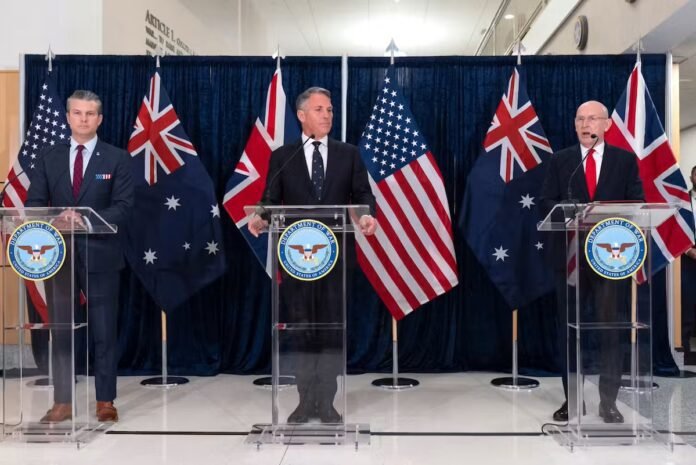
From left to right: US Secretary of Defense Pete Hegseth, Australian Defense Minister Richard Marles and British Defense Secretary John Healey on the sidelines of an AUKUS ministerial meeting at the Pentagon on Dec. 10, 2025. Photo: Mark Schiefelbein / AP via The Conversation
At a security conference in Singapore over the weekend, the three AUKUS partners – the United States, United Kingdom and Australia – announced a tweak to their partnership that has generated quite a lot of attention in Canberra.
Australia will now receive three second-hand Virginia-class, nuclear-powered submarines in the coming years, instead of the original deal of two used vessels and one brand new sub.
Australian Defence Minister Richard Marles spun this as a welcome streamlining of the fleet that would simplify its supply chain, as well as the management and sustainment of these complex warships.
What Marles seems not to have noticed is that not all Virginia-class submarines are the same.
The new boat the US had promised would have been from Block 6, the most recent design. Instead, all of Australia’s submarines will now likely come from Block 4, which carry a much smaller weapon payload. Firepower is a measure of a fighting ship’s utility. Having the largest weapon capacity is a key ingredient for battle success.
It seems Australia has been a willing – not to say eager – victim of what is essentially a “bait and switch.”
The deal has always been unequal
The unilateral change of plans should not have come as a surprise to anyone in the Australian government.
AUKUS has always been a one-sided deal in which the US reaps the benefits while Australia accepts the risks. The agreement Australia entered into provides the US with numerous opportunities to cancel or modify the deal. Washington simply acted on what was permitted.
In addition, the AUKUS agreement allows the US president to cancel the submarine transfer at his or her whim, while Australia has no right to challenge or lobby against the decision.
The current president, Donald Trump, is not known for loyalty to his allies. The fact the AUKUS deal was signed by his predecessor, Joe Biden, is likely to further reduce Trump’s level of commitment.
To make the US decision more of an affront, Australia has already contributed at least US$2 billion (A$2.8 billion) to the American submarine manufacturing pipeline.
The US is not building enough submarines to meet its own requirements, let alone the additional boats it has promised to Australia. The Australian cash contribution was meant to improve the US rate of production so Canberra would be able to get one or two of the latest boats. Australia’s investment has turned out to be a very poor one, and there are no refunds.
The Australian government has also misinterpreted what the US hopes to get out of the deal.
For the Americans, selling Australia any subs at all makes little sense in the contest with China for supremacy in the Western Pacific. It just reduces America’s own military capability.
The key element in AUKUS for the US has always been the submarine base that Australia is building at HMAS Stirling in Western Australia. This is where the US Navy plans to operate its submarines. The US has already announced the establishment of the support elements that will administer and sustain these warships.
As we can see now, Australia has virtually no leverage to make the submarine deal more equitable.
The Americans know that Australian strategic policy since before the Vietnam War has been to demonstrate relevance to the US. Australia has not hesitated to rush into US-led wars – even those of dubious legality – in order to show loyalty. If this was a poker game, the Australians would be playing with most of their cards face-up.
What can Australia do to gain more agency?
Unfortunately, not a lot. The US holds all the important cards. Australia will likely continue to be a dutiful ally in the hope the US will deliver what it has promised. But there are no guarantees.
The only vulnerability the US has is its desire to base its submarines at Stirling. If Australia were to halt construction or restrict US access to the base, it would be seen as tantamount to canceling the deal.
The price Australia would pay for its temerity would be an enormous loss of respect and favor in Washington – the very thing a long succession of governments has sought to boost.
Australia’s defense policy has seen our country ensnared in a trap of its own making. There are lessons our political leaders can hopefully learn. The first is to accept the wisdom of former UK Prime Minister Lord Palmerston’s adage that countries have no eternal allies, just eternal interests.
The second is to recognize that an unbalanced alliance leads to servility, not partnership. The final lesson is to develop faith in Australia’s ability to protect itself rather than turning to an ally of increasingly dubious reliability.
Albert Palazzo is adjunct professor in the School of Humanities and Social Sciences at UNSW Canberra, UNSW Sydney
Owain Rhys Davies, the Welsh actor known to Twin Peaks fans for his role in the cult classic revival Twin Peaks: The Return, has died suddenly at just 44 years old.
His family announced the heartbreaking news Tuesday, revealing that the actor’s death has left loved ones stunned and searching for answers.
Davies played Agent Wilson in Twin Peaks: The Return, the long-awaited 2017 revival of David Lynch and Mark Frost’s eerie, surreal television phenomenon. The show brought back longtime fans and introduced a new generation to the strange, haunting world of Twin Peaks.
But now, the actor’s own story has taken a tragic and mysterious turn.
His brother, Rhodri, shared the devastating update on social media, writing that he and their father were announcing the loss with “profound sadness.”
“This news will come as a great shock to many,” he wrote.
Rhodri described Owain as a man whose “love, friendship and generosity” reached far and wide, making clear just how deeply his loss is being felt by those who knew him.
The family also acknowledged that the circumstances surrounding his death are not fully clear.
Although there are “still questions that remain unanswered regarding the circumstances of his death,” Rhodri said the family’s understanding at this stage is that Owain “passed suddenly, naturally, and peacefully.”
No official cause of death has been publicly released.
Davies’ passing is especially shocking because of his young age. At only 44, the actor had built a career that included roles in television, fantasy films, and offbeat horror.
In addition to Twin Peaks: The Return, Davies appeared alongside Johnny Depp in Disney’s 2016 fantasy sequel Alice Through the Looking Glass. He also starred in the 2019 satirical horror film A Serial Killer’s Guide to Life.
For fans of Twin Peaks, his death marks another sad loss connected to one of television’s most beloved and bizarre franchises.
The revival series, which aired more than two decades after the original show became a cult sensation, was packed with mystery, nostalgia, and unsettling twists. Davies’ appearance as Agent Wilson placed him inside that unforgettable universe, alongside a cast tied forever to one of TV’s strangest legacies.
Tributes are expected to pour in from friends, fans, and colleagues as news of his sudden death spreads.
For now, his family is mourning a beloved son, brother, and friend whose life ended far too soon.
Davies leaves behind a legacy of creativity, warmth, and a screen presence that fans of the strange and surreal will not forget.