Microsoft’s Project Solara is an Android OS designed for agents instead of apps
Microsoft has been deeply committed to the growth of generative AI technology in recent years through its now-fragmented partnership with OpenAI. At Build 2026, the company remains all-in on AI, and it’s looking toward the future with a new software platform. The new Android-based OS is called Project Solara, and Microsoft says Solara is designed to run agents instead of apps.
Project Solara is not something you’ll have to worry about killing your apps anytime soon. It’s limited to a few pieces of concept hardware and software that are awaiting the magical agents of the future. The vision is for Solara to run on myriad specialized devices with interfaces generated on the spot, and it’s all powered by the explosive intelligence of models that Microsoft and others insist will soon exist.
According to Microsoft, Solara is a chip-to-cloud platform intended to free agents from reliance on single interfaces. Much of Microsoft’s messaging around AI is speculative and self-serving, but the company rightly points out that new computing form factors have always required specialization, and that process is complex and expensive. The shift to mobile computing, for example, tripped Microsoft up multiple times as it fell behind on app availability, security, and long-term support.
But imagine none of that mattered because you have a gaggle of AI agents that build what you need based on context. That’s Project Solara, which is based on an open source build of Google’s Android software (AOSP). Microsoft can’t really call it Android as it’s not a licensed package—the underlying OS is called the Microsoft Device Ecosystem Platform. It includes various Microsoft enterprise technologies, along with a shell that can interact with multiple AI agents.
Microsoft says Solara is being designed around a concept called just-in-time UI. Rather than manually designing interfaces and content for a watch, a desktop monitor, or smart glasses, Solara would use agents to create interfaces that make sense in the moment. So your work badge, which runs a full Android OS for some reason, could display a minimal interface with one or two functions, but the same functions on a smart display would include more data and features.
However, Microsoft is clear that this is still just a concept. None of it works, but the company is committed to spending money on it as part of its massive AI expansion plans.
Agentic concepts
Microsoft has shown off two concept devices that illustrate where it hopes to go with Project Solara. The more conventional is the Desk Concept, which looks like a typical smart display. It’s got a touchscreen, microphones, and a camera. While you sit at your desk, this gadget would keep you apprised of what your theoretical AI agents are doing on your behalf. It can act as a secondary monitor or become a standalone Windows PC with Windows 365 cloud computing. This concept is built around MediaTek IoT chips.
The other Solara concept skews weirder. What if the work badge at the end of your lanyard had a touchscreen, 5G connectivity, a camera, microphones, and a fingerprint scanner? That’s the Badge Concept. It would have the same Solara software, piping in generative interfaces from your preferred AI agent. Microsoft envisions this Qualcomm-based device providing biometric-authenticated access to your agents—just tap the sensor and start telling your personal robot what to do. It could also record and summarize meetings and use the camera to “take action on the environment,” whatever that means.
You can’t even get in line to buy either of these devices. Microsoft’s next step is to demo its agent-first devices with industry partners, including AccuWeather, Best Buy, CVS Health, Levi’s, and Target.
Microsoft has struggled to branch out beyond traditional computing and enterprise services, having tried and failed on numerous occasions to gain a foothold in mobile computing. With AI, Microsoft was uncharacteristically at the forefront of change. With its OpenAI deal sputtering, the company is now looking to the future, and this is it: agents instead of apps.
This is an interesting pitch for how we might actually use AI agents, and it’s not coming totally out of left field. Google is also pursuing agentic interfaces in its search products. At I/O, Google previewed new agent-first search tools that can instantly build dashboards and mini-apps based on your search queries.
As vague and pie-in-the-sky as Project Solara may be, Microsoft is pretty in tune with the rest of big tech’s AI plans. If any of it works, we can only hope it doesn’t lead to a new generation of touchscreen millstones around our necks.
Pentagon bans reporters from public affairs office
Hegseth’s aides previously banned photographers because he didn’t like how he looked. Photo illustration: Thomas Levinson / The Daily Beast
The Trump administration’s “attempts to silence objective journalism just hit a new low,” said one press freedom advocate late Monday after the Pentagon announced that the US Department of Defense would mark its press office as a classified area, banning journalists from the space where they’ve previously talked openly with DOD officials.
Reporters on the military are currently largely banned from the building altogether as litigation is ongoing over the administration’s requirement that journalists have an escort to move about the Pentagon, but the new policy means that should they be able to return, they would be even more limited in their access to public affairs officers whose job it is to keep the press and public informed.
“For multiple administrations, Pentagon reporters have used the press office to meet with public affairs officers and have open conversations about what America’s armed services are doing in order to keep the public informed,” said Ben Grazda, an advocacy manager for Reporters Without Borders North America.
Calling Defense Secretary Pete Hegseth “petulant” and pointing to his unsuccessful demand that journalists sign “loyalty pledges,” Grazda added that “journalists will continue their tenacious reporting and hold the Pentagon accountable for the money, operations, and lives they impact every day.”
The Washington Post reported that Pentagon speechwriters will be moved into the public affairs office, which will be equipped with the secret internet protocol router network, or SIPRNet, which is used to transmit classified information.
“This is the most transparent war department in history. No amount of spin from the Fake News media will change that. The Pentagon Press Office has been redesignated as a sensitive compartmented information facility due to speechwriters from the Office of the Secretary of War sharing the facility,” said Jose Valdez, the acting Defense Department press secretary, on social media on Monday, referring to Hegseth by the title he prefers.
Despite Valdez’s claims, journalists referred to the decision as “Orwellian” and noted that Hegseth is further curtailing press access to the Pentagon as the US is mediating talks to end the war the US and Israel started against Iran in February.
The policy was also announced as The New York Timesreported that Hegseth had blocked the promotions of nine Navy officers who had been selected by senior Navy admirals, appearing to “violate the rules governing a promotion system that is supposed to be apolitical and merit-based.”
“Banning journalists from the press office in the Pentagon, where they worked professionally in previous administrations, is simply a sign that current DOD leadership fears accountability,” said Times reporter Trip Gabriel.
The decision to close the press office to members of the press comes eight months after hundreds of journalists walked out of the Pentagon in protest of a new policy barring them from seeking information that the Trump administration had not authorized for release.
That policy was struck down by a federal court earlier this year, but the government has appealed the ruling.
The National Press Club called the Pentagon’s newest policy “a remarkable and troubling escalation in the Defense Department’s ongoing effort to restrict independent reporting.”
“This move does not occur in isolation,” said Mark Schoeff Jr., a reporter at CQ Roll Call and president of the organization. “It follows a troubling pattern of escalating restrictions on Pentagon coverage, including efforts to limit journalists to pre-approved information, revoke credentials for routine reporting practices, and physically remove reporters from long-standing workspaces and access without an escort.”
“Calling a press workspace ‘classified’ does not make the government more transparent,” said Schoeff. “It creates yet another obstacle between journalists and the information Americans have a right to know, especially at a moment when the public needs clear, unfiltered information about the US military.”
“Independent reporting on the US military is not optional,” he added. “When journalists are pushed farther from the institutions they cover, the American people are left with less information, less transparency, and less oversight. Any effort to restrict that access should alarm everyone who values a free and informed society.”
Belgium Tightens Visa Rules for Non‑EU Students in Major Migration Crackdown
Belgium is imposing stricter academic requirements on international students from outside the European Union, warning that those who fail to make sufficient progress risk losing their visas under new migration‑reduction measures introduced this week.
Migration Minister Anneleen Van Bossuyt said the rules are intended to curb “abuse of student status” while keeping the country open to qualified international talent. Under the changes, non‑EU students must show steady advancement in their studies to retain residency. Bachelor’s students will be required to earn at least 60 credits after two academic years and a minimum of 40 credits each year after that. New limits on the maximum duration of master’s, specialisation and doctoral programs have also been set, though details were not released.
Students who attempt to enroll in a third field of study within their first three years in Belgium — without completing the previous two — will be denied a visa extension. Those who switch unsuccessfully to a lower academic level after higher education will face tighter scrutiny.
“Studying in Belgium is not a revolving door,” Van Bossuyt said, arguing that repeated course changes and prolonged stays undermine the system. She said the measures are “harsh, but fair” to students who meet academic expectations.
Nearly 14,000 non‑EU nationals applied for a first student visa in 2025. Approval rates reached 82% for recognized higher‑education institutions but fell to 51% for non‑recognized schools such as private business, music or ballet academies, where authorities say quality standards are less certain.
The reforms align with Prime Minister Bart De Wever’s broader effort to reduce migration, including measures targeting international students. Since September, non‑EU students living in Brussels have lost access to child benefits, a change expected to save €17.8 million annually by 2030. Beginning next academic year, non‑EU students must also prove they can cover €1,050 in monthly expenses, up from €835.
Critics say the higher financial threshold and rising tuition fees at some Brussels institutions will disproportionately affect students from lower‑income backgrounds. Schools such as RITCS and the Royal Conservatory of Brussels have launched crowdfunding campaigns to retain international talent.
New administrative rules also require non‑EU students to renew residence permits online through the IRISbox platform before appearing at the Immigration Office. In 2025, authorities rejected 2,615 student visa applications, most from Cameroon and Morocco.
Rubio says Iran’s supreme leader alive, ‘increasingly engaging’ through intermediaries
US Secretary of State Marco Rubio said Tuesday that Iran’s Supreme Leader Mojtaba Khamenei is alive and “increasingly engaging at some level,” although he has not appeared publicly after he was injured at the beginning of the war, Anadolu Agency reports.
“We haven’t seen him publicly, and I would imagine, given what’s happened to multiple leaders in that system, being very public is probably not something that’s recommended for them internally, but that said, I think there are indications out there that he is increasingly engaging at some level, although all of his communications have been in writing and through intermediaries,” Rubio told lawmakers during a hearing at the Senate Foreign Relations Committee.
He said Iran’s internal decision-making process appears to be highly centralized, saying messages from negotiators are typically relayed back to a governing council for approval before any response is issued.
“It is our view of the system as we understand it, and as it’s been expressed to us both by the intermediaries and by Iran directly, that what (Abbas) Araghchi and (Mohammad Bagher) Ghalibaf bring or take from us, they then have to run back to this council and ultimately get guidance from them, and that process oftentimes takes three to five days to get a response,” he added.
READ: Trump says talks with Iran ‘going on continuously,’ adds, ‘where they lead, one never knows’
Although Rubio and US President Donald Trump insist talks with Iran continue, Iranian media reported Tuesday that exchanges of messages between the two countries have been halted for at least several days now.
Rubio’s comments come as Washington and Tehran continue efforts to turn a fragile ceasefire into a broader agreement following months of conflict that began Feb. 28 with US-Israeli strikes on Iran.
Iranian authorities said more than 3,000 people have been killed since the start of the war, while at least 13 US service members have been killed in Iranian retaliatory attacks.
Tehran retaliated with attacks targeting Israel and US allies in the Gulf, alongside the closure of the Strait of Hormuz.
A ceasefire took effect on April 8 through Pakistani mediation, but subsequent talks in Islamabad failed to produce a lasting agreement. Efforts for a solution, however, have continued since.
READ: Iran to hold funeral ceremonies for late Supreme Leader Khamenei in 3 cities
Trump’s Yielding on Iran Leaves Netanyahu With Less Room To Strike Hezbollah
Washington is pressing Israel to avoid escalation in Lebanon while the US president tries to preserve negotiations with Tehran
Israel’s longest-serving prime minister and most controversial political figure finds himself at a major crossroads as the country faces a strategic conundrum. Benjamin Netanyahu, who has been at the heart of Israel’s political scene for three decades, is facing elections this fall after leading the country through almost three years of war.
The war, which began as Israeli retaliation for Hamas’ October 7, 2023, attack, initially drew widespread support at home and sympathy from many Western governments. As it dragged on, international approval of Israel’s conduct, especially in Gaza, fell sharply, while Israeli public opinion became increasingly focused on hostage deals, ceasefires, and frustration with the government’s failure to deliver a decisive end to the fighting.
A joint US-Israeli attack on Iran that ended in April was the culmination of the regional war that has engulfed the region since October 2023. The operation showcased close US-Israeli coordination, but Reuters has reported that the two countries’ objectives later diverged, with Washington focused on preserving Iran negotiations and reopening the Strait of Hormuz while Israel sought to preserve freedom of action against Hezbollah and other Iranian-backed threats.
The confrontation with Iran did not begin with the later joint US-Israeli operation. In June 2025, Israel and Iran fought an intense direct conflict that brought open strikes between the two countries into the center of the regional war, sharpening Israeli concerns over Iran’s nuclear program and its network of armed proxies. A later joint US-Israeli attack on Iran, which ended in April 2026, marked a new phase in that confrontation and showcased close coordination between Washington and Jerusalem. That alignment has since come under strain as President Trump pursues a deal with Tehran while pressing Netanyahu to avoid escalation in Lebanon. Negotiations for a more permanent agreement are underway between the Trump administration and the Iranian government, while Israel cautiously awaits the outcome.
Monday’s tit-for-tat fire between Israel and the Lebanon-based Hezbollah organization, coupled with a reportedly heated conversation between Netanyahu and President Donald Trump, offered a stark illustration of the complex situation the Jewish state faces and the competing interests of the two previously aligned leaders. Neither leader denied any part of the reported conversation, which allegedly included expletive language from President Trump.
Netanyahu has no leverage with Trump essentially accusing him of being the reason behind the delay in reaching a ceasefire with Iran
“The alleged conversation exposed the give-and-take relationship between Netanyahu and Trump,” Dr. Kobby Barda, a senior researcher at the Jewish People Policy Institute (JPPI), told The Media Line. “Netanyahu has no leverage with Trump essentially accusing him of being the reason behind the delay in reaching a ceasefire with Iran.
After Hezbollah continued attacking Israeli forces in Lebanon and firing rockets at Israeli communities in northern Israel, Netanyahu threatened on Monday to strike Beirut. The threat elicited a counterthreat from Iran, Hezbollah’s main sponsor, to withdraw from the ceasefire negotiations with the US. According to several media reports, President Trump then called Netanyahu and ordered him to halt any plans to strike Hezbollah targets in the Lebanese capital. Whether Netanyahu agreed or not, the Israeli military did not strike targets in Beirut overnight.
Israel, as a partner, cannot just enjoy the benefits of the partnership and do whatever it wants
“Israel and the US embarked on the war against Iran and are still partners,” Roni Rimon, a strategic adviser and partner at the public relations firm Rimon Cohen & Co., told The Media Line. “Israel, as a partner, cannot just enjoy the benefits of the partnership and do whatever it wants.”
For Netanyahu’s supporters and opponents alike, reports that President Trump screamed at him and ordered him to turn back Israeli troops became an opportunity to score political points four months before the scheduled election. From across the political spectrum, Netanyahu was criticized for yielding to American demands, giving rivals an opening to attack the Israeli leader, whose party leads in all polls.
“This is not a good position, not for Israel and not for Netanyahu,” said Barda. “He put all his eggs in one basket.”
Throughout his years in office, Netanyahu has cultivated close ties with the Republican Party, largely alienating much of the Democratic Party. Heightened tensions with the Obama and Biden administrations marked some of the lowest points in relations between the two allies.
“We are at a critical moment regarding a decision on whether the situation will escalate or enter a ceasefire,” Barda added.
According to Ariel Sender, head of the Republican Party’s campaign in Israel, reports of tension and harsh personal remarks during the call are false.
“The two leaders had an important conversation in which each one presented their position,” Sender told The Media Line. “Trump told Netanyahu he cannot escalate the attacks on Lebanon without coordinating with the US in advance.”
“Trump wants to control whatever has potential impact on a deal with Iran,” Sender added.
Gadi Eisenkot, leader of the Yashar party and a key rival to Netanyahu’s Likud party in the upcoming election, blasted Netanyahu for “capitulating” to President Trump’s demand.
There has never been a prime minister in Israel who capitulated to such a demand, one that is blatantly unreasonable!
“There has never been a prime minister in Israel who capitulated to such a demand, one that is blatantly unreasonable!” Eisenkot, a former minister and Israeli military chief, posted on X.
Hezbollah began firing at Israel two days after the joint US-Israeli attack began in March. The fighting ended in a ceasefire days after the Iranian ceasefire took effect in April. Since then, Israel has continued to strike Hezbollah targets in southern Lebanon, further cementing its presence in the area, which Hezbollah says violates the original ceasefire reached in November 2024.
“What Netanyahu, the government, and the cabinet are doing today is harming the national interests of the State of Israel from a place of weakness. And don’t try to spin tales about the connection to the US’s negotiations with Iran,” Eisenkot continued.
“Trump is much more aggressive in his coercion, and Netanyahu’s hands are tied,” said Barda.
Fourteen Israeli soldiers have been killed since the ceasefire began, many of them by Hezbollah-operated fiber-optic drones that pose a significant challenge to the Israel Defense Forces (IDF).
“The continued attacks by Hezbollah and the fact that the US is limiting Israel’s response to a certain extent, prevent Israel from doing what it thinks it needs to do militarily, which is a much more aggressive response,” said Rimon. “This creates internal pressure in Israel.”
“Netanyahu is within the boundaries of whether to appease Trump or Israeli public opinion,” he continued. “Without public opinion, Netanyahu would choose to follow the US because of the partnership between the two. What he is doing now is trying to increase the pressure on Lebanon without taking actions that the US forbids him to take.”
Hezbollah fire into Israel continued Tuesday, despite President Trump’s declaration that Israel and Hezbollah would scale down the fighting. President Trump continues to insist that a deal with Iran is imminent. Failure to reach such an agreement would likely resume the war between the sides and bring Hezbollah into the fighting once again.
“Trump is creating a blame game vis-à-vis Iran and doesn’t want Israel to be the one that causes the negotiations to fail,” said Sender. “He wants to Iranian’s to be the ones to decline a deal, and then he will have legitimacy to resume the war.”
Elections in Israel are scheduled for the fall. Netanyahu, who is on trial on several corruption charges, is seen by his supporters as the leader who improved Israel’s regional status by projecting strength after Hamas’ deadly attack in October 2023. The opposition, which says Netanyahu is unfit for leadership, sees him as responsible for the greatest terrorist attack to hit the Jewish state because of Hamas’ surprise offensive. His opponents also blame him for dragging out the war to avoid an investigation into the events that led to the attack and to delay an election that could remove him from power.
Still, ballots are expected to open at the end of October, and while some polls give Netanyahu’s Likud party a larger lead than others, several surveys suggest his ability to form a coalition is at risk.
“Netanyahu’s situation is not good,” said Rimon. “He spent his term cultivating his political base, but to govern, he needs 10 mandates from outside of his base, and those he is currently losing. The current situation isn’t helping him get those 10 mandates back.”
According to Rimon, Israel’s security situation is not the only issue troubling voters. Another divisive matter is a law that would extend the exemption ultra-Orthodox Jews have from otherwise mandatory conscription. Netanyahu, who needs his ultra-Orthodox partners to form a stable coalition, is caught between his political interests and growing public pressure to abolish the exemption.
The prolonged war has pushed the conscription debate to the forefront and threatens to deepen divisions within Israeli society. An unresolved conflict with Iran, Hezbollah, and Hamas would only further strain the military, putting Netanyahu’s policies and political interests under even greater scrutiny. The war in Gaza also remains unresolved, with a fragile ceasefire stuck in the second phase of implementation.
For Netanyahu, the coming months could be among the most consequential of his political career. Caught between an assertive American administration on which he relies, unresolved regional conflicts, and an electorate weary after years of war, he faces a rocky path to political survival. Whether he can balance Israel’s security needs with mounting domestic and international pressure may determine not only the outcome of the election but also the legacy of Israel’s longest-serving prime minister.
Amazon-owned Ring should pay Americans for scanning their faces, lawsuit says
A lawsuit against Amazon is seeking financial damages for millions of Americans whose faces may have been recorded by Ring cameras since the Familiar Faces feature was rolled out late last year.
Plaintiff Charles Sigwalt yesterday filed a class action suit that aims to represent all people in the US “who had their facial recognition data collected, retained, and otherwise used by the Familiar Faces feature created and implemented by Defendant.” The lawsuit will seek “far” more than $5 million, but the $5 million figure was given in the complaint because US district courts have jurisdiction for civil actions seeking at least that amount.
“Here, there are millions of Americans who have walked by Ring cameras which have activated the Familiar Faces feature… the damages in this action far exceed $5,000,000.00 when calculating the statutory damages that may be owed to each Class member in addition to the actual damages caused by the aggregate loss of value of biometric information,” the lawsuit said.
Ring’s Familiar Faces feature is designed to identify people who appear at one’s door and provide alerts to the owner of the camera. Amazon says Familiar Faces is not enabled by default but that owners of Ring cameras can turn it on. Ring camera users can create a “personal directory of up to 50 familiar faces” so they can be alerted when one comes to the door.
Sigwalt lives in Virginia and filed the suit in US District Court for the Western District of Washington, where Amazon is headquartered. He proposes a nationwide class of all people in the US whose faces were scanned and a subclass for Virginia residents.
“Familiar Faces uses facial recognition technology to scan the face of all guests and passersby before categorizing who they are using artificial intelligence,” the lawsuit said. “AI then collects a ‘face print’ of the respective person and translates it into a unique patchwork of numbers that allows Ring to re-identify who that person is each time Familiar Faces deploys facial recognition on them.”
“Violates basic notions of consumer privacy”
The complaint notes that Familiar Faces isn’t available everywhere in the US because some areas have stricter privacy laws than others:
Ring clearly has the ability to follow biometric privacy laws with respect to the Familiar Faces feature—but it deliberately chooses not to. Specifically, Ring told The Washington Post that Familiar Faces will not be available in Texas, Illinois, or Portland, Oregon because each jurisdiction has strict laws banning this type of biometric facial recognition surveillance. However, the rest of the country, including Plaintiff and Class members do not get the same respect.
The lawsuit argues that Amazon’s conduct is illegal even in parts of the US without specific laws banning this type of facial recognition. The lawsuit pointed to a Federal Trade Commission policy statement that businesses “engaging in surreptitious and unexpected collection or use of biometric information” may violate the FTC Act’s prohibition on deceptive and unfair trade practices.
“Ring’s collection, retention, and use of biometric information without adequate consent demonstrates that Ring violates Section 5 of the Federal Trade Commission Act—which protects against deceptive and unfair trade practices,” the complaint said, adding that “Ring’s collection of facial recognition [data] violates basic notions of consumer privacy in the United States.”
Lawsuit seeks injunction and payouts
The lawsuit further alleges violations of Virginia state laws, such as one prohibiting the use of people’s pictures for purposes of trade without their consent. “Defendant knowingly violated this provision of the Virginia code by using personal data, photographs, and likenesses in the form of pictures and biometric information of Plaintiff and Class members without their written consent for the purposes of trade,” the lawsuit said.
Other allegations include intrusion upon seclusion, negligence, and unjust enrichment. The complaint says Amazon did not compensate class members for the use and retention of their biometric data despite “increased sales due to the Familiar Faces feature of Ring cameras.” It seeks an injunction to change Amazon’s behavior, financial payouts to compensate class members for privacy violations, and disgorgement of profits.
Amazon declined to comment on the lawsuit when contacted by Ars today.
The Electronic Frontier Foundation (EFF) wrote in November that Ring’s Familiar Faces will scan “many people who have not consented to a face scan, including friends and family, political canvassers, postal workers, delivery drivers, children selling cookies, or maybe even some people passing on the sidewalk.” The EFF said Amazon seems to be “try[ing] to unload some consent requirements onto individual camera owners themselves” with messages reminding customers to comply with applicable laws.
“But Amazon—as a company itself collecting, processing, and storing this biometric data—could have its own consent obligations under numerous laws,” the EFF said, urging regulators to “investigate, protect people’s privacy, and test the strength of their laws.”
Senator urged Amazon to end Familiar Faces
US Sen. Ed Markey (D-Mass.) has urged Amazon to discontinue the Familiar Faces feature. Markey sent Amazon a letter in October 2025 asking how Familiar Faces works, and summarized Amazon’s responses in a February 2026 letter that repeated his call to end Familiar Faces.
Markey said that Amazon revealed in its response to his first letter “that Ring’s privacy protections apply only to device owners who may ‘opt in’ to the Familiar Faces feature, while providing no comparable consent mechanism for individuals unknowingly subjected to facial recognition, leaving members of the public with no right to consent to a facial scan and no control over their biometric data.”
According to Markey’s follow-up letter, Amazon also revealed that “individuals seeking deletion of their biometric data [must] request removal from each individual Ring device owner, forcing people to make separate deletion requests for every home they visit,” and “that the number of law enforcement agencies on its Neighbors Public Safety Service has grown from 2,161 in 2022 to 2,723 today.”
Ring posed privacy risks before the Familiar Faces and Search Party features were launched. In 2023, the FTC filed a lawsuit accusing Ring of invading users’ privacy by “allowing thousands of employees and contractors to watch video recordings of customers’ private spaces.” Amazon did not admit any wrongdoing but agreed in a settlement to pay $5.8 million for customer refunds, delete certain types of data, and implement privacy and security controls.
Michael Jackson Drank ‘Two Bottles of Cough Syrup a Night to Sleep’
Michael Jackson’s private struggle to sleep may have been even more disturbing than fans ever knew.
A former bodyguard for the King of Pop claims the superstar was so desperate for rest that he would sometimes down two full bottles of cough syrup in one night, far beyond the recommended dose on the label.
The shocking claim comes from Matt Fiddes, who worked as Jackson’s personal bodyguard from 1999 to 2009. According to Fiddes, Jackson would send him out to buy multiple bottles of cough syrup because the singer believed it was the only way he could get through the night.
But even that allegedly was not enough.
Fiddes said safety limits meant he often had to visit several different pharmacies to collect the medicine Jackson wanted. When he returned to the singer’s hotel room, he claimed he watched in horror as Jackson quickly drank bottle after bottle.
“I get to his hotel room, and it horrified me because he downed them,” Fiddes recalled during an appearance on The Art of Dialogue podcast. “He downed them. Boom, boom, boom, boom, boom. And then he got another one. Downed it.”
Fiddes said he tried to warn Jackson that he was taking far too much.
“I was like, ‘Whoa, I think you should just take two, five milliliter teaspoons of that, Mike,’” he said.
But according to the bodyguard, Jackson insisted he needed it.
“He said, ‘No, I have to have it. I won’t sleep. I got this important meeting in the morning. I got people flying in,’” Fiddes claimed.
The saddest part, according to Fiddes, was that even the massive amount of syrup did not work.
“He drank two bottles of it,” he said. “And he was still wide awake two hours later. He stayed up all night.”
Jackson’s desperate battle with insomnia would later become a major part of the tragic story surrounding his death.
The music icon eventually hired Dr. Conrad Murray to oversee his medical care. Murray was reportedly paid $150,000 a month and was tasked with helping Jackson sleep as the singer prepared for his planned comeback concerts.
Jackson biographer Steve Knopper has said the singer had tried to get doctors to give him stronger and stronger sleep drugs and painkillers, but many refused.
“But doctor Murray would say yes,” Knopper said.
Murray later administered propofol, a powerful anesthetic normally used in medical settings, to help Jackson sleep. The drug became central to the investigation into Jackson’s death on June 25, 2009.
At Murray’s trial, prosecutors revealed that Jackson had been receiving nightly propofol treatments for insomnia. Murray was convicted of involuntary manslaughter in 2011 and sentenced to four years in prison.
Fiddes also painted a heartbreaking picture of Jackson’s final years, claiming the singer was never the same after being accused of child molestation.
“It was clear after the trial verdict he was never going to be able to click his fingers and be back in Michael Jackson mode again,” Fiddes said.
He described Jackson near the end as a shell of the man the world once knew.
“He was like a walking dead man by the end,” Fiddes claimed. “Eating and sleeping was a battle. He was just a complete mess.”
Fiddes said the accusations took a devastating toll on Jackson, who he claimed wanted desperately to prove his innocence and move on with his life.
“He lost so much weight,” Fiddes said. “It took a big toll on him. But he was adamant he wanted to prove his innocence. Michael wanted to get all this rubbish behind him.”
The former bodyguard added that it was painful for Jackson to hear the allegations made against him.
“He struggled,” Fiddes said. “It was awful for him to hear all those things said about him.”
Nearly two decades after Jackson’s death, new claims about his final years continue to stir fascination, sadness, and debate among fans.
For millions, he remains one of the most gifted entertainers who ever lived.
But behind the glittering stage lights, moonwalks, and record-breaking fame, those who were closest to him say Jackson was also a deeply troubled man fighting private battles the public never fully saw.
It’s easy to think of recycling as the solution, but the vast majority of plastic waste now ends up in landfills, or worse.
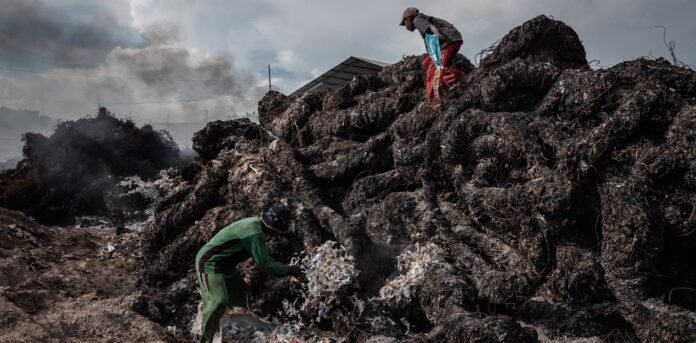
A large amount of plastic waste gets shipped overseas. In a new study, my colleague and I analyzed what happens when plastic waste is shipped to lower- and middle-income countries, where open burning is a common way of dealing with excess waste. The result, we found, is pronounced increases in toxic air pollution.
A worker carries a basket of plastic waste, wood and coconut husks to be used as fuel to fry tofu at a factory in Sidoarjo, Indonesia, in 2025. Burning waste is a common way to cut fuel costs, but studies have found high levels of microplastics in the tofu from these factories, toxic ash inside the buildings and hazardous levels of air pollution.Robertus Pudyanto/Getty Images
When plastic burns, it releases particularly toxic air pollutants. Fine particles can penetrate deep into people’s bodies, along with gases that include carbon monoxide, styrene gas and hydrogen cyanide. It also releases persistent organic pollutants such as polycyclic aromatic hydrocarbons and dioxins. These particles and gases have been linked to health risks ranging from respiratory and cardiovascular disease to cancer and reproductive and neurological disorders.
The ash from open burning can also contaminate soil and groundwater with persistent organic pollutants, heavy metals and other toxicants, creating more chances for people to be exposed to them through food and water.
Where this exported plastic waste ends up has been shifting.
In 2018, China stopped importing plastic waste, causing the total amount of plastic waste moving among countries – at least through official channels – to drop dramatically. Between 1992 and 2016, China’s plastic waste imports made up 45% of global imports.
We harnessed data from multiple monitoring systems, including satellite observations and cargo ship tracking signals, to understand where these plastic waste imports went and how much air pollution was released by openly burning this waste.
We found that particulate matter air pollution – of great concern for health – increased an average of 3.3% at the locations of large open waste dump sites in Indonesia after China’s ban in 2018-19 relative to expected business as usual, based on data from 2012-17. We found increases up to 1.68 micrograms per cubic meter.
Based on risk estimates from a global study of mortality associated with long-term exposure to outdoor fine particulate matter, this corresponds to an approximate 1.5%, 1.9% and 3.5% increase in mortality risk from chronic obstructive pulmonary disease, lung cancer and lower respiratory infections, respectively.
In mid-2025, Malaysia followed suit, allowing plastic waste only from countries that have ratified the Basel Convention on the Control of Transboundary Movements of Hazardous Wastes and their Disposal – a treaty that the U.S. has never ratified.
For these bans to be effective, these countries must also find ways to contend with illegal plastic waste shipments and paper imports contaminated by plastic waste.
Meanwhile, negotiations for an international, legally binding treaty on plastic waste, started in 2022, have stalled. In mid-2024 the European Union did pass a new regulation on waste shipments, prohibiting exporting plastic waste to countries outside the group of wealthy countries in the Organization for Economic Cooperation and Development from November 2026 to at least May 2029.
The effectiveness of these and future policies at reducing air pollution – and other kinds of environmental degradation – can be evaluated using methods like ours.
Ways to reduce plastic waste
As of 2021, only 5% to 6% of U.S. domestic plastic waste was recycled, according to estimates from the advocacy group Beyond Plastics and Bennington College. It is now even harder to export plastic waste to other countries that could “recycle” it.
Part of the problem is lack of capacity: The Association of Plastic Recyclers estimates that current plastic reclamation facilities in the U.S. and Canada could at most increase their plastic recycling by 35% to 44%, depending on the type of plastic, leading to a total recycling rate of 7% to 9%.
Ultimately, both decreasing plastic use and increasing recycling will likely be needed to solve the problem. Beyond consumer choices, packaging reuse – creating packaging and return systems that put the same materials back to work – can reduce the need for new plastics.
Recycling experts call for harmonized design standards to help streamline processing and deliver higher-quality recycled plastics, as well as extended producer responsibility fees or taxes to raise the cost of producing products that aren’t recyclable. The fees can provide needed funding to scale up recycling and other programs to reduce generation of plastic waste.
Since 2021, seven states have enacted extended producer responsibility laws focused on packaging: Maine, Oregon, California, Colorado, Minnesota, Washington and Maryland. However, it will take time to see the effects. Colorado’s final implementation plan, authorized in 2022, was approved only in late 2025. The first payment of extended producer responsibility fees to the Colorado Department of Public Health and Environment are scheduled to begin in mid-2026.
Ultimately, reducing and better managing our nation’s plastic waste can help prevent global health harms.
Why is this Trump official dead set on saving a failing California dam?
The Potter Valley Project, which dams Northern California’s Eel River, isn’t doing very much right now. Its reservoir is clogged with sediment, and drought often empties it out. The project once supported a hydroelectric power plant that could produce about 9 megawatts of electricity, which is about 1 percent of a typical fossil-fuel-fired plant, but it has not worked in years. Plus, some of its infrastructure may be at risk of collapsing during an earthquake.
Like thousands of other small dams across the U.S., it is now more trouble than it’s worth. That’s why the utility that owns the project, Pacific Gas and Electric, moved last year to demolish it and undam the river. PG&E has wanted to abandon the project for decades, but a final removal agreement required years of careful negotiation. The dam project currently supplies water to vineyards and cities in Sonoma County, and it’s the sole water source for the rural farm community of Potter Valley.
The final agreement was a delicate compromise: The Round Valley Indian Tribe, which has senior rights to water from the Eel, agreed to let some water flow from the river to farmers through a diversion tunnel, and the farmers agreed to accept about half the water they had received in past years when the reservoir was full. Supporters say that dam removal will restore natural water flow for vulnerable fish that have long inhabited the river.
But now, U.S. Secretary of Agriculture Brooke Rollins appears determined to blow up the deal.
An aerial view of the Potter Valley Project. Kyle Schwartz / CalTrout
The longtime ally of President Trump has joined a small group of local residents in mounting a public campaign against the deal. She may well succeed — she’s already identified an obscure Southern California water agency that suggests it’s open to taking control of the dams.
The intervention is just the latest in a series of efforts by Rollins to turn conservation issues into culture-war fodder. Under her leadership, the U.S. Department of Agriculture, or USDA, hastargeted federal funding for sustainable farming practices as well as programs that broaden farmers’ access to USDA support — terminating billions of dollars worth of grants on the grounds that such initiatives are what Rollins has called “woke” holdovers from the Biden administration.
Supporters of dam removal have reacted to Rollins’s intervention with incredulity.
“It’s not really even the federal government [opposing the agreement]. It’s a couple of MAGA extremists who happen to be government actors,” said U.S. Representative Jared Huffman, a Democrat who represents the area in Congress. “It’s sort of political theater masked as some sort of policy move that purports to be about taking over and operating this project, which is pretty preposterous.”
Rollins’s attempt to derail the Potter Valley deal has thrown the region’s future into question. Without an agreement, the Eel River and its surrounding environment will likely continue to deteriorate. The Round Valley tribe could sue to claim its senior rights over the river’s water, leading to prolonged litigation that could jeopardize water availability for nearby farms and cities. And water deliveries from the degraded reservoir will likely continue to be meager. More broadly, the development threatens a recent trend of negotiation and compromise in vulnerable watersheds across the country. The Potter Valley project is the latest in a series of dam removal agreements, from the Juniata River in Pennsylvania to the massive Klamath River dam removal on the California-Oregon border. These bipartisan agreements are fragile even in the best of times, but by politicizing the issue, Rollins may have made a permanent truce impossible.
Even though many farmers who receive water from the Potter Valley Project support the dam removal agreement, there are many local landowners and conservative residents who oppose it. One of the most vocal is a ranch-animal veterinarian named Rich Brazil, who lives in the small town of Potter Valley, just south of the main project dam. Brazil’s daughter, Keely Brazil Covello, is a filmmaker who writes a blog called America Unwon that advocates for farmers and ranchers. Her blog, which is ranked 44th on Substack’s “Climate & Environment” leaderboard, has publicized the perceived downsides of the deal and framed it as an existential threat to Potter Valley.
“This will change the face of that area,” said Covello, who now lives in Southern California. “People need to know what’s happening.”
After PG&E secured the dam removal deal, Covello began writing frequently about the deal. In early September, Rollins retweeted one of Covello’s posts about Potter Valley with the caption, “I’m on it.” That month, Covello and her father helped organize a letter addressed to Rollins and seven other leaders in the Trump administration that urged the officials to reject the agreement as “inadequate, noncompliant with federal law, and dismissive of community and environmental consequences.” Rollins and Covello later engaged in what appeared to be a coordinated messaging campaign about the dam removal effort.
In the following months, Rollins held a series of meetings with Covello, Rich Brazil, and other local dam removal opponents, and posted to social media about how the state legislature and Democratic Governor Gavin Newsom are putting “fish over people” — a standard attack line used on environmental activists in California. In December, Rollins published a letter to the editor in a local newspaper, The Mendocino Voice, condemning the dam removal effort for its threat to farmers and ranchers in the region.
Later that month, the agriculture secretary also filed a notice to intervene in the project proceedings as well as comments to the Federal Energy Regulatory Commission, or FERC, the nation’s independent dam regulator, requesting that the commission suspend PG&E’s formal request to surrender its license for the dams. “If this plan goes through as proposed, it will devastate hundreds of family farms and wipe out more than a century of agricultural tradition in Potter Valley,” said Rollins in a statement. “This plan would put countless USDA investments at risk and leave families even more vulnerable to drought and wildfire.”
Multiple current and former USDA staffers and officials told Grist that the USDA’s arguments in its request to FERC appear to omit the conservation and environmental priorities of the agency’s mission areas. In it, the agency argued that the dam decommissioning would cause adverse impacts to many of USDA’s mission areas, claiming impacts across five of the USDA’s subagencies, including the U.S. Forest Service and the Natural Resources Conservation Service, or NRCS.
U.S. Agriculture Secretary Brooke Rollins delivers remarks to farmers from the Truman balcony of the White House as President Donald Trump looks on in Washington, D.C. Oliver Contreras / AFP via Getty Images
Erin Foster West, a former NRCS staffer who is now executive programs director at the National Young Farmers Coalition, said that while the NRCS and Forest Service have historically managed and worked to support very small dams, the Potter Valley Project appears to have no obvious connection to USDA’s operations.
Gloria Montaño Greene, who served as deputy undersecretary of the USDA’s Farm Production and Conservation mission area during the Biden administration and was involved with the Klamath Dam removal, said these processes typically unfold very differently than the administration’s current approach — slowly, across multiple administrations, with a wide range of stakeholders at the table. The USDA’s public intervention here, she suggested, looks nothing like that.
“What’s the NRCS saying? What’s the state of California saying? What are the tribal leads for the area saying? There are many voices in the conversation,” she said.
Answers to these questions have remained elusive, and the story has only gotten stranger. Covello, Brazil, and the other dam removal opponents met with USDA officials in January at the Farm Bureau convention in Anaheim and in Washington, D.C., a month later. Then, in late April, Rollins announced that an entity had emerged to buy the dams from PG&E: the Elsinore Valley Municipal Water District, a water service provider some 500 miles away in Riverside County. A member of the Elsinore Valley board appeared on Covello’s podcast and declared her ambition to take over the dams, framing it as an altruistic gesture that will protect water supply for all Californians.
“All of California benefits when there’s water and all of California is harmed when there’s not,” Burke told Grist when asked why she wanted to acquire the project. She admitted that “there might be no benefit” to her district and said that “we are just interested and doing our due diligence.” Burke added that she first learned about the dam removal deal when she read an X post from Chad Bianco, the Riverside County sheriff who is running for governor as a Republican.
Policymakers and environmentalists have blasted Elsinore Valley’s involvement as at best a political stunt and at worst a plan to siphon water from Northern California and deliver it farther south. There is no infrastructure that could convey water from Potter Valley down to Elsinore Valley, making a direct water transfer physically impossible, but that has not quelled suspicions. Huffman’s office has begun a formal investigation into Elsinore’s involvement.
For Rollins, the political frenzy around the dam removal may be part of the point, according to Alicia Hamann, executive director of the environmental advocacy organization Friends of the Eel River.
“The involvement of this water district, nearly 600 miles away from the project, with no tangible connection to the power or the water associated with the project, is really bizarre,” said Hamann. She suspects that the administration could be using the case to appeal to farmers ahead of November’s midterm elections. Farmers, despite voting overwhelmingly for the GOP, have been increasingly dissatisfied with the administration’s trade policies and geopolitical conflicts roiling America’s farm economy.
In response to inquiries from Grist, a USDA spokesperson reiterated Rollins’s position, saying that dam removal “is expected to create severe, lasting consequences for the region’s agricultural producers and surrounding communities.” The spokesperson added that removing the dams would harm water quality and compromise drinking water supplies, reduce firefighting capacity, and put groundwater wells at risk “while jeopardizing substantial USDA investments tied to loans, insurance programs, conservation work, and rural development.” The spokesperson also pointed to other “unresolved issues” but did not clarify them.
Rollins’s intervention has fractured the delicate consensus around the dam removal agreement, but no one involved seems to have any clue what will happen next. PG&E’s proposal to decommission the dams is still pending before FERC, and neither USDA nor Elsinore Valley has submitted a formal proposal to take them over.
In the meantime, the two sides of the debate have begun to exchange legal barbs. Friends of the Eel River and other environmental organizations submitted a public records request to the Elsinore Valley Municipal Water District on May 5. The request, a copy of which was shared with Grist, cites concerns that the water district’s decision to explore purchasing the dams from PG&E violates the Brown Act, a California law that requires local legislative bodies to conduct their business in public.
Elsinore Valley appears to be pushing back. That same week, the water district and the America First Policy Institute, a conservative think tank cofounded by Rollins herself in 2021, began to file a torrent of their own public records requests to organizations that were involved in dam removal talks. While some of these were governmental agencies that are legally required to respond to such requests, others were private sector actors that are typically not subject to the law, like the conservation nonprofit CalTrout. The request toCalTrout, a copy of which was shared with Grist, sought all electronic communications concerning the Potter Valley Project; all records, internal documents, and funding applications; and all communications shared with a variety of related entities and agencies.
“We are not a public agency. So we were really confused we got it,” said Charlie Schneider, a project lead at the nonprofit. “What are they even after is hard to understand, right?”
Just days later, however, the America First Policy Institute rescinded its request. (The Institute declined to respond to a request for comment, instead directing Grist to the nonprofit’s public comment submitted to FERC opposing the dam removal.)
The most important local player in the Potter Valley conflict is the Round Valley Indian Tribe, which has senior rights to the water from the Eel River, meaning it could, in theory, assert a claim to the water that farmers and cities who rely on the Potter Valley Project are now using. The tribe has been pushing dam removal for generations, and the PG&E agreement was only possible thanks to their cooperation. They will allow farmers who got water from the dams to receive some of their Eel River water through a new diversion tunnel, and in exchange, the farmers will give the tribe money for ecosystem restoration.
Read Next
In an interview with Grist, tribal president Joseph Parker vowed to claim his tribe’s water rights if USDA continued to block the removal deal. This would mean a lengthy adjudication of the Eel River’s water rights, which could block Elsinore or any farmers downstream from taking water from the dams even if they did stay in place.
“We talked to USDA, we told them our story, and they listened, but you could tell they didn’t want to listen,” said Parker. “[The farmers] have been getting free water this whole hundred-plus years. Hopefully they know that we aren’t backing down and that we’re here for the long fight.” The tribe has addressed letters to both Rollins and Elsinore warning them about “the potential liabilities that any successor owner of these dams will likely face, and the resolve of our people to oppose their retention.”
Meanwhile, locals who have come to support the agreement argue that there’s no alternative to dam removal now that PG&E has decided to offload the project.
“If anybody had asked me ten years ago what would happen if [the Project] was gone I would have said it would be disastrous,” said Janet Pauli, a grape and hay farmer who is one of Potter Valley’s largest landowners and the head of the irrigation district representing most of the area’s farmers. “But that was then, and this is now.” Pauli helped secure the 2025 agreement in exchange for water diversion that would supply farms and cities downstream from Potter Valley during the winter.
Livestock graze on a patch of field not flooded by a swollen Eel River in Ferndale, California, in 2024. Stephen Lam / San Francisco Chronicle via Getty Images
Pauli also argues that it’s possible to mitigate the negative effects of dam removal for local farmers in Potter Valley by expanding a nearby dam on the Russian River and building other water storage projects in the valley. She said that opponents of dam removal haven’t been advocating for those projects, which would make the area more self-reliant.
Covello and the other opponents of dam removal don’t believe that those replacement projects for Potter Valley will ever be built, or that the winter water diversions from the Eel River will come to fruition. She also said she’s heard from both tribal members in the area and employees at PG&E that dam removal will offer far fewer benefits than proponents claim.
“It’s not gonna happen, and it’s not gonna work,” she said. “What we have works right now, and California can’t build anything to save its life.”
A spokesperson for PG&E said the utility had tried multiple times to find a buyer for the dam and is moving forward with decommissioning. The spokesperson said that there has been “misinformation” about the utility’s role and the availability of alternatives to dam removal. “There is a significant difference between an entity inquiring about the Potter Valley Project and actually submitting a proposal to acquire the project,” the spokesperson said in an apparent reference to Elsinore Valley’s overtures.
Keeping the dams up would be an enormous challenge, even if Elsinore Valley succeeds in acquiring them. By all accounts, the Potter Valley Project is in terrible condition. The hydroelectric power house broke down in 2021, and the diversion tunnel from the dams sits on a seismic fault zone capable of triggering a major earthquake. Furthermore, the dams are out of compliance with federal environmental laws around fish passage and water quality. Upgrading them to meet all these conditions would take hundreds of millions of dollars.
FERC, for its part, appears to be moving forward with the Potter Valley dam license surrender and decommissioning in lieu of any viable alternative. On May 22, the agency kicked off its environmental assessment of the Potter Valley removal project by releasing its first National Environmental Policy Act scoping document. That document calls dam retention “infeasible” because of seismic stability concerns, fruitless past efforts to find an operator for the project, and PG&E’s preferred alternative to remove the structure.
“FERC is saying, ‘There’s nothing else in front of us to assess,’” said CalTrout’s Schenider. “It’s certainly helpful [in] understanding where things are actually at.”
Even though they’re on opposite sides of California’s traditional conservation debate, which pits environmentalists who want to keep water in rivers against farmers who want to use it, Schneider agrees with Pauli, the local grape and hay farmer who thinks dam removal is the best path forward for the community.
“For USDA, some funding support for those farmers … strikes me as a much better use of their time and energy than trying to save 100-year-old dams that are eventually going to fill with sediment,” he said.
Kyle Farmer, a farmer and rancher who lives in Potter Valley, said the truth is far more nuanced than the fish-versus-people framing that Rollins has adopted. He once fought to preserve the dam, but now he views the big challenge in Potter Valley as finding a way to make farmers and residents whole once the dams inevitably go down.
“It would be great if this was a fish-versus-farmer problem, because there is a lot of precedent on how to handle those,” he said. “What we haven’t made much progress on is how to replace aging infrastructure. This is more like a town whose bridge is failing.”
How Pacific islands can gain from Australia-Japan ties
In their meeting on May 4 in Canberra, Australian Prime Minister Anthony Albanese and his Japanese counterpart, Prime Minister Sanae Takaichi, agreed to prioritize a range of issues including supply chains, energy, critical minerals, trade and security.
Under the framework of the Joint Declaration on Economic Security Cooperation, the leaders also pledged to support Pacific island countries (PICs) to combat money laundering through capacity-building initiatives. This should be seen by PICs as a positive development, as the crime remains one of the key challenges in the region.
The implicit identification of China as a threat to regional stability will displease some Pacific Island nations and perhaps encourage others. In all, however, strengthening Australia-Japan ties is overwhelmingly positive for a disparate region.
Multilateralism is central to the diplomatic and economic functioning of the island nations. In light of the US’s repudiation of international institutions and China’s increasingly aggressive acts, its decline is cause for alarm. North Korean missiles flying over Japan and Chinese aircraft buzzing foreign planes may feel far from, say, Port Moresby. But Pacific island governments notice, register and are planning for this more disputatious era.
Chinese influence in the Pacific Island countries is well documented; its economic and security cooperation initiatives in the region have surged in recent decades. Solomon Islands is closely aligned with China. Kiribati has welcomed Chinese funding for airstrip upgrades, seen by some analysts as evidence of grey-zone military tactics. Luganville Wharf on Vanuatu may soon serve a similar “dual-use” purpose — for Chinese commercial and military vessels alike.
The Australian government is well aware of these investments (or encroachments, depending on who you ask). For its part, Japan’s Takaichi government is pushing itself to step up across the islands, adding hard capabilities to its energetic diplomatic efforts.
In February this year, Defence Minister Shinjiro Koizumi welcomed 28 countries to Tokyo for the third Japan-Pacific Islands Defense Dialogue. Agreements were made with Papua New Guinea, Tonga and Fiji covering maritime security and disaster relief. Koizumi has been clear that the global and regional security environment is deteriorating and that Japan is sharpening its military capabilities and partnerships in response.
Under Koizumi, Japan’s defense budget will now exceed 9 trillion yen (around US$56 billion), closing in on the 2% of GDP target well ahead of schedule. Self-defense is the priority, but self-defense will come, in part, in the form of stronger alliances across the Indo-Pacific.
Koizumi’s call for the “autonomy” of the Pacific island countries aligns with this approach and serves as a clear rebuke to China. Japan’s alternative pitch is the preservation of national sovereignty with Tokyo serving as a long-term security partner. This is the Free and Open Indo-Pacific (FOIP) way, as it were. Now in its tenth year but updated for the current circumstances, Japan’s FOIP vision is based on freedom of navigation and trade, and the preservation of national sovereignty.
The Albanese government has faced diplomatic setbacks in the Pacific islands, not least the failure of a security and climate pact with Vanuatu in 2025. (A revised version of the Nakamal Agreement was approved by Vanuatu’s cabinet in May 2026, but only after explicit language limiting China’s security and investment role in the country was stripped out.)
Australia is sometimes seen as “other” on the islands or too close a partner of the United States. Japan’s renewed focus on the islands, therefore, will be welcome.
As Japan-Australia collaboration on global challenges intensifies, this will have positive knock-on effects on Pacific security.
For example, on April 18, Australia signed contracts for 11 of Japan’s Mogami-class frigates in a deal worth A$10 billion (US$7 billion). This acquisition will bolster the Royal Australian Navy. The frigates, to be built by Mitsubishi Heavy Industries, will have a range of up to 10,000 nautical miles — a gamechanger for Australia’s efforts to protect the Pacific islands’ maritime sovereignty.
The deal was followed by Prime Minister Takaichi’s overhauling of defence export regulations. Now, Japan’s firms will be able to sell lethal weaponry to countries with which it holds defense equipment and technology transfer agreements, including Australia and New Zealand. Increased exports and improved interoperability with Japan’s Self-Defense Forces will be a plus for regional security and stability.
In tandem with defense export reform, Japan’s official security assistance (OSA) budget for 2026 has been doubled to 18.1 billion yen (A$175 million). PNG and Tonga were named priority recipients for the 2025-2026 period. Dual-use assets for disaster response and maritime infrastructure building have already been provided to PNG.
Australian policy in the Pacific island countries has tended to focus on economic support. A record A$2.2 billion worth of Official Development Assistance (ODA) was committed to the Pacific in the 2026-2027 budget. Climate funding has been generous for some island nations. But tools to preserve national sovereignty have been constabulary- and maritime policing-oriented. For example, Australia’s Pacific Maritime Security Program, under which 12 Pacific island countries plus Timor-Leste have been gifted Guardian-class patrol boats, is a notable success. In terms of hardware, Japan is now well placed to add lethal weapons to the foundations of regional security.
Pacific island countries are too small — economically, militarily and diplomatically, with very limited resources and capacity — to explicitly take sides in the superpower rivalry. They should be cautious about middle power alignment, too. That said, external interests that act in good faith to preserve, not erode, national sovereignty should be welcomed. To that end, Australian economic aid and Japan’s more defense-edged approach are opportunities to be exploited.
The concept of rowing between the reefs — finding a path through choppy geopolitical waters without cleaving to one side of a conflict — has become somewhat of a cliché in international affairs. But it is surely the best way for Pacific island countries to preserve national sovereignty and secure prosperity in an era of escalating confrontation.
Moses Sakai is resident Vasey fellow at the Pacific Forum, a foreign policy think tank based in Hawai’i. He was previously a research dellow at PNG National Research Institute and a visiting scholar on US foreign policy at the University of Delaware.