Japanese Prime Minister Sanae Takaichi set the tone for the debate over Japan’s rearmament with her remark that a Chinese move against Taiwan could threaten Japan’s survival and warrant a military response.
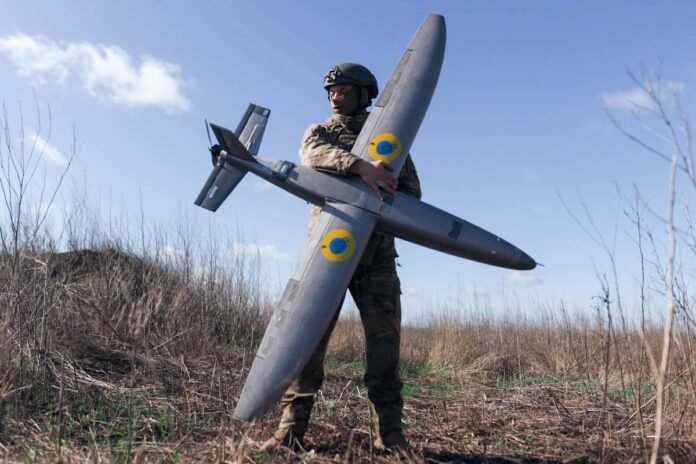
But the first casualties of her military buildup might be in Ukraine, where the Japanese venture Terra Drone has teamed up with the Ukrainian drone builder Amazing Drones.
This was underlined on May 29, when Japan’s Ministry of Defense (MOD) announced the Dispatch of Japan Self-Defense Forces personnel to the headquarters of the NATO Security Assistance and Training for Ukraine (NSATU).
Here are the details as announced by Japan’s MOD:
- The Ministry of Defense (MOD) and the Japan Self-Defense Forces (JSDF) have decided to dispatch four JSDF personnel to the headquarters of the NATO Security Assistance and Training for Ukraine (NSATU), located in Germany.
- This dispatch follows the offer conveyed in April last year by former Minister Nakatani to Secretary General Rutte of NATO, expressing Japan’s intention to proceed with arrangements for participation in NSATU. Coordination with the NATO side has now been finalized, which leads to this announcement.
- This dispatch will contribute to strengthening Japan’s own defense capabilities by gaining the lessons-learned in Ukraine, including the “new-way of warfare.” It will also deepen Japan–NATO cooperation in the context of the inseparability of security between the Euro-Atlantic and Indo-Pacific regions.
- MOD/JSDF will continue to advance security and defense cooperation between Japan and NATO.
In March 2026, Terra Drone announced its “full-scale entry” into the defense equipment market and a strategic investment in Amazing Drones, which develops and manufactures interceptor drones in Ukraine.
In April, Terra Drone announced the operational deployment of the short-range “Terra A1” interceptor drone, which was developed in partnership with Amazing Drones. The first successful interception of a “long-range unmanned aerial threat” was announced at the end of the month.
Also in April, Terra Drone announced a second strategic investment, this one in WinnyLab, a Ukrainian defense technology company that manufactures fixed-wing interceptor drones and integrates related software. That fixed-wing capability was used in the longer-range Terra A2 drone deployed in May.
Terra A1 is a high-mobility interceptor designed for rapid deployment, instant launch, and high-speed short-range interception. It accelerates to 200 kilometers per hour within 10 seconds after launch, flies at a maximum speed of 302 km/h and has an operational range up to 32km.
Terra A2 has a maximum speed of 310 km/h, a maximum flight time of 40 minutes, and an operational range up to 75 km. To see more specs and watch videos of these drones being launched, click here.
Distributed production in Ukraine
At the end of March, UNITED24 Media, an initiative of the government of Ukraine, reported that“Japan Plans Interceptor Drone Production in Ukraine—but Not the Way You Think.”
Speaking at a joint press conference with Amazing Drones in Kyiv on March 31, Terra Drone CEO Toru Tokushige said, “If you build a large factory in the normal way, it becomes a target. Ukrainian engineers already have know-how – how to decentralize production and operate under constant threat. We are learning from that.”
Tokushige’s point was reinforced by Russia’s Ministry of Defense and Dmitry Medvedev, deputy chair of Russia’s Security Council, in mid-April, after the German government announced a 4 billion euro aid package to support Ukraine’s air defense and drones, and when Ukrainian President Volodymyr Zelensky and Italian Prime Minister Giorgia Meloni announced that they were exploring joint drone production.
Russia’s MOD responded that joint production of drones would be a “step towards escalation” and published a list of European drone manufacturers and their addresses, writing on Telegram: “We consider this decision to be a deliberate step leading to a sharp escalation of the military and political situation on the entire European continent and creeping transformation of these countries into a strategic rear for Ukraine.”
The list includes companies in the UK, Germany, the Netherlands, Denmark, Latvia, Lithuania, Poland, Czechia, Spain, Italy, Turkey and Israel. In case someone missed the point, Russia’s MOD added that, “The European public should not only clearly understand the underlying causes of the threats to their safety, but also know the addresses, as well as the location of ‘Ukrainian’ and ‘joint’ companies producing UAVs.”
Former Russian president Medvedev wrote on X that: “Russian Defense Ministry’s statement must be taken literally: the list of European facilities which make drones & other equipment is a list of potential targets for the Russian armed forces. When strikes become a reality depends on what comes next. Sleep well, European partners!”
Against this, as with its Ukrainian partner, Terra Drone favors distributed small-scale production, which would also reduce the risk of casualties among the Japanese engineers and productions specialists Tokushige plans to send to Ukraine.
But, “Right now,” he continued, “the most important thing is real combat deployment. That is what we are working on.”
According to Amazing Drones CEO Maksym Klymenko, “The main challenge is scaling in a full-scale war—constant threats, strikes, and security risks. There is also a shortage of personnel, but we believe these challenges can be overcome.”
Back in Kyiv on April 28 to talk about scaling up production of the Terra A1 and Terra A2 interceptor drones, Tokushige said:
“Ukraine has its advantages: speed of development and low cost. But there are also challenges – lack of experience in mass production and operating in global markets, as well as shortages of key technologies. Many processes are still manual, which complicates scaling, especially beyond the country. That’s why the development of autonomous systems is critically important, and that is exactly what is expected from us.”
On April 28, Terra Drone also announced that a Terra AI drone jointly developed with Amazing Drones had “demonstrated its capability to respond to long-range unmanned aerial threats under actual operational conditions… a significant milestone … [that] represents an important step in validating the effectiveness of Terra A1 in real-world operating environments.”
Or, as Tokushige put it, “One of our A1 drones has already successfully intercepted a ‘Shahed.’ This is critical because in the military field, what matters most is not certifications but proven performance in combat. Without that, it is impossible to sell.”
Shahed drones are unmanned combat aerial vehicles designed by Iran’s Shahed Aviation Industries. They are manufactured both in Iran and Russia, the Russian version having been upgraded. By shooting down a Shahed, Tokushige got his selling point.
Terra Drone has developed a layered defense concept combining interceptor drones with complementary capabilities. According to Tokushige, “It is impossible to defend using just one type of system. You need multiple layers – short, medium, and long range, with different speeds. Our A1 is one layer, and the new A2 is the middle layer. Another type is also under development.”
Terra Drone also plans to introduce jet-powered drones capable of flying up to 440 km/h with a range of up to 140km.
“In Ukraine,” said Tokushige, “such solutions are already being developed – drones or low-cost missiles. The pace of development here is not 10 – 20 years like in traditional defense industries, but literally six months. That’s why startups are critically important.”
Terra Drone also aims to build AI-enabled drone systems that detect and engage targets autonomously, reducing dependence on humans in dangerous or depopulated areas.
Collaboration with Turkey
May 6 was Turkey-Japan Defense Industry Cooperation Day at the SAHA International Defense & Aerospace Exhibition in Istanbul. Turkey’s Secretariat of Defense Industries (SSB) and Japan’s Acquisition, Technology and Logistics Agency (ATLA) took “Important steps… toward developing strategic cooperation between the two countries in the defense industry and high-technology fields,” according to SSB President Haluk Gorgun. Japanese ambassador Masami Tamura echoed that sentiment.
More than 10 Japanese companies participated in the event, including Terra Drone. Japanese military equipment makers have had their eyes on Turkish drone technology for several years now and are reportedly in talks with military contractor Baykar, maker of the Bayraktar TB2 drone used by Azerbaijan, Ukraine and Qatar, and also with Turkish Aerospace Industries.
Speaking from Istanbul, Tokushige told Nikkei Asia that he is looking for partners to integrate interceptor drones into bigger systems capable of detection, identification, tracking, and command and control. With this in mind, he is talking with leading Turkish defense contractor Aselsan.
Japan seeks to replicate South Korea’s success in selling defense equipment to Turkey, while Turkey aims to diversify and expand both its access to defense technology and its own exports of defense equipment.
Tokushige also hopes to sell interceptor drones to Persian Gulf states targeted by Iran, or may have already done so, if MilitaryNewsUA@front_ukrainian on X can be believed. The price advantage is very great: About $2,500 for a Terra A1 and $3,000 for a Terra A2 vs. $4 million for a Patriot missile. A Shahed drone reportedly costs around $35,000.
In any case, Terra Drone is targeting international markets beyond Ukraine, hoping to build economies of scale and its reputation. “Specific financial figures are not yet available,” said Tokushige,“but the potential is hundreds of millions of dollars…”
In April 2025, Terra Drone was selected to receive Japanese government subsidies to promote sales of commercial drones to the UAE and Saudi Arabia.
Japan’s leading drone maker
The ultimate goal, however, is mass production of advanced military drones in Japan. And it seems likely to be reached sooner rather than later.
On May 8, Terra Drone announced that it had secured an order through a public competitive tender conducted by Japan’s Acquisition, Technology & Logistics Agency (ATLA) and entered into a manufacturing contract for 300 units of its domestically produced “Modular UAV (General-Purpose), Training Model.”
According to Terra Drone, this “represents a significant order achievement for the Company’s defense business… We believe this order reflects recognition of Terra Drone’s capabilities in developing, supplying, and fielding domestically produced drone systems amid these broader market and policy trends.”
Established in 2016, Terra Drone is headquartered in Tokyo. Overseas, in addition to its partnerships in Ukraine, it is active in Europe, the US and Canada, Latin America, the Middle East, India, Southeast Asia and Australia.
Terra Drone’s original target markets were agriculture, inspection of industrial facilities, surveying for construction and engineering projects, and unmanned aircraft traffic management.
Now, with its defense business key to Japan’s military build-up and its interceptor drones in demand overseas, the company’s sales growth should accelerate and its need for subsidies decline until it becomes a profitable enterprise by the end of the decade.
Follow this writer on X: @ScottFo83517667









![Roman Gofman [Wikipedia]](https://i0.wp.com/www.middleeastmonitor.com/wp-content/uploads/2026/06/Roman_Gofman_2017.jpg?fit=640%2C360&ssl=1)