28.8 C
London
Thursday, June 25, 2026
Home Blog

Breaking the algorithm: why AI will never master diplomacy

0
breaking-the-algorithm:-why-ai-will-never-master-diplomacy
Breaking the algorithm: why AI will never master diplomacy

Today, foreign ministries across the world are drowning in information — news reports, intelligence assessments, social media posts, satellite imagery, economic data, speeches and diplomatic cables.

AI can summarize thousands of documents in minutes, track political sentiment across countries, detect emerging crises earlier, analyze sanctions, dissect trade flows and monitor military movements.

The technology’s promise is compelling. A foreign minister who once relied on a 20-page briefing note may soon receive an AI-generated dashboard constantly updated with developments from across the globe.

Negotiations could become more data-driven. AI can model trade agreements, energy partnerships, climate commitments and infrastructure projects, among others.

Before entering negotiations, governments may simulate multiple scenarios and identify optimal bargaining positions. For example, while negotiating a free trade agreement, diplomats could rapidly assess the impact of thousands of tariff combinations.

Traditionally, major powers held an advantage because they could afford large diplomatic corps and intelligence agencies. But AI could partially level the playing field for smaller nations with fewer diplomats.

With access to advanced AI tools, smaller nations may be able to perform analytical tasks previously requiring hundreds of specialists. This could democratize diplomatic capability, though access to the most advanced AI systems may itself become a source and determinant of power.

Yet diplomacy has an enduring complication: A single leader can upend all predictions with one unexpected decision.

Donald Trump’s tariff escalations and policy reversals, Kim Jong Un’s unexpected military alignment with Russia, and Benjamin Netanyahu’s carrot-and-stick approach in Gaza are stark examples. The Iranians walking out of talks after Trump’s recent threat is another. Can diplomacy really be automated when leaders themselves are so often unpredictable?

Political leaders are not algorithms. The central assumption behind most predictive systems is that actors behave according to identifiable patterns. AI learns from past behavior, detects correlations and estimates probabilities.

This works remarkably well when patterns are stable. Diplomacy, however, often turns on individuals who deliberately refuse to behave predictably — or, in some cases, rationally. This is where the limits of algorithmic diplomacy become starkly evident.

Consider Trump. During his second presidency, many analysts anticipated tougher trade measures against China. What proved difficult to anticipate was the speed, scope and sequencing of those decisions. Markets, businesses and even allies found themselves constantly revising expectations as Trump raised and lowered tariffs at will.

For Trump, unpredictability is a strength, not a weakness, and is often leveraged as a negotiating tool. Threatening extreme measures, altering positions, creating uncertainty and keeping counterparts guessing can all generate leverage at the bargaining table. The more others try to predict his actions, the greater the advantage of remaining unpredictable.

A similar dynamic can be observed in North Korea. For years, many assumed Kim Jong Un remained heavily dependent on China and therefore constrained by Beijing’s preferences.

Instead, he deepened military cooperation with Russia, extracted strategic and economic benefits from that relationship and simultaneously strengthened his bargaining position with China.

Kim has also repeatedly alternated between threats and conciliatory gestures, making it difficult for outside observers to determine whether particular signals represent genuine policy shifts or tactical maneuvers.

Benjamin Netanyahu presents a different challenge. Throughout the Gaza conflict and wider regional tensions, outside observers often struggled to predict Israeli decision-making.

Military considerations were only one factor. Coalition politics, domestic pressures, personal political survival and strategic calculations all interacted in complex ways.

Such variables are difficult to fully capture in datasets or predictive models. None of these examples prove that world leaders have “defeated” artificial intelligence — governments do not publicly disclose what their predictive systems forecast.

But they do illustrate a broader point: The same leaders who surprise intelligence agencies, diplomats, markets and policy experts are also likely to expose the limitations of AI-driven prediction.

The problem is not that AI lacks intelligence. The problem is that politics is not governed solely by logic. Diplomacy involves trust, prestige, fear, ambition, ideology, ego and perception.

Leaders sometimes pursue courses of action that appear costly or irrational to outside observers because they are responding to domestic political pressures, personal convictions or concerns about reputation. In many cases, these motivations are difficult to quantify and even harder to predict.

Paradoxically, the growing use of AI may actually increase the value of unpredictability. If governments increasingly rely on predictive algorithms, leaders gain incentives to become less predictable.

Strategic ambiguity becomes a source of power. Sending contradictory signals, changing course unexpectedly or maintaining uncertainty can complicate an adversary’s calculations and reduce the effectiveness of predictive tools.

History offers an instructive precedent. During the Cold War, President Richard Nixon’s “madman theory” sought to convince adversaries that he might act unpredictably, thereby encouraging caution. Whether the strategy succeeded remains debated. What matters is the underlying logic: uncertainty can itself be a strategic asset.

The leaders most likely to frustrate predictive systems are not necessarily irrational. They are often leaders who understand that others are trying to predict them and deliberately cultivate ambiguity.

In a world increasingly dependent on algorithms, strategic unpredictability may become even more valuable. Leaders like Trump consciously exploit AI’s weaknesses: appearing unpredictable becomes strategically valuable when governments rely on predictive algorithms.

A leader who frequently changes positions, sends contradictory signals or makes unexpected decisions becomes harder for AI systems to model — and in that sense, erratic behavior can itself become a negotiating tool.

This does not mean AI will fail in diplomacy — far from it. AI will transform diplomatic practice in profound ways: improving intelligence analysis, accelerating decision-making, enhancing crisis monitoring and strengthening policy planning. It may even help smaller countries compensate for limited diplomatic resources.

For India, these advantages are particularly significant. India’s diplomatic service remains relatively small for a country of its size and global ambitions. AI could serve as a force multiplier, improving analytical capacity and enabling more effective engagement across multiple regions simultaneously.

As AI becomes increasingly central to national power, investments in indigenous technological capabilities, computing infrastructure and advanced research will become essential components of strategic autonomy.

Yet even the most sophisticated AI system cannot fully answer the questions that matter most in diplomacy. Is a leader signaling resolve or bluffing? Is a threat genuine or intended for domestic audiences? Is a sudden conciliatory gesture the beginning of a compromise or merely a tactical pause?

Such questions are not fundamentally data problems — they are problems of interpretation and judgment. And as AI handles more routine analysis, human diplomats may become more valuable, not less.

A seasoned ambassador might notice a leader’s mood, body language, personal insecurities, rivalries within the ruling elite or changes in tone during private conversations.

These subtle signals often matter more than data. An AI might conclude: “There is a 75% probability of agreement.” A diplomat might say: “The leader feels personally insulted — the deal is unlikely to survive.” The second assessment could prove more accurate.

That is why diplomacy is unlikely to become AI-led and far more likely to become AI-assisted. Algorithms will process information faster and more comprehensively than any human bureaucracy, identifying patterns, generating scenarios and highlighting risks.

But the most consequential decisions in international politics will continue to be made by human beings — leaders who can choose, at any moment, to follow the script, rewrite it or discard it altogether. And that is precisely why the leaders most likely to succeed in advancing national interests may be those who can still break the algorithm.

Raghu Gururaj is a retired Indian ambassador and former foreign service officer.

Google Finance finally gets a mobile app as AI-powered overhaul leaves beta

0
google-finance-finally-gets-a-mobile-app-as-ai-powered-overhaul-leaves-beta
Google Finance finally gets a mobile app as AI-powered overhaul leaves beta

Google Finance is not a new product—it has been around for 20 years, long enough that it initially relied on Flash to display charts and graphs. The website has gotten a few major updates over the years, but it has never had a mobile app until now. Google has released the first standalone app for Google Finance, which is currently exclusive to Android, with iOS planned for later this year.

The app is available globally in the Play Store, but that’s not the only update to Google’s financial tracker. The AI-powered makeover for the Finance website is also leaving beta, making Google’s chatbot a core part of the experience. Naturally, the mobile app includes a heaping helping of generative AI that aims to make sense of irrational financial markets.

If you’ve checked out the new Finance web experience, you’ll see a lot of familiar features in the app. You can create watchlists, monitor real-time market data, and keep up with financial news in one place. While perusing graphs of stock performance, Finance will use AI to generate “key moments” that can explain why the numbers changed. This feature initially launched in the Finance web interface back in May.

Google Finance on Android

The mobile app also gets Google’s new AI research tool, accessible via the “Ask” button floating at the bottom of the UI. This allows users to converse with Google’s money-tuned bot about stocks. The bottom bar also includes a History section where you can easily access your past chats.

Google says that the current Android app is just a starting point. It plans to adapt more features from the new website to the app over time. Consequently, the updated website has a few features you won’t find in the app. While you can build a watchlist in the app by searching for stock symbols, the website has an expansive portfolio feature. Portfolios from the old Finance will port over, gaining new AI insights and suggestions. You can also upload a CSV or PDF to build a trackable portfolio in Google Finance. The chatbot has access to your portfolio data and can answer questions taking that into account.

The Finance website is also gaining a new AI-powered research tool that can send you periodic updates. Google suggests something like: “Send me a daily pre-market briefing analyzing significant overnight moves across major cryptocurrencies.”

Whatever you’re interested in, be that crypto or something marginally less sketchy, you’ll get notifications through the mobile app when your research reports are ready. They will also be viewable in the web version’s research panel.

Portfolios in the new Google Finance

Few industries have adopted generative AI as readily as finance. Many of the investments and market trends that lead to numbers going up or down are driven by AI models. So maybe a hallucinatory robot is what you need to make sense of the nonsense. Google’s got you covered there.

Why Carbon Capture Can’t Conceivably Solve Climate Change

0
why-carbon-capture-can’t-conceivably-solve-climate-change
Why Carbon Capture Can’t Conceivably Solve Climate Change

Carbon Captured How the fossil fuel industry influenced climate research

An investigative series by ProPublica and Drilled

For more than 40 years, oil companies have been funding research at prestigious universities into climate change “solutions” that would not require the public to stop using oil and gas. Among their favored fixes is carbon capture and storage.

An investigation by ProPublica and Drilled has found that boosters of CCS have ignored evidence of the technology’s limitations, or overstated its potential, and convinced the world it could be effective.

They’ve promoted this idea despite the fact that for CCS to work at the scale now envisioned, the world would need to devote almost unimaginable resources. Even if that were done, it might still prove impossible to trap so much carbon dioxide inside the earth.

Optimism has reigned, however, because small tests have worked and because slow global response to climate change has left few other options.

Right now, globally, we’re permanently burying less CO2 than a single large power plant can emit in a year.

Some experts point to the CO2 that gets pumped into the ground to help extract oil as proof CCS works. But that process, called enhanced oil recovery, isn’t designed to function the same way and isn’t monitored as stringently.

Global leaders are betting on carbon capture working now more than ever.

The models used in the latest United Nations assessment presume the technology succeeds.

IEA representatives and U.N. modelers say their projections reflect what the world has to do to achieve its goals of averting extreme warming.

To make CCS work, we would need to capture CO2 pollution in four ways:

Trap it from smoke stacks.

Absorb it from the air with fast-growing grasses or trees,

then capture it from those plants when they are burned for fuel.

Scrub it from the air, often using giant fans.

Then we would pump all of it into porous rock deep beneath the earth’s surface.

The U.N. analysis now suggests that countries must inject 6 billion tons of CO2 underground each year by the middle of the century.

Getting 6 billion tons of CO2 a year out of the atmosphere, though, is a daunting task.

If all of this works, and the CO2 is successfully captured, it must then be moved to a place where it can be buried.

In the U.S. alone, this could require building more than 68,000 miles of new pipelines in a little more than two decades.

That’s more than double the distance to fly around the earth.

And longer than the country’s entire interstate highway system.

Globally, pipelines could tally in the hundreds of thousands of miles.

Then, there is the challenge of finding a place to put 6 billion tons of CO2 a year.

Today, just 12 large-scale geologic reservoirs have attempted to permanently store CO2 pollution — but we would need more than 2,000 reservoirs of that size for CCS to work, each requiring years of study and engineering before it could be used.

Even if this could be done, it would cost tens of trillions of dollars.

Right now, U.S. taxpayers are paying oil and gas companies $85 for every metric ton they put underground.

At that rate, by 2050, the world could be spending half a trillion dollars — more than China’s military budget, and 10 times more than the U.N.’s humanitarian and development aid budget — each year.

$500 billion

annual global expenditure on carbon capture and storage by 2050

$340 billion

China’s military budget in 2025

$50 billion

U.N.’s humanitarian and development aid budget in 2024

The few test sites that exist suggest that keeping carbon underground may not work at scale.

Since 1996, while the 12 large-scale geological storage projects have opened, plans for another 12 have been scrapped. Many CCS sites in operation — in Norway, Algeria, Australia and the U.S. — have been mired in problems, pointing to enormous challenges ahead.

Climate experts know about the costs, technical troubles and failures of CCS test projects.

Yet many of them have continued to boost the technology, even as they have downplayed solutions showing greater progress.

For example, the same modelers who overestimated the potential of geological carbon storage repeatedly underestimated solar power — one of the energy technologies that would allow more oil to remain in the ground.

The modeled pathways, what we call projections, for deployment of carbon capture and storage are from text and tables in the International Energy Agency’s Energy Technology Perspectives and World Energy Outlook reports, and from correspondence with the IEA. The 2008 and 2010 projections are from the IEA’s Blue Map scenario; a second 2010 projection is from the Net Zero by 2050 scenario; 2018 is from the Sustainable Development scenario; and 2021, 2022, 2023 and 2024 are from the Announced Pledges, Stated Policies and Net Zero by 2050 scenarios. Some of these scenarios represent pathways designed to achieve a specific temperature or concentration of CO2. Other scenarios represent what is possible based on current policies or pledges. Pathways from years where underlying data was not provided in the IEA’s report were excluded.

In response to emailed questions, a spokesperson for the IEA said, “The IEA’s long-term modelling and scenarios are not designed to predict future deployment of technologies; the different scenarios we produce are intended to explore the potential implications and trade-offs of different policy, technology and investment choices.” The agency said that solar power has succeeded in part because of successful policy support for it, especially in China, and that CCS has lagged because of a lack of similar support. It added that CCS remains a part of the solution portfolio for industries that might otherwise be hard to decarbonize. The spokesperson noted that a record number of CCS projects are under construction.

Data for the actual CCS capacity derives from the IEA’s CCUS Projects Database. We defined large-scale projects as those with the estimated capacity to store at least 500,000 metric tons of CO2 annually. The data comprises only projects that were completed and that permanently store CO2, rather than those that utilize CO2 for enhanced recovery of oil and gas or other uses, since those uses can create more carbon than they store or have looser requirements for monitoring.

Of the 12 completed CCS injection projects, 11 remain operational and one has been decommissioned. The annual total for carbon stored assumes the projects operated at their stated capacity each year since launch, which few have done. The comparison to the volume of CO2 emitted by a single large power plant is derived from data provided by the U.S. Energy Information Administration.

The projections for solar power production are from the IEA’s World Energy Outlook reports. Data depicted is from the Announced Pledges, Current Policies, New Policies, Net Zero by 2050, Reference, Sustainable Development and Stated Policies scenarios. Data was limited to projections from IEA reports from every other year to make the chart less cluttered.

Data for the actual deployment of solar energy was taken from IEA’s World Energy Outlook and Energy Technology Perspectives reports.

Data comparing projections and deployment of carbon storage and solar energy was initially compiled by researchers Rory French and Lindsey Gulden.

The 6 billion tons target figure is derived from the 2024 paper “The feasibility of reaching gigatonne scale CO2 storage by mid-century.” It reflects the median quantity of subsurface carbon storage among scenarios from the Intergovernmental Panel on Climate Change’s Sixth Assessment Report scenario database that have a greater than 67% chance of limiting warming to 2°C.

The IPCC said it does not develop or run the models that create the scenarios in its database, and noted that the Assessment Report includes information contextualizing and questioning the models’ assumptions around solar and CCS deployment.

The estimate of 768,000 square miles of land needed to grow biomass comes from the Sixth Assessment Report’s Technical Summary, which states that the cropland area needed to keep warming below 1.5°C with no or limited overshoot is around 199 million hectares in 2050.

The estimate of 68,000 miles of pipeline is sourced from the 2021 Net-Zero America report.

To calculate how many large-scale CCS reservoirs would be required to meet the 6 billion metric tons target, we assumed the projects would bury as much as the largest carbon storage project has in its largest year, the Gorgon Carbon Dioxide Injection Project in Australia, which injected 2.7 million tons in 2019. That figure came from the 2025 annual report from the London Register of Subsurface CO2 Storage, produced by Imperial College London.

To calculate the total annual cost for CCS projects by 2050, we multiplied the $85-per-ton subsidy the U.S. offers industry in its 45Q tax credit by 6 billion tons.

China’s 2025 military budget is sourced from the Stockholm International Peace Research Institute.

The U.N.’s humanitarian and development aid budget for 2024 comes from the U.N. Systems Chief Executives Board for Coordination’s expenses factsheet.

Why a development project linked to Donald Trump’s son-in-law has rocked Albania

0
why-a-development-project-linked-to-donald-trump’s-son-in-law-has-rocked-albania
Why a development project linked to Donald Trump’s son-in-law has rocked Albania

Thousands of Albanians have been taking to the streets of their capital, Tirana, for over three weeks now to oppose a luxury coastal resort project backed by Jared Kushner, the son‑in‑law of the US president, Donald Trump. The €4 billion (£3.5 billion) development will be constructed on southern Albania’s unspoiled Zvërnec coastline and surrounding wetlands.

Albania’s longstanding prime minister, Edi Rama, who has been in power since 2013, has hailed the project as transformative for the Albanian economy and tourism sector. But local residents and environmental organisations have fiercely resisted the plan, citing unresolved land ownership disputes and the threat it poses to fragile ecosystems.

Public anger exploded in late May when footage emerged of a protester being dragged across a cliff by security guards at the resort site. The video went viral, igniting Albania’s largest civic protests in decades and galvanising a society long divided by party politics and the legacy of communism.

The protests have snowballed into a broad anti‑government movement that has become known as the “flamingo revolution”, named after the rare birds that inhabit the wetlands threatened by the Zvërnec development. Protesters in Tirana, as well as at demonstrations organised by the diaspora across Europe, are demanding Rama’s resignation.

Protestors hold a banner reading 'sea turtles were here first!' in the area planned for a coastal resort project.

The Zvërnec project has faced public opposition over environmental concerns and land-ownership questions. Malton Dibra / EPA

The anger on display has been building for years in a country plagued by systemic corruption. A string of government ministers have been jailed in recent years for abuse of office and on corruption charges.

And while tackling corruption and organised crime remains the central condition for Albania’s accession to the EU, for which negotiations opened in 2024, Rama’s government has repeatedly undermined accountability.

His ruling Socialist party recently refused a request from Albania’s EU‑sponsored special prosecution body to lift the parliamentary immunity of the former deputy prime minister Belinda Balluku. She has been indicted for corruption, though denies any wrongdoing. Moves like this threaten to delay Albania’s EU accession further.

The cost of living in Albania has also soared. Fuel prices there were among the highest in the Balkans, even before the energy shocks linked to wars in Ukraine and Iran. Politically connected individuals dominate Albania’s energy market and stifle competition.

Foreign investors have long faced significant challenges in doing business in Albania due to distorted competition, as well as corruption in procurement and the weak enforcement of contracts.

At the same time, a housing affordability crisis has pushed many people to the brink. Albania’s real estate sector has seen rapid growth in recent years, facilitated by weak oversight of transactions. A UN report from 2021 suggested that money laundering has become a major factor in the price increases in Tirana and coastal areas.

Tourism is a key engine of growth for Albania, with millions of people now visiting the country each year. However, an underdeveloped domestic food industry as well as poor road and rail connectivity means ordinary Albanians are rarely able to capitalise on the sector’s success.

Young people in particular feel excluded from political processes and economic opportunities, shut out by opaque decision‑making and entrenched elites. More than half a million Albanians have emigrated to EU countries in the past decade in search of better opportunities.

What comes next?

With the protests now in their fourth week, the question hanging in the air is what the endgame might be. Protesters are demanding not only the government’s resignation but also deep structural reforms, starting with an overhaul of the country’s electoral system.

Many are calling for a caretaker government tasked with making constitutional amendments and renewing the fight against organised crime and corruption.

But the Socialist party holds a comfortable parliamentary majority and Rama has so far dismissed calls to step down. He has attacked protesters with slurs and suggested – without providing evidence – that foreign malign actors are behind the movement.

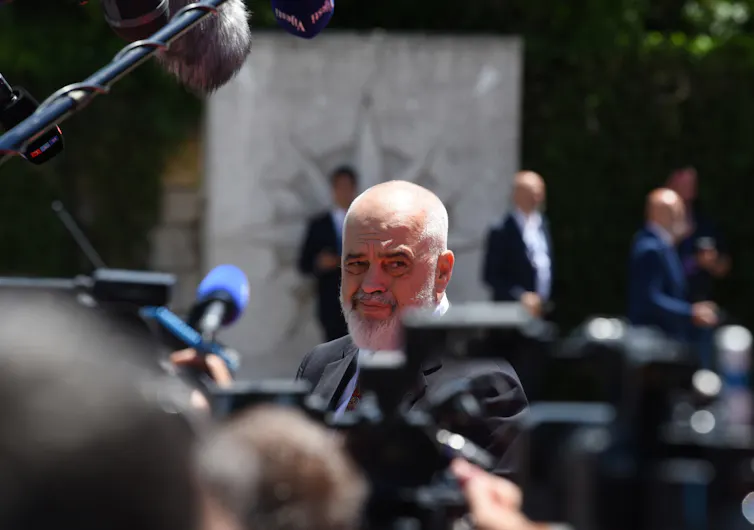
Edi Rama speaks to reporters after arriving at the EU-Western Balkans summit in Montenegro.

Edi Rama has rejected calls by protesters for him to resign. Boris Pejovic / EPA

However, pressure is mounting. On June 17, the European parliament urged Albania to suspend construction in protected areas. And the special prosecution has indicted several people allegedly involved in money laundering in construction, a sector that has long been considered a pillar of the government’s power.

Signs of dissent are also emerging within the Socialist party ranks. Marjana Koçeku, a young ruling party MP, recently defected to become an independent. And during the current unrest, some former cabinet ministers have publicly criticised what they see as Rama’s strong rule of the country.

The protest movement is ideologically diverse, making it hard to coalesce into a single political party. Yet it still poses a genuine challenge to Rama’s authority. The sheer scale of public mobilisation signals a profound legitimacy crisis and the desire among Albanians for a future without the existing elite at the helm of their country.

Refusing to resign, Rama hopes the movement will lose momentum. Yet the protests have empowered Albanians who now believe that deep political change is possible.

Hundreds of Palestinians protest Israeli policies of home demolitions in Negev

0
hundreds-of-palestinians-protest-israeli-policies-of-home-demolitions-in-negev
Hundreds of Palestinians protest Israeli policies of home demolitions in Negev

Hundreds of Palestinians protested Thursday in Beersheba in Israel’s southern Negev region against Israeli policies of home demolitions and land confiscation targeting Bedouin communities in the area, Anadolu reports.

According to the Israeli daily Yedioth Ahronoth, protesters included residents of Bedouin communities affected by demolitions or facing displacement, as well as supporters from among Arab Israelis.

The protest was organized by the Higher Steering Committee for Arabs in the Negev, the Committee of Heads of Bedouin Local Authorities, and the Regional Council for Unrecognized Villages.

Demonstrators carried banners affirming their rights to land and housing, with slogans including “The Negev belongs to its people and owners” and “No to house demolitions, yes to our right to housing.”

They also held signs bearing the names of villages facing demolition or evacuation, including Tel Arad, Al-Sirr, Wadi al-Khalil, Umm al-Hiran, and Al-Araqib.

Earlier Thursday, Israeli National Security Minister Itamar Ben-Gvir praised the demolition of Bedouin Palestinian homes and vowed to intensify the policy.

On Wednesday, Ben-Gvir said 5,700 homes had been demolished over the past year.

Successive Israeli governments have promoted what they call “development programs” for Palestinian Bedouin villages in the Negev, aimed at relocating residents to state-planned towns.

Palestinian Bedouins, however, view these policies as a tool of forced displacement that severs them from their historic lands and denies recognition to their villages.

OPINION – Beyond the Day After: A Strategy To Accelerate Iran’s Democratic Transition

0
opinion-–-beyond-the-day-after:-a-strategy-to-accelerate-iran’s-democratic-transition
OPINION – Beyond the Day After: A Strategy To Accelerate Iran’s Democratic Transition


Iran’s opposition has moved beyond planning for the day after the Islamic Republic and must now build the organization, networks, and defections needed to hasten democratic change

The recently announced understanding between Washington and the Islamic Republic of Iran has once again sparked debate among opponents of the Islamic regime. Some view it as a necessary step to avoid a longer and deeper regional war. Others fear it may give the regime economic and political breathing room.

Both concerns are understandable.

Still, regardless of whether this agreement succeeds or fails, the Iranian opposition must confront a difficult reality: Our future cannot depend on decisions made in Washington, Brussels, Jerusalem, or any other foreign capital.

The future of Iran will ultimately be determined by the Iranian people.

For years, one of the most common criticisms directed at the opposition was simple: “What happens the day after the Islamic Republic falls?”

Today, that question is finally beginning to receive credible and substantive answers.

Under the guidance of Prince Reza Pahlavi and through the work of the Iran Prosperity Project, dozens of experts have invested countless hours developing frameworks and plans for a democratic transition, economic recovery, institutional reform, and national reconstruction. These efforts show that serious preparation is taking place and that a viable alternative to the Islamic Republic is emerging.

The question before us now is no longer what happens after regime change.

A more urgent question has come into focus: How do we accelerate regime change itself?

The opposition’s greatest weakness is not the absence of a vision. It is the absence of sufficient organization.

Millions of Iranians oppose the regime. Millions more are disillusioned with it. Yet opposition efforts remain fragmented across organizations, activists, professionals, media personalities, and civic groups.

The regime benefits from this fragmentation.

To accelerate change, the opposition should focus on five strategic priorities.

First, we must dramatically increase coordination among opposition organizations while respecting their independence. No single group, movement, or personality can accomplish this mission alone. The objective should be cooperation around shared goals, not competition for leadership.

Second, we must invest far more heavily in building operational networks inside and outside Iran. Sustainable change requires organized citizens, trusted communication channels, trained volunteers, and the ability to mobilize rapidly when opportunities emerge.

Third, we must expand support for defections from within the regime. Every bureaucrat, military officer, security official, judge, diplomat, and public servant who chooses the nation over the regime weakens the system from within. Successful transitions throughout history have depended not only on public pressure but also on the erosion of regime loyalty. This principle has also been emphasized by Pahlavi as a critical pillar of democratic transition.

Fourth, we must continue strengthening independent communications and information networks. Authoritarian systems survive through control of information. The freer the flow of information, the weaker the regime’s ability to manipulate public perception and suppress dissent.

Fifth, the Iranian diaspora must move beyond commentary and become a force multiplier for change. The diaspora possesses extraordinary expertise, financial resources, professional networks, and political influence. These assets should be systematically organized to support the struggle for freedom and prepare for national recovery.

Pahlavi has repeatedly articulated a strategy built on maximum pressure on the regime, maximum support for the people, maximum defections from within the system, maximum organization of Iranians, and preparation for prosperity after transition. The opposition should view these principles not as slogans but as a practical framework for action.

History rarely provides unlimited opportunities.

The current moment may prove to be one of the most consequential periods in modern Iranian history. If the opposition remains fragmented, the regime may survive yet another crisis. But if we combine preparation, organization, and strategic coordination, we can greatly increase the likelihood of a peaceful and democratic transition.

The foundation for rebuilding Iran is already being laid.

Now we must focus on bringing that future closer.

EU names ex-Dutch defence minister as EEAS secretary-general

0
eu-names-ex-dutch-defence-minister-as-eeas-secretary-general
EU names ex-Dutch defence minister as EEAS secretary-general


Former Dutch Defense Minister Kajsa Ollongren has been appointed secretary general of the European External Action Service, the EU’s foreign policy wing.

The move, announced in an email to staff on Wednesday afternoon and then made public, reflects the growing importance of defense-related matters in Brussels. It also puts an end to weeks of speculation after predecessor Belén Martínez Carbonell was moved to lead the EU’s delegation in Mexico after two years in the post, as first reported by POLITICO’s Brussels Playbook.

The EEAS has been in turmoil since October when the team of top EU diplomat Kaja Kallas sought to cut Carbonell’s key responsibilities, including managing relations with member country ambassadors, and instead hand them to a deputy.

Kallas’ team initially planned to appoint controversial German bureaucrat Martin Selmayr to the role, only for opposition from capitals and the European Commission to sink the bid. Kallas then temporarily handed the position to fellow Estonian diplomat Matti Maasikas, who is now confirmed to serve as EEAS deputy secretary general.

Another key appointment confirmed by the diplomatic service today is that of David Cvach, the current French ambassador to NATO, who will take on the role of deputy secretary general in charge of defense, as first reported in Morning Defense. Cvach’s new role means France will keep control of a key position overseeing the EU’s defense setting, as he will replace French diplomat Charles Fries.

The appointments of Ollongren and Maasikas will be effective Sept. 1.

While some officials disputed how vital Ollongren’s role can be given that she won’t be attending the regular meetings of EU ambassadors — a key function that will remain with Maasikas — an EU official granted anonymity to speak freely defended the package of appointments: “The key priority for this mandate is defending Europe, defending Ukraine, we have to deliver on that, and for that, to bring in the people who have the best knowledge and the best experiences on that is very important.”

“It is also deliberate that there are people who will make our cooperation with NATO even stronger because at the time that we are working on building this European defense, it has to be done hand in hand with NATO,” the official added.

The EEAS will need to fill another key position in the coming months, as Kristin de Peyron, the agency’s head of human resources, has publicly announced her early retirement starting Oct. 1.

Source: Politico

Two Republicans flip votes, blocking Iran war powers resolution

0
two-republicans-flip-votes,-blocking-iran-war-powers-resolution
Two Republicans flip votes, blocking Iran war powers resolution

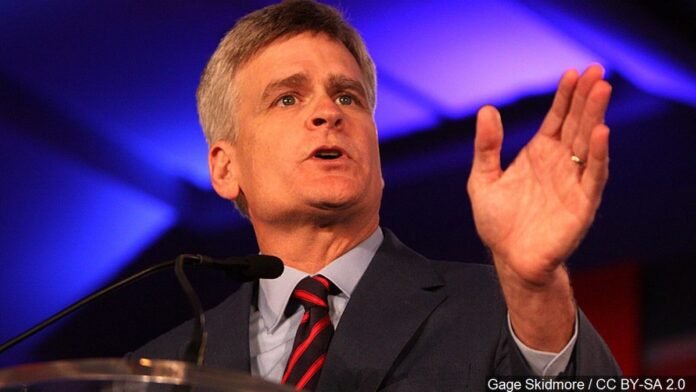
Senator Bill Cassidy. Photo: Gage Skidmore / creative commons

Two Senate Republicans who supported a previous resolution calling for an end to the US war on Iran changed their votes late Wednesday after President Donald Trump publicly and privately berated GOP lawmakers, calling them “losers” who provided “aid and comfort to the enemy.”

In Wednesday’s procedural vote, Sen. Bill Cassidy (R-La.) – who reportedly got into a shouting match with Trump over the Iran war during a closed-door lunch hours earlier – sided with virtually every other Republican in opposing the war powers resolution, just a day after he supported a separate, symbolic resolution calling for the removal of US forces from the conflict. Sen. Rand Paul (R-Ky.) also switched, changing his vote to “present” at the urging of the president.

Senate Republicans forced late Wednesday’s vote in a clear effort to placate Trump, who fumed at “Republican losers” who backed the symbolic war powers resolution that passed the upper chamber earlier this week. Sen. Tim Kaine (D-Va.), the lead sponsor of the resolution that Republicans blocked on Wednesday, said the vote was held to “appease” Trump’s “temper tantrum.”

“After both Republican-majority Houses took the historic step of voting that additional war against Iran is illegal without congressional authorization, President Trump came to the Capitol and tried to browbeat Republican senators for upholding their oaths of office,” said Kaine. Wednesday’s vote, the senator added, “does not undo the expressed position of Congress that further war against Iran is illegal unless Congress votes for it.”

Trump, who has repeatedly threatened to resume attacks on Iran if negotiations collapse, celebrated Wednesday’s vote in a late-night post on his social media platform, thanking Senate GOP leaders and highlighting that Cassidy and Paul changed their votes.

Cassidy, who lost reelection last month and insisted hours before the vote that he would not “be bullied” by the administration, subsequently thanked the White House for giving him a “thorough briefing” on Iran to “address many of my concerns.” Trump reportedly had called Cassidy a “lunatic” during Wednesday’s private lunch.

Wednesday’s vote came amid tenuous negotiations between the US and Iran on a diplomatic resolution to end the illegal war that Trump launched in late February, killing thousands of Iranians, throwing the global economy into chaos, and driving up prices at home.

On Wednesday, prior to the Senate war powers vote, the White House asked Congress to approve an $87.6 billion supplemental funding package that includes nearly $70 billion for military programs to address “operational costs incurred” during the war on Iran.

Rep. Brendan Boyle (D-Pa.), the top Democrat on the House Budget Committee, said in a statement that “the tens of billions in military spending requested by the Trump administration could be used to protect Americans’ healthcare, feed hungry children, and help working families afford everyday life.”

“Instead, Trump wants taxpayers to continue footing the bill for his reckless war in Iran, which has sent the cost of gas and everyday goods skyrocketing, put our brave men and women in uniform at risk, and left the region no safer than before,” Boyle added.

Senate Democrats’ top appropriator, Patty Murray of Washington, said she would not “rubberstamp tens of billions more for this disastrous war of choice.”

“This president is telling the American people there’s no money for healthcare, housing, or childcare—but there should be endless taxpayer dollars to fund wars they don’t support,” said Murray.

-Common Dreams

Feds deny Polestar authorization to sell cars in US from model year 2027

0
feds-deny-polestar-authorization-to-sell-cars-in-us-from-model-year-2027
Feds deny Polestar authorization to sell cars in US from model year 2027

The electric car brand Polestar’s days in the US are seriously numbered. Today, the company revealed that the US Commerce Department has declined to authorize imports of new Polestars from model year 2027 onward as part of a rule banning connected cars from automakers with Chinese links.

Polestar says it will continue to sell its existing stock of Polestar 3 and Polestar 4 SUVs and “will continue to support customers, including providing access to its service network.” But we can forget about the Polestar 5 sedan, the Polestar 6 roadster, or any future models making it to these shores.

The automaker was spun out of Volvo Cars several years ago as a pure EV brand by its corporate parent, Zhejiang Geely Holding, a Chinese company that also owns OEMs like Lynk and Co and Zeekr. And just weeks ago, Commerce authorized Volvo to import MY27 vehicles. At the time, Polestar told Ars that it was continuing to work with US authorities to meet the regulations; that work was evidently in vain.

US domestic auto manufacturing interests have been wildly successful in raising support for protectionist measures from across the political spectrum, although ironically, the Polestar 3 SUV is built in South Carolina at the Volvo plant near Charleston. Polestar 4s destined for the US were built in South Korea, although much of Polestar’s manufacturing is in China.

“The automotive industry is entering a new phase, based on regional dynamics. Our strategy reflects that, with Europe being our largest growth engine and our plan to manufacture Polestar 7 in Europe,” said Michael Lohscheller, Polestar’s CEO. “Our record sales in 2025 and the first quarter of 2026 show that we are making strong progress, with several new market launches taking place in Europe this year. In addition, we will continue to invest in markets where we have opportunities to continue to grow, like Southeast Asia, Eastern Europe, Latin America, and Canada.”

Establishment Democrats to the Dustbin of History

0
establishment-democrats-to-the-dustbin-of-history
Establishment Democrats to the Dustbin of History


When Hakeem Jeffries, who’s positioning himself to be House speaker if the Democrats retake the chamber come November, was shown on the screen at an election party full of socialists in Brooklyn Tuesday night, the crowd chanted, “You’re next! You’re next!” Before polls closed on the night that would see the Jeffries-endorsed candidates fall and Mayor Zohran Mamdani’s candidates win, the New York congressman told reporters that he and the mayor have “agreed to strongly disagree” and that “a handful of primaries that go in one direction or the other in a given state or two aren’t going to reshape who we are as House Democrats.”

He may be right in the short term; it will take many nights like Tuesday to remake the face of the party. But what’s underway is nothing less than an existential threat to the version of the party that has made Jeffries its standard-bearer. If middle-of-the-road Democrats fail to reckon with this escalating reality and shift to the left, they risk making themselves irrelevant forever — and ceding even more ground to the Republicans as they cut off their nose to spite their face.

After all three congressional candidates that earned Mamdani’s endorsement — Darializa Avila Chevalier, Brad Lander, and Claire Valdez — won handily, as did nearly all of the Democratic Socialists of America’s down-ballot slate in New York, Jeffries and his ilk were quick to discount Mamdani’s political project as one that could never take root beyond the New York City meeting halls of Williamsburg and Bushwick. But as other primary races this cycle have shown us, that’s simply not true.

In Maine, Graham Platner delivered a crushing defeat in the Democratic Senate primary to Gov. Janet Mills, whom Chuck Schumer reportedly “aggressively recruited” to enter the race at all (and as we’ve covered, her campaign never really got off the ground or found anything approximating grassroots support). Platner’s victory — amid a spate of scandals over his online posts and alleged mistreatment of women — is now exposing the lie of one of his party’s favorite refrains for disciplining the left: that for all our differences, we must “vote blue no matter who.” 

These candidates stand for actual policy, not just mealy-mouthed “messaging.”

In the Senate race in Michigan, polling is strong for Abdul El-Sayed, a former public health official pushing Medicare for All and centering Israel’s genocide of Palestinians while competing with a both-sides-ing progressive and an outright AIPAC Democrat. Philadelphia nominated Chris Rabb, an outspoken anti-genocide democratic socialist, over the party’s political machine-mined candidate in Philadelphia, and Dr. Adam Hamawy, a 9/11 first responder who saved Sen. Tammy Duckworth’s life as an Army medic but was also tarred with Islamophobic attacks that tried to frame him as a supporter of terrorism, won a crowded 12-way primary in New Jersey earlier this month. (The latter three have all appeared on the trail with Hasan Piker, the popular streamer who’s become a potent political force for left-wing Democrats, much to the dismay of centrists who condemn him as “controversial” and worse.)

If you care to pay attention, there’s an obvious through line with all these candidates: They all stand for actual policy, not just mealy-mouthed “messaging,” and they have been unequivocal in their criticism of Israel. Mainstream Democrats have long lacked that moral clarity as America’s ally in the Middle East committed a genocide in Gaza and dragged the U.S. into an instantly unpopular war with Iran, and they’re being handed the losses they so richly deserve by candidates running to the left. For now, they’ve responded by making overtures of progressive change without meaningful or widespread policy shifts.

The idea that the party should respond to the will of its voters has become so foreign to the Democrats that Jeffries’s political operation has sneeringly referred to even the notion of a party challenge from the left as coming from “Team Gentrification.” On no issue is the division between voters and the national party as stark as it is when it comes to Israel.

A party that wants to defeat the rise of the far right in this country should look to bring the left in, especially as it continues to win at the ballot box. But instead, establishment Democrats have continued to bash and attempt to marginalize the growing left consensus. “If you hate the Democratic Party, then please don’t run for our nomination,” former Democratic National Committee chair Jaime Harrison wrote on social media on Tuesday.

But you can only condescend and disregard your party’s supporters for so long until they look for another vision of the future — one that doesn’t include you.

0FansLike
0FollowersFollow
0FollowersFollow
0SubscribersSubscribe
- Advertisement -
Google search engine

Recent Posts