President Trump Warns Iran Not To ‘Get Cute’ With Renewed Pickaxe Nuclear Site Activity
President Donald Trump warned Iran that the US could launch heavy strikes against the country if construction continues at Pickaxe Mountain, a suspected underground nuclear site where satellite imagery has shown increased activity this year.
“We notice there’s a little activity at Pickaxe. I would advise Iran not to get cute because we will have to hit them very hard,” President Trump said in a speech at the midterm Republican convention.
Pickaxe Mountain, roughly 140 miles south of Tehran near the Natanz nuclear complex, has been under construction for years. An analysis of six years of satellite imagery by the Center for Strategic International Studies found “a clear surge in construction activity” at the site this year, CNN reported.
The center said the deeply buried facility could potentially serve as a centrifuge assembly facility, an enrichment plant, or a protected underground shelter.
President Trump issued the warning as fighting between Iran and the US has resumed and oil prices have again climbed above $100 a barrel ahead of the US midterm elections.
The Wall Street Journal reported that President Trump’s advisers have warned him the conflict could last through the remainder of his presidential term and potentially continue beyond it. Senior US officials, including Vice President JD Vance and Secretary of State Marco Rubio, have discussed that possibility with Trump in multiple conversations, the newspaper reported.
In recent weeks, President Trump has moved away from pursuing an extensive military campaign against Iran, favoring economic sanctions intended to put financial pressure on the Iranian regime.
The world just experienced its joint-hottest month since records began, with August pushing the planet’s average global temperature to more than 1.5 degrees Celsius (2.7 degrees Fahrenheit) above pre-industrial levels, the EU’s Copernicus Climate Change Service (C3S) said on Thursday.
Extreme weather and climate-related disasters raged around the world last month. Scientists have said climate change likely played a role in the landslides and flash floods that killed hundreds in Nepal and China’s Tibet, although the specifics are still being studied. Wildfires surged from Indonesia to Greece and Belgium, while severe drought struck Hungary and Romania.
🌡 August #C3S Climate Bulletin reports that August was the joint-warmest month on record & 1.65°C above the estimated pre-industrial level. Western Europe saw its warmest summer on record, while the average sea surface temperature across the extra-polar ocean was also the joint highest on record.⬇️
Temperatures of more than 1.5 C above pre-industrial times are significant because that temperature, when measured as a decades-long average, is the level of warming nearly 200 countries vowed to try to prevent under the 2015 Paris climate agreement, in order to avoid the worst consequences of climate change.
August was the first month since November 2025 in which the world’s average temperature exceeded 1.5 C above pre-industrial levels.
With an average global surface air temperature of 16.96 C, last month tied with July 2023 as the world’s warmest month on record. This was 1.65 C hotter than the planet’s average temperature in the 19th century, before humans started burning oil, coal and gas on an industrial scale, C3S said.
Emissions from burning these fossil fuels are the main cause of climate change.
“We’ve really seen the impact across Europe of how maladapted we are, with roads melting, train lines buckling, schools closing, hospitals completely overwhelmed, and record wildfires for the time of year,” said Samantha Burgess, strategic lead at the European Centre for Medium-Range Weather Forecasts.
“The narrative around climate change has really transitioned from being quite an abstract concept that happens in a faraway place, to disrupting our daily lives,” she said.
The data confirmed western Europe is emerging from its hottest summer ever recorded, with many regions suffering unusually low river flows and soil moisture — adding to farmers’ woes, after a succession of extreme heatwaves since May ravaged crops.
ANOTHER 1.5 C BREACH
The world has not yet technically breached the Paris Agreement’s 1.5 C target — which refers to an average temperature over decades, rather than a temporary peak. Currently, the world’s long-term warming level is about 1.4 C above pre-industrial levels.
The U.N. said last week that sticking to the long-term 1.5 C goal is no longer possible. It urged governments to cut CO2 emissions faster, to limit overshooting the target.
C3S’s records go back to 1940, and are cross-checked with global temperature records going back to 1850.
Last month’s extreme heat was not limited to land. The world’s oceans outside of the polar regions also recorded their joint-highest sea surface temperature for any month on record, C3S said.
In the tropical Pacific, record-high temperatures were fuelled by the formation of the El Nino weather pattern, which is forecast to strengthen in the coming months — potentially pushing up global temperatures further.
Far-Right Hacker Touting Cyber Attacks on Leftist Sites Has Close Ties to Pentagon Influencer
It was a bad week for the Autistici/Inventati collective.
On August 26, the State Department announced far-reaching sanctions against the Italian collective, which provides web-hosting services to a swath of the international far left. The U.S. government categorized A/I, as it’s also known, as a “specially designated global terrorist” and accused it of being an “extremist group that builds and operates the digital infrastructure for violent Antifa cells.”
A/I maintains digital infrastructure utilized by thousands of leftists and left-wing organizations across the globe, including anonymous email accounts and servers powering its NoBlogs.org hosting platform. The designation could force many of the sites offline — threatening much of what the A/I Collective has built.
Two days later, the site came under a different kind of attack. Hackers took aim at the NoBlogs site itself. A cyberattacker gained access to the platform, vandalizing its homepage and potentially accessing internal user data.
For far-right hackers and internet trolls, this was a moment for celebration. Just two minutes after the vandalized homepage was captured by an internet archive, the attack was publicized on X by someone using the handle “AstraRCE” and soon promoted by prominent far-right accounts, including “DataRepublican,” the online moniker of Jennica Pounds.
Until June, Pounds was a member of the Pentagon press corps — famous mostly for trolling the left — but allowed her credentials to expire at the end of the month. In late August, it was revealed that Pounds had been employed by the Pentagon since July, as part of a larger operation launched by the federal government to recruit right-wing influencers into jobs at President Donald Trump’s Department of War.
The relationship between DataRepublican and AstraRCE goes back through several prominent hacks of the left. The pair have a long and involved history of posting to each other about hackers’ exploits online, raising questions about the relationship between a Trump administration employee and an anonymous online personality posting real-time updates on hacks against the left.
“That is a line that is always worth noting and ringing the alarm bell when crossed.”
DataRepublican and AstraRCE are part of a wider circle with huge followings that are often the first to mention hacks against left-wing digital infrastructure. They publish screenshots, share each other’s posts, offer snide commentary, and congratulate their associates — messages that frequently verge into bestowing credit for the hacks.
The federal government’s support for an influencer who praises domestic hacking efforts would mark a major escalation in the Trump administration’s crackdown on dissent, said Harlo Holmes, the chief security programs officer at Freedom of the Press Foundation.
“It’s the difference between open-source intelligence, that is often used in surveillance, and ever increasingly used in surveillance, and actually jumping into people’s machines,” Holmes said. “That is a line that is always worth noting and ringing the alarm bell when crossed.”
Though members of the A/I Collective weren’t able to attribute the hack to anyone, the cyberattack would eventually achieve its apparent aim. Beset by the pressure of terrorism sanctions, a hostile cyberattack, and continued scrutiny from the U.S. government, the group announced on September 6 that, after 25 years, it would disband.
“We cannot engage in a fight or expose ourselves to manipulations that threaten the lives of these people and their loved ones, leaving them at the mercy of autocrats, fascists, and agencies that take extra-legal courses of action,” the group wrote in a statement. “The Autistici/Inventati collective is shutting down and will soon discontinue all of the services we provide.”
Publicizing NoBlogs Hack
DataRepublican frequently publishes reports, visualizations, and data leaks that target leftist groups involved in protests and activism across the country.
Before Pounds’s assignment at the Department of War, DataRepublican regularly posted inside information about hacks, nodding to the involvement of other far-right social media personalities, among them AstraRCE.
DataRepublican and AstraRCE were the first people to publicize the NoBlogs hack online. Taking a celebratory tone, they linked to and replied to one another’s post. In one instance, AstraRCE claimed apparent inside knowledge about the federal government’s possession of internal user data from NoBlogs. DataRepublican confirmed the claim.
AstraRCE’s initial X post about the hack showed a screenshot of the vandalized NoBlogs homepage, which now displayed a message that said, “All user data has been saved and given to the United States government” — alongside an altered banner that read “TRUMPBLOGS.” AstraRCE later offered a mocking congratulations to NoBlogs for its “rebrand.”
Just four minutes after AstraRCE pointed to the screenshot of the hack, DataRepublican’s X account reposted the image, alongside a caption characterizing NoBlogs as a “platform shared by Antifa and far-left Marxists.”
“The State Department designed them as a Specially Designated Global Terrorist group yesterday,” DataRepublican wrote. “And now … they’re TrumpBlogs.”
Later, DataRepublican’s website published a visualization tool that allows users to view thousands of NoBlogs sites dispersed across a map, naming the tool Trumpblogs, in what appears to be a reference to the hack. Shortly after the tool went online, AstraRCE posted on X to say that the trumpblogs.org domain would now be redirecting to DataRepublican’s site.
The Pentagon has thus far declined to reveal what assignment Pounds or other right-wing media influencers have been given, and it’s unknown if activities like producing the visualization tool would be part of these duties. (The Department of War did not reply to a request for comment.)
They’re “trying to identify their enemies and build dossiers on them.”
“They’re hiring people who have a history of sort of dirt digging,” said David Greene, who serves as legal counsel at the nonprofit Electronic Frontier Foundation. “And they’re digging for information about their enemies, and both trying to identify their enemies and build dossiers on them.”
Holmes, of the Freedom of the Press Foundation, said that determining responsibility for cyberattacks like the one that targeted NoBlogs can be incredibly difficult, especially for smaller organizations.
“Attribution is really hard to prove definitively,” Holmes said. “But, also, there are a lot of imbalances there because the folks at Autistici don’t necessarily have the ability to perform the type of forensics and response that normally leads to successful attribution, or at least not quickly.”
Partners in Posting
DataRepublican and AstraRCE steer clear in their posts of explicitly claiming responsibility for hacks. They frequently, however, offer kudos to fellow travelers. Sometimes they post claims of insider access to information about the hacks or, in a few cases, show information that reveals access to the hacked systems themselves.
In at least one instance, a post by DataRepublican appeared to take direct responsibility for a cyber operation. Writing on X in July, the DataRepublican account claimed credit for a honey-pot scheme against a Nigerian hacker, which DataRepublican said had gone after right-wing media personality Hugh Hewitt.
“It’s true,” DataRepublican wrote, attaching a screenshot of the hackers’ location and IP address. “@astrarce and I honeypotted the Hugh Hewitt hacker.”
Even though DataRepublican and AstraRCE don’t take credit for cyberattacks, the far-right web heaps praise on them for the exploits.
Seeking to disrupt a database collecting information on U.S. Immigration and Customs Enforcement vehicles, a January hack overrode images of license plates with a meme saying, “ALL YOUR LOGINS, LOCATIONS, PASSWORDS, AND PHONE NUMBERS HAVE BEEN GIVEN TO FBI AND ICE.”
After sharing the image and tagging AstraRCE, DataRepublican was asked by an online fan how it happened. The account replied, “I don’t know, but an unrelated tip is that it’s a bad idea to make your encryption/decryption script readable to the world.”
Several X accounts in the right-wing milieu responded to DataRepublican’s initial post with congratulations. A spokesperson for Turning Point USA said, “Well done, patriots.”
In another case, a Fox News article purported to expose the network of organizers behind protests at ICE’s Delaney Hall detention center in New Jersey. Summarizing its report, Fox News credited, among others, DataRepublican and AstraRCE with infiltrating the group: “The activities of this network have motivated a group of tech sleuths on the X — @DataRepublican, @Astrarce, @bitchuneedsoap and @gunshymartyr — to penetrate these groups, their Signal chats and their operations like a digital Avengers squad.”
In February, following a cyberattack on Siembra NC, a North Carolina-based immigrant rights organization, DataRepublican claimed the group operated two active websites responsible for “doxxing ICE.” Citing AstraRCE, DataRepublican suggested hackers had taken over the nonprofit’s notification system.
“Per @astrarce,” DataRepublican wrote, “the 1000+ users signed up to both sites have received a text alert with the meme attached” — a photo of FBI Director Kash Patel with meme text that says, “FEDS HAVE ALL YOUR DATA.”
DataRepublican then posted what appeared to be a screenshot of the organization’s internal notification dashboard, claiming that more than 2,000 users had received push notifications. The notification text visible on the dashboard suggested users received a message urging self-deportation and claimed their personal information had been sent to federal authorities.
During a similar hack of StopICE.net, an ICE tracking website, DataRepublican claimed to have insider knowledge of data from a hack being sent to the authorities.
“I can personally testify,” DataRepublican posted, “that the names, logins, passwords, locations (down to coordinates), and phone numbers of 100K+ users were all sent to FBI, ICE, HSI” — ICE’s Homeland Security Investigations division — “and more.”
Like the cyberattack targeting NoBlogs, in other cases DataRepublican and AstraRCE were also quick to celebrate cyberattacks against leftist groups and post screenshots of the incursions. In many of the cases, the webpages of the sites were vandalized and a message was left behind claiming to have accessed and sent internal data to the federal government.
Claiming Inside Info
The NoBlogs hack became one of the instances where DataRepublican and AstraRCE alluded to both having insider information about the provenance of materials from the hack and their transmittal into the hands of the authorities — all while Pounds was firmly ensconced at the Pentagon.
“Can confirm the authorities have everything that was on the NoBlogs servers.”
The episode, in the immediate wake of the NoBlogs hack, was telling. AstraRCE echoed the claim made on the vandalized NoBlog homepage: that the federal government was in possession of the site’s internal user data.
The episode was set off when the A/I collective issued a statement acknowledging the hack and that the “attacker may have had access to the users database.” The collective warned that the hackers could have accessed the “list of email addresses of the people who manage the blogs and their passwords.”
The password information for the user accounts, however, was stored “hashed,” A/I said, rather than in plain text, making it substantially harder to access.
Shortly after A/I published its statement about hashed passwords, AstraRCE posted an image of the statement alongside a caption suggesting that they had direct knowledge of the data that was breached.
“Yep,” AstraRCE wrote. “The government has their emails and dehashed results.”
Lawsuit: Amazon refused to give pregnant workers bathroom breaks and chairs
Amazon discriminated against pregnant warehouse employees by denying accommodations like bathroom breaks and the option to sit while working, according to a lawsuit filed yesterday by four women who worked for Amazon while pregnant. The lawsuit is a class-action complaint that seeks to represent Amazon workers throughout the US.
“Plaintiffs Willamina Barclay, Kristina Green, Jennifer Hatch, and Dazaria Parks were formerly Amazon warehouse employees,” said the lawsuit filed in US District Court for the Eastern District of New York. “All four became pregnant. All four asked Amazon for basic pregnancy-related accommodations so they could keep doing their jobs. Amazon denied them basic modifications the law recognizes pregnant workers regularly need, even in uncomplicated pregnancies: Bathroom breaks. An extra 15-minute break. Sitting instead of standing.”
The lawsuit said the four plaintiffs were unlawfully terminated from jobs at Amazon facilities in New York between April 2025 and July 2026. After the plaintiffs “took medically necessary breaks or absences to get off their feet, visit the doctor, or go to the emergency room, they were punished,” the lawsuit said. “Amazon deducted their limited bank of unpaid time off. Soon enough, they had depleted that limited bank of ‘unpaid time off,’ and Amazon threatened to terminate them.”
In a statement, Amazon said the lawsuit contains inaccuracies and denied that it violates federal law on pregnancy accommodations. “We’re limited in discussing ongoing legal matters, however we look forward to a timely resolution of these matters, as extended investigation timelines benefit neither employees nor employers,” Amazon said.
Amazon has faced similar lawsuits in previous years, but this one has the added backing of a 2022 US law called the Pregnant Workers Fairness Act (PWFA). The relatively new federal law requires “reasonable accommodations for qualified employees affected by pregnancy, childbirth, lactation, or related medical conditions and limitations so long as doing so does not create an undue hardship on the entity’s operations,” the lawsuit said.
US agency finding may bolster case against Amazon
Amazon demanded medical documentation even for simple requests, the lawsuit said. “When Plaintiffs sought accommodations, Amazon applied its unlawful policy of demanding medical paperwork for every pregnancy-related accommodation request, no matter how basic,” despite such paperwork often taking weeks to obtain early in pregnancy, the lawsuit said.
The US Equal Employment Opportunity Commission (EEOC), the federal agency that enforces the PWFA, instructed employers in 2024 that it is not reasonable to demand supporting documentation for certain kinds of pregnancy-related requests. This includes having water nearby for drinking, taking additional bathroom breaks, taking breaks to eat and drink, and sitting while working, “because these are a small set of commonly sought modifications that are widely known to be needed during an uncomplicated pregnancy,” the EEOC said.
Hatch’s claims have reportedly been evaluated and deemed credible by the EEOC. She filed a charge of discrimination with the EEOC, and in February 2026 the agency found reasonable cause that Amazon “has discriminated against a nationwide class of female warehouse associates, based on their pregnancy, by failing to accommodate their limitations related to pregnancy, childbirth, and or related medical conditions, and in some instances forcing them to take leave, in violation of the PWFA,” according to the lawsuit.
The EEOC finding was previously described in a New York Times report published in April. The NYT report said that because of the finding, “The EEOC will now try to reach an agreement with Amazon. If it can’t, Ms. Hatch will have the option of suing.” According to the lawsuit filed yesterday, “the EEOC issued Ms. Hatch a Notice of Right to Sue” on August 26. Barclay also received a Notice of Right to Sue.
The lawsuit accuses Amazon of violating the PWFA by failing to accommodate pregnant workers and by retaliating against those who sought reasonable accommodations. “Plaintiffs and Class Members’ requests for reasonable accommodation caused Amazon to take adverse employment actions against them by applying its Punitive Attendance Policy, leading to disciplinary action and/or termination,” the lawsuit said.
The state of New Jersey previously sued Amazon in October 2025, alleging widespread discrimination against pregnant workers and employees with disabilities. Amazon reported $200.6 billion in net sales in Q2 2026 and a net income of $62.6 billion.
Amazon says it approved 99.9% of pregnancy requests
Amazon said in a statement provided to Ars that the claims in the New York-based workers’ lawsuit “contain inaccuracies and omit important details” and “do not reflect the full facts of these cases or the reality of our extensive accommodations process…. While we’re not able to discuss individual employee details, we have conducted thorough internal reviews of each case referenced.”
Amazon said it “strive[s] to provide a safe and supportive environment for everyone, which includes supporting tens of thousands of employees with pregnancy accommodations each year. In the past year, more than 99.9 percent of pregnancy related accommodations requests have been approved,” including “additional breaks, modified duty, or seated roles.”
Amazon also said it provides “up to 20 weeks of fully paid leave for eligible birthing parents, including four weeks of pre-partum leave and a ramp-back program.”
Barclay and Green worked at an Amazon warehouse in Rochester, New York. Hatch had a job processing customer returns in a Lancaster fulfillment center, while Parks was a delivery associate at an Amazon delivery station in Rochester.
The former Amazon workers are represented by A Better Balance, a nonprofit advocacy group. The lawsuit seeks to represent a nationwide class of Amazon workers and a subclass of New York-based Amazon workers. The four named plaintiffs want reinstatement, back pay, compensation for lost benefits, and punitive damages.
Amazon “did not permit her to have a chair”
Amazon allowed Barclay to switch from a “picker” to a “packer” role, but she “was still forced to stand for long periods, squat repetitively, and lift heavy boxes,” the lawsuit said. The lawsuit alleged that even when “Barclay dutifully submitted medical documentation from her provider to support her original requests,” Amazon denied some of the requests.
Amazon “permitt[ed] her to take four extra 15-minute breaks per day, but did not permit Ms. Barclay to take breaks to sit ‘as needed,’ and did not permit her to have a chair, which caused further strain to her back,” the lawsuit said.
Barclay was allegedly fired four days after an episode of severe vomiting caused her to call out of work. She “provid[ed] a same-day doctor’s note to explain her absence and prevent disciplinary consequences,” but Amazon deducted the hours from her bank of unpaid time off and “fired Ms. Barclay due to her negative” balance of unpaid time, the lawsuit said.
Hatch’s pregnancy was classified as high-risk by her physician “due to advanced maternal age,” the lawsuit said. She has asthma, and her breathing problems were exacerbated by having to stand for extended periods and perform strenuous activity, the lawsuit said. Barclay and Hatch are both said to have suffered severe abdominal pain and lightheadedness at work.
“Although Ms. Hatch’s requests were unambiguous—a 30-pound lifting restriction, request for a sitting break for 15 minutes every four hours, and a maximum of eight hours per shift—Amazon refused to approve any of them, instead requesting additional followup information about her restrictions,” the lawsuit said, adding that “site-level managers ordered her to lift heavy boxes and refused her short breaks when she felt lightheaded.”
Hatch could have performed her typical duties while sitting, the lawsuit said. “Ms. Hatch was well qualified to work in customer returns and could easily have performed her usual tasks while seated in a chair during her requested breaks from standing, and was further willing to be transferred to other work paths within the customer returns department to process lighter items or to perform other tasks that would not involve standing for long periods of time,” the lawsuit said.
Billy Joel is opening up about a frightening health battle that led to brain surgery — but the legendary rocker insists he has no plans of disappearing.
“I’m not going anywhere. I’m here. I’m still here,” the 77-year-old “Piano Man” singer said Wednesday on SiriusXM’s The Billy Joel Channel.
Joel revealed that he underwent surgery after being diagnosed in 2025 with normal pressure hydrocephalus, or NPH, a condition in which excess cerebrospinal fluid builds up inside the skull and puts pressure on the brain.
The music icon said one of the first signs something was wrong was a troubling change in his balance.
“I noticed that my balance was not good,” Joel recalled. “I had this sense of being on a boat, like this rocking motion. I wasn’t steady on my feet.”
Joel eventually went to a neurologist, who recommended surgery to treat the condition.
At first, Joel wanted no part of it.
“I said, ‘Well, what does that entail?’” he recalled. “I didn’t want to do that.”
But after researching the procedure, Joel changed his mind when he learned it could potentially improve both his balance and memory.
“You know, I don’t want to lose my marbles,” he said. “It’s hard to tell what’s age and what’s a condition, so I agreed to do the shunt.”
Doctors implanted a shunt in Joel’s brain to help drain the excess fluid.
According to the singer, the procedure made a noticeable difference.
“It actually improved things,” Joel said, explaining that his memory, balance and overall ability to function all got better.
But Joel’s health scare was far from over.
Doctors later warned him that returning to his famously loud rock concerts could be putting his brain at further risk.
“The doctors told me this, because of my job, which is playing rock and roll music very loud, that it was giving me something like a concussion every time I did a show,” Joel revealed.
He said doctors feared the performances could damage nerves in his brain and potentially cause him to lose even more brain cells.
“It was causing damage to my brain nerves, and I could be losing more brain cells the more shows I did,” he said.
That warning was enough to convince Joel that he needed to put his career on hold and focus on getting better.
“I realized that means I shouldn’t be doing this right now,” he said. “I got to improve.”
Joel said he is now undergoing physical therapy and following doctors’ orders as closely as possible.
“I’m doing whatever it is they tell me to do because I don’t want to lose it, you know?” he said.
The Grammy-winning superstar first publicly revealed his NPH diagnosis in May 2025, when he announced that he was canceling the remainder of his scheduled tour dates.
The announcement came after several concerts had already been postponed following a scary fall during Joel’s March 2025 performance at Mohegan Sun Arena in Connecticut.
At the time, Joel told fans that he needed to make his health his top priority and said doctors expected him to make a full recovery.
Now, more than a year later, the “Uptown Girl” singer is making one thing clear — he is still fighting.
“I’m not going anywhere,” Joel said. “I’m still here.”
Indonesia’s bold bid to set the world’s critical mineral prices
In the global supply chain, Indonesia sits at the epicenter of the market for nickel and other critical minerals. Yet the value of that natural wealth is still set on distant trading floors and market exchanges in places like London and Singapore.
Indonesia holds the largest global supply share in several strategic commodities, from nickel and palm oil to tin. But the financial benchmarks that set the value of those exports remain firmly anchored abroad.
That dynamic now faces its most direct challenge yet. Indonesia is preparing to launch a dedicated Mineral and Strategic Commodities Exchange — Bursa Mineral dan Komoditas Strategis, or BMKS — aiming for full operations by January 1, 2027. The plan is part of President Prabowo Subianto’s strategic economic agenda to secure more value-added from the nation’s natural resources.
The regulatory architecture is coming together quickly. Indonesia’s Financial Services Authority (OJK) is expected to issue key transitional and governing rules on September 17, placing supervision of national commodities trading under the same roof as financial market oversight.
The change is more than a bureaucratic handoff from the Ministry of Trade’s futures regulator, Bappebti, to the OJK. Rather, it marks a fundamental strategic pivot from physical downstreaming, or hilirisasi, to financial downstreaming, as Jakarta asserts sovereign control over how its commodities are priced amid the global energy transition.
Structural disconnect
Jakarta’s push stems from a widening structural gap between legacy global exchanges and the realities of modern supply chains. Take nickel, the backbone of the electric-vehicle (EV) battery supply chain, as an example.
Historically, the London Metal Exchange (LME) has served as the metal’s sole global benchmark. But LME delivery standards remain rigidly tied to Class 1 refined nickel — purity above 99.8% — a market segment that now represents a shrinking share of actual industrial demand.
Meanwhile, Indonesia’s industrial buildout, powered by heavy capital investment in high-pressure acid leach (HPAL) facilities and rotary kiln-electric furnace (RKEF) smelters, has transformed the country into the source of more than half the world’s nickel output.
That production is dominated by Class 2 products — nickel pig iron and ferronickel — along with intermediate battery chemical precursors such as mixed hydroxide precipitate (MHP) and nickel sulfate.
For Indonesian producers, relying on LME pricing has forced them to navigate a fragmented pricing landscape characterized by arbitrary discounts, opaque bilateral pricing formulas and exposure to LME short squeezes that have little to do with battery-grade supply and demand market fundamentals.
By establishing a national exchange backed by a single-door export policy and an official Indonesia Reference Price, Jakarta seeks to force global markets to benchmark against actual production hubs rather than distant speculative trading desks.
By placing the BMKS under OJK supervision, Indonesia is effectively reclassifying critical minerals — treating them not just as physical goods but as systemic financial assets requiring the same oversight as capital markets.
The shift targets long-standing structural vulnerabilities, including market integrity, tax leakage and capital flight. Sarjito, OJK’s newly appointed executive head of strategic commodities supervision, has emphasized that building a “trusted market” is essential before international investors will take the exchange seriously.
For years, Indonesia’s mining and processing sectors have been plagued by underinvoicing, transfer pricing and regulatory arbitrage between regional ports and foreign buyers — practices that have eroded state royalty revenue and distorted official trade data.
Bringing commodity spot and futures trading under OJK oversight introduces rigorous bank-style governance, standardized financial auditing and mandatory reporting aligned with international environmental, social and governance (ESG) standards.
The goal of a transparent, central-counterparty exchange is to eliminate artificial price distortions so that trading reflects real market forces rather than supervisory loopholes or illicit transfer schemes.
Supply chain fault lines
A Jakarta-based benchmark would also change the geopolitical calculus for foreign investors in Indonesia.
Chinese industrial conglomerates, which account for the bulk of capital invested in the country’s smelting infrastructure, have long operated through integrated supply chains with internal transfer pricing. A mandatory, exchange-based reference price would compel them toward greater price transparency on exports bound for Chinese processing centers.
An OJK-regulated exchange could serve as an institutional bridge, offering transparent price discovery and audited provenance for Western buyers seeking ethically sourced battery inputs without relying on opaque middlemen.
Still, Jakarta’s ambition faces formidable friction. Resource nationalism alone cannot build a thriving exchange; deep market liquidity, hedging instruments and international participation will determine whether the BMKS becomes a genuine global price maker or remains an underutilized domestic platform.
Global commodity houses, state-backed miners and foreign buyers have a multitude of reasons to stick with the status quo.
Pulling them away from established legacy contracts will take more than regulatory mandates — it will require deep order books, reliable and robust settlement infrastructure, clear legal arbitration and recourse and currency convertibility.
If the new exchange introduces operational rigidity or adds new friction to export clearances, market participants will inevitably look for workarounds or push back through multilateral trade channels.
Genuine price discovery, moreover, cannot be dictated by executive decree. To earn global credibility, the exchange will need full institutional transparency, insulated from political interference and interventions during periods of extreme price volatility.
If Indonesia succeeds in building a transparent, liquid exchange by 2027, the geopolitical ripple effects will extend far beyond its borders.
Jakarta’s move reflects a broader structural shift across the Global South where resource-rich nations demand a larger share of the financial value generated by their own mineral wealth. As the global energy transition accelerates, the center of gravity for critical-mineral governance is shifting from Western financial capitals to sovereign production hubs.
Indonesia is no longer content to serve merely as an extraction site and refinery for the metals set to power the 21st-century economy. It is now determined to set their prices. Whether Jakarta can successfully turn its physical supply dominance into real financial power will be one of the most consequential market stories to watch in the years ahead.
Rabiul Misa is a junior analyst at Bank Indonesia. His work focuses on monetary economics, payment systems, financial inclusion, MSME development and public policy. His commentary has appeared in Kompas.id, Kompas.com, Tribun News, ANTARA News and Kumparan, covering topics monetary policy, cross-border payments, digital finance, MSME development and regional economic development.
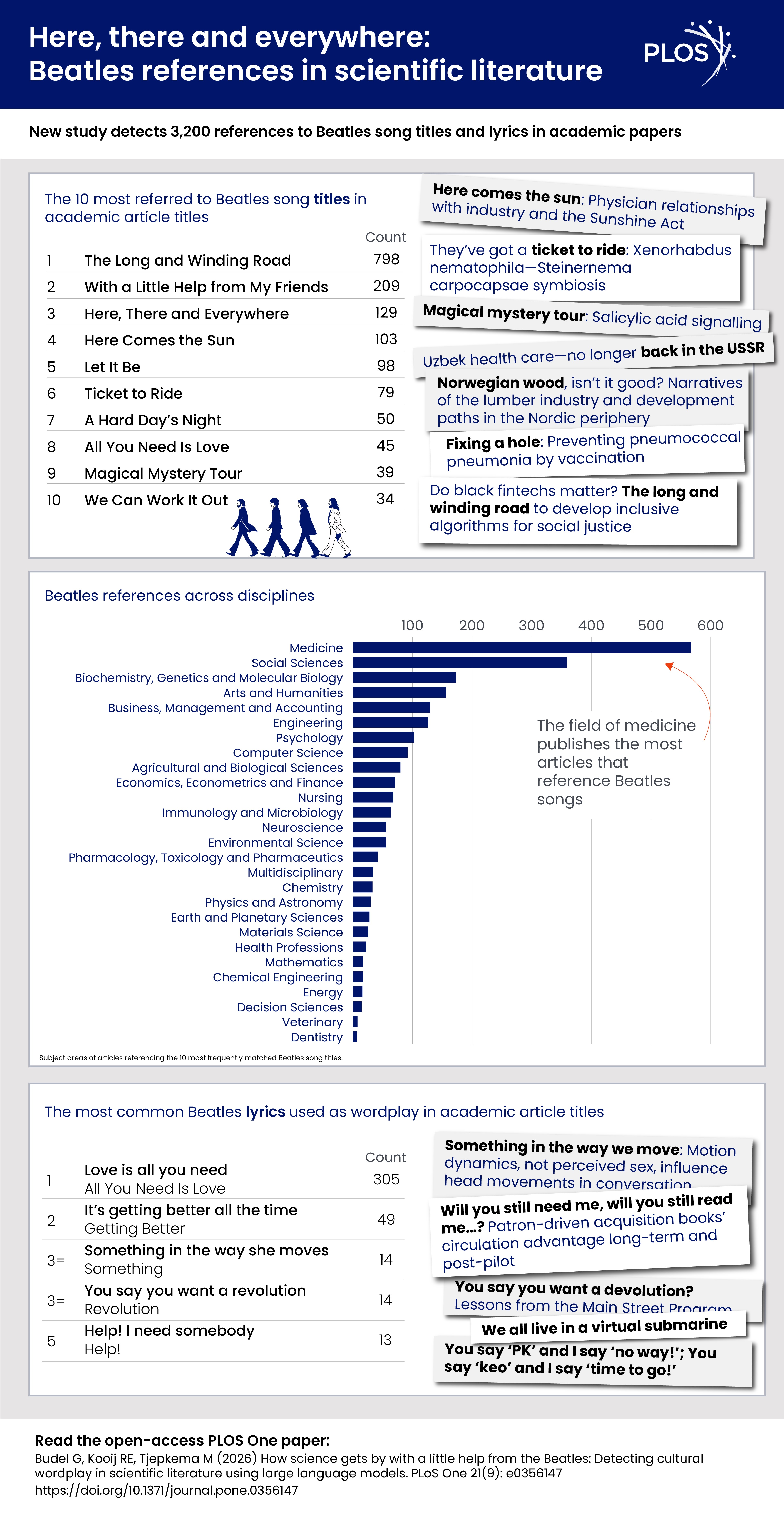
When it comes to Beatles references, scientists can’t let it be
Scientists have an indisputable playful side, evidenced by frequent allusions to popular culture in their research publications. That includes popular song lyrics. And the most popular musical group, in terms of how frequently their songs and lyrics appear in the scientific literature, is The Beatles, according to a new paper published in the journal PLoS ONE.
“Some of these are genuinely brilliant,” said co-author Gabriel Budel of Delft University of Technology in the Netherlands. “‘The lung and winding road’ is a paper on Long COVID that changes one vowel of the more than 3,000 references they found to The Beatles. ‘Here comes the SU(N)’ turns ‘Here Comes the Sun’ into a quantum computing paper about mathematical groups. Someone was having a very good day at their desk.”
Back in 2014, scientists at the Karolinska Institute in Sweden revealed that they had been deliberately inserting Bob Dylan lyrics into their papers as part of a long-running bet, starting with a 1997 Nature review entitled “Nitric Oxide and inflammation: The answer is blowing in the wind.” That resulted in a 2015 study on whether Dylan lyrics appeared elsewhere in the biomedical literature; the most frequently referenced were “The Times They Are A’Changin’” and “Blowing in the Wind.”
Meteorologists and climate scientists were also keen on referencing Dylan lyrics. This was followed by a 2017 study comparing the frequency of Dylan and Beatles lyrics in the biomedical literature—The Beatles were more prevalent—and a 2023 analysis of the frequent use of The Clash’s “Should I Stay or Should I Go” in scientific papers. That paper found that The Clash dominated with 408 references to the song, compared to 236 for the Beatles’ “The Long and Winding Road,” and 128 for “The Times They Are A’Changin’.”
And now Budel et al. are getting in on the fun. Naturally, the authors are all Beatles fans who couldn’t help noticing how much their favorite band had permeated the world of science. A quick search of the Nature site, for instance, revealed 116 articles specifically referencing the Beatles as of July 2025, and in the field of drug discovery, the challenge of bringing new drugs to market with significantly higher benefits than the best existing treatments is known as the “better than The Beatles” problem. Even NASA couldn’t resist naming a research project on ice-cored hills called “pingos” Pingo STARR (SubTerranean Aquifer Reconnaissance and Reconstruction).
Budel et al.’s study is much broader in scope than these prior studies. It is not limited to a single scientific discipline like biomedical science. And they used a large language model to comb through Scopus and Google Scholar looking for references to Beatles songs—not just exact title matches but also references to specific lyrics and clever wordplays on titles and lyrics.
A little help from their friends
Once again, “The Long and Winding Road” came out on top with 798 references—substantially more than the 561 references to the Clash’s “Should I Stay or Should I Go?” In fact, the authors contend that The Beatles are the most frequently referenced musical artist in the titles of scientific papers, based on their analysis of the top 10 hits of several bestselling artists, including Michael Jackson and Elvis Presley.
Budel et al. note that Paul McCartney has said that his song is “all about the unattainable; the door you never quite reach,” which they believe makes it a particularly apt metaphor for the scientific process, “which often progresses through trial and error toward meaningful, albeit temporary, results,” they wrote. “Likewise, many of the phenomena studied in science are characterized by prolonged and unpredictable development.”
Overall, the authors found 2,048 exact matches with Beatles song titles in Scopus—over 3,000 if you add in clever wordplay—but the distribution was highly skewed. In fact, it follows a power law distribution, also known as Zipf’s law. “As network scientists we’re used to seeing power laws in earthquakes, in social networks, in wealth,” said co-author Robert E. Kooij, also of Delft University of Technology. “It turns out references to Beatles songs follow one too: a handful of songs are cited constantly and the bulk of them are used once or twice. The Beatles apparently obey the same statistics as the rest of nature.”
The 2017 paper that invented the architecture behind ChatGPT, with the wordplay title “Attention is all you need,” is the most cited overall (89,737 citations). The top three most highly cited papers with exact Beatles song references: “Good day sunshine: Stock returns and the weather” (1,009 citations); “Seizure prediction: The long and winding road” (954 citations); and “Th17 cell differentiation: The long and winding road” (599 citations). Beatles lyrics seem to blend particularly well with biomedical themes: although references to Beatles songs span every subject area on Scopus—bolstering the authors’ argument that this is a cross-disciplinary phenomenon—medicine clearly dominates, along with social sciences.
When Budel et al. broke down the data by year, they found a marked steady increase in the use of Beatles songs in scientific literature since 1990, particularly between 1995 and 2005—a surge that happens to coincide with the release of The Beatles’ Anthology project (1995–1996). The authors suggest Anthology introduced new generations to The Beatles’ music, and once their music became widely available on streaming platforms like Spotify (late 2015), the trend was reinforced.
Meanwhile, there was a rapid digitization going on in academic publishing, placing more pressure on authors to stand out in the crowd. A 2023 study suggested that using song references in titles is a great way to grab a reader’s attention while avoiding the usual highly technical jargon. Budel et al. also think their work provides “concrete evidence that academic writing is becoming more informal and more attentive to its readers.”
While one might argue that the overall impact of references to “The Long and Winding Road” has been weakened by overuse, “More innovative wordplay still offers appeal,” the authors wrote. “For example, few fans of the White Album will fail to smile upon encountering titles such as ‘Happiness is a warm theorem,’ or ‘Everybody’s got something to hide except me and my patented monkey: Patentability of cloned organisms.’”
Brent crude rises above $100 a barrel as Middle East conflict intensifies
Benchmark Brent crude oil futures rose past $100 a barrel on Wednesday, hitting a more than six-week high and breaching the symbolic threshold for the first time since July 24 as intensifying conflict in the Middle East heightened concerns about oil flows from the region.
Brent crude futures were up $2.01, or 2.05%, at $99.93 a barrel by 0802 GMT, after earlier touching $100.19, while U.S. West Texas Intermediate crude was up $1.49, or 1.60%, at $94.52 a barrel.
Brent crude prices have risen by a quarter since early last month as hopes fade for a permanent resolution to the six-month-old U.S.-Iran conflict.
Since the Iran war began on February 28, Brent has surged as high as $126.41 a barrel, a peak reached on April 30.
This week, attacks by Iran-backed Houthis on Saudi energy facilities set oil installations ablaze, threatening a significant expansion of the conflict.
The attacks also threaten crude shipments via the Red Sea, which has been a key alternative route to the crucial Strait of Hormuz, where oil flows have been severely curtailed since the February 28 start of the Iran war.
Item 1 of 2 A map showing the Strait of Hormuz, also known as Madiq Hurmuz, and 3D printed oil barrels are seen in this illustration taken March 26, 2026. REUTERS/Dado Ruvic/Illustration
[1/2]A map showing the Strait of Hormuz, also known as Madiq Hurmuz, and 3D printed oil barrels are seen in this illustration taken March 26, 2026. REUTERS/Dado Ruvic/Illustration Purchase Licensing Rights, opens new tab
SUPPLY RISKS MOUNT
“Market participants appear to be pricing in a more prolonged conflict in the Middle East as well as the risk that the latest escalation in military strikes disrupts oil flows from the Middle East,” said Hamad Hussain, senior climate and commodities economist at Capital Economics.
“The key risk is whether the recent attacks on oil tankers lead to fewer ship-to-ship transfers taking place in the Gulf of Oman, which have so far played a key role in providing oil to global markets and keeping a lid on prices.”
A growing number of banks, including Goldman Sachs, Bank of America and HSBC, have raised their crude price forecasts in recent days.
In the week before a resumption in fighting on August 30, roughly 8 million to 9 million bpd had flowed through Hormuz, double the previous week’s volume, according to Rystad Energy’s Chief Economist Claudio Galimberti, although more recently it had fallen below 2 million bpd.
“I think the market is trying to treat this rise in energy prices as a one-off. It’s not. This is structural. It’s not going away, and it’s part of what I would argue as a security premium. And it’s only going to get bigger,” said Jeffrey Currie, co-chairman at Abaxx Markets.
While non-OPEC oil producers including the United States, Canada and Guyana have ramped up output, the International Energy Agency said last month it expected global oil supply would fall this year by 4.3 million bpd, or about 4%.
25 years of war was the exact wrong response to 9/11
The lesson of 9/11 should be that war is not the answer to any of the problems facing the United States.
After inflicting violence and chaos on country after country for 25 years in a “global war on terror” that has evolved into a Zionist genocide and a revived Cold War against Russia and China, the widespread public opposition to Trump’s war on Iran suggests that most Americans have finally learned that lesson.
Unfortunately, powerful sections of our corrupt business and political elites have not. Most Americans old enough to remember September 11, 2001, can still recall the horrifying images played endlessly on our TV screens as the scale of the mass murder became clear.
But we also remember something else: the sinking feeling that the hopes and dreams of billions of people, in the US and around the world, would be pushed to the back-burner for the foreseeable future, as our leaders and corporate media all too predictably embraced a new agenda of revenge, fear-mongering, jingoism and military violence.
We found out later that only hours after the attacks — less than six hours after the first plane struck the World Trade Center and barely five hours after the Pentagon was hit — the planning for America’s military response to the 9/11 massacre was already under way.
At 2:40 pm, Defense Secretary Rumsfeld convened a meeting at the Pentagon. Notes taken by Undersecretary Stephen Cambone, later obtained by CBS News, recorded Rumsfeld demanding the “best info fast. Judge whether good enough hit S.H.”—meaning Saddam Hussein—“at the same time” as Osama bin Laden. Then came the chilling instruction: “Go massive. Sweep it all up. Things related and not.”
Twenty-five years later, we can look back and see how the US government used September 11 to unleash a crusade of violence, war crimes and chaos across the world.
Experts like Nuremberg prosecutor Ben Ferencz and military historian Michael Howard warned from the beginning that declaring a “war on terror” made no sense and would make matters worse.
They were right, of course. But when the State Department’s annual Patterns of Global Terrorism report for 2004 showed an unprecedented increase in global terrorism following the US invasion of Iraq, Secretary of State Condoleezza Rice simply cancelled and discontinued the report, replacing it with a new one with different criteria to prevent comparison with previous years.
But, as Rumsfeld made clear to his subordinates from the outset, the 9/11 crisis provided an open-ended pretext for endless wars against enemies who had nothing to do with the attacks, and for the remilitarization of the United States after the small reduction in its military spending after the end of the Cold War.
Total US military spending for the past 25 years has exceeded US$21 trillion (in 2024 dollars), surpassing the combined spending of the other 18 largest military powers in the world.
During that time, China has built a whole new civilization and infrastructure, and leapfrogged the US economy to become the world leader in clean energy, high-speed rail and technological sectors in which the US was once preeminent.
Both Democrats and Republicans are responsible for these counter-productive choices, and the appalling human costs of these wars on the countries the United States has attacked, bombed or invaded make this an especially atrocious way to squander our nation’s wealth.
The history of the United States during this period calls to mind an old Greek myth. Croesus, the famously wealthy king of Lydia, asked the Oracle at Delphi what would happen if he invaded Persia.
The Oracle told him, “If you cross the Halys river, a great empire will fall.” Encouraged, Croesus launched the invasion. But he lost the war, and the empire that fell was his own.
In pursuing their global imperial ambitions, our leaders and ruling classes have discounted and betrayed the real sources of America’s prosperity and security: the well-being of the American people and peaceful relations with our neighbors around the world.
They have led us into war, poverty and extreme inequality and hollowed out a system of government that was slowly becoming more democratic.
At home, decades of political struggle by labor, civil rights and other social movements produced enormous advances, including Social Security, Medicare and Medicaid, major investments in public infrastructure and education, and a highly progressive tax system — with the top income tax rate at 91% until 1963 — that helped finance those public goods and narrow the gap between rich and poor.
Contrary to the “End of History” theory embraced by many policymakers after the Cold War, and Margaret Thatcher’s famous insistence that “there is no alternative” to the extreme neoliberal capitalism that she and Ronald Reagan ushered in, societies always have political and economic alternatives.
It is only a transparently self-serving choice by America’s corrupt ruling classes that saddles us with a system that keeps all decision-making power in their own hands in order to build their own wealth to the detriment of the country we all share.
We can see one alternative today in New York City, where Mayor Zohran Mamdani is pursuing a different set of priorities: expanding free childcare, making major investments in affordable housing, improving public transportation, and freezing rents for tenants in rent-stabilized apartments.
Electoral politics can be part of the solution, but only if it reflects what ordinary people really want, instead of limited choices between oligarchic “lesser evils.”
Americans are demanding a renewal of social progress, with universal healthcare, quality public education, and all the things we need but can’t afford as long as this bloated, destructive war machine remains our government’s top priority.
As Martin Luther King lamented in 1967, “I knew that America would never invest the necessary funds or energies in rehabilitation of its poor so long as adventures like Vietnam continued to draw men and skills and money like some demonic, destructive suction tube.”
Twenty-five years is a long time to keep moving in the wrong direction, especially when that direction involves endless war and the destruction of other countries. We are a long way from where most Americans would like our country to be. But we have a pretty good idea of what is wrong and what we need to do, namely:
Stop throwing money at a broken, destructive war machine. Stop threatening and blockading our neighbors. Close overseas bases and bring our troops home. Tax the wealthy. Start rebuilding our country, and replace war and militarism with cooperation and problem-solving.
Take public ownership and responsibility for things we all need and use, like education, healthcare, housing, infrastructure, and utilities.
Abolish ICE, and other militarized institutions that waste our national resources and do not serve the public good. Insist that the military be scaled back to its legitimate role of defending the United States against a possible, but very unlikely, foreign military attack.
If we have truly learned the lesson of the past 25 years, then we must translate it into policies that reflect that. The real test is not whether we can finally see what went wrong after 9/11. It is whether we are able to change course.
Medea Benjamin is co-founder of Global Exchange and CODEPINK: Women for Peace. She is the co-author, with Nicolas J.S. Davies, of “War in Ukraine: Making Sense of a Senseless Conflict,” available from OR Books in November 2022. Other books include, “Inside Iran: The Real History and Politics of the Islamic Republic of Iran” (2018); “Kingdom of the Unjust: Behind the U.S.-Saudi Connection” (2016); “Drone Warfare: Killing by Remote Control” (2013); “Don’t Be Afraid Gringo: A Honduran Woman Speaks from the Heart” (1989), and (with Jodie Evans) “Stop the Next War Now” (2005).
Nicolas J. S. Davies is an independent journalist and a researcher with CODEPINK. He is the co-author, with Medea Benjamin, of “War in Ukraine: Making Sense of a Senseless Conflict,” available from OR Books in November 2022, and the author of “Blood On Our Hands: the American Invasion and Destruction of Iraq.“
UK sanctions on illegal settlements mark diplomatic setback, major failure for Netanyahu: Israeli report
The Yedioth Ahronoth newspaper in Israel on Wednesday described the announcement by 12 Western countries, led by Britain, to restrict trade with illegal Israeli settlements in the occupied West Bank as a “diplomatic setback and a significant failure” for Prime Minister Benjamin Netanyahu’s government.
Britain, Canada, Denmark, Finland, France, Iceland, Ireland, Norway, Poland, Portugal, Spain and Sweden announced Tuesday their intention to impose restrictions on trade in goods originating from illegal Israeli settlements.
In a statement, the 12 countries said the Israeli government’s actions in the occupied West Bank undermine the possibility of a two-state solution and urged Israel to immediately halt illegal settlement expansion and violence by occupiers.
Yedioth Ahronoth said that “with the European Union unable for months to reach consensus on sanctions that would ban imports from Israeli settlements, several European countries have begun pursuing restrictions independently, moving the issue from EU-wide diplomacy to national legislatures.”
The absence of an agreement in Brussels led governments supporting the restrictions to conclude that each country would need to enact its own legislation to ban imports from illegal settlements, it said.
The newspaper noted that “the Netherlands has already adopted such measures, although the Dutch order has been challenged in court on claims that it is discriminatory. It is scheduled to take effect Sept. 22.”
“Spain already has legislation in effect, although Israeli exports to the country from the West Bank are limited. Similar legislation is now being discussed in Luxembourg, while Sweden is pursuing its own process,” it added.
Belgium has announced plans for similar action but has not yet enacted legislation, “meaning no restrictions are currently in force there,” said the newspaper.
– Fears of wider economic boycott
Yedioth Ahronoth said the growing number of countries supporting restrictions has “caused significant concern in Israel,” not because of the relatively limited volume of trade from illegal settlements, but because officials fear the measures could discourage European importers from altogether purchasing Israeli products.
“Under the new Dutch rules, importers of products originating in settlements could face up to six years in prison,” it added.
Israeli officials and business representatives fear some Dutch companies may choose to avoid Israeli goods entirely rather than verify whether individual products were manufactured inside Israel or in illegal settlements.
They warn that it “could effectively create a quiet, broader boycott.”
“The concern is that importers unwilling to assume the legal risk or administrative burden of establishing where Israeli goods were produced will simply stop purchasing them,” said the newspaper, adding that Israeli officials believe the secondary effects could have serious consequences for the economy as a whole.
The newspaper noted that Europe has long opposed Israeli settlement expansion, “but growing attention to attacks by extremist settlers against Palestinians has given fresh momentum to governments seeking punitive measures.”
Images of Israeli occupiers entering Palestinian villages and reports of violence “have intensified European pressure,” while inflammatory statements by far-right National Security Minister Itamar Ben-Gvir and Finance Minister Bezalel Smotrich “have further fueled criticism,” it said.
“From Israel’s perspective, the failure to effectively address reported incidents of settler violence has created a political boomerang: Extremists in the West Bank are strengthening the case of European governments and activists already opposed to settlements,” it said.
The occupied West Bank has witnessed escalating attacks by occupiers against Palestinians and their property, including incursions into towns and villages, and assaults on residents, vehicles and homes, under the protection of Israeli forces.
Yedioth Ahronoth warned that the potential economic consequences could eventually affect not only occupiers and companies operating in the West Bank, but the Israeli economy as a whole if importers begin viewing all Israeli products as potentially subject to restrictions.
– Coordinated initiative viewed as failure
The newspaper said domestic political considerations played a role in Britain’s decision, according to Israeli assessments, as the Labour government faces pressure from elements of its political base; “however, the more consequential development was Britain’s ability to assemble a coalition of 12 countries behind the initiative.”
The timing added another dimension to the controversy because the measures came during Israel’s election campaign.” Some Israeli political figures argue that international pressure on settlements could strengthen Prime Minister Benjamin Netanyahu and his right-wing allies electorally, and British officials had been warned about that possibility,” said the newspaper.
Nevertheless, the newspaper concluded that the decision by Britain and the 11 other Western countries was viewed “not only as a diplomatic setback but as a significant failure by Israel to prevent a coordinated international initiative.”
Palestinians warn that Israel is paving the way for formal annexation of the West Bank through army raids and attacks by occupiers, undermining the possibility of establishing a Palestinian state as stipulated in relevant UN resolutions.