28.1 C
London
Thursday, May 28, 2026
Home Blog

Israel plans to expand control over Gaza in coming months

0
israel-plans-to-expand-control-over-gaza-in-coming-months
Israel plans to expand control over Gaza in coming months

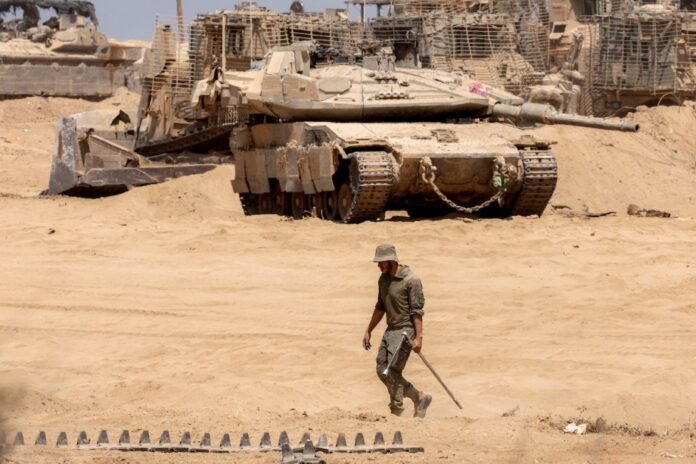
An Israeli army soldier walks near a main battle tank deployed at a position along the border with the Gaza Strip and southern Israel on July 29, 2025. [Jack GUEZ / AFP/Getty Images]

An Israeli army soldier walks near a main battle tank deployed at a position along the border with the Gaza Strip and southern Israel on July 29, 2025. [Jack GUEZ / AFP/Getty Images]

Israel is planning, in coordination with the United States, to expand its occupation of the Gaza Strip.

According to Israel’s Channel 14, the plan includes a major expansion of the so-called Yellow Line in Gaza, alongside continued bombardment and targeted killings outside the area controlled by the Israeli army, which currently occupies more than 60 per cent of the territory.

As part of the new strategy, the Hebrew-language channel said Israel, in coordination with the United States, will work to significantly expand the Yellow Line area across the Gaza Strip over the coming months.

IDF Soldier Rotem Yanai Killed in Hezbollah Drone Strike on Northern Israel Military Compound  

0
idf-soldier-rotem-yanai-killed-in-hezbollah-drone-strike-on-northern-israel-military-compound  
IDF Soldier Rotem Yanai Killed in Hezbollah Drone Strike on Northern Israel Military Compound  


An Israeli soldier was killed, and two reservists were wounded when an explosive drone struck a military compound in Moshav Shomera, the Israel Defense Forces (IDF) said Thursday, amid continuing Hezbollah drone attacks in northern Israel.  

The IDF identified the soldier as Sgt. Rotem Yanai, 20, of  Binyamina-Givat Ada, a welfare noncommissioned officer in the Givati Brigade. According to the military, the two reservists wounded in the attack sustained serious and moderate injuries and were evacuated to a hospital for treatment.  

The military said the drone strike occurred as attacks involving enemy unmanned aircraft continued in and around the Shomera area in recent days. The explosive drone struck a military facility inside the moshav while Yanai was making her way to a protected area, where she was killed.  

Yanai is the 24th Israeli fatality since Hezbollah began launching attacks against Israel as part of Operation Roaring Lion.  

She is survived by her parents, Hili and Tal, and her brothers, Dor and Aviad. Yanai studied at the Kramim school in her community, where she focused on theater studies, and was active in the Gefen troop of the local Scouts movement.  

Friends and acquaintances described her as a young woman with humor and self-confidence who treated those around her with sensitivity and care.  

Defense Minister Israel Katz offered condolences to Yanai’s family and wished a speedy recovery to the wounded soldiers.  

“Rotem dedicated her service with devotion to assisting soldiers and fighters who have been battling on all fronts over the past two years,” Katz said.  

Referring to the fighting along Israel’s northern border, Katz said Israeli troops continued operating against the Hezbollah terrorist organization to defend civilians in northern communities.  

“Hezbollah has paid, is paying, and will continue to pay a heavy price for its criminal acts against the State of Israel and its citizens,” he said.  


Forecasters predict below-average hurricane season, advise against complacency

0
forecasters-predict-below-average-hurricane-season,-advise-against-complacency
Forecasters predict below-average hurricane season, advise against complacency

Forecasters are calling for below-average activity this hurricane season, which begins Monday, June 1.

The National Weather Service is predicting eight to 14 named storms, including three to six hurricanes and one to three major hurricanes of category 3, 4, or 5 strength, packing winds of 111 mph or greater. By comparison, a typical season is characterized by 14 named storms, including seven hurricanes and three major hurricanes. The season ends November 30.

“It just takes one,” said Ken Graham, director of the National Weather Service. “Now is the time to start thinking about your hurricane preparedness.”

The forecasters based their predictions on an expected El Niño that is likely to develop during the season. An El Niño is a naturally occurring climate phenomenon that begins with unusually warm waters in the central and eastern equatorial Pacific Ocean and can affect weather patterns worldwide.

In the Pacific, an El Niño can trigger more hurricanes. But in the Atlantic Ocean, the phenomenon can suppress activity, as it tends to cause more wind shear that can break apart the storms. Nonetheless, warm water temperatures in the Atlantic were expected to help the storms that do develop rapidly intensify, something that is becoming more common as climate change heats the planet’s oceans.

“When your ocean temperatures are warmer you get more intense hurricanes to develop. So if there is an opportunity and a location for low wind shear and warm ocean temperatures,” said Marc Alessi, science fellow at the Union for Concerned Scientists, an advocacy group, “that is when you can get a very strong hurricane to form.”

Haiyan Jiang, a meteorologist at Florida International University, said there was a high chance of a strong El Niño that could boost water temperatures in the Gulf of Mexico.

“We probably won’t have as many number of storms as previous years. However, some storms get lucky,” she said. “We see outliers all the time, especially with hurricanes. So I believe Floridians, we need to get prepared.”

2026 Atlantic Tropical Cyclone Names

Arthur Hanna Omar
Bertha Isaias Paulette
Cristobal Josephine Rene
Dolly Kyle Sally
Edouard Leah Teddy
Fay Marco Vicky
Gonzalo Nana Wilfred

The NWS outlook was for overall seasonal activity and did not include predictions for when or where hurricanes might make landfall, as that is determined by short-lived weather patterns, said the National Oceanic and Atmospheric Administration, which oversees the National Weather Service. NOAA said there was a 55 percent chance of a below-normal season, 35 percent chance of a near-normal season, and 10 percent chance of an above-normal season.

Forecasters at Colorado State University similarly predicted a below-average season, with 13 named storms, including six hurricanes and two major hurricanes. The forecasters said waters in the western tropical Atlantic were warmer than normal but the eastern tropical and subtropical Atlantic were slightly cooler than normal. They said a warmer Atlantic also tends to lead to lower atmospheric pressure and a more unstable atmosphere, which can boost hurricane activity.

The Colorado State forecasters said the probability of a hurricane making landfall was 32 percent for the entire US coastline, 15 percent for the US East Coast including the Florida peninsula, and 20 percent for the Gulf Coast from the Florida panhandle to Brownsville, Texas.

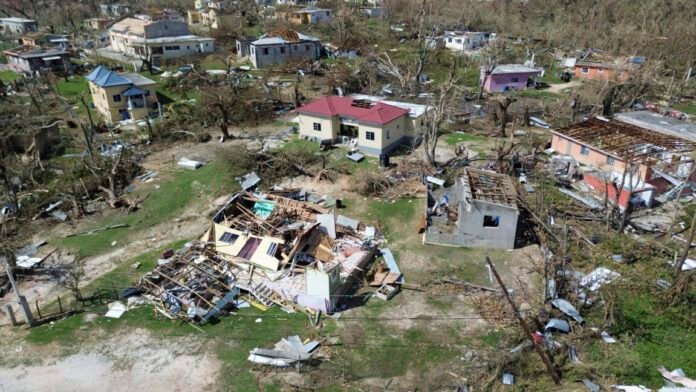
Alessi pointed out that although no hurricanes made landfall in the US last year, Hurricane Melissa devastated Jamaica as a category 5 storm. Melissa caused nearly $9 billion in damage and 95 fatalities across the Caribbean.

“Just because it’s a below-average season doesn’t mean a very powerful hurricane won’t make landfall in the United States,” he said.

This article originally appeared on Inside Climate News, a nonprofit, non-partisan news organization that covers climate, energy, and the environment. Sign up for their newsletter here.

The fading mirage of US-guaranteed Gulf security

0
the-fading-mirage-of-us-guaranteed-gulf-security
The fading mirage of US-guaranteed Gulf security

Wars in the Middle East are often decided less by what is destroyed than by what continues functioning afterward — and how quickly those systems begin to fail.

That distinction has become harder to ignore in the aftermath of recent US-Israeli strikes on Iran, which Washington has framed as evidence of restored military dominance but which also exposes a structural gap between the speed of modern warfare and the region’s economic capacity to absorb its consequences.

The trajectory of the conflict has underscored a significant strategic irony. In May 2025, President Donald Trump chose Saudi Arabia, Qatar and the United Arab Emirates for the inaugural international tour of his second term, generating large-scale investment pledges for the US economy and reinforcing perceptions of deepened alignment.

Yet the political momentum proved short-lived. When Washington and Israel launched direct military action against Tehran in early 2026, they did so despite reported warnings from Riyadh and Doha urging restraint. Now, strategic pressure appears to be reversing: Gulf capitals are less focused on exporting stability and more on absorbing the domestic costs of regional escalation.

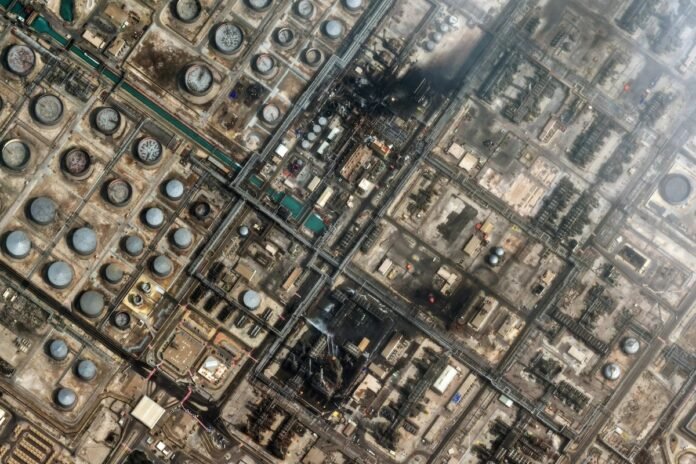
In March, an Iranian missile strike on Ras Laffan Industrial City disrupted a key LNG hub. Reuters reported that QatarEnergy confirmed operational disruption and a roughly 17% reduction in export capacity following the damage to key facilities.

At issue is not only physical damage, but financial repricing. Energy markets respond rapidly to perceived fragility in export infrastructure: insurance premiums rise, shipping costs adjust and long-term contracts are reassessed on the basis of risk rather than volume.

A similar dynamic is emerging in aviation. Disruptions across Gulf air corridors and major hubs such as Dubai International Airport illustrate how rapidly conflict can affect global connectivity. Airspace closures, rerouted traffic and rising war-risk insurance premiums are increasing operational costs for carriers across the region.

These vulnerabilities extend into the Gulf’s post-oil transition strategies. States are investing heavily in artificial intelligence, cloud infrastructure and data-center capacity.

As compute infrastructure becomes a geopolitical asset, the distinction between civilian economic systems and national security infrastructure is increasingly blurred. The region’s growth model depends on globally integrated infrastructure that is highly exposed to sustained geopolitical disruption.

Once those assumptions begin to erode, the impact appears in sovereign spreads, delayed investment timelines and downgraded growth forecasts across the Gulf Cooperation Council.

The central question may no longer be whether the region can absorb isolated shocks, but whether sustained instability is altering the assumptions underpinning long-term diversification strategies such as Saudi Vision 2030.

This growing pressure helps explain a broader diplomatic recalibration underway across the region. The assumption that American military power functions as a stabilizing shield is increasingly giving way to a more complex reality: US military action may also impose significant economic costs on Gulf states themselves.

That unease appeared to culminate in an unusually visible divergence in early May. As reported by The Guardian, Trump’s “Project Freedom” — a plan to reopen the Strait of Hormuz through military enforcement — encountered resistance from Saudi Arabia after Riyadh reportedly restricted US access to key airbases and airspace corridors.

By constraining operations at Prince Sultan Air Base, Saudi Arabia significantly reduced the feasibility of unilateral escalation, reflecting growing regional concern over uncontrolled conflict spillover.

The Wall Street Journal similarly reported that Gulf states, including Saudi Arabia, the UAE, and Qatar, pressed Washington to pause further escalation amid fears of broader economic and infrastructural fallout.

Recognizing that temporary restraint may not constitute a durable security framework, Saudi Arabia has also moved toward direct diplomatic stabilization with Tehran.

A proposed non-aggression architecture — sometimes compared to the logic of the 1975 Helsinki Accords — signals an emerging shift toward regionalized security management outside traditional US-led frameworks.

None of this, of course, implies imminent economic collapse. Gulf states retain substantial fiscal buffers and sovereign investment capacity. But adaptation becomes costlier as instability shifts from episodic disruption to structural condition.

It also exposes a widening fault line within the Gulf itself: while Saudi Arabia leans toward regional déeente to protect long-term transformation strategies, the UAE has at times adopted a more security-forward posture, reflecting the two states’ divergent risk assessments.

These different views reflect a broader unresolved question in Western policy: whether Iran can be contained through pressure without producing fragmentation. Recent events suggest the greater risk may not be regime stability, but partial state breakdown.

Historical precedents from Iraq, Libya, and Syria suggest that fragmented states often generate prolonged instability rather than strategic clarity. For Gulf states, a weakened Iran may not be safer — it may be less predictable, less centralized and more prone to asymmetric escalation across maritime and energy corridors.

The central issue facing the US is therefore not military effectiveness alone, but economic absorption. While US force projection remains unmatched, the surrounding system is increasingly sensitive to the economic consequences of that power.

Military superiority may no longer be sufficient to guarantee regional order. What is changing is not America’s capacity to project force, but the region’s capacity to absorb it. If policymakers interpret the current pause in escalation as durable stability, they risk mistaking tactical restraint for strategic resolution.

The recent campaign may have degraded Iranian capabilities, but it has also accelerated a broader reassessment of external security guarantees across the Gulf. Stability is not disappearing because deterrence has failed — but because sustaining it is becoming economically more expensive within the region itself.

Malik AboRashid is a strategic advisor focused on US-Middle East policy, business and security issues. He graduated from the University of California, Berkeley.

Pentagon Reinforces Strategic Assets Near Cuba

0
pentagon-reinforces-strategic-assets-near-cuba
Pentagon Reinforces Strategic Assets Near Cuba


The Pentagon has spent months positioning the troops and weapons needed for the U.S. to launch a military attack on Cuba — all it needs is a final go-ahead from Donald Trump.

The president has floated an invasion of the island after economic and political pressure failed to topple the Communist government. But the Navy’s built-up presence in the region — the largest in the world outside the Middle East — would allow the U.S. to act immediately.

These strategically placed assets set the table for military action, from a capture of Havana’s leadership much like the seizure of former Venezuelan President Nicolas Maduro, to a series of precision strikes. And they open the possibility that the U.S. throws itself into the third international conflict of the Trump administration.

Cuba is “in a lot of trouble,” Secretary of State Marco Rubio said Wednesday at a full Cabinet meeting. “Having a failed state 90 miles from our shores is a threat to the national security of the United States.”

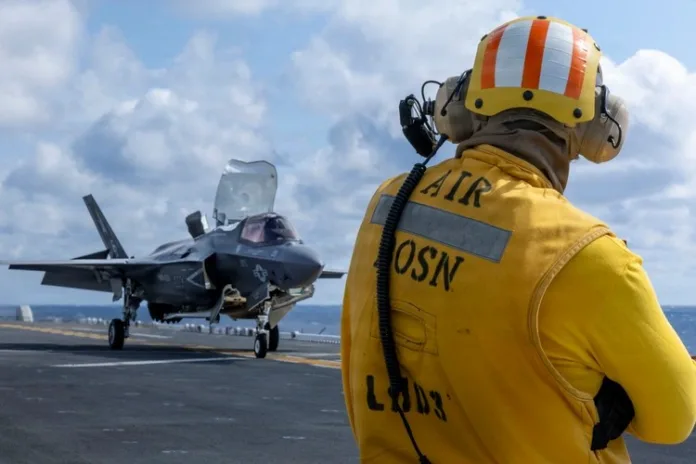
The armada in the region is slightly smaller than it was in January when the U.S. captured Maduro. But the USS Nimitz aircraft carrier strike group entered the Caribbean in May, along with several guided missile destroyers and cruisers that can launch precision missiles at targets onshore. An array of advanced American drones and surveillance aircraft have also circled Cuba for months, according to flight tracking sites. The USS Kearsarge amphibious ships and escorts, which carry 2,500 Marines, are off the coast of Virginia preparing for a new deployment, and could replace some ships heading home.

The surge provides a variety of military options, although the Pentagon would need additional troops for a massive ground invasion.

The Nimitz arrived in the region on the same day as the U.S. indicted former president Raul Castro, in what appeared a public show of force. “The Nimitz is likely there primarily for intimidation, though it could be used in a military operation if needed,” said Mark Cancian, a former Pentagon official and now a senior analyst at the Center for Strategic and International Studies.

The ship, along with fighter planes based in Florida and Puerto Rico, would probably play a role in any military action in Cuba, he said. “Air strikes are possible to take out their air defenses to allow broader air operations or, perhaps, destroy their leadership with the idea of establishing a relationship as we have with Venezuela. Raul Castro would be their first target.”

But the administration faces a timeline to act. Many of the biggest warships deployed in the summer are approaching 10 months at sea, far beyond the usual six to seven months. This has caused defense officials to worry about overextending crews, and adds to the stress on a naval force that is also conducting a blockade of Iranian ships in the Arabian Gulf.

The White House referred questions to the Pentagon. The Navy declined to comment on current deployments. Naval Forces Southern Command did not respond to a request for comment.

“These back-to-back long deployments will add up over time,” said a defense official, granted anonymity to speak candidly about military operations. “Keeping them out there so long creates more problems in the long run when it comes to refitting and repairing those ships once they come home.”

The prolonged missions come on the back of the record-setting 11 month deployment of the USS Gerald R. Ford aircraft carrier, which ended this month after sailing from Europe to the Caribbean for the Maduro operation and then to the Middle East for the Iran war.

The Nimitz is also extended on what was expected to be its final deployment of a 50-year career. It was initially set to sail to Norfolk, Virginia, to have its nuclear-powered engines removed, but the Navy has decided to extend its life until 2027.

The USS Iwo Jima and USS Fort Lauderdale amphibious ships have also remained since the summer, although the Marine Corps announced Wednesday that they will return to Norfolk next week.

But the long deployments take a toll on the crews and Marines, who had planned for a normal rotation and are now months past their initial scheduled return home.

“You don’t sign up for an easy time, you know any deployment is going to be uncertain,” said Joe Plenzler, a retired Marine Corps officer. “But extending deployments like this, when it feels really open-ended, that starts to bleed into retention. How much more likely am I able to convince my family to do another enlistment and stick with it?”

Source: Politico

Valve’s Steam Deck is back in stock after months, but you won’t like it

0
valve’s-steam-deck-is-back-in-stock-after-months,-but-you-won’t-like-it
Valve’s Steam Deck is back in stock after months, but you won’t like it

Valve’s Steam Deck handheld has been largely unavailable to buy since mid-February, a victim of the RAM and storage shortages that have been driving up prices for most consumer tech since the fall of 2025. The good news is that the Deck is back in stock on Valve’s site and ready to ship in three to five days; the bad news is that it appears to have returned because somebody wished for it on a monkey’s paw.

The 512GB version of the OLED Steam Deck now sells for a whopping $789, $240 more than its previous $549 price. The 1TB version (which also includes an anti-glare screen coating, a slightly nicer case, and an “exclusive startup movie and keyboard theme”) will now run you $949, a $300 increase from its old $649 price. The old $399 base model with 256GB of storage and the older LCD screen has been discontinued, though this had been announced well before these price increases took effect.

These prices are particularly hard to swallow for a nearly 3-year-old revision of an over-4-year-old handheld PC. If there’s a saving grace for Valve, it’s that most competing handhelds from the likes of Asus and Lenovo are also pushing or exceeding that $1,000 mark. Of the Deck’s major competitors, only the $600 Asus ROG Xbox Ally (and its AMD Ryzen Z2 A processor, which is very similar to the Deck’s semi-custom AMD chip) is significantly cheaper than the Steam Deck.

“Steam Deck itself hasn’t changed; these new prices reflect the current state of component costs and other global logistical challenges across the industry as a whole,” reads Valve’s brief announcement about the price hikes. “We’ll keep you updated if anything changes.”

The new Deck pricing bodes poorly for the potential pricing of the Steam Machine desktop, which was announced late last year at what ended up being a spectacularly awful time to build and ship a new gaming PC. The Steam Machine was always going to have problems competing with dedicated game consoles on price, but at this point, it would be a pleasant surprise if the box launched for under $1,000. Valve plans to launch the box sometime “this year,” and it recently appeared in the database of devices conforming to the Vulkan graphics API.

The only one of Valve’s new hardware announcements from late last year to have actually shipped is the $99 Steam Controller, because “it doesn’t have RAM in it.”

Bee Gees Legend ‘Forced’ to Prove He’s Still Alive

0
bee-gees-legend-‘forced’-to-prove-he’s-still-alive
Bee Gees Legend ‘Forced’ to Prove He’s Still Alive


Barry Gibb is alive and well — despite a cruel death hoax that sent Bee Gees fans into a frenzy online.

The 79-year-old music legend, best known as the soaring falsetto voice behind some of the biggest disco hits of all time, was forced to shut down a bizarre internet rumor after a fake “R.I.P. Barry Gibb” Facebook page went viral.

According to TMZ, sources close to Gibb’s family confirmed the Bee Gees icon is safe at his home near Miami and very much alive.

The false rumor reportedly spread after the Facebook page racked up nearly one million likes on Sunday. When fans clicked on it, they were met with a fake report claiming Gibb had died earlier that day.

It was not true.

But that did not stop the bogus post from spreading fast, alarming longtime fans who grew up dancing to the Bee Gees’ unforgettable hits.

Gibb is just the latest major celebrity to be targeted by a disturbing online trend where scammers and attention-seekers create fake death announcements to collect likes, shares, and clicks.

Over the years, stars including Tom Hanks, Justin Bieber, Michael J. Fox, Morgan Freeman, and Jon Bon Jovi have all been dragged into similar fake death rumors.

For many fans, the Barry Gibb hoax hit especially hard because he is the last surviving member of the Bee Gees.

Gibb formed the legendary group with his brothers Robin and Maurice Gibb, turning the family band into one of the most recognizable acts in music history.

The trio became disco royalty with massive hits including “Stayin’ Alive,” “Night Fever,” and “How Deep Is Your Love.”

Their music helped define the sound of the late 1970s and became the heartbeat of Saturday Night Fever, the movie soundtrack that turned disco into a worldwide phenomenon.

But the Bee Gees’ story has also been marked by tremendous loss.

Maurice Gibb died in 2003 at age 53 following complications from a twisted intestine. Robin Gibb died in 2012 at age 62 after a battle with cancer.

That left Barry as the surviving brother and keeper of the Bee Gees legacy.

So when the fake death rumor surfaced, it was no surprise that fans reacted with shock and sadness before the truth came out.

Thankfully, the report was nothing more than an internet hoax.

Barry Gibb is still here, still beloved, and still remembered as one of the unmistakable voices behind some of the most famous songs ever recorded.

In Myanmar’s info war, foreign pens mouth junta’s lines

0
in-myanmar’s-info-war,-foreign-pens-mouth-junta’s-lines
In Myanmar’s info war, foreign pens mouth junta’s lines

Myanmar’s revolution is now being decided as much in headlines and briefing rooms as in the wartime hills of Sagaing and Karenni. The most dangerous narratives are no longer the crude slogans on military television; they are the polished “balanced” commentaries in think tank reports, op‑eds and diplomatic talking points that subtly ask the world to learn to live with the coup-maker generals.

These narrative‑makers rarely wear the junta’s uniform. They write for respected outlets, sit on panels, hold academic titles or introduce themselves as “independent” experts. They often open by acknowledging atrocities and calling the coup disastrous.

Then, gradually, they guide the reader toward a single conclusion: the military is brutal but durable, the resistance is fragmented and unreliable, the public is exhausted and wants any peace at any price, and therefore “realism” requires working with the junta as the only viable partner. This is junta messaging in the language of objectivity.

The latest Quad foreign ministers’ statement, issued in New Delhi on May 26, shows why these matters. The statement expressed concern over Myanmar’s worsening crisis, called for expanded ceasefire measures, endorsed ASEAN’s efforts and its Five‑Point Consensus and urged safe, unhindered humanitarian access.

It also flagged the explosion of online scam networks in Southeast Asia as a regional security threat linked to criminalized borderland economies. To be sure, none of this will topple the junta.

But the fact that four major Indo‑Pacific democracies still cannot openly side with the generals – and still describe Myanmar as a “crisis” to be managed rather than a “transition” to be endorsed – undercuts the claim that the military has already won and must now be accepted as inevitable.

Inside Myanmar, however, such signals are often misread at both extremes. For some, any criticism of the army is celebrated as a breakthrough. For others, anything short of explicit endorsement of the resistance is viewed as betrayal. Both reactions are understandable in a traumatized society, but both are dangerous.

Ethical criticism of the junta should be welcomed because it discourages the generals and reminds the world who caused this catastrophe. But the public must be shielded from unrealistic expectations that every communique is either a turning point or a sell‑out.

The same clarity is needed when reading more “serious” analysis. A widely‑cited report that describes real military abuses but ends by suggesting that “there is no choice” except a junta‑managed transition is still doing the junta’s work.

A piece that dwells on resistance mistakes while skating over the military’s forced conscription, scorched‑earth campaigns, airstrikes against civilian populations and rapacious extractive war economy should not be read as neutral.

And when such narratives appear at the same time the generals are hiring lobbyists, rebranding themselves as democratic through sham elections and negotiating over half-hearted scam‑center crackdowns, it is hard to believe the appearance of such pieces is coincidental.

In this respect, the region has already seen a warning. As ASEAN’s previous rotational chair, Cambodia’s Hun Sen pushed early engagement with the junta in the name of pragmatism and “special envoy” diplomacy. Critics inside and outside Southeast Asia warned that this risked normalizing a coup regime without any political compromise or accountability.

His more recent praise for the closure of US‑funded broadcasters such as Radio Free Asia and Voice of America illuminated a deeper truth: authoritarian leaders understand that controlling narrative space is part of controlling political outcomes. Independent media – however imperfect – make it harder to sell lies. Once scrutiny is softened, coercive power can be dressed up as “order”, “stability” or “dialogue.”

Myanmar’s generals understand this all too well. They are not only fighting for battlefield gains; they are fighting for narrative gains. They want diplomats and analysts to talk about “stability” without justice, “peace” without political equality and “engagement” without accountability.

They want a world so tired that fatigue can be mistaken for realism. At home, they want the public to be too exhausted and disgusted to care what kind of “solution” is imposed, as long as the guns fall silent and the airstrikes on villages stop.

That strategy builds on 70 years of psychological conditioning. Under successive military regimes, Burmese citizens were taught to memorize, repeat and obey. Critical thinking was treated as a threat, not a skill.

In that context, “respectable” propaganda from abroad – written in proper English, published under prestigious mastheads, sprinkled with the right buzzwords – is much more dangerous than the junta’s own clumsy slogans. Such paid placements do not absurdly shout “the army is heroic”; rather, they potently whisper “there is no alternative.”

This is why critical literacy is now a survival skill for the Burmese public. Every citizen who reads or listens to news needs a simple toolkit for separating fact from manipulation. That means learning to ask, every time:

1.) Who is speaking, and who might be paying or influencing them?

2.) Which facts are included – battlefield losses, forced conscription, scam‑center economies, lobbying contracts – and which are conveniently left out?

3.) When they describe the people as “war‑weary”, do they also explain who caused that suffering and what kind of “peace” is being proposed?

4.) What outcome is this analysis preparing us to accept – a genuine federal democracy, or a slightly repainted military order? Who benefits?

This kind of public education does not require university degrees. It can be built in small, practical ways: community discussions that walk through a single article and ask what is missing; diaspora webinars that explain the difference between lobbying and independent analysis; short Burmese‑language explainers that decode terms like “stability”, “transition”, “dialogue” and “responsible engagement”.

The goal is not to turn everyone into a professional, critical analyst. It is to make it much harder for anyone, however well‑dressed or well‑credentialed, to sell resignation as “realism.”

The resistance side has responsibilities, too. It cannot answer propaganda with fantasy. It should welcome fair criticism, including of fragmentation, coordination failures, local abuses and poor transparency.

These are real problems and must be fixed, not denied. But criticism needs full context. War‑weariness among Myanmar’s people is real and should never be mocked – yet fatigue is not consent.

Wanting peace is different from accepting permanent military domination or a renewed war economy dressed in civilian clothes. If the resistance expects the world to take it seriously, it must demonstrate that it can confront its own weaknesses while insisting that the crisis’s root cause remains military rule.

Viewed this way, the information war is not a sideshow; it is central to whether the junta’s strategy succeeds. The generals do not need everyone to adore them.

Rather, they need people inside Myanmar and abroad to be tired, disgusted and confused enough to stop resisting and to accept whatever “political solution” is put on the table through a sham election, a cosmetic civilian cabinet, a few high‑profile prisoner releases and token cooperation on scams and refugees.

Narrative‑makers who present themselves as objective while steering audiences toward de facto normalization will have helped the junta turn battlefield stalemate into political survival.

Myanmar’s revolution does not need a perfect story. It needs a disciplined, truthful one.

That truth is that business and geopolitical interests that prefer a corruptible authority to democratic oversight are part of the problem, not the solution, and that “stability” purchased by rewarding the authors of a coup is not peace, but the opening chapter of the next crisis.

If Burmese communities can learn to recognize how “objective” narratives are used to normalize the junta, and if foreign readers can learn to ask who benefits from every call to be “realistic”, the generals’ information strategy becomes much harder to execute and sell.

James Shwe is a Myanmar American professional engineer and advocate for democracy in Myanmar, affiliated with the Los Angeles Myanmar Movement.
Roku OS’s home screen now features a large, permanent ad

0
roku-os’s-home-screen-now-features-a-large,-permanent-ad
Roku OS’s home screen now features a large, permanent ad

Roku just unveiled the biggest overhaul to its smart TV operating system (OS) in 10 years. One of the most noticeable differences is that ad space now takes up a large chunk of the screen’s landing page.

Before the update, loading up a Roku OS-powered smart TV or streaming device would yield a menu on the left side with sections including “What to Watch,” “Live,” and “Search.” The right side had a row of tiles for “Recommended” content above several rows of tiles representing downloaded apps. Once a user started started navigating the home screen, the menu would collapse, and they’d see a large ad on the right side of the screen.

The old Roku OS landing page before the ad is visible. 

The old Roku OS landing page before the ad is visible.  Credit: Roku


Now, users will see that large ad as soon as they turn on their Roku device. The ad remains visible as you navigate different parts of the Roku platform, taking away space that could be used for displaying apps and content.

The marquee ad space can show marketing for a TV show or movie that you can stream. For example, the image that Roku shared with its announcement shows the space occupied by an ad for the Apple TV+ show Ted Lasso. The ad space could also just show a regular, possibly unrelated, advertisement. CNET, for example, reported seeing a demonstration that showed the space filled with an ad for The Farmer’s Dog dog food.

CNET, citing a discussion with Preston Smalley, VP of viewer product at Roku, reported “that the proportion of each type [of ad], paid or programmed, wasn’t set and could change.”

The home screen makeover seems tied to Roku’s efforts to maintain profitability. Roku first reached annual profitability in 2021, largely due to people staying at home during the pandemic. However, the company didn’t see annual profitability again until 2025, when its finances were buoyed by a growth in advertising revenue. In its most recent earnings report, Roku made $371 million in advertising revenue, and its Platform business, which includes advertising and subscriptions, posted a gross profit of $584.1 million. Roku’s devices business, meanwhile, lost $19.1 million. Total gross profit was $564.9 million.

In a February earnings call, Roku CEO Anthony Wood said that he thinks the new home screen, which was in testing at the time, would “increase monetization over time, whether that’s getting viewers to sign up for subscriptions or watch more ad-supported content.”

Other changes

The new Roku OS home screen also has a slimmer left sidebar menu with images replacing text. In the center are tiles for “Top Picks for You” above rows of tiles for “Quick Access.” The former, per Roku’s announcement, is a “personalized row that makes recommendations and highlights trending and relevant content based on your interest,” where “no two people will see the same mix.” Quick Access, meanwhile, uses AI to show users’ “most-used apps and shortcuts.”

“One of the things we found is that not very many people actually customized those app screens,” Smalley told Fast Company. “They’d end up scrolling all the way to the bottom of this long list. So, what we wanted to do was actually pull that all together in a way that made sense for you.”

Other changes include the addition of a section called Destinations, which Roku said are “curated hubs [that] span genres and moods,” such as comedies, sports, and movies, with content across different streaming services.

However, some users are perturbed by the new home screen.

“I don’t want recommendations! I know what I want to watch. Plastering ads for shit you think I want to see is the fastest way to get me to not watch it. This is going to suck,” an apparent Roku user going by Kruse on Reddit posted today.

One feature that could be useful but that’s not included in the update would be an easy way to play recently viewed content from across apps directly from the home screen, so you can quickly get back to watching. With Roku’s update, users can pin a “Continue Watching” tile to the Quick Access section or to their “shortcuts.” However, you’d have to enter the tile to access content, instead of being able to click play from the home screen, like some other smart TV OSes allow. Although, such a feature would be technically challenging to implement, especially among older Roku devices. Overall, Roku’s home screen update seems more geared toward recommending new stuff and using AI, rather than just recent history, to try to guess at what you might want to watch.

Roku TVs and streaming devices in the US will start seeing the new home screen today. “The update will arrive automatically,” Roku noted.

This article was updated with information about Roku OS’s old home screen and Continue Watching feature. 

Court Ruling Throws Turkey’s Main Opposition Into Leadership Crisis

0
court-ruling-throws-turkey’s-main-opposition-into-leadership-crisis
Court Ruling Throws Turkey’s Main Opposition Into Leadership Crisis


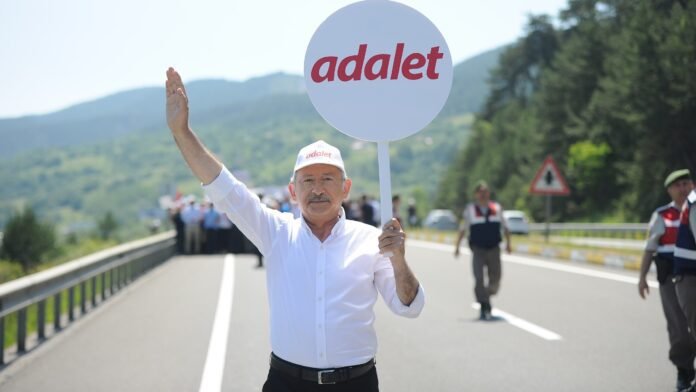
Turkey’s main opposition party lurched deeper into crisis Wednesday after reinstated Republican People’s Party (CHP) Chairman Kemal Kılıçdaroğlu said the party would hold a new congress only once legal conditions were met, days after a court annulled the 2023 vote that brought Özgür Özel to power and threw the country’s largest opposition force into open turmoil.

Kılıçdaroğlu, who lost Turkey’s 2023 presidential election to President Recep Tayyip Erdoğan and was later pushed out as CHP leader by Özel, told reporters that the party’s lawyers would help determine the timing. A congress, he said, “will be held, there is no alternative,” but only on a legal basis and under party rules.

That may sound procedural. In Turkey, these days, procedure can be political dynamite.

The Ankara appeals court ruling last week invalidated the CHP congress that elected Özel and ordered Kılıçdaroğlu and the previous party leadership back into office. Özel denounced the decision as a “judicial coup,” while supporters gathered at party headquarters and police later forced their way into the building. The turbulence rattled Turkish markets and raised fresh questions about the independence of Turkey’s courts.

The crisis lands at a dangerous moment for the opposition. The CHP scored major wins in the 2024 local elections and had been trying to build momentum toward the 2028 presidential vote. Istanbul Mayor Ekrem İmamoğlu, one of Erdoğan’s strongest potential challengers, has been jailed since March 2025 on corruption charges the CHP rejects.

Other opposition parties have joined the outcry. Tuncer Bakırhan, co-chair of the pro-Kurdish Peoples’ Equality and Democracy Party, said, “The fate of political parties should not be determined by courts; it should be determined by their members and the choices of their voters.” Erdoğan’s Justice and Development Party rejected claims of political interference, with party spokesman Ömer Çelik saying the judiciary was handling allegations tied to CHP infighting.

For Turkey’s opposition, the question is no longer only who leads the CHP. It is whether the party can fight Erdoğan while fighting itself.

0FansLike
0FollowersFollow
0FollowersFollow
0SubscribersSubscribe
- Advertisement -
Google search engine

Recent Posts