16.4 C
London
Thursday, May 28, 2026
Home Blog

Roku OS’s home screen now features a large, permanent ad

0
roku-os’s-home-screen-now-features-a-large,-permanent-ad
Roku OS’s home screen now features a large, permanent ad

Roku just unveiled the biggest overhaul to its smart TV operating system (OS) in 10 years. One of the most noticeable differences is that ad space now takes up a large chunk of the screen’s landing page.

Before the update, loading up a Roku OS-powered smart TV or streaming device would yield a menu on the left side with sections including “What to Watch,” “Live,” and “Search.” The right side had a row of tiles for “Recommended” content above several rows of tiles representing downloaded apps. Once a user started started navigating the home screen, the menu would collapse, and they’d see a large ad on the right side of the screen.

The old Roku OS landing page before the ad is visible. 

The old Roku OS landing page before the ad is visible.  Credit: Roku


Now, users will see that large ad as soon as they turn on their Roku device. The ad remains visible as you navigate different parts of the Roku platform, taking away space that could be used for displaying apps and content.

The marquee ad space can show marketing for a TV show or movie that you can stream. For example, the image that Roku shared with its announcement shows the space occupied by an ad for the Apple TV+ show Ted Lasso. The ad space could also just show a regular, possibly unrelated, advertisement. CNET, for example, reported seeing a demonstration that showed the space filled with an ad for The Farmer’s Dog dog food.

CNET, citing a discussion with Preston Smalley, VP of viewer product at Roku, reported “that the proportion of each type [of ad], paid or programmed, wasn’t set and could change.”

The home screen makeover seems tied to Roku’s efforts to maintain profitability. Roku first reached annual profitability in 2021, largely due to people staying at home during the pandemic. However, the company didn’t see annual profitability again until 2025, when its finances were buoyed by a growth in advertising revenue. In its most recent earnings report, Roku made $371 million in advertising revenue, and its Platform business, which includes advertising and subscriptions, posted a gross profit of $584.1 million. Roku’s devices business, meanwhile, lost $19.1 million. Total gross profit was $564.9 million.

In a February earnings call, Roku CEO Anthony Wood said that he thinks the new home screen, which was in testing at the time, would “increase monetization over time, whether that’s getting viewers to sign up for subscriptions or watch more ad-supported content.”

Other changes

The new Roku OS home screen also has a slimmer left sidebar menu with images replacing text. In the center are tiles for “Top Picks for You” above rows of tiles for “Quick Access.” The former, per Roku’s announcement, is a “personalized row that makes recommendations and highlights trending and relevant content based on your interest,” where “no two people will see the same mix.” Quick Access, meanwhile, uses AI to show users’ “most-used apps and shortcuts.”

“One of the things we found is that not very many people actually customized those app screens,” Smalley told Fast Company. “They’d end up scrolling all the way to the bottom of this long list. So, what we wanted to do was actually pull that all together in a way that made sense for you.”

Other changes include the addition of a section called Destinations, which Roku said are “curated hubs [that] span genres and moods,” such as comedies, sports, and movies, with content across different streaming services.

However, some users are perturbed by the new home screen.

“I don’t want recommendations! I know what I want to watch. Plastering ads for shit you think I want to see is the fastest way to get me to not watch it. This is going to suck,” an apparent Roku user going by Kruse on Reddit posted today.

One feature that could be useful but that’s not included in the update would be an easy way to play recently viewed content from across apps directly from the home screen, so you can quickly get back to watching. With Roku’s update, users can pin a “Continue Watching” tile to the Quick Access section or to their “shortcuts.” However, you’d have to enter the tile to access content, instead of being able to click play from the home screen, like some other smart TV OSes allow. Although, such a feature would be technically challenging to implement, especially among older Roku devices. Overall, Roku’s home screen update seems more geared toward recommending new stuff and using AI, rather than just recent history, to try to guess at what you might want to watch.

Roku TVs and streaming devices in the US will start seeing the new home screen today. “The update will arrive automatically,” Roku noted.

This article was updated with information about Roku OS’s old home screen and Continue Watching feature. 
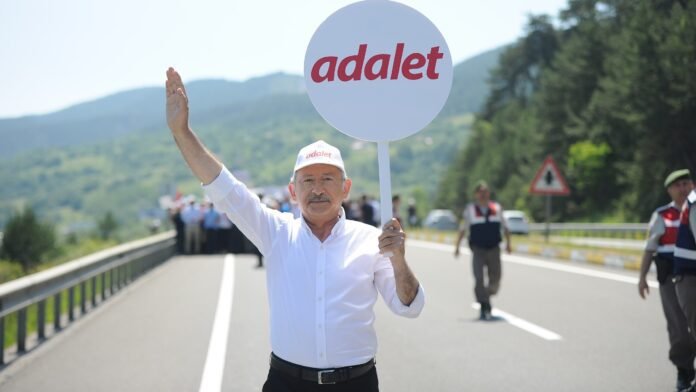
Court Ruling Throws Turkey’s Main Opposition Into Leadership Crisis

0
court-ruling-throws-turkey’s-main-opposition-into-leadership-crisis
Court Ruling Throws Turkey’s Main Opposition Into Leadership Crisis


Turkey’s main opposition party lurched deeper into crisis Wednesday after reinstated Republican People’s Party (CHP) Chairman Kemal Kılıçdaroğlu said the party would hold a new congress only once legal conditions were met, days after a court annulled the 2023 vote that brought Özgür Özel to power and threw the country’s largest opposition force into open turmoil.

Kılıçdaroğlu, who lost Turkey’s 2023 presidential election to President Recep Tayyip Erdoğan and was later pushed out as CHP leader by Özel, told reporters that the party’s lawyers would help determine the timing. A congress, he said, “will be held, there is no alternative,” but only on a legal basis and under party rules.

That may sound procedural. In Turkey, these days, procedure can be political dynamite.

The Ankara appeals court ruling last week invalidated the CHP congress that elected Özel and ordered Kılıçdaroğlu and the previous party leadership back into office. Özel denounced the decision as a “judicial coup,” while supporters gathered at party headquarters and police later forced their way into the building. The turbulence rattled Turkish markets and raised fresh questions about the independence of Turkey’s courts.

The crisis lands at a dangerous moment for the opposition. The CHP scored major wins in the 2024 local elections and had been trying to build momentum toward the 2028 presidential vote. Istanbul Mayor Ekrem İmamoğlu, one of Erdoğan’s strongest potential challengers, has been jailed since March 2025 on corruption charges the CHP rejects.

Other opposition parties have joined the outcry. Tuncer Bakırhan, co-chair of the pro-Kurdish Peoples’ Equality and Democracy Party, said, “The fate of political parties should not be determined by courts; it should be determined by their members and the choices of their voters.” Erdoğan’s Justice and Development Party rejected claims of political interference, with party spokesman Ömer Çelik saying the judiciary was handling allegations tied to CHP infighting.

For Turkey’s opposition, the question is no longer only who leads the CHP. It is whether the party can fight Erdoğan while fighting itself.

Oil pulls back as traders look for progress on US-Iran talks

0
oil-pulls-back-as-traders-look-for-progress-on-us-iran-talks
Oil pulls back as traders look for progress on US-Iran talks


Oil prices pulled back from recent highs on Wednesday, erasing some of ​the previous day’s 4% gain as traders sought ‌clarity on complex negotiations between Iran and the U.S. after renewed hostilities set back efforts to reopen the Strait ​of Hormuz.

Brent crude futures fell $1.42, or 1.43%, to $98.16 ​a barrel as of 0253 GMT, while ⁠U.S. West Texas Intermediate (WTI) crude lost $1.66, or 1.77%, ​to $92.23 a barrel.

Oil surged on Tuesday after the U.S. ​military carried out new strikes in Iran, hurting hopes over the weekend that the United States and Iran would reach ​an agreement to end the war.

Iran said on ​Tuesday the United States had violated a ceasefire by striking targets ‌near ⁠the contested Strait of Hormuz, while the U.S. said its strikes were defensive in nature.

Following an April ceasefire in the three-month long conflict, both sides ​indicated they had ​made progress ⁠on talks toward reopening the Strait, a key conduit for global oil and gas ​flows. But rising hostilities now threaten those ​negotiations.

Israel ⁠ramped up bombing on Lebanon on Tuesday, further straining peace efforts.

Nevertheless, the news that some LNG tankers have passed ⁠through the ​strait in recent days lifted ​expectations that the waterway might reopen soon, which would add to ​global supply.

Source:  Reuters

From Arash to Epstein: Iran’s loaded billboard propaganda

0
from-arash-to-epstein:-iran’s-loaded-billboard-propaganda
From Arash to Epstein: Iran’s loaded billboard propaganda

Since the US–Israel war against Iran began in late February, images of giant billboards in Tehran have been ubiquitous across traditional and social media. These billboards have been placed in some of the busiest and most visible parts of the city, and are constantly being updated to reflect current events.

Iran has long used public spaces as a tool of political communication. Since the 1979 Islamic Revolution – and especially during the Iran–Iraq War – the regime has erected murals and billboards to display revolutionary imagery, war memorials and ideological messages.

Today, these billboards are designed not only for local audiences, but also for global digital circulation. Depicting powerful imagery, slogans and symbolic representations, they serve a dual function:

  • to reinforce a sense of collective identity, national unity and shared emotion during a time of crisis
  • to serve as a tool of propaganda for the state, at times featuring Hebrew and English alongside Farsi (Persian).

Researchers argue these billboards are part of a broader visual communication strategy on the part of the state. They are intended to be photographed, posted and shared widely on social media as a way of projecting power and resistance to a global audience (even with a months-long internet blackout in place).

So, what do the billboards say, and what’s the deeper symbolism behind the imagery? We’ve chosen five samples from Tehran to analyze.

1. The Epstein missile

A billboard in Valiasr Square depicting Iranian missiles with messages on March 17 2026. Kaveh Kazemi/Getty Images

One of the billboards that circulated widely in recent months depicted Iranian missiles covered with handwritten messages and symbolic phrases.

Among the most striking inscriptions is the phrase “To the girls of Minab”, written in bold, red Farsi script. This is a reference to a strike on a girls’ school in the opening days of the war that Iranian officials say killed 175 girls and teachers. Reports indicate US forces were likely responsible.

Directly below that, written in English, are the words “Epstein Island victim girls”, a reference to the island owned by convicted sex offender Jeffrey Epstein where young women were allegedly sexually assaulted.

On another missile is the phrase “the girl with the pink jacket”. This is a deeply emotional reference to a young Iranian girl killed in a terror attack in 2024, who was identified by her pink jacket and heart-shaped earrings.

The intention is to connect these disparate events through a narrative of vulnerable young women affected by violence, exploitation and political power. Rather than presenting missiles only as weapons of destruction, the image reframes them as symbols of grief, revenge, memory and defence.

In this narrative, Iran is portrayed not as seeking war. It is responding to injustice and protecting its people.


2. ‘Masters of war’

A billboard in Enqelab Square, Tehran, threatening Iranian missile attacks on Israel, on October 3 2024. Fatemeh Bahrami/Anadolu via Getty Images

Another billboard that gained significant attention in 2024 depicted the Farsi phrase “If you want war, we are masters of war” above a Hebrew message saying “Israel must be wiped from the face of the earth.”

The billboard portrays the sky over Israel illuminated by waves of incoming missiles, almost resembling a meteor shower or rain of fire. The imagery is highly stylised and cinematic, with the missiles transforming the night sky into a scene of overwhelming force.

By directly addressing Hebrew-speaking viewers, the billboard functions as both a direct warning to Israelis and a symbolic projection of power, designed to have psychological impact. Language becomes a tool of warfare itself.

This multilingual strategy reveals an important shift in Tehran’s urban propaganda. These billboards, which have become more prominent in recent years, are no longer designed solely for Iranian pedestrians and motorists. The regime is aware photographs will circulate instantly across the internet, reaching intended audiences in Israel.

3. Trump’s sutured mouth

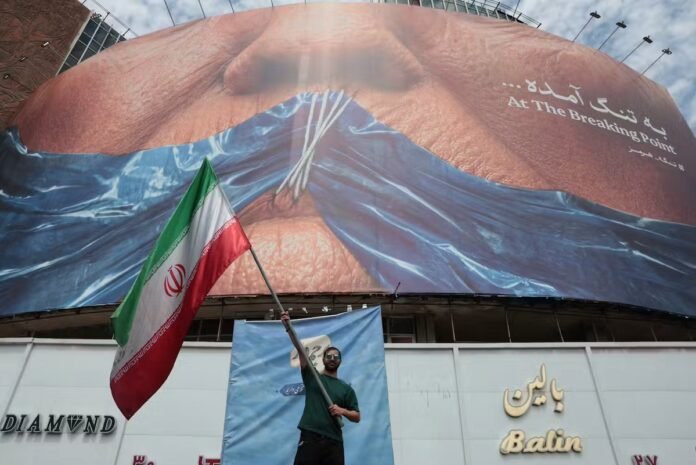
A billboard depicting US President Donald Trump’s mouth and the Strait of Hormuz at Valiasr Square on May 2 2026. Photo: Abedin Taherkenareh / EPA via The Conversation

Another bilingual billboard is targeted to Western – and specifically American – audiences. It features US President Donald Trump’s mouth with a rendering of the Strait of Hormuz sutured on top, alongside the English phrase “The Breaking Point.”

The Farsi text roughly translates to “its patience has run out.” It also contains a literary pun: the word tang in Farsi can refer both to “narrowness” or “constraint” and to the Strait (tangeh) of Hormuz itself. This creates a double meaning linking the geopolitical tensions in the Strait of Hormuz with the idea of reaching a psychological or political breaking point.

The image also critiques Trump’s constant political rhetoric and media presence. The sutures placed across his mouth symbolise silencing, constraint and the loss of Trump’s authority or influence in relation to Iran and the Strait of Hormuz.

4. Arash the Archer

A billboard featuring the legendary mythical archer Arash in Vanak Square, Tehran, on July 16 2025. Photo: Atta Kenare/AFP via Getty Images via The Conversation

Another billboard draws on the famous Persian myth of Arash the Archer. In the image, Arash places an arrow into his bow in the heat of battle, surrounded by missiles. The reference comes from the ancient story in which Arash sacrifices his life after shooting an arrow during a mythological war between Iran and neighbouring Turan.

The billboard suggests modern Iranian soldiers, like Arash, are willing to sacrifice their lives to defend their homeland.

More broadly, the image also reflects how poetry, mythology and heroic storytelling are deeply embedded in Iranian history and culture. It connects the contemporary conflict to centuries of struggle.

5. The fishermen

A billboard in Enghelab Square in Tehran that says, ‘The Strait of Hormuz remains closed’, on April 28 2026. Photo: Abedin Taherkenareh / EPA via The Conversation

Another billboard demonstrates Iranian military power through the image of a massive fishing net spread across the Persian Gulf. Inside the net are captured American aircraft, drones and naval vessels.

The imagery is accompanied by the phrase, “The entire Persian Gulf is our hunting ground” in Farsi, connoting it is under direct Iranian control and surveillance. The image also emphasises the strategic importance of the Strait of Hormuz, indicating the power to open or close this vital waterway ultimately lies with Iran.

At the same time, the fishing net operates as a cultural metaphor. Like fishing itself, Iran’s warfare strategy is based on patience, resilience, careful strategy and long-term determination, rather than sheer force alone.

Hamideh Khaleghi Mohammadi is lecturer in media and communications, University of Sydney and Ali Abbasi is sessional academic and researcher in media and communications, University of Sydney

This article is republished from The Conversation under a Creative Commons license. Read the original article.

Can Kuwait really be Indonesia’s defence ally?

0
can-kuwait-really-be-indonesia’s-defence-ally?
Can Kuwait really be Indonesia’s defence ally?

Indonesia’s Defense Ministry says it wants closer military cooperation with Kuwait through training, military education, and strategic dialogue. Officials presented the initiative as part of a long-standing bilateral relationship dating back to 1968.

But Kuwait is unlikely to become a central pillar of Indonesia’s defense strategy, and the recent meeting also reflects Jakarta’s lack of clear prioritization in how it engages countries across the Middle East and North Africa region.

Indonesia’s main security concerns are in the Indo-Pacific: maritime security, Chinese pressure around the Natuna waters, and military modernization. Those challenges require naval capability, surveillance systems, defense technology, and industrial cooperation.

Kuwait contributes little in those areas. It is not an Indo-Pacific military power and does not have a major defense industry. Kuwait itself still relies heavily on Western defense suppliers. Reuters recently reported that Kuwait signed a €320 million naval systems deal with Italian defense company Leonardo. 

Indonesia already has defense relationships that are more directly tied to its strategic needs. The United States focuses on interoperability and military training. Japan has become increasingly important in maritime security cooperation, while Australia remains a key regional partner because of geographic proximity. South Korea is central to Indonesia’s aerospace ambitions, Türkiye has expanded cooperation in drones and defense manufacturing, and France has emerged as one of Jakarta’s main suppliers of advanced military hardware. 

Kuwait’s value to Indonesia is elsewhere.

What Kuwait can realistically offer is capital, energy cooperation, and access to Gulf financial networks. Kuwait Investment Authority and Kuwait Fund for Arab Economic Development have shown interest in Indonesian infrastructure and energy projects.

Last year, Indonesian lawmakers discussed potential Kuwait involvement in the energy sector, including support for increasing domestic oil production. 

This fits Indonesia’s actual needs. President Prabowo Subianto is trying to expand sovereign wealth funding, downstream industries, and infrastructure investment through institutions like Danantara. Reuters reported this year that Indonesia plans billions of dollars in resource-processing and industrial projects through its sovereign wealth strategy. Gulf capital could become important for that agenda.

READ: Indonesia reiterates call for UN probe after peacekeeper dies in Lebanon attack, condemns Israel

That is why Indonesia needs a more focused Middle East strategy.

Jakarta often treats the Middle East as a single geopolitical category instead of identifying what each country is actually good at. The result is vague “strategic partnerships” with unclear objectives.

Indonesia should prioritize by sector.

The UAE is useful for infrastructure and logistics investment. Saudi Arabia matters for energy, labor, and religious diplomacy. Türkiye matters for defense manufacturing. Qatar matters for finance. Kuwait’s comparative advantage is sovereign wealth, development finance, and energy cooperation.

That is a credible partnership. A defense alliance is not.

The larger problem is that Indonesia increasingly labels almost every bilateral relationship as “strategic.” This creates diplomatic inflation. Partnerships become symbolic rather than functional.

Indonesia’s weakness is not lack of diplomatic outreach. It is lack of prioritization.

The country still depends heavily on foreign suppliers for military modernization. Procurement remains fragmented. Long-term defense planning remains inconsistent. Adding more memorandums of understanding does not solve those problems.

There is also a political reason Indonesia prefers partnerships like Kuwait. They are low-risk. Unlike cooperation with the United States, Gulf partnerships do not trigger fears about alignment or sovereignty. Earlier this year, domestic debate intensified after reports about expanded U.S. military cooperation with Indonesia. Many Indonesians worried the country was drifting away from its “free and active” doctrine. 

Kuwait carries no such political baggage because the strategic stakes are low.

That may make the relationship politically convenient, but convenience is not strategy.

Indonesia should cooperate with Kuwait where Kuwait is genuinely useful: investment, energy financing, sovereign wealth partnerships, and development funding. Trying to frame Kuwait as a meaningful defense ally only weakens the credibility of Indonesia’s broader foreign policy.

OPINION: Indonesia’s foreign minister didn’t defend the flotilla detainees. He defended Israel’s language

The views expressed in this article belong to the author and do not necessarily reflect the editorial policy of Middle East Monitor.

Nvidia bets $150B on Taiwan as Trump’s plan to make US an AI hub backfires

0
nvidia-bets-$150b-on-taiwan-as-trump’s-plan-to-make-us-an-ai-hub-backfires
Nvidia bets $150B on Taiwan as Trump’s plan to make US an AI hub backfires

In a splashy move that signals that Taiwan remains irreplaceable to the AI industry’s short-term and long-term goals, Nvidia CEO Jensen Huang announced Wednesday that his chip company will invest $150 billion a year to make sure Taiwan remains at the “epicenter” of the “AI revolution.”

“This is where the chips come, packaging comes, this is where the systems are made, this is where AI supercomputers were created,” Huang said. “The number of partners we work with here in Taiwan, incredible.”

As Reuters reported, the substantial investments will be used to create a new Taiwan headquarters for Nvidia, which Huang expects will drive so much AI innovation that the partnership will cement Taiwan as “the world’s tech manufacturing hub for a long time.” That ambitious project will be operational by 2030, Nvidia anticipates, after breaking ground this year.

“Four years ago, five years ago, Nvidia was spending about 10, 15 billion dollars a year in Taiwan,” Huang said at a ceremony celebrating the launch of the company’s new Taiwan base. “Now we’re spending 100, going to 150 billion dollars in Taiwan each year.”

Nvidia is currently the world’s most valuable company, making history in 2025 after becoming the first company to reach a $5 trillion market capitalization. And Huang bragged that the Taiwan base will make sure Nvidia is “worth even more in three ⁠to five years.”

But Huang has so far not explained how Nvidia’s plans in Taiwan may potentially conflict with Donald Trump’s push to make the US the world’s AI hub.

Nvidia did not immediately respond to Ars’ request to comment on this seeming tension.

Nvidia needs Taiwan HQ to meet demand

Last April, Nvidia started producing AI chips on US soil for the first time. The move seemed designed to appease Trump, who had been pressuring US firms to increase domestic manufacturing, a top priority of his AI Action Plan.

At that time, Huang said that “the engines of the world’s AI infrastructure are being built in the United States for the first time,” because “adding American manufacturing helps us better meet the incredible and growing demand for AI chips and supercomputers, strengthens our supply chain, and boosts our resiliency.”

Over the next four years, he projected that Nvidia could produce up to half a trillion dollars of AI infrastructure in the US—but it was hard to see how Nvidia could race to achieve that result when the company still relied on shipping chips to Taiwan for advanced packaging.

Now, Huang seems to be confronting that reality head-on, prioritizing more investments and deepening partnerships in Taiwan at a time when Huang claims that overwhelming demand for agentic AI is accelerating AI factory buildouts “at extraordinary speed,” The Guardian reported.

While the US investments will surely factor into Nvidia’s growth, it’s the Taiwan HQ that seemingly matters most.

Tech giants collectively plan to spend $750 billion on AI infrastructure this year, with “a significant portion” of that expected to “go towards chips for data centers,” the Guardian noted, and Nvidia needs a plan to keep up with that rapidly spiking demand. Then there’s also Nvidia’s new AI system, Vera Rubin, to consider, which Huang claimed would be a “generational leap” that’s going to be “kicking off the greatest infrastructure buildout in history.” Nvidia fears it will face supply chain constraints “throughout the entire life of Vera Rubin,” Huang said.

Perhaps to Huang, the Taiwan base looks like a lifeline for that and future systems.

Before Trump’s AI Action Plan rolled out, Nvidia had previously manufactured all its AI chips exclusively in Taiwan. So, the firm is well acquainted with the benefits of working in that ecosystem.

With its Taiwan HQ, Nvidia hopes to expand its partnership with the Taiwan Semiconductor Manufacturing Company (TSMC), while benefiting from close proximity to advanced packaging technology not yet available at TSMC’s US factories. And Nvidia can also “boost its alliances” with other nearby partners playing “key roles in the build-out of AI servers and infrastructure,” like Foxconn, Wistron, and Quanta Computer, Reuters reported.

For Nvidia, the focus appears to be on expanding the AI ecosystem to further its bottom line. Earlier this month, Huang told CNBC that Nvidia would be “aggressively” expanding its supply chain and suggested that the “first priority for its growing cash pile was supporting suppliers amid surging demand.”

Trump’s plans for Nvidia chips backfired

Trump has not yet commented on Nvidia’s plans in Taiwan, but the US president has repeatedly praised Huang as brilliant, while consulting with Huang on AI industry and tariff questions. Over the past year, their ties have grown, with Huang making commitments to perhaps avoid the consequences of Trump’s tariff regimes. Last year, Huang paid $1 million to attend a Mar-a-Lago dinner, then promised to invest $500 billion in US data centers. Shortly afterward, Trump halted plans for export controls blocking some of Nvidia’s chips from China’s market.

But Huang may be too smart to be all-in on Trump’s AI plans, perhaps increasingly recognizing that Trump’s export controls and tariffs aren’t working as planned to ensure US dominance in AI.

Directly impacting Nvidia, Trump’s plan to give the US a 25 percent cut of certain Nvidia chips sold to China seemingly backfired, since China has refused to purchase the chips. China’s refusal is reportedly not due to paying the fee, but due to a requirement that all chips subjected to the fee must be routed through the US. China seems worried that the US might tamper with chips sold in its markets, and Nvidia is pretty sure that Beijing won’t budge on buying its chips any time soon, so long as Trump’s policy remains in place.

For Huang, the goal remains to sell Nvidia chips in China’s market, which the company recently told investors it has “largely conceded” to Huawei. And about a month ahead of Trump’s meeting with China’s president, Xi Jinping, Huang told the US think tank the Special Competitive Studies Project that Trump’s export curbs blocking its chips from China have “already largely backfired.”

“Conceding an entire market the size of China probably don’t make a lot of strategic sense,” Huang said, whereas giving US chip companies access to China’s market where AI demand is spiking “makes a lot of sense.”

But Huang has to be careful navigating Trump, who likely still relies on Huang despite their perhaps disparate views on where the global AI hub should be. When Trump tapped Huang at the last minute to attend a summit with China’s president, Xi Jinping, in Beijing, Huang reportedly dropped everything to go, seemingly in the hopes that Trump would convince China to buy Nvidia chips.

However, experts agreed that Trump had little leverage at the summit, and it was later confirmed that US export curbs were not discussed. After the meeting, Trump confirmed that China had no plans to buy Nvidia’s chips because “they want to develop their own” and already have a chip that’s more advanced than Nvidia’s product, the H200.

Looming chip tariffs

Ultimately, the summit may have been a wasted trip for Huang, who might be tiring of Trump’s trade tactics, despite exemptions from tariffs that have seemingly benefited Nvidia.

So far, Trump has exempted semiconductors to be used in data centers from tariffs. But Nvidia likely knows that could change soon.

In July, official investigations into whether more tariffs are needed to protect national security will conclude. Among the most feared tariffs that could come, there’s a threat looming over the AI industry that Trump “may issue ‘significant’ additional tariffs” on semiconductors used in data centers in order “to encourage domestic manufacturing,” a supply chain management newsletter called Supply Chain Dive reported.

Currently, the US only fully manufactures about 10 percent of the chips it requires, a Trump proclamation read. That is “too low to meet projected national defense needs and to match the requirements of a growing commercial industry,” Trump said, ordering the probes to see if substantial tariffs might be needed to stop firms from relying so much on importing semiconductors.

Last week, US trade representative Jamieson Greer said that “the Trump administration continues to weigh US tariffs on imported semiconductors to boost domestic chip manufacturing, though there are no immediate plans to impose any new levies,” Bloomberg reported. However, “Greer stressed the importance of using import duties to bring chip production back to the US,” confirming that Trump’s goal is to “facilitate the reshoring” of the semiconductor supply chain.

Huang bets on Taiwan

For Nvidia, commitments to invest in the US may be enough to avoid future tariffs, Greer suggested. That makes it appear as if Huang has been successful at both influencing and staying ahead of Trump’s next moves.

But Trump seems unlikely to take kindly to Huang’s mission to ensure Taiwan maintains dominance in the semiconductor industry.

Trump has recently sent confusing signals on the US position on Taiwan, which he has irrationally accused of stealing the semiconductor industry from the US. Last October, Taiwan rejected Trump’s demands to move 50 percent of its chip production into the US or else lose US protection from a potential Chinese invasion. Although Trump recently approved the largest-ever weapons package to support Taiwan’s defense, he has said it’s up to Xi to decide if China will invade Taiwan or not, which experts warned expressed US indifference.

Although the US likely needs more time than Trump’s presidency to achieve the goals of the AI Action Plan, Trump seemingly thinks that pressuring Taiwan to shift its production could be a shortcut.

Whether Taiwan will ever bend to that pressure remains to be seen, as it has sought to strengthen its own communications with the Trump administration. Experts have suggested that explosive AI demand will, over time, diminish Taiwan’s lead, currently producing over 90 percent of the world’s most advanced semiconductor chips. Countries that have experienced global chip shortages have realized that it’s foolish to rely on one supplier, and it’s expected that the supply chain will diversify, as leading nations pioneering AI build up their own domestic manufacturing or seek to support allies doing the same.

Huang does not appear to expect Taiwan’s dominance to wane any time soon, though. He was born in Taiwan before emigrating to the US at the age of 9, and while he did not indicate exactly how long he intends to invest $150 billion a year into Taiwan projects, he did suggest that Nvidia’s future hinged on establishing a headquarters there, while seeming to take pride in Taiwan’s accomplishments.

“Taiwan is booming,” Huang said at the launch.

Trump’s “Donroe Doctrine” Supercharges Violence in the Americas

0
trump’s-“donroe-doctrine”-supercharges-violence-in-the-americas
Trump’s “Donroe Doctrine” Supercharges Violence in the Americas


The Trump administration’s aggressive diplomatic and military engagement in the U.S.’s backyard — dubbed the Donroe Doctrine — has led to more violence in the Americas, increased impunity by local security forces, and heightened danger from cartels in the Western Hemisphere, according to a new analysis by a top violence watchdog, shared with The Intercept.

“U.S. pressure on organized crime is accelerating the spread of militarized security approaches in the region,” according to Sandra Pellegrini and Tiziano Breda, senior Latin America analysts with the Armed Conflict Location & Event Data project, known as ACLED. “Growing volatility in the organized crime ecosystem will likely fuel an increase in violence throughout the rest of Trump’s term, potentially undermining any short-term improvements achieved through hardline approaches.”

President Donald Trump has turned the Western Hemisphere into a war zone as part of what he and others have called the Donroe Doctrine. This bastardization of the 1823 Monroe Doctrine has been used to justify strikes on civilian boats in the Caribbean Sea and Pacific Ocean; an attack on Venezuela and the abduction of its president; CIA operations in Mexico; joint counter-cartel operations in Ecuador dubbed “Operation Total Extermination”; and increased military and intelligence operations elsewhere in Latin America.

“In countries where cartels’ revenue sources are most diversified, the spread of militarized security strategies has led to counterproductive results, such as group fragmentation and intensified competition,” according to the ACLED analysis. In Ecuador, the capture or killing of gang leaders has led to a proliferation of splinter groups. The reported number of gangs there increased from 24 in 2023 to 37 by the end of last year. And after José Adolfo Macías, the leader of the gang Los Choneros, was extradited to the United States, another group — Los Lobos — was able to push into its rival’s strongholds, fueling more violence, the analysts noted.

Cartels are also increasingly waging a light-footprint air war strategy, similar to the tactics employed by the U.S. military during the War on Terror and now in its boat strike campaign. Armed groups in Mexico and Colombia are employing weaponized drones to target security forces, write Pellegrini and Breda, “in an effort to maximize the impact of their attacks while minimizing the costs of a direct confrontation.” In Mexico, drone attacks by cartels have jumped 567 percent from 2023 to 2025. In Colombia, such attacks have spiked an astounding 10,600 percent, from one strike in 2023 to at least 107 in 2025.

For its part, the U.S. military’s illegal campaign of strikes on boats in the Caribbean Sea and Pacific Ocean has resulted in 59 attacks on so-called drug boats since September 2025, killing 195 civilians. The latest strike, on May 8 in the Pacific Ocean, killed three people.

Regional security forces aligned with the U.S. have also employed attacks from afar. “Forms of remote violence, namely aerial bombardments and, in the case of Haiti, the use of drones by a special task force, have exposed civilians to shelling and caused the number of people killed from clashes between security forces and gangs to skyrocket,” according to the ACLED analysts. 

Pellegrini and Breda note that Trump is fostering both a “hardline response to crime across the region” and “a climate of impunity” that has led to runaway state violence. Operations by security forces reportedly killed almost 6,900 people last year, the highest total since 2018.

Under the Donroe Doctrine, the Trump administration has repeatedly bullied Panama and threatened Canada, Colombia, Greenland, and perhaps also Iceland. It has also increasingly threatened Cuba.

Last week, federal prosecutors in Florida unsealed an indictment charging former Cuban leader Raúl Castro and five others in connection with the Cuban military’s fatal downing of two planes 30 years ago. The administration has also been making claims that the tiny island nation is a military threat. Democrats in Congress have pushed back and repeatedly warned that the administration is crafting a pretext to justify an invasion.

“Look, the Cuban regime is an appalling regime, but it is no more a national security threat than Nicaragua is. It’s just insane to say that it is, and especially if it’s done in the service of military action,” said Rep. Jim Himes, D-Conn., the top Democrat on the House Intelligence Committee. 

Kawasaki Heavy Industries opens physical AI center in Silicon Valley

0
kawasaki-heavy-industries-opens-physical-ai-center-in-silicon-valley
Kawasaki Heavy Industries opens physical AI center in Silicon Valley

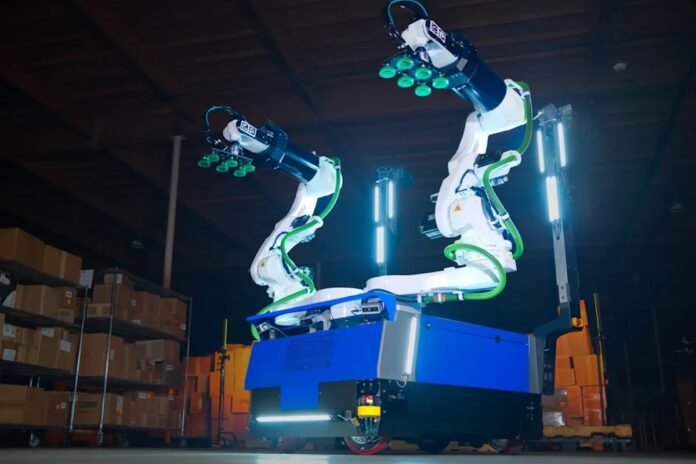
Kawasaki Heavy Industries is reaching for AI collaboration in Silicon Valley. Image: KHI

While cybersecurity threats from large language models and amoral generative AI without guardrails make front-page headlines, Japanese engineering conglomerate Kawasaki Heavy Industries (KHI) has established a physical AI development center in San Jose, California.

The purpose of the facility is to make practical improvements in healthcare, mobility, semiconductors and other industries in collaboration with Nvidia, Analog Devices, Microsoft and Fujitsu.

Speaking at the opening ceremony on May 21, KHI CEO Yasuhiko Hashimoto said, “At the Kawasaki Physical AI Center, we will first focus on healthcare and elder care, where aging societies and labor shortages are global challenges. We will establish ‘hospital one-stop solution’ that covers the entire in-hospital experience from arrival, examination, diagnosis, and treatment, to surgery and post-care – through the integration of Physical AI and robotics.

“Simultaneously, by expanding the integration of Physical AI and robotics across a wide range of industries… we will deploy integrated solutions across diverse fields.

“What matters most is that these solutions take root on site, are used continuously, and contribute to improving the quality of healthcare. This is what we call “social implementation.” What we aim for is NOT to replace people, but to deliver Physical AI that supports human judgment and action – safely and efficiently.”

Points of collaboration include:

  • Nvidia: Creation of new solutions that integrate AI and robotics technologies across diverse fields, with healthcare as the entry point
  • Analog Devices: Realization of robots capable of handling a wide range of tasks by integrating AI, voice recognition, and sensing technologies  
  • Microsoft: Accelerating the deployment of Physical AI solutions by leveraging cloud and AI platform capabilities to help ensure reliability and scalability in real-world operations  
  • Fujitsu: Realization of new value creation in the healthcare domain through the integration of business systems, robotic systems, and AI

Congratulatory video messages were sent by Nvidia CEO Jensen Huang and professor of surgery at the University of Strasbourg, France, Dr. Jacques Marescaux.

Huang foresees “a new generation of intelligent machines” using Nvidia for AI training and simulation, and robot control: “An Nvidia Jetson would be the computer to run the AI in your robotic systems… The technology created in this lab will reach across Kawasaki’s entire product line-up.”

Marescaux, who is founder and president of the Research Institute against Digestive Cancer (IRCAD) in Strasbourg, France, stated that “Today, the development of AI is fantastic in surgery…[and] we know that within the next 10 or perhaps 15 years, the majority of procedures will be performed with a robot.”

Marescaux achieved international renown in 2001, when he led the team of surgeons that performed the first successful trans-Atlantic telesurgery, removing the gallbladder from a patient in Strasbourg with robot arms controlled from New York via a high-speed fiber optic link.

Based within the University Hospital of Strasbourg, IRCAD has eight “mirror institutes”, in Taiwan, China, India, Rwanda, Lebanon, the US, and two in Brazil. These are operationally independent affiliates aligned with IRCAD Strasbourg. The idea is to allow surgeons from around the world to acquire best practices in minimally invasive surgery.

The operations of KHI itself encompass aerospace, shipbuilding, power generation, plant engineering, industrial machinery, robotics and motorcycles. It possesses an extensive range of manufacturing expertise and data that it can bring to the Physical AI Center.

Kawasaki Robotics, a division of KHI, makes general-purpose industrial robots, collaborative robots, and specialized robotic systems.

The latter include silicon wafer handling and transfer robots used in semiconductor fabs, the hinotori (Firebird) surgery support robot, and a four-legged mobility robot. Hinotori was developed by Medicaroid, a joint venture between KHI and Sysmex, a Japanese medical diagnostics company.

The Kawasaki Physical AI Center will also work with KHI’s R&D centers in Japan and Europe. KHI’s first overseas R&D center, the Kawasaki Innovation Centre Europe SAS began operations at IRCAD in Strasbourg in March 2026.

It is dedicated to facilitating efficient hospital procedures by combining surgical, service and delivery robots, and a positioning system, with AI and remote operating technologies. In addition, Medicaroid operates a hinatori training center at IRCAD under its registered trademark MIL.

Robotic surgery and hospital management set standards for accuracy and reliability that physical AI must meet. Hallucinations and factual errors cannot be permitted. This should be reflected in the quality of all KHI robotics.

Follow this writer on X: @ScottFo83517667

Mystery GPS jammer in Iran becomes test for NASA satellites’ capabilities

0
mystery-gps-jammer-in-iran-becomes-test-for-nasa-satellites’-capabilities
Mystery GPS jammer in Iran becomes test for NASA satellites’ capabilities

NASA satellites designed to observe cyclone wind speeds and collapsing ice sheets have also proven capable of identifying the approximate locations of GPS jammers. That could help monitor high-risk areas for aircraft and ships navigating the growing prevalence of GPS interference worldwide.

Two different NASA satellite systems showed how they could locate a known but mysterious GPS jammer within several kilometers of its position in Iran, according to an experiment by Sean Gorman, CEO and cofounder of the location-based technology company Zephr.xyz that was detailed in the magazine GPS World. Such jammers use strong signals to overpower the weaker radio signals coming from US-operated GPS satellites and other global navigation satellite systems.

Such NASA satellites cannot perform “near-real time monitoring” or pinpoint the exact location of GPS jammers, said Clara Chew, principal scientist and lead of the GNSS systems and data team at the California-based satellite manufacturer Muon Space, who was not involved in the study. But Chew told Ars that identifying the approximate locations of GPS jammers “could potentially be helpful for flight planning” or for “indicating high risk areas for maritime shipping.”

One of the NASA satellite systems, the Cyclone Global Navigation Satellite System (CYGNSS), has eight microsatellites that detect GPS signals reflected from ocean surfaces to measure wind speeds within the eyewalls of hurricanes, tropical cyclones, and typhoons. When an Earth-based jammer turns on, the effect creates a huge footprint in the reflected GPS signals that can show up hundreds of kilometers from the jammer’s location.

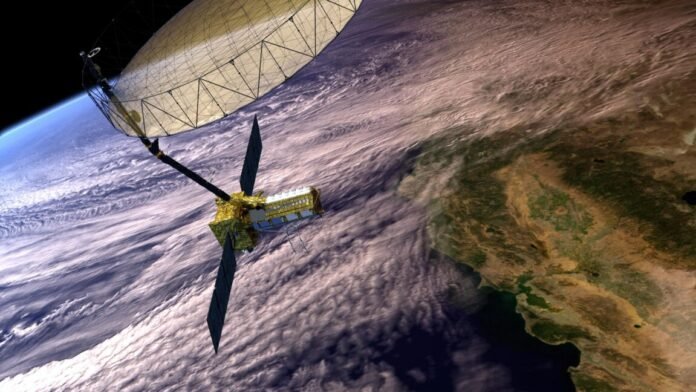
The other satellite system, NASA-ISRO Synthetic Aperture Radar (NISAR), typically uses radar imaging to continually map and track changes across the Earth’s surface, including earthquakes, tsunamis, volcanoes, and ice sheet collapses. GPS jammer emissions create streaks in the NISAR radar imagery that run perpendicular to flight direction—meaning that “each streak encodes the jammer’s direction relative to the satellite’s ground track,” Gorman wrote in his GPS World article.

“CYGNSS sees the jammer’s effect on reflected GPS signals, offering an indirect measurement spread across hundreds of specular reflection points,” Gorman wrote. “NISAR sees the jammer’s emissions directly in its own receiver, which is a more precise measurement, but only along the satellite’s narrow ground track.”

Comparing satellite systems

To validate the NASA satellite systems’ performances using a known jammer location, Gorman and colleagues first used “independent signals intelligence” to identify and locate a GPS jammer operating near the city of Shiraz in Iran. This mystery jammer has been active since the start of 2026 and has continued operating at even higher power since the war began with the US and Israel attacking Iran on February 28, 2026.

The researchers then ran a controlled experiment that looked at the NASA satellite data during two “jammer on” dates from January 8 and January 20, 2026, along with two “jammer off” dates from December 15 and December 27, 2025. They applied several detection and signal analysis techniques to both the CYGNSS and NISAR data in order to come up with the best approximations for the GPS jammer’s location.

The experiment showed that CYGNSS located the jammer within 4.33 kilometers of the ground truth, with a circular error probable of 3.48 kilometers. The latter means 50 percent of the estimates from repeated analyses on many similar jammers would fall within 3.48 kilometers.

By comparison, NISAR located the jammer to within 6.26 kilometers of the ground truth while demonstrating a circular error probable of 6.88 kilometers. So CYGNSS came out on top.

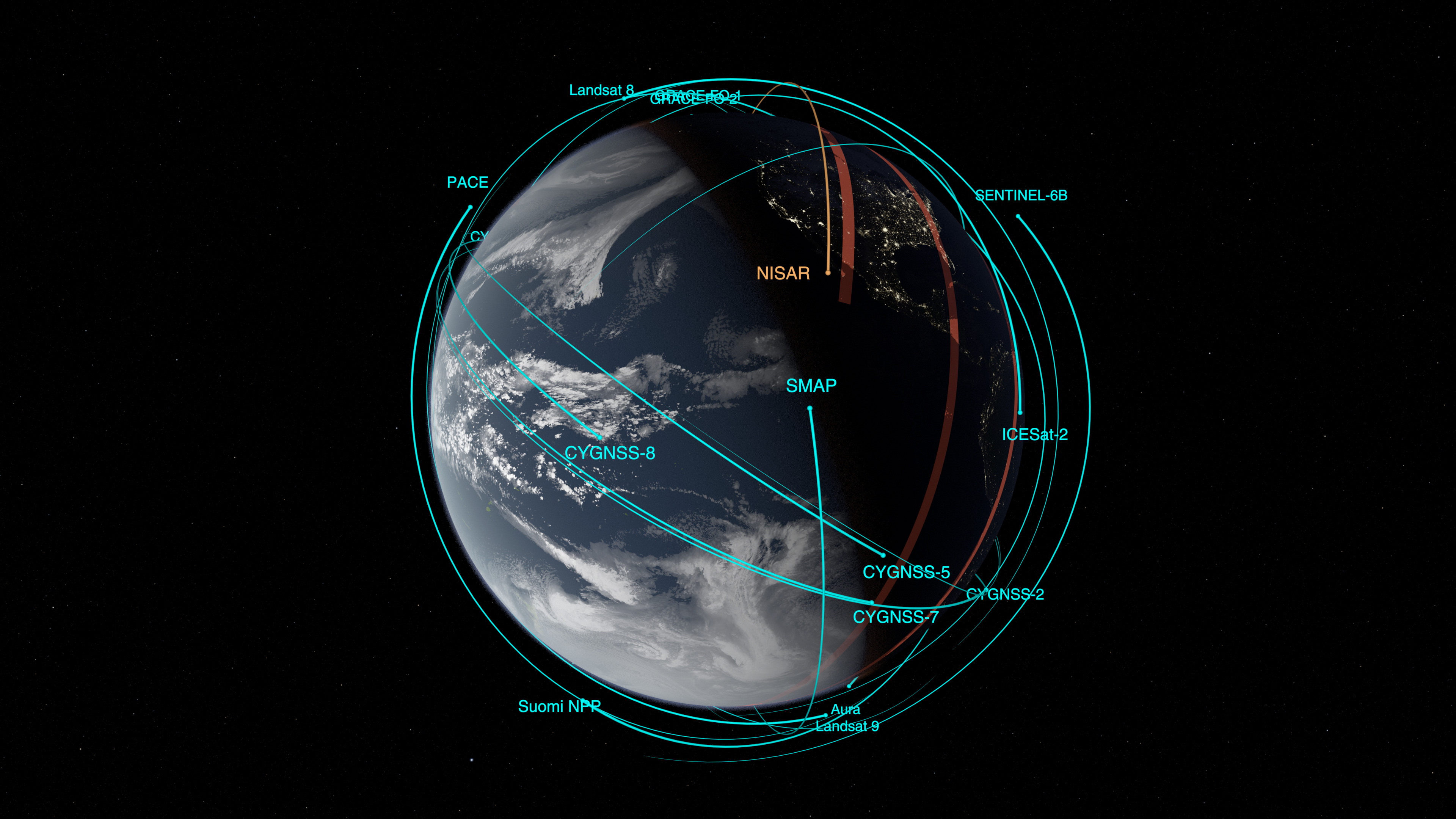
Still image showing NISAR’s orbit and ground swath (in orange), alongside the rest of NASA’s Earth-observing satellite fleet such as the CYGNSS micro-satellites (in cyan).

Still image showing NISAR’s orbit and ground swath (in orange), alongside the rest of NASA’s Earth-observing satellite fleet, such as the CYGNSS micro-satellites (in cyan).

Still image showing NISAR’s orbit and ground swath (in orange), alongside the rest of NASA’s Earth-observing satellite fleet, such as the CYGNSS micro-satellites (in cyan). Credit: Kel Elkins | NASA

Gorman and colleagues also attempted to combine “CYGNSS’s wide-area sensitivity with NISAR’s geometric precision” in a fused approach. That fused result located the jammer to within 4.69 kilometers with a circular error probable of 7.85 kilometers, which fell short of the standalone CYGNSS result but still showed how “two independent physics arriving at similar locations builds confidence that neither sensor is producing an artifact,” Gorman wrote.

It is unusual to see worse performance with the fused approach compared to using CYGNSS alone, said Todd Humphreys, director of the Wireless Networking and Communications Group and the Radionavigation Laboratory at The University of Texas at Austin, in correspondence with Ars. But he said that can happen when calculating the circular error probable based on real-world error data—and he praised the overall work for achieving “such accurate results” using publicly available satellite data.

The demonstration built on earlier research by Chew and colleagues that used CYGNSS data to map regions rife with GPS interference and identify possible jamming sources. “My work didn’t try to geolocate jammers like Gorman’s does—I was simply gridding the noise variable to 9 km and associating ‘hot spots’ with known conflict areas around the world,” Chew explained.

Keeping tabs on GPS jamming

Such NASA satellites cannot provide “near-realtime monitoring of GPS jammers” because it can take up to several days for collected data to become publicly available, Chew said. She would be “surprised” if this could deliver very precise geolocation of jammers, but still expressed interest in seeing such methods repeated on other known jammers to measure how consistently they can get within five kilometers of actual locations.

Harnessing this capability from NASA satellite data could allow researchers to better filter out interference from GPS jammers that may impact NASA science missions, Chew said. But she also highlighted the potential usefulness for supporting aviation and maritime navigation warnings, along with aiding open source intelligence investigators who track GPS interference across the world.

Navigation interference resulting from GPS jamming has spread well beyond major conflict zones in Ukraine and the Middle East to impact shipping in the Baltic Sea and Mediterranean, along with maritime traffic in the South China Sea. About 900 flights experience GPS disruptions daily, with degraded GPS service affecting a dozen or so transatlantic flights. Given this unwelcome trend, there is growing interest in a wide variety of GPS alternatives.

When the US military launched Operation Epic Fury against Iran, more than 1,100 ships experienced GPS interference across the Persian Gulf between February 28 and March 1, 2026. Much of the contested Strait of Hormuz is still experiencing GPS jamming and spoofing, with the latter involving false signals that trick GPS receivers into reporting inaccurate positions.

Meanwhile, NASA’s CYGNSS satellite data shows the mystery jammer is operating at “dramatically higher power” with a fivefold increase in signal intensity since the start of the Middle East conflict. Possible explanations include the jammer operator increasing power output to ward off potential US or Israeli military strikes using GPS-guided weapons, more jammers becoming active in the area, or a shift from intermittent to continuous operations, Gorman said. In any case, the NASA satellites’ passive, persistent monitoring capabilities may serve well in letting us know what happens next.

Horrifying Detail Revealed in NASCAR Star’s Death Certificate

0
horrifying-detail-revealed-in-nascar-star’s-death-certificate
Horrifying Detail Revealed in NASCAR Star’s Death Certificate


NASCAR fans are still reeling after the shocking death of Kyle Busch, and now new details are painting an even more heartbreaking picture of the racing legend’s final days.

Busch, one of the most recognizable and hard-charging drivers in modern NASCAR history, died on Thursday, May 21, at just 41 years old. Now, according to a death certificate obtained by Us Weekly, his death followed a terrifying “chain of events” that reportedly began with bacterial pneumonia.

The document says Busch had been suffering from pneumonia for “days to weeks” before his death. That illness then progressed into sepsis, a dangerous and fast-moving reaction to infection that the medical examiner determined he likely had for only one day.

From there, the situation reportedly spiraled.

According to the death certificate, the sepsis led to disseminated intravascular coagulation, a serious condition where small blood clots form throughout the bloodstream and can block blood flow to vital organs.

That then led to hemorrhagic shock, which happens when the body loses a severe amount of blood internally or externally.

It was a devastating and rapid collapse for a man who, to millions of NASCAR fans, seemed almost larger than life.

Busch’s death came just one day after he was rushed to the hospital in North Carolina. He had reportedly been found unresponsive while using a racing simulator.

He leaves behind his wife, Samantha, and their two young children, 11-year-old son Brexton and 4-year-old daughter Lennix.

The details listed on the death certificate line up with what Busch’s family revealed on Saturday, May 23. In that statement, they said he died after pneumonia progressed “into sepsis, resulting in rapid and overwhelming associated complications.”

Even more troubling details emerged from a 911 call obtained by TMZ Sports.

During the call, the caller said Busch was struggling to breathe and had been coughing up blood before he was hospitalized.

“I’ve got an individual that’s shortness of breath, very hot,” the caller said, according to the report. “[He] thinks he’s going to pass out, and he’s producing a little bit of blood, coughing up some blood.”

The caller then added another chilling detail.

“He’s on the bathroom floor right now.”

NASCAR announced Busch’s death Thursday evening, only hours after his family had shared that he would not be competing in the Coca-Cola 600 because he had been hospitalized with what they described as a “severe illness.”

“We are saddened and heartbroken to share the news of the passing of Kyle Busch, a two-time Cup champion and one of our sport’s greatest and fiercest drivers,” NASCAR wrote in a statement on X. “We extend our deepest condolences to the Busch family, Richard Childress Racing and the entire motorsports community.”

In hindsight, there were signs that Busch may have been struggling in the days before his death.

During a Cup Series race in New York on May 10, Fox’s broadcast reportedly picked up Busch asking for a doctor.

“He’s the Hendrick doctor guy,” Busch said of Dr. Bill Heisel. “Tell him I need him after the race, please.”

When asked whether he wanted the doctor to meet him at his car or bus, Busch reportedly replied, “I’m gonna need a shot.”

The broadcast also suggested Busch had been “suffering from a sinus cold all week.”

Those comments now feel haunting in light of what followed.

Busch’s longtime rival Brad Keselowski also noticed something was off when he saw him on an airplane the week before his death.

“Kyle is normally a fairly gregarious person, very outgoing — and he wasn’t,” Keselowski told People in a story published Monday, May 25. “He sat down one row behind me and next to me and fell asleep right away and I could tell he wasn’t feeling well.”

For fans, the new details only make Busch’s death feel more stunning. He was a two-time Cup Series champion, a fierce competitor, and one of the most polarizing but undeniably talented drivers NASCAR had ever seen.

On the track, he was known for his fire, his confidence, and his refusal to back down.

Off the track, he was a husband and father whose family is now facing an unimaginable loss.

What began as pneumonia reportedly turned into a catastrophic medical emergency in a matter of days. Now, NASCAR is left mourning a driver whose final race came far too soon.

0FansLike
0FollowersFollow
0FollowersFollow
0SubscribersSubscribe
- Advertisement -
Google search engine

Recent Posts