GOP hawks alarmed as Trump mulls deal to end his Iran war
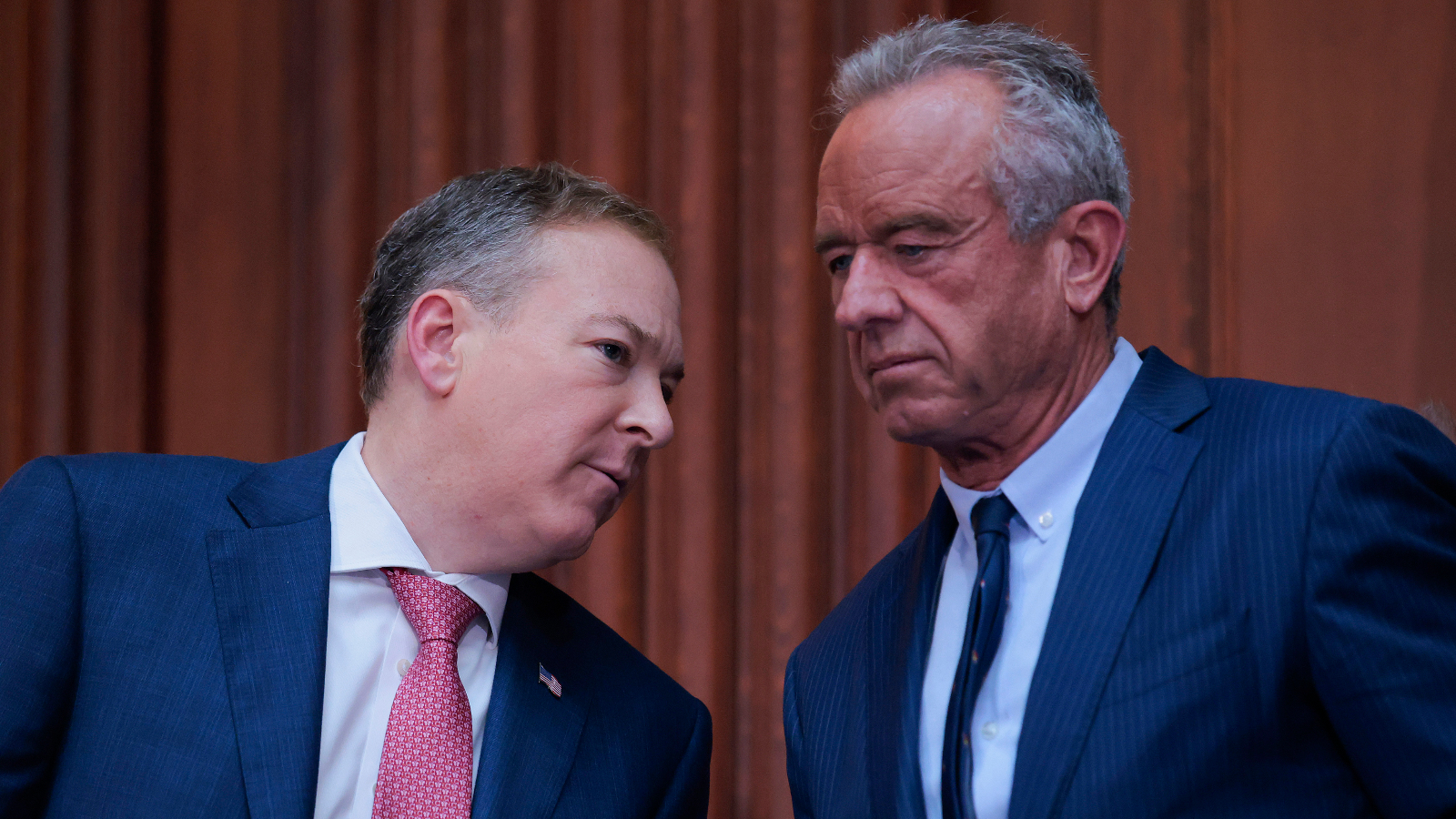
Donald Trump and Ted Cruz. Photos: Texas Tribune
President Donald Trump revealed over the weekend that he is mulling a deal that would end his war with Iran, and some hawks within the Republican Party are expressing alarm.
According to a Sunday report in The New York Times, many details of the agreement to end the war remain murky, with the fate of Iran’s enriched uranium up in the air. US and Iranian officials have also given contradictory messages about the proposed deal’s contents, suggesting there is much work still to be done before any agreement is finalized.
Regardless, three hawkish GOP senators on Saturday raised major concerns about the contents of the deal, warning against accepting any agreement that will leave Iran in a stronger position than before Trump launched a war against it in late February.
“If it is perceived in the region that a deal with Iran allows the regime to survive and become more powerful over time, we will have poured gasoline on the conflicts in Lebanon and Iraq,” wrote Sen. Lindsey Graham (R-SC), who lobbied Trump to attack Iran repeatedly before the start of the war. “A deal that is perceived to allow Iran to survive and possess the ability to control the [Strait of Hormuz] in the future will put Hezbollah in Lebanon and the Shia militias in Iraq on steroids.
Sen. Ted Cruz (R-Texas), another longtime Iran hawk, said he was “deeply concerned” about what he’s been hearing about the deal and expressed particular worry about Iran getting relief from US sanctions while still maintaining the ability to shut down the Strait of Hormuz.
“If the result of all that is to be an Iranian regime – still run by Islamists who chant ‘death to America’ – now receiving billions of dollars,” Cruz wrote, “being able to enrich uranium and develop nuclear weapons, and having effective control over the Strait of Hormuz, then that outcome would be a disastrous mistake.”
Sen. Roger Wicker (R-Miss.) was even blunter in his condemnation of the reported agreement.
“The rumored 60-day ceasefire – with the belief that Iran will ever engage in good faith – would be a disaster,” Wicker wrote. “Everything accomplished by Operation Epic Fury would be for naught!”
Ben Rhodes, a former deputy national security adviser for President Barack Obama, challenged Wicker’s claims that Trump’s war had achieved anything of value.
“Nothing was accomplished by Operation Epic Fury,” Rhodes wrote, “except putting the Islamic Revolutionary Guard Corps in charge of Iran and the Strait of Hormuz.”
Rhodes’ criticism was echoed by Stephen Wertheim, senior fellow at the Carnegie Endowment for International Peace, who wrote that “everything accomplished by Operation Epic Fury is already for naught.”
Ali Vaez, director of the Iran Project at the International Crisis Group, accused the Iran hawks of being delusional for thinking further bombing would force Iran to capitulate.
“DC’s Iran hawks got two wars, nearly every conceivable sanction designation, a blockade, threw a wrench in global economy,” Vaez wrote, “and will still claim that just a little more pressure and a touch more bombing will magically yield the concessions they still won’t be satisfied with.”
FACTBOX – Iranian, US versions of potential agreement proposals
Both the US and Iran have recently signaled progress on efforts to reach a deal to end their conflict, though their accounts of its terms differ on some issues across respective media narratives, Anadolu reports.
US President Donald Trump on Saturday said an agreement with Iran to end the war was “largely negotiated” and awaited finalization.
On Sunday morning, Iran’s semi-official Tasnim news agency also published a report on the details of a potential agreement. However, certain aspects of what has been agreed seem to diverge.
Here is a comparison of the US and Iranian versions of the deal by key issues.
Strait of Hormuz
Citing a US official, Axios said the deal that Washington and Tehran are close to signing would extend a ceasefire by 60 days, during which the Strait of Hormuz would be reopened.
During the 60-day period, the Strait of Hormuz would be opened without any tolls, and Iran would remove the mines it has placed there to ensure unrestricted maritime passage.
In return, Washington would lift its blockade on Iranian ports, added the report.
The New York Times also said it was informed by three senior Iranian officials that Tehran had agreed to a memorandum of understanding to halt fighting and reopen the Strait of Hormuz.
US Secretary of State Marco Rubio also said on Sunday that the agreement could, if successful, result in a “completely open” Strait of Hormuz, with no tolls or restrictions on passage.
“They don’t own it. It’s an international waterway,” Rubio told reporters of the strait, in remarks that came during his visit to India.
A report by Iran’s semi-official news agency Tasnim, however, said that the Strait of Hormuz will not fully return to its pre-war status if the agreement is reached.
Instead, the number of ships allowed to pass would be restored to pre-war levels within 30 days, the outlet added.
Tehran also demands an end to the US blockade on its ports, arguing that no changes will be made in the strait if the blockade remains in place.
For its part, the US argues that the quicker Iran removes the mines and allows shipping to resume, the sooner the blockade will be lifted.
READ: Iran ready to reassure world it is not pursuing nuclear weapons, president says
Sanctions relief and release of frozen Iranian assets
Iran was seeking the immediate unfreezing of funds and a permanent lifting of sanctions, but the US position indicates these measures would only be granted after Iran made concrete concessions, according to the Axios report.
As part of the proposed 60-day agreement, the US is offering temporary sanctions waivers that would allow Iran to sell its oil freely. These waivers are explicitly linked to Iran reopening the Strait of Hormuz, removing mines, and ending restrictions on maritime traffic. Once these steps are taken, Washington would also lift its naval blockade on Iranian ports.
Tehran, however, says no agreement will be reached unless at least a portion of the frozen Iranian assets is released immediately. Iranian media confirmed the discussion of temporary oil sanctions waivers in the latest US proposal but insisted on broader and more permanent sanctions relief.
Nuclear file
The Axios report said the draft deal includes commitments from Iran not to pursue nuclear weapons, along with provisions to negotiate a suspension of uranium enrichment and the removal of its stockpile of highly enriched uranium.
The Iranian media reports, however, indicate that Tehran has not yet accepted anything on its nuclear program.
A potential deal would involve a 60-day negotiation window on Iran’s nuclear program, according to Tasnim.
Extent of ceasefire
Both US and Iranian media reports suggest that the cessation of hostilities would mean a halt to fighting on all fronts, including Lebanon.
This was also highlighted by Iranian Foreign Ministry spokesman Esmaeil Baqaei on Saturday, when he said Tehran was prioritizing an end to hostilities across all fronts, including Lebanon.
Context
Regional tensions have escalated since the US and Israel launched strikes against Iran in February. Tehran retaliated with strikes targeting Israel, as well as US allies in the Gulf, along with the closure of the Strait of Hormuz.
A ceasefire took effect on April 8 through Pakistani mediation and was later extended by Trump indefinitely. Washington and Tehran also held rare direct talks in the Pakistani capital Islamabad on April 11-12, but have failed to reach an agreement.
Trump’s Saturday remarks came after Pakistani army chief Asim Munir’s visit to Tehran. The visit was the second of its kind in recent weeks, as Munir is directly involved in Islamabad’s mediation efforts.
READ: Trump says Iran talks ‘constructive’ but blockade will remain until final deal is reached
Hawaiʻi has some of the freshest air in the nation, but in some parts of the state hazy skies can impact tourism and public health.
Now, the U.S. Environmental Protection Agency has pumped the brakes on a multi-decade effort to improve visibility and reduce fine particulates and other man-made pollutants.
On May 15, the agency announced it had partially denied Hawaiʻi’s 2024 Regional Haze State Implementation Plan, a detailed proposal that lays out the state’s intention to comply with the federal Clean Air Act. The plan was designed specifically to reduce haze in two iconic places: Hawaiʻi Volcanoes National Park on the Big Island and Haleakalā National Park on Maui.
Because the two parks are designated as Class I under the Clean Air Act, their air quality is legally entitled to the highest level of protection.
Although the EPA is leaving some aspects of the haze plan intact, it is jettisoning its main thrust: the state’s long-term strategy, which included shutting down at least two of Hawaiian Electric Co.’s oil-fired electricity generating units in the Kanoelehua-Hill and Kahului power plants by 2028. The units are the dinosaurs of the industry; the Kahului unit was commissioned in 1948.
The agency referred to the closures as “unconsented” and said in a press release that they could make Hawaiʻi’s grid less reliable and “violate the Takings Clause of the U.S. Constitution for the taking of private property without just compensation.”
Determining to what degree natural and man-made emissions contribute to the overall air quality in the region requires a series of complex, evolving math equations. Erin Nolan / Civil Beat
The decision isn’t the first of its kind for the agency; in Colorado, it rejected a similar plan that involved closing a coal plant. But it is one of the first from the current EPA to impact Hawaiʻi, and part of a larger plan by EPA Administrator Lee Zeldin to execute on President Donald Trump’s executive orders to promote what he calls “energy dominance.”
“This is one of the biggest bombs to drop in Hawaiʻi so far from the EPA,” Isaac Moriwake, managing attorney of Earthjustice’s mid-Pacific office, told Civil Beat.
Earthjustice is part of a group of 10 national environmental advocacy groups, which also includes the National Parks Conservation Association, Natural Resources Defense Council, and Center for Biological Diversity, to respond to the decision, saying it will harm Hawaiʻi communities and result in dirtier air in the parks.
Mike DeCaprio, vice president of power supply at HECO, describes the situation as a trade-off. He said the company still plans to retire the aging plants. But to do so by the end of 2028, DiCaprio said more biofuel plants and more solar farms and battery storage have to first come online.
“We felt that having a contingency to run these units longer if needed was in our interest, and in our customers’ interest, so that we don’t end up in a grid reliability issue,” he said.
“Reliability on an island grid is a really tough issue, right? They’re very small grids. With size comes stability, and they don’t have size,” DeCaprio said. “Making sure that the lights stay on is the most important part.”
Regulation or ‘total regulatory taking’?
In a detailed 67-page comment on an earlier draft of the EPA’s decision, the environmental advocates accused HECO of exploiting the Trump administration’s fossil fuel agenda.
The advocates asserted that the Clean Air Act was written in such a way that it already allowed for contingency plans if renewable energy wasn’t available. They also said that HECO had previously agreed to retire three of its oldest oil-fired generating units in the Hill, Kahului, and Māʻalaea plants after it was asked by the health department to submit a plan to upgrade the technology to improve air quality.
“HECO was the one coming to Department of Health and saying, ‘Hey, we will commit to shutting down these plants in lieu of having to spend all kinds of money, which the ratepayers are going to pay for at the end of the day, to upgrade these plants to try to clean them up. It’s cheaper, it’s more reliable, it’s more affordable for our ratepayers to just shut them down,’” Moriwake said.
Then, last August, Karin Kimura, director of the environmental division at HECO, sent a letter to the EPA’s regional administrator saying the company had been “forced under the SIP to accept enforceable retirement deadlines.”
Read Next
Kimura said the retirement deadlines were no longer viable because of “actual or potential cancellations and delays” in renewable energy sources coming online to replace the power plants. Those projects had slowed down due to permitting challenges, changes in tax incentives and supply chain changes, she added.
“Following this notification, Hawaii … needed to provide assurances that EPA’s approval of the unconsented source closure would not amount to a taking without just compensation under the Takings Clause of the U.S. Constitution,” the EPA press office told Civil Beat in an emailed statement. “Hawaii did not provide such assurances, and EPA was therefore required to partially disapprove the state’s long-term strategy.”
The haze plan process had been overseen by the Department of Health, but HECO sent the letter without the Department of Health’s involvement.
The health department did not respond to a request for comment from Civil Beat but it noted this omission in its own letter to the EPA in April — once it was clear that the EPA was responding to HECOs request by shutting down the plan. In it, the state’s director of health, Kenneth Fink, said the EPA’s response was “not consistent with the purpose of Clean Air Act Section 169A which was enacted to protect visibility in national parks and wilderness areas” and “directly conflicts with EPA’s previous guidance” for developing such plans.
The company also has already signaled it is raising its customers’ rates, in part to compensate for the plant closures, Moriwake noted.
“HECO has a pending request right now,” he said. “It’s sitting in front of the PUC to increase customer rates by $45 million a year for this purpose.”
Read Next
Jeff Mikulina, executive director of Climate Hawai‘i, acknowledged that renewable energy in Hawaiʻi is facing headwinds, thanks in large part to the Trump administration’s tariffs and choice to cut tax credits and other federal support. But he believes Hawaiʻi will continue to lead on renewables. And he’s particularly optimistic about what’s happening on Kauaʻi, where local lawmakers just approved twonew solar-and-storage projects that could get them to 90 percent renewable energy by 2030.
“It’s important to look at the long-term signal as opposed to the near-term noise, and that long-term signal tells us that this technology is getting cheaper by the day, particularly energy storage, which is really that secret sauce that’s going to allow us to achieve our 100 percent renewable energy future.”
In its email, the EPA press office said it is “committed to working with the state of Hawaii to revise the SIP, in order to both follow the law and achieve clean air for all in the state.”
And yet the legal argument that the agency is using to justify its move away from a haze rule with teeth concerns the environmental advocates as much, if not more, than this one decision. In its legal rationale, the federal agency argued that the haze plan would unfairly restrict HECO’s use of its private property, in what it called “a total regulatory taking.”
“By asserting that the retirement deadlines in the 2024 SIP are now ‘forced,’ EPA opens a massive loophole in the Act’s requirements, allowing facilities to entirely evade compliance with the Regional Haze Program,” they wrote in their comments in April. They say they are concerned that the agency could dismantle other parts of the Clean Air Act, such as the National Ambient Air Quality Standards Program.
“They are signaling that they want to overhaul this entire regulatory scheme,” Moriwake said.
Not to be confused with vog
When the Kīlauea volcano is erupting, vog — volcanic smog — adds sulfur dioxide and fine particulate matter to the air, particularly on the southern side of Hawaiʻi island. The Hawaiʻi Department of Health warns that even brief exposure can cause shortness of breath, chest tightness, and other respiratory problems.
Power plants and other industrial facilities — such as the Mauna Loa processing facility named in the state’s 2024 SIP — also emit sulfur dioxide as well as nitrogen oxides, which has been shown to aggravate lung and heart conditions.
Determining to what degree these natural and man-made emissions contribute to the overall air quality in the region requires a series of complex, evolving math equations. EPAs under previous administrations have used specific tools to calculate the region’s “natural visibility conditions” while accounting for episodic volcanic events.
But when the current EPA proposed its disapproval of the haze rule in February, it asserted that no methodology “has been developed that is able to fully screen out the volcanic impacts and thus isolate the visibility impairment caused by anthropogenic air pollution.”
The environmental groups disagree. In their comments they called the agency’s assertions “arbitrary and capricious.”
Civil Beat’s coverage of climate change and the environment is supported by The Healy Foundation, the Marisla Fund of the Hawai‘i Community Foundation, and the Frost Family Foundation.
Pakistan’s Federal Shariat Court Rules Decriminalization of Attempted Suicide Contrary to Islamic Law
Pakistan’s Federal Shariat Court has declared the legislation decriminalizing attempted suicide is contrary to Islamic principles and has struck it down.
The Federal Shariat Court issued the ruling in response to the various petitions filed against the legislation passed by Parliament.
In 2022, the National Assembly amended the Pakistan Penal Code, removing attempted suicide from the list of criminal offenses. Under the legislation, no legal action was to be taken against a person attempting suicide.
In its ruling, the Federal Shariat Court said it is the state’s responsibility to protect the lives of citizens and noted that attempted suicide had previously been treated as a criminal offense in order to discourage people from taking such a step and to deter them through the fear of legal action.
According to the court, there is no justification for repealing this law solely on the basis of mental illness.
During the hearing, the government presented data from the World Health Organization, according to which millions of people worldwide die by suicide every year, and the primary cause is mental illness.
The federal government took the position that the primary objective of the legislation concerning attempted suicide was to acknowledge that individuals who attempt suicide are often suffering from psychological distress or mental illness.
The federal government further stated that since a person attempting suicide is themselves a victim, the issue should be treated as a health matter rather than a legal one, and no criminal action should be taken against them.
It was further argued that individuals in such situations are often under mental, financial, and social pressure, and should therefore receive treatment rather than punishment.
By contrast, the Federal Shariat Court argued that the causes of suicide or attempted suicide are not limited to mental illness or psychological stress alone.
They may also include suicide attempts carried out for the purpose of terrorism, hunger strikes for political or financial gain, setting oneself on fire in public by dousing oneself with kerosene oil, and in some cases, suicide attempts influenced by the internet or mobile applications.
According to the court, the circumstances of each person who attempts suicide are different; however, it is not appropriate to decriminalize all suicide attempts regardless of the cause.
The court stated that the Constitution of Pakistan already provides a mechanism for relief for individuals who suffer from mental impairments.
The Federal Shariat Court also sought a reference from the Council of Islamic Ideology, which stated that suicide is a severe sin and must be discouraged.
Tanzeela Javed, an Islamabad-based clinical psychiatrist, told The Media Line, “In most cases, attempted suicide is associated with treatable mental health conditions such as depression, anxiety disorders, trauma-related disorders, or acute psychosocial stressors like financial hardship or relationship breakdown.”
She further said, “Prevention strategies are never purely medical; they also require social support systems, crisis services, and responsible public policy. The most effective frameworks internationally tend to treat suicide prevention as a public health priority while still ensuring appropriate safeguards in exceptional contexts”.
Javed stressed, “Ultimately, the clinical goal is not punishment, but risk reduction, treatment access, and preservation of life through early and non-judgmental intervention.”
A mother-of-two’s dream birthday climb turned into a nightmare when she plunged 2,000 feet down one of Chile’s most feared volcanoes after posting a haunting final message about her “uncertainty” over what was about to happen.
Ingrid Daniela Vera Figueroa was celebrating her 42nd birthday with a daring climb up the Llaima volcano in Chile’s Conguillío National Park when disaster struck.
What began as a once-in-a-lifetime birthday adventure ended with her friends watching in horror as she lost her balance and fell down a steep ravine.
According to reports, Figueroa had been taking photos during the climb when she let go of her ice pick, slipped, and vanished down the mountainside.
The fall was catastrophic.
Her friends immediately called for help, but the rescue mission quickly turned into a desperate race against brutal mountain weather.
Strong winds reportedly stopped a rescue helicopter from reaching the scene, leaving crews unable to recover her body until the next morning.
By Sunday evening, the devastating news was confirmed.
Figueroa, a school governor and devoted mother of two, was dead.
Just hours earlier, she had posted a birthday message that now reads like a chilling farewell.
“It’s three in the morning, and we’re finishing packing our backpacks to ascend Llaima,” she wrote on social media.
“I hope God accompanies me on this wonderful day, on which I’m turning 42 and am super happy.”
Then came the eerie line that has left so many people shaken.
“Yes, I have a little uncertainty about what’s going to happen,” she admitted.
Those words would become tragically prophetic.
The experienced climber had set out with friends for what should have been a joyful birthday challenge. Instead, the celebration ended in horror on the slopes of one of Chile’s most active and dangerous volcanoes.
Emergency crews, police, firefighters, volunteers, and officials from Chile’s National Forest Corporation, known as Conaf, later joined together to recover her remains.
The mission was made even more difficult by freezing temperatures and punishing high-altitude conditions.
Conaf director Héctor Tillería said the group had not registered with park authorities before beginning the climb, which went against safety protocol.
Officials are now warning other hikers not to take the mountain lightly.
The Llaima volcano towers more than 9,800 feet and is considered one of the toughest climbing challenges in southern Chile. The route usually begins at the Las Araucarias ski resort and can take seven to eight grueling hours to complete.
It is beautiful, but unforgiving.
For Figueroa’s loved ones, the tragedy has been crushing.
At Alexander Graham Bell School in Villarrica City, where she served as a school governor, she was remembered as a “responsible, kind, committed” mother.
The school community offered condolences to her husband, her two children, her family, and her friends as grief spread through the area.
Figueroa was no stranger to the mountains. She had climbed several peaks in the region and was known for her love of adventure.
But on her 42nd birthday, the mountain she hoped to conquer became the place where her life came to a sudden and terrifying end.
Authorities are still investigating the exact circumstances of the deadly fall.
The horror on Llaima comes after a string of terrifying volcano tragedies.
Last year, an Argentinian tourist went missing for several hours while trying to climb the same Chilean mountain in extreme conditions before being rescued.
Another haunting case involved Brazilian traveler Juliana Marins, 26, who fell nearly 2,000 feet from Mount Rinjani, an active volcano in Indonesia, and was trapped for days before dying.
Her body was later found beside a crater after rescue crews used a thermal drone during a brutal search through dangerous terrain.
Now, Figueroa’s final birthday post has become the heartbreaking detail her loved ones may never forget.
EU Commission chief welcomes progress toward US-Iran deal
European Commission President Ursula von der Leyen on Sunday welcomed progress toward a possible agreement between the US and Iran, stressing the need for a deal that would reduce tensions and prevent further escalation in the region, Anadolu reports.
“I welcome the progress towards an agreement between the US and Iran. We need a deal that truly de-escalates the conflict, reopens the Strait of Hormuz and guarantees toll free full freedom of navigation,” von der Leyen said through the US social media company X.
She reiterated that Iran “must not be allowed to develop a nuclear weapon” and called on Tehran to end actions she described as “destabilizing in the region, directly or through proxies, as well as its unjustified and repeated attacks on its neighbours.”
“Europe will continue working with international partners to seize this moment for a lasting diplomatic solution. And to contain the spillover of this conflict, notably on supply chains and energy prices,” von der Leyen wrote.
After a call with regional leaders, US President Donald Trump on Saturday said an agreement with Iran to end the war that began on Feb. 28 and led to the de facto closure of the strait was “largely negotiated” and awaited finalization.
READ: US, Iran near 60-day ceasefire deal to reopen Strait of Hormuz
Whatever the mirror test tells us, beluga whales pass it
In hours of underwater video footage from a New York aquarium, a beluga whale named Natasha stretches her neck, pirouettes, nods, and shakes her head in front of a two-way mirror. Her daughter Maris does much the same. According to a new study published in PLOS One, both animals show the behavioral hallmarks of mirror self-recognition—a cognitive ability long considered a marker of self-awareness, and one that had never before been documented in beluga whales.
If the result holds up, belugas join a remarkably short list. The mirror self-recognition test (MSR) has been passed, with varying degrees of confidence, by humans (starting around age two), a handful of great apes (chimps, bonobos, orangutans, and—somewhat contentiously—gorillas), Asian elephants, bottlenose dolphins, probably magpies, possibly orcas, and, if you can believe it, a cleaner wrasse. That’s it. No dogs, no cats, no monkeys. Plenty of species we had assumed were self-aware have been tested and failed.
Looking at the mirror
So what is this test, exactly, and what is it supposed to tell us?
The procedure is this: While the animal isn’t looking, researchers place a mark on a spot it can only see via a reflection. A mirror is then put in front of the animal while the researchers watch. If the animal touches or examines the mark while looking at its reflection, it comprehends that the figure in the mirror is itself. The test is intuitive and easy to perform—and almost no species passes.
Why is this a test of self-awareness in the first place? The logic, going back to the psychologist Gordon Gallup (who invented the test in 1970), is that to use a mirror as a tool for inspecting your own body, you need a mental representation of yourself as a distinct entity. A piece of silvered glass, in this telling, can pry open a lot of cognitive doors.
Gallup himself is a tough grader. Plenty of positive results have been announced over the decades, and he’s pushed back on most of them. If an animal doesn’t show clear self-directed behavior—actively trying to touch or examine the mark—the test, in his view, fails. On that score, the beluga results sit right at the edge.
Revisiting old data
The footage is more than two decades old. “After the initial study we were hoping to conduct more studies with additional belugas over the next years but that was not possible,” senior author Diana Reiss said in an email. “Inspired by the numerous studies over the past years reporting on different aspects of beluga whale cognition and behavior, we decided to revisit and digitize the original videotapes and conduct a rigorous analysis.” Some tapes had degraded in the meantime, and portions of the original data were lost.
The original experiment exposed four belugas to the mirror together, in their usual social housing. Only Natasha and Maris showed sustained interest, so only they advanced to the experimental phase, where they were marked with waterproof lipstick during feeding sessions. Because the animals were awake and could feel the application, the researchers ran sham-mark controls: the same procedure, but without the pigment. The whales only showed self-recognition-like behaviors after being actually marked.
“The two beluga whales showed the same progression of behavioral stages reported for other species that show evidence of MSR,” first author Alexander Mildener said in an email. “The whales did not exhibit self-directed behaviors in the absence of the mirror or in the control condition. One of the whales also passed the mark test by demonstrating mark-directed behavior by orienting the area of her body that was temporarily marked toward the mirror.”
The sample is tiny, but that’s not unusual—if even a single animal can do something, the species is in principle capable of it. The harder question is whether what Natasha and Maris did really counts. Some of the most-cited behaviors—bubble bite play, barrel rolls—are documented forms of solo play that belugas engage in even without a mirror nearby. Their increased time spent at the reflective surface is suggestive, but doesn’t rule out the possibility that the mirror was just a novel source of stimulation.
The one genuinely mark-directed behavior came from Natasha, who repeatedly pressed the marked area—behind her right ear—against the mirror. Without arms, she couldn’t point. It’s the strongest data point in the study, but a softer kind of evidence than a chimp or an elephant typically delivers.
Even granting that belugas pass—and given that dolphins do, and orcas plausibly do too, it wouldn’t be a shock—the more interesting question is what a result like this tells us. Or, conversely: What does failing actually mean? One of the most persistent criticisms is that many animals fail simply because mirrors carry little relevance in their perceptual world. Anil Seth, a neuroscientist at the University of Sussex, told Ars in an email that “the MSR is not a test of consciousness itself, but a test of a particular kind of the ability to recognize one’s own body (or face). Failure to reliably pass the MSR does not mean that an animal lacks consciousness, or any form of selfhood.”
The test, he added, is motivated by what feels natural to humans. “It may well not feel natural to other species, even if they have the same kind of ability,” He said. “This raises various other reasons why animals might ‘fail’ the test: they may not like making eye contact, they might not like mirrors, or they simply just might not care enough about a very strange task.”
Seth has argued that consciousness may be something like an integrated experience of our perceptions, broadly construed—a view consistent with the increasingly mainstream idea that consciousness exists in degrees and forms across many species. If perceptions are central to the sense of self, that sense will look different depending on how each animal perceives the world. Humans are heavily visual; bats lean on echolocation; for dogs, smell is everything. That’s why researchers like Alexandra Horowitz, who heads the Dog Cognition Lab at Barnard College, have been working on an olfactory version of the test.
From the opposite direction come critics who argue the test fails to measure self-awareness even when an animal passes it. That’s the position of Alex Jordan, an evolutionary biologist at the Max Planck Institute of Animal Behavior in Germany and co-author of the PLOS Biology studies on the cleaner wrasse. The wrasse passes the mirror test, Jordan says—but that doesn’t necessarily mean the fish is self-aware. The test was designed around us, and suffers from both anthropocentrism (treating humans as the yardstick) and anthropomorphism (projecting human traits onto other animals).
The mirror test, then, has problems from every angle. As Seth put it in his email: “When looking for evidence of consciousness or selfhood, it’s important to complement tests like the MSR with other tests”—ones that take into account what might be salient in a particular animal’s own perceptual world. And yet the MSR remains one of the few tools we have for trying to glimpse inside the minds of other animals—and, perhaps, our own. The trick is knowing exactly what it can, and can’t, tell us.
Judge Sanctioned Private Prison Giant for Destroying Evidence in ICE Death Suit
A judge Issued what appears to be the first-ever sanction against the private prison giant CoreCivic for destroying video evidence in a case alleging wrongful death of a man who died by suicide in U.S. Immigration and Customs Enforcement custody.
The sanction came shortly before a trial was slated to begin in January, but it never got underway. Instead, in March, the company reached an undisclosed settlement with the family of the detainee.
The judge ordered what is known as an adverse inference against the company in a December hearing. That means the jury could have presumed the missing evidence was unfavorable in an eventual trial and therefore effectively imposed a penalty against CoreCivic.
“CoreCivic is essentially used to getting away with it — to not getting called on it.”
The previously unreported sanction is the first known incident of a private prison corporation being held responsible in a wrongful death lawsuit for destroying video or other evidence related to immigration detainees dying in custody — despite there being cases of such behavior stretching back nearly a decade, experts said. (Neither CoreCivic nor ICE responded to requests for comment.)
Rebecca Sheff, senior staff attorney of ACLU New Mexico and part of plaintiffs’ legal team, told The Intercept that the judge’s sanction was an important response to prison companies’ propensity for overwriting video evidence. In court, destroying evidence is considered “spoliation,” the legal term for destroying, altering or failing to preserve evidence.
“It’s a practice we documented and unearthed: CoreCivic routinely lets video evidence be overwritten,” Sheff said, “even in this case, where they’ve been put on notice.”
“CoreCivic is essentially used to getting away with it — to not getting called on it,” Sheff added.
Immigration attorney Laboni Hoq, who was not involved in the CoreCivic case but has pursued similar sanctions in a wrongful death case involving the prison corporation GEO Group, said, “There has to be accountability when there are knowable consequences and prison corporations flout their responsibilities to preserve evidence.”
14 of 15 Cameras
The CoreCivic case revolved around the detention of Kesley Vial, a 23-year-old Brazilian asylum-seeker who died in a hospital on August 24, 2022, seven days after attempting suicide at the CoreCivic-owned Torrance County Detention Facility in Estancia, New Mexico.
Attorneys for Vial’s family sent CoreCivic a letter on the day he died, demanding preservation of all records relevant to his suicide attempt, including video footage taken in Vial’s cell, adjacent areas, rooms, and anywhere relevant to the incident. (Vial’s family declined to comment for this story.)
In the weeks that followed, a CoreCivic investigator produced a report featuring 49 stills taken from video footage, laying out a timeline supporting the company’s contention that it bore no responsibility for Vial’s death.
CoreCivic, however, never produced the actual video footage underlying 37 of the 49 photos, according to Sheff’s courtroom testimony. In fact, the company destroyed footage from 14 of 15 cameras in use that day, Sheff testified. The company claimed to have taped over the material.
“CoreCivic says that their staff had no way of knowing that Kesley Vial was on the verge of taking his own life on August 17th of 2022,” Sheff told Judge Francis J. Mathew during a December pre-trial hearing. “And when CoreCivic destroyed hours of video footage from that day, fully aware of the likelihood of litigation, they deprived the jury and all of us of the chance to see for ourselves.”
“More than three years later, we still have no convincing explanation for this destruction of evidence,” Sheff added.
The company pointed the judge to its 49-page timeline.
“More than three years later, we still have no convincing explanation for this destruction of evidence.”
“I know of no situation where opposing parties get to tell the opposed that what they have is the important information,” Mathew replied, according to an audio recording of the proceedings obtained by The Intercept.
The company’s attorney responded, “The jury will have all the evidence they need to determine whether or not CoreCivic fell below their duty.”
The judge said, “That’s a question I’m not sure we can answer without that video.”
In slightly less than an hour, Mathew made up his mind.
“I do believe that the spoliation of this evidence merits a sanction,” he said, “an adverse inference instruction to the jury.”
Within weeks of the judge’s decision, CoreCivic began settlement discussions with Vial’s family for an undisclosed amount. ACLU New Mexico announced the settlement March 19.
The judge’s order may have factored into the company’s decision to forgo a trial, which was set to start in January, said Eunice Cho, an immigration attorney with expertise in detention conditions.
“The fact defendants settled in the 11th hour made it clear they potentially didn’t want relevant facts to be tried – including the adverse inference,” Cho told The Intercept. “An adverse finding could lead the court to instruct the jury that the evidence contained unfavorable information and may damage the witness’s credibility.”
Hours Before the Suicide
In Vial’s case, the missing footage would have shown key events in the hours before he attempted to take his own life — “including him crying so hard that he was having trouble walking, punching the wall and collapsing to the floor,” according to a September plaintiff’s motion seeking sanctions against CoreCivic.
“There’s no substitute for seeing how he was behaving, how medical staff and officers were behaving, at Mental Health, in the hallway, in the cell – all these consequential, pivotal moments – and what could’ve been done to protect him,” Sheff told The Intercept.
Whereas Vial’s case came to a relatively quick end, lawsuits in which judges don’t intervene can become drawn out. Many families of loved ones who have died in immigration detention are stymied by the lack of video evidence and by the amount of time it can take to resolve a wrongful death lawsuit against an immigration detention corporation, said Jeremy Jong, immigration attorney for Al Otro Lado, a legal rights organization.
“They begin thinking, ‘We want justice,’” Jong said. “Years later, it’s more like, ‘We just want to give up.’”
Even when private prison firms are forced to pay out, the sums pale in comparison with the companies’ government contracts. Jong said the disparity creates “perverse incentives” to let poor detention conditions persist, with the settlements acting as “just part of their operating expenses.”
CoreCivic — which, alongside GEO Group, is one of the two largest prison corporations in the U.S. — received $2.2 billion in revenue last year, up from $2 billion the year before.
The issue will only become more important as the Trump administration pursues its mass deportation push, leading to more deaths in detention: 18 this year as of May 1, on track to reach a record high.
With the rising number of deaths, Hoq finds herself advising attorneys and families who contact her regarding wrongful death claims.
“The first piece of advice I give them is to send a letter to the corporation requesting them to immediately stop overwriting video,” she said. “The issue is more important than ever — to scrutinize whether ICE and prison corporations are following through on their obligation to preserve evidence.”
Prime Minister Benjamin Netanyahu will convene a limited security cabinet meeting Sunday evening to discuss the emerging US-Iran agreement, amid Israeli concerns over provisions in the proposed memorandum of understanding that would halt fighting with Hezbollah and delay detailed nuclear negotiations.
An aide to one of the ministers attending the meeting confirmed the gathering to The Times of Israel, adding that a time had not yet been set.
According to Kan, Netanyahu is concerned about at least two elements of the proposed arrangement: a requirement to end military operations against Lebanon and the postponement of substantive discussions regarding Iran’s nuclear program until a second phase of negotiations.
The memorandum of understanding under discussion would extend the ceasefire for 60 days and require Iran to reopen the Strait of Hormuz, while the United States would end its naval blockade. During the 60-day period, the US would discuss lifting sanctions against Iran, while American troops would remain in the region until negotiations conclude.
Fighting between Israel and Hezbollah would be halted according to the agreement, although Israel would retain the ability to respond militarily if Hezbollah launches attacks.
Israel was not included in Saturday’s “phone summit” involving the United States and leaders from Saudi Arabia, Qatar, the UAE, Bahrain, Kuwait, Oman, Egypt, Jordan, and Turkey regarding the updated memorandum of understanding. Reuters reported that Pakistan also participated in the call.
Israeli broadcaster N12 reported that Netanyahu believes the proposal could be unfavorable to Israel. An Israeli official cited in the report said US special envoy Steve Witkoff strongly supported the agreement and “wants a deal at almost any price, and is placing immense pressure on Trump not to resume the war.”
Two American officials told The New York Times that Iran had agreed as part of the developing arrangement to relinquish its stockpile of highly enriched uranium.
According to the report, the proposal does not specify how Tehran would surrender the material, and discussions on implementation were postponed to the next round of nuclear talks.
The report said Iran initially resisted including uranium provisions in the first stage of the agreement, but American officials conveyed through intermediaries that military operations would resume without such an understanding.
AI put “synthetic quotes” in his book. But this author wants to keep using it.
Journalist and author Steven Rosenbaum has more reasons than most to distrust AI.
His new book, The Future of Truth: How AI Reshapes Reality, is all about “how Truth is being bent, blurred, and synthesized” thanks to the “pressure of fast-moving, profit-driven AI.” Yet a New York Times investigation this week found what Rosenbaum now acknowledges are “a handful of improperly attributed or synthetic quotes” linked to his use of AI tools while researching the book.
These quotes include one that tech reporter Kara Swisher told the Times she “never said” and another that Northeastern University professor Lisa Feldman Barrett said “don’t appear in [my] book, and they are also wrong.” Rosenbaum is now working with editors on what he says is a full “citation audit” that will correct future editions.
Speaking to Ars in the wake of the controversy, Rosenbaum says he “learned a lesson” and is “going to be much more suspicious” and “reticent to trust” AI outputs going forward.
But he also can’t tear himself away from the tools. Rather amazingly, Rosenbaum is not interested in going back to the AI-free research process he used to write previous books.
“The idea of taking X years off [from AI] while it sorts itself out, and going back to, like, Microsoft Word … it’s just not in my nature,” he told Ars. “[AI] is magical. Because it connects, it knits together ideas and gives you pathways to think about things that you’re not going to come up with on your own.”
It’s also magical in another way: Like J.R.R. Tolkien’s One Ring, AI convinces many of those who use it that they can control its power properly. But can they?
Slipping through the cracks
Rosenbaum used AI tools during his writing process, he told me, “to surface ideas, locate articles, summarize themes, identify people or papers I might want to look into.” He draws a hard line between this kind of research and the “actual reporting, narrative structure, interviews, arguments, and conclusions in the book,” which he says are “entirely mine… There was never a time when AI was writing the book.”
In addition to chapters based on transcribed interviews that Rosenbaum says he conducted himself, The Future of Truth also includes more research-based chapters in which Rosenbaum said, “We’re pulling facts and then knitting them together into a narrative.” Tools like OpenAI’s ChatGPT and Anthropic’s Claude were used heavily to gather information, he said, with any nuggets mined by those tools tagged with a “this came from AI” warning in his notes.
It’s strangely creative and crafty and unusual in all these ways … and then it betrays you in ways that are just really quite horrible.
Steven Rosenbaum
Those tagged AI-generated notes were then passed on to a fact-checker and two copy editors provided by the publisher, Rosenbaum said. Of the 285 outside citations in the book, six have been identified by the Times as problematic, including three so-called “synthetic quotes” that have no apparent source. (More examples could turn up as the book undergoes further review. And it’s worth noting that most writers manage to include zero made-up quotes when they write a book.)
“I think we did that [double-checking] incredibly effectively, but not a hundred percent,” Rosenbaum told Ars. “We’re doing the work, we’re doing the best we can. We look at it, it looks right. We double-check it, and then we made a mistake.”
But the significant failure here highlights how the traditional fact-checking process might be ill-equipped to handle AI-assisted research. In the past, a fact-checker could be reasonably confident that any author quoting cited written works had simply copied down those quotes directly. These quotes would need to be checked, of course, but the fact that they’re so easy to verify makes them less inherently suspicious. If AI tools are involved anywhere in the pipeline, though, that assumption goes out the window, and there needs to be an extra layer of skepticism that those quotes had been copied correctly or that they even exist at all.
The widespread adoption of AI tools among writers of all stripes also comes at a time when financially pressured newsrooms and publishers are increasingly cutting copy editors and fact-checkers from their workflows. We’ve seen how AI-generated errors like this can make it into a published book even with a fact-checking layer. The risk of using those tools only increases for the many books that never go through any fact-checking before publication.
Rosenbaum, for his part, agreed that “publishers are going to need new verification workflows designed specifically for AI-era research. That probably includes mandatory source tracing for quotations, better provenance tracking, clearer standards around AI-assisted research, and potentially (more irony here) AI tools that audit citations against primary materials.”
“I didn’t set out to fabricate anything,” Rosenbaum continued. “What happened is what increasingly happens to journalists, students, researchers, lawyers, and authors working with these systems every day: [There was] AI-generated information that looked authoritative, and some of it made its way too far downstream before being caught.”
Ars itself is not immune to this problem. Earlier this year, we retracted an article after a former reporter used an AI tool designed to extract verbatim quotes from a source’s blog post—but the tool instead generated fabricated versions of what the source actually wrote. (The latest version of our AI policy can be found here.)
The irony of an author incorporating AI-generated falsehoods into a book on AI’s reality-skewing effects is not lost on Rosenbaum. “I appreciate the book getting some attention, but this would not have been my choice about how to get it,” he said.
While that irony is “uncomfortable,” he’s quick to spin it as “also instructive. The fact that someone writing critically about AI and verification could still encounter these failures tells you how pervasive and persuasive these systems have become.” Rosenbaum’s own issue with AI “demonstrates the problem more vividly than any abstract argument could,” he said.
Perhaps. But if we accept this take, every avoidably obvious mess in the world might be a disguised good because it really helps illuminate the huge mistake. And that can’t be right; sometimes “negligence” is just that.
When asked directly how he could succumb to some of the AI-related problems his own book warns about, Rosenbaum described what sounds like a dysfunctional relationship with a charming charlatan.
“As a writer, AI is often a delightful writing companion,” Rosenbaum told me. “When I say ‘writing companion,’ I don’t use that lightly. It’s strangely creative and crafty and unusual in all these ways… and then it betrays you in ways that are just really quite horrible.”
Throughout our conversation, Rosenbaum frequently cited examples in which obvious AI errors left him enraged and literally cursing at the machine. Those date back to 2022, when Rosenbaum said he started experimenting with AI tools for “little research projects.” At the time, he found AI answers “spectacularly useful” about 8 out of 10 times, with the remainder being confabulations that were “just not true.”
Despite these errors, he kept using the tools in his life and work. When we talked on Tuesday, Rosenbaum said he had recently asked an AI tool to extract his “no changes, verbatim” speaker’s notes out of a slide deck so he could use them for an upcoming presentation. He was about to print those extracted notes when he realized that the LLM had actually rewritten his words despite his “very clear instructions for the robot.”
“And I say to it, ‘Did you rewrite the words?’ And it says, ‘Well, I just made the language a little stronger.’ Well, pardon me, but like, fuck you!” he said.
Even in the face of these kinds of profanity-inducing errors, though, Rosenbaum still believes that AI tools are too efficient not to use.
“The deck was 100 pages,” Rosenbaum said. “To cut and paste page by page, the text from each page would have been an hour’s worth of work, of mindless cutting and pasting. ChatGPT did it in about four seconds.”
To which the obvious retort might be: Yes, it was fast.
But it was also wrong.
Getting off the motorcycle
The efficiency gains might be worth it when the only stakes are personal presentation notes. But The Future of Truth shows how the balance between AI’s reliability and apparent speed should be weighed very differently when it comes to research that ends up in a published book.
As we continued our conversation, I kept coming back to that accuracy/efficiency trade-off, which Rosenbaum seemed to recognize as a problem at some level. Even as he called AI’s research help “magical” and “delightful,” he described dealing with AI’s confabulations and ignored directives as a “pernicious and exhausting” struggle.
“It leaves you… uncomfortable almost any time you’re using it,” he said of its tendency to ignore clear instructions.
“I’ve never fought with tech before this, honestly,” he said at another point. “And I use it extensively.”
I’ve never been in a place where I thought the tech that I was using was both intoxicating and dangerous…
Steven Rosenbaum
Given the issues with his new book, I asked if the risk of introducing inaccuracies that you might not catch was really worth the perceived benefits.
“I don’t do drugs, and I don’t drink, but I presume that that’s kind of the question an addict asks when they’re having one drink too many and they know they are,” Rosenbaum said. “I’ve never been in a place where I thought the tech that I was using was both intoxicating and dangerous. And I wrote the book specifically to raise that concern, so if I end up being the poster child of not being aware of the guardrails, so be it.”
At one point, when discussing the relative risks and rewards of using AI, Rosenbaum noted that he rides a bicycle but wouldn’t ride a motorcycle. “I know a motorcycle gets me places faster. I think it’s dangerous and I might die. And that’s why I don’t own a motorcycle,” he said.
Rosenbaum made it clear that using AI was the relatively safe “bicycle” option in this analogy. I responded that the supercharged efficiency and catastrophic risk inherent in using AI made it feel a bit more like the motorcycle. Rosenbaum said “that might be fair” and thanked me for “sharpening” his analogy.
I then asked the obvious question: Are you going to keep riding the motorcycle?