19.1 C
London
Saturday, May 23, 2026
Home Blog

How Xi Jinping is rewriting the rules of global power

0
how-xi-jinping-is-rewriting-the-rules-of-global-power
How Xi Jinping is rewriting the rules of global power

There is an old Chinese proverb that says the skilled hunter does not chase the rabbit — he positions himself where the rabbit must eventually run.

Xi Jinping, whatever his many critics may argue, has been extraordinarily patient. And now, in the span of a few remarkable weeks, both Vladimir Putin and Donald Trump have made their separate visit to Beijing.

The rabbit, it turns out, ran exactly where Xi expected. This is not coincidence. It is architecture.

The simultaneous gravitational pull that China is exerting on Washington and Moscow — two powers that nominally define opposing ends of the current global order — tells us something profound about where real geopolitical weight now sits. Beijing is no longer reacting to the international system. It is, with quiet deliberation, reshaping it.

When Moscow faces eastward

Putin’s visit to China carried the unmistakable optics of dependence dressed as partnership. Russia arrived not as an equal but as a supplicant — energy exports to offload, sanctions to survive, diplomatic cover to purchase. The Kremlin needs China far more than Beijing needs Moscow – and both sides understand this perfectly, even if neither says it aloud.

This asymmetry matters enormously. Since the Ukraine war began, Russia has pivoted its entire economic architecture eastward, funneling gas, oil, and raw materials into Chinese markets at discounted rates that Beijing negotiated with the quiet confidence of a creditor who knows the borrower has nowhere else to go.

The second Power of Siberia pipeline, long stalled in negotiation, reflects this dynamic precisely — Russia wants it desperately; China is in no particular hurry.

Historically, a great power that becomes economically captive to a single partner loses strategic independence gradually, then suddenly. Think of how Habsburg Spain, flush with New World silver yet structurally dependent on Genoese bankers, found its foreign policy quietly constrained by financial obligation.

Russia today is not so different. It retains military prestige and nuclear deterrence, but its room for independent geopolitical maneuver is steadily narrowing into a corridor that Beijing defines.

For South Asia, this consolidation carries real weight. India, which has carefully preserved its Russia relationship as a counterbalance to both China and Western pressure, now faces a Moscow increasingly filtered through a Beijing lens. Every arms deal, every energy contract, every diplomatic signal from Russia now carries a Chinese shadow. New Delhi sees this. The discomfort is visible, even when unspoken.

Trump arrives with flattery, leaves with little

If Putin’s visit revealed Russia’s structural weakness, Trump’s visit revealed something arguably more striking — America’s diplomatic disorientation. Trump arrived in Beijing with the country’s most powerful corporate executives in tow, a gesture that, whatever its intended message, read internationally as a solicitation. The imagery was, to put it plainly, uncomfortable for a country that has spent decades lecturing the world about leverage and strength.

Xi received him with the composed authority of someone who had already decided the terms of engagement. He invoked the Thucydides trap ( the idea that a rising power and an established one inevitably collide) not as a warning this time, but almost as a settled verdict. China, Xi’s posture suggested, has already made the transition. The question now is whether America will accept the new geometry or exhaust itself resisting it.

The summit produced no joint statement. That absence speaks louder than any communiqué could. When two powers meet at the highest level and cannot agree on shared language, it means the gap between their respective worldviews is too wide for diplomatic paper to bridge.

The two sides issued separate readouts — America’s notably subdued, stripped of the triumphalist language Trump typically deploys after any negotiation he declares a victory. A man who once described a brief phone call with a foreign leader as “incredible and productive” called this meeting merely “good.” That is a telling retreat.

On trade, on Taiwan, on technology restrictions and rare earth controls, the tit-for-tat sanctions architecture that preceded the visit had already demonstrated something important: China is no longer absorbing American pressure quietly. It is retaliating systematically, and with growing confidence in its own capacity to impose costs.

The export restrictions on critical rare earth elements, imposed in 2025 and affecting American defense supply chains directly, were not the actions of a country that fears confrontation. They were the actions of a country that has done the math and likes its position.

The G-2 reality

Xi’s most consequential gambit during the Trump summit was not a trade concession or a diplomatic formula. It was a conceptual one. By framing the bilateral relationship around the idea of a “constructive strategic stable relationship” — and by explicitly invoking the notion that China and the United States bear shared responsibility for global peace — Xi was advancing something Washington has long resisted: the formal acknowledgment of a G-2 world.

This is China’s real ask, beneath all the tariff negotiations and technology disputes. Not equality on paper — Beijing has long since moved past the need for symbolic gestures — but structural recognition that the international order requires Chinese consent to function. That no crisis, whether in the Middle East, in Ukraine, or across the Taiwan Strait, can be managed without Beijing’s active or passive cooperation.

The Iran dimension of Trump’s visit underscores this precisely. America’s failure to decisively resolve the Iranian conflict — its inability to force the Strait of Hormuz open through either military pressure or diplomatic leverage — arrived in Beijing as evidence of a superpower whose reach now visibly exceeds its grip. Xi did not need to say this. The facts said it for him.

What Beijing has built, quietly and without fanfare

The deeper story of these twin visits is not really about Trump or Putin at all. It is about the patient, systematic construction of a position that makes Beijing indispensable — to energy markets, to supply chains, to diplomatic crisis management, to the Global South’s infrastructure ambitions.

China did not stumble into centrality. It engineered it, over decades, through the Belt and Road, through rare earth dominance, through trade architecture, through the kind of long-term strategic thinking that democracies, with their electoral cycles and attention deficits, structurally struggle to sustain.

Henry Kissinger once observed that the great powers of history rarely announce their dominance — they simply begin making decisions that others find themselves bound by. Beijing is increasingly in that position today. When both your principal adversary and your most important aligned power arrive at your capital within weeks of each other, seeking your engagement on their most pressing problems, the question of who holds structural advantage answers itself. Xi Jinping did not need a joint statement. The visits themselves were the statement.

The world is not becoming Chinese in culture or ideology. But it is becoming a world in which Beijing’s preferences carry a weight that can no longer be wished away, sanctioned away or tariffed away. That is the geopolitical reality that both Washington and Moscow are, in their very different ways, now being forced to reckon with — whether they are prepared to admit it or not.

M A Hossain is a senior journalist and international affairs analyst, based in Bangladesh. 
EU Lawmakers Approve Expanded Protection Measures for Crime Victims

0
eu-lawmakers-approve-expanded-protection-measures-for-crime-victims
EU Lawmakers Approve Expanded Protection Measures for Crime Victims


The European Parliament has approved new European Union rules aimed at strengthening support, protection measures and rights for victims of crime during criminal proceedings.

On Thursday, Members of the European Parliament endorsed the modernisation of the legal framework for victims of crime with 440 votes in favour, 49 against and 84 abstentions.

The updated framework includes measures intended to strengthen victims’ rights during criminal proceedings. These include access to information and emotional support at court premises, a new right to privacy and protection from disclosure of a victim’s personal data to offenders, legal aid during the entire trial process for victims with insufficient financial means, and faster compensation payments.

The new rules also call for the establishment of support helplines offering information, assistance and referrals to relevant services. These services would be available online, through applications and via an EU-wide telephone number, 116 006.

The legislation introduces the possibility of reporting criminal offences online and aims to ensure that individuals whose liberty is restricted, including non-EU citizens in immigration-related facilities and people in institutional care settings, can effectively report crimes. Measures would also facilitate third-party reporting through civil society organisations.

Additional support measures are planned for victims with specific needs following individual assessments carried out by trained professionals. Victims of sexual violence would have access to healthcare services including emergency contraception, post-exposure prophylaxis treatment, testing for sexually transmitted infections and access to abortion services.

The proposal also seeks to establish stronger protection measures for child victims through a child-friendly and age-appropriate approach. Services such as medical examinations, psychological support, video-recorded testimonies and administrative assistance would, where possible, be provided within the same premises.

Co-rapporteur for the Women’s Rights and Gender Equality Committee, Lucia Yar, said the directive represented “real progress” for victims, including vulnerable groups such as victims of violence and children.

“We have turned an outdated framework into modern legislation that strengthens victims’ rights, improves protection and closes key gaps in access to support,” Yar said.

Co-rapporteur for the Civil Liberties, Justice and Home Affairs Committee Javier Zarzalejos said approximately 70 million people across the EU become victims of crime each year and described the reform as a major step toward stronger protection and support.

Meanwhile, Women’s Rights and Gender Equality Committee Chair Lina Galvez described the agreement as “historic,” saying it guaranteed access to information and sexual and reproductive healthcare services for victims of sexual violence, including abortion care in line with national law.

The proposed directive must still receive formal adoption by the Council before being published in the Official Journal and entering into force. EU member states will then have two years to implement the rules.

First-generation Chromecast users stressed by devices suddenly failing

0
first-generation-chromecast-users-stressed-by-devices-suddenly-failing
First-generation Chromecast users stressed by devices suddenly failing

Google’s first Chromecast was a hit. With 10 million units sold in 2014, it excelled as an easy solution for streaming TV and movies from the Internet to a TV. Released at a time when dumb TVs were more common, the first-generation Chromecast has a simplicity you don’t find in streaming devices these days. Press “Cast” in an app, select a TV with a Chromecast, and start watching. Foregoing extras like a UI or ads, the device remains active in some homes today, despite Google ending support for the $35 device in 2023.

However, this week it seemed like those days were over. Numerous people reported that their original Chromecast had suddenly stopped casting from popular apps, including Chrome, YouTube, and Paramount+. This brought concern that the original Chromecast was really dead now. A Reddit thread started by someone who claimed to have two first-gen Chromecasts suddenly stop working at the same time includes various responses from people who suspected that Google bricked the devices in order to force upgrades.

But Sahana Mysore, senior product manager for Google Home, told Ars Technica today that Google didn’t kill the devices, saying:

Earlier this week, a technical issue temporarily disrupted casting for some Gen 1 Google Chromecast users. Our team quickly identified the root cause and resolved the issue.

All of the devices should be working now, per Mysore. As of last night, some people online have reported that their Chromecasts are working again.

Ars asked what exactly the technical issue was and will update this article if we learn more.

Another point of stress for owners of older Chromecasts this week is a report today that Google has ended support for every Chromecast except for the Chromecast with Google TV (HD) from 2022. However, as of this writing, the support page still lists all Chromecasts except the first-gen Chromecast as “currently receiving critical security updates.”

Candace Owens and Hunter Biden Spark Fury with ‘Staged Trump Assassination’ Theories

0
candace-owens-and-hunter-biden-spark-fury-with-‘staged-trump-assassination’-theories
Candace Owens and Hunter Biden Spark Fury with ‘Staged Trump Assassination’ Theories


Candace Owens and Hunter Biden may come from opposite sides of America’s political battlefield, but the unlikely pair just found one shocking thing they seemed to agree on.

During a tense and bizarre podcast interview, Owens and Biden raised serious doubts about the assassination attempts against President Donald Trump, sparking instant outrage from critics who accused them of pushing a dangerous conspiracy theory.

The jaw-dropping exchange unfolded on Owens’ self-titled podcast, where the conservative commentator sat down with former President Joe Biden’s embattled son for a wide-ranging conversation that quickly veered into explosive territory.

At one point, the two began questioning the string of attacks and alleged attempts targeting Trump in recent years, including the horrifying shooting at his rally in Butler, Pennsylvania, where Trump was struck in the ear and a rallygoer was killed.

Instead of treating the attacks as grim political violence, Biden and Owens appeared to suggest something about the incidents did not add up.

“It’s just not right,” Hunter said during the interview. “And I mean it’s so glaringly not right it’s almost as if they’re just saying ‘F you.’”

Owens then pushed the suspicion even further.

“We’re supposed to believe he survived four assassination attempts?” she asked. “The first president that’s ever survived four assassination attempts?”

That was all it took for social media to explode.

Critics immediately tore into the pair, with many blasting the comments as not only reckless but deeply disrespectful to the people affected by the violence.

One furious X user raged that the “Trump staged his own assassination attempts” crowd was “delusional,” while another pointed to the Pennsylvania rally victim who was killed while shielding his family.

“That shows you just exactly how sick and demented that lady is, in my opinion,” the critic wrote. “Because the one in Pennsylvania, a father and a husband, was shot and killed in cold blood while protecting his family. Was that staged?”

Others mocked the strange political pairing itself, with one commenter taking a brutal swipe at both Hunter and Owens by referencing Biden’s past drug addiction and Owens’ history of controversial online projects.

The conversation did not stop with Trump.

Owens and Biden also waded into the death of conservative activist Charlie Kirk, with Hunter appearing open to some of Owens’ darker suspicions about the circumstances surrounding Kirk’s murder.

Owens has repeatedly questioned details involving Kirk’s death, Turning Point USA leadership, internal drama, and the future of the organization after the killing. Her comments about Kirk’s widow, Erika Kirk, and alleged text messages she claimed Charlie sent before his death have already triggered backlash from critics who accused her of using the tragedy to stir up attention online.

The interview then took another strange turn when Owens brought up a conspiracy theory much closer to Hunter Biden’s own life.

She asked him about the infamous bag of cocaine found inside the White House in 2023, a scandal that instantly became political ammunition because of Hunter’s well-documented history of drug addiction.

Hunter flatly denied the drugs belonged to him.

“No,” he said.

He then argued that people misunderstand where the cocaine was found, saying the area is used by visitors and staff moving through the West Wing.

“People have to understand, where that cocaine was found – that is where visitors come in,” Hunter explained. “They come over from the old executive office building, staff, to go to the Oval or go to the chief of staff office or to the offices in the West Wing.”

He added that the bag was discovered in a cubby near the Situation Room and insisted there was “no possibility” it was his, saying he was not even there at the time.

But by then, the interview had already become a political firestorm.

For many viewers, the headline was not Hunter denying the White House cocaine rumors. It was the spectacle of Candace Owens and Hunter Biden, two people who usually sit on opposite ends of America’s culture war, seemingly finding common ground in one of the wildest theories in modern politics.

And critics made it clear they were not buying it.

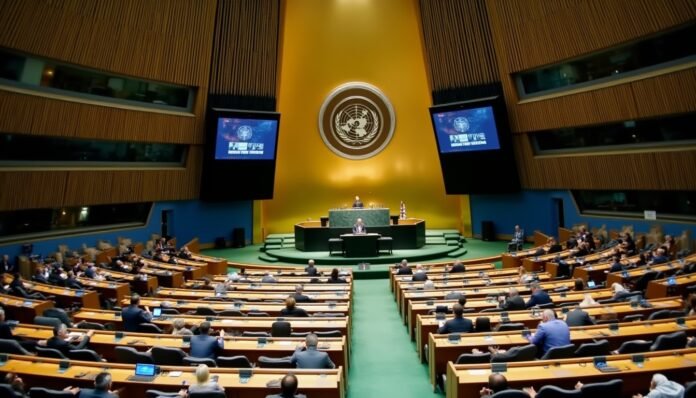
US Presses Palestinians To Drop UN General Assembly Vice Presidency Bid – Report

0
us-presses-palestinians-to-drop-un-general-assembly-vice-presidency-bid-–-report
US Presses Palestinians To Drop UN General Assembly Vice Presidency Bid – Report


The United States has instructed its diplomatic mission in Jerusalem to press the Palestinian leadership to withdraw its candidacy for a vice presidency of the United Nations General Assembly, according to a State Department cable cited by The Guardian.

A May 19 cable, obtained by the newspaper, said the US embassy in Jerusalem was directed to deliver a formal protest to Palestinian Authority officials demanding that the candidacy be withdrawn by May 22. The document warned that “consequences will follow” if the bid remains in place.

According to the report, Washington linked the issue to broader disputes involving Palestinian diplomatic initiatives and financial matters. The cable stated that Palestinians would make no progress in recovering tax and customs revenue withheld by Israel unless they “engage in good faith without internationalizing disagreements in courts.”

Those revenues account for 60% of the Palestinian Authority’s income. The funds have been largely withheld since the Gaza war began in October 2023 under policies implemented by Finance Minister Bezalel Smotrich.

The document also referred to earlier US pressure surrounding leadership roles at the United Nations. It praised Palestinian envoy Riyad Mansour for withdrawing his candidacy for president of the General Assembly in February following American lobbying efforts. The cable said Mansour had “understood the gravity of the issue and intended to be constructive.”

Palestinians are running as part of a four-member Asia-Pacific slate for vice-presidential positions at the General Assembly. While the role is considered less powerful than the presidency, the cable noted that vice presidents may be called upon to oversee assembly meetings.

“In a worst case scenario, the next PGA [president of the general assembly] might assist the Palestinians in presiding over high-profile sessions related to the Middle East or during UNGA81 high-level week,” the cable stated, referring to meetings and speeches planned for September in New York.

The communication also said the Palestinian candidacy “undermines President Trump’s Comprehensive Plan,” referencing the US-supported Gaza ceasefire initiative and the Board of Peace.

“To be clear. We will hold the PA responsible if the Palestinian delegation does not withdraw its VPGA candidacy, and consequences will follow,” the cable stated.

The document additionally referenced the temporary revocation of visas for Palestinian officials ahead of last August’s UN summit week before the restrictions were later lifted. “It would be unfortunate to have to revisit any available options,” the cable said.

US officials declined to comment on The Guardian’s report.

Bangladesh’s paramilitary problem cannot be rebranded

0
bangladesh’s-paramilitary-problem-cannot-be-rebranded
Bangladesh’s paramilitary problem cannot be rebranded

Bangladesh’s rulers have a habit of renaming institutions when they become politically radioactive. Roads are renamed after coups, and laws after public outrage. The practice is usually useless.

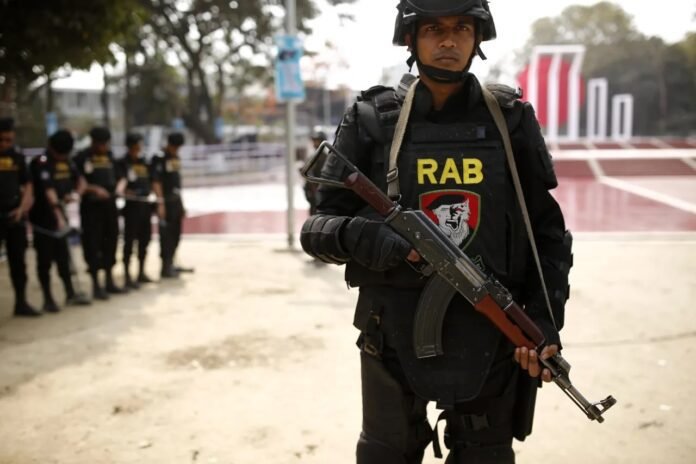
Now, the same survival instinct is being applied to the Rapid Action Battalion (RAB), the paramilitary force that for two decades served as the preeminent enforcement arm of Bangladeshi authoritarianism.

Officials insist a new legal framework and a fresh signboard can rehabilitate the force. They are wrong. The problem with RAB was never branding. It was the state philosophy that weaponized it.

RAB emerged in 2004 under a Bangladesh Nationalist Party (BNP) coalition government led by Khaleda Zia. Born out of public panic over a wave of violent crime and a nascent Islamist militancy, it was sold as a necessary tool for a weak state.

In narrow tactical terms, it worked. Operations against the militant group Jama’atul Mujahideen Bangladesh (JMB) won praise at home and abroad. Yet Zia’s government made a Faustian bargain of efficiency for accountability.

Under her watch, RAB’s “crossfires” – the term is a transparent euphemism for extrajudicial executions – became normalized.

According to human rights monitors, more than 350 people were killed in these staged gunfights during the BNP’s tenure up to 2006. Like many elite units born in panic, RAB quickly evolved from a counterterrorism squad into a parallel coercive structure operating in the grey zone between military power and civilian life.

That ambiguity was by design. Although nominally placed under the Ministry of Home Affairs, RAB was built by amending the Armed Police Battalion Act to allow the secondment of personnel from the military and intelligence services.

Soldiers from army, navy and airforce entered civilian law enforcement without shedding their martial culture. This was the original sin. Armies are trained to neutralize enemies; police are trained to manage citizens under constitutional restraint.

When Sheikh Hasina and her Awami League took power in 2009, they perfected the machinery. Over her 15-year rule, RAB ceased to be an anti-crime unit and became a sophisticated apparatus for political survival.

Under the guise of a “war on drugs” and counterterrorism, the force systematically targeted the political opposition, journalists, dissenters and even random people from the civil society.

The statistics of the Hasina era are grimly precise. Between 2009 and her ouster in August 2024, human rights groups documented over 600 enforced disappearances and more than 2,500 extrajudicial killings by security forces.

RAB was the primary executioner. A terrifying new vocabulary entered the Bangladeshi lexicon. Foremost was Aynaghar (the “House of Mirrors”), a network of clandestine military and paramalitary-run black sites where dissidents were subjected to prolonged isolation and waterboarding, sometimes for years, completely cut off from the legal system.

The force operated with absolute impunity until December 2021, when the United States imposed Global Magnitsky sanctions on RAB and six of its top commanders, including Benazir Ahmed, the former RAB chief and later Inspector General of Police.

The subsequent shift exposed the central myth of Dhaka’s security discourse: that such abuses were tragic necessities of national security. Following the sanctions, extrajudicial killings and disappearances dropped precipitously overnight.

The state had always possessed the capacity to restrain the force. It simply chose not to until external pressure altered the cost-benefit calculation.

This is why cosmetic reforms inspire little confidence. Bangladesh’s current Bangladesh Nationalist Party (BNP) government again approaches the issue administratively rather than structurally, debating new ordinances while avoiding the fundamental question: Should a military-trained institution be embedded in civilian governance at all?

The danger is amplified because Bangladesh’s military establishment is a sprawling corporate conglomerate. Military-linked enterprises dominate banking, insurance, construction and telecommunications.

This fusion of coercive authority and economic interest creates a combustible political economy. When security-linked networks become entrenched across civilian sectors, the temptation to influence civilian politics grows irresistible.

RAB became the blunt instrument through which this institutional creep occurred.

The collapse of Sheikh Hasina’s autocratic and repressive regime in 2024 exposed the ultimate failure of security-heavy governance. The combined terror of the police, RAB and military intelligence could successfully suppress peaceful dissent, but proved incapable of managing mass popular uprisings without escalating violence to a catastrophic, and ultimately fatal, degree. Such systems excel at intimidation, not legitimacy.

They mistake fear for stability until the moment both collapse together.

Bangladesh now faces a choice familiar to many post-authoritarian states. It can continue refining instruments of coercion while pretending they are compatible with democratic accountability, or it can rebuild civilian policing around transparency and genuine legal restraint.

The first option is easier. It also guarantees recurrence. A renamed RAB may temporarily soothe foreign diplomats, but institutions do not change because governments repaint their logos.

Until Bangladesh confronts the militarization of its domestic governance, the culture of the black site will survive any rebranding exercise intact.

Faisal Mahmud is a Dhaka-based journalist

70,000 Palestinians attend Friday prayers at Al-Aqsa amid Israeli restrictions

0
70,000-palestinians-attend-friday-prayers-at-al-aqsa-amid-israeli-restrictions
70,000 Palestinians attend Friday prayers at Al-Aqsa amid Israeli restrictions

More than 70,000 Palestinians performed Friday prayers at Al-Aqsa Mosque in occupied Jerusalem despite Israeli restrictions imposed since October 2023, according to Islamic authorities.

The Islamic Waqf Department in Jerusalem said more than 70,000 Muslim worshippers were able to access the mosque compound for prayers.

Dozens of Israeli police officers were deployed across the Old City, including near the compound’s external gates and surrounding alleyways, an Anadolu correspondent reported.

Israeli police stopped several young Palestinians in the area, checked their identification documents, he added.

Since the start of Israel’s genocidal war on Gaza on Oct. 7, 2023, Israeli authorities have prevented tens of thousands of Palestinians in the occupied West Bank from entering Jerusalem and accessing Al-Aqsa Mosque for prayers. Al-Aqsa Mosque is Islam’s third-holiest site.

READ: Jordan condemns Israeli seizure of properties near Al-Aqsa Mosque

Four Russian satellites are now within striking distance of an ICEYE radarsat

0
four-russian-satellites-are-now-within-striking-distance-of-an-iceye-radarsat
Four Russian satellites are now within striking distance of an ICEYE radarsat

At least four Russian military satellites changed their orbits to match that of a Finnish-American radar surveillance satellite in the last week, raising questions about Russia’s intentions amid an ever-expanding standoff high above Earth.

The maneuvers were identified through open source orbital tracking data. Greg Gillinger, a retired Air Force space intelligence officer, revealed the orbit changes Friday in a special edition of his Integrity Flash newsletter, published by Integrity ISR, a private business that provides “combat-proven operational support and elite training that enhances mission success across ISR (Intelligence, Surveillance, and Reconnaissance), cyber, space, and targeting domains.”

The Russian satellites in question, designated Kosmos 2610 through 2613, launched together on April 16 on a Soyuz-2.1b rocket from Plesetsk Cosmodrome in northern Russia. Over the last week or so, the four satellites adjusted their inclinations—the angles of their orbits to the equator—by less than a degree.

That may sound insignificant, but such “plane change” maneuvers use up a lot of fuel. The delta-v, or velocity change, required for a plane change maneuver of this magnitude is equivalent to the impulse needed to raise altitude by more than 100 miles.

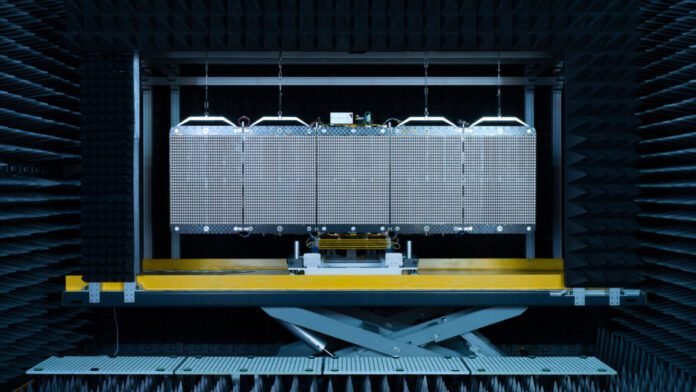
The upshot is that these four Russian satellites are now positioned to routinely pass near a commercial radar surveillance satellite operated by the Finnish-American company ICEYE. This imaging platform, named ICEYE-X36, is part of a fleet of satellites providing all-weather overhead radar images to the US military and European governments. ICEYE also provides imagery to Ukraine’s military in its fight against Russia. ICEYE’s co-founder and CEO, Rafal Modrzewski, met with Ukrainian President Volodymyr Zelenskyy last year.

According to Gillinger, the cross-track distances between the four Russian satellites and ICEYE-X36 now range between about 500 meters (1,640 feet) and 22 kilometers (13.7 miles). All of this is taking place in polar orbit at an altitude of approximately 340 miles (547 kilometers).

Russian satellite operators are now in a position to close in on the ICEYE satellite with “minor adjustments” in “satellite eccentricity and average altitudes,” Gillinger wrote in his newsletter. A fifth satellite from the same Russian launch last month now appears to be performing a similar set of maneuvers to move closer to ICEYE-X36.

Co-planar or cosplay?

We know little about what these particular Kosmos satellites can do. Perhaps, as one retired US military space official recently told Ars, this is another example of Russia rattling a dull saber. Russian military officials seem to enjoy probing US and allied forces, often flying strategic bombers near US and European airspace.

This same behavior now appears to extend into space, with Russia’s launch of several military spacecraft shadowing the US government’s most sophisticated spy satellites in low-Earth orbit several hundred miles above the planet. US officials believe at least some of these Russian satellites are part of an anti-satellite weapons program.

More recently, a mysterious Russian military satellite arrived in geosynchronous orbit more than 22,000 miles over the equator. Circumstantial evidence suggests this, too, may be part of a Russian anti-satellite system. The US Space Force dispatched one of its own inspection satellites in geosynchronous orbit to get a closer look.

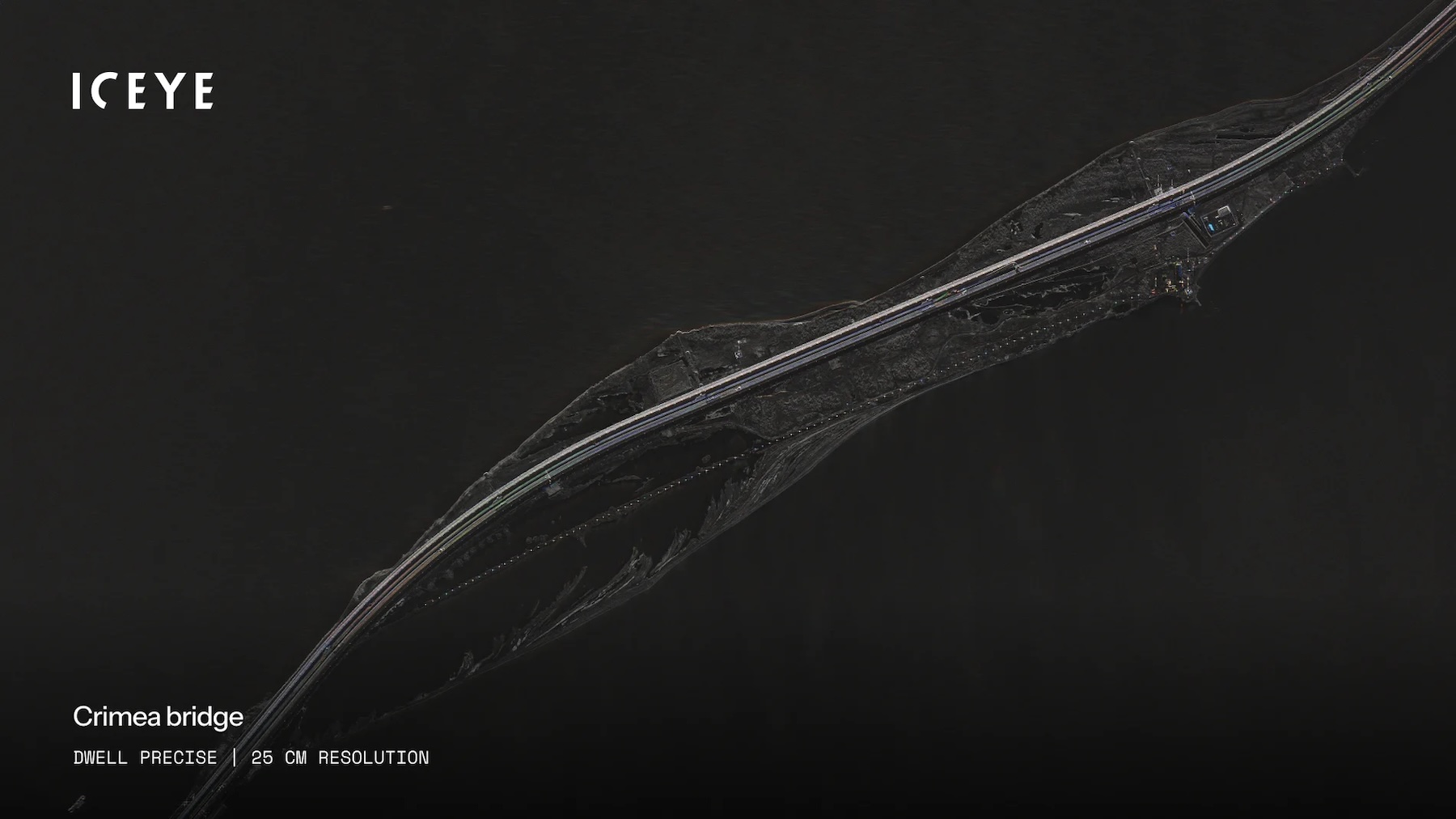
A radar image of a bridge in Crimea taken by an ICEYE satellite.

A radar image of a bridge in Crimea taken by an ICEYE satellite. Credit: ICEYE

Targeting a single spacecraft, such as ICEYE-X36, in a constellation of similar imaging satellites would do little to inhibit the access of Ukraine or other Western nations to radar surveillance imagery. ICEYE, itself, operates dozens more radar imaging satellites. Unlike optical spy satellites, radars provide imagery day and night, regardless of cloud cover.

But Russia’s maneuvers to match the plane of ICEYE-X36’s orbit appear to be intentional. Russian military satellites have conducted similar operations to move into “co-planar” orbits with Keyhole-class spy satellites owned by the National Reconnaissance Office. The recent maneuvers with Kosmos 2610 and its cohorts appear to mimic what Russia has done to move within striking distance of the NRO’s satellites.

“We do not know Russia’s intentions or the capabilities of these particular satellites,” Gillinger wrote. “However, maneuvering into a co-planar orbit is alarming. Plane matching is the first (and most fuel expensive) step to conducting Rendezvous Proximity Operations (RPO), likely necessary for the Russian satellites to target (kinetically or non-kinetically) ICEYE-X36.

“We also do not know the satellites’ total fuel capacity, however the expenditure [during these maneuvers] is evidence the satellites are capable of conducting high-energy maneuvers,” Gillinger continued. “This capability is not common for satellites conducting typical Earth observation, signal collection, or communications missions.”

ICEYE did not respond to questions from Ars on Friday; the company announced in January that it was expanding its partnership with the Ukrainian military. ICEYE’s newest satellite capture images with a resolution of up to 16 centimeters, about the size of a grapefruit.

“ICEYE is proud and humbled to have supported Ukraine’s defense teams with reliable, near-real-time space-based intelligence since the beginning of the invasion,” said John Cartwright, senior vice president of data product at ICEYE.

“This agreement strengthens assured access to our high-resolution SAR imagery, helping Ukraine make decisions faster and with greater confidence,” Cartwright said. “ICEYE stands firmly with Ukraine in the face of these hostilities, and is deeply committed to strengthening Europe’s security more widely by ensuring our allies have the best decision-ready data when they need it most.”

MEPs Back European Commemoration Day for Victims of Work-Related Fatalities and Accidents

0
meps-back-european-commemoration-day-for-victims-of-work-related-fatalities-and-accidents
MEPs Back European Commemoration Day for Victims of Work-Related Fatalities and Accidents


In remembrance of victims of accidents at work and of occupational diseases, MEPs are asking for 8 August to be designated the European Day in Remembrance of the Victims of Accidents at Work and for the Protection and Dignity of Workers.

The day would aim to raise awareness, they argue, about the importance of prevention and safety at work at public, enterprises, and institutions, together with a roll-out of concrete initiatives in schools and workplaces. The text was endorsed by MEPs with 395 votes in favour, 12 votes against, and 41 abstentions.

On 8 August 1956, 262 miners lost their life at the tragedy at the Bois Du Cazier mine in Marcinelle, Belgium. The workers were citizens from several countries that are currently EU-countries.

In the EU in 2023, there were 3,298 fatal accidents at work and around 2.8 million non-fatal accidents resulting in at least four days’ absence from work, with serious problems in high-risk sectors such as construction, transport, manufacturing and agriculture.

Parliament also wants the Commission to assess and address occupational health and safety risks associated with AI and algorithmic management systems. MEPs say that workers engaged through digital labour platforms and those whose tasks, pace and performance are directed or evaluated by AI-based tools, can face heightened risks due to intensified work rhythms and abusive monitoring in algorithmic decision-making.

Heat risks at work

MEPs call on the Commission to assess occupational safety and health risks related to climate-related factors, such as heat stress, extreme weather events, and air pollution. They have asked for better protective and preventive workplace measures to protect workers from extreme heat and climate change impacts, which they want to be recognised as major occupational risk factors.

To help achieve safe and healthy workplaces, Parliament underlines the importance of regulatory occupational health and safety inspections and call on EU-countries to strengthen labour inspectorates with permanent staff, adequate resources and institutional independence.


Xi Jinping’s praise of ‘Make America Great Again’ a major signal

0
xi-jinping’s-praise-of-‘make-america-great-again’-a-major-signal
Xi Jinping’s praise of ‘Make America Great Again’ a major signal

Western mainstream media and podcasters have dismissed the Trump-Xi summit in Beijing. When you listen to Jake Sullivan and Aaron Friedberg, China hawks from diagonally opposite political background – the liberal elite of the Democratic party and the Republican neoconservative camp – they are competing with each other to disparage the summit as “much ado about nothing.”

But they  seem to have neglected, or deliberately ignored, a significant event when Xi at the state banquet publicly praised MAGA, adding a real foundation stone for rebuilding mutual trust between the two countries.

Although no agreement was signed on the Taiwan issue, to the relief of the China hawks, Trump acted swiftly to reciprocate Xi’s praise by publicly downplaying Taiwan’s strategic importance, refusing to defend Taiwan based on traditional logic of strengthening military deterrence and directly pressuring the Taiwanese government to make corresponding adjustments to arms sales, in order to handle the Taiwan Strait issue within the agreed common framework of “constructive strategic stability.”

This is a major breakthrough. Apart from Xi, only a very few world leaders have praised the MAGA movement. Foreign leaders, especially US allies, rarely comment on it at all. There are two reasons for this:

First, they disagree with Trump’s MAGA philosopthy – nationalistic populism and burden-shifting national security policy.

Second, they do not believe the movement can survive after Trump leaves office. Trumpism is considered an aberration in American history.

Even when a few leaders do comment, it is often out of some specific motive, ranging from neutral approval to public praise.

Rather than publicly praising MAGA, leaders who are well disposed to Trump either praise the man, the president, himself or appreciate certain aspects of his policies or are ideologically aligned with him.

Based on available information up to May 2026, high on the list of foreign leaders who have praised Trump is Vladimir Putin – though Putin has never explicitly mentioned by its name the “Make America Great Again” movement.

Putin praised Trump’s political style and criticized American “elitism” in a manner consistent with the MAGA slogan. In 2018, Putin stated that Trump possessed “keen political instincts” and praised his ability to connect with ordinary voters. However, Putin’s praise was not directed at the MAGA slogan itself, but rather indirectly praised its ideology. Putin’s comments focused selectively on populism and anti-establishment appeals.

Then there iss former Brazilian President Jair Bolsonaro, who has expressed admiration for Trump and his populist political approach.

Bolsonaro publicly praised Trump’s political ideology, calling him a “model” for Brazilian conservative politics. His praise suggests alignment with Trump’s nationalist, law-and-order rhetoric and questioning of globalist institutions – signature features of the MAGA movement.

Several Eastern European leaders – particularly Viktor Orbán of Hungary – have praised Trump-style nationalism and anti-immigrant policies, though they generally do not explicitly mention MAGA.

Orbán publicly praised Trump’s policies on immigration and nationalism. While Orbán didn’t directly mention “Make America Great Again,” he explicitly endorsed the populist and nationalist line it represents – but citing Hungary as a model instead.

Israel’s Benjamin Netanyahu praised Trump’s “America First” foreign policy, calling it the cornerstone of the “historic partnership” between the two countries during Trump’s presidency. This praise was directed at specific policies, not the MAGA movement itself.

Most other leaders who indirectly praise  MAGA, such as Italy’s Giorgia Melloni, or France’s Marine le Pen, focus on his political style, or some of his policies, merely emphasizing ideological commonality with the MAGA movement.

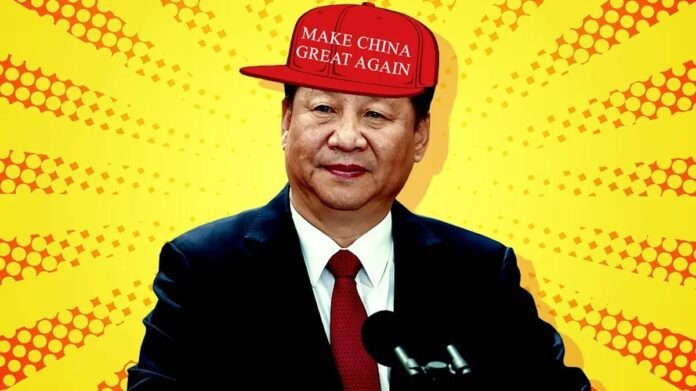
However, at this Xi-Trump meeting, Xi Jinping openly and unreservedly compared the MAGA movement to China’s grand national project – the Chinese national rejuvenation movement – a form of praise never before heard.

President Xi Jinping’s comments on the movement are analytical and thoughtful praise.

Trump seems very pleased, as it is certainlybeneficial for his image and the midterm elections, alongside subtantial trade and other economic deals. .

According to reports, Xi Jinping stated,

This year also marks the 250th anniversary of American independence, and more than 300 million Americans are revitalizing their patriotic, innovative, and pioneering spirit, propelling American development onto a new journey.

The people of China and the United States are both great peoples, and realizing the great rejuvenation of the Chinese nation and making America great again can be done in parallel, mutually beneficial, and for the benefit of the world.

This statement highly praises Trump’s MAGA movement, even implying that the American people yearn for change and suggesting that the movement has effectively inspired Trump’s supporters.

Therefore, only Xi Jinping has directly and explicitly praised the MAGA movement (including its slogan and its political brand itself). This greatly boosts Trump’s tarnished domestic and international image.

Xi’s remarks, from the leader of the world’s second most powerful nation, are not purely political flattery such as Europeans pathetically offered when they called him “daddy,” but more thoughtful endorsement, representing the closest a foreign leader has come to explicitly acknowledging the positive value of the MAGA movement itself.

More interstingly, Xi Jinping also set a three-year timeframe, apparently hoping to use the remaining three years of President Trump’s term to normalize Sino-US relations.

At the same time, Xi is betraying real concerns about US policy reversal toward China after Trump’s departure.

However, even in the post-Trump era, the common-sense revolution launched by Trump may  not fade away from American politics and is likely to continue to strengthen. A group of power restrainers – technologically minded and mission-bound young people represented by Vice President J D Vance – will carry the banner of the MAGA movement, as it holds immense appeal for the American working class who are disillusioned with globalization, immigration, and the establishment political elite.

Regarding China policy, if the MAGA movement under Trump could turn out to be a ballast for stabilizing political relationship between the two countries, the resurgence of China hawks will be effectively curbed, as the three-year stable and win-win situation will be evident to all.

Even if the Democrats come back to power, they will not dare to easily disrupt this constructive strategic stability and restart a new Cold War of “democracy versus autocracy.”

Avoiding the Thucydides trap between China and the US will safeguard both the process of “Making America Great Again” and the rejuvenation of the Chinese nation. These two movements can truly coexist and complement each other.

The establishment elite in the US refuse to accept the fact that, the MAGA movement is not just about Trump; it’s about the broader cultural and political change needed for the well-being of the American people. One of its core features, a de-ideologized foreign policy will help stop the chaotic pendulum in the most important relationship, the one between the US and China, to prevent an unthinable conflict for the sake of world peace.

The author is professor emeritus of the Graduate Institute of International and Development Studies, Geneva, Switzerland.

0FansLike
0FollowersFollow
0FollowersFollow
0SubscribersSubscribe
- Advertisement -
Google search engine

Recent Posts