Electrical utility megamerger is all about the data centers
A proposed merger of the largest utility in the country by market value, NextEra Energy, with the sixth-largest, Dominion, would create a megacompany at a time when data centers and rapid increases in electricity demand are reshaping the industry.
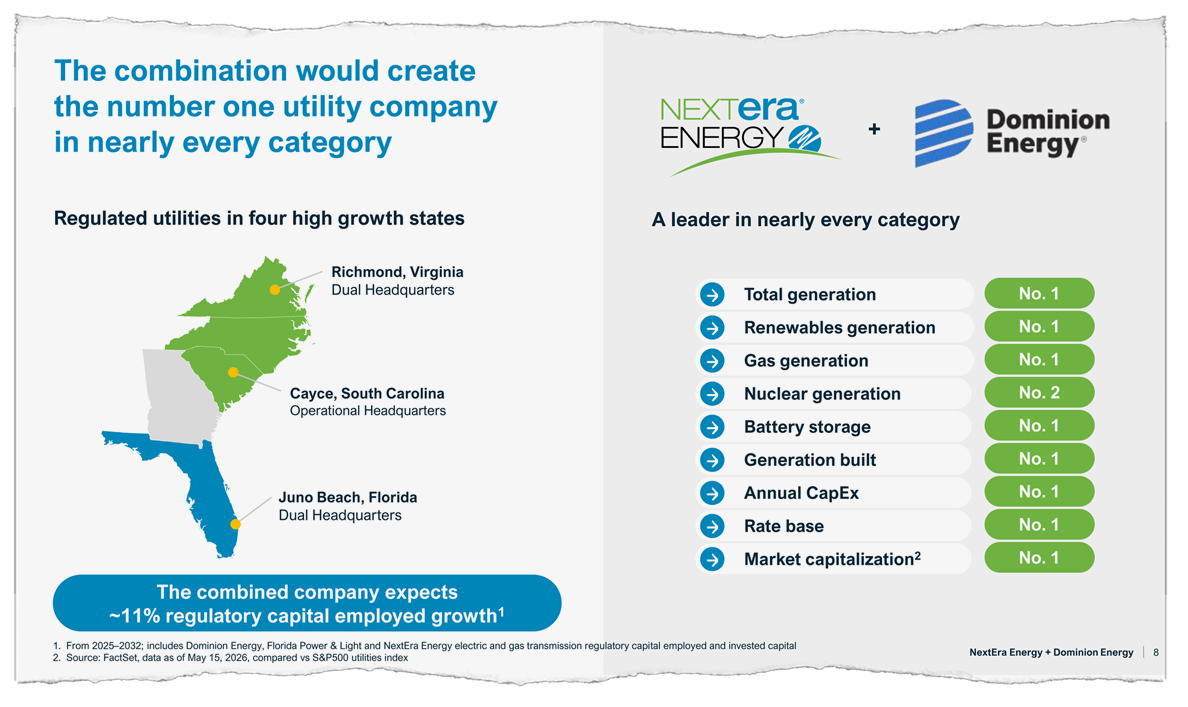
The proposal, announced Monday morning and contingent on state and federal regulatory approval, would result in a company that leads in nearly every aspect of the US power and utility industry, including overall electricity generation, natural gas generation, and renewables.
The $67 billion deal combines NextEra’s size and reach with Dominion’s positioning as the local utility for the world’s largest concentration of data centers in northern Virginia. But the results are likely bad for consumers and the environment, creating a company with enormous financial and political strength that will be difficult to effectively regulate, according to consumer advocates and analysts.
For perspective, only Exxon Mobil and Chevron would be larger based on market value among US-based energy companies.
“Mergers are not about consumers; they’re about shareholders,” said Ari Peskoe, director of the Electricity Law Initiative at Harvard Law School. “For the Dominion shareholders, they are selling their shares at a premium. The executives are getting massive payouts for facilitating this, assuming it all goes through, and obviously NextEra believes the transaction is going to add value to the company. Ratepayers are all an afterthought.”
The deal makes financial sense for both companies, said Andrew Bischof, an equity analyst for Morningstar.
“We view the transaction as allowing NextEra to accelerate its data center ambitions, which had trailed those of its regulated peers, by using Dominion’s expertise and relationships to expedite NextEra’s data center hub plans,” he said in a note to clients.
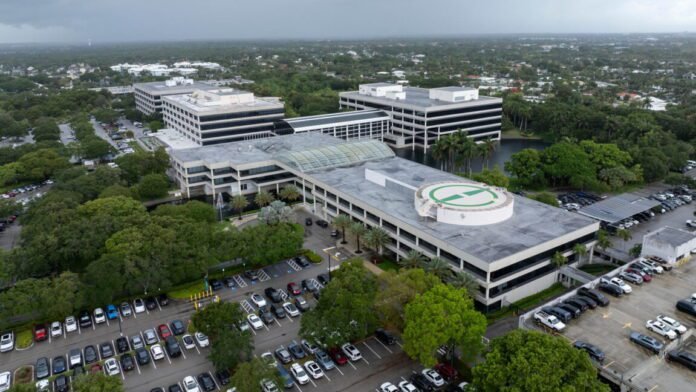
NextEra, based in Juno Beach, Florida, includes Florida Power & Light, the largest regulated electricity utility in the state, and NextEra Energy Resources, a wholesale electricity supplier that owns power plants across the nation. Dominion, based in Richmond, Virginia, includes regulated utilities serving much of Virginia, parts of North Carolina and South Carolina, and other assets across the country.
The company would be called NextEra Energy, and NextEra CEO John W. Ketchum would serve in the same role after the deal closes. Robert M. Blue, Dominion’s CEO, would be the CEO for regulated utilities for the merged company. The parties said they expect regulatory approvals to take 12 to 18 months.
A page from NextEra Energy and Dominion’s investor presentation shows the states where each company has regulated utilities and the merged company’s ranking in various categories.
Credit: NextEra Energy
A page from NextEra Energy and Dominion’s investor presentation shows the states where each company has regulated utilities and the merged company’s ranking in various categories. Credit: NextEra Energy
NextEra shareholders would own 74.5 percent and Dominion shareholders would own 25.5 percent, respectively, of the combined company in the all-stock transaction.
“We are bringing NextEra Energy and Dominion Energy together because scale matters more than ever—not for the sake of size, but because scale translates into capital and operating efficiencies,” Ketchum said in a statement.
“Adding to the pollution problem”
The post-merger NextEra would be the leader in so many categories in the US utility sector that it’s easier to list the ones where it wouldn’t be on top. It would rank second in nuclear power generating capacity and in the number of regulated utility customers, trailing Exelon Corp. of Chicago in both.
NextEra and Dominion both have substantial carbon emissions, but neither was among the top five utility companies in the country in 2024, according to the most recent edition of Benchmarking Air Emissions report from the Natural Resources Defense Council. NextEra ranked sixth and Dominion ranked 11th, and their sum was less than that of each of the leaders, Vistra Energy and Duke Energy.
But those are still massive emissions from a company that stands to gain more clout because of its size.
“If we continue to add dangerous climate pollution into the mix, then people who are already suffering and are typically hurt first and worst will suffer even more,” said Susan Glickman, vice president of policy and partnerships at the CLEO Institute, a Florida-based nonprofit dedicated to climate education and advocacy. She noted that those with the fewest resources often are the most affected by disasters like hurricanes, which are intensifying as fossil fuel emissions warm the global climate.
“They’re going to continue to be at the short end of the stick, while these companies build more methane gas plants to provide additional power for data centers, and adding to the problem of pollution that is warming our climate.”
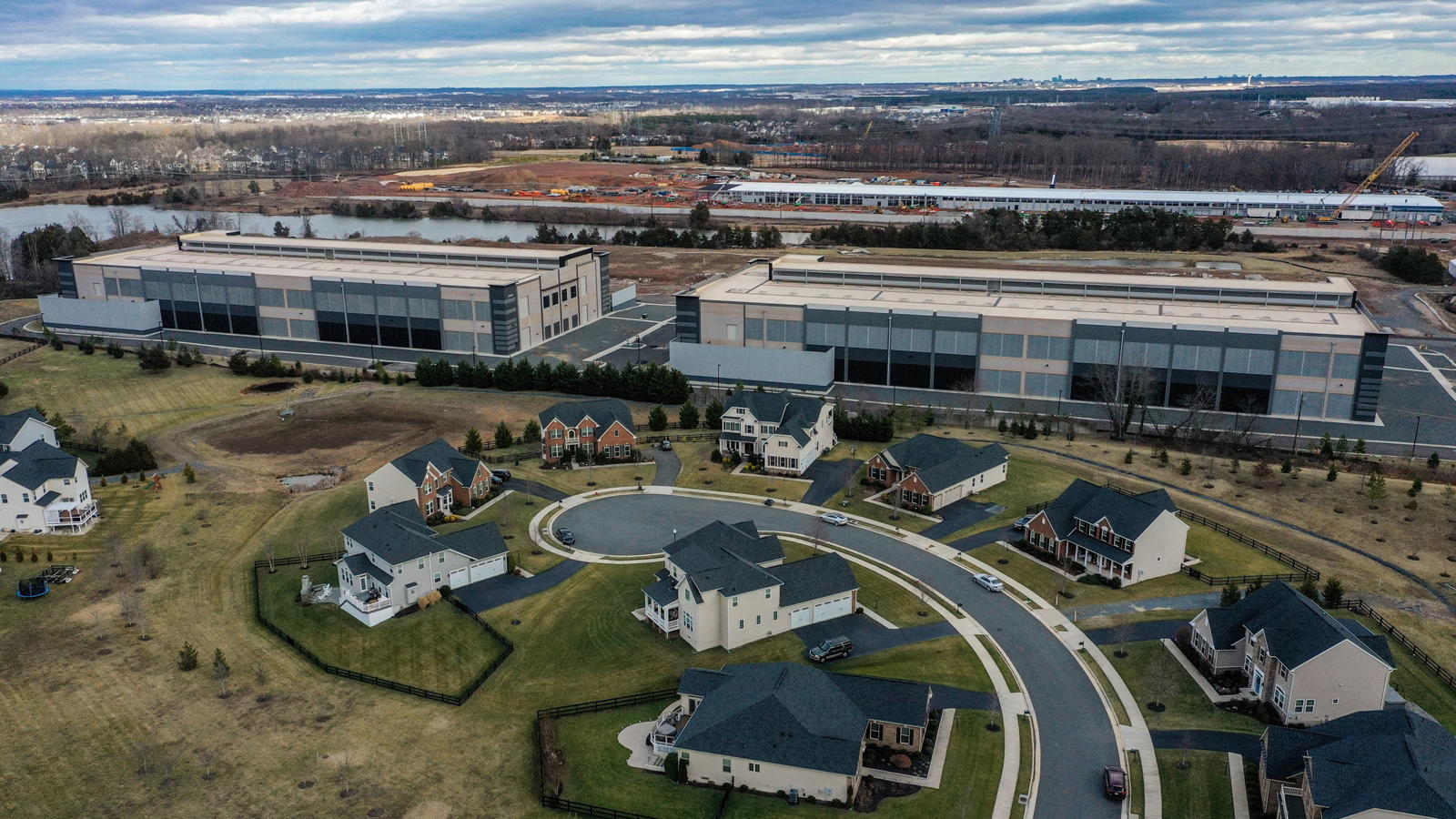
Amazon data centers loom over houses at the edge of a neighborhood in Loudoun County, Va.
Credit: Jahi Chikwendiu/The Washington Post via Getty Images
Amazon data centers loom over houses at the edge of a neighborhood in Loudoun County, Va. Credit: Jahi Chikwendiu/The Washington Post via Getty Images
Consumers stand to lose
In a conference call Monday morning, company officials said the agreement will lead to economies of scale, providing savings that will benefit ratepayers. The deal includes $2.25 billion in bill credits for Dominion customers, spread over two years.
But utility mergers do not have a track record of delivering long-term benefits to consumers, said Marissa Paslick Gillett, who served as chair of the Connecticut Public Utilities Commission from 2019 to 2025. She resigned following clashes with utilities in the state and now is a senior fellow at the American Economic Liberties Project, a think tank that works to limit the concentration of corporate power.
“I continue to be sort of flabbergasted by the tone deafness,” she said. “I’m not sure that any of us could point to a major utility merger acquisition that’s happened in the past decade… where that merger acquisition has definitively provided the synergies that they told their commissions were going to come out.”
Gillett’s experience includes work as a staff member at the Maryland Public Service Commission during the 2012 merger of Exelon with Maryland-based Constellation Energy, which was one of the largest US utility mergers ever.
One of the main problems that arises from a utility merger is that it creates a company that is difficult to regulate because of its complexity, she said.
“We know how this goes, and the real, tangible problems of having to regulate a behemoth like this,” she said.
Stephen Smith, executive director of the Southern Alliance for Clean Energy, said the merger could be a good thing if NextEra is responsible to customers and continues to expand its renewable energy portfolio. He noted NextEra’s status as the largest renewable energy developer in the country, but he also had concerns about the growing weight of the utility’s political influence, especially in Florida.
”You’re making a very large utility that has a tremendous amount of financial resources, a tremendous amount of political power, and that does not always bode well for ratepayers,” he said. “The more political power that a utility has, the more probable it is that they will use that power to the disadvantage of ratepayers.”
Smith cautioned that the merger should not be viewed as a done deal. NextEra has attempted to acquire other utilities in the past and failed, including aborted talks with Duke Energy in 2020.
“Their track record in acquisitions is not really that great,” he said. “Going after Dominion is the biggest fish that they have tried to reel in.”
Virginia’s laws would still apply
Despite those worries, Dominion and its out-of-state parent company would still need to follow Virginia’s laws and regulations, said William Shobe, a research professor emeritus of public policy at the University of Virginia.
“The regulations don’t mention Dominion, they mention the utility that covers Dominion’s footprint, whatever its name is,” he said.
Those laws include the Virginia Clean Economy Act, the state’s 2020 law seeking to decarbonize its grid by 2050, and the recently passed legislation increasing Dominion’s battery storage development targets.
If anything, NextEra’s track record as a leader in solar and wind power could “bleed” into the Dominion culture that “has not been super aggressive about adding non-emitting technology,” Shobe said.
Acquiring Dominion is appealing to NextEra Energy, he said, because Virginia has a friendly policy environment to build grid infrastructure, a strong profit margin, and a booming data center market. NextEra said the merger creates a pipeline of 130 gigawatts’ worth of demand from data centers, which critics say are speculative, and a chance to more than double generation capacity to 225 gigawatts by 2032.
In November, state regulators approved a $7 billion rate hike for Florida Power & Light. Consumer groups characterized the rate hike, which faces a legal challenge in state court, as the largest in US history.
Bradley Marshall, a senior attorney at Earthjustice, said the rate hike positioned NextEra financially to pursue the merger.
“In the past, when we see utilities become even more powerful, we’ve seen bills go up even further,” he said. “Consumers need to be informed about what’s happening and ensure that keeping bills from going up is a priority.”
Maldives investigates if Italian divers went too deep in fatal cave dive
Maldivian authorities are investigating whether Italian divers who died in a deepwater cave accident may have descended further than intended, following the discovery of five fatalities in a submerged cave system near the capital Malé.
A government spokesperson said officials are examining several possible factors behind the tragedy, including whether the group went beyond safe or expected diving depths during the expedition. One body has been recovered so far, while the remaining four were located deeper inside the cave, according to rescue teams.
The diving group entered the cave on Thursday as part of a research mission led by Monica Montefalcone, a 51-year-old University of Genoa professor and marine ecologist with extensive experience diving in Maldivian waters. Her daughter was among the four researchers who died, along with an instructor.
Authorities said the original permit for the expedition was issued for marine research involving soft coral studies, and did not specifically authorise cave diving activities, raising questions about whether the group’s activities matched the approved scope of the expedition.
The instructor’s body was recovered from a depth of around 60 metres, highlighting the extreme conditions involved in the dive. Officials are continuing recovery efforts and reviewing dive data, equipment use and planning procedures as part of the ongoing investigation into the incident.
From indemnity to indispensability: China’s 125-year reversal
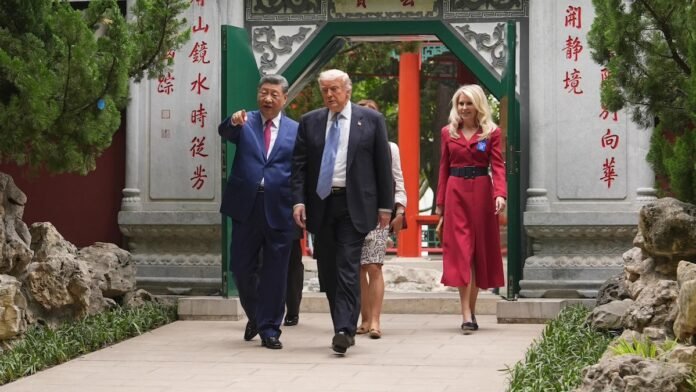
When eight foreign flags flew over Beijing in August 1900, no one in the Forbidden City could have imagined that the city would, 125 years later, host the president of the United States as a guest of honor and the president of Russia just days afterward.
The contrast is almost cinematic. In 1900, some 51,755 troops from Austria-Hungary, Britain, France, Germany, Italy, Japan, Russia and the United States marched into the Chinese capital, looted the Forbidden City and the Old Summer Palace, destroyed volumes of the Yongle Dadian and the Siku Quanshu, and imposed the punitive Boxer Protocol of September 1901.
In May 2026, those same eight capitals — through their successors and alliances — watch as Beijing, not foreign legations, sets the choreography of great-power diplomacy.
The Boxer Protocol was a humiliation engineered around indemnity, extraterritoriality, and the permanent garrisoning of foreign troops on Chinese soil. The 2026 Trump–Xi summit was the photographic negative of that arrangement.
It was the visiting US president who lavished praise, calling Xi Jinping “my friend” and “tall, very tall,” while the Chinese side responded with measured boilerplate and conceded almost nothing concrete on Taiwan, trade, fentanyl or artificial intelligence.
Where 1901 ended with signatures extracted from a fleeing Qing court at Xi’an, 2026 ended with Air Force One departing Beijing before the US president publicly mentioned Taiwan at all.
This is not a moral scorecard; it is a structural observation. The same geographic stage — Beijing — now functions as a convening power rather than a conquered one, and the choreography of who travels to whom has quietly inverted.
In 1900, the Eight-Nation Alliance was bound by no treaty and no formal declaration of war, only by a temporary convergence of interests against a common adversary. In 2026, the language of friendship has migrated to the other side of the table.
President Xi reserves the word “friend” for President Putin, with whom joint statements, pancakes-and-vodka summits, and a “no limits” partnership have been cultivated since 2022.
Yet the relationship is asymmetric in ways that mirror, in reverse, the asymmetries of 1901. Russia depends on China for more than a third of its imports and a quarter of its exports, while accounting for only about 4% of Chinese trade — less than Vietnam.
The supplicant in the room has changed – the room has not. It would be tempting to read this arc as a linear ascent. The evidence is more interesting than that.
The argument that China’s peak is now rests on hard numbers: a fertility rate of 1.0 in 2025, a fourth consecutive year of population decline, a generation of young Chinese reporting no desire for children, and 2021 as the high-water mark of nominal-GDP convergence with the US. Belt and Road has stalled in places; demographic gravity is unforgiving; cultural soft power remains, by global metrics, modest.
So the 2026 tableau captures not a permanent new order but a particular moment — perhaps a maximum — in which industrial scale, diplomatic patience, and the relative disorganization of competitors have converged. The Eight-Nation Alliance arrived at a Chinese nadir; today’s summits may be occurring at, or near, a Chinese zenith.
Both are snapshots, not destinies. Three implications follow.
Sovereignty has become the default, not the prize. The 1901 Protocol made Chinese sovereignty conditional; the 2026 summits assume it absolutely. Any future Asian order will be negotiated among sovereign equals or not at all, regardless of which capital is ascendant in a given decade.
Personality diplomacy has limits in both directions. Trump’s wager on charm yielded vague commitments on Boeing jets and soybeans that Beijing declined to confirm in detail. The lesson is not partisan; it is procedural. Centralized states reward preparation, not improvisation, and this is true whether the visitor comes from Washington, Moscow, or Tokyo.
The window is narrower than triumphalism suggests. If demographic and growth trends hold, the strategic latitude China enjoys in 2026 may not extend to 2046. That should counsel patience in every capital — including Beijing, whose best long-term insurance is restraint while the cards are favorable, and including Washington, whose best response is competence rather than spectacle.
The same caution applies to any partnership — Sino-Russian, transpacific or otherwise — that looks unshakeable in the glow of a state banquet. History’s most reliable lesson, from 1901 through 2026, is that the photograph on the palace steps is never the whole story.
Y. Tony Yang is an Endowed Professor at the George Washington University in Washington, D.C.
Iran Demands Reparations, Lebanon Ceasefire; Nuclear Issue Still Major Obstacle to Agreement
Iran has proposed terms for ending the conflict that include a rapid withdrawal of US forces from the region, reparations, an end to the war in Lebanon, and the lifting of sanctions, according to Iranian media reports and statements by senior officials.
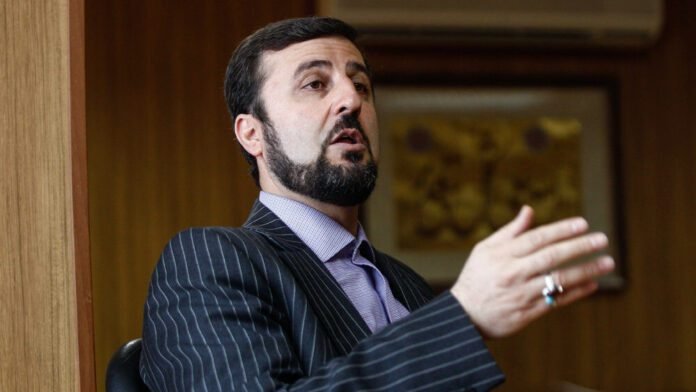
Deputy Foreign Minister Kazem Gharibabadi said Tehran was also demanding the release of frozen Iranian funds and an end to what he described as a US marine blockade on the country, according to the IRNA news agency.
According to a report by Walla, disagreements over Iran’s nuclear program remain the primary obstacle in the latest version of Tehran’s proposal. The report said Israeli and American interests were not aligned with Iranian demands and cited an assessment that Iran was attempting to gain time through the negotiations.
Walla also reported that coordination had taken place with additional Middle Eastern countries in the event that President Trump decides to authorize renewed strikes against Iran.
Reuters reported that the latest Iranian proposal closely resembled a previous offer rejected by President Trump last week.
In a post on Truth Social Monday, he said that the leaders of Qatar, Saudi Arabia, and the United Arab Emirates had urged him to halt plans for renewed attacks on Iran while negotiations continued.
“This Deal will include, importantly, NO NUCLEAR WEAPONS FOR IRAN!” President Trump wrote.
Before announcing on Monday that planned military action had been suspended, President Trump had been preparing for what was described as a major operation against Iran. He later said he chose to delay the move in order to allow an opportunity for a diplomatic agreement preventing Iran from acquiring nuclear weapons.
Meanwhile, Iranian military officials warned of additional escalation if Iran comes under renewed attack.
Army spokesperson Brigadier General Mohammad Akraminia said Iran would respond by expanding the conflict.
“If the enemy acts foolishly and once again falls into the trap of the Zionists and carries out another act of aggression against our dear Iran, we will open new fronts against them using new methods and capabilities,” he said.
A former British glamour model is making explosive new claims about a wild night with Sarah Ferguson that allegedly spiraled from champagne and dancing into a bizarre late-night hotel hangout just after the royal’s split from Andrew Windsor.
Alicia Douvall, now 46, says she first crossed paths with Ferguson at an upscale London nightclub packed with wealthy socialites and VIPs. According to the former pin-up model, the evening quickly took a strange turn after a millionaire businessman allegedly invited her to continue partying with him — and the Duchess of York.
Douvall claimed the businessman showered her with expensive champagne and attention while they danced and flirted inside the exclusive Mayfair hotspot. But she says Ferguson, who had reportedly arrived with the wealthy tycoon earlier in the night, appeared increasingly uncomfortable as the pair hit the dance floor together.
The model alleged the duchess became “jealous” and uneasy as the night went on.
Things only got stranger from there.
According to Douvall, the businessman later invited her back to a luxury hotel suite where Ferguson was already waiting. The former glamour star said the trio continued drinking heavily while the atmosphere became increasingly flirtatious.
Douvall claimed Ferguson repeatedly complimented her appearance and became fixated on her revealing outfit and chest during the late-night gathering.
“At one point Sarah made a remark about my breasts being wonderful,” Douvall alleged. “It felt like she kept staring at them.”
The model said she had been wearing a black see-through dress cut down to her navel while partying at the club.
She also described the entire situation as “surreal,” recalling how she eventually found herself sitting on a bed next to the duchess while the businessman whispered and giggled privately with Ferguson nearby.
Despite the bizarre encounter, Douvall insisted nothing explicitly sexual happened and said she ultimately became uncomfortable and left the suite after about an hour.
Looking back, the former model admitted the evening left her shaken.
“I was only 22 and they were both much older than me,” she said. “I think I felt overwhelmed.”
Douvall added she has not spoken to Ferguson since the alleged encounter but said recent headlines about the royal brought the memories rushing back.
The claims come as Ferguson, long known to royal watchers as “Fergie,” continues to remain in the public eye decades after her turbulent marriage and divorce from Andrew Windsor, the scandal-plagued Duke of York.
In addition to space stations, Vast says it will now build high-power satellites
As part of its plan to develop a private space station, Vast Space built and then launched a small demonstration spacecraft in early November. This vehicle then completed dozens of test objectives with flying colors before making a successful de-orbit three months later.
The mission, which tested power, propulsion, tracking, and a multitude of other technologies needed for Vast’s Haven-1 space station, was evidently so successful that the company is ready to use its spaceflight capabilities for other purposes. The Long Beach, California-based company announced Tuesday that it plans to begin selling high-powered satellite buses.
“Every single successful space company is diversified in its products,” said Max Haot, chief executive of Vast Space, in an interview. “So for us it really was a question of when, not if.”
A satellite for power-hungry applications
The company’s first offering is a 15 kW-class satellite bus capable of supporting a variety of demanding missions. Each satellite is about 3 meters long and 4 meters tall, with a mass of 700 kg and payload capacity of at least 350 kg. They will have a design lifetime of five years and be intended to operate in areas ranging from low-Earth orbit out to lunar orbit. Vast aims to serve a variety of customers, from telecommunications to observation to data services. Haot added that Vast also plans to offer an NVIDIA Space-1 Vera Rubin Module to support orbital data center inferencing needs.
The Vast satellite bus—essentially a backbone providing power, propulsion, and navigation for various payoads—will be based largely on technology ported over from the company’s Haven-1 space station, which is due to launch for the first time next year as the world’s first private space station. However there will be some new elements needed for the satellite, and Haot said Vast is already moving forward with in-house development of electric propulsion and a deployable solar array for the satellite.
Vast has already signed a customer for four satellites, with an option to purchase up to 200 additional satellites. Haot said the company is targeting a launch of at least 10 Vast Satellites in the fourth quarter of 2027.
With this new product line, Vast is entering an increasingly crowded market. Historically, in the United States, a handful of large companies such as Boeing, Lockheed Martin, Northrop Grumman, Maxar, and Sierra Space have manufactured medium and large satellites. Typically these were costly and often bespoke designs that cost tens to often hundreds of millions of dollars.
But a few trends have changed the landscape in recent years. The US government’s Space Development Agency has signaled that it prefers proliferated constellations—many satellites spread out present less of a concentrated target than a few larger and more expensive satellites. With the Falcon 9 rocket’s increased cadence, as well as rideshare missions, it became easier and sometimes cheaper to get smaller and medium-size satellites into orbit.
This has led to an influx of venture capital to back a new generation of companies seeking to build less expensive, more modular satellites that could fill a variety of purposes. There are several prominent, relatively new entrants in this area including K2 Space, Rocket Lab, True Anomaly, Blue Canyon, and Millennium Space Systems.
Vast already has… vast facilities
Haot said most of these companies are still emerging, with products that are not yet mature. In other words, he believes that if Vast Space can execute, it could become a market leader, especially with applications that are power-hungry. Vast has already invested $1 billion in facilities for spacecraft manufacturing, including clean rooms, which can be used for space stations as well as satellites, he said.
The number of satellites in space has exploded in recent years, largely due to the rapid expansion of SpaceX’s Starlink constellation. For decades the total number of satellites orbiting Earth numbered about 4,000, but in the last five years that number has grown to about 14,000.
This is just the beginning. By some estimates, in another decade, there will be approximately 500,000 satellites in orbit for the purpose of communications, Earth observation, orbital data centers, and other applications.
Haot expects that about 90 percent of these will be satellites built by SpaceX, Amazon, Blue Origin, or other major players. But even 10 percent of that number, if available to commercial satellite bus manufacturers, would represent 50,000 satellites for Vast and other companies to compete for.
Trump’s “Anti-Weaponization” Fund Is a Handout to His Hardcore Supporters
In yet another staggeringly corrupt and unprecedented move, President Donald Trump’s Justice Department on Monday announced a $1.776 billion slush fund, drawn from public coffers, to funnel payouts to Trump loyalists.
The fund is part of a deal decided by the Trump administration to drop its weak $10 billion lawsuit against the IRS over a leak of the president’s tax returns. The entire lawsuit had itself become an egregious example of self-dealing: Trump’s Justice Department suing Trump’s IRS on behalf of Trump.
Over 90 House Democrats recently signed an amicus brief to the presiding judge asking that she dismiss the suit. A settlement, the Democrats wrote, would create a “specter of corruption unparalleled in American history.”
With his popularity at historic lows, Trump can only turn to these kinds of payouts for his allies and dwindling base.
Before the judge could respond, however, Trump withdrew the lawsuit and moved to set up something even worse than that specter: a slush fund beholden entirely to Trump, with little in the way of judicial or congressional oversight.
According to the Justice Department announcement, the so-called “anti-weaponization” fund — to remedy the purported weaponization of the U.S. government — will be paid out to Trump allies who claim they were targeted by President Joe Biden’s administration. The irony that the fund itself is just one of Trump’s countless weaponizations of the government should be lost on no one.
The fund amount — $1.776 billion — is, of course, an on-the-nose reference to American independence and tells us everything we need to know about this deal. For most of the country, there is little of substance in this too-cute-by-half dollar amount. Instead, the material benefit will go to the largely to the white ruling classes with some crumbs for Trumpian militia members convicted under Biden.
Trump’s reckless and brutal presidency is materially harming the American working classes — even the white working class. With his popularity at historic lows, Trump can only turn to payouts like this, pardons, and the spectacle of white supremacist violence; these are all he has to offer his allies and dwindling base.
That’s what this slush fund does: nod to Trump’s allegiance to his supporters, the vast majority of whom will get little other than the mood elevation that comes with having their resentments recognized — what W.E.B. DuBois once called the “psychological wages” of whiteness, a benefit that is only felt by virtue of the greater oppression of others.
Trump’s authoritarian capitalism will not, after all, uplift the white working class; there aren’t enough U.S. Immigration and Customs Enforcement signingbonuses or slush-fund payouts to go around.
January 6 Loyalists
The slush fund money would come directly from the Treasury Department’s Judgment Fund, which is typically used to pay legally reached settlements and court judgments. But in this case, a commission picked by Trump’s attorney general will apparently hand out payments as it pleases.
No specific recipients have been named yet, but beneficiaries could reportedly include Proud Boys and other January 6 Capitol rioters, many of whom have since pardoned by Trump.
The fact that any payouts will be funded by taxpayer dollars is not mentioned in the Justice Department’s fund announcements.
“This is a theft far worse than Watergate,” wrote civil rights attorney Aaron Reichlin-Melnik on social media. “There is no other word for it. They are stealing $1.78 BILLION dollars to pay Trump’s allies, despite knowing that these people are not legally entitled to any money.”
The Trump regime hopes programs like this “anti-weaponization” fund can appease just enough of an active base to hold power under minority rule, while enriching all those in Trump’s inner circles who in turn stick by his side regardless of what happens in elections.
The Trump regime hopes programs like this fund can appease just enough of an active base to hold power under minority rule, while enriching all those in Trump’s inner circles.
Rep. Jamie Raskin, D-Md., told the New Republic that he sees the fund as Trump and his lawyers “figuring out a way to refund the January 6 militia, presumably to get them ready for the next round of battle.”
Raskin added that, should the Democrats retake the House and Senate in the midterms, they would shut down the fund and demand transparency about any payments made. According to the Congress member, any payouts to January 6 participants would violate the Fourteenth Amendment by aiding in an insurrection against the U.S. It is, however, no easy task to claw back money once doled out.
“It is my personal opinion that this is a criminal act and people should respond accordingly,” noted Reichlin-Melnik.
The problem is that for Trump’s regime and its loyal Supreme Court, the distinction between presidential criminal corruption and permissible executive action has all but evaporated.
The challenge, then, is to show that Trump’s meager offerings are not worth accepting.
This Convicted Felon Gets $1 Million a Year to Sell Obsolete Internet Service. You Pay for It.
Reporting Highlights
Internet Gold Rush: Alaskan companies are getting billions of dollars in public telecom subsidies, yet the state ranks last in internet speed.
Subsidizing a Ghost Town: The federal government pays one company more than $350,000 a year to provide internet to 300 buildings on an island of 80 people.
Operating From Prison: The owner of another company operated his telecom business from behind bars and today gets more than $1 million a year despite faster options for consumers.
These highlights were written by the reporters and editors who worked on this story.
At the beginning of his three-year federal prison sentence for felony tax evasion, Roger Shoffstall lost his telephone privileges when a guard caught him running his small Alaska phone company from behind bars.
He’s lost a lot of privileges over the years. Shoffstall, 75, can’t serve on a federal jury. Unlike most Alaskans, he doesn’t receive an annual Permanent Fund dividend check. And he is not allowed to own a gun.
One thing never changes, however: Each year, the federal government sends his company, Summit Telephone, more than $1 million.
The money comes from a special government subsidy program that Congress created to bring fast, affordable phone and internet service to hard-to-reach places. You help pay for it.
Pull up your latest phone bill and look for a line labeled “Universal Service Fund.” Some phone companies list it as a “Universal Connectivity Charge” or fold it into a “Regulatory Programs & Telco Recovery Fee.” It’s all the same thing: a surcharge added to the monthly bill of phone customers throughout the United States.
The federal government and phone companies don’t call it a tax — but it acts like one. Carriers must currently contribute 37 cents of every dollar of their interstate and international phone revenues to the fund.
In Alaska, where many communities can only be reached by plane or boat, the Federal Communications Commission has given telecommunications companies $4.6 billion in these subsidies since 2016. That’s more than $600 per Alaskan per year. More per resident than in any other state.
Yet after all that spending, Alaska still ranks near the bottom for access to the very land-based, high-speed internet service the money was meant to deliver.
Some communities have yet to be wired at all. In others, fiber-optic cables or microwave towers offer internet with speeds that were recently clocked, statewide, as the slowest in the country. Even with the subsidies, the service comes at a steep price to customers: often hundreds of dollars a month for internet one-tenth what the FCC considers broadband quality.
The federal program has kept money flowing to companies like Shoffstall’s whose operators have troubled pasts. It also gives money to companies like Shoffstall’s regardless of how many people use their services. And fewer and fewer Alaskans have done so since low-earth satellites from Starlink entered the market at better prices. (Satellite internet doesn’t qualify for the subsidy but costs about $90 to $130 per month for download speeds up to 280 megabits per second in the same service area as Summit Telephone. According to Summit’s website, its fastest internet plan in the same region maxes out at 25 Mbps and costs $135 a month.)
All of these excesses appear to fall within the program’s rules or the FCC’s discretion.
A telecom on the Aleutian island of Adak receives more than $350,000 a year to provide phone and low-speed internet services to 306 buildings, according to FCC records, even though the state Department of Labor says the island is home to fewer than 80 people. One business owner said everyone he knows on the island has moved on to Starlink anyway.
GCI, the state’s largest telecom and its largest subsidy recipient, got $466 million just two years after its settlement with the federal government for alleged fraud related to the same subsidy program. (The settlement said it was neither an admission of guilt by GCI nor a concession by the Justice Department that the claims were not well founded.)
Shoffstall and his attorney did not respond to repeated interview requests or answer detailed questions sent by email. On Thursday, Shoffstall sent two documents to the Anchorage Daily News and ProPublica asserting that he is a sovereign citizen of the United States, an ideology that the FBI has described as “those who believe that even though they physically reside in this country, they are separate or ‘sovereign’ from the United States.” The FBI has categorized the extremist version of this movement as “domestic terrorism.”
Larry Mayes, the owner of Adak Eagle Enterprises, the company that receives the subsidy to provide internet on Adak, declined to answer questions about the funding. “You’ll have to talk to the FCC about that,” he said, hanging up the phone.
In a written response to questions, GCI said it and other Alaska telecoms depend heavily on the subsidies to provide services across the state.
“Before and after the settlement, GCI continued to work with the FCC and customers to provide high-quality communications services in compliance with all applicable laws and regulations,” the GCI statement said. “The settlement did not change Alaskans’ growing demand for these services, GCI’s willingness to provide them, or the criticality of USF funding to the sustainability of those services.”
The FCC did not respond to requests for comment. The agency is weighing the future of the program and recently circulated a proposal to overhaul or potentially sunset elements of the subsidy that funds companies like Summit.
Alaska telecom lobbyists and executives said that the state provides some of the most challenging geography to serve in the United States, and that they have made great progress in bringing internet access to Alaska.
Christine O’Connor, executive director of the Alaska Telecom Association, said the subsidies have improved access and lowered costs for rural Alaskans.
“There is simply no way that rural Alaskan communities could be connected with Anchorage or with the rest of the United States and the world” if consumers living in rural Alaska communities had to pay the full cost, she wrote in a statement to the Daily News and ProPublica.
But Daniel Lyons, a former attorney whose law firm represented Verizon and AT&T and who now teaches internet law at Boston College Law School, said the subsidy program is broken. The fundamental problem: No one has ever rigorously tested whether it works.
“It’s not proven how successful it is,” said Lyons, who specializes in telecommunications and internet law, “because the FCC is not very good at auditing its program.”
In Shoffstall’s case, the FCC pays his company what works out to about $800 per month per customer. Lyons has advocated scrapping this approach and sending the subsidy directly to consumers instead, letting them choose which provider gets their money. In Alaska, that might mean Starlink, though some new users say they are being charged a “high demand” fee of $1,500 to sign up, or its future satellite competitors like Amazon Leo.
“If the goal is to make sure everybody gets online,” Lyons said, “you try to find the families that can’t afford service at market rates and you give subsidies to them directly.”
Money for Homes With No Internet
Alaska’s outsized share of the subsidy traces back to a man memorialized with a life-sized bronze statue in the Anchorage airport.
Sen. Ted Stevens — “Uncle Ted” — spent 40 years delivering federal money to Alaska and was nearing the height of his power in 1996 when Congress passed the Telecommunications Act, creating the modern Universal Service Fund.
It was before smartphones or Netflix. Most homes in America had no internet, and by the late 1990s “high-speed” service meant 200 kilobits per second — faster than dial-up modems but too slow to play high-definition video. Today, the FCC defines broadband, which is just another way of saying high-speed internet, as 100 Mbps. That’s 500 times faster than in the ’90s.
As chair of the committee that controlled the FCC’s budget, Stevens ensured Alaska telecoms received special treatment, according to Carol Mattey, a former FCC official who oversaw efforts to reform the subsidy.
“It would be suicidal to do something to make the head of the Appropriations Committee angry at you,” said Mattey, who served as deputy chief of the commission’s Wireline Competition Bureau.
Stevens lost reelection in 2008 while under a corruption indictment that was later dropped. He died two years later in a plane crash on a trip from a private lodge owned by GCI, the Alaska telecom giant. GCI’s current president and chief operating officer, Gregory Chapados, is Stevens’ former chief of staff.
A GCI spokesperson wrote that while Stevens chaired the Appropriations Committee, he did not at the time chair the Senate Commerce Committee, which drafted the Telecommunications Act and oversees the subsidy program. Chapados, who served as chief of staff for Stevens from 1986 to 1992, was not involved in developing the Telecommunications Act, the company said.
The company said it “maintains constructive working relationships with all members of our delegation to advocate on behalf of our customers and all other Alaskans.”
Nationally, the subsidy program allows payments to any company that the FCC or state regulators have designated as an “eligible telecommunications carrier.” How much they get depends on whether they want to provide internet to village schools, health care clinics or simply remote communities.
Sen. Ted Stevens in 2008Al Grillo/AP
In its statement to ProPublica and the Anchorage Daily News, GCI said, “There are no provisions in the Telecom Act extending special treatment for Alaska.” But the state is treated differently in practice. In 2016, the FCC created a program called the Alaska Plan specifically for carriers here, allowing them to negotiate their own performance targets rather than being subject to the same cost models applied elsewhere.
Alaska’s geography made it especially difficult for the agency to estimate the cost of serving customers in the state, Mattey said. The FCC assumed the companies would only set goals that they would be able to achieve.
They tried to adjust the national formula for distributing money to account for this factor, Mattey said, but Alaska telecoms kept pushing back and FCC officials gave up.
“We tried so hard not to treat Alaska differently because our goal was to create defined deployment obligations for all companies, and we failed,” she said of the 2016 reforms. “The political pressure was too strong.”
Summit has received $12 million over the past decade by promising to deliver internet to 337 locations across a collection of woodsy, roadside neighborhoods just north of Fairbanks. Filings by Summit report dozens of new connections in some years, a combined total of 271 as of 2025.
But according to the FCC’s interactive map of all locations U.S. telecoms report actually serving with internet, the number of customers using Shoffstall’s service is far smaller. In a phone interview, the company’s acting general manager, James Perry, said that Summit has about 120 internet customers and 160 in total.
Mattey said the rules of the program say nothing about making sure the lines that a subsidy recipient builds actually get used — only that they get built.
Companies that fall behind on building out their network can have their subsidies reduced. But they are allowed to go on collecting cash long after the technology they use has become outdated, customers have moved on to cheaper and faster alternatives or their community has become a ghost town.
“They’re playing by the rules, so to speak,” Mattey said. “It’s a flat amount of money the government has decided they are entitled to.”
Off the Grid
Shoffstall’s penchant for setting his own rules first landed him in trouble in 1996. State prosecutors charged him with a misdemeanor when he mailed documents whose tone and language mimicked court orders to an Alaska bank, demanding money.
The trial ended without a verdict when Shoffstall agreed to change his plea from not guilty to no contest. He received a suspended imposition of sentence, a judgment entering a conviction with no jail time, contingent upon completing probation. Over the decades since, he has continued to file paperwork in state court, federal court and with the Alaska Department of Natural Resources claiming to be a sovereign citizen not bound by the same court systems as other Alaskans.
An electrical technician by trade, Shoffstall bought the business for about $675,000 in 2000.
Shoffstall’s customers live mainly in the hillsides north of Fairbanks. Some right off the highway. Some at the end of snowy roads littered with warning signs like: “You are no longer a trespasser. You are a target.”
People moved here when the famously independent and rough-edged city of Fairbanks felt too urbane. They moved here to get off the grid. Not on it.
Many of Summit Telephone’s customers live in rural, remote places in Alaska, including Cleary Summit, north of Fairbanks.Kyle Hopkins/ADN
Among Shoffstall’s customers was a Sunday school teacher who’d arrived in Alaska in 1981, answering phones for a small insurance company.
In the late 1990s and early 2000s, still the days of landlines and dial tones, Lois Sannes found herself frustrated with a surcharge added to calls in the Summit service area. She began complaining to the Regulatory Commission of Alaska.
She wrote so many letters to the governor that someone wrote back. Sannes met with an attorney, who she said told her the IRS had launched a criminal investigation into Shoffstall.
Separately, Shoffstall’s company was under scrutiny from the regulatory commission itself.
When Summit sought approval for the rates it charged other telecom companies to use its phone lines, the commission allowed them to look at Summit’s unredacted financial reports. A consultant hired by the rival telecom companies testified to the commission that Summit’s spending appeared unusually high, poorly documented and in some cases tied to transactions between the company and Shoffstall himself.
Roughly 95% of the company’s revenue around this period came not from phone customers but the federal subsidy program and payments redistributed through the telecom industry itself, according to audited financial statements Summit filed with state regulators.
The dispute before the regulatory commission ended when Summit and its competitors agreed to a settlement. The commission issued no findings on whether there were indeed problems with Summit’s books, as the consultant’s report had outlined.
But a new legal issue arose for Shoffstall — this time from the IRS, whose investigation Sannes had heard about. On Sept. 15, 2009, a federal grand jury indicted Shoffstall on allegations of felony tax evasion. The charges said he “willfully evaded the payment of his income taxes” for at least eight years beginning in 1996.
Shoffstall’s former accountants testified against him.
“I told him that he was going to get nailed, that’s not a question,” certified public accountant Garry Hutchison told the jury. “The only question is whether or not it would bring the company down.”
A Fairbanks jury found Shoffstall guilty on Feb. 5, 2010, after a five-day trial.
The FCC has the power to cut off subsidies to recipients convicted of fraud and other financial crimes related to the subsidy program. How closely related the crime must be to the subsidy payments is up for interpretation by the agency.
On one hand, Shoffstall’s indictment said he used his position running a federally subsidized company to obstruct the IRS investigation. On the other, the conviction was for tax evasion related to money he personally owed the IRS.
There is precedent for the FCC closely scrutinizing a subsidy recipient who’s been convicted of evading personal income taxes.
The FCC Wireline Competition Bureau directed the Universal Service Fund’s administrator to look into whether Hawaii-based Sandwich Isles Communications misused its subsidy dollars. The action followed owner Albert Hee’s conviction on federal tax crimes in 2015.
The FCC fined Sandwich Isles and Hee $49.6 million and ordered the company to repay $27 million in what it described as improperly received subsidies. Hee’s attorneys contested the charges, arguing that he had concealed nothing and that the government mistook accounting errors for criminal intent. A jury disagreed.
It’s not clear whether the FCC investigated Shoffstall after his conviction; the agency did not respond to questions about the case.
But records show that Shoffstall’s company steadily continued to receive Universal Service Fund subsidies, even while Shoffstall was in prison. Two months after his release in January 2013, Summit reported collecting $1.1 million in annual subsidies.
When Shoffstall’s probation officer told a federal judge that Shoffstall was ignoring his probation requirements, he was arrested on Dec. 9, 2013, and went back to prison for several months. His company received $859,393 in Universal Service Fund subsidies during that time.
In the years that followed, the subsidies to Summit grew. FCC data shows Summit in 2016 received one of the highest levels of federal subsidies per customer in the country.
As of that year, Shoffstall’s company paid him an annual salary of up to $121,000 and paid an annual dividend of up to $155,000 to a holding company for which he was the sole shareholder. His company stopped publicly disclosing that information after 2016, as the Regulatory Commission of Alaska stopped requiring detailed annual reporting, leaving far less financial information available to the public.
Sannes, the former Summit customer who once pressured state regulators to take a closer look at the company, now lives in Wisconsin. Asked if she was surprised to learn that the company’s subsidies not only continue today, but have increased to $1.5 million a year, Sannes said she had assumed his criminal conviction alone would have been enough to cut off the money.
“I’m horrified,” she said.
Unplugged
Summit Telephone is named for a mountaintop, Cleary Summit, outside Fairbanks. Sled dogs can be heard howling from their plywood houses, and every so often a semitruck barrels down the highway, swirling snow as it hauls gold ore from open-pit mines.
In the winter, you might see a rocket launch from a valley a few miles north, from the world’s only rocket launch site operated by a university. The hills are known for world-famous aurora borealis displays, and a collection of Airbnbs and lodges line winding roads.
As the subsidies flowed to Summit, Shoffstall continued to create and distribute documents intended to look like court orders. He submitted paperwork in federal court arguing he didn’t have to pay taxes — in one 2017 filing accusing the federal government of “high crimes” against him, in another issuing what he called a “summary judgment” against President Donald Trump for “fraud, collusion and conspiracy.”
None of this stopped the state’s telecom industry from spotlighting him as a poster child. O’Connor, the executive director of the Alaska Telecom Association, cited Summit to state lawmakers in 2018 as an example of a company forced to “muddle along with the obsolete technology” rather than upgrade its network due the burden of state overregulation. Raising the rates to provide upgrades would have required Summit to make its case to regulators that the fee increases were necessary.
Asked whether it was an appropriate use of public funds for a company like Summit to receive roughly $10,000 per customer per year in federal subsidies, O’Connor did not directly answer. In a written response, the Alaska Telecom Association said the program “is specifically designed to support building and operating telecommunications networks in high-cost areas” and that participating providers “are subject to FCC program requirements, reporting obligations, and oversight.” Asked whether it stood by its 2018 characterization of Summit, O’Connor said her testimony was focused on the challenges facing smaller providers generally.
Shoffstall never upgraded to expand its service. According to the FCC broadband map, Summit’s equipment today remains incapable of delivering internet faster than 25 Mbps — one-fourth the FCC’s current definition of broadband.
Meanwhile, the internet marketplace has changed. Some Alaskans no longer need or want the slower subsidized service.
Members of the Alaska Telecom Association board, including Shoffstall, middle of bottom row. Despite his conviction for personal tax evasion, the association highlighted Shoffstall and Summit in 2018.Screenshot by ProPublica
One recent Saturday, 74-year-old Philip Marshall shoveled a waist-high tunnel through the snow to a cabin near the top of the mountain. A wood carver, he wore a red ski cap decorated with the flag of Denmark. Asked about his internet access, he invited a reporter inside and made a pot of black tea.
Marshall said his wife, Janet, moved into this cabin before he met her. The construction boom for the 800-mile trans-Alaska oil pipeline had raised rents so high within Fairbanks’ city limits during the mid-1970s that she moved here out of town. Like many cabins outside Fairbanks, the home is “dry,” meaning there’s no running water. Old-timers hauled the building itself up the side of the mountain on sleds.
In interviews, several of Marshall’s neighbors said they have no complaints about the internet speeds Summit provides. One said she pays Summit $95 a month and the internet is fine for her needs. Another, who retired after a career working on remote Alaska radar sites, said he uses the service too. But he’s recently added satellite internet.
Others who have opted for the low-orbit satellite dishes, which deliver speeds up to 10 times faster than Summit for about the same price, have dropped their Summit plans altogether. One especially clear evening recently, Marshall stood in the snow and counted 18 satellites passing overhead within nine minutes. “Starlink,” he said.
The company and corporate parent SpaceX did not respond to questions and do not publicly release the number of users in Alaska. But Ookla, a company that offers tools people can use to test their internet speed, offered a proxy measure: About 1 in 10 Alaskans who tested their home internet speed through Ookla connected via Starlink, compared with roughly 1 in 67 in California.
The Marshalls haven’t felt the need to pay for either service. Their cellphones give five-bar, 5G service from a nearby tower. Finishing his tea, Marshall pulled on his jacket to head back outside. Still have to shovel a path to the outhouse, he said.
In the corner of the room, a plastic box the size and color of a concrete brick sat near the floor. It was for the Summit internet line that public subsidies pay the company roughly $10,000 a year to provide. Unplugged and unused.
America’s Taiwan gap utterly exposed at Trump-Xi summit
The most revealing line of last week’s Trump-Xi summit was not delivered at the Great Hall of the People. It came afterward, aboard Air Force One, when the American president was asked by Fox News what he thought of the island that had dominated his two days of talks with Xi Jinping.
“We will call it a place,” Donald Trump said, “because nobody knows how to define it.” Asked whether Taiwanese citizens should feel more or less secure after the summit, he answered: “Neutral.”
Washington’s bipartisan Taiwan lobby is, predictably, scandalized. The op-ed pages will fill in coming days with warnings about appeasement, abandonment and credibility. But Trump’s careless phrasing has done something the careful prose of three administrations could not.
It has named, in plain English, the strategic reality that the American foreign policy establishment has spent a generation pretending does not exist.
The asymmetry no one wants to discuss
Taiwan sits roughly 100 miles from the Chinese mainland and roughly 7,000 miles from the continental United States. For Beijing, the island is what Chinese strategists have for decades called a “core interest”, bound up with sovereignty, civil-war memory and the legitimacy of Communist Party rule.
Xi reminded Trump of this in unusually direct language, calling Taiwan “the most important issue in US-China relations” and warning that mishandling it would put the relationship into “great jeopardy.”
For the US, Taiwan is something else entirely. It is a democratic society with which Americans have warm sympathies, a critical node in the global semiconductor supply chain, and a useful, if minor, piece of the Western Pacific’s geography. None of this rises to the level of a vital national interest in the classical sense, the kind for which a great power risks general war.
That is not a moral statement. It is a statement about distance, logistics and the balance of conventional military power in the First Island Chain. The honest assessments by serious analysts, not the wargame press releases, have for some time pointed in the same direction.
That is, in any near-term Taiwan contingency, the People’s Liberation Army would fight at home with mass and interior lines, while the US would fight at the end of supply chains stretching across an ocean, from bases in Japan and Guam that are themselves within range of Chinese missiles.
Trump, for all the inelegance of his vocabulary, appears to grasp this. “I don’t think they’ll do anything when I’m here,” he said of a Chinese move on Taiwan. “When I’m not here, I think they might, to be honest with you.”
Translated out of Trumpese, this is something close to the position long argued by foreign policy realists: deterrence by personal unpredictability for as long as possible, accommodation thereafter, and certainly no war for an island a hundred miles from China and seven thousand miles from California.
The American readout speaks loudest
Diplomatic statements should be read for what they include, but also for what they leave out. The Chinese readout of the summit placed Taiwan at the center of the conversation. The American readout, according to multiple reports, did not mention Taiwan at all.
This is not an oversight. It is a quiet acknowledgment that the US, having just fought one war in the Persian Gulf and presiding over an open-ended security entanglement in Europe, is in no mood to advertise a third front in the Western Pacific.
The framework Xi proposed and Trump accepted in principle — “constructive strategic stability” between two great powers — is, whatever the diplomats wish to call it, the language of accommodation. The Chinese are already treating it as the operating doctrine of US-China relations for the rest of this decade.
In Washington, this will be presented by Trump’s critics as weakness. In Beijing, it is being presented as historic. Both are partly right. What it actually is, however, is something more interesting: the slow, embarrassed admission that the unipolar moment is over and that the US must once again live in a world in which other great powers have spheres of vital concern.
The danger of the in-between
None of this means Taiwan is doomed, and none of it means Washington should hand Beijing the keys.
The pragmatic course, the one this column has argued for some time, has always been the maintenance of the awkward but durable architecture set up in 1979: the One China policy, robust unofficial relations, arms sales sufficient for self-defense, and the deliberate ambiguity about American intervention that has helped keep the peace across the Strait for nearly half a century.
What is dangerous is neither realism nor restraint, but the in-between posture that Washington has drifted into since 2016: rhetorical commitments that grow ever more sweeping, military preparations that remain insufficient, and a bipartisan habit of treating Taiwan less as a place than as a symbol in America’s larger ideological contest with China.
That is the worst of all worlds. It invites Beijing to test American resolve precisely where American resolve is weakest, while encouraging Taipei to believe in guarantees Washington has not in fact made.
Trump’s “place” remark, mocked as it will be, is closer to the spirit of the 1972 Shanghai Communiqué than anything the last three administrations have managed. The original American genius on the Taiwan question was to leave the question’s definition usefully unresolved. It was Washington, not Beijing, that began rewriting that script in recent years.
A modest recommendation
The lesson the Beijing summit ought to teach the foreign policy establishment is not that Trump has betrayed Taiwan. He hasn’t, at least not yet.
The lesson is that even an instinctively combative president, surrounded by China hawks, finds himself drawn, by the sheer gravitational pull of geography and military reality, toward something resembling the realist accommodation that Henry Kissinger sketched out half a century ago and that his many critics have refused to update for the present age.
Those who claim to put America first have an obligation to ask the question that Washington’s think-tank class will not: is the US really prepared to send its sons and daughters to die in the Taiwan Strait, against a nuclear-armed adversary, over an interest that any honest accounting would call peripheral?
If the answer is no, and one suspects, in the private rooms where these things are actually discussed, that it is, then the public posture must eventually catch up to the private one. Trump, in his characteristically inarticulate way, has just begun that catching up. The grown-ups in the room would do well to finish the sentence.
This article was originally published on Leon Hadar’s Global Zeitgeist and is republished with kind permission. Become a subscriber here.









 Unless otherwise stated in the article above, this work by Middle East Monitor is licensed under a Creative Commons Attribution-NonCommercial-ShareAlike 4.0 International License. If the image(s) bear our credit, this license also applies to them. What does that mean? For other permissions, please contact us.






