Between assurances from President Donald Trump that a peace agreement is all but wrapped up and renewed skirmishes, the price of oil rises and falls. Even at recent lows, crude’s price is 40% higher than in late February when the Iran war began.
Someday – tomorrow? next week? next month? – the United States and Iran may announce an agreement to end the war. Odds are it will leave decisions on gnarly issues like Iran’s uranium stockpile and the lifting of sanctions for later talks.
Still, an agreement could be good news for farmers, who’ve been squeezed by higher fertilizer and diesel prices, and drivers, who’ve been experiencing shell shock at the pump. I say “could” rather than “would” for two important reasons.
First, the Strait of Hormuz is Iran’s main leverage in the continuing talks. No one should expect the Iranians to give it up entirely. Even if they agree to “open” the strait and promise not to charge tolls, they could maneuver to retain at least some control. And having demonstrated the ability to close the strait, they can always close it again.
Second, even if the Iranians don’t play games with the opening, oil shortages are likely to continue. It will take weeks to sweep the mines. It will take months to resume production at shut-in oil wells. It will take years to repair the damage to Middle East refineries, pipelines and other oil and gas facility casualties of the war.
Talk of a peace agreement pushes oil prices down, renewed hostilities push them up, but even when they’re down, they’re much higher than they were a few months ago. Chart: DTN ProphetX
And all this assumes an agreement will be reached soon. It could take longer. The negotiations have been difficult, at least in part because each side is convinced it holds the cards and can wait the other out.
President Donald J. Trump’s team thinks the pummeling we’ve given Iran’s economy has left it in such catastrophic shape that the Iranians will have to sweeten their terms. The Iranians think Trump can’t afford to go into the midterm elections with gas prices high. Which side has the greater tolerance for pain?
By all accounts the president wants an end to the war. There have been reports that he’s “bored” with it. Frustrated is perhaps more accurate. The war hurts him politically. It’s beginning to feel like a quagmire, the kind of thing candidate Trump promised to keep the country out of.
It’s unlike quagmires past, however. It’s only lasted three months, and more than half of that period has been a ceasefire. Earlier quagmires went on for years and took thousands of American lives.
Still, this war qualifies for inclusion on a different dishonor roll. It’s yet another demonstration of how difficult it can be for a great power to triumph over a seemingly much weaker power.
Among the other examples are the US failure to defeat Vietnam, the Soviet Union’s inability to subdue Afghanistan and the agonizing US wars in Iraq and Afghanistan this century. And then there’s Russia’s invasion of Ukraine, which has now gone on longer than the Soviet Union’s World War II.
A digression:
The Russians have been aiding Iran with intelligence and materiel. Trump’s critics cite this as an example of how little the US benefits from the president’s bromance with Vladimir Putin.
The critics have a point but, if Trump were to push Putin, Putin could respond that he’ll stop helping Iran when we stop helping Ukraine – which we still are doing, though not anywhere near as much as in the past.
The Chinese, meanwhile, are aiding everyone, though some more than others. The drones that all of the parties use in both wars – the Russians, the Ukrainians, the Iranians and, yes, even the US – contain critical Chinese components.
End of digression.
If Trump tires of the ceasefire failing to produce a deal, he can renew the bombing. It’s far from clear that would make the Iranians buckle, though. He could try to steal the Iranians’ uranium – or help the Israelis do it. But if that heist were easy to pull off, it would already have been tried.
Yet another military option is to try to open the Hormuz Strait by force, using US Navy ships and planes to escort non-Iranian commercial shipping. This would involve bloodshed; success wouldn’t be guaranteed.
If it did succeed, though, it would undermine Iran’s negotiating leverage – its ability to keep world oil prices high by keeping the strait bottled up. Iran would be unable to ship its oil, improving the odds that a starved-out Iran is forced to give up its nuclear ambitions.
For now, Iran has a chokehold on the strait – and the effects are felt ’round the world.
Google’s new Gemma 4 12B model is designed to run on any laptop with 16GB of RAM
The generative AI boom has driven the cost of memory into the stratosphere, and Google is a key part of that trend. So it’s only fitting that Google should offer some less RAM-hungry local AI models. The company has announced the release of a new Gemma 4 model that fills a gap in the lineup that launched earlier this year. The new model is efficient enough that you may be able to run it on a pretty average consumer laptop.
In April, Google released four models in the Gemma 4 family, which also marked the shift to a more open Apache 2.0 license. The initial models included two mobile-optimized options (E2B and E4B) along with a pair of models for more serious work (26B Mixture of Experts and 31B Dense). That left a rather large unserved space in the middle, which is right where the new model falls.
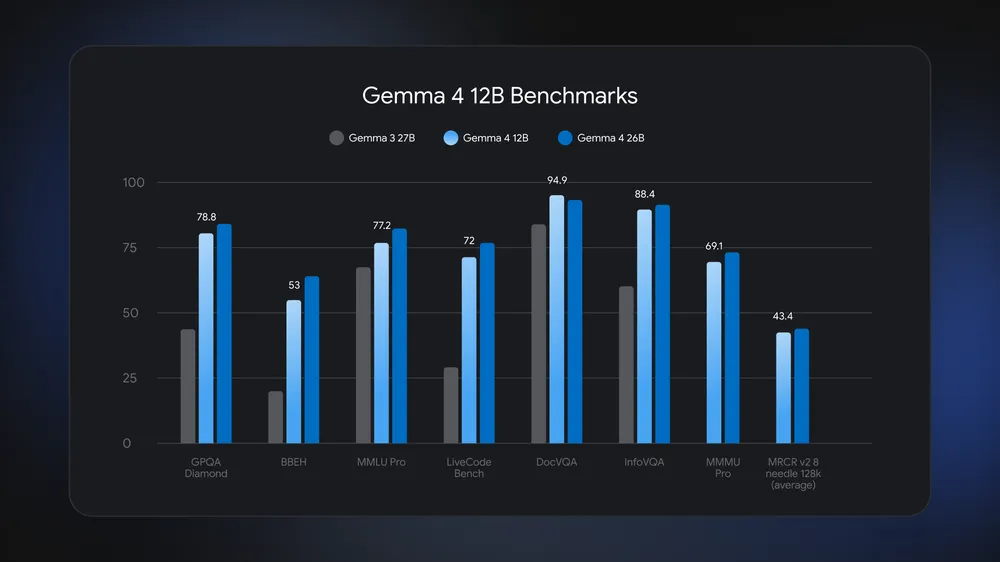
Gemma 4 12B is considerably more capable than the mobile versions, but it won’t require a $20,000 AI accelerator to run locally. Google says Gemma 4 12B is unique in that it can run on many consumer laptops without sacrificing quality. As long as you’ve got a computer with 16GB of system RAM or VRAM, the 12-billion-parameter model will work. That’s about half the total memory footprint of Gemma 4 26B MoE, and Google claims the new model is almost as capable, at least as far as benchmarks go.
Gemma 4 12B is almost as capable as the version with 26 billion parameters.
Credit: Google
Gemma 4 12B is almost as capable as the version with 26 billion parameters. Credit: Google
Google says the new model is capable of complex multistep reasoning and agentic workflows that previously required the larger Gemma variants. Despite the smaller parameter count, Gemma 4 12B comes with the newly devised Multi-Token Prediction (MTP) drafters, which take advantage of unused processing cycles to calculate possible future tokens. The result is greater speed and efficiency. Google has released optional MTP versions of the other Gemma 4 models, but this is the first one to have MTP out of the box.
Gemma 4 12B is also more efficient thanks to a new approach to multimodality. The Gemma 4 family is natively multimodal, accepting text, audio, or images as inputs. Most gen AI models—including the other Gemma 4 variants—use dedicated encoders to process non-text inputs and pass that data to the LLM. This works well enough, but it increases latency and memory usage.
With the new mid-weight model, Google has implemented a streamlined embedding module for vision, featuring single-matrix multiplication and positional embedding, which allows the data to pass to the LLM with proper spatial awareness. This eliminates the need for a bulky middleman encoder. For audio, there’s no encoding at all. The developers worked out a method of projecting the raw audio signal into the same vectors used for text tokens.
Gemma 4 12B Demo
If you want to check out the new Gemma 4 model, it’s accessible without a download via tools like LM Studio, Google AI Edge Gallery, and more. But the whole idea with Gemma 4 12B is that you can run it locally and on your own terms. If you’ve got the RAM, the model weights are available for download immediately on Kaggle and Hugging Face. It’s just shy of 18GB.
New York backtracked on its climate goals. Here’s why.
Last week, New York became the first state in the country to weaken a mandatory climate law passed by its own legislature.
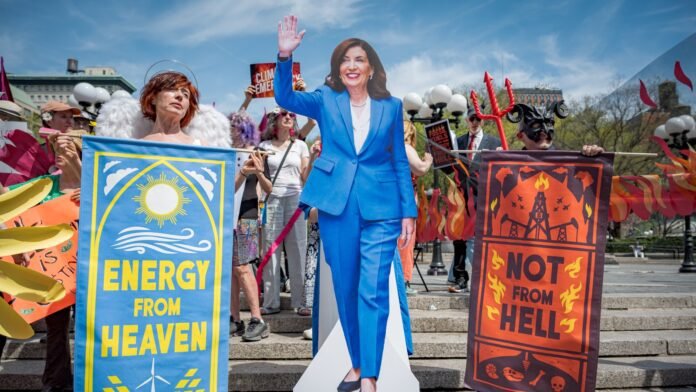
The change comes at the behest of Governor Kathy Hochul, a moderate Democrat who has often criticizedclimate action for increasing consumer costs. After months of backroom negotiation, the legislature reached a deal that weakens the 2019 law in several different ways — most notably by giving the state an additional decade to meet legally-required emissions targets.
The original law, one of the most ambitious in the U.S., required the Empire State to reduce its greenhouse gas emissions by 40 percent before 2030. (The state used its 1990 emissions as the baseline for comparison, per standards set by the United Nations.) Thanks to the law’s uniquely strict accounting rules, the only way for the state to meet this target was to shift away from natural gas, which provides most of the state’s electricity and almost all its heating fuel.
But as the 2020s progressed, New York failed to wean itself off of gas. The reason for that depends on who you ask. Some argue that President Donald Trump’s attacks on renewable energy have slowed the state’s progress, and others believe that state politicians have backed natural gas when they could have invested in more clean energy. Either way, the state fell way behind schedule, and it stood no chance of meeting its 2030 goal without dramatic action that would have taxed or banned consumption of fossil fuels.
Besides delaying the 2030 deadline by 10 years, the deal will also change the law’s accounting to give less weight to natural gas, and it will slow the rollout of a cap-and-trade system, which would force polluters to bargain with each other to stay below a hard limit on total emissions. Hochul has defended these changes as an attempt to protect New Yorkers from rising costs, blaming Trump for the state’s slow progress. She has warned that meeting the state law’s ironclad emissions target — something a court ordered her to do last year — would require huge pollution taxes that would end up inflating utility bills and gasoline prices, imposing thousands of dollars on the average household. (The budget deal also includes language that would require the state to consider the impact of its climate regulations on household budgets.)
Legislators and climate activists who support the original climate law said Hochul pushed the changes without giving lawmakers a chance to discuss a path forward for climate action in the state.
“This really came out of nowhere, it was sprung on us, and it was difficult even to understand what was happening,” said Marcella Mitaynes, a progressive state assembly member who represents a swath of waterfront neighborhoods in Brooklyn with many working-class residents.
Some experts who study decarbonization in New York said that the state’s legally binding emissions target had become virtually impossible to hit given broader headwinds against a national or global transition away from fossil fuels.
“It was going to be really difficult to meet, because the economy wasn’t cooperating,” said Al McGartland, who served as the chief economist at the Environmental Protection Agency from 2005 to 2025. McGartland, an expert on carbon taxes, said that the change to the law is “not all bad because I think it does buy time to think this thing through carefully, and do it right.”
The biggest change is delay. The budget deal sets a new target of reducing the state’s emissions 60 percent by 2040, a number that the governor’s office says is far more achievable than the 40 percent originally required by 2030. It also delays the launch of a “cap-and-invest” system, which was supposed to launch last year, until 2028. This system would assess new fees to polluters such as power plants and oil terminals and would funnel that revenue toward climate projects such as electric-vehicle chargers and heat pumps. Many climate experts believe such systems are the most efficient way to nudge an economy away from fossil fuels, but Hochul had grown concerned that the system would raise gas prices and utility bills at a time when many consumers are already struggling with fuel prices.
The deal also makes two important changes to the way the state counts its emissions. Under the old system, New York had to account for the climate pollution associated with extracting the fossil fuels that it imports from other states. For instance, when a natural gas field in Pennsylvania leaked planet-warming methane before piping the gas to New York, the latter state had to count those leaks as its own pollution, in addition to that caused by burning the fuel for energy. Most other states don’t do this. Once New York makes this change, it will reduce its apparent emissions by about 15 percent overnight — a result of the fact that the state imports most of its natural gas.
This dynamic was compounded by the fact that the state’s old accounting system also gave extra weight to methane, which is the second most common greenhouse gas after carbon. Methane warms the Earth about 80 times faster than carbon dioxide, but it disappears from the atmosphere after around 20 years. Most countries evaluate their greenhouse gas emissions by considering the warming that will take place over 100 years, but New York only considered 20 years of warming, which makes methane look much worse compared to carbon.
The 20-year outlook benefited certain polluting sectors and disadvantaged others. Under the new system, for instance, the warming impact attributed to the state’s livestock industry and its landfills will fall by two-thirds. Unlike the accounting change for imported fuels, however, the change to a 100-year framework can be defended as ultimately more climate-conscious: The 100-year framework is the standard used by the United Nations climate secretariat that administers the Paris Agreement, and many climate scientists have criticized the state’s 20-year framework for distorting the true costs of warming. (The reason, in short: If you have a system that prioritizes methane over carbon, you may limit some warming in the short-term while baking in much more in the long run.)
But even with these changes, the state still won’t be on track to meet its original 2030 goal. That’s because it has made little progress on the biggest sources of carbon: cars, power plants, and residential buildings.
Natural gas provides around 50 percent of the state’s electricity, and it is the heating fuel for almost all the big apartment buildings in New York City and its suburbs. In order to fully ditch fossil fuels, the state will have to convert all those buildings to electrical systems like heat pumps. And then it will still have to replace all its natural gas-fired power plants with emissions-free sources like wind and solar.
These are both very difficult tasks. For one thing, electrifying a place like New York is expensive. The cost of replacing gas boilers with electric heaters in a century-old apartment building can run into the tens of millions of dollars, and landlords have been struggling to find that money without bankrupting their tenants. The New York City Council has passed its own law, Local Law 97, that requires large buildings to make the switch by 2030 or face steep fines. But some building owners have said the fines might still be cheaper than the cost of making the switch.
The law’s 2030 target provides an powerful spur to decarbonization even if some buildings will struggle to meet the deadline, said John Foley, an executive vice president at First Service Project Management.
“The goals may be difficult to reach, but they’re important to have,” said Foley, whose firm handles construction projects for a large portfolio of multifamily buildings. He said that while new heat pump technology has made decarbonization easier for some buildings, meeting the Local Law 97 target will depend on the state’s grid.
“The solution seems to be going towards electrification a lot more, and in order for electrification to be the answer, then you have to produce energy in a cleaner way,” he said.
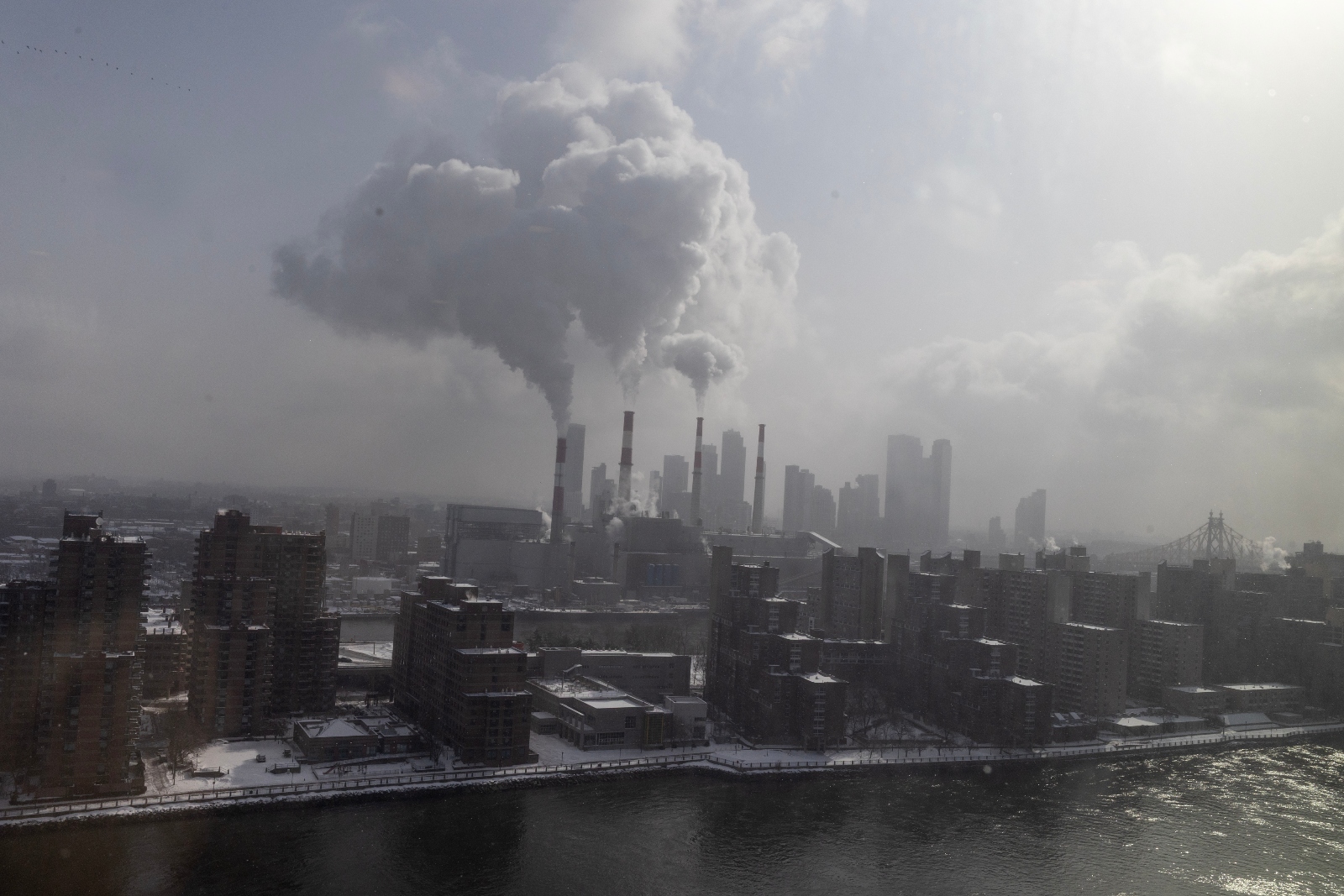
Steam rises from the smokestacks of the Ravenswood Generating Station, the largest power plant in New York City. The state has struggled to build out enough clean power to replace its natural gas power plants. Photo by Andrew Lichtenstein / Corbis via Getty Images
Finding clean sources of electricity to replace gas-fired power plants has also been an uphill battle. A new transmission line carrying clean power from hydropower dams in Canada down to New York City will come online this month, but it was delayed for years by litigation and environmental permitting. Two major offshore wind farms, Empire Wind and Sunrise Wind, will also come online this year, despite the Trump administration’s attempts to block them. But they will only displace a fraction of the state’s gas supply, and won’t provide much power in the summer when demand is highest. (Coastal winds tend to be calmest in the summer when the oceans are hot and there are fewer storms.) Plus, developers have shown little interest in building more offshore wind farms due to Trump’s opposition.
Some of the challenges, however, are of the state’s own making. The state made its own electricity grid much more polluting when it closed the Indian Point nuclear power plant in 2011 due to environmental concerns. After the plant closed, the state had to import more gas to make up the loss.
The borough of Brooklyn, where residents who live near seasonal power plants complain of asthma and respiratory conditions, shows just how difficult this transition is. The state has been trying for almost a decade to close the particularly dirty “peaker” gas plants that turn on to provide power during the hot summer months when electricity demand is highest and not enough power is available from other sources. But even once the new Hudson transmission line and Empire Wind come online, the state’s independent grid operator says New York City could still need those peaker plants to avoid blackouts come 2031.
“To me, the heart of the climate law was really to invest in our communities and reverse this legacy of pollution,” said Mitaynes, the Brooklyn assembly member who represents residents who live near such peaker plants, like the Gowanus Generation Station. She said that the delayed cap-and-trade system would have funneled 35 percent of its revenue toward disadvantaged communities. That money could help address poor air quality and support the buildout of an offshore wind manufacturing facility on the waterfront. “This law really set us up as leaders, and [Hochul] has taken this opportunity to dismantle it,” she said.
Hochul spokesperson Ken Lovett said the changes are “commonsense reforms” and that the governor “remains committed” to climate action.
“Governor Hochul has made clear her top priority is keeping the lights on and costs down for all New Yorkers,” he told Grist.
The state is still making investments in decarbonization: One state agency is investing heavily in large batteries that could store clean energy and thereby replace some natural gas capacity, and another will purchase $100 million in new renewable power this year. The state budget also increased a tax credit for New York City landlords that electrify their buildings. The budget deal also ups the proportion of future cap-and-trade revenues that will go to disadvantaged areas.
But other than that, Hochul has shown little interest in a plan for the state’s transition off of gas. Indeed, she appears to have decided that the state will need gas for the long run. Last year she approved water permits for a new Trump-backed pipeline project that will carry natural gas from Pennsylvania to Queens. The pipeline endorsement was part of a deal to protect the Empire Wind project from Trump’s interference, but Trump’s Interior Department attempted to stop Empire Wind a few months later anyway.
The new gas pipeline broke ground in April at a ceremony in Brooklyn attended by Trump administration Secretary of Energy Chris Wright, Interior Secretary Doug Burgum, and Environmental Protection Agency head Lee Zeldin. Hochul herself did not attend.
Oil ‘powder keg’: Trump says Hormuz blockade may last all summer
Image: AOL.com
US President Donald Trump on Wednesday tried to project optimism about reaching a deal to end the illegal war he started against Iran, even while acknowledging the crisis could last for several more months.
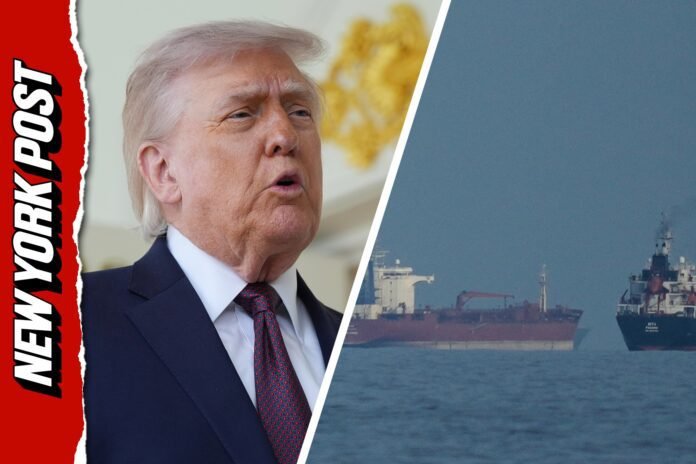
In an interview with The New York Post, Trump was asked whether the current blockade of Iran would last until Labor Day, which falls on September 7 this year.
“I don’t know,” Trump said. “I mean, I think it could be, but I think it’s unlikely.” He added, “I think this will resolve itself fairly quickly.”
The president for the last several months has managed to keep oil prices from spiking to disastrous levels by dropping hints that his illegal war will soon be over, even though it has continued with no end in sight.
And while the Trump administration has insisted that its ceasefire deal is still in effect, CNN reported on Wednesday that Iran launched attacks against US military bases in Kuwait and Bahrain after US forces fired a Hellfire missile at a Botswana-flagged oil tanker that was heading toward an Iranian port.
Iran also launched drone and missile strikes at Kuwait’s international airport, killing one person and leaving dozens injured, according to Al Jazeera.
Oil industry expert Patrick De Haan on Tuesday warned that the price of oil will soon shoot back up if the Strait of Hormuz remains closed because US petroleum supplies, which have been drained at a rapid pace since the start of the war, are about to hit their lowest level in over two decades.
“US distillate inventories will likely fall under 100 million barrels for the first time in over 20 years, exacerbated by high exports due to the closure of the Strait of Hormuz,” De Hann wrote in a social media post. “This is a powder keg waiting to go off if a deal to reopen the strait doesn’t happen soon.”
In an analysis published Wednesday, The American Prospect’s Ryan Cooper similarly warned that the tricks used by nations around the world to keep a lid on oil prices, such as releasing petroleum reserves, would soon be ineffective thanks to hard supply constraints.
“As storages dwindle and run out, the only way to match demand to supply will be for the price to rise high enough to destroy something like 10 to 20% of global oil consumption,” Cooper wrote. “And because a great deal of oil demand is obligatory and therefore not very price-sensitive, that price will likely be north of $150 per barrel.”
This would lead to not just an explosion in gasoline and diesel fuel prices, Cooper continued, but a “corresponding price hike for anything that needs to be transported, or involved in plastic in some way, which is to say basically everything.”
New social features further Plex’s evolution from media server business
Plex is adding new social features to the platform.
As of today, users can make and share “personalized lists on Plex of any movie, show or episode,” the company said in an announcement. Later this year, users will be able to import lists from other streaming services and react to other people’s lists.
This month, Plex will also launch a community forum that will allow people to “post and comment directly on any movie, show, season, or episode.” Later this year, Plex will introduce “Match Scores” based on a viewer’s history and past ratings to predict how much they’ll like a show or movie, Plex said.
Plex already lets people rate content, and this year it will also allow them to react with emoji. Similarly, Plex will also enable people to respond to reviews and discussions with images. The goal, per Plex’s announcement, is to bring “a new layer of expression to every conversation.”
Finally, a “Follow Anything” feature coming this year will provide users with alerts around movies, shows, actors, and crew members that they follow.
Plex’s announcement claimed that its users have already “made over 100 million watching decisions a month and created more than 45 million watchlists,” making the new capabilities relevant to how people use Plex today.
“The addition of these features marks the next step in Plex’s vision to unify entertainment discovery and help users navigate an increasingly fragmented streaming landscape,” Plex’s announcement said.
Plex is targeting a common challenge for streaming users: finding stuff worth watching across streaming services.
“We believe the future of entertainment discovery is social and trust-driven,” Scott Olechowski, co-founder and chief product officer at Plex, said in a statement.
Plex’s evolution
The new capabilities highlight Plex’s focus on features that go beyond its media server business.
In 2019, Plex started offering free ad-supported streaming television (FAST) channels. By 2024, Plex was selling movie rentals, a stark contrast to its original business, which focused on letting people share their own media with friends and family. The California-headquartered company has since added the ability for users to leave reviews on movies, as well as to comment on other users’ reviews.
Meanwhile, Plex’s changes have raised concerns among some users about its commitment to self-hosting. For instance, Plex last year began removing users’ ability to remotely access a personal media server without paying a subscription fee. Plex also got rid of its Watch Together feature and redesigned its app to look more like a streaming service. And starting next month, the price for a lifetime subscription to Plex’s media server features will increase from $250 to $750. When launched in 2012, the Lifetime Plex Pass cost $75.
Plex’s evolution from its legacy business seems to be paying off. The company’s marketing VP, Scott Hancock, said in 2023 that Plex has had more people using its online streaming service than its media server features since 2022. Ad-supported streaming has also been a top revenue driver for the company, which is key as it seeks profitability.
This all suggests that Plex’s expanding interest in streaming and rentals won’t end anytime soon.
Hotel Guests Warned After Hackers Access Reservation Information Across Netherlands
Hotel guests in the Netherlands are being targeted with convincing fake payment requests after criminals obtained reservation details through a data breach affecting at least 100 hotels, according to a hotel services provider.
Hospecs, a company that operates hotels and supplies services to the hospitality sector, confirmed the breach on Tuesday. The company told Dutch broadcaster NOS that stolen data includes guests’ contact details as well as their arrival and departure dates.
The source of the breach has not yet been identified. Hospecs Managing Director Tim Vissers said the vulnerability likely lies in software used by multiple hotels rather than in the hotels’ own systems.
“Between making a reservation and confirming it, there are several layers,” Vissers told NOS, referring to systems used to log bookings and set prices. “The leak seems to be in one of those.”
Hospecs said the affected hotels appear to share certain booking, channel-management or property-management systems, although it has not identified a supplier while the investigation continues.
Vissers said at least 100 hotels in the Netherlands have been affected, with additional reports coming from Belgium and Ireland. He estimated the number of impacted guests could eventually reach hundreds or thousands as investigators continue to assess the scope of the breach.
“The reports are pouring in,” he said, adding that dozens of phishing messages are being sent daily to hotel customers requesting payment for reservations.
The Dutch data protection authority, AP, said it is investigating the incident. Hospitality industry organization KHN urged travelers to carefully verify the sender of any messages related to hotel bookings.
The breach is the latest in a series of cybersecurity incidents affecting organizations in the Netherlands this year. Travel platform Booking.com warned customers of a reservation data breach in April.
Hackers have also stolen data this year from telecom company Odido, medical software firm ChipSoft and nearly all residents of the Dutch municipality of Epe.
In an earlier scam, Booking.com customers were targeted through the platform’s own messaging system using similar payment-demand tactics.
Guests with active reservations are being advised not to respond to payment requests received through messages and instead contact their hotel directly through official channels to verify whether any payment is required.
Iran war: ordinary Israelis and Lebanese remain trapped by the false promises of their leaders
When the United States and Israel began their conflict against Iran, the Islamic Republic retaliated – as it has done in the past – by launching missile strikes against Israel as well as US military basis in the region. In addition, Iran targeted military and civilian locations across several Arab Gulf states.
Iran’s proxy in Lebanon, Hezbollah, drew the country into the war on March 2 by responding to the US-Israeli attack on Iran with widespread rocket attacks on northern Israel. In turn, Israel bombarded Beirut’s southern suburbs, where Hezbollah has its power base, as well as sending troops across the border into southern Lebanon.
Lebanon’s prime minister, Nawaf Salam, reacted swiftly. He banned Hezbollah’s military wing calling its activities “illegal” and ordering the Lebanese security forces to “prevent any attacks originating from Lebanese territory”. Hezbollah ignored his call and continued to pound northern Israel, while engaging with the Israel Defense Forces (IDF) on the ground.
Both sides – the Israeli government and Hezbollah – have framed the use of military force as necessary to protect their respective communities. This is nothing new. When referring to Hezbollah during his speech at the 2024 annual gathering of the United Nations general assembly, Israel’s prime minister, Benjamin Netanyahu explicitly made this link. “Israel has every right to remove this threat,” he declared, “and return our citizens to their homes safely, and that is exactly what we are doing”.
Hezbollah’s secretary general, Hassan Nasrallah (since assassinated in an Israeli strike on Beirut in September 2024) made a similar case of using military force to defend communities across Lebanon earlier that same year. After Israel assassinated Hamas’ deputy political leader, Salah Al-Arouri, in Beirut, in January that year he said that “we cannot keep silent about a violation of this seriousness because this means that all of our people will be exposed. All of our cities, villages, and public figures will be exposed.”
Two years on, both sides continue to justify the use of military force to defend their respective communities. But this claim does not bear scrutiny. As of June 2026, communities on both sides of the Israel-Lebanon border remain highly insecure. This is despite the supposed US-brokered ceasefire between the two sides declared by Donald Trump on April 7.
Hezbollah’s attacks on Israel have resulted in civilian and military casualties as well as severe disruption to everyday life. The situation on the Lebanese side of the border is worse. Since Hezbollah drew Lebanon into the war between the US and Israel on the one side, and Iran on the other, the IDF has significantly expanded its ground offensive, reportedly resulting in more than 3,000 people killed and more than 1 million displaced.
Nevertheless, Nasrallah’s replacement as Hezbollah secretary general, Naim Qassem, has continued his predecessor’s aggressive line against Israel. Upon the onset of the current hostilities he pledged, on March 5, to “continue the fight against Israel”. In addition, he has rejected the Lebanese government’s order to refrain from attacks on Israel and refused to disarm.
In a statement on May 25 to mark Resistance and Liberation Day, the Lebanese holiday marking the anniversary of Israel’s withdrawal from Lebanon in 2000, Qassem said disarmament would destroy Lebanon’s “defensive capability and the capability of the resistance and its people, as a prelude to extermination”. He added: “Disarmament is extermination, and this is something we cannot accept.”
Ordinary lives under threat
Having clearly learned a lesson from Ukraine’s defence against Russia, Hezbollah has taken to using fibre-optic drones as their main weapon. Apart from the military and civilian casualties inflicted by these attacks, they severely threaten everyday life across the north of Israel, forcing workplaces and businesses to close and disrupting schools.
Overwhelmed and insecure, residents in northern Israel have described themselves as becoming “invisible” in the eyes of the Israeli government. A spokesperson for Lobby 1701, a northern Israel residents’ group named after UN Security Council resolution 1701, which ended the last Israeli occupation of southern Lebanon and was supposed to ensure the demilitarisation of the region, told Israeli news outlet Ynet Global that people in northern Israel felt abandoned by their government: “Why does no one care even a little when a drone hits a children’s bus stop in Shomera, compared with if that same drone had, God forbid, hit a children’s bus stop in Tel Aviv?”
Israeli civilians take refuge from Hezbollah reocket attacks in a shelter in Kiryat Shmona, near to the Israeli-Lebanon border, March 2026.EPA/Atef Safadi
Hezbollah’s pledge to “defend” its communities through its military operations have clearly utterly failed and a majority of Lebanese people favour the group disarming. One Lebanese politician from a party which opposes Hezbollah, told journalists: “I have never seen a so-called resistance movement that is supposed to liberate the country from the occupier, do everything it can to give the occupier a pretext to send even more troops and create a buffer zone. If they want to commit suicide, let them go to their master in Tehran, far from Lebanon.”
Captives of conflict
Thus, ordinary Israelis and Lebanese remain captive to the false promises of their leaders. The continued reliance on military force has brought neither side greater security. Instead, it has deepened their vulnerability.
The only sustainable path out of this deadly cycle is a diplomatic and political settlement along the lines laid down in resolution 1701 – but with stronger security guarantees – which people on both sides of the border need and deserve.
Yet the government of Israel and Hezbollah’s leadership remain committed to rigid ideologies and political calculations – domestic and international – that prevent such an agreement. Meanwhile, their communities continue to bear the cost.
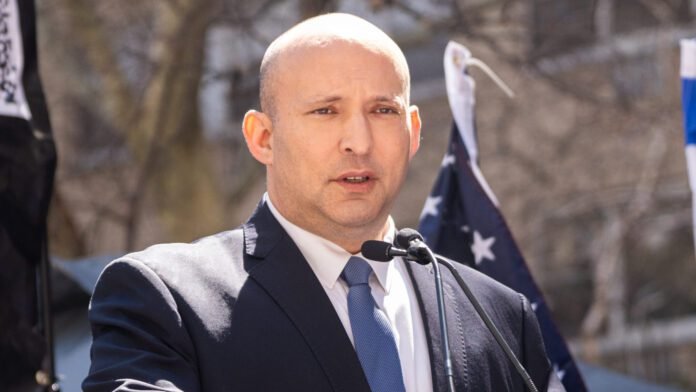
Bennett Pitches ‘From Tribes to a People’ Education Reform Ahead of Election
Former Prime Minister Naftali Bennett unveiled a proposal for a unified national education framework on Tuesday, describing it as a plan to create a shared educational foundation for all children in Israel.
Speaking at the Israel Democracy Institute’s Eli Hurvitz Conference on Economy and Society, Bennett presented what he called the “From Tribes to a People” plan, which he said would be implemented under a future government led by him.
Naftali Bennett and Yair Lapid currently lead Together, a joint political alliance formed ahead of Israel’s next election. Bennett heads the alliance, which was created through the merger of his Bennett 2026 party and Lapid’s Yesh Atid.
Israel’s next Knesset election is currently scheduled to be held by October 27, 2026, although ongoing efforts to dissolve the Knesset could move the vote forward by several weeks.
Under the “From Tribes to People” proposal, all students would study a common curriculum that includes Hebrew, English, mathematics, civics, Torah, and Jewish and Zionist tradition. Bennett said Muslim students would have the option of studying the Quran instead of the Torah.
“I am proud to unveil before you the most important plan that we will implement in my government: the ‘From Tribes to a People’ plan, to establish one state (public) education system for all the children of Israel,” Bennett said.
“This will work according to a 60–40 method: 60 percent will be the shared subjects that everyone studies, and 40 percent — each community will be able to expand according to its wishes,” Bennett said.
According to Bennett, schools and local authorities would receive greater autonomy over the portion of the curriculum not included in the shared core, while the Education Ministry would focus on policy and oversight.
Bennett said the initiative goes beyond traditional discussions surrounding core educational requirements.
“For all these years we said, ‘Let them study mathematics and English.’ No—that is not enough. They need to receive both the tools and the values to be part of a Jewish and democratic state,” he said.
The former prime minister said the proposal would seek to create a common civic and cultural foundation across Israeli society.
“The children of Israel will study both Einstein and Maimonides. All Israeli children and all Israeli citizens will have a shared story,” Bennett said.
“This will turn us from tribes into a people: one people, diverse, colorful, and wonderful, very opinionated, but a people that has a shared story. And this is how Israel will develop resilience for generations to come.”
Lawmakers Demand Answers After the White House Initiated a $620M Loan to a Firm Tied to Donald Trump Jr.
A group of lawmakers demanded answers from the White House this week following a ProPublica investigation revealing that a top aide to the president intervened to secure a $620 million Pentagon loan to a startup linked to the president’s eldest son.
ProPublica’s reporting “reveals a staggering level of corruption and influence peddling that superseded this process, enriching the President’s son at the expense of U.S. national security and taxpayer dollars,” wrote the group of Democratic lawmakers, including Sens. Elizabeth Warren of Massachusetts, Richard Blumenthal of Connecticut and Mazie Hirono of Hawaii as well as Reps. Jason Crow of Colorado and Mike Levin of California.
Read More
Last year, the Pentagon announced the loan to Vulcan Elements, a small North Carolina startup, about three months after Donald Trump Jr.’s venture capital firm took a stake of undisclosed size in the rare-earth magnet company.
Interviews and Defense Department records reviewed by ProPublica show that the request to lend to the firm was made by Peter Navarro, who serves as the president’s senior counselor for trade and manufacturing and is a friend of Trump Jr.’s.
Of the dozens of companies the Pentagon was considering funding at the time, Vulcan’s was the only deal initiated by a top aide to the president, an official at the Pentagon who was not authorized to speak publicly told ProPublica.
After defense officials got the White House request, they asked Pentagon staff to move at an unusually rapid pace, said another person who was involved in the deal at the Pentagon but not authorized to speak about it.
“The call came from the White House: We have to get this done,” the person said.
In their letter, addressed to White House Chief of Staff Susie Wiles, the lawmakers asked a series of questions about Navarro’s involvement in the deal, including whether he intervened at someone else’s direction, if the president was aware or involved, and who Navarro communicated with at the Pentagon.
They also asked more broadly about whether White House officials have communicated with federal agency officials about other companies linked to the Trump family.
“The American public — and service members that are in harm’s way — expect that the DoD contracting process is fair, unbiased, and competitive to ensure that only the best companies, providing only the best products, receive taxpayer dollars,” the lawmakers wrote.
Navarro, who served as trade adviser in the president’s first term, and Trump Jr. have formed a close bond in recent years. The president’s son visited Navarro in prison while he served time for defying a subpoena from lawmakers investigating the Jan. 6, 2021, riot at the U.S. Capitol. Trump Jr. was one of the small group of people Navarro dedicated his latest book to for having “my back when it was against the wall.” And a week before the Vulcan deal was announced, Trump Jr. hosted Navarro on his streaming show, encouraging his nearly 2 million subscribers to buy Navarro’s book. That interview was not long after word came down from Navarro to Pentagon staff to make the massive loan to Vulcan, one of the defense officials involved in the deal said.
Asked to respond to the lawmakers’ allegations and ProPublica’s reporting, Navarro in a text message wrote “Staggering level of hyperbole. More fake news” but did not elaborate. The White House did not immediately respond to a request for comment on Tuesday.
Navarro did not respond to questions from ProPublica sent to him directly before the initial article was published. But in a post on X afterward, he called the story “fake news on steroids.”
Vulcan has not commented. A White House spokesperson had said in a statement that the administration is working “in the best interest of the American people,” adding, “The President’s entire team, including Senior Counselor Navarro and officials at the Department of War, is working together and with private industry to secure America’s critical mineral supply chain at Trump Speed.” Trump Jr.’s spokesperson said last week that the president’s son does not discuss companies he has invested in with federal government officials and did not speak to Navarro about Vulcan. He “has no knowledge about how this deal came together,” the spokesperson said. A spokesperson for 1789 Capital, the venture firm where Trump Jr. is a partner, said it also played no role in Vulcan getting the loan and did not learn about the deal before it was public.
“No company receives preferential treatment,” a Pentagon spokesperson said. “Outside affiliations, investors, or political connections play absolutely no role in the Department’s funding decisions.”
The loan was part of the Pentagon’s effort to fund companies that could help the U.S. reduce dependence on China’s critical mineral supply chains. It represented a big win for Vulcan and its investors. Estimates of the company’s valuation grew tenfold after the deal was announced.
The deal is one of many actions by the administration of President Donald Trump that have helped companies in which his family holds stakes. Government contracts and other benefits have gone to various Trump-linked companies. But ProPublica’s reporting on the Vulcan loan represented the first time the awarding of a contract from a federal agency was directly linked to White House intervention.
A number of other lawmakers also criticized the Vulcan deal following ProPublica’s investigation.
Sen. Raphael Warnock, a Georgia Democrat, called it “corruption to the highest degree,” alleging on X: “They are looting this country. Dismantling it, selling it for parts, and lining their own pockets.”
Sen. Patty Murray, a Washington Democrat, called for a congressional investigation. “It’s just nonstop corruption from this White House, and Republicans in Congress are content to twiddle their thumbs and look right in the other direction,” she posted on X. “Congress should be investigating and putting a stop to this kind of crooked self-dealing—not enabling it.”
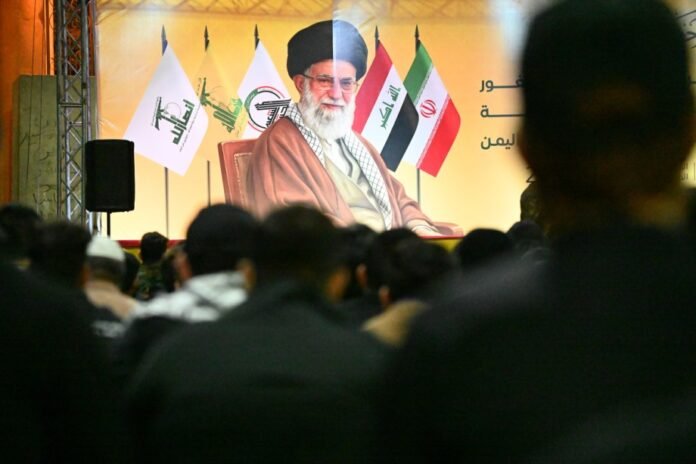
It won’t take long to understand what lies ahead for Iraq—and for the Iran‑aligned militias—after President Donald Trump appointed Tom Barrack as his Special Presidential Envoy for Syria and Iraq. All one needs is the paragraph Barrack published just hours after the announcement. He wrote that “the balance of power around which the United States operates works best when allies become more self‑reliant and share the burden—always within a framework that preserves American influence, stability, and alignment with core U.S. strategic objectives.”
That single sentence makes something unmistakably clear: Washington no longer views Iraq as a political file requiring relationship management, but as a security file requiring decision management.
The irony is that the focus on Barrack’s name obscures the real shift. The issue is not the replacement of one envoy with another, nor the illusion—long cultivated by Iraq’s militias—that U.S. policy changes every time Washington rotates a mid‑level official. That illusion fed a false sense of victory for years, as if Iraq’s fate hinged on the temperament of a bureaucrat. But Barrack is not that type. He is not a practitioner of soft diplomacy. He calls things by their real names. He insults publicly. He speaks without silk gloves.
American media have repeatedly described him as the “man for the dirty jobs” in U.S. foreign policy—one of the few capable of convincing Trump to take on complicated files personally.
Before his appointment, Politico and Axios reported that Barrack had been pushing for a “merged‑file approach” to the region: treating Iraq, Syria, and Lebanon as a single interconnected arena rather than three separate problems. Today, it seems we have moved from “quiet execution” to “execution with audible slaps.” Barrack is not a diplomat who smiles for the camera. He is the man who once described Iraq as a “failed political experiment,” Lebanon as a “farce,” and journalists in terms unfit for print. Imagine that language becoming part of U.S. policy toward the Green Zone and the militias surrounding it.
But the fixation on Barrack’s personality hides something deeper: Washington no longer sees Iraq as a political partner. It sees a malfunctioning security file. And once Iraq becomes a security file, the language shifts from negotiation to surgery—excision, not maneuvering; control, not accommodation.
This explains the panic among Iran‑aligned factions the moment Barrack’s name surfaced. He embodies a shift that is too blunt to be misread and too sharp to hide behind slogans of sovereignty.
For Iran’s parties and militias, the picture is even clearer: they are the inevitable losers. The U.S. decision to curb their dominance is not a personal whim; it is an institutional choice. Barrack is merely the executor—armed with a dose of diplomatic cruelty he is well known for.
Militias accustomed to whispered diplomacy will now face diplomacy that shouts, delivered by a man who writes messages in bold and reads them aloud.
READ: US envoy welcomes Iraqi move to place weapons under state control
Washington now treats Iraq as part of a regional network, not a standalone case that can be indulged or excused. In the eyes of the current administration, Iraq is one link in a chain stretching from Tehran to Baghdad to Beirut. The tighter the interconnection, the more likely the three files will be handled with one mind, one hand, and one envoy who neither flatters nor smiles.
This is why Barrack’s arrival is not a personnel change—it is the declaration of a new phase in which decisions are measured by their ability to break stagnation, not by their ability to appease local actors.
In an interview with The National in Abu Dhabi, Barrack abandoned even the minimal diplomatic varnish. He said the United States had “divided Iraq and Syria,” and that the Iraq invasion became “a glaring example of what should never be repeated.” He was not trying to beautify the past. He was diagnosing it: three trillion dollars spent, twenty years of fractured history, hundreds of thousands of lives lost, and, in his words, “we walked away empty‑handed.”
This is not self‑criticism. It is a policy statement: no more spending without results, no more patience for dual power between state and militia.
Iraq is entering a phase with no courtesies. Washington no longer sees Baghdad as a relationship‑management file but as a decision‑management file. The duality of power is no longer tolerable, and American patience with “state thieves” is wearing thin. The coming language will not be diplomatic—it will be direct, exposing, and perhaps wounding.
If Iraqi media celebrated the removal of Mark Savia, they may need to brace themselves. The man replacing him does not speak the language of traditional diplomacy. He speaks the language of shock.
So the question now is: who can afford to sleep in Iraq’s current landscape?
Certainly not the militias. The era of “grey understandings” is over. The era of “sharp decisions” has begun.
What awaits Iraq under Barrack is not a change of faces, but a change of rules.
OPINION: Why does Muqtada al‑Sadr expect us to believe him?
The views expressed in this article belong to the author and do not necessarily reflect the editorial policy of Middle East Monitor.