What do we know about the Ebola outbreak in Congo and Uganda?
The World Health Organization on Sunday declared an Ebola outbreak in the Democratic Republic of Congo and Uganda to be a public health emergency of international concern.
The WHO said the outbreak, caused by the Bundibugyo strain of the virus, does not meet the criteria of a pandemic emergency but that countries sharing land borders with the DRC are at high risk for further spread.
What do we know about this new Ebola outbreak and how it has spread?
WHAT IS EBOLA?
Ebola disease is a severe, often-fatal virus, which causes fever, body aches, vomiting and diarrhoea, and spreads through direct contact with the bodily fluids of infected persons, contaminated materials or persons who have died from the disease, according to the Africa Centres for Disease Control and Prevention.
This is the Democratic Republic of Congo’s (DRC) 17th outbreak since its discovery in 1976.
WHAT IS THE BUNDIBUGYO STRAIN?
Bundibugyo is a strain of the virus. According to the WHO, there have been two previous outbreaks of the strain.
The outbreak is “extraordinary” as there are no approved Bundibugyo virus-specific therapeutics or vaccines, unlike for Ebola-Zaire strains, it said.
“Unfortunately, Bundibugyo has fewer proven countermeasures than Zaire ebolavirus, where vaccines have been highly effective in controlling outbreaks,” said Amanda Rojek, Associate Professor of Health Emergencies, Pandemic Sciences Institute at the University of Oxford, in a statement.
WHICH COUNTRIES HAS IT SPREAD TO?
The governments of the Democratic Republic of Congo (DRC) and Uganda have confirmed cases, with the outbreak most severely affecting the DRC.
The Africa Centres for Disease Control and Prevention said on Sunday it was coordinating with South Sudan to monitor cross-border activity and limit further international spread.
HOW MANY PEOPLE HAVE BEEN AFFECTED?
The WHO said on Sunday that eight lab-confirmed cases were recorded, 80 suspected deaths and 246 suspected infections.
Another case in Goma, the eastern DRC town controlled by M23 rebels, was confirmed in a statement released by them on Sunday.
Ugandan officials also confirmed a second case on Sunday.
The WHO, however, warned that “there are significant uncertainties to the true number of infected persons and geographic spread associated with this event at the present time”.
There is a moment in every great geopolitical confrontation when the outcome becomes structurally inevitable — long before anyone is willing to announce it.
Rome understood this when Germanic tribes stopped retreating. Britain understood it in 1947, standing in Delhi with empty hands. America understood it somewhere between Fallujah and Kandahar, though it took another decade of bleeding to say so publicly.
We are living inside one of those moments right now, and almost nobody in the rooms where decisions get made will admit it.
Iran has won. Not on the battlefield so much as strategically. And the proof is not found in missile counts or casualty figures — it’s found in the singular, undeniable fact that both Washington and Tel Aviv are more afraid of what Tehran does next than of anything Iran has already done.
That fear is rational. Understanding why it’s rational requires setting aside the comfortable theater of press conferences and congressional hearings, and looking at what has actually been constructed over the past four decades.
Architecture of patience
The Iranian Revolutionary Guard Corps did not spend 20 years building an army. It built something far more dangerous: an architecture of distributed, self-replicating network of proxies, tunnel systems, drone factories, missile stockpiles and intelligence assets stretching from Beirut to Sanaa. And it was built not by reactive improvisation, but by design.
Game theorists call it second-mover advantage. Most conventional military thinking obsesses over the first strike — the shock, the dominance, the psychological impact of hitting first. America has perfected this via its “shock and awe” campaigns of precision bombing and decapitation strikes. It’s a brilliant playbook against an enemy that fights by the same rulebook.
Iran, however, never agreed to that rulebook. Instead, Iran studied the one lesson that Vietnam, Iraq and Afghanistan screamed at anyone willing to listen: America wins battles but loses wars.
Firepower decides battles, but will decides wars. And a nation fighting for its survival generates a depth of will that a nation fighting for its credibility simply cannot match. That asymmetry — quiet, structural, almost invisible in a single news cycle — is the engine driving everything in the Iran war.
Collapse of Israeli deterrence
Consider what Israeli deterrence actually rests upon. For decades, the architecture was elegant: strike us, and the cost will exceed any conceivable gain.
It worked magnificently against Egypt in 1973, against conventional adversaries with fixed addresses and governments that needed to keep their wobbly economies intact. Deterrence is a transaction. It requires the other party to have something they desperately fear losing.
But what do you threaten to destroy when the entity has no single neck to collar? When Hezbollah loses a commander, the command disperses.
When Hamas loses a tunnel, three more are dug. When Iranian assets in Syria are struck, they move. Israel has been bombing the same supply lines for 15 years, but the lines still run.
That is not a military failure — it’s a conceptual one. The deterrence model was built for a world that Iran methodically dismantled.
The threshold doctrine
And then there is the nuclear question, which the Western press routinely reduces to a binary — does Iran have the bomb or not — when the actual strategic reality is considerably more sophisticated than that.
Iran does not need the bomb – it needs the threshold. North Korea understood this. Pakistan understood it. Israel has quietly practiced it for 50 years without ever officially declaring its arsenal.
The doctrine is called calculated ambiguity, and its logic is brutal in its simplicity: a state that might have nuclear capability is more strategically paralyzing than a state that definitively has it.
Once you cross the threshold openly, the deterrence math reasserts itself and everyone knows the rules. A state existing permanently at 90% capability forces its adversaries into frozen uncertainty — wondering whether to strike, whether they are already too late or whether confrontation itself could trigger the very outcome they fear.
Uncertainty is Iran’s most powerful weapon precisely because it costs nothing to maintain and everything to respond to. This is why regime change remains structurally off the table, though no American official will say so clearly.
What was done to Saddam Hussein’s Iraq cannot easily be repeated against a nuclear threshold state. Nor can the Libyan model that removed Muammar Gaddafi be replicated under such conditions.
There has never been a successful regime change achieved from the air alone — not once in the history of modern warfare. The only path runs through ground troops, and the prospect of infantry operations against a state weeks from nuclear capability produces something in Washington’s war rooms that functions very much like operational terror.
The Hormuz lever
The Strait of Hormuz deserves more serious treatment than it typically receives. Twenty percent of global oilsupply moves through a waterway, at its narrowest, 39 kilometers wide. Iran does not need to close it. Closure would be an act of war with immediate, unified international response.
Instead, Iran only needs to make it unreliable, jacking up insurance premiums that make commercial passage unviable. A tanker struck every few weeks has the desired effect: quiet, deniable and economically catastrophic — and perfectly calibrated to fracture the coalition supposedly united against Tehran.
The Gulf states, Japan, South Korea and Germany — their opposition to Iran evaporates the moment the economic pain becomes personal. Iran has done that arithmetic carefully and knows the numbers better than Washington’s strategists do.
History is unambiguous about what happens when empires reach the limit of their effective power. They don’t accept stalemate — stalemate is psychologically and politically unbearable for ruling classes that have built entire identities around dominance. Rather, they escalate by reaching for the next instrument of force, not because escalation constitutes a strategy, but because it delays the moment of reckoning.
Every additional airstrike, every new sanction, every assassination that fails to produce submission functions not as pressure but as accelerant — hardening Iranian resolve, legitimizing the program in the eyes of the Iranian public and recruiting the next generation of fighters with grievances now written into lived experience.
Iran has survived 45 years of sanctions, isolation, assassination and bombardment and the regime is still there. That single data point contains more strategic information than 1,000 intelligence briefings.
Patience, in Persian strategic culture, is not so much temperamental as it is doctrinal. And history — genuinely, consistently and without exception — bends toward the patient.
M A Hossain is a senior journalist and international affairs analyst, based in Bangladesh.
BMW sends off the 6th-gen M3 CS with a manual gearbox, rear-wheel drive
The march of time, and what counts for progress in the automotive industry, has not been particularly kind to the driving enthusiast. Our vehicles have gotten bigger and heavier. Touch-sensitive panels and screens replaced buttons. Steering feel evaporated about a decade ago. And if you’re a fan of changing your own gears with a stick shift and three pedals, things have been looking bleak for a while now. Which makes BMW’s send off for its current sixth-generation M3 so notable.
BMW’s M division kept the six-speed manual alive for the G80 M3, but only the normal version. If you wanted the more powerful, much torquier M3 Competition or the track-focused M3 CS (Competiton Sport) the only transmission choice was an eight-speed automatic. That automatic happens to be the excellent ZF 8HP gearbox, and for being fast on track, I’d still choose it, because that makes left-foot braking easier.
Using paddle shifts might be faster, but I won’t pretend it’s more engaging than co-ordinating the movement of a gearstick through its gate, timed properly to the action of the clutch—especially if you’re heel-and-toeing, but even if you use the auto-blip feature that revs the engines for you on downshifts now. BMW appears to recognize that too, because it says the 2027 M3 CS Handschalter is designed for maximum driver engagement, and just for North America.
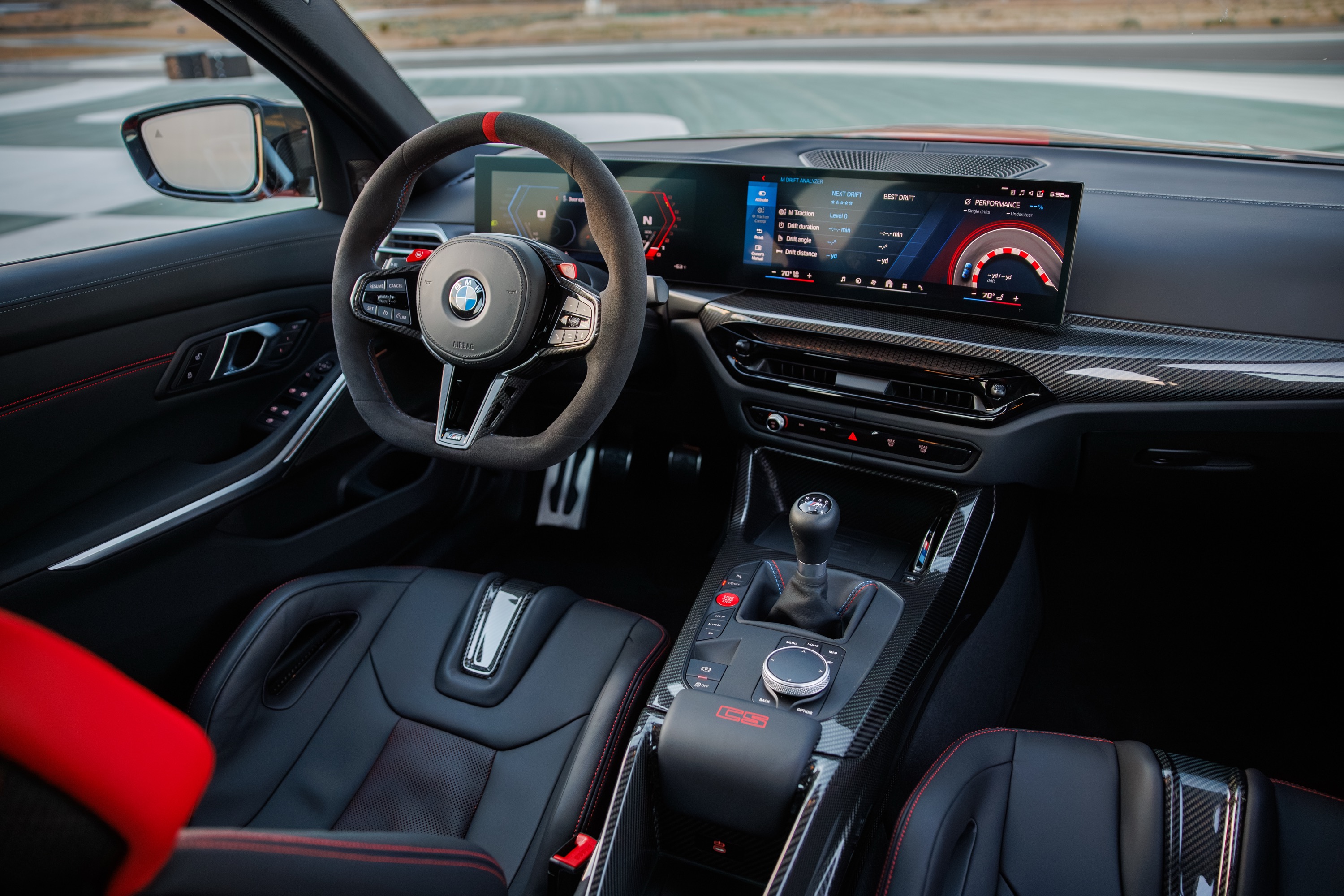
Yes, that is a big carbon-fiber hump in the middle of that seat.
BMW
Yes, that is a big carbon-fiber hump in the middle of that seat. BMW
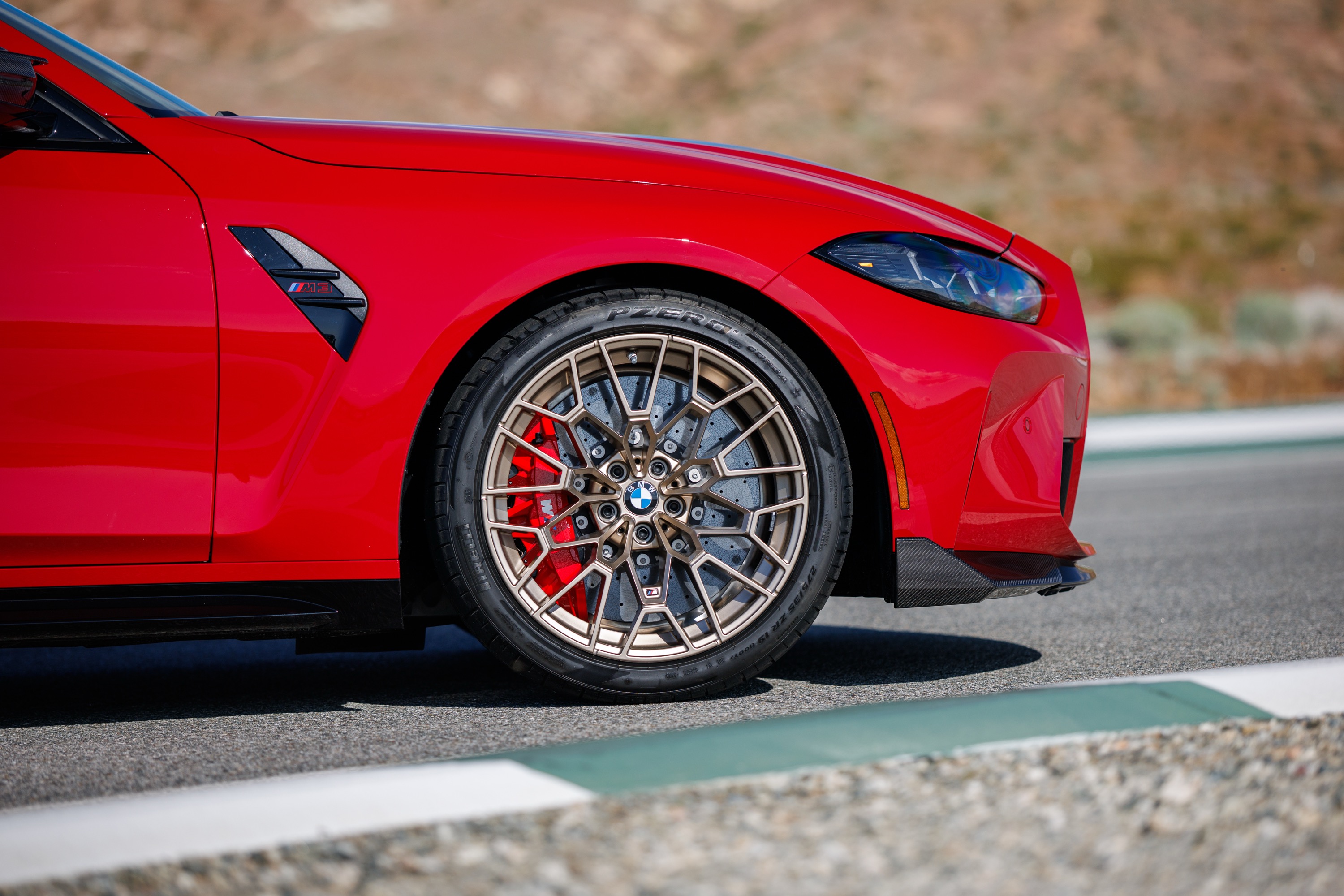
New, lighter wheels.
BMW
New, lighter wheels. BMW
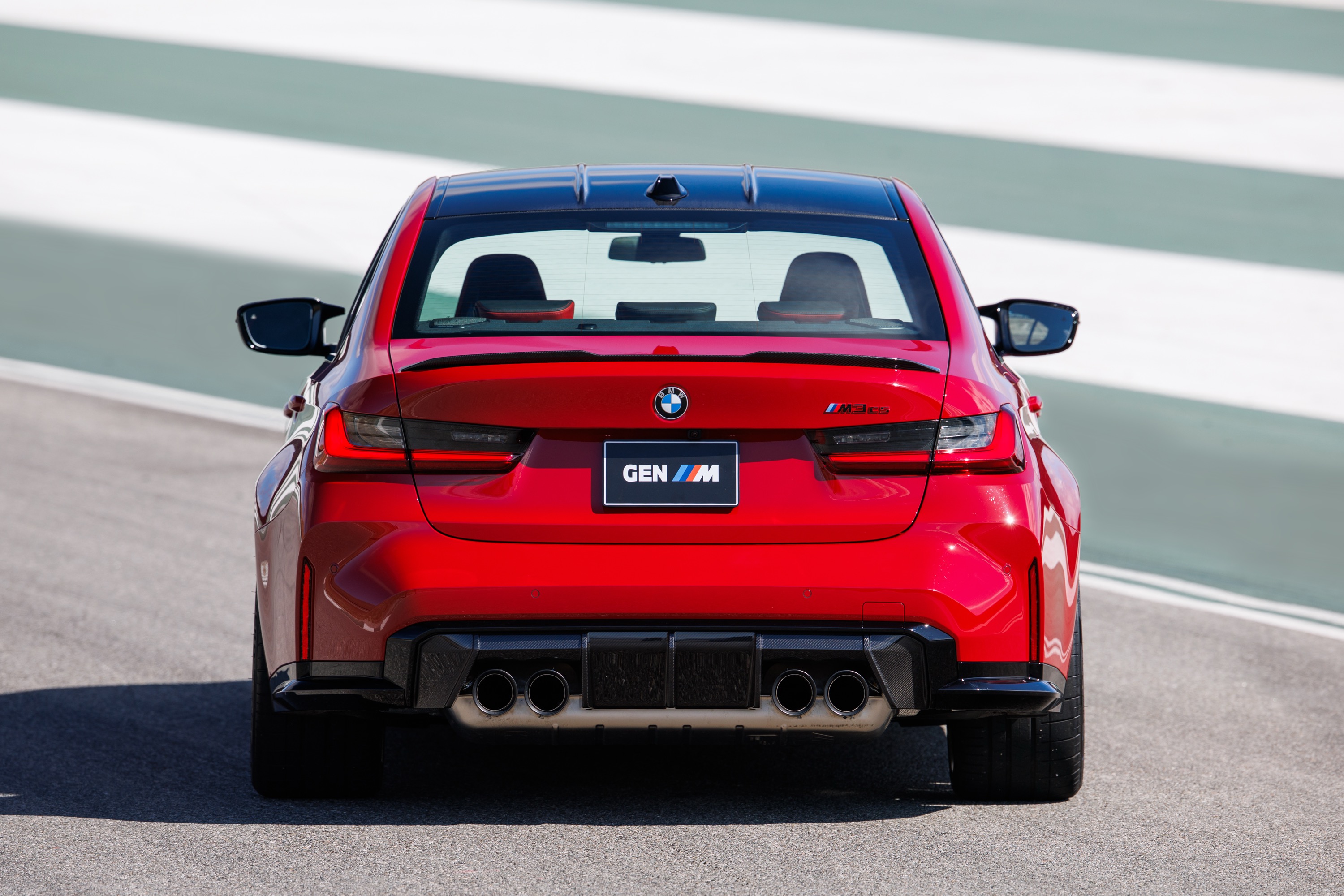
Imola red paint is a $4,500 option.
BMW
Imola red paint is a $4,500 option. BMW
New, lighter wheels. BMW
Imola red paint is a $4,500 option. BMW
The $107,100 M3 doesn’t use the more powerful engine from the M3 Competition, but the same 473 hp (353 kW) inline six-cylinder engine as the regular six-speed M3. But it’s a lighter car, to the tune of about 75 lbs (34 kg) thanks to things like a titanium exhaust muffler, carbon-fiber seats, carbon ceramic brakes, lighter wheels, and plenty of carbon-fiber reinforced plastic for body panels. And instead of the ZF 8HP, there’s a six-speed manual, which sends its power to the rear wheels and the rear-wheels only: There’s no xDrive AWD here, unlike the M3 Competition.
BMW M’s next major work will be next year’s all-electric quad-motor M3, derived from the Neue Klasse i3. And we can’t imagine there’s no three-pedal version of that one in the works, sadly.
The M3 I really want
In BMW’s briefing materials for the M3 CS Handschalter, it notes that the 3.0 L S58 engine is also used, in modified form, in the BMW M4 GT3 Evo that won the Rolex 24 at Daytona this year. BMW has had a fair degree of success with the M4 GT3 Evo, as it also won last year’s Nurbürgring 24, among other races. But the only M race car with an S58 engine anyone cared about at this year’s N24 started life as an April Fool’s joke.
As 24-hour races go, the N24 is certainly unique. Le Mans and Daytona have faster prototypes among the GTs. Spa-Francorchamps is just GT3, but more than 70 of them on track together. But the N24 combines everything from GT3 cars down to Volkswagen Golfs, and does so across not just the modern F1-grade GP Circuit but also the entire stretch of the Nordschleife, with its narrow straights, crests, drops, and dozens of blind corners. Watching driver onboards are frankly terrifying, given the speed differentials.
The BMW M3 Touring at the N24.
Christian Kaspar-Bartke/Getty Images
The BMW M3 Touring at the N24. Christian Kaspar-Bartke/Getty Images
I do wonder if the car handled a bit differently thanks to a higher, farther-back center of gravity.
Silas Stein/picture alliance via Getty Images
I do wonder if the car handled a bit differently thanks to a higher, farther-back center of gravity. Silas Stein/picture alliance via Getty Images
The M3 Touring looked amazing in its race livery.
Silas Stein/picture alliance via Getty Images
The M3 Touring looked amazing in its race livery. Silas Stein/picture alliance via Getty Images
I do wonder if the car handled a bit differently thanks to a higher, farther-back center of gravity. Silas Stein/picture alliance via Getty Images
The M3 Touring looked amazing in its race livery. Silas Stein/picture alliance via Getty Images
This year’s race had a pair of stars. Max Verstappen took time off from his F1 job, got his Nürburgring race permit, and then showed that he could absolutely cut it with the world’s best sportscar drivers on the world’s most challenging racetrack. Even if you’re a Verstappen hater, it’s worth watching some of his onboard footage from the race just to see a master at work.
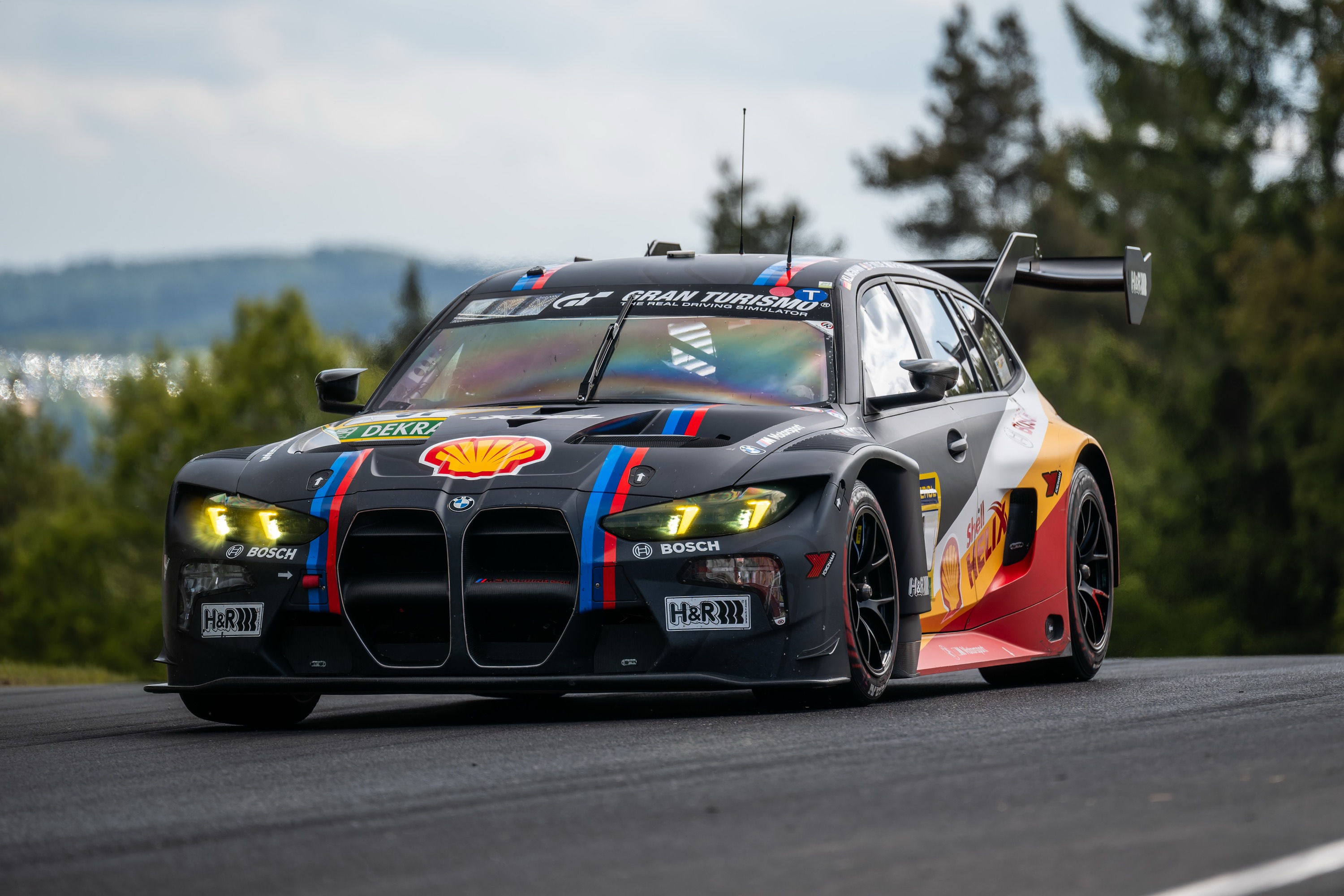
But Max wasn’t the only headline attraction, because he had to share plenty of attention with the BMW M3 Touring. Originally thought up as a joke last year, overwhelmingly positive feedback meant BMW had to make it a reality for 2026. The powertrain is identical to the M4 race car, but the M3 Touring bodywork is unique. And just look at it!
Although the M3 Touring only qualified 22nd overall, it moved forward quickly and spent much of the race in contention—if not for a win, then a podium.
Michael Jackson’s Friend Drops Chilling Bombshell That Could Rewrite His Tragic Story
Michael Jackson’s tragic childhood is back under the spotlight after one of the late singer’s close friends made explosive new claims about the King of Pop’s past.
According to Emmy-winning producer Geoffrey Mark, Jackson privately admitted he had been “inappropriately touched” by an adult while growing up as a child star — but shockingly did not even view it as abuse.
Mark claimed the Thriller singer had become so emotionally conditioned by what happened to him that he described the disturbing acts as simply “playtime.”
The bombshell allegations are resurfacing just as audiences around the world are flocking to see Michael, the smash-hit biopic chronicling Jackson’s rise from pint-sized Motown sensation to global superstar.
But while the film focuses heavily on his legendary music career, it avoids diving into the darker controversies that haunted Jackson for decades — including the many accusations involving young boys and the emotional trauma Mark now says shaped the singer’s entire life.
“Michael told me he experienced abuse as a kid,” Mark revealed during a recent interview.
But according to the producer, Jackson never used words like “abuse” or “molestation” because he genuinely believed what happened to him was normal.
“It was playtime,” Mark recalled Jackson saying.
The producer claimed the disturbing conversations happened during private dinners and gatherings at the Los Angeles mansion of celebrity dermatologist Dr. Arnold Klein in the late 1990s and early 2000s.
Mark said the topic came up after he shared his own painful history of childhood sexual abuse.
What stunned him most, he said, was Jackson’s reaction.
“He looked confused that I was upset about it,” Mark explained. “Like he thought this was something natural that happened to children.”
The revelations are likely to reignite fierce debate over Jackson’s troubled relationships with children later in life.
Over the years, multiple former child companions — including Wade Robson and James Safechuck — publicly accused the singer of grooming and molestation. Jackson repeatedly denied the allegations before his death in 2009 and was acquitted during his explosive 2005 criminal trial involving accuser Gavin Arvizo.
Mark insists he is not claiming Jackson was “evil” or intentionally predatory.
Instead, he believes the superstar remained emotionally frozen in childhood after years of trauma, fame and isolation under the control of his strict father, Joe Jackson.
“Michael didn’t know what was right and wrong emotionally,” Mark claimed. “He was trying to recreate the kind of childhood experiences he thought were normal.”
Jackson famously spoke for years about the beatings and emotional torment he suffered growing up in Gary, Indiana while performing with the Jackson 5.
His sister, La Toya Jackson, also accused their father Joe of abuse during interviews in the 1990s before later walking back those claims.
Mark now believes those traumatic early years may also explain Jackson’s later struggles with addiction.
“It’s common for people with childhood trauma to turn to drugs or alcohol to numb the pain,” he said.
Despite the shocking claims, Mark said he stayed silent for years because of the sensitive nature of Jackson’s life and legacy.
“I never made money off this,” he said. “I kept it private because addiction and trauma are complicated.”
Even nearly two decades after his death, Michael Jackson remains one of the most controversial figures in music history — celebrated as a once-in-a-generation performer while still shadowed by disturbing accusations that continue to divide fans around the world.
Trump’s ‘cordial’ Beijing trip has not changed superpower rivalry
Donald Trump’s appraisal of his recent state visit to China was, typically, positive and self-regarding. At the end of the trip, the US president told reporters that it had achieved “a lot of good” and “fantastic trade deals” had been signed. He concluded that a lot of different problems were settled “that other people wouldn’t have been able to solve”.
As usual, the US president appeared to enjoy the pageantry of a state visit. He likes meeting other “great” leaders – strongmen who lead powerful countries.
At face value, the trip appeared largely successful. The Trump-Xi relationship appeared cordial. There were no undiplomatic comments by Trump. Xi described it as “a milestone visit” of “historic” proportions. Trump said that his relationship with Xi is “a very strong one”. China pledged to buy 200 Boeing aircraft and also committed to buying billions of dollars of soybeans and other agricultural goods. These are all things Trump can present as wins, even if their significance is disputed.
The cordiality of the visit was a contrast to the Biden years, when “extreme competition” with China – in Biden’s words – was the central organising principle of US foreign policy. The Biden administration viewed China as a once-in-a-generation challenger to US power: politically, economically, militarily and ideologically. It believed Beijing was aggressively trying to displace the US as the world’s dominant power and actively sought to prevent this.
Over the past year, the second Trump administration has shifted attention away from great power conflict with China and focused on other things. These have included regime change in Venezuela (and, all the signs suggest, Cuba is now in his sights). He has changed America’s relationship with Europe, introduced an at-times erratic regime of tariffs in an attempt to address US trade deficits. And, above all, he has started a war with Iran.
Ely Ratner, a China hawk from the Biden administration has accused Trump of “strategic deference” towards Beijing. And there can be little doubt that the Trump administration has dialled down the Cold War-style ideological rhetoric about China.
Its 2025 national security strategy stresses that: “We seek good relations and peaceful commercial relations with the nations of the world without imposing on them democratic or other social change that differs widely from their traditions or histories.” This much was evident from Trump’s visit. Unlike Biden, Trump did not publicly raises human rights issues on his trip to China. This removed a persistent irritant in the relationship.
That said, the US Congress – and many of those around the president – still see the relationship with China as fundamentally competitive and adversarial. They want the US to remain the world’s primary power, militarily, economically and technologically. The desire to out-compete China is likely to drive policy in the longer-term.
The 2026 national defense strategy, published in January, states that Washington will be “clear-eyed and realistic about the speed, scale, and quality of China’s historic military buildup” and will “prevent anyone, including China, from being able to dominate us or our allies”. The strategy commits the US to deterring a Chinese invasion of Taiwan by keeping “a strong denial defense along the First Island Chain” north and south of Taiwan. The US secretary of state, Marco Rubio, who accompanied Trump to Beijing, confirmed that US policy on Taiwan has not changed as a result of the leaders’ meeting.
The Trump administration’s approach is driven primarily by economic interests. This is because it believes that “the Indo-Pacific will soon make up more than half of the global economy” and, according to the defense strategy: “Were China… to dominate this broad and crucial region, it would be able to effectively veto Americans’ access to the world’s economic center of gravity.”
US Navy Wasp-class amphibious assault ship USS Boxer on exercise in the Pacific.MCS Trace Gorsuch/U.S. Navy Photo/Alamy Live News
This means the Trump administration will try to preserve the giant US military presence in Asia Pacific that the Chinese see as encirclement.
‘Conscious de-coupling’
The US president remains a mercurial character who can make unpredictable decisions. He likes to tout his prowess as a dealmaker and it is always possible that he could undermine the consensus view within his own government. But the US Congress is also firmly behind the drive to out-compete China and to “decouple” in advanced technology.
In July 2025, the bipartisan “One Big Beautiful Bill” Act (OBBBA) included US$58 billion (£43.5 billion) of federal investments in, and tax incentives for, AI production inside the US. These measures barred “prohibited foreign entities” from US supply chains. In 2018, Congress passed strict new export controls and investment restrictions into law to try to decouple from China in emerging new technologies. The House Select Committee on China is pushing for more of this.
Over the past year, the Trump administration launched a new strategy for rare earth metals. China’s dominance of the mining and processing of these metals is a huge advantage – they are critical to modern weapons systems and widely used in electronics, from smartphones to EVs.
In April 2025, Beijing began to impose export controls on rare earths in response to US tariffs. Since then, the US has launched a US$7.3 billion global effort to secure supplies of rare earths outside China and invest in domestic mining and processing capabilities. While this will take years to come to fruition, the goal is to speed up decoupling from China in rare earths – hardly a sign of trust.
Finally, Trump reportedly refused to extend the trade truce signed in October 2025 until the end of his administration as he believed he would lose leverage over China in future. It’s a clear sign that even he expects tension in future.
The Trump administration says that, unlike its predecessors, it is not looking for conflict with China. But its insistence on US dominance of Asia Pacific is likely to drive competition with China in the long-term.
“We are a sovereign country that does not wish to take part in illegal wars,” Sánchez said. U.S. President Donald Trump responded by threatening a full trade embargo against Spain.
Weeks later, Italian Prime Minister Giorgia Meloni – Trump’s closest European ally and the only EU head of government invited to his second inauguration – broke publicly with Washington.
“When we don’t agree, we must say it,” she said. “And this time, we do not agree.” Rome then refused to let U.S. bombers refuel at a base in southern Italy.
These are not minor diplomatic frictions. As a scholar of alliance politics and nuclear security, I see something much larger than a tactical disagreement. The Iran war’s most consequential casualty may not be in Tehran. It may be American credibility as an ally, and with it, the trans-Atlantic alliance itself.
The Iraq comparison misleads
The initial U.S. and Israeli strikes on Iran were launched with virtually no advance consultation with European allies. The Trump administration treated NATO partners not as participants in strategic decision-making but as logistical infrastructure to be commandeered or punished for refusing assistance.
The reflex in Washington has been to read this as a rerun of 2003, when France and Germany opposed the Iraq War. In January 2003, Defense Secretary Donald Rumsfeld dismissed France and Germany as “old Europe” while courting the postcommunist “new Europe,” including Poland, the Czech Republic and Hungary.
On the surface, the parallel is tempting: a unilateral American war in the Middle East, European refusal to participate, trans-Atlantic recriminations.
Protesters against the Iran war carry placards in Rome on March 28, 2026, depicting U.S. President Donald Trump, Italy’s Prime Minister Giorgia Meloni and Israeli Prime Minister Benjamin Netanyahu.Tiziana Fabi/AFP via Getty Images
But the comparison conceals more than it reveals. In 2003, the United States wanted Europe in its coalition. The George W. Bush administration sought United Nations authorization, courted allies and treated European refusal as a problem to be managed.
The deeper difference is structural. In 2003, the trans-Atlantic alliance still rested on shared commitments to collective defense, open trade and an international, rules-based order.
Today, the Trump administration does not share the commitments that traditionally bound the United States to its European partners, whether on NATO, the Russia-Ukraine war, or the rules governing trade and migration.
The shared values that papered over the Iraq disagreement in 2003, and that allowed President Nicolas Sarkozy to reintegrate France into NATO’s command by 2009, are no longer there to do the work of repair.
The Iran war inverts the conditions of that lesson. In 1956, Europeans learned that they could not act independently of Washington. In 2026, they are learning that they cannot rely on Washington’s consent being available, and that the U.S. will act without them, against their stated interests and at their economic expense.
Secretary of State John Foster Dulles, left, and President Dwight Eisenhower discuss the nationalization of the Suez Canal by the Egyptian government in August 1956 at the White House.Abbie Rowe/PhotoQuest via Getty Images
The pattern is the same: Dependence on the U.S. is unsustainable, and autonomous capacity is no longer optional. What has changed is that Europe is now willing to use the financial, economic and military tools it has long possessed in ways it would not have considered before.
The strategic postures were debated for decades. The Iran war is making them operational.
This is not yet European strategic independence. Europe remains militarily reliant on U.S. air defense, satellite capacity and intelligence.
The closure of the Strait of Hormuz, for example, has forced an uncomfortable energy reckoning with American liquefied natural gas, Russian pipelines, Middle Eastern hydrocarbons and Chinese-dominated renewable supply chains. None of the available paths to energy security run through trusted partners.
France and Germany still disagree on nearly every detail of how integration should proceed. But the political condition for autonomy, a shared European belief that Washington can no longer be trusted to share strategic decision-making, has crystallized in a way that no previous crisis produced.
The post-1945 trans-Atlantic bargain traded U.S. security guarantees for European deference on global strategy. Iraq 2003 strained that bargain. Trump’s first term cracked it, and the Iran war has broken it.
What replaces it will not be a renewed partnership. It will be a parallel relationship between two powers with sometimes overlapping interests and, increasingly, separate strategic horizons.
In 1956, Europe learned how dependent it was on Washington. In 2026, it is learning that dependence is no longer sustainable.
Eleni Lomtatidze, a student in the International Relations Program at the University of Pennsylvania and at SciencesPo Paris, contributed to this story.
You are here: Home/All RECIPES/ Pineapple Bread (Moist, Tropical & Absolutely Irresistible)
There’s something truly special about baking with pineapple. The natural sweetness, juicy texture, and bright tropical flavor transform an ordinary loaf into something unforgettable. If you’ve never made homemade pineapple bread before, you’re about to discover one of the most underrated quick breads ever.
This recipe was born on a warm afternoon when one simple can of crushed pineapple sat forgotten in the pantry. Banana bread felt predictable, cake felt too heavy, and I wanted something different—something sunny, soft, and comforting. What came out of the oven was pure magic: a golden loaf with a tender crumb, rich moisture, and bursts of pineapple in every bite.
The first slice disappeared while it was still warm. The second was spread with a little butter. By the next morning, the loaf was nearly gone, and my family was already asking when I’d make another.
That’s when I knew this Pineapple Bread was a keeper.
Why You’ll Love This Pineapple Bread
✔ Incredibly moist and tender ✔ Packed with real pineapple flavor ✔ No yeast, no kneading, no complicated steps ✔ Made with simple pantry ingredients ✔ Perfect for breakfast, brunch, snacking, or dessert ✔ Freezer-friendly and great for gifting
This is the kind of recipe that feels fancy but comes together effortlessly.
Ingredients You’ll Need
Dry Ingredients
2 cups all-purpose flour
2 teaspoons baking powder
¼ teaspoon salt
⅔ cup granulated sugar
Wet Ingredients
2 large eggs
½ cup vegetable oil (or melted butter)
1 teaspoon vanilla extract
1 can (8 oz) crushed pineapple with juice — do not drain
Optional Mix-Ins
½ cup shredded coconut
½ cup chopped walnuts or pecans
These optional add-ins create even more tropical flavor and wonderful texture.
How to Make Pineapple Bread
Step 1: Prepare the Oven
Preheat your oven to 350°F (175°C).
Grease a 9×5-inch loaf pan or line it with parchment paper for easy removal.
Step 2: Mix the Dry Ingredients
In a large mixing bowl, whisk together:
Flour
Baking powder
Salt
Sugar
Mix until evenly combined.
Step 3: Mix the Wet Ingredients
In a separate bowl, whisk together:
Eggs
Oil
Vanilla extract
Crushed pineapple with all of its juice
The pineapple juice is essential—it’s what gives this bread its incredible moisture.
Step 4: Make the Batter
Pour the wet ingredients into the dry ingredients.
Gently stir until just combined.
Do not overmix—this keeps the bread soft and tender.
If using coconut or nuts, fold them in now.
Step 5: Bake
Pour the batter into your prepared loaf pan and smooth the top.
Bake for 55–65 minutes, or until a toothpick inserted in the center comes out clean.
If the top begins browning too quickly, loosely cover with foil during the final 15–20 minutes.
Step 6: Cool and Serve
Let the bread cool in the pan for 10 minutes, then transfer to a wire rack.
Slice and serve:
Warm with butter
Toasted for breakfast
With coffee or tea
As an afternoon tropical snack
Pro Tips for Perfect Pineapple Bread
Don’t Drain the Pineapple
The juice adds moisture and natural sweetness.
Don’t Overmix
Mix just until the flour disappears.
Use Room Temperature Eggs
This helps create a smoother batter.
Tent with Foil if Needed
This prevents over-browning while the center finishes baking.
Delicious Variations
Want to make it your own?
Try adding:
White chocolate chips
Macadamia nuts
Dried mango pieces
Cinnamon
A pineapple glaze made with powdered sugar and pineapple juice
Storage Tips
Room Temperature
Store in an airtight container for up to 3 days.
Refrigerator
Keeps fresh for up to 1 week.
Freezer
Wrap tightly and freeze for up to 3 months.
Simply thaw overnight before serving.
Frequently Asked Questions
Can I use fresh pineapple?
Yes! Finely chop fresh pineapple and include any natural juices.
Can I make muffins instead?
Absolutely. Divide into a muffin pan and bake for 20–24 minutes.
Can I make it gluten-free?
Yes—use a 1:1 gluten-free baking flour blend.
Is it sweet like cake?
It’s sweeter than traditional bread but less sweet than cake—perfectly balanced.
Final Thoughts
This Pineapple Bread is one of those recipes that surprises everyone who tries it. It’s simple, comforting, tropical, and bursting with flavor in every soft, moist bite.
Whether you serve it for breakfast, brunch, dessert, or gift it to someone special, one thing is certain…
Cuban drone crisis: US fears Russia-China Caribbean threat
As the US confronts growing fears that Russian, Chinese and Iranian-backed drone and intelligence activities are turning Cuba into a new strategic pressure point near US territory, the island is reemerging as a focal point of great-power rivalry in the Western Hemisphere.
This month, Axios reported that US officials are increasingly concerned that Cuba’s growing military drone program, backed by Russian and Iranian support, could endanger the US naval base at Guantanamo Bay, US military vessels and even Key West, Florida, according to classified intelligence.
The report stated that Cuba has obtained over 300 drones with different capabilities since 2023. These drones have been distributed at key locations across the island, and Cuba has been seeking more systems from Russia in recent weeks.
US CIA Director John Ratcliffe reportedly traveled to Havana to warn Cuban officials against hostile actions, as the US weighs additional sanctions and legal measures against Cuba’s leadership. US officials said Iranian military advisers in Cuba and Russian and Chinese intelligence facilities on the island have heightened fears that Cuba is becoming a platform for adversaries near US territory.
US Defense Secretary Pete Hegseth informed Congress that foreign intelligence activities in Cuba have been a longstanding concern. Cuba did not deny possessing attack drones, saying it had the right to defend itself under international law and accusing the US of fabricating pretexts for aggression.
While US officials said Cuba is not considered an imminent threat, they warned that lessons learned from Iranian drone warfare and Cuban involvement in Russia’s war in Ukraine have increased the island’s military relevance.
For US planners, the concern is less that Cuba could conventionally challenge US power than that it could serve as a nearby platform for asymmetric disruption, surveillance and political coercion. It reflects broader anxieties over great-power rivalry and strategic influence near US territory as much as fears of any direct Cuban military threat.
Underscoring US vulnerability to drone strikes from Cuba, The War Zone noted that during the lead-up to Operation Absolute Resolve in Venezuela, many US aircraft wereparked openly in the Caribbean, potentially making them vulnerable to such strikes.
The Iran war has highlighted the destructive potential of such attacks, with the Washington Post reporting this month that Iran has hit 228 structures or pieces of equipment in US bases in the Middle East since Operation Epic Fury began in April 2026, notably destroying high-end assets, including a critical E-3 Sentry command-and-control aircraft at Prince Sultan Air Base in Saudi Arabia.
As for the role of Chinese and Russian intelligence facilities in Cuba, Matthew Funaiole and other writers mention in a December 2024 report for the Center for Strategic and International Studies (CSIS) that four such sites – Bejucal, Wajay, Calabazar and El Salao — contain equipment capable of intercepting communications, monitoring satellites and tracking military activity.
Funaiole and others stress that Cuba’s proximity to Florida allows monitoring of sensitive US military communications, rocket launches and naval operations. They also note that Russian personnel have returned to Lourdes, Russia’s largest overseas signals intelligence site.
However, Daniel DePetris argued in a January 2026 Defense Priorities report that despite renewed concerns over Cuba, the logic of Mutually Assured Destruction (MAD) that stabilized the 1962 Cuban Missile Crisis still constrains escalation today. He added that Chinese intelligence facilities on the island offer limited strategic value in a China-US conflict centered primarily in the Pacific.
Even so, responding to a relatively limited Cuban threat could impose disproportionate strategic costs on the US. A US buildup in the Caribbean — whether intended as intimidation or preparation for strikes on Cuba — could overstretch US military resources, time and strategic attention from other theaters.
Stars and Stripes noted in November 2025 that during Operation Southern Spear – the lead-up to Operation Absolute Resolve – the US deployed 20% of its operational warships in the Caribbean, leaving the Mediterranean and Middle East without a US carrier.
Despite the looming possibility of a US invasion of Cuba, Rocío de los Reyes Ramírez argues in an April 2026 article for the Spanish Institute of Strategic Studies that direct US intervention in Cuba remains unlikely in the near term, but that intervention scenarios are increasingly being normalized in political and public debate.
Reyes Ramírez says Cuba’s internal deterioration, energy crisis, protests and geographic proximity have expanded the range of conceivable US responses, including more intense forms of pressure or even intervention.
However, he stresses that domestic political constraints in the US — including voter fatigue, economic pressures, migration concerns and the political sensitivity of Florida — limit the Trump Administration’s willingness to undertake open escalation. Instead, he says that the US favors calibrated pressure, targeted interventions, selective contacts and strategic ambiguity over direct military action.
As for what may be the US’s endgame in Cuba, Claudia Zilla notes in an April 2026 report for Stiftung Wissenschaft und Politik (SWP) that the US seeks political and economic change through blockades, coercion and negotiations with ruling elites rather than with democratic actors, potentially preserving authoritarian structures under US influence.
However, Michael Bustamante writes in a recent article in The Conversation that although surveysindicate many Cubans and Cuban Americans support US intervention, such action doesn’t resolve complex issues like rebuilding institutions, restoring trust, addressing inequality, reconstructing the economy, fostering reconciliation, and negotiating among competing political visions after years of polarization and authoritarian rule.
Bustamante states that the Cuban people now must choose between reverting to a US client state or taking back control of their country’s future.
Saurabh Mishra argued in an April 2026 report for the Manohar Parrikar Institute for Defense Studies and Analyses (MP-IDSA) that an energy strategy ultimately drives US pressure on Cuba, Venezuela and Iran.
He said that the US used different threat narratives — narcotics in Venezuela, nuclear risks in Iran and hostile foreign ties in Cuba — to justify pressure campaigns aimed at opening strategically important energy sectors while curbing Chinese and Russian influence.
He says Venezuela and Iran were targeted despite posing no imminent military threat, while Cuba was elevated from a manageable sanctioned state into a “national emergency” because of its ties to China and Russia and its untapped offshore oil potential.
Mishra contends the broader objective is to secure long-term US access to oil resources, expand energy dominance and weaken rival geopolitical influence across the Western Hemisphere and Middle East.
As drone warfare and great-power rivalry spill deeper into the Caribbean, Cuba is reemerging not as a conventional military threat to the US but as a nearby arena for asymmetric pressure, intelligence competition and geopolitical confrontation.
Tel Aviv University Study Finds Why Exercise Alone Often Fails To Cut Weight
A new Tel Aviv University-led study has found that exercise alone may fail to produce major weight loss because the body compensates for added physical activity by lowering energy use elsewhere, including through changes in organ size and resting metabolism.
The study, published in Communications Medicine, was led by Dr. Tzachi Knaan as part of his doctoral work in the laboratory of Prof. Yftach Gepner at Tel Aviv University’s School of Public Health and the Sylvan Adams Sports Institute. Researchers from the University of Colorado and other Israeli laboratories also took part.
The findings address a common frustration among people trying to lose weight: regular exercise improves health and fitness, but often does not produce the expected drop on the scale.
Research team members (L-R) Prof. Yftach Gepner, Lior Friedmann and Dr. Tzachi Knaan. (Tel Aviv University)
Researchers recruited overweight participants for a 12-week supervised aerobic walking program, with sessions held four to five times a week. During the study, they tracked energy use, physical activity, food intake, body composition, and metabolic changes using advanced measurement tools.
Participants burned hundreds of additional calories each week and improved their fitness. Their fat mass decreased, and their muscle mass increased, but their overall body weight did not fall.
The researchers found that the body adjusted to the added exercise by becoming more efficient. Resting metabolic rate declined, meaning participants burned fewer calories while at rest. They also used less energy during ordinary daily movement.
One of the study’s more striking findings was a roughly 5% decrease in the volume of the liver and kidneys, organs that consume large amounts of energy. The brain did not show a similar change.
The researchers also found no meaningful rise in food intake, suggesting the stalled weight loss was caused not by eating more but by metabolic adaptation.
Dr. Tzachi Knaan said: “The human body is extremely sophisticated—it knows how to adapt itself to maintain balance. Physical activity is very important for good health, but when it comes to weight loss, it is not always sufficient on its own. The implication for the public is clear: exercise is a vital component of a healthy lifestyle—it improves fitness, reduces fat, and improves health indicators—but to see significant weight loss, it must be combined with the appropriate nutrition.”
The study reinforces the view that exercise remains essential for health but is most effective for weight loss when paired with dietary changes.
The US space enterprise is desperately waiting for Starship—will it finally deliver?
These days, one would be forgiven for forgetting that SpaceX is, at its core, a rocket company.
Consider the company’s mega deals over the last year. SpaceX paid $17 billion—more than it has spent developing every one of its rockets—to EchoStar for wireless spectrum to boost its Starlink network. It revealed plans to launch 1 million orbital data centers. SpaceX merged with xAI in a deal that valued Elon Musk’s artificial intelligence firm at $250 billion, and it announced plans to become a major computer chip manufacturer. And earlier this month, SpaceX sold an enormous amount of ground-based compute to Anthropic.
As a result of all this activity, an impending IPO will value the company at something like $1.5 or $2 trillion. That’s trillion, with a t.
So yes, one might reasonably ask what SpaceX does these days. Because all the buzz, all the Wall Street euphoria, and all the financial frisson are only tangentially related to what SpaceX cut its teeth on during its first 25 years: becoming the globally dominant player in launch. It largely concerns telecommunications and AI data services.
And yet everything SpaceX aspires to accomplish in the next quarter of a century, all of its enormous valuation, is predicated on a new launch vehicle. A rocket that, to date, has a decidedly mixed record of success. A rocket that has not flown in seven months. A rocket that, finally, may return to the skies on Wednesday.
We are speaking, of course, of Starship—a truly revolutionary rocket. If it works. And after a long period of development and three years of test flights and setbacks, it kind of has to.
“Test Like You Fly”
A few weeks ago, SpaceX released a visually stunning video that takes viewers inside its massive new Starfactory in South Texas and provides up-close views of its rockets and engines.
The “Test Like You Fly” video also outlines the development of the third iteration of the Starship rocket, V3, highlighting both advances and setbacks encountered along the way. SpaceX is distilled to its core as the exceptional engineers who are designing and testing a radically new rocket talk about the very difficult problems they’re trying to solve.
“We are not breaking laws of physics; we are just trying to leverage them as effectively as we can,” explains Jacob McKenzie, the company’s vice president for the Raptor rocket engine that powers both the first and second stage of Starship.
McKenzie says SpaceX built 600 Raptor engines as part of its V2 Starship program, a remarkable number that underscores the investment the company is making to develop a rocket that has yet to reach orbit or deliver a single payload. (To put this into perspective, NASA is spending $3.5 billion to procure two dozen comparably powered, expendable rocket engines.)
By some estimates, SpaceX has now invested $15 billion in the Starship rocket program over the last decade, funding 11 test flights, a sprawling spaceport in South Texas, a massive new factory there to support a high production rate, and expanding facilities in Florida alongside the company’s existing infrastructure in the state.
It has not gone particularly smoothly. The company conducted its initial Starship test flight in April 2023. I’m not sure anyone expected that, three years and nearly a dozen flights later, the company would still be firmly in test mode.
But it turns out that building the world’s largest and most powerful rocket and optimizing it for rapid reuse is a difficult, time-consuming task. Even for a company that prides itself on moving fast and trying to achieve the near impossible.
A very difficult 2025
SpaceX performed six test flights in 2023 and 2024, and by November of the latter year had made substantial progress. The company demonstrated the ability to launch and capture the Super Heavy first stage and completed a safe flight of the upper Starship stage, including re-lighting its Raptor engine in space, before making a controlled splashdown in a precise location.
That month, the then-general manager of the Starbase facility in South Texas, Kathy Lueders, said the company aimed to dramatically increase the vehicle’s launch cadence in 2025. “Elon would say, next year, he would love to have us have 25 missions a year,” she said during a community event. The company also planned to “capture” a Starship upper stage and conduct an orbital refueling test in that time frame.
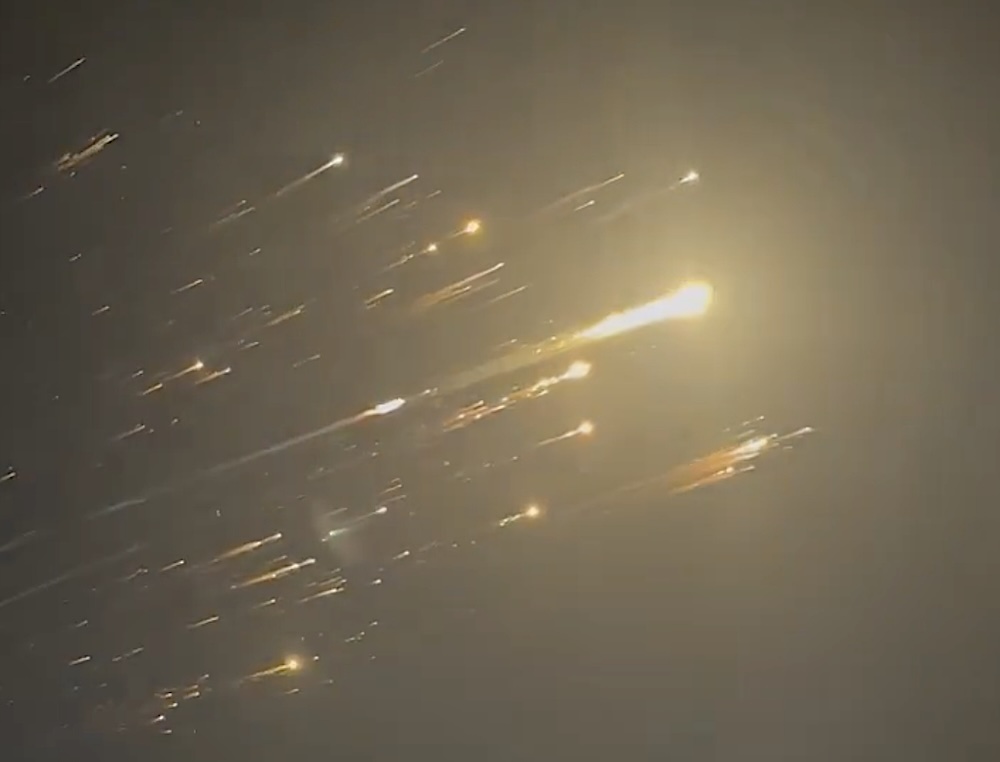
Debris from Starship falls back into the atmosphere in this view over Hog Cay, Bahamas, in March 2025.
Debris from Starship falls back into the atmosphere in this view over Hog Cay, Bahamas, in March 2025. Credit: GeneDoctorB via X
None of that happened.
The first half of 2025 was a disaster for the program. During three consecutive flights, SpaceX lost control of the Starship vehicle during ascent, often showering debris below. No one on the ground was injured, but the reentering pieces of Starship made for powerful imagery, and not in a good way for the company. The third flight of the year, the program’s ninth overall, represented a nadir for the program. In this May 27th flight, not only was the upper stage lost, but the Super Heavy booster stage also failed to make a safe return.
After standing down for three months, SpaceX returned and completed two largely successful flights of its V2 Starship before the end of the year. This provided valuable data to inform the ongoing development of the newer V3 rocket.
Even though Starship would fly no more in 2025 after the fifth flight in October, there were still setbacks. In November, during a test to ensure the V3 booster could hold pressure, the vehicle unexpectedly exploded. This booster was lost. It seemed like a fitting end to a challenging year.
This year starts slowly
Since its most recent test flight seven months ago, SpaceX has focused on building a second launch tower at Starbase with more rugged ground systems while completing the development of the V3 vehicle for flight. Time has slipped away as the launch team has encountered more issues; winter tumbled into spring, and now summer is mere weeks away.
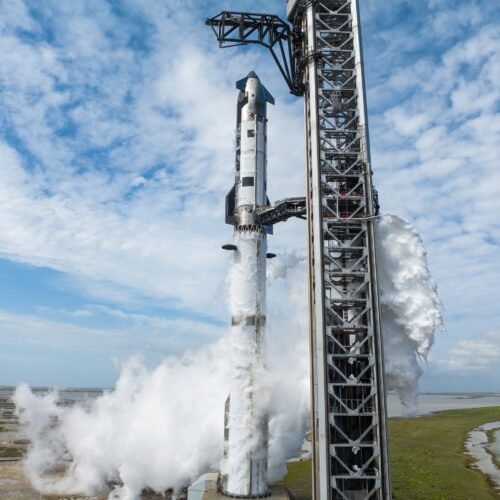
In early February, the next V3 booster successfully passed pressure testing. After it was moved to the launch pad, SpaceX planned to ignite 10 engines up to full power. But just after ignition, due to an automatic abort from the ground systems, a hard shutdown was commanded. This ended up damaging half of the Raptors.
Then, in mid-April, the company moved this booster with a full complement of 33 engines to the launch pad for another static fire test. This time, a ground-side sensor reported an issue with pressure in the manifolds, which distribute propellant to the vehicle. This may have been a spurious reading, but it ended the test early, just 1.88 seconds after ignition.
“This is such a wild ride,” said Jenna Lowe, senior manager of Starship operations, in the new video. “The highs are high. The lows are low.”
The new rocket
In many ways, this is a brand new rocket. It incorporates hundreds of lessons learned from V1 and V2 of the vehicle and seeks to improve overall performance, reliability, and robustness. This is the vehicle that should hopefully allow SpaceX to start deploying large Starlink satellites into orbit and demonstrate in-space refueling that is critical for NASA’s Artemis Moon goals.
For the booster stage, the changes begin at the bottom and continue all the way to the top.
SpaceX says that for this third version of the Raptor rocket engine, it has reduced the mass to 1,525 kg from 1,630 kg and that overall vehicle-level mass savings are nearly 1 ton per engine through simplification of the engine itself, vehicle-side commodities, and supporting hardware. The entire fuel transfer system has been redesigned. This should be more reliable and will allow simultaneous startup of all Raptors.
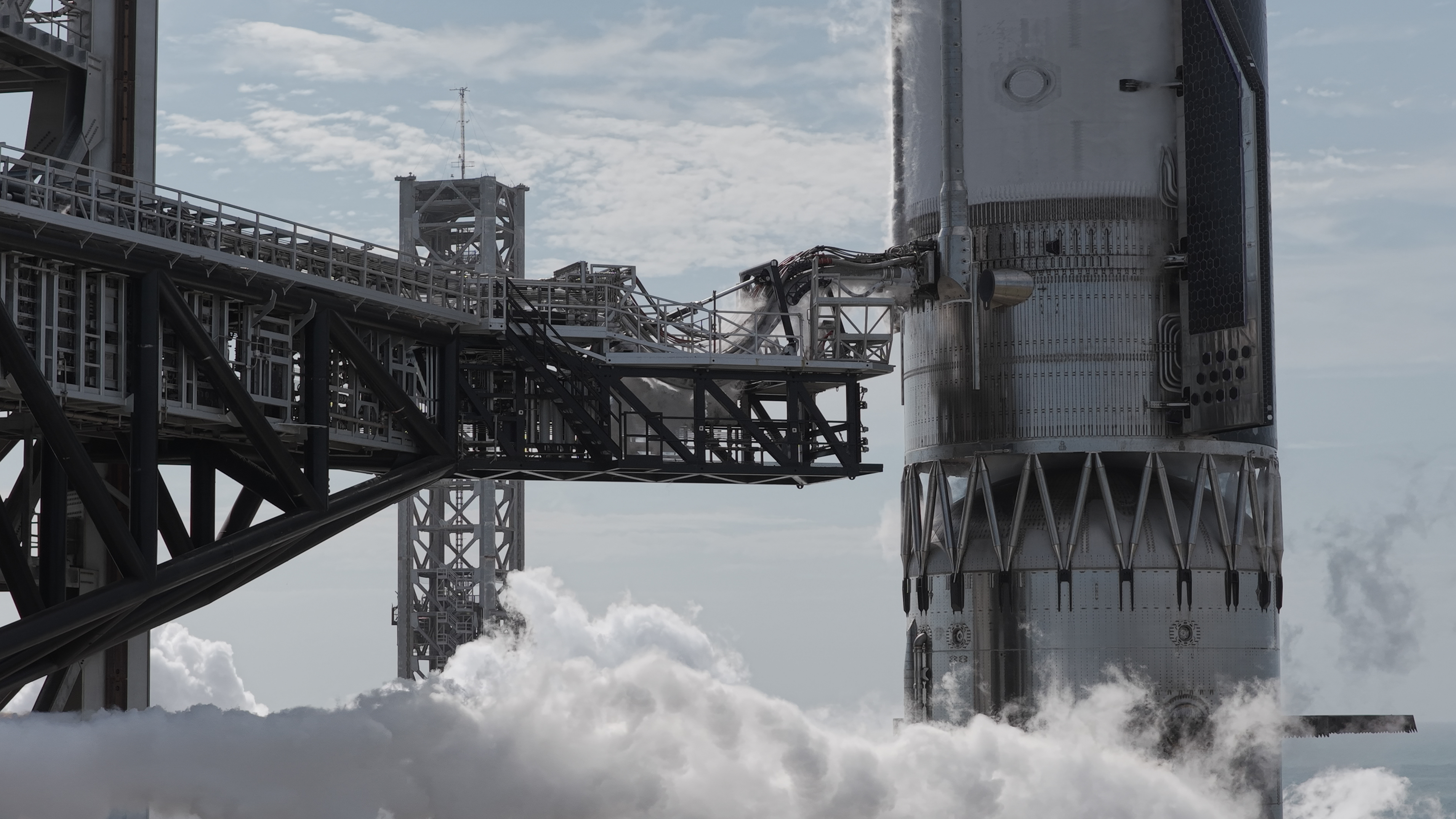
The number of grid fins has been reduced from four to three, and they have been lowered on the vehicle to protect them during hot staging—when the Starship upper stage ignites its engines while still attached to the booster stage. The ring hardware to support this hot staging is now integrated into the booster stage, so it will be reusable.
The hot staging ring has now been incorporated into the booster stage so it can be reused.
Credit: SpaceX
The hot staging ring has now been incorporated into the booster stage so it can be reused. Credit: SpaceX
For the Starship upper stage, SpaceX has done a “clean sheet” redesign of the propulsion system, which was so problematic during the vehicle’s V2 flights.
“These changes enable a new Raptor startup method, increase propellant tank volume, and improve the reaction control system used for steering while in flight,” the company said. “The propulsion updates also reduce contained volumes in the aft end of the vehicle that could trap propellant leakage.”
SpaceX has also built a new and improved launch pad, with larger propellant storage capabilities that should support faster fueling operations.
The upcoming V3 test flight is significant in that it will put all of these changes and their integration into a new rocket and launch pad to the ultimate test. If things go badly, it could spur a repeat of 2025 at a time when SpaceX (becoming a public company) and NASA (in a tight race with China back to the Moon) can ill afford further significant delays.
Falcon 9, it’s time?
Teething challenges notwithstanding, SpaceX is increasingly counting on Starship to be the bedrock of its launch initiatives.
After conducting 165 Falcon 9 launches last year, the company anticipates flying the workhorse rocket fewer times this year. SpaceX has also stopped flying the Falcon 9 from one of its two Florida pads, Launch Complex-39A at Kennedy Space Center. This facility will now focus on Starship launches.
Additionally, last month, SpaceX retired one of its two Florida-based seagoing landing platforms from service for future use as a transporter to ferry Starships and Super Heavy boosters from SpaceX’s factory in South Texas to Florida.
This is a bold bet because, after a decade and a half, the Falcon 9 has become the most successful launch vehicle in the world, setting records for reuse, longevity, price, and cadence. Because of its reusable first stage and payload fairing, SpaceX has pared back internal launch costs to about $15 million. This affords the company a huge advantage over Starlink competitors who, for a similar launch capability, must pay four to six times this amount. SpaceX charges a base price of $74 million for a Falcon 9 launch to external customers.
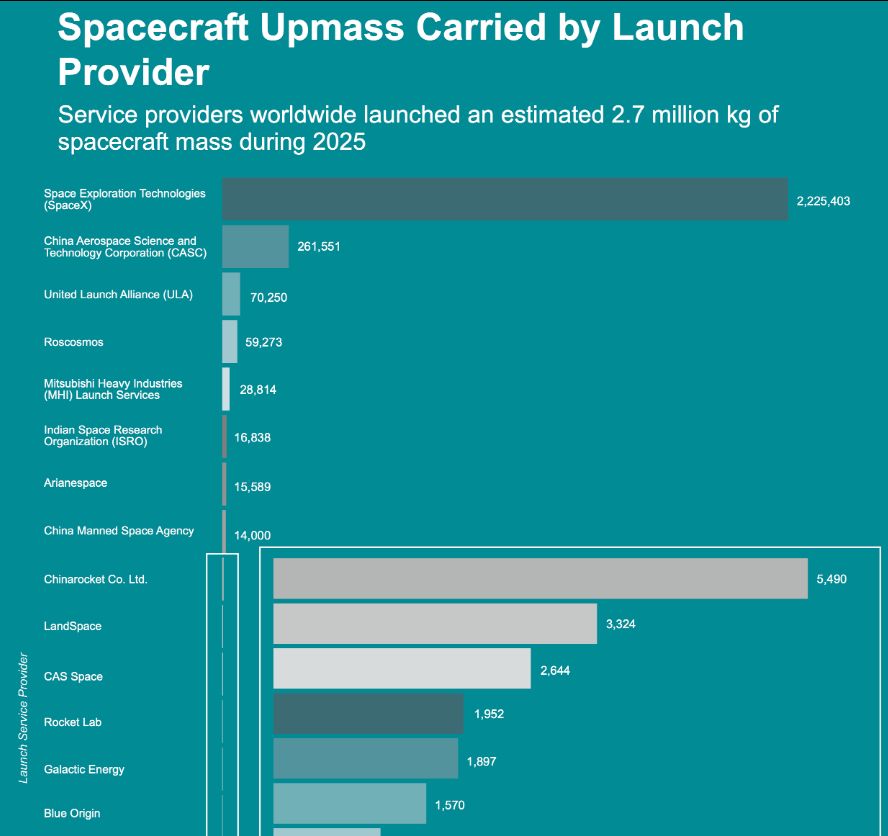
Falcon dominance: SpaceX launched 82 percent of all mass into orbit in 2025.
Credit: BryceTech
Falcon dominance: SpaceX launched 82 percent of all mass into orbit in 2025. Credit: BryceTech
Even so, the company has no lack of takers. The Falcon 9 remains the most in-demand rocket in the Western world as competitors like United Launch Alliance’s Vulcan rocket (side-mounted boosters) and Blue Origin’s New Glenn (upper stage) have seen their cadence slowed by technical issues. Arianespace has had better success with the new Ariane 6 rocket, but it’s only targeting a cadence of six to eight launches a year. There is little capacity left for any of these vehicles for the remainder of the decade.
Newer medium-lift vehicles, such as Rocket Lab’s Neutron or Relativity Space’s Terran R, are likely at least 12 months from their debuts and then will require years to scale up to a higher cadence.
Despite its high flight rate, the Falcon 9 manifest is largely filled out for the next two years. The market, quite simply, is consuming available launch capacity faster than it is being created. So as much as SpaceX wants to obsolete the Falcon 9 rocket, it remains essential to almost everyone outside of China and Russia.
Waiting for Starship
Many other people are counting on Starship beyond the walls of the Starfactory in South Texas.
Tom Patton, an author at The Journal of Space Commerce, recently wrote about the need for Starship to reach a “commercial” cadence for many space businesses to achieve their aims. These space companies, particularly those interested in large constellations of orbital data centers and other satellites, are basing their business models on a commercially available Starship.
The promise of a commercial Starship is twofold. First, it will ease the current launch-capacity crunch by carrying several times the mass of a Falcon 9 payload in a single mission. And second, its price is potentially much sweeter. The Falcon 9 rocket brought launch costs per kilogram down into the low thousands of dollars. Starship could bring them into the low hundreds of dollars, nearly an order of magnitude.
But first, Starship V3 must fly successfully and then become orbital. After that, SpaceX will begin deploying its larger Starlink satellites and start working toward orbital refueling. NASA then has dibs on lots of flights in 2027 and 2028 when Starship is slated to fly as part of Artemis III, make a demonstration landing on the Moon, and then fly an actual lunar landing with humans. Including refueling launches, this accounts for dozens of missions, and the company has recently signaled to NASA that it will prioritize the government program.
So where does that leave customers beyond NASA and SpaceX’s internal Starlink payloads? Patton estimates that Starship may not become widely available for commercial purposes until 2028 or 2029.
SpaceX could beat that estimate, of course. Wednesday’s flight of V3 could knock it out of the park. SpaceX has been building the capacity to mass-produce Starships and fly them frequently. If everything goes well, the company could reach a sub-monthly launch cadence before the end of this year. But what if something goes wrong? Everything just slips further into the future.
So the stakes surrounding this Starship launch are really quite high. The US commercial space industry is depending on lower launch costs and higher capacity. NASA’s lunar ambitions, to a great degree, hinge on its success. And the stakes are highest of all for SpaceX.
Starlink direct-to-cell? Orbital data centers? SpaceX’s fantastic valuation after its IPO? An eventual city on Mars?
All of these rely entirely on Starship fulfilling its promise of rapid, low-cost, reusable launch. Starship must not just work; it must work far, far more efficiently than any rocket ever built, while simultaneously being the most colossal thing our species has ever launched into space.