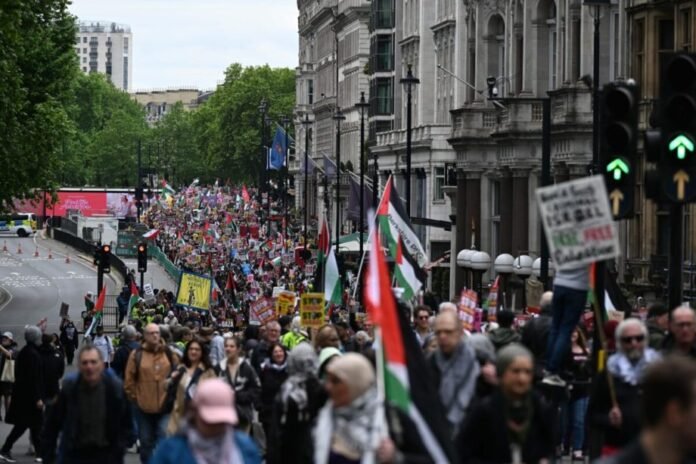
Large crowds march through the streets during a demonstration marking the Nakba Day in London, United Kingdom on May 16, 2026. [ Raşid Necati Aslım – Anadolu Agency]
A large crowd of demonstrators marched through the British capital of London on Saturday, May 16, to express solidarity with Palestine, Anadolu reports.
The participants carried Palestinian flags, banners, and placards while chanting slogans to demand an immediate end to the… pic.twitter.com/Gk0OzxpBKT
— Middle East Monitor (@MiddleEastMnt) May 16, 2026
A large crowd of demonstrators marched through the British capital of London on Saturday, May 16, to express solidarity with Palestine, Anadolu reports.
The participants carried Palestinian flags, banners, and placards while chanting slogans to demand an immediate end to the conflict.
The rally joins a series of global demonstrations calling for international intervention and the protection of civilian lives in the region.
Demonstration marks the 78th anniversary of the Nakba, which is described as the “Great Catastrophe” of 1948.
More than 800,000 Palestinians were forcibly displaced during the events surrounding the establishment of Israel in 1948—a catastrophe Palestinians commemorate annually on May 15 as the Nakba.
Casimir force co-opted to generate free energy, midichlorians not included
This week, a company called Casimir Inc. emerged from “stealth mode” to announce that it had raised significant funding from venture capitalists willing to roll the dice on free energy. That’s right: a startup has gotten serious backing to develop sources of perpetual free energy. The people behind this fantastic new energy generator also brought us the wildly successful WTF thruster EM-drive that could supposedly directly convert electricity into a propulsive force.
(Its one practical application was in the show Salvation, where it was treated with the same detailed attention to physical laws as Galaxy Quest’s Omega-13.)
With that success, who are we to be skeptical?
Use the (Casimir) Force, Luke
Casimir Inc. is convinced it can squeeze energy from the vacuum via the Casimir force (hence the subtle reference in the name). The Casimir force is a real thing, arising from the fact that a vacuum is not actually nothing. Instead, it is filled with a froth of virtual particles becoming real in pairs, waving to us, annihilating each other, and sinking back into the soup of virtual particles. The Casimir force emerges when we create an imbalance in the spatial distribution of these virtual particles, leading to a pressure as the Universe seeks to equalize the distribution.
To get to the heart of the Casimir force, we need to talk about modes—one of my favorite concepts (and my chosen instrument of torture for undergraduate students). Put simply, a mode describes how a photon can spread out and occupy a space. The larger the space, the more ways a photon can occupy that space.
The Universe is big, so it has an enormous number of modes. But if you create a confined space within the Universe, such as the gap between two closely spaced metal plates, there are only a few modes available, and they are less likely to be occupied by a particle. Between the plates, we have no particles; outside the plates, we have particles. This excess of particles, as they bounce off the plates, drives them together.
This is the Casimir force. And, yes, a force means energy is involved, so in principle, you could extract a small amount of energy from the plates moving together. You would immediately lose all that energy to move the plates apart again if you want to repeat the process.
What if the plates never moved?
To get a continuous flow of energy, according to Casimir Inc., the setup needs to be slightly different. The plates are fixed so they can’t move together, and a row of pillars is placed between the plates. The plates and pillars are then connected via the device that will be powered (a load). From here, things get hazy because the details are missing—or at least highly obfuscated.
The idea is that electrons will tunnel from the plates to the electrodes but not tunnel in the reverse direction. Tunneling is the quantum process by which a particle can pass through a barrier to another region of space. Again, modes are involved: The electron is in a mode in one place and will occupy a mode in its new location. All else being equal, the chance of tunneling forward is the same as tunneling backward because the overlap between the modes is symmetrical. This will not generate energy.
But there are a couple of ways to make tunneling asymmetric (and hence might work). The one proposed in the paper by Casimir Inc. is that the structure it has designed somehow has modes between the plates that follow the same rules as a hydrogen atom, and the tunneling involves an electron going from a high-energy state to a low-energy state (at least in hydrogen, these would represent different energetic states).
If this is the case, one would expect a net flow of electrons from high energy to low energy via tunneling. Unfortunately, although the math in the paper looks fine (I’ve not checked it in detail), the underlying assumption—that the modes are identical to those in a hydrogen atom—seems quite shaky.
The more likely route is the same as that used in quantum cascade lasers. In these systems, electrons tunnel from one location to another with almost the same energy. But in their new location, they quickly lose energy (via an acoustic wave generated by the crystalline material that holds the electrons), which traps them there. This is an actual mechanism based on well-established physics. It does, however, rely on very specific material properties and precise structural engineering. Given that, it’s probably not what would happen in the proposed device, either.
If you measure, you get numbers
Nevertheless, the company claims to have made a device and measured a drop in voltage between the plates and pillars. The company also claims this voltage is predicted in a paper that doesn’t appear to have any predictions, which is necessary for success.
I would be shocked if Casimir, Inc. had not measured a potential difference. For a decade, surfaces of materials were the bane of my existence. Surfaces are not simple and can exhibit all sorts of weird properties due to missing atoms, crystalline boundaries, and impurities from fabrication techniques. If Casimir, Inc.’s team chose the right metal and the pillars were thin enough, they might even have fully oxidized on exposure to air, making them very different from the plates next to them. All of these material properties play a role in generating the potential measured by a probe, independent of any special Casimir forces or vacuum fluctuations.
But let’s give the company the benefit of the doubt and assume it will observe (or already has observed) an electron flow from the plates to the pillars due to the Casimir force—it’s not impossible. These electrons still need to be coaxed through a load where they can give up their energy. That means connecting the pillars and plates to wires, each of which will introduce a potential difference due to the point of contact between different metals. To overcome that potential difference, charge will have to accumulate in the pillars. This will reduce the potential difference between the pillars and the plates and slow the flow of the tunneling current.
Eventually, the whole charge pump will grind to a halt, leaving no current flow. In other words, I expect that no useful energy will be extracted. But I do value the company’s service in burning through a bunch of VC money.
Supposedly related paper: Physical Review Research, 2026: 10.1103/l8y7-r3rm
China’s Xi hails trade progress in Trump summit, sends Taiwan warning
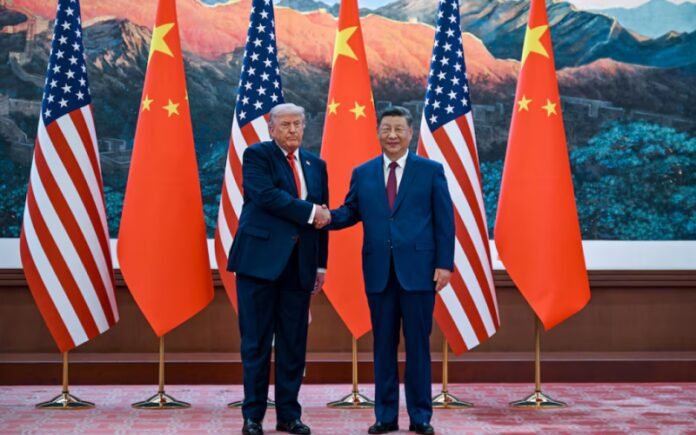
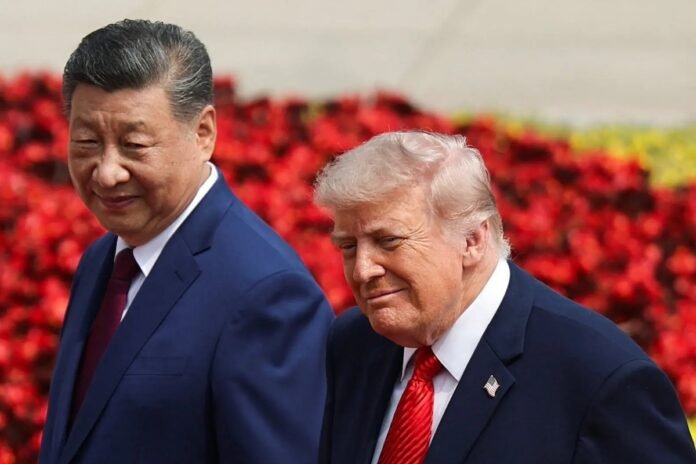
China’s Xi Jinping told President Donald Trump that trade talks were making progress at the start of a two-day summit on Thursday but warned that disagreement over Taiwan could send relations down a dangerous path.
The Chinese leader’s remarks, reported by the official Xinhua news agency, set the stage for what Trump described as possibly the “biggest summit ever” following a pomp-filled reception at Beijing’s imposing Great Hall of the People.
With Trump’s approval ratings dented by his Iran war, the first visit by a U.S. president to America’s main strategic rival since his last trip there in 2017 has taken on added significance.
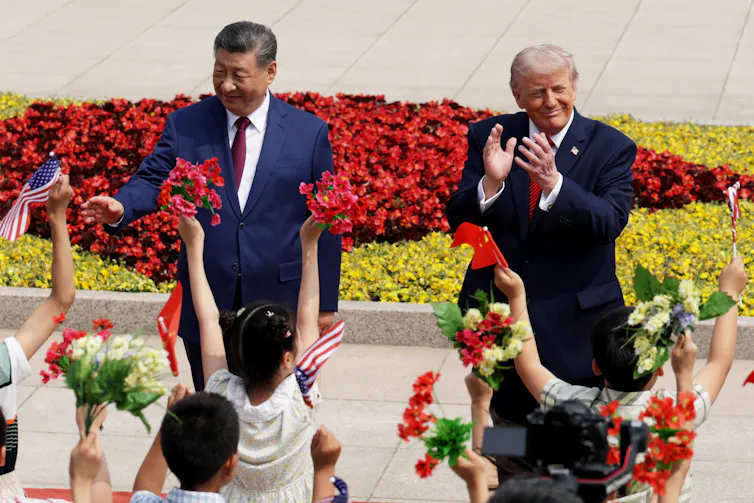
After an opening ceremony that featured an honour guard and throngs of children excitedly waving flowers and flags, Xi opened the summit by telling Trump that stable relations between the world’s two biggest economies benefit the entire world.
“When we cooperate, both sides benefit; when we confront each other, both sides suffer,” he said in brief remarks that were open to media.
“You’re a great leader, sometimes people don’t like me saying it, but I say it anyway,” Trump responded. “There are those who say this may be the biggest summit ever,” he added.
Behind closed doors, Xi said negotiations between economic and trade teams on Wednesday had reached an “overall balanced and positive outcome”, according to a readout by China’s state-run Xinhua news agency.
The latest round of negotiations aimed to maintain the trade truce struck between Trump and Xi last October and establish mechanisms to support future trade and investment, officials with knowledge of the matter said.
Xi also broached the subject of Taiwan, the democratically governed island claimed by China and armed by the United States.
The Chinese leader told Trump that Taiwan was the most important issue in U.S.-China relations and if handled poorly could lead to conflict and an extremely dangerous situation, according to the Chinese readout of the talks , which concluded after a little over two hours.
Joining Trump on the trip are a group of CEOs looking to resolve issues with China, including Elon Musk and Nvidia CEO Jensen Huang, a late addition. Trump has said his first request to Xi will be to “open up” China to U.S. industry.
Musk, Huang and Apple’s Tim Cook were present during the opening talks between the leaders, with Musk telling reporters they were “wonderful” as he left the Great Hall.
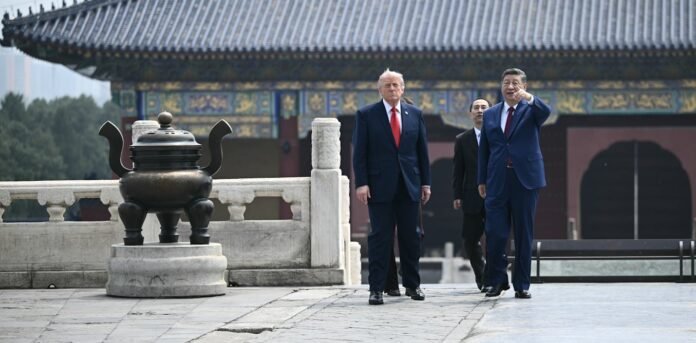
This week’s leaders’ meetings will provide plenty of face time between Xi and Trump: after their initial talks, they will tour the UNESCO heritage site Temple of Heaven and attend a state banquet on Thursday, before taking tea and lunch together on Friday, according to the White House.
POWER DYNAMICS HAVE SHIFTED
The power dynamics have changed since Trump’s last visit to Beijing when China went out of its way to lavish Trump and buy billions in U.S. goods, said Ali Wyne, senior adviser for U.S.-China relations at International Crisis Group.
“This time around it’s the United States, unprompted, of its own volition, that is acknowledging that status,” Wyne said, pointing out Trump revived the term ‘G2’, referring to a superpower duo, when he last met Xi on the sidelines of an APEC meeting in South Korea in October.
U.S. courts have hemmed in his ability to levy tariffs at will on exports from China and other countries. The Iran war has also boosted inflation at home and escalated the risk that Trump’s Republican Party will lose control of one or both legislative branches in November’s midterm elections.
Though the Chinese economy has faltered, Xi does not face comparable economic or political pressure.
Nevertheless, both sides are eager to maintain a trade truce struck last October in which Trump suspended triple-digit tariffs on Chinese goods and Xi backed away from choking global supplies of rare earths, vital in making items from electric cars to weapons.
They are also expected to discuss forums to support mutual trade and investment and dialogue on AI issues.
Washington looks to sell Boeing airplanes, farm goods and energy to China to cut a trade deficit that has long irked Trump, while Beijing wants the U.S. to ease curbs on exports of chipmaking equipment and advanced semiconductors, officials involved in the planning said.
IRAN, TAIWAN IN FOCUS
Aside from trade matters, Trump is expected to encourage China to convince Iran to make a deal with Washington to end the conflict. But analysts doubt that Xi will be willing to push Tehran hard or end support for its military, given Iran’s value to Beijing as a strategic counterweight to the U.S.
U.S. Secretary of State Marco Rubio told Fox News aboard Air Force One that it was in China’s interest to help resolve the crisis as many of its ships are stuck in the Gulf and a slowdown in the global economy would hurt Chinese exporters.
For Xi, U.S. arms sales to Taiwan are a top priority.
China reiterated on Wednesday its strong opposition to the sales, with the status of a $14-billion package awaiting Trump’s approval still unclear. The U.S. is bound by law to provide Taiwan with the means to defend itself, despite a lack of formal diplomatic ties.
Xi has a reciprocal visit tentatively planned for later this year, which would be his first visit to the United States since Trump re-took office in 2025.
Golf Star Hits Elderly Volunteer in Furious Outburst at PGA Championship (Video)
Jon Rahm’s temper exploded in dramatic fashion at the PGA Championship — and an elderly volunteer ended up paying the price.
The fiery Spanish golf star found himself at the center of controversy Thursday after wild footage showed him accidentally blasting a chunk of turf straight into the face of an older volunteer during a meltdown on the course at Aronimink.
Rahm, 31, was already having a rough day when things spiraled on the seventh hole.
After sending an approach shot flying too far past the green, the frustrated golfer angrily swung his club through the thick rough in what appeared to be a rage-filled practice motion. But instead of just venting, Rahm ripped up a massive divot that launched into the crowd.
The chunk of dirt and grass struck an elderly volunteer in the shoulder before smacking him in the face, according to videos that quickly spread online.
Fans watching nearby appeared stunned as Rahm instantly realized what had happened.
The two-time major champion quickly apologized on the course before later giving an emotional explanation during his post-round press conference.
“I got a flyer on my second shot that went long. It’s not a good spot,” Rahm admitted. “Just out of frustration, I tried to make an air swing over the grass, and I wasn’t looking. I took a divot, and unfortunately, I hit a volunteer.”
Rahm said he felt terrible after realizing the volunteer had been struck.
“Unfortunately it hit him in the shoulder and then the face,” he continued. “I couldn’t feel any worse. That’s why I was there apologizing.”
The golfer even said he now wants to track the man down personally because he feels so guilty over the incident.
“I need to somehow track him down to give him a present because that’s inexcusable and completely avoidable,” Rahm added. “Whether it was my intention or not, it was just not good.”
Despite the ugly scene, Rahm will reportedly avoid punishment from PGA officials.
The PGA of America recently rolled out a stricter “Player Code of Conduct” aimed at cracking down on bad behavior and emotional outbursts from players. But tournament officials determined Rahm’s incident was accidental and didn’t cross the line into a formal violation.
A spokesperson told The Athletic there was “no intent” behind the incident and confirmed no warning or penalty would be issued.
Still, the footage has already sparked debate among golf fans online, with many questioning whether stars should be held more accountable when tempers boil over during major tournaments.
The awkward moment instantly became one of the most talked-about scenes of the opening round — and not for Rahm’s golf.
Honda shows off new hybrids for America as it absorbs $9 billion EV loss
After US government policies wrecked the country’s electric vehicle market, automakers have been scrambling to adapt. The loss of federal clean vehicle tax incentives and funding for charging infrastructure, combined with capricious tariffs, has resulted in a 28 percent drop in EV sales for the first three months of the year.
That’s a far cry from just a few years ago, when optimism abounded and a strong commitment to an EV-heavy portfolio translated into a higher share price. As those commitments are abandoned, there’s a financial price to pay, including more than $9 billion of write-downs for Honda, which made its first operating loss in the company’s history.
Honda’s first move was to cancel a trio of EVs it planned to build in Ohio, along with another pair of EVs planned as part of a joint venture with Sony. Yesterday, in Tokyo, Honda CEO Toshihiro Mibe held a press conference to announce the automaker’s plan to rebuild its business in the wake of these changes.
Like General Motors before it, Honda says it needs more hybrids moving forward; this technology, importantly, requires far fewer expensive battery minerals and materials than a battery EV.
“Honda will reallocate more development and production resources into hybrid models to accelerate the market launch ahead of the original schedule and increase the number of compelling products,” said Mibe. “We have made steady progress in the development of hybrid vehicle technologies, where Honda has strengths, based on our belief that hybrid models will continue to be the key to addressing environmental challenges.”
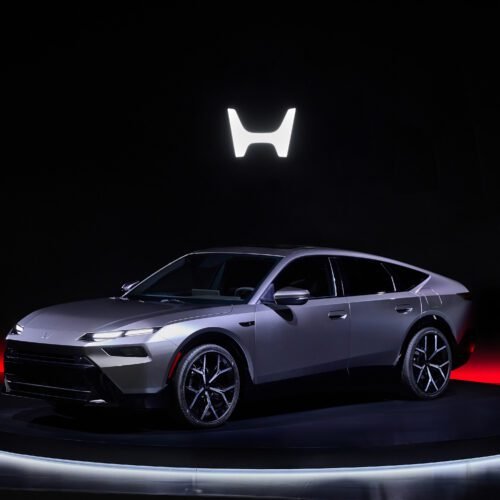
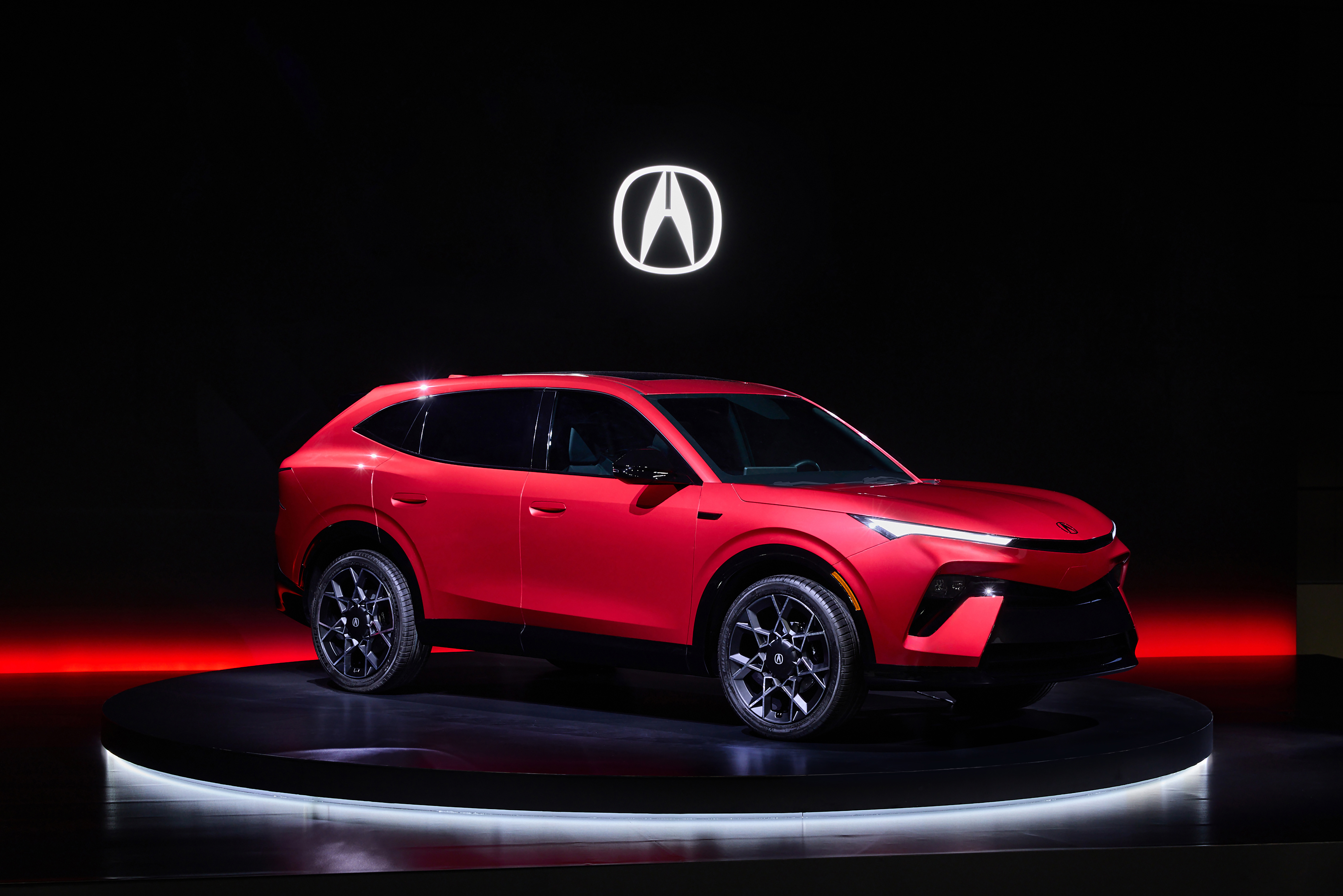
To that end, Honda says it will launch 15 models with a new generation of hybrid powertrains by 2030, with most of them destined for here in North America. Yes, that includes a full-size SUV to compete in the D-segment with vehicles like the Toyota Sequoia or Chevrolet Suburban. Honda is targeting a 10 percent increase in fuel efficiency and a 30 percent reduction in cost for the new hybrid system, with the first of the new hybrids—the sedan you see here—planned to debut next year. Acura, Honda’s North American performance brand, isn’t being left out—at least one of the prototypes shown was a new hybrid Acura SUV.
This Acura hybrid SUV is coming to America.
Credit: Acura
This Acura hybrid SUV is coming to America. Credit: Acura
Honda plans to rejigger its US factories so they’re all capable of producing hybrids; last year, we learned about the effort it made to incorporate BEV assembly into its Marysville, Ohio, plant. And a battery joint venture with LG Energy Solution that was supposed to make EV batteries will have part of its line converted to make hybrid traction batteries, now that Honda will need so many more of those.
Regional strategies
Honda’s plan for Japan looks very different from its plan for North America. Instead of lots of bigger hybrids, Japan will receive more electric Kei cars; you will probably recall the diminutive vehicle form factor was recently praised by President Trump, although my repeated inquiries to the US Department of Transportation have failed to uncover any actual progress toward his promise to make these tiny cars and trucks street-legal here.
Growth in China will require the company to “incorporat[e] the overwhelming speed of local businesses,” and, unlike the US, success here will require many more new EVs. India will be another important region, according to the company. There, the plan is for mid-size vehicles, but also products far smaller that can tempt some of Honda’s 6 million Indian motorcycle customers to trade up to something more expensive with twice as many wheels.
From beef ribs to a ‘heavenly’ walk: Xi-Trump summit symbolism underscored American power and Chinese tradition
Diplomacy often masquerades as theater. And nearly nine years after his first state visit to China, Donald Trump returned to Beijing with an extended cast of characters.
Alongside the U.S. president on his May 2026 visit was a senior delegation of politicians including his secretary of defense, and a phalanx of business leaders and technology executives. It was a traveling display of American political and corporate power.
Not that the hosting Chinese were short of symbolic gestures themselves. Trump’s first China visit in 2017 had already shown how far Beijing was willing to go to turn diplomacy into theater. On that occasion, Chinese President Xi Jinping and his wife Peng Liyuan personally accompanied Donald and Melania Trump through the Forbidden City, Beijing’s former imperial palace, drinking tea inside the palace walls and taking in a Peking opera at the Belvedere of Pleasant Sounds, a Qing imperial theater built for court entertainment.
So what was being conveyed this time around? As a cultural historian of modern China, I took a peek beyond the official statements and trade headlines of the Xi-Trump summit and into the images, gestures and cultural symbolism on display.
The formal choreography began at Beijing’s Great Hall of the People, where the two leaders exchanged views on the Iran conflict, the war in Ukraine and the Korean Peninsula, among other items.
But the more interesting story of the visit, to me, was told outside the meeting room.
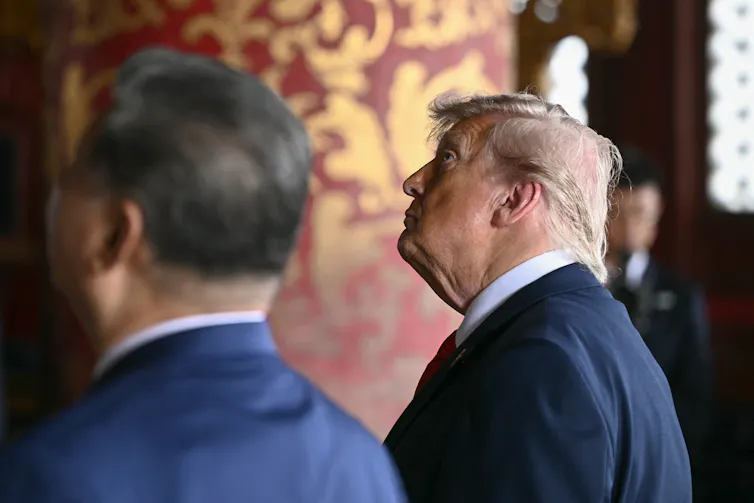
After their two-hour bilateral meeting, Trump and Xi paid a cultural visit to the Temple of Heaven in Southern Beijing. Built in the early 15th century, the temple is China’s most complete surviving imperial religious complex. For nearly five centuries, emperors of the Ming and Qing dynasties came here to worship Heaven and pray for good harvests.
Its most recognizable structure, the Hall of Prayer for Good Harvests, rises in three tiers of blue-glazed tiles above a marble platform, its circular form and crimson columns translating cosmology into architecture. UNESCO inscribed the site as a World Heritage Site in 1998, recognizing it as “a masterpiece of architecture and landscape design.”
When Trump and Xi posed for photographs, they were standing in a place long associated with cosmic order and the welfare of the people. To bring a foreign leader there is to invite a particular reading of the relationship: not simply as a bargain between states, but as a relationship that Beijing hopes to associate with order, abundance and peace.
There was also a more practical layer to this symbolism. The Temple of Heaven links political authority to agricultural abundance. Emperors came here to pray not for abstract harmony but for grain. That made it a pointed setting for a visit in which American agricultural exports — soybeans, grains and beef among them — were expected to matter.
For Trump, any Chinese commitment to buy more U.S. farm goods would have clear domestic political value. For Xi, the setting allowed a hard bargaining issue — farm purchases — to be translated into an older symbolic language of harvest that spoke to both domestic and international audiences.
Before Trump, Kissinger
Trump was not the first American statesman to be brought to the Temple of Heaven.
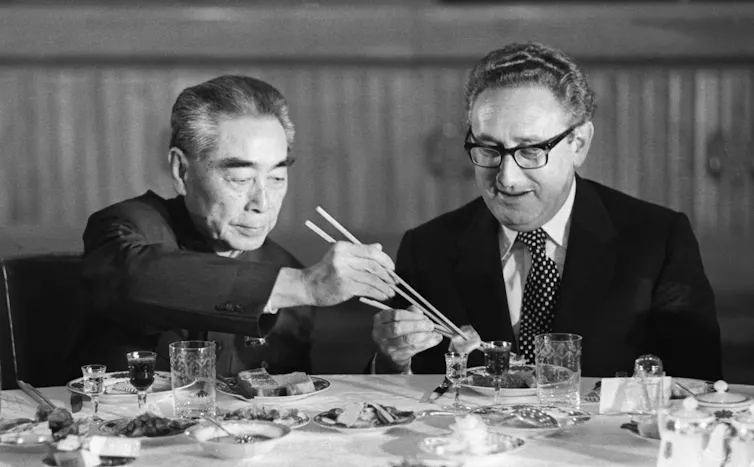
In July 1971, Henry Kissinger, then national security adviser to President Richard Nixon, arrived in Beijing on his famous secret mission — the back-channel visit that helped re-open the door between two countries that had little direct contact for more than two decades. Between tense negotiations with Chinese premier Zhou Enlai, Kissinger made time to visit the temple.
There, standing amid the old cypress groves, he was said to have been deeply moved by the timeless atmosphere of the hall and its surroundings.
Henry Kissinger accepts food from Chinese Premier Zhou Enlai during a state banquet in the Great Hall of the People in Beijing in 1973.Bettman/Getty Images
The motif of old trees and deep time returned on May 15, when Xi gave Trump a rare walk through Zhongnanhai, the walled compound that now houses the core of China’s party-state leadership. Reuters reported that a hot mic captured Xi drawing Trump’s attention to the age of the trees around them — some centuries old, some said to be more than a thousand years old. When Trump asked whether Xi had taken other presidents on similar walks, Xi replied that he had only rarely.
Together, the Kissinger anecdote and the Zhongnanhai walk reveal a recurring logic in Chinese-American diplomacy: America’s fast-moving economy is invited to look at China’s sense of tradition. Xi has used this tactic with other leaders, too. When French President Emmanuel Macron visited China in 2023, he attended a guqin performance invoking the classical idea of the zhiyin — the rare listener who truly understands one’s music.
Basketball and roast duck
Trump’s visit was not staged only through imperial grandeur, however. It also moved into a more familiar register: food, sports and popular culture.
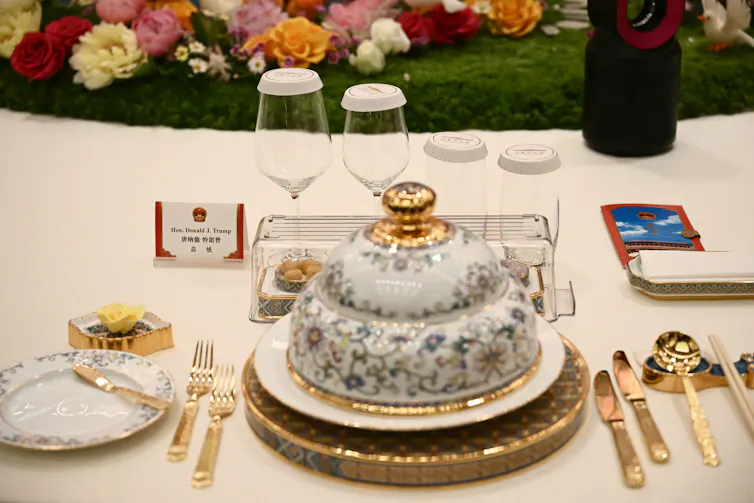
The state dinner on May 14 was another study in careful hospitality. Chefs designed the menu to honor both Chinese culinary prestige and Americans’ — and Trump’s — known preferences: Peking roast duck, crispy beef ribs, pan-fried pork bun, tiramisu and fruit and ice cream.
The table setting for U.S. President Donald Trump at a state banquet with China’s President Xi Jinping at the Great Hall of the People in Beijing on May 14, 2026.Brendan Smialowski/AFP via Getty Images
Trump thanked Xi for a “magnificent welcome like none other,” then replied in a language more recognizably his own. He spoke not only of power politics but of people-to-people ties: Chinese workers who helped build America’s railroads, Chinese enthusiasm for basketball and blue jeans and the sheer presence of Chinese restaurants across the U.S.
The examples were characteristically Trumpian — simple, vivid and easy to grasp. But they pointed to something important. U.S.–China relations have never been made only by presidents, diplomats and official communiques. They have also been shaped by athletes, musicians, restaurant owners, students and tourists.
The basketball reference was especially resonant. Sports have long offered a softer language for U.S.–China relations. In April 2026, just weeks before Trump’s visit, China and the U.S. marked the 55th anniversary of ping-pong diplomacy — the famous 1971 exchange in which a “little ball” helped move the “big ball” of world politics.
Basketball now plays a similar role. For many Chinese fans, the NBA is a deeply familiar world of players, teams and memories that represents the spirit of America: Michael Jordan, Kobe Bryant, LeBron James and Yao Ming. That reservoir of affection has survived even periods of political tension. Trump, in invoking it, was drawing on something real.
A second act in the US?
The main lesson of all this symbolism is that, in U.S.–China relations, atmosphere has never been secondary.
Diplomatic theater cannot settle disputes over technology or Taiwan, or determine the future of the global order. But it can shape the mood in which rivalries are managed, and the stories that leaders tell their public about what the relationship means.
And on that front, the summit worked on several levels. To the Chinese audience, it presented their leaders as confident and capable of managing a tense relationship with the U.S. on China’s own cultural terms.
U.S. President Donald Trump and Chinese President Xi Jinping attend a welcome ceremony at the Great Hall of the People on May 14, 2026, in Beijing, China.Alex Wong/Getty Images
For Trump and the American delegation, it offered a lesson in Chinese traditions and culture that promotes deeper understanding across political divides. And for both societies, the references for food, sports and popular culture created a more neutral ground on which connection could still be imagined.
From the 1970s opening to Trump’s 2017 visit to the Forbidden City, and from the Temple of Heaven photo-op to the walk among old trees at Zhongnanhai in 2026, cultural staging remains central to how China presents itself to America — and how America is invited to imagine China. It was announced on May 15 that Xi will pay a state visit to the U.S. in September at the invitation of Trump. If that happens, the theater of diplomacy will move to American soil, and the question will be how Washington chooses to stage China in return.
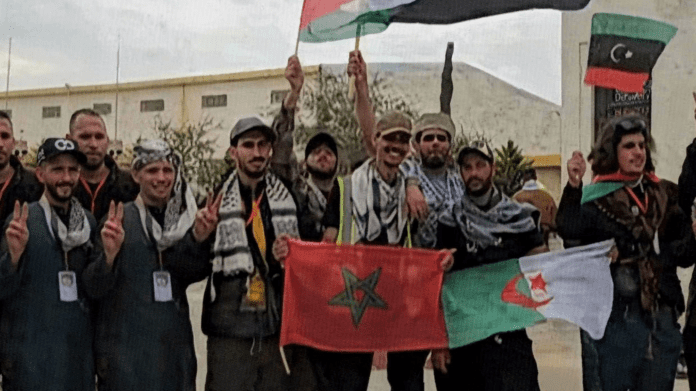
International Aid Convoy Departs Libya Bound for Gaza Through Rafah Crossing
An international humanitarian convoy carrying relief supplies and volunteers departed from the Libyan city of Zawiya and is heading toward Egypt’s Rafah crossing in an effort to deliver aid to Gaza.
The convoy, known as “Sumud 2” or “Resilience 2,” includes more than 350 activists from 30 countries, including the United States, the United Kingdom, Turkey, Algeria, and Spain.
Participants include doctors, engineers, volunteers, and members of civil society organizations traveling in buses and trucks loaded with humanitarian supplies and housing units.
Organizers said the convoy consists of 50 containers, including 30 carrying humanitarian relief supplies, 20 mobile housing units, and five fully equipped ambulances.
The caravan began its journey in Algeria approximately one week ago, regrouped in Libya, and continued eastward. Organizers said the convoy successfully passed security and passport checkpoints before proceeding beyond Zliten.
The mission aims to reach Gaza via Egypt’s Rafah crossing in the coming days.
Coordinator Ahmed Ghniya said organizers were working closely with humanitarian agencies as the convoy advanced toward the Egyptian border.
“We’re now setting off in coordination with them to deliver the relief aid, as well as to deploy the medical specialties, in coordination with the Red Crescent,” Ghniya said, as reported by Africa News. He added that the convoy was in the “advanced stages” of coordination efforts with the Red Crescent.
Miles of smiles belie a fraught and fragile Trump-Xi summit
Diplomacy involves the art of telling lies with a straight face or even a reassuring smile.
On day one of Donald Trump’s China visit, political correctness and diplomatic finesse were in ample display from the US leader, while Chinese sources reported that Xi Jinping issued a stern warning to “properly” handle Taiwan, “the most important issue in China-US relations.”
Otherwise, Xi continued, “the two countries will have clashes and even conflicts, putting the entire relationship in great jeopardy.” That was typical Chinese bluster, clearly uttered for domestic consumption. The issue has been “properly” handled by the US since 1949, otherwise it would have blown up into a war by now.
Much has been written and said about China’s position of relative strength in this summit, with the US bogged down in the Iran war. This may be the reflection of the alleged antipathy of much of the mainstream media towards anything Republican Party in general and towards Trump in particular. True or not, polls show that a majority of Republicans have no trust in the US mass media.
But US and Chinese actions may be a better guide about who is actually speaking from a position of strength at the summit. We could start with trivia. China allowed a sanctioned American to travel with Trump, land in Beijing and shake hands with none less than Xi Jinping.
US Secretary of State Marco Rubio is renowned for China-bashing, rooted in part in his antipathy toward all things communist, hailing from an immigrant family from Cuba who was deeply influenced by the exiled, anti-communist Cuban community in Miami.
Rubio has repeatedly touched a raw nerve with Xi through his criticism of China’s atrocities against ethnic Uighurs in Xinjiang and was sanctioned by Beijing in 2020. Rubio’s inclusion in Trump’s delegation and warm welcome in Beijing speaks to China’s desire to bend over backward to facilitate the summit.
While Beijing was preparing a red-carpet welcome for Trump and company, it was likely no coincidence that a jury found Lu Jianwang guilty of opening and operating a secret police station in Manhattan’s Chinatown neighborhood on behalf of the Chinese government.
Moreover, just two days earlier, Eileen Wang, the mayor of Arcadia in southern California, had resigned after she was charged by the US Department of Justice with being a Chinese government agent. Wang faces charges of sharing pre-written articles by Chinese government officials on the US News Centre website and spreading Chinese Communist Party disinformation, including denial of atrocities against Uighurs.
The First Assistant US Attorney had called it the latest success in America’s “determination to defend the homeland against China’s efforts to corrupt our institutions.” This calling out of China’s grey-zone war against the world’s democracies, just a couple of days before the Trump-Xi summit, would surely not have been music to Xi’s ears.
Widespread labeling of China as a totalitarian, repressive state had begun much earlier but notably intensified as the summit came closer. The US National Security Strategy 2025 re-emphasized US dominance in the Western Hemisphere, amid China’s rapid inroads.
A reassertion of the Monroe Doctrine, the portmanteau “Donroe Doctrine” stressed securing critical supply chains and materials and the “reindustrialization” of the US, measures clearly aimed at China without naming it.
Later in the document, it directly refers to China, accusing American elites of both political parties of being “either willing enablers of China’s strategy or in denial.”
There has been a slew of federal agency actions in recent weeks directed at China. On May 6, 2026, the US Trade Representative issued a notice that it has started a second, statutory four-year review of the actions taken in the “investigations of China’s Acts, Policies, and practices Related to Technology Transfer, Intellectual Property, and Innovation.” Apparently, a routine exercise, but the timing sends a signal.
On April 14, 2026, the US Federal Trade Commission announced a “Made in USA” sweep and took action against companies for selling products made in China as if they were produced in America.
On April 16, 2026, the US State Department, headed by Rubio, issued a report on conditions in Hong Kong which said that, “Beijing and Hong Kong authorities have systematically degraded Hong Kong’s political autonomy and civilians’ rights and freedoms.”
It added that US citizens who live in Hong Kong or go there for business or tourism and “publicly criticize the Chinese Communist Party or its policies are at a heightened risk of arrest, detention, expulsion or prosecution.” The report did note there were no national security-related arrests in 2025; its appearance so close to the summit nonetheless raises eyebrows.
On 23 April 2026, the US Scam Center Strike Force brought “criminal charges against two Chinese nationals who managed a cryptocurrency investment fund compound” in Myanmar, where “trafficked workers were beaten and forced to steal from Americans.”
So why would the Trump administration initiate so many actions against China and the Chinese shortly before an important summit meeting if Trump is the summit’s underdog?
It does not stand to reason that the “stronger” party would roll out the red carpet and do legal calisthenics to facilitate sanctioned Rubio’s participation at the summit, while the “weaker” US would paint its welcome carpet black through numerous actions aimed at antagonizing China.
Trump, buoyant from his recent achievements against China in Venezuela, Panama and elsewhere, is talking in Beijing about it being an “honor” to meet and call Xi his friend.
Xi, facing an economic slowdown, falling consumption, an entrenched real estate crisis and high youth unemployment, on the other hand, issued a warning. This is what diplomacy is all about – flexing while weak and showing grace while strong – but the realpolitik reality in Beijing is that the US, not China, is deciding the relationship’s direction and tone.
Bill to block publishers from killing online games advances in California
A bill focused on maintaining long-term playable access to online games has passed out of the California Assembly’s appropriations committee, setting up a floor vote by the full legislative body. The advancement is a major win for Stop Killing Games‘ grassroots game preservation movement and comes over the objections of industry lobbyists at the Entertainment Software Association.
California’s Protect Our Games Act, as currently written, would require digital game publishers who cut off support for an online game to either provide a full refund to players or offer an updated version of the game “that enables its continued use independent of services controlled by the operator.” The act would also require publishers to notify players 60 days before the cessation of “services necessary for the ordinary use of the digital game.”
As currently amended, the act would not apply to completely free games and games offered “solely for the duration of [a] subscription. Any other game offered for sale in California on or after January 1, 2027, would be subject to the law if it passes.
“Back shortly before Christmas, when I flew to the US to help set up SKG-US, I didn’t expect us to get this far this quickly,” SKG’s Monitz Katzner wrote on Reddit after the committee vote. “It has been an honor to take part in drafting this bill on behalf of the SKG community: gamers, developers, and publishers alike.”
In a formal statement of support for the bill sent to the California legislature, SKG wrote that “there is no other medium in which a product can be marketed and sold to a consumer and then ripped away without notice… As live service games rise in popularity for game developers and gamers alike, end-of-life procedures are essential tools to ensure prolonged access to the games consumers pay to enjoy.”
The Entertainment Software Association, which helps represent the interests of major game publishers, publicly told the California Assembly last month that the bill misrepresents how modern game distribution actually works. “Consumers receive a license to access and use a game, not an unrestricted ownership interest in the underlying work,” the ESA wrote. The eventual shutdown of outdated or obsolete games is “a natural feature of modern software,” the group added, especially when that software requires online infrastructure maintenance.
The ESA also said the bill would impose unreasonable expectations on publishers regarding licensing rights for music or IP rights, which are often negotiated on a time-limited basis. “A legal requirement to keep games playable indefinitely could place publishers in an impossible position—forcing them to renegotiate licenses indefinitely or alter games in ways that may not be legally or technically feasible,” they wrote.
Last month, the Protect Our Games Act also received positive votes from the California Assembly’s Privacy and Consumer Protection and Judiciary committees. But the bill still faces significant hurdles in getting majority passage in the full California Assembly and the California Senate before being sent to California Governor Gavin Newsom for signature.
Gulf tensions deepen as reports emerge of covert UAE attacks on Iran and secret Netanyahu visit
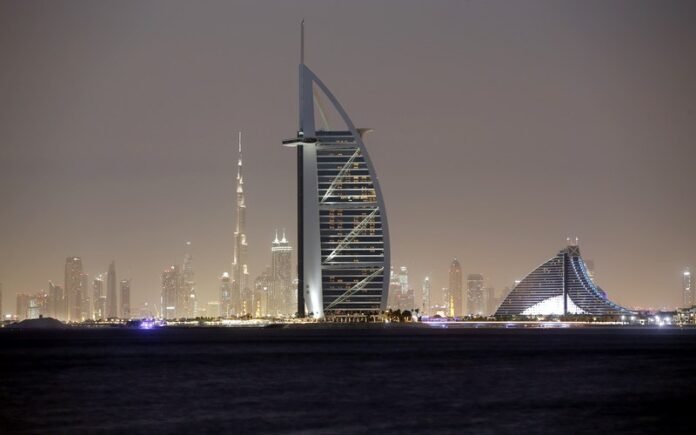
The Middle East conflict widened further this week after reports emerged that Gulf states including the United Arab Emirates and Saudi Arabia had secretly carried out attacks on Iran, raising fears that the war could draw more regional powers directly into the fighting.
According to Reuters, Saudi Arabia launched covert strikes against Iran in retaliation for attacks linked to Tehran during the regional conflict. The operations were reportedly not made public at the time and reflected growing alarm among Gulf monarchies over Iranian missile and drone attacks targeting energy infrastructure and shipping routes.
Separately, The Guardian reported that the UAE also carried out secret military strikes against Iranian targets, including an alleged attack on facilities on Iran’s Lavan Island shortly before an April ceasefire. The report said the UAE’s actions came after repeated Iranian attacks on Emirati infrastructure during the conflict.
The disclosures have intensified concerns that the confrontation between Iran, Israel and the United States is evolving into a broader Gulf security crisis. Gulf states have increasingly faced direct threats to oil facilities, shipping lanes and urban centres since the conflict escalated earlier this year.
Iran has accused Gulf countries of cooperating with Israel and the United States against Tehran. Iranian Foreign Minister Abbas Araqchi warned that countries “colluding with Israel” would be “held to account” after reports surfaced of closer UAE-Israel coordination during the war.
The UAE has publicly denied some claims surrounding secret diplomatic and military coordination. Emirati officials rejected reports that Israeli Prime Minister Benjamin Netanyahu held an undisclosed wartime meeting with President Sheikh Mohamed bin Zayed, insisting relations with Israel are conducted openly under the Abraham Accords framework.
Analysts say the reported covert operations highlight divisions within the Gulf region. While the UAE has taken a more confrontational approach towards Iran and strengthened ties with Israel, other regional powers including Saudi Arabia, Qatar and Kuwait have publicly warned against a wider regional war that could destabilise energy markets and the Strait of Hormuz.
The conflict has already disrupted shipping and energy infrastructure across the Gulf. A UAE-linked oil tanker was damaged in an Iranian drone strike near Oman this month, while several Gulf economies continue to face pressure from instability around the Strait of Hormuz, a key global oil transit route.
![Large crowds march through the streets during a demonstration marking the Nakba Day in London, United Kingdom on May 16, 2026. [ Raşid Necati Aslım - Anadolu Agency]](https://i0.wp.com/www.middleeastmonitor.com/wp-content/uploads/2026/05/AA-20260516-41403964-41403960-NAKBA_DAY_MARCH_IN_LONDON-scaled-e1778957103457.jpg?fit=920%2C613&ssl=1)