In a Private Meeting, Colorado Marijuana Regulators Acknowledge the Extent of Illegal Hemp Sales
A top regulator for Colorado’s Marijuana Enforcement Division acknowledged in a private meeting with industry representatives that the amount of chemically converted hemp being illegally sold as marijuana is far greater than the agency has publicly disclosed.
The virtual meeting, an audio recording of which was reviewed by the news organizations, was convened by members of Colorado Leads, a marijuana industry trade group, in March to discuss a problem they said had “metastasized” and now posed an “existential threat” to the nation’s first legal recreational marijuana market.
During the meeting, Kyle Lambert, the enforcement division’s deputy senior director, said the number of hemp-derived products is “larger than we can quantify.” He said the agency feared the prevalence of banned hemp was driving down the price of marijuana in the state and helping facilitate the diversion of high-grade marijuana out of Colorado and into the black market in other states.
Describing anomalies in the system the state uses to track marijuana production and sales, Lambert told the industry players that the extent of suspicious transactions in the system “would probably explode your minds.”
Two weeks after that meeting, the division sent a bulletin to the industry that it plans to crack down on companies that illegally sell cheaper and potentially hazardous hemp products as marijuana and that it would pursue emergency rules.
But it hasn’t done so yet, and other reform efforts failed during this year’s legislative session. Despite the regulators’ concerns, Colorado lawmakers, who weren’t at the March briefing, abandoned a bill that would have let voters decide whether to overhaul how marijuana products are tested for contaminants. (The Denver Gazette and ProPublica investigation found that other states have adopted stronger safety measures.)
Dominique Mendiola, the senior director of the Marijuana Enforcement Division, said in a statement that the agency has “consistently been proactive in pursuing the necessary rules, legislation and authority to combat this issue.”
“Lambert was speaking frankly to highlight the scale and complexity of the problem, as nominal-dollar transactions do not amount to definitive evidence of non-compliance,” Mendiola said. She added that investigations into such transactions require extensive resources and can take significant time.
The problem of companies substituting hemp for marijuana dates to 2018, when Congress legalized hemp, a close cousin of marijuana that has only trace amounts of THC, the psychoactive compound that makes people high. Federal lawmakers had hoped to support farmers while satisfying advocates who believe the high levels of the nonintoxicating compound CBD in hemp help with seizures, pain and sleep.
But hemp manufacturers quickly figured out how to convert CBD in hemp into THC through a process that involves toxic solvents, creating products that sometimes contain harmful chemicals and that can be more potent than products made from marijuana.
Colorado became one of the first states to ban that chemical conversion process and prohibit the sale of intoxicating hemp products to its residents.
But manufacturers were allowed to produce hemp products for export to other states, and some companies continue to rely on hemp within Colorado because it is cheaper than using marijuana to make the honey-colored THC distillate that goes into vapes and edibles, industry insiders say.
“This has become pervasive to where it’s, like, half the market,” said Jordan Wellington, a marijuana industry lobbyist and consultant, during the meeting with Lambert and a four-person investigative team that handles the agency’s most difficult cases. “We’re past Stage 1 cancer of it being, like, one spot. It’s fully metastasized.”
He said “rampant” use of hemp and other illicit material was putting pressure on honest manufacturers to cut corners to survive.
“It might be the most important and existential threat we’ve ever faced as an industry,” Wellington said.
When the state legalized recreational marijuana in 2012, it promised to establish a “seed-to-sale” system to track marijuana from the initial planting to the purchase of pot, vapes and other products in dispensaries. Close tracking would prevent marijuana grown in Colorado from being diverted to states where it remained illegal, supporters promised. Tracking also was supposed to assure consumers that they were buying safe, quality products.
But during the March video conference, Colorado regulators confided to industry lobbyists that the tool for rooting out fraud isn’t working.
“There’s a lot of really crap data in there that is hard for us to proactively go take action on,” Lambert said of the tracking system.
Extensive fraud in sales transaction reporting likely means the state has lost out on millions of dollars in marijuana excise tax revenue while businesses that follow the law have paid more than their fair share, industry insiders claim.
Unprocessed marijuana typically can fetch more than $600 a pound on the open market, depending on the category, but manufacturers often report to the state’s tracking system unrealistic nominal sales, often as low as a penny or dollar a pound, Lambert said.
When pressed by regulators, businesses typically defended those valuations, arguing that they had submitted placeholder numbers while they were still negotiating the price of products, Lambert said.
The division, which employs 26 investigators to monitor roughly 2,100 marijuana businesses, doesn’t have the resources to investigate all cases adequately, he said.
“We’d love to set up, you know, surveillance on places and track vehicles and see where they come from,” he said. “Did they come from a hemp plant? Did it come from here? Where did it go? We’re not resourced or equipped to do those types of investigations.”
In April, state Sens. Kyle Mullica, D-Thornton, and Marc Snyder, D–Colorado Springs, introduced the Cannabis Consumer Protection Act, which would have placed a ballot measure before voters this fall to overhaul how marijuana products are tested for contaminants, bringing Colorado in line with other states.
The ballot measure would have put private labs in charge of collecting marijuana samples for the testing required before products go to dispensaries. Currently, manufacturers can select their own samples. Regulators have caught companies gaming that system by substituting samples that were different from what they sold in stores or by treating the samples with chemicals.
The act also would have shifted oversight of safety and testing from the Marijuana Enforcement Division to the Colorado Department of Public Health and Environment and funded a program in which regulators would randomly collect marijuana products from dispensaries to test them for contaminants.
But the legislation collapsed as different segments of the marijuana industry clashed over a provision tucked into the bill that would have increased taxes on products with higher amounts of THC. Manufacturers of highly concentrated THC products argued that the proposed potency tax would cut into their profits while lowering costs for manufacturers of edibles like gummies. Consumer safety groups also weren’t satisfied and wanted the bill to be tougher, pushing for a strict cap on potency like Vermont has.
Ultimately, the main industry trade group opposed it, and Gov. Jared Polis, through a spokesperson, said he feared the bill would cause too much regulation.
The bill died, though Snyder, the cosponsor of Senate Bill 26-161, said he plans to revisit the issue in the 2027 legislative session.
Snyder said he had hoped to give regulators more tools to tackle fraud.
“One of the problems in being first, like Colorado was, into the legalizing of cannabis,” he said, “is that you have to learn all the unintended consequences and unforeseen outcomes the hard way.”
Donald Trump left Beijing empty-handed – but avoided something worse
When Britain sent its first formal diplomatic mission to China in 1793, one of the participants from London, Peter Auber, remarked that the group had been “received with the utmost politeness, treated with the utmost hospitality, watched with the utmost vigilance and dismissed with the utmost civility”.
The mission, which aimed to open trade and establish a permanent British embassy in Beijing, involved great pomp – but it led to no tangible return. Auber’s quote came back to me as I watched Donald Trump’s two-day state visit to China unfold.
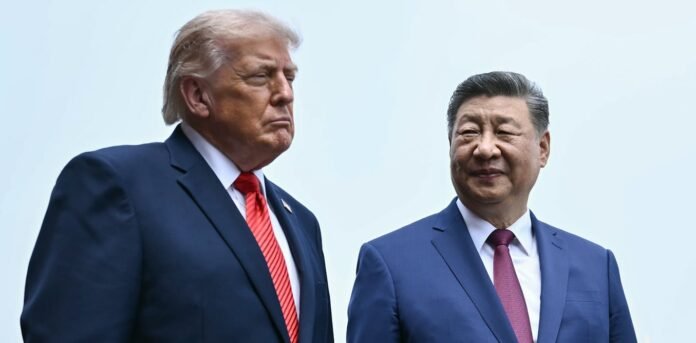
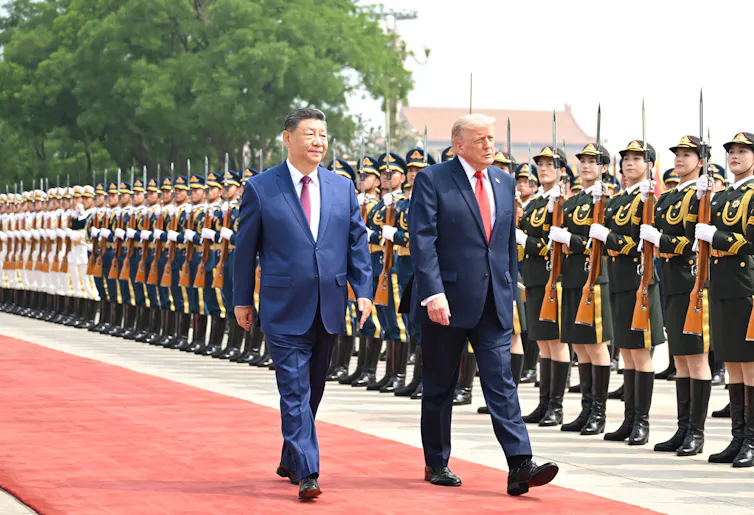
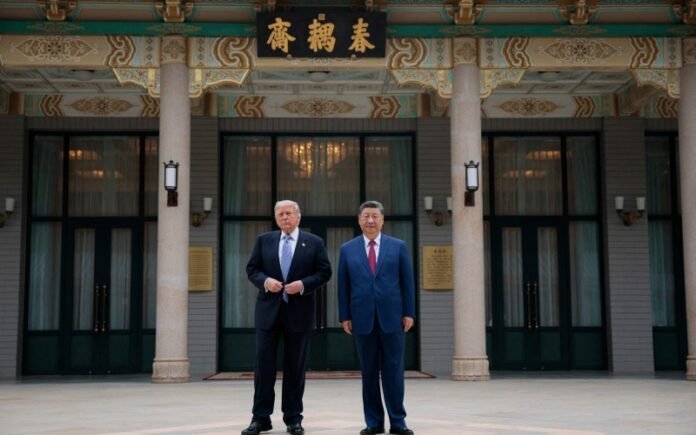
The Chinese president, Xi Jinping, opened the summit by greeting his American counterpart with warm words. The relationship between their two countries, he stated, was the “most consequential in the world”. Xi added that making America great again, a reference to Trump’s political slogan, was compatible with Chinese progress.
Trump was equally effusive in his praise of Xi. Writing on social media during his flight to Beijing, he stated that the Chinese president was “respected by all”. And when the two delegations sat down for direct talks, Trump told Xi: “You’re a great leader.”
But what did this visit actually achieve, beyond the diplomatic words and mutual flattery?
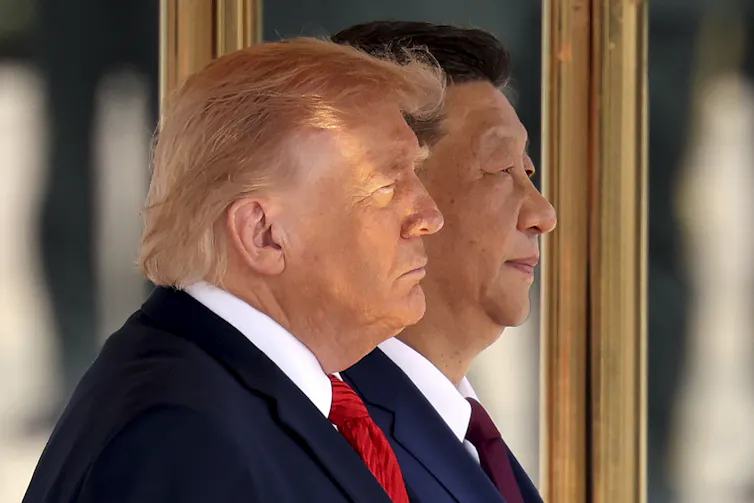
China’s president, Xi Jinping, sits alongside his US counterpart, Donald Trump, at a welcome ceremony in Beijing on May 14.Maxim Shemetov / EPA
One of Trump’s perennial aims in his first and second spells in the White House has been to correct the trade imbalance between the two powers. Figures from 2025 show that while the US sold US$106 billion (£79 billion) of goods to China, it bought products worth US$308 billion from Chinese exporters – a trade deficit of around US$200 billion.
On Trump’s previous visit to China in 2017, soya beans were the thing Beijing agreed to buy more of from the US. This time around, the sole big ticket item was aircraft.
On May 14, Trump announced that China had agreed to order 200 Boeing jets. Yet Boeing’s stock fell 4% immediately after the announcement, because the order was lower than many analysts had expected.
Trump also said that China had, in principle, agreed to buy crude oil from the US.
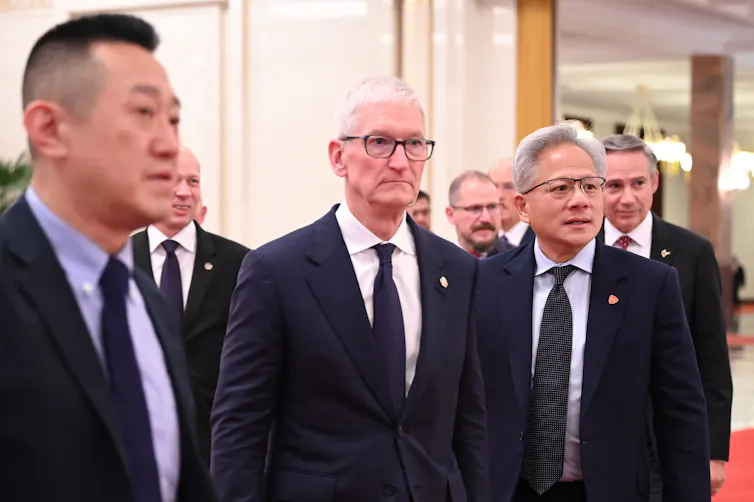
However, in terms of something significant for the CEOs of major tech companies accompanying Trump to Beijing, including Tesla’s Elon Musk, Nvidia’s Jensen Huang and Apple’s Tim Cook, it seems there was no major breakthrough.
China’s strategy of developing its own technology and capacity in this area is well-known, with the government’s recent 15th five-year plan setting out its commitment to innovation, and to its own indigenous companies.
Great-power cooperation
A more significant outcome from the visit came in the less tangible space of geopolitical management and great-power cooperation. At the summit, Xi said clearly that the world relies on China and the US being able to engage with each other pragmatically, even if they don’t see eye to eye.
Comments made on Taiwan, in particular, were seen as underlining the red lines for each side. Xi repeated his demand for American non-interference, a coded warning about US arms sales to the island, which Beijing regards as a breakaway province. Trump later told reporters he had not yet decided whether a major US sale of weapons to Taiwan could move forward.
But in their talks with Chinese officials, the US delegation appear to have stuck largely to policy lines in place since the 1970s – that this issue has to be sorted out peacefully, with agreement from both Taiwan and China.
In view of the other turbulence in the world at the moment, sticking as far as possible to the status quo on this issue, while unexciting, can be described as a positive.
Regarding that turbulence, Trump said Xi had offered to help the US in the Iran conflict – but how this might work out in practice is another matter. China is unlikely to want to play a heavy mediation role, because of the potential to be sucked into the perpetual problems the region seems to present to anyone getting more involved there.
What China wants is a long-term truce that means both Tehran and Washington can claim to have emerged from the Iran war as the winner – despite there being no final decisive outcome. China definitely does not want the conflict to continue indefinitely, given its disruptive economic impact – hence the offer of some kind of help.
History will probably judge Trump’s visit as one more landmark along the road to a world in which China has greater prominence, but still accords the US respect and acceptance of its current economic and military primacy. Trump may have left empty-handed – but in diplomacy, nothing happening is sometimes a good thing.
That the two leaders got on, did not clash and agreed to continue the conversation might not seem a great outcome. But in this turbulent world, it still counts as a plus.
Trump-Xi summit: Cautious progress on trade, ties and some ‘win-wins’
President Donald Trump departed China on May 15, 2026, after a two-day summit with Chinese leader Xi Jinping that was scrutinized from every angle for clues on where the relationship is heading.
No one really expected there to be movement on Taiwan – which mainland China lays claims over – although it is clear that Beijing would like the United States to make a firmer stance against the island moving toward a declaration of independence, or for the U.S. to expressly demand reunification.
So what we got was Beijing reiterating that Taiwan remained a priority and a core interest. Xi did this on the first day of the summit, noting that the Taiwan “question” remained “the most important issue in China-U.S. relations,” and that any mishandling of it could lead to “clashes and even conflicts.”
But this was aimed at two things. First, Xi has a domestic audience he needs to address, and Taiwan has long been important to Chinese rhetoric. The Chinese Communist Party has around 100 million members, many of whom would have expected Xi to talk tough on Taiwan – and it was those people he was largely talking to.
But he was also signaling to the U.S. that it shouldn’t support Taiwanese independence. And that won’t ruffle any feathers in Washington. Indeed, the 2025 National Security Strategy stressed that the U.S. opposed unilateral action on Taiwan from “either party” – a signal to Beijing that it opposed Taiwan declaring independence.
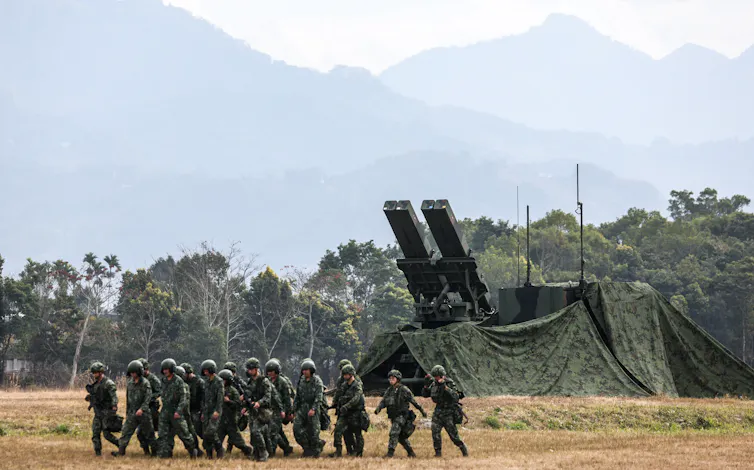
Taiwanese soldiers walk past a Sky Sword II Land-based Air Defense Missile in Taichung on Jan. 27, 2026.I-Hwa Cheng / AFP via Getty Images
Trump did mention arms deals to Taiwan. But the U.S.’s declaratory policy since the Reagan administration is that it doesn’t allow Beijing to enter discussions about what weapons Washington sells to Taiwan. And that hasn’t changed at all, nor has the U.S.’s treaty commitment to Taiwan since 1979 that requires the U.S. to provide Taiwan with defensive weapons to maintain a sufficient self-defense capability.
Rhetoric aside, everyone is happy with the status quo on Taiwan – it is in no one’s interest for it to change.
But talk of Taiwan has been muddied a little by Xi’s determination to modernize the People’s Liberation Army. The Chinese president has laid out a series of benchmarks including that the PLA should be capable of invading Taiwan by 2027. This has been misinterpreted in the U.S. under the so-called “Davidson window” – a concept that has it that China is intent on invading by that time.
In reality, China is nowhere near able to do so. It doesn’t have a “blue water navy” able to operate without port assistance, and the island is incredibly difficult to invade – it only has two places where you can land, and only at certain times of the year. It is also very mountainous. Taiwan is also slowly building its defenses – and learning a lot from Ukraine’s war with Russia – with the intention of becoming “indigestable” to China.
Xi’s modernization timeline also states that the PLA should be a “world class military” – taken to be a peer to the U.S. – by 2049. But the fact that it spends more on internal security than it does on defense indicates where the CCP’s true interests lay – in domestic security rather than external capabilities.
Trade: Tamped down expectations
The big picture is that the U.S. and China have been trying to restabilize what was until fairly recently a very good relationship in terms of economic ties.
Both sides have clear priorities to that extent. China wants to regain the American market it had in the 1990s and early 2000s – and certainly reverse the trend since 2018’s trade war.
Trump since his first administration has made it clear that he sees Chinese control over supply chains and the trade imbalance as a national security issue. Washington also wants to address unfair trade practices, such as the requirement that American companies hand over blueprints, trade secrets, customer lists, marketing plans and more to operate.
So what was achieved in the summit? On the surface, very little. There was some movement on sales of U.S. beef to China. And Trump announced that Beijing would buy 200 aircraft from Boeing – lower than the 500 that had been earlier touted in media reports. And several Chinese companies agreed to buy Nvidia microchips – a continuation of a process that began in late 2025.
That doesn’t seem much, and it was telling that Trump himself wasn’t being very “Trumpian” on what could be achieved during the summit. He wasn’t promising the moon.
A lot of focus will be on technology. China is about 18 months behind the U.S. in microchip development. Some have questioned whether U.S. companies should be selling chips to China, amid fears that China could steal the intellectual property and be able to use higher-technology chips for defense reasons. The U.S. position is it can’t allow Huawei – China’s telecom giant – to take over the whole Chinese market, so it will only allow the sale of what it considers appropriate-level Nvidia chips.
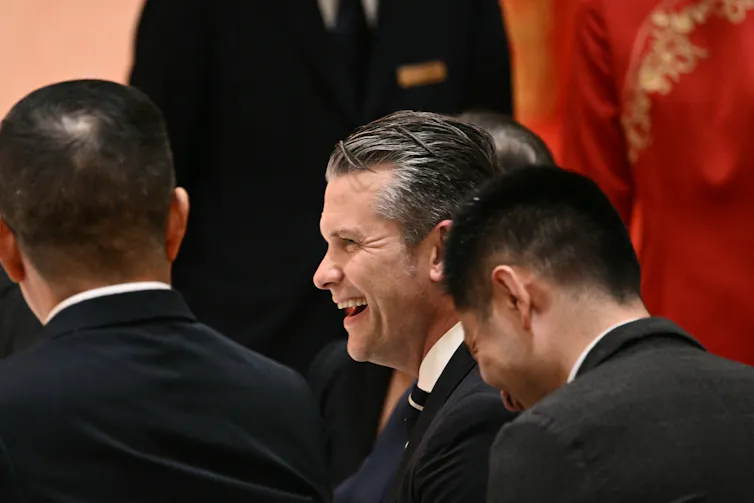
Washington is seeking to open up a line of communication on military matters, and that is probably why U.S. Secretary of Defense Pete Hegseth was there in Beijing. Indeed, it is highly unusual for a defense secretary to be at such a summit.
US Secretary of Defense Pete Hegseth attends a state banquet at the Great Hall of the People in Beijing on May 14, 2026.Brendan Smialowski/ AFP via Getty Images
In fact, little news came out of the summit on Iran. China has criticized the U.S. over the war, but has also quietly been telling Tehran to stop bombing Gulf countries.
Despite some commentary suggesting that Beijing benefits from the U.S. being bogged down in the Middle East, what Xi will want is a resolution before the economic fallout bites in China.
China’s stockpile of Iranian oil will only last a few more weeks and then oil price rises will hit China like a brick.
Bill to keep online games playable clears key hurdle in California
A bill focused on maintaining long-term playable access to online games has passed out of the California Assembly’s appropriations committee, setting up a floor vote by the full legislative body. The advancement is a major win for Stop Killing Games‘ grassroots game preservation movement and comes over the objections of industry lobbyists at the Entertainment Software Association.
California’s Protect Our Games Act, as currently written, would require digital game publishers who cut off support for an online game to either provide a full refund to players or offer an updated version of the game “that enables its continued use independent of services controlled by the operator.” The act would also require publishers to notify players 60 days before the cessation of “services necessary for the ordinary use of the digital game.”
As currently amended, the act would not apply to completely free games and games offered “solely for the duration of [a] subscription. Any other game offered for sale in California on or after January 1, 2027, would be subject to the law if it passes.
“Back shortly before Christmas, when I flew to the US to help set up SKG-US, I didn’t expect us to get this far this quickly,” SKG’s Monitz Katzner wrote on Reddit after the committee vote. “It has been an honor to take part in drafting this bill on behalf of the SKG community: gamers, developers, and publishers alike.”
In a formal statement of support for the bill sent to the California legislature, SKG wrote that “there is no other medium in which a product can be marketed and sold to a consumer and then ripped away without notice… As live service games rise in popularity for game developers and gamers alike, end-of-life procedures are essential tools to ensure prolonged access to the games consumers pay to enjoy.”
The Entertainment Software Association, which helps represent the interests of major game publishers, publicly told the California Assembly last month that the bill misrepresents how modern game distribution actually works. “Consumers receive a license to access and use a game, not an unrestricted ownership interest in the underlying work,” the ESA wrote. The eventual shutdown of outdated or obsolete games is “a natural feature of modern software,” the group added, especially when that software requires online infrastructure maintenance.
The ESA also said the bill would impose unreasonable expectations on publishers regarding licensing rights for music or IP rights, which are often negotiated on a time-limited basis. “A legal requirement to keep games playable indefinitely could place publishers in an impossible position—forcing them to renegotiate licenses indefinitely or alter games in ways that may not be legally or technically feasible,” they wrote.
Last month, the Protect Our Games Act also received positive votes from the California Assembly’s Privacy and Consumer Protection and Judiciary committees. But the bill still faces significant hurdles in getting majority passage in the full California Assembly and the California Senate before being sent to California Governor Gavin Newsom for signature.
Trump expected to drop IRS suit in exchange for MAGA slush fund
The top Democrat on the House Judiciary Committee on Thursday accused US President Donald Trump of “orchestrating a $1,700,000,000 fraud on the American taxpayer to line the pockets of his MAGA political allies” amid new reporting on the terms Trump is seeking in talks to settle his $10 billion lawsuit against the Internal Revenue Service.
ABC News reported late Thursday that Trump is expected to drop his lawsuit in the coming days “in exchange for the creation of a $1.7 billion fund to compensate allies who claim they were wrongfully targeted by the Biden administration.” The money would come from the Treasury Department’s Judgment Fund, which pays out court judgments and settlements against the federal government.
The president is also expected to receive a public apology from the IRS for the leak of his tax returns during his first White House term.
Rep. Jamie Raskin (D-Md.) said in a statement that the reported settlement terms represent “another installment” in Trump’s “ongoing effort to turn the federal government into a personal cash machine for his unpopular extremist movement.”
“This is a massive and unprecedented presidential plunder of the American people,” said Raskin. “Worse still, this is only the beginning—a declaration that the prior payouts were just a down payment, and that he now intends to earmark billions more in taxpayer dollars for his political allies, sycophants, and private militia of unemployed insurrectionists.”
“The president has no authority to conjure up billion-dollar compensation schemes or raid the Judgment Fund, which exists to settle valid lawsuits. Trump is systematically converting neutral government mechanisms into a presidential slush fund to build his army of political dependents,” Raskin continued. “Congress must act immediately to reassert the power of the purse and stop this brazen looting of taxpayer funds before this ‘pilot program’ for corruption becomes the permanent operating system of our government.”
According to ABC, which cited unnamed sources who emphasized that the settlement’s terms should not be considered final until officially announced, the deal is “expected to prohibit Trump from directly receiving payments related to those three legal claims; however, entities associated with Trump are not explicitly barred from filing additional claims.”
“The arrangement would be an unprecedented use of taxpayer dollars with little oversight,” ABC noted. “Under the terms of the potential settlement agreement, President Trump would have the authority to remove members of the commission running the fund without cause, and the commission would be under no obligation to disclose its procedures or decision-making process for awarding more than a billion dollars.”
‘Largest single act of grand larceny in American history’
ABC’s story came on the heels of reports earlier this week revealing internal Justice Department discussions on settling Trump’s lawsuit, which he filed in late January. Last month, a federal judge questioned the constitutionality of Trump’s suit, noting that “he is the sitting president and his named adversaries are entities whose decisions are subject to his direction.”
“Real story: Judge was about to throw out the case because Trump controls both parties,” Rep. Dan Goldman (D-NY) wrote late Thursday. “Before it’s dismissed, Trump tells both parties to reach a ‘settlement.’ Settlement shields Trump from any future audit and creates a secret slush fund that can dole out money to anyone with no transparency.”
“Mind-boggling corruption,” Goldman added.
The case centers on the IRS’s leak of Trump’s tax returns during his first term, which occurred after he broke decades of precedent by refusing to release them. The lawsuit alleges that the IRS failed to prevent former IRS contractor Charles Littlejohn from unlawfully disclosing tax information to media outlets, for which he pleaded guilty in 2024.
The leaks, reported by The New York Times and ProPublica, revealed that Trump had engaged in what was described as “outright fraud” and other “dubious” schemes to avoid taxation, and that he paid no federal income taxes in many of the years leading up to his presidency.
The Trumps are seeking a payout of at least $10 billion from the IRS, which is currently being headed by Trump’s handpicked Social Security Administration head, Frank J. Bisignano, who reports to Treasury Secretary Scott Bessent.
This creates an extraordinary legal situation widely described as a blatant conflict of interest, since Trump is suing an IRS that he effectively controls, which is being represented by a DOJ he also effectively controls.
For a case to be valid, however, the parties must demonstrate that they are actually on opposite sides; otherwise, the case can be thrown out of court.
US District Judge Kathleen M. Williams of the Southern District of Florida, who is overseeing the case, questioned its constitutionality last month and required the parties to file briefs by May 20 demonstrating whether there is an actual conflict between them.
According to the Times, however, if the DOJ decided to settle the case with Trump before that date, there’d be little Williams could do to stop it.
Not only could Trump walk away with a payout of more than a billion dollars but, according to the Times, the White House and DOJ have also discussed a deal for the IRS to drop all audits into Trump, his family, and his businesses.
Presidents and vice presidents are required under IRS to undergo audits of their annual tax returns, and a 2024 Times report found that if Trump failed an audit, it could cost him more than $100 million.
Trump’s presidency has been defined by his and his family’s profiting from their positions of influence. According to a live tracker from the Center for American Progress, Trump and his family have used the White House to rake in more than $2.6 billion worth of cash and gifts.
In addition to about $1.5 billion from their cryptocurrency ventures, which they’ve used the White House to promote, they have received direct gifts – like a $400 million luxury jet from the government of Qatar – and legal cash settlements from media and tech companies worth over $90 million. On top of the IRS lawsuit, Trump has also demanded that the DOJ pay him $230 million over past criminal investigations into him.
But if Trump received even a fraction of what he demanded in a payout from the IRS, it could make the graft from the first year and a half of his presidency look like pocket change, potentially netting him several billion more dollars and possibly even doubling his net worth.
“Trump is considering stealing billions of dollars from the American people,” said Rep. Don Beyer (Va.), the ranking House Democrat on the Joint Economic Committee. “He’s already the most corrupt president ever by a wide margin, but this would be fraud and theft on a scale even he has never attempted. The largest single act of grand larceny in American history.”
Sen. Elizabeth Warren (D-Mass.), the ranking member on the Senate Banking, Housing, and Urban Affairs Committee, added that for the DOJ to hand Trump a settlement “before a court rules” would be a “massive, unprecedented scandal.”
“Congress must stop him,” the senator added, noting that she had introduced a bill last month that would bar presidents, vice presidents, and their families from collecting settlement payments from the federal government while in office. If they file administrative claims, Warren’s bill would also require that the agencies be represented by independent counsels appointed by the court. However, her bill has gotten little traction in a Republican-controlled Congress.
Bharat Ramamurti, who served as the deputy director of the White House National Economic Council under former President Joe Biden, said the IRS lawsuit was a “massive scam” that was “much worse” than Trump’s proposal for Congress to provide $1 billion in taxpayer money to pay for his White House ballroom project.
Trump leaves Beijing with few wins but warm words for Xi
U.S. President Donald Trump left China on Friday with no major breakthroughs on trade or tangible help from Beijing to end the Iran war, despite two days spent heaping praise on his host, Xi Jinping.
Trump’s visit to America’s main strategic and economic rival, the first by a U.S. president since his last trip in 2017, had aimed for tangible results to beef up his sagging approval ratings before midterm elections.
The summit was filled with pageantry, from goose-stepping soldiers to tours of a secret garden, but behind closed doors Xi issued a stark warning to Trump that any mishandling of China’s top concern, Taiwan, could spiral into conflict.
Trump declined to comment on the matter, staying unusually restrained throughout the visit, with his off-the-cuff remarks mainly focused on feting Xi’s warmth and stature.
“It’s been an incredible visit. I think a lot of good has come of it,” Trump told Xi at their final meeting at the Zhongnanhai complex, a former imperial garden housing the offices of Chinese leaders, before their lunch of lobster balls and Kung Pao scallops.
While Trump searched for immediate business wins, such as a deal to sell Boeing jets that did not impress investors, Xi talked up a long-term reset and pact to maintain stable trade ties with Washington, underscoring their differing priorities.
Xi pushed the new term to describe the relationship as “constructive strategic stability” – a sharp departure from the framing of “strategic competition” used by former U.S. President Joe Biden which Beijing disliked.
Analysts said the new framing was a success for China as for the first time it was Beijing that defined the ties on terms that meant that any major rift or “unconstructive” behaviour would violate the spirit of the relationship.
“Until now, China hasn’t proposed an alternative – now they have – if the U.S. side agrees, that is progress,” said Da Wei, director of the Center for International Security and Strategy at Tsinghua University in Beijing.
NO TANGIBLE HELP ON IRAN
Just before the leaders met for tea on Friday, China’s foreign ministry issued a blunt statement outlining its frustration with the U.S.-Israeli war against Iran.
“This conflict, which should never have happened, has no reason to continue,” the ministry said, adding that China supported efforts to reach a peace deal in a war that had disrupted energy supplies and the global economy.
At Zhongnanhai, Trump said the leaders had discussed Iran and felt “very similar”, though Xi did not comment.
U.S. Treasury Secretary Scott Bessent had urged China to use its leverage with Iran to make a deal. But analysts doubt Xi will be willing to push Tehran hard or end support for its military, given Iran’s value to Beijing as a strategic counterweight to the U.S.
A brief U.S. summary of Thursday’s talks highlighted what the White House called the leaders’ shared desire to reopen the Strait of Hormuz off Iran, through which a fifth of global oil and liquefied natural gas flowed before the war, and Xi’s apparent interest in American oil purchases to pare its dependence on the Middle East.
“What’s notable is that there’s no Chinese commitment to do anything specific with regards to Iran,” said Patricia Kim, a foreign policy fellow at the Brookings Institution.
BOEING SHARES SLIDE ON UNDERWHELMING DEAL
In another sign of a diminished scale of the summit, Trump’s readout did not mention the broad structural reforms on which previous presidents pressed Xi.
Unlike on his previous trip in 2017, Trump did not discuss “structural reforms,” “global economic governance” or the “international trading system” with Xi, according to the readout.
“For the market, the summit can be strategically reassuring while underwhelming in substance,” Chim Lee, senior analyst at the Economist Intelligence Unit.
U.S. officials said they had agreed deals to sell farm goods and made progress on setting up mechanisms to manage future trade, with both sides expected to identify $30 billion of non-sensitive goods.
advanced H200 AI chips to China, despite CEO Jensen Huang’s dramatic last-minute addition to the trip.
Trump also left without official resolution to the rare earths supply problem that has dogged ties since China imposed export controls on the vital minerals in response to Trump’s tariff barrage in April 2025.
While the leaders struck a truce last October for Washington to lower tariffs in exchange for China keeping rare earths flowing, Beijing’s controls have caused shortages for U.S. chipmakers and aerospace companies.
It has not even been decided whether to extend the truce beyond its expiry later this year, U.S. Trade Representative Jamieson Greer, accompanying Trump, told Bloomberg TV on Friday.
Such an extension would be “the most basic benchmark” for the success of the summit, said the Brookings’ Kim.
Xi’s remarks to Trump that mishandling Taiwan, the democratically governed island Beijing claims, could lead to conflict, delivered a sharp warning during a summit that otherwise appeared friendly and relaxed.
Taiwan, 50 miles (80 km) off China’s coast, has long been a flashpoint in ties, with Beijing refusing to rule out use of military force to gain control of the island and the U.S. bound by law to provide it the means of self-defence.
“U.S. policy on the issue of Taiwan is unchanged as of today,” Secretary of State Marco Rubio told NBC News. Taiwan Foreign Minister Lin Chia-lung thanked the U.S. for expressing its support.
Palestinian National Popular Action Committee issues statement to mark 78th anniversary of the Nakba
On the seventy-eighth anniversary of the Palestinian Nakba, the Palestinian National Coordinating Body for Popular Action issued a statement affirming that the Nakba is not merely a painful memory, but an ongoing crime and a continuing settler-colonial project. The Committee said the Nakba is renewed today through the genocide in Gaza, ethnic cleansing, the escalation of settlement expansion, the Judaization of Jerusalem, the targeting of the right of return, and attempts to dismantle UNRWA and eradicate the Palestinian cause in all its national and political dimensions.
“What is taking place today is not a new chapter separate from the Nakba, but rather a continuation of the very same settler-colonial project; the methods may change, but the objective remains the same: to uproot the Palestinian people from their land and eliminate their national rights.”
The statement added that the Palestinian people are facing one of the most dangerous conspiracies in modern history, as they confront systematic attempts to break their will, erase their rights, and liquidate their cause under the cover of war, displacement, siege, and dubious settlement deals, amid blatant international complicity, shameful silence, and every form of political collusion targeting Palestine — its land, people, identity, and rights.
“While the Commission condemns all those who participate in, remain silent about, or gamble on projects aimed at liquidating the Palestinian cause, it affirms that Palestine is not a bargaining chip, that the right of return cannot be erased, and that Jerusalem is neither a cause to be Judaized nor one open to compromise. The blood of our people and their sacrifices are greater than all narrow calculations and suspicious agendas.”
The statement concluded by emphasising that the Nakba will remain a witness to the crime and will remain a testament to the fact that Palestine is neither forgotten, nor for sale, nor to be erased, and “that the determination to liberate the land and achieve return is stronger than all conspiracies.”
Rocket Report: Cowboy up for data centers in LEO; Russia’s new ICBM actually works
Welcome to Edition 8.41 of the Rocket Report! The stories of the world’s two most powerful rockets are now intertwined. Hardware for NASA’s third Space Launch System rocket is coming together at Kennedy Space Center in Florida, while SpaceX is readying its first upgraded Starship Version 3 rocket for liftoff from Starbase, Texas. The readiness of each vehicle, along with Blue Origin’s New Glenn rocket and Blue Moon lander, will go a long way toward determining the schedule and content of NASA’s Artemis III mission in low-Earth orbit. We discuss those plans in this week’s Rocket Report.
As always, we welcome reader submissions. If you don’t want to miss an issue, please subscribe using the box below (the form will not appear on AMP-enabled versions of the site). Each report will include information on small-, medium-, and heavy-lift rockets, as well as a quick look ahead at the next three launches on the calendar.
An Indian startup nears its first launch. After the Indian government opened a pathway in 2020 for private industry to build and launch its own rockets, one Indian startup is nearing the pad with its first orbital rocket, Ars reports. The most promising Indian launch company, Skyroot Aerospace, says its Vikram-1 launch vehicle could take flight within the next couple of months. And with a recent $60 million fundraising round valuing the firm at $1.1 billion, the company is poised to accelerate its commercial launch efforts.
A pioneering name… Skyroot’s co-founder and CEO, Pawan Kumar Chandana, worked for the Indian space agency before splitting off in 2018 to establish Skyroot Aerospace in Hyderabad. Although India lacked a purely commercial space industry, Chandana believed that the rising country had the right ingredients in place: great engineers, a supplier base, government spaceports, and an advantageous location near the equator.
Skyroot named its initial line of vehicles “Vikram” in honor of the Indian physicist Vikram Sarabhai, who is considered the father of the Indian space program. As a testbed for its technology, Skyroot worked on a suborbital version of its rocket, Vikram-S, from 2020 to 2022 and launched the 6-meter rocket in November of that year. The larger Vikram-1 rocket now nearing its debut consists of three solid-fueled stages, with the capability to place up to a half-metric ton of payload into low-Earth orbit.
The Ars Technica Rocket Report
The easiest way to keep up with Eric Berger’s and Stephen Clark’s reporting on all things space is to sign up for our newsletter. We’ll collect their stories and deliver them straight to your inbox.
Russia finally tastes success with Sarmat. Russia has announced a successful test of its long-delayed Sarmat intercontinental ballistic missile (ICBM), which President Vladimir Putin now says will be operationally deployed later this year, The War Zone reports. The weapon, developed to deliver multiple nuclear warheads over great distances, has a mixed record in testing so far and was once planned to be fielded in 2020.
All this makes this week’s announcements more significant, although they have yet to be independently verified. The test launch from the Plesetsk Cosmodrome in the Arkhangelsk region took place on Tuesday, according to the Kremlin. Around half an hour later, Russian officials said the missile hit its target at the Kura test range on the Kamchatka Peninsula in Russia’s Far East.
Righting the ship... The RS-28 Sarmat, known to NATO by the codename SS-29 Satan II, is Russia’s new-generation heavy ICBM, intended to replace the Soviet-era R-36M2 system (SS-18 Satan). The Sarmat is a silo-launched, liquid-fueled, nuclear-armed ICBM. The missile will reportedly have a host of capabilities intended to defeat ballistic missile defenses, but Russia has not built a good track record with the vehicle.
The first successful test launch of the Sarmat took place in 2022, also from Plesetsk. However, it was followed by a failed test launch in February 2023. A further test in September 2024 was also unsuccessful, leading to the destruction of the test silo at Plesetsk.
Italy is experimenting with air-launch. An Italian consortium has successfully completed a suborbital demonstration of an air-launched rocket system, European Spaceflight reports. The project, which used a Dornier Alpha Jet aircraft and a HAX25 sounding rocket developed by an Italian company named T4i, was initiated to support Italy’s push to develop a more responsive launch capability.
Another Italian contractor, GMV, provided avionics for the rocket. The program is named Aviolanco and is backed by the Italian government. A ground-launched sounding rocket completed the program’s first test flight in 2022, and Aviolanco progressed to the next phase with an air-launch demonstration from a Houston-based Alpha Jet over the Gulf of Mexico on April 22. The flight targeted an altitude of 80 to 100 kilometers, but a press release announcing the test’s completion did not indicate whether that target was met.
Prioritizing responsiveness... The test “successfully verified the entire system under real-world conditions,” officials said in a press release. Proponents of air-launch systems highlight their versatility. For example, an air-launched space mission could be rescheduled on short notice, with flexible trajectories to work around constraints such as changing weather conditions.
Air-launched rockets like Northrop Grumman’s Pegasus and Virgin Orbit’s LauncherOne have demonstrated that the concept works from a technical perspective, but neither proved to be commercially sustainable. As some space-faring nations look to develop more spaceports and sea-based launch platforms, though, an air-launch system could offer a strategic, if not commercial, advantage. (submitted by EllPeaTea)
German company joins French spaceplane initiative. Dassault Aviation and German satellite developer OHB have teamed up to propose that Dassault’s Vortex-S spaceplane become a European Space Agency program, Aviation Week & Space Technology reports. The two companies are proposing the reusable spacecraft as a means of transporting supplies to space stations and performing autonomous orbital free flyer missions. Dassault, best known for building French fighter jets and business aircraft, is the prime architect and integrator on the program. OHB would develop a service module for the spaceplane. Dassault and OHB said they are in discussions with other European space companies to expand the team.
This sounds cool, but... The French government announced 30 million euros ($35 million) of funding to support the spaceplane program last year. The first step is a sub-scale suborbital demonstrator, called Vortex-D, that Dassault says could fly as soon as 2028. That would be followed by an orbital free-flyer called Vortex-S, and the Vortex-C operational cargo transport vehicle with a total mass of about 8 to 9 metric tons.
Dassault has long-term plans for a human-rated spaceplane. Past and ongoing efforts to develop a European spaceplane have not made it to the launch pad. ESA’s Hermes spaceplane was canceled in 1992, and progress on a smaller low-Earth orbit (LEO) spaceplane named Space Rider has been slow. Meanwhile, ESA is working with The Exploration Company and Thales Alenia Space on developing cargo capsules, not spaceplanes, to service the International Space Station. ESA may have too many cooks in the kitchen to commit to another LEO transport vehicle. (submitted by EllPeaTea)
SpaceX launches NRO satellites for GMTI mission. The National Reconnaissance Office’s (NRO) proliferated satellite architecture, now boasting hundreds of satellites, is supporting a new mission area for space-based sensing and targeting, Aviation Week & Space Technology reports. The latest batch of satellites for the proliferated constellation launched Monday night from Vandenberg Space Force Base, California, aboard a SpaceX Falcon 9 rocket.
The constellation now numbers more than 200 satellites developed in a partnership between SpaceX and Northrop Grumman. In a press release after Monday night’s launch, the NRO revealed that the constellation is supporting the Defense Department’s Ground Moving Target Indication (GMTI) mission as part of the Pentagon’s space-based sensing and targeting architecture.
Migrating upward... The GMTI mission has historically been performed with aircraft, such as the E-8C Joint STARS fleet retired in 2023. Now, satellites are capable of overseeing the battlefield from hundreds of miles in space. The Space Force is developing a separate constellation for Air Moving Target Indication (AMTI).
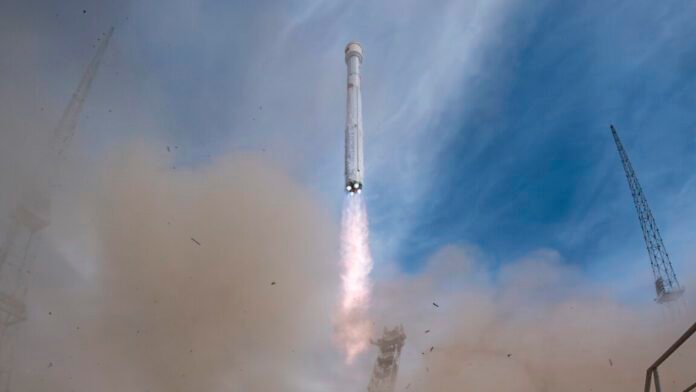
China’s Zhuque-2E rocket returns to flight. China’s commercial Zhuque-2E rocket successfully deployed a mock payload into orbit after lifting off Thursday from a commercial spaceport in the Gobi Desert, Space News reports. This was the first launch of the medium-lift Zhuque-2E rocket since a second stage failure on a mission last August.
Developed by LandSpace, the Zhuque-2E rocket is an evolution of the Zhuque-2 rocket, which became the first methane-fueled launch vehicle to reach orbit in 2023. The version used Thursday is taller and more powerful than previous iterations, with a height of 183 feet (55.9 meters), 745,000 pounds of thrust at liftoff, and a payload capacity of more than 6 metric tons (13,000 pounds) to low-Earth orbit.
Zhuque-3 on deck… LandSpace’s other rocket, the Zhuque-3, is scheduled to make its second flight in the next few months, according to Chinese state media. The Zhuque-3 launched for the first time in December, becoming the first Chinese orbital-class rocket to attempt booster recovery. While the launch phase was successful, the booster crashed during a downrange landing attempt. LandSpace is expected to try again to land the reusable booster on the next flight. (submitted by EllPeaTea)
China launches space station resupply mission. A freighter carrying nearly seven tons of supplies has made its way to China’s Tiangong space station, Space.com reports. The robotic Tianzhou 10 cargo ship lifted off atop a Long March 7 rocket from the Wenchang Space Launch Site on China’s Hainan Island on Sunday. Five hours later, Tianzhou 10 with Tiangong, the T-shaped, three-module space station that China finished assembling in low-Earth orbit in late 2022.
Crew rotation soon… Tianzhou 10 delivered about 6.9 tons (6.3 metric tons) of supplies to the Tiangong space station, including scientific experiments in fluid physics, propellant for the lab’s propulsion system, and a new spacewalking spacesuit. The cargo ship also carried provisions for the station’s three-person crew, which has been in orbit since October. A new Chinese crew is scheduled for launch in the next few weeks.
$275 million for rockets and data centers. A space unicorn started by Baiju Bhatt, the billionaire co-founder of Robinhood Markets Inc., raised $275 million, changed its name, and unveiled a plan to build data centers in orbit, Bloomberg reports. Bhatt’s startup, founded in 2024, was rebranded to Cowboy Space Corp. from Aetherflux, which initially focused on building satellites for beaming solar energy to Earth. Index Ventures led the funding, which valued Cowboy Space at $2 billion, the startup said Monday in a statement. Silicon Valley-based Cowboy Space will use the funding to develop its own rocket to put data centers into orbit.
Cowboy up… The company’s vision sounds familiar. Elon Musk’s SpaceX and Jeff Bezos’ Blue Origin have each announced plans to use their own rockets for launching orbital data centers. Cowboy’s approach differs from the former in that the new startup will design the upper stage of its rocket to itself become the satellite. The company says its new rocket is scheduled to debut in 2028. The path ahead for Cowboy Space is riddled with roadblocks. There are tall barriers to entry for anyone looking to compete with SpaceX and Blue Origin to put data center networks into orbit. Even those companies, bankrolled by two of the world’s richest entrepreneurs, are seeking outside funding to make their visions a reality.
Starship launching next week. For the third time in three years, SpaceX has stacked a new version of its enormous Starship rocket on a launch pad in South Texas, just a few miles north of the US-Mexico border, Ars reports. The newest-generation Starship, known as Starship Version 3, is taller and more powerful than its predecessors. If all goes according to plan, this is the version of Starship that SpaceX will use to begin experimenting with in-orbit refueling, a capability engineers must master before sending ships anywhere farther than low-Earth orbit. In the near-term, refueling will enable Starships to fly to the Moon to serve as landers for NASA’s Artemis program.
Final steps… SpaceX’s launch team filled the rocket with more than 11 million pounds of methane and liquid oxygen propellants Monday in a final countdown rehearsal before the test flight’s scheduled liftoff Tuesday, May 19. After completing the rehearsal, ground crews removed the rocket from the launch pad to install hardware for the vehicle’s flight termination system. The test flight will mark the 12th launch of a full-scale Starship and Super Heavy booster and the first since last October.
Artemis III comes into focus. NASA announced Wednesday that it will fly the Artemis III mission in low-Earth orbit and that it continues to target 2027 for this stepping-stone flight that will help land humans on the Moon, Ars reports. The space agency chose the orbit close to Earth—as opposed to a higher orbit—because it would preserve the final remaining Interim Cryogenic Propulsion Stage for launching the Artemis IV landing mission later this decade. Instead, NASA will use a “spacer” to simulate the mass and overall dimensions of an upper stage but without propulsive capabilities.
Questions remain… Instead of landing on the Moon with Artemis III, the agency now plans to launch four astronauts in the Orion spacecraft, on top of the Space Launch System rocket. NASA Administrator Jared Isaacman announced the change three months ago. In Earth orbit, they will rendezvous with one or both of the vehicles under development to carry astronauts down to the lunar surface: SpaceX’s Starship and Blue Origin’s Blue Moon Mark 2.
NASA will assess each vehicle’s readiness through the rest of 2026 and perhaps into early 2027 before deciding on a final flight plan for Artemis III. What the astronauts will do after rendezvousing with Starship and/or Blue Moon is also unclear. “While some decisions are yet to be determined, astronauts could potentially enter at least one lander test article.” That will hinge on the maturity of each lander’s life support system.
Next three launches
May 15: Falcon 9 | CRS-34 | Cape Canaveral Space Force Station, Florida | 22:05 UTC
May 16: Falcon 9 | Starlink 17-37 | Vandenberg Space Force Base, California | 14:00 UTC
May 17: Long March 8 | Qianfan Polar Group TBD | Wenchang Space Launch Site, China | 14:40 UTC
Mother Shot and Killed in Front of Her 7-Month-Old Baby Outside Grocery Store
A young Georgia mother who dreamed of becoming a nurse was gunned down outside a grocery store while her 7-month-old baby sat nearby in the car — and police say the suspected shooter was her ex-boyfriend, who then turned the gun on himself.
Shyla Cummings, 25, was killed May 6 in the parking lot of a Publix grocery store in Stonecrest, Georgia, in a tragedy that has left her family shattered and a baby girl without her mother.
According to the DeKalb County Police Department, officers rushed to the scene on Panola Road around 7:20 p.m. after reports of gunfire erupted outside the busy shopping center.
When officers arrived, they found Cummings suffering from gunshot wounds. She was pronounced dead at the scene.
Police say the suspected gunman, identified as 23-year-old Isaiah Tarver, was also found wounded from what investigators described as a self-inflicted gunshot wound. He was taken to a nearby hospital and is expected to survive.
Authorities say Tarver and Cummings knew each other, and family members later revealed the pair had been involved in a long, turbulent on-and-off relationship.
Even more heartbreaking, loved ones say Cummings’ 7-month-old daughter, Sariyah, was inside the vehicle during the shooting. Miraculously, the baby was not injured.
The infant is now in the care of Cummings’ parents.
“She was a beautiful soul who loved being a mom,” the grieving family told local outlet 11 Alive.
Her father, Roston Cummings, struggled to hold back emotion while speaking about his daughter and granddaughter.
“Keep our family strong, almighty God,” he said. “Her daughter is almost like Shyla 25 years ago. Same exact way. Adorable. Beautiful.”
Family members say Cummings had been preparing to start nursing school this August and was excited about building a future for herself and her daughter.
“She was in the peak of her life,” her mother, Shameeka Cummings, said. “Striving. She was the best. That was like my vacation partner and everything.”
Friends and loved ones are now preparing to lay the young mother to rest next week as the community mourns another shocking case of domestic violence turned deadly.
Tarver is currently facing a murder with malice charge, according to DeKalb County Jail records.
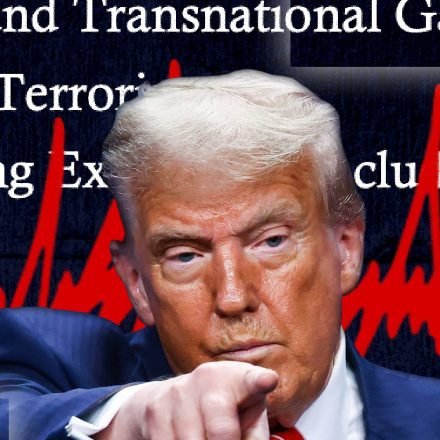
IN 16 pages, the Trump administration’s new official counterterrorism strategy outlines in broad terms who it views as terrorist threats and priority targets, ranging from anti-fascist activists to ISIS and so-called narco-terrorists. The line “We will find you, and we will kill you” appears in the memo.
“[The] strategy brings together Trump’s war on the wider world, which stretches from interventions and wars in Yemen and Somalia to Venezuela and the Caribbean Sea,” says Intercept senior reporter Nick Turse. “It combines it with the administration’s war on dissent at home which has also been lethal, as we saw on the streets of Minneapolis. … We can consider this strategy a new declaration of war by the Trump administration on its enemies both foreign and domestic, both real and imagined.”
This week on The Intercept Briefing, host Jessica Washington and colleagues Turse and Noah Hurowitz, who covers federal law enforcement, dissect how the Trump administration is painting anyone it wants to go after — state and non-state actors — as terrorists. “Fundamentally, this document is a list of the administration’s enemies and a promise of what they’re going to do to them,” says Hurowitz. “This anti-terror imperative makes for a very flexible and useful means of tamping down on dissent.”
“We’re not just talking about rhetoric here,” says Washington. “We’ve seen the administration actually use these terms in action when it comes to the boat strikes in the Caribbean and Pacific that killed nearly 200 people as of early May.”
“The actual legal justification for the strikes is, like so much else, secret,” says Turse, who has been covering the attacks on so-called narco-terrorists. “We’re talking about a fake war in which the enemies aren’t even read into the fact that they’re in an armed conflict with the United States.” He adds, “It’s really built on a quarter-century of executive overreach and targeted killings around the world. It’s the price of Congress allowing Presidents Bush, Obama, Biden, and Trump to hunt and kill people by drone from Afghanistan and Pakistan to Yemen and Somalia. It took this legally dubious, at best, post-9/11 drone war and laid the groundwork for a completely illegal one in the Caribbean and the Pacific Ocean.”
“Say what you will about the people around President Trump,” Hurowitz notes, “but they have proved very adept at finding levers of power and levers of pain to go after their enemies.”
For more, listen to the full conversation of The Intercept Briefing on Apple Podcasts, Spotify, YouTube, or wherever you listen.
Transcript
Jessica Washington: Welcome to the Intercept Briefing. I’m Jessica Washington, politics reporter at The Intercept.
Maia Hibbett: And I’m Maia Hibbett, managing editor at The Intercept.
Last week, we talked about the Supreme Court’s gutting of the Voting Rights Act, and the news on that subject has been moving really fast. I was wondering if first you could just give us a quick update on what else is happening since that last conversation.
JW: There’s been a lot happening since the Supreme Court gutted the Voting Rights Act last month, well, gutted it again further, I should say. In Tennessee, Gov. Bill Lee signed into law a new congressional map eliminating the only majority-Black district. Then in Alabama, House primaries are next week, but the Republican governor is planning to hold a special vote in four districts in August after the state redraws a more GOP-friendly map. Republican leaders like Speaker Mike Johnson are excited about it. Here he is talking about it on “Fox and Friends.”
[Clip]
Brian Kilmeade: There’s Tennessee, Alabama. How many more?
Rep. Mike Johnson: Potentially South Carolina, maybe Missouri, Mississippi. There are other states who are similarly situated. And we think the analysis is, by the end of all this, when you correct all that, Republicans’ll probably pick up between seven and eight seats and maybe double digits, depending on how many states get involved. That’s obviously a good thing for the outcome.
[Clip ends]
JW: My only reaction to hearing that is that Republicans are clearly hiding the ball here. They’re saying that this is about fairer representation, but in Mississippi, they’re clearly trying to eliminate representation for Black Americans. The governor has called to redraw a map that would eliminate Rep. Bennie Thompson’s district. He is the only Black representative representing Mississippi, a state that is nearly 40 percent Black.
Maia, did anything strike you in that clip or just anything about this redistricting effort at all?
MH: I just keep getting struck by the way Republicans are framing this as some sort of anti-racist effort, that the way congressional districts are drawn sometimes to take into account the racial diversity or lack thereof of an area is inherently anti-democratic. And as you’ve pointed out before, in reality, that’s a disingenuous framing of what they’re doing.
JW: Yeah. We’re going to continue to watch the fallout from the Supreme Court. But I want to talk about some other news.
There’s been talk online that we might be facing a new pandemic. Maia, what can you tell us about the hantavirus, and do I need to start stockpiling toilet paper?
MH: No, please, no one go buy a lot of toilet paper. Never helpful.
There’s definitely a lot of chatter and panic online, but I don’t think there’s any sign that this is going to be a new pandemic. A pandemic is when there is this uncontrolled disease spread on a global scale, and there’s really no sign that’s going to be the case here.
It is, however, really fascinating. This is a wild example of a group of people who have been traveling all over the world, who are all on a ship together, and then a very rare infectious disease breaks out. People are certainly freaked out and worried about this when they’re reading about it online, and I think there’s a lot of information on Twitter, on Instagram, everywhere. There’s a lot of panic.
What the general scientific consensus says is still that this strain of the virus, which is known to spread between people, is still more likely to spread animal to human, not human to human. And when it does spread between humans, it typically requires close contact. So you’re having a conversation with someone and your faces are close together, you’re exchanging saliva, there’s some sort of large droplet transfer, something like that, is the most likely way for this to spread between people.
We don’t know everything about it, and of course, viruses do change, but that is still the overall scientific consensus. It’s not known to spread the way Covid does, where it’s aerosolized and someone in the room has it and anyone else in the room could get it.
The most well-known vector for this disease to spread is from people actually inhaling particles from the feces or urine of rodents, especially rats. So really the people, I think, who are at the highest risk are anyone who might be in a setting where they’re cleaning that up or otherwise really directly exposed.
JW: Gross, but I do feel a little bit safer. [Laughter.]
But one thing, I do have some concerns about — we know who’s in charge of HHS, we know who’s in charge of the FDA. Do we have the public health infrastructure to deal with something like this?
MH: We know that since the Trump administration came back into office and Robert F. Kennedy Jr. was appointed to be in charge of Health and Human Services, the CDC has been pretty dramatically gutted. And the Trump administration just doesn’t have the kind of infrastructure the U.S. government used to maintain in order to keep an eye on pandemics and other disease outbreaks. So that certainly is concerning.
For example, there was a lot of chatter last week. Marjorie Taylor Greene was spreading claims that ivermectin was going to be helpful for keeping this virus at bay, and Intercept contributor Austin Campbell reached out to the CDC and asked what they thought of that, and he just never heard back. They never had a stance on it.
Another Intercept contributor, Jackie Sweet, tracked down for a piece this past week on her Substack the case of a 75-year-old cruise ship passenger who had dual residency in both the U.S. and New Zealand. She had managed to totally evade the supervision of public health authorities, which is staggering because there were fewer than 150 people on that ship. So it’s a little bit wild that they couldn’t keep track of them all.
JW: So what I’m hearing from you is that we’re lucky that it’s this kind of virus and not something that is easier to transmit person to person?
MH: I would say that’s right, yeah.
JW: I want to talk about some other reporting that we published this week. On Tuesday, my co-host Akela Lacy published a story about Mahmoud Khalil, a former Columbia University student and Palestinian rights activist who was detained by ICE for protesting in support of Palestinians as a part of the Trump administration’s targeting of student protesters. So I know the story goes into a little bit more detail about that targeting. Maia, what can you tell us about the story?
MH: I think a lot of our listeners probably remember this moment last spring when he was detained, and he was one of the first of this group of students that the Trump administration was targeting. What Akela’s story found was that two days before ICE arrested Mahmoud Khalil, the FBI had gotten an anonymous tip which accused him of calling for, and this is a quote from the tip, “violence on behalf of Hamas.”
Now, we don’t really have any detail in this document on what the tip is. It came in via a FOIA request that his legal team received and passed on to Akela, and the document is mostly redacted. But what we do know is that less than two weeks after they got the tip, the FBI closed this investigation, and they found that the tip did not warrant further investigation.
But by then, he was already in ICE detention in Louisiana, and the Trump administration was already calling him a “Hamas supporter” and accusing him of being a supporter of terrorism. At this point, we now know that the FBI at least had found that allegation was not worth looking into.
JW: That’s really interesting. It feels like we’re going to be unraveling what actually went behind the Trump administration’s targeting of these students. This really fits into broader efforts from the Trump administration to target any of the president’s perceived political enemies, both abroad and in the United States.
MH: Exactly. And this week, everyone in the newsroom has really been focused on this project that you’ve been working on with our colleagues, Nick Turse and Noah Hurowitz, about how the Trump administration is taking that political targeting apparatus to the next level, and what the next phase of it will look like. Could you tell us a little bit more about that project?
JW: We’ve been poring through this new counterterrorism strategy that’s been handed down from the Trump administration. I know that sounds incredibly boring, but this is a document laying out the president’s strategy for coming after his political enemies in the United States and abroad, and potentially giving him the authority to kill his political enemies.
So we’ve been really looking into this next evolution of President Donald Trump’s attempt to label his enemies — so anyone who disagrees with him — as “terrorists.” And I’ve now successfully dragged both of my brilliant coworkers onto the show to talk about it. Nick is a senior reporter covering national security and foreign policy, and Noah is a federal law enforcement reporter.
MH: Let’s hear that conversation.
JW: Nick, Noah, welcome to The Intercept Briefing.
Nick Turse: Thanks so much for having us.
Noah Hurowitz: Thanks for having us.
JW: Let’s dive right into this project. Last week, the Trump administration released its counterterrorism strategy. The 16-page memo outlines who they view as terrorist threats and priority targets. The three of us have been combing through this document for an in-document analysis that we just published.
To start, Nick, can you tell us a bit more about this document and the objectives of the administration?
NT: I consider this a truly foundational document, a genuine distillation of Trumpism as both a movement and a system of governance. The document is the brainchild of the senior counterterrorism director at the National Security Council, Sebastian Gorka, who’s a truly bizarre figure and whose credentials for the job of counterterrorism czar are highly dubious.
This Gorka-led strategy brings together Trump’s war on the wider world, which stretches from interventions and wars in Yemen and Somalia to Venezuela and the Caribbean Sea, and it combines it with the administration’s war on dissent at home which has also been lethal, as we saw on the streets of Minneapolis. The 2026 counterterrorism strategy puts so-called domestic “antifascist” or antifa organizations on par with actual terrorist organizations such as the Islamic State and Al Qaeda as well as with international drug cartels.
“The 2026 counterterrorism strategy puts so-called domestic ‘antifascist’ or antifa organizations on par with actual terrorist organizations, such as the Islamic State and Al Qaeda, as well as with international drug cartels.”
It states that there are three major types of terrorist threats. So we’re talking about what they call legacy Islamist terrorists, Al Qaeda and ISIS; narco-terrorists like the Venezuelan gang Tren de Aragua; and these supposed violent left-wing extremists, which include anarchists and anti-fascists. The latter are longtime Republican boogeymen but don’t actually exist in a real way as, say, urban guerrillas or something like that in the United States.
This is a fictional foe. We can consider this strategy a new declaration of war by the Trump administration on its enemies, both foreign and domestic, both real and imagined.
JW: I think that’s a really good way to look at this document. If we think about it as a foundational text of the Trump administration, then the foundation of the Trump administration is a politics of vengeance, which I think is borne out in so many of the administration’s policies, both at home and abroad.
Noah, I want to bring you in. One thing that this document does is loosely define who is and who isn’t a terrorist. So I want to ask you, what did we now learn about who’s considered a terrorist?
NH: One thing that I found really interesting about this document is that it specifically calls out previous weaponizations of government counterterrorism policy, which is, I think, a pretty clear reference to the prosecutions of right-wing groups, and specifically participants in January 6.
As we know, FBI Director Kash Patel, prior to becoming head of the FBI, was very critical of the federal government’s policies toward violent right-wing extremists, which statistically have been a majority of the domestic terrorists in the United States. This document really explicitly does away with that and explicitly names left-wing groups or left-wing people holding left-wing ideologies as terrorists.
There’s a specific line about doing away with the weaponization of counterterrorism policy against American citizens, when in reality we’ve seen the very explicit weaponization of counterterrorism policy and rhetoric by this administration against its domestic foes, if you will.
Most notably, the language used to describe Alex Pretti and Rene Good in Minneapolis following their deaths, and also the prosecution of nine protesters for their roles in a demonstration outside of an ICE facility in Texas last July. This is the Prairieland case in which eight defendants were convicted on terrorism charges. They might say that they’re ending the weaponization of counterterrorism against American citizens, but in reality, we’ve seen a dramatic escalation of it.
JW: One group that you didn’t mention here, but is mentioned repeatedly throughout the document, are people who the administration calls adherents to radical pro-transgender ideology.
Clearly throughout this document, we’re seeing references to the Christian right, references to the idea that anyone who does not adhere to these very specific tenets of white Christian nationalism — a very specific subset of white evangelical Christianity — that those groups are also considered terrorists under this document.
In April, the Trump administration released the anti-Christian bias task force report which allegedly detailed the Biden administration’s radical efforts to punish Christians and also highlighted President Donald Trump’s efforts to restore religious liberty. There are very similar themes to that document. There clearly is an effort to target anyone who is not a part of MAGA world, and so that includes, obviously, Christian nationalists, but other groups as well.
Noah, I want to ask, how would you characterize what the administration has outlined here?
NH: Fundamentally, this document is a list of the administration’s enemies and a promise of what they’re going to do to them.
JW: Nick, we’re not just talking about rhetoric here. We’ve seen the administration actually use these terms in action when it comes to the boat strikes in the Caribbean and Pacific that killed nearly 200 people as of early May.
The administration has alleged that they are targeting “narco-terrorists.” This has been going on now since September of last year. What evidence has the administration provided to justify what appear to be extrajudicial killings?
NT: Actually, we haven’t seen one shred of evidence. Instead, we’ve been treated to outlandish claims that are demonstrably outright lies. President Trump has repeatedly claimed that the vessels that the U.S. is attacking are trafficking fentanyl, a synthetic opioid. Trump says that the boats are hit, and then you see bags of fentanyl floating in the ocean.
First off, fentanyl is shipped in dramatically smaller quantities than, say, cocaine. You wouldn’t see bales of it floating in a body of water in the aftermath of an airstrike. It’s really beside the point. No fentanyl comes to the United States from South America. Ninety-nine percent of the fentanyl comes into the U.S. through legal ports of entry primarily from Mexico by U.S. citizens and legal permanent residents. Cartels would have to smuggle fentanyl down to South America to smuggle it back by boat.
The actual legal justification for the strikes is, like so much else, secret. There is a classified opinion from the Justice Department’s Office of Legal Counsel. It was drawn up by an interagency lawyers’ group, including representatives of the CIA, the White House Counsel, Department of Justice, and the War Department’s Office of General Counsel. It claims that narcotics on these supposed drug boats, cocaine essentially, are lawful military targets because their cargo generates revenue for cartels whom the Trump administration claims are in a non-international armed conflict with the United States.
Government officials told me that this secret memo wasn’t actually signed by the assistant attorney general until days after the first boat strike on September 2 of last year. So the strikes came before the horse. I should also note that attached to this secret legal memorandum is a similarly secret list of what they call “designated terrorist organizations,” or DTOs. That list is secret too.
So we’re talking about a fake war in which the enemies aren’t even read into the fact that they’re in an armed conflict with the United States.
JW: As you’ve reported, nearly 200 people are dead as a result of these strikes, but there are survivors. What do we know about the survivors of these strikes?
“To me, that says that there’s a higher evidentiary standard to hold someone on drug charges than to kill them for supposed smuggling.”
NT: Yeah, very little at this point. Most survivors have been gravely injured, or they’ve been left to die at sea by the United States. What’s notable is that behind closed doors in classified briefings, military officials have said that they can’t actually hold or try the individuals that survive because they can’t satisfy the evidentiary burden. They can’t bring these people to court because they know they would lose. To me, that says that there’s a higher evidentiary standard to hold someone on drug charges than to kill them for supposed smuggling. So I think of these strikes as a centerpiece counterterrorism strategy of the Trump administration.
It’s really built on a quarter-century of executive overreach and targeted killings around the world. It’s the price of Congress allowing Presidents Bush, Obama, Biden, and Trump to hunt and kill people by drone from Afghanistan and Pakistan to Yemen and Somalia. It took this legally dubious, at best, post-9/11 drone war and laid the groundwork for a completely illegal one in the Caribbean and the Pacific Ocean.
Experts in the laws of war, as well as members of Congress from both parties, say that these boat strikes are illegal extrajudicial killings because the military isn’t permitted to deliberately target civilians, even suspected criminals who don’t pose an imminent threat of violence.
JW: It is so telling that they say they have the legal authority to kill people, but not the legal authority to hold them. I think it just shows the entire game, frankly.
[Break]
JW: Noah, the strategy repeatedly references narco-terrorists in Latin America as principal targets for the Trump administration’s counterterrorism efforts around the world. Does this help us to understand anything about what the administration has been doing in Venezuela, Cuba, and elsewhere?
NH: I think what it helps us understand is that the drug war is and always has been a instrument for various U.S. foreign policy objectives, particularly in Latin America.
“The war on drugs continues to be a very useful cudgel for U.S. foreign policy in the region.”
Actually labeling these somewhat nebulous drug trafficking groups as explicitly as terrorist groups was, until fairly recently, a right-wing fever dream. But on day one, President Trump signed an executive order asking the State Department to label various drug trafficking groups in Mexico and elsewhere in Latin America as terrorist groups. What that tells us is that the war on drugs continues to be a very useful cudgel for U.S. foreign policy in the region.
It’s been used by Trump to discipline and pressure President Claudia Sheinbaum of Mexico. It’s been used to underwrite the sanctions regime against the government of Nicolás Maduro. Then, of course, as a pretext for the kidnapping of Maduro in January.
This counterterrorism strategy, like the national security strategy released late last year, makes repeated reference to the Monroe Doctrine, which is a cornerstone of U.S. foreign policy dating back to 1823 when President James Monroe issued a diktat, if you will, basically saying that the Western Hemisphere is closed to further colonization by Spanish forces and other European powers, and basically it’s our corner of the world, butt out.
The strand of “American First” nationalism that undergirds the Trump administration’s foreign policy is heavily influenced by this Monroe Doctrine. Now what’s interesting is that it was posed as a sort of anti-colonial doctrine — that the Spanish should stop meddling, that the British should stop meddling. But it has been used in an essentially colonialist or imperialist fashion by the United States to assert power in the Western Hemisphere for centuries now.
It is popular among American-first nationalists because it is a vision of the world that predates liberal internationalism, and instead — it’s not isolationist, it’s not, “We’re going to sit in our country and take care of ourselves” — it is, “We are going to take care of ourselves by projecting power in the Western Hemisphere.”
That is something that we’ve seen very explicitly from the Trump administration, both in rhetoric, in the national security strategy and the counterterrorism strategy, and in its actions. We’ve seen that in Venezuela. We’ve seen that in Cuba with the reinforced blockade. We’ve seen that in Mexico with the Trump administration’s treatment of President Claudia Sheinbaum.
We’ve seen that in other countries where it appears that the Trump administration, especially through Marco Rubio, are trying to create a sort of Pan-American right-wing project linking the brain trusts and power of Javier Milei in Argentina, the supporters of Juan Orlando Hernández in Honduras, the administration in Paraguay, and the the government of Ecuador, where we’ve also seen military strikes against alleged drug traffickers.
JW: Nick, this Pan-American view isn’t really limited to the Western Hemisphere. We had a conversation with historian Greg Grandin as well where he got into this. Can you talk about how the administration has also loosened rules of engagement and the effects of that on countries with U.S. military operations?
NT: This new strategy boasts that as soon as Trump retook the White House he reinstituted loosened rules of engagement that were used during his first term in office. In retrospect, we know that these weak rules during Trump’s first term had a profound effect across the Middle East and Africa. Attacks in Somalia, for example, tripled after Trump relaxed targeting principles. At the same time, U.S. military and independent estimates of civilian casualties across U.S. war zones, including Afghanistan, Iraq, Syria, and Yemen all spiked. The U.S. conducted more than 200 declared attacks in Somalia during Trump’s first term, and that was a more than 300 percent increase over the eight years of the Obama presidency.
Now, Trump, already in less than a year and a half in office in the second term, is on the cusp of eclipsing his first four years of strikes in Somalia. A review of the Trump era rules by the Biden administration found that the operating principles used in these strikes including what had previously been at a near-certainty that civilians would not be injured or killed in the course of operations, were severely watered down.
When I talked to retired Brig. Gen. Donald Bolduc, who led Special Operations Command Africa during Trump’s first term, he told me that this shift in the rules of engagement led to a major shift in who could be targeted and who would be killed. In essence, it made it much easier to strike targets.
Back in 2023, in an investigation for The Intercept, I found that these rules in one case led to the deaths of three and possibly five civilians in a strike in Somalia, including a young mother, a 22-year-old, Luul Dahir Mohamed, and her 4-year-old daughter, Mariam. Members of the U.S. strike cell didn’t know what they were looking at and somehow misidentified Luul as a man and completely missed Mariam.
The mother and child had hitched a ride in a pickup truck that the U.S. targeted. Luul and Mariam actually survived the initial strike but were killed in a double-tap attack as they fled for their lives. This was only possible because of these loosened rules of engagement that Trump has now bragged about in this 2026 counterterrorism strategy.
JW: Frankly, it’s alarming to think that now we’re going to see even more incidents like that, like you just described. And we’re seeing people targeted here at home too.
Nick, I was looking at a piece you did last year focused on NSPM-7, the presidential memorandum that effectively created a secret list of domestic terrorists, which included everyone from anti-Christians to anti-capitalists.
One of the haunting questions from your piece was whether the administration has the authority to kill people on the list that it has designated as terrorists. The line “We will find you and we will kill you” appears in this new counterterrorism strategy. I know that stuck out to both of us as incredibly chilling.
Does this new strategy give us an answer to your earlier question? Does the administration have the legal authority to kill its enemies?
NT: The White House and Justice Department have never answered this question. It’s been left hanging there in both cases since the fall when I started asking.
But in December, Gen. Gregory Guillot, the Chief of U.S. Northern Command, a four-star general who takes his orders from Pete Hegseth and oversees the United States, seemed to answer this question, and worryingly so. When he was asked about his willingness to attack so-called designated terrorist organizations within U.S. borders by Sen. Jack Reed of Rhode Island. Guillot said that if he had questions about such an order, he would ask Hegseth, and if not, if he thought it was a legal order, then he would “definitely execute that order.”
“You don’t get four stars on your shoulder by saying, no, sir, that’s immoral. I won’t do what you want, sir.”
Now, as far as four-star generals go, Guillot has a good reputation. People on the Hill, decent people there, like him. He’s not a Hegseth acolyte, not a MAGA general. But the military are, in the end, orders followers. They kill on command. They do what they’re told. You don’t get four stars on your shoulder by saying, no, sir, that’s immoral. I won’t do what you want, sir.
You don’t see a lot of military officers at any level pushing back against the orders of this administration to attack and kill people, whether it’s in Iran or Venezuela, or specifically the boat strikes that every legal authority worthy of that name says are illegal extrajudicial killings.
With secret lists of both foreign and domestic terrorists, we don’t know who can be targeted. But it’s possible that so-called left-wing extremists could be targeted and killed on Trump or Hegseth’s say-so. In a world of secret wars, secret enemies lists, secret legal findings, we just can’t know for sure. And that alone should scare every American.
JW: I think most people in the United States would like to believe that the military would not follow those kinds of orders. But as you’ve documented throughout your entire career, we cannot count on individual soldiers not following through on those orders.
The fact that we now have an enemies list and a counterterrorism strategy that is rather explicit about targeting the left, that includes the words “We will find you and we will kill you,” I think that should be terrifying to pretty much anyone.
Noah, you’ve covered other targets, specifically nonprofits. Can you talk a little bit about how that fits into the broader efforts to not only tamp down but arguably eliminate any dissent? Has the Trump administration strategy here evolved over the last year? And if so, how?
NH: As we’ve mentioned before, this anti-terror imperative makes for a very flexible and useful means of tamping down on dissent. Prior to the Trump administration returning to power, I reported extensively on what was known as the “nonprofit killer bill,” which was a piece of legislation in Congress that would allow the Treasury Department to revoke the nonprofit status of any 501(c)(3) organization found to be providing material support for terrorism.
That was a bill that had received relatively broad bipartisan support prior to the reelection of Donald Trump, and then in the immediate aftermath of the reelection of Donald Trump, it became much more of a partisan issue because suddenly the Democrats looked around and realized that we were going to be handing this tool to a new emboldened Trump administration. So that bill ended up languishing in legislative hell.
I see that as an early warning sign of the way in which the Trump administration planned to use this terrorism rhetoric to tamp down on pretty non-terroristic political enemies. I think that we’ve seen most clearly that coming through in its prosecution of the Southern Poverty Law Center.
Now, that is through the DOJ. They are not necessarily using the rhetoric of anti-terror against the SPLC in that lawsuit, which is based on the use of undercover informants in white supremacist groups. They did accuse the SPLC of essentially providing material support to these extremist groups by paying informants, but it was a slight evolution of the somewhat more crude use of this terrorism label against political enemies.
But we do see that they are using every tool in the toolbox to delegitimize, to prosecute, to make the lives harder of anyone they see as their political enemies.
JW: What’s also fascinating, maybe horrifying is the better word, is the fact that they don’t even have to pass this legislation. They don’t even have to convict these organizations on any charges, and yet there’s already damage. The Intercept has been reporting on the fact that certain financial institutions essentially complied in advance and began preventing donations from their donor-advised funds to SPLC.
Nick, at different points in history, we’ve seen the government target civilians it perceived as enemies of the state, from the McCarthy era to COINTELPRO to the war on terror. Perhaps it’s too soon to tell the full impact, but how does what we’re seeing now with the Trump administration compare to these other periods?
NT: I was really struck by some of the language in this new counterterrorism strategy. At one point, it notes that the national counterterrorism activities “will prioritize the rapid identification and neutralization of violent secular political groups” whose ideology is and this is quoting, “anti-American, radically pro-transgender, and anarchist.”
This language of neutralization, it really harkens back to the FBI’s analogous and infamous COINTELPRO program that you mentioned which was employed in the 1960s and 1970s to target the civil rights movement; the new left; anti-Vietnam War protesters — basically domestic groups and individuals. It’s very much the spiritual precursor to Trump’s current war at home. It’s just that COINTELPRO was secret, and Trump’s effort is out and proud.
“This type of counterintelligence was meant to ‘expose, disrupt, misdirect, discredit, or otherwise neutralize’ — that language again — ‘African American groups and leaders.’”
According to a 1976 Senate Select Committee report on U.S. intelligence activities, COINTELPRO turned a law enforcement agency into a law violator. The Senate committee found that the FBI went beyond the collection of intelligence to secret action designed to “disrupt and neutralize target groups and individuals,” and that they used wartime counterintelligence techniques that were antithetical to a democratic society. There was a 1967 internal FBI memo that laid this out basically that this type of counterintelligence was meant to “expose, disrupt, misdirect, discredit, or otherwise neutralize” — that language again — “African American groups and leaders.”
These efforts were meant to, this is another quote, “cause serious physical, emotional, or economic damage to the targets,” according to the Senate committee. Martin Luther King Jr., for instance, was one of the targets of the FBI’s campaign. The Senate Select Committee again uses that same language. They said that the FBI targeted him to neutralize him. The man that was in charge of the FBI’s what they called “war against Dr. King,” said that they used the same methods they employed against Soviet agents. It’s the Cold War at the time, very much at war with the Soviet Union.
To me, I think Trump is really reinstituting COINTELPRO under a new name.
“Trump is really reinstituting COINTELPRO under a new name.”
JW: The groups that you just mentioned are all generally considered left-leaning movements. What impact did those efforts have on leftist movements in the United States?
NT: Yeah, COINTELPRO and some analogous operations were going on at the same time. They really weakened activist groups. They sowed dissent within organizations, discord among members. They broke up families. They encouraged gang warfare on the streets of American cities. It got people killed.
They utilized informants and agent provocateurs. They undermined groups that were trying to bring about social change through democratic means and hurt people that really just wanted to build a better, more inclusive America.
We can talk about the promise of 1960s radicalism and the movement and people trying to bring about social change and how it failed. But, we can’t seriously address those failures if we don’t talk about a sophisticated government campaign that was meant to undermine those groups and destroy those people.
JW: Are we doomed to repeat that history, to repeat that fate of previous leftist movements? Or is there a way for alleged enemies of the state to fight back? Noah, I want to start with you.
NH: Oh, yeah, we’re doomed. [Laughter.] Just kidding. No, I think there are definitely ways to push back on these. The Trump administration has been dealt a number of defeats in various district courts on a number of important policies.
So it’s going to be really important for groups like the SPLC to fight back from a legal basis. We’re also seeing a number of the charges that are being brought against protesters in various cities that have been invaded by ICE fall apart. The Prairieland case in Texas was actually a bit of an outlier. If you look at a lot of the cases, particularly in Chicago and Los Angeles, the charges brought against protesters there, where the rhetoric of terrorism has been used against them by the administration, have often fallen apart because juries see through what the prosecution is saying against them.
“We’re going to keep seeing creative methods used to tamp down on dissent.”
I think that we are early in this administration and we’re going to keep seeing creative methods used to tamp down on dissent. Say what you will about the people around President Trump, but they have proved very adept at finding levers of power and levers of pain to go after their enemies.
The SPLC lawsuit is a really good example of that. I’m sure they knew that these donor-advised funds were going to stop allowing donations there. It’s not just the bad press. It’s not just the legal headaches. There’s all sorts of problems that you kick off when you make an accusation like this in court.
So we are going to continue to see this so-called anti-terrorism carried out against leftist groups. It’s just going to be really important to find creative ways to push back on.
JW: Nick, how does the left survive this?
NT: The only reason that we, the public, that Congress, anyone ever found out about the COINTELPRO program is because a tiny group of academics, a daycare director, and a taxi driver broke into an FBI field office in Media, Pennsylvania, in 1971, stole more than a thousand classified FBI documents, and exposed the FBI’s illegal operations.
The Citizens’ Commission to Investigate the FBI, as they called themselves, changed our understanding of how underhanded and unhinged the U.S. government is and can be. And they were just regular people.
I’m not encouraging people to break into an FBI field office, but activists are still smart and committed, and I’m confident they’ll find a way to expose today’s illegality.
I hope and I humbly ask that they send whatever they uncover to The Intercept.
“I’m not encouraging people to break into an FBI field office, but activists are still smart and committed.”
JW: Sounds like we’re going to have a lot more documents to go through. We’re going to leave it there. We go into much more detail about the far-reaching implications of the administration’s counterterrorism strategy beyond what we cover here, so you can check out our story. You can find it at theintercept.com, and we’ll link it in the show notes.
Nick and Noah, thanks for joining me on The Intercept Briefing.
NT: Thanks so much for having us.
NH: Thanks so much.
JW: That does it for this episode.
This episode was produced by Laura Flynn. Ben Muessig is our editor-in-chief. Maia Hibbett is our Managing Editor. Chelsey B. Coombs is our social and video producer. Fei Liu is our product and design manager. Nara Shin is our copy editor. William Stanton mixed our show. Legal review by David Bralow.
Slip Stream provided our theme music.
This show and our reporting at The Intercept doesn’t exist without you. Your donation, no matter the amount, makes a real difference. Keep our investigations free and fearless at theintercept.com/join.
And if you haven’t already, please subscribe to The Intercept Briefing wherever you listen to podcasts. Do leave us a rating or a review, it helps other listeners to find us.
Let us know what you think of this episode, or If you want to send us a general message, email us at podcasts@theintercept.com.