11.6 C
London
Friday, May 15, 2026
Home Blog

Why Have Immigration Agents Detained This American Citizen Three Times?

0
why-have-immigration-agents-detained-this-american-citizen-three-times?
Why Have Immigration Agents Detained This American Citizen Three Times?

When immigration agents pulled U.S. citizen Leonardo Garcia Venegas from his car this month and shackled him, he wasn’t surprised. He wasn’t scared. 

He was tired.

As ProPublica detailed last fall, he had already been detained twice before.

A year ago, Garcia Venegas was filming his brother’s arrest during a raid on their coastal Alabama construction site when he was tackled by agents, who ignored his pleas that he was a citizen. A few weeks later, an officer entered the home Garcia Venegas was building and refused to trust the now-26-year-old’s Alabama REAL ID, which only citizens and legal residents can get.

Videos of the incidents went viral. He appeared before Congress. He also has a suit pending against the Trump administration. 

But all the attention hasn’t changed much. On May 2, agents followed him back to his home. They again didn’t believe his claims of citizenship or the REAL ID he once again tried to show them.

Now, after that latest detention, Garcia Venegas sounds demoralized.

“Honestly, it feels terrible,”  Garcia Venegas told ProPublica. The mental burden of wondering when it will happen again weighs on him, bringing stress and depression. “I drive to work every morning and I know, at any moment, they could pull me over again.”

Garcia Venegas, a U.S. citizen, was recently detained for a third time by immigration authorities. Joanna Shan/ProPublica

While immigration sweeps have receded from the headlines, Garcia Venegas’ most recent incident highlights how the mistaken detention of Americans has continued despite congressional inquiries and denials by senior immigration officials. 

Days after Garcia Venegas’ latest detention, masked agents tackled an American teen in the Bronx. When they finally realized he was a citizen, they left him in an unfamiliar neighborhood, bloody and bruised.

The same week both citizens were held, administration officials spoke on a panel at a border security conference in Phoenix and downplayed and denied that citizens have been mistakenly detained. Recordings of the conference were shared with ProPublica. 

“Since the start of this administration, we have not had any arrests of U.S. citizens for false identification, where we thought they were an illegal alien but they were actually a U.S. citizen,” said Matthew Elliston, a top Immigration and Customs Enforcement official. “That’s happened zero times.”

In another panel, the outgoing head of ICE, Todd Lyons, acknowledged immigration agents sometimes detained American citizens in cases where those citizens allegedly put “hands on law enforcement.” He also said the arrests operated as “a deterrent.” 

As ProPublica and others have reported, citizens — including Garcia Venegas — accused of assaulting officers have not always been charged with assault. Video footage has often also contradicted Department of Homeland Security claims that its agents were attacked.

In response to questions from ProPublica, a DHS spokesperson said in a statement that despite the shackles, Garcia Venegas was “NOT detained.” The statement continued: “ICE conducted a routine vehicle stop on a car registered to an illegal alien. After Venegas’ identity was established, he was released.” DHS also stated that the teen in the Bronx was “NOT arrested” but rather “temporarily detained.” 

The agency said it is “NOT arresting U.S. citizens by mistake. DHS enforcement operations are highly targeted.” 

But it’s not clear what, if any, intel agents have used in the repeated detention of Garcia Venegas. 

Garcia Venegas said agents and local law enforcement at the scene blamed him for his most recent arrest because he was driving a car registered to his brother.

A split image shows a group of law enforcement officers in tactical vests standing around a person near a gray car in a grassy yard, left, and a dark, close-up view of a person’s ankles in metal cuffs inside a vehicle, right.
Immigration agents and local law enforcement with a shackled Garcia Venegas Photos courtesy of Leonardo Garcia Venegas

“The officers told me that I risk being stopped again until I register the license plates in my own name,” Garcia Venegas said in a recent filing in his lawsuit. “But the officers could have known immediately that I was not my brother just by checking the REAL ID that was in my hand when they pulled me from the truck and tackled me to the ground.”

Garcia Venegas’ incidents bear the hallmarks of what have become known as “Kavanaugh stops.” Those are stops in which, Supreme Court Justice Kavanaugh wrote in a case last fall, agents are allowed to stop people based in part on their “apparent ethnicity” (Garcia Venegas is Latino), job (he works in construction) and language (he primarily speaks Spanish).

Americans, Kavanaugh said, have no reason to worry. Agents will establish their citizenship and “promptly let the individual go.” (In a later case on another issue, Kavanaugh included a footnote that “officers must not make interior immigration stops or arrests based on race or ethnicity.”)

In his latest stop, Garcia Venegas was let go after about 15 minutes. But the fallout is far from over. 

Even though he was born in Florida and graduated high school in the same county where keeps getting detained, Garcia Venegas sometimes wonders if he should pick up and move to his family’s home in Mexico. 

“I just want to live in peace,” he said. 

Last fall, when Garcia Venegas filed his federal lawsuit against the government, he demanded more than compensation. He has insisted agents stop “unconstitutional” raids in his area. The government said in court that the immigration sweeps are “based on reasonable suspicion and probable cause and the Constitution.”

After Garcia Venegas was held for the third time, his lawyers rushed to update his lawsuit with details of his latest detention. But the government’s lawyers have argued that Garcia Venegas’ case still has no merit.

Garcia Venegas also filed a separate claim for damages with the government last fall. He received a denial from ICE in mid-April that contained no explanation. His third detention came roughly two weeks later.  

During the border security conference this month, the head of Customs and Border Protection,   Rodney Scott, was asked about ProPublica’s reporting on citizens’ detentions and how the agency is addressing them.  

“I’m not going to do anything to not arrest U.S. citizens,” he said. “Because we arrest criminals, period.”

The perfect commuter bike? Velotric’s Discover 3 makes its case.

0
the-perfect-commuter-bike?-velotric’s-discover-3-makes-its-case.
The perfect commuter bike? Velotric’s Discover 3 makes its case.

Commuter bikes don’t come with the same constraints many other bikes do. Mountain bikes must glide gracefully through all sorts of abusive terrain; road bikes need to mix high performance with enough comfort to let riders stay in the saddle for hours on end. All a commuter bike needs to do is comfortably and reliably get you from A to B on typical roads with minimal fuss.

So it’s been surprising how rarely the commuter bikes I’ve tested have gotten it right. At the low end of the price scale, as you’d expect, the required compromises have a big impact on the experience. The high end addresses those shortcomings, but at prices comparable to high-end bikes from specialized categories. I’ve never encountered something in the middle of the two: affordable, with no compromises.

But I may have just found my ideal commuter bike: the Velotric Discover 3. It’s comfortable, it has a great combination of components, and it comes in at just under $2,000.

Upgrades all around

Velotric’s first entry in this line, the Discover 1, marked a promising start for the company. While it was definitely in the “compromises needed” category, the shortcomings were relatively minor and carefully chosen. Since then, the company has expanded considerably, introduced many new models, started working with local dealers in the US, and moved a bit upmarket.

The third iteration of the Discover illustrates the upmarket move. It costs nearly twice as much as the original Discover, but you get a lot for that price. The hub motor is gone, replaced by a mid-frame motor produced under contract for Velotric.

While it still has a cadence sensor you can select through a menu, the Discover uses a torque sensor by default, providing far more integration with your pedaling. Cadence sensors simply register when the pedals are spinning; a torque sensor registers how much force you’re applying to the cranks. The latter makes the electric assist feel more like just that: an assist for your legs rather than a replacement for effort.

Switching to the cadence sensor triggers a warning that it will drain the battery faster, which makes sense: You can gently spin the pedals in a gear meant for climbing hills while the electric motor does all the work. I quickly switched back to the torque sensor for pleasant spring-time riding, but I can see where the cadence sensor might make sense once the full heat of summer starts.

Of course, you could always just use the throttle. More on that below.

Another big upgrade comes in the drivetrain, provided by Shimano. After years spent diversifying its low-end components and moving electronics down from the high end to the middle of its range, Shimano has finally decided to rationalize everything. All the models in its upper range, both road and mountain bikes, will have dedicated electronic groupsets. The entire low end will be occupied by items from the Cues groupsets, which will all be completely interoperable.

Image of the rear wheel of a bicycle, showing its gears and the derailleur.

Look at that nicely spaced set of gears. Shimano’s new Cues components seem great.

Look at that nicely spaced set of gears. Shimano’s new Cues components seem great. Credit: John Timmer

In theory, this means a mountain bike rear derailleur could be paired with a road-style shifter and work without a fuss (the road shifter hasn’t been released yet, so nobody knows). This seems to be a recipe for even more chaos, as bike manufacturers can potentially mix and match quality and intended use at random.

In practice, though, using a Cues system has allowed Velotric to avoid the worst features of some of Shimano’s previous low-end hardware: cheap plastic shifters and a gear range so narrow it was nearly impossible to pedal fast enough to reach the full rated speed. The Discover 3 has decent-feeling thumb trigger shifting that runs you through eight useful gears in back, with a range typical of a low-end mountain bike. It is an enormous step up from some previous budget hardware.

True class

US law defines three classes of e-bike. Class 1 provides an assist for up to 20 miles an hour (32 km/hr), but you must be pedaling to activate it. Class 2 is similar but adds a throttle that also cuts out at the same maximum speed. Class 3 e-bikes offer an assist to 28 mph (45 km/hr) but do not allow a throttle. The accepted classes are a patchwork, making it difficult to design a single bike for the US market.

Nearly every manufacturer focused on the US market has settled on a compromise that’s probably not technically legal: They enable switching to Class 3 in software but still provide a hardware throttle. The throttle simply cuts out at the lower max speed of Class 2. The assist it provides is also somewhat anemic; I could generally accelerate away from a full stop much faster by mashing the pedals a bit.

Velotric has provided a simple software solution. If the bike is set to Class 1 or Class 3, the throttle is disabled. While this may seem like a blindingly obvious way to do things, it’s rare enough that I initially thought I had been shipped a bike with a defective throttle.

Image of the handle bar of a bicycle, showing a controller and throttle lever.

Even if you don’t use the throttle, the seven buttons on the controller should keep your left thumb busy.

Even if you don’t use the throttle, the seven buttons on the controller should keep your left thumb busy. Credit: John Timmer

The assist provided by the throttle is a bit weak; I could generally accelerate from a full stop faster by mashing the pedals down with the assist set to high. If you want to cruise around using the throttle to avoid the effort of pedaling, you’re better off activating the cadence sensor and then casually spinning the pedals with the chain in a large gear ring. That will get you to the max speed faster than waiting for the throttle to take you there.

Customize your ride

In general, Velotric offers exceptional customization options. You can adjust the speed of any assist level up to its legal maximum. So if you live in an area with low speed limits, you can set Class 1’s assist to max out at 15 mph while leaving the remaining ones untouched. Or if you’re worried you’re not getting enough exercise, you can set the throttle to cut out at 10 mph while leaving Class 2’s 20 mph assist maximum untouched.

This is actually useful because Velotric includes a dedicated button for switching classes on the controller. On most bikes, changing classes requires a trip to a phone application or diving through menus that require you to pull over. Thanks to the button, you simply adjust the class to your current needs. I would set it to Class 1 when sharing space on a heavily trafficked bike path, then switch to Class 3 to match the traffic speeds on suburban streets.

Anything that makes it easier to change classes will obviously also make it easy for riders to switch into a class that may not be appropriate for the conditions. Of course, this sort of rider is more likely to set the bike to Class 3 and keep it there.

This isn’t the only nice bit of electronics that Velotric has added. The bike includes rear turn signals controlled by buttons that are easy to use without looking down, along with an alert when they’re active. I’ve found that leaving them on after a turn can be a real problem, as directionals are not part of my normal cycling routine. The only omission is front directionals, which would be helpful for turning left across oncoming traffic.

Screenshot of a phone application showing a number of sliders and check boxes to adjust things.

If you decide to use the phone app, all the options are logically laid out.

Screenshot of a phone application showing a number of sliders and check boxes to adjust things.

You can do a lot of fine tuning of your bike’s performance.

All this customization can be done through the on-bike display or Velotric’s phone app. On many systems I’ve tested, it felt like I couldn’t access everything I needed without making adjustments on both the bike and the app. Velotric’s system, by contrast, presents the same options in the same order in both places, giving me confidence that I’m not missing out on any options, no matter how I’m setting them.

All that and a great ride

Reviewing the list of features, there’s little that’s missing or problematic. The battery is sufficient, and it comes standard with a robust rear rack and fenders. It’s UL listed, and depending on how aggressively you set the assist, it should deliver the promised 60–80 miles of range (at least 100 km). Hydraulic disk brakes from Tektro provide plenty of stopping power.

The screen is bright and clear, and the settings are easy to navigate, though there are a lot of them. It’s helpful that Velotric’s smartphone app isn’t required, but it’s a nice alternative. The software also integrates with Apple’s Find My system and Google’s equivalent, and it can be set to unlock the bike when you’re nearby. There’s also a USB-C port for charging on the go.

Velotric has also included adjustable front shocks and a shock-absorbing seatpost, coupled with a thick and cushy saddle. The Discover 3 also comes with some fairly beefy tires that also help cushion any bumps. The result is a very gentle ride, even across my local Worst Paved Road in Town™.

Image of the saddle of a bicycle, showing a mechanical dampener between it and the seat post.

The seat post includes a device that should cushion the bumps.

Image of the front wheel of a bicycle, showing forks with a shock absorber.

There are also front shocks to cushion bad pavement.

In general, the ride is great. You sit with a very upright posture, but it’s comfortable, and the large version is appropriately sized for someone like me (well over 6 feet/185 cm), which isn’t always the case with “large” frames. It’s not a performance bicycle, but the U-shaped frame is solid and gives the sense that the effort you put into the pedals translates directly to forward movement rather than being lost to frame flex.

With three classes and five levels of assist a few button presses away, it was easy to find a setting that worked for the effort I wanted to put in. That could range from powering down the streets in an “I’m going to be late panic” to gentle “I don’t want to end up covered in sweat” rides. Having a useful gearing setup thanks to the Cues components was also a big help in this regard.

At a bit over 60 pounds (27 kg), it’s not enjoyable to ride without the assist, but it’s manageable in a pinch.

Image of the display screen of a bicycle, which is centered on the handlebars.

When it’s not nagging you to change gears, the display nicely balances information content and information overload.

When it’s not nagging you to change gears, the display nicely balances information content and information overload. Credit: John Timmer

One mildly annoying feature is that the bike uses input from the torque sensor and occasionally flashes a yellow warning on the display recommending when you should shift gears. This typically happened when I was pushing a high speed at high cadence—the bike would prompt me to shift into a higher gear and pedal more slowly with more force. I’m a better judge of my own cadence/power tradeoff than the software, so I found this less than helpful, and there doesn’t appear to be a way to shut it off.

Little to complain about

I’m not really the target audience for a commuter bike; if I had to commute, I’d rather do it on something that could also handle something like a bit of light trail riding. But it was hard not to be impressed with what Velotric has put together. The $2,000 price tag will obviously be a barrier for some people, but it isn’t a huge jump from models that are a significant step down in features and quality. And many commuter bikes that cost substantially more than the Discover 3 don’t add much to the riding experience, though they likely have higher-quality components.

Velotric itself has also been around long enough to iterate on several of its designs, lending some confidence that the company will be there to provide any service that’s needed in the future.

I see a couple of minor things that could be improved, but they are truly minor. So for the second time since I’ve started reviewing e-bikes, I’m giving one the official Ars seal of approval. If you’re in the market for a good commuter bike, the Discover 3 provides a fantastic balance of price and quality.

The Good

  • Solid and comfortable commuter bike
  • Very competitive price for the quality
  • Great (and actually legal) system for managing the assist class
  • New Shimano Cues components are a big step up from budget gear

The Bad

  • Doesn’t have a front turn signal
  • Throttle takes forever to get the bike up to 20 mph
  • Gets annoying about telling you what gear you should be in

The Ugly

  • There’s nothing ugly about it

EU activates crisis mechanism to monitor hantavirus outbreak

0
eu-activates-crisis-mechanism-to-monitor-hantavirus-outbreak
EU activates crisis mechanism to monitor hantavirus outbreak


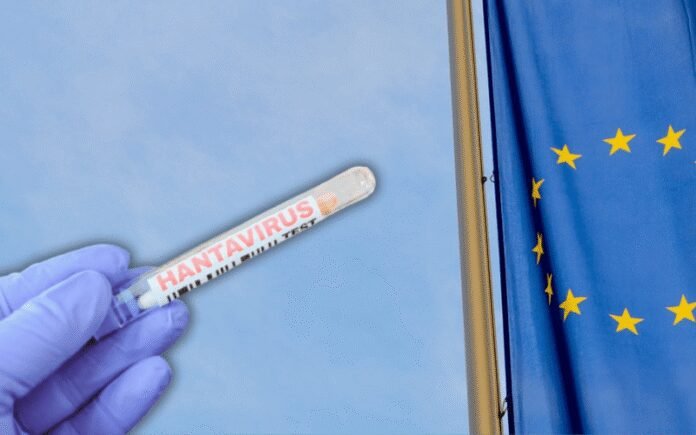
The Cyprus Presidency has activated the EU’s Integrated Political Crisis Response (IPCR) arrangements as part of efforts to monitor the hantavirus outbreak that has prompted increased vigilance among member states.

A Cypriot official said the decision was taken as a precautionary measure to facilitate information-sharing and coordination between EU countries.

The IPCR mechanism is used during major cross-border crises and provides a platform for exchanges between member states, the European Commission and relevant agencies. Officials said the framework would help improve situational awareness should additional cases emerge.

Coordination is already taking place through EU health and civil protection networks. The European Centre for Disease Prevention and Control has been involved in the response since being notified on 2 May and has been cooperating with member states.

Cypriot officials said the Presidency considered it prudent to formalise cooperation through the IPCR framework because of uncertainties linked to the outbreak and the virus’s incubation period.

According to the ECDC, 11 cases had been reported in Europe as of 14 May, including eight confirmed infections, two probable cases and one inconclusive result.

The agency said additional infections among former passengers and crew connected to the outbreak could still emerge in the coming weeks due to the virus’s long incubation period.

ECDC Director Pamela Rendi-Wagner said the agency’s precautionary approach since the beginning of the outbreak had been important.

The ECDC continues to assess the overall threat to the EU and EEA population as “very low”, noting that hantaviruses are not easily transmitted between humans when appropriate infection-control measures are applied.

Xi-Trump summit: reset for US-Chinese relations but tension over Taiwan remains

0
xi-trump-summit:-reset-for-us-chinese-relations-but-tension-over-taiwan-remains
Xi-Trump summit: reset for US-Chinese relations but tension over Taiwan remains

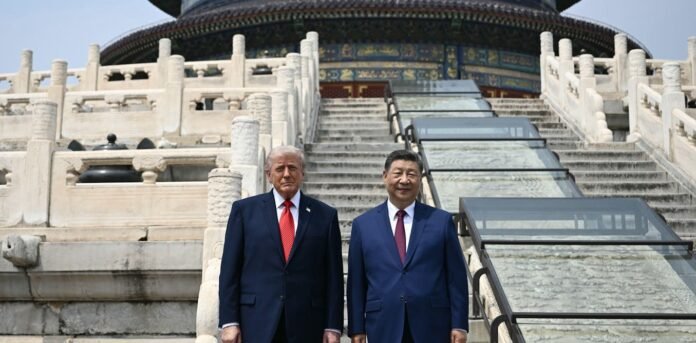
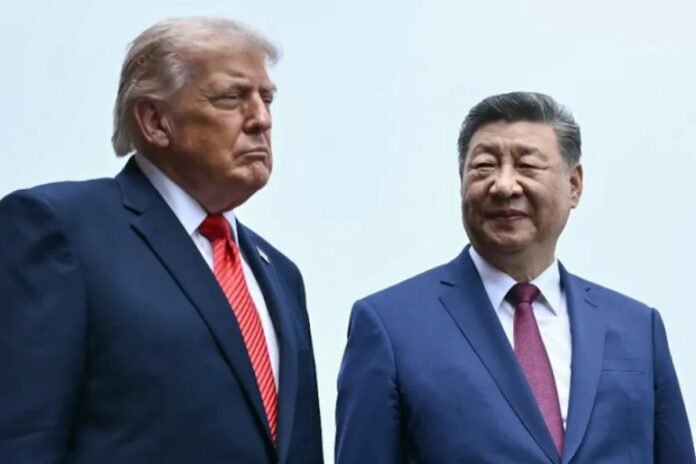
The initial top line emerging from the Trump-Xi summit in Beijing was that while the two leaders had talked trade, technology and the US war in Iran, the most potentially hazardous issue was Taiwan. The Chinese foreign ministry reported that the Chinese president, Xi Jinping, told the US president, Donald Trump, that “the Taiwan question is the most important issue in China-US relations”.

Handled properly, China’s statement said, relationship between China and the US will remain stable. “If handled poorly”, Xi told the US president, “the two countries will collide or even clash, putting the entire US-China relationship in an extremely dangerous situation.”

A White House statement didn’t mention Xi’s warning over Taiwan, instead focusing on the two leaders’ agreement that the Strait of Hormuz must be kept open and the importance of China buying US agricultural produce and curtailing the flow of fentanyl precursors into the US.

In other words, the two sides’ reports neatly reflected their respective priorities.

So, despite the warm words and bonhomie at the subsequent banquet at which the two leaders raised glasses to each other over lobster, beef ribs and Beijing roast duck, there is clearly the potential for a serious misunderstanding over Taiwan. Last week a The Trump administration bipartisan group of senators sent a letter to the US president urging him to sign off on a US$14 billion (£111 billion) package of arms to Taipei. If he proceed with this, it would seriously hamper any efforts the two leaders might make to stabilise relations between the two countries.

The problem, write international affairs specialists Nicholas Wheeler and Marcus Holmes, is that the two sides come at the issue from completely different directions. For the US, continuing to provide Taiwan with state-of-the-art US defence weaponry is about deterring Chinese aggression. For China, US arms sales to Taiwan are themselves an aggressive move.

The situation is fraught with possibilities for misunderstanding. But surely this is what summits are for, argue Wheeler and Holmes. They recall the crisis in 1983 sparked by a US military drill that the Soviet Union convinced themselves was a preparation for a real nuclear strike by the US. It was Ronald Reagan’s realisation that “maybe they are scared of us and think we are a threat” which led him to develop warm relations with the next Soviet leader, Mikhail Gorbachev, precipitating a new era in arms control.

Maybe this week’s summit could help the pair to – as Xi put it – “make 2026 a historic, landmark year that opens up a new chapter in China-US relations”.


Read more: Trump-Xi summit: in a high-stakes meeting the two leaders can’t afford to misread each other


Where would this new era leave Taipei? Distinctly nervous, you’d have to think. As Trump prepared to leave for Beijing, he commented that he was planning to discuss US arms sales with Xi – which, as Andrew Gawthorpe notes – breaches one of the Six Assurances that has been part of America’s policy towards Taiwan since the 1980s.

Gawthorpe, an expert in US foreign policy at the University of Leiden, cautions that the Trump administration breaking one of these promises could embolden Xi to press Trump on the other five, which include a US commitment on Taiwanese sovereignty.

The fact is, Gawthorpe concludes, if US arms sales to Taiwan are on the table now, they a likely to stay there, which could prove perilous for Taiwan if the US wants any major concessions, say on China’s support for Iran.


Read more: Trump-Xi summit: US president says he will discuss arms sales to Taiwan – breaking decades of US policy


Xi talked about his hope that the summit could work towards “a new paradigm of major-country relations”. The importance of this bilateral relationship was a theme the Chinese president returned to several times in the meeting, at one point referencing what he called the “Thucydides trap”, which refers to the stresses that occur when a rising power challenges an established one. (You may recall Canadian prime minister Mark Carney made reference to the revered Greek historian in his widely praised Davos speech in February.)

But where was Russia in all this? Stefan Wolff, professor of international security at the University of Birmingham, observes that any stabilising of relations between Washington and Beijing is likely to come at Moscow’s expense and will certainly be a blow to Vladimir Putin’s aspiration to restore his country to great power status.

So as not to be left out, Kremlin spokesman Dmitry Peskov announced as Xi and Trump toured the Temple of Heaven in Beijing (an honour that has yet to be afforded to Putin) that preparations are underway for the Russian president to visit China “very soon”.

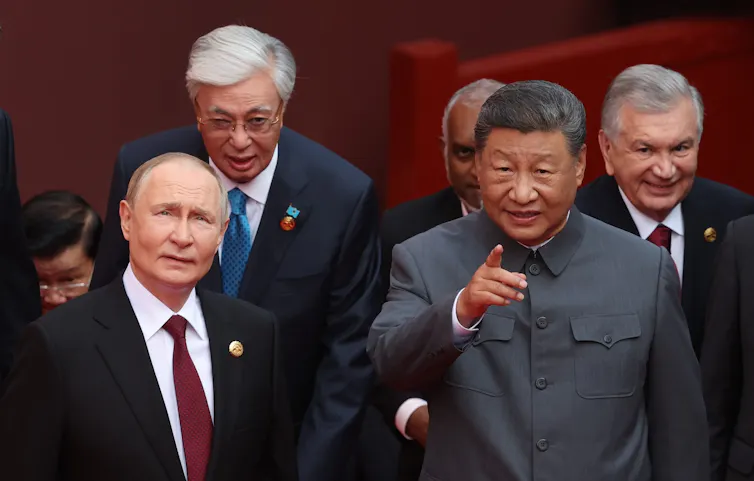
Vladimir Putin and Xi Jinping in Beijing, September 2025.

Still best friends? Vladimir Putin and Xi Jinping at celebrations to mark the 80th anniversary of the end of the Sino-Japanese war, September 2025. EPA/Alexander Kazakov/Sputnik//Kremlin pool

That’s not to say that Putin’s “no-limits friendship” with Xi is at threat, writes Wolff. But he observes that “the Xi-Trump summit is a party to which Putin was not invited”, which “indicates that his efforts to make his presence felt have largely failed”.


Read more: Why Putin will have been watching the Trump-Xi summit nervously


Damp squib for Putin

It hasn’t been a great week for the Russian president, all things considered. On May 9, what has traditionally been a red letter day for Vladmir Putin – Russia’s Victory Day celebration – proved to be something of a damp squib.

Ukraine’s recent successes in long-range drone attacks, one of which successfully struck a luxury high-rise apartment block less than ten miles from Red Square, prompted Putin to scale back the parade. What is usually a showcase of Russia’s military might, parading tanks, ballistic missile launchers and an array of other state-of-the-art weaponry in front of invited world leaders, was reduced to a march past with a couple of Putin allies and assorted second world war veterans.

Russia-watcher Jennifer Mathers of Aberystwyth University has examined the Victory Day parades since the Ukraine war begin in 2022 and believes they reflect Russian national morale. This year’s, she says, saw Russia looks “fearful, diminished and isolated”.


Read more: Fearful, diminished and isolated: what this year’s Victory Day parade in Moscow tells us about Russia’s war against Ukraine


Caspian Sea

With all the attention – understandably – on the Strait of Hormuz in recent weeks, little has been written about the Caspian Sea. But the world’s largest landlocked body of water has played an important role in both the Iran and Ukraine wars.

During the Ukraine war, Iran used it to supply Russia with Shahed drones, now Russia is returning the compliment. The two countries have also found it useful in avoiding western sanctions on trade in all manner of other goods.

Here’s a piece from maritime security expert Basil Germond, of Lancaster University on just how significant the Caspian Sea has become.


Read more: Why the Caspian Sea has become so important in both the Ukraine and Iran wars


Salesman Trump leaves China with very little in his bag

0
salesman-trump-leaves-china-with-very-little-in-his-bag
Salesman Trump leaves China with very little in his bag

Few things enrage Donald Trump more than being upstaged, particularly when he is on the biggest stage of both his stints as US president — in Beijing. Though Trump World  will deny that Nvidia CEO Jensen Huang did just that this week, he did. And global markets know it.

Just as expected, the first visit by a US leader to the Chinese capital in eight years was huge on pomp and circumstance, light on diplomatic breakthroughs. President Xi Jinping threw Trump enough of a bone so that he can argue back in Washington that the US and China will cooperate to tamp down trade tensions and, most importantly, end the war in Iran.

But the real action – and global fascination – was Trump’s US$20 trillion entourage of CEOs seeking greater access to Asia’s biggest economy. That delegation, representing a market value equivalent to China’s annual gross domestic product, stole the spotlight from the camera-hungry Trump.

Especially Huang, who was a late-breaking addition to the CEO army that fortified Trump’s China trip strategy. So late, in fact, that Huang had to catch up with Air Force One at a refueling stop in Alaska. Huang’s inclusion signaled to many that Trump is bending over backward to curry favor with Beijing.

It means that, “contrary to our expectations, the announcement of Chinese purchases of a first batch of H200s appears increasingly likely, following Huang’s last-minute participation,” notes Eurasia Group analyst Amanda Hsiao.

This is huge news for the artificial intelligence boom that’s driving global stock markets to all-time highs. And it could be the most lasting win from Trump’s Beijing trip – Huang’s win. And a win for the AI trade, with chipmaking behemoth Nvidia approaching an unprecedented $6 trillion market capitalization.

Sure, there’s talk of some Boeing plane orders, soybean purchases and a reciprocal Xi visit to Washington later this year. But the truly big issues – unfettered access to rare earths, AI coordination or reopening the Strait of Hormuz – were left on the table for another time.

As former US Congressman Adam Kinzinger put it on his YouTube channel: Xi treated Trump “like a salesman that he’s going to politely entertain, and this particular salesman appears to be flying home with very little in his bag.”

Now, the waiting game begins. We’re several months away from knowing if Trump’s jamboree of tech, finance and defense executives – including Tesla’s Elon Musk, Apple’s Tim Cook and the heads of Boeing, Citi, Goldman Sachs will bear fruit.

One wildcard, of course, is that Trump is deal-hunting with far less juice or leverage than he expected at the start of 2026. It depends largely on whether an increasingly erratic Trump White House goes off the rails with new tariffs, an intensified war in the Middle East or wherever else this White House might decide to shake things up.

Xi told Trump’s CEO parade that China will open its economy further. Trump emerged from his meeting with Xi, calling it “great” while striking an optimistic tone. The warm, welcoming optics will clearly cheer global markets.

Below the surface, though, uncertainty abounds. Xi’s stern warning of a potential conflict if the Taiwan issue is mismanaged — including talk of “collision or even clashes” — was an obvious wake-up call for geopolitical risk experts. It was hardly a great look for Trump, who, while standing at Xi’s side, refused even to acknowledge reporters’ questions on Taiwan.

Economists, meanwhile, have plenty to chew over following Xi’s raising the risk of a “Thucydides trap” involving two economies worth a combined $53 trillion of GDP. The reference here is to the risk of military conflict when a rising power threatens to displace an established one. Though framing the scenario in historic terms, Xi proposed a “constructive, strategic and stable relationship” between the Group of Two.

Of course, the very fact that Trump and Xi were able to clink glasses and take a deep breath this week is an unambiguous positive for the global economy. That in itself is an economic victory.

But lost in the shuffle this week is the top goal of Trump’s two presidencies: bringing China to heel with a “grand bargain” trade deal that browbeats Xi’s Communist Party into deep economic concessions. Amid the photo ops and niceties in Beijing, that goal looked more fleeting than ever.

In the medium-term, a notable diplomatic breakthrough “remains improbable,” notes Carlos Casanova, economist at Union Bancaire Privee. “More plausible are modest gestures, including calibrated moves toward a tariff truce in select categories and assurances on critical‑materials access.”

As US-China talks resume in the weeks ahead, rare earths are a “prime candidate,” Casanova says. China’s rare‑earth exports surged 197% year-on-year in April (up from 3.3% in March), underscoring both Washington’s dependence and Beijing’s display of “goodwill.”

A “mutual understanding to maintain a stable supply in exchange for restraint on punitive measures would be a logical, market‑friendly outcome, especially given vast investments in artificial intelligence that have fueled the stellar performance of equity markets in the United States,” he adds.

Yet, as with Iran and the Strait of Hormuz, global markets can unsee the events of 2025. China retains the capacity at any moment to switch off the flow of rare-earth minerals vital to the production of electric vehicles, LED TVs, lithium-ion batteries, military radar systems, semiconductors and smartphones.

China could also deepen its relationship with Iran, including increased oil purchases from Tehran, military equipment aid and intelligence sharing. China could, at any moment, cancel Boeing’s 200-plane order or pivot back to Brazilian soybeans.

As Trump returns home to a White House in disarray, his MAGA base can’t be impressed. From 2017 until now, across two presidencies, Trump promised to show China who’s boss. How has that worked out? China’s GDP is now $8 trillion higher than in 2017.

That’s despite more tariff announcements and trade curbs than researchers could ever count. Despite US tariffs as high as 145% on China in 2025, Xi’s economy ended the year with a record trade surplus of US$1.2 trillion.

The problem for Trump is that only a splashy victory over China on trade, and the last 15 months of tariff turmoil and inflation, might convince the MAGA faithful that it was all worth it.

The Iran war that Trump launched with Israel on Feb. 28 complicated things for Trump World. The resulting surge in oil prices, on top of tariff fallout, has Trump’s approval ratings at historic lows.

Now he returns to Washington with, essentially, a deal to continue talking about a potential framework for a deal sometime down the road. In the interim, Trump World probably won’t like the headlines from Beijing highlighting just how little Trump achieved versus his big talk of just a few months ago.

Also, Trump’s Republicans approaching mid-term Congressional elections in November, might have to fend off too-easy-on-China chatter, considering the deference the administration showed Xi’s inner circle. Not to mention the risk that Trump leaves himself hemmed in by China’s diplomatic language.

As Bill Bishop, a longtime China watcher who writes the Sinocism newsletter, noted, Xi’s inner circle “wants a period of strategic detente and this concept could realize that on terms favorable to them for the rest of Trump’s second term.”

Bishop adds that “any future US moves to address PRC industrial overcapacity, tighten technology controls, etc. could then be cast by Beijing as violations of the new ‘constructive China-US relationship of strategic stability’ to which the two leaders personally agreed.”

Though China is plagued by many domestic challenges, including a giant property crisis, Xi has used the Trump era to position China as the more stable economic partner that’s open for business. Only time will tell if this week in Beijing marked the latest soft-power win for Xiconomics.

But Xi will have to find a new gear to convince inflation-traumatized Americans that China didn’t just eat the US’s lunch.

Follow William Pesek on X at @WilliamPesek

Cisco announces record revenue and 4,000 layoffs in the same day

0
cisco-announces-record-revenue-and-4,000-layoffs-in-the-same-day
Cisco announces record revenue and 4,000 layoffs in the same day

Following a quarter in which his company delivered record revenue, Cisco CEO Chuck Robbins announced that the company’s latest round of layoffs begins today.

In a blog post yesterday, Robbins was quick to boast that Cisco’s fiscal Q3 2026 earnings saw revenue increase 12 percent year-over-year to $15.8 billion. He told employees that he and the rest of Cisco’s executive leadership team “could not be prouder of the growth you have all delivered for Cisco.”

But that pride could apparently not save the company’s successful employees from unemployment.

“We are making changes today that will result in the reduction of our overall workforce in Q4 by fewer than 4,000 jobs, representing less than 5 percent of our total employee base,” he wrote. “Most notifications will begin on May 14 and continue globally in alignment with applicable local laws and regulations.”

As with many layoffs at tech companies recently, Cisco’s job losses are attributed to the growth of AI. Robbins’ blog noted that companies that “will win in the AI era” need to demonstrate the “focus, urgency, and the discipline to continuously shift investment toward the areas where demand and long-term value creation are strongest.”

“This means making hard decisions—about where we invest, how we’re organized, and how our cost structure reflects the opportunity in front of us,” Cisco’s chief said.

Cisco plans to turn the layoffs into investments in “silicon, optics, security, and in our employees’ use of AI across the company,” according to Robbins.

In its earnings report released on Wednesday, Cisco said it sold $5.3 billion in AI infrastructure from hyperscalers so far this fiscal year. It is now expecting orders for the fiscal year to reach $9 billion, up from $5 billion, and revenue to reach $4 billion instead of $3 billion.

During a call with investors on Wednesday night, Cisco executives discussed the layoffs further, with CFO Mark Patterson saying, “This was really not a savings-driven restructure,” according to a transcript of the call.

“Things are moving incredibly fast right now,” he said. “And this is more realigning from an already strong base, as you’re seeing in our financials, but really realigning resources around silicon, optics, security, and AI. And so being able to move fast, we don’t always have the exact resources that we need going forward in the right places. And so that’s really what this is about versus savings.”

Due to the layoffs, Cisco expects to “recognize up to $1 billion of pre-tax charges with $450 million to be recognized in the Q4 FY ’26 and the remainder during FY ’27,” Patterson added.

“These [layoffs] are building from a position of strength and focusing on the technologies that will accelerate our growth, deliver unmatched innovation to customers and partners, and define our future,” Robbins said on the call.

Bonuses and training for laid-off workers

Robbins’ blog post said that affected workers will receive “pro-rated payment” of fiscal 2026 bonuses. The company also says it will offer services to help laid-off employees find new jobs.

“We will provide support in finding new opportunities, whether internal or external, through Cisco’s placement services—a program that has seen 75 percent of participants discover their next role,” Robbins said. “We are also committed to continued personalized learning and will provide one year of access to all Cisco U courses and certifications, covering AI, security, networking, and more.”

This round of layoffs follows the dismissal of 4,245 employees, or 5 percent of the workforce at the time, in February 2024, and about 6,000 people, or about 7 percent of the workforce, in August 2024. Cisco also attributed the latter layoffs to the need to restructure around AI and security, The Register reported at the time.

US lawmaker reintroduces resolution recognizing Palestinian Nakba

0
us-lawmaker-reintroduces-resolution-recognizing-palestinian-nakba
US lawmaker reintroduces resolution recognizing Palestinian Nakba

US Rep. Rashida Tlaib reintroduced a resolution Thursday recognizing the 78th anniversary of the Nakba and reaffirming the right of return for Palestinian refugees, Anadolu reports.

“The Nakba never ended,” Tlaib said in a statement.

“Today, the Israeli apartheid regime is committing genocide in Gaza, violently erasing entire communities across the occupied West Bank and Jerusalem, and bombing Palestinian refugee camps in Lebanon. It is a campaign to erase Palestinians from existence.”

The resolution, titled “Recognizing the Ongoing Nakba and Palestinian Refugees’ Rights,” comes ahead of the 78th anniversary of the Nakba on May 15.

The Arabic term “Nakba,” meaning “catastrophe,” and refers to the displacement of hundreds of thousands of Palestinians during the 1948 war and the creation of the state of Israel.

Tlaib also accused Israeli Prime Minister Benjamin Netanyahu and his government of seeking to permanently displace Palestinians from the Gaza Strip, and expand military threats into southern Lebanon.

“True peace must be built on justice and the inalienable right of return for Palestinian refugees,” she said.

The resolution is co-sponsored by several Democratic lawmakers, including Alexandria Ocasio-Cortez, Ilhan Omar, Ayanna Pressley and Betty McCollum.

Whoopi Forced into On-Air Apology to Elon Musk

0
whoopi-forced-into-on-air-apology-to-elon-musk
Whoopi Forced into On-Air Apology to Elon Musk


Whoopi Goldberg stunned viewers by issuing an on-air apology to Elon Musk after accusing the billionaire of being “okay with apartheid” during a fiery segment on The View — all while ABC is locked in a growing battle with the Trump administration over free speech and political bias claims.

The dramatic moment unfolded during Thursday’s episode of the daytime talk show as the panel discussed outrage from conservatives over rumored casting choices in Christopher Nolan’s upcoming movie The Odyssey.

Goldberg, 70, kicked off the conversation by taking a swipe at Musk, saying: “Elon Musk, you know, the man from South Africa who was okay with apartheid, is still railing against Lupita Nyong’o playing the fabled, most beautiful woman in the world, Helen of Troy.”

The Oscar winner also mocked conservative media figures for allegedly “losing it” over online rumors claiming actor Elliot Page could be cast as Achilles — despite no official casting announcements being made.

But after clips of conservative commentators aired, Goldberg suddenly reversed course and walked back her remarks about Musk.

“Let me just say this first because I know it will have upset people,” she told the audience. “I don’t know that he was an apartheid apologist. I don’t know anything about him, except that I’m not a fan, so I take it back.”

The awkward backpedal instantly caught attention online.

Co-host Joy Behar jumped in and pointed out Musk was born in South Africa in 1971 during the apartheid era, but Goldberg insisted she wasn’t making any factual claim about his personal beliefs.

“I’m not saying he was there. I don’t know that he was there. I wasn’t there,” Goldberg said. “So I’m saying, ‘OK.’”

Meanwhile, co-host Sunny Hostin defended the idea of diverse casting in Greek mythology adaptations, arguing that ancient Greek culture had historical influences tied to North Africa and Egypt.

Hostin referenced the controversial book Black Athena, which argues that classical Greek civilization borrowed heavily from African and Near Eastern cultures.

“I actually taught Greek mythology to eighth graders,” Hostin said. “People that are saying that Helen of Troy could not possibly be played by a Black woman don’t know.”

The tense exchange comes as ABC faces mounting pressure from Trump allies and federal regulators.

Trump-appointed FCC Chairman Brendan Carr is reportedly reviewing ABC’s broadcast license and revisiting whether The View improperly benefits from exemptions to “equal time” political broadcasting rules.

The FCC previously ruled in 2002 that The View qualified as a “bona fide news interview program,” meaning it was exempt from strict equal-time requirements.

But Carr’s renewed scrutiny has sparked outrage at ABC, which accused the government of targeting the network because of criticism aimed at President Donald Trump.

In a blistering response, ABC warned the investigation could “chill critical protected speech” and create the appearance of “viewpoint discrimination and retaliatory targeting.”

The network added: “Some may dislike certain — or even most — of the viewpoints expressed on The View or similar shows. Such dislike, however, cannot justify using regulatory processes to restrict those views.”

Now the controversy surrounding Goldberg’s comments, Musk, and The View is exploding online — adding even more fuel to the already heated culture war battle surrounding the daytime talk show.

“It’s Overwhelming But It’s Amazing”: Richard Glossip Released From Jail After Three Decades

0
“it’s-overwhelming-but-it’s-amazing”:-richard-glossip-released-from-jail-after-three-decades
“It’s Overwhelming But It’s Amazing”: Richard Glossip Released From Jail After Three Decades


Three decades after he was arrested for a capital crime he swore he didn’t commit — and more than a year after the U.S. Supreme Court overturned his conviction — former death row prisoner Richard Glossip was granted bond by an Oklahoma judge and released from jail.

In an order handed down on Thursday, Oklahoma County District Judge Natalie Mai set Glossip’s bond at $500,000. She ordered him to live with his wife, wear an electronic monitoring device, and abide by a curfew from 10 p.m. to 7 a.m., and forbade him from traveling outside the state.

Shortly after 5 p.m., Glossip, 63, walked out of the Oklahoma County jail accompanied by his wife Lea and members of his legal team, who expressed gratitude to everyone who has supported him. “It’s overwhelming but it’s amazing at the same time,” Glossip said.

“We are extremely grateful that Judge Natalie Mai has granted Richard Glossip a bond,” Glossip’s longtime attorney Don Knight wrote in a statement. “In doing so, she rejected the State’s claim that there is a strong case for guilt. For the first time in 29 years of being incarcerated for a crime he did not commit, during which he faced 9 execution dates and ate 3 last meals, Mr. Glossip now has the chance to taste freedom while his defense team continues to pursue justice on his behalf.”

Mai’s decision comes more than a year after the U.S. Supreme Court overturned Glossip’s conviction and death sentence based on false testimony and prosecutorial misconduct. The momentous victory before the high court seemed certain to mark the end of Glossip’s decadeslong ordeal.

But in June 2025, Oklahoma Attorney General Gentner Drummond, who is running for governor, announced that he would retry Glossip for first-degree murder, opening a new chapter in the protracted legal saga. Glossip has remained in jail ever since.

His next court appearance is scheduled for June 23.

Glossip was twice convicted and sentenced to death for the murder of his boss, motel owner Barry Van Treese, who was brutally killed at the Best Budget Inn on the outskirts of Oklahoma City in January 1997. A 19-year-old handyman named Justin Sneed admitted to fatally beating Van Treese with a baseball bat but insisted that Glossip bullied him into doing it. Sneed’s account became the basis for the state’s case against Glossip — and for a plea deal that allowed Sneed to avoid the death penalty. Sneed is serving a life sentence.

Prosecutors told jurors at Glossip’s 1998 trial that he’d taken advantage of the younger, more vulnerable Sneed, offering him money to kill their boss so that Glossip could take over the motel. “Glossip encouraged, aided and abetted and sent Mr. Sneed off to do his dirty work,” they said.

But this story began falling apart not long after Glossip arrived on death row. A video of Sneed’s police interrogation cast serious doubt on the state’s version of events, revealing coercive questioning by Oklahoma City detectives who pressured Sneed into implicating Glossip. 

Glossip’s conviction was overturned twice. In 2001, the Oklahoma Court of Criminal Appeals ruled that Glossip’s lawyers had been ineffective for failing to present the interrogation video to jurors. But in 2004, a second jury convicted Glossip and resentenced him to death. More than 20 years later, in February 2025, the U.S. Supreme Court again vacated Glossip’s conviction, finding that Sneed had lied on the stand during Glossip’s retrial — and that prosecutors had failed to correct Sneed’s testimony. This misconduct, combined with “additional conduct by the prosecutor further undermines confidence in the verdict,” the justices wrote.

Glossip came close to execution numerous times, as Oklahoma authorities aggressively defended their conviction despite mounting evidence pointing to his innocence. Drummond, who came into office in 2023, broke with his predecessors and took unprecedented steps to block Glossip’s execution — only to announce months after Glossip’s Supreme Court victory that he would retry Glossip for first-degree murder. 

The state has since fought to keep Glossip locked up at the Oklahoma County Jail. At a bond hearing last summer, prosecutors insisted to Oklahoma County Judge Heather Coyle that Glossip is guilty and poses a danger to the community. Coyle ruled in their favor but later stepped down from the case after Glossip’s lawyers discovered that she was close friends with the lead prosecutor at Glossip’s second trial. Five more judges subsequently stepped down from the case due to their own ties to the Oklahoma County District Attorney’s Office.

Mai’s order granting bond came on the heels of a setback for Glossip’s legal team, who had hoped to resolve the case once and for all. In April, following a daylong hearing in Oklahoma City, Mai declined to enforce a previous agreement between Drummond and Knight that would have allowed Glossip to walk free. After hearing testimony on the matter from Knight and from the Oklahoma solicitor general, Mai sided with the state, ruling from the bench that “the matter should go on for trial.”

In a subsequent motion, Glossip’s lawyers argued that, while Mai may have concluded that the agreement was not enforceable for the purpose of resolving the case, it was still grounds to release Glossip from jail.

“Regardless of the parties’ differing views,” they wrote, “it remains significant that … the Attorney General believed that an appropriate resolution of this case should result in Mr. Glossip’s release from custody. The State’s chief law enforcement officer did not see Mr. Glossip as a dangerous individual who should remain incarcerated, or one against whom the State had proof beyond a reasonable doubt that he was guilty of murder.” 

In a reply brief, Jimmy Harmon, the chief of the criminal justice division of the AG’s office, wrote that in making her decision Mai should not consider anything Drummond has said about the case.

Mai apparently disagreed. In her order, Mai quoted a letter Drummond wrote to the parole board in 2023, expressing his view that the record didn’t support a first-degree murder conviction.

“The Court fully expects that the State will rigorously prosecute its case going forward and the defense will provide robust and effective presentation for Glossip,” Mai wrote. “The Court hopes that a new trial, free of error, will provide all interested parties, and the citizens of Oklahoma, the closure they deserve.”

“After everything we’ve been through together over the years, knowing that my husband is finally coming home is a feeling I can’t even begin to describe.”

At Glossip’s most recent bond hearing in February, Harmon alerted the judge that she should not expect anything new from the state at Glossip’s third trial. “The evidence presented will be essentially the same as was presented in the first two trials,” he said. 

This evidence, which was never strong to begin with, has been diminished and discredited in the decades since Glossip was first sent to death row. While Knight has spent more than a decade uncovering new evidence debunking the state’s case, the state is evidently prepared to once again rely on Sneed, whose credibility has been fatally undermined. “Besides Sneed, no other witness and no physical evidence established that Glossip orchestrated Van Treese’s murder,” Supreme Court Justice Sonia Sotomayor wrote last year. 

As Mai prepares to preside over a trial based on the same discredited evidence, Glossip, who is now 63, is set to rejoin the free world for the first time in nearly 30 years. “After everything we’ve been through together over the years, knowing that my husband is finally coming home is a feeling I can’t even begin to describe,” his wife Lea said.

Meanwhile, Glossip’s legal team is gearing up for trial “against a system that the United States Supreme Court has found to be guilty of serious misconduct by state prosecutors,” Knight said. “Mr. Glossip is deeply grateful to the many thousands of people who have expressed support for him over the years and now looks forward to the day when he is exonerated and truly free from this decades-long nightmare.”

Update: May 14, 2026, 7:08 p.m. ET
This article has been updated to include new details after Richard Glossip’s release from jail.

Putin’s Peace Language Collides With Ukraine’s Battlefield Reality

0
putin’s-peace-language-collides-with-ukraine’s-battlefield-reality
Putin’s Peace Language Collides With Ukraine’s Battlefield Reality


For Kyiv, Russia’s talk of peace matters less than the conditions attached to it and the attacks that continue

Russian President Vladimir Putin’s recent suggestion that the war in Ukraine may be nearing an end has reopened a central question for Kyiv and its partners: Is Moscow preparing for a genuine diplomatic opening, or is it using the language of peace to pressure Ukraine and divide Western support while the war continues?

The contradiction is difficult to ignore. Putin and other Kremlin officials have spoken in recent days about possible movement toward ending the war while continuing to demand that Ukraine withdraw from territories Russia claims to have annexed, including territory that Russian forces do not fully control. Reuters reported this week that the Kremlin repeated Putin’s June 2024 conditions, under which a ceasefire and negotiations could take place only if Ukraine withdrew from the four Ukrainian regions Russia says it has annexed. Kyiv has rejected those terms as unacceptable.

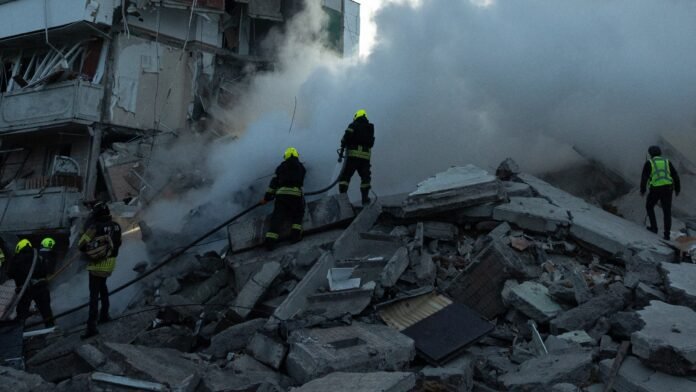
Russia’s actions on the battlefield point in the opposite direction. On May 13 and 14, Russia launched what Reuters described as its largest two-day aerial assault since the start of the full-scale invasion, using 1,567 drones and 56 missiles, according to Zelenskyy. The strikes hit Kyiv and other regions, damaged homes and infrastructure, disrupted electricity in several areas, and killed at least 15 civilians. The attacks came as Moscow continued to present itself as open to talks.

For Kyiv, Russia’s terms look less like a compromise than a demand for capitulation. Moscow announced short ceasefires around Easter and Victory Day, but both sides accused each other of violations. Kremlin foreign policy aide Yuri Ushakov recently told the Russian news agency Interfax that Russia saw no point in further peace talks until Ukraine withdrew its troops from the Donbas, reinforcing Ukraine’s view that Moscow’s offer is an ultimatum presented as diplomacy.

More than four years into Russia’s full-scale invasion, Russia still occupies about one-fifth of Ukrainian territory and retains major advantages in manpower, missile capacity, artillery production, and strategic depth. Yet Moscow failed to seize Kyiv, failed to collapse the Ukrainian state, and has failed to fully control the four Ukrainian regions it claims as Russian territory. Russia declared the annexation of Donetsk, Luhansk, Kherson, and Zaporizhzhia in September 2022 after widely rejected referendums, but it did not fully control all four regions then and has never done so since.

David Satter, an American journalist, historian, and former Moscow correspondent, said Putin’s recent language should be treated as potentially meaningful because it is unusual, not because it necessarily indicates a real shift in Moscow’s goals.

“It is serious because it is unusual, and it could be a signal to the Russian public that there may be some concessions Russia will have to make,” Satter told The Media Line. “But at this stage, I would not attach too much importance to it, because Russia also has a desire to appear reasonable.”

Satter said Moscow’s aim may be less about persuading Kyiv than about influencing Europe. In his view, Russia wants to create the impression that it is willing to compromise in order to weaken European resolve and separate Ukraine from its supporters. “They want to separate Ukraine from its European supporters,” he said. “It is in their interest to give the impression that they are willing to compromise.”

Jason Jay Smart, an adviser on national security and geopolitics based between Kyiv and Washington, and an expert on Russia and Ukraine, offered a sharper assessment from the Ukrainian perspective. “Inside Ukraine, Putin’s statements are not taken as a serious offer,” Smart told The Media Line. “They are heard as messaging aimed at Washington and Europe, while Russia keeps attacking on the ground.”

Smart pointed to recent ceasefire announcements as one reason Ukrainians judge Moscow by conduct rather than by Kremlin statements. “Moscow announced Easter and May 9 ‘Victory Day’ ceasefires, then violated them hundreds of times,” he said, “which is why Ukrainians judge the conduct, not the Kremlin wording.”

That is not negotiation. It is surrender language packaged as diplomacy.

He also referred to Ushakov’s statement on Donbas as evidence that Moscow’s diplomatic language still rests on demands Ukraine cannot accept. “That is not negotiation,” Smart said. “It is surrender language packaged as diplomacy.”

Russia has gained territory, but it has not achieved the political victory it sought. Satter described Ukraine’s achievement as “enormous” because, in his view, it prevented the destruction of the country. Ukraine, he said, stopped Russia from achieving its initial invasion goals, held many major cities, and forced Russia to pay “a terrible price” for whatever gains it has achieved.

Russia’s achievements, by contrast, are harder to define politically, Satter said. Moscow wrote four Ukrainian oblasts—Donetsk, Luhansk, Kherson, and Zaporizhzhia—into the Russian constitution, but it has not fully conquered the territory it claims. “In terms of their objectives, they have not been successful,” he said. Russia declared the regions part of the Russian Federation, but “they have not conquered those territories.”

He said Luhansk is the only one of the four under near-total Russian control, while Donetsk remains only partly occupied, and Russia still lacks full control of Zaporizhzhia and Kherson. For that reason, he argued, Moscow’s battlefield gains have not produced the political victory the Kremlin claimed when it announced the annexations.

Ukrainians are exhausted, but they are not confused about what surrender would bring

Smart framed Ukraine’s current position as both exhausted and determined. Years of missile strikes, funerals, mobilization, and occupation have placed enormous pressure on Ukrainian society, he said, but have not produced acceptance of Russian rule. “Ukrainians are exhausted,” he said, “but they are not confused about what surrender would bring.”

Ukraine’s political position, Smart argued, rests on a simple principle: an aggressor cannot invade another country and then demand to keep the territory it managed to seize. “You cannot break into someone’s house and then demand to keep the rooms you managed to occupy,” he said. “The invader has to leave.”

He described Ukraine’s central achievement as survival that has imposed real costs on Russia. “Ukraine preserved the state, defended Kyiv, kept democratic politics alive, reopened trade routes, struck Russian military infrastructure, and showed the limits of Russian power,” Smart said. “Its central achievement is survival with consequences.”

Ukraine’s resilience has depended on outside support, but Smart cautioned against reducing the war to Western weapons alone. External aid mattered because Ukraine first made the national decision to resist. “Without that national decision,” he said, “no shipment of weapons would have saved the country.”

One of Ukraine’s clearest military successes has been its use of aerial drones, unmanned naval systems, electronic warfare, battlefield software, and locally adapted technologies. These tools have helped Ukraine partly offset Russia’s advantages in armor, artillery, and manpower by allowing Ukrainian forces to damage or destroy costlier Russian equipment with cheaper, more flexible systems.

“Drones and electronic warfare changed the economics of the battlefield,” Smart said. Unable to match Russia “tank for tank or shell for shell,” Ukraine used drones, sensors, and battlefield software to make Russian troops, armor, artillery, and supply lines easier to detect and attack. Innovation has not replaced artillery, air defense, or Western support, he said, but it has made Ukraine “more dangerous, more adaptable, and much harder for Russia to overwhelm.”

The war has also forced Europe to confront its dependence on the US for security. With long-term American support for Ukraine uncertain, European governments and defense analysts are debating whether the continent can keep Ukraine armed while rebuilding its own depleted stockpiles, expanding defense production, and preparing to deter Russia with less reliance on Washington. The debate is no longer theoretical; it concerns shells, air-defense interceptors, production lines, and defense budgets.

Satter said Ukraine is already defending the rest of Europe. If Ukraine were to fall, he argued, much of the country’s mobilized capacity could be absorbed into or redirected by Russia, creating a far greater threat to NATO’s weaker members.

For Satter, Europe has the capacity to resist Russia together with Ukraine, but only if it has the political will. “The key question is whether Europe can now rearm and defend itself without the US,” he said. “Europe, together with Ukraine, can definitely resist Russia.”

Smart also said uncertainty over US support has made Ukrainians more urgent and realistic. Europe can do more, and Ukraine is increasing its own defense production, but American support remains decisive in specific areas, including air defense, intelligence, long-range capabilities, and advanced systems. “For Ukrainians, delays are measured in lives, not press statements,” Smart said.

Economic pressure on Russia is real, but whether it is sufficient to change Moscow’s behavior remains uncertain. Sanctions, war spending, labor shortages, inflationary pressure, and long-term isolation from Europe all carry costs. Satter warned against expecting an imminent Russian collapse. “It is not at a breaking point,” he said, “but it is under pressure.”

Russia’s size and resources mean it can continue for some time, Satter said. That pressure matters, but, in his view, Russia is more likely to be stopped by military defeat than by economic collapse alone.

Conflicts beyond Ukraine also affect Russia’s ability to sustain the war, especially those that move energy prices or strain Moscow’s partnerships. Higher oil prices linked to conflict involving Iran can benefit Russia financially, but Satter said the broader picture does not necessarily strengthen Russian influence. Russia may gain from rising prices, he argued, while still looking less capable as a protector of its partners and clients. “As for their influence, I do not think it helps them,” he said. “They were not able to defend Assad in Syria.”

Asked about speculation that Iran could transfer enriched uranium to Russia, Satter was cautious. Russia already has its own uranium resources and nuclear weapons, he noted, and he said there is no clear indication Iran would send enriched uranium to Moscow. “This is all very hypothetical,” Satter said.

A possible ceasefire remains one of the war’s most politically sensitive questions. A ceasefire along the current line of contact would freeze the fighting, at least temporarily, but it would not require Ukraine to formally recognize Russian sovereignty over occupied territory. That distinction is central to Kyiv’s position: Zelenskyy has said Ukraine will not recognize occupied territory as Russian.

Satter said Ukraine might accept a ceasefire based on the existing line of contact, but not a settlement that gives Russia legal recognition over conquered territory or territory it does not fully occupy.

Smart was even more categorical about Ukraine’s red lines. Formal recognition of Russian territorial conquest, imposed neutrality, or Moscow-dictated limits on Ukraine’s future alliances would be unacceptable, he said. “Anyone arguing for territorial concessions should ask how rewarding mass violence is supposed to deter the next invasion.”

“Ukraine is not asking for a special rule,” he said. “The normal rule is enough: the invader leaves, the victim survives, and aggression is punished rather than rewarded.”

Many Ukrainians are wary of a ceasefire that freezes Russian occupation without making Ukraine more secure. The memory of 2014 and the Minsk process remains central: for many in Ukraine, a frozen conflict can become the preparation period for a larger war.

“A ceasefire that leaves Ukrainians under Russian occupation is not peace for the people still trapped there,” Smart said. “Everyone wants the missiles, drones, artillery, and funerals to stop,” he added, “but stopping the shooting is not enough if Russia gets time to reload.”

He said the real test of any ceasefire would be whether Ukraine becomes safer. If a ceasefire freezes Russian occupation, abandons occupied communities, leaves abducted children in Russian hands, and gives Moscow time to rebuild, many Ukrainians will see it as “a pause before the next attack.”

This also limits Zelenskyy’s room for maneuver. Smart said the Ukrainian president can negotiate sequencing, guarantees, monitoring, sanctions, prisoner exchanges, and the mechanics of stopping the shooting, but cannot sell Ukrainians a deal that makes Russia’s invasion appear successful. “Ukrainians understand painful choices,” Smart said. “They will not accept being told that Russia gets rewarded because it was brutal enough.”

For Europe, such a settlement would shape future defense spending, sanctions policy, energy relations, and the credibility of deterrence. For Russia, it would determine whether the Kremlin emerges from the war isolated and constrained or partially normalized despite the invasion. For other powers, the outcome would send a message about whether territorial conquest can be rewarded if the aggressor can absorb enough costs.

Satter warned that Western governments should not rush to normalize ties with Moscow simply because the fighting stops. “I think the relationship with the West is going to be ruined for a long time,” he said. He argued that easing sanctions without clear signs of changed Russian behavior would be unwise if the same government remains in power.

Smart framed the question in global terms. “A just end strengthens deterrence,” he said, because it shows that “borders cannot be erased by force, civilians cannot be bombed into submission, and nuclear threats do not grant the right to steal land.”

Every dictatorship is watching whether Russia is punished for conquest or paid for it. If Moscow is rewarded, this war becomes a precedent. If Moscow is punished, it becomes a warning.

“A weak pause teaches the opposite lesson,” he warned. “Every dictatorship is watching whether Russia is punished for conquest or paid for it. If Moscow is rewarded, this war becomes a precedent. If Moscow is punished, it becomes a warning.”

For now, Putin’s language has changed more than Russia’s demands. Moscow says it is open to talks while insisting that Ukraine withdraw from territories Russia claims but does not fully control. Ukraine remains under severe pressure, but it is not defeated. The question facing Kyiv and its partners is not only whether the war can be stopped, but whether any ceasefire would make Ukraine safer—or merely give Russia time to prepare for the next phase.

0FansLike
0FollowersFollow
0FollowersFollow
0SubscribersSubscribe
- Advertisement -
Google search engine

Recent Posts