9.7 C
London
Wednesday, May 13, 2026
Home Blog

US news reports of gloomy Iran war intel assessments anger Trump

0
us-news-reports-of-gloomy-iran-war-intel-assessments-anger-trump
US news reports of gloomy Iran war intel assessments anger Trump

Image: The New Yorker / Tom Bachtell

US President Donald Trump has accused news outlets of committing “virtual treason” by reporting on classified American intelligence agency assessments showing that Iran has retained significant missile capabilities, contradicting triumphant White House claims that the Middle East country’s military capability has been “destroyed 100%.”

The New York Times reported Tuesday that the Trump administration’s “public portrayal of a shattered Iranian military is sharply at odds with what US intelligence agencies are telling policymakers behind closed doors, according to classified assessments from early this month that show Iran has regained access to most of its missile sites, launchers, and underground facilities.”

“Most alarming to some senior officials is evidence that Iran has restored operational access to 30 of the 33 missile sites it maintains along the Strait of Hormuz, which could threaten American warships and oil tankers transiting the narrow waterway,” the newspaper added.

The Times reporting came on the heels of a Washington Post story last week detailing “a confidential CIA analysis delivered to administration policymakers” concluding that Iran “can survive the US naval blockade for at least three to four months before facing more severe economic hardship.”

The Post also reported that the US intelligence community “found that Tehran retains significant ballistic missile capabilities despite weeks of intense US and Israeli bombardment.”

“Iran retains about 75% of its prewar inventories of mobile launchers and about 70% of its prewar stockpiles of missiles,” according to the Post, which cited an unnamed US official. “The official said there is evidence that the regime has been able to recover and reopen almost all of its underground storage facilities, repair some damaged missiles, and even assemble some new missiles that were nearly complete when the war began.”

In a Truth Social post late Tuesday afternoon, Trump – who has claimed that Iran has “nothing left in a military sense” – fumed that “when the Fake News says that the Iranian enemy is doing well, Militarily, against us, it’s virtual TREASON in that it is such a false, and even preposterous, statement.”

“They are aiding and abetting the enemy!” the president continued, declaring that Iran has “no Navy, their Air Force is gone, all Technology is gone, their ‘leaders’ are no longer with us, and the Country is an Economic Disaster.”

On top of intelligence assessments showing that Iran has maintained substantial military capabilities in the face of the US-Israeli onslaught, reports indicate that Iran has inflicted more damage on American military bases and other equipment than the Trump administration has publicly disclosed.

“American military bases and other equipment in the Persian Gulf region suffered extensive damage from Iranian strikes that is far worse than publicly acknowledged and is expected to cost billions of dollars to repair,” NBC News reported late last month, citing three unnamed US officials, two congressional aides, and another person familiar with the damage.

A recent Washington Post analysis of satellite imagery found that “Iranian airstrikes have damaged or destroyed at least 228 structures or pieces of equipment at US military sites across the Middle East since the war began, hitting hangars, barracks, fuel depots, aircraft, and key radar, communications, and air defense equipment,” an amount of destruction “far larger than what has been publicly acknowledged by the US government.”

Phil Gordon, a foreign policy scholar at the Brookings Institution, wrote Wednesday that, “10 weeks in, the strategic failure is undeniable” for the Trump administration in Iran.

“The risk now is that having missed the opportunity to declare victory after the first few weeks, Trump can’t accept defeat and humiliation so will keep looking for the next quick fix, thereby likely only making things worse,” Gordon warned.

The Trump administration has lashed out publicly at news outlets for reporting on assessments that run counter to the Pentagon’s rosy narrative of the illegal war’s trajectory. Pete Hegseth, the Pentagon secretary, has condemned American media outlets as “unpatriotic” and warned reporters to “think twice” before publishing classified information.

Earlier this week, The Wall Street Journal revealed that the US Justice Department subpoenaed the newspaper’s journalists in March for records related to coverage of the Iran war.

“This is the latest attack in the Trump administration’s war on press freedom,” Katie Fallow, deputy litigation director at the Knight First Amendment Institute at Columbia Universitysaid in response to news of the subpoenas. “Time and again, the administration has shown itself willing to disregard the First Amendment and long-standing limits on the use of government power to go after news outlets that publish embarrassing or critical information about the government.”

-Common Dreams

Palestinian teen killed by Israeli fire during occupier attack in West Bank

0
palestinian-teen-killed-by-israeli-fire-during-occupier-attack-in-west-bank
Palestinian teen killed by Israeli fire during occupier attack in West Bank

A Palestinian teenager was killed Wednesday by Israeli fire during an attack by occupiers on the towns of Sinjil and Jiljilya in the central West Bank, according to health authorities and local sources, Anadolu reports.

The Palestinian Health Ministry said in a statement that Yousef Ali Yousef Kaabneh, 16, was killed by Israeli fire near Jiljilya, north of Ramallah.

The Palestinian Red Crescent Society said its teams treated a child in critical condition with a chest wound during an occupier attack on Sinjil and Jiljilya.

The organization said four other people were injured during simultaneous raids in the two towns, including two wounded by gunfire and two injured after being beaten.

READ: Israeli army raids West Bank’s Ramallah, renews closure of Al Jazeera office

Witnesses said dozens of armed occupiers, protected by army forces, attacked Palestinian homes west of Sinjil and Jiljilya.

Residents confronted the occupiers, who stole about 700 sheep and agricultural equipment during the attack, witnesses said.

The occupied West Bank, including East Jerusalem, has seen an escalation in Israeli military operations, including raids, arrests, shootings and excessive use of force, alongside rising occupier attacks on Palestinians and their property.

Since October 2023, attacks by the Israeli army and occupiers have killed 1,155 Palestinians, wounded about 11,750 and led to the arrest of nearly 22,000, according to official Palestinian figures.

READ: EU agrees on sanctions targeting Israeli occupiers in West Bank

Windows Update is getting better at saving your PC from buggy drivers

0
windows-update-is-getting-better-at-saving-your-pc-from-buggy-drivers
Windows Update is getting better at saving your PC from buggy drivers

Hardware driver updates can be a blessing and a curse. When they’re good, they can fix bugs, improve performance, and add new capabilities, giving your PC a minor upgrade without requiring any extra effort or investment. When they’re bad, they can make a once-reliable PC slower and unstable, handing you a one-way ticket to blue screen town (or whatever color the Windows error screen is these days).

While gamers and other enthusiasts may be in the habit of downloading and installing new driver updates for their systems, most PC users just let Windows Update handle driver installation and updates. PC manufacturers can submit their own tested and validated versions of drivers for distribution via Windows Update, which (at least in theory) should maximize stability and minimize problems.

But mistakes happen, and sometimes a driver update is distributed that causes more problems than it fixes. Normally when this happens, the company either needs to submit an updated fixed driver to Windows Update, or the user is on the hook for either rolling back the update or finding and downloading a better driver themselves.

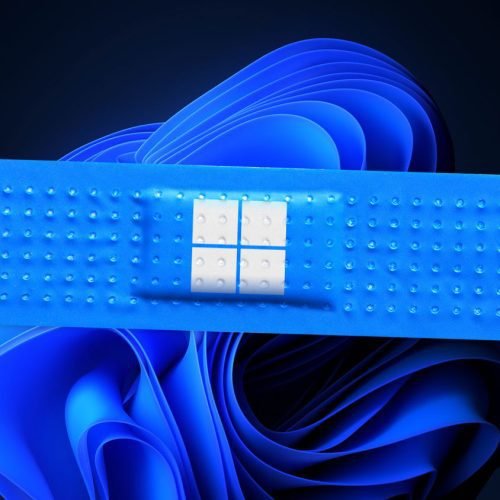
Now Microsoft is offering another path: automated rollback to a previous working driver, even after a buggy one is downloaded and installed. Cloud-Initiated Driver Recovery, as the company calls it, allows Microsoft to “initiate a recovery action from the cloud, replacing the problematic driver on affected devices without requiring manual intervention from the user or the hardware partner.”

When a driver published to Windows Update is found to have a problem, your PC will still look for an updated version of the driver instead. If it can’t find one, that’s when Cloud-Initiated Driver Recovery kicks in, loading the previous known-good version of the driver and uninstalling the buggy one. Microsoft “handles the recovery end-to-end,” and it requires no additional software or system agents to be running on your PC.

Microsoft’s announcement post ties the Cloud-Initiated Driver Recovery feature to its “commitment to Windows quality” push, a mix of PR work and actual changes to Windows 11 meant to address user complaints about the operating system. Changes that have either rolled out, are currently being tested in the Windows Insider Program, or have been announced include a rolling back of the Copilot branding in some apps, changes meant to improve Windows’ performance and responsiveness, more taskbar customization options, and a streamlining of the Windows Insider beta program itself.

Cloud-Initiated Driver Recovery helps to achieve two of Microsoft’s top-level goals for the “commitment to quality” push: to “[increase] OS, driver, and app reliability,” and to “[reduce] disruption” from Windows Update. Since it’s important for users to patch their PCs to protect themselves from malware and other security threats, Microsoft doesn’t want its users to associate “installing updates” with “breaking stuff.” With a more automated system for rolling back bad drivers, Microsoft has another way to fix things when they do break.

Miami Beach Official Hired Billboard Truck to Call Pro-Palestine Activists “Jew Hater,” Lawsuit Alleges

0
miami-beach-official-hired-billboard-truck-to-call-pro-palestine-activists-“jew-hater,”-lawsuit-alleges
Miami Beach Official Hired Billboard Truck to Call Pro-Palestine Activists “Jew Hater,” Lawsuit Alleges


A city official in Miami Beach, Florida paid thousands of dollars to hire billboard trucks with text attacking specific members of an anti-Zionist Jewish group, according to a new filing in federal court.

David Suarez, a city commissioner for Miami Beach, is accused of hiring the trucks to drive past a Jewish Voice for Peace demonstration outside the Art Basel festival in Miami Beach in December. The trucks accused JVP of being an “extremist group” and singled out members Alan Levine and his wife, Donna Nevel, with the label “Jew Hater,” according to court documents that Jewish Voice for Peace South Florida filed on Wednesday.

The trucks arrived while JVP and other Palestine solidarity organizations were protesting Art Basel in what has become an annual tradition since 2023. Activists have picketed each year outside the annual art fair, calling for a boycott over financial ties between Art Basel sponsor UBS and Elbit Systems, an Israeli weapons manufacturer.

Nevel, a native of Miami Beach who described her early education in Jewish ethics as a driving force behind her activism, accused Suarez of targeting her and her husband over their clashing views of Judaism and Israel’s assault on Gaza.

“The Commissioner has targeted me and called me a Jew hater because I differ with his views on Israel,” Nevel said. “When we saw the billboards, we didn’t know Commissioner Suarez was the one who created and paid for them, but having watched his destructive, taunting behavior in City Commission meetings over and over again, I can’t say I was shocked to learn it was him — though, even for him, it was extreme.”

Supporting exhibits filed alongside the motion include an invoice from Mobile Billboards of Miami dated December 6, 2025, charging Suarez $4,000 for the rental of three trucks, and an email from the company to a Gmail account that JVP claims is the commissioner’s personal email address.

Suarez and his attorneys did not immediately respond to a request for comment.

The motion, filed in the Southern District of Florida on Wednesday, requests that the court compel Suarez, Miami Beach Mayor Steven Meiner, and others to produce documents related to a larger court case brought by JVP over a city ordinance that the group claims was passed to stifle its protests against the genocide in Gaza.

“In the months since October 2023, the Mayor and the Miami Beach City Commission have become active supporters of Israel’s campaign of relentless destruction in Gaza,” the group wrote in its broader complaint filed in September of last year. “At the same time, the Defendants have aggressively sought to silence critics of the Israeli onslaught in Gaza, first by adopting a resolution that prohibited the City from hiring contractors who refused to do business with Israel, then by publicly castigating Israel’s critics for their views, and finally by passing an unconstitutional anti-protest Ordinance explicitly designed to silence criticism of Israel.”

The city government of Miami Beach has come under fire recently for allegations that it targeted pro-Palestine residents, including Raquel Pacheco, a local artist who in January received a visit to her home by police after writing a Facebook post criticizing Meiner for his pro-Israel views. In March, Pacheco sued the city, Meiner, and police chief Wayne Jones in federal court alleging that the visit to her home violated her First Amendment rights.

Similar stunts to the Miami Beach billboard trucks have become a hallmark of pro-Israel groups seeking to discredit and attack pro-Palestine activists. Accuracy in Media, a pro-Israel pressure group focusing on allegations of antisemitic media bias, has hired so-called “doxxing trucks” on multiple occasions to personally call out members of the pro-Palestine movement at Columbia University and other college campuses. In January, a state court in New York ruled that a defamation lawsuit over the tactic could proceed.

Why the Caspian Sea has become so important in both the Ukraine and Iran wars

0
why-the-caspian-sea-has-become-so-important-in-both-the-ukraine-and-iran-wars
Why the Caspian Sea has become so important in both the Ukraine and Iran wars

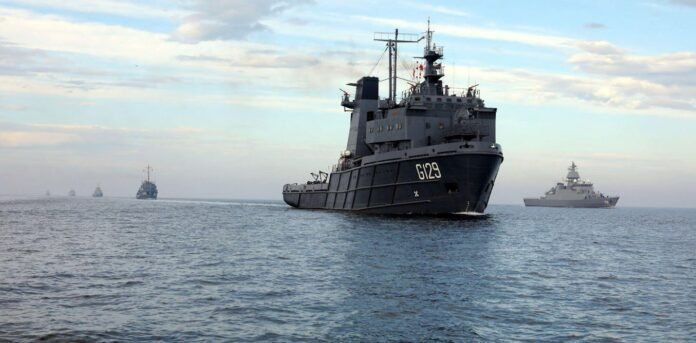
The recent attack by Ukraine of a Russian missile-carrying corvette stationed in the Caspian Sea more than 1,500km away from Kyiv has put the spotlight on this large, often overlooked body of inland salt water.

The Caspian Sea hosts major offshore oil and gas fields and critical maritime infrastructure, including ports, pipelines and terminals that connect central Asia to global markets. It is a key node in the so-called middle corridor trading route from China to Europe via central Asia that avoid increasingly uncertain routes via Russia in the north and Iran in the south.

China views it as a key corridor for energy supplies and its belt and road initiative that is an economic statecraft strategy that uses infrastructure connectivity to expand Beijing’s influence. The middle corridor links mainland China to Europe via Kazakhstan and Azerbaijan. Turkey, meanwhile, uses Caspian links, especially fossil fuel transit projects, via Azerbaijan, to increase its influence across the Turkic world, becoming a regional energy hub.

The 2018 Convention on the Legal Status of the Caspian Sea sets out how the Caspian’s oil, gas, and fishing resources are divided among the bordering nations. Crucially, the agreement also prohibits the deployment of armed forces from third-party countries within the Caspian’s waters. This establishes a regional security order that excludes western military presence.

Russia’s back yard

For Russia, the Caspian Sea has a high value, both as a strategic back yard and a bridge to Iran. There, Moscow maintains the strongest navy and has used the Caspian as a platform for long‑range power projection. This has included missile strikes into other theatres, including against Islamic State targets in Syria in 2015.

Map of Caspian sea showing surrounding countries.

The ‘world’s largest lake’: Caspian Sea. Peter Hermes Furian/Shutterstock

Since Russia’s full-scale invasion of Ukraine in 2022, the Caspian Sea has also gained renewed importance as a rear maritime space for Moscow. Indeed, with the Black Sea Fleet increasingly under threat from Ukraine’s drones and missiles, elements of Russia’s naval forces have redeployed away from the contested Black Sea towards the Caspian Sea via inland waterways. That said, Ukraine’s recent attack demonstrates that the Caspian Sea’s role as a sanctuary for Russia’s naval forces is limited.

More importantly, the Caspian Sea plays a structurally important role in enabling strategic coordination between Russia and Iran. As a geographically enclosed maritime space with its own specially designed legal status, it provides a direct logistical and economic corridor between the two states that is largely shielded from western military presence and oversight.

The Russia-Iran connection

This corridor enables not only energy cooperation and trade flows but also the movement of technologies and materials relevant to sustaining both war economies under sanctions pressure. This includes sanctioned goods, drone components and dual-use technologies. The Iran war has accelerated this trading pattern.

In this sense, for the two allies, the Caspian Sea functions as a critical node in a broader resilience architecture. It reinforces bilateral alignment and reduces exposure to external coercion. Its role is therefore less tactical than systemic: it provides a stable logistical, economic and strategic framework that underpins long‑term convergence between Moscow and Tehran.

In late March 2026, Israeli airstrikes reportedly disabled dozens of Iranian Caspian naval assets, including missile boats, a corvette, a shipyard and a command centre. The strikes are likely to have severely disrupted the Caspian logistics corridor that links Russian ports to Iran’s port at Bandar Anzali, the largest and oldest Iranian port on the Caspian Sea. It also degraded Tehran’s ability to receive supplies via this route. This could force both countries to rely more on riskier overland routes via Azerbaijan or Kazakhstan.

In other words, the Caspian’s attribute as a haven for the two allies is currently under threat. That might force Russia and Iran to spend more on multi-level air defence systems and drone monitoring. They might even need to redeploy troops and military equipment to the region. This would significantly raise the cost and complexity of using the Caspian as a safe space for mil,itary and naval assets and a bridge for trade.

The Caspian Sea has become an increasingly important strategic connector linking two conflicts that are usually thought of as separate. The war in Ukraine and the war in Iran are not isolated theatres but parts of an emerging Eurasian conflict system in which Russia and Iran are mutually dependent.

Iran’s provision of drones and other military support to Russia has directly affected the course of the war in Ukraine. Meanwhile, Russia’s diplomatic, military and economic backing is central to Iran’s capacity to withstand pressure and sustain its regional posture.

The Caspian Sea underpins this alignment by providing a relatively insulated corridor for coordination, logistics and economic exchange.

Recent events, such as Ukrainian and Israeli strikes, however, reveal the limits of this strategic function for both Moscow and Tehran. At the same time, other countries, notably China and Turkey, are investing in the middle corridor. This is raising the value of the Caspian Sea, both economically and in terms of its geographical connectivity.

The Caspian Sea faces an uncertain future. Its north–south Russia–Iran strategic and military axis is increasingly contested by their adversaries. Its east–west trade and energy role, meanwhile, holds the potential to rebalance regional power dynamics towards economic connectivity, rather than conflict. Or, to put it another way, this body of water could become either be a theatre of strategic confrontation or a corridor of trade and exchange. The latter, of course, would be better for all concerned.

We tested the new World Cup ball – this is what you need to know about how it will fly, dip and swerve

0
we-tested-the-new-world-cup-ball-–-this-is-what-you-need-to-know-about-how-it-will-fly,-dip-and-swerve
We tested the new World Cup ball – this is what you need to know about how it will fly, dip and swerve

Every four years, the men’s World Cup delivers some certainties. The pitch dimensions are tightly regulated, offside is signaled with a flag, and referees end the match with a blast of a whistle. But one key piece of equipment is changed on purpose: the ball.

Adidas, which has supplied World Cup soccer balls since 1970, introduces a new match ball for every tournament, and with that comes fresh aerodynamic calculations for players. How will it fly through the air, weave and dip?

For the past 20 years, my engineering colleagues in Japan and England and I have put the new balls through their paces, investigating soccer ball aerodynamics. Our work begins by putting balls in wind tunnels to measure drag, side and lift forces. We use the measurements from these tests in trajectory simulations that tell us how the ball will behave in a real-game setting.

Putting the 2026 World Cup ball through the wind tunnel test.

That may all sound a little academic, and we do produce an academic paper on our findings. But what our data indicates could mean the difference between a goal or a miss for strikers, a save or a blunder for goalkeepers, and jubilation or heartache for fans.

At the World Cup, the ball is the most important piece of equipment in the biggest tournament of the world’s most popular sport.

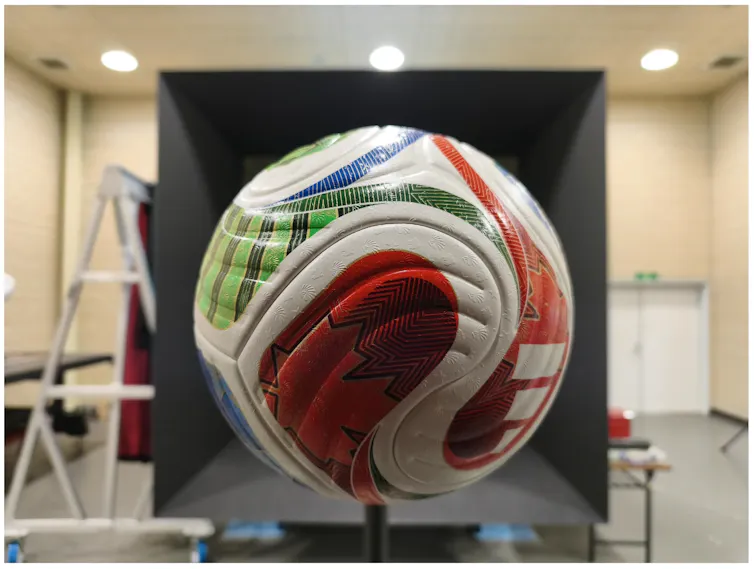
This year’s ball, the Trionda, is especially interesting. When FIFA and Adidas unveiled it in fall 2025, the first thing many people noticed was the color and the paneling.

An orange ball and a black and white ball are under a trophy.

Earlier World Cup balls used many panels; modern balls use far fewer. Manfred Rehm/picture alliance via Getty Images

The ball’s red, blue and green graphics correspond to the three host countries, with maple leaf, star and eagle motifs representing Canada, the United States and Mexico. And for the first time in men’s World Cup history, matches will be played with a four-panel ball.

But with so few panels, has Adidas made the ball too smooth? That is the trap engineers fell into with the Jabulani ball used at the 2010 World Cup in South Africa that became notorious for sudden dips and swerves, which made goalkeepers’ lives far trickier.

You do not want the World Cup ball to feel like the start of a science experiment once it is in the air. And if it behaves strangely, players and goalkeepers notice immediately.

The evolution of soccer balls

World Cup balls have come a long way over the decades. If you go back to 1930, the ball looked very different. The first World Cup final used two different leather balls: Argentina’s Tiento in the first half and Uruguay’s T-Model in the second. Both were hand-sewn, multipaneled balls, inflated through a bladder opening that had to be tied off and tucked back beneath the laces. In damp conditions, the leather absorbed water, making the ball heavier and less predictable in play.

A ball nestles in the top of a goal.

Uruguayan keeper Enrique Ballestrero fails to save a shot from Argentina’s Carlos Peucelle in the final of the first World Cup. Keystone/Getty Images

By 1994 – when the United States last hosted the men’s tournament – the official ball, Adidas’ Questra, had evolved into a foam-based design. The modern World Cup ball is no longer just stitched leather. It is an engineered aerodynamic surface.

Trionda pushes that evolution further. It has only four panels, the fewest in men’s World Cup history, which have been thermally bonded – melded together using heat and adhesive.

Fewer panels might suggest less total seam length and therefore a smoother ball. And smoothness matters because the thin boundary layer of air clinging to the ball determines where the flow separates, how large a wake forms, and how much drag the ball experiences.

The Trionda has intentionally deep seams, three pronounced grooves on each panel and fine surface texturing.

But will these textures and grooves do the trick? To find that out, my colleagues and I measured the ball’s seam geometry and overall aerodynamic behavior. We compared it with Trionda’s four predecessors: 2022’s Al Rihla, 2018’s Telstar 18, the Brazuca used in 2014 and the Jabulani in 2010.

What the measurements show

In our wind tunnel tests at the University of Tsukuba, we measured something called the drag coefficient, which is a way of describing how much air resistance a ball experiences as it moves.

Using this data, we gained insights into how the airflow changes around the ball after it is kicked. The tests helped identify the drag crisis, the speed range in which changes in the boundary layer and flow separation produce a sharp change in drag, which can alter the ball’s acceleration, trajectory and range.

A ball is seen suspended.

The Trionda soccer ball prepares for the wind tunnel. Goff/Hong/Liu/Asai

We found that the Trionda is effectively rougher than those predecessors.

Trionda reaches its drag crisis at a lower speed, at about 27 mph (43 kph). That is below the roughly 31-40 mph (50-65 kph) range for Al Rihla, Telstar 18 and Brazuca, and far below Jabulani’s roughly 49-60 mph (79-97 kph) range, depending on orientation.

Why does all that matter? Because a ball can feel ordinary off the boot and still behave differently in flight. When the drag crisis occurs in the middle of game-relevant speeds, small changes in launch speed, orientation or spin can shift the ball from one aerodynamic regime to another.

That was Jabulani’s problem. Once kicked with little spin, it had a tendency to slow down too much as it passed through its critical-speed range.

Trionda does not look like that kind of ball. It has a more steady and consistent drag coefficient in the range of speeds associated with corner kicks and free kicks.

But there is a trade-off. Our measurements also showed that once Trionda enters the higher-speed, turbulent-flow regime, its drag coefficients are somewhat larger than those of Brazuca, Telstar 18 and Al Rihla.

In plain language, that suggests a hard-hit long ball may lose a little range.

In our simulations, the difference is not huge. But it is large enough that players may notice long kicks coming up a few meters short.

It is also important to note that we tested a nonspinning ball. As such, our results do not provide a prediction of every pass, clearance or free kick fans will see this summer. Balls in flight often spin due to off-center kicks. That, along with altitude, humidity, temperature and air pressure all influence how a ball flies through the air once kicked.

A ball mounted on a rod.

Close-up of the Trionda ball during wind tunnel testing. Goff/Hong/Liu/Asai

The big test yet to come

Fewer panels and more texturing aren’t the only differences with the new ball.

Trionda also carries technology that has little to do with its flight and a great deal to do with officiating. Like Al Rihla, Trionda includes “connected-ball technology” that lets computers know when the ball is kicked, helping with offside decisions.

But the architecture has changed. In 2022, the measurement unit was suspended at the center of the ball. With Trionda, it sits in a specially created layer inside one panel, with counterbalancing weights in the other three panels. The chip sends data to the video assistant referee, or VAR, system and the tournament’s semi-automated offside system.

That tweak will help referees, but will the new ball in general help or hinder players?

The evidence from our tests suggests that the ball won’t be behaving in a way that leads to baffling and erratic flight.

But the more intriguing possibilities are subtler and outside the scope of our tests. Will the grooves on Trionda help players generate more backspin on the ball, generating more lift and possibly offsetting Trionda’s somewhat larger high-speed drag coefficient?

That is why I keep studying World Cup balls both in the lab and through their behavior in play. Every four years, a new design offers a fresh way to watch physics enter the game, not in theory, but in the movement of an object in which every player on the soccer field must place their trust.

The US has always been obsessed with controlling Cuba

0

For months, US President Donald Trump has been fixated on Cuba. He’s issued threats and imposed additional sanctions on the island. The US military has conducted dozens of intelligence-gathering flights off the coast in recent weeks, suggesting a prelude to an invasion.

The Cuban government has indicated a readiness to negotiate with the Trump administration on some issues, such as migration, drug trafficking and investment openings for Cuban-Americans. But Cuba’s sovereignty is not negotiable.

After interviewing Cuban President Miguel Díaz-Canel last month, US journalist Kristen Welker seemed to catch on:

Nothing gets under [Cubans’] skin more than the notion that the United States can tell the Cuban government who should lead it or what it should be doing, how it should be governing, because that challenges the very idea of the sovereignty of the country.

This US obsession with controlling, influencing and coercing Cuba long predates Trump and even the Cold War. This is how President Theodore Roosevelt described the island in 1906:

I am so angry with that infernal little Cuban republic that I would like to wipe its people off the face of the earth. All we have wanted from them was that they would behave themselves and be prosperous and happy so that we would not have to interfere. And now, lo and behold, they have started an utterly unjustifiable and pointless revolution.

Understanding the current impasse between the two adversarial neighbors requires looking at this full arc of history. While the 1823 Monroe Doctrine sought to establish US predominance in the entire American continent, Cuba has always been a particular focus of Washington’s attention.

‘Americanization’ of the island

From the moment the 13 American colonies declared independence from Britain, Americans assumed Cuba would become part of the union. Successive US administrations sought to purchase, annex or otherwise control Cuba, claiming this was inevitable by virtue of the laws of gravity and geography. It was also seen as part of a self-proclaimed “civilizing mission.”

When the Cubans eventually defeated their Spanish colonial masters in 1898, the United States stepped in and occupied the island to thwart its independence.

At the time, at least one third of Cubans were former slaves or of mixed race. The US governor of Cuba, Leonard Wood, argued they were not ready for self-government.

Illustration shows Uncle Sam talking to a young boy labeled ‘Cuba’ on a beach, from a 1901 publication. Source: Library of Congress

Certainly, the US – especially the Southern former slave holders – didn’t want another Haiti in its neighbourhood. Haitian slaves had seized control of their island nation from the French in a violent rebellion in 1804, echoing the cries of the French revolution for liberty, fraternity and equality.

The US military occupation of Cuba ended in 1902 and Cuba formally declared independence – albeit with provisions. These allowed for future US intervention whenever Washington thought the Cuban people needed a guiding hand (which turned out to be fairly often).

In the decades that followed, US business interests deeply penetrated every sector of Cuba’s economy and had complete sway over Cuban governments.

On a cultural level, Cuba rapidly became “Americanized” through a new US-style education system. Travel to the island picked up, too. The popular Terry’s Guide to Cuba reassured US visitors in the 1920s they would feel right at home because “thousands” of Cubans “act, think, talk and look like Americans.”

Castro’s mission

All of this changed with the rise of Fidel Castro.

During the Cuban Revolution, Castro announced in April 1959 that the revolutionary government would be “Cubanizing Cuba.” This might seem “paradoxical,” he explained, but Cubans “undervalued” everything Cuban. They had become “imbued with a type of complex of self-doubt” in the face of the overwhelming US influence on the island’s culture, politics and economy.

US journalist Elizabeth Sutherland similarly observed at the time that Cubans suffered from a “cultural inferiority complex typical of colonized peoples.”

For North Americans, however, Castro’s blunt statement seemed at best to reflect ingratitude and, at worst, an insult. As the US broadcaster Walter Cronkite recalled:

The rise of Fidel Castro in Cuba was a terrible shock to the American people. This brought communism practically to our shores. Cuba was a resort land for Americans…. We considered it part of the United States.

At the heart of Cuba’s revolutionary project has been an assertion of Cuba’s sovereignty, independence and national identity. The drive has been to create a new, united and socially just Cuban nation, as envisioned by its great national hero and poet José Martí.

So, for Cubans it’s a matter of history. For North Americans, it’s a matter of self-image. They had “convinced themselves,” writes historian Louis A. Pérez, of the “beneficent purpose” from which the US “derived the moral authority to presume power over Cuba.”

When the Obama administration finally resumed relations with Cuba in 2014, it felt like a historic shift was taking place. The US might finally respect Cuban sovereignty and engage with Cuba on equal terms.

As President Barack Obama said at the time:

It does not serve America’s interests, or the Cuban people, to try to push Cuba toward collapse.… We can never erase the history between us, but we believe that you should be empowered to live with dignity and self-determination.

Trump has now reverted to Washington’s traditional neocolonialist view of Cuba, proclaiming he can do what he likes with the island. Perhaps it is time to try a new approach. As the spectacular debacle of the US-backed Bay of Pigs invasion showed 65 years ago, Cubans remain ready to defend their independence and their right to determine their own future.

Deborah Shnookal is a research fellow, Department of Spanish and Latin American Studies, The University of Melbourne.

This article is republished from The Conversation under a Creative Commons license. Read the original article.

Blue Origin may need external funding to hit ambitious launch targets

0
blue-origin-may-need-external-funding-to-hit-ambitious-launch-targets
Blue Origin may need external funding to hit ambitious launch targets

Blue Origin is weighing its first external fundraising as part of a push by Jeff Bezos’ rocket venture to hit ambitious launch targets and tap investor appetite boosted by SpaceX’s upcoming initial public offering.

Chief Executive Dave Limp told employees at a recent all-hands meeting that the company would require outside investment if it were to significantly increase its launch cadence, according to details of the meeting from two people who attended.

He said it would “take a lot of capital” to achieve the number of rocket launches Blue Origin has targeted—more money than would be available with “just one investor,” the people added.

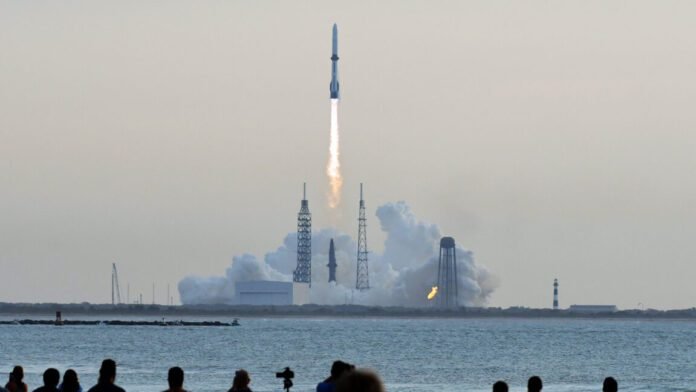
Blue Origin has set ambitious launch targets after reaching orbit with New Glenn, a 98-meter-tall heavy-lift rocket, for the first time in January 2025. It is competing with SpaceX for large commercial contracts and to develop a lunar lander for Nasa’s Artemis program.

Blue Origin is considering fundraising as SpaceX, which dominates the space launch market, gears up to list on the public market as early as June, with a valuation in excess of $1.75 trillion.

Limp told employees Blue Origin would have to demonstrate strong economics but that external funding was one option “on the table,” the people added.

Blue Origin declined to comment.

Limp was speaking to employees as he responded to questions on a new stock option plan. He said that similar to OpenAI and SpaceX, the group could use fundraising rounds to help staff exercise stock options. “We wrote this plan intentionally to allow for that,” he said.

He said the company needed to be “ready for external funding” and he was confident in strong interest from outside investors.

Bezos, who founded Blue Origin in 2000, is the company’s sole shareholder and its primary source of financial backing. He has largely used the sale of Amazon stock—he owns nearly 9 percent of the group, according to proxy filings—to fund the rocket maker.

Blue Origin is spending heavily as it scales operations including building an 800,000 sq ft manufacturing facility and a second launch pad in Florida. It is also investing in the testing and development of its reusable rocket booster and orbital upper stage.

The company is expected to spend roughly $4.8 billion this year, according to analysts at Capstone, a Washington-based consulting firm. It estimates the group has spent nearly $28 billion since its inception.

Josh Parker, an analyst at Capstone, said Blue Origin had faced significant cost increases in recent years as it developed New Glenn in a “brutal inflationary environment.” He said competition for talent with SpaceX had also forced up salaries.

Limp, a former Amazon executive who took charge of Blue Origin in late 2023, told employees that he did not expect Bezos would ever sell the business. He did not rule out a potential IPO in the future, the people added.

Blue Origin’s CEO in April said the group was planning between eight and 12 launches in total this year with New Glenn. A target of 14 launches had earlier been shared with employees internally.

He said the group had a longer-term goal of hitting 100 launches a year, with a significant portion of these expected to help build out its TeraWave satellite communications network for business customers.

© 2026 The Financial Times Ltd. All rights reserved. Not to be redistributed, copied, or modified in any way.

EU Commission considers overhaul of regional policy department in spending shake-up

0
eu-commission-considers-overhaul-of-regional-policy-department-in-spending-shake-up
EU Commission considers overhaul of regional policy department in spending shake-up


The European Commission is considering a major restructuring of one of its oldest departments as President Ursula von der Leyen seeks more direct control over EU spending.

The Directorate-General for Regional and Urban Policy, known as DG REGIO, oversees almost a third of EU spending through the bloc’s cohesion policy — roughly €600 billion of cash designed to help poorer regions.

But DG REGIO could become a casualty of the Commission’s broader effort to reorganize itself around new priorities, including competitiveness, defense and strategic investment, according to nine EU officials and diplomats familiar with the discussions. They were granted anonymity to discuss the confidential plans.

The debate reflects a wider shift in how Brussels manages money. While traditional cohesion funds have been managed jointly by EU governments and regions, during the pandemic the bloc moved to a more centralized model, with national recovery plans negotiated directly between capitals and the Commission.

That model showed the EU could move money faster when spending decisions were controlled more tightly from Brussels, the officials said, adding that the same logic is now shaping talks on the bloc’s next long-term budget.

Von der Leyen has pushed to steer more EU money toward defense and competitiveness. Under two restructuring scenarios now circulating in Brussels, she would gain tighter control over major spending programs, officials said.

One option is the creation of a new super-department, informally dubbed DG INVEST, that would oversee regional and social funds as well as the future competitiveness fund, four officials said.

Such a move would give von der Leyen a chance to reshape a major part of the Commission around her own priorities, one of the officials said: “If you build a structure from scratch, you shape it in your own image.”

A second option would stop short of scrapping DG REGIO outright, given its history and political weight. Instead, it could be merged with the Reform and Investment Task Force, known as SG REFORM, three officials said. SG REFORM manages the EU’s Covid recovery funds and already sits close to von der Leyen through the Secretariat-General.

But Ľubica Karvašová, vice chair of the European Parliament’s REGI Committee, said the ideas were “a failure to understand what cohesion policy is really about.”

Europe’s regions cannot be managed through an overly centralized investment model, Karvašová said. She also warned there would be political resistance if other Commission departments were strengthened at DG REGIO’s expense.

Inside DG REGIO, anxiety is spreading. One official described staff as “an egg in the fridge” — carrying an expiration date — adding that while many officials have already moved elsewhere in the Commission, there is no “panic exodus” yet.

The key moment for any overhaul is likely to be the Commission’s large-scale review, expected by the end of 2026 ahead of the next budget cycle in 2028, officials said.

The expected retirement next year of Director-General Themis Christophidou is also fueling speculation that DG REGIO could be killed off altogether, two Commission officials added.

Source: Politico

The $50 Billion Roadmap: Can Abu Dhabi Engineer Regional Stability Through Syria’s Reconstruction?

0


[DAMASCUS] Damascus and Abu Dhabi on Monday, May 11, launched a comprehensive economic road map valued at more than $50 billion in what officials described as a major turning point in Syria’s recovery efforts and a new phase of Arab-led development in the Eastern Mediterranean.

The announcement came during the first Syrian-Emirati Investment Forum, hosted in Damascus, with the participation of a high-level Emirati delegation led by Minister of State for Foreign Trade Thani bin Ahmed Al Zeyoudi, alongside senior leaders from the UAE private sector, most notably Eagle Hills founder Mohamed Alabbar.

Opening the forum, Al Zeyoudi outlined the UAE’s broader strategic direction, emphasizing that the initiative aims to “advance bilateral relations across investment and trade sectors in a manner that serves the shared interests of both countries and their brotherly peoples.” He stressed before Syrian officials and investors that the UAE believes “economic integration and direct dialogue remain the optimal path toward sustainable growth.”

The development was met with strong official support from Damascus. Syrian Minister of Economy and Industry Dr. Mohammad Nidal al-Shaar described the forum as “a restoration of trust and natural communication between brothers.” In remarks that resonated strongly with attendees, he praised the Emirati development model, saying: “What we see in the UAE is the result of genuine effort and vision. We seek to benefit from an experience that turns the impossible into reality.”

The Syrian minister also said the government is committed to providing all necessary support and facilitation to ensure the success of Emirati projects, describing Syria today as “a major investment opportunity and a platform for launching toward the future.”

At the center of the discussions stood Alabbar, who drew significant attention after announcing Eagle Hills’ intention to launch massive urban and logistics projects worth $50 billion. Speaking directly to participants, Alabbar said the region is “undergoing a very major political transformation,” a shift that he said has given investors the confidence to commit large-scale investments matching Syria’s historical stature and the aspirations of its people.

The proposed investment vision includes the construction of integrated smart cities in Damascus and Latakia, providing more than 100,000 housing units, in addition to the redevelopment of strategic infrastructure, including the airports of Latakia, Qamishli, and Deir ez-Zor. The broader goal is to position Syria as a logistical hub linking the Arabian Gulf to the Mediterranean.

First Syrian-Emirati Investment Forum in Damascus, May 11, 2026. (Syrian Investment Authority)

The forum itself was not an isolated event, but rather the culmination of a gradual political track pursued by Abu Dhabi over several years. Observers point in particular to Syrian President Ahmed al-Sharaa’s visit to the UAE last April, which many viewed as the political green light for major Emirati companies to begin implementation.

The Syrian community in the UAE—estimated at around 250,000 people—is also emerging as a key bridge for transferring expertise and capital. Mahmoud al-Dharawi, deputy head of the Syrian Economic Forum for Development, stated that Syria has now become “a major investment opportunity” capable of attracting long-term strategic partners.

Despite challenges related to international financing mechanisms and the lingering effects of sanctions, the heavy Emirati presence in Damascus sends what analysts describe as a powerful signal: that economic realities may ultimately override political hesitation.

The success of this multibillion-dollar partnership would not merely mean rebuilding Syria’s physical infrastructure. It could also reshape the balance of power across the eastern part of the Arab world by presenting economics as the only sustainable guarantor of regional stability, and by demonstrating that development and joint economic interests may succeed where years of conflict failed.

As the forum concluded, it became increasingly clear that Damascus and Abu Dhabi are seeking to write a new chapter in the modern history of the region —one built on the premise that durable alliances are founded on economic integration and development, and that Syria may once again reclaim its traditional role as a commercial and investment crossroads in the Arab world.

Syrian-Emirati relations have passed through several pivotal stages. Since the era of Zayed bin Sultan Al Nahyan, the UAE has been a key supporter of development efforts in Syria, while Dubai and Sharjah became major hubs for Syrian business communities beginning in the 1990s.

Despite periods of diplomatic stagnation ushered in by the beginning of the Syrian Civil War in 2011, Abu Dhabi has maintained relatively friendly relations with Damascus before initiating a phase of what observers called “active engagement” in 2018. That trajectory accelerated dramatically after the devastating February 2023 earthquake, when Emirati humanitarian aid evolved into a political bridge that paved the way for Syria’s return—under former President Bashar Assad—to the Arab League.

Today, bilateral ambitions extend far beyond the real estate sector into strategic logistics cooperation. Discussions during the forum included opportunities to invest in and operate the airports of Latakia, Qamishli, and Deir ez-Zor, part of a broader effort to reconnect Syria with global trade networks.

With a large Syrian expatriate population in the UAE, representing, according to economic experts, roughly 68% of Syria’s educated workforce abroad, many analysts expect this partnership to create a “human bridge” capable of accelerating the return of Syrian expertise and capital.

Ultimately, supporters of the initiative argue that the project is about far more than reconstruction. They see it as an attempt to redesign the political and economic landscape of the Arab East through investment-led stability, offering a model in which development and regional cooperation replace conflict as the defining language of the future.

0FansLike
0FollowersFollow
0FollowersFollow
0SubscribersSubscribe
- Advertisement -
Google search engine

Recent Posts