15.4 C
London
Sunday, May 17, 2026
Home Blog

Qatari, Saudi Arabia discuss efforts to ease tension in Middle East

0
qatari,-saudi-arabia-discuss-efforts-to-ease-tension-in-middle-east
Qatari, Saudi Arabia discuss efforts to ease tension in Middle East

Qatar’s Foreign Minister Sheikh Mohammed bin Abdulrahman Al Thani and his Saudi Arabian counterpart Foreign Minister Prince Faisal bin Farhan discussed the situation in the Middle East, including those related to the US-Iran war, Anadolu reports.

In a Sunday statement on US social media company X, the Qatari Foreign Ministry said the discussions over the phone call also addressed efforts to ease tensions and promote stability and security across the region.

Sheikh Mohammed stressed the “importance of all parties responding positively to the ongoing mediation efforts, which would pave the way for addressing the root causes of the crisis through peaceful means and dialogue, leading to a sustainable agreement that prevents renewed escalation,” the ministry said.

READ: US officials pushing UAE to seize Iranian island: Report

The officials also reviewed bilateral ties and ways to strengthen them, it added.

Late Saturday, the Saudi Foreign Ministry also said Sheikh Mohammed and bin Farhan held a phone and discussed efforts to maintain stability and security.

Regional tensions have escalated since the US and Israel launched strikes against Iran on Feb. 28. In response.

Tehran retaliated with strikes targeting Israel as well as US allies in the Gulf, along with the closure of the Strait of Hormuz.

A ceasefire took effect on April 8 through Pakistani mediation, but talks in Islamabad failed to produce a lasting agreement. US President Donald Trump later extended the truce indefinitely.

OPINION: How Washington profits from Iran’s pain

Pakistan High Court Upholds Rizwan Habib’s Death Sentence in Murder of American Ex-Wife

0
pakistan-high-court-upholds-rizwan-habib’s-death-sentence-in-murder-of-american-ex-wife
Pakistan High Court Upholds Rizwan Habib’s Death Sentence in Murder of American Ex-Wife


A division bench of the Lahore High Court at Rawalpindi dismissed the appeal and upheld the death sentence of Rizwan Habib, who was convicted of the brutal murder of his former wife, US citizen Wajiha Swati, in a case involving a property dispute over assets worth around Rs1 billion that took place in Rawalpindi.

The High Court remarked that the convict perpetrated a vile crime, thus justifying the death sentence.

The division bench of the Lahore High Court included Justice Sadaqat Ali Khan and Justice Tanveer Sheikh.

In April 2025, Rawalpindi District and Sessions Judge Majid Hussain Gadi sentenced Rizwan Habib to death for the brutal murder of his American ex-wife. The accused subsequently challenged the verdict before the High Court, which ordered a retrial on merits.

Following reconsideration, Additional Sessions Judge Afzal Majoka again gave the death sentence. The decision was once more challenged in the High Court, where the Rawalpindi Bench ultimately dismissed the appeal and upheld the conviction.

According to the case details, Rizwan Habib contracted a second marriage with 47-year-old US citizen Wajiha Swati after persuading her with assurances of a lucrative business venture. The relationship deteriorated within months, leading to a divorce.

During her stay in the United States, the accused took control of her luxury cottage in Rawalpindi and initiated the transfer of other properties into his own name. Police investigations further revealed that Swati had been seeking the recovery of property worth millions of rupees that she had previously transferred to him prior to the divorce.

When she initiated legal proceedings, Habib persuaded her to return to Pakistan under the pretext of a reconciliation agreement and the return of her assets.

Swati arrived from the United States via the United Kingdom on October 16, 2021. Just a day later, she was murdered by her ex-husband.

Her prolonged disappearance prompted her son, Abdullah, based in the United States, to involve the FBI and the US Embassy in Islamabad, while also filing an online complaint with Rawalpindi Police.

Given the sensitivity of the matter and diplomatic involvement, police launched a priority investigation and arrested the victim’s ex-husband, who confessed to the brutal murder of Swati.

During interrogation, he stated that Swati’s body was wrapped in a carpet, transported from Rawalpindi to a remote village in Khyber Pakhtunkhwa, and buried in a pit within the courtyard of a house.

Sixty-three days after the murder, Rawalpindi Police recovered the remains and transported them to the city for legal formalities.

A forensic report from a US laboratory confirmed that Swati had died as a result of torture, corroborating the prosecution’s case.

The case remained under close observation by US authorities, with three American diplomats and an FBI officer present in court when the verdict was announced.

The perfect commuter bike? Velotric’s Discover M makes its case.

0
the-perfect-commuter-bike?-velotric’s-discover-m-makes-its-case.
The perfect commuter bike? Velotric’s Discover M makes its case.

Commuter bikes don’t come with the same constraints many other bikes do. Mountain bikes must glide gracefully through all sorts of abusive terrain; road bikes need to mix high performance with enough comfort to let riders stay in the saddle for hours on end. All a commuter bike needs to do is comfortably and reliably get you from A to B on typical roads with minimal fuss.

So it’s been surprising how rarely the commuter bikes I’ve tested have gotten it right. At the low end of the price scale, as you’d expect, the required compromises have a big impact on the experience. The high end addresses those shortcomings, but at prices comparable to high-end bikes from specialized categories. I’ve never encountered something in the middle of the two: affordable, with no compromises.

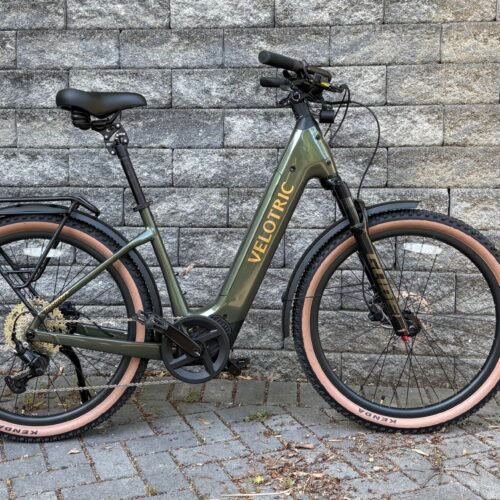
But I may have just found my ideal commuter bike: the Velotric Discover M. It’s comfortable, it has a great combination of components, and it comes in at just under $2,500.

Upgrades all around

Velotric’s first entry in this line, the Discover 1, marked a promising start for the company. While it was definitely in the “compromises needed” category, the shortcomings were relatively minor and carefully chosen. Since then, the company has expanded considerably, introduced many new models, started working with local dealers in the US, and moved a bit upmarket.

The latest iteration of the Discover illustrates the upmarket move. It costs nearly twice as much as the original Discover, but you get a lot for that price. The hub motor is gone, replaced by a mid-frame motor produced under contract for Velotric.

While it still has a cadence sensor you can select through a menu, the Discover uses a torque sensor by default, providing far more integration with your pedaling. Cadence sensors simply register when the pedals are spinning; a torque sensor registers how much force you’re applying to the cranks. The latter makes the electric assist feel more like just that: an assist for your legs rather than a replacement for effort.

Switching to the cadence sensor triggers a warning that it will drain the battery faster, which makes sense: You can gently spin the pedals in a gear meant for climbing hills while the electric motor does all the work. I quickly switched back to the torque sensor for pleasant spring-time riding, but I can see where the cadence sensor might make sense once the full heat of summer starts.

Of course, you could always just use the throttle. More on that below.

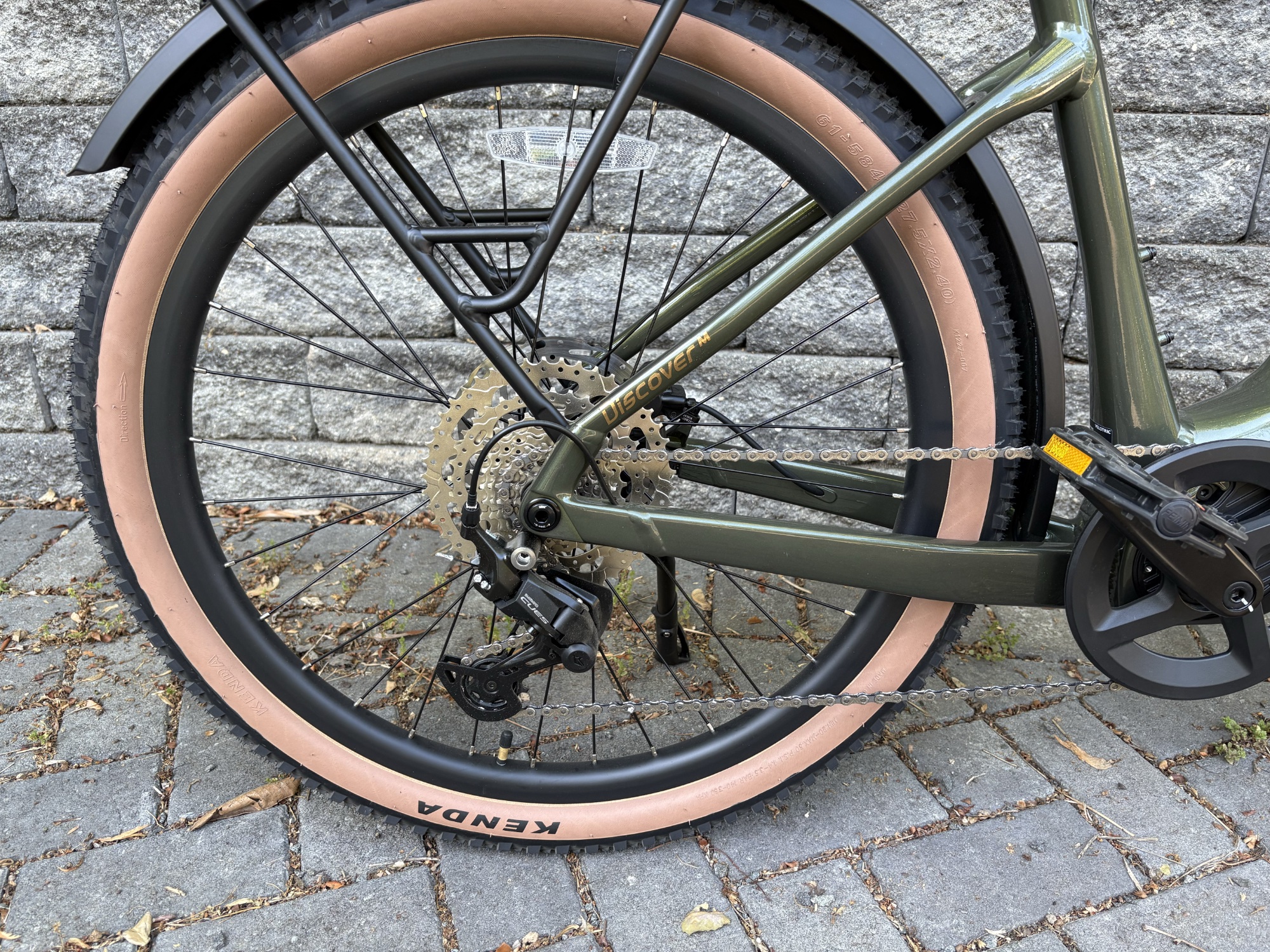
Another big upgrade comes in the drivetrain, provided by Shimano. After years spent diversifying its low-end components and moving electronics down from the high end to the middle of its range, Shimano has finally decided to rationalize everything. All the models in its upper range, both road and mountain bikes, will have dedicated electronic groupsets. The entire low end will be occupied by items from the Cues groupsets, which will all be completely interoperable.

Image of the rear wheel of a bicycle, showing its gears and the derailleur.

Look at that nicely spaced set of gears. Shimano’s new Cues components seem great.

Look at that nicely spaced set of gears. Shimano’s new Cues components seem great. Credit: John Timmer

In theory, this means a mountain bike rear derailleur could be paired with a road-style shifter and work without a fuss (the road shifter hasn’t been released yet, so nobody knows). This seems to be a recipe for even more chaos, as bike manufacturers can potentially mix and match quality and intended use at random.

In practice, though, using a Cues system has allowed Velotric to avoid the worst features of some of Shimano’s previous low-end hardware: cheap plastic shifters and a gear range so narrow it was nearly impossible to pedal fast enough to reach the full rated speed. The Discover M has decent-feeling thumb trigger shifting that runs you through eight useful gears in back, with a range typical of a low-end mountain bike. It is an enormous step up from some previous budget hardware.

True class

US law defines three classes of e-bike. Class 1 provides an assist for up to 20 miles an hour (32 km/hr), but you must be pedaling to activate it. Class 2 is similar but adds a throttle that also cuts out at the same maximum speed. Class 3 e-bikes offer an assist to 28 mph (45 km/hr) but do not allow a throttle. The accepted classes are a patchwork, making it difficult to design a single bike for the US market.

Nearly every manufacturer focused on the US market has settled on a compromise that’s probably not technically legal: They enable switching to Class 3 in software but still provide a hardware throttle. The throttle simply cuts out at the lower max speed of Class 2. The assist it provides is also somewhat anemic; I could generally accelerate away from a full stop much faster by mashing the pedals a bit.

Velotric has provided a simple software solution. If the bike is set to Class 1 or Class 3, the throttle is disabled. While this may seem like a blindingly obvious way to do things, it’s rare enough that I initially thought I had been shipped a bike with a defective throttle.

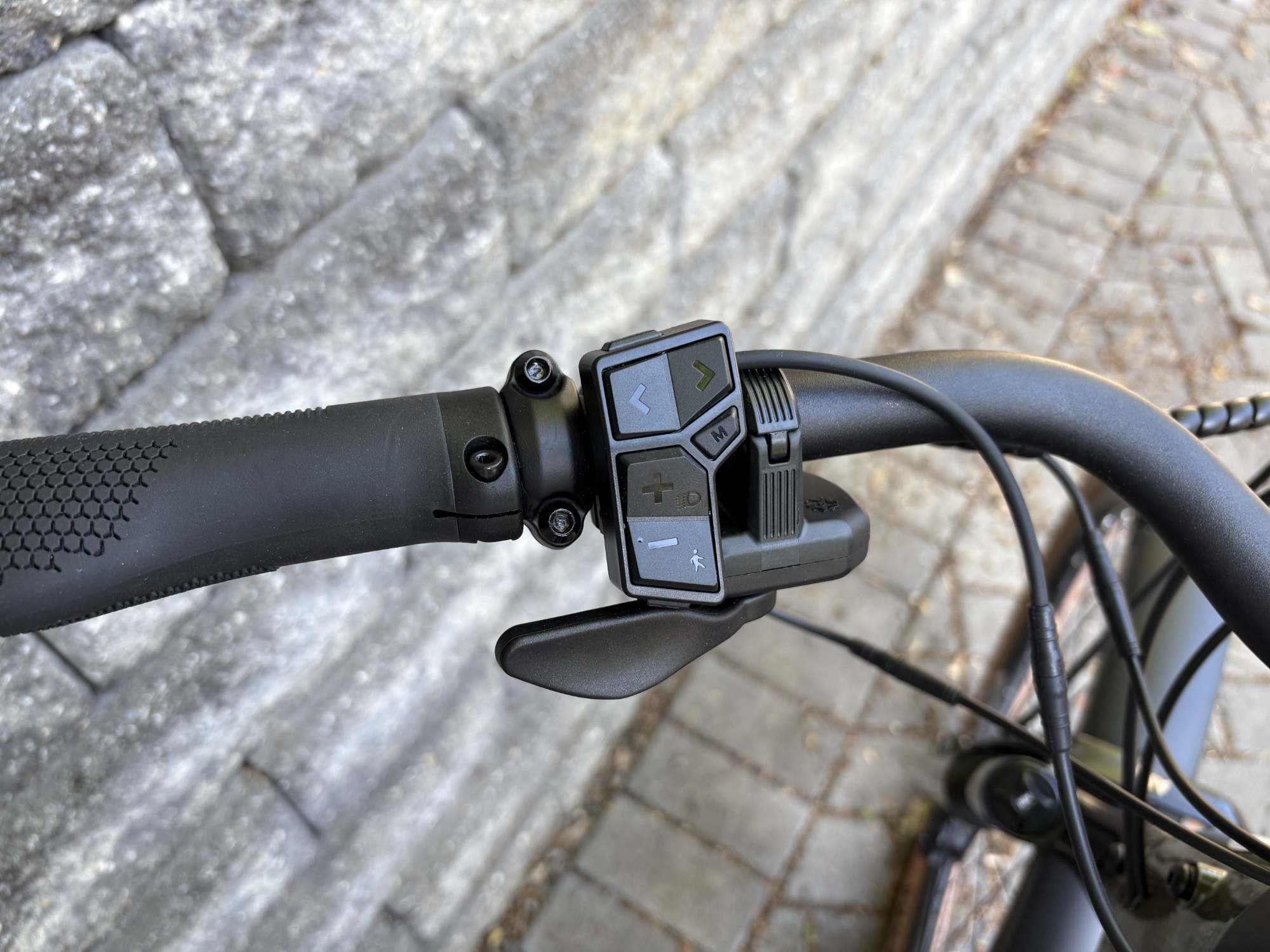
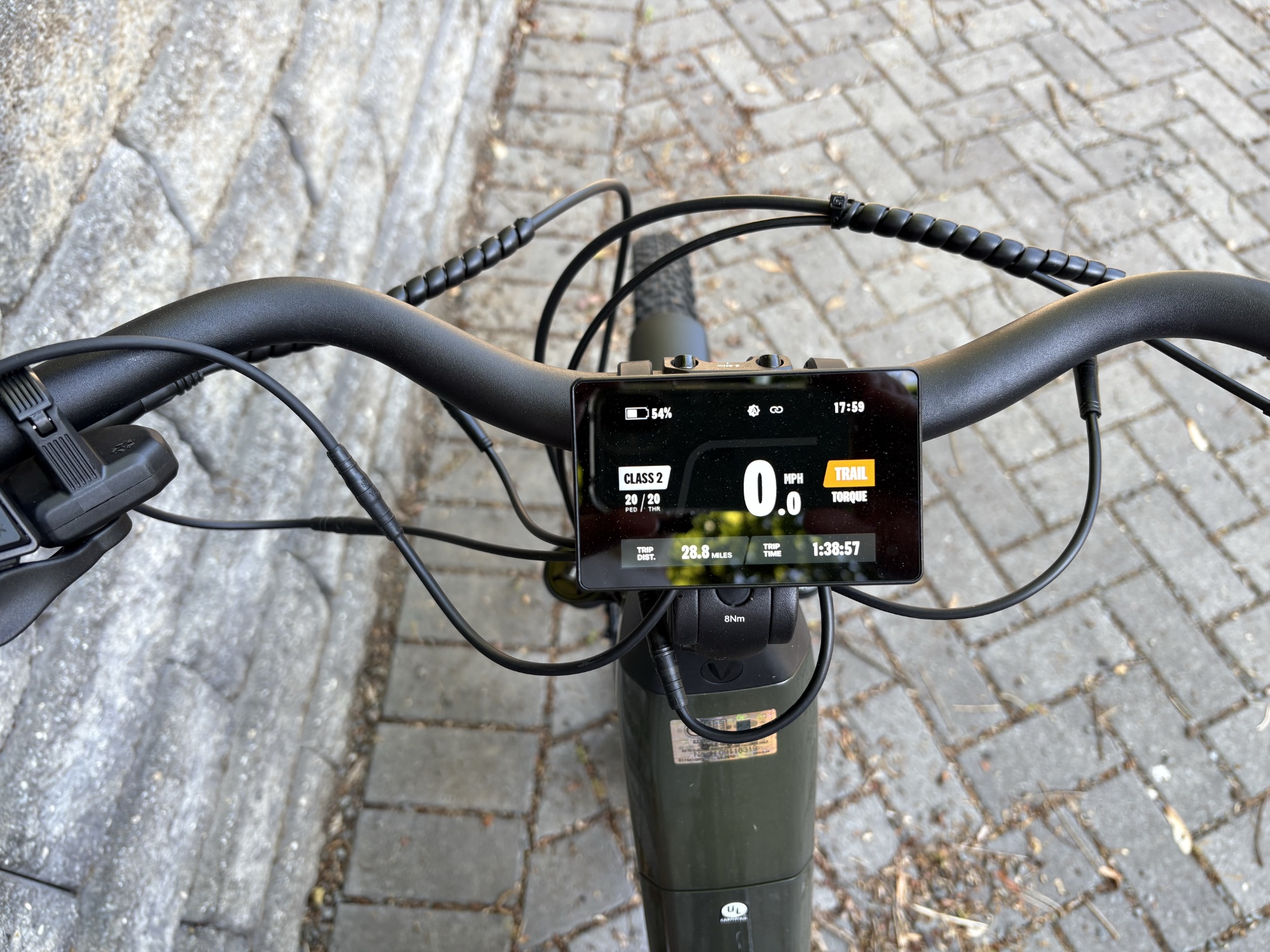
Image of the handle bar of a bicycle, showing a controller and throttle lever.

Even if you don’t use the throttle, the seven buttons on the controller should keep your left thumb busy.

Even if you don’t use the throttle, the seven buttons on the controller should keep your left thumb busy. Credit: John Timmer

The assist provided by the throttle is a bit weak; I could generally accelerate from a full stop faster by mashing the pedals down with the assist set to high. If you want to cruise around using the throttle to avoid the effort of pedaling, you’re better off activating the cadence sensor and then casually spinning the pedals with the chain in a large gear ring. That will get you to the max speed faster than waiting for the throttle to take you there.

Customize your ride

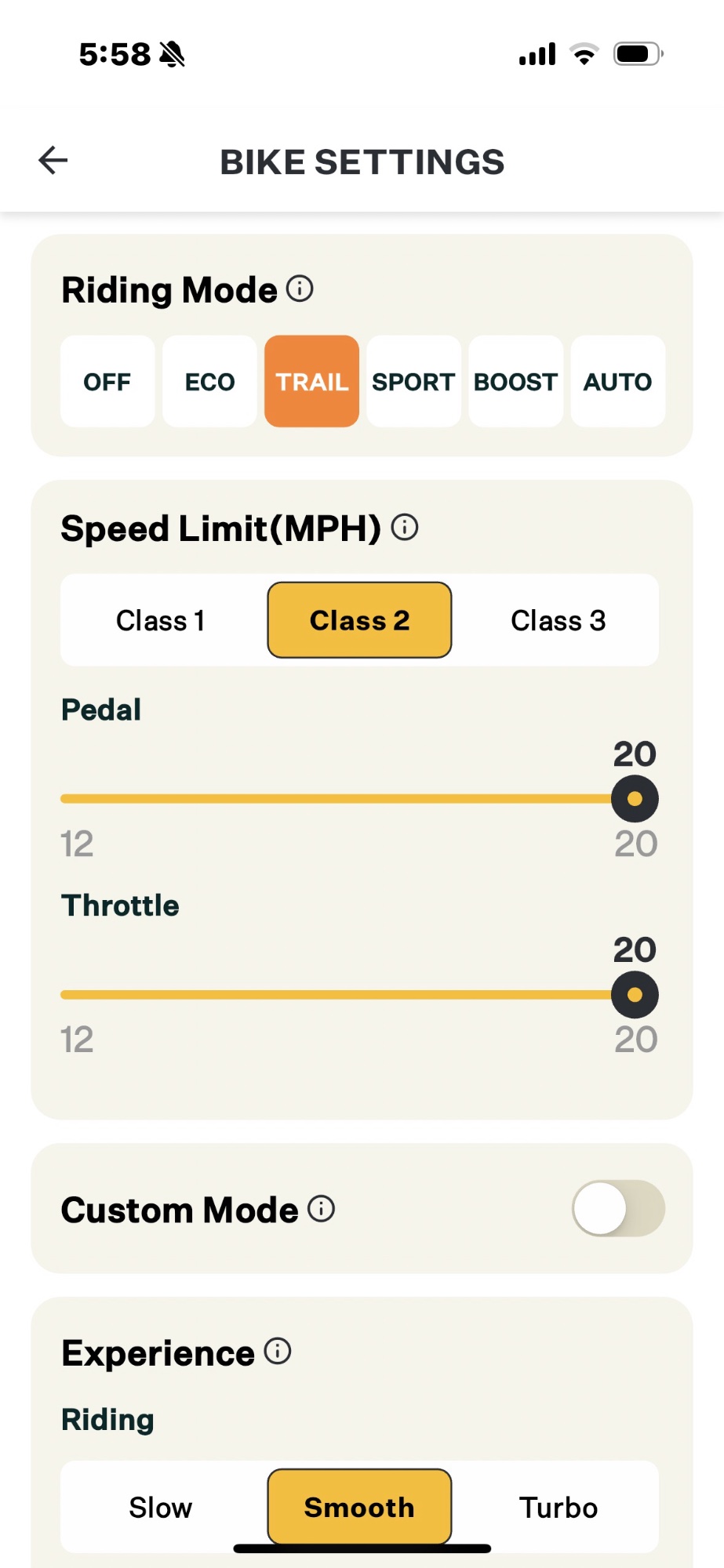
In general, Velotric offers exceptional customization options. You can adjust the speed of any assist level up to its legal maximum. So if you live in an area with low speed limits, you can set Class 1’s assist to max out at 15 mph while leaving the remaining ones untouched. Or if you’re worried you’re not getting enough exercise, you can set the throttle to cut out at 10 mph while leaving Class 2’s 20 mph assist maximum untouched.

This is actually useful because Velotric includes a dedicated button for switching classes on the controller. On most bikes, changing classes requires a trip to a phone application or diving through menus that require you to pull over. Thanks to the button, you simply adjust the class to your current needs. I would set it to Class 1 when sharing space on a heavily trafficked bike path, then switch to Class 3 to match the traffic speeds on suburban streets.

Anything that makes it easier to change classes will obviously also make it easy for riders to switch into a class that may not be appropriate for the conditions. Of course, this sort of rider is more likely to set the bike to Class 3 and keep it there.

This isn’t the only nice bit of electronics that Velotric has added. The bike includes rear turn signals controlled by buttons that are easy to use without looking down, along with an alert when they’re active. I’ve found that leaving them on after a turn can be a real problem, as directionals are not part of my normal cycling routine. The only omission is front directionals, which would be helpful for turning left across oncoming traffic.

Screenshot of a phone application showing a number of sliders and check boxes to adjust things.

If you decide to use the phone app, all the options are logically laid out.

Screenshot of a phone application showing a number of sliders and check boxes to adjust things.

You can do a lot of fine tuning of your bike’s performance.

All this customization can be done through the on-bike display or Velotric’s phone app. On many systems I’ve tested, it felt like I couldn’t access everything I needed without making adjustments on both the bike and the app. Velotric’s system, by contrast, presents the same options in the same order in both places, giving me confidence that I’m not missing out on any options, no matter how I’m setting them.

All that and a great ride

Reviewing the list of features, there’s little that’s missing or problematic. The battery is sufficient, and it comes standard with a robust rear rack and fenders. It’s UL listed, and depending on how aggressively you set the assist, it should deliver the promised 60–80 miles of range (at least 100 km). Hydraulic disk brakes from Tektro provide plenty of stopping power.

The screen is bright and clear, and the settings are easy to navigate, though there are a lot of them. It’s helpful that Velotric’s smartphone app isn’t required, but it’s a nice alternative. The software also integrates with Apple’s Find My system and Google’s equivalent, and it can be set to unlock the bike when you’re nearby. There’s also a USB-C port for charging on the go.

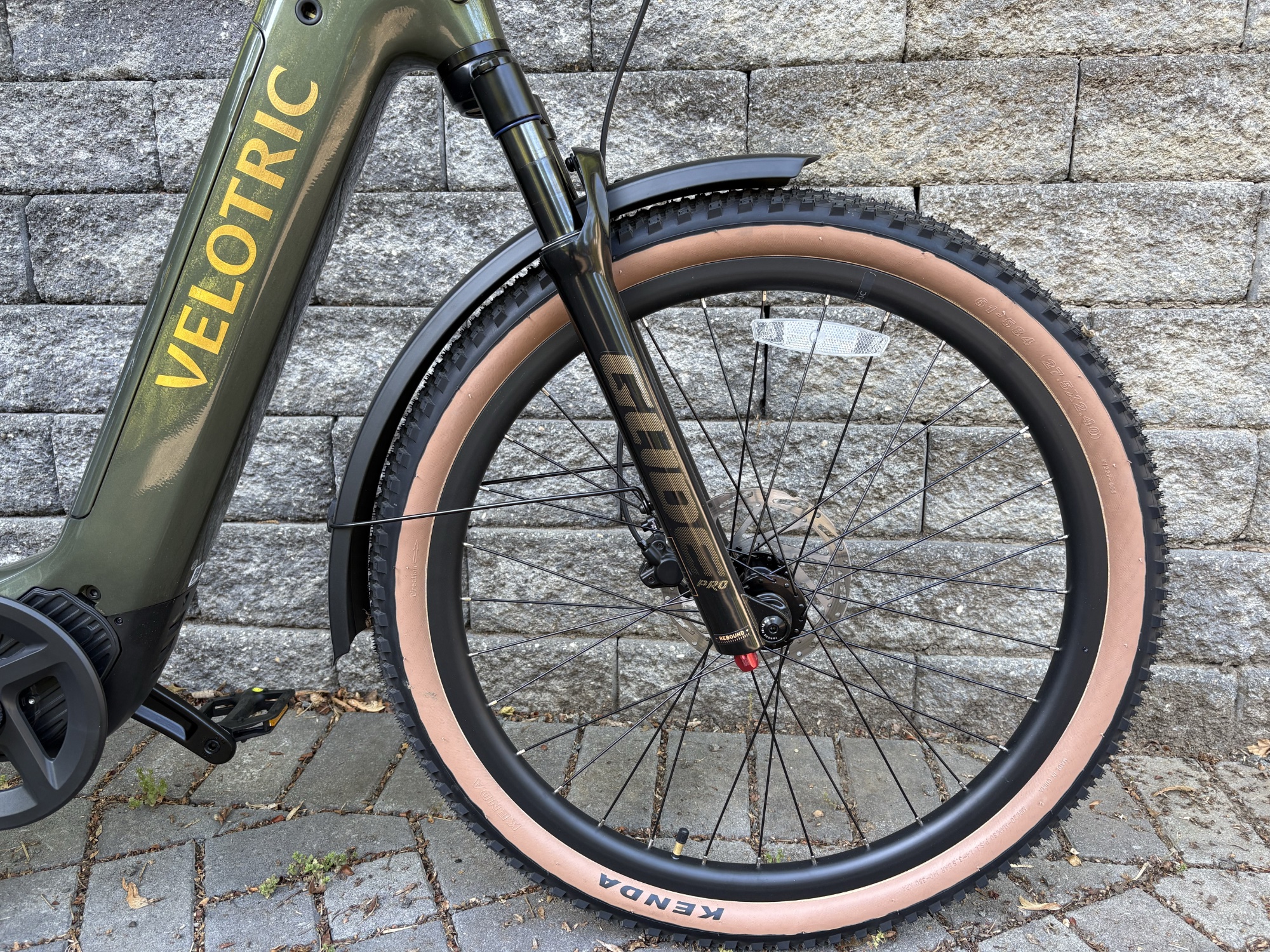
Velotric has also included adjustable front shocks and a shock-absorbing seatpost, coupled with a thick and cushy saddle. The Discover M also comes with some fairly beefy tires that also help cushion any bumps. The result is a very gentle ride, even across my local Worst Paved Road in Town™.

Image of the saddle of a bicycle, showing a mechanical dampener between it and the seat post.

The seat post includes a device that should cushion the bumps.

Image of the front wheel of a bicycle, showing forks with a shock absorber.

There are also front shocks to cushion bad pavement.

In general, the ride is great. You sit with a very upright posture, but it’s comfortable, and the large version is appropriately sized for someone like me (well over 6 feet/185 cm), which isn’t always the case with “large” frames. It’s not a performance bicycle, but the U-shaped frame is solid and gives the sense that the effort you put into the pedals translates directly to forward movement rather than being lost to frame flex.

With three classes and five levels of assist a few button presses away, it was easy to find a setting that worked for the effort I wanted to put in. That could range from powering down the streets in an “I’m going to be late panic” to gentle “I don’t want to end up covered in sweat” rides. Having a useful gearing setup thanks to the Cues components was also a big help in this regard.

At a bit over 60 pounds (27 kg), it’s not enjoyable to ride without the assist, but it’s manageable in a pinch.

Image of the display screen of a bicycle, which is centered on the handlebars.

When it’s not nagging you to change gears, the display nicely balances information content and information overload.

When it’s not nagging you to change gears, the display nicely balances information content and information overload. Credit: John Timmer

One mildly annoying feature is that the bike uses input from the torque sensor and occasionally flashes a yellow warning on the display recommending when you should shift gears. This typically happened when I was pushing a high speed at high cadence—the bike would prompt me to shift into a higher gear and pedal more slowly with more force. I’m a better judge of my own cadence/power tradeoff than the software, so I found this less than helpful, and there doesn’t appear to be a way to shut it off.

Little to complain about

I’m not really the target audience for a commuter bike; if I had to commute, I’d rather do it on something that could also handle something like a bit of light trail riding. But it was hard not to be impressed with what Velotric has put together. The $2,500 price tag will obviously be a barrier for some people, but it isn’t a huge jump from models that are a significant step down in features and quality. And many commuter bikes that cost substantially more than the Discover M don’t add much to the riding experience, though they likely have higher-quality components.

Velotric itself has also been around long enough to iterate on several of its designs, lending some confidence that the company will be there to provide any service that’s needed in the future.

I see a couple of minor things that could be improved, but they are truly minor. So for the second time since I’ve started reviewing e-bikes, I’m giving one the official Ars seal of approval. If you’re in the market for a good commuter bike, the Discover 3 provides a fantastic balance of price and quality.

The Good

  • Solid and comfortable commuter bike
  • Very competitive price for the quality
  • Great (and actually legal) system for managing the assist class
  • New Shimano Cues components are a big step up from budget gear

The Bad

  • Doesn’t have a front turn signal
  • Throttle takes forever to get the bike up to 20 mph
  • Gets annoying about telling you what gear you should be in

The Ugly

  • There’s nothing ugly about it


Correction:  fixed references to the wrong Velotric model.

Pennsylvanians use town hall meeting to rail against data center boom

0
pennsylvanians-use-town-hall-meeting-to-rail-against-data-center-boom
Pennsylvanians use town hall meeting to rail against data center boom

The latest example of burgeoning opposition to rapid data-center development in Pennsylvania came at a town hall meeting overflowing with frustration about how the state is managing the surge.

As about 225 people watched, more than 20 speakers in the two-hour online forum late Wednesday spoke about resistance to an industry they blame for rising electricity prices, heavy water use, noise pollution and rural industrialization. Gov. Josh Shapiro, who has tried to thread the needle of welcoming data centers while proposing some guardrails, was a frequent target.

“This is a public trust and transparency issue,” said Jennifer Dusart, a small business owner and resident of Mechanicsburg, near the state capital. “Too many Americans are finding out about these projects after decisions have been made. We have been bulldozed over, and when citizens have raised concerns, they are often dismissed as uninformed, emotional or anti-progress.”

According to the Data Center Proposal Tracker, Pennsylvania has nearly 60 data centers that have been officially proposed, are in early planning stages, have received approval to build or are under construction.

Karen Feridun of the environmental nonprofit Better Path Coalition, which organized the town hall, said the Pennsylvania Data Center Resistance Facebook group she started in January with a few dozen members now has more than 12,000 followers. Kelly Donia of East Whiteland Township in southeastern Pennsylvania, who lives near a proposed data center, said she’s a registered Democrat who had been excited about speculation in 2024 that Shapiro would be the Democratic vice presidential candidate. But she said she no longer supports him because he has courted data centers. “He is losing his base,” she said. “I want him to hear this loud and freaking clear. I’m going to make it my job to make sure that man never gets elected again for any office.”

While an Emerson College survey in November found that Pennsylvanians were split on data-center development—38 percent supported it, while 35 percent opposed it—opposition to such development close to home was more pronounced. A February poll of registered voters in the state by Quinnipiac University found even more pushback: 68 percent said they would oppose a data center for AI in their community.

Neither the Data Center Coalition, an industry group, nor Pennsylvania Data Center Partners, a developer of large data centers, responded to requests for comment, though industry advocates have said the growth will bring jobs and tax revenue to the state.

The Shapiro administration said it seeks to protect communities while reaping the economic benefits of the booming data center industry.

“If companies want the Commonwealth’s full support—including access to tax credits and faster permitting—they must meet strict expectations around transparency, environmental protection, and community impact,” Rosie Lapowsky, a Shapiro spokesperson, said in a statement. “This is about setting a higher bar for projects, not lowering it, and ensuring development happens responsibly and in a way that benefits Pennsylvanians.”

In February, Shapiro proposed standards as part of his budget address, including that new data centers seeking state support must either provide their own power rather than drawing it from the grid, or fully fund their power needs and the transmission infrastructure that comes with them.

Feridun said Shapiro did not respond to multiple invitations to attend the town hall, which she thinks the state should have hosted to give people a chance to express their concerns about data centers.

Colby Wesner of the activist group Concerned Citizens of Montour County, which successfully opposed a data center, criticized House lawmakers for passing the Shapiro-supported HB 2151, which would require state officials to draft a model ordinance that towns could use to respond to data center applications.

Supporters say its use would be voluntary and it would help local officials protect quality of life in their communities. But Wesner believes it will benefit the industry if enacted: “There is absolutely no way this ordinance won’t be a data center developer’s dream.”

Donia urged townships to change their zoning so they have the legal right to deny data center applications in places they don’t want them. Without carefully zoned land, towns are vulnerable to lawsuits from developers, she said.

“If you’ve got terrible ordinances in your township, and you add in bad zoning, guess what? You get a hyperscale data center,” she said.

The surge in data center projects in Pennsylvania has been driven by tax breaks for developers, as allowed by a 2021 law that lawmakers should repeal, said Republican state Rep. Jamie Walsh, who spoke at the town hall event. In Virginia, the state with the most data centers, developers have to pay a sales and use tax, but Pennsylvania doesn’t require that, he said.

“That has made Pennsylvania a target. In Virginia, they have to pay tax on the contents of those buildings. Pennsylvania will never realize that. That is why we’ve become ground zero,” said Walsh, who represents Luzerne County in northeast Pennsylvania.

State Sen. Katie Muth, a Democrat who represents part of the Philadelphia suburbs, plans to introduce a bill to place a three-year moratorium on data center development so state and local governments can first study and plan for the industry. She announced the bill in a legislative memo in February and expects to introduce it soon, a spokesman said.

Muth told activists at the town hall that the data center industry has not done enough to fully disclose its plans to the public. ”This has all been planned long before any of us had a clue, so don’t feel that you missed all these things,” she said. “You were supposed to; no one wanted you to know about it.”

Michael Sauers, a retired school teacher from Bloomsburg, southwest of Scranton, called on officials to amend the Pennsylvania Municipalities Planning Code, a regulation first published in 1970.

“This has to be strengthened to empower communities to be able to say no to unwanted development that is being shoved down their throats,” he said. “Communities must be empowered to reject top-down development that gives them little or no voice in the future.”

This story originally appeared on Inside Climate News.

Man Rams Crowd with Car Before Going on Stabbing Rampage

0
man-rams-crowd-with-car-before-going-on-stabbing-rampage
Man Rams Crowd with Car Before Going on Stabbing Rampage


Chaos erupted in the heart of an Italian shopping district after a speeding car plowed into a crowd of pedestrians before the driver allegedly jumped out and stabbed a bystander who tried to stop him, according to local reports.

The terrifying scene unfolded Saturday in the historic city of Modena, Italy, where witnesses say a silver Citroen barreled through the busy Largo Porta Bologna area, smashing into multiple people before crashing violently into the window of a department store.

At least seven people were injured in the horror incident, including four who suffered serious injuries. One woman was reportedly pinned against the storefront during the impact and may lose both of her legs, according to Modena Mayor Massimo Mezzetti.

Emergency crews rushed to the chaotic scene as stunned shoppers looked on. Images from the area showed the mangled vehicle surrounded by debris, shattered glass and twisted bicycles left scattered across the street.

Italian media reports say a 55-year-old woman was fighting for her life and had to be airlifted to a hospital in Bologna. A 55-year-old man was also seriously hurt in the crash.

But the violence reportedly didn’t stop there.

Authorities say the driver, who was allegedly injured in the wreck, fled the scene on foot after the crash. During the frantic escape, he reportedly stabbed a person who attempted to stop him before police finally took him into custody.

Anti-terror investigators are now monitoring the case as authorities work to determine whether the attack was intentional.

Mayor Mezzetti confirmed that while no deaths had been reported, several victims remain in critical condition.

“Fortunately, there were no deaths, but seven people were injured, two of them seriously,” the mayor said. “One woman will likely have to have both legs amputated. She was crushed against the shop window.”

Italian outlets identified the suspect as a 31-year-old Italian citizen of foreign origin who reportedly holds a degree in economics. Police later carried out searches at his home in a Modena neighborhood as the investigation intensified.

Authorities have not yet revealed a possible motive, and investigators are continuing to question the suspect at a local police station.

China ramps up missile buildup for a Taiwan war

0

China’s accelerating missile buildup is increasingly turning industrial capacity, stockpile depth, and sustained precision-strike capability into decisive factors in the emerging military balance over Taiwan and the wider Indo-Pacific.

This month, Bloomberg reported that China sharply accelerated missile production in 2025, citing an analysis of corporate filings that showed 81 listed Chinese firms disclosed supplying key components to the country’s missile industry, more than double the number recorded when President Xi Jinping took office in 2013.

According to Bloomberg, nearly 40% of those companies posted record revenues last year, with combined sales rising 20% to 189 billion yuan (US$28 billion), even as revenues among China’s 300 largest listed firms declined overall.

Bloomberg said the surge reflected a wave of new military orders tied to China’s push to expand missile stockpiles amid rising tensions with the US, the war in Iran and concerns over Taiwan.

The report identified firms linked to China’s two main state-owned missile makers, CASIC and CASC, producing components ranging from infrared sensors and stealth coatings to fiber-optic guidance systems for cruise and ballistic missiles.

The buildup underscores China’s drive to strengthen deterrence and prepare for a potential Indo-Pacific conflict, particularly over Taiwan, while also extending China’s strike reach across the region, including Guam.

China’s rapid expansion of missile production, deployment, and strike capacity is reshaping the military balance in a potential Taiwan conflict. Despite persistent structural weaknesses in its defense industry, China appears to hold significant advantages over the US in missile production speed, stockpile replenishment, and industrial surge capacity.

Highlighting China’s missile buildup, the 2024 US Department of Defense China Military Power Report (CMPR) estimates that the People’s Liberation Army Rocket Force’s (PLARF) arsenal grew by almost 50% over four years, to about 3,500 missiles.

That growth is backed by a substantial increase in production and storage facilities, with CNN reporting in November 2025 that China expanded 60% of 136 missile-related facilities between 2020 and 2025, adding over 21 million square feet of floor space, identifying 99 missile manufacturing sites, of which 65 have expanded.

On missile deployment, The New York Times reported in September 2025 that China is expanding and dispersing missile deployments along its eastern coast facing Taiwan. It reported that missile brigades have built larger new bases and added launch pads and facilities for mobile launchers.

The report says Chinese forces practice launching missiles from farm fields, valleys, expressways and coastal outcrops near Taiwan. It notes that during wartime, commanders would deploy mobile missile units to caves and protected sites, then move them after firing to avoid detection.

In the event of a Chinese invasion of Taiwan, Lyle Goldstein, in an October 2025 Defense Priorities report, says China would use ballistic missiles, cruise missiles, rocket artillery, drones and airpower to suppress Taiwan’s air defenses and strike radars, command-and-control nodes, airbases, naval facilities and logistics infrastructure.

Goldstein says Chinese strike missions could number in the thousands per day initially, while China’s industrial capacity would allow it to replenish missile stocks during a prolonged conflict and sustain repeated strikes on Taiwanese airfields.

Looking into the effect of Chinese missile strikes on Taiwanese airfields, Kelly Grieco and Hunter Slingbaum argue in a March 2026 Stimson report that Chinese missile and artillery strikes could crater Taiwan’s runways and taxiways, grounding Taiwanese fighters for days or weeks, and potentially for months if China employed more advanced missile systems or aerial bombardment.

Using modeling based on DF-11 and DF-15 missile attacks, they say China could keep Taiwan’s fighter bases closed for over two weeks, and nearly a month if long-range artillery were added.

They also note that five successful strikes could disable all operational surfaces at Ching Chuan Kang Air Base, leaving surviving aircraft unable to take off or land, while repeated Chinese follow-up strikes could keep airfields unusable during the conflict’s opening phase.

Comparing China’s missile production capacity to that of the US, a January 2026 Heritage Foundation report states that Chinese state-owned defense enterprises are reportedly producing munitions, high-end weapons systems, and other equipment at rates approximately five to six times faster than their US counterparts.

The report further assesses that the People’s Liberation Army (PLA) could plausibly surge output of selected munition types by roughly 150–250% within six to eight months of national mobilization.

It attributes this potential to military-civil fusion policies, automated “smart factory” production lines, the rapid conversion of dual-use civilian industry, and China’s access to critical inputs such as rare-earth elements and energetic materials.

In comparison, Seth Jones argues in a May 2026 Center for Strategic and International Studies  (CSIS) report that the US military lacks sufficient munitions and industrial readiness for a prolonged war with China, particularly in long-range strike and air defense systems.

According to Jones, US stockpiles of long-range offensive missiles and air defense interceptors were already low before the Iran War and were further depleted during the conflict.

He notes that replenishment timelines are lengthy, taking over four years for some SM-3 IIA interceptors and roughly three years for systems such as Terminal High Altitude Area Defense (THAAD) interceptors, SM-6, SM-3 IB, Precision Strike Missiles (PrSM), Tomahawk cruise missiles and Joint Air-to-Surface Standoff Missiles (JASSMs).

Recognizing those risks, Tom Karako and Jerry McGinn, in a CSIS podcast this month, advocate expanding multiyear procurement contracts, increasing funding for munitions production, broadening the industrial base through second- and third-source suppliers, and pursuing co-production arrangements with allies to strengthen US missile manufacturing capacity.

They stress the need for sustained government demand signals to give industry confidence to invest in workforce, assembly lines and long-lead materials, while also promoting a “high-low mix” of munitions that combines high-end precision weapons with cheaper mass-produced systems and expanded production capacity.

As China continues to expand its missile arsenal, industrial base and precision-strike capabilities, the emerging Indo-Pacific balance may increasingly depend not only on operational military power but also on which side can sustain high-intensity missile warfare over the long term.


Merkel, Wałęsa and Sandu among first European Order of Merit laureates

0
merkel,-walesa-and-sandu-among-first-european-order-of-merit-laureates
Merkel, Wałęsa and Sandu among first European Order of Merit laureates


The European Parliament will host the inaugural European Order of Merit ceremony on 19 May in Strasbourg, where the first laureates will be recognised for their contribution to European integration and the promotion and defence of European values.

The ceremony will take place in Parliament’s hemicycle and will be streamed live. According to Parliament, 13 of the first 20 laureates are expected to attend and will address the chamber after receiving their distinction.

Among those expected at the ceremony are former German Chancellor Angela Merkel, former Polish President Lech Wałęsa, Moldovan President Maia Sandu and former European Central Bank President Jean-Claude Trichet.

Other expected laureates include former Austrian Chancellor Wolfgang Schüssel, former EU foreign policy chief Javier Solana and former European Commission Vice-President Viviane Reding.

The European Order of Merit was launched on the 75th anniversary of the Schuman Declaration, described as the starting point of European unity. Parliament said the distinction recognises individuals who have made a significant contribution to European integration or to the promotion and defence of values contained in the EU treaties.

The Order consists of three levels: Member of the Order, Honourable Member of the Order and Distinguished Member of the Order.

Appointments are made through an annual procedure under which up to 20 laureates may be selected each year. Parliament said the decision is taken by a selection committee appointed by the Bureau of the European Parliament.

The current committee members are Roberta Metsola, Ewa Kopacz, Sophie Wilmès, Michel Barnier, José Manuel Barroso, Josep Borrell and Enrico Letta.

Routine vaccines may cut dementia risk—experts have startling hypothesis on how

0
routine-vaccines-may-cut-dementia-risk—experts-have-startling-hypothesis-on-how
Routine vaccines may cut dementia risk—experts have startling hypothesis on how

More and more routine vaccines are being linked to lower risks of dementia. Shots against seasonal flu, RSV, tetanus, diphtheria, and pertussis (Tdap), pneumococcal infections, hepatitis A and B, and typhoid have all been linked to lower risks. And one of the strongest connections is from vaccination against shingles, with more data supporting the link still coming in. But as the evidence mounts, scientists continue to puzzle over the pleasant surprise—how are vaccines that target specific pathogens inadvertently shielding our minds from deterioration?

A burgeoning hypothesis offers a brow-raising possibility: The shots may be protecting our noggins by training the part of our immune system that had long been considered untrainable. If the idea holds up, it could generate a deeper understanding of fundamental aspects of our immune systems while opening new avenues to treating or preventing dementia. It could also add another dimension to the benefits of vaccines, which already save millions of lives worldwide.

Trained immunity

It’s well understood how vaccines work generally; they’re designed to prime our immune systems against specific pathogens. Vaccines present either defanged pathogens or distinctive fragments of them to specialized immune cells—namely, T cells and antibody-producing B cells—that can then learn to identify those microbial enemies.

So if such a pathogen stages an attack after immunization, those immune cells will be able to recognize the invaders quickly and destroy them. This process, as intended, engages adaptive immune responses, the part of the immune system known to be trainable. It can learn to target specific threats—and remember those threats, aka immunologic memory.

Then there’s the other part of the immune system, the innate immune responses. These precede adaptive responses, acting as first-line, non-specific defenses against germs and injury. Innate defenses include everything from physical barriers—skin, mucous, gastric acid—to immune cells that can indiscriminately gobble invaders, as well as chemical signals that can swiftly ignite generic inflammation.

For decades, the innate immune response was considered relatively static—not one that evolves or hones itself as new threats are encountered. But that changed in 2011 with the coining of the term “trained immunity” to explain changes documented in innate immune responses from past exposures. Trained immunity occurs when cells involved in innate responses are activated and then primed by generic signals from a germ. Those primed cells acquire and maintain changes that allow them to respond to those germ signals faster and with more intensity the next time they’re encountered.

Specifically, the changes observed in trained immunity are epigenetic. These don’t alter the underlying DNA sequence of the cells but are modifications or chemical tags that alter gene activity. In the case of trained immunity, the changes may involve genes coding for pro-inflammatory signals that make those genes more active when the same germ signal is encountered again. Ultimately, this would lead to a stronger inflammatory response. Similar to adaptive responses, these epigenetic changes stick around afterward, creating another type of immunologic memory.

Quirky vaccines

So how does this connect to vaccines? The concept of trained immunity was solidified by data involving a vaccine—but one that’s far from routine in the US: the quirky Bacillus Calmette-Guérin (BCG) vaccine, which was designed to protect against tuberculosis, caused by the bacterium Mycobacterium tuberculosis, but also used to treat bladder cancer (it’s still unclear how the vaccine works against this cancer).

Nevertheless, in 2012, researchers in the Netherlands conducted an experiment to investigate trained immunity in mice engineered to lack adaptive immune responses—they had no T cells or B cells. The researchers vaccinated the weakened animals with BCG, looking for changes in innate responses, the only responses the mice had.

The researchers found that the shot not only bolstered the rodents’ innate protective responses against M. tuberculosis but also boosted responses against an unrelated yeast pathogen, Candida albicans. Further work suggested similar trained immunity occurred in humans.

In the same study, the researchers examined blood samples from healthy human trial participants before and after immunization with BCG. After vaccination, the researchers found that immune cells in their blood produced stronger innate responses (pro-inflammatory signals) to M. tuberculosis than they did before the shot. They also produced stronger responses to C. albicans and the bacterial pathogen Staphylococcus aureus, suggesting non-specific trained immunity. The study was published in PNAS.

Since then, researchers have built a body of evidence to support and understand trained immunity. But in the past few years, the idea has collided with a steady stream of large population studies that have found that vaccines seem to protect against dementia. While most of the big studies that have made headlines have focused on routine vaccines—shingles and the flu, for example, a study in 2023 found that the BCG vaccine is also associated with a significantly lower risk of dementia.

In March, vaccine researchers in Belgium and South Africa, led by Justin Devine, put the findings together, including all the work on BCG, and published a hypothesis: Perhaps trained immunity from vaccines is behind the lower risks of dementia.

Prior to this, a leading hypothesis for the connection was that vaccines reduce the risk of dementia directly by preventing infections that can lead to inflammation in the brain, which, over time, could cause deterioration. This is particularly a strong hypothesis for the shingles vaccine. Shingles is caused by the varicella-zoster virus, which initially causes chickenpox but then lingers in the body, staying mostly dormant in nerve cells. It can reactivate any time there’s a fault in the immune system, which often happens in older age, when immune responses naturally wane.

A shot of a shingles vaccine blocks reactivation, potentially preventing the virus from triggering brain inflammation that could contribute to the development of dementia. Conversely, there’s some evidence that having shingles may increase the risk of dementia.

A possible mechanism

But not every vaccine linked to reduced dementia risk comes with such an explanation for how it may protect the brain. For example, the seasonal flu vaccine seems to reduce dementia, but it’s unclear how. Still, in a large retrospective study published last month, researchers again bolstered the link between the seasonal flu shot and lower risks of dementia, this time finding that high-dose seasonal flu shots given to older patients are yet more protective against dementia than standard doses.

In other words, there seems to be a dose-dependent response—the higher the flu vaccine dose, the lower the dementia risk. The authors don’t speculate on how the seasonal shot could affect cognitive health, but they call for more research into potential mechanisms, including trained immunity.

In the March hypothesis piece, published in the journal Frontiers in Immunology, Devine and colleagues hypothesize that trained immunity from vaccinations could indeed be responsible.

“A central element in this immunological model is that uncontrolled or excessive levels of neuro-inflammation, associated with elevated dementia risk, can be counteracted by epigenetic reprogramming of innate immune cells,” they write.

For instance, it may be that the nonspecific changes to innate responses from vaccines are able to keep both targeted and non-targeted pathogens in check, preventing brain inflammation from flaring up, they say.

For now, the idea is just a hypothesis, and there’s a lot more work needed to validate it. But the stakes are high for pursuing it, the researchers argue. “Elucidating the mechanisms underlying these promising observations may open new avenues to promote healthy aging through vaccination and could be crucial for alleviating the global burden of dementia,” they write.

Trump-Xi summit’s cautious progress and subtle win-wins

0
trump-xi-summit’s-cautious-progress-and-subtle-win-wins
Trump-Xi summit’s cautious progress and subtle win-wins

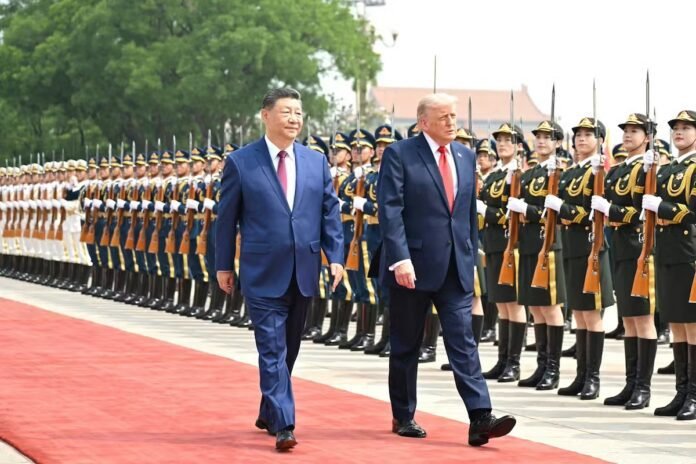
President Donald Trump departed China on May 15, 2026, after a two-day summit with Chinese leader Xi Jinping that was scrutinized from every angle for clues on where the relationship is heading.

Trump hailed the trip as “incredible,” while Xi remarked that it marked a “new bilateral relationship.” Other observers were a little less enthusiastic, noting that no major breakthroughs were evident at the highly anticipated meeting of the world’s two most powerful political leaders.

Yan Bennett, an expert in US-China relations and author of “American Policy Discourses on China,”, provides here her three big takeaways from the summit.

Taiwan: tough(ish) talk but status quo in place

No one really expected there to be movement on Taiwan – which mainland China lays claims over – although it is clear that Beijing would like the United States to make a firmer stance against the island moving toward a declaration of independence, or for the US to expressly demand reunification.

So what we got was Beijing reiterating that Taiwan remained a priority and a core interest. Xi did this on the first day of the summit, noting that the Taiwan “question” remained “the most important issue in China-US relations,” and that any mishandling of it could lead to “clashes and even conflicts.”

But this was aimed at two things. First, Xi has a domestic audience he needs to address, and Taiwan has long been important to Chinese rhetoric. The Chinese Communist Party has around 100 million members, many of whom would have expected Xi to talk tough on Taiwan – and it was those people he was largely talking to.

But he was also signaling to the US that it shouldn’t support Taiwanese independence. And that won’t ruffle any feathers in Washington. Indeed, the 2025 National Security Strategy stressed that the US opposed unilateral action on Taiwan from “either party” – a signal to Beijing that it opposed Taiwan declaring independence.

A group of people in army fatigues walk past a large missile launcher.
Taiwanese soldiers walk past a Sky Sword II Land-based Air Defense Missile in Taichung on Jan. 27, 2026. I-Hwa Cheng / AFP via Getty Images / The Conversation

Trump did mention arms deals to Taiwan. But the US’s declaratory policy since the Reagan administration is that it doesn’t allow Beijing to enter discussions about what weapons Washington sells to Taiwan.

And that hasn’t changed at all, nor has the US’s treaty commitment to Taiwan since 1979 that requires the US to provide Taiwan with defensive weapons to maintain a sufficient self-defense capability.

Rhetoric aside, everyone is happy with the status quo on Taiwan – it is in no one’s interest for it to change.

But talk of Taiwan has been muddied a little by Xi’s determination to modernize the People’s Liberation Army. The Chinese president has laid out a series of benchmarks, including that the PLA should be capable of invading Taiwan by 2027.

This has been misinterpreted in the US under the so-called “Davidson window” – a concept that has it that China is intent on invading by that time.

In reality, China is nowhere near able to do so. It doesn’t have a “blue water navy” able to operate without port assistance, and the island is incredibly difficult to invade – it only has two places where you can land, and only at certain times of the year.

It is also very mountainous. Taiwan is also slowly building its defenses – and learning a lot from Ukraine’s war with Russia – with the intention of becoming “indigestable” to China.

Xi’s modernization timeline also states that the PLA should be a “world-class military” – taken to be a peer to the US –ie by 2049. But the fact that it spends more on internal security than it does on defense indicates where the CCP’s true interests lie – in domestic security rather than external capabilities.

Trade: Tamped down expectations

The big picture is that the US and China have been trying to re-stabilize what was until fairly recently a very good relationship in terms of economic ties.

Both sides have clear priorities to that extent. China wants to regain the American market it had in the 1990s and early 2000s – and certainly reverse the trend since 2018’s trade war.

Trump since his first administration has made it clear that he sees Chinese control over supply chains and the trade imbalance as a national security issue. Washington also wants to address unfair trade practices, such as the requirement that American companies hand over blueprints, trade secrets, customer lists, marketing plans and more to operate.

So what was achieved in the summit? On the surface, very little. There was some movement on sales of US beef to China. And Trump announced that Beijing would buy 200 aircraft from Boeing – lower than the 500 that had been earlier touted in media reports. And several Chinese companies agreed to buy Nvidia microchips – a continuation of a process that began in late 2025.

That doesn’t seem much, and it was telling that Trump himself wasn’t being very “Trumpian” on what could be achieved during the summit. He wasn’t promising the moon.

But importantly, Xi and Trump agreed to establish a Board of Trade and Board of Investment – intended to create a pathway forward to more trade in the months to come.

A group of people wearing suits stand in a hall.
Tim Cook andJensen Huang, CEOs of Apple and Nvidia walk through the Great Hall of the People in Beijing. Johannes Neudecker/picture alliance via Getty Images

A lot of focus will be on technology. China is about 18 months behind the US in microchip development. Some have questioned whether US companies should be selling chips to China, amid fears that China could steal the intellectual property and be able to use higher-technology chips for defense reasons.

The US position is it can’t allow Huawei – China’s telecom giant – to take over the whole Chinese market, so it will only allow the sale of what it considers appropriate-level Nvidia chips.

Military matters: Washington wants to talk

During the Cold War, the Soviet Union and the US always kept the military lines of communications open to avert a catastrophic incident. This hasn’t been the case with Beijing and Washington. We saw that in 2001 when a US aircraft collided with a Chinese jet; and again over the “Chinese spy balloon incident” in 2023.

Washington is seeking to open up a line of communication on military matters, and that is probably why US Secretary of Defense Pete Hegseth was there in Beijing. Indeed, it is highly unusual for a defense secretary to be at such a summit.

A man chuckles surrounded by other people
US Secretary of Defense Pete Hegseth attends a state banquet at the Great Hall of the People in Beijing on May 14, 2026. Photo: Brendan Smialowski/ AFP via Getty Images / The Conversation

Not that Trump believes he needs China’s help on military matters. He made that clear when asked about possible Beijing assistance prior to the summit.

In fact, little news came out of the summit on Iran. China has criticized the US over the war, but has also quietly been telling Tehran to stop bombing Gulf countries.

Despite some commentary suggesting that Beijing benefits from the US being bogged down in the Middle East, what Xi will want is a resolution before the economic fallout bites in China.

China’s stockpile of Iranian oil will only last a few more weeks and then oil price rises will hit China like a brick.

Yan Bennett is professorial lecturer, American University. She has a contract position at the US Department of State’s Foreign Service Institute, working to educate US diplomats on transnational matters. Her views are her own and do not represent that of the US government.

This article is republished from The Conversation under a Creative Commons license. Read the original article.

Congressman Jack Bergman Praises Pakistan’s Role in Regional Security and Diplomacy 

0
congressman-jack-bergman-praises-pakistan’s-role-in-regional-security-and-diplomacy 
Congressman Jack Bergman Praises Pakistan’s Role in Regional Security and Diplomacy 


Jack Bergman, a US congressman and retired Marine Corps lieutenant general issued a formal letter of appreciation on May 15 to Prime Minister Shehbaz Sharif and Field Marshal Syed Asim Munir.  

Bergman, who represents Michigan’s 1st congressional district, emphasized Pakistan’s vital role in regional security and its deepening partnership with Washington, stating that the United States’ relationship with Pakistan is of enduring strategic importance.  

The second American lawmaker in recent weeks to publicly praise Islamabad, Bergman said Pakistan has used its unique position constructively to help facilitate dialogue and support ongoing diplomatic efforts. He added that both the White House and the US Congress have publicly acknowledged Pakistan’s contribution in bringing relevant stakeholders to the table. 

The letter further expressed appreciation for the leadership demonstrated in broader regional peace efforts and described Pakistan’s role as a demonstration of “true statesmanship.”  

Bergman also expressed gratitude on behalf of the Congressional Pakistan Caucus, noting that the partnership between the two countries remains vital to regional stability and long-term cooperation. 

Earlier, Congressman Joe Wilson, a senior Republican from South Carolina and the ranking member of the House Foreign Affairs Committee, had sent a letter expressing appreciation for Pakistan’s leadership. Wilson, known for his strong stance on national security, has been a consistent voice for strengthening US-Pakistan ties.  

The consistent praise from senior US politicians reflects a growing cross-party recognition of Islamabad’s constructive foreign policy, particularly its ability to broker dialogue between the United States and Iran. 


0FansLike
0FollowersFollow
0FollowersFollow
0SubscribersSubscribe
- Advertisement -
Google search engine

Recent Posts