9.1 C
London
Monday, May 11, 2026
Home Blog

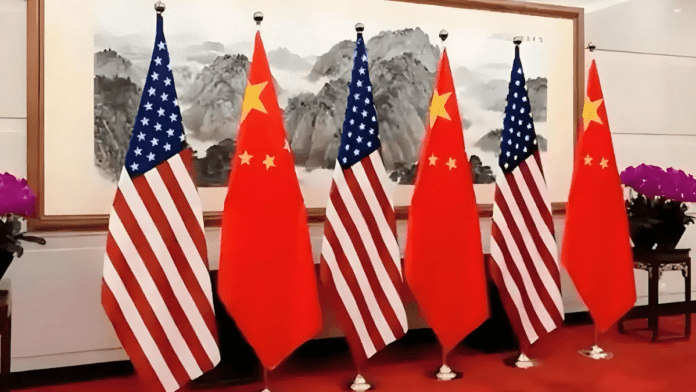
Trump-Xi summit will be no ‘Nixon in China’ moment – that they are talking is enough for now

0
trump-xi-summit-will-be-no-‘nixon-in-china’-moment-–-that-they-are-talking-is-enough-for-now
Trump-Xi summit will be no ‘Nixon in China’ moment – that they are talking is enough for now

Meetings between Chinese and American leaders are not exactly routine, but few are historically groundbreaking.

The exceptions include the very first visit by a sitting U.S. president to China, when Richard Nixon met with Chairman Mao Zedong in Beijing in February 1972 – at a time when America did not even formally recognize the People’s Republic of China. Deng Xiaoping’s visit to the U.S. in 1979 generated a similarly iconic moment when the reformist Chinese leader donned a Stetson at a Texas rodeo, a sign that he would be willing to engage with America in a way that Mao contemplated only near the end of his life.

Donald Trump may harbor hopes that his upcoming visit, slated for May 14-15, 2026, could have similar historical significance to those moments half a century ago. It will, after all, be the first face-to-face meeting of U.S. and Chinese leaders in Beijing since Trump’s own visit nearly a decade ago in 2017.
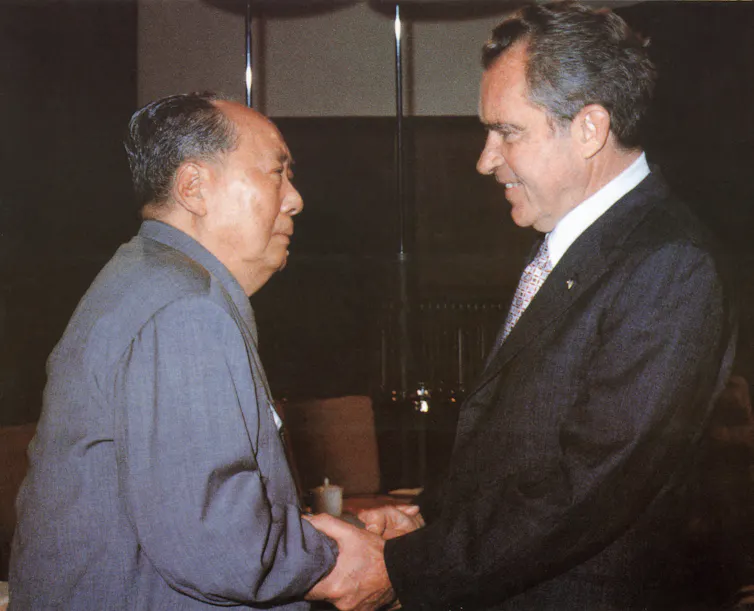
Two men in suits shake hands.

Chinese Communist Party Chairman Mao Zedong welcomes U.S. President Richard Nixon to his house in Beijing in 1972. AFP via Getty Images

Yet the outcomes of this Trump summit with Xi Jinping are likely to be vague because the goals for both leaders are also only partially evident. The visit is being driven by trade imperatives, but there are other issues that threaten U.S.-China relations in the longer term.

It will be extremely hard for the two sides to address these more deep-rooted divides. Indeed, as an analyst of U.S.-China relations, I believe the world’s two largest economies will have an essentially competitive relationship for years to come, and areas of plausible cooperation – whether on climate change or AI regulation – are increasingly hard to find.

Taiwan: A change in US position?

One area that has been a source of contention for quite some time is Taiwan. Xi has made it clear that the unification of the island with the mainland cannot be left to “another generation” but has left it vague – up to now – as to how that goal will be achieved.

The summit has been preceded by lots of chatter about U.S. preparedness to honor its somewhat ambiguous promise to defend Taiwan in the event of an invasion – with Chinese analysts concluding that the war in Iran has severely weakened Washington’s capabilities on this front.

However, there are plenty of signs that Xi would rather find peaceful means to unite with Taiwan that avoid all-out war, particularly as the examples of Russia in Ukraine and the U.S. in Iran show that the outcomes of wars are not predictable.

Instead, China has seemingly concentrated its efforts on influencing the upcoming January 2028 Taiwan presidential election. The leader of the island’s major opposition Kuomintang party, Cheng Li-wun, recently visited the mainland and had a photo op with Xi – a sign that she thinks dealmaking with China might just be acceptable to the Taiwan electorate despite its deep distrust of Beijing.

To further fuel the narrative of a seemingly inevitable path toward unification, it would be helpful for Xi to have signals that the U.S. is no longer committed to defending Taiwan.

China will push for a change from the official position that the U.S. “does not support Taiwan independence” to “the U.S. opposes Taiwan independence.” The latter change sounds minor but would have great significance, as it would essentially be an acknowledgment that the U.S. recognizes unification, by some means, as a legitimate goal in its own right.

Trump has kept his own position ambiguous: He has noted more than once that Taiwan is very close to China and very far from the U.S., but he has also authorized major arms sales to the island that have infuriated Beijing.

The outline of a man is seen in front of a large ship.

Taiwanese navy warships anchored in Keelung, Taiwan. Annabelle Chih/Getty Images

Taiwan’s ruling Democratic Progressive Party does not specifically endorse independence, as it knows that’s a red line for Beijing, but it would regard this change in American language as a serious blow to its position. It’s unlikely that the U.S. would make such a major concession during Trump’s visit – but that won’t stop Beijing from asking for it.

AI: The battle for global leadership

A more tentative but increasingly important area for discussion during the Xi-Trump summit is technology in general and AI in particular.

Just three years ago, the attitude of the U.S. government was summed up in the phrase of then national security adviser Jake Sullivan: “small yard, high fence.”

In other words, there would be only a few restricted areas of technology, but they would be fiercely guarded.

In 2026, things have changed. In some areas, tech restrictions have just become looser; the U.S. government now permits the sale to China of some high-specification, American-manufactured chips that were previously restricted. That policy was probably driven by the sense that China was developing its own domestic alternatives anyway and that the U.S. was losing market share.

Yet there is growing concern both in the U.S. and China that AI developments are moving too fast for governments – or companies – to know fully what the technology is capable of doing, let alone being able to regulate it.

China and the U.S. both desire to dominate AI and set the global norms and standards surrounding it. But they are also aware that AI has the potential to cause immense damage.

There has been loose discussion of whether any joint form of supervision or regulation of AI between the U.S. and China might be possible. And that could well form part of the discussions during the leaders’ summit.

But realistically, both sides see themselves in fierce competition, and the likelihood that either American or Chinese companies would restrain themselves may be fanciful.

The trade elephant in the room

The most substantial achievements of the summit, however, are likely to be in the least glamorous area: remedying the trade deficit.

Trump’s tariffs aim to make the United States’ global trade partners pay a higher price for entry to the American market, and China’s persistent and massive trade surplus has been a prime target for the U.S. president.
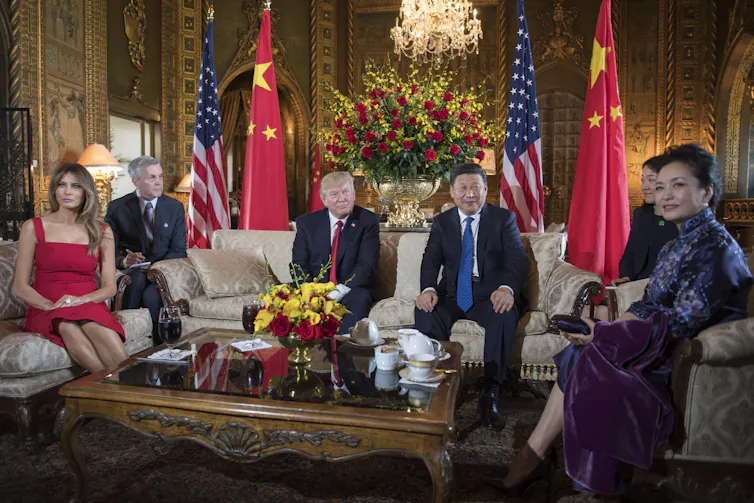
Four people sit on chairs surrounded by flags.

U.S. first lady Melania Trump, Donald Trump, Chinese President Xi Jinping and his wife, Peng Liyuan, in West Palm Beach, Fla., on April 6, 2017. Jim Watson /AFP via Getty Images

While there are many American products that China would like to buy, most of them are not products that the U.S. government is willing to let them have, including high-tech equipment that could be used for military purposes.

Instead, the key products are likely to be agricultural, including U.S. soybeans and beef. Look out for concessions from China that would benefit farmers in key Republican states, such as Iowa.

The current tariff dispute between the U.S. and China has frozen into a standoff: The U.S. has agreed to allow China’s goods into its immense market at manageable tariff rates, and China has – mostly – agreed to allow critical minerals and rare earths to flow to U.S. manufacturers.

That truce lasts until October, but the summit may see it extended.

Neither side is keen to restart the trade war that marked the summer of 2025, when Trump announced tariffs of over 100% on China and the U.S. was in danger of having key mineral supplies cut off as a result.

Summit to talk about? Perhaps not

So how consequential will the Trump-Xi summit be? Well, don’t expect another “Nixon meets Mao” moment.

The circumstances more than a half-century on are also remarkably different. Today’s China, unlike in 1972, has an economy and military second only to the U.S. and a central position in global organizations, from the United Nations to the World Trade Organization, particularly as the U.S. retreats from such institutions.

Both the U.S. and Chinese sides know that they can expect limited cooperation at best from their opponent.

But after a period, particularly during the COVID-19 pandemic, when communication between the countries atrophied, it’s still important that they are talking at all.


Podcast by Jasim Al-Azzawi with Phyllis Bennis on Israeli Genocide and Palestinians|Vanishing Dream

0
podcast-by-jasim-al-azzawi-with-phyllis-bennis-on-israeli-genocide-and-palestinians|vanishing-dream
Podcast by Jasim Al-Azzawi with Phyllis Bennis on Israeli Genocide and Palestinians|Vanishing Dream

Middle East Monitor

Creating new perspectives since 2009

Middle East Monitor

Phyllis Bennis is an American Jewish writer, activist, and political commentator. Focusing mainly on issues related to the Middle East and the United Nations, she is a strong critic of Israel and the United States and a leading advocate of Palestinian rights.

WATCH: Podcast by Jasim Al-Azzawi with Former CIA Analyst Scott Ritter: Iran and Nuclear Armageddon

  • Subscribe to our newsletter

Islam Race and Rebellion in the Americas: Transatlantic Echoes of the West African Jihads

Engaging the World: The Making of Hamas’s Foreign Policy

Related Posts

Trending

Israeli Real Estate Expo Advertising West Bank Settlements Returns to NYC

0
israeli-real-estate-expo-advertising-west-bank-settlements-returns-to-nyc
Israeli Real Estate Expo Advertising West Bank Settlements Returns to NYC


A controversial real estate expo that advertises properties for sale in the occupied Palestinian territories is returning to New York City on Monday, less than a week after a previous event drew dueling protests on the Upper East Side.

The “Great Israeli Real Estate Event” will take place Monday evening at Young Israel of Midwood, an Orthodox synagogue in southern Brooklyn. Event organizers confirmed the location in an automated response to The Intercept’s request for comment, but they did not comment on the event itself.

The roving expo is co-sponsored by several real estate companies with ties to Israel, and it is typically held at synagogues and other centers of Jewish life. At the event held last week at Park East Synagogue, The Intercept saw at least one table advertising land sales in Kfar Eldad, Karnei Shomron, and other Israeli settlements in the occupied territories — sales considered illegal under international law.

The event presents a test for New York City Mayor Zohran Mamdani, who has caught flak from the pro-Israel side for condemning the illegal land sales, and from pro-Palestine groups and free speech advocates for allowing the NYPD to maintain “buffer zones” that keep protesters away from houses of worship.

Compounding the mayor’s entanglement is the fact that Young Israel of Midwood, the synagogue where Monday’s event will take place, is home to a city-funded senior center called Young Israel Senior Services. The senior center received more than $800,000 from the Department for the Aging in 2024, according to a city budget document.

A spokesperson for Mamdani, who campaigned on his pro-Palestine bona fides, declined to comment on the latest real estate event, pointing instead to comments about last week’s expo.

“Mayor Mamdani is deeply opposed to the real estate expo this evening that includes the promotion of the sale of land in settlements in the Occupied West Bank,” spokesperson Sam Raskin told The Intercept last week.

The mayor has also affirmed attendees’ rights to go to and from synagogues without interference, in line with a controversial “buffer zone” bill the New York City Council passed last month. The new law, sponsored by the council’s moderate speaker, requires the New York Police Department to address physical obstructions and interference at houses of worship — which opponents see as a means to crack down on protests.

Last week’s event, held Tuesday at Park East Synagogue on the Upper East Side, prompted heated protests from Pal-Awda and other pro-Palestine activists, which in turn drew a counter-protest from pro-Israel groups including members of the extremist group Betar U.S. The NYPD kept the groups separate and kept protesters, members of the media, and members of the public alike away from the synagogue with a tight cordon of security barriers that impeded movement along numerous city blocks in the vicinity of the synagogue.

After last week’s event, Mamdani praised the NYPD’s handling of the crowd at an unrelated press conference on Wednesday.

“We in this city believe in the sacrosanct nature of the right to protest and also are committed to ensuring that any New Yorker can safely enter or exit from a house of worship and that access never be in question while we also protect the First Amendment, and I do believe that the police ensured that yesterday,” he said. “I think that critique of the policies of a government is very much separate from bigotry toward the people of a specific religious faith. And there is no tolerance for antisemitism.”

The New York Civil Liberties Union, by contrast, offered a rebuke for the police force, calling the NYPD’s barricaded area a “no-speech zone.”

“When politicians use Freedom of Religion as a pretext to impose severe restrictions on speech, they undermine all New Yorkers’ rights,” said Donna Lieberman, the NYCLU’s executive director, in a statement released Wednesday. “The subject of last [week’s] protests was not a religious service but a private, politically-charged real estate event held at a synagogue.”

More protests are expected at Monday’s event in Midwood, putting the NYPD and the mayor under scrutiny once again.

Correction: May 11, 2026, 4:59 p.m. ET
Due to an editing error, this story previously stated that Mamdani signed the City Council’s new “buffer zone” law. The bill passed with a veto-proof majority, and Mamdani allowed it to become law without his signature.

After banning foreign routers, FCC says existing ones can get updates until 2029

0
after-banning-foreign-routers,-fcc-says-existing-ones-can-get-updates-until-2029
After banning foreign routers, FCC says existing ones can get updates until 2029

The Federal Communications Commission is relenting a bit on its restrictive router rules, saying it will allow foreign-made routers to receive software and firmware updates until at least January 1, 2029. The FCC also expanded the waiver to cover more types of software updates.

Previously, the FCC said routers currently on the market or already sold to consumers could receive security patches and other updates only until March 1, 2027. On Friday, the agency announced a waiver extension that lets devices receive updates until January 1, 2029, and said the waiver may eventually become permanent.

The software-update cutoff date is part of a sweeping set of rules the FCC announced in March. Claiming that restrictions are needed for national security reasons, the FCC imposed a ban on new hardware and related limits on software updates for routers that were authorized for sale before the ban was implemented.

Specifically, the FCC said in March that it would stop approving consumer-grade routers made outside the US, an action that affects virtually every router maker (with the possible exception of Starlink). The Trump administration is handing out exemptions to hardware makers that it decides are safe enough, with Netgear and the Amazon-owned Eero among those receiving exemptions so far.

The hardware ban is only for new devices, so all routers previously approved for sale in the US can continue to be imported and sold without obtaining a special exemption. But previously approved routers were hit with a separate rule that would prohibit software and firmware updates—unless the FCC keeps extending the cutoff date after which no updates can be installed.

Drone and router extensions

The new 2029 cutoff date announced Friday applies to foreign-made routers and foreign-made drones, which were both added to the Covered List. Devices on the Covered List “are deemed to pose an unacceptable risk to the national security of the United States or the security and safety of United States persons,” the FCC says.

Devices on the Covered List need waivers to continue receiving software updates, the FCC Office of Engineering and Technology said in its waiver extension order on Friday.

“Under this waiver, all Uncrewed Aircraft Systems (UAS), UAS critical components, and routers produced in a foreign country that were authorized for use in the United States prior to these devices being added to the Covered List may at least until January 1, 2029, consistent with FCC rules, continue to receive software and firmware updates that mitigate harm to US consumers,” the FCC engineering office said.

The waiver covers “all software and firmware updates to ensure the continued functionality of the devices, such as those that patch vulnerabilities and facilitate compatibility with different operating systems.” The FCC engineering office said it “will, as soon as practicable, recommend to the full Commission considering codifying this waiver through a rulemaking.”

That means the waiver would become permanent, but the FCC could impose various conditions. This could happen through a rulemaking process in which the public is invited to comment on the impact of proposed changes. But the router ban itself was imposed without any public comment, and the idea of making the software-update waiver permanent is simply a recommendation at this point.

Allowing basic software updates

Extending the waiver to 2029 will “give the Commission an opportunity to consider a rulemaking on this subject,” and reduce “potential harm to the public interest,” the FCC engineering office said. The office said it will recommend making the waiver permanent for existing equipment on the Covered List and “any future covered equipment with similar characteristics.”

The Friday update also extended the waiver to so-called “Class II permissive changes,” while the original waiver covered only Class I changes. This expansion of the waiver seems to be mainly about ensuring that all basic software updates are allowed.

Class I changes include “modifications in the equipment which do not degrade the characteristics reported by the manufacturer,” which can be made without a filing to the commission. Class II changes may degrade the performance characteristics a manufacturer previously reported to the FCC, but the changes are expected to be minimal compared to Class III changes that face more scrutiny to ensure compliance with FCC rules.

For both Class I and Class II, the FCC said its waiver is intended to cover “software and firmware updates that mitigate harm to consumers.” There’s no change to the process for Class III.

While extending or making the software-update waiver permanent will alleviate some concerns among router makers and users, the ban on new hardware may be a continued source of trouble. Many major router makers haven’t yet obtained exemptions that would let them import new models, and getting clearance could involve some negotiation with the Trump administration.

TP-Link still seeking exemption

The ban extends to any device partially made outside the US, regardless of whether the router maker is a US-based company. But it appears that Chinese companies will have the most trouble obtaining exemptions.

Chinese drone company DJI has not received an exemption and sued the FCC over the ban. The process for gaining exemptions for routers and drones is the same, indicating that “Chinese-origin manufacturers like TP-Link may face a presumptive denial, while companies with manufacturing in allied nations like Taiwan, Vietnam, or South Korea could find an easier path,” said a report by the Global Electronics Association trade group.

One router maker still waiting for an exemption is TP-Link, which was founded in China but relocated to the US in 2024. The company has faced US scrutiny over hacking campaigns linked to the Chinese government.

TP-Link met with FCC officials in mid-April to discuss its request for an exemption. “TP-Link routers are safe and secure. Publicly available data places TP-Link on par with or ahead of other major industry players in terms of security outcomes,” the company said in a filing.

FCC guidance says that companies seeking exemptions must obtain a determination from the Department of Defense or Department of Homeland Security that their routers do not pose unacceptable national security risks. The FCC clarified last month that the router ban also includes portable hotspots, but not phones with hotspot features.

Ultra-Moist Chai Cake with Chai Milk Soak & Brown Butter Cream Cheese Frosting

0
ultra-moist-chai-cake-with-chai-milk-soak-&-brown-butter-cream-cheese-frosting
Ultra-Moist Chai Cake with Chai Milk Soak & Brown Butter Cream Cheese Frosting

You are here: Home / All RECIPES / Ultra-Moist Chai Cake with Chai Milk Soak & Brown Butter Cream Cheese Frosting

This chai cake is the ultimate fall dessert—soft, fluffy, and infused with warm spices, then soaked in a sweet chai milk mixture for an incredibly tender texture. Topped with a rich brown butter cream cheese frosting, every bite is cozy, indulgent, and full of comforting flavor.


🌟 Why You’ll Love This Chai Cake

  • Super soft & fluffy texture thanks to butter, eggs, and buttermilk
  • Packed with chai spices like cinnamon, ginger, cardamom, and cloves
  • Chai milk soak adds moisture and deep flavor (like a lighter tres leches)
  • Brown butter frosting brings a rich, nutty, bakery-style finish

🧁 Ingredients

For the Chai Cake:

  • 2 1/4 cups all-purpose flour
  • 1 tbsp ground cinnamon
  • 1 1/2 tsp ground ginger
  • 1/2 tsp allspice
  • 1/2 tsp nutmeg
  • 1 tsp cardamom
  • 1/4 tsp cloves
  • 1 1/2 tsp baking powder
  • 1/4 tsp baking soda
  • 1/2 tsp salt
  • 10 tbsp unsalted butter, softened
  • 1 cup granulated sugar
  • 1/2 cup brown sugar
  • 3 eggs (room temperature)
  • 1 tbsp vanilla extract
  • 1 cup buttermilk

For the Brown Butter Cream Cheese Frosting:

  • 1 1/4 cups unsalted butter
  • 8 oz cream cheese
  • 2 cups powdered sugar

For the Chai Milk Soak:

  • 1/2 cup whole milk
  • 2 chai tea bags
  • 1/2 cup sweetened condensed milk
  • 1 tsp vanilla extract

👩‍🍳 Instructions

1. Make the Cake

Preheat oven to 350°F (175°C). Grease and line a 9×9-inch baking pan.

In a bowl, whisk together flour, spices, baking powder, baking soda, and salt.

In a separate bowl, beat butter and sugars until light and fluffy. Add eggs and vanilla, mixing until smooth.

Gradually add dry ingredients and buttermilk, mixing on low speed until just combined.

Pour batter into the pan and bake for 35–38 minutes, or until a toothpick comes out clean. Let cool completely.


2. Make Brown Butter Frosting

Melt butter over medium heat until it turns golden brown and smells nutty. Let it cool until soft but not melted.

Whip the browned butter until fluffy, then add cream cheese and mix until smooth. Add powdered sugar and beat until light and creamy.


3. Make the Chai Milk Soak

Heat milk until steaming, then steep chai tea bags for 20 minutes. Remove tea bags and let cool.

Stir in sweetened condensed milk and vanilla.


4. Assemble the Cake

Trim a thin layer off the top of the cake. Poke holes all over the surface.

Slowly pour the chai milk mixture over the cake, allowing it to soak in.

Spread the frosting evenly on top and dust with cinnamon if desired.

Slice into 16 servings and enjoy!


💡 Tips for Best Results

  • Use room temperature ingredients for a smooth batter
  • Don’t overmix after adding flour—this keeps the cake soft
  • Use a light-colored metal pan for even baking
  • Measure flour properly (preferably with a scale)

❓ FAQs

How to store:
Keep in an airtight container in the fridge for up to 3 days. Bring to room temperature before serving.

Can it be gluten-free?
Yes, use a 1:1 gluten-free baking flour blend.

No buttermilk?
Mix 1 cup milk with 1 tbsp lemon juice or vinegar.

Can I skip brown butter?
Yes, use regular butter (slightly reduce the amount).


✨ This chai cake is rich, cozy, and full of warm spice flavors—perfect for fall, holidays, or anytime you want a bakery-style dessert at home!

Maybe overkill, new sanctions show Trump hope for Xi help on Iran

0
maybe-overkill,-new-sanctions-show-trump-hope-for-xi-help-on-iran
Maybe overkill, new sanctions show Trump hope for Xi help on Iran

The United States has sanctioned a new group of mainland China- and Hong Kong-linked companies and individuals accused of helping Iran secure drone materials and missile-related components, raising fresh tensions days before US President Donald Trump’s state visit to China.

The US Treasury Department said on May 8 that its Office of Foreign Assets Control (OFAC) had targeted 10 individuals and companies across the Middle East, Asia and Eastern Europe under its “Economic Fury” campaign against Iran.

The campaign is aimed at disrupting networks that Washington says help Iran’s military secure weapons and raw materials for Shahed-series unmanned aerial vehicles and ballistic missiles. The US State Department simultaneously designated four entities over their links to Iran’s conventional arms activities.

The China- and Hong Kong-related designations fall into several broad categories:

  • Aerospace-grade materials: Hitex Insulation Ningbo Co Ltd and its legal representative Li Genping were accused of supplying, or trying to supply, millions of dollars’ worth of carbon fiber, honeycomb fabric and other aerospace-grade materials to Iran-linked Pishgam Electronic Safeh Company.
  • Procurement support: Yushita Shanghai International Trade Co Ltd, AE International Trade Co Ltd of Hong Kong and HK Hesin Industry Co Ltd were accused of supporting procurement efforts for the Center for Progress and Development of Iran (CPDI), the latest name of the US-designated Center for Innovation and Technology Cooperation (CITC).
  • Weapons-related financing: Mustad Ltd was accused of helping facilitate financial transactions tied to the Islamic Revolutionary Guard Corps’ procurement of millions of dollars’ worth of weapons.
  • Satellite imagery: Meentropy Technology Hangzhou Co Ltd (MizarVision) and The Earth Eye Co (Beijing Mumei Starry Sky Technology Co Ltd) were accused of providing satellite imagery support for Iranian military activity.

The sanctions against the two Chinese satellite-imagery firms came against the backdrop of an earlier satellite allegation that Beijing had denied.

Citing leaked Iranian military documents, the Financial Times reported on April 15 that Iran had secretly acquired a Chinese-built satellite known as TEE-01B, giving the Islamic Revolutionary Guard Corps’ Aerospace Force a new capability to target US military bases across the Middle East. The satellite was launched from China and later acquired by Iran in late 2024.

The May 8 sanctions did not cover other recent reports about alleged China-to-Iran missile-fuel shipments. The Washington Post reported in early March that two cargo ships owned by a sanctioned Iranian shipping company had left a Chinese chemical-storage port carrying suspected rocket-fuel precursor materials and were heading toward Iran. 

The Telegraph reported on April 3 that five vessels carrying sodium perchlorate, a precursor used in solid-fuel rocket propellant, were identified at or near Iranian ports. The reported quantity was said to be enough for hundreds of ballistic missiles. 

Trump’s visit to Beijing

On April 24, the OFAC sanctioned Hengli Petrochemical (Dalian) Refinery Co Ltd for allegedly buying Iranian crude, while also targeting about 40 shipping firms and vessels accused of moving Iranian oil through a shadow fleet. 

The May 8 action goes farther because it alleges support for Iran’s weapons supply chain, not just its oil revenue. That makes the case more sensitive after Trump warned on April 8 that any country supplying military weapons to Iran would face a 50% tariff on all goods sold to the US, with “no exclusions or exemptions.” 

The timing has sharpened the political signal. Trump is due to visit China from Wednesday to Friday for talks with Chinese President Xi Jinping. Iran, Taiwan, trade and export controls are expected to be among the most sensitive items on the agenda.

On Monday, Beijing confirmed for the first time Trump’s upcoming trip to China.

“This will be the first visit to China by a US president in almost nine years. President Xi will have in-depth exchanges of views with President Trump on major issues concerning China-US relations and world peace and development,” the Chinese Foreign Ministry’s spokesperson Guo Jiakun said in a regular media briefing on Monday. 

Guo said heads-of-state diplomacy was important in guiding China-US relations, adding that Beijing was ready to work with Washington to expand cooperation, manage differences and provide more stability in a volatile world.

But some Chinese commentators said the sanctions had cast a shadow over the summit.

“The US seems to believe that, with Trump’s China visit already scheduled, it can add sanctions to increase its bargaining chips, whether China is happy about it or not,” says a Shandong-based columnist using the pen name “Xiaoliu.” 

“However, China’s swift and forceful legal countermeasures, together with Iran’s confident response, show that the other side does not intend to follow Washington’s script,” she writes, referring to the countermeasures as Beijing’s recent move to forbid local firms and banks from enforcing the US sanctions against Chinese “teapot” refiners. 

“Sanctions and counter-sanctions have become a normalized tool in the China-US contest,” she says. “At such a sensitive moment, Washington’s decision to play this card again raises a question: is this a clever calculation or an arrogant misjudgment that could backfire? When Trump’s plane lands in Beijing, will the shadow created by these sanctions hang over the negotiating table?”

“This is not the first time the US has taken such unilateral action on the eve of high-level exchanges,” says a Guangdong-based writer surnamed Chen. “Before past bilateral meetings, Washington has often used sanctions or tough rhetoric to create leverage. This time, using Iran-related issues to sanction Chinese entities reflects the same game-playing mentality.”

He says this approach will not achieve its intended purpose and will instead damage the foundation of mutual trust. If Washington really wants to use the visit to improve bilateral relations, he adds, it should show sincerity rather than apply pressure in its talks.

The sanctions come as Washington and Beijing are exploring a possible trade package for the summit. Reuters reported on May 7 that the two sides are working on a proposed Board of Trade mechanism to identify products that could expand bilateral commerce without weakening national security or critical supply chains – including possible Chinese purchases of US crops, Boeing aircraft and American energy such as coal, oil and natural gas.

Whether Trump can secure Chinese commitments to buy more US products could affect Republican efforts to retain control of the House and Senate in the November midterm elections, according to some observers.

New security framework

The regional security argument has gained traction as the US-Iran ceasefire remains fragile. On April 8, Washington and Tehran agreed to a two-week ceasefire mediated by Pakistan, which was later extended while negotiations continued. However, after several rounds of direct and indirect talks via Pakistan, Trump has still not secured what Washington wants most: the removal or firm neutralization of Iran’s enriched-uranium stockpile.

On April 23, Chinese Foreign Minister Wang Yi met with Iranian Foreign Minister Seyyed Abbas Araghchi in Beijing. Wang said China and Iran had supported each other in recent years, deepened political trust, expanded practical cooperation and worked together against unilateralism and bullying, making the strategic significance of their ties more prominent. 

On May 6, Wang met Araghchi again, where the Iranian side briefed China on the latest Iran-US negotiations and Tehran’s next steps.

Araghchi said political crises could not be solved by military means and that Iran would defend its sovereignty and dignity while continuing to seek a comprehensive and lasting solution through peaceful negotiations. He said Iran trusted China’s role in preventing further escalation and looked forward to Beijing continuing to promote peace.

“China is a trustworthy strategic partner of Iran,” Wang told Araghchi during the meeting. “China is willing to consolidate and deepen political mutual trust with Iran, maintain and strengthen high-level exchanges, deepen mutually beneficial cooperation in various fields, and continue to advance the China-Iran comprehensive strategic partnership.”

“Before Araghchi left for Beijing on May 5, the US had gotten ready to respond,” writes Jiangsu-based writer Jingting Guoji, who uses a pen name. “If China and Iran had reached a military deal, Washington could have quickly moved to intercept weapons shipments, expand sanctions or pressure China through its allies. But Araghchi was smart. He did not ask China for weapons. He asked China to help build a new security framework in the Middle East.”

“Iran showed diplomatic wisdom by not falling into the ‘military confrontation’ trap set by the US,” he says. “Instead, it dealt with Washington at the political and diplomatic level, using the balance among major powers to win greater strategic space.”

He says Wang’s response showed China’s attitude and determination in supporting a new security framework for the Middle East.

China has, in recent years, promoted a new Middle East security framework as part of its wider regional diplomacy. The idea involves balancing relations with major regional powers, including Saudi Arabia, Pakistan, Turkey and Egypt, rather than relying on a US-led security order.

“Pakistan played a clever move by using its role as intermediary to mislead the Trump administration,” Hong Kong-based pro-Beijing news outlet Flamingwheels said in a commentary. 

It said Pakistan, in late April, passed the Territorial Transit Goods Ordinance 2026 to open six dedicated land routes for third-country goods to move through Pakistan into Iran, bringing new logistics activity and economic benefits to local communities. It also said that the new land routes would give the China-Pakistan Economic Corridor and Gwadar port a new strategic role at a moment of crisis.  

Chinese media reports said the US military blockade of Iranian ports had continued for nearly a month, but China could still send about 100 to 150 containers to Iran by rail per week. The trains depart from Xi’an and travel through Kazakhstan and Turkmenistan before reaching Tehran, although the volume is only about 5% of what Iran could have received by sea before the blockade. 

Read: Trump-Xi summit set to weigh Iran oil, Taiwan and US exports

Follow Jeff Pao on X at @jeffpao3

EU Approves Sanctions on Israeli Settlers and Hamas Leaders After Hungary Drops Veto

0
eu-approves-sanctions-on-israeli-settlers-and-hamas-leaders-after-hungary-drops-veto
EU Approves Sanctions on Israeli Settlers and Hamas Leaders After Hungary Drops Veto


European Union foreign ministers approved sanctions Monday against certain Israeli settlers and groups associated with violence in the West Bank and senior Hamas figures after Hungary’s new government lifted a previous veto that had blocked the measures for months.

The sanctions include asset freezes and travel bans targeting seven Israeli settlers or entities as well as multiple Hamas leaders.

Although the names of individuals and organizations were not yet released, the sanctions did not include Israeli ministers Itamar Ben-Gvir and Bezalel Smotrich, according to the Guardian. The two ministers were sanctioned by the United Kingdom last June over what Britain described as “repeated incitements of violence against Palestinian communities.”

The sanctions still require technical and legal procedures before formal implementation.

EU foreign policy chief Kaja Kallas said, “Extremisms and violence carry consequences,” while also noting continuing divisions within the bloc over broader economic measures against Israeli settlements.

“We had discussions on the trade issues, limiting trade with the illegal Israeli settlements,” Kallas told reporters after the meeting. “There was a call by many member states to take this forward, so we will continue to work with the Commission on presenting proposals.”

According to the material, France and Sweden supported additional measures including restrictions on trade with settlements, while proposals such as suspending the EU-Israel Association Agreement remained divisive among member states.

Israeli Foreign Minister Gideon Saar criticized the sanctions decision, calling it “arbitrary and political.”

“Israel has stood, stands, and will continue to stand for the right of Jews to settle in the heart of our homeland,” Saar wrote on X.

Michael Jackson’s Secret Family Making Chilling New Claims

0
michael-jackson’s-secret-family-making-chilling-new-claims
Michael Jackson’s Secret Family Making Chilling New Claims


More than 15 years after Michael Jackson’s death, a family once known as the singer’s “second family” is making shocking new allegations that are once again throwing the King of Pop’s legacy into turmoil.

In a disturbing television interview that aired on 60 Minutes Australia, the Cascio siblings — Eddie, Dominic, Aldo and Marie-Nicole Cascio — accused Jackson of years of manipulation, grooming, and sexual abuse they claim began when they were children.

The emotional sit-down comes just months after the siblings filed a lawsuit against Jackson’s estate, reigniting one of the most controversial chapters surrounding the late music icon.

The Cascio family first met Jackson back in the 1980s, when the superstar allegedly became extremely close with them. What started as excitement over befriending one of the most famous men in the world quickly turned dark, according to the siblings.

“When you have the biggest celebrity on the planet wanting to be part of your family, you don’t think something evil could happen,” Dominic claimed during the interview.

The siblings said Jackson showered the family with gifts, vacations, and endless attention. But behind the scenes, they now allege the singer was slowly gaining control over them emotionally and psychologically.

Eddie Cascio claimed the alleged abuse began when he was just 11 years old while traveling with Jackson during the Dangerous tour in the early 1990s.

“That’s when everything changed,” he alleged, claiming Jackson began touching him inappropriately before things escalated further over time.

Eddie tearfully claimed the alleged abuse became frequent and left him emotionally shattered for years.

“At the end of the day, he was the monster, not us,” he said during the interview.

Dominic Cascio also accused Jackson of inappropriate behavior, alleging the singer manipulated him into believing disturbing acts were signs of affection and love.

Meanwhile, sister Marie-Nicole claimed Jackson exposed her to inappropriate sexual behavior and even allegedly gave her prescription pills when she was only 11 years old.

Youngest sibling Aldo made some of the most heartbreaking accusations of all, claiming he was abused while still too young to even understand what was happening.

“I thought it was love,” he claimed.

The siblings also alleged Jackson constantly warned them not to tell anyone, allegedly telling them their family would be destroyed if the truth ever came out.

One of the most painful moments came when Aldo recalled his mother once asking if Jackson was harming him. According to Aldo, he repeated exactly what Jackson had allegedly “trained” him to say.

The accusations have once again sparked fierce debate online, where Jackson’s legacy remains deeply divisive years after his death in 2009.

Jackson’s estate is aggressively denying every allegation.

Attorney Marty Singer blasted the claims as nothing more than a “money grab,” arguing the accusations surfaced years after Jackson’s death because he can no longer defend himself in court.

“Sadly, in death just as in life, Michael Jackson remains a target because of his fame and success,” Singer said in a statement.

The explosive interview is already sending shockwaves through social media and the entertainment world, with many longtime fans struggling to reconcile the disturbing allegations with Jackson’s legendary status as one of music’s biggest stars.

Passengers from hantavirus ship arrive in US; 3 people in biocontainment

0
passengers-from-hantavirus-ship-arrive-in-us;-3-people-in-biocontainment
Passengers from hantavirus ship arrive in US; 3 people in biocontainment

The cruise ship rocked by an unprecedented Andes hantavirus outbreak arrived in the Canary Islands off the coast of Tenerife Island over the weekend and is being evacuated. At least one new case has been identified amid the disembarkment.

As of Monday morning, officials for the World Health Organization reported that the last of the passengers of the MV Hondius cruise ship are expected to be evacuated today. Thirty crew will remain on board and see the ship back to Rotterdam in the Netherlands. Prior to the evacuation there were 147 people on board.

All of those evacuated from the ship are being transported off the island on specially arranged repatriation flights, not commercial flights. The evacuations and flights are being coordinated by Spanish authorities as well as the WHO and other national health officials.

Amid the evacuations, one new case has been definitively identified in a French citizen who tested positive on the journey home. That brings the outbreak tally to nine cases. Of those cases, three deaths had previously been reported, including a Dutch couple and a German woman.

US passengers

There may be a 10th case in a US passenger; US health officials reported that a person tested “mildly positive” after being evacuated from the ship. But for now, the WHO is reporting that as “inconclusive” testing and is awaiting confirmation before updating the case count.

The information about that possible US case came on Sunday from a statement on social media by the US Department of Health and Human Services. The statement incorrectly said that federal and state officials had transported 17 American citizens who were on board the ship back to the US on a non-commercial flight. The repatriated US passengers were flown to Omaha, Nebraska, where the federal government has its only National Quarantine Unit on the campus of Nebraska Medical Center and the University of Nebraska Medical Center. The Nebraska Medical Center also houses a National Biocontainment Unit.

In a press briefing in Omaha on Monday morning, federal and Nebraska officials corrected the HHS statement, saying that the US has repatriated 18—not 17—people, which includes 17 US citizens and one person who is a dual British/US citizen. The passengers range in age from late 20s to late 70s–early 80s.

On the flight to Omaha, two were flown in special biocontainment units “out of an abundance of caution.” That includes the one person who tested “mildly positive,” and a second person who had symptoms. For now, the definition of symptoms is “liberal,” including anything as minor as nasal congestion, officials said in the press briefing.

Three people in US biocontainment

Of the 18 people, 15 (including the dual citizen) are asymptomatic and in the quarantine unit.

The person with the “mildly positive” test is being housed in the Nebraska biocontainment unit. That person is said to be asymptomatic for now. In the press briefing, officials offered only vague answers as to what they meant by “mildly positive.” But, they are likely referring to the cycle threshold (Ct value) for the real-time PCR test used to detect snippets of hantavirus genetic material to confirm an infection. The test does repeated cycles to try to amplify specific snippets of genetic material that may be present. A test is generally considered negative if there’s no clear signal after 40 cycles. But it’s not a precise cutoff, and faint signals that appear after 35 or more cycles may be seen as ambiguous—possibly an early or late infection when little virus genetic material is present, or possibly just contamination.

The remaining two passengers are a couple traveling together, one of whom is the person previously identified as having symptoms. They have been moved to a biocontainment unit together at Emory University in Atlanta. The reason for the move is to ensure that the biocontainment unit in Nebraska—which has a small capacity to isolate hantavirus cases—can reserve space in the event that any of the 15 in quarantine develop an infection, officials explained in the press briefing.

The quarantine period for those exposed to hantavirus is 42 days from their exposure date. The 18 people will be monitored carefully for the life-threatening infection, with the 15 in quarantine undergoing detailed risk assessments. Depending on various factors, some in the quarantine unit may be able to return home before the 42-day period. These factors include, among many things, their assessed exposure and risk levels as well as their access to care at home. People who develop hantavirus infections require high-level care. Thus, if people do not live close to health facilities with intensive care units or advanced life-support technology, namely ECMO (extracorporeal membrane oxygenation), they would likely be advised to stay in Omaha.

Transmission risk

Andes hantavirus is a rare infection in humans, and the vast majority of cases are acquired via exposure to rodents or inhaling particles from their droppings, urine, or bodily fluids. However, the Andes virus is the only hantavirus known to, in even rarer cases, spread from human to human, which appears to have been the case on the Hondius. Rodents have not been reported on the ship.

Cruise ships—where a mix of people from various places live in confined settings with communal facilities—are known to enable wide and rapid spread of viruses. While this is the first time an Andes virus outbreak with likely human-to-human transmission has occurred on a ship, no other features of the outbreak appear out of line with what’s known about the virus’s spread or disease. The virus transmits human-to-human amid close, prolonged contact with a symptomatic case. The virus is generally not known to transmit easily or from asymptomatic people. For more information about the outbreak and Andes virus, check out our explainer.

In addition to the 18 people returned to the US this weekend, six other American passengers on the Hondius had disembarked the ship in April before the outbreak was identified. They are being monitored by state health officials.

France says no to rushing EU budget negotiations before elections

0
france-says-no-to-rushing-eu-budget-negotiations-before-elections
France says no to rushing EU budget negotiations before elections


France has signalled that it is unwilling to rush negotiations on the European Union’s next long-term budget simply to secure an agreement before the politically sensitive year of 2027, when several key member states, including France, are expected to head to the polls.

Speaking on the sidelines of a ministerial meeting in Nicosia, French Europe Minister Benjamin Haddad insisted that Paris would not accept what he described as “artificial deadlines” aimed at accelerating talks on the EU’s next Multiannual Financial Framework (MFF), which will cover the period between 2028 and 2034.

“Our only priority is to have a good budget,” Haddad said, underlining that France’s focus remains on securing a financial package that protects strategic European interests rather than concluding negotiations quickly.

The comments come amid mounting pressure from several European leaders to secure a political agreement before the end of 2026. German Chancellor Friedrich Merz and European Council President António Costa have both urged member states to finalise the framework early in order to avoid the uncertainty that could arise from elections across Europe in 2027.

The concern is particularly acute in France, where the far-right National Rally could potentially gain power in the presidential elections scheduled for April 2027. The party has previously advocated reducing France’s contributions to the EU budget and scaling back military support for Ukraine, positions that could complicate delicate negotiations among member states.

Despite concerns over possible political disruption, Haddad argued that there was still enough time to conclude negotiations in the latter half of 2027 if necessary. He stressed that securing a strong and resilient budget was more important than reaching a rapid compromise. France is particularly keen on preserving strong agricultural subsidies and introducing new EU-wide revenue streams to finance future spending priorities.

The issue is further complicated by the fact that Italy, Spain and Poland are also expected to hold national elections in 2027, raising fears that changes in government across multiple member states could reshape negotiating positions midway through the process.

Poland nevertheless voiced support for moving quickly. Deputy Foreign Minister Ignacy Niemczycki said an early agreement would allow technical preparations and sectoral programmes to begin sooner, although he acknowledged that the quality of the agreement remained the priority.

The European Commission has proposed a budget package worth around €1.8 trillion, alongside an additional €166 billion earmarked for repaying joint EU debt accumulated during the Covid-19 pandemic. The proposed budget would fund key priorities including agriculture, competitiveness, defence, migration and support for Ukraine.

Meanwhile, the European Parliament last week adopted its negotiating position on the next long-term budget, calling for a significantly more ambitious financial framework than the one proposed by the Commission. MEPs backed an increase of roughly 10%, arguing that the EU cannot meet growing demands in areas such as defence, competitiveness and support for Ukraine while maintaining traditional policies like agriculture and cohesion spending without additional funding. Parliament also insisted that repayments linked to the post-pandemic recovery fund should remain outside the main budget ceilings to avoid reducing funding for existing programmes.

via Politico

0FansLike
0FollowersFollow
0FollowersFollow
0SubscribersSubscribe
- Advertisement -
Google search engine

Recent Posts