12.1 C
London
Tuesday, May 5, 2026
Home Blog

Italy opens probe into activists’ detention after Gaza aid flotilla interception

0
italy-opens-probe-into-activists’-detention-after-gaza-aid-flotilla-interception
Italy opens probe into activists’ detention after Gaza aid flotilla interception

People carrying Palestinian flags and banners, gather to protest the detention of Global Sumud Flotilla activists Thiago de Avila and Saif Abu Keshek, who were seized in international waters on the night of April 29-30 by the Israeli Navy and are currently being held in Israel, on May 4, 2026 in Milan, Italy. [Andrea Carrubba - Anadolu Agency]

People carrying Palestinian flags and banners, gather to protest the detention of Global Sumud Flotilla activists Thiago de Avila and Saif Abu Keshek, who were seized in international waters on the night of April 29-30 by the Israeli Navy and are currently being held in Israel, on May 4, 2026 in Milan, Italy. [Andrea Carrubba – Anadolu Agency]

The public prosecutor’s office in Rome has opened an investigation into the alleged abduction of individuals by Israeli forces after they intercepted the Global Sumud Flotilla, a Gaza-bound aid convoy, in international waters on Thursday, Italian media reports.

According to the reports, three legal complaints have been filed against Israeli forces over the alleged abduction of two activists — Spanish national Saif Abu Keshek and Brazilian national Thiago Avila — who are currently being held in Israel. Both were on board a vessel flying the Italian flag at the time of their detention in international waters.

An Israeli court has ordered that the activists’ detention be extended for an additional two days.

The Rome prosecutor’s office had previously opened a similar investigation in October following an earlier attempt by a humanitarian flotilla to reach Gaza.

On Thursday, around 175 activists of various nationalities were detained while on board nearly 20 vessels in the flotilla, which organisers say aimed to break the Israeli blockade on the Gaza Strip, where the entry of humanitarian aid remains severely restricted.

MIT’s virtual violin offers luthiers a new design tool

0
mit’s-virtual-violin-offers-luthiers-a-new-design-tool
MIT’s virtual violin offers luthiers a new design tool

Violin makers, aka luthiers, traditionally learn from hands-on experience how to craft parts and select materials to shape an instrument’s final sound. MIT engineers hope to streamline that painstaking process with their new virtual violin. It’s a computer simulation tool that can capture the precise physics of the instrument and even reproduce a realistic sound of a plucked string, according to a paper published in the journal npj Acoustics.

Unlike more common software programs and plugins that simulate violin sounds via sampling, averaging the final sound from thousands of notes, the MIT model is based on the fundamental physics of the instrument. “We’re not saying that we can reproduce the artisan’s magic,” said co-author Nicholas Makris. “We’re just trying to understand the physics of violin sound, and perhaps help luthiers in the design process.”

Violin acoustics has long been a hot topic of research among acousticians, particularly when it comes to unlocking the secret to the superior sounds of violins crafted during the so-called “Golden Age”—notably the instruments of famed Cremona luthier Antonio Stradivari, as well as those of the Amati family and Giuseppe Guarneri. There are plenty of variables to consider, given a violin’s acoustic complexity.

Per my 2021 article, the (perceived) unique sound can’t just be due to the instrument’s geometry, although Stradivari’s geometrical approach gave us the violin’s signature shape. It might be due to the wood; some researchers have hypothesized that Stradivari used Alpine spruce grown during a period of uncommonly cold weather for the region. The annual growth rings were closer together, making the wood unusually dense. Differences in wood density, they argue, would have an impact on the instrument’s vibrational efficiency and hence its sound.

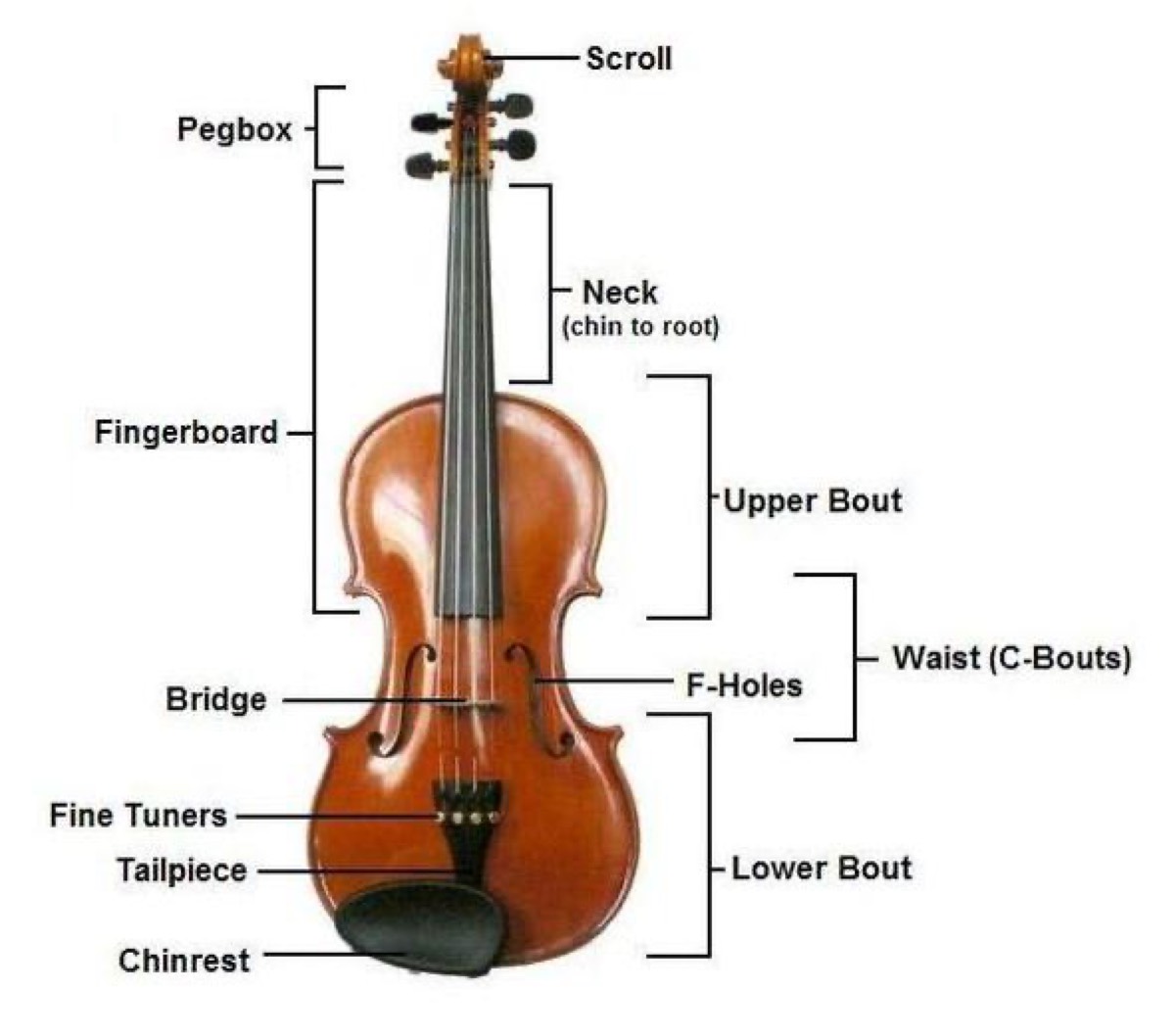
The construction of a violin

The construction of a violin.

The construction of a violin. Credit: Sotakeit/CC BY-SA 3.0

Or perhaps it was the varnish Stradivari used: a cocktail of honey, egg whites, and gum arabic. A 2022 study involving nanoscale imaging of two such instruments revealed a protein-based layer at the interface of the wood and the varnish, which may influence the wood’s natural resonance.

Biochemist Joseph Nagyvary has argued that it was the chemicals used to treat the wood that give Stradivari violins their unique sound, specifically salts of copper, iron, and chromium used to preserve the wood—all of which are excellent wood preservers but may also have altered the instruments’ acoustical properties. A 2021 study supported that argument, identifying borax, zinc, copper, alum, and lime water as the most likely chemicals affecting the sound.

CT scans have provided quite a bit of insight into the conundrum, since the technique can reveal wood density, size and shapes, volume measurements, and thickness graduation, as well as any damage or repairs to a given instrument. For instance, a 2009 study used CT scans to study the material properties of the wood. In 2011, Minnesota radiologist Steven Sirr took detailed CT scans of the 1704 “Betts” violin and then collaborated with two luthiers to make a replica.

One of the most thorough investigations was the Strad3D project, spearheaded in 2006 by the late George Bissinger. That project used 3D scanning lasers to make detailed quantitative measurements of the acoustic properties of several Stradivarius violins, essentially mapping out precisely how the instruments vibrate and produce their distinctive sound. (For what it’s worth, when I interviewed Bissinger in 2007, he was skeptical of efforts to one day reproduce the sound quality of a Stradivarius violin on a mass scale, insisting that making an instrument is as much art as science and that there is no single secret to the Stradivari sound.)

Simulating the system

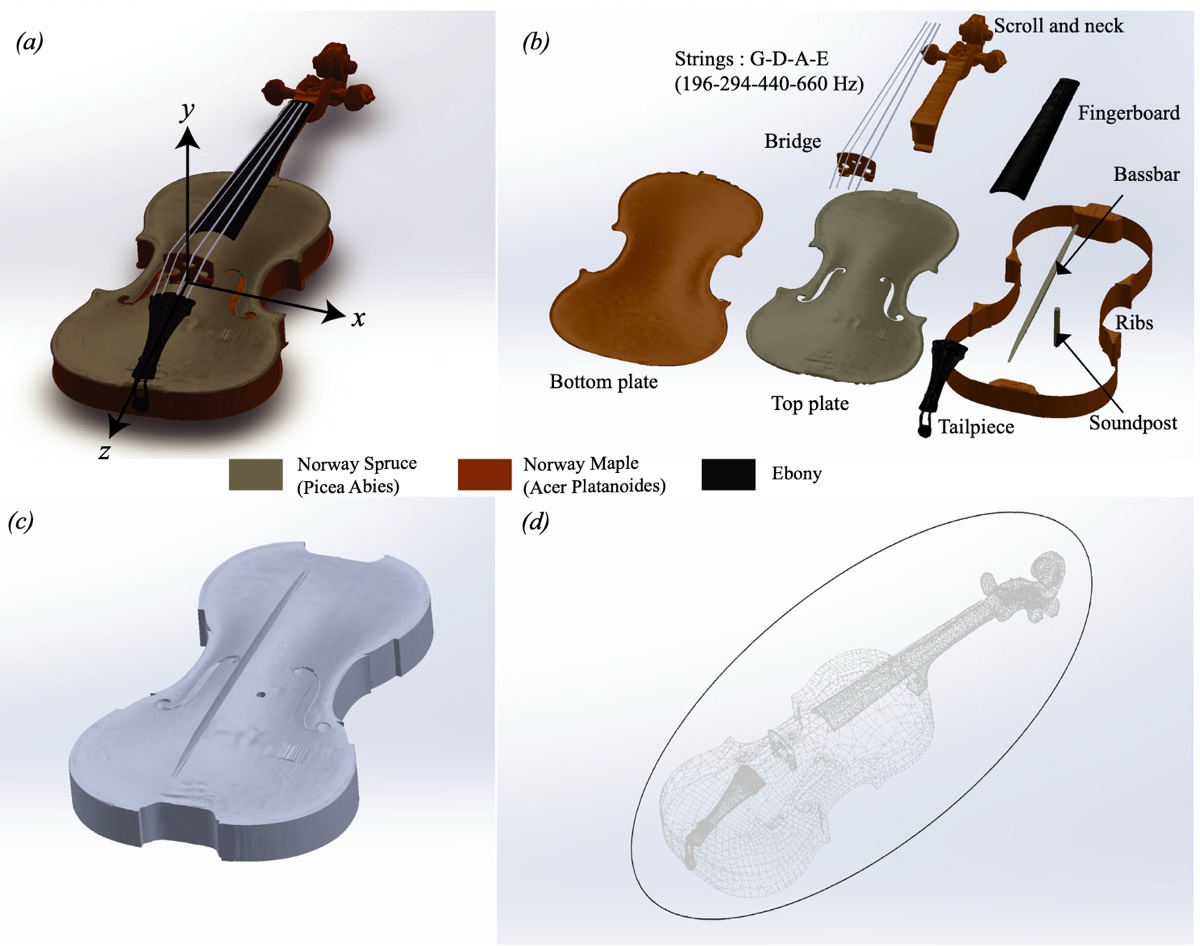
a Complete instrument. b Components, where wood types are color-coded. c Internal air domain bounded by the plates, ribs, bass bar, sound post and blocks. d External air domain consisting of an ellipsoid that encloses the violin.

Virtually reconstructed violin: (a) Complete instrument. (b) Components, where wood types are color-coded. (c) Internal air domain. (d) External air domain consisting of an ellipsoid that encloses the violin.

Virtually reconstructed violin: (a) Complete instrument. (b) Components, where wood types are color-coded. (c) Internal air domain. (d) External air domain consisting of an ellipsoid that encloses the violin. Credit: Arun Krishnadas et al., 2026

MIT’s virtual violin is based on the Strad3D project’s scan of the 1715 “Titian” Stradivarius. Makris et al. imported that data into a modeling software program and generated a 3D model of the instrument. Then they ran a simulation that broke down the violin into millions of cubes, noting which materials were used in each cube—such as the kind of wood that makes up the back plate, or whether it had natural fiber or steel strings. Next, the team used physics equations to predict how those materials would move and interact relative to every other element in the violin. Those elements include the air surrounding the instrument, simulated using acoustic wave equations.

Having built their virtual violin, Makris et al. were able to simulate the sound of a single plucked string—a playing technique called “pizzicato”—and program it to pluck out several notes of Bach’s “Fugue in G Minor,” as well as “Daisy Bell (A Bicycle Built for Two).” They have not yet figured out how to simulate bowing, which is a much more complex interaction, but it is a focus of their future research.

In the meantime, the team hopes their virtual violin will prove useful for luthiers in the early design process, enabling them to test the effects of various parameters, such as wood type or body thickness. “You can tweak the model to hear the effect on the sound,” said Makris. “Since everything obeys the laws of physics, including a violin and the music it makes, this approach can add an appreciation to what makes violin sound. But ultimately, we get most of our inspiration from the artisans.”

npj Acoustics, 2026. DOI: 10.1038/s44384-026-00049-6 (About DOIs).

Britain explores legal options to prosecute suspect in McCann disappearance

0
britain-explores-legal-options-to-prosecute-suspect-in-mccann-disappearance
Britain explores legal options to prosecute suspect in McCann disappearance


British police are seeking to bring a German suspect to trial in the disappearance of Madeleine McCann, as investigators step up efforts ahead of the 20th anniversary of her case next year.

Detectives from London’s Metropolitan Police are working to build a case against Christian Brueckner, 48, with the aim of securing charges related to abduction and murder. Officials say they believe sufficient evidence could be gathered for prosecutors to proceed.

Senior officers are leading a push to bring the suspect to trial in the United Kingdom, potentially at London’s Old Bailey. However, legal obstacles remain, including Germany’s constitutional ban on extraditing its citizens to countries outside the European Union.

The restriction could prevent German authorities from handing over Brueckner, raising the prospect of legal and diplomatic tensions between the two countries.

British officials have indicated that if extradition is not possible, efforts will continue to ensure the suspect faces justice either in Germany or in Portugal, where the alleged crime took place.

Madeleine McCann was three years old when she disappeared from a holiday apartment in Praia da Luz, Portugal, on May 3, 2007. Despite one of the largest international search efforts, she has never been found.

Brueckner, who lived near the resort at the time, was identified as a prime suspect by German authorities in 2020. He has denied any involvement.

The Metropolitan Police investigation remains officially a missing persons case, but a specialist team has been compiling evidence for the Crown Prosecution Service related to more serious charges.

A police source said investigators were determined to pursue “every available avenue” to achieve justice, noting the significance of the upcoming anniversary.

Under post-Brexit arrangements, the United Kingdom and Germany cooperate on extradition through the EU–UK Trade and Cooperation Agreement. However, Germany applies a “nationality bar,” rooted in its constitution, which prevents the extradition of its own citizens to non-EU countries.

Legal experts say this barrier cannot be waived, regardless of the seriousness of the alleged crime. One possible route could involve sharing evidence with Portuguese authorities, who may pursue prosecution within the EU’s legal framework.

British police have been working closely with counterparts in Germany and Portugal as part of a long-running investigation known as Operation Grange, launched in 2011. The inquiry has cost more than £13 million and continues to examine new leads.

Meanwhile, Madeleine’s parents, Kate McCann and Gerry McCann, marked the 19th anniversary of their daughter’s disappearance, reiterating their determination to find answers and secure justice.

German prosecutors have previously said they are confident Brueckner was responsible for Madeleine’s death, citing what they describe as strong but largely circumstantial evidence. However, no charges have been brought in connection with the case.

Authorities say the investigation remains ongoing, with no clear timeline for its conclusion.

With USAID gone, Indo-Pacific allies face the fallout

0
with-usaid-gone,-indo-pacific-allies-face-the-fallout
With USAID gone, Indo-Pacific allies face the fallout

Image: YouTube Screengrab

For more than 60 years, the United States Agency for International Development (USAID) was the backbone of American development diplomacy. Today, it is gone.

But the most immediate consequence is not what many assume. It is not simply the loss of funding. It is the collapse of coordination — the quiet system that aligned the United States with allies and partners across the developing world.

I have seen how that system works from the inside. And when it breaks, the effects are immediate.

In March 2025, the US administration dismissed most remaining staff and formally notified Congress of plans to dismantle the agency and absorb limited functions into the State Department.

What had once been the world’s premier development institution is rapidly being hollowed out. This may appear to be a mere bureaucratic shift in Washington, but it is not.

For decades, USAID served as a central node connecting the US with other major development actors, including Japan, South Korea and Australia. Through formal coordination and daily operational engagement, these partnerships aligned priorities, avoided duplication and amplified collective impact.

When that node disappears, coordination does not simply continue. It fragments, projects overlap, standards diverge, strategic focus weakens and US competitors gain space — not just because they invest, but because others fail to act together.

This matters most in the Indo-Pacific. From Southeast Asia to the Pacific Islands, development assistance is not peripheral — it is strategic infrastructure. It shapes governance, builds economic ties, and influences political alignment.

Australia has long understood this, using development assistance as a central pillar of its engagement in the Pacific. Japan and South Korea have done the same across Asia and beyond.

Their own development trajectories reinforce this approach. Once aid recipients, they transformed their economies through strategic investment and long-term planning.

Today, through institutions such as the Korea International Cooperation Agency, the Japan International Cooperation Agency, and Australia’s development programs—historically led by AusAID — they are major development actors in their own right.

I have worked alongside these institutions in the field. In Paraguay and Iraq, I saw firsthand how these partnerships function — not as abstract policy, but as daily coordination across governments, agencies, and technical teams.

That coordination is not easily replaced. And China understands this. Its development model does not depend on coordination with others. It is centralized, state-driven and executed through aligned financial and operational institutions.

Where Western approaches fragment, China’s often appear more coherent and decisive. This is the strategic risk. The dismantling of USAID does not create a neutral space – it creates a vacuum in coordination, one that competitors are well positioned to exploit.

The question is not whether allies such as Australia, Japan and South Korea will step forward. They already are. The question is whether they will do so together.

For decades, development cooperation functioned as one of the quiet pillars of the international system. It strengthened alliances, reinforced shared standards and enabled collective action.

That system is now under strain, if not broken. What replaces it will shape not only development outcomes, but the future balance of influence across the Indo-Pacific.

Steven E. Hendrix is a former senior US diplomat and development official who served as the USAID senior coordinator for foreign assistance at the US State Department. As the State Department managing director for planning, performance and systems, he oversaw global strategies across US foreign assistance, including for the Asia-Pacific region.

He has coordinated closely with international development agencies, including the Korea International Cooperation Agency (KOICA), the Japan International Cooperation Agency (JICA) and Australia’s former development agency, AusAID. He is an attorney in the United States, Bolivia, Guatemala and Ghana.  

Mac mini starting price goes up to $799, may be hard to get for “months”

0
mac-mini-starting-price-goes-up-to-$799,-may-be-hard-to-get-for-“months”
Mac mini starting price goes up to $799, may be hard to get for “months”

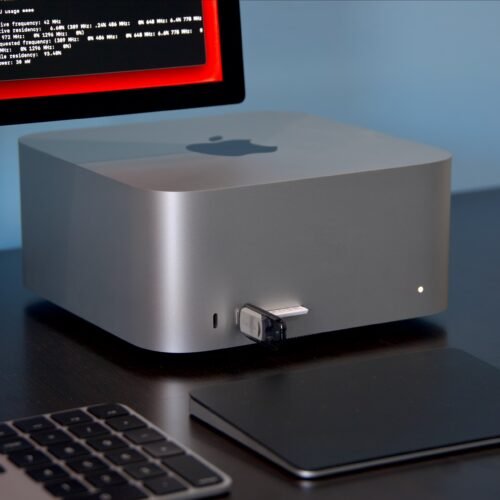
Apple’s Mac mini and Mac Studio desktops have been increasingly difficult to buy over the course of the year—multiple configurations are listed on Apple’s site as “currently unavailable,” which almost never happens, and others will take weeks or months to ship if you order them today. A top-end version of the Mac Studio with 512GB of RAM was delisted from Apple’s store entirely.

Now, the $599 entry-level Mac mini has also been removed from Apple’s store. The cheapest Mac mini you can currently order from Apple costs $799, which gets you an M4 chip, 16GB of RAM, and 512GB of storage.

This isn’t technically a price hike; Apple has charged the same amount for these specs since launching the M4 Mac mini in late 2024. But now that the basic model with 256GB of storage has apparently been discontinued, it’s no longer possible to buy a Mac mini for its original $599 starting price unless you can find stock left over at some third-party retailer somewhere.

The last time the Mac mini’s starting price was this high was in 2018, when the last Intel-based version of the desktop was introduced. The system’s cost had been falling in the Apple Silicon era—first to $699 for the Apple M1 version, then to $599 for the M2 version. The M4 iteration increased the starting RAM allotment from 8GB to 16GB, making the entry-level model much more useful and future-proof.

Apple similarly discontinued the 256GB versions of the MacBook Air earlier this year when it introduced the new M5 models, but the company only increased the starting prices of those laptops by $100, rather than $200. A new M5 version of the Mac mini is reportedly coming later this year, and its starting price could land anywhere between $599 and $799, depending on its specs (and how much Apple is paying for memory and storage chips by then).

A $799 Mac mini ordered from Apple’s website today will take five or six weeks to show up at your door.

“Higher-than-expected demand”

Current Apple CEO Tim Cook addressed the situation on Apple’s Q2 earnings call last week as part of a larger conversation about how Apple is navigating component shortages, and he partly blamed the shortage on the popularity of those desktops among users looking to run AI agents and other tools locally.

“Both [the Mac mini and the Mac Studio] are amazing platforms for AI and agentic tools, and the customer recognition of that is happening faster than what we had predicted, and so we saw higher-than-expected demand,” said Cook. “We think looking forward that the Mac mini and the Mac Studio may take several months to reach supply-demand balance.”

Cook wasn’t specific about what components were driving the Mac mini and Studio shortages, though he did say that generally, “availability of the advanced [manufacturing] nodes our SoCs are produced on” was constrained, and “we have less flexibility in the supply chain than we normally would.” In other words, it has become harder for Apple to go to TSMC and ask for more chips because TSMC doesn’t have the spare manufacturing capacity. Cook said these constraints “primarily” affected the iPhone, though, and only affected the Mac “to a lesser extent.”

As we wrote last month, the extent of the shipping delays can probably be blamed on multiple factors. AI-related demand for the desktops and chip shortages are probably factors, but Apple is also said to be planning replacements for both systems with Apple M5-series chips later this year, and it’s common for models to see their ship times slip when replacements are imminent. Cook’s “several months” estimate could easily include the introduction of new models, plus whatever time Apple needs to catch up to pent-up demand afterward.

Cook also noted that “customer response to MacBook Neo has been off the charts, with higher-than-expected demand” and that Apple “set a March record for customers new to the Mac, partly due to the Neo.” (Note that “a March record” is not the same thing as “an all-time record,” but regardless, it seems that demand for the Neo has been healthy.)

But MacBook Neo availability has been much better than for the Mac mini or Studio. A Neo ordered directly from Apple will usually arrive in two or three weeks, but this time window has stayed roughly the same since early March. The Neo also remains widely available for same-day shipping or pickup at third-party retailers like Amazon, Walmart, and Best Buy, which is not true of most Mac mini or Studio models.

Supply constraints aside, Apple’s Q2 2026 was a successful one for the company. Apple made $111.2 billion in revenue, a 17 percent increase over Q2 of 2025, thanks to strong growth from iPhone 17 sales and its Services division. The Mac also grew 6 percent year over year despite the shortages affecting the Mac mini, Mac Studio, and MacBook Neo. But Apple isn’t immune to the industry-wide RAM shortage: Cook said that Apple expected “significantly higher memory costs” for Q3 than it paid in Q2 and that “memory costs will drive an increasing impact on our business” going forward.

This story was updated on May 4 at 10:55 am Eastern to add details about the discontinued $599 Mac mini.

The internet has a Strait of Hormuz problem

0
the-internet-has-a-strait-of-hormuz-problem
The internet has a Strait of Hormuz problem

The next attack on the global economy may not arrive with a missile strike or a cyberattack on a server farm. It may arrive as silence — the sudden, eerie quiet of severed fiber-optic cables resting on the floor of the Persian Gulf, cut by a vessel whose crew will claim it was an accident.

Recent developments in the Middle East should alarm policymakers far beyond the region. Iran has already mined the Strait of Hormuz, constricting the flow of oil and gas through one of the world’s most critical energy passages.

But a quieter and potentially more consequential campaign is now underway. State-linked Iranian media outlets began circulating detailed maps of undersea cable routes, landing stations and regional data hubs across the Persian Gulf on April 22, 2026. Analysts at The Jerusalem Post have concluded that these disclosures appear to be target preparation.

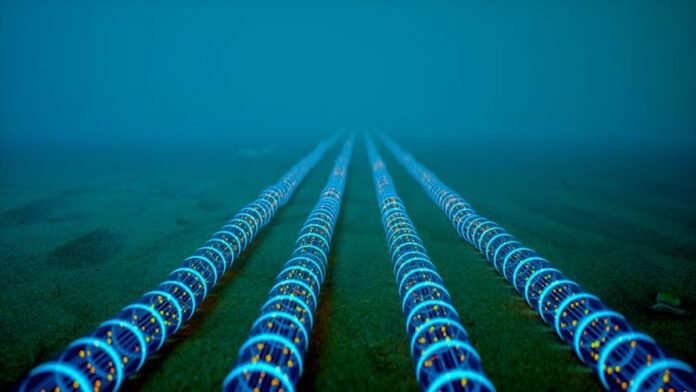
To understand why this matters, consider a fact that surprises most people: nearly all global internet traffic — more than 97% — moves not through satellites but through fiber-optic cables resting on the ocean floor.

These strands, thinner than a garden hose, carry an estimated US$10 trillion in daily financial transactions. They underpin bank transfers, stock markets, cloud computing and the artificial intelligence systems now increasingly woven into the fabric of the global economy. Satellites, despite their reputation as a technological fallback, cannot come close to absorbing the load if major cables fail.

Geography concentrates the risk. At least 17 cable systems run through the Red Sea, and several more cross the Persian Gulf. These are not redundancies; they are primary arteries. Both regions are now disrupted by conflict. And both are narrow chokepoints where a single, well-placed break can reverberate across continents.

There is precedent for this kind of attack and a chilling pattern that preceded it. On February 7, 2024, the BBC reported that Yemen’s Houthi movement had shared a plan on the Telegram app outlining its intent to target undersea cables linking Europe and Asia through the Red Sea.

That same day, Foreign Policy magazine observed that even if the Houthis lacked the technical capability to execute such an attack on their own, Iran could readily supply the necessary assets. The warning was explicit, and the threat was credible, but the world largely moved on.

Less than three weeks later, the warnings materialized. On February 26, 2024, four undersea cables connecting Saudi Arabia and Djibouti were severed. The Houthis had telegraphed their intentions, and the cables were sabotaged. The pattern was unmistakable: public signaling, followed by action.

Now that pattern is repeating itself — this time potentially targeting infrastructure that connects not just a region, but the entire digital world. Iranian state-linked outlets are circulating maps of cable infrastructure with the same clinical detail the Houthis used before the 2024 attack.

The Middle East, once primarily an energy hub, has become a digital one as well — hosting more than 300 data centers across 18 countries, with Amazon, Microsoft and Google investing billions in Gulf-based cloud facilities.

Severing the cables feeding these hubs would not simply disrupt email. It would strand hundreds of billions of dollars in digital infrastructure overnight and potentially shut down the world economy, as so much of the world relies on the Internet for banking, investing and commerce every day.

What makes this threat so difficult to deter is precisely what makes it so appealing to Iran: plausible deniability. A missile strike is unmistakable aggression, triggering immediate political and military consequences.

But a vessel dragging an anchor across a cable near the Strait of Hormuz is something murkier. Was it an accident? A fishing boat that strayed off course? A proxy operating at arm’s length from Tehran?

By the time those questions are answered — and cable repair ships cannot safely enter an active conflict zone — the damage is already done, and entire regions can remain offline for weeks or months.

The legal framework designed to deter such attacks is astonishingly weak. Under the United Nations Convention on the Law of the Sea (UNCLOS), when a cable is damaged in international waters, jurisdiction to prosecute the attacker falls to that attacker’s own country, not the cable owner’s.

The result is predictable: no nation has ever been prosecuted. No cable cut has ever gone to court. When states operate through proxies, as Iran routinely does, attribution becomes even harder to establish, and the threshold for retaliation is never clearly met.

The US and more than two dozen allies signed the 2024 New York Joint Statement on undersea cable security, acknowledging the vulnerability. But acknowledgment, obviously, is not deterrence.

What is needed now is a legal framework with teeth — one that empowers cable-owning states to pursue action directly against perpetrators regardless of nationality, and that holds state sponsors accountable for attacks carried out through proxies.

Since the US is already in the region, one action it can take immediately is to guard the undersea cables to minimize the potential of a cut. The Houthis warned, and the cables were subsequently cut.

Iran is now signaling a similar but potentially more devastating cable cut. The only question is whether Washington and its partners will act before the silence comes.

Amy Paik is an adjunct professor at Johns Hopkins University School of Advanced International Studies (SAIS) and a part-time lecturer at Northeastern University. She is a recipient of the 2024–2025 Wilson International Competition Fellowship and holds a doctorate in international affairs from Johns Hopkins SAIS.

Murdered Children’s Faces Approved To Appear on Memorial Mural

0
murdered-children’s-faces-approved-to-appear-on-memorial-mural
Murdered Children’s Faces Approved To Appear on Memorial Mural


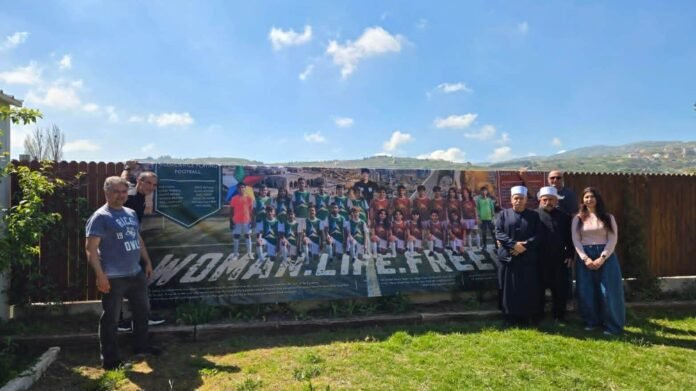
A mural in honor of children killed in regional violence and unrest in Iran will be unveiled in Israel, presenting the victims through a symbolic depiction of a children’s football match, according to project details released by its organizers and artist Hooman Khalili.

The installation centers on Druze children in green, representing 12 children killed by a Hezbollah rocket on July 27, 2024, in Majdal Shams while playing football, facing children in red symbolizing minors killed in Iran since September 2022. The figures are depicted as players rather than adversaries.

Sheik Dr. Rafea Halabi from Daliyat al-Karmel, Sheik Hussein Taraby and his son Ali from Buq’ata village, Naela and Ayman Fakher Aldin from Majdal Shams village. (Courtesy)

Above the scene appears Zahra Azadpour, a young female footballer killed during unrest in Iran in January 2026, portrayed as the referee.

The mural incorporates imagery of Nabi Shu’ayb (Jethro’s Tomb) in the Galilee and Tehran’s Azadi Tower, alongside the Lion and Sun symbol, described in the project as representing resilience and identity.

The Druze children named in the installation are Fajr Laith, Ameer Rabeea, Hazem Akram, Wadeea Ibrahim, Iseel Nashaat, Yazan Nayeif, Finis Adham, Alma Ayman, Naji Taher, Milad Muadad, and Nathem Fakher.

Children cited as among those killed in Iran include Kian Pirfalak, Sarina Esmailzadeh, Nika Shakarami, Asra Panahi, Mohammad Eghbal, Hasti Narouei, Mona Naghib, Helen Ahmadi, Ali Rezaei, and Mirshekar Abolfazl, along with others.

According to the project description, Amnesty International has reported that Iranian security forces killed children during protests using live ammunition, metal pellets, and beatings, and that authorities attempted to conceal the incidents and silence families.

Memorial wreaths for children killed in conflict (Courtesy)

Artist Hooman Khalili told The Media Line: “I see these murals and banners as the roots of something much bigger. The roots are here in Israel—but my hope is that the tree will grow and fully blossom in the United States.”

He added, “My prayer is to have this mural installed in the US before or during the FIFA World Cup, when the eyes of the world are watching. When that moment comes, I want people everywhere to see the truth—to understand the brutality of the Islamic regime and the reality that children are being targeted.”

“This is about making sure their stories are seen, remembered, and impossible to ignore,” Khalili concluded.

Hooman Khalili is an Iranian-born artist, filmmaker, and activist known for large-scale murals supporting Iranian protesters and highlighting human rights issues. Born in Tehran in 1974, he grew up in California and has worked in film, radio, and public art projects across Israel and the United States.

Football Player-Turned-Actor Dead at 81

0
football-player-turned-actor-dead-at-81
Football Player-Turned-Actor Dead at 81


Veteran actor and former football player Beau Starr has died at the age of 81, closing the curtain on a decades-long career that spanned the gridiron and the silver screen.

According to his brother, Mike Starr, the rugged character actor passed away peacefully of natural causes in Vancouver, Canada. No drama, no headlines—just a quiet goodbye for a man who spent years playing some of Hollywood’s toughest roles.

Before the lights of Hollywood ever found him, Starr was grinding it out on the football field. A tight end during his college years, he spent time on the practice squad with the New York Jets before taking his talents north of the border. He went on to suit up for the Montreal Alouettes and the Hamilton Tiger-Cats, putting up respectable numbers and proving he had grit long before he ever faced a camera.

But it was his second act that made him unforgettable.

Starr traded shoulder pads for scripts and slowly carved out a name for himself in Hollywood. His early days included appearances on classic TV hits like The A-Team, Knight Rider, and Three’s Company—even popping up multiple times in different roles, a testament to his versatility.

Fans of horror will forever remember him as Sheriff Ben Meeker in Halloween 4: The Return of Michael Myers and Halloween 5: The Revenge of Michael Myers, where he stood toe-to-toe with one of cinema’s most terrifying villains.

And then there was his role in Goodfellas, the iconic mob classic directed by Martin Scorsese. Starr played the father of Henry Hill, adding emotional weight to one of the most celebrated crime films of all time alongside stars like Robert De Niro, Joe Pesci, and Ray Liotta.

Tributes quickly poured in following the news of his death. Christopher Serrone, who shared the screen with Starr in Goodfellas, remembered him as more than just an actor.

“He was a son, brother, father, grandfather, actor and NFL/CFL player,” Serrone wrote. “Please take a moment to remember a great guy.”

From football fields to film sets, Beau Starr lived a life that most only dream of—tough, resilient, and unforgettable.

F1 in Miami: That’s what it looks like when an upgrade works

0
f1-in-miami:-that’s-what-it-looks-like-when-an-upgrade-works
F1 in Miami: That’s what it looks like when an upgrade works

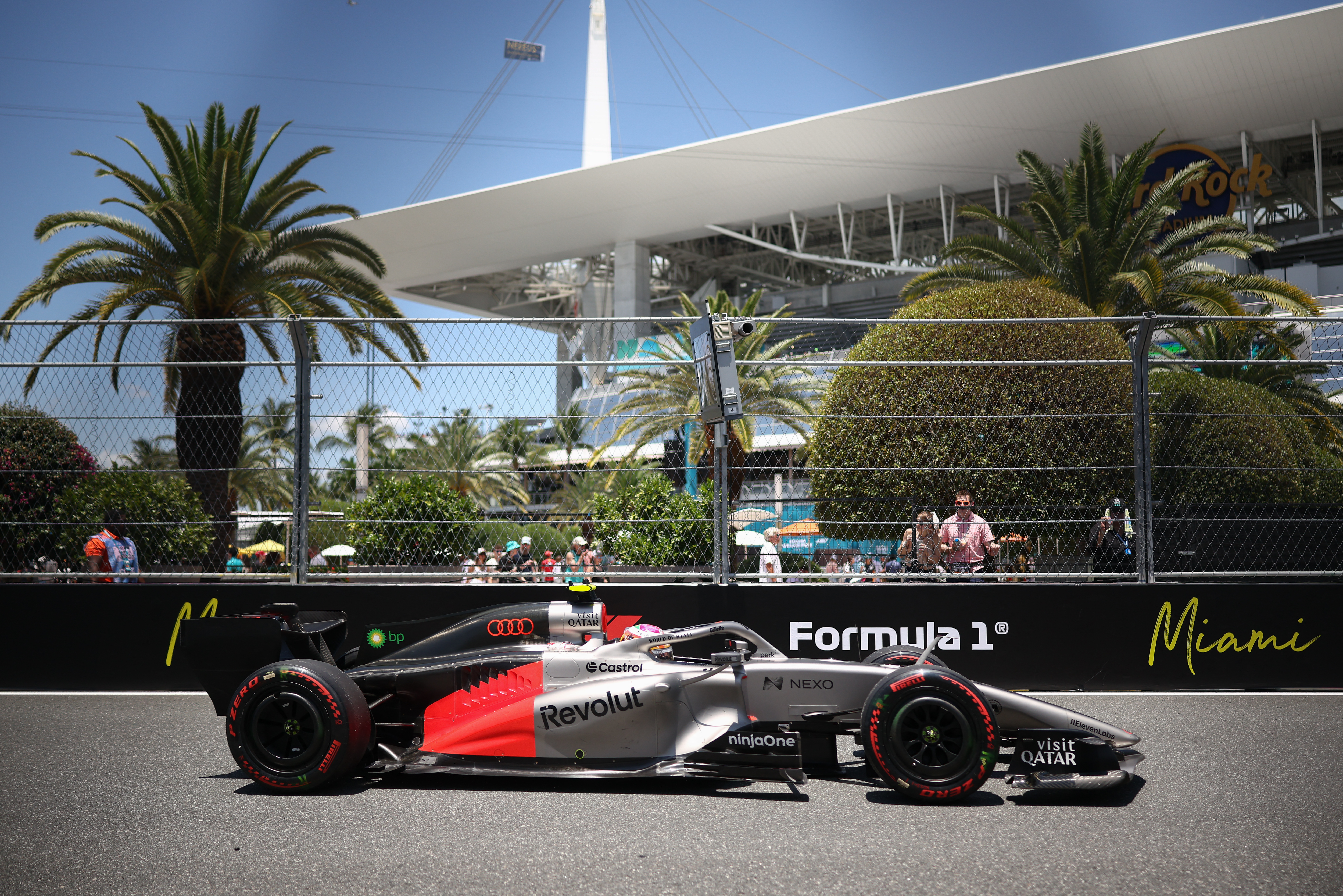
After an unanticipated five-week break in the season, Formula One resumed action this past weekend in Miami. Held at a temporary circuit around Hard Rock Stadium, the event is emblematic of the Liberty era of F1: a turbocharged marketing extravaganza crammed full of hospitality suites with ticket prices as high as $95,000. It might be miles from the sea—the original plans to race across a bridge over Biscayne Bay did not survive contact with locals—but the sport is doing its best to make this a modern Monaco, playing up the host city’s glamorous reputation and pastel color palette.

As we learned a couple of weeks ago, there have been tweaks to the amount of energy that the cars’ new hybrid power units can regenerate and deploy via the electric motor that contributes almost half of the car’s power output. The first three races of this season were frenetic, but they alarmed many longtime fans, as the cars are now too energy-limited to be driven flat-out during qualifying; that energy limitation also led to cars swapping positions multiple times, derisively dubbed “yo-yo” racing by critics.

The new limits on harvesting energy from the V6 to charge the battery on the move should reduce the potential for huge speed differentials like the one that caused Oliver Bearman’s crash in Japan, and energy management was (thankfully) not much of a topic this weekend. Miami’s layout definitely helps there, with plenty of braking zones to help regenerate much of the now-allowed 7 MJ each lap.

Correlation is causation

In a more conventional season, you might not bring any upgrades to Miami. It’s one of F1’s six sprint weekends, with just a single hour’s practice session on Friday morning; the other two are replaced by a shortened qualifying session on Friday afternoon, then a (roughly) half-hour sprint race on Saturday morning, before normal qualifying later that day and the proper race on Sunday. Mindful that it had imposed new rules for this round, the sport’s organizers increased practice time to 90 minutes on Friday.

MIAMI, FLORIDA - MAY 01: Lando Norris of Great Britain driving the (1) McLaren MCL40 Mercedes on track during practice ahead of the F1 Grand Prix of Miami at Miami International Autodrome on May 01, 2026 in Miami, Florida. (Photo by Clive Mason/Getty Images)

McLaren wasn’t the fastest car at the start of the season, but it might be now.

McLaren wasn’t the fastest car at the start of the season, but it might be now. Credit: Clive Mason/Getty Images

Every team, except the troubled Aston Martin, brought an upgrade package to Florida. Coming out of the blocks strong as Mercedes did this year is all well and good, but the 2009 season showed us what happens when a team with a huge advantage at the start fails to develop its car: Everyone else catches up.

Well, that’s assuming those upgrade packages work. A new wing or wishbone or whatever design might look like an improvement when you simulate it in computational fluid dynamics (CFD) or a wind tunnel, but if those aren’t well-correlated with the full-size car on track, that work was for naught. Many’s a time a team has brought what it hoped was a step forward only to find out it’s now even less competitive—just ask the closest tifosi.

Over the past few years, McLaren has nailed that correlation problem, causing all of its upgrade packages to add performance. What’s more, that ability has now spanned across three different sets of technical regulations. It caught up to the front of the pack in 2021 after years in the wilderness, then was the only team to overhaul Red Bull in the ground-effect era. Now it looks set to do that again.

Ferrari and Red Bull have both also taken a step forward. The Mercedes might have looked awfully dominant in Australia, China, and Japan, but as of now, the season looks like a four-way fight.

The flag drops

Audi's Brazilian driver Gabriel Bortoleto races during a practice session for the 2026 Miami Formula One Grand Prix at Miami International Autodrome in Miami Gardens, Florida, on May 1, 2026. (Photo by CHARLY TRIBALLEAU / AFP via Getty Images)

The vast stadium looms over the track.

The vast stadium looms over the track. Credit: CHARLY TRIBALLEAU / AFP via Getty Images

The changes to energy harvesting in qualifying looked successful, at least in Miami. Cars weren’t losing speed precipitously three-quarters of the way down the straight, and I doubt anyone could tell they were a second and a bit slower than last year’s machines in qualifying trim.

Lando Norris took pole in sprint qualifying, a couple of tenths of a second faster than McLaren teammate Oscar Piastri. Between 19-year-old Kimi Antonelli and teammate George Russell, Antonelli was able to make his Mercedes do things that his more experienced teammate could not. Charles Leclerc was similarly more at home in his Ferrari than Lewis Hamilton was around the Hard Rock Stadium, but the gap between teammates was nothing like that separating Max Verstappen’s Red Bull from that of Isack Hadjar.

Verstappen, the four-time champion, has been vocal about his dislike of the new cars and the new racing style, and he has increasingly signaled that he could walk away from F1 to pursue other racing interests. This weekend, the Red Bull upgrade package seems more to his liking, and the gap to Hadjar was more than a second in practice.

Both Mercedes made atrocious getaways at the start of the sprint, and the two McLarens drove off to an uneventful 1–2 finish that seemed reminiscent of 2025. Leclerc demonstrated the Ferrari’s superior performance off the line and held third until the end.

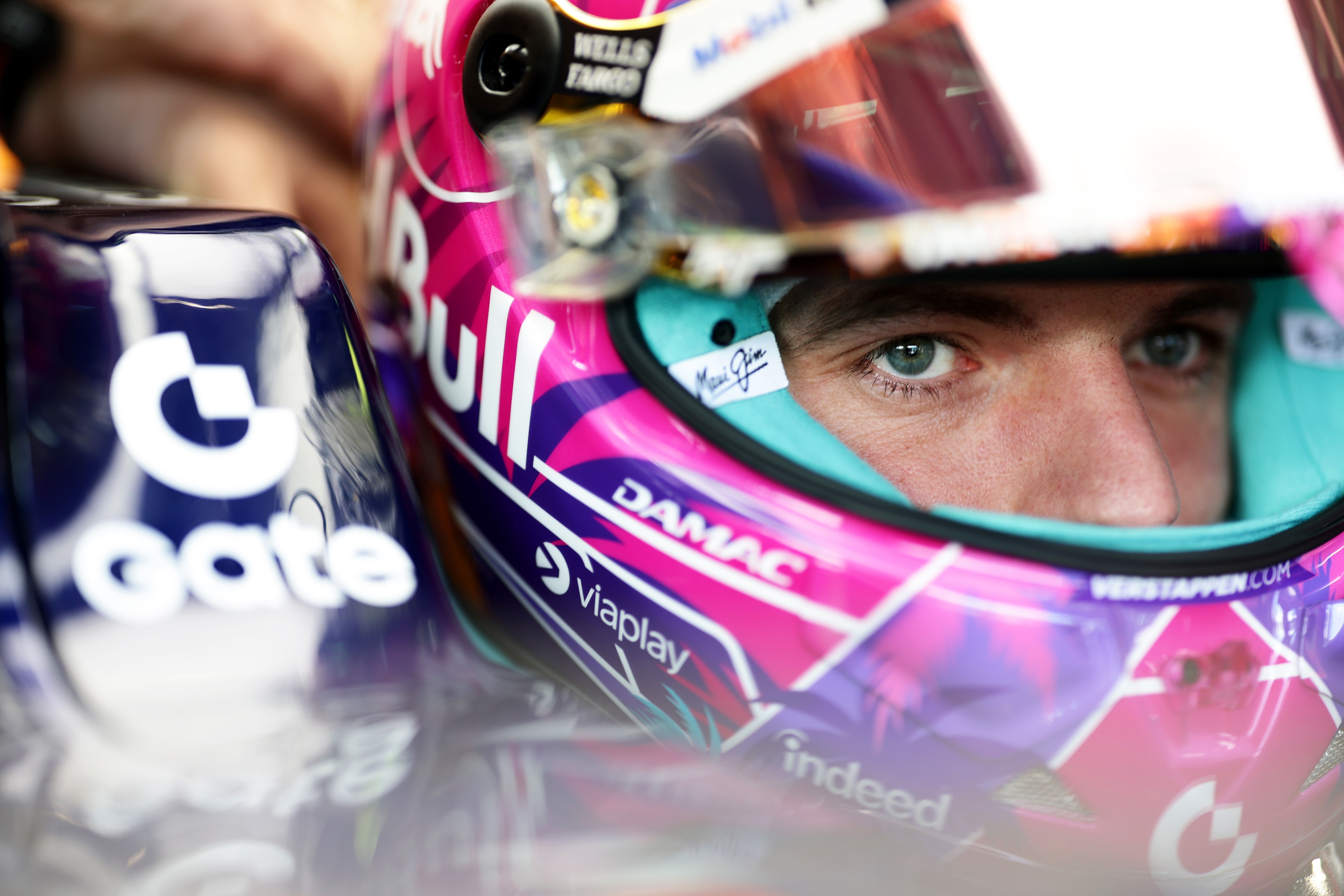
MIAMI, FLORIDA - MAY 01: Max Verstappen of the Netherlands and Oracle Red Bull Racing prepares to drive prior to practice ahead of the F1 Grand Prix of Miami at Miami International Autodrome on May 01, 2026 in Miami, Florida. (Photo by Mark Thompson/Getty Images)

Verstappen got Miami-fied with his helmet.

Verstappen got Miami-fied with his helmet. Credit: Mark Thompson/Getty Images

Fears of a wet race on Sunday did not materialize, although the potential for weather chaos saw the race start moved forward by three hours. Antonelli had secured the pole on Saturday afternoon, his third in a row. Lining up next to him? Verstappen’s Red Bull. Leclerc was third, then Norris, Russell, Hamilton, and Piastri filled out rows three and four.

When Ferrari designed its 2026 power unit, it went for a small turbocharger in large part because it knew engines with larger turbos, and therefore more lag, would struggle with standing starts. Leclerc made mighty use of that and was in first place by turn three. Verstappen tried to stay alongside him but spun at turn three; Verstappen’s resulting pirouette left him facing the right way and still in the race, which is one of his party tricks.

Antonelli got a much better start than the sprint but was the man on the outside as he, Leclerc, and Verstappen went into the first corner, and he ran wide and resumed third. The two McLarens were next, then Russell and Hamilton’s Ferrari, which was damaged in a tussle with Franco Colapinto’s Alpine. The midfield team has also made clear progress and may well trouble the top four a lot more this year.

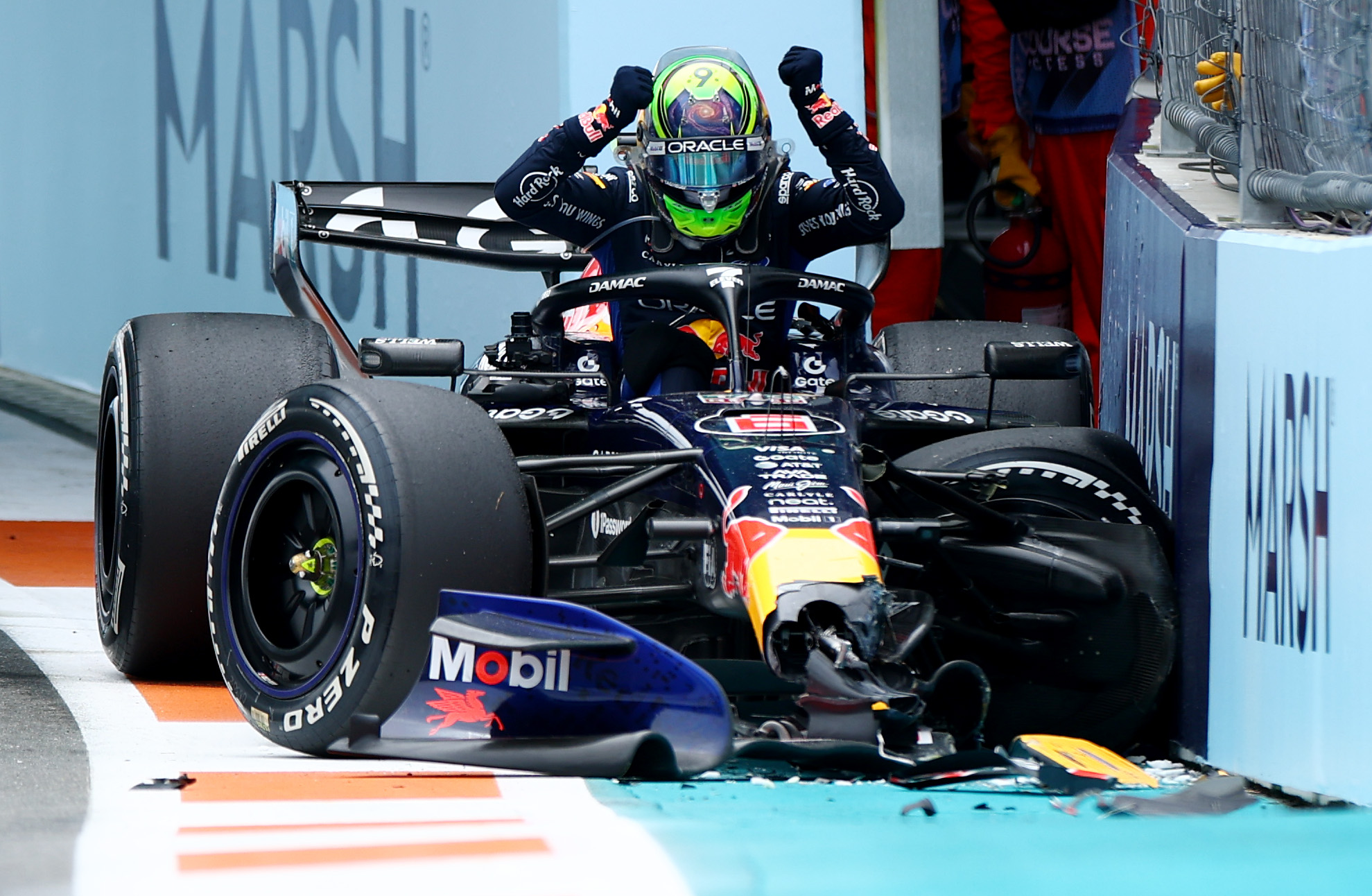
Lap six was eventful. Hadjar misjudged the apex at turn 13 and destroyed his front left suspension. At about the same time, the other Alpine of Pierre Gasly diced with the Racing Bulls of Liam Lawson before they made contact, rolling Gasly and depositing him partially on the tire barrier at turn 17. Norris got past Antonelli before the safety car came out, then a lap later took the lead from Leclerc. Antonelli also passed the Ferrari quickly, and by lap 22, Leclerc’s race was looking pretty mediocre, stuck behind Russell after both had made relatively early pit stops for the mandatory tire change.

Verstappen was on a different trajectory. After falling to ninth with his spin, he stopped for hard tires and was maneuvering his way back up the running order. As the leaders stopped, they rejoined on track just behind his Red Bull, Antonelli beating Norris to be the one in the middle. As Piastri made his stop, he relinquished the lead to Verstappen, but the Dutch driver was on tires that were 21 laps older than Antonelli’s new rubber, and by halfway around the lap, the Mercedes was through into first with Norris’ McLaren following.

MIAMI, FLORIDA - MAY 03: Isack Hadjar of France and Oracle Red Bull Racing climbs out of his crashed car during the F1 Grand Prix of Miami at Miami International Autodrome on May 03, 2026 in Miami, Florida. (Photo by Clive Mason/Getty Images)

Isack Hadjar was furious with himself for crashing on lap six.

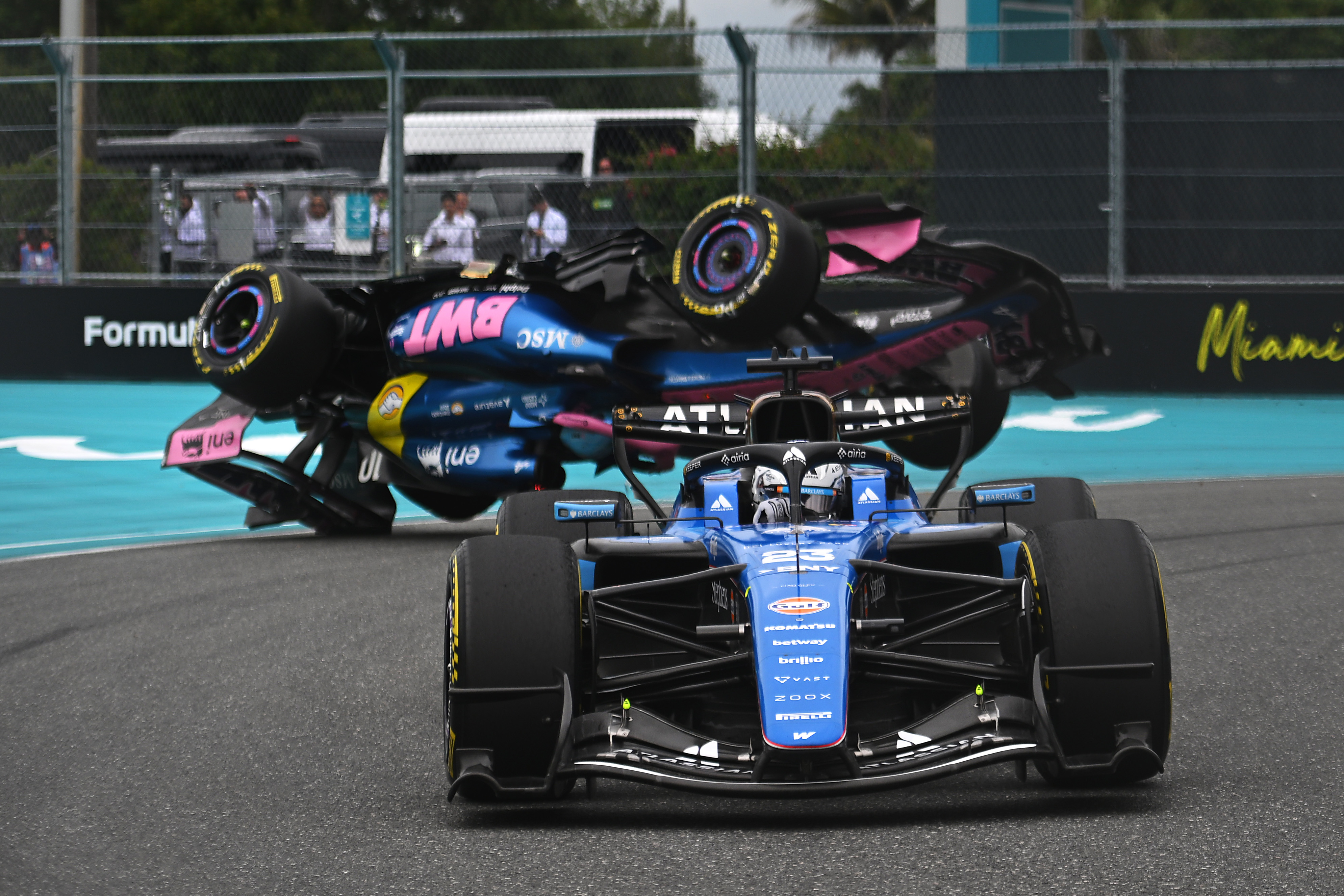
MIAMI, FLORIDA - MAY 03: Alexander Albon of Thailand driving the (23) Williams FW48 Mercedes leads as Pierre Gasly of France driving the (10) Alpine F1 A526 Mercedes crashes during the F1 Grand Prix of Miami at Miami International Autodrome on May 03, 2026 in Miami, Florida. (Photo by Rudy Carezzevoli/Getty Images)

With a 10th place finish on Sunday, it was a good weekend at last for Alex Albon in the Williams. Pierre Gasly’s weekend ended about as well as the rolling Alpine in the background suggests.

The Antonelli hype is real

Norris harried Antonelli for the rest of the 57-lap race, but the reigning world champion could not force the Mercedes sophomore into a fault. Behind them, Piastri was able to overtake Russell, although he was almost half a minute behind the winner. After a spirited defense, Verstappen’s much older tires meant he surrendered third to Leclerc with 12 laps to go. Piastri was next, then Russell too, clipping the Red Bull’s rear tire with his Mercedes’ front wing.

Piastri wasn’t done; he caught Leclerc with a lap to go, then passed him on the final lap for third place. It went downhill from there for the Ferrari man, who spun, then biffed the wall and broke his suspension, then earned a penalty that dropped him from sixth to eighth place for leaving the track and gaining a lasting advantage.

Between Leclerc’s travails and Hamilton’s somewhat-damaged, mostly anonymous race, it was a weekend without much glory for Ferrari. Audi didn’t have the best time either; Nico Hulkenberg’s car caught fire on the way to the sprint grid, and Gabriel Bortoleto was disqualified from the sprint after finishing 11th for a technical infringement.

Williams went home with smiles, though. It has had a very poor start to 2026, with a car that’s overweight and exhibiting some difficult handling characteristics that saw it mired at the back of the pack if not quite as slow as Cadillac or Aston Martin. But in Miami, the two Williams cars looked far more at home, especially in the race where they both finished in the points. Even Cadillac and Aston Martin will probably be content with their performances on Sunday; both teams got both cars to the flag, and Perez managed to split the two Astons.

MIAMI, FLORIDA - MAY 03: Race winner Andrea Kimi Antonelli of Italy and Mercedes AMG Petronas F1 Team lifts his trophy on the podium during the F1 Grand Prix of Miami at Miami International Autodrome on May 03, 2026 in Miami, Florida. (Photo by Mark Sutton - Formula 1/Formula 1 via Getty Images)

Kimi Antonelli (middle) is too young to spray champagne if he wins a race in America. Lando Norris (left) and Oscar Piastri (right) did not have to abstain.

Kimi Antonelli (middle) is too young to spray champagne if he wins a race in America. Lando Norris (left) and Oscar Piastri (right) did not have to abstain. Credit: Mark Sutton – Formula 1/Formula 1 via Getty Images

Antonelli has now converted three consecutive pole positions into three consecutive race wins, the first driver to do so in 76 years of F1’s history. And none of those three wins has been a simple lights-to-flag victory, given how sluggish his car is when the five red lights go out. He leaves Florida with a 20-point margin in the championship over Russell in second, albeit with 18 races left to go.

Lawmakers Demand Answers About Growing Number of Unfixed Mistakes on Credit Reports

0
lawmakers-demand-answers-about-growing-number-of-unfixed-mistakes-on-credit-reports
Lawmakers Demand Answers About Growing Number of Unfixed Mistakes on Credit Reports

Four U.S. senators sent letters grilling the nation’s major credit bureaus on Thursday after a ProPublica investigation showed two of the bureaus were fixing fewer consumers’ credit reports.

The letters came in response to a ProPublica investigation from March, which found that two of the three major credit bureaus — TransUnion and Experian — had substantially scaled back how often they provided relief to complaints filed through the Consumer Financial Protection Bureau. The decline in relief coincided with the Trump administration’s attempts to conduct mass layoffs at the CFPB and roll back much of its oversight of the financial sector.

The letters’ lead author is Sen. Elizabeth Warren, D-Mass., the ranking member of the Senate Banking Committee and a key architect in the creation of the CFPB. Democratic Sens. Tammy Duckworth, Andy Kim and Lisa Blunt Rochester also joined the letters.

ProPublica found that TransUnion’s rate of relief, which had remained relatively steady for several years, dropped sharply in the summer of 2025. By October it was providing relief roughly half as often. Experian, which had provided relief to nearly 20% of consumer complaints in 2024, provided relief to less than 1% of complaints in 2025, according to the CFPB’s data.

Companies are required to respond to consumer complaints filed through the CFPB, and relief can be financial or nonmonetary, for instance, fixing an error on a credit report.

In the letters to Experian and TransUnion, the senators called ProPublica’s findings “greatly concerning” and said that the reporting “raises significant questions about the legality” of the companies’ practices. The “drastic drop in responsiveness means that American consumers may be getting denied a mortgage or housing simply due to an error on their report that your company failed to correct.”

In a statement, TransUnion said, “We appreciate the opportunity for meaningful engagement with policymakers regarding the robust and compliant processes TransUnion deploys,” and that it would respond to the letter. Experian did not respond to a request for comment. The company previously told ProPublica it investigates “all legitimate” complaints.

The third major credit bureau, Equifax, did not see a similar decline in relief, ProPublica found. Last year, just prior to President Donald Trump’s inauguration, the company entered a settlement with the CFPB that aimed to fix the company’s deficiencies in its consumer dispute processes, although the agreement did not mention CFPB complaints specifically.

Three men wearing suits sit at a green table with people sitting behind them in a wood paneled room.
From left: Mark Begor, chief executive officer of Equifax; Chris Cartwright, president and CEO of TransUnion; and Brian Cassin, CEO of Experian, during a Senate Banking Committee hearing in April 2023 Ting Shen/Bloomberg via Getty Images

Equifax said it would engage with the letter and that the company works to make it easier for consumers to “correct any potential errors quickly.”

In the letters, the senators requested data on disputes and complaints sent to the companies, as well as information on their dispute handling processes and staffing. The senators also asked for correspondence with the CFPB, including communication regarding dropped and halted enforcement actions against TransUnion that were identified in ProPublica’s investigation.

Consumer complaints about credit reporting have risen dramatically, with over 4 million filed last year with the CFPB. The credit bureaus have said that many recent complaints are illegitimate, including a large volume filed by third-party credit repair organizations that charge customers to challenge negative information on their reports.

Errors on a credit report can be difficult and time-consuming to fix. ProPublica spoke with a Colorado accountant, Rebecca Sheppard, who had spent nearly a year trying to get a $240,000 debt that she did not owe removed from her credit report. The error caused her credit score to plunge roughly 85 points and jeopardized her plans to move with her disabled father into a more accessible home.

Sheppard contacted the credit bureaus on four occasions, including through the CFPB’s complaint system, but they did not remove the debt. In response to her fourth attempt, via certified mail, TransUnion sent her a postcard stating it believed the submission had not come from her.

She eventually sued the credit bureaus in January. TransUnion settled the claim shortly after ProPublica’s story was published, while the case is still pending against Equifax and Experian, which have denied the allegations in court.

A woman with shoulder-length blond hair and glasses wearing a green sweater, beige top and jeans stands outside. Behind her are conifer bushes, a tan house and ornaments hanging from the porch.
Rebecca Sheppard at her home in February. The Colorado accountant spent nearly a year trying to get a $240,000 debt that she did not owe removed from her credit report. Theo Stroomer for ProPublica

The CFPB previously had been putting pressure on the credit bureaus to fix errors and engage with consumers, and relief rates had risen during the Biden administration. However, upon the change of administrations, Trump appointed Russell Vought as acting head of the CFPB. He quickly ordered a stop to nearly all agency work. Under Vought, the agency also attempted to fire much of its staff, an effort that has been paused by litigation.

Read More

Heeding the concerns voiced by the credit reporting industry’s lobbying group, the CFPB in February added notices for consumers to click through before filing a complaint, warning them that their requests might be ignored if they had not already disputed issues directly with credit bureaus.

A CFPB spokesperson told ProPublica in March that the complaint system was inundated with submissions from bots and third-party credit repair firms, and the agency was working to address that so legitimate consumers can more effectively get help.

In the letters, the senators also highlighted the consequences of the system. “It is hard to overstate the extent to which credit reports and credit scores produced by credit reporting companies permeate nearly every aspect of modern American life,” they wrote.

0FansLike
0FollowersFollow
0FollowersFollow
0SubscribersSubscribe
- Advertisement -
Google search engine

Recent Posts