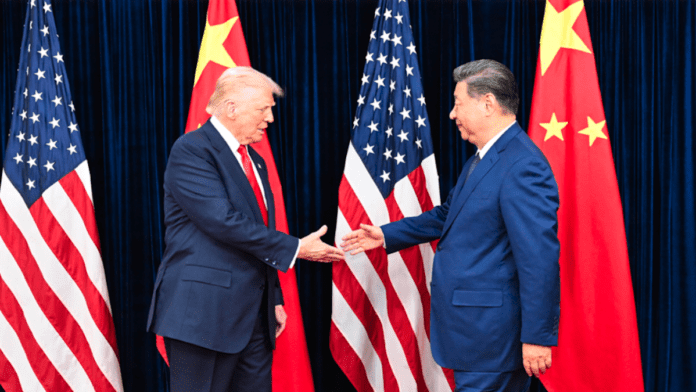
A long-awaited summit between US President Donald Trump and Chinese President Xi Jinping is set to take place in Beijing May 14 and 15, with both sides preparing to address a crowded agenda spanning Iranian oil, Taiwan, trade, human rights and technology controls.
Beyond the main geopolitical disputes, the talks are also expected to cover the possible release of Hong Kong media tycoon Jimmy Lai and Beijing’s move to discourage local firms from buying Nvidia’s H200 artificial intelligence chips, even after Trump approved their export to China.
The summit was originally scheduled for late March or early April, but the White House postponed it because Trump needed more time to focus on the war in Iran. On top of the Trump-Xi meeting’s agenda, the ongoing conflict in Iran remains the biggest issue hanging over the talks.
“Iran is the world’s largest state sponsor of terrorism, and anyone who’s buying oil from Iran is contributing to that,” US Trade Representative Jamieson Greer said in an interview with Bloomberg TV on Wednesday. “So when the Treasury takes a step similar to steps it’s taken many times over decades with respect to oil refiners who are dealing with Iran, and you have a country that refuses to comply or directs non-compliance, that’s going to have to be a discussion item.”
Greer said the issue had already been raised at the staff level between China and the United States. But he also made clear that Washington did not want the Iranian oil dispute to dominate the summit or derail any wider understanding reached in Beijing.
“We’re looking for stability with China,” he said. “We don’t want this to be something that derails the broader relationship, or any agreements that might come out of our meeting in Beijing.”
He said countries sometimes adopt domestic laws and regulations that conflict with US policy, adding that the European Union has, for years, maintained a blocking statute preventing compliance with US sanctions on Cuba. He said Washington would expect “some kind of resolution” when Chinese rules clash with US sanctions.
“What China is doing is serious. We take it very seriously. But again, for us, it’s not something where we’re going to let that become the only thing we talk about in the relationship,” he said. “We’ll address other issues related to trade and geopolitics and foreign policy and everything that comes with the relationship between two of the most important countries in the world.”
On April 28, the US Department of the Treasury’s Office of Foreign Assets Control (OFAC) warned financial institutions about secondary sanctions risks associated with China’s independent “teapot” refineries, which Washington accused of buying Iranian crude.
However, on May 2, China’s Ministry of Commerce invoked the Rules on Counteracting Unjustified Extraterritorial Application of Foreign Legislation and Other Measures, or the “Blocking Rules,” against US sanctions on five mainland “teapot” oil refiners, including Hengli Petrochemical (Dalian) Refinery. It said the US measures, including asset freezes and transaction bans, “shall not be recognized, enforced or complied with” in China.
“If you ignore our sanctions, you are going to face secondary sanctions,” US Secretary of State Marco Rubio said Wednesday. “We don’t do these things for symbolic purposes.”
Rubio also commented on Iranian Foreign Minister Abbas Araghchi’s recent visit to Beijing, saying he hoped China would deliver a clear message to Tehran about its actions in the straits.
“I hope the Chinese tell him what he needs to be told, and what you are doing in the straits is causing you to be globally isolated. You’re the bad guy in this. You should not be blowing up ships, putting mines and trying to hold hostage the global economy,” he said.
“A cost needs to be imposed on Iran for what they are doing,” Rubio said. “Otherwise, if they get away with this without paying a price for it and backing down, you’re going to see multiple places around the world where other countries are going to be tempted to do the same.”
He said China’s export-driven economy also had an interest in preventing Iran from closing the Strait of Hormuz, as disruptions to shipping would hurt Chinese trade.
Taiwan matters
The Trump-Xi summit is expected to discuss the United States’ arms sale to Taiwan.
Last December, the Trump administration announced the largest-ever US arms sale to Taiwan, worth more than US$11 billion. The package includes 420 Army Tactical Missile Systems (ATACMS), more than 80 High Mobility Artillery Rocket Systems (HIMARS) and loitering munitions, or kamikaze drones, aimed at strengthening Taiwan’s asymmetric defense capabilities. However, some components are reportedly still delayed at the State Department.
“The Taiwan question is at the very core of China’s core interests, and the bedrock of the political foundation of China-US relations,” Chinese Foreign Ministry spokesperson Lin Jian said at a regular briefing on Thursday. “Abiding by the one-China principle and the three China-US joint communiqués, and honoring the commitments made by US administrations on the Taiwan question is the United States’ due international obligation and the prerequisite for a steady, sound and sustainable China-US relationship.”
He said China was determined to defend national unity and territorial integrity, adding that peace in the Taiwan Strait required clear opposition to “Taiwan independence.”
Hou Junyi, a Tianjin-based columnist, writes that Taiwan’s Democratic Progressive Party (DPP) administration, led by Lai Ching-te, should be worried that the island’s interests could be sacrificed in the Trump-Xi talks.
“The United States’ main tool for supporting the DPP’s pursuit of independence is its arms sales to Taiwan,” Hou says. “But the Iran war has consumed large quantities of US weapons and ammunition, and rebuilding those stocks could take years.”
“The Taiwanese authorities have to face a harsh reality that the United States’ military influence in the Indo-Pacific is shrinking, and the Trump administration is pulling back from the region strategically,” he says. “Trump’s second term is more dependent on cooperation with China.”
A Shaanxi-based writer says the Sino-US relations will remain unstable if Washington ignores China’s core concerns about Taiwan.
“Trump may be able to return with some economic benefits from his China visit,” the writer says. “But if the US still tries to handle Taiwan issues in an ambiguous way, China-US relations will be hurt. China will not compromise its national interests for a temporary improvement in diplomacy.”
He says the Trump-Xi summit is important as major economies, including in Europe, are reassessing how to balance ties with China and the US.
Reuters reported on Thursday that the US and China are working on a Board of Trade mechanism to identify products that can increase bilateral trade without compromising national security or critical supply chains. The proposals include potential Chinese purchases of US crops, Boeing aircraft and American energy, including coal, oil and natural gas.
In fact, China has restarted importing about 600,000 barrels per day of American crude oil in April, according to a Nikkei Asia report.
Meanwhile, the summit is also expected to test whether Trump can secure progress on politically sensitive human rights issues.
Trump said Monday that he would raise Lai’s case with Xi during his upcoming Beijing trip. while suggesting the issue remained personally sensitive for the Chinese leader.
At his meeting with Xi on the sidelines of the Asia-Pacific Economic Cooperation (APEC) summit last October, Trump called for the release of Jimmy Lai. However, on February 9, Lai was sentenced by a Hong Kong court to 20 years in prison on charges of colluding with foreign forces. His son Sebastien Lai called the decision a “death sentence,” saying his father would not survive two decades in prison.
The case partly centered on Lai’s calls in mid-2019 for Washington to speak up for Hong Kong democratic protesters and pressure Beijing in trade talks.
Read: China invokes rules to blunt US sanctions on ‘teapot’ refiners
Follow Jeff Pao on X at @jeffpao3