Scientists warn 1.5°C climate change threshold could arrive by 2029
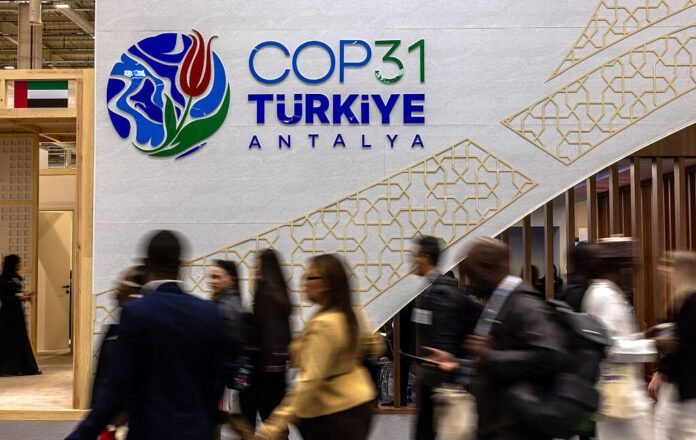
ANTALYA, Turkey—Amid upbeat green-tech pep talks and notices for happy hours at the annual United Nations COP31 climate change conference on Thursday, two new reports offered a stark reminder of how far the world remains from containing global warming.
Climate Action Tracker, a nonprofit group that analyzes climate policies, found that the planet is still on track to warm nearly 5° Fahrenheit by 2100, a rise that would devastate coral reefs, disrupt agriculture and forests and melt most of the world’s ice. In a separate bulletin, the European Union’s Copernicus climate change service reported that global warming has accelerated significantly since the 2015 Paris climate agreement.
When the Paris agreement was adopted, the average global temperature was projected to surpass the pact’s long-term threshold of 2.7° Fahrenheit above the preindustrial average around 2045. After another decade of global climate summits, warming is now projected to cross that benchmark as soon as 2029, according to Copernicus.
“This striking change suggests that global warming has accelerated in recent years,” the EU scientists wrote. Even without understanding every aspect of the recent rapid global temperature increase, “It is clear that the ever-growing concentrations of greenhouse gases emitted by human activity in the atmosphere remain the main driver of this trend.”
The current level of warming has already triggered deadly and destructive floods, wildfires and catastrophic glacier collapses, said Swedish activist Greta Thunberg, who is attending the UN “Conferences of the Parties” climate talks, for the first time since 2021.
“The climate crisis is a matter of life and death,” she said. “The actions from those in power here are completely detached from reality. As we speak, we are losing priceless lives, ecosystems and species that we will never get back.”
Sarah Heck, a climate policy analyst with Climate Analytics, an international climate science and policy institute, said governments have failed to meaningfully improve the outlook for end-of-century warming.
“Our message is a stark one,” Heck said. “Collective government action on climate change has stalled for the fifth consecutive year.” Efforts to speed up the shift away from fossil fuels have been negated by new oil and gas drilling projects and governments that are “delaying, weakening or rolling back their climate policies.”
Even under the most optimistic scenario, assuming full implementation of existing policies and promises, global temperatures would rise 3.4° Fahrenheit above preindustrial levels by 2100, an increase climate scientists consider extremely dangerous.
While there has been progress on developing renewable energy sources, the “brutal truth is that these positive developments have not yet added up to bend the curve fast enough,” said Niklas Höhne, a researcher with The New Climate Institute. Developing new oil and gas projects is a bit like discovering your food is burning and then turning up the stove instead of turning it off, he added.
Getting into the specifics of the current negotiations at COP31 surrounding global renewable goals, he noted that conference co-hosts Turkey and Australia have so far opposed including the word “clean” in connection with electrification targets.
“It’s very hard to understand, and the only explanation I can think of is their interest in fossil fuels,” Höhne said.
Australia is one of the world’s biggest coal exporters, and Turkey is a major coal consumer, with its power sector still highly dependent on the most climate-damaging fossil fuel. Even as they host this year’s climate conference, neither country has offered any specific plans to transition away from fossil fuels.
Bill Hare, the CEO of Climate Analytics, called out wealthy, developed countries for their lack of leadership on climate action, noting that European Union Commission President Ursula von der Leyen failed to mention anything about transitioning away from fossil fuels during her speech this week at COP31.
“Governments … at this COP have a stark choice,” Hare said. If they continue supporting fossil fuels, “it would consign humanity and our ecosystems to insurmountable economic damage and irretrievable loss.”
Bob Berwyn is an Austria-based reporter who has covered climate science and international climate policy for more than a decade. Previously, he reported on the environment, endangered species and public lands for several Colorado newspapers, and also worked as editor and assistant editor at community newspapers in the Colorado Rockies.
The scientists fighting to help Maui wildfire survivors heal
This story was originally published by Inside Climate Newsand is reproduced here as part of the Climate Desk collaboration.
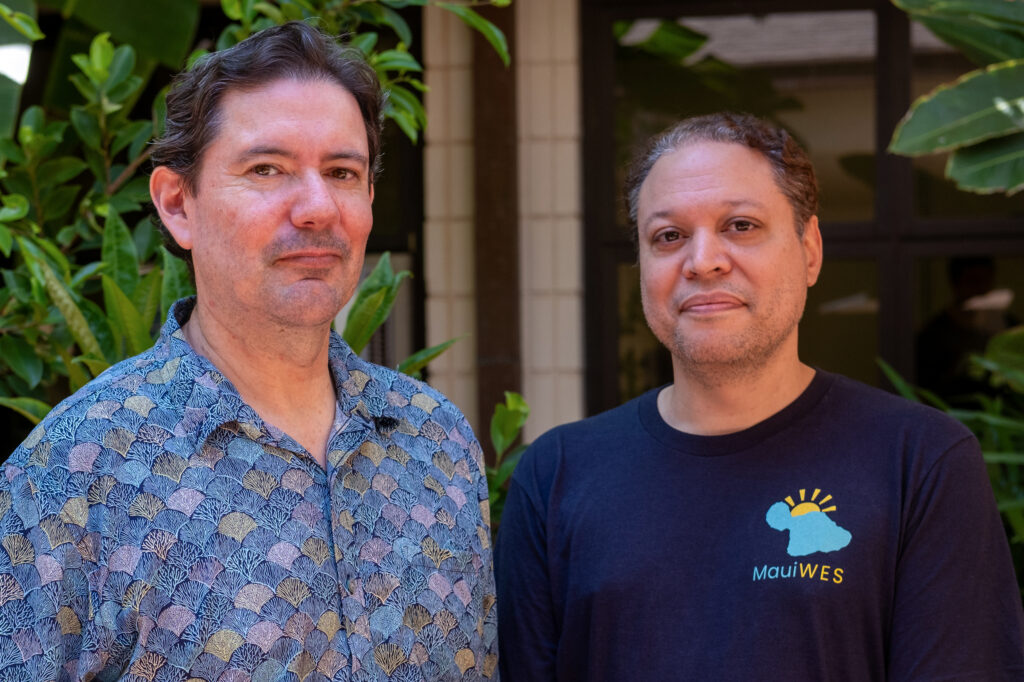
Early on a Saturday morning in May, Ruben Juarez took the 45-minute flight from Oʻahu to Maui, just like he’d done dozens of times over the past three years.
This one felt different.
Juarez landed in Kahului Airport with his partner, Alika Maunakea, and drove on a long winding highway beside the piercing blue ocean until they reached the Lahaina Comprehensive Health Center.
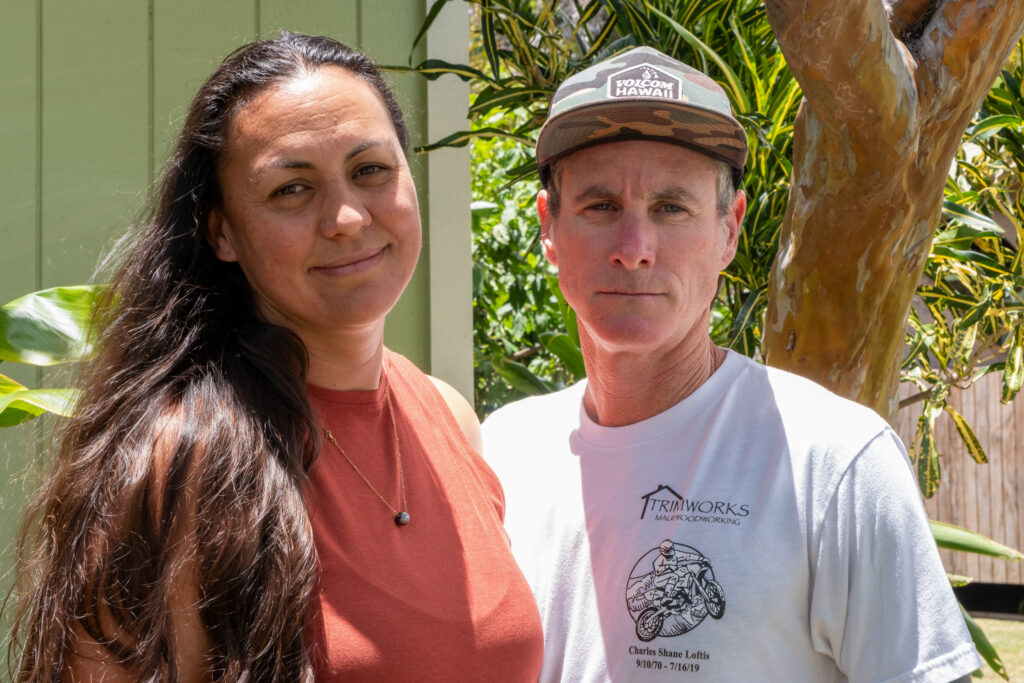
A cool breeze wafted in from the Pacific less than half a mile below as they set up stations for blood collection, lung function tests, and mental health check-ins, directing a team of Ph.D. students and local healthcare providers. Then they waited for the fire survivors to arrive.
Alika Maunakea checks wildfire survivor Nilsson Panis into the Maui Wildfire Exposure Study at the Lahaina Comprehensive Health Center in May. Keerti Gopal
But critical federal support to keep the effort going for at least a decade was running out, and its renewal was uncertain — grant applications had been met with silence for months. And just two weeks before Juarez and Maunakea landed on Maui, state funding they were counting on fell through.
Now, here they were at what might be their last big event to understand how survivors were doing and what help they needed.
Juarez was distraught: It felt like the end. But Maunakea, usually the pessimist of the pair, refused to believe it. He felt the study had to continue. The need was too great. They would find a way.
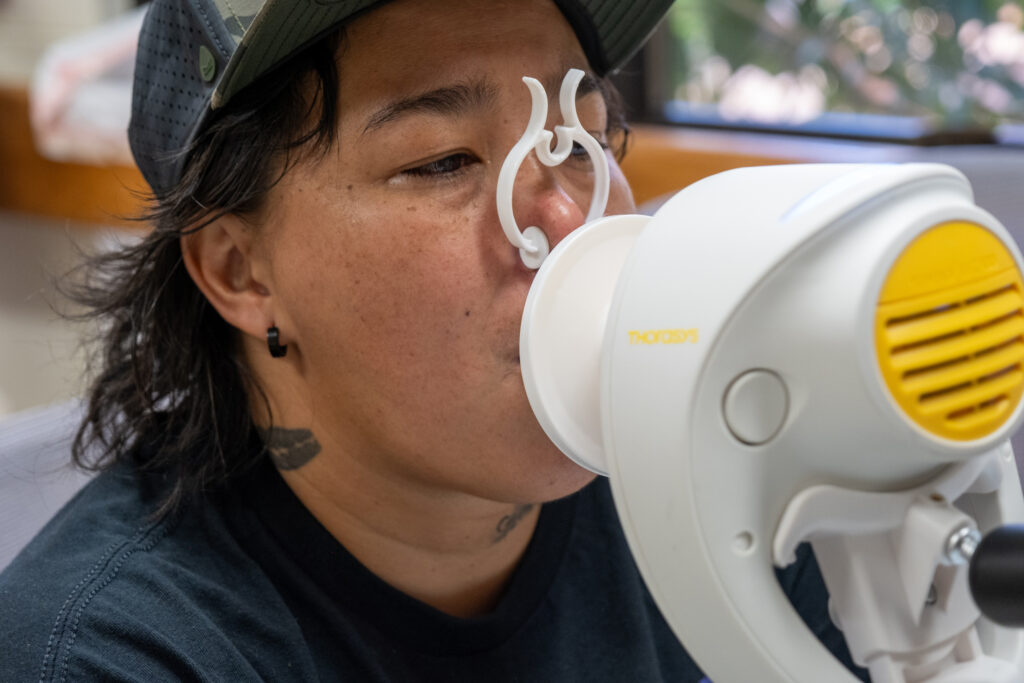
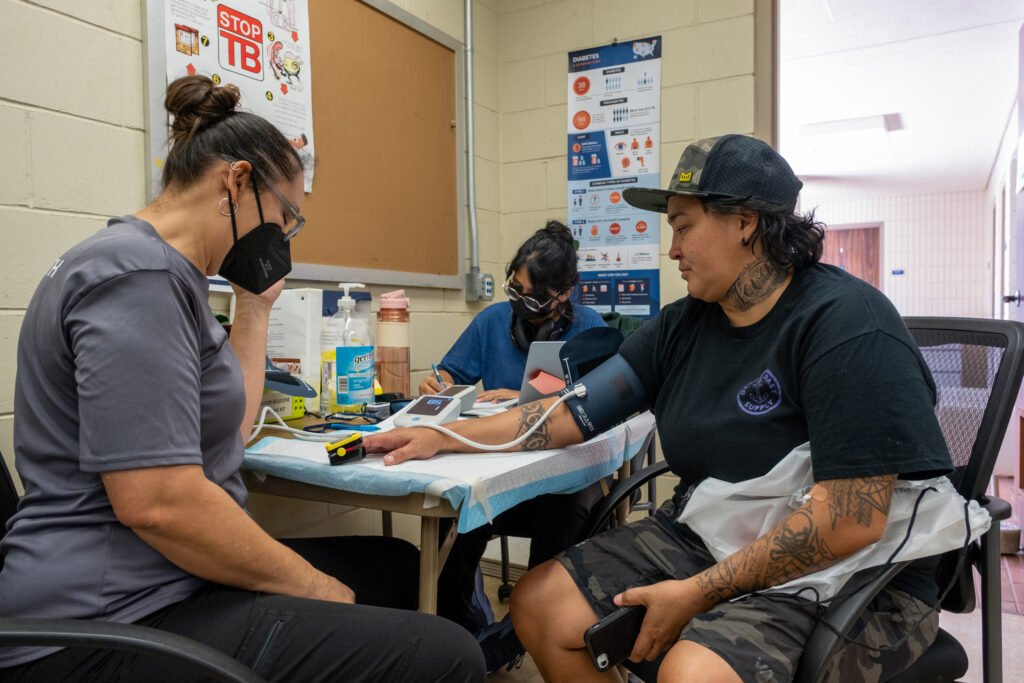
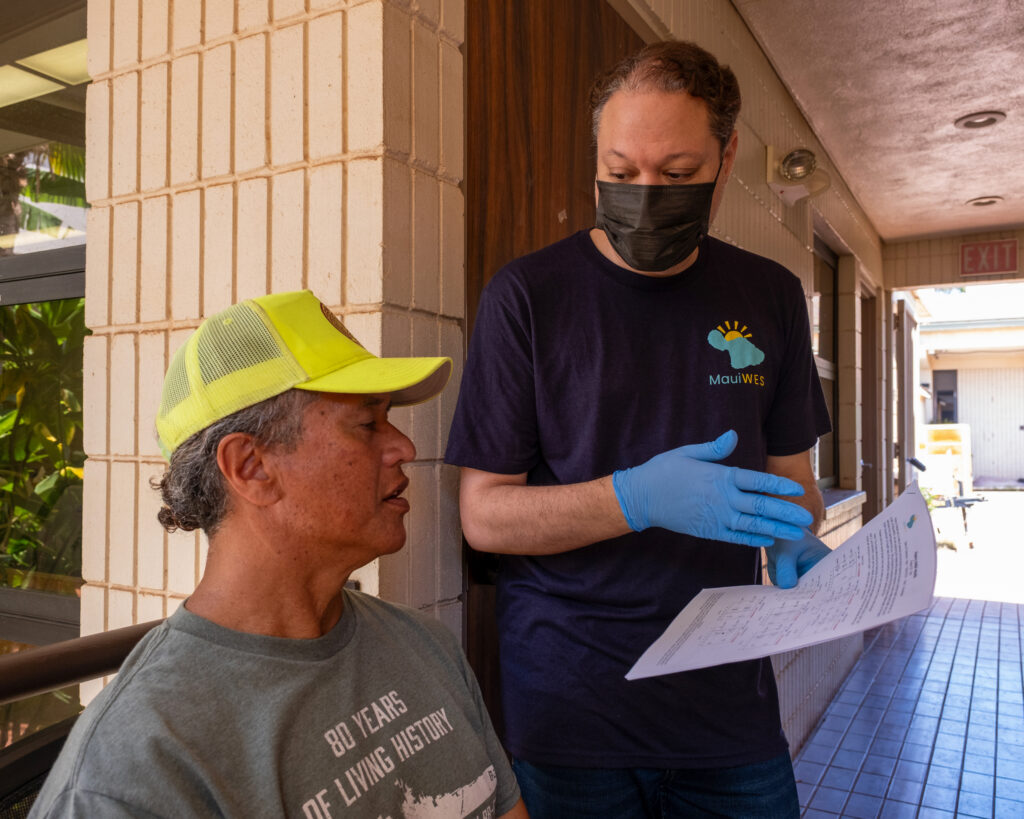
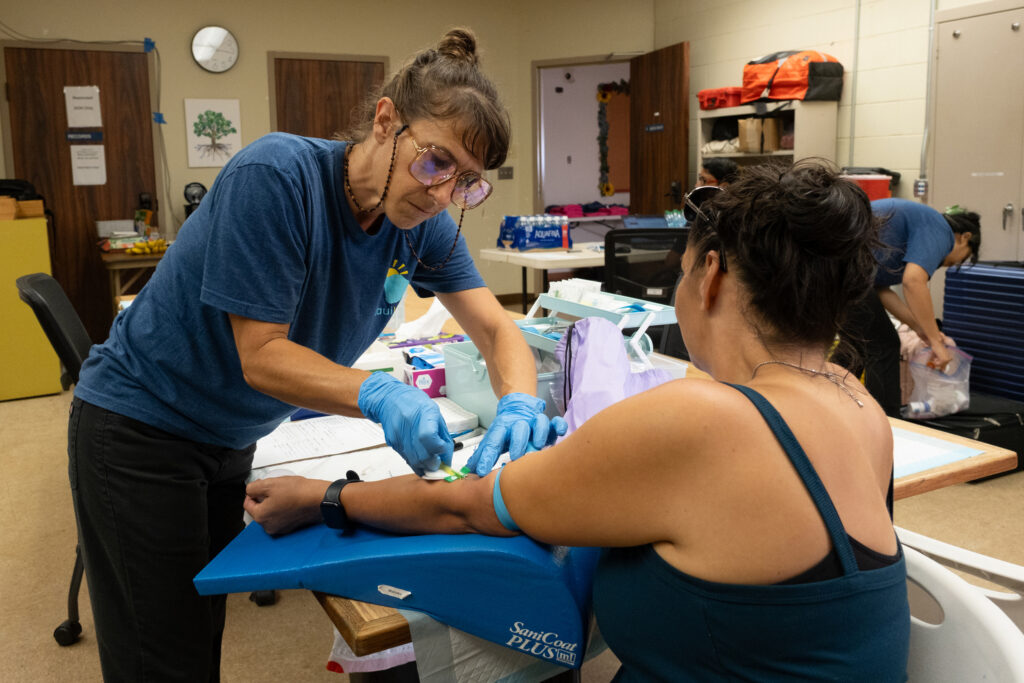
At the health center that Saturday morning, Maunakea greeted Lisa and Nilsson Panis, a pair of siblings born and raised in Lahaina. As he checked them into the study, he explained what they’d do that day. Urine samples to track environmental exposures. Saliva collection for biomarkers of stress and aging. Blood tests for metabolic function. Two assessments of lung health. Recordings of blood pressure, height, and weight. A mental health screener.
At the end of it all, they’d meet with a volunteer physician who would help them understand their test results, and they’d each walk away with $100, compensation for their time.
“We’re trying to do this every year,” Maunakea told the Panises.
He was determined to make that happen.
The lobby of the health center had a dark stain on its ceiling where water had leaked in just a month before.
The building — run by the state’s Department of Health and loaned to MauiWES for the weekend — sits near the base of the sprawling West Maui mountains. That weekend, the foothills above the center were covered in dry, yellowing grass that was nonetheless much greener than usual, courtesy of recent Kona low storms.
The storms swept water damage into construction sites and homes that had just been rebuilt. They busted up highways and caused torrential flooding, triggering millions of dollars in damage across the county. They also kicked off an unusually verdant spring, with flowers blooming on the trees outside the center and along the highway below. Wetness that early can heighten the fire risk later in the year, fueling grass and brush growth that dries out and becomes plentiful tinder, susceptible to heat and strong winds.
Lisa Panis, a participant in the Maui Wildfire Exposure Study, has struggled with her mental and physical health since the fires, and her family is still in temporary housing. Keerti Gopal
Lisa Panis had an appointment with MauiWES that day, but she was hoping they’d have room for her older brother, too. In a fluorescently lit room just beside the center’s main lobby, she introduced Nilsson to Maunakea and explained that he had been a first responder after the wildfires, cleaning up debris in the burn zone. Maunakea immediately instructed the Ph.D. students working the check-in desk to sign him up, along with Nilsson’s girlfriend, another survivor.
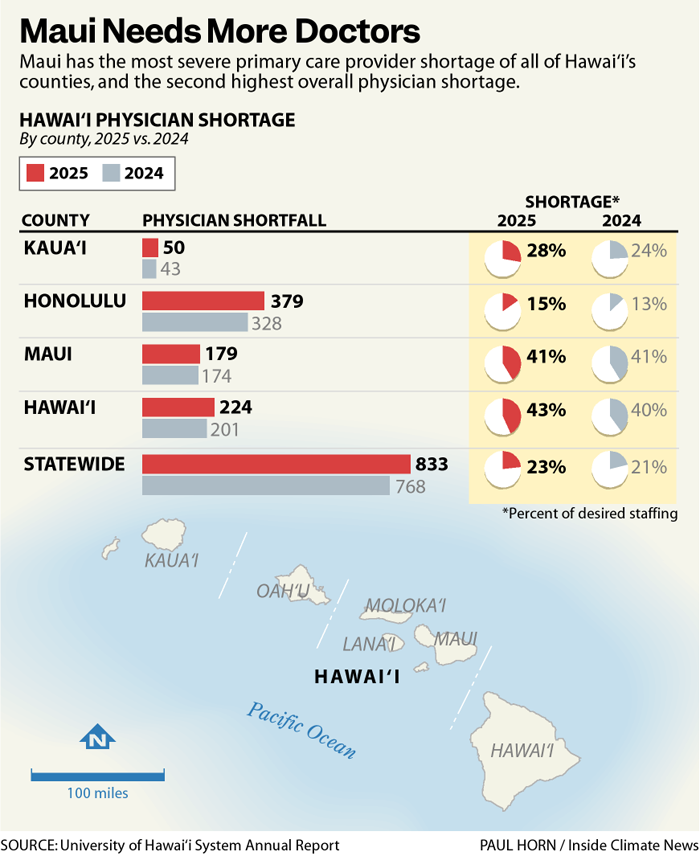
MauiWES had limited resources, especially with funding so up in the air. But on an island already suffering from a severe healthcare provider shortage, Maunakea and Juarez didn’t like turning anyone away.
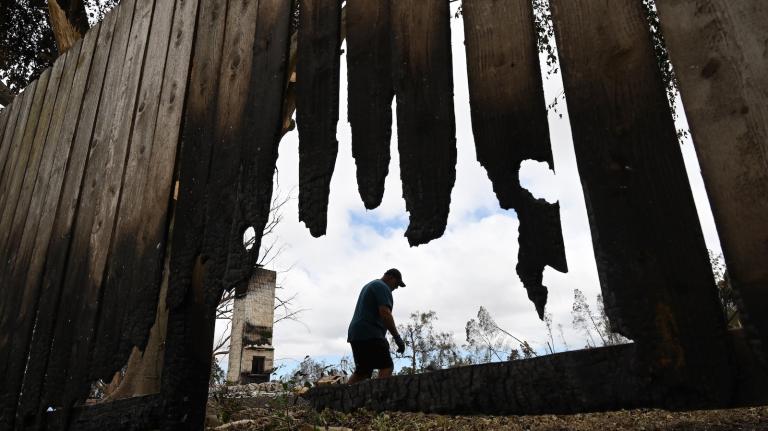
Maunakea listened to Nilsson explain what his life looked like in the months after the fires:12-hour days, seven days a week, clearing the burn zone for a construction company. He wore full-body gear to keep as much of the dust out as possible, but he still ended each day coated in grime. Though he’d never been tested, Nilsson felt confident the constant inhalation of ash and the debris that covered his body as he worked had impacted his health.
“We tried to push all the dust down with water,” Nilsson said to Maunakea, describing the cleanup. “But you cannot get everything.”
“Are you still doing that, or pau?” Maunakea asked.
“Pau,” Nilsson replied. Finished. Now he was working as a mason, bringing his sister on whenever he could. It wasn’t steady. He hoped jobs would pick up in the summer.
The Panis siblings’ father is descended from Filipino immigrants who came to the island to work on the sugar plantations more than a century ago, during a period when American and European companies brought indentured laborers from the Philippines to work under brutal conditions for extremely low pay. The plantations, established before Hawaiʻi’s illegal annexation by the United States and continuing another century after, sucked water out of Lahaina’s once green and fertile hills.
Kelly Panis, Lisa and Nilsson’s mother, sits in her FEMA-built temporary home in May. Three years after the fires, she still does not have permanent housing. Keerti Goapl
That set the stage for modern-day wildfire risks, now worsened by climate change, and cemented a pattern of local disenfranchisement that continued as the tourism industry took hold.
For years, the Panises had experienced the harder realities of life in Lahaina, like gentrification and unstable housing and employment. On the day of the fires, Nilsson was meant to fly back from Las Vegas to spread the ashes of two siblings who had passed away just weeks apart that spring. Lisa was living with an aunt whose home would not survive. She remembers standing on the field next to the post office where she and her brothers played football as kids, watching as flames engulfed the town above and below her.
After they finished checking into the study, the Panis siblings moved through the stations, a sort of medical assembly line: urine samples, then blood tests, then blood pressure, then spitting into a tube. A few feet away, Juarez coached another participant on how to blow into a spirometer to test lung function.
Ruben Juarez explains to a participant in Spanish how to take the lung function test.Keerti Gopal
Amy Jackson, a former trauma nurse, credits MauiWES with saving her life after her hemoglobin was so low she had to go to the hospital.Keerti Gopal
“Sigue, sigue, sigue,” he said, reminding the man to keep breathing out. Throughout the day Juarez greeted Spanish-speaking participants, acting as one of a handful of interpreters who walked people through the study’s tests in English, Spanish, and Tagalog.
Juarez was pulled into Maui’s recovery because of his connections to Lahaina’s abundant immigrant community. One-third of Lahaina residents were born outside the U.S., many in Asia or Latin America. Juarez moved from Mexico to Houston for a doctorate at Rice University, then to Oʻahu for a job at the University of Hawaiʻi. There, he met Maunakea, and as neighbors in the university’s faculty housing, they fell in love.
When they met, Juarez’s research was focused on social networks and Maunakea’s on health disparities in disease. After the fires, Maunakea was drawn to Maui by his connections with people working to address the disproportionate public health burdens faced by Native Hawaiians across the islands. Although he lives on Oʻahu, his great-grandmother, a Native Hawaiian healer, was born in Kula, an upcountry Maui community that was also badly impacted by the 2023 fires.
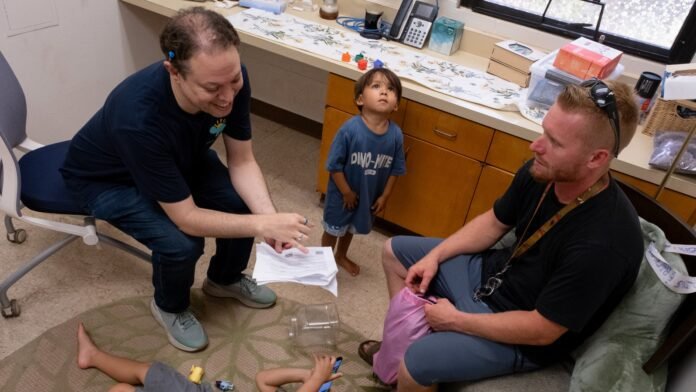
emotional distress and trauma in adults and children, and connected many with therapists.
During a weekend collection event in May, the Lahaina Comprehensive Health Center was bustling with families, healthcare workers, and researchers. MauiWES has seen 2,500 participants in three years. Keerti Gopal
On an island with a severe shortage of physicians, MauiWES was also most early participants’ first time seeing a doctor after the fires. Over the past three years, the team made some big saves.
In August 2024, one year after the fires, a former trauma nurse named Amy Jackson had such a low hemoglobin count that it wasn’t registering on MauiWES’ testing system. The team urged her to go to the emergency room immediately. Jackson had signed up for the study because the cash would be a good birthday present for her daughter. If it wasn’t for that, she wouldn’t have gotten checked out at all.
At the hospital, she remembers a doctor telling her he was amazed she was still alive. She was admitted and treated, and she credits MauiWES with saving her life.
Lisa and Nilsson Panis wait for their test results at the Lahaina Comprehensive Health Center. Keerti Gopal
In February 2024, another participant presented with symptoms suggesting a serious lung infection. Volunteer physicians were concerned and said she needed medical attention right away. But she was an undocumented immigrant and one of the 10 percent of study participants who had both lost their jobs in the fire and weren’t eligible for state insurance.
Juarez coordinated with Roots Reborn — a local organization supporting Maui’s immigrant community — and reached out the next day to ask an insurer with a charitable health coverage program to consider an emergency enrollment.
She got the insurance and then the treatment she needed. She’s one of more than 200 participants Juarez estimates have been connected with private insurance via Kaiser Permanente because of interventions from MauiWES and Roots Reborn. He was happy to see her now, in good spirits and good health, coming in for her follow-up at the May collection event. He thought the immigrant population had the most to lose from the study ending.
The team still had so much to do.
Alika Maunakea walks MauiWES participant Ekolu Lindsey through his test results, including a panel on heavy metals. Keerti Gopal
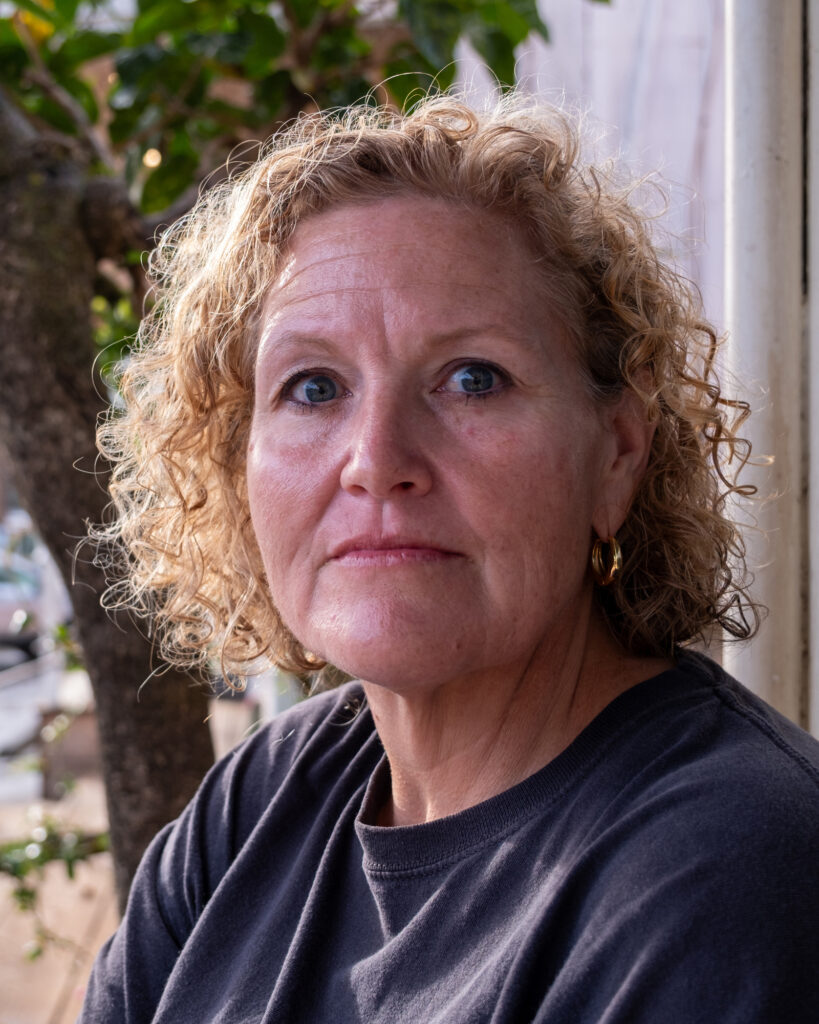
After her lung test, Lisa Panis stood underneath the stain on the lobby’s ceiling and waited for her brother. The Panis siblings stay strong for one another. But she’s experienced depression since the fires, like many other survivors, and her tests revealed elevated levels of several toxic metals in her body.
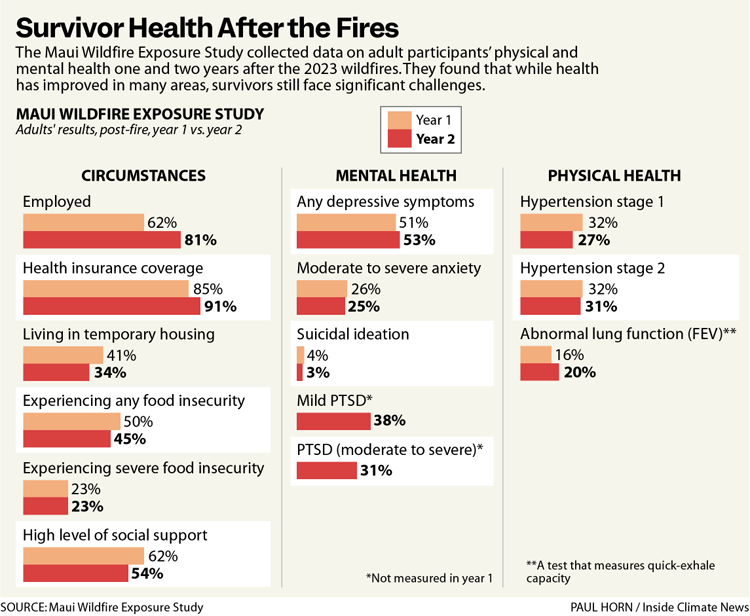
In their first, smallest cohort, about six months after the fires, Juarez, Maunakea, and their colleagues found that about half of study participants were experiencing breathing problems that suggested ongoing, residual impacts from wildfire smoke. They’ve also found that poor lung function was linked to elevated levels of heavy metals in participants’ urine, including some of the same metals the health department found in the burn zone.
After looking at so many test results, Maunakea can guess with considerable accuracy what neighborhood a participant lives in just by seeing the distribution of metals in their body. Some of that contamination may predate the fires. But the health implications are the same.
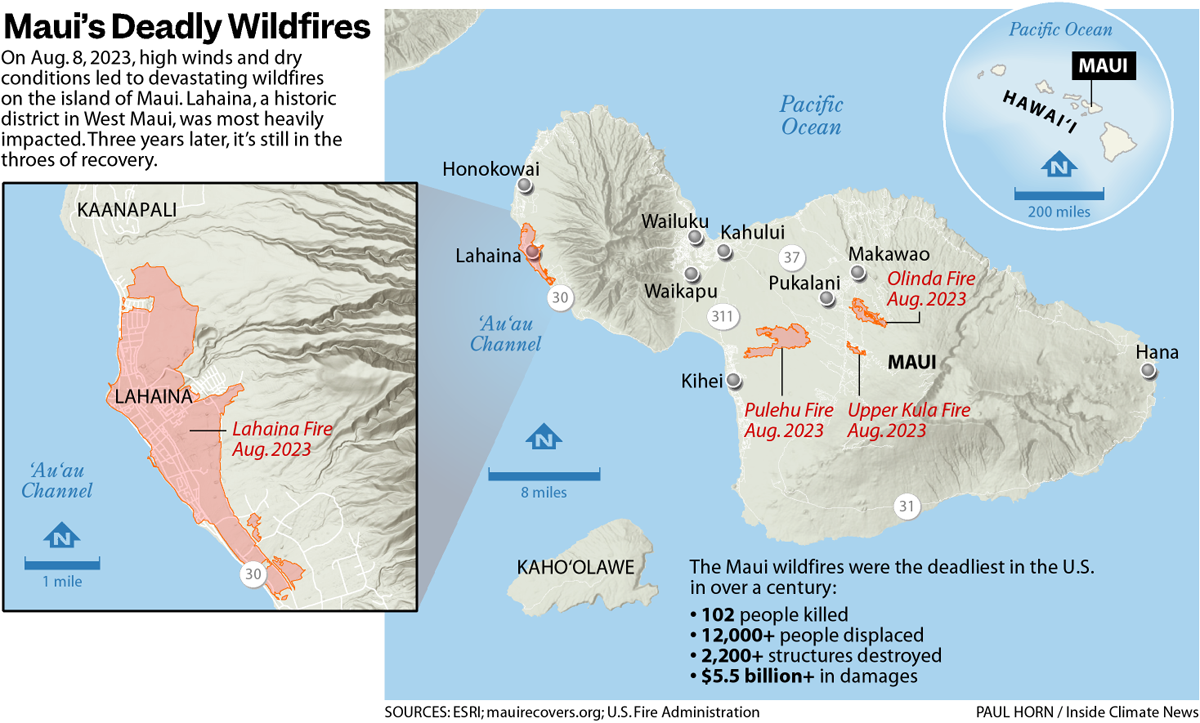
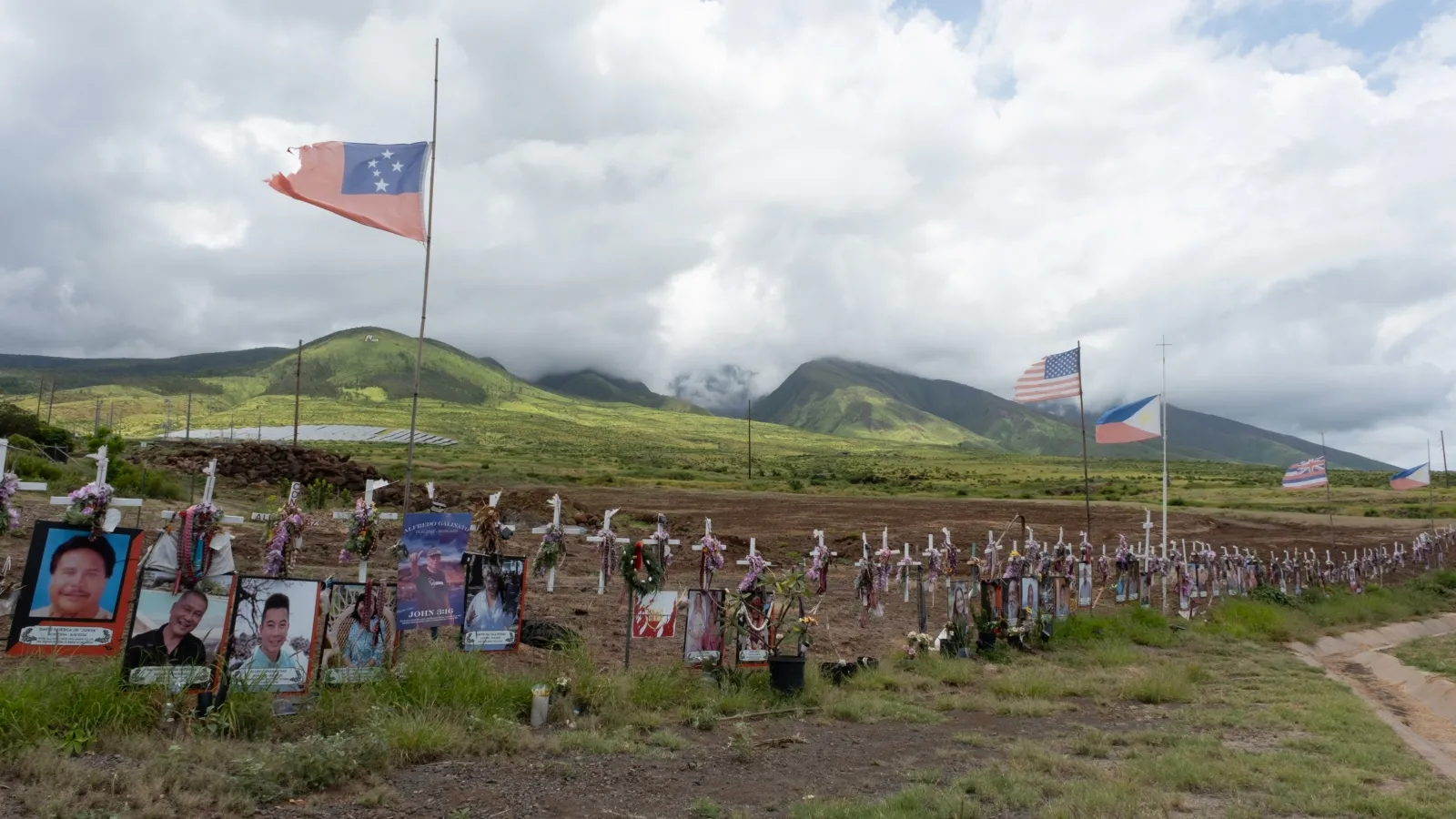
Lahaina residents lay flowers at a memorial for the at least 102 people who were killed in the 2023 fires, the deadliest the U.S. has seen in more than a century. Keerti Gopal
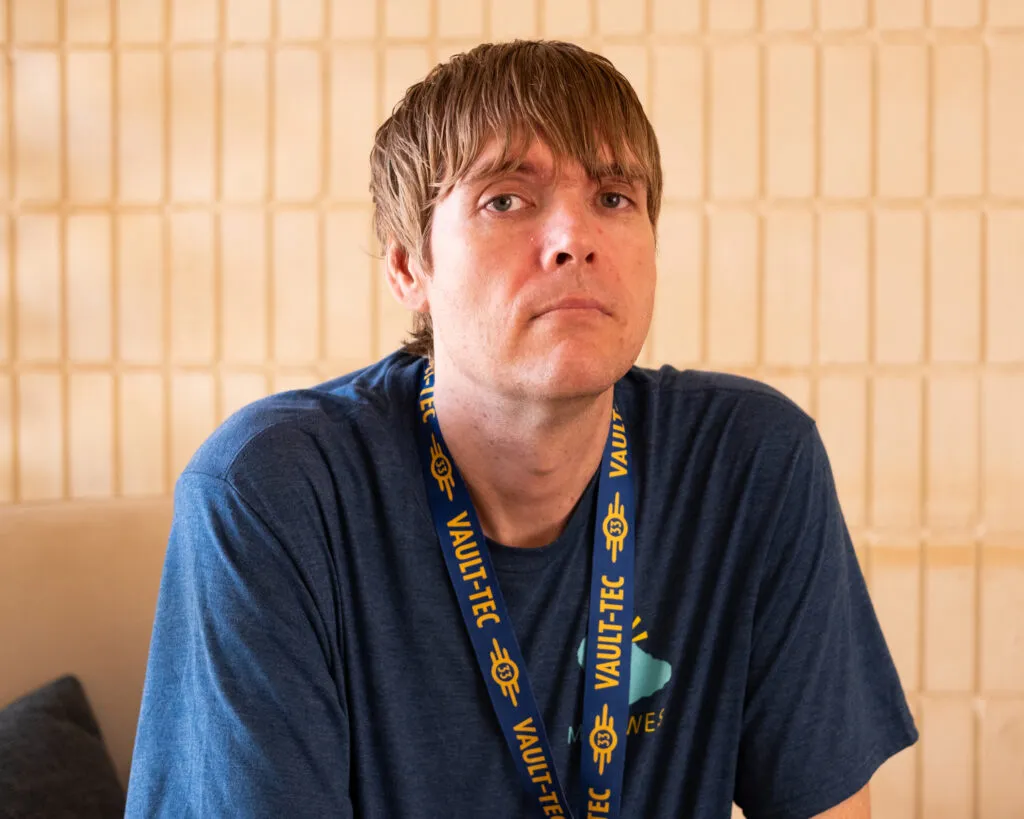
Before Nilsson Panis left for the day, Juarez gave him a T-shirt with the MauiWES logo — a sun rising behind the island — and a hundred-dollar bill. Then he ushered him over to the front desk, where a case manager who works for the Department of Health was waiting.
She asked Nilsson if there was anything he might need help with.
He paused for a moment before answering. Maybe some assistance with food, he said. He also asked about opportunities to volunteer and help other survivors.
The case manager took down his email.
The next day Maunakea supervised a group of staff and volunteers administering lung function tests. A participant wearing a neon-yellow baseball hat and flower-patterned shorts walked in and took a seat.
“It’s unfortunate that you guys didn’t get more additional funding from the legislative session this time,” Ekolu Lindsey said to Maunakea as he took a break from breathing hard into a plastic mouthpiece.
It had been MauiWES’ most recent funding attempt: A bill sponsored by the state senator for West Maui, Angus McKelvey, would have allotted $3 million to keep the study going and expand the number of children it could serve. But at the last minute, the bill failed to make it through.
“I get it, they went for the bigger-ticket items, but the health part is also a big-ticket item that didn’t take precedence,” continued Lindsey, who is the president of a grassroots land trust organization on Maui. “I don’t think they understood, because probably none of them went through it.”
Maunakea agreed. He had thought that public health would be more of a priority in the wildfire recovery, especially in a state with a doctor as a governor. But funding MauiWES has been an ongoing challenge.
The study’s first cohort, in early 2024, began with charitable funding from the Hawaiʻi Community Foundation and Kaiser Permanente, while the researchers pursued government support. That summer, they got $2.3 million from the state. And almost one year after the fires, they received a $1.4 million grant from the National Institutes of Health’s minority health disparities program.
That support quickly turned precarious after Donald Trump retook office and slashed funding for programs focused on diversity or health disparities, along with a wide swath of academic research.
Since the 2023 wildfires, the Maui Wildfire Exposure Study has tested more than 2,500 participants for a range of physical and mental health impacts. Keerti Gopal
The MauiWES researchers hoped to renew their federal funding and keep the study going for at least a decade. But heading into the May event, applications they submitted to the agency had been languishing without a decision for more than a year. By that time, the NIH had lost 23 percent of its staff under the Trump administration, almost double the reduction across the entire federal government, according to an analysis by Inside Climate News.
The MauiWES researchers started getting national recognition in the disaster recovery space, speaking on panels and presenting at conferences on the mainland, hoping that might drum up more cash. But private funding wasn’t enough to keep the study going, and the speaking engagements had yet to pay off. More state funding seemed like Juarez and Maunakea’s best hope.
Initially, the team had strong backing from the state’s Department of Health, which wrote enthusiastic letters of support for federal grants. But as the study progressed and the researchers began publicizing their results, the agency pushed back.
The Department of Health had earlier screened 557 West Maui residents for lead in their blood, saying in May 2024 that so few had elevated levels that it was not necessary to screen the general population for toxic substances identified in the burn zone.
Christopher Knightsbridge leads the mental health portion of the Maui Wildfire Exposure Study. He worries about study participants who are still facing acute, ongoing trauma due to fallout from the fires. Keerti Gopal
“On the basis of these results with lead as an indicator of exposure, we do not expect to find health impacts caused by toxins in the wildfire ash,” agency director Kenneth Fink said in a statement at the time.
But lead is just one of the toxic substances the department found at elevated levels in burn zone ash, and it’s undetectable in people’s blood relatively quickly after exposure, unlike some other substances found in the burn zone. Environmental health experts questioned why the department used a limited sampling of lead to draw broad conclusions about the burn zone as a whole.
Then MauiWES found elevated levels of heavy metals associated with heart and lung issues and cancer risks in a cohort of more than 1,200 fire survivors.
As of early October 2026, more than 360 Maui families are still living in temporary FEMA housing, and another 169 are receiving rental assistance from the federal agency. MauiWES researchers have found that temporary or unstable housing is a strain on survivors’ health. Keerti Gopal
The findings seemed to contradict the Department of Health’s assertion that the burn zone was safe. Emails and letters Inside Climate News obtained through public records requests suggest that agency staff quickly moved into damage-control mode.
The day after Honolulu Civil Beat published a story about the preliminary findings last year, a naturopathic doctor on Maui emailed state toxicologist John Jacob for information about the effects of heavy metals like arsenic, nickel, cadmium, mercury, and lead on psychological function. Her clients had been tested by MauiWES and registered high levels of those metals, she wrote.
Jacob forwarded the email to colleagues at the Department of Health.
“I don’t want to affirm what UH is stating,” he wrote, referring to the University of Hawaiʻi. “The panic has begun!”
A few days later, agency staff discussed whether to stop assisting MauiWES with data collection. Fink, the director, said staff could continue for now, but he felt the department’s recommendations on study design had been either inadequate or disregarded. “If the latter, I would need to reevaluate our involvement,” Fink wrote to colleagues.
In October, the Department of Health sent a letter to the University of Hawaiʻi, criticizing MauiWES’ reliance on sampling survivors who showed up — as opposed to a randomized cohort — and its findings of elevated heavy metals in their urine.
Read Next
The university defended the research in its response and explained that MauiWES was not claiming a definitively causal relationship between the fires and the heavy metals.
Although the team remained committed to working with the state, Juarez said he saw the Department of Health’s letter as an attempt to censor their research. Academics not involved with MauiWES told Inside Climate News the exchange seemed unusual for a university and a state agency, and they did not think the health department’s dismissal of burn-zone dangers was warranted based on the limited information it had collected.
The agency’s director said in a statement to Inside Climate News that discussions about the best way to approach research “are a normal and healthy — and often essential — aspect of scientific collaboration.”
“While our perspectives may differ, both DOH and UH remain committed to respectful dialogue and evidence‑based inquiry,” Fink wrote in his statement. “Most importantly, the public needs clear, accurate, and consistent information about how the wildfires may have affected their health. Residents deserve timely communication they can trust — free of speculation and grounded in the best available data.”
In an emailed statement to Inside Climate News, Jacob acknowledged that the researchers’ approach was acceptable but said that not disclosing limitations could “result in confusion among the general public.”
In defense of the agency’s own approach to quantifying post-wildfire health risks, a department spokesperson said in an email that a structured soil sampling technique allowed staff to use the lead screening as a “reasonable indicator for population exposure.”
In internal emails in January, agency staff discussed a bill with funds earmarked to keep MauiWES alive. They agreed to keep a close watch on the effort. “Especially since we are not satisfied with their science,” wrote Jacob, the toxicologist.
In the end, a department subagency was among those submitting testimony in support of the funding. But that wasn’t enough to push it through. When the bill fell short with still no word on federal money, it looked like the end of MauiWES.
At nearly 5 p.m. on Sunday, the team packed up while finishing tests for the last few stragglers. Most of the staff and volunteers had to catch a flight back to Oʻahu in a couple of hours, but Christopher Knightsbridge, a therapist working on the study’s research team, would stay on Maui a few more days to see patients in person.
Knightsbridge was overcome with pure frustration. All weekend, he’d done mental health check-ins with participants still focused on getting by, day by day. He felt certain the study was having an impact. He saw it every week. And he was still concerned about what he’d been hearing in his sessions. He wanted his patients to wake up and feel like they were living, not simply fighting to survive. For that, they needed more support, not less.
Knightsbridge poured everything he had into supporting survivors’ mental health in recovery. He spent half of most weeks away from his wife and young children on Oʻahu to see patients still dealing with ongoing crises: survivors in temporary housing and unstable employment, people with cancer diagnoses, young children whose lives were turned upside down by the fires. He’s seen serious PTSD symptoms, depression, and even suicidal ideation from kids as young as 6.
That same week, he sat in his video gaming group for kids at the health center with two of Mikey and Rob Burke’s sons, the twins dealing with PTSD. Knightsbridge was seeing both boys for therapy and organized the gaming group as another form of support, a low-stakes place for kids to open up. But the federal emergency grant supporting his position — separate from MauiWES’s funding — was also about to run out.
Read Next
On the other side of the lobby, Juarez stood in a doorway, gutted. The study had made painfully apparent the gaps in healthcare access on the island, and it felt like their work was just beginning. The thought brought him to the brink of tears. Throughout the weekend, he heard from worried participants who asked if the study was going away. He didn’t want to let them down.
Near the entrance to the courtyard, Maunakea carried a table from the hallway back into one of the offices, tired but heartened by how many people had come through. Sitting with returning participants, learning about their recovery journeys and watching how they were putting the pieces back together was energizing for him. Healing is a communal task in Lahaina. The study leaned into that.
Maunakea knew the next disaster was just around the corner. He believed Maui could adapt and offer a model to the rest of the world for building resilience to the steep challenges climate change brings.
Maybe, he thought, that would be the ultimate lesson from the study: that documenting and addressing health inequities in the wake of a disaster helps communities withstand what they cannot escape.
Toward the end of the day, more survivors arrived without appointments after hearing about the study from family and friends. By closing, he estimated the team had turned away more than a dozen new people, taking down their names in case funding came through. Maunakea met people that weekend who said they’d known about the study for several years but hadn’t felt ready to participate until now. It hammered home to him how crucial it was for their work to go on.
The team would find a way to continue the study, Maunakea felt certain. He didn’t know how, but he saw no other choice. If his great-grandmother was alive, she would have said: ‘O ka pono ke hana ‘ia a iho mai nā lani. Continue to do good until the heavens come down to you.
He believed that this study is pono, and that the community wanted and needed this service. So, somehow, iho mai nā lani. The heavens would come down.
Inside Climate News’ Peter Aldhous contributed to this story.
Israeli opposition leader Yair Golan accused caretaker Prime Minister Benjamin Netanyahu on Saturday of neglecting the lives of Arab citizens and leaving them at the mercy of criminal groups after a grenade attack killed a woman and injured three others in northern Israel, Anadolu reports.
“A bomb explodes in broad daylight in the village of Kafr Manda. People killed and many injured. This is what the Netanyahu government’s policy of neglect looks like,” Golan, who leads The Democrats party, wrote on US social media company X.
“Netanyahu neglected the lives of Arab citizens in Israel. When he appointed Itamar Ben-Gvir as national security minister, he handed them over to criminal organizations,” Golan said. He added that those groups had grown stronger under Netanyahu and Ben-Gvir and now posed a threat across Israel.
“We will form a government of change that takes responsibility, fights criminal organizations and restores personal security to all Israeli citizens, Jews and Arabs,” he said.
Lina Qassem Zidan, 51, was shopping at a sweets shop in a busy commercial area of Kafr Manda, an Arab town in the Galilee, when a grenade was thrown at the shop, Israeli media reported. Medics took her to Rambam Hospital in Haifa in critical condition, and she was later pronounced dead. A man and a woman in their 50s were moderately injured, and another man sustained minor injuries.
READ: Israel’s Eisenkot denounces ‘racist, hostile’ campaign against Arab citizens, cites progress in coalition talks
Israeli media reported that, according to an initial assessment, the attackers were looking for a specific person and threw the grenade at a shop owned by one of his relatives after failing to find him.
Zidan’s death brought the reported number of homicide victims in Israel’s Arab communities since the start of the year to 200, including 20 women, according to Israeli media. Residents of Kafr Manda said homes and businesses had been targeted in a series of shootings and grenade attacks over the past month, with no arrests announced.
On Friday, Gadi Eisenkot, who has been tasked with forming Israel’s next government, accused Netanyahu of fueling a “racist and hostile” campaign to delegitimize Arab citizens, who make up more than one-fifth of Israel’s population.
President Isaac Herzog gave Eisenkot, the leader of the Yashar party, the mandate on Nov. 8 following the Oct. 27 parliamentary elections. Lawmakers representing 67 seats in the 120-seat Knesset recommended Eisenkot, while 46 backed Netanyahu and seven United Torah Judaism lawmakers recommended neither candidate.
Eisenkot has 28 days to form a government, with a possible 14-day extension.
READ: Netanyahu discusses possible resumption of attacks on Iran with Eisenkot: Israeli media
At 93 years old, country music legend Willie Nelson has made a startling admission about his troubled younger years, revealing that his drinking, drug use and reckless lifestyle were so extreme he never expected to live long enough to become an old man.
The “On the Road Again” singer, who has spent more than seven decades entertaining audiences, opened up about his past in a revealing interview with The Guardian, admitting that surviving into his 90s is something he once considered almost unimaginable.
“I don’t think anyone expected me to live beyond 21, the way I was going,” Nelson confessed.
The music icon didn’t hold back when describing the destructive habits that dominated his early life. Heavy drinking, cigarettes and an assortment of pills were all part of a lifestyle he now recognizes was dangerous.
Nelson even joked that whenever he encountered something he shouldn’t do, he was likely to do it twice.
For years, the singer’s excessive drinking became a serious problem. Whiskey was his preferred drink, and he has previously acknowledged that alcohol brought out an unpleasant side of his personality.
By 1978, Nelson had decided to make a major change, giving up alcohol and other drugs apart from marijuana. He believes that decision played an important role in keeping him alive.
But leaving his wildest years behind didn’t mean Nelson escaped the consequences of decades of smoking.
The country star has endured numerous health problems, including pneumonia, emphysema and a collapsed lung. Those respiratory issues eventually forced him to abandon smoking marijuana at age 86.
Although he continues to use cannabis in edible form, Nelson says protecting his lungs has become a priority.
His wife, Annie D’Angelo, has helped him make that adjustment, even preparing marijuana-infused chocolates that allow him to continue using cannabis without smoking it.
Nelson’s health struggles have occasionally become frighteningly serious.
In his newly released memoir, “The Last Leaf,” the singer recalls a devastating battle with COVID-19 in May 2022 that left him struggling to breathe.
According to an excerpt published by People, his condition became so severe that he twice asked his wife to let him die. Annie refused to give up on him, helping arrange medical care as he fought through two agonizing weeks.
The experience was another reminder of just how close Nelson has come to losing his life.
Yet despite everything, the legendary performer has continued doing what many musicians decades younger can only dream of.
He released his 79th studio album, “Dream Chaser,” in 2026 and performed dozens of concerts over the previous year, including an appearance at Farm Aid, the organization he helped establish in 1985.
Still, reaching 93 has brought its own heartbreak.
Nelson has watched several of his closest friends and musical collaborators pass away, including fellow Highwaymen Johnny Cash, Waylon Jennings and Kris Kristofferson.
Their deaths have left him reflecting on what it means to be among the last surviving members of one of country music’s most celebrated groups.
He admitted feeling extraordinarily fortunate to still be alive, even as he continues mourning the friends who are no longer beside him.
The singer has also become surprisingly comfortable discussing his own mortality. Rather than dwelling on the possibility of death, Nelson says he believes life continues in another form after people pass away.
For a man who once doubted he would survive his early 20s, reaching his 90s has given him an entirely different perspective on life.
And although his age and health challenges might suggest it is time to retire, Nelson has shown little interest in stepping away from music.
In fact, when asked about his remarkably long career, the country legend offered a characteristically humorous response, joking that he had already been retired for 50 years.
After surviving decades of excess, serious illnesses and the deaths of some of his closest friends, Nelson remains determined to enjoy whatever life brings next.
Screenless GPS: Slate Auto says, “Remember the road atlas”
Whether it’s nostalgia or a sense that technology has gotten a bit too pervasive, there’s no denying that Slate Auto appears to be tuned into the particular moment. The startup has a simple pitch: an affordable electric truck with just the basics, leaving owners to DIY and BYOD for everything else, all for a sub-$25,000 starting price.
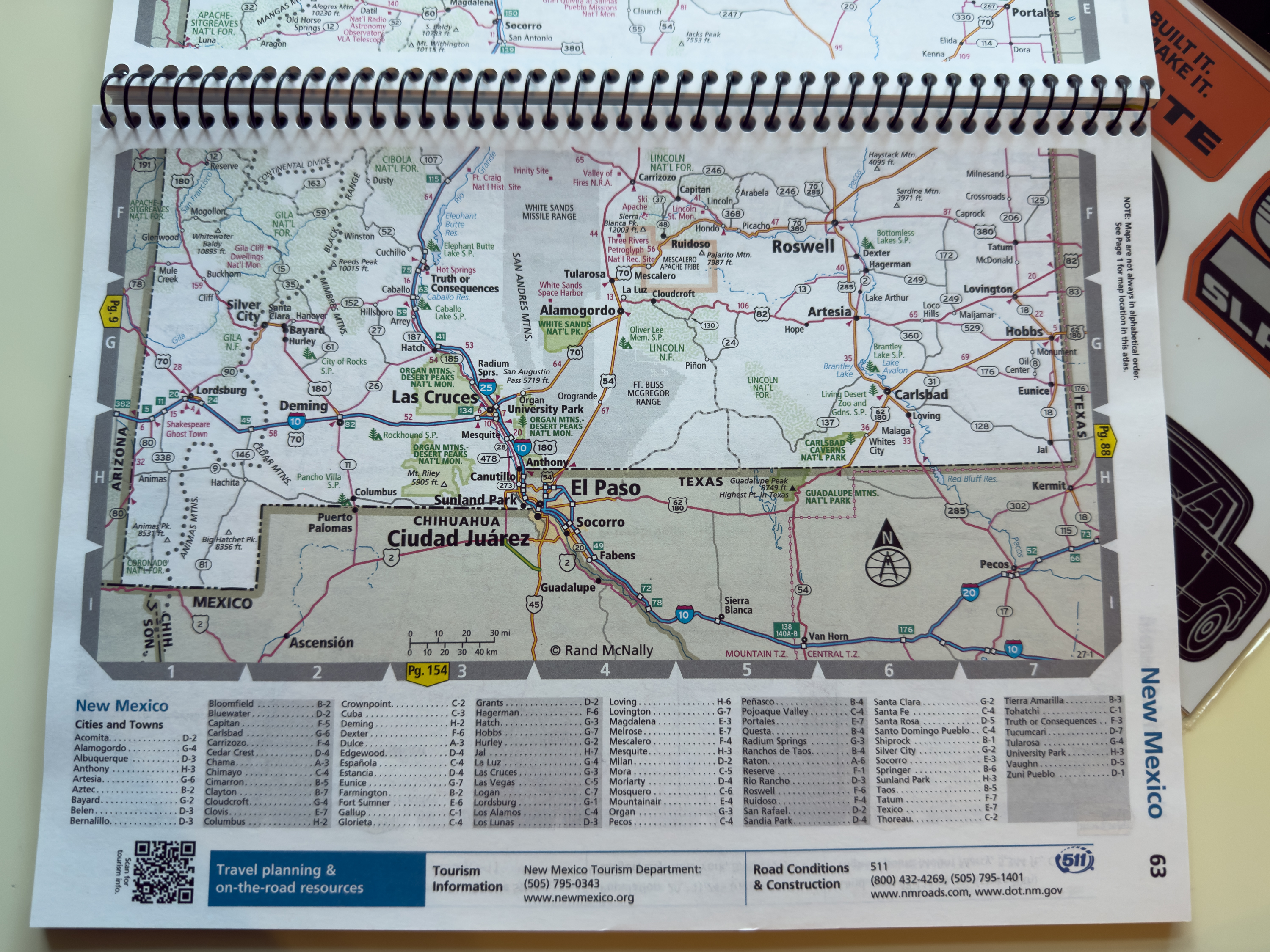
Among the things Slate does without is an embedded infotainment system. The small digital display on the dashboard that shows your speed and range is also where the backup camera appears if you engage reverse, and there are two USB-C ports that provide power but not connectivity, and that’s that. But there is a solution to getting lost, and it’s called “Screenless GPS.” Even though we don’t have a Slate truck to test it with, the OEM sent us a unit to review.
That’s right, it’s a good old spiral-bound road atlas! “We believe you should use the devices you know and love,” Slate says, and it reckons that maps worked just fine for past generations, so they should still work now.
Remember these?
Jonathan Gitlin
Remember these? Jonathan Gitlin
OK, so it’s not turn by turn. I accept that.
Jonathan Gitlin
OK, so it’s not turn by turn. I accept that. Jonathan Gitlin
Remember these? Jonathan Gitlin
OK, so it’s not turn by turn. I accept that. Jonathan Gitlin
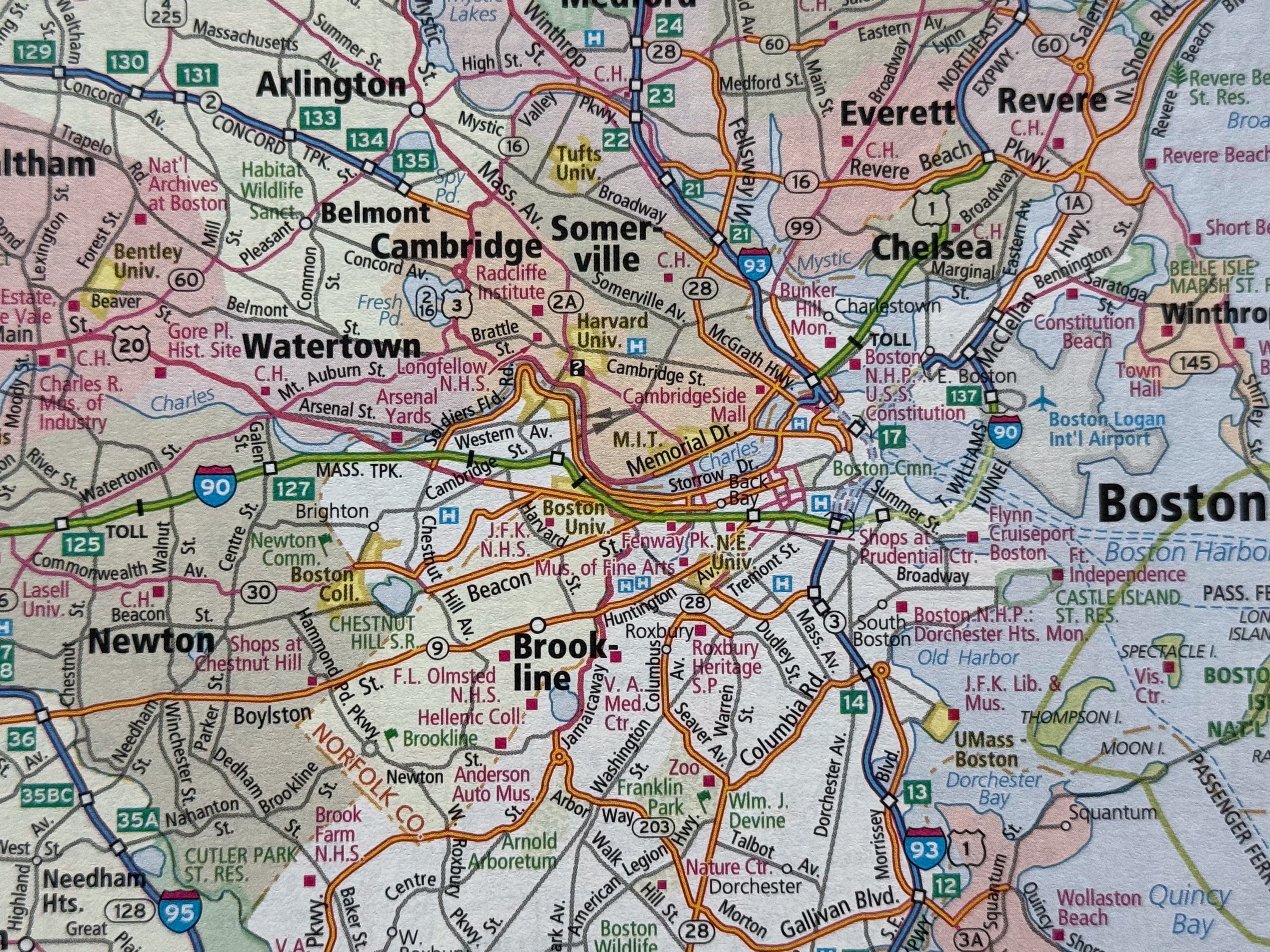
The Rand McNally 2027 Road Atlas isn’t quite as detailed as the maps being made for automotive navigation by companies like here. Those are designed to be read by computers, not people, with rich data on not just places of interest but also live traffic, road conditions, and the accuracy required for assisted and autonomous driving systems. Any OTA updates to the atlas must be applied by Post-it note, and its 154 pages cover the United States, Canada, and Mexico, in full color.
The system is entirely portable, and it’s vehicle-agnostic: you can use it as easily in a Ford, Ferrari, or Fisker as in a Slate. Some might find the idea a little contrived, but having spent some time behind the wheel of the refreshingly simple truck, I think it fits the vibe perfectly. The automaker has added its screenless GPS system to its store for a limited time, and the review copy Slate sent Ars, along with the sticker pack, will be up for grabs in our end-of-year charity drive.
China’s Xi says Taiwan ‘reunification’ must happen as history cannot be stopped
cde.news desk · 3 min read
The tide of history cannot be stopped, Chinese President Xi Jinping said on Thursday, as he urged complete “reunification” of Taiwan with the motherland and pledged to do so peacefully, making no mention of the use of force.
China views democratically-governed Taiwan as its own territory, despite Taipei’s strong rejection of that claim, and has repeatedly offered a “one country, two systems” model of autonomy not supported by any major Taiwanese political party.
Resolving the Taiwan question is an “unwavering historical mission” of China’s Communist Party, Xi said in a speech in Beijing’s Great Hall of the People.
“The tide of history cannot be stopped,” Xi added. “The complete reunification of the motherland must be realised, and it will certainly be realised.”
Xi’s comments came in a speech on the 160th birthday of revolutionary hero Sun Yat-sen who helped lead a 1911 revolt that ended centuries of rule by emperors and empresses and ushered in the Republic of China.
Xi said China adheres to “peaceful reunification and the policy of ‘one country, two systems’” and is willing to talk to Taiwan while upholding the “one-China principle”, or Beijing’s position that both sides of the Taiwan Strait are one country.
All Chinese, including those in Taiwan, should join hands to jointly oppose Taiwan independence “separatist” forces and strive for peaceful development of cross-Strait ties, Xi added.
Taiwan’s government did not immediately respond to a request for comment.
Despite Xi not mentioning the use of force, which China has never renounced for Taiwan, its military operates around the island on a daily basis, and is extending its reach further into the Pacific.
TAIWAN TELLS PEOPLE TO STAY AWAY
Xi’s speech comes a week ahead of the APEC summit in China’s southern tech hub of Shenzhen, where he is due to again meet US President Donald Trump, and also a little more than two weeks before important local elections in Taiwan.
Last month, Taiwan called on its people to steer clear of any of China’s events to mark the Sun anniversary, saying China had a distorted view of him and his legacy.
Beijing calls Sun a great national hero and patriot, as well as the forerunner of the 1949 communist revolution that forced the defeated Republic of China government to flee to Taiwan, where it remains to this day.
Xi said Sun was a great national hero, a great patriot and a “great pioneer of China’s democratic revolution”.
“Mr. Sun Yat-sen consistently upheld the unity of the country and the solidarity of the nation, and he firmly opposed all words and actions that split the country or the nation,” he added.
‘FATHER OF THE NATION’
In Taiwan, Sun is officially considered the “father of the nation” and his portrait hangs in the presidential office, though his political philosophy, “Three Principles of the People”, is no longer a required text for schoolchildren.
While Taiwan President Lai Ching-te and his ruling Democratic Progressive Party champion Taiwan’s separate identity from China, they have been striking a tougher tone with Beijing on the role of the Republic of China.
Taiwan has been particularly upset by Beijing’s effort to claim credit for the victory in World War Two, saying it was the Republic of China government that fought alongside the allies, as the People’s Republic of China did not exist at the time.
China says Lai is a “separatist” and has refused to speak with him. Lai says only Taiwan’s people can decide their future.
Next Time, Impeach Pete Hegseth for Press Censorship
Seth Stern is the director of advocacy for Freedom of the Press Foundation.
Before the effort to impeach him failed Tuesday, Pentagon chief Pete Hegseth lashed out at a group he despises even more than “beardos” and “weirdos”: the press. His security team threatened to physically remove journalists from a news briefing, Hegseth’s first in several months, if they didn’t maintain decorum.
It’s nothing new for Hegseth. He may want to pump soldiers up with testosterone, but he’s spent the last couple years trying to neuter the Fourth Estate. It’s unfortunate that his unconstitutional attacks on journalists were not part of the official case for removing him. Next time, they should be. And Congress should not stop with Hegseth.
The impeachment resolution Rep. Thomas Massie, R-Ky., brought against Hegseth included eight articles, alleging that the so-called Secretary of War acted illegally in military campaigns in Iran, Venezuela, and the Caribbean, among other things. The resolution touched on free speech violations – Article VI is about Hegseth’s retaliation campaign against Sen. Mark Kelly, D-Ariz., for reminding troops of their right to refuse illegal orders – but it didn’t mention the press.
A recap is in order: In February of 2025, Hegseth’s Pentagon evicted the New York Times, NBC, Politico, and NPR from their dedicated workspaces in the building, replacing them largely with sycophantic right-wing outlets like Breitbart and One America News Network. Some elements of the fawning right-wing press were on full display during his Tuesday press conference: “How does it make you feel,” asked a reporter from an outlet called Real America’s Voice, “when our own politicians don’t support taking out the narco-traffickers that kill their own constituents?”
Months later, Hegseth concocted a requirement that journalists who wish to access the Pentagon pledge not to solicit unauthorized information from the government, under threat of losing their credentials. Dozens of reporters from outlets across the political spectrum turned in their access badges rather than comply. They were replaced, once again, by loyalists who could be counted on to treat Hegseth and his fragile ego with kid gloves.
A judge soon struck down the pledge policy as an unconstitutional effort to force out disfavored journalists. The Pentagon immediately issued new restrictions on unauthorized disclosures that were, in some ways, even worse than the originals. The judge rejected that policy too. Hegseth also imposed a requirement for reporters to be escorted around the Pentagon, which is still working its way through the courts.
Hegseth’s Pentagon cracked down on the military’s newspaper, Stars and Stripes, barring it from briefings and demanding it stop publishing “woke” content. After all, it used to run columns from that well-known leftist Ann Coulter. His Pentagon then fired key personnel and otherwise did everything it could think of to try to turn Stars and Stripes into a propaganda organ unrecognizable to its readership – mostly troops, veterans, and their families.
It gets even pettier: Hegseth’s staff barred press photographers from briefings after they published pictures of him that he found unflattering.
Hegseth’s illegal war on transparency has extended not just to reporters but also to their sources. He forced staff to take unreliable polygraph tests to identify leakers until the White House itself halted the effort after a Trump loyalist complained about being targeted. He’s formed a joint task force with the Justice Department to push for prosecution of leakers and adopted President Donald Trump’s alarming habit of equating national security reporting to “treason.”
There will almost certainly be another effort to impeach Hegseth in the next Congress, if not sooner. Censorship may not be the lede — alleged international war crimes understandably tend to take the spotlight over other infractions — but it also shouldn’t be an afterthought.
While Congress is at it, remove Brendan Carr too
And while they’re impeaching wartime censors, Congress shouldn’t forget about FCC Chair Brendan Carr. He has defied federal law, the First Amendment, and the FCC’s own rules and guidelines in his incessant efforts to turn the agency into Trump’s journalism police. And critical reporting on the Iran war – which the Republican party now apparently agrees deserved criticism all along – has been one of Carr’s most frequent targets.
At the beginning of the war, after Trump fumed at accurate coverage he disliked, Carr – who wears Trump’s gilded face as a lapel pin and sips from a mug depicting himself as Trump’s pit bull – promptly reposted the president’s attack. He warned that broadcasters airing “hoaxes and news distortions” should “correct course before their license renewals come up.”
An emboldened Trump responded the same night, posting that outlets spreading “fake news” about the war should “be brought up on Charges for TREASON,” adding that he was “thrilled” Carr was investigating the licenses of media outlets across the country.
Then, after April’s purported ceasefire, CNN reported a statement from Iran’s Supreme National Security Council claiming victory. Trump took to Truth Social to announce a purported investigation into whether CNN committed some unspecified crime by publishing the quote. Carr piled on, accusing CNN, which the FCC does not regulate, of pushing a “hoax headline” that “requires accountability,” implying that licensees who aired similar reporting would face his wrath. But the statement was real. Trump just would’ve preferred CNN air a different one.
Of course, Carr’s censorship campaigns are myriad and many have little to do with the war. But his arguably most egregious (and impeachable) offense did, albeit indirectly.
Last year, Carr inexplicably stalled the FCC’s consideration of then-CBS News parent Paramount’s merger with David Ellison’s Skydance until Paramount paid $16 million to settle Trump’s frivolous lawsuit over “60 Minutes’” editing of an interview with Kamala Harris. He approved the merger two days after Trump said he’d received his dirty money. Essentially, he aided Trump in laundering a bribe through the courts.
Carr – who knows better, having once written that editorial judgment “should be beyond the reach of any government official” – also used his leverage over the merger to give himself and his delegates a seat at CBS’s editors desk, extracting unconstitutional editorialconcessions from Ellison’s team. CBS has since been widely criticized for softening its coverage of Trump’s agenda, including (among other things) echoing administration narratives on the U.S. military operations like the war in Iran and the abduction of Venezuelan President Nicolás Maduro.
Facilitating likely bribery is the epitome of an impeachable offense. Republicans might not vote for impeachment, but after all the backlash Carr has received from the right, they also can’t credibly accuse Democrats of some kind of partisan witch hunt. Congress should not let the opportunity to hold Carr accountable pass them by.
Lawmakers need to acknowledge that the reporters the administration called traitors got it right all along, and that those who attempted to censor wartime journalism did a disservice to the Constitution and the American people. Hegseth and Carr should both be impeached, with the press they tried to muzzle freely reporting on every minute of the proceedings.
It’s the end of the world as we know it, per a physicist’s 1960 prediction
As of this morning, Microsoft is still scrambling to restore service following yesterday’s global outage, with millions of users unable to access Outlook and other vital tools. It’s not the end of the world, but it does seem fitting that this should happen on the day a physicist predicted would be the end of humanity: November 13, 2026. And it falls on a Friday, too. The physicist in question is Heinz von Foerster, who published a 1960 paper in the journal Science predicting that by today, overpopulation would reach the breaking point.
It’s not a new fear. English economist Thomas Malthus—one of the early pioneers in modeling population dynamics—made a similar prediction in 1798, claiming that a rapidly growing population would eventually exhaust the available food supply, and humanity would starve to death. His model rested on the assumption of exponential growth, but the equation is only applicable under specific conditions, such as scientists growing bacteria in a lab in a perfectly controlled environment. Even then, while growth occurs exponentially for a time, it does not continue forever.
Population dynamics are notoriously tricky to calculate because there are so many variables to consider and so much unpredictability in the system. In his 1960 analysis, Von Foerster accurately measured past trends in population growth, but like Malthus, he assumed those trends would carry into the future largely unchanged. So he projected that human population growth would march inexorably toward infinity. We wouldn’t starve to death; von Foerster thought we would be ingenious enough to solve the food supply problem. Instead, “they will be squeezed to death,” he wrote.
Plenty of scholars objected at the time, dismissing von Foerster’s conclusion as “ridiculous” and “manifestly absurd.” The global population did not keep accelerating at an exponential rate; the baby boom petered out just a few years after von Foerster published his paper.
“He got the picture right just as that picture ceased to be right,” mathematical biologist Joel Cohen of Rockefeller University and Columbia University recently told Popular Science. “The all-time peak happened in the early 1960s.” Nor did von Foerster foresee the impacts of longer life expectancy and the sharp decline in child mortality rates.
We’re always doomed
Nevertheless, the paper was highly cited and received a fair amount of media coverage at the time. As Alan MacEachern, a historian at Western University, pointed out at The Conversation:
The doomsday idea persisted in part because its predictions for future populations turned out to be highly accurate—at least for a while. Its core equation yielded projections that were better than those of most demographers throughout the 1970s and 1980s.
Only around 1993 did that accuracy begin to falter and the global population began falling behind the forecasts—because the world began to do what von Foerster and his colleagues recommended it do. Today, the global birth rate is slightly less than half the 1960 rate.
Doomsday predictions are nothing new; they date at least back to the first century CE, when an ascetic sect interpreted the Jewish uprising against the Romans in 66–70 as a harbinger of the coming Messiah. The Christian religion has produced a ton of incorrect predictions of the end times; among those making them was Martin Luther, who believed the world would end no later than 1600.
Puritan minister Cotton Mather kept updating his predictions, first calling for the end in 1697, then 1716, then 1736. (He would probably have kept updating them had he not died in 1728.) My personal favorite is Mary Bateman, an Englishwoman in Leeds who claimed in 1806 that her hen was laying eggs inscribed with the words “Christ is coming.” It was a hoax: Bateman had actually used a corrosive ink to etch the eggs before putting them back inside the hens.
Astrologers have come up with their fair share of doomsday predictions, usually involving rare planetary alignments and comets, but scientists have not been immune. Jacob Bernoulli thought the Earth would be destroyed by a comet on April 5, 1719, for example. And in 1974, astrophysicist John Gribbin co-authored The Jupiter Effect, which predicted several catastrophes arising from the combined gravitational force of aligned planets. (Gribbin has since distanced himself from that hypothesis.)
There hasn’t been a successful doomsday prediction yet. So relax, once Microsoft is up and running again, we’ll probably all be fine—at least until 2060, which none other than Isaac Newton believed could herald the end of the world. Or maybe it won’t happen until 2129 or 2239 (based on interpretations of the Talmud) or 2280 (based on interpretations of the Qur’an). Or we can cling to the prophecy of a mystic named Baba Vanga, who thought the world wouldn’t end until 5078.
European gaming firms say new EU consumer rules will ‘cripple’ the industry
cde.news desk · 2 min read
Top global gaming companies have blasted new EU consumer regulations they say would “cripple the competitiveness of Europe’s world-leading video games industry.”
The European Commission unveiled a new set of rules Wednesday on consumer protection, including the Digital Fairness Act, that is part of the first-ever sector-specific limits on the video-game industry, alongside the EU’s mid-September regulation to protect children online.
Under the proposed DFA, which still has to be negotiated with other EU institutions, video games would no longer be able to earn money by offering minors micro-transactions to advance in the game, known as pay-to-win or pay-to-progress. There are also restrictions on “loot boxes,” which contain surprise virtual items that players can buy with real money. The law also stipulates that in-app virtual currencies must be turned off by default for under-18s.
The Commission says these practices encourage overspending, which is especially dangerous for vulnerable consumers like kids. Violating the rules can lead to fines of up to 6% of global revenue in cases that affect more than two-thirds of the EU population.
“We want the European gaming industry to continue to thrive,” said Michael McGrath, the commissioner for consumer protection, announcing the measures. But competition, McGrath added, should be based “on creativity, innovation, and quality, and not on practices that exploit consumers.”
In a joint statement, the European Game Developer Federation, an association representing EU firms, and Video Games Europe, which includes global juggernauts like Sony and Epic Games, say that the proposed definition of pay-to-win is “fundamentally flawed, lacks clear definitions and would create huge confusion for players and developers alike” since it could cover “any purchase.”
Angry Birds & friends
While Europe has struggled to keep up with the U.S. and China in several tech sectors as AI and social media, the bloc is home to developers of some of the world’s most popular games such as Angry Birds and The Witcher. Video game spending in the bloc topped €27 billion, accounting for 17% of the global market, last year, according to the European Audiovisual Observatory.
The gaming groups argue that the industry already does a good job regulating itself with parental controls and the content rating system PEGI, which the DFA doesn’t take into account.
“Effectively, the DFA moves all decisions from parents and children to the Commission,” they wrote.
The DFA aims to regulate a slew of other industries, cracking down on manipulative practices in online commerce such as addictive design, dynamic pricing and making it difficult to unsubscribe from a digital subscription.
As climate variability places increasing pressure on grape production, many wine producers are building on sustainability measures that have long been part of vineyard management.
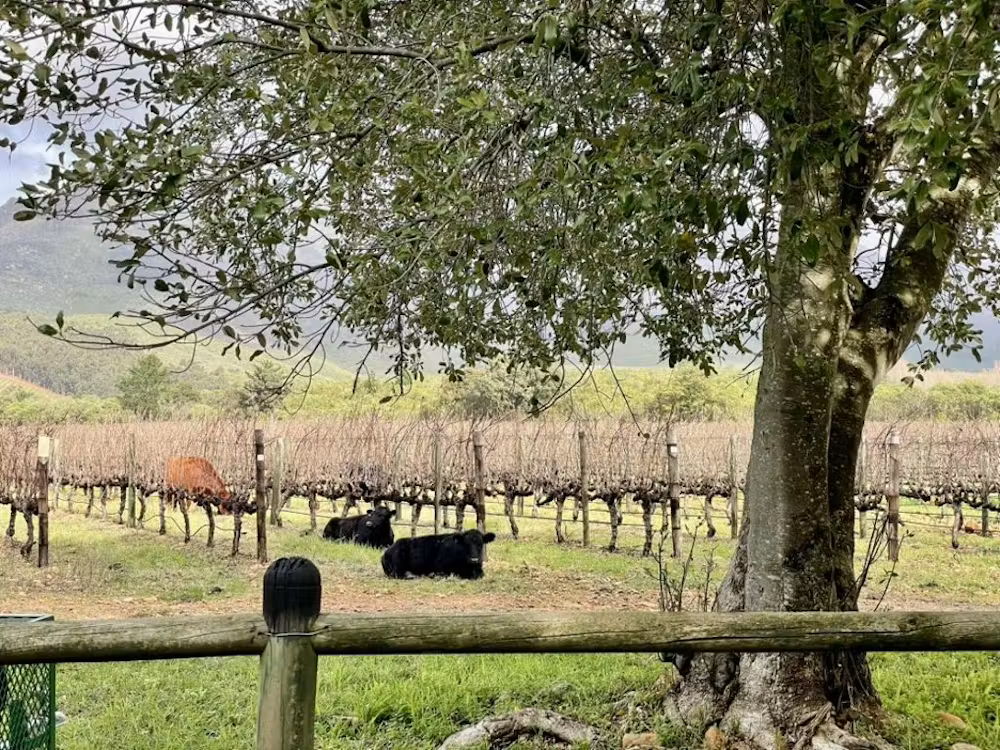
A sustainability practice found in some South Africa vineyards is regenerative agriculture, which focuses on restoring and nurturing the soil naturally. Cows provide natural fertilizer and work organic material into the soil with their hooves as they graze on weeds and grasses.
Credit: Hannah Herrero
A sustainability practice found in some South Africa vineyards is regenerative agriculture, which focuses on restoring and nurturing the soil naturally. Cows provide natural fertilizer and work organic material into the soil with their hooves as they graze on weeds and grasses. Credit: Hannah Herrero
We are a team of geographers and sustainabilityscientistswho studyenvironmental change, environmental health, conservation, agriculture and land management. Our team wanted to better understand how farmers in South Africa’s wine-producing regions are responding as a range of environmental and economic pressures rise. We talked with growers, conservation practitioners and wine industry experts in the Western Cape and analyzed how 107 vineyards, about 20% of the total, were using sustainable land stewardship practices to adapt.
In many agricultural landscapes, production and conservation goals are frequently viewed as competing priorities. But our research found that many vineyard operators in the Western Cape see long-term stewardship and conservation of soil and wildlife habitat as essential strategies for business success.
Conservation as an investment, not a constraint
The Western Cape is home to the Cape Floral Region, a global biodiversity hot spot. It includes fynbos, a unique biome containing thousands of endemic plant species, including types of proteas, ericas and restios that are found nowhere else on Earth.
Sustainability certification and conservation programs, such as World Wildlife Fund Conservation Champions, have helped encourage vineyards to protect biodiversity in the region. Many growers use these sustainability certifications to increase their wine’s marketability. But we found they have also embraced conservation for how it can benefit their vineyards. Rather than viewing conservation as land taken out of production, many said they see it supporting the ecological processes essential to their business.
The majority of South Africa’s vineyards today participate in the Integrated Production of Wine certification system, created by the South African wine industry and researchers in 1998 to reduce environmental harm. The system sets standards governing pesticide use, water management, wastewater treatment and environmental stewardship. It also uses independent auditing of participating farms and wineries to ensure those claiming certification meet the standards.
To manage the water supplies their vineyards depend on, growers described restoring native vegetation, including the removal of alien species, along waterways and reducing erosion to protect wetlands and rivers. Research shows that healthy natural systems can improve water retention in the soil and contribute to the overall resilience of the landscape in the face of more extreme climate conditions.
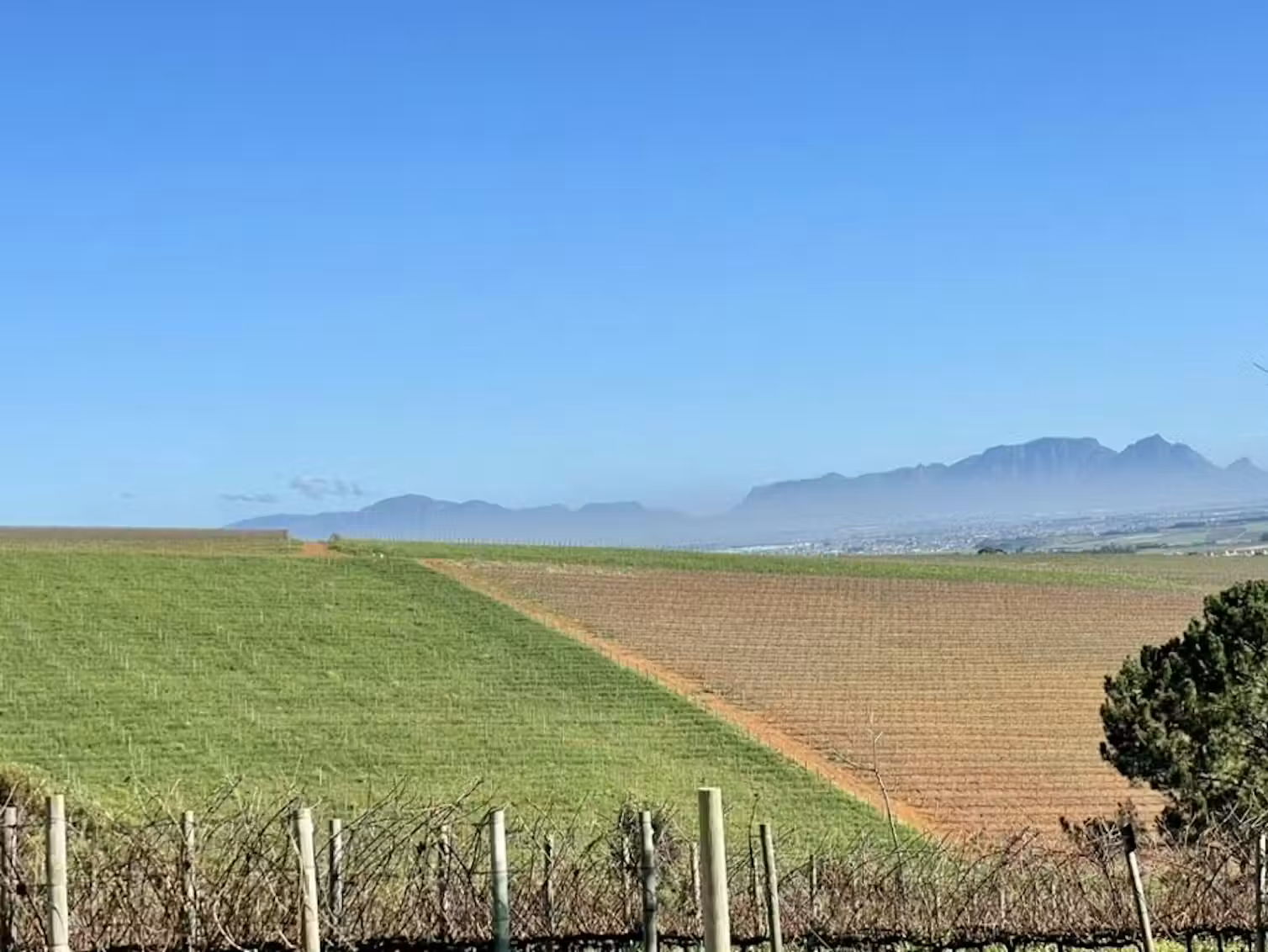
Two vineyard blocks, one with cover crops on the left and the other without.
Credit: Hannah Herrero
Two vineyard blocks, one with cover crops on the left and the other without. Credit: Hannah Herrero
To boost their soil’s health, some growers are planting cover crops, such as legumes, cereals like oats and rye, and brassicas such as radish and mustard, between vine rows. Growers broadly described using cover crops, compost, mulching and other practices to improve soil structure and increase organic matter in the soil. Cover crops require maintenance and can provide habitat for pests, but research shows that the right cover crops, when well maintained, can benefit vineyards by reducing erosion and increasing water retention and nutrients in the soil.
Several producers also described efforts to reduce their reliance on chemical pesticides, which is beneficial not only for the environment but also their businesses as chemical costs continue to rise. We heard about vineyards that monitor pest populations closely and respond in targeted ways rather than using pesticides broadly.
Some growers encourage beneficial insects and manage habitats that support natural pest control. The creation of habitats for natural pest predators can reduce the overall disease risk too. While chemical treatments remain part of many vineyard operations, growers reported increasing interest in other approaches that prevent disease and pest outbreaks, such as pruning, to reduce their total chemical use.
Sustainable practices like these are well established in South Africa’s wine industry, but our interviews suggest their use has been expanding in recent years. Rather than focusing solely on treating problems after they arise, these approaches emphasize prevention, monitoring and ecological balance.
Sustainability must also make economic sense
The stewardship practices we observed in South Africa are investments in long-term business resilience for many growers.
Many of the wine producers we interviewed described facing rising costs and market uncertainty. Exports, labor and chemicals are all expensive. They emphasized that maintaining healthy soils, conserving water and reducing vulnerability to drought and disease are essential to keeping their vineyards productive.
As concerns about drought, climate pressures and profitability rise, the area in vineyard production in South Africa has also decreased. Several growers described diversifying their business models and even switching crops to make their businesses more resilient to hotter, drier conditions.
Lessons beyond South African wine
Farmers around the world are confronting the realities of a changing climate. Our research shows that effective solutions can come from recognizing the interconnectedness of nature and production.
The experience of South Africa’s winegrowers shows that farms can be managed more sustainably when they’re seen as part of larger ecological systems.


 emotional distress and trauma in adults and children, and connected many with therapists.









 Seth Stern is the director of advocacy for Freedom of the Press Foundation.