13.8 C
London
Sunday, May 3, 2026
Home Blog

Umpire ‘Drops’ After Brutal Hit To The Face (Video)

0
umpire-‘drops’-after-brutal-hit-to-the-face-(video)
Umpire ‘Drops’ After Brutal Hit To The Face (Video)


It was supposed to be just another heated SEC showdown—but it turned into a terrifying scene that left fans holding their breath.

During a clash between Alabama and Vanderbilt, things took a frightening turn in the second inning when Alabama’s Brennan Holt sent a foul ball screaming straight back behind home plate. In a split second, the ball smashed directly into the facemask of home plate umpire Scott Kennedy—and what happened next stunned everyone watching.

Kennedy staggered for a moment like he was trying to stay upright… then suddenly collapsed backward onto the dirt.

Players froze. The crowd went silent.

The impact knocked his mask clean off, and Kennedy lay motionless on the ground for several tense minutes as trainers from both teams sprinted onto the field. It was the kind of moment that instantly shifts a game from competitive to deeply concerning.

Medical staff surrounded him, carefully checking for injuries as players and coaches watched anxiously. After what felt like an eternity, Kennedy was finally helped to his feet—and in a huge sigh of relief for everyone, he was able to walk off the field under his own power.

Still, the scare was enough to halt the game for about 15 minutes.

Second base umpire Anthony Perez stepped in to take over behind the plate for the rest of the game at Sewell-Thomas Stadium in Tuscaloosa.

Afterward, Alabama officials shared a brief update, saying Kennedy was “doing better,” though no detailed medical report has been released.

Crimson Tide head coach Rob Vaughn echoed what everyone was thinking: “First and foremost, you’re just hoping Scott’s OK… I think he’s doing better.”

The game eventually resumed, with Alabama shutting out Vanderbilt 5-0—but the final score felt secondary after such a heart-stopping moment.

For fans, players, and coaches alike, it was a sobering reminder of just how dangerous the game can be—even for those not swinging the bat.

Rocket Report: Falcon Heavy is back; Russia’s Soyuz-5 finally debuts

0
rocket-report:-falcon-heavy-is-back;-russia’s-soyuz-5-finally-debuts
Rocket Report: Falcon Heavy is back; Russia’s Soyuz-5 finally debuts

Welcome to Edition 8.39 of the Rocket Report! There’s a lot of news to share in the universe of powerful rockets this week, and we’re delighted to sum it up in this week’s edition. The biggest rocket of them all, Starship, had a relatively quiet week as SpaceX aims to launch the vehicle’s next test flight, perhaps sometime in May. The results of that flight and the outcome of Blue Origin’s first attempt to land on the Moon with its Blue Moon cargo lander in the coming months should tell us a lot about NASA’s actual chances of putting astronauts on the lunar surface in 2028.

As always, we welcome reader submissions. If you don’t want to miss an issue, please subscribe using the box below (the form will not appear on AMP-enabled versions of the site). Each report will include information on small-, medium-, and heavy-lift rockets, as well as a quick look ahead at the next three launches on the calendar.

These 12 companies are developing SBIs. The US Space Force released a list on April 24 of a dozen companies working on Space-Based Interceptors for the Pentagon’s Golden Dome initiative, a multilayer defense system to shield US territory from drones and ballistic, hypersonic, and cruise missile attacks, Ars reports. The roster of Golden Dome Space-Based Interceptor (SBI) contractors, some of which were previously reported, includes Anduril Industries, Booz Allen Hamilton, General Dynamics Mission Systems, GITAI USA, Lockheed Martin, Northrop Grumman, Quindar, Raytheon, Sci-Tec, SpaceX, True Anomaly, and Turion Space. The companies will contribute in different areas to develop and deliver SBI prototypes for testing. The agreements have a maximum combined value of $3.2 billion. Contracts for full-scale production will come later with a significantly higher price tag.

If they’re ever built… SBIs are widely seen as the most challenging and expensive element for Golden Dome, but they may not be the panacea administration officials argued for when President Donald Trump signed the executive order for Golden Dome in January 2025. Gen. Michael Guetlein, director of the Golden Dome program, suggested SBIs for boost-phase missile intercepts, which Trump’s executive order originally called for, may not be built. “We are so focused on affordability. If we cannot do it affordably, we will not go into production,” Guetlein said in a hearing before the House Armed Services Strategic Forces subcommittee earlier this month. “We are looking at the threats from a multi-domain perspective to make sure I have redundant capabilities, and I don’t have single points of failure,” he added. “So, if boost-phase intercept from space is not affordable and scalable, we will not produce it, because we have other options to get after it.”

The Ars Technica Rocket Report
The easiest way to keep up with Eric Berger’s and Stephen Clark’s reporting on all things space is to sign up for our newsletter. We’ll collect their stories and deliver them straight to your inbox.

Sign Me Up!

Hello to Virgin Galactic’s new rocket plane. Virgin Galactic has completed structural assembly of the first Delta-class SpaceShip and moved the vehicle into an adjacent facility in Mesa, Arizona, to begin ground tests, bringing the company a step closer to resuming commercial suborbital flights later this year, Aviation Week & Space Technology reports. That is the plan, at least. A photo released by Virgin Galactic shows there’s much work to do inside and outside the vehicle. The most recent schedule update from Virgin Galactic called for flight testing of the first Delta-class spaceship to begin in the third quarter, followed by commercial private astronaut flights to suborbital space by the end of the year.

The only game in town... Virgin Galactic hasn’t flown to space since June 2024, but the company finds itself leading the suborbital human spaceflight market after Blue Origin suspended flights of its New Shepard suborbital booster earlier this year. Virgin decided to move on to the Delta-class program after completing 12 flights to the edge of space—above 80 km or 50 miles, as defined by the US government—with the previous-generation VSS Unity rocket plane. The Delta-class ships are designed for a higher flight rate.

The Moon as a dartboard. Astronomers say the upper stage of a Falcon 9 rocket that launched in early 2025 will strike the Moon later this summer, likely on the near side of the Moon, Ars reports. Bill Gray, who writes the widely used Project Pluto software to track near-Earth objects, has published a comprehensive report on the impact expected to occur at 2:44 am ET (06:44 UTC) on August 5. The Falcon 9 rocket’s upper stage is 13.8 meters (45 feet) tall and has a 3.7-meter (12 feet) diameter. Since the Moon has no atmosphere, it will strike the lunar surface intact. Although the Moon will be visible to the eastern half of the US and Canada, and in much of South America, Gray said he believes the impact will probably be too faint to be seen by Earth-based telescopes.

This happens... Four years ago, Ars reported that astronomers believed another Falcon 9 upper stage would strike the Moon. However, subsequent analysis revealed that the object was, in fact, an upper stage from the Chinese Chang’e 5-T1 mission. Gray said there is no doubt that this object is the Falcon 9 upper stage because it has been tracked since launch. There is no risk from its impact to anything on the Moon. It is a dead world, and there are no human-landed objects nearby.

Ukraine has a Russian spaceport in its sights. If you believe official Russian reports, the country’s northern spaceport has come under attack from drones on multiple occasions in the last few months, Ars reports. The drones did not succeed in striking the spaceport, but the attempted attacks come as Russia ramps up activity at Plesetsk Cosmodrome to deploy a new constellation of Internet and data relay satellites akin to SpaceX’s Starlink, a space-based network underpinning much of Ukraine’s military communications infrastructure. Plesetsk is a military base located in Russia’s Arkhangelsk region, some 500 miles north of Moscow. Russian officials have not identified the source of the drones, but Russia’s defense ministry has ascribed other drone swarms in the Arkhangelsk region to Ukraine. Ukrainian drones have routinely struck deep into Russian territory, hitting Russian military bases, oil refineries, and the Russian capital.

Cloaked launch schedule… Since the reported drone incursions, the Russian government has put a tighter lid on information about its launches from Plesetsk. Authorities typically publish airspace warning notices called NOTAMs advising pilots to steer clear of a rocket’s flight path and downrange drop zones where spent booster rockets fall back to Earth. These NOTAMs usually cover a few minutes to a few hours for a primary launch date, and perhaps a backup date in the event of a delay. The notices accompanying the most recent launches from Plesetsk covered much longer time periods, with daily windows of up to 10 hours over up to 14 consecutive days. This makes it more difficult to pin down when a launch will occur ahead of time.

Russia debuts new rocket. Russia’s new Soyuz-5 rocket has taken to the skies at long last, Space.com reports. The Soyuz-5 lifted off for the first time ever on Thursday, rising off a pad at the Russia-run Baikonur Cosmodrome in Kazakhstan at 2 pm EDT (18:00 UTC). Things apparently went well on the flight, which was a brief suborbital shakeout cruise. “The first and second stages of Soyuz 5 performed as planned, and a mockup was launched onto the calculated suborbital trajectory, followed by a reentry into an area in the Pacific Ocean previously closed to shipping and aviation,” officials with Russia’s federal space agency, Roscosmos, said via the Telegram app on Thursday.

Resurrecting Zenit… Russia has been developing the Soyuz-5 rocket since 2017. It is a new vehicle, but it does not represent a major leap forward in technology, Ars reported last year. The Soyuz-5 is a replacement for the medium-class Zenit rocket, which had tanks manufactured in Ukraine coupled with Russian-made engines. The Zenit last flew in 2017. It was developed in the 1980s, before the Soviet Union’s breakup, and continued to fly for decades while Russia and Ukraine remained on good terms. That changed after Russia’s annexation of Crimea in 2014. The Soyuz-5 uses the same basic type of Russia-built RD-171 engine that flew on the Zenit rocket, but the tanks and structures are also built within Russia’s borders. Soyuz-5’s performance slots it in between Russia’s smaller legacy Soyuz-2 rocket and the heavy-lift Angara-A5. (submitted by EllPeaTea)

FAA tells launch companies it’s time to pay up. The Federal Aviation Administration is ready to begin collecting user fees for the first time for commercial launches and reentries, which could generate millions of dollars annually, Space News reports. The legal foundation for the user fees was signed into law last year by President Donald Trump as part of the “One Big Beautiful Bill Act,” which called for the FAA to phase in user fees over eight years, beginning in 2026. The money will go into a trust fund to help pay for the operating costs of the FAA’s commercial space office. The FAA will assess the user fee as the lesser of two amounts. For 2026, that fee is 25 cents per pound of payload, capped at $30,000 per launch or reentry. The FAA will retroactively charge launch and reentry operators for fees accrued since the beginning of this year.

SpaceX will pay most… The company most impacted by the user fees will be SpaceX, which owns and operates the vast majority of US launch and reentry vehicles. Based on the assessment of 25 cents per pound of payload, SpaceX initially would pay a fee of between $9,000 and $10,000 for each of its Falcon 9 launches carrying Starlink Internet satellites. The fee rate will increase over the next eight years, with the maximum fee reaching a cap of $200,000 in 2033. The funding will be used by the FAA to improve integration of launches and reentries into the national airspace system.

Atlas V launches again for Amazon. United Launch Alliance completed its second Atlas V rocket launch of the month Monday, marking the company’s fastest turnaround between two Atlas V missions from the same launch pad at Cape Canaveral, Florida, Spaceflight Now reports. It beats the previous record by nearly three days. Onboard the Atlas V rocket was a batch of 29 Amazon Leo satellites. This was ULA’s sixth flight delivering production versions of Amazon’s broadband Internet satellites to orbit and its seventh overall, including the two demo satellites launched on the Protoflight mission in October 2023.

The end is near… This was the 108th launch of an Atlas V to date. ULA is hitting a stride with the Atlas V rocket as the company’s new Vulcan launch vehicle remains grounded due to a booster anomaly on its most recent flight in February. But the Atlas V program is winding down, with hardware for just eight more Atlas Vs in ULA’s inventory, including two more for the Amazon Leo constellation. ULA is on contract to launch 38 Vulcan rockets to deploy satellites for the Amazon Leo network, but those missions are on hold pending the investigation into Vulcan’s solid rocket motor problem. (submitted by EllPeaTea)

Ariane launches for Amazon, from the Amazon. Less than three days after the Atlas V launch from Florida, another cluster of 32 Amazon Leo satellites rode a European Ariane 6 rocket into orbit from the Guiana Space Center in South America, European Spaceflight reports. The rocket launched in its Ariane 64 configuration that features four solid-fuel boosters. The first of the 32 satellites was separated from the rocket’s upper stage just under an hour and a half after liftoff. All 32 satellites were deployed over 12 separation events lasting roughly 25 minutes in total.

Hitting a cadence… Arianespace has been contracted by Amazon to carry out 18 missions supporting the deployment of its satellite constellation, which is intended to compete with SpaceX’s Starlink global broadband network. Arianespace has indicated that it plans to launch up to eight Ariane 6 flights in 2026, a significant portion of which will be dedicated to working through its backlog for Amazon. (submitted by EllPeaTea)

Lofty launch targets for New Glenn. Earlier this week, Blue Origin posted a job opportunity for a “senior manager” to oversee tank fabrication for “Quattro,” and the description contained some intriguing information, Ars reports. Quattro is the company’s nickname for a more powerful upper stage for the New Glenn rocket, which will feature four BE-3U engines instead of the two currently powering the booster. Blue Origin revealed plans for this more powerful variant of New Glenn, 9×4 (nine first stage engines, and four upper stage engines), last November. The 9×4 could debut as soon as next year, and the person Blue hires for upper stage tank fabrication will be charged with executing a “rate ramp” of 12 per year to 100 per year by 2029.

Miles to go… The upper stage is currently not reusable, so each new build will equate to one launch. Blue Origin has a long way to go before achieving 100 New Glenn flights, and doing it within three years sounds overly optimistic. The company has a lot on its plate with the development of a human-rated Moon lander for NASA, a standardized spacecraft bus and space tug called Blue Ring, and other lesser-known projects. The New Glenn rocket’s current upper stage, with two BE-3U engines, failed on the most recent launch earlier this month. But Blue Origin has talented engineers and deep pockets thanks to its owner Jeff Bezos, so it’s worth taking the goals seriously. Money solves many, if not all, ills.

Welcome back, Falcon Heavy. A triple-core SpaceX Falcon Heavy, the company’s most powerful operational rocket, blasted off from Florida on Wednesday, boosting a ViaSat Internet satellite into space, the company’s third in a globe-spanning fleet of high-speed broadband relay stations, CBS News reports. Along with putting the ViaSat-3 satellite into its planned preliminary orbit, the rocket’s two side boosters, heralded by competing sonic booms, executed on-target touchdowns on separate pads at the Cape Canaveral Space Force Station after boosting the vehicle out of the dense lower atmosphere. It was the 12th flight of a Falcon Heavy rocket since the booster’s maiden launch in 2018 and the first since October 2024 when SpaceX sent NASA’s Europa probe on the way to Jupiter.

A healthy backlog… Despite the long gap between flights, SpaceX has quite a few Falcon Heavy missions planned over the next few years. The next one is set to launch NASA’s Nancy Grace Roman Space Telescope from Florida in September. Another Falcon Heavy will launch a commercial lunar lander for Astrobotic, perhaps toward the end of this year. SpaceX has at least a dozen more Falcon Heavy flights on contract through the end of the decade. (submitted by EllPeaTea)

Artemis III core stage arrives at KSC. The largest piece of hardware for NASA’s Artemis III mission arrived at Kennedy Space Center, Florida, on Monday after a trip by barge from its factory in New Orleans, Florida Today reports. Ground teams at Kennedy offloaded the core stage—still lacking its engine section—from the barge on Tuesday and transferred it inside the Vehicle Assembly Building. There, technicians will install the core stage’s four RS-25 main engines and prepare the rocket for stacking.

Next year, maybe… NASA hopes to launch Artemis III next year on a mission to Earth orbit. The astronauts on Artemis III will perform rendezvous and docking tests in orbit between NASA’s Orion crew capsule and one or both human-rated lunar landers developed by SpaceX and Blue Origin. The agency’s administrator, Jared Isaacman, told lawmakers on Monday that SpaceX and Blue Origin say they could have their spacecraft ready for the Artemis III mission in Earth orbit in late 2027, somewhat later than NASA’s previous schedule of mid-2027. If Artemis III flies next year, NASA hopes to follow it with a human lunar landing attempt in 2028. (submitted by EllPeaTea)

Next three launches

May 1: Falcon 9 | Starlink 10-38 | Cape Canaveral Space Force Station, Florida | 17:35 UTC

May 3: Falcon 9 | CAS500-2 rideshare | Vandenberg Space Force Base, California | 06:59 UTC

May 6: Falcon 9 | Starlink 17-29 | Vandenberg Space Force Base, California | 02:00 UTC

Family Urges Immediate Release of Nobel Laureate Narges Mohammadi After ‘Catastrophic’ Health Decline

0
family-urges-immediate-release-of-nobel-laureate-narges-mohammadi-after-‘catastrophic’-health-decline
Family Urges Immediate Release of Nobel Laureate Narges Mohammadi After ‘Catastrophic’ Health Decline


Nobel Peace Prize laureate Narges Mohammadi has been transferred from prison in Iran to a hospital following what her family’s foundation described as a “catastrophic deterioration in her health condition,” after months in custody without access to specialized medical care.

The foundation, which is run by her family, said the transfer came “after 140 days of arbitrary detention and the persistent denial of specialized healthcare.”

Mohammadi, who was awarded the Nobel Peace Prize in 2023 while imprisoned in Evin Prison in Tehran, has faced ongoing health concerns in recent months. In February, the foundation said she had begun a hunger strike, and in March it reported that her condition was “critical” and that she had suffered what was suspected to be a heart attack.

According to the foundation, Mohammadi did not receive medical treatment during this period.

The Nobel Peace Prize Committee and Mohammadi’s family have called on Iranian authorities to release her so she can receive treatment from her own medical team, warning that “her life remains in danger.”

Her brother, Hamidreza Mohammadi, told the BBC on Saturday that her current medical condition is complicated by both acute and preexisting issues: “Her current problems include low blood pressure and a heart attack, but her previous conditions, such as pulmonary embolism (…) and having undergone stenting and angiography, make any treatment by the doctors in Zanjan effectively impossible.”

Mohammadi has been arrested 13 times over her lifetime and sentenced to a total of 31 years in prison and 154 lashes, according to her foundation.

In 2021, she began serving a 13-year sentence on charges of committing “propaganda activity against the state” and “collusion against state security,” which she denied.

Her case has drawn continued attention from international organizations and her family, who are urging her release amid concerns about her condition.

Stockholm protesters rally against Israeli strikes on Gaza, Lebanon, and Iran

0
stockholm-protesters-rally-against-israeli-strikes-on-gaza,-lebanon,-and-iran
Stockholm protesters rally against Israeli strikes on Gaza, Lebanon, and Iran

Activists gathered in the Swedish capital on Saturday to protest Israel’s ongoing military offensives in the Gaza Strip, Iran and Lebanon, Anadolu Agency reports.

Responding to calls from several non-governmental organizations, demonstrators assembled at Odenplan Square, carrying banners reading ‘Stop the killing of civilians,’ ‘End the food blockade in Gaza,’ and ‘Stop attacks on Lebanon and Iran’.

Participants demanded an immediate end to genocide in Gaza and urged the Swedish government to halt arms sales to Israel.

Ann Christin Kristiansson, a nun from the Church of Sweden, told Anadolu that the current violence constitutes a crime against humanity that transcends politics and religion.

She emphasized that the global community must unite against this oppression, stating that the dignity shown by those resisting in Palestine has set an example for the world.

READ: Sweden calls for immediate ceasefire in Lebanon, urges protection of civilians

The Israeli army launched a brutal two-year offensive on Gaza in October 2023, killing more than 72,000 people, injuring over 172,000, and causing massive destruction across the besieged territory.

The US and Israel launched strikes on Iran on Feb. 28, prompting retaliation from Tehran against Israel and US allies in the Gulf, as well as the closure of the Strait of Hormuz.

In response to Hezbollah’s retaliation to the Iran war, Israel has waged an offensive in Lebanon since March 2, killing more than 2,600 people, and displacing over 1.6 million.

A 10-day ceasefire that began on April 17 was later extended until May 17, but Israel continues to violate it daily through airstrikes and the demolition of homes.

It also maintains a so-called “buffer zone” in southern Lebanon, saying it is meant to prevent attacks from Hezbollah. An earlier truce in Lebanon was reached in November 2024.

READ: Lebanon death toll in Israel’s latest offensive reaches 2,659

Women sue the men who used their Instagram feeds to create AI porn influencers

0
women-sue-the-men-who-used-their-instagram-feeds-to-create-ai-porn-influencers
Women sue the men who used their Instagram feeds to create AI porn influencers

A little over a year ago, MG was leading the relatively normal life of a twentysomething in Scottsdale, Arizona. She worked as a personal assistant and supplemented her income by waiting tables on the weekends. Like most women her age, she had an Instagram account, where she’d occasionally post Stories and photos of herself getting matcha and hanging out by the pool with her friends, or going to Pilates.

“I never really cared to pop off and become popular on social media,” says MG (who is cited only as MG in the lawsuit to protect her identity). “I just used it the way most people did when it first came out, to share their lives with the people closest to them.” She has a little more than 9,000 followers—a robust following, but nowhere close to a massive platform.

Last summer, she received a DM from one of her followers. Did she know, the person asked her, that photos and videos of a woman who looked exactly like MG were circulating on Instagram? MG clicked the link and saw multiple Reels of what appeared to be her face superimposed onto a body that looked exactly like her own. The woman in the photo was scantily clad, with tattoos in the same places as MG.

MG was horrified. “If you didn’t know me well, you could very well think they were images of me,” she said. “It was kind of like this reality check that I don’t have any control over my own image.”

She was even more appalled when she discovered that not only were doctored nude or scantily clad photos of her being circulated on the Internet, as she outlined in a recently filed complaint—they were also being used to advertise AI ModelForge, a platform that teaches men how to generate their own AI influencers. In a series of online classes and tutorials, the men allegedly taught subscribers to use a software called CreatorCore to train AI models using photos of unsuspecting young women, posting the resulting content on Instagram and TikTok.

“They provided a whole playbook, including instructions on how to pick the right person so that it’s not someone who can defend themselves, so they all had instructions on what type of women to use and where to get their pictures,” she claims. “It was disgusting on every single level.”

MG is one of three plaintiffs in a lawsuit filed in January in Arizona against three Phoenix men: Jackson Webb, Lucas Webb, and Beau Schultz, as well as 50 other John Does. The lawsuit alleges that the Webbs and Schultz scoured the Internet for photos of unsuspecting young women, then used AI to generate photos and videos of fictional models who look exactly like them, selling such content on the subscription platform Fanvue.

The suit further alleges that for $24.95 a month on the platform Whop, the men sold courses online training other men, including the John Does named in the suit, how to make their own AI-generated influencers based on real women’s photos. The men allegedly created “Blueprints” for how to scrape images from women’s social media accounts and feed them into the generative AI model on CreatorCore, as well as a separate app that would remove the women’s clothes and generate sexually explicit images and videos. Such content, the suit claims, generated millions of views, reportedly generating more than $50,000 in income in one month. (The Webbs and Schultz did not respond to requests for comment.)

This moneymaking scheme, the complaint alleges, preyed on a “harem of indistinguishable AI copies of unsuspecting women and girls,” as well as instructing “predators seeking to prey on” women on social media. According to the suit, in 2025 the CreatorCore platform had more than 8,000 subscribers generating their own AI influencers, resulting in more than 500,000 images and videos.

AI ModelForge is one of many burgeoning companies seemingly looking to capitalize on the widespread use of artificial intelligence by teaching men how to create their own “AI influencers” as a side hustle of sorts. On platforms like X, self-styled entrepreneurs boast about their own patented methods for earning hundreds of thousands of dollars off AI models, luring in young tech-savvy men looking to earn a quick buck.

“The prevalence of this has been shocking to me,” says Nick Brand, who, with attorney Cristina Perez Hasano, is representing MG and the other two plaintiffs. The young men the lawsuit alleges are behind AI ModelForge are “targeting normal, everyday folks that have average social media profiles and social media followings.” One of the more insidious elements of this particular case, he alleges in an interview, is the use of the women’s images to teach other men how to find victims. According to the complaint, the defendants encouraged subscribers to target women with less than 50,000 followers to avoid “legal issues.”

“These boys aren’t just using generative AI to disrobe women—they’re selling the ability to do so to other men and boys, who are then going to use other women’s images to do the same thing,” Brand contends. MG and the other two plaintiffs, he claims, are “the face of a product that is harming other women. It’s like making somebody the face of ICE who has had their parents deported. It’s horrifying.”

Technically, there is a federal law preventing the proliferation of nonconsensual AI-generated porn. The Take It Down Act, which President Trump signed into law in May 2025, makes publishing nonconsensual sexualized AI-generated content illegal, requiring platforms to remove such content within 48 hours when it’s flagged. And most US states, including Arizona, have passed laws banning so-called “deepfake” porn. But the Take It Down Act does not go into effect until May 2026, and state laws tend to be “reactive rather than proactive,” says Arizona State Representative Nick Kupper.

Earlier this year, Kupper introduced a bill in the Arizona Legislature requiring websites to use automated detection tools, such as age verification or consent forms, to prevent nonconsensual AI content from being uploaded. “Once something’s online, it’s pretty much there forever, even though victims spend millions of dollars trying to take it down. It’s like whack-a-mole—you hit one, another one pops up.”

Currently, if you visit the Linktree page for AI ModelForge, it directs you to what appears to be the same business rebranded as “TaviraLabs,” a Telegram group with more than 18,000 members that advertises itself as “the #1 AI Influencer coaching community.” Additionally, the suit names more than a dozen Instagram accounts used by the defendants to promote AI ModelForge, most of which are still active. The suit details how such accounts continue to post photos of nubile women, fast cars, and expensive watches, writing captions such as, “She’s not my girlfriend, she’s my best paid employee” and “POV: You built her in 20 minutes and she made you $13.2k in the first 45 days.”

Even though MG and the other plaintiffs have continually lobbied Instagram to take their images down, many of them are still up, she claims, because they do not technically violate Instagram’s guidelines surrounding AI-generated content. When reached for comment, a spokesperson for Instagram said it had “extremely strict policies” around both AI- and non-AI-generated nonconsensual intimate imagery, removing accounts that post such content. When provided with a list of a dozen or so accounts thought to be associated with AI ModelForge, the spokesperson said the accounts were under review.

The suit also cites a number of TikTok accounts promoting the men’s business. When reached for comment, a TikTok spokesperson said the accounts were found to violate community guidelines and have been taken down.

MG says the images generated by AI Model Forge are distinct enough from her own photos that she frustratingly has been unable to claim that the accounts are impersonating hers, which is also a violation of Instagram guidelines. “It’s my face, my tattoos, on a different outfit on a slightly different body,” she says. “These are real women being transformed, not just a random AI-generated person.”

Though MG lives in constant fear of people in her lives seeing the pornographic AI-generated images of her, she says filing suit has given her a bit of her agency back. “We were put in this place where our backs were against the wall and I want other women to know you can’t stop living your life,” she says.

Still, what happened to MG, a woman with fewer than 10,000 followers, has daunting implications for virtually anyone with a remotely public online presence.

“It’s not about being cautious with your image online because everyone posts on social media now,” she says. “Everyone is on LinkedIn. Everyone is on Instagram. And I want people to realize that this could also happen to them.”

This story originally appeared on wired.com.

The ramifications of record-shattering heat on the West’s ecosystems

0
the-ramifications-of-record-shattering-heat-on-the-west’s-ecosystems
The ramifications of record-shattering heat on the West’s ecosystems

This story was originally published by High Country News and is reproduced here as part of the Climate Desk collaboration.

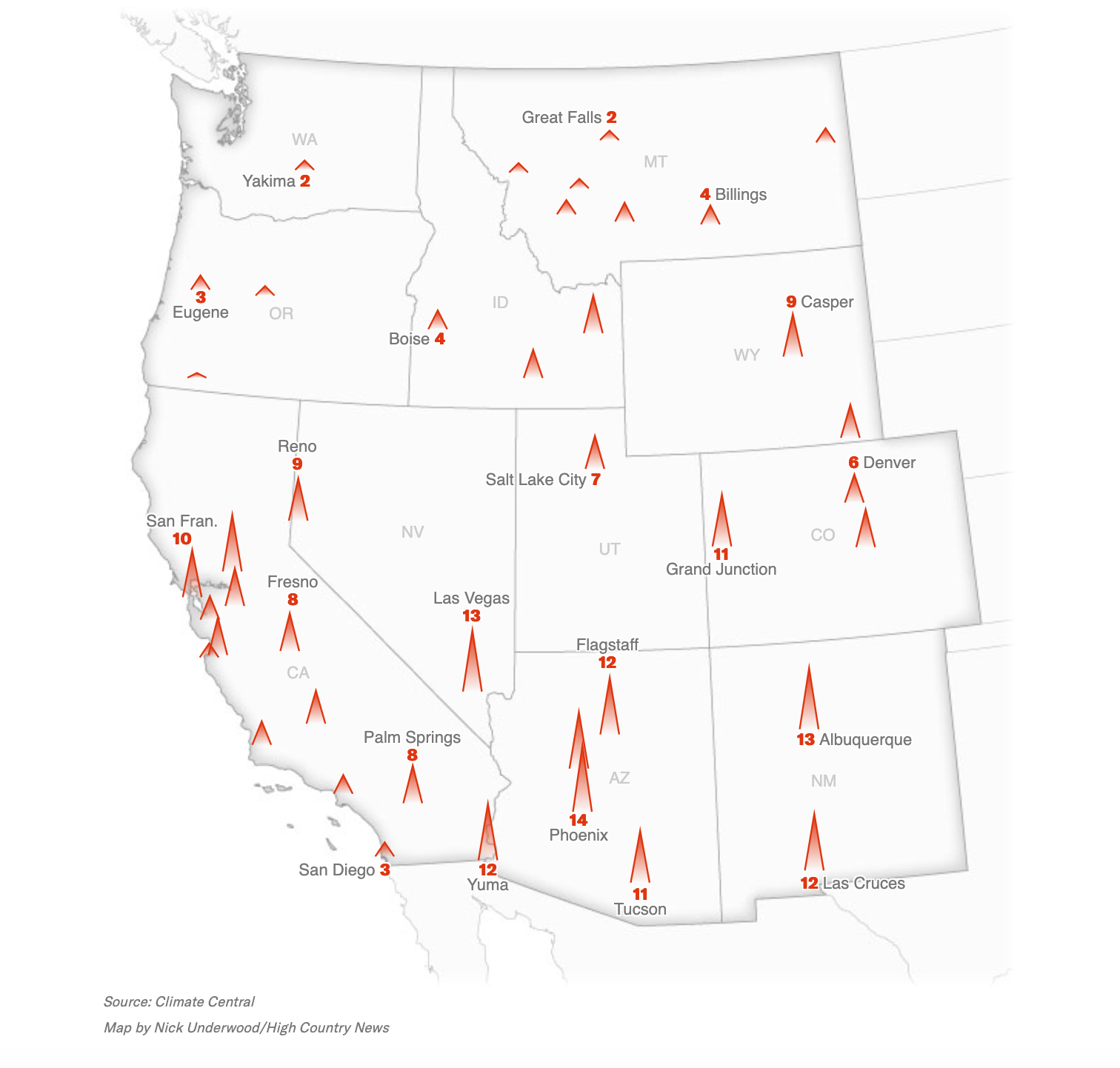
In March, a month traditionally known for heavy mountain snows and dreary lower-elevation weather, a heat wave settled across the West, shattering temperature records from Tucson, Arizona, to Casper, Wyoming.

The heat wave’s intensity and early arrival shocked many climate scientists. “It is exceptionally difficult for the Earth system to produce temperatures this warm so early in the season,” wrote Daniel Swain, a climatologist with the University of California Agriculture and Natural Resources who runs the Weather West blog.

Yet not only did Western locations set new March highs; many exceeded temperature records for May. And those high temperatures kept hanging on, said Zachary Labe, a climate scientist at the nonprofit science center Climate Central, for nearly two weeks.

While heat waves are a natural phenomenon, this was the earliest and most widespread one ever recorded in the Southwest. And it was caused by climate change, which is making intense heat waves much more likely. Researchers say this means understanding their fallout is even more important.

Scientists are just now beginning to understand the ramifications of a devastating 2021 heat wave, when a massive heat dome brought 120-degree temperatures to the Pacific Northwest, causing widespread ecological damage. Tens of thousands of trees died. Baby birds that could not yet fly plummeted to the ground as they tried to escape the heat. Salmon and trout suffocated in small streams. Millions — perhaps even billions — of mussels and barnacles cooked.

Number of daily record highs broken in March 2026

Map of Number of daily record highs broken in March 2026

This year’s heat wave may not have had the same immediate ecological impacts, but it comes on the heels of an already record-breaking hot, dry winter. Researchers say 2021 holds lessons about what lies ahead for both vulnerable and resilient species. Ecosystems, they warn, are likely to permanently change as some species simply can’t handle the heat.

Fully understanding the impact that events like heat waves have on long-lived tree species takes time. Research is now trickling out from places like Washington, Oregon, and British Columbia, and it’s not good.

The 2021 heat wave either killed or otherwise harmed more than three-quarters of species surveyed, including by limiting their reproductive success, according to Julia Baum, a professor at the University of Victoria who co-wrote a recent paper on the long-term impacts. The hardest hit, perhaps unsurprisingly, were those unable to move to seek shade or cooler temperatures. Marine species like acorn barnacles and green rope seaweed fared the worst, as did kelp, surfgrass, and rockweed.

“The rocky shorelines they live on heated up to [122 Fahrenheit]. Think of being glued to hot concrete on the most scorching summer day: They essentially baked and died,” said Baum. “On land, wildflowers wilted and died, preventing entire populations from reproducing that year, and there was widespread leaf scorch and death in forests.”

Some species that could move modified their behavior: Ferruginous hawks reduced their flight time by about 81 percent, while wolves moved around more, perhaps seeking hunkered-down prey like mule deer and moose.

Read Next

Meanwhile, species already adapted to hotter or more variable temperature ranges adjusted better than others.

The heat wave’s timing also mattered, said Adam Sibley, a remote sensing scientist and co-author of a 2025 paper that examined the impact on trees and forests. Plants tend to acclimate to heat throughout a season, so the triple-digit temperatures that struck in June hit harder than they would have in August.

So many tree needles died, in fact, that when Sibley drove to the Oregon coast with friends a few days after the heat wave ended, the tree canopy looked as though it had been dusted with orange snow.

New buds and needles are fragile for a number of reasons, said Christopher Still, a forest ecology professor at Oregon State University. Many contain fatty membranes that, when super-heated, will melt and cause the leaf to fall apart. Young leaves and needles also lack “heat hardening” mechanisms like specialized proteins that stabilize mature leaves and needles when it’s hot.

Many larger, more well-established trees, such as Douglas fir, lost a growing season: Their needles fell off, but grew back the following year. Other trees died, especially younger ones and species like Sitka spruce and western red cedar that require cooler, wetter temperatures.

The 2021 heat wave also rapidly dried grasses, flowers, and other fine fuels, leading to record-breaking wildfires in the Pacific Northwest, according to a 2024 paper in the journal Nature.

Read Next

While the timing of this year’s heat wave surprised many climatologists, the fact that it arrived in March may have ultimately saved some Southwestern plants, said Osvaldo Sala, a professor and director of Arizona State University’s Global Drylands Center.

During the hottest period, he explained, many plants were still dormant. Desert plants tie their growing cycles to rain and moisture instead of heat or sun duration. That means that, unlike in places like Wyoming, where cherry trees started blooming in March instead of May, desert plants were still waiting for rains to come.

Unfortunately, that early blooming has left the cherry trees and other flowering plants particularly susceptible to spring frosts, Still said.

The effects of this year’s heat dome have only exacerbated the winter’s record-setting heat and drought, Still added. Snowpack across much of the West was abysmal; in many places, it was the worst in recorded history. 

“The heat dome put an exclamation point on the worst winter in a century,” said Still. “It was the worst possible way to end the winter that was already worse than normal.”


Myanmar’s political makeover unmasked by revolutionary reality

0
myanmar’s-political-makeover-unmasked-by-revolutionary-reality
Myanmar’s political makeover unmasked by revolutionary reality

After five years of conflict and a tightly controlled election, Myanmar’s junta leader, Min Aung Hlaing, shed his uniform, named himself president and spoke of peace and reconciliation.

The release of elected President Win Myint, the reduction of Aung San Suu Kyi’s sentence and her transfer to house arrest all serve to reinforce this image.

These cosmetic moves, however, do not amount to a democratic transition. Rather, they are part of a political makeover by a military ruler who still cannot claim control over the country he claims to govern.

To understand Myanmar in 2026, it is more useful to look at the battlefield than speeches and pronouncements made in Naypyitaw. The coup-installed regime controls the capital, major airports and urban cores of Yangon and Mandalay.

Beyond these centers, however, its authority fades quickly. In areas where rebel forces hold sway, the military bombs, raids and blocks transit arteries. It punishes, not governs, civilian populations.

Myanmar is no longer a classic civil war with a central state fighting rebels on the margins. Since the coup, armed resistance has spread into central Myanmar, breaking the old center-periphery pattern.

The conflict is fragmented, with rival claims to legitimacy and multiple armed groups exercising power and control.

The anti-coup National Unity Government, or NUG, claims democratic legitimacy from the 2020 election and has built parallel armed and administrative structures, including People’s Defense Forces, or PDF – some of which it controls, many others which it doesn’t.

Min Aung Hlaing may control the state’s formal shell, but he does not command authority across Myanmar. Internationally, meanwhile, Myanmar’s UN seat is still held by Ambassador Kyaw Moe Tun, aligned with the pre-coup government, while ASEAN remains cautious and divided over the junta’s latest attempt at a makeover.

Map tells the story

The picture on the ground is just as revealing. ISP-Myanmar estimated in January that the regime had lost control of roughly 38% of the country’s territory and had not recovered at least 150 overrun bases.

A 2025 ISEAS study claimed that anti-junta armed groups controlled as much as half the country, while the military held only about a quarter.

Figures and estimates of who controls where may differ, but the broad picture does not: Myanmar’s map does not support the regime’s claim of restored national control and its recent tactical gains do not represent stabilization.

In northwestern Myanmar, the regime recently retook Falam, Chin State’s second city, after a six-month offensive involving ground assaults and heavy airstrikes. Its recapture is a reminder that the junta can still concentrate firepower.

But Falam does not indicate the revolution is waning. Resistance forces remain active across Chin State, and retaking a town is different from holding territory, governing people, reopening roads and restoring legitimacy.

The same is true in Magway, where the military recently seized Kangyi village in Saw Township, a strategic route to Chin State and onward toward Paletwa near the Rakhine State border. The move appears aimed not only at local control but at tightening pressure on routes feeding into Rakhine.

That matters because Rakhine State remains one of the clearest examples of the junta’s loss of authority. The Arakan Army now controls most of the state except for three townships, and the military is reduced to defending a few remaining strategic pockets, including Sittwe, Kyaukphyu, and Manaung.

Recent reports describe Arakan Army pressure around Sittwe, with the regime responding through naval blockades and airstrikes. The junta’s rule is less governance than a siege in Rakhine.

Fighting still raging

Across Myanmar, crisis monitoring continues to describe clashes, displacement, airstrikes and insecurity across multiple regions, including the central heartland. That alone should make observers skeptical of the junta’s claim to have restored order.

In Karen State, resistance forces reportedly captured regime positions over the Myanmar New Year holidays in April, while fighting along the Thai-Myanmar border remained intense.

Meanwhile, in the north, Kachin State points in the same direction. The Kachin Independence Army and allied anti-junta forces have expanded their influence, seizing towns, border crossings and rare-earth mining areas.

The battle for Bhamo, near routes linking central Myanmar, northern Kachin and the China border, has become one of the country’s most important fronts.

Northern Shan State tells a different story. Operation 1027, launched by the Three Brotherhood Alliance, exposed the military’s weakness, but it also revealed the limits of gains in a war shaped by outside actors, especially China.

Formally, this is still Myanmar’s internal war. In practice, Beijing is shaping parts of the battlefield by pressuring armed groups it tacitly supports or arms, and seeking to secure trade corridors near its border.

Myanmar’s conflict is also geopolitical. The country sits between China and India, linking South and Southeast Asia. Rakhine State is especially critical: China sees Kyaukphyu as a route to the Indian Ocean, while India has connectivity interests through the Kaladan project and Sittwe port.

When the military blocks roads between Magway, Chin and Rakhine, or when the Arakan Army dominates much of Rakhine, the issue affects trade routes, border stability, humanitarian access and the geopolitical and geoeconomic calculations of Beijing and New Delhi.

Foreign governments, however, must be careful not to confuse Min Aung Hlaing’s new title with a new reality. The junta’s “transition” is not ending the war – it is simply trying to repackage it.

Peace offer changes nothing

The junta’s latest peace language should be treated with equal caution. The 100-day talks proposal is less a breakthrough than another attempt to turn military weakness into diplomatic legitimacy.

It asks resistance groups to enter a process designed by the same power that overthrew an elected government, jailed opponents and still relies on airstrikes, mass arrests, blockades and coercion to impose its will.

The swift rejection by major resistance organizations was hardly surprising. That said, none of this means the junta is about to collapse tomorrow.

Naypyitaw remains under regime command. Yangon is not on the verge of falling. Mandalay remains a core military-held city. The junta still has aircraft, prisons, patronage networks, foreign backers and the capacity to inflict immense violence, including on civilian populations.

But regime survival is not the same thing as regime victory. The war is now arguably entering a longer, harsher phase. The regime can still retake towns, block roads and punish the general population.

The resistance faces fragmentation, fatigue, shortages and the task of turning battlefield control into durable political authority. Myanmar’s revolution, however, is not waning, because the problem was never just Min Aung Hlaing or his latest attempt to dress military rule in civilian garbs.

The crisis runs much deeper, characterized by decades of military domination, the denial of democratic rights and the failure to build a genuine federal union with real equality and power-sharing. So long as those issues remain unaddressed, the resistance will endure.

Nyein Chan Aye is a Burmese journalist based in Washington, D.C., who previously worked for the BBC and Voice of America and writes on Myanmar, the US, China and regional affairs.


Apple may take “several months” to catch up to Mac mini and Studio demand

0
apple-may-take-“several-months”-to-catch-up-to-mac-mini-and-studio-demand
Apple may take “several months” to catch up to Mac mini and Studio demand

Apple’s Mac mini and Mac Studio desktops have been increasingly difficult to buy over the course of the year—multiple configurations are listed on Apple’s site as “currently unavailable,” which almost never happens, and others will take weeks or months to ship if you order them today. A top-end version of the Mac Studio with 512GB of RAM was delisted from Apple’s store entirely.

Current Apple CEO Tim Cook addressed the situation on Apple’s Q2 earnings call yesterday as part of a larger conversation about how Apple is navigating component shortages, and he partly blamed the shortage on the popularity of those desktops among users looking to run AI agents and other tools locally.

“Both [the Mac mini and the Mac Studio] are amazing platforms for AI and agentic tools, and the customer recognition of that is happening faster than what we had predicted, and so we saw higher-than-expected demand,” said Cook. “We think looking forward that the Mac mini and the Mac Studio may take several months to reach supply-demand balance.”

Cook wasn’t specific about what components were driving the Mac mini and Studio shortages, though he did say that generally, “availability of the advanced [manufacturing] nodes our SoCs are produced on” was constrained, and “we have less flexibility in the supply chain than we normally would.” In other words, it has become harder for Apple to go to TSMC and ask for more chips because TSMC doesn’t have the spare manufacturing capacity. Cook said these constraints “primarily” affected the iPhone, though, and only affected the Mac “to a lesser extent.”

As we wrote last month, the extent of the shipping delays can probably be blamed on multiple factors. AI-related demand for the desktops and chip shortages are probably factors, but Apple is also said to be planning replacements for both systems with Apple M5-series chips later this year, and it’s common for models to see their ship times slip when replacements are imminent. Cook’s “several months” estimate could easily include the introduction of new models, plus whatever time Apple needs to catch up to pent-up demand afterward.

Cook also noted that “customer response to MacBook Neo has been off the charts, with higher-than-expected demand” and that Apple “set a March record for customers new to the Mac, partly due to the Neo.” (Note that “a March record” is not the same thing as “an all-time record,” but regardless, it seems that demand for the Neo has been healthy.)

But MacBook Neo availability has been much better than for the Mac mini or Studio. A Neo ordered directly from Apple will usually arrive in two or three weeks, but this time window has stayed roughly the same since early March. The Neo also remains widely available for same-day shipping or pickup at third-party retailers like Amazon, Walmart, and Best Buy, which is not true of most Mac mini or Studio models.

Supply constraints aside, Apple’s Q2 2026 was a successful one for the company. Apple made $111.2 billion in revenue, a 17 percent increase over Q2 of 2025, thanks to strong growth from iPhone 17 sales and its Services division. The Mac also grew 6 percent year over year despite the shortages affecting the Mac mini, Mac Studio, and MacBook Neo. But Apple isn’t immune to the industry-wide RAM shortage: Cook said that Apple expected “significantly higher memory costs” for Q3 than it paid in Q2 and that “memory costs will drive an increasing impact on our business” going forward.

Domino’s Delivery Driver Attacks Man Who Didn’t Tip

0
domino’s-delivery-driver-attacks-man-who-didn’t-tip
Domino’s Delivery Driver Attacks Man Who Didn’t Tip


A routine pizza delivery took a terrifying turn in Missouri when a Domino’s driver allegedly snapped over a missing tip and used his car to settle the score.

Police say the shocking incident unfolded on April 29 at a private home in Fulton, where officers rushed to reports of a crash involving injuries. But this wasn’t your typical accident — investigators say it all started with a heated argument over a tip.

According to witnesses, the delivery driver became furious after the customer refused to tip, quickly escalating the situation into a verbal confrontation. The victim later told police the driver was visibly angry, hurling insults as tensions boiled over.

Court documents cited by KRCG reveal the driver, identified as 36-year-old Zachary Nicholos Walton, allegedly lashed out, calling the customer and a witness “f–king rude” before storming back to his vehicle. As he climbed inside, he reportedly taunted them, shouting, “What are you going to do, b—h? Come get me.”

Moments later, things took a dangerous turn.

Authorities say Walton then hit the gas, accelerating straight toward the victim, who was standing in their own driveway. The vehicle struck the customer, leaving them injured, before the driver sped off from the scene.

The victim suffered injuries to their hand, according to police.

Officers later tracked Walton down at a local Domino’s, where he allegedly admitted to what happened — but claimed he only meant to scare the victim, not actually hit them.

That explanation didn’t stop authorities from taking swift action.

Walton was arrested and booked into the Callaway County Jail, now facing multiple serious felony charges, including first-degree assault and armed criminal action.

What began as a simple pizza delivery ended in chaos — and now, a driver’s moment of rage could cost him far more than just a tip.

Aid Groups Seek Hormuz Humanitarian Corridor as Supply Routes Strain

0
aid-groups-seek-hormuz-humanitarian-corridor-as-supply-routes-strain
Aid Groups Seek Hormuz Humanitarian Corridor as Supply Routes Strain


Humanitarian organizations are calling for a protected aid corridor through the Strait of Hormuz after the Iran war and related shipping disruption drove up fuel costs, slowed deliveries, and threatened food and medical assistance to vulnerable countries across Africa, the Middle East, and Asia.

Aid groups say the crisis has disrupted supply routes from major logistics hubs in Dubai and India, affecting deliveries to Sudan, Somalia, Ethiopia, Nigeria, and Afghanistan. The Guardian reported that the appeals came from organizations including the International Rescue Committee, Save the Children, and the World Food Programme.

The Strait of Hormuz is one of the world’s most important maritime chokepoints, carrying about one-fifth of global oil and gas flows. Its disruption has pushed energy prices sharply higher, increasing the cost of shipping food, medicine, fuel, and other emergency supplies. Humanitarian agencies say the added expense is stretching already strained budgets, forcing some programs to reduce services, delay deliveries, or redirect funds away from direct aid.

The World Food Programme has warned that supply disruptions and rising prices could worsen global hunger at a time when hundreds of millions of people already face severe food insecurity. Aid groups say children with acute malnutrition, displaced families, and communities dependent on imported grain, fertilizer, and fuel are among those most exposed.

The crisis comes as humanitarian operations are already under pressure from wars in Sudan and Yemen, instability in the Horn of Africa, and funding cuts from major donors. Higher fuel prices also affect clinics, water systems, cold storage for medicine, and transport for relief workers.

European Commission President Ursula von der Leyen warned this week that the wider effects of the Iran war “may echo for months or even years to come.”

Aid officials say a humanitarian corridor through Hormuz would not resolve the wider conflict, but could help keep lifesaving supplies moving while diplomatic efforts continue.

0FansLike
0FollowersFollow
0FollowersFollow
0SubscribersSubscribe
- Advertisement -
Google search engine

Recent Posts