22.5 C
London
Saturday, May 2, 2026
Home Blog

China should borrow Britain’s tobacco-ban logic, not its law

0
china-should-borrow-britain’s-tobacco-ban-logic,-not-its-law
China should borrow Britain’s tobacco-ban logic, not its law

Britain’s Tobacco and Vapes Bill, passed by Parliament in April and awaiting Royal Assent, would permanently bar the sale of tobacco to anyone born on or after January 1, 2009.

The measure is designed to create what British officials call a “smoke-free generation.” It does not force current smokers to quit. Instead, it raises the legal age of sale year by year, while also tightening controls on tobacco retailing, vaping, advertising, packaging and public use.

That design matters. Britain is not trying to ban smoking overnight. It is trying to change the market’s default settings so that tobacco gradually stops recruiting new customers. In public-health terms, this is less a sudden prohibition than an intergenerational firewall.

That distinction is important for China, where the tobacco debate can too easily collapse into a false choice: preserve the status quo or impose an unrealistic ban. Britain’s experiment suggests a third possibility — not immediate abolition, but long-term market denormalization.

The British case arrives with hard realities attached. Smoking still causes tens of thousands of deaths each year in England and imposes large health-care and productivity costs. Those numbers help explain why London has moved from ordinary tobacco control toward endgame thinking.

China does not face the same problem at the same scale. It faces a much larger one. China remains the world’s largest producer and consumer of tobacco, with more than 300 million smokers.

A 2024 China CDC study found that current smoking prevalence among Chinese adults aged 15 and older was 23.2%, with higher rates in rural than urban areas. Beijing’s Healthy China 2030 plan aims to reduce adult smoking prevalence to 20% by 2030, a goal that will be difficult to reach without stronger measures.

Still, China should resist the temptation to read Britain’s bill as a ready-made blueprint. Britain is regulating a private-market habit in a relatively mature tobacco-control environment.

China is managing a public-health burden intertwined with a state tobacco monopoly, local fiscal interests, male social norms, gift culture, retail habits and uneven enforcement capacity. That is why the most useful lesson from Britain may not be the headline policy itself, but its sequencing.

The British approach is phased rather than abrupt, youth-centered rather than punitive and paired with complementary measures such as retailer licensing, age restrictions, vaping controls and enforcement powers.

For China, the strategic question is not “Should Beijing copy London?” but rather “Which parts of the British approach can help China reduce youth initiation, support adult cessation and manage transition costs in a credible order?”

The answer should begin with a shift in framing. China does not need to define tobacco control as a campaign against smokers or a symbolic attack on the tobacco sector.

It can define success as reducing future dependency while expanding present-day options: protecting adolescents from initiation, making quitting easier for adults, reducing secondhand smoke exposure in homes and workplaces and lowering the long-term burden on families and the health system.

A generational tobacco restriction, if ever considered in China, would only be credible if the runway were built first. That means stronger national retailer licensing, reliable age-verification systems, better product tracing, visible enforcement against illicit sales, broader smoke-free public spaces, higher effective prices and a serious expansion of cessation services.

A ban without this platform would risk becoming performative. A platform without a long-term endgame would risk becoming incremental forever. China could therefore begin not with a national lifetime sales ban, but with disciplined experimentation.

Selected cities, special zones or provinces with stronger public health infrastructure could pilot a generational tobacco control model. These pilots could test whether retailer licensing, digital-age verification, school-based prevention, smoke-free enforcement, and cessation support can work together before any national decision is made.

This would fit China’s own governance style better than a sudden national leap. It would allow policymakers to measure real outcomes: fewer young initiates, lower secondhand smoke exposure, more quit attempts, better compliance by retailers and reduced local medical costs.

It would also help avoid turning tobacco control into a symbolic contest between Western liberalism and Chinese governance. The issue should be judged by health, fiscal and administrative results.

The harder question is political economy. China’s tobacco system is not merely a public-health challenge. It is also a revenue system and an industrial structure. Any serious reform must therefore answer a practical question: what happens to local governments, tobacco-growing regions, retailers and workers if cigarette sales gradually decline?

This is where China may need a health-transition strategy, not just a health campaign. One approach would be transparent accounting: how much tobacco revenue is collected, where it goes and how much smoking-related disease costs the health system, households and employers.

Over time, a portion of tobacco revenue could be placed into a dedicated transition fund to support cessation services, local public-health enforcement, farmer adjustment, worker retraining and fiscal cushioning for tobacco-dependent areas.

The point is not to punish local governments for relying on tobacco revenue. It is to make declining cigarette sales financially manageable rather than administratively threatening. Public health reform becomes more governable when the losers from transition are acknowledged rather than ignored.

Britain’s gamble is that a society can end smoking by denying the habit to a new generation. China’s challenge is broader: it must decide whether tobacco control is mainly a health campaign, a fiscal problem or an industrial reform agenda. The honest answer is that it is all three.

That is precisely why the British bill is useful to China. Not because it offers a script, but because it exposes the real question China will eventually have to answer: whether the country wants to keep managing tobacco’s harms indefinitely, or begin managing tobacco’s sunset.

For China, the most innovative response may therefore be the least theatrical one. Do not import Britain’s bill as a symbol. Import its logic: long horizons, youth protection, regulatory layering, credible enforcement, cessation support and gradual market denormalization.

If Britain is testing how to create a smoke-free generation, China may need to test something even harder: how to build post-tobacco state capacity inside a tobacco state.

Y. Tony Yang is an endowed professor at the George Washington University in Washington, D.C.
Over two-thirds of Germans think government lacks strategy on Iran war: Poll

0
over-two-thirds-of-germans-think-government-lacks-strategy-on-iran-war:-poll
Over two-thirds of Germans think government lacks strategy on Iran war: Poll

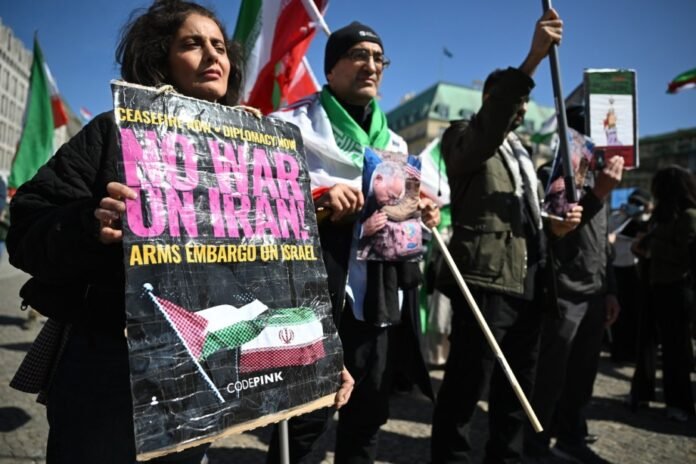
More than two-thirds of Germans think that their government lacks a clear strategy on how it should act in the Iran war, according to a survey published by the Internationale Politik news magazine on Saturday.

Some 68% of respondents answered “no” to a question on this topic, while 28% held the opposite view.

According to the poll, only among supporters of the co-ruling Christian Democratic Union / Christian Social Union did a narrow majority of 54% believe that the government has a clear vision of how Germany should position itself in the Iran conflict.

Meanwhile, the majority of supporters of the governing Social Democratic Party (43%) see it differently – as do, to an even greater extent, supporters of the opposition parties.

READ: Germany calls on UN to take responsibility for settling Iran conflict

Among voters of the far-right Alternative for Germany (AfD), the proportion of those who cannot discern a clear course is particularly high at 86%. Additionally, 78% of the opposition Left Party supporters and 69% of Green Party supporters share this view.

In eastern Germany, this assessment is even more pronounced – only 17% feel that the federal government is clear about its course on this issue, while 82% disagree.

Looking at age groups, it is striking that 76% of 18- to 29-year-olds in particular feel that the federal government lacks a clear course. Only 20% think differently.

After the US and Israel attacked Iran on Feb. 28, Chancellor Friedrich Merz initially supported the action. In recent weeks, however, he has repeatedly criticized the US in particular and accused President Donald Trump’s administration of lacking a plan.

READ: Trump calls US naval blockade of Strait of Hormuz ‘a very profitable business’

Research roundup: 6 cool science stories we almost missed

0
research-roundup:-6-cool-science-stories-we-almost-missed
Research roundup: 6 cool science stories we almost missed

It’s a regrettable reality that there is never enough time to cover all the interesting scientific stories we come across. So every month, we highlight a handful of the best stories that nearly slipped through the cracks. April’s list includes tracking Roman ship repairs, the discovery that mushrooms can detect human urine, crushing soda cans for science, and the physics of why dolphins can swim so fast.

Physics of why dolphins swim so fast

Dolphins are very good swimmers but the exact mechanisms by which they achieve their impressive speed and agility in water have remained murky. Japanese scientists from the University of Osaka ran multiple supercomputer simulations to learn more about how dolphins optimize their propulsion and found it has to do with the vortices, or eddies, produced by dolphin kicks, according to a paper published in the journal Physical Review Fluids.

Per the authors, when dolphins flap their tails up and down, the kicking motion pushes water backward and produces swirling currents of varying sizes.  The computer simulations enabled the team to break down those different sizes, revealing that the initial tail oscillations produce large vortex rings that generate thrust, and those larger ones then produce many more smaller vortices. However, the smaller ones don’t contribute to the forward motion.

In short, “Our results show that the hierarchy of vortices in turbulence is crucial for understanding dolphin swimming,” said co-author Susumu Goto. “The largest vortices are responsible for most of the propulsion, while the smaller ones are mainly byproducts of turbulent flow.” The team hopes to apply these insights into the mechanics of underwater propulsion to the design of faster and more efficient underwater robots.

DOI: Physics of Fluids, 2026. 10.1103/tnxb-ckr5  (About DOIs).

Tracking Roman shipwreck repairs

View of the excavation of the bow area of the Ilovik-Paržine 1 shipwreck. In the foreground, the cargo of logs and amphoras can be seen. Archaeologists are working near the structure of the bow complex.

Credit: Adriboats © L. Damelet, CNRS/CCJ

Back in 2016, archaeologists discovered a shipwreck from the Roman Republic, the Ilovik–Paržine 1. The wreck has been the subject of much study of the actual ship, enabling scientists to determine it was constructed in what is now Brindisi on Italy’s south-eastern coast. Most recently, analysis of pollen trapped in the ship’s waterproofing layers have yielded insight into repairs made successively in other locations throughout the Adriatic Sea, according to a paper published in the journal Frontiers in Materials.

Per the authors, prior research had largely ignored studying non-wooden materials like seawater-resistant coatings, so they used mass spectrometry and similar methods to examine the molecular makeup of ten coating samples. The results showed that pine tree resin or tar (pitch) was the main component. But one sample was a combination of beeswax and tar, a mixture unique to Greek shipbuilders known as zopissa. The combination makes the coating easier to apply when heated and also makes the pitch adhesive more flexible.

Because pitch’s adhesive nature easily traps and preserve pollen, the researchers were also able to identify which plants had been present when the coating was applied, so they could in turn identify the regions where the pitch had been produced. They found pollen from a wide range of environments, such as forests of holly oak, pine, and matorral, all typical of the Mediterranean and Adriatic coastal regions. Other samples contained alder and ash, more common to rivers, as well as fir and beech more typical of the mountain regions of Istria and Dalmatia. This provides concrete proof of mid-voyage repairs to the ship.

DOI: Frontiers in Materials, 2026. 10.3389/fmats.2026.1758862  (About DOIs).

Crushing soda cans for science

Soda can in a hydraulic press

Credit: Finn Box

Who doesn’t love to watch those YouTube videos of people using hydraulics to crush a variety of objects? That includes physicists at the University of Manchester, who were intrigued by the difference between crushing an empty soda can versus one that is full of liquid. An empty can collapsed immediately; a full can collapses gradually in a series of circular rings. The Manchester physicists wanted to know why a full can behaves this way. They investigated via a combination of mathematical modeling and laboratory crushing experiments, describing their findings in a paper published in the journal Communications Physics.

It turns out that how a full can buckles isn’t random and that the liquid inside actually alters how the can responds to force. The buckling may start in the middle, and minor variations in a given can’s shape and size might affect when the first ring emerges. But then, the authors say, the physics takes over in a highly predictable process. The rings arise because the metal softens as the can compresses, then stiffens, then compresses and stiffens again, repeating the pattern until the compression is complete—akin to something called homoclinic snaking.

This seems to be a fundamental property of liquid-filled cylinders, which are common in such industries as industrial storage transportation, construction, energy systems, and rocket parts. So this work could help engineers detect early signs of failure in such structures.

DOI: Communications Phhysics, 2026. 10.1038/s42005-026-02589-5  (About DOIs).

How Australia’s 12 Apostles formed

The Twelve Apostles in Victoria, Australia

Credit: Mark Cuthell

Australia is home to many natural wonders and among the most striking is the “Twelve Apostles,” a clustering of limestone stacks off the shore of Campbell National Park in Victoria. But the same geological forces that formed the stacks may also be their undoing. In 2005, four of the stacks collapsed, followed by a fifth four years later, so only seven remain. Scientists are keen to learn more about their formation in order to reconstruct all the changes in climate, ocean conditions, and sea levels and thus better understand contemporary coastal erosion.  A team at the University of Melbourne described their latest findings in a paper published in Australian Journal of Earth Sciences.

The authors describe the Twelve Apostles formation as “an environmental time capsule,” since its limestone layers can yield information about variations in temperatures and sea level over millions of years, much like tree rings. Thanks to microscopic fossils, the Melbourne researchers found that the formation is younger than previously thought: 8.6 to 14 million years old, compared to the previous estimate of 7 to 14 million years.

That’s when tectonic plates first pushed them out of the sea, but the shaping of the pillars via coastal erosion only occurred over the last few thousand years. And that tectonic movement didn’t push them straight up, but tilted them just a few degrees. There are also small fault lines in the layers, evidence of past earthquakes. The next step is to take a closer look at the individual rock layers.

DOI: Australian Journal of Earth Sciences, 2026. 10.1080/08120099.2026.2638817  (About DOIs).

“Gossipy” mushrooms can detect your urine

Close-up of mushrooms with electrodes attached.

Credit: Yu Fukasawa et al., 2026

It’s well known that mushrooms have a vast, interconnected underground network by which they can communicate; it’s the main body of the mushroom, in fact, rather than what we see growing on the surface. But little is known about how, exactly, information spreads across these mycelial networks. Japanese researchers at Tohoku University found that electrical flow can either increase or decrease communication levels, depending on whether one applies water or urine, according to a paper published in the journal Scientific Reports.

The scientists attached electrodes to 37 locally grown mushrooms, specifically ectomycorrhizal fungi, which are sensitive to high concentrations of ammonia in the soil. Ammonia is a chemical byproduct of urine, so the team chose urine as a trigger for their experiments. They watered the mushrooms with either tap water or urine and measured the ‘shrooms’ electrical response.

The results: applying water around one mushroom increased electrical activity (and hence the flow of information), while applying water across a larger area reduced electrical activity. Applying urine to just one mushroom also reduced information flow. The spatial distance and how closely the mushrooms are genetically related also seem to be factors. More research is needed to understand why the mushrooms vary their responses, but the authors hypothesize that when water is broadly applied, there is no need to share information since the network already knows.

DOI: Scientific Reports, 2026. 10.1038/s41598-026-42673-y  (About DOIs).

Japanese poetry and  space weather

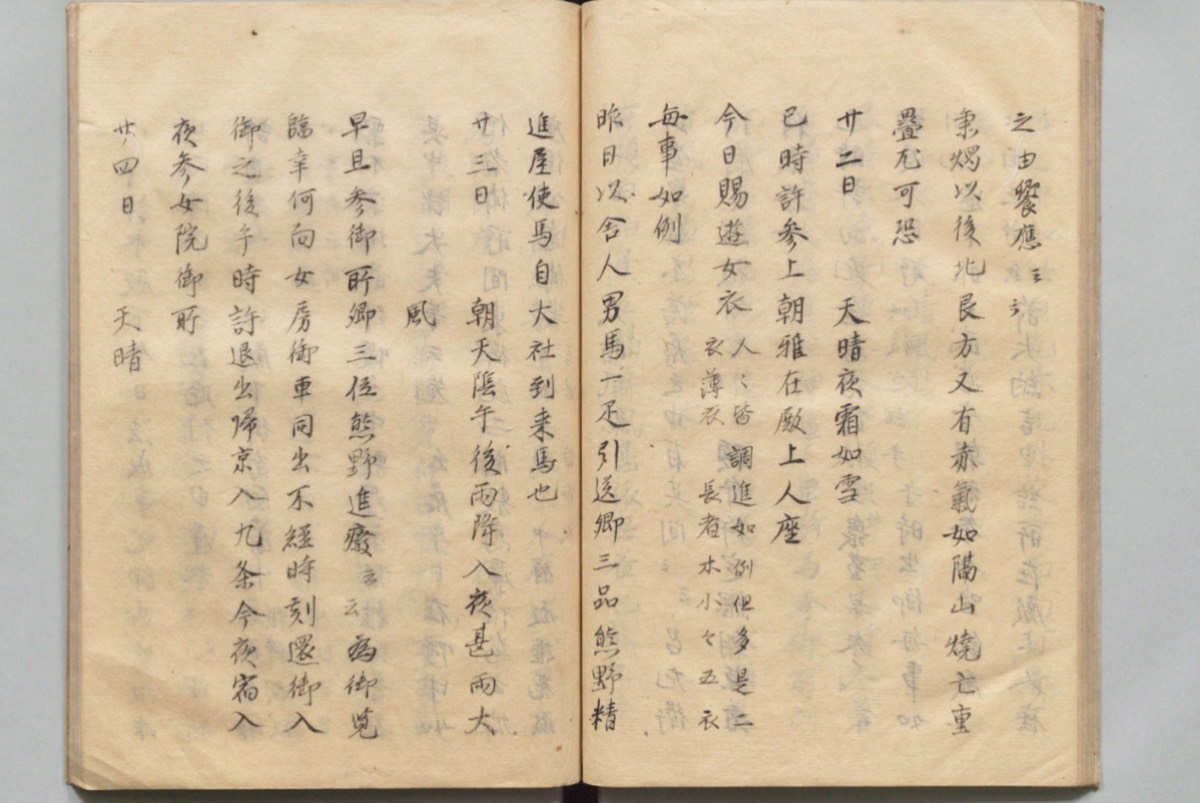
A hand-copied version of Fujiwara no Teika’s diary, Meigetsuki, from the Edo period. The page shown includes references to “red lights in the northern sky” on the right-hand side.

Credit: National Archives of Japan/Public domain

Achieving a deeper understanding space weather is vital to all manner of space-based science, such as extreme solar activity known as solar proton events (SPEs), which hurl high-energy particles toward the Earth traveling as much as 90 percent of light speed. Should an SPE coincide with a manned space mission—as a string of SPEs nearly did in 1972, just missing the Apollo 16 and 17 missions—it could expose astronauts to lethal radiation. Learning more about past SPEs is key but to date research has focused on rare, very powerful historical SPEs.

The standard method for identifying when an SPE occurred is measuring carbon-14, produced when high-energy photos penetrate the Earth’s magnetic field (usually near the poles) and collide with gases in the atmosphere. Those carbon-14 compounds then spread through the atmosphere around the globe and are eventually deposited into organic materials, like buried trees. But the method is time consuming and researchers would like to be able to identify the most likely places to focus their efforts. Japanese scientists have developed an interdisciplinary method for identifying less extreme SPEs, which are more frequent but harder to detect, according to a paper published in the Proceedings of the Japan Academy Series B.

They turned to medieval historical sources for help, looking for any mention of phenomena that might be evidence for an SPE. The first clue came from a diary of an influential Japanese courtier and poet, Fujiwara no Teika, who described seeing “red lights in the northern sky over  Kyoto” in February 1204 CE—i.e., an aurora. So the team measured carbon-14 in asunaro wood in the region and discovered the telltale spikes of an SPE. An examination of tree rings confirmed that a red aurora had occurred in China between 1200 and 1201 CE. (SPEs don’t cause aurora but they are associated with the space weather conditions that do.) The authors also found that there were shorter fluctuations in the solar cycles at that time: seven- to eight-year cycles, vs. the eleven-year-cycles we see today.

DOI: Proceedings of the Japan Academy Series B, 2026. 10.2183/pjab.102.011  (About DOIs).


Never Apologize

0
never-apologize
Never Apologize


Another writer once told me that she never, ever apologizes. How unenlightened and abrasive, I thought at the time. This was circa 2019, when the specter of cancellation loomed large, where old tweets were being dug up, and public apologies abounded.

I like to think we’ve come out on the other side a bit more canny. The era of overcorrection converted me to the idea that, with few exceptions, you should not publicly apologize, and you should not retreat.

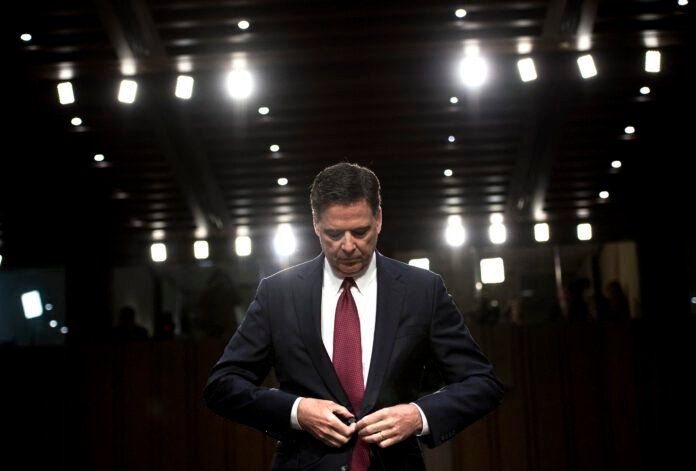
I’ve been thinking about this again in the wake of former FBI Director James Comey’s second indictment stemming from a dumb joke he literally wrote in the sand. While on a beach vacation last year, Comey spelled out the words “86 47” and posted the photo online. For this limp act of resistance, he’s been charged with threatening to kill the president and transmitting the message via interstate commerce, i.e., Instagram.

For those who’ve never worked a service industry job and are not unruly, public drunks — which would make for an interesting Venn Diagram for members of this administration — “86” is slang for removing someone from an establishment. It’s ludicrous to imagine this being read as a threat on Donald Trump’s life, but that was hardly the point.  

What matters is that Comey made a critical misstep: He deleted the post and retreated, giving his detractors exactly what they so richly desired. “I didn’t realize some folks associate those numbers with violence. It never occurred to me but I oppose violence of any kind so I took the post down,” he said at the time.

Now, some necessary caveats: There is great value in addressing specific wrongs to the specific people you’ve wronged. This is best done in private. If you find yourself apologizing to a large group of unspecified people for hard-to-pin-down or ever-evolving wrongs, it should give you pause, ditto if you start by opening up your Notes app. Consider who is asking you to apologize and their motivations for doing so. Are they trying to exert control over you? Do they want to gain leverage for future use?

Comey’s de facto apology not only didn’t matter to its intended audience, but it also telegraphed the former FBI director as weak. Announcing himself as willing to capitulate only chummed the water further, the sharks circled, and he bent the knee to the worst actors rather than stand his ground. Deleting the post, in the modern era, ends up looking like an admission of guilt — or, at least, an admission that the bad guys got under your skin, which means they can do so again, at will, in the future.

Once you start apologizing to appease the nameless, faceless ombudsmen looking to catch you out, you might find it’s impossible to stop. 

New York City Mayor Zohran Mamdani is experiencing this firsthand. Early in March, the right-wing website Jewish Insider thought they were onto the scoop of the century when they published a story blaring: “Zohran Mamdani’s wife liked social media posts celebrating Oct. 7 attacks.” That premise was hardly borne out by the posts that Rama Duwaji, an interdisciplinary artist, had “liked” — which included such incendiary phrases as “Systemic change for collective liberation” — but the damage was done. A Mamdani spokesperson responded to the report with a conciliatory statement: “Mayor Mamdani has been clear and consistent: Hamas is a terrorist organization, October 7th was a horrific war crime, and he has condemned that violence unequivocally.”

It’s safe to say this apology was not accepted, and bad actors in the media doubled down on attacking Duwaji. One week later, a gotcha reporter manufactured outrage with a story for the conservative Washington Free Beacon about one of Duwaji’s illustrations running alongside a collection of essays edited by Susan Abulhawa about the indignities of living under Israeli occupation — in this case, a Gazan woman’s search for something as simple as a bathroom. The publication attempted to hold Duwaji accountable for everything the editor has ever said, none of which was contained in the piece itself, which was actually written by Diana Islayih.

Mamdani apologized for the editor, saying, “I think that that rhetoric is patently unacceptable. I think it’s reprehensible.” But the mayor’s critics were quick to seize on what was left unsaid, with an Anti-Defamation League leader crediting his apology with one hand while offering with the other: “However, we have not heard from [Duwaji]. Does she have a problem with the author and her statements? We just don’t know.” (Abulhawa, for her part, nailed it in a withering response to Mamdani’s apology: “You succumbed to forces that seek to pick away at you, at your talented, beautiful wife, and at your work, clawing harder with each apology or concession you make.”)

It wasn’t over, and we likely haven’t heard the end of it. The Free Beacon doubled down on its intrepid reporting by advanced-searching up some of Duwaji’s off-color tweets from when she was a teenager. This seemed to break the dam, and New York’s first lady publicly apologized earlier this month in an interview on the art site Hyperallergic.

“I felt a lot of shame being confronted with language I used that is so harmful to others; being 15 doesn’t excuse it,” she told the site. “I’ve read and seen a lot of what others have had to say in response, and I understand the hurt I caused and am truly sorry.” 

This all comes after Mamdani was only a few months off his historic win in an election where the most votes were tallied since 1969 — one in which he overcame wave after wave of Islamophobic fearmongering and political opponents smearing him as “antisemtic” for refusing to roll over on supporting Palestinian liberation. He stood up for something people believe in and was rewarded for not backing down, which makes it all the more mystifying that he would start apologizing now.

But Mamdani and Duwaji are far from alone. Years back, Rep. Ilhan Omar was famously disciplined for her “all about the Benjamins” tweet, which suggested, apparently quite controversially, that money was involved in lobbying. (After being tarred as trafficking in antisemitic tropes, Omar tweeted, “I unequivocally apologize.”) The attacks on Omar — again, brought by bad actors — have not stopped since then.

The door on all this apologizing only swings one way. You’ll never get an apology out of Donald Trump, AIPAC, or the vast majority of elected Republicans. This should force you to consider that, just maybe, your opponents weren’t actually offended in the first place; they were exercising power over you in a way you’ve already proven works. It’s akin to political blackmail: If you prove you’re willing to pay the bad guys off once, there’s nothing to stop them coming back again and again for another pound of flesh.

Being involved in public life — and politics in particular — means offending people. It means making enemies of the types of people who strenuously fight against everything you stand for. What the left should stake out is the courage to stand on principle and be willing to have the bad people dislike you. Because without a spine, an elected lefty is just another politician.

Event With Links to Oil Industry Teaches Judges “Healthy Skepticism” of Climate Science

0
event-with-links-to-oil-industry-teaches-judges-“healthy-skepticism”-of-climate-science
Event With Links to Oil Industry Teaches Judges “Healthy Skepticism” of Climate Science

For many months, conservative lawmakers and political operatives have been targeting the scientists and lawyers behind the Climate Judiciary Project, a program meant to educate the courts about climate science, alleging that their effort constitutes a conspiracy to influence federal judges and persuade them to rule against the oil industry.

Now, just as congressional investigators are escalating a formal inquiry into the project, a separate program closely aligned with the fossil fuel industry and free-market conservatives is hosting a symposium for 150 judges in Nashville, Tennessee. The program, run by the Antonin Scalia Law School at George Mason University, also aims to educate judges, but in a way that prioritizes American business interests and questions climate science. 

The dueling efforts come as a number of significant lawsuits seeking to hold fossil fuel companies accountable for climate damages are making their way through the courts and as oil-industry-aligned attacks on climate policies, and the legal arguments supporting them, have been sharply increasing.

ProPublica reported in April that political operatives connected to the conservative activist Leonard Leo were coordinating an effort across 11 states to pass laws shielding fossil fuel companies from liability for climate harm. In the past three weeks, similar liability waiver bills have been introduced federally in both the House and the Senate. Last week the Florida attorney general’s office launched an investigation into alleged judicial influence by the organization that oversees the Climate Judiciary Project, the Environmental Law Institute, a nonpartisan legal scholarship group funded until recently by the Environmental Protection Agency. 

These developments come on the heels of a campaign last winter to get the Federal Judicial Center, the publishing body for the federal court system, to retract a roughly 90-page chapter devoted to climate science from the latest volume of its technical manual for judges. Twenty-two Republican attorneys general wrote to Rep. Jim Jordan of Ohio, the Republican chair of the House Judiciary Committee, demanding that the committee investigate the center’s publication of material about how to weigh scientific evidence about climate and the weather because the chapter’s authors appeared to be biased. In their letter, they noted the authors work for Columbia University’s Sabin Center for Climate Change Law and alleged the chapter was influenced by Michael Burger, the executive director of the center who works closely with the law firm Sher Edling, which represents several climate plaintiffs. The Republican attorneys general also noted that some staff at the Sabin Center work with the Environmental Law Institute and the Climate Judiciary Project. Although the chapter had been peer reviewed and approved by the Federal Judicial Center, as well as by the National Academies of Sciences, Engineering and Medicine, the center retracted the climate chapter in February.

On April 28, Jordan went a step further, issuing letters accusing Burger, the Environmental Law Institute and Sher Edling of bias, conspiracy and collusion. Jordan demanded that the three parties produce private communications, receipts and records of funding sources, and that the recipients sit for interviews before the committee.

A close-up photo of a man wearing a blue shirt and tie.
Rep. Jim Jordan of Ohio leaves a House Republican Conference meeting in the U.S. Capitol in March. Tom Williams/CQ-Roll Call via Getty Images

The Sabin Center, Jordan wrote, is “producing materials to be used to bias federal judges about novel climate-related legal theories” and coordinating to bring climate-related litigation to court. The activity raises questions about “the integrity and independence of the judicial process” and “ex parte contact with courts,” Jordan wrote, referring to the improper conduct of contacting a judge without opposing counsel present to argue issues related to a pending case. 

Neither Sher Edling, the Sabin Center nor Burger responded to a request for comment. A representative for the Environmental Law Institute stated in an email that the Climate Judiciary Project “does not participate in litigation, coordinate with any parties related to any litigation, or advise judges on how they should rule on any issue or in any case. The goal of CJP is to provide judges with the tools they need to understand climate science and how it arises in the law.”

Jordan’s office replied to a request for comment by reasserting the statements in the letters it sent, and it did not respond to a detailed list of questions.

Amid the allegations of impropriety and conflicts of interest though, the program at George Mason University has scarcely been noticed.

The George Mason conference, called the “Judicial Symposium on Scientific Methodology, Expert Testimony, and the Judicial Role,” opened the day after Jordan sent out his letters and will continue through Saturday, May 2. It is run by the university’s Law and Economics Center, which oversees a project called the Judicial Education Program. The center is funded in part by ExxonMobil, which is a defendant in several of the climate lawsuits. ExxonMobil did not respond to a request for comment. 

The conference includes speakers who have filed amicus briefs — filings by people who aren’t part of the case but have a strong interest in its outcome — in favor of the oil industry in several of those cases, as well as at least one lawyer who has represented fossil fuel companies in court. The reading assignments prepared for the judges include a Substack post by a notable climate contrarian accusing the authors of the retracted climate chapter in the federal court’s reference manual of including material by Burger and hiding his authorship. They also include a law journal argument that a key tenet of climate science used to identify the cause of disasters should be inadmissible in their courtrooms. One session, titled “Debates on the trustworthiness of tools to evaluate science in the courtroom,” focuses entirely on the federal courts’ reference manual. 

In an emailed response to ProPublica, Donald Kochan, the executive director of George Mason’s Law and Economics Center, which organized the event, presented the symposium as a robust and objective discussion. The program’s advisory board, he wrote, is a politically and jurisprudentially diverse group including “some of the most progressive jurists in the country, including on climate issues.” Kochan, who did not respond to a list of specific questions, added that lectures are by leading academics on science and law and that he invited the authors of the judicial reference manual to speak but they declined, as did several others who he suggested would have represented more centrist viewpoints on the climate issue.

The conference is one of dozens of meetings, retreats and “intimate weeklong gatherings” that are regularly hosted by the Law and Economics Center as part of an initiative to instill free-market values and greater knowledge of the economic consequences of policy in judicial decision-making. In 2016 the law school renamed itself after the former Supreme Court Justice Antonin Scalia and the center expanded with $30 million in gifts, adding faculty and scholarships and launching additional “colloquia.” The center today runs several parallel initiatives under the umbrella of the Judicial Education Program, each aimed at gathering judges together and educating them. The symposium on science and evidence is one of these events.

A crowd of people in business attire look on as two men pull a curtain down from a larger-than-life statue of Justice Antonin Scalia with his arms crossed.
A statue of former Justice Antonin Scalia is unveiled at George Mason University’s Antonin Scalia Law School in 2018. Katherine Frey/The Washington Post via Getty Images

According to an internal fundraising document from 2020 obtained by ProPublica, the gatherings are often luxurious all-expenses-paid affairs, created to foster lasting relationships and opportunities to network with judges. The document included a solicitation for more than $930,000 sent by the center to the Charles Koch Foundation, a libertarian organization that provides grants to universities and scholars. At the time of the proposal, more than 5,000 judges representing all 50 states had attended at least one of the organization’s programs, the document stated.

The goal of the symposium, according to the document, is to sway judges toward a libertarian economic viewpoint in their rulings — the very sort of “biasing” that Jordan accused the Sabin Center and the Climate Judiciary Project of. 

“The goal of this project is to expose judges to the intellectual history of the role of capitalism, economic freedom, and a constitutionally limited government as fundamental features of a liberal society,” the document says. It is also to establish a community of like-minded justices “with synergistic effects on the judiciary as a whole” and to influence the outcome of cases that come before the courts. Judges, the fundraising proposal continues, “urgently need to cultivate an understanding” of economic analysis and its relevance to the legal system if they “are to issue decisions that advance the rule of law and America’s free enterprise system.”

According to the George Mason University website, the Law and Economics Center’s 2025 funders include DonorsTrust, a dark money pass-through organization meant to shield the identity of contributors. DonorsTrust is often used by organizations tied to Leo, who brought George Mason a $20 million gift, in addition to $10 million from the Charles Koch Foundation, that made expansion of the law school’s program possible. 

This weekend’s symposium in Nashville is one of the most significant parts of the center’s outreach to justices. According to the 2020 fundraising letter, the goal of such gatherings is to challenge the status quo on science. The conference “will give judges a rounded understanding and healthy skepticism of the invocations of ‘science’ that lurk in the background of lawsuits they are hearing,” the center’s then-director wrote, and it will help judges understand that “so much of what passes as ‘science’ for leverage purposes never has to face tests for rigor, reliability and quality in front of a neutral arbiter.”

One of the symposium’s events prominently features Philip Goldberg, a managing partner at the law firm Shook, Hardy & Bacon and the special counsel to the National Association of Manufacturers’ policy lobbying arm, the Manufacturers’ Accountability Project, which the group describes as “the leading voice of manufacturers in the courts.” MAP, as it is called, has publicly rejected the claims in a landmark case that the city of Honolulu brought against Shell, ExxonMobil and other oil companies alleging they misrepresented the risks of using their fuels and are responsible for the damages they have caused. Goldberg authored a brief for the group that was submitted to the U.S. Supreme Court on the case in 2024.

Goldberg, who did not respond to a request for comment, has also authored briefs in climate liability cases brought by the city of Baltimore against BP and other fossil fuel companies — a case won by the defendants in March — as well as a case brought by Boulder County in Colorado against Suncor Energy and ExxonMobil, which alleges the companies misrepresented the risks of using fossil fuels. Lawyers from Shook, Hardy & Bacon are also present at the conference. Other lawyers at the firm wrote a brief in favor of Chevron in a case brought by Plaquemines Parish, Louisiana. (The oil companies dispute the allegations and each of these cases is ongoing.)

For its assigned reading for a session on the judicial manual, the symposium offered an article by the political scientist Roger Pielke Jr., a senior fellow at the conservative American Enterprise Institute. Pielke wrote that he found evidence that the true authorship of a significant part of the climate chapter in the reference manual was obscured. He used the Claude artificial intelligence program to run an analysis comparing the chapter’s text to a paper co-authored by Sabin’s Burger and said he found a correlation. 

“Michael Burger did not write any of the text in the climate science chapter nor did he have any control over the content and scope,” one of the chapter’s two authors, Jessica Wentz, who has denied the chapter was biased, wrote to ProPublica. The other author did not respond, and Burger declined to comment. 

The conference did not offer readings from the climate chapter of the manual itself, which is still available on the website of the National Academies of Sciences, Engineering and Medicine. Nor did it offer readings from the United Nations climate science authorities or climate-related readings from any other peer-reviewed scientific journal.

In its final session, the symposium features attorney Matthew Wickersham of the firm Alston & Bird, which has served as counsel for Chevron in several lawsuits. Wickersham did not respond to a request for comment. The only reading assigned to justices for that session is a paper Wickersham wrote in the Rutgers Law Record in 2025 about why attribution science — the field of study that makes it possible to link climate disasters to specific amounts of pollution and their sources — should never be admitted in court.

Japan-Australia frigate deal about far more than 11 warships

0
japan-australia-frigate-deal-about-far-more-than-11-warships
Japan-Australia frigate deal about far more than 11 warships

The signing of the “Mogami Memorandum” aboard the JS Kumano frigate docked in Melbourne on April 18, 2026, marks a pivotal geopolitical moment, one that signals a tectonic shift in the Indo-Pacific security architecture.

Japan has, in effect, shed the constraints of its post-World War II pacifism to emerge as a major global exporter of defense equipment.

Under the agreement, valued at up to A$20 billion (US$14.4 billion), Tokyo has committed to supplying 11 next-generation Mogami-class frigates (Upgraded Mogami/06FFM) to the Royal Australian Navy.

Japan’s Defense Minister Shinjiro Koizumi and Australia’s Deputy Prime Minister Richard Marles jointly inaugurated what is now widely viewed as the most integrated north–south defense axis in the region.

The procurement scheme is notably ambitious. The first three vessels will be entirely built by Mitsubishi Heavy Industries in Nagasaki to meet an accelerated delivery schedule by December 2029. The remaining eight will be constructed in Henderson, Western Australia.

This decision concludes a prolonged contest in which Japan outmaneuvered Germany’s MEKO A-200 proposal, as well as bids from South Korea and Spain.

Canberra ultimately favored Tokyo due to the maturity of its design, schedule reliability, and superior automation technology, allowing operations with a crew of just 92, roughly half that of conventional frigates.

For Japan, this contract marks redemption after its failed bid for Australia’s Soryu-class submarines a decade ago. More importantly, the Mogami deal serves as a geostrategic instrument to anchor Australia within a quasi-alliance, a de facto alignment aimed at balancing China’s growing military assertiveness in the Indo-Pacific.

Bilateral relations have evolved well beyond trade, entering a phase defined by shared strategic doctrine, particularly the concept of “deterrence by denial,” designed to prevent conflict in maritime theaters before it can escalate.

This strategic convergence did not emerge overnight. Since the declaration of a Special Strategic Partnership in 2014, Tokyo and Canberra have methodically built a robust legal and operational framework.

The culmination came with the Reciprocal Access Agreement (RAA), enacted in 2023, which streamlines the deployment of troops and defense assets across each other’s territories. It represents Japan’s first such defense agreement with a country other than the United States since 1960.

A quasi-strategic alliance

The deepening of ties is rooted in shared vulnerabilities, particularly concerning the security of sea lines of communication (SLOC). Australia functions as a critical supplier of energy and minerals to Japan, providing roughly one-third of its LNG needs and two-thirds of its industrial minerals.

Any disruption in the South China Sea or the Strait of Malacca would force reliance on alternative routes along Australia’s eastern seaboard and through the Vitiaz Strait, lifelines essential to Japan’s economic survival.

Consequently, Australia’s capacity to secure its northern maritime approaches is not merely a regional concern, but a direct Japanese national interest.

Both countries are now embedded in overlapping multilateral security frameworks. These include the Quadrilateral Security Dialogue (Quad) alongside India and the United States, as well as close coordination under the Trilateral Strategic Dialogue (TSD).

Australia has also opened pathways for Japan’s participation in AUKUS Pillar II, focusing on advanced capabilities such as autonomous underwater systems, artificial intelligence, and quantum technologies.

The Framework for Strategic Defence Coordination (FSDC), launched in late 2025, institutionalizes this partnership further, encompassing intelligence-sharing and long-term defense policy alignment.

This dense network of strategic cooperation distinguishes Japan’s relationship with Australia from its engagements elsewhere in Asia. In Southeast Asia, Tokyo relies on the Official Security Assistance (OSA) mechanism — providing, for instance, air surveillance radars and patrol vessels to the Philippines to enhance maritime domain awareness in the South China Sea.

While Manila signed an RAA with Japan in 2024, that cooperation remains focused on baseline defense capacity and humanitarian assistance, rather than the deep industrial integration seen with Australia.

Australia occupies the apex of Japan’s hierarchy of “like-minded countries,” largely due to strategic symmetry and full interoperability with US and NATO standards.

Canberra is viewed as a partner capable of high-end combat operations, whereas engagements with countries such as Indonesia and the Philippines focus on maritime diplomacy, sovereignty patrols, and archipelagic security.

The Mogami differentiation

These distinctions are starkly reflected in the technical specifications of the Mogami frigates being supplied. The Australian variant, the “Upgraded Mogami” or New FFM, is significantly more lethal than the versions discussed with Indonesia.

It is equipped with 32 Mk 41 Vertical Launch System (VLS) cells capable of carrying up to 128 Evolved Sea Sparrow Missiles (ESSM), and it is integrated with the US weapon systems such as the Naval Strike Missile (NSM) and potentially Tomahawk cruise missiles.

By contrast, Japan’s proposed cooperation with Indonesia, covering eight vessels, split between Japanese and domestic production, centers on the standard 30FFM or a modified variant. This version emphasizes patrol and surveillance functions in archipelagic waters.

Indonesian frigates are projected to carry only 16 VLS cells, with sensor suites optimized for independent operations in shallow seas. The cost differential is equally significant: Australian units average around A$1.8 billion each, reflecting extensive technology transfer and the upgraded OYQ-1 combat management system, whereas Indonesia’s version is designed to be more economical and scalable for domestic production.

Functionally, Australia’s Mogami fleet is intended to operate as part of an integrated combat system alongside U.S. and Japanese Aegis destroyers in high-intensity conflict scenarios in open waters.

For Indonesia, however, the platform serves as a tool to assert physical presence in exclusive economic zones, emphasizing operational efficiency and minimal crew requirements, without adopting long-range offensive capabilities that could trigger regional sensitivities.

This divergence underscores Japan’s “tailoring” strategy in defense exports: deploying a common technological platform but calibrating capabilities to match each partner’s risk profile and geopolitical role.

Japan’s seriousness in expanding defense exports is further evidenced by domestic legal reforms. Under Prime Minister Sanae Takaichi, Tokyo has relaxed its “Three Principles on Transfer of Defense Equipment,” enabling the export of lethal systems to strategic partners.

Australia has been the primary beneficiary, but the ripple effects are visible elsewhere, from radar system transfers to Mongolia to ongoing discussions about supplying used frigates to the Philippines.

ASEAN’s strategic calculus

The Japan-Australia axis is poised to become a decisive factor in shaping the Indo-Pacific balance of power.

In the East China Sea and around Taiwan, the deployment of 11 advanced Australian stealth frigates, equipped with superior anti-submarine warfare (ASW) capabilities, will complicate Chinese submarine operations attempting to breach the “First Island Chain.”

This adds a critical defensive layer to Japan’s energy supply routes, ensuring resilience even amid escalation in the South China Sea.

For China, this emerging axis represents a direct challenge to its incremental “salami-slicing” strategy. Beijing has criticized the agreement as a catalyst for an arms race and the formation of an exclusive, NATO-like bloc in Asia.

Yet from the perspective of Tokyo and Canberra, this integration serves as strategic insurance, particularly against potential fluctuations in U.S. commitment to the region amid domestic political shifts in Washington.

The implications extend beyond the immediate actors. For ASEAN countries, the deal carries a strong magnetic appeal. Australia’s success in securing access to Japan’s most sensitive defense technologies could set a precedent for others, including Vietnam and Indonesia, to reassess their defense procurement strategies.

Japanese systems offer a compelling middle path: high-end combat performance combined with industrial reliability, without the political constraints often attached to Western platforms or the limitations imposed by sanctions on Russian systems.

Ultimately, the Mogami agreement is not merely about deploying advanced warships. It represents the construction of a broader defense innovation and manufacturing ecosystem between two middle powers determined to avoid marginalization in great-power competition.

The Japan-Australia axis, anchored by the Mogami frigates, lays the groundwork for a more horizontal and resilient regional security order, one no longer dependent on a single hegemonic anchor.

In the years ahead, the integration of Japanese sensors, American missile systems, and Australian shipbuilding capacity will define a new strategic reality, one that any actor seeking to alter the Indo-Pacific status quo through coercion will have to reckon with.

Ronny P Sasmita is senior international affairs analyst at Indonesia Strategic and Economic Action Institution, a Jakarta-based think tank.

Infrasound waves stop kitchen fires, but can they replace sprinklers?

0
infrasound-waves-stop-kitchen-fires,-but-can-they-replace-sprinklers?
Infrasound waves stop kitchen fires, but can they replace sprinklers?

In a makeshift demonstration kitchen in Concord, California, cooking oil splatters in and around a frying pan, which catches fire on an unattended gas stove. Within moments, a smoke detector wails. But in this demonstration, something less common happens: An AI-driven sensor activates and wall emitters blast infrasound waves toward the source of the fire in an attempt to put it out.

The science of acoustic fire suppression, which has long been known and documented in scientific literature and the press, works by vibrating oxygen molecules away from a fuel source, depriving the fire of a critical component needed for combustion.

Indeed, after just a few seconds of infrasound, the tiny kitchen blaze goes out.

The demonstration I witnessed took place in the presence of numerous firefighters and officials from Contra Costa County Fire Protection District, the state’s premier wildland firefighting agency (CAL FIRE), and invited journalists.

“We were able to not just point-and-shoot like a fire extinguisher; we figured out how to run it through ducting and distribute it like a sprinkler system,” said Geoff Bruder, co-founder and CEO of Sonic Fire Tech, during the presentation.

The company’s goal is to replace sprinklers, which are effective at stopping fires but can also do significant water damage to a property. Sonic Fire Tech appears to be the first company trying to commercialize the science of acoustic fire suppression. Its executives have already been touring Southern California; Wednesday’s event was the first in the northern half of the state.

The company aims to make this infrasound technique mainstream in both commercial (for instance, a data center, where sprinklers would damage electronics) and in-home installations, given that sprinklers are already required in all new California homes built in 2011 and later.

Sonic Fire Tech also hopes to produce a backpack-based system that could be worn by wildland firefighters headed out into the field.

“We are making meaningful technological improvements on a monthly basis,” Stefan Pollack, a company spokesperson, emailed Ars after the event.

But two experts who spoke with Ars raised serious questions about the potential for this technology to supplant traditional sprinklers in a home. They are even more skeptical as to whether the technique can be effective in an uncontrolled wildfire situation, where flames can grow very quickly.

The infrasound system in action

Sprinkler replacement?

Sonic Fire Tech says that its system is as good as, if not better than, traditional sprinklers for many applications.

“Sonic Fire Tech is in fact intended to replace interior residential sprinklers,” Pollack told Ars. “The demo showed a critical benefit of SFT over water sprinklers in suppressing a kitchen fire, which represents about half of all residential fires. This is also applicable to commercial kitchen fires and other common grease and chemical fire applications.”

The company’s press releases tout infrasound’s advantages over sprinklers. “Traditional residential sprinklers activate several minutes only after heat rises to a threshold, can discharge large volumes of water that damage interiors and electronics, and require plumbing infrastructure that adds cost and complexity,” says one release. “Sonic Home Defense, by contrast, deploys in milliseconds and uses inaudible low-frequency infrasound waves to disrupt the chemistry of combustion before flames can spread, with no water, no chemicals, and no risk of flooding the interior of the home being protected.”

The goals sound great, but they do raise questions among outside observers.

“Sprinklers have a well-established role,” Nate Wittasek, a Los Angeles-based fire protection engineer, emailed Ars. “They apply water directly to the fuel, cool the space, slow or stop flashover, and give people time to get out while reducing risk to firefighters. Sound may knock down a small flame, but it does not cool hot surfaces or wet fuel. That raises real questions about re-ignition, smoldering fires, hidden fires, and fires that are partially blocked by contents.”

Water sprinklers have been around for a long time. The National Fire Protection Association (NFPA), a well-known industry nonprofit, was founded in the late 1800s to develop a uniform standard for sprinklers. The latest iteration of those guidelines, known as the “13D” standard, is well documented and widely adopted.

A recent press release from Sonic Fire Tech states that the company has “secured third-party validation of its system as a viable NFPA 13D-equivalent alternative to conventional residential sprinklers.”

The company told Ars that it has been evaluated by James Andy Lynch (who was present at the demonstration) and his team at Fire Solutions Group, a Pennsylvania-based consultancy, to establish Sonic Fire Tech’s bona fides.

Sonic Fire Tech declined to provide Ars with a full copy of Lynch’s report, citing “confidential and patent-pending information,” but it did send Ars the two-page executive summary.

This document states that “the Sonic Fire Tech system is capable of delivering extremely rapid fire detection, meaningful suppression or extinguishment, and consistent performance across a variety of installation configurations.”

But the summary lacks any kind of detailed explanation of which tests were run and under what conditions. It also concludes that “additional testing and optimization are recommended to further expand the range of validated applications,” adding that Sonic Fire Tech’s products have the “potential to complement or, in certain applications, serve as an alternative to traditional suppression systems.”

“Equivalency [to the 13D standard] can only be approved by the appropriate authority having jurisdiction and requires technical documentation be submitted demonstrating the equivalency,” Jonathan Hart, NFPA Technical Lead, Fire Protection Technical Resources, emailed Ars.

To date, Sonic Fire Tech has not publicly provided this information.

Wittasek said that if Sonic Fire Tech is going to claim that its product is as good as or better than the NFPA 13D standard, it should be able to provide a whole range of specifics, such as “who validated it, what test protocols were used, what fire scenarios were included, and how success was defined.”

“I would want to see full-scale testing that includes typical residential fires like furniture and mattress fires, cooking fires, electrical fires, and attic or exterior ember exposures,” he added. “It should also cover different conditions like open and closed doors, varying ceiling heights, crosswinds, obstructed fuel packages, and whether the fire comes back after the system shuts off.”

Similarly, Michael Gollner, a professor of mechanical engineering at the University of California, Berkeley, and an expert in fire dynamics, told Ars there’s simply not enough information yet to show that this technology works better than sprinklers.

He pointed to a 2018 academic paper, which found that “acoustics alone are insufficient to control flames beyond the incipient stage.”

By contrast, “Fire sprinklers are extensively tested and certified by standards developed by the fire safety community over many years,” he emailed Ars. “I think this product needs to demonstrate the same or better performance with the same reliability before it can be considered to replace any existing safety measure. While I am absolutely supportive of out-of-the-box thinking, lives are truly at stake, and new technologies must carefully demonstrate effectiveness and reliability before being entrusted by society.”

Dozer time

As for the Contra Costa County firefighters who hosted the demonstration, they are curious to see more. Deputy Fire Chief Tracie Dutter told Ars that the agency does not recommend specific products, but it does try to understand the uses that new technology can have.

“Sonic representatives indicated they are exploring opportunities to partner with fire departments to test this technology on a bulldozer,” Dutter said.

“The District would be open to testing this system on one of our dozers,” Dutter added, to “better understand its limitations and potential failure points.”

With new tech like this, firefighters also want to understand what “long-term maintenance requirements” it has, whether “routine testing or calibration is required to ensure reliability,” and “how system failures such as a malfunctioning detector or acoustic generator are identified and communicated to an owner.”

Will the Bennett-Lapid Alliance Reshape the US-Israel Relationship?

0
will-the-bennett-lapid-alliance-reshape-the-us-israel-relationship?
Will the Bennett-Lapid Alliance Reshape the US-Israel Relationship?


As elections near, the opposition alliance clarifies leadership in Israel while raising questions about how a new government would manage ties with Washington

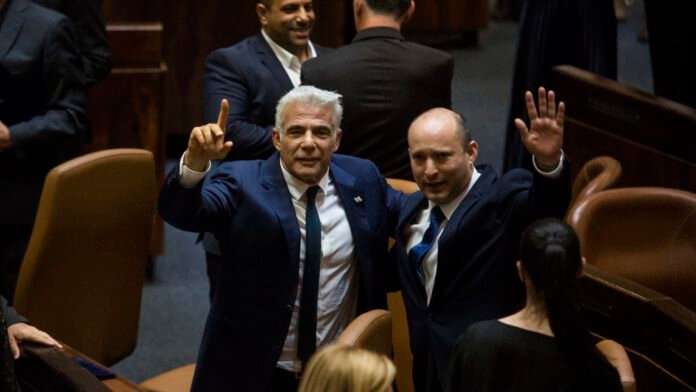
Former Prime Minister Naftali Bennett and Former Prime Minister Yair Lapid will run together in Israel’s next election, a move that reshapes the opposition camp and places Bennett at its center, at least for now.

“I think that ship has sailed,” said Ofir Dayan, a researcher at the Institute for National Security Studies, speaking with The Media Line, when asked whether Prime Minister Benjamin Netanyahu is still seen in Washington as irreplaceable. “When Bennett and Lapid replaced Netanyahu in 2021, I think it became clear that Netanyahu is not irreplaceable.”

When Bennett and Lapid replaced Netanyahu in 2021, I think it became clear that Netanyahu is not irreplaceable

Michael Koplow, chief policy officer at Israel Policy Forum and a senior research fellow at the Shalom Hartman Institute of North America, said the picture looks different depending on where one looks.

There are definitely warning signs in Congress … and that’s where it probably makes a difference who the prime minister is

“At the institutional level, under this administration, it’s very stable, and I don’t think that will change no matter who’s leading the Israeli government,” he told The Media Line. “But when you get past the level of the president and the administration, there are definitely warning signs in Congress … and that’s where it probably makes a difference who the prime minister is.”

The framework, known as Together, brings back the same two leaders who headed Israel’s short-lived unity government in 2021–2022. The arrangement now is more defined. Bennett is expected to lead the list. Lapid, who heads Yesh Atid, moves into a secondary role.

At first glance, the move looks straightforward. In practice, it raises a different set of questions—both inside Israel and in Washington—about how such a partnership would function and how a different government would approach relations with President Donald Trump. It gives the opposition a clear front-runner, but Israel’s system is not built around a single candidate. Governments are formed through blocs that must assemble a majority after the election.

Dr. Assaf Shapira of the Israel Democracy Institute told The Media Line that, from the narrow perspective of Bennett and Lapid, the alliance is a success. “If we are talking about the particular interests of Lapid and Bennett and their parties, then it is a success,” he said. “It will bring them only gains.”

For Lapid, Shapira said, the deal protects Yesh Atid from a steep decline. “The party, according to the polls, was about to crash,” he said, adding that some polls had placed Lapid’s party near the electoral threshold. “Now, Lapid secures his place in the next Knesset. He secures the fact that he will be the deputy of a list that will certainly be a large list.”

Shapira said Lapid could also return to the foreign policy role most naturally associated with him. “If Bennett forms a government, I think there is a good chance that we will see Lapid as foreign minister,” he said. “You cannot know, but that seems a little like his natural role in the next government, and that may also be relevant to the United States.”

If Bennett forms a government, I think there is a good chance that we will see Lapid as foreign minister

For Bennett, the gain is different. Before the merger, Bennett was not the undisputed leader of the opposition camp, Shapira said. He was still competing for that position, including with Gadi Eisenkot, the former army chief who has moved into politics with a strong security profile.

The joint list, at least for now, seems to settle that question. “Now, with this union, Bennett is the leader of the bloc,” Shapira said. “There are still six months until the election, but at the moment it looks like Bennett is completely the leader of the bloc, and he positions himself as the main, almost the only, competitor to Netanyahu.”

Shapira pushed back on the idea that the move reshapes the electorate itself. “I don’t see how this union can bring additional voters from Likud,” he said. “There is probably no one who was debating whether to vote Bennett or Likud and now says, after Bennett united with Lapid, I will definitely vote Bennett.”

In his view, the impact is mostly internal. The alliance may consolidate support within the camp but not necessarily expand it. Some voters from Lapid’s side could drift toward Yair Golan and the Democrats. On Bennett’s right, some could move toward Avigdor Liberman or back toward Eisenkot.

“From the point of view of the bloc, I don’t think it changes very much,” Shapira said. “It does not bring voters. It does not scare voters away. That is how it looks now, at least.”

It does not bring voters. It does not scare voters away. That is how it looks now, at least

The larger effect, he said, may be psychological. If Israelis see the Bennett-Lapid list polling near Likud, or even ahead of it, that could create enthusiasm. “The very fact that people will suddenly see in the polls a list, the Together list, that is like Likud, maybe even in some polls bigger than Likud, that is something that can create enthusiasm,” Shapira said. “And that enthusiasm is important. It has importance in itself.”

Beyond Bennett and Lapid, much remains unresolved. “We don’t know what will happen, for example, with Gantz—whether he runs separately, whether he unites,” Shapira said, pointing to the open questions surrounding Benny Gantz, the former defense minister and IDF chief of staff who leads National Unity.

He added that other configurations remain possible, including moves involving Yoaz Hendel, a former communications minister, or Avigdor Liberman, who continues to operate independently. “There is still uncertainty,” Shapira said. Eisenkot’s next move could also affect the map.

Part of the difficulty is understanding what “center” means in the Israeli context. Yesh Atid defines itself as a centrist party, but Shapira said the term no longer functions in Israel the way it might in other political systems. “Lapid defines himself as a center party. That is nice. It is not a center party,” he said. “There is almost no center today in Israel.”

Since 2022, Shapira said, Israeli politics has been divided less by classic left-right debates and more by the fault line around Netanyahu, the judiciary, liberal democracy, and the role of legal institutions. “You can call it the Bibi bloc and the anti-Bibi bloc,” he said. “You can call it a bloc that supports the Supreme Court and a bloc that opposes the Supreme Court. You can call it a bloc that supports liberal democracy and a bloc that supports ethnic democracy, or electoral democracy.”

In that division, Shapira said, Lapid is not really in the middle. “Lapid is on a specific side of this political map,” he said. “There is nothing to do about it.”

The question for Washington is whether a Bennett-led government would change the substance of US-Israel relations or mainly the tone. Dayan said the relationship with President Trump is currently shaped by the unusually close bond between Netanyahu and the American president.

“You can’t underestimate the value of personal connection,” Dayan said. “President Trump and Prime Minister Netanyahu are good friends. They have been working together for many years, so it has influence.”

President Trump and Prime Minister Netanyahu are good friends. They have been working together for many years, so it has influence.

That does not mean Bennett could not work with President Trump, Dayan said. But it would not be the same. “Even if future Prime Minister Bennett will have great relations with President Trump, still he doesn’t have that advantage of working with President Trump and being friends with him for so many years,” she said. “So, obviously, that’s going to change.”

Dayan said the current Israeli opposition is viewed in Washington with “some sort of an ambivalency.” The Trump administration is close to Netanyahu, especially his inner circle, leaving little room for the opposition to build direct channels. “There is no light between Prime Minister Netanyahu and President Donald Trump,” she said. “So, the opposition is not really very much in touch with the American administration.”

At the same time, she said, Washington knows Bennett and Lapid. President Trump has publicly praised Lapid, and the opposition is not unknown in Republican circles. “They are aware of them and have some sort of relations with them, even if not working directly together,” Dayan said.

Koplow also pointed to the unusual nature of the relationship between President Trump and Netanyahu, describing it as distinct from past US-Israel dynamics. “I don’t think there’s ever been a president and a prime minister who were so tightly linked … and who went out of their way to also give each other such high levels of political support,” he said.

That dynamic, he added, may be difficult to replicate under a different Israeli leader. “They seem to have this bond that I don’t think you’ll see with Trump and a different Israeli prime minister.”

They [Netanyahu and President Trump] seem to have this bond that I don’t think you’ll see with Trump and a different Israeli prime minister

On security, Dayan argued, the relationship is more institutional and less dependent on any single leader. The war with Iran strengthened already close ties between the Israeli and American security establishments, she said. “In terms of security, the relationship is super close, super intimate,” she added . “And I think it will stay this way for the near future, again, unless something drastic changes in the administration.”

But politics is different. Dayan said Bennett and Lapid would likely be less confrontational toward a future Democratic administration than Netanyahu, especially because Netanyahu’s image has become deeply polarizing in parts of the United States. “Netanyahu’s image became toxic in certain American circles,” she said. “Not necessarily just the policies of the Netanyahu government, but Netanyahu himself. He is portrayed as the prototype of an illiberal leader.”

Koplow noted that while a change in leadership could affect perceptions, it would not necessarily transform policy outcomes. “On a policy level, any Israeli government is going to have to listen to the US government,” he said. “If Trump says that there has to be a ceasefire … it doesn’t matter who the Israeli prime minister is.”

If Trump says that there has to be a ceasefire … it doesn’t matter who the Israeli prime minister is

With President Trump, however, the issue would be more delicate. Dayan said Bennett’s policies are not necessarily far from Netanyahu’s on core issues. “Let’s face it, Bennett and Netanyahu agree on most policy issues,” she said. “The issue is going to be what is the approach with which the prime minister’s office is approaching the American presidency and the American administration.”

Dayan also raised another possibility: Bennett might be better placed than Netanyahu to resist some American pressure. “Netanyahu has a soft spot with Trump,” she said. “Trump knows he can pressure Netanyahu, and there are many things that Bennett might be better positioned to refuse Trump than Netanyahu is, because Netanyahu feels like he owes Trump for things they did together in the past.”

Bennett might be better positioned to refuse Trump than Netanyahu is

Asked whether President Trump could intervene politically in Israel’s election, Dayan said it is possible. “I think it is likely,” she said. “I don’t know that it will happen.” At a minimum, she said, “we will see Trump saying that he wants Netanyahu to remain in office.”

For now, the Bennett-Lapid alliance has clarified the leadership of the opposition but not the outcome of the election. For now, the move mainly gives the opposition a clearer structure, with Bennett at the top. Whether that turns into a majority is still an open question.

“It’s good for both Bennett and Lapid,” Shapira said. “In terms of the blocs, I don’t think it changes very much.”

90210 Star Reveals Shocking Secrets from Hit Show

0
90210-star-reveals-shocking-secrets-from-hit-show
90210 Star Reveals Shocking Secrets from Hit Show


It’s the kind of behind-the-scenes drama fans of Beverly Hills, 90210 never saw coming.

Tori Spelling is pulling back the curtain on a shocking moment from the iconic ‘90s series — revealing that future Oscar winner Hilary Swank was left in tears after being abruptly fired from the show.

Speaking on her 90210MG podcast, Spelling, now 52, recalled the emotional day in 1998 when Swank’s time on Beverly Hills, 90210 came to a sudden end. And according to her, it was anything but quiet.

“She was hysterically crying,” Spelling said, remembering the moment her co-star returned from a meeting with producers.

Swank, who played single mom Carly Reynolds during the show’s eighth season, had grown close to Spelling behind the scenes. The actress — who was married at the time to Chad Lowe — often leaned on Spelling for support.

“I was kind of her safe place on set,” Spelling shared, adding that the two frequently spent time together off-camera.

But everything changed in an instant.

According to Spelling, Swank was called into a meeting with producer Paul Waigner — and came back devastated.

“She walked into my dressing room crying and said she got let go,” Spelling revealed.

Even more heartbreaking? Swank reportedly feared her entire career was over.

“She was like, ‘Oh my God, if I get fired off of 90210, I’m never gonna make it,’” Spelling recalled.

At the time, the firing blindsided everyone on set — including Spelling herself, who said there were no warning signs.

But what looked like a crushing setback would soon turn into one of Hollywood’s greatest comeback stories.

Just months later, Swank landed the life-changing role of Brandon Teena in Boys Don’t Cry — a performance that earned her an Academy Award and catapulted her into A-list status. She would go on to win a second Oscar for Million Dollar Baby, cementing her place among Hollywood’s elite.

Looking back, even Swank admitted the experience was painful at the time.

In a past interview with Conan O’Brien, she said she was “devastated” by the firing — especially since the show had already lost major buzz following Luke Perry’s departure.

“I got fired off a show that no one watches,” she said at the time, recalling her mindset.

But within two months, everything changed.

Swank now sees the moment as a turning point — proof that sometimes a setback is actually a setup for something bigger.

And if Spelling’s memory is any indication, that tearful breakdown inside a dressing room may have been the first step toward Oscar history.

Donroe Doctrine is becoming everything China feared

0
donroe-doctrine-is-becoming-everything-china-feared
Donroe Doctrine is becoming everything China feared

On April 28, the State Department issued a joint statement “in solidarity with Panama” in response to an uptick in detentions of Panama-flagged vessels at Chinese ports, which it characterized as “a blatant attempt to politicize maritime trade.”

This comes on the heels of a targeted lawfare campaign by American and Panamanian officials to dispossess Chinese logistics infrastructure at the Balboa and Cristobal terminals, and within a broader maritime context that has seen the US blockade the Strait of Hormuz, enter a defense partnership with Indonesia and put out aggressive statements about Peru’s Port of Chancay.

The co-signatories on the statement include Costa Rica, Bolivia (more on that later), Paraguay, Guyana, and Trinidad and Tobago.

It’s difficult to overstate the irony of this about-face on Panama. Just months ago, the US was pursuing a two-pronged strategy of diplomatic coercion via bilateral security dialogues and lawfare through a highly politicized audit of Chinese concessions near the Panama Canal.

This culminated in an utterly predictable Panamanian Supreme Court ruling against port operator CK Hutchinson, resulting in its eviction and replacement with a subsidiary of the Danish logistics firm Maersk.

Recall that the Trump administration’s opening position in these negotiations was threatening to retake the Panama Canal by force, and the State Department’s lofty rhetoric about defending Panama’s “sovereignty” and rejecting “politicization” starts to ring hollow.

The co-signatories joining the US in this declaration of “freedom” may seem random; however, they map perfectly onto America’s long-term economic and security priorities in the region.

Guyana is the world’s breakout producer of sweet light crude and is benefiting from new investments downstream amid America’s blockading of the Persian Gulf, while Trinidad is a major producer of petrochemicals like urea and ammonia.

Costa Rica is a reliable American ally that operates the most technologically advanced port in the Caribbean, and Paraguay is likely in the mix as the only remaining South American country that recognizes Taiwan.

But perhaps the most interesting co-signatory is Bolivia, a landlocked Andean nation that seems irrelevant to defending maritime “security” in the Caribbean – until one considers America’s long-term energy goals.

Bolivia sits on top of the world’s largest lithium reserves, but the high magnesium-to-lithium ratio in its source brine requires capital-intensive (and largely experimental) processes for extraction.

There is also the logistical challenge of moving thousands of tons of lithium across hundreds of kilometers of rough terrain to Chilean ports on the Pacific and, finally, up through the Panama Canal.

To put it lightly, these factors put a massive premium on every ton of lithium bound for export to manufacture electric vehicle (EV) batteries and grid-scale energy storage systems. Bolivian President Rodrigo Paz is clearly aware of this.

His recent decision to replace the head of the state-owned lithium company, Yacimientos de Litio Bolivianos, signals that he is willing to break off deals made with China and Russia under Bolivia’s previous socialist government,  provided that Western capital can offer a guaranteed market.

For Paz’s foreign ministry, signing a US-directed statement recognizing Panama as a “pillar of our maritime trading system,” is a low-friction, transactional diplomatic play.

Bolivia’s potential as a commodity export powerhouse depends on cooperation with its longtime rival, Chile, for port access. (Chile has its own highly profitable lithium sector, and is the reason why Bolivia has no coastline to begin with).

By aligning with the United States against China, Bolivia is signaling to countries like Panama and Chile that it is willing to play by the same American-directed rules as everyone else, in exchange for access to their logistics infrastructure.

Of course, America’s diplomatic maneuvering in Panama and Bolivia cannot be understood in a vacuum. In the Persian Gulf, the US military is blockading the flow of flagship light and heavy crude to Asian markets.

Meanwhile, the State Department is working diligently in the Caribbean to dispossess Chinese logistics capital through diplomatic coercion and lawfare.

In this context, it’s becoming increasingly clear that the objective of the so-called “Donroe Doctrine” is not to benevolently integrate the US and Latin America’s economies, but to force capital out of West Asia and back to the Western Hemisphere by establishing new maritime trade routes.

Whether or not the US will succeed is impossible to say, but it should not be assumed it is by accident that the State Department is promoting a new maritime consensus with Latin American countries that produce the primary inputs for energy, agricultural and logistics industries, as well as “green” metal and mineral commodities – many of which have recently rebuffed Chinese investment offers.

At this point, anyone who still views America as a neutral arbiter or policeman of global maritime trade is willingly ignoring reality. The US military is seizing ships in West Asia, while the State Department simultaneously demands that China play by its rules in Central and South America.

The moment Trump abdicated America’s responsibility to defend the Persian Gulf under the Carter Doctrine, the romantic notion of a “free” global maritime commons died.

In the long run, this is likely to be to the benefit of China and other coastal nations, but in the short term, it has created unprecedented instability in the global maritime order, which the State Department is fully prepared to capitalize on in the service of America’s energy, agricultural and mining interests.

0FansLike
0FollowersFollow
0FollowersFollow
0SubscribersSubscribe
- Advertisement -
Google search engine

Recent Posts