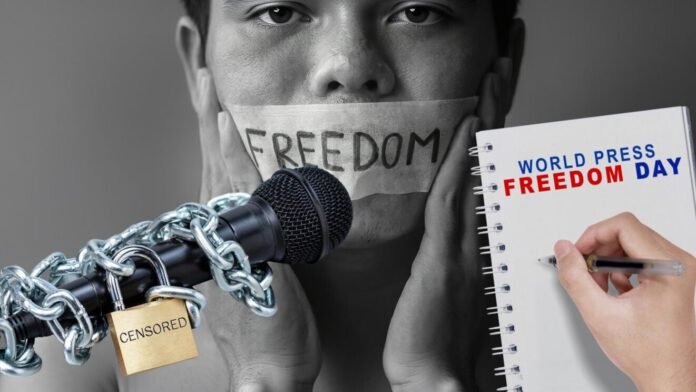
Press freedom remains essential to verified reporting, public accountability, and the ability of journalists to challenge censorship, intimidation, and violence
World Press Freedom Day, marked every year on May 3, serves as an annual test of whether governments, institutions, armed groups, technology platforms, and the public still accept a basic democratic principle: people have a right to know what is being done in their name.
The date comes from the Windhoek Declaration, adopted on May 3, 1991, by African journalists meeting in Windhoek, the capital of Namibia. The gathering took place when many African media systems were still dominated by state control, censorship, party organs, and pressure on independent newspapers. The declaration called for a “free, independent and pluralistic press,” meaning a media environment in which journalists and publishers could operate without government control and where multiple voices, not just official ones, could reach the public.
UNESCO later treated the declaration as a landmark in the global press freedom movement, and in 1993, the UN General Assembly proclaimed May 3 as World Press Freedom Day.
For 2026, UNESCO’s global World Press Freedom Day conference is being held May 4–5 in Lusaka, Zambia, under the theme “Shaping a Future at Peace.” The theme reflects the connection between press freedom, conflict, public trust, digital platforms, and the ability of societies to make decisions based on verified information rather than rumor, propaganda, or fear.
Press freedom is closely related to freedom of speech, though the two concepts serve different purposes. Freedom of expression protects the right of individuals to speak, argue, protest, publish opinions, and criticize authority. Press freedom protects the public function of journalism: gathering information, checking facts, protecting sources, questioning officials, investigating wrongdoing, and publishing findings without censorship, intimidation, imprisonment, or violence. A country can protect broad freedom of speech—allowing citizens to complain online, criticize officials, or argue in public—while press freedom remains under threat through blocked records, harassment of reporters, controlled broadcast licenses, or the jailing of journalists.
The smartphone age has made the distinction more complicated. Almost anyone can now photograph an airstrike, livestream a protest, publish a thread, or upload a video before a reporter reaches the scene. That democratization has real value. It can expose abuse, document state violence, and give voice to people ignored by traditional media. It can also flood the public square with rumors, propaganda, fake images, selective clips, and confident nonsense. As the information environment becomes more chaotic, professional verification becomes increasingly valuable.
The global picture is bleak. Reporters Without Borders (RSF) says its World Press Freedom Index compares conditions for journalists and media in 180 countries and territories. Its 2026 index found that press freedom declined over the past year in 100 of them, pushing the global average to the lowest level in the index’s 25-year history. Economic fragility has become a leading threat worldwide, with editorial interference by media owners reported as a recurring problem in many countries.
RSF’s Middle East and North Africa grouping places 18 of 19 countries in either the “difficult” or “very serious” categories. Qatar—the region’s highest-ranked country at 75th—is listed as the lone exception, but still, press freedom is considered “problematic” there.
Using The Media Line’s broader working definition of the region—all Arab League countries except Comoros, plus Afghanistan, Cyprus (including Northern Cyprus), Iran, Israel, Pakistan, and Turkey—the picture remains grim: only Mauritania, Qatar, Cyprus and Northern Cyprus fall into the less severe “problematic” category, while the rest are rated “difficult” or “very serious.” The lowest-rated country in our region is Iran, with Saudi Arabia and Afghanistan not much better.
Freedom House measures the problem from another angle, particularly through internet freedom. Its Freedom on the Net 2025 report found that global internet freedom declined for the 15th consecutive year, with citizens arrested or imprisoned for online expression in at least 57 of the 72 countries assessed. That matters for press freedom because journalism increasingly depends on digital tools: messaging apps, mobile footage, online archives, encrypted communication, social platforms, and cross-border distribution.
The dangers faced by journalists range from battlefield exposure to bureaucratic harassment. Some are killed in combat zones. Some are deliberately targeted. Some are jailed under national security, cybercrime, insult, defamation, or anti-terror laws. Others are bankrupted through lawsuits, smeared by state media, threatened online, denied accreditation, or forced into exile. The toolkit changes from country to country, but the pressure often has a familiar effect: reporting becomes costly, risky, and sometimes impossible.
The Middle East over the past year has offered numerous examples. In Iran, press freedom groups reported a widening crackdown in 2026, including the arrests of journalists Mohammad Parsi, Artin Ghazanfari, Somayeh Heydari, Pedram Alamdari, and others, along with summonses, detentions, and pressure on media outlets.
In Tunisia, journalist Zied el-Heni, editor-in-chief of the independent news site Tunisian Press, was arrested on April 24, 2026, after complying with a summons from a cybercrime unit. The Committee to Protect Journalists (CPJ) said he later began a hunger strike to protest his detention, while Reuters reported that his lawyer linked the case to criticism of the judiciary.
Kuwaiti-American journalist Ahmed Shihab-Eldin was detained for 52 days over social media posts involving publicly available wartime footage before being acquitted of charges that included spreading false information and harming national security. His case showed how vague security and misinformation laws can be turned against journalists even in countries often seen as less repressive than the region’s worst offenders.
In Bahrain, freelance photographer Sayed Baqer Al-Kamel was sentenced in April 2026 to 10 years in prison after being accused of publishing defense-related material and content deemed supportive of Iran during the war. CPJ described the case as part of the criminalization of journalistic work under national security language.
Syria has raised another concern: disappearance and detention without transparency. German journalist Eva Maria Michelmann and Kurdish-Turkish journalist Ahmed Polad disappeared in January 2026 and are believed to have been detained in Damascus. AP reported that Michelmann’s lawyer said she was likely being held in a Damascus prison, while CPJ called for transparency, legal access, and humane treatment.
Sudan’s civil war has made independent reporting exceptionally dangerous. Three years of fighting between the Sudanese Armed Forces and the Rapid Support Forces have left journalists working under siege, displacement, threats, detention, and impunity while trying to document abuses by both sides, according to CPJ.
Algeria has also seen arrests of journalists in 2026, including Omar Ferhat, director of the independent news website Algerie Scoop, and freelance journalist Abdelali Mezghiche, according to CPJ.
The pattern extends beyond the Arab world. In Pakistan, RSF reported that four Pakistani journalists in exile—Wajahat Saeed Khan, Sabir Shakir, Shaheen Sehbai, and Moeed Pirzada—were sentenced to life imprisonment in absentia in January 2026. CPJ has also reported on the detention of digital journalist Sohrab Barkat under Pakistan’s cybercrime law in connection with his reporting.
War-zone deaths require particular care. In Lebanon and Gaza, journalists including Amal Khalil, Mohammed Samir Washah, Ghada Dayekh, and Suzan Khalil were killed in Israeli strikes in 2026, but the circumstances vary, and some remain disputed. Press freedom groups have called for investigations and claimed that some incidents were cases of deliberate targeting. Israel denies deliberately targeting journalists and has alleged links between some media workers and armed groups. Those cases belong in any honest account of the dangers facing journalists, but they should be described with precision rather than folded automatically into a single category of deliberate suppression.
That caution does not weaken the larger point. Press freedom suffers when journalists are intentionally silenced, when governments jail reporters through vague laws, when armed groups threaten witnesses, when courts punish journalism as terrorism, and when war makes independent reporting nearly impossible. In each case, the public loses access to verified information at the moment it is most needed.
World Press Freedom Day exists because societies need people whose job is to find out what happened, test competing claims, and publish what others would prefer to hide. That work is imperfect, sometimes messy, and often unpopular. Without it, citizens are left with official statements, viral fragments, and guesses dressed up as certainty. That makes it easier for abuses to be hidden, events to be distorted, and accountability to collapse.