32.4 C
London
Monday, May 25, 2026
Home Blog

Egypt rejects involvement of non-Red Sea states in regional security arrangements

0
egypt-rejects-involvement-of-non-red-sea-states-in-regional-security-arrangements
Egypt rejects involvement of non-Red Sea states in regional security arrangements

Egypt announced on Sunday that it rejects the involvement of non-Red Sea countries in security and political arrangements concerning the Red Sea and the Gulf of Aden.

The position was expressed by Egyptian Foreign Minister Badr Abdelatty during talks in Cairo with Yemeni Prime Minister and Foreign Minister Shaya al-Zindani as part of the ninth round of the Egyptian-Yemeni strategic dialogue.

According to a statement issued by the Ministry of Foreign Affairs of Egypt, Abdelatty reaffirmed Egypt’s support for the unity and territorial integrity of Yemen and its backing for Yemen’s internationally recognised government and state institutions.

The discussions also focused on maritime security in the Red Sea and Gulf of Aden amid growing regional tensions.

Abdelatty stressed Egypt’s “categorical rejection” of attempts to internationalise or militarise the Red Sea and Gulf of Aden, as well as Cairo’s rejection of the participation of non-littoral states in arrangements related to the two waterways.

He stated that responsibility for securing and governing the region belongs exclusively to Arab and African countries bordering the Red Sea.

The two sides also agreed on the need for a broader approach to Red Sea security that includes economic and developmental dimensions in addition to military considerations.

In this context, Abdelatty called for accelerating the activation of mechanisms linked to the Council of Arab and African States Bordering the Red Sea and Gulf of Aden.

The statement follows similar remarks made earlier this month during talks between Egypt and Eritrea in Asmara, where both countries rejected attempts by non-littoral actors to impose security arrangements in the region.

’30 Rock’ Star Grizz Chapman Dead at 52

0
’30-rock’-star-grizz-chapman-dead-at-52
’30 Rock’ Star Grizz Chapman Dead at 52


30 Rock fans are mourning a heartbreaking loss after beloved actor Grizz Chapman died at just 52 years old.

Chapman, best known for playing Grizz on the hit NBC sitcom alongside Tracy Morgan, reportedly passed away peacefully in his sleep on May 22, 2026, after years of serious health struggles.

The sad news was shared by members of his family, including his cousin Donte “Hammer” Harrison of the Harlem Globetrotters, who posted an emotional tribute to the actor on Instagram.

“Life gave my cousin Grizz Chapman some heavy battles, but he fought them with strength and dignity until the very end,” Harrison wrote.

He said many fans knew Chapman as the sitcom star from 30 Rock, but his family knew the real man behind the screen.

“A good heart, good energy, and somebody who made an impact in this life,” Harrison continued. “After years of fighting illness and dialysis, he passed peacefully in his sleep on May 22nd, 2026.”

Harrison added that he was grateful he had a chance to reconnect with Chapman two months before his death.

“Rest easy, cousin. Your name and legacy will live on forever,” he wrote.

Fans were crushed as the news spread online. Many remembered Chapman not only for his size and screen presence, but for the warmth and humor he brought to one of NBC’s most popular comedies.

“So sorry for your loss. Thank you to Grizz for all the laughs,” one fan wrote.

Another added, “Rest easy, Grizz. I only knew him through his acting but his performances brought me and many others so much joy.”

A third fan remembered him as “awesomely funny in 30 Rock,” while another wrote, “He brought joy to so many people. May he RIP.”

No official cause of death has been confirmed.

Chapman had battled major health problems for years. In 2010, he underwent a kidney transplant after suffering from severe hypertension and kidney disease. Before receiving the transplant, he had been on regular dialysis.

Rather than keep his health battle private, Chapman used his platform to help others. He became a spokesperson for the National Kidney Foundation in 2010 and worked to raise awareness about hypertension and kidney disease.

He also appeared on The Dr. Oz Show in 2009, where he spoke openly about the medical struggles that had changed his life.

Born in Brooklyn in 1974, Chapman did not take a typical path to Hollywood. Before landing on television, the towering seven-foot actor worked as a bouncer at a strip club. That is where he first crossed paths with Tracy Morgan.

That meeting changed everything.

Chapman later joined 30 Rock in 2006 as part of Tracy Jordan’s entourage. He appeared alongside Dot Com, played by Kevin Brown, and quickly became a familiar face to fans of the Emmy-winning sitcom.

Though he started as a supporting character, Grizz became a fan favorite and appeared in roughly 80 episodes across all seven seasons.

His quiet comic timing, unforgettable look, and chemistry with Morgan made him a standout in a cast packed with stars.

Chapman is survived by his wife and two children.

His death leaves behind grieving fans, a heartbroken family, and a comedy legacy that helped make 30 Rock one of the most memorable sitcoms of its era.

Australia punts on pushing China out of rare‑earths projects

0
australia-punts-on-pushing-china-out-of-rare‑earths-projects
Australia punts on pushing China out of rare‑earths projects

It’s been a significant month for Australia’s ambitions to become a critical-minerals superpower, while balancing its relations with China and the United States.

On May 18, Treasurer Jim Chalmers announced he had ordered six investors with links to China to sell off shares in Northern Minerals, an Australian rare-earths company developing the Browns Range project in Western Australia.

Then, on May 21, mining company Arafura Rare Earths announced its planned Nolans rare earths mine in the Northern Territory would go ahead. This was after the federal government committed to purchasing 500 tonnes of rare earths from the project for Australia’s Critical Minerals Strategic Reserve.

Both moves matter. One signals a big shift in how Australia screens foreign investments, moving from vetting transactions one by one to strengthening ongoing surveillance of foreign ownership and influence.

The other shows how Australia, aligned with the US, is moving to build its own critical minerals capability.

But this isn’t without risks. For the US, kicking out Chinese investment is a straightforward win for national security. But Australia also has to work out if it can build and run these expensive projects without Chinese participation.

The Northern Minerals Browns Range project, located in northern Western Australia, is strategically important because it contains heavy rare earths – particularly dysprosium and terbium.

These elements are essential for high-performance magnets used in electric vehicles. They’re also used in offshore wind turbines and advanced defense weaponry.

Browns Range is one of the world’s few high-grade heavy rare-earth deposits outside China, and Northern Minerals is Australia’s only developer of this kind of asset. The company estimates that once in production, this mine could supply about 8% of global demand for these minerals.

Ordered to sell

The Chinese-linked investors in Northern Minerals, who together own a 17.58% stake in the company, have been given until July 2 to divest.

The federal treasurer didn’t go into specific detail about the reasons for that decision. But he said it was “consistent with advice from Treasury and the Foreign Investment Review Board and is about protecting our national interest.”

Australia’s Foreign Investment Review Board exists to advise the treasurer on whether specific foreign investments are good for Australia. And divestment orders like this are not unprecedented.

But the Northern Minerals case illustrates the stringent political conditions attached to financing critical minerals projects when alignment with the US is a factor. For Northern Minerals, this pressure hasn’t appeared overnight. The government has been applying it for years.

In 2023, Chalmers blocked a China-linked fund from expanding its stake in the firm. Then, in 2024, he ordered five foreign investors to sell their shares in the firm. This resulted in Federal Court action in 2025 after one investor ignored the order.

The message is clear: Australia’s foreign investment scrutiny now extends beyond the question of who owns the majority of a company on paper. It’s looking at:

  • who else may be making decisions and pocketing profits, despite not being named on paper (something known as “beneficial ownership”)
  • whether investors are passing shares to their own partner companies or allies when ordered to sell (known as “related-party transfers”)
  • who has voting rights and potential board influence.

The fact that an investor holds a minority stake is no longer automatically seen as low-risk.

Competition between the US and China on critical minerals is intensifying. The US and its allies are increasingly coordinating efforts to reduce their reliance on China – which still dominates processing globally.

However, the US-led alliance faces deeper fissures than appear on the surface.

Washington is prioritizing secure mineral inputs for defense manufacturing. Its industrialized allies in East Asia and Europe also want certainty of supply, but they don’t want to completely abandon low-cost, high-purity Chinese inputs.

For Australia, supply-chain security is important. However, it wants more. Its Critical Minerals Strategy document outlines a plan for more domestic processing to generate jobs and boost local industry long-term.

That is, Australia wants to outgrow its reputation simply as the “world’s quarry”, to do more with our minerals here instead.

Security is not capability

Across US-aligned countries, strategic reserves, guaranteed state buyers and allied export credits are turning rare earths into “credentialed commodities.” That is, their value depends increasingly on where they came from, rather than merely price and purity.

But blocking Chinese investment won’t automatically create Australia’s industrial capability.

The Perth-based Lynas Rare Earths illustrates this challenge. In 2025, it became the first non-Chinese operator to separate dysprosium and terbium at industrial scale. Although its output remains small in commodity-market terms, it proved China’s longstanding technical monopoly is not unbreakable.

But the company’s separation processes rely heavily on Chinese specialized equipment and chemical inputs.

The lesson for Australia is supply-chain security cannot be achieved through ownership changes alone. Beijing’s expanding export controls on rare-earth minerals, processing chemicals and refining equipment further entrench its leverage.

If security rules are applied too broadly, they could raise costs and complicate investment. Ordering out Chinese investors – after transactions have occurred – also risks unsettling other foreign investors considering investing in Australia.

As a country with deep ties with both China and the US, Australia faces a hard balancing act in protecting its own interests, without putting either major power offside.

Marina Yue Zhang is associate professor of technology and innovation, University of Technology Sydney

This article is republished from The Conversation under a Creative Commons license. Read the original article.

US’s big bet on quantum computing may not be entirely legal

0
us’s-big-bet-on-quantum-computing-may-not-be-entirely-legal
US’s big bet on quantum computing may not be entirely legal

Last week, the US government announced $2 billion in investments in quantum computing companies, allocating $100 million each to a range of startups in exchange for equity in the companies. Those could be make-or-break investments for many companies that are likely years away from a product that could see widespread use. But a member of the US Congress is now arguing that those deals are illegal, as Congress did not allocate the money for this purpose—instead, it was meant to support public research in semiconductors.

But the biggest chunk of money would go to a company that likely wouldn’t exist if it weren’t for the government’s backing. Anderon will be set up with a billion dollars each from IBM and the government and will inherit personnel and IP from IBM. It will serve as a foundry for fabricating quantum processing units and will contract its services out to IBM and any other company that wants access to cutting-edge hardware.

Is any of this legal?

Zoe Lofgren (D–Calif.), the ranking member of the House Science, Space, and Technology Committee, made it clear that she is not happy with how the government is using its money to support this technology.

“This announcement is illegal and troubling on so many levels,” Lofgren said one day after the announcement, pointing out that the money being used for the deal comes from the CHIPS and Science Act, which was passed during the Biden administration and was allocated “specifically for microelectronics R&D, with a focus on semiconductor technology.”

That technology overlaps only partially, at best, with what’s used in quantum processors. In addition, Lofgren says the money was allocated to foster public/private research partnerships, which these deals most decidedly are not. Finally, she noted that the largest sum of money will go to IBM, and she suggested that a former IBM executive (Dario Gil, current Under Secretary for Science at the Department of Energy) was involved in the negotiations that led to this deal.

None of this, she noted, means that quantum processing technology is a bad investment or that any of these companies are unworthy of support. She just argues that doing so would require Congress to allocate the money to do so.

At this point, however, it’s not obvious how to stop the deal. A lawsuit is the obvious choice, but that would require a party with standing to sue. It’s possible that a company that might otherwise have used the money for the intended research (a public-private partnership focused on electronics) could argue that it has been harmed by the diversion of the funds to a different field. But that argument would likely take so long to sort out in court that all the money would have been spent by then.

A quantum foundry

One thing that has helped IBM stay at the forefront of quantum computing is its access to in-house materials scientists and fabrication capabilities. Those resources have enabled the company to manufacture chips that test alternate designs and rapidly iterate and refine successes—an advantage powerful enough that Google also decided to open its own fabrication facility.

Given that, it’s somewhat surprising that IBM is choosing to spin these efforts into a separate company, called Anderon, which it will fund with $1 billion, alongside an equal government investment. According to the company’s announcement, it will also be handing over “significant intellectual property, assets, and a skilled workforce” to the newly launched company. The result could resemble TSMC, with the company fabricating quantum chips for firms that submit a design and pay the cost.

Not just any companies, though. IBM has specialized in producing transmons, a specific type of hardware that can host a qubit. But it’s not the only game in town. Other companies, including a number funded in the same announcement, are using technologies that host qubits in very different hardware or no hardware at all. This is very much a case of using government money to favor a specific category of technology.

That said, the move will likely be good for the broader field. A significant number of companies are designing transmon-based hardware that differs in important ways from IBM’s approach. But they’re stuck producing a limited number of test samples in fabs that may not specialize in quantum hardware, or where they have to compete with academic users for fabrication time. The launch of Anderon means those companies should now be able to access higher-quality hardware and rapidly iterate on designs. It will make testing their ideas less dependent on whether the fab they’re using produces high-quality hardware.

For IBM, this may reflect a confidence that the company has already extracted the major benefits of rapid iteration and is safely ahead of its competition. Jay Gambetta, the leader of IBM’s quantum computing efforts, has told Ars that the current hardware error rates for its chips are where they need to be to move forward with large-scale computing. Lower errors would be better, and the company has some ideas for how to achieve them, but they’re not strictly necessary for the next few years of development.

If that’s the case, why not have the government assume half the cost of staff and facilities?

What’s the long term?

We’re likely still several years away from useful error-corrected quantum computing, and closer to a decade from tackling some of the large, complicated problems where quantum computers could see widespread use. At the moment, though, it’s still unclear which technology (or technologies) will ultimately get us there first or prove capable of scaling for a decade or more. Keeping some of these companies viable for the next few years could be critical to ensuring that these technologies receive a full evaluation against those standards.

At the same time, the deal all but guarantees we’ll be investing in companies that are certain to fail. In the past, that has often devolved into cheap political point-scoring.

Longer term, it’s not entirely obvious how large Anderon’s target market will be. With a large number of startups, there will likely be a strong demand for these sorts of tips as companies test design variants and configurations. But even assuming the market settles on transmons, it’s not clear how large the annual need for these chips will be.

Transmons must be operated at milliKelvin temperatures, and large-scale, error-corrected quantum computers will likely require chaining together chips housed in multiple refrigerated containers. That will likely mean most of the hardware in use will sit in just a few data centers and be accessed online (as it is currently). Consequently, there’s a real potential for a boom-and-bust pattern in the market for these chips.

Pope Leo XIV warns of ‘new forms of slavery’ linked to Artificial Intelligence

0
pope-leo-xiv-warns-of-‘new-forms-of-slavery’-linked-to-artificial-intelligence
Pope Leo XIV warns of ‘new forms of slavery’ linked to Artificial Intelligence


In his encyclical Magnifica Humanitas, Pope Leo XIV cautioned against what he described as a global competition for increasingly powerful algorithms and vast datasets, driven by geopolitical ambitions and commercial interests.

The pontiff also warned that artificial intelligence risks creating “new forms of slavery,” pointing to the exploitation of workers such as content moderators and miners involved in supplying materials for AI technologies.

He argued that technological progress cannot be considered liberating if it results in new systems of dependence and exploitation that undermine human dignity.

Calling for stronger oversight of the rapidly expanding AI sector, Pope Leo XIV said artificial intelligence must be “human-friendly” and effectively “disarmed” to ensure it serves society ethically rather than becoming a tool of domination or abuse.

via Reuters

Why Vietnam won’t steal the show at Shangri-La Dialogue 2026

0
why-vietnam-won’t-steal-the-show-at-shangri-la-dialogue-2026
Why Vietnam won’t steal the show at Shangri-La Dialogue 2026

The Shangri-La Dialogue, held every year in Singapore, is one of the Indo-Pacific’s premier signaling platforms. A leader takes the keynote podium, and the room reads it for cues about where a country is heading: what partnerships it is prioritizing, what risks it is willing to name and how it sees the regional order.

The SLD draws defense ministers and military chiefs from over 40 countries, and much of its value has always rested less on the speeches than on the sideline bilateral meetings they facilitate across a wide range of relationships, from Japan-Australia defense coordination to India-ASEAN engagement.

In recent years, gauging great power rivalry has become a key purpose of the forum, and China’s level of participation has drawn particular scrutiny. Beijing has varied its delegation level over the years, sending PLA Academy vice-presidents rather than its defense minister in 2012, 2017 and 2018, before upgrading to ministerial attendance from 2019 to 2024.

Its downgrade in 2025, sending a one-star PLA National Defense University academic rather than Defense Minister Dong Jun, broke that recent run and drew pointed comment from Singapore’s own defense minister.

At the time, interpretations varied. While a US defense official suggested it signaled Beijing’s displeasure with Washington, others pointed to the political risk Chinese defense ministers face in a forum where questioning is unscripted. Still others read it as reciprocal after the West downgraded its own attendance at Beijing’s Xiangshan Forum.

Whatever the motive, the effect was felt across the forum: without senior Chinese participation, a significant set of bilateral meetings would lose their counterparts. Whether Beijing upgrades its delegation this year remains unconfirmed at the time of writing.

The stakes are sharpened by the 2026 SLD’s outline agenda, which runs from May 29 to 31: the fifth plenary is dedicated to “China’s Cooperative Partnerships in the Asia-Pacific.” In 2025, Beijing canceled a plenary on China’s security altogether. Whether this year’s China-focused session goes ahead, and at what level, will say more than whatever is said from the podium.

The keynote speeches, meanwhile, have a mixed record of their own. In 2022, Fumio Kishida pledged to “fundamentally reinforce” Japan’s defense capabilities, but the process had been underway incrementally since the Abe era.

Narendra Modi in 2018 presented India as central to Indo-Pacific security while offering few concrete commitments. In 2025, Emmanuel Macron called for “coalitions of action” between Europe and Asia, but France’s Indo-Pacific presence still rests on limited permanent deployments.

The plenaries have tended to follow a similar pattern: firm language on rules-based order with arguably little discernible shift in behavior once delegates leave Singapore. That track record is worth bearing in mind when assessing To Lam’s keynote address this Friday (May 29).

He will be the first Vietnamese leader to open the summit, a selection that itself signals Vietnam’s elevated standing in regional security conversations. It is also an opportunity to reassure partners that Hanoi’s strategic autonomy remains intact, even as its institutional ties with Beijing deepen.

To Lam had already been pursuing a sweeping restructuring of Vietnam’s administrative apparatus before his unprecedented consolidation of both party and state leadership at the 14th National Party Congress in January.

The diplomatic tempo since has been just as striking: a state visit to Cambodia in February, a meeting with Trump the same month, a state visit to Beijing in April, to India in May, and an official visit to Thailand on 27–29 May, landing in Singapore just ahead of the keynote.

Whether To Lam’s likely message of reassurance holds up to scrutiny is another matter. The inaugural “3+3” strategic dialogue with China in March has embedded security cooperation, including what Beijing has described as counter-“color revolution” coordination, into the institutional architecture of the relationship.

What To Lam says about maritime security, about ASEAN and about the terms of Vietnam’s partnerships will likely be read against that backdrop. The summit’s outline agenda suggests where the wider pressure points sit, and where To Lam’s reassurance of strategic autonomy will be tested by what others signal in return.

Pete Hegseth, now styled America’s secretary of war, speaks in the first plenary on Saturday (May 30) under the title “United States’ Strategy for Peace in the Indo-Pacific.” His 2025 SLD appearance surprised observers with its conventional reassurance of US regional commitment, a contrast with the Munich debacle months earlier.

It is unclear if that tone will hold this year. The USTR’s Section 301 investigations targeting Vietnam among 16 economies and the transshipment problem of rerouting tariff-dodging China-made goods remain unresolved.

Whether Washington folds economic grievances into its security framing could shape how the room reads American reliability, and how much room Vietnam has to present itself as a partner to both sides.

The third plenary, “Asia’s Maritime Security Disorder,” is likely to be the most charged session, and the one where Vietnam’s balancing act is most exposed. Vietnam is expected to complete its Spratly infrastructure program this year, populating features with civilians and naval infantry in ways that could provoke a Chinese response.

The Philippines, as the 2026 ASEAN chair, is pushing to conclude negotiations on the South China Sea Code of Conduct, which most analysts consider unlikely under its watch. Previous plenaries on the contested sea have tended to produce firm language without corresponding movement.

For To Lam, the session tests whether Vietnam can assert its sovereignty claims on the podium while preserving the institutional relationship with Beijing that the “3+3” mechanism represents. The intersection of Middle Eastern and Indo-Pacific security will run through several of the sessions.

The disruptions in the Strait of Hormuz following the US-Iran escalation have had tangible consequences for Southeast Asian states, with Vietnam turning to Japan and South Korea for crude oil assistance after China and Thailand banned refined fuel exports.

The fourth plenary on cross-regional security threats and the special sessions on strategic stability and defense-industrial resilience will be where these threads converge.

For all its prominence, the Shangri-La Dialogue remains a convening forum. It can surface tensions and offer a stage for signaling, but it does not bind anyone to anything. As ever, its value will depend more on who shows up and on what happens in the margins than what is and isn’t said on the podium.

Lam Duc Vu is a Vietnam-based risk analyst focused on regional trade and geopolitics

Rubio Congratulates Jordan on 80th Independence Anniversary 

0
rubio-congratulates-jordan-on-80th-independence-anniversary 
Rubio Congratulates Jordan on 80th Independence Anniversary 


US Secretary of State Marco Rubio on Monday congratulated King Abdullah II and the Jordanian people on the 80th anniversary of Jordan’s independence, praising the kingdom’s role in promoting stability and security in the Middle East. 

“On behalf of the United States of America, I extend my best wishes and congratulations to His Majesty King Abdullah II and the Jordanian people on the 80th anniversary of Jordan’s Independence,” Rubio said in a statement released for Jordan’s National Day on May 25. 

Rubio said ties between Washington and Amman were rooted in “our shared commitment to a peaceful, prosperous, and secure Middle East.” 

“We deeply value Jordan’s critical role in advancing our shared priorities for the region,” he said. 

The secretary of state also expressed support for continuing cooperation between the two countries. 

“As you celebrate Jordan’s National Day, the United States wishes the people of Jordan lasting prosperity under the leadership of His Majesty King Abdullah II, and we look forward to continuing our steadfast, decades-long partnership,” Rubio said. 

A separate statement issued in Rubio’s name said the United States “deeply value[s] the pivotal role Jordan plays in advancing our shared priorities in the region” and reaffirmed Washington’s commitment to maintaining its long-standing partnership with the kingdom. 

Jordan marks its independence anniversary each year on May 25, commemorating the end of the British Mandate and the establishment of the Hashemite Kingdom of Jordan in 1946. 

Following World War I, the territory fell under British administration. A treaty negotiated under King Abdullah I ended the mandate in March 1946, and on May 25 of that year the Jordanian Legislative Council formally declared independence. 

The anniversary is observed as a national holiday across Jordan with official ceremonies, military displays, cultural performances, concerts, and public gatherings.  

Celebrations traditionally include events attended by members of the Hashemite royal family, government officials, and foreign diplomats, along with fireworks, flag displays, and community festivities in cities including Amman. 


I spent years forcing myself to finish The Witcher 3—don’t repeat my mistake

0
i-spent-years-forcing-myself-to-finish-the-witcher-3—don’t-repeat-my-mistake
I spent years forcing myself to finish The Witcher 3—don’t repeat my mistake

I don’t like The Witcher 3: Wild Hunt. I’m sorry to disappoint you. I know it’s confusing, and I hope you will still respect me.

I had to say that a lot back in 2015. When the game first came out, the community of critics and enthusiasts I was a part of went bananas for it, much in the same way the current crop of journalists and influencers rallied around Clair Obscur: Expedition 33 in 2025—another game that didn’t really work for me, if I’m being frank.

The Witcher 3 was showered in accolades and awards, and it seemed like every Twitter conversation was about it. There were memes all over Reddit about how no other game could live up to it, plus lengthy essays from games journalists about just why it was so incredible. “Game of the Year” awards rained from the proverbial sky.

Meanwhile, I tried it and found it a slog. It took me years to finish it, because I kept losing interest and feeling like I had to force myself to keep going in order not to be out of the loop.

Those who knew me found this baffling. “You love RPGs like this,” they’d say. “Two of your favorite recent games are Skyrim and Mass Effect. This is like the best of both of those. What’s the problem?” (I’m paraphrasing, but I got several versions of basically this.)

The thing is, games are so diverse in focus these days that “I love open world RPGs” can mean a lot of different things.

Creating a character vs. being a character

Every RPG I have ever truly loved was a game in which I made my own character.

Filling out that blank character sheet with a vision for the identity I wanted to inhabit was by far my favorite step when I played D&D, GURPs, Traveller, Shadowrun, and other tabletop RPGs when I was younger.

To me, the overriding point of a role-playing game is defining your role and inhabiting it. It’s creating my own alter ego to meet a certain fantasy, and seeing where inhabiting it takes me.

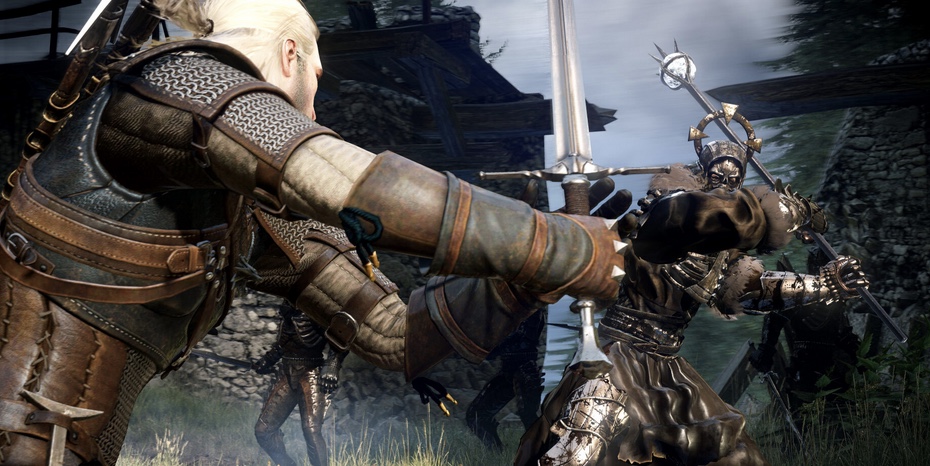
The Witcher 3 puts you in the shoes of Geralt of Rivia, a man with decades of history, the subject of multiple games, books, and a TV show. Geralt is as well-defined as they come, and while you get to make some choices for him, they still reflect the core of who that man is.

It’s genuinely impressive that The Witcher 3‘s writers managed to give the player meaningful choices within this framework. Each branching dialogue choice taps into different aspects of and conflicts within Geralt’s personality and values—the writing in The Witcher 3 is far above par, I’ll give it that. But ultimately, it’s just Geralt from different perspectives, not an identity formed by the player.

Geralt is indisputably a rad dude. He’s just not my rad dude.

Geralt is indisputably a rad dude. He’s just not my rad dude. Credit: CD Projekt Red

Even Cyberpunk 2077, a game made by The Witcher 3 developer CD Projekt Red that I do love, offers a sort of middle path between these approaches. Yes, there is a named protagonist, and yes, they have some hints of a predetermined personality in much of their dialogue. But the player can customize how they look and define their background, and that background gives the player very different dialogue options. The major choices in the game reflect fundamentally different values, not just conflicts within one person with an otherwise consistent worldview.

The same is true for Mass Effect 3‘s protagonist, Commander Shepard. You decide what they look like, you pick their background, and you get to make a very meaningful impact on who they are through your dialogue choices, play style, and more.

Some open-world RPGs take one path here, and some take the other. It’s OK to only like one of them, regardless of what others may value.

Power fantasy vs. earned competence

Geralt is, frankly put, a total badass. The man has been training for his entire life to face off against the most terrifying monsters put him in a different class from most people.

Part of the appeal of The Witcher 3 is in being that badass. I understand that appeal very well. But you know where this is going: it’s not what I’m looking for from my RPGs.

I enjoy the transition from nobody to somebody, from novice to master.

The Witcher 3 gives you ways to specialize Geralt, strengthening powers and abilities he already has, but he is most definitely not starting from zero. It’s not just because The Witcher 3 is a sequel, either. The game’s designers are intentional about making sure you feel the power fantasy in full force from the very beginning.

So again, we have an example of a variation within a genre. To outsiders, Elden Ring (another favorite game of mine) and The Witcher 3 might look similar—grimdark open-world roleplaying games with melee combat, right? But one has you going from zero to hero, and the other has you going from hero to even more heroic hero.

Geralt is powerful, so the power fantasy is strong.

Geralt is powerful, so the power fantasy is strong. Credit: CD Projekt Red

You may feel differently, but it’s that journey, not its destination, that matters to me.

All this is to say it’s OK to like one flavor of something, and not the other. You can like orange, but not lemon, or vice versa—you don’t have to categorically say “I like citrus,” and no one should expect liking one to mean you like the others. (Not that any well-adjusted person would, but hey, gamers are special sometimes.)

The value of knowing what you like

On gaming subreddits, you’ll often see folks lamenting the state of things in Twitch/YouTube/TikTok/Instagram world. There’s a strong sentiment that people who play games no longer form their own opinions, as they’re just parroting what influencers think.

I think there’s some truth to this, though it’s more complicated than just, “influencer says this, so I believe it too.” There are deeper social dynamics around community belonging and algorithms at play. But the point I want to make here is that this phenomenon is not entirely new. As long as there has been gaming media, there have been anointed games that everyone who’s part of the club is expected to like.

The Witcher 3 was one of those games. But if you take one thing away from what I’m writing here, I want it to be this: Like genre itself, those media and social dynamics flatten taste into something much simpler than it really is, and it’s important to think about what you like and why, not focus on what you think you should like.

I know I’m preaching to the choir when it comes to the Ars audience, but I, at least, need a reminder sometimes. I mean, I almost fell for it again; I spent $70 on this year’s hyped open-world RPG Crimson Desert because of all the buzz, and bounced off it immediately for many of the same reasons I didn’t like The Witcher 3—all of which I knew about before I clicked the “buy” button. At least this time I didn’t play the game for 100 hours because I felt like I should like it when I really didn’t.

Playing The Witcher 3 today

Are you someone who likes The Witcher 3? Good for you! I’m glad. And if you haven’t played it but you read this and said to yourself, “Actually, I prefer the power fantasy and the authored character,” that clearly bodes well for your potential enjoyment of the game.

You can nab it on GOG and other storefronts. In fact, it’s 80 percent off on GOG right now (so it’s $7.99). That’s a good deal for 100-plus hours of entertainment.

Unlike some older games we discuss in this series, there’s no need to install a bunch of community patches to get it running on this system. Plus, it’s been well-maintained by its developers; it got a major free update with new features like ray-tracing just a couple years ago.

Give it a shot, and if you like it more than I did, I’ll be glad to hear it—just don’t tell me it’s baffling that I’m not into it!

Some quick C:ArsGames housekeeping

First, a quick apology: It’s been almost two months since the last entry in this ostensibly monthly series. For those who’ve been following the series closely, the Ars staff is sorry for the long gap! This series is dessert for us, not the main course; we love doing it, and we get to it when we can, but when things in the wider tech world get busy, it can sometimes end up on the back burner. We’re still committed to keeping it going, though—hopefully at a more consistent pace.

That brings me to a question, though. Generally, these posts have centered on PC-focused games from the 90s, but we’ve had a couple of examples of somewhat more recent games—The Witcher 3 and Dishonored both came out in the past 15 years.

For those following along at home: are you interested in slightly newer games like that, or would you prefer the series mostly stick to that bygone golden age of shareware floppies, Voodoo cards, and big boxes at Software Etc? If you have an opinion, let us know!

The ‘cockroaches’ India’s elite created — and can’t exterminate

0
the-‘cockroaches’-india’s-elite-created-—-and-can’t-exterminate
The ‘cockroaches’ India’s elite created — and can’t exterminate

When India’s Chief Justice Surya Kant compared unemployed young people to cockroaches last week, he probably expected outrage, maybe an apology cycle, and then silence.

What he got instead was 15 million Instagram followers in five days, a cockroach logo on a mobile phone, and a movement that has already overtaken the ruling Bharatiya Janata Party’s own social media presence. The Cockroach Janta Party was born, and its viral rise is more verdict than joke.

The CJP calls itself the “Voice of the Lazy and Unemployed.” Its membership criteria include being chronically online and able to rant professionally. The irony is sharp and deliberate: these are not the qualities of people who gave up.

These are the qualities of a generation that studied hard, followed the rules, and then watched the system fail them, and decided to say so loudly.

India’s government would prefer you focus on the GDP number. With projected growth of 6.3% to 6.8% for 2025-26, the economy is, by global standards, performing well.

Prime Minister Narendra Modi has made this the centerpiece of his legacy, a rising India, a confident India, an India that will be the world’s third-largest economy by 2030. The headline growth figures conceal an economy that has failed to deliver broad-based opportunity.

Growth for whom?

The latest data from the Centre for Monitoring Indian Economy tells a different story from the government’s headline figures. Youth unemployment among those aged 20 to 24 hovered around 44 to 45% for much of 2025, levels that are substantially worse than before 2014, when the current government came to power.

Even the more conservative official measure, the Periodic Labor Force Survey, puts youth unemployment at 9.9% for the 15-to-29 age group, more than three times the general rate. In urban areas, the picture is bleaker still, with youth unemployment reaching 14.7%.

Education, which was supposed to be the great equalizer, has become an additional cruelty. Unemployment among Indians with secondary education and above stands at 6.5%, meaning that staying in school does not protect you from joblessness; it often just delays it at greater personal cost.

For women, the numbers reach extremes: female youth unemployment hits 41% in Goa and 44% in Kerala, and nearly 40% among degree-holding women in Jammu and Kashmir. This is the country the CJP’s 400,000 members signed up to criticize, more than 70% of them between the ages of 19 and 25.

Meanwhile, the wealth generated by India’s growth has flowed in a strikingly narrow direction. According to the Centre for Financial Accountability, the top 1% of Indians now control more than 40% of national wealth, while the bottom 50% survives on just 15% of national income.

Between 2019 and 2025, the wealth of India’s richest 1,688 individuals grew by 227%, from roughly 31 lakh crore rupees to 88 lakh crore rupees. Household debt in the same period nearly doubled. India’s Gini coefficient for wealth concentration, at 0.74, now matches the United States, a comparison few in Modi’s government would welcome.

This is not a coincidence. It is the result of policy choices: a growth model built around services and consumption, which generates GDP growth but not the mass employment that manufacturing once provided; tax structures that have concentrated gains at the top; and a persistent failure to invest at scale in the quality of education and job creation that an aspirational generation was promised.

When the system eats its own children

Nothing illustrates the institutional rot more clearly than the NEET examination scandal. In May 2024, approximately 2.4 million young Indians sat for NEET-UG, the sole nationwide gateway to medical education. The question paper had already been sold.

In Bihar, police arrested 13 people who had allegedly charged students up to 50 lakh rupees, roughly $60,000, for advance access to the exam. A student whose family had sold land and taken on debt to fund coaching died by suicide after the NEET-UG 2026 exam was similarly canceled over another paper leak.

This is the system the Chief Justice was defending when he called unemployed youth cockroaches for holding “fake and bogus degrees.” The more honest question is: who ran the institutions that produced those degrees? Who administered the leaked examinations? Who built the economy that cannot absorb two million medical aspirants, let alone the hundreds of millions beyond them?

The CJP’s 30-year-old founder, Abhijeet Dipke, now based in Boston after leaving India two years ago, put it plainly to Reuters: “The youth of India has largely vanished from mainstream political discourse. Nobody is talking about us. Nobody is listening to our issues or even trying to acknowledge our existence.”

The brain drain embedded in that quote is itself data. Dipke is one of countless educated young Indians who concluded that the country’s future was not going to include them, and left.

A democracy that stopped listening

India is, by law and by election, a democracy. It is also, by press freedom metrics, one of the more constrained media environments in the world.

In the 2026 World Press Freedom Index published by Reporters Without Borders, India ranked 157th out of 180 countries, a six-place decline from 2025, and lower than Bangladesh and Nepal.

RSF cited rising violence against journalists, highly concentrated media ownership, and outlets with “increasingly overt political alignment.” The political indicator sub-score placed India 160th globally.

This matters for the CJP story for a specific reason: if India’s mainstream media were functioning as an accountability mechanism, it would not have taken a viral meme movement to put youth unemployment, exam leaks, and financial insecurity onto the national agenda.

These issues have been visible for years. They were made invisible by a media ecosystem that found it more comfortable to broadcast GDP growth projections than to interview the families selling land to send their children to coaching institutes.

The CJP’s platform, covering everything from media independence to demanding that half of parliament seats be reserved for women, reads less like a party manifesto and more like a list of things that a functioning press should already have been demanding of government.

Potent crude symbolism

It is worth pausing on the name itself. The cockroach, in popular imagination, is the creature that survives everything: nuclear winters, institutional failure and elite contempt.

When the Chief Justice reached for that image as an insult, the young people it was directed at heard something different: a description of what they had already become. Resilient, persistent, impossible to exterminate.

Dipke cautioned against comparison to the Gen Z-led protests in Bangladesh and Nepal that recently toppled governments. That caution is worth respecting, movements that begin on Instagram do not automatically become political revolutions. Whether the CJP converts fifteen million followers into sustained pressure, or becomes a case study in the limits of digital dissent, remains to be seen.

But the underlying conditions that created it are not going away. Artificial intelligence is already beginning to displace entry-level roles in India’s back-office and services sectors, the employment buffer that absorbed millions of educated workers who could not find manufacturing jobs.

The exam pipeline is leaking. The housing market is pricing out a generation. The media is concentrated. The wealth is concentrated. And a Supreme Court judge, speaking from the heights of the institution designed to protect citizens, reached for the word “cockroach.”

India’s government should be less concerned about 15 million Instagram followers and more concerned about what those 15 million people are describing. They are not wrong about what they see.

They are just the first generation willing to say so at a volume that cannot be ignored.

Nimra Khalil is a geopolitical analyst and opinion writer whose work focuses on international relations, security strategy and the evolving balance of power in an increasingly multipolar world, with a particular emphasis on South Asia and the Asia-Pacific region

US official says Washington, Tehran reach preliminary deal to reopen Strait of Hormuz: Reports

0
us-official-says-washington,-tehran-reach-preliminary-deal-to-reopen-strait-of-hormuz:-reports
US official says Washington, Tehran reach preliminary deal to reopen Strait of Hormuz: Reports

The US and Iran have agreed in principle to a deal that would reopen the Strait of Hormuz, in exchange for Tehran’s commitment to dispose of its highly enriched uranium, a US official said, according to a report by The New York Times on Sunday.

The official said that the agreement has not yet been signed and remains subject to final approval by US President Donald Trump and Iran’s Supreme Leader Mojtaba Khamenei, a process that could take several days, noting that the method for disposing of Iran’s highly enriched uranium is still being negotiated.

The proposed deal does not address Iran’s missile stockpile nor include a moratorium on uranium enrichment, the official said, adding that these issues are expected to be handled in future rounds of talks.

According to a Fox News report on Sunday, the official suggested that the US could consider “significant accommodations” on sanctions relief if Iran agrees to make similar concessions regarding its enriched uranium stockpile.

READ: Iran ready to reassure world it is not pursuing nuclear weapons, president says

“Our plan is to deal with all of their stockpile of the enriched material,” the official said, adding that Washington sees Tehran making “serious accommodations” not previously seen in earlier negotiations, according to the report.

The official also rejected the idea of any “tolling” mechanism for the Strait of Hormuz, saying such an arrangement would not be acceptable and had not been proposed by either side, the report noted.

According to a separate CBS News report, the official said the administration views the emerging agreement as stronger than the 2015 nuclear deal reached under former US President Barack Obama, which allowed uranium enrichment up to certain levels.

As part of the agreement, the US would lift its blockade on vessels entering and leaving Iranian ports. The official said the US Central Command and Gulf partners would coordinate to ensure safe passage, stressing this should not be viewed as a toll system.

The official also said US Vice President JD Vance, Middle East Envoy Steve Witkoff, and Trump’s son-in-law Jared Kushner have been involved in the talks, adding that Washington is seeking to include all regional allies in the process, the report added.

READ: Trump says Iran talks ‘constructive’ but blockade will remain until final deal is reached

0FansLike
0FollowersFollow
0FollowersFollow
0SubscribersSubscribe
- Advertisement -
Google search engine

Recent Posts