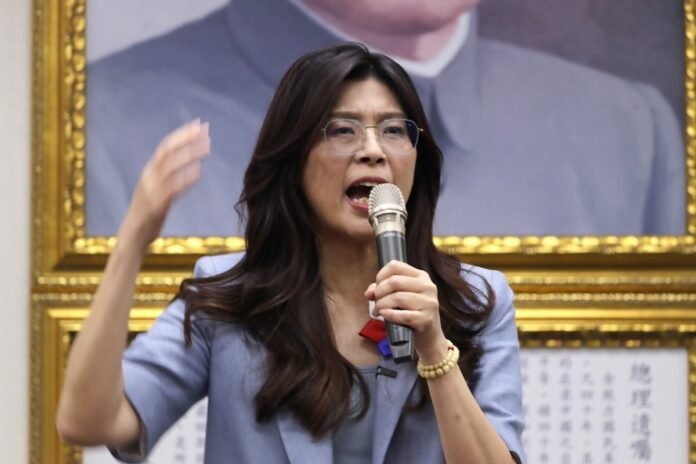
Fresh from consultations with Chinese paramount leader Xi Jinping in April, Cheng Li-wun, the Chairwoman of Taiwan’s Kuomintang (KMT), plans to visit the US in June. It will be awkward.
During her US visit, at which she hopes to talk with US officials and politicians and visit think tanks and elite universities, Cheng says she will explain an approach to cross-Strait relations that will secure peace for Taiwan while also aligning with US interests.
It is unclear, however, how she will simultaneously pacify Beijing while maintaining US support.
Beijing’s and Washington’s agendas for Taiwan directly clash. China wants to sever Taiwan’s security relationship with the US, so Taiwan’s people believe they have no alternative but to accept formal political unification with the People’s Republic of China (PRC).
For both ideological and strategic reasons, the US wants to help Taiwan maintain its liberal democratic political system and deter any Chinese attempt at forcible annexation. From the US standpoint, the urgent need is to arm Taiwan to address its otherwise hopeless quantitative military inferiority to the PRC.
While Cheng’s policy ideas made for smooth meetings in China, they will encounter challenges in America.
There is a schism within the KMT over Taiwan’s grand strategy. Cheng represents the party faction that is relatively pro-Beijing and anti-American. Along with politicians such as KMT vice-chairman Hsiao Hsu-tsen and legislators Fu Kun-chi and Jessica Chen Yu-jen, Cheng advocates accommodating China and skepticism toward the US.
This faction argues that the US is an unreliable protector, emphasizes that Taiwan should avoid provoking China, objects to what it considers excessive defense spending and cautions against a close relationship with Washington.
Cheng has said that, in principle, she wants continued US arms sales. That will presumably be part of her pitch during the US visit. But she has also criticized these weapons transactions.
First, she says the ruling DPP government’s approach to arms sales lacks transparency and fiscal discipline, partly by allocating funds before receiving letters of offer and acceptance from the US government for specific weapons packages.
Second, Cheng complains that arms sales inordinately benefit the US rather than Taiwan, and even turn Taiwan into a “powder keg.” Her views seem a mashup of recognizing Taiwan’s defense needs, incorporating China’s outlook and bashing her domestic opposition.
Cheng specifically says, “the United States is treating Taiwan as a chess piece, a pawn, to strategically provoke the Chinese Communist Party at opportune times.” Regarding the Ukraine war, Cheng blames NATO as the “core reason” for the conflict, while defending Putin as “not a dictator; he is a democratically elected leader.”
Cheng’s other takeaway from the war is that the US did not send troops to fight alongside Ukrainians, but rather sent only weapons to keep the war going, plus levied sanctions against Russia, with the results of massive death and destruction in Ukraine and failure to defeat Russia or bring down Putin.
She suggests something similar would happen in a cross-Strait war: the US would use Taiwan as a proxy, China would win the war anyway and Taiwan would be destroyed in the process.
These comments by Cheng align with prominent themes in PRC propaganda: NATO as the cause of the Ukraine war; the US allegedly tricking its friends into proxy wars intended to weaken China, resulting in the devastation of America’s security partners; and the absurd conspiracy theory of a “US plan to destroy Taiwan.”
The alternative KMT faction — which includes Eric Chu, Johnny Chiang, Lu Shiow-yen, Jaw Shaw-kong, Hau Lung-bin — argues for maintaining strong defense ties with the US and seeking limited engagement with China.
This group is willing to increase defense spending, has fewer reservations about buying weapons from the US and wants to try to meet Washington’s expectations. It seeks to engage China from a position of strength and to avoid making Taiwan more vulnerable to Chinese economic coercion.
Public support for the two factions is mixed. A March 2025 opinion poll by the Taiwanese Public Opinion Foundation found that only 39% of Taiwanese respondents believed the US would send military forces to intervene if China attacked Taiwan.
Nevertheless, most of Taiwan’s people have favorable views of the US and negative views of China, and most also support closer economic and political ties with the US. Less than 10% of Taiwanese trust China. A TVBS poll released April 24 indicated that only 39% of respondents supported Cheng’s meeting with Xi. Most disapproved of what they perceived as an attempt to achieve peace by selling out Taiwan’s sovereignty.
Mindful of public opinion, Jaw Shaw-kong wrote in an April 30 social media post, “The Kuomintang has already been labeled ‘pro-China’ by the DPP. If they are also called ‘anti-American,’ then there will be no need to hold elections this year or in 2028.”
Despite being an America skeptic, Cheng maintains that Taiwan’s relationship with the US is valuable. She has said it is “impossible” for Taiwan to do without US assistance, and “very crucial and important for us to have solid US support for Taiwan.”
That potential contradiction will get tested. At least some people in Cheng’s American audience will be very familiar with her past statements on Taiwan’s relations with China and the US, and journalists covering the events will have done their homework.
Cheng should expect that Americans will have problems with her narrative about what the Ukraine war means for Taiwan. First, the Ukraine war doesn’t demonstrate the US’s unreliability. Considering that Ukraine is not a US ally, is 5,000 miles from the US and that the war there is a far more immediate threat to Western Europe, the fact that the US provided half of the outside military support for Ukraine during the first three years of the war is rather impressive.
Second, Taiwan is more important to the US than Ukraine. There was never any chance the US would send its own military personnel to fight to defend Ukraine, but there is a strong likelihood American armed forces would intervene to protect Taiwan.
The Trump Administration’s National Defense Strategy and National Security Strategy specifically state that the US has an interest in preventing China from seizing the first island chain, of which Taiwan is the central piece.
Third, the US policy-making community generally believes the cause of the Ukraine war is Putin’s aggressive obsession with absorbing Ukraine, not the eastward expansion of NATO.
Finally, rather than destroying Ukraine, Americans would tend to view US assistance as having helped the Ukrainians keep most of their territory even into the fourth year of the war, while those parts of Ukraine occupied by Russia have suffered from various atrocities and war crimes.
A second problem for Cheng is that the US expects Taiwan to make a reasonable effort to defend itself. As Admiral Samuel Paparo, commander of US military forces in the Asia-Pacific region, said in April, “We can’t want Taiwan’s defense more than they want it itself.”
The most visible metric of this effort is national defense spending. Both John Noh, the Pentagon’s top official for the Asia-Pacific region, and Elbridge Colby, undersecretary of defense for policy, have said the Trump administration expects Taiwan to spend 10% of its GDP on defense.
Cheng, however, has ruled out the idea of Taiwan spending even 5% of GDP as “too high and unreasonable for Taiwan.” She says disparagingly that the US treats Taiwan like “an ATM.”
The KMT, which controls the most seats in Taiwan’s legislature, has been blocking a proposed special defense budget championed by the DPP-controlled executive branch of Taiwan’s government that would spend US$40 billion over eight years. Instead, the KMT has offered a counter-proposal that is 70% smaller than the DPP’s proposed special budget.
In February, a bipartisan group of senior US members of Congress sent a letter to Taiwan’s legislature expressing “serious concerns” over the failure to pass the US$40 billion special budget. “We need Taiwan to step up,” the letter says.
In April, American Institute in Taiwan Director Raymond Greene, America’s quasi-ambassador to Taiwan, said passage of the special defense budget is “vital” and delay could cause Taiwan to lose its place in the queue waiting for US weapons deliveries.
Other senators said they were disappointed, questioning whether Taiwan is serious about its own defense, and believed “short-changing Taiwan’s defense to kowtow to the CCP is playing with fire.”
Americans acknowledge that the US has been slow to deliver weapons systems already purchased by Taiwan, but they think the solution is for US industry to speed up production, not for Taiwan to stop buying US-made armaments.
Cheng is trying to have it both ways on three fronts. She wants peace, as do Taiwan’s people, but via a means that most Taiwan voters do not approve.
She has made an overture to China to reduce cross-Strait military tension, but Beijing will be willing to back off only if Cheng can persuade the Americans to withhold arms sales and high-level US-Taiwan official contacts and persuade Taiwan’s people to vote Cheng’s KMT faction into control of the government.
Now Cheng faces the challenge of appealing to the US for continued American support, despite a record of denigrating the value of that support in ways that echo PRC propaganda. As she addresses some tough questions, two other countries will be listening closely to her answers.
Denny Roy is a senior fellow at the East-West Center in Honolulu.