At a US House Armed Services Committee hearing on April 22, 2026, that had been convened to discuss US foreign policy amid the Iran war, General Xavier Brunson, commander of US Forces Korea, was asked how the relationship between China and Russia was affecting stability on the Korean Peninsula.
His answer was revealing.
“If you would imagine an Oreo, China’s the cookie part and Russia’s the other cookie part, and DPRK’s in the middle, that’s changed the region significantly,” the general said.
“It’s changed it by way of the way that North Korea gets material that they then use to pressure South Korea. The connectivity across those three nations is something that we can’t belie. We’ve got to pay attention to this because it changes the way that North Korea acts.”

Brunson’s metaphor captured a growing strategic reality. North Korea is no longer merely an isolated dictatorship surviving on the margins of the international system. It is increasingly part of a hostile network linking China, Russia and North Korea.
That alignment has consequences not only for South Korea, but for Japan, US alliances and the balance of power across the Indo-Pacific.
Pyongyang is now part of active war networks
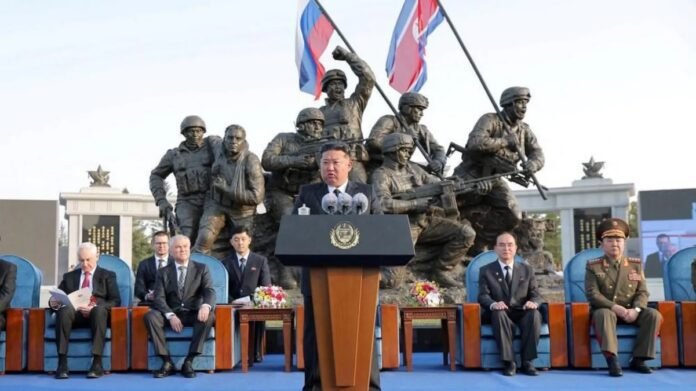
On April 27, 2026, North Korean leader Kim Jong Un and Russian Defense Minister Andrey Belousov unveiled a memorial in Pyongyang honoring North Koreans killed fighting in the Ukraine war.
At the ceremony, Moscow thanked Pyongyang for sending troops, while Kim praised North Korean soldiers who killed themselves rather than be taken prisoner.
It is estimated that 15,000 North Korean personnel were deployed to help Russia recapture territory in Kursk, with more than 6,000 reportedly killed.
This development should end the outdated assumption that the North Korean problem is static. Pyongyang is exporting manpower, gaining battlefield experience, earning political leverage and deepening military cooperation with a revisionist power engaged in a major European war.
What matters is not only that North Korea is aiding foreign wars. It is the reasons why the regime can do so with such ease.
A state that can send thousands of its own citizens to die abroad without consent or accountability reveals how it governs at home. Pyongyang’s behavior overseas cannot be separated from the system of repression that sustains it domestically.
Why human rights is a national security issue
Yet people too often, even now, treat North Korean human rights as a moral side issue, separate from “real” security concerns such as missiles, troops and deterrence.
That distinction is false.
When the rights of one individual are violated, we call it human rights abuse. When the rights of millions of people who collectively constitute a state are violated, we call it a national security threat.
The nature of both is the same. Both rely on coercion, fear and violence. Both destroy human agency.
A regime that terrorizes its own citizens will inevitably threaten others. A state that imprisons truth at home will lie abroad. A government that normalizes forced labor internally will sell weapons, will proliferate technology and will traffic in conflict externally.
North Korea’s prison camps, censorship system, forced labor networks and dynastic dictatorship are not separate from its missile and nuclear programs. They are what sustain those programs.
Totalitarian regimes fear freedom more than sanctions
As former Soviet dissident Natan Sharansky argues in discussing totalitarian systems, when escape is an option, the fear used to control people no longer works.
That insight applies directly to North Korea.
Authoritarian regimes do not survive by force alone. They survive by convincing citizens that resistance is futile, alternatives do not exist and the outside world is unreachable.
Once people gain access to outside information, hear uncensored broadcasts, see the prosperity of free societies or know that escape is possible, the psychological monopoly of the regime begins to weaken.
This is why Pyongyang fears USB drives, radios and defectors more than rhetorical condemnations at the United Nations.
A lesson Seoul once understood
South Korea once understood this more clearly.
On October 1, 2016, during Armed Forces Day remarks, then-President Park Geun-hye publicly urged North Koreans to come to the bosom of freedom in the South.
Whatever one’s political view of Park may be, her strategic logic was sound. The existence of a free, prosperous and democratic South Korea is itself a challenge to Pyongyang’s legitimacy.
The most dangerous contrast for the North Korean regime is not military pressure. It is civilizational comparison.
No quick fix, but a realistic long game
There is no quick solution to the North Korean question.
Sanctions can impose costs but not transform the regime. Summit diplomacy can reduce tensions but not change the system. Military deterrence remains essential but it can only contain threats.
A durable strategy requires sustained pressure on the internal foundations of dictatorship.
That means supporting defectors, expanding information access, documenting crimes against humanity, targeting forced labor networks, protecting refugees and making human dignity a permanent part of diplomacy rather than an occasional slogan.
It also means closer coordination among Seoul, Washington and Tokyo. North Korean, Japanese and American abductees, separated families, forced labor victims and defectors are not merely humanitarian concerns. They are common alliance concerns.
Human rights as a national security strategy
North Korean human rights should no longer be treated as an afterthought to nuclear negotiations. It is the foundation of the North Korean problem itself.
The same regime that starves, censors and terrorizes its own citizens also builds nuclear weapons, exports arms and sends troops to foreign wars. To separate internal repression from external aggression is to misunderstand both.
If the free world seeks lasting peace on the Korean Peninsula, it must think beyond crisis management and missile counts. Human rights pressure is slow, difficult and often frustrating.
But over time, it strikes at the fear on which totalitarian power depends.
That is not naïve idealism. It is realism measured in decades.
Hanjin Lew is a political commentator specializing in East Asian affairs. Jio Lew contributed research for this article.