8.3 C
London
Wednesday, April 29, 2026
Home Blog

Inmates Have Died in the Care of Armor Health Companies. Jails Keep Contracting With Them Anyway.

0
inmates-have-died-in-the-care-of-armor-health-companies-jails-keep-contracting-with-them-anyway.
Inmates Have Died in the Care of Armor Health Companies. Jails Keep Contracting With Them Anyway.

Reporting Highlights

  • Struggling to Breathe: Before he died in the medical ward of a jail, Brian Tracey had spent nine days struggling to get enough oxygen and passing out.
  • Long History of Complaints: Armor Correctional Health Services had been sued for subpar care and had been convicted of felony abuse over the death of an inmate.
  • State Inaction: A Florida law says companies convicted of a felony should be barred from holding public contracts, but the state has not acted to bar Armor companies and won’t say why.

These highlights were written by the reporters and editors who worked on this story.

For 30 minutes, Brian Tracey lay naked and unable to breathe on the floor of the medical ward at the St. Johns County Detention Center, a low-roofed building south of Jacksonville, Florida. It was Dec. 15, 2023, the day Tracey was supposed to be released from jail. 

By the time deputies noticed him, it was too late. His girlfriend, who’d posted bond for Tracey after nine days, waited outside for him but was instead greeted by a deputy and chaplain, who told her Tracey was dead.

Medical staff working for the jail’s health provider, Armor Health of St. Johns County LLC, an affiliate of Miami-based Armor Health, said Tracey, 62, was showing flu-like symptoms and suffered from chronic obstructive pulmonary disease, a lung condition that makes it difficult to breathe. In the days and hours before his death, Tracey had passed out and appeared confused, according to a police report from the county sheriff’s office, which investigated the death. Much of what is known about how he died comes from this report, which includes Tracey’s autopsy, interviews with deputies and medical staff, and a description of a video of Tracey in the medical ward.

Four experts reviewed available detention and autopsy records for The Florida Trib and ProPublica. All four — two retired jail commanders and two medical doctors with extensive knowledge of jail treatment — determined that Tracey should have been hospitalized based on the symptoms he showed at the jail, which were later determined by an autopsy to be caused by pneumonia with COVID-19. 

He never was.

For people like Tracey, who arrive in poor health, jails can be particularly dangerous, according to a growing body of medical research. Jailhouse deaths have been rising in the United States for the past decade, with about half due to illness, according to the Bureau of Justice Statistics. 

Yet even as the death rate climbs, improving healthcare in jails has proven difficult. Many jails have turned to private contractors to care for inmates. But when those contractors perform poorly, there’s little pressure on the sheriffs or local governments to make a change. That’s even more true in Florida, where the vast majority of jails are run by elected sheriffs with little oversight from local and state officials.

“Healthcare overall in Florida prisons and jails is a difficult and frankly ignored issue that’s put on the back burner,” said former Republican state Sen. Jeff Brandes, who was vice chair of the state’s Criminal Justice Committee. “And it’s one that has no independent accountability or oversight. It’s kind of a black box that operates in the state.”

Contracts Despite a Conviction

In the decade leading up to Tracey’s death, Armor Health Management LLC, known as Armor Health, and its predecessor, Armor Correctional Health Services Inc., faced allegations that they failed to hospitalize patients who needed more intensive care, according to court records obtained by The Florida Trib and ProPublica. (Armor Health had previously been operating as Armor Correctional Health Services Inc. until legally converting to an LLC in 2021.)

From 2014 to early 2021, Armor Correctional Health Services was sued over 450 times, the company reported in documents submitted to St. Johns County as part of a contract-bidding process in 2021. Lawsuits over subpar jailhouse healthcare are frequently filed and often dismissed, as was the case in two-thirds of the suits filed against Armor. The bid documents show the company has settled at least 56 suits that alleged medical negligence or inappropriate medical care. Court records show that at least 13 of those cases alleged a delay in hospital care. More than 100 cases are still pending, according to the documents. In a 2020 wrongful death suit against Armor Correctional Health Services, lawyers hired a medical expert to review internal company reports of inmate deaths at Armor facilities obtained through discovery. The expert claimed the company failed to hospitalize patients in more than 70 instances, according to court documents. 

Armor denied claims that it has provided poor care or that its staff failed to hospitalize people, saying of the expert review that “each case involves unique medical circumstances, and deaths referenced were related to drug overdoses, natural causes, or other clinical conditions that were not associated with decisions regarding hospital transfer.” 

Other states have taken action against Armor. After 14 inmates died at two county jails in New York where Armor Correctional Health Services of New York Inc. provided healthcare, the state sued the company in 2016 for breach of contract and fraud. The New York State Commission of Correction’s Medical Review Board found what it called “egregious lapses in medical care” in seven of the deaths, and a separate investigation by the state attorney general found that the company failed to keep accurate records. Armor settled the suit and denied responsibility, but the agreement barred the company from doing business in New York for three years. Armor is now allowed to operate in the state. 

In Wisconsin, prosecutors said Armor Correctional Health Services failed one jail inmate to such a degree that they charged it with a felony. In December 2018, Milwaukee prosecutors levied eight criminal counts against the company for its role in the death of a Wisconsin inmate who died from dehydration while under its care. The charges included seven counts of falsifying a record and one felony count of abuse of a resident of a penal facility. A jury in 2022 found the company guilty of all charges.

Prosecutors had hoped the conviction would push jails to cancel contracts with Armor, they said in an interview. And at least in Florida, they had reason to believe that might happen. Under Florida law, companies convicted of crimes directly related to transactions with government agencies must report the conviction to the state within 30 days and are barred from working with Florida public entities. Barred companies are also placed on a public list of convicted vendors. But the Florida Department of Management Services told reporters in 2023 that the company did not report its conviction to the state — a claim the company rejects. The company also continued to do work in Florida under a range of names linked to entities that had similar leadership and structure. 

After it was charged but prior to its conviction, the company filed paperwork with Florida converting itself to a new corporation under the name Armor Health Management LLC, according to corporate records. When the verdict came down in December 2022, it was against the defunct company. A series of new LLCs, which were formed under the holding company Armor Health and have Armor Health in their names, then signed new contracts with seven Florida jails. Florida business records show those limited liability companies have the same chief executive officer and street address in Miami as Armor Health. Manuel Fernandez, chief operating officer of Armor Health, also testified in court that the new entities assumed the liabilities of Armor Correctional Health Services Inc. after that company dissolved. Fernandez said the LLCs were created for tax purposes. 

In at least one document, the company seemed to acknowledge a connection between the defunct company and one of its newly formed companies. When Armor Health of St. Johns County LLC was asked in bid documents to provide a list of all litigation for the past seven years, the company listed hundreds of suits filed against the defunct Armor Correctional Health Services.

Within three years of the company’s conviction, six of the seven Florida jails using an Armor entity stopped contracting with those companies, with at least two ending their contracts early: one citing poor performance and contract violations, and the other saying the termination was in the county’s best interest.

St. Johns County, where Tracey died, holds the only known remaining contract with an Armor entity in Florida. Sheriff Robert A. Hardwick, who is responsible for signing contracts with vendors, declined to comment. 

An attorney for Armor defended the ongoing contract, telling the news organizations last month that it disclosed the conviction to the state and that the convicted company no longer exists. “Each Armor entity is in full compliance with all applicable State of Florida requirements and each remains eligible to operate in the state,” J. Alfredo Armas, the attorney for Armor Health of St. Johns County LLC, wrote in an email to The Florida Trib.

The state of Florida does have safeguards to ensure its contractors are providing good services. However, in multiple ways, the state did not employ those tools when it came to Armor. In 2023, the state’s Department of Management Services, which is responsible for maintaining the list of convicted state vendors, said that it was investigating the company after a man died in the Duval County jail under Armor’s care. The inmate’s family alleged in a lawsuit filed in 2024 against the sheriff that the man was denied life-sustaining medication for a heart transplant. Armor said at the time that it had located and ordered the medication, but it arrived after the man had been released. That suit was later settled. The Department of Management Services has declined repeated inquiries over two years to say whether it has investigated Armor Correctional Health Services or Armor Health Management, or if it ever took action against any of the company’s entities. Armor does not appear on a public list of banned companies on the department’s webpage.

The fact that there is a known vendor that has basically allowed people to die while under their care and they can continue to work in our prisons and jails is something that I have a problem with.

Angie Nixon, former state representative for Jacksonville, Florida

The state has also failed to reply to public records requests that might shed light on how it handled its investigation, if one was conducted. When a reporter went to the Department of Management Services headquarters in Tallahassee in February, the department would not make any agency representative available and told the reporter to contact the same spokesperson who has repeatedly declined to answer questions.

In addition, at the time of the transplant patient’s death, former Jacksonville state Rep. Angie Nixon and a state senator wrote to the U.S. Department of Justice and stated that Armor had failed to report its conviction and should be barred from operating in the state. They asked the DOJ to conduct an investigation into “potential violations of federal law” by Armor. The DOJ acknowledged receipt of the letter to Nixon, but she said they never heard from the department again. The DOJ did not respond to a request for comment. 

The office of Gov. Ron DeSantis, who appointed the interim Department of Management Services secretary, Tom Berger, declined through a spokesperson to comment about the agency’s investigation, or to say if the governor has a stance on convicted companies working in Florida. The Florida attorney general, who represents state agencies and issues formal legal opinions, also declined to comment. 

Nixon, who is now running for a seat in the U.S. Senate, said she would be raising the issue of Armor again with the DOJ, the Department of Management Services and the governor’s office.

“The fact that there is a known vendor that has basically allowed people to die while under their care and they can continue to work in our prisons and jails is something that I have a problem with,” said Nixon. 

“Repetitive Conduct of Delaying” 

When Jose “Pepe” Armas, a Miami physician and business owner, started Armor Correctional Health Services in 2004, he had very different ambitions. He had learned about jail deaths and substandard care that plagued the Broward County jail in South Florida for decades. So he consulted with other physicians and told a medical professor whom he attempted to recruit that he wanted to raise the standard of correctional care across the country. 

Armor’s first contract was a $127 million deal in Broward County to handle medical care for all of its roughly 5,000 inmates. The company grew rapidly, winning additional contracts in Brevard, Hillsborough, Martin, Palm Beach and Sarasota counties and, in 2007, St. Johns County. By 2011, Armor had also signed contracts in at least 12 other states. 

In a 2021 wrongful death lawsuit, Pensacola attorney Joe Zarzaur argued that those contracts incentivize Armor entities to keep sick inmates in the jails because Armor is paid a flat fee to provide healthcare; that means, he argued, there’s no billable benefit for adding additional services, such as hospitalization. 

“This is why Armor’s contractual partners, inmates, and families see this repetitive conduct of delaying or outright denying inmates medical care, which leads to their deaths,” Zarzaur argued in court filings. In that case, 44-year-old Misty Williamson died of pneumonia with sepsis after she was sick for five days at the Santa Rosa County jail. 

Armor said no Armor entity assumes financial responsibility for offsite medical costs, therefore there is no financial incentive to delay or avoid sending a patient to the hospital, adding that delaying hospital care is counterproductive. 

“Allowing a serious condition to deteriorate only increases the likelihood that the patient will ultimately require more intensive, expensive and specialized treatment,” Armor’s attorney, J. Alfredo Armas, said. The suit alleged in court records that since 2011, at least 72 people died under the care of Armor Correctional Health Services after they were not hospitalized or their hospitalization was delayed, including 11 other people who died from pneumonia or sepsis. The analysis was conducted by an expert in jailhouse medical care who reviewed hundreds of pages of Armor’s internal death reports gained through discovery. Armor attempted to block the analysis from being used in the trial by arguing the allegations had no bearing on whether the medical treatment its employees provided to Williamson met its standard of care. A judge allowed the death reports and a written affidavit by the expert to be entered as exhibits in the trial. 

A jury sided with the family of Williamson, whose estate was awarded $6 million in compensatory damages. Jurors found both Armor and its employees were negligent in delaying her transfer to a hospital and awarded her family an additional $10 million in punitive damages. 

But there was a larger issue at play: Was it individual employees or a larger company policy that was at fault? During the Williamson trial, Amy Dixon, a former Santa Rosa County jail nurse, testified that Armor had an ambiguous standard for sending patients to the hospital without preapproval, and that she could transfer someone if they were having a heart attack, but that something like a seizure should wait. Jurors ruled against Armor, saying the company’s policies and its employees were at fault for Williamson’s death. But the judge overruled that, striking down the $10 million award and finding that attorneys did not prove Armor’s policies led to Williamson’s death. Armor said the deaths in the analysis involved unique medical conditions and were related to drug overdoses, natural causes or other clinical conditions that were not associated with decisions regarding hospital transfer.

Despite that outcome, in other cases nurses have similarly testified that Armor delayed transfers to hospitals. Carolyn Rubin testified in a Sarasota case that “there was a strong corporate push for the doctor not to send patients out.” She added, “It was our duty to keep them there as long as possible, to prevent costs of the hospital.” Armor denied the allegations that it failed to hospitalize a detainee who died of a brain hemorrhage after she complained for days about health problems including trouble walking. The lawsuit was later settled and Armor made no admission of wrongdoing. 

In 2018, Katherine McCormack Grange, an Armor nurse working at a New York jail where an inmate died of a heart attack, testified in a civil trial that she was personally told by an Armor manager that the company did not want patients to be sent to the hospital because of the expense. The lawsuit accused Armor Correctional Health Services of a “long and pervasive history of deficient health and medical care” at the Nassau County jail, which the company denied. The case was eventually settled and Armor made no admission of wrongdoing. The New York State Commission of Correction later determined the man’s death may have been prevented if he received proper care, according to the commission’s report, and that Armor Correctional Health Services staff did not properly fill out documentation after his collapse, which the company also denied.

Sheriffs Canceled Contracts

In the years leading up to Tracey’s death but before the conviction in Milwaukee, a handful of Florida sheriffs dumped Armor, blaming the company for inmate deaths and failed accreditations, and claiming it provided lax medical care.

Flagler County Sheriff Rick Staly publicly fired Armor Correctional Health Services in 2019 after a 23-year-old was found seizing and unresponsive in his cell earlier that year; he had been complaining of a high fever. He was taken to a hospital and died there. Staly said the medical provider failed to recognize the man “was having a reaction to medicine they had prescribed to him and the seriousness of his illness.” 

“In response to this tragedy, Armor has shown little interest in anything other than denying responsibility and trying to bill us for even more money,” Staly said then. The next year, an annual audit by the Florida Model Jail Standards at the Flagler County jail “found expired medications, lapses in medical care by Armor and other deficiencies in Armor’s services.” 

In 2020, Sarasota County Sheriff Thomas Knight wrote in a declaration during a civil employment case that Armor filed against an employee that he fired Armor because he was “not satisfied with their performance,” including lack of proper medical staffing. Wakulla County Sheriff Jared Miller also wrote a declaration, explaining that he was “not satisfied with the service levels the WCSO had been receiving from Armor” when he ended the contract.

In response to this tragedy, Armor has shown little interest in anything other than denying responsibility and trying to bill us for even more money.

Rick Staly, Flagler County sheriff, after an inmate died

Then, in 2022, Armor Correctional Health Services was criminally convicted in Milwaukee for abuse and falsifying records after a man died of dehydration in a Wisconsin jail. 

“We understood that this would likely have some broader impact if we were successful,” Milwaukee prosecutor Nicolas Heitman told The Trib, adding that the district attorney’s office wanted to make sure the company could not operate in other jails. “If you look at the history and their performance as a corporate partner with these institutions, you see they have a history of problems and an inability to reform themselves.”

One sheriff cited the conviction as a reason for ending a contract. Duval County first hired Armor in 2017, but Sheriff T.K. Waters ended a renewed contract early, saying that Armor failed to disclose its felony conviction, failed to maintain accreditation with the National Commission on Correctional Health Care, and failed to comply with Florida’s open record laws. The decision came after the heart transplant recipient died after not getting antirejection medications while in the Duval County jail. Waters did not cite the death as a reason to cancel the contract.

Mariloly Muller, a spokesperson for Armor Health, said the canceled contracts “relate to a prior leadership team and legacy operations that are not reflective of the current organization, its leadership, or its ongoing business practices.”

Piecing Together a Death

The only public record of Tracey’s nine days in jail comes from a 26-page police report from the St. Johns County sheriff’s major crimes unit, which investigates in-custody deaths. 

Tracey had been taken to jail on Dec. 6, 2023, for pushing an elderly woman he had been dating. The report shows that upon his arrival, jailers placed him in the infirmary to monitor a dog bite wound that doctors at University of Florida Health Flagler Hospital had treated shortly after he was arrested. 

Soon after he arrived at the infirmary, medical staff noticed Tracey was having trouble breathing and prescribed him an oxygen mask, according to the report. A nurse said that on Dec. 14, Tracey was sweaty and complained of shortness of breath. The report noted that Tracey repeatedly removed his mask, something nurses interpreted in the report as noncompliance, and reprimanded him. The nurse who treated Tracey noted that his blood oxygen level dropped to 89%. The Cleveland Clinic, an academic medical center, recommends on its website that people seek immediate medical treatment when their blood oxygen level falls below that. 

The next day, a different nurse told medical staff that Tracey needed to be watched because of his “decline in health,” that his blood oxygen levels were still “very low,” and that Tracey had passed out in his cell, according to the sheriff’s incident report.

According to the report, the nurse practitioner on staff later told investigators he was never told Tracey passed out. Another staffer quoted in the report said no one had discussed whether to send Tracey to the hospital. One person told investigators that Tracey was asked if he’d want to be hospitalized, but he declined. There is no standard “refusal” form that detainees have to sign if they say no to medical care, the report noted.

About an hour after he passed out, at 7:09 p.m. on Dec. 15, Tracey’s girlfriend had paid his bond and the deputy went to his cell to give him street clothes. He was found naked and lying in his bed. Investigators noted that it took “a lot of effort” for Tracey to get dressed. At 7:56 p.m., Tracey, who was still in the cell, appeared to yell something, waved his hands and then used an inhaler and put his hand on his chest, investigators saw in the videotape. 

By 8:16 p.m., Tracey had removed his pants and was visibly struggling to breathe, the report says. 

However three minutes later, in the inmate log report, a separate document maintained by sheriff’s deputies who conduct routine checks of medical patients, deputies noted they checked on Tracey and he was “OK.” 

Over the next 26 minutes, as Tracey lay alone in his cell, nobody came to his aid. 

At 8:35, Tracey appeared to stop breathing, according to investigators who watched the surveillance video. Investigators noted two deputies went into his cell two minutes later, then left. They came and went three more times over the course of a few minutes, without giving Tracy medical care, the report says.

An excerpt from a document reads: At approximately 2016 hours, Brian removes his pants and lays down on the bed. Note: Brian appears to have labored breathing. At approximately 2027 hours, Brian lays down on the bed on his back naked. Note: Brian appears to have labored breathing. At approximately 2035 hours, Brain appears to stop breathing while on the bed on his back. At approximately 2057 hours, Deputy Jackson and Deputy Torrey Cox enter the cell, check on Brain and shortly after they both exit.
A report from the St. Johns County Sheriff Office’s major crimes unit describes Tracey struggling to breathe and eventually stopping altogether. Obtained by The Florida Trib and ProPublica

In the jail log, deputies wrote that they checked on all medical inmates at 8:45 — 10 minutes after investigators noted Tracey stopped breathing — and wrote that “all appears secure.” 

No one gave Tracey CPR until 9 p.m., when he had already lost his pulse, according to the investigative report. 

An ambulance was called, but Tracey was declared dead at the jail.

Dr. Marc Stern, a correctional healthcare expert and University of Washington Public Health professor, said based on the information known about Tracey’s symptoms from the investigative report, Tracey should have been hospitalized.

Rich Forbus, a former jail commander who currently serves as vice president at the National Commission on Correctional Health Care, reviewed the sheriff’s report at the request of The Trib and agreed with Stern. The private nonprofit company offers accreditation services to jails upon request. While some Florida county jails, such as Duval, have received accreditation from the company, St. Johns confirmed it doesn’t use the firm now, though its 2022 contract with Armor Health of St. Johns County LLC required the company to maintain accreditation with the commission. 

“You know the person’s a COPD patient and you know he’s sick, I’ll be honest, I question why he didn’t go out” to a hospital, Forbus said. “If I’m the jail commander, I’m questioning why he’s not at the hospital.”

“He Just Fell Over and Died”

That’s a question that Tracey’s sister, Lillian Scharf, is also asking. About five hours after he died, at 1:30 a.m. on Dec. 16, 2023, Maryland police went to her house.

A woman on a living room sofa looks off to the side with a serious expression.
Lillian Scharf, Brian Tracey’s closest remaining relative, didn’t learn the true details of her brother’s death until this year, when The Florida Trib and ProPublica sent her the autopsy and police report, obtained through a record request. “I sat in my chair for 30 minutes and cried reading them,” she said. Greg Kahn for ProPublica

Scharf, Tracey’s closest remaining relative, said police told her to call the Florida sheriff for more information. 

“They told us he died of a heart issue, that it was sudden, he just fell over and died,” her daughter, Tracey Letourneau, recalled being told.

But when Scharf asked for her brother’s full medical documents, the sheriff declined to give them because she’s not his legal next of kin. Tracey’s wife, Brenda, died a year before he did.

When asked about Tracey’s death, J. Alfredo Armas, the attorney for Armor Health of St. Johns County LLC, cautioned against drawing conclusions regarding Tracey’s death because his medical records have not been released. The company has withheld those medical records from The Florida Trib, ProPublica and Tracey’s sister, citing medical privacy laws. 

Scharf also contacted a handful of attorneys in Florida and Maryland, but because the jail told her he died of a heart issue, each attorney turned her away. 

Scharf didn’t learn the true details of her brother’s death until this year, when The Trib and ProPublica sent her the autopsy and police report, obtained through a record request. By then, the two-year statute of limitations to sue for a wrongful death or neglect had passed. Florida also doesn’t allow monetary lawsuits in cases where the deceased doesn’t have a spouse or children.

Her younger brother’s ashes are now in Glen Burnie, Maryland, in a box in Scharf’s closet. His pug, Thor, lives with Brenda’s sister.

“You know, only the Lord knows the truth as far as if he would have survived or if he would have died, but I just feel like they didn’t give him the opportunity to try to save his life,” Scharf said.

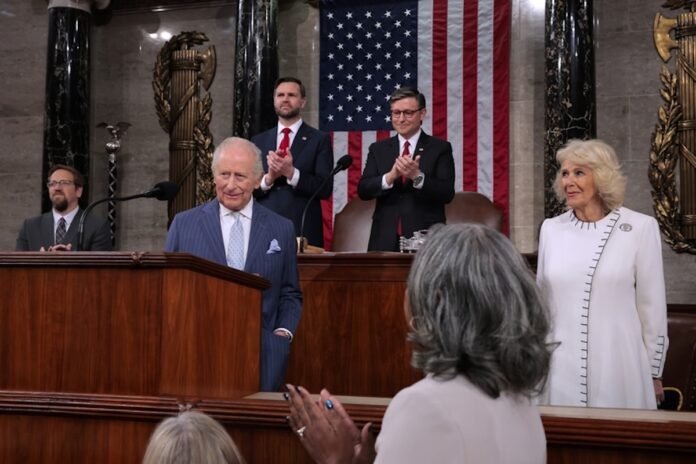
A small wooden box sits on a shelf inside a closet, next to an American flag and above clothing on hangers.
Scharf keeps her brother’s ashes in a box in her closet. Greg Kahn for ProPublica

Charles’s speech cites ‘checks and balances’ on executive power

0
charles’s-speech-cites-‘checks-and-balances’-on-executive-power
Charles’s speech cites ‘checks and balances’ on executive power

WASHINGTON — King Charles III did not name President Donald Trump Tuesday when he acknowledged before a joint session of Congress the transatlantic tension between the United States and the United Kingdom, but he stressed that “America’s words carry weight and meaning” as he reflected on decades of diplomatic ties.

The monarch of the United Kingdom of Great Britain and Northern Ireland told lawmakers that from “bitter division” 250 years ago, the two nations “forged a friendship that has grown into one of the most consequential alliances in human history.”

“I pray with all my heart that our alliance will continue to defend our shared values with our partners in Europe and the Commonwealth and across the world,” he said.

Charles is the first British king to address a joint session of Congress, and only the second British monarch to do so after his mother, Queen Elizabeth II, spoke before lawmakers in 1991.

King Charles III and U.S. House Speaker Mike Johnson, R-La., walk through the U.S. Capitol on April 28, 2026, before Charles' address to Congress. (Photo by Ashley Murray/States Newsroom)
King Charles III and U.S. House Speaker Mike Johnson, R-La., walk through the US Capitol on April 28, 2026, before Charles’ s address to Congress. (Photo: Ashley Murray / States Newsroom

Charles was received with loud unanimous applause from both sides of the aisle — a notable difference from the usual one-party enthusiasm during the president’s annual State of the Union address.

He punctuated his roughly 27-minute speech with laugh lines, including a quip that 250 years for America is “just the other day” for the British.

To whoops and cheers, Charles nodded to the “bold and imaginative rebels with a cause” who declared independence but also “carried forward” the ideals of the Magna Carta, a 13th-century document outlining the protection of rights and property from the monarch.

Both sides of the aisle stood applauding in unison as the king cited US Supreme Court cases that laid the “foundation of the principle that executive power is subject to checks and balances.”

But the king also delivered his speech against the ominous backdrop of a breakdown of American support for Ukraine and an ongoing war in Iran, initiated by the United States and Israel, that has disrupted energy supply in the United Kingdom and around the world.

These are conflicts that “pose immense challenges for the international community, and whose impact is felt in communities the length and breadth of our own country,” he said. 

As the king was still speaking on Capitol Hill, the White House shared on social media a photo of Charles and Trump together under the heading “TWO KINGS” and a crown emoji.

Trump attacks on British prime minister

US-UK relations have frayed as a result of Trump’s recurrent attacks on British Prime Minister Keir Starmer’s decision not to join offensive operations targeting Iran.

Trump paused his scathing online screeds against the British government during the king’s first full day of his state visit, which included a 21-gun salute and ceremonial flyover after Charles and Queen Camilla arrived on the White House South Lawn. 

Shortly before Charles addressed Congress, Trump took aim on his Truth Social platform at another European leader, German Chancellor Friedrich Merz, accusing him of thinking “it’s OK for Iran to have a Nuclear Weapon. He doesn’t know what he’s talking about!”  

Just over one month into the US campaign in Iran, Trump, on Truth Social, told the UK and other allied partners to “Go get your own oil!”  from the blockaded Strait of Hormuz. 

“You’ll have to start learning how to fight for yourself, the USA won’t be there to help you anymore, just like you weren’t there for us,” he wrote.

Two weeks earlier, Trump attacked NATO allies, telling reporters in the Oval Office, “I’ve long said that, you know, I wonder whether or not NATO would ever be there for us. So … this was a great test, because we don’t need them, but they should have been there.”

Charles recounted in his speech to Congress how the only time the North Atlantic Treaty Organization, or NATO, invoked Article 5 was to defend the United States following the September 11, 2001 attack.

The king and Camilla are scheduled to visit the 9/11 Memorial in New York City on Wednesday.

“We stood with you then, and we stand with you now in solemn remembrance of a day that shall never be forgotten,” Charles said.

Just under 460 British troops died fighting alongside Americans in Afghanistan.

Epstein files

The king’s trip to the U.S. also comes after the high-profile release of millions of records related to the disgraced hedge fund manager and sex offender Jeffrey Epstein, who had ties to Charles’ brother, Andrew Mountbatten-Windsor. 

Mountbatten-Windsor settled outside of court in 2022 with the late Epstein victim Virginia Giuffre, who accused Epstein and the former British prince of trafficking her for sex.

Mountbatten-Windsor has been stripped of his royal title of prince and is under investigation in Britain for allegedly sharing confidential government information with Epstein, which came to light in the publicly released files.

The king acknowledged victims of sexual abuse in his speech, according to a palace aide, when he remarked to lawmakers, “In both of our countries, it is the very fact of our vibrant, diverse and free societies that gives us our collective strength, including to support victims of some of the ills that, so tragically, exist in both our societies today.”

Answering questions about the king’s address, the palace aide told reporters traveling with Charles, “It was certainly in [his majesty’s] mind to acknowledge victims of abuse, so they are naturally incorporated in this line.”

Sky Roberts, Giuffre’s brother who has become an activist following his sister’s death last year, was on Capitol Hill Tuesday for a roundtable about Epstein victims ahead of Charles’s visit.

Roberts and the king did not meet.

King will visit Virginia

Charles, a vocal advocate for the environment, is also scheduled to visit Shenandoah National Park in Virginia Thursday to view America’s “extraordinary natural splendor.” The king emphasized to lawmakers the need for a collaborative effort to fight climate change.

“Even as we celebrate the beauty that surrounds us, our generation must decide how to address the collapse of critical natural systems, which threatens far more than the harmony and essential diversity of nature,” he said. 

“We ignore at our peril the fact that these natural systems, in other words nature’s own economy, provide the foundation for our prosperity and our national security,” he said.

Charles also celebrated the shared financial economy between the United States and UK, highlighting $430 billion in annual trade. Just over a year ago, Trump began a new tariff regime on British goods, and imports from many other trading partners.

Review of the troops

Trump and first lady Melania Trump welcomed the king and queen on the White House South Lawn Monday morning for a ceremony full of pomp and circumstance, including a review of the troops, a distinguished honor for a visiting head of state.

During brief and mostly scripted remarks, Trump highlighted a tree planted on the White House grounds by Elizabeth II in 1991. Trump described the tree as a “living symbol” of the relationship between the United States and the United Kingdom.

“In the centuries since we won our independence, Americans have had no closer friends than the British. We share that same root. We speak the same language, we hold the same values and together our warriors have defended the same extraordinary civilization under twin banners of red, white and blue,” Trump said.

Trump and Charles met in a closed-door Oval Office bilateral meeting following the ceremony. 

The first lady and the queen met with American schoolchildren at the White House tennis pavilion, where the students donned Meta Quest headsets to view several UK landmarks, including Stonehenge and Buckingham Palace. The event was part of the first lady’s effort to promote technology in education, according to the White House.

Charles and Camilla are scheduled to attend a state dinner at the White House East Room Tuesday night before heading to New York City Wednesday.

The king and queen are scheduled to visit the small town of Front Royal, Virginia, Thursday, as well as meet Interior Secretary Doug Burgum in Shenandoah National Park, according to the British embassy.

-States Newsroom

Anti-Trump Instagram pic of seashells now enough to indict ex-FBI directors

0
anti-trump-instagram-pic-of-seashells-now-enough-to-indict-ex-fbi-directors
Anti-Trump Instagram pic of seashells now enough to indict ex-FBI directors

In my misspent youth, I once worked a summer job as a waiter at Shoney’s. It is an experience that I do not recommend. But it did teach me two valuable things: 1) How not to drown in a puddle of my own embarrassment when marching around the dining room with my fellow servers and singing a birthday song that began, “Happy, happy birthday, we’re so glad you came”; and 2) That when the surly line cooks ran out of chicken fried steak, they would shout “86 the chicken fried steak!” through the pass.

To “86” something, in restaurant slang, is to say that it is out, finished, gone, through, not on the menu anymore. This is the only sense in which I have heard the term used in my entire life.

But according to Wikipedia, which naturally has an entry about the term, two further meanings do exist. “86” can also be applied to people a restaurant refuses to serve, and some slang dictionaries say it can refer to murder.

Which brings us to former FBI director James Comey, Instagram, and a picture of seashells.

86 the shells!

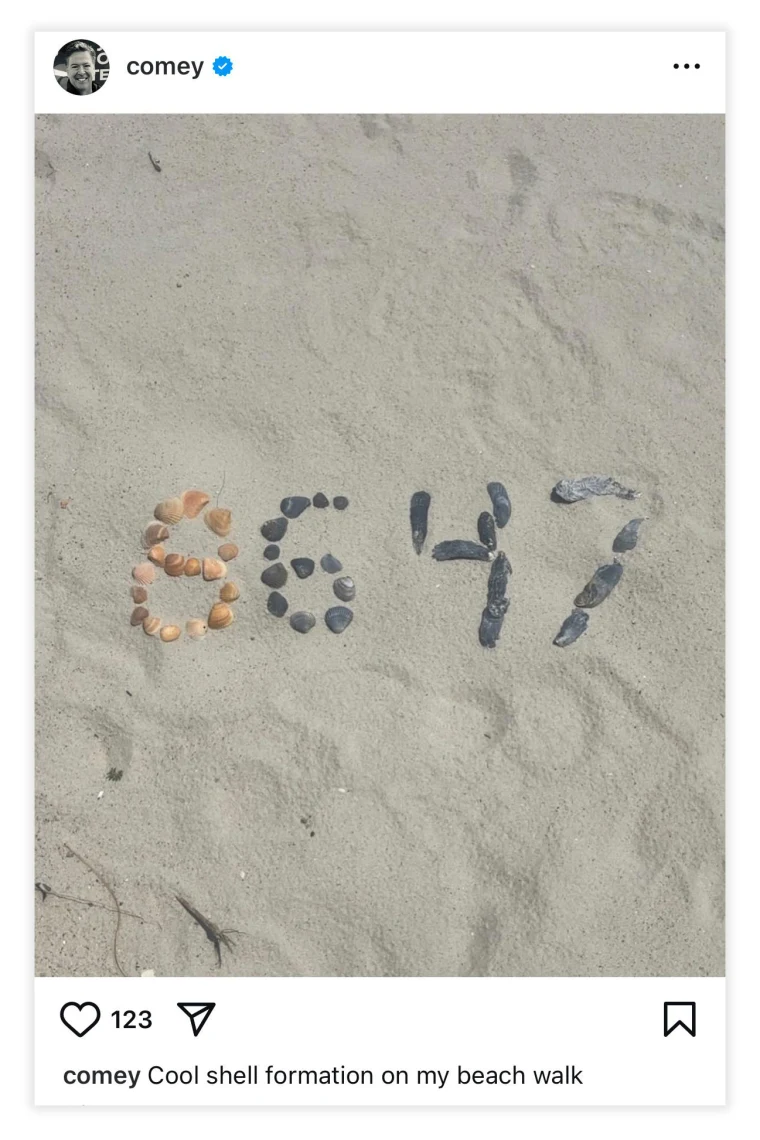
In 2025, Comey posted to Instagram an image of shells arranged in the shape of two numbers: “86 47.”

A copy of Comey's post.

James Comey’s seashell post.

James Comey’s seashell post.

Trump, our 47th President, has long harbored a grudge against Comey, going back to Comey’s investigation of Trump’s possible Russian ties. Trump famously fired Comey in 2017—then, for good measure, fired his prosecutor daughter in 2025.

Trump has been clear for years about his desire to use the power of the federal government to make life more difficult for Comey, and federal officials in his second term have been willing to comply.

Fortunately, they have also been pretty stupid. Through a series of staggeringly incompetent actions, the administration already had its first Comey indictment tossed out in Virginia—a loss so epic that it got Trump’s interim US attorney for Virginia booted, too.

Today, on completely new and unrelated charges, the Department of Justice has indicted Comey again, this time in North Carolina. The charge is nothing less than a threat to murder the president.

And it’s all based on that single seashell image.

The new indictment says that Comey “did knowingly and willfully make a threat to take the life of, and to inflict bodily harm upon, the President of the United States, in that he publicly posted a photograph on the internet social media site Instagram which depicted seashells arranged in a pattern making out ’86 47,’ which a reasonable recipient who is familiar with the circumstances would interpret as a serious expression of an intent to do harm to the President of the United States.”

You might expect more details in a case this serious and against such a high-ranking former official; there are none.

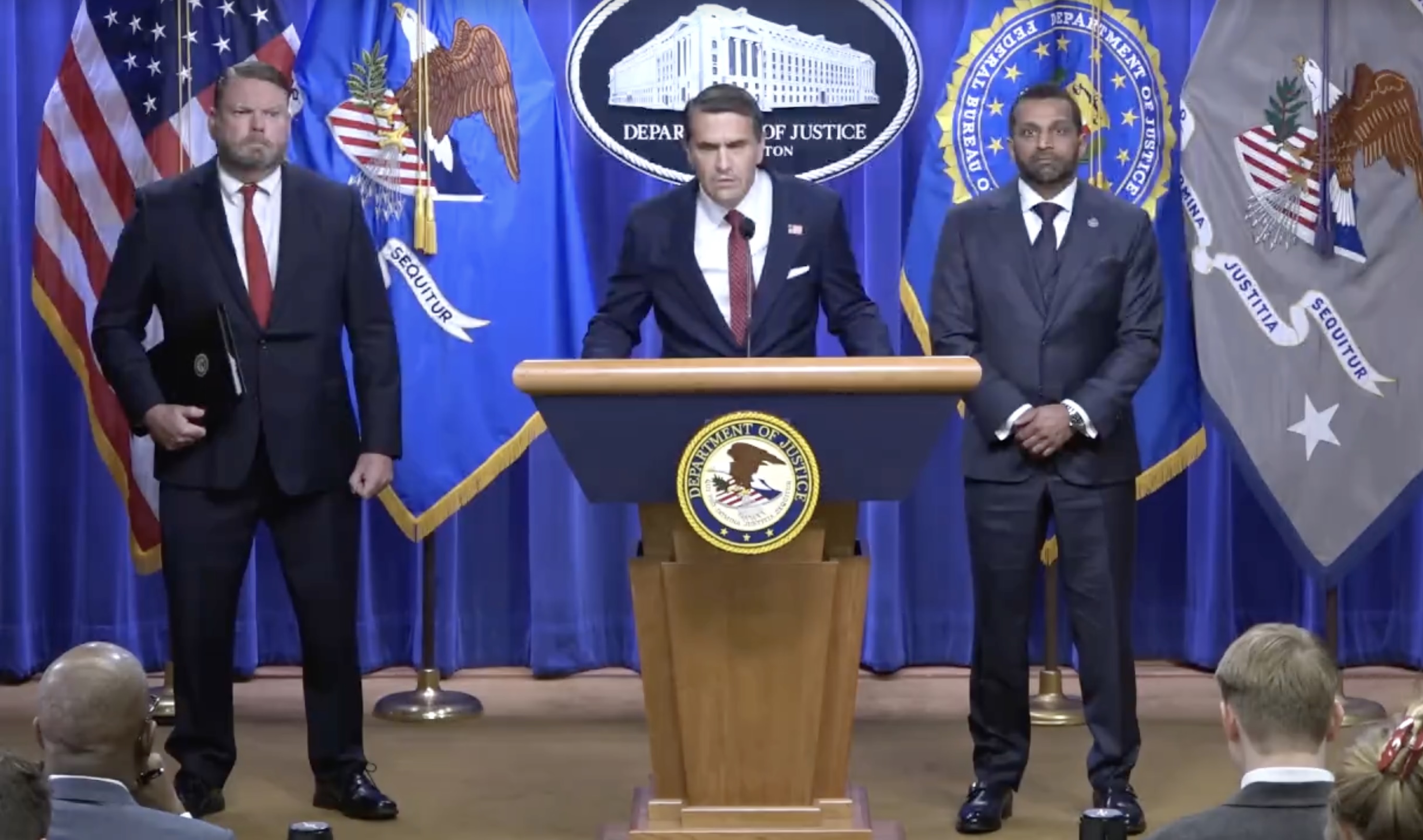
A photo of the DOJ press conference about the indictment.

The DOJ held a 15-minute press conference in which three men in suits tried to make this all sound normal and natural.

The DOJ held a 15-minute press conference in which three men in suits tried to make this all sound normal and natural.

Get in the clown car

A case this ridiculous, and about such a weighty matter, may be the bulbous red nose that completes the full-on beclownment of the Department of Justice under Trump. (The DOJ is currently run by one of Trump’s personal lawyers.) Popular legal blog Above the Law, for instance, called today’s move a “new low point for DOJ integrity.”

As we have learned just in a single day, the federal government is willing to come after your broadcast licenses if you make a joke that Trump doesn’t like… and your freedom if you make social media posts that Trump doesn’t like. These are apparently the ways in which Trump is fulfilling his promise to halt government “censorship” of US citizens.

Trump himself is, of course, a famously peace-loving—sorry, “peace prize”-loving—man, most recently seen warning Iran that “a whole civilization will die tonight, never to be brought back again” in a social media post so unhinged even the pope had to step in and tell him to knock it off.

But apparently, it’s James Comey’s restaurant-slang seashell Instagram image that’s the real crime, the sort of thing stopping America from being truly great again.

Eni says market underestimating Iran war’s impact on energy prices

0
eni-says-market-underestimating-iran-war’s-impact-on-energy-prices
Eni says market underestimating Iran war’s impact on energy prices


The Iran war will have a bigger and more lasting impact on oil and gas prices than is ​being priced in, Eni’s finance chief Francesco Gattei said as the group raised its estimate for 2026 Brent ‌crude prices to $83 per barrel, from $70.

Eni also lifted its forecast for Dutch TTF gas prices to 50 euros per megawatt hour, from 36 euros per MWh, as it reported first-quarter adjusted net profit of 1.3 billion euros ($1.5 billion), down from 1.4 billion euros a year earlier and below an analyst consensus forecast of 1.5 billion ​euros.

Although the Italian oil and gas group’s upstream business benefited from the initial fallout of the Iran war, its refining division ​was unable to fully capitalise on higher product prices as its plants were operating at reduced utilisation rates.

Eni also ⁠said it would raise its 2025 share buyback plan to 2.8 billion euros, from the 1.5 billion euros announced on March 19, just over ​2-1/2 weeks after the U.S. and Israel launched strikes against Iran.

Shares in Milan-listed Eni closed 1.14% lower, after opening up 1% following the release of ​its results.

MORE IMPACTFUL CRISIS

“This crisis is not just a matter of reaching a sort of ceasefire or peace, but also to restart a lot of infrastructures and production facilities that were shut down, impacted by the fire and bombing, so it will take longer,” Eni’s Chief Transition and Financial Officer Gattei said.

The conflict appeared “much more impactful ​than the market is probably evaluating,” he added.

Eni said the enlarged buyback was driven by the revised macroeconomic outlook and a more optimistic ​view on underlying cash flow generation, which Eni now sees at 13.8 billion euros this year, up from a previous estimate of 11.5 billion euros.

The war has ‌severely disrupted ⁠global energy supplies, with the Strait of Hormuz – a conduit for about one-fifth of global oil and liquefied natural gas flows – effectively closed.

Benchmark Brent crude prices averaged $78.38 a barrel in the first quarter, up 24% on the previous quarter, LSEG data showed.

The benchmark front-month TTF gas price averaged 40.15 euros/MWh in the first quarter of 2026, up from 30.14 euros/MWh in the fourth quarter of 2025, ICE data showed.

PARTNERSHIP ON TRADING

Analysts cited maintenance ​at refining sites and continued margin ​pressure in Eni’s chemicals business ⁠as the main reasons for the first-quarter earnings miss.

“Heavy planned maintenance in the downstream businesses sees Eni first-quarter earnings below market expectations, albeit perhaps setting up for a better second quarter,” Citi said.

Earlier this month, several ​European rivals said their trading divisions generated billions of dollars in profit from volatility triggered by the Iran ​war, helping cushion the ⁠impact of disruptions to production.

Eni’s CEO has said the group is considering a partnership with a commodity trader to develop a dedicated trading business.

“The group has started engaging with other trading players to try to combine the best of the two,” said Guido Brusco, Eni’s head of natural resources, adding ⁠that the ​current volatile environment could accelerate the plan.

Eni’s oil and gas production rose 9% in the ​quarter, supported by project ramp-ups in West Africa and Norway, start-ups in Angola and solid operational continuity, offsetting limited disruption from the Middle East.

Exploration added around 1 billion barrels ​of oil equivalent, with discoveries in Angola, Ivory Coast and Libya.

Source:  Reuters

UAE’s OPEC exit has been long in the works – and may mark the beginning of a Gulf realignment

0
uae’s-opec-exit-has-been-long-in-the-works-–-and-may-mark-the-beginning-of-a-gulf-realignment
UAE’s OPEC exit has been long in the works – and may mark the beginning of a Gulf realignment

The United Arab Emirates’ decision to withdraw from the Organization of Petroleum Exporting Countries will leave the oil cartel weakened at a crucial time. It also illustrates the ongoing tensions between the UAE and Saudi Arabia, OPEC’s largest producer and de facto leader.

The UAE announced on April 28, 2026, that it will depart OPEC and OPEC+, an expanded grouping which includes Russia, on May 1, depriving the groups of their third- and fourth-largest oil producer, respectively.

Though the move may seem abrupt, as a close observer of the UAE and intra-Gulf politics, I believe Abu Dhabi’s decision to leave OPEC and go it alone was in the cards for a while and follows years of Abu Dhabi’s complaints about the cartel.

The announcement also follows years of divergence between Emirati and Saudi oil policies, as well as the growth of competitive rivalries between the two countries over wider regional questions. This rift between the two largest Sunni Gulf states burst into the open in December 2025, when competing visions for security in Yemen threatened to reignite civil conflict in the war-torn country.

Unity in the face of Iranian attacks since then should not mask that underlying split, of which the UAE’s OPEC decision is merely the latest manifestation.

The world’s most prominent cartel

OPEC formed in 1960 as a way for the main oil producers to set production limits and therefore control the price of crude around the world.

The UAE has been a member of OPEC since the seven-emirate federation was established in 1971, although Abu Dhabi – the emirate that holds 95% of Emirati oil reserves – has been a member since 1967.

A large building with 'Organization of the Petroleum Exporting Countries' written on it.

Exterior view of OPEC’s headquarters in Vienna. Christian Bruna/Getty Images

At its height in the mid- and late-1970s, OPEC played a powerful role in reshaping the balance of power between oil producers and consumers, and countering Western dominance in a postcolonial setting of resource nationalization.

While other members have withdrawn from OPEC in recent years – such as Qatar in 2019 and Angola in 2024 – the impact of the UAE’s departure is on a far greater scale, affecting about 12% of OPEC’s total oil output.

Furthermore, the exit of the UAE removes one of the few major swing producers from OPEC, weakening the organization’s ability to respond rapidly to changing market conditions in the future.

Diverging Gulf priorities

The UAE has been signaling a potential split for at least five years, when differences of opinion with Saudi Arabia on how to manage oil policy emerged ahead of a November 2020 OPEC+ summit. The rift became openly visible during a subsequent meeting of OPEC+ countries in July 2021.

In both cases, the UAE wished to increase oil production – which had been sharply curtailed by OPEC members during the COVID-19 pandemic – while the Saudis sought to maintain high prices by keeping output lower and prices higher.

In part, this reflects the different circumstances of the two Gulf nations. The Saudis are reliant on higher oil prices to drive the revenues needed to fund its lavish budget and pay for massive infrastructure projects like its Vision 2030 project. The Emirati economy, on the other hand, is more diversified and less directly dependent on oil revenues.

Instead, Abu Dhabi has invested heavily in recent years to expand capacity to be able to increase oil production from 3.4 million barrels a day before the U.S.-Israel war against Iran to 5 million barrels a day by 2027 – and potentially higher later on. This reflects a desire to monetize its reserves and move the oil to market to avoid the risk of stranded assets should global demand fall in any future transition away from fossil fuels.

Shorn of the constraints of OPEC quotas, which the Emiratis have chafed against for years, officials in Abu Dhabi will be able to increase production should it wish to do so once the impasse with Iran is broken and the Strait of Hormuz fully reopens.

Men in suits and traditional Gulf attire stand.

Energy ministers from Russia, Saudi Arabia and the UAE at an OPEC meeting in Riyadh, Saudi Arabia, on June 2, 2024. Haitham El-Tabei/AFP via Getty Images

Post-Iran war regional shifts

It is clear that UAE leadership is first and foremost intent on doubling down on the pursuit of its national interests, with an emphasis on prioritizing ties with the U.S. – and likely also Israel – over those with countries that Abu Dhabi feels reflect an old world it is now seeking to leave behind.

While the war in Iran may have temporarily overshadowed the eruption of Saudi-Emirati tensions over Yemen and visions for the region, the rift had not been resolved prior to the U.S. and Israeli launch of military operations on Feb. 28.

Comments by prominent Emiratis have suggested that officials in the UAE have paid close attention to which countries have, in their view, stepped up to assist the UAE in times of crisis, and which have not.

The OPEC decision thus reflects a calculation in Abu Dhabi that there is no longer any utility in remaining part of a Saudi-dominated organization. The UAE’s reconsideration of other memberships, such as the Arab League, Organization of Islamic Conference or even the Gulf Cooperation Council, may be next, as the UAE and other regional countries begin to think ahead to an uncertain post-war landscape.

Former NFL Player Dies at 35

0
former-nfl-player-dies-at-35
Former NFL Player Dies at 35


Shock in the NFL world as former defensive lineman Josh Mauro has died suddenly at just 35, leaving fans and former teammates reeling over the heartbreaking loss.

Mauro’s family confirmed the devastating news in a statement released Tuesday, revealing he passed away on April 23. The cause of death has not been disclosed, deepening the mystery surrounding his untimely passing.

“With many tears and broken hearts… our precious Josh Mauro is now healed and made new,” his father Greg shared in an emotional message, adding that Mauro had “breathed his last breath on this earth and his first breath in heaven.” The grieving family asked for prayers as they struggle to cope with the tragedy.

The former NFL standout was remembered as far more than just a football player — described by loved ones as an “amazing son, brother, uncle, grandson and friend.”

Born in St. Albans, England, Mauro moved to the United States as a toddler and grew up in Texas, where he began carving out his football future. After shining in high school, he went on to play college football at Stanford, building a reputation as a tough, dependable force on the defensive line.

Despite going undrafted, Mauro refused to give up on his NFL dream. He initially signed with the Pittsburgh Steelers but was cut during final roster decisions — a setback that would have ended many careers. Instead, Mauro pushed forward and found his footing with the Arizona Cardinals, where he made his mark.

He spent the bulk of his career in Arizona, playing four seasons from 2014 to 2017 before returning for a second stint from 2020 to 2021. Known as a reliable rotational player who could step up when needed, Mauro had his best season in 2016, starting 13 games and racking up a career-high 42 tackles.

Mauro also suited up for the New York Giants in 2018, the Oakland Raiders in 2019, and the Jacksonville Jaguars in 2020, before ultimately closing out his NFL journey back in Arizona.

As news of his death spread, tributes flooded social media from across the football world.

Former Cardinals teammate Adrian Wilson remembered Mauro as a player you could always count on. “Always in shape, always ready to go wherever he got that call… you could depend on him,” he wrote.

Others echoed the sentiment, with sports anchor Rudy Reyes calling his death “greatly saddening” and recalling Mauro as “an outstanding person” long before he reached the NFL.

Fans also poured in with messages of shock and grief, with one Raiders supporter writing, “You are an Oakland Raider, which is a special honor. May God bless the Mauro family.”

Another added simply: “Absolutely loved this guy… horrible situation.”

Now, as questions linger over what led to his sudden death, one thing is clear — Josh Mauro’s impact stretched far beyond the field, leaving behind a legacy of grit, perseverance, and quiet reliability that teammates and fans won’t soon forget.

China’s science surge is not a problem — America’s retreat is

0
china’s-science-surge-is-not-a-problem-—-america’s-retreat-is
China’s science surge is not a problem — America’s retreat is

China’s rapid rise in science has hit a milestone. The country’s investment in research and development has reached parity with – and by purchasing power measures has surpassed – that of the United States, according to a March 2026 report from the Organisation for Economic Co-operation and Development. Both nations have crossed the US$1 trillion threshold on research spending.

For 80 years, the US operated the most productive scientific and technological enterprise in human history. Breakthroughs and advances that came from American labs included the internet; the mRNA vaccine; the transistor and its children, semiconductors and microprocessors; the Global Positioning System; and many more.

US scientific and technological leadership was nurtured by sustained public investment in research universities and federal laboratories, as well as a culture of open inquiry. These investments turned scientific discovery into economic strength – accounting for more than 20% of all US productivity growth since World War II.

In contrast, China had previously spent little to nothing on research and development. Some estimates show that China was among the lowest research spenders worldwide in 1980.

As a policy analyst and public affairs researcher, I study international collaboration in science and technology and its implications for public and foreign policy. I have tracked China’s rise across every major database for more than a decade.

The most recent reports showing that China is now outspending the US on scientific and technological research is a turning point worth understanding clearly because, historically, global leadership in one sector – including technology and warfare – feeds into others. US dominance is in question.

China’s systematic and unrelenting rise

China’s R&D spending milestone caps a series of achievements that have arrived in rapid succession. In 2019, China surpassed the US in its share of the top 1% most-highly cited papers – what some call the Nobel class of research. By 2022, it had taken first place globally in most-cited papers overall.

In 2024, China overtook the United States in total scientific publications – the first time any nation has displaced American dominance since the U.S. itself surpassed the United Kingdom in 1948.

Researchers found that China overtook the US in scientific output even earlier. That same year, China pulled ahead in the Nature Index, which tracks publications in the world’s most selective scientific journals, posting a 17% advantage over the US in outlets long considered the gold standard of scientific excellence.

In 2024, Chinese entities also filed roughly 1.8 million patent applications, compared to the US’s 603,191 applications.

Given these milestones, it’s possible to argue that China is quickly taking the lead in global science and technology. These are not isolated data points. They mark a structural shift in where the world’s scientific frontier is being built.

More science is good – the problem lies elsewhere

China’s ascent is, in one sense, good news. More knowledge, generated by more researchers across more institutions, expands the global pool of discovery from which everyone can draw. The world benefits when science thrives.

The problem is not that China is investing, but that the US is not.

First, the US is divesting from basic, open science. Federal R&D spending in the US peaked in 2010 at roughly $160 billion and fell by more than 15% over the following five years. Federal investment in research and development has been in a long, slow slide – from a peak of 1.86% of gross domestic product in 1964 to about 0.66% in 2021.

The federal government is no longer the largest spender in R&D: It funded about 40% of basic research in 2022, while the business sector performed roughly 78% of US R&D. While not a problem in itself, industry has simultaneously withdrawn from open scientific publication over the past four decades, shifting from research toward development. The result is a shrinking pool of openly shared scientific knowledge precisely as public investment in it also contracts.

Under the second Trump administration, US government science agencies have been slow-walking proposals for new research. Current budget cuts from the White House threaten to deepen cuts to government spending significantly.

The second is the active restriction of scientific exchange: tightening access to US institutions, scrutinizing international collaborations and raising barriers to foreign-born researchers. These policies, though intended as security measures, work against the openness that has historically made American science productive and attractive to global talent.

I describe this issue as an example of the stockyard paradox, in which securing research assets may weaken the very system these measures aim to protect.

Disinvestment cuts deeper than it appears

The deeper danger for the US economy is that disinvestment and selective engagement in research erodes the capacity to use cutting-edge science regardless of where it is produced.

Absorbing and applying cutting-edge knowledge, whether developed in Boston or Beijing, requires maintaining research institutions and trained workforces, as well as active participation in global networks.

This is not a passive process. You cannot free-ride on Chinese science if you have dismantled the institutional and human capital needed to evaluate, translate and apply it. A nation that hollows out its research base not only falls behind but also progressively loses its ability to benefit from science, including in technologies it is already able to access.

Talent compounds the problem. The US built its scientific dominance partly by being the destination of choice for the world’s most ambitious researchers. The US leads the world in Nobel Prizes, but, notably, 40% of the Nobel Prizes in chemistry, medicine and physics that were awarded to Americans since 2000 were won by immigrants. The flow of foreign talent is not guaranteed. It follows opportunity, funding and openness.

Researchers who might once have come to American universities are finding welcoming alternatives in Europe, China and elsewhere.

YouTube video

Around 75% of U.S. researchers are considering leaving the country due to the Trump administration’s funding policies.

A decision point, not a trend line

China’s milestone in research funding arrives at a moment when the US is deciding whether to maintain its scientific leadership.

Scientific infrastructure does not decline gradually and recover on demand. Doctoral scientists represent a decade or more of training; tacit laboratory knowledge lives in working research groups, not in documents.

Once talented young researchers leave the pipeline – or international talent redirects to other countries – the capacity is very hard to rebuild. Early warning signs are already visible in the US system: thousands of NIH grants terminated, a collapse in international applications and an exodus of early-career scientists.

What is at stake is not a ranking. It is whether the US maintains the institutional capacity – the universities, the federal laboratories, the graduate pipelines, the culture of open inquiry – that made those returns on scientific investment possible in the first place.

China’s rise did not create this decision point, although it brings it into sharp relief. Does the US still want to lead in science?

The Information Technology and Innovation Foundation, a nonprofit think tank, estimates that a 20% cut in federal research and development starting in fiscal year 2026 would shrink the US economy by nearly $1 trillion over 10 years and reduce tax revenue by around $250 billion. Others point out that the scientific enterprise has contributed at least half of US economic growth.

That is a lot to lose.

Caroline Wagner is professor of public affairs, The Ohio State University

This article is republished from The Conversation under a Creative Commons license. Read the original article.

Pakistan Tests Fateh-II Missile Used in 2025 Conflict With India

0
pakistan-tests-fateh-ii-missile-used-in-2025-conflict-with-india
Pakistan Tests Fateh-II Missile Used in 2025 Conflict With India


Pakistan conducted a successful training launch of the indigenously developed Fateh-II missile system on Tuesday, marking a significant milestone for the Army Rocket Forces Command.

According to the military’s media wing, Inter Services Public Relations, the Fateh-II, also known as Fatah-II, is an indigenously developed guided multi-launch rocket system with a range of around 250 miles, equipped with sophisticated avionics and cutting-edge navigational technology to ensure high accuracy and survivability on the modern battlefield. Its low, flat trajectory is designed to reduce the chances of radar detection.

Senior leadership from the Strategic Plans Division and various defense scientists monitored the flight, which received high praise from the president, prime minister, and services chiefs for the technical expertise demonstrated by the engineering teams.

This validation of the Fateh-II is particularly resonant given the system’s performance during the intense military confrontation between Pakistan and India in May 2025.

During that brief but fierce conflict, the Fateh series emerged as a decisive factor in the conventional theater, allowing for precise strikes against strategic infrastructure and military installations deep within the neighboring territory.

The ability of these rockets to bypass defensive layers and hit high-value targets changed the tactical calculus on the ground as both nations engaged in heavy exchanges involving drones, artillery, and fighter jets.

The effectiveness of the Fateh missiles during those weeks provided Pakistan with a critical standoff capability that influenced the dynamics of the conflict before a ceasefire was eventually brokered by the United States.

The training launch was carried out by the Army Rocket Forces Command, a specialized group formed in August 2025 to unify Pakistan’s conventional missile and rocket capabilities under a single command structure, while the exercise was used to enhance troop readiness and validate updated technical parameters.

While regional ties remain deeply strained following the 2025 war, this latest test confirms that the military remains committed to maintaining the technological edge and operational reliability of the missile assets that proved so pivotal during the previous year’s hostilities.

FCC orders review of ABC licenses after Kimmel joke offends Trump and first lady

0
fcc-orders-review-of-abc-licenses-after-kimmel-joke-offends-trump-and-first-lady
FCC orders review of ABC licenses after Kimmel joke offends Trump and first lady

The Federal Communications Commission today opened an unusual review of ABC’s broadcast licenses, one day after President Trump and the first lady called on ABC to fire Jimmy Kimmel over a recent joke in which he said Melania Trump looked like an “expectant widow.”

There are no TV station licenses for any company up for renewal until 2028, and the legal process for revoking licenses is so difficult that it’s been described as nearly impossible. But the FCC today issued an order instructing ABC owner Disney to file early license renewal applications for all of its licensed TV stations by May 28.

“FCC rules provide that whenever the FCC regards an application for a renewal of a license as essential to the proper conduct of an investigation, the FCC has the authority to call the broadcaster’s licenses in for early renewal,” the agency said. “Doing so both allows the FCC to conduct its ongoing investigation and enables the FCC to ensure that the broadcaster has been meeting its public interest obligations more broadly.”

The demand apparently stems from FCC Chairman Brendan Carr’s opposition to Disney’s diversity, equity, and inclusion (DEI) practices, which he claims are a form of discrimination. Carr previously opened an investigation into the matter, and today’s order said the FCC “has been investigating Disney’s ABC stations for possible violations of the Communications Act of 1934 and the FCC’s rules, including the agency’s prohibition on unlawful discrimination.”

“While Disney’s ABC has purported to respond to two FCC Letters of Inquiry (LOIs) as part of this investigation, the FCC has determined that additional actions are appropriate at this time,” the agency order said.

Kimmel’s pretend roast

The license probe reportedly was sped up after the Kimmel joke. An NBC News article said that, while the proceeding ostensibly is about DEI, a source indicated that it was “fast-tracked after ABC late-night host Jimmy Kimmel made a joke about first lady Melania Trump.”

The uproar is over a Kimmel joke during a skit in which he pretended to deliver a roast at the White House Correspondents’ Dinner. “Our first lady, Melania, is here… So beautiful, Mrs. Trump, you have a glow like an expectant widow,” Kimmel said. Kimmel also suggested in his pretend roast that Trump and his wife were introduced to each other by Jeffrey Epstein.

ABC owns eight TV stations in New York, Los Angeles, Chicago, Philadelphia, Houston, San Francisco, Raleigh-Durham, and Fresno. The stations’ licenses were originally scheduled for renewals between 2028 and 2031, a Disney spokesperson told Ars today.

“ABC and its stations have a long record of operating in full compliance with FCC rules and serving their local communities with trusted news, emergency information, and public‑interest programming,” Disney said in a statement provided to Ars. “We are confident that record demonstrates our continued qualifications as licensees under the Communications Act and the First Amendment and are prepared to show that through the appropriate legal channels.”

“Retribution for a joke Donald Trump didn’t like”

Anna Gomez, the only Democratic FCC commissioner, said in a statement today that the Disney review “is the most egregious action this FCC has taken in violation of the First Amendment to date. As part of its ongoing campaign of censorship and control, the White House called publicly for the silencing of a vocal critic, and this FCC has now answered that call. This is an unprecedented and politically motivated attempt to interfere with how broadcasters operate, and this unlawful overreach will fail. This should be a lesson to media companies that no amount of capitulation to this administration will buy them protection. The only choice is to stand up and stand firm in defense of the First Amendment.”

Media advocacy group Free Press said that demanding an early license renewal “is an extremely rare escalation.” Free Press co-CEO Jessica J. González said, “Carr will try to dress up this latest attack like a legitimate FCC procedure, but his motivations are clear. He is using his position of power to silence dissent at the president’s beck and call… The timing of this move suggests unconstitutional retribution for a joke Donald Trump didn’t like.”

An ABC probe could examine DEI, Kimmel’s comedy, and other shows. Carr threatened ABC station licenses in September 2025, alleging at the time that airing Kimmel’s show might violate the rarely enforced news distortion policy. He later opened an equal-time rule investigation into ABC’s The View, even though the interview portions of talk shows have historically been exempt from the rule.

Carr’s investigations into media generally haven’t gone very far, but the probes cause trouble for news organizations even if they don’t result in penalties. Carr has also used merger reviews to impose requirements related to DEI and news coverage, since large companies are willing to make concessions in exchange for transaction approvals.

Trump’s fight against comedy

Trump skipped the White House Correspondents’ Association dinner in previous years but attended this year’s event on April 25. The dinner was cut short by gunshots in an apparent assassination attempt.

Kimmel’s monologue and skit aired last week, before the dinner occurred. Kimmel said the event typically includes remarks from a comedian, but that this year’s event had no comedian because “our president is a delicate snowflake.” Kimmel introduced the skit by saying he had decided to “do some of the jokes a comedian might do if our president wasn’t a trembling drama queen who’s scared of comedy.”

In a Truth Social post yesterday, Trump linked the “expectant widow” joke to the shooting. “A day later a lunatic tried entering the ballroom of the White House Correspondents Dinner, loaded up with a shotgun, handgun, and many knives. He was there for a very obvious and sinister reason,” Trump wrote. “I appreciate that so many people are incensed by Kimmel’s despicable call to violence, and normally would not be responsive to anything that he said but, this is something far beyond the pale. Jimmy Kimmel should be immediately fired by Disney and ABC.”

Melania Trump called for Kimmel’s firing in an X post. “His monologue about my family isn’t comedy… People like Kimmel shouldn’t have the opportunity to enter our homes each evening to spread hate. A coward, Kimmel hides behind ABC because he knows the network will keep running cover to protect him,” the first lady wrote.

Kimmel defends “very light roast joke” about age gap

Kimmel discussed the controversy over his skit in last night’s monologue. “There was no big reaction to it until this morning when I greeted the day facing yet another Twitter vomit storm and a call to fire me from our first lady, Melania Trump, saying I should be fired because of a joke I made five nights ago,” Kimmel said.

Kimmel said he made “a very light roast joke about the fact that he’s almost 80 and she’s younger than I am. It was not by any stretch of the definition a call to assassination, and they know that. I have been very vocal for many years speaking out against gun violence.”

Addressing the first lady, Kimmel said, “I agree that hateful and violent rhetoric is something we should reject, and I think a great place to start to dial that back would be to have a conversation with your husband about it.”

Today’s FCC announcement of the Disney probe came several hours after a group of former FCC chairs and commissioners asked a federal appeals court to compel the FCC to respond to a November 2025 petition to repeal the agency’s 1960s-era news distortion policy.

“If the writ is granted, the FCC will be required to take a position on whether to repeal or uphold the news distortion policy, which FCC Chair Brendan Carr has abused to chill free speech in the press,” said a press release announcing today’s court filing. The filing was submitted by former FCC leaders from both major political parties along with the Radio Television Digital News Association, which represents broadcast journalists.

Who Decided to Indict Kilmar Abrego Garcia Over a Years-Old Traffic Stop?

0
who-decided-to-indict-kilmar-abrego-garcia-over-a-years-old-traffic-stop?
Who Decided to Indict Kilmar Abrego Garcia Over a Years-Old Traffic Stop?


More than a year after Kilmar Abrego Garcia won at the U.S. Supreme Court — forcing the Trump administration to bring him back from El Salvador — federal officials can’t seem to decide what, exactly, they want to do with him.

On the one hand, Trump officials continue to insist that Abrego must be deported to Africa, recently settling on Liberia. At the same time, the Department of Justice has pressed forward with its prosecution of Abrego for human smuggling — a criminal case that must be resolved before the government deports him.

“You can’t have it both ways,” Maryland District Judge Paula Xinis, who first ordered Abrego’s return to the U.S. and who is still presiding over his immigration case, recently told the DOJ. “He physically needs to be in this country to be prosecuted.”

The criminal case against Abrego stems from a 2022 traffic stop in Tennessee, which, according to federal prosecutors, was proof he was enmeshed in a human smuggling plot. The case was set to go trial in Nashville this year but presiding District Judge Waverly Crenshaw of the Middle District of Tennessee canceled the trial date to consider a key question: whether Abrego is the target of a “selective and vindictive prosecution.” The answer will determine whether the case moves forward; Crenshaw is expected to rule any day.

Defense attorneys argue that the Trump DOJ brought the charges against Abrego as revenge for his successful legal challenges, which freed him from the notorious Salvadoran prison known as CECOT. “This case results from the government’s concerted effort to punish him for having the audacity to fight back, rather than accept a brutal injustice,” they wrote in their motion to dismiss the case.

Crenshaw has already found some evidence to support these allegations, writing last fall that there was a “realistic likelihood of vindictiveness” against Abrego. He pointed to numerous public statements made by top Trump officials, particularly that of then-Deputy Attorney General Todd Blanche, formerly Trump’s personal defense attorney, who told Fox News that the Justice Department began investigating Abrego after “a judge in Maryland” interfered with Trump’s decision to deport him.

Still, proving their case has been a challenge for Abrego’s defense. The DOJ has refused to turn over evidence that would illuminate its decision-making — and tracing the prosecution to its roots requires untangling the Tennessee case from a previous probe originating in Baltimore. The Maryland investigation, which was linked to Abrego’s immigration case, probed Abrego’s 2022 traffic stop and stayed open for more than two and a half years, only to be closed after Abrego was shipped to El Salvador.

After Abrego prevailed at the Supreme Court, however, the Maryland investigation was suddenly reopened to great fanfare. The Department of Homeland Security sent out press releases trumpeting the “bombshell” revelations supposedly derived from the traffic stop – namely that Abrego was a human smuggler and a member of MS-13. It was in the wake of this publicity that the U.S. attorney’s office in the Middle District of Tennessee began its case, repackaging the evidence from the Baltimore investigation and indicting Abrego in May 2025.

To further probe the government’s motivations, Crenshaw ordered an evidentiary hearing, where the DOJ would be required to present “objective, on-the-record explanations” for Abrego’s prosecution. If the DOJ could not rebut his previous finding that there was a “likelihood of vindictiveness” against Abrego, he would have to throw out the case.

That hearing took place in late February, with lawyers on both sides filing post-hearing briefs earlier this month. In its 24-page filing, which contained the word “undisputed” 20 times, the DOJ insisted that it proved once and for all that Abrego’s prosecution was rooted in evidence of criminality rather than revenge. “Regardless of the tale Defendant invites this Court to believe,” wrote Associate Attorney General Stanley Woodward, “any narrative of animus has been affirmatively disproven by the Government’s undisputed evidence.”

In reality, the testimony offered by the government raised more questions than answers — while revealing that DOJ higher-ups were involved at every step leading up to Abrego’s indictment. Though Woodward cast the prosecution as one steered by law enforcement officers duty-bound to the evidence and their own moral compass, this was hard to take seriously. Donald Trump, after all, has spent the past 15 months trying to transform the DOJ into his personal law firm, demanding that prosecutors go after his political enemies.

In their own post-hearing brief, Abrego’s lawyers argued that the government has “tried to sanitize the origins of this prosecution.” Its story is “at odds with both the documentary record in this case and common sense.”

Abrego arrived at the hearing on February 26 in a black pea coat, black zip-up sweater, and black shirt. It was a gray, humid morning in downtown Nashville as TV cameras set up outside the federal courthouse plaza. While a line formed at security, Abrego, 30, headed toward the elevators with his legal team and supporters. Crenshaw’s fifth-floor courtroom quickly filled up; Abrego was given headphones to listen to the hearing in Spanish. An overflow area was provided for press.

Representing the federal government was Woodward, a former assistant to Trump who previously helped orchestrate his defense in the classified documents case. He sat alongside three members of Task Force Vulcan, a multiagency body created by the Trump administration to go after international gangs.

Woodward called Rana Saoud, a former special agent at the Nashville office of Homeland Security Investigations, which is part of the Department of Homeland Security. According to Saoud, who retired last December, she first heard that Abrego had been stopped by the Tennessee Highway Patrol through an article in the conservative Tennessee Star. She did not remember who sent it to her. “I don’t have my phone anymore,” she said.

The story was published on April 23, 2025 — five days after DHS announced its reopening of the Baltimore investigation — and was heavily based on the government’s claims. While it was not clear when Saoud read the article, she called Robert McGuire, the acting U.S. Attorney for the Middle District of Tennessee, the following Sunday, April 27. McGuire apparently was not yet aware of the traffic stop or the Baltimore investigation either. He agreed they should take a closer look.

Although Abrego was famous by then for his exile to CECOT, Saoud testified that this had no bearing on her actions. “We’re not waived by political attention or political posturing,” she said.

On cross-examination, one of Abrego’s lawyers asked Saoud if she’d seen the DHS press releases publicizing the traffic stop. She said no. Nor did she apparently see Trump boast about it in the press. Saoud said she had “stopped listening to the news. … I had other priorities to investigate and focus on.”

Saoud conceded that she was not privy to the decision-making process at DOJ. But she insisted that the evidence supported charges against Abrego. “The facts were leading us towards an individual who was involved in a human smuggling crime,” she said.

In a list of witnesses in advance of the hearing, the DOJ had included a second HSI investigator, Special Agent John VanWie, who led the investigation in Baltimore. But since then, Woodward had apparently changed his mind. Rather than calling the man who could explain why his office reopened the investigation into Abrego after the Supreme Court ruling, Woodward went straight to his second and last witness: Assistant U.S. Attorney McGuire.

Wearing a dark suit and his hair parted to the side, McGuire took the stand with the air of a seasoned but humble public servant. Once an unsuccessful candidate for local district attorney, McGuire found himself in charge of the Nashville U.S. attorney’s office by chance. He joined the office in 2018, working as a line prosecutor until back-to-back resignations catapulted him to the top just weeks before Trump was inaugurated in 2025. “Here I am, kind of the accidental acting U.S. attorney,” he told the Tennessee Banner that February. A few months later, he was in charge of the Abrego prosecution.

“I’d like to get right to the heart of the matter everyone is here for,” Woodward began. “Who made the decision to seek an indictment of Mr. Abrego?”

“Who made the decision to seek an indictment of Mr. Abrego?”

“I did,” McGuire said.

“Did Deputy Attorney General Todd Blanche direct you to do so?”

“No.”

“Anyone at Main Justice?”

“No sir.”

“What about the White House?”

“Absolutely not.”

McGuire reiterated what he’d previously written in a sworn affidavit, insisting that the decision to prosecute Abrego was his alone. He said he recognized signs of human smuggling in the footage from the traffic stop, which showed Abrego driving eight other Latino men in a van with no luggage, and decided to pursue the case personally.

Yet McGuire’s written narrative contained a key omission. Email records had subsequently revealed that another DOJ prosecutor played an active role — a man with a reputation as Trump’s “brashest enforcer when it comes to clamping down on US attorneys’ autonomy”: Associate Deputy Attorney General Aakash Singh.

Singh, it turned out, had written to McGuire about Abrego’s case on the same Sunday he got the call from Saoud — the first of several emails from the D.C.-based prosecutor. Singh wanted to meet the next morning with McGuire and two other AUSAs who’d been involved in providing evidence for the Baltimore investigation. There was nothing unusual about this, McGuire maintained. Singh was simply a point person for U.S. attorneys across the country when it came to communicating with the deputy attorney general’s office in Washington. “If there was a noteworthy case — if there was an important matter that happened in the Middle District of Tennessee — he would be my conduit to let them know what was going on,” he said.

McGuire insisted that he was in charge of Abrego’s prosecution at every step. His correspondence with Singh was simply intended to provide updates on his work. But Abrego’s lawyers zeroed in on the emails as proof that the prosecution was being driven by officials in D.C. On cross-examination, defense attorney David Patton went through the correspondence one email at a time. The first message concerned a confidential informant who would later testify against Abrego before the grand jury. Singh “knew about that witness before you did,” Patton pointed out. In another, Singh wrote to McGuire thanking him for his work on the case, writing, “It’s a top priority for us.”

Who was the “us” in this email?

“I presumed it was Main Justice leadership,” McGuire replied.

In another email, Singh pressed McGuire for an update on the timing for a possible indictment even though McGuire had already updated him earlier that day. “He’s pretty eager here isn’t he?” Patton asked. McGuire demurred. It was pretty typical for the DAG’s office to ask for updates “in any high-profile matter,” he said. Yet “high-profile” — a term McGuire repeatedly invoked on the stand — did not begin to capture the extent of the Trump administration’s particular fixation on Abrego.

Patton also grilled McGuire about his correspondence with his own staff. In one email, McGuire wrote to several members of the Nashville U.S. attorney’s office to provide them with a memo laying out the potential charges against Abrego, noting that he’d heard anecdotally that Blanche and then-Principal Deputy Attorney General Emil Bove “would like Garcia charged sooner rather than later.” According to McGuire, this was merely an attempt to keep his colleagues in Nashville apprised of the situation. “I just wanted to be transparent with my team that I hadn’t been told to do anything but there was some interest,” he said.

Yet, in the same message, McGuire told the recipients not to put their thoughts on the matter in an email. “Isn’t it true that you didn’t want people putting in writing that they opposed the prosecution?” Patton asked. McGuire said he just preferred to hash things out face to face.

One person, however, had replied in writing: Ben Schrader, chief of the criminal division at the Nashville U.S. attorney’s office, who firmly opposed the prosecution. He sent back a memo of his own, asking McGuire to “please pass it along to relevant parties in D.C.” McGuire said he didn’t recall if he did. On the day that Abrego was indicted, Schrader resigned.

Although McGuire denied ever discussing his decisions with the highest Trump officials, Patton pointed to at least one conversation. Records showed that, on June 6, the same day Abrego was returned from El Salvador, Blanche personally called McGuire. It was a “very brief phone call,” McGuire said. The deputy attorney general simply wanted to notify him that Abrego was headed back to the country. “I’ll be honest, I don’t totally remember all the things he said.”

Over the past year, Abrego’s case has faded amid the constant chaos and upheaval of Trump’s second term. Today it is impossible to keep track of all the resignations and firings across the federal government. The DOJ has itself lost thousands of employees.

Yet Abrego’s ordeal was one of the first shocks of Trump’s second term, revealing the chilling lengths to which his administration would retaliate against employees who failed to fall in lockstep behind the president. It was Abrego’s case that spurred veteran prosecutor Erez Reuveni to become a whistleblower after he was punished for conceding that Abrego had been erroneously deported to El Salvador.

This recent history loomed large over the hearing — and will inevitably inform Crenshaw’s ultimate decision. At one point, Patton pulled up the infamous February 2025 memo issued by Pam Bondi, which cast DOJ attorneys as the president’s lawyers. It warned that “any attorney who, because of their personal political views or judgments, declines to sign a brief or appear in court, refuses to advance good faith argument on behalf of the administration, or otherwise delays or impedes the department’s mission will be subject to discipline and potentially termination.”

“It wasn’t very subtle, was it, Mr. McGuire?” Patton asked.

“I understood the policy,” McGuire replied.

0FansLike
0FollowersFollow
0FollowersFollow
0SubscribersSubscribe
- Advertisement -
Google search engine

Recent Posts