16.5 C
London
Sunday, April 26, 2026
Home Blog

CIA Ran MK-ULTRA Experiments on Prisoners of War in U.S. Custody, Declassified Docs Confirm

0
cia-ran-mk-ultra-experiments-on-prisoners-of-war-in-us.-custody,-declassified-docs-confirm
CIA Ran MK-ULTRA Experiments on Prisoners of War in U.S. Custody, Declassified Docs Confirm


Korean prisoners of war in the 1950s were subjected to early MK-ULTRA experiments while in American custody, according to recently declassified CIA documents which confirm these experiments for the first time.

The only reporting that previously referenced Koreans being used as guinea pigs for these experiments was journalist John Marks’s landmark 1979 book, The Search for the “Manchurian Candidate.” Using CIA documents, Marks traced the now-infamous MK-ULTRA project to its start, when it was known as Project Bluebird. In the book, Marks describes how, in October 1950, 25 unnamed North Korean POWs were chosen as the first test subjects to receive “advanced” interrogation techniques, with the overt goal of “controlling an individual to the point where he will do our bidding against his will and even against such fundamental laws of nature as self-preservation.”

While MK-ULTRA is best known for its invasive experimentation — like LSD dosing and torture — the documents confirm Korean POWs were the unwitting subjects of less splashy attempts at mind control, like being subjected to polygraph tests, with plans for other invasive testing.

The declassified documents, which the National Security Archive released between December 2024 and April 2025, are available through a special collection titled “CIA and the Behavioral Sciences: Mind Control, Drug Experiments and MK-ULTRA.” The National Security Archive website states that the collection “brings together more than 1,200 essential records on one of the most infamous and abusive programs in CIA history.”

The first reference to “Project Bluebird” in the NSA’s collection is an office memorandum from April 5, 1950. Addressed to CIA Director Roscoe H. Hillenkoetter, the document lays out the project’s goals, required training, and budget, all while emphasizing that knowledge of Project Bluebird “should be restricted to the absolute minimum number of persons.”

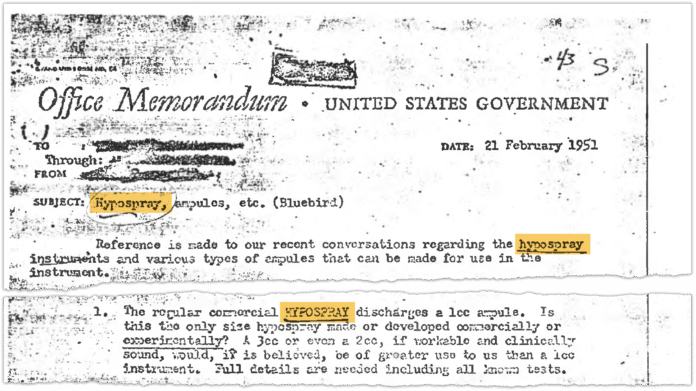
The memo includes detailed plans for interrogation teams trained to utilize the polygraph, various drugs, and hypnotism “for personality control purposes.” These teams were to be made up of three people: a doctor (ideally a psychiatrist), a hypnotist, and a polygraph technician. The memo clarifies that while the doctor and technician would need to undergo approximately five months of training, the Inspection and Security Staff’s own department hypnotist could be made available immediately. In a later memo from February 2, 1951, there are inquiries into acquiring six “hypospray” devices: experimental instruments designed to covertly inject sedatives through the skin via “jet injection.” There’s a request to investigate modification of a “tear gas pencil” and other “devices of unestablished action,” such as the “German ‘Scheintot’ [sic] (appearance of death) pistol.”

The project’s proposed budget of $65,515 accounted for team salaries and equipment like syringes, towels, and film cameras. The budget also allots $18,000 for “Transportation,” and while the actual offshore locations are redacted, a write-up of a CIA meeting held one year later specifically notes a “project in Japan and Korea in which the Army had used a polygraph operator along with a team of psychiatrists and psychologists on Korean POWs.” 

Although the initial proposal for Project Bluebird mostly emphasized the potential for “personality control,” it’s clear that CIA officials were also interested in broader, more ambitious outcomes. One document summarizing a “special meeting” between U.S., British, and Canadian intelligence services notes the CIA’s desire to research “the psychological factors causing the human mind to accept certain political beliefs” and “determining means for combatting communism,” “‘selling’ democracy,” and preventing the “penetration of communism into trade unions.” Another meeting held on May 9, 1950, called for “the Surgeon General of the Army to place on the search list of the Nuremberg Trials papers request for information on drugs, narcoanalysis, and special interrogation techniques.” 

There were requests for other tests that, at the time, were deemed “impossible for security reasons.” According to a memo from September 18, 1951, this included “experiments on the outside with SI inducted over the telephone.” The writer explains that this over-the-phone hypnosis has, so far, been “universally successful,” however testing along agency lines was yet to be approved. 

One declassified memo emphasizing the importance of the project gets more detailed, citing “specific problems which can only be resolved by experiment, testing and research.” Unlike the lists of supplies necessary for Project Bluebird, the “specific problems” officials hoped to explore in the experiments offer a uniquely intimate perspective into the bureau’s interests. A few examples of these “problems” include: 

  • “Can we create … an action contrary to an individual’s basic moral principles?”
  • “Could we seize a subject and in the space of an hour or two … have him crash an airplane, wreck a train, etc.?”
  • “Can we ‘alter’ a person’s personality? How long will it hold?” 
  • “Can we guarantee total amnesia under any and all conditions?” 

This last question surrounding drug-induced amnesia would prove incredibly relevant months later, when the first team of Project Bluebird technicians arrived in Japan to carry out initial tests. According to Marks, these men “tried out combinations of the depressant sodium amytal with the stimulant benzedrine on each of four subjects, the last two of whom also received a second stimulant, picrotoxin.” The team was attempting to induce a state of medically administered amnesia, and according to their reports, the experiments proved successful enough to pursue further tests. Two months later, according to Marks’s book, the Project Bluebird team began testing more “advanced” interrogation techniques on 25 North Korean prisoners of war in Japan.

Notably absent from these declassified documents is any proof that similar experiments were undertaken by enemies of the U.S. The central animating myth behind MK-ULTRA and Project Bluebird is the narrative of the American soldier who returned home after months of imprisonment by enemy forces, only to be revealed as a hypnotized double agent. Throughout the Korean War, American moviegoers were screened films starring and narrated by future president Ronald Reagan. These films showed American troops being psychologically tortured by Chinese and North Korean soldiers until dangerous, anti-democratic ideals were implanted in their minds without their knowledge.

The knowledge most Americans have about these experiences are based on a work of fiction: Richard Condon’s 1959 political thriller, “The Manchurian Candidate.” In Condon’s book (and its two film adaptations), an American soldier returns home with a secret, one that he himself isn’t even aware of. While held captive by North Korean and Chinese soldiers, the American POW was brainwashed by enemy troops, unknowingly turning him into a sleeper assassin with the goal of being “activated” to kill a presidential nominee. 

Throughout these declassified documents are numerous reminders that the Korean War’s label as “The Forgotten War” serves, in part, as intentional obfuscation.

As Project Bluebird transformed into Project Artichoke and later MK-ULTRA, the CIA’s goals seemed to shift into one of beating the enemy at their own game. Essentially, programs surrounding psychological experiments were deemed necessary evils after our own troops were coming home hypnotized and transformed by our enemies. While this narrative offers a convenient excuse for why the CIA developed programs like Bluebird in the first place, one declassified document tells a different story. 

In a 1983 witness testimony from CIA chemist Sidney Gottlieb, who led the MK-ULTRA experiments, he recalls receiving confirmation that, after thorough investigation, there was no evidence any American POWs were subjected to drug-induced hypnosis at any point during the Korean War. “As I remember it,” Gottlieb said, “[The report] basically said that they felt that the techniques the Chinese and/or the Koreans used were not esoteric. … [They] didn’t depend upon sophisticated techniques used in drugs and other more technical means.” Additionally, a 1952 memo to Allen Dulles reinforces the CIA’s willingness to fund these experiments without any proof that enemy countries were undergoing similar research: “We cannot accept this lack of evidence as proof.”

In one of the more revealing moments from the entire collection of documents, the CIA’s Morse Allen recounts a conversation with an agency employee about the effectiveness of interrogating individuals through hypnosis. “Individuals under hypnotism will give information,” Allen writes, “but … it could not always be regarded as accurate, since fantasy and even hallucinations are present in certain hypnotic states.” Reading the lengthy budgetary sheets for drugs, syringes, polygraph machines, and hypnotists, paired with the details of Marks’s book, one’s imagination begins trying to fill in the gaps, drifting into fantasy. It’s an experience uniquely fitting for research into the CIA’s pursuit of technology aimed at erasing facts, experiences, and memories.

Throughout these declassified documents are numerous reminders that the Korean War’s label as “The Forgotten War” serves, in part, as intentional obfuscation. People, histories, and crimes are rarely forgotten on accident, and what these disclosures clearly demonstrate is that there remains a world of difference between the forgetting of history and its swift, coordinated erasure.

Microsoft bets big on AI in Australia with $18 billion investment

0
microsoft-bets-big-on-ai-in-australia-with-$18-billion-investment
Microsoft bets big on AI in Australia with $18 billion investment


Microsoft ( said on Thursday that it will invest A$25 billion ($17.9 billion) in Australia by ‌the end of 2029 to boost computing and artificial intelligence capacity, betting on growing demand for the technology in the country.

The U.S. tech giant’s latest investment reflects rising demand for AI technologies and positions Australia as a key growth market.

Microsoft said the ​investment will support the expansion of its Azure AI supercomputing and cloud infrastructure, strengthen cybersecurity and promote AI skills development across the country.

“Australia ​has an enormous opportunity to translate AI into real economic growth and societal benefit,” ⁠Microsoft CEO Satya Nadella, currently visiting Sydney as part of the company’s global AI tour, said in a ​statement. He described the initiative as Microsoft’s largest investment in Australia to date.

Microsoft and its Big Tech rivals ​Alphabet , Amazon and Meta will collectively invest about $650 billion to scale up AI-related infrastructure this year, according to Bridgewater Associates.

“This is a serious vote of confidence in Australia as a tier-one AI market,” eToro Analyst Josh Gilbert said.

“For a long time, the AI ​capex conversation has been a U.S. story, with occasional nods to Japan, Singapore, and even the Middle ​East. The fact that Microsoft is now putting this kind of capital behind Australia, alongside similar moves across the globe, ‌shows ⁠the region is squarely in the AI build-out plan,” Gilbert added.

The investment also comes at a time when Microsoft faces growing competition in AI assistants, with its Copilot tool competing against offerings such as Anthropic’s Claude and Google’s Gemini. The Windows maker has been racing to improve Copilot to drive better adoption.

Microsoft also announced plans ​to expand its commercial ​cloud and AI, including ⁠graphics processing unit offerings, for Australian customers by more than 140% by the end of 2029.

For Microsoft, the investment “is about defending Azure’s turf, locking in enterprise customers, ​and buying distribution in a market where the AI race is still wide ​open,” eToro’s ⁠Gilbert added.

The latest commitment builds on Microsoft’s A$5 billion investment in 2023 aimed at expanding its hyperscale cloud computing and AI infrastructure in Australia.

“More training, better technology and new opportunities for Australians to get ahead. That’s what the massive AI ⁠investment Microsoft ​announced today will mean for Australia,” Prime Minister Anthony Albanese said ​in a post on X.

The Australian government welcomed the announcement, and said it will collaborate with Microsoft to forecast infrastructure needs and ​strengthen the country’s energy systems.

Source:  Reuters

Syria holds public trial for Assad’s cousin over crimes against civilians

0
syria-holds-public-trial-for-assad’s-cousin-over-crimes-against-civilians
Syria holds public trial for Assad’s cousin over crimes against civilians

Atef Najib, a cousin of ousted President Bashar al-Assad and former political security chief in Syria’s Daraa city, appeared on Sunday before the Fourth Criminal Court in Damascus, Al-Ikhbariya television reported, Anadolu reports.

The outlet broadcast video footage showing Najib in the defendant’s cage, after he had been brought to the court in the Syrian capital.

“The first trials of transitional justice in Syria include a detainee (Atef Najib) and defendants who are fugitives from justice,” the channel quoted an unnamed judge in the court as saying.

Among those fugitives were Assad, his brother and commander of the notorious Fourth Division Maher Assad , former Defense Minister Fahd Jassem al-Freij, former military intelligence chief in Daraa Laith al-Ali, and former military intelligence chief in Suwayda province Wafiq Nasser.

The judge announced the adjournment of the session until May 10.

Najib, who was arrested in January last year, graduated from the Military Academy before joining the intelligence services, where he held various positions, including the Political Security Branch in Daraa.

He is accused of being one of the first to carry out violations against civilians in Daraa, the birthplace of the 2011 uprising.

He is also blamed for the arrest and torture of children in Daraa who had written anti-regime slogans on walls, an incident that sparked initial protests in Syria.

In December 2024, Assad, who ruled Syria for nearly 25 years, fled to Russia, bringing an end to the Baath Party’s decades of rule that began in 1963. A transitional administration led by President Ahmad al-Sharaa was formed in January 2025.

New robotic control software avoids jamming their joints

0
new-robotic-control-software-avoids-jamming-their-joints
New robotic control software avoids jamming their joints

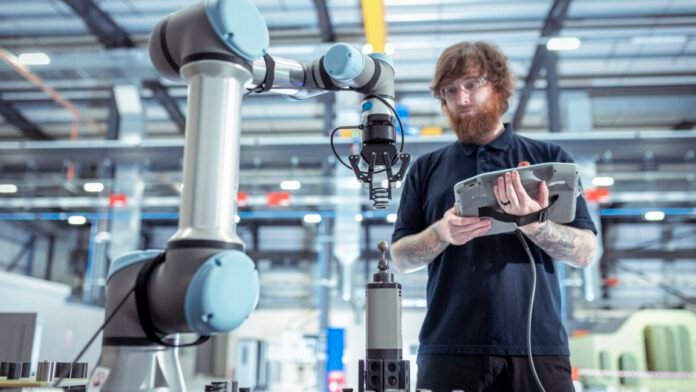
Switching from one smartphone to another is mostly a smooth procedure. You log into your accounts and your apps, preferences, and contacts should sync to the new hardware. But in the world of robotics, swapping an old robotic arm for a newer model has meant setting everything up from scratch.

To fix that, a team of researchers at the Swiss École Polytechnique Fédérale de Lausanne (EPFL) has developed what they call Kinematic Intelligence, a framework that makes switching robots work more like switching smartphones. They describe their system in a recent Science Robotics paper.

Demonstrating skills

For years, roboticists have been working on getting robots to learn from demonstration—teaching them new skills by showing them what to do, rather than writing lines of code. The idea is to remotely control or physically guide the robot’s arm to teach it a task like wiping a table, stacking boxes, or welding a car component. The problem is that most of these taught skills end up tied to the specific robot the training was done with.

But robotics is advancing quickly. “The robots have different designs, and nowadays there are new designs being proposed—that brings its own set of challenges,” said Sthithpragya Gupta, a roboticist at EPFL and lead author of the study. If a new robot has slightly longer links, a different joint orientation, or a more complex configuration, that learned behavior instantly breaks and the new robot will likely flail, freeze, or crash if attempting it.

“With new designs come different capabilities and constraints,” said Durgesh Haribhau Salunkhe, an EPFL roboticist and co-author of the study. “The problem is to adapt to these constraints and capabilities—to faithfully replicate the actions demonstrated by a human.” Today, making the leap from one robot body to another usually means starting from scratch and retraining the whole system.

The danger zone

When a robot moves through space to complete a task, it must constantly calculate how to bend its joints to keep its end-effector (a robotic equivalent of a hand) on the right path. The robot has to avoid hitting a physical limit, or worse, a singularity, which in robotics is a mathematical danger zone: a physical configuration where the robot’s joints align in such a way that it temporarily loses a degree of freedom. “In such positions, the robot’s motion may become unstable or [you] may lose control of the robot,” Gupta said.

In human terms, it works roughly like locking the elbows as they get fully straightened when pushing something heavy, which makes the arms unable to perform side-to-side movements for a moment.

Transferring skills from one robot to another is hard because differently structured robots usually have a different topology of singularities. When a robot’s algorithm blindly follows a path and hits a singularity, the math controlling its joints will fail. The robot might try to spin a joint at infinite speed, for instance, resulting in a sudden, unsafe movement. Gupta’s team solved this by giving the robots a deep, innate mathematical awareness of their own physical limitations. This Kinematic Intelligence, as they call it, lets a user demonstrate a skill just once, and have it executed safely by an entirely different type of robot.

And (surprisingly, these days) Kinematic Intelligence was built in an AI-free manner.

Seeking certainty

Traditionally, engineers have dealt with singularities through software fixes. They built inverse models, complex mathematical formulas that work backward from the target position of the robot’s end-effector to map all the joint positions required to get it there. Then, they just slapped on safety filters or corrections to prevent the robot from getting itself into trouble.

Some of the newer, data-driven AI approaches take less effort and expertise but require access to every robot that the control software will be used on during the training phase. “Also, there is this probabilistic or black box nature of AI wherein it can do something incoherent, which can be potentially catastrophic,” Gupta said. His team wanted certainty, not probabilities, so they took a different approach.

Instead of trying to correct for a robot’s mechanical constraints after the training, they embedded these constraints directly into the control policy from the beginning. They focused on three-revolute robots—basically robotic arms with three joints—which act as the foundational building blocks for many of the commercial robots we see today. Through an algebraic analysis of the robots’ parameters, such as the lengths of their links and the offsets of their joints, the team mapped out exactly where the singularities lie within their joint space. These singularities, combined with the hard limits of the joints, slice the robot’s possible movement space into feasible regions the researchers call aspects.

By looking at the topology of these aspects, the researchers classified three-revolute robots (those with three joints) into six categories. This way, once they knew which of these six categories a specific robot falls into, they instantly knew the exact structure of its physical limitations—a complete map of its danger zones.

Armed with this map, the Kinematic Intelligence framework enables robots to go around their singularities using a strategy the team calls a track cycle. Based on its category classification, the robot knows its physical limits, which prevents it from crashing and dynamically redirects the movement to safely slide or traverse along the edge of the singularity boundary. The robot carefully follows this boundary until it finds a safe configuration where it can re-enter the nominal path to finish the task.

When the team made sure the math behind their idea was correct, they put their framework to the test on various machines. And it worked.

Robotic teamwork

The experimental setup included a compact 6-DoF Duatic DynaArm with tight joint limits, a 7-DoF KUKA LWR IIWA 7 with moderate limits, and a 7-DoF Neura Robotics Maira M with much more relaxed boundaries. With these machines, the researchers built a mock multi-robot assembly line where three different robotic arms cooperated to complete a sequence of tasks. At the beginning, a human performed a single demonstration of three skills in sequence. “We demonstrated a task where you push something off a conveyor belt, pick it up and put it on a workbench, and then pick it up again and throw it into a basket,” Gupta said. All these actions were then distributed among the robots so that each robot performed one of them: the DynaArm did the pushing, the KUKA did the picking and placing, and the Neura did the picking and throwing.

Even though the pushing and throwing motions forced the robots into excursions near the boundaries of their physical workspaces, and the pick-and-place maneuver demanded complex internal mathematical checks, all three machines were able to learn a functional policy via a single human demonstration. “And then we said, you know what, let’s shuffle these robots around,” Gupta said.

Without any retraining, the team swapped the robots’ locations and tasks. It turned out their Kinematic Intelligence made it possible to complete the sequence when KUKA was responsible for pushing, the DynaArm for throwing, the Neura for picking and placing, and in all other possible configurations. “The key challenge for now is to take this technology to the industrial assembly floor,” Gupta said. He admitted, though, that there are several details the team still has to figure out.

Plug-and-play robotics

While the Kinematic Intelligence framework guarantees mechanically safe motion, it currently lacks the advanced sensing and context-sensitive decision-making required for unpredictable environments. While the researchers acknowledge that the system flawlessly handles a robot’s internal physical constraints like singularities and joint limits, it is not yet equipped to inherently understand the nuances of the objects it interacts with. For example, the system cannot currently distinguish between moving a full container, which requires slow, careful handling, and an empty one, which can be moved quickly. What’s more, it requires the integration of high-level cognitive safety checks to integrate human commands with common sense, such as knowing not to grab a knife when asked to prepare coffee.

Another hurdle to overcome before Kinematic Intelligence can transition from controlled laboratory experiments to factory floors is the integration of advanced environmental sensing, which would enable robots to safely navigate dynamic spaces where humans are constantly and unpredictably moving around. Additionally, while the software framework has already been validated on current industrial robots, its deployment in more sensitive fields like medicine is currently bottlenecked by hardware limitations.

“If we talk deploying this technology in medical scenarios, I believe in the next five years we will see mechanically safer robots that should make this possible,” Salunkhe said. “Our framework can be immediately translated to such new designs, so we’re waiting for these robots now.”

Gupta’s and Salunkhe’s work on robots’ skill sharing is published in Science Robotics: http://dx.doi.org/10.1126/scirobotics.aea1995

Scientist’s Chilling Warning Before Death Ignites Explosive Cover-Up Fears: ‘I DIDN’T KILL MYSELF’

0
scientist’s-chilling-warning-before-death-ignites-explosive-cover-up-fears:-‘i-didn’t-kill-myself’
Scientist’s Chilling Warning Before Death Ignites Explosive Cover-Up Fears: ‘I DIDN’T KILL MYSELF’


A dead scientist. A haunting warning. And a trail of secrets that some believe reaches all the way into America’s most classified UFO programs.

This isn’t a movie plot — it’s the real-life mystery of 34-year-old Alabama researcher Amy Eskridge… and the story is getting darker by the day.

Eskridge, a rising figure in advanced propulsion and anti-gravity research, was officially ruled a suicide in 2022 after being found with a gunshot wound to the head.

But critics say that explanation doesn’t add up — not even close.

Before her death, Eskridge allegedly sent a spine-chilling message that now reads like a warning from beyond the grave.

“If you see any report that I killed myself, I most definitely did not.”

Let that sink in.

The message, reportedly sent to former intelligence officer Franc Milburn, didn’t stop there. She also insisted she hadn’t overdosed — and hadn’t harmed anyone else — as if she knew exactly what narrative might follow her death.

And then there’s the video.

In resurfaced footage that’s now circulating online, Eskridge reportedly speaks about terrifying encounters and claims she feared she was being targeted — not just professionally, but physically and psychologically. According to Milburn, she even showed him disturbing images of her own hands, appearing discolored, which she believed were evidence of some kind of attack.

Friends say none of it sounds like the behavior of someone planning to take their own life.

So what was she really afraid of?

That’s where the story takes a sharp turn into even murkier territory.

Eskridge wasn’t just any scientist. She was working on fringe-level propulsion concepts — the kind often whispered about in connection with UFO technology and next-generation aerospace breakthroughs.

And she’s not alone.

At least 10 scientists and researchers tied to sensitive nuclear, aerospace, or UFO-related projects have reportedly died or vanished under mysterious circumstances in recent years. No official link has been confirmed — but the pattern has conspiracy watchers on high alert.

Even Donald Trump has raised eyebrows, calling the case “pretty serious stuff” as pressure mounts for answers.

Now the feds are involved.

The FBI has launched a probe into Eskridge’s death, while lawmakers on Capitol Hill are demanding transparency from agencies including the Department of Energy, Department of Defense, NASA, and the FBI itself.

And just as the mystery deepens, the government is cracking open the vault.

Earlier this year, Trump ordered the release of long-classified files on UFOs, extraterrestrial life, and unexplained aerial phenomena — a move that has only intensified speculation about what’s been hidden for decades.

Tennessee Congressman Tim Burchett, who has been briefed behind closed doors, dropped a bombshell of his own.

“If the public heard what I’ve heard, they’d be up at night,” he warned.

Up at night.

Still not enough? Brace yourself.

Former Congressman Matt Gaetz has claimed he was told — in a non-classified setting — about alleged “hybrid breeding programs” involving humans and extraterrestrials operating on U.S. soil.

Yes, really.

He admits he couldn’t verify it. But in a story already filled with dead scientists, secret research, and government silence, even unproven claims are pouring gasoline on an already raging fire.

So what actually happened to Amy Eskridge?

A tragic suicide — or something far more sinister?

Right now, the answers remain buried in a maze of classified files, conflicting accounts, and chilling final words that refuse to be ignored.

And if more truths come out… this could be just the beginning.

Gunfire Erupts at White House Correspondents’ Dinner, President Trump Evacuated

0
gunfire-erupts-at-white-house-correspondents’-dinner,-president-trump-evacuated
Gunfire Erupts at White House Correspondents’ Dinner, President Trump Evacuated


Gunfire disrupted the White House Correspondents’ Association dinner Saturday night at the Washington Hilton, triggering panic inside one of Washington’s most high-profile annual gatherings and prompting the Secret Service to evacuate President Donald Trump, senior officials, and hundreds of attendees. Authorities said the suspect, identified as Cole Tomas Allen, 31, of Torrance, California, was taken into custody and that the president was not harmed.

The shooting unfolded as journalists, administration officials, and public figures were gathered in the ballroom. Witnesses described confusion as initial sounds were mistaken for dropped equipment before security personnel rushed in and ordered people to take cover. Some attendees ducked under tables as agents moved quickly to secure the room and escort senior officials out.

Law enforcement officials said at least one officer was struck but protected by a bullet-resistant vest and is expected to recover. Investigators believe Allen acted alone, though a motive had not been publicly established by early Sunday morning Israel time. AP and Reuters described him as a California tutor and computer programmer with an academic background in engineering and computer science.

The incident has raised immediate questions about security at the Washington Hilton, which, unlike the White House complex, relies on layered but less centralized protection for large public events. Authorities are expected to review how the attacker was able to approach or access the area.

Among those caught in the chaos was Erika Kirk, the widow of conservative activist Charlie Kirk. She reportedly took cover under a table during the shooting and later appeared visibly shaken as she was escorted out. Witness accounts said she was crying and said, “I just want to go home.”

The dinner was effectively halted as security teams swept the area. It remains unclear whether the event will be rescheduled as officials continue investigating Allen’s background, his route into the hotel, and whether any security failures contributed to the breach.

Mass rescue operation by Libyan authorities: over 400 migrants saved from 10 boats

0
mass-rescue-operation-by-libyan-authorities:-over-400-migrants-saved-from-10-boats
Mass rescue operation by Libyan authorities: over 400 migrants saved from 10 boats


Libya’s eastern-based coast guard of the Libyan National Army rescued at ​least 404 migrants on board 10 ‌boats after they had “faced harsh conditions at sea,” the Tobruk Red Crescent said.

Tobruk is a coastal city ​in eastern Libya near the border ⁠with Egypt.

The Red Crescent in the ​city said the migrants are from different ​nationalities.

Pictures posted by the Red Crescent on Facebook showed their volunteers providing first aid, food ​and blankets to the migrants.

Libya ​is a transit route for migrants, many of ‌them ⁠from sub-Saharan Africa, risking their lives to flee to Europe across desert and sea in the hope of escaping ​conflict and ​poverty.

On ⁠Monday, 10 migrants were confirmed to have died after their ​boat capsized off Tobruk, and ​31 ⁠were still missing, according to three Libyan sources and the International Organization for ⁠Migration. ​Six bodies were recovered ​on Saturday after washing ashore.

Source:  Reuters

Geocultural forces reshaping China’s economic map

0
geocultural-forces-reshaping-china’s-economic-map
Geocultural forces reshaping China’s economic map

On April 1, the National Bureau of Statistics of China released the latest GDP rankings for the country’s various provinces and municipalities. The data showed consistent growth across major metropolises, but also revealed a significant geographic shift in the Chinese economy.

The data ranked Jiangsu and Zhejiang first and third, respectively, among Chinese provinces by GDP per capita, while Guangdong ranked fourth. Yet 20 years ago, Guangdong held an undisputed first place, with Zhejiang and Jiangsu a distant third and fourth.

The shift is even more apparent at the city level. In 2005, nine cities from Guangdong appeared in the top 25 by GDP per capita, compared with five from Jiangsu and two from Zhejiang.

Twenty years later, only three Guangdong cities remain in that group, while Jiangsu and Zhejiang have grown to seven and four, respectively.

To be sure, all three provinces remain among the most developed regions in China. Since the late 1970s, China’s economic reforms have relied heavily on manufacturing and export-led growth, fueling a regional inequality that persists today and favors its eastern seaboard.

Guangdong pioneered this model, with Shenzhen (ranked No. 1 in 2005, No. 6 in 2025) and Zhuhai (No. 3 in 2005, No. 16 in 2025) leveraging their proximity to Hong Kong and Macao, respectively, to become successful special economic zones.

Guangzhou (No. 8 in 2005, No. 22 in 2025) also used its status as the province’s capital and largest city to establish itself as a major manufacturing and trading hub.

That manufacturing success spurred the formation of innovative local firms, including Huawei in telecommunications, DJI in drones, Tencent in digital services and BYD in batteries and electric vehicles.

While these firms continue to make their mark in China and abroad, the country’s cutting-edge startup scene has shifted further north. China’s latest five-year plan, released March 12, makes the new centers of gravity clear.

In artificial intelligence and robotics, Zhejiang’s capital Hangzhou leads with local champions DeepSeek and Unitree, backed by hometown tech giant Alibaba.

In biomanufacturing, national champion WuXi Biologics has facilities in Hangzhou, Jiangsu’s Suzhou (No. 25 in 2005, No. 7 in 2025), and neighboring Wuxi (No. 11 in 2005, No. 5 in 2025).

The divergence in high-tech entrepreneurship may partly be explained by the presence of top educational institutions.

Last March, The Economist profiled Zhejiang University, concluding that its presence is instrumental in turning Hangzhou into a startup hub — much as Stanford has done for Silicon Valley.

Indeed, various university rankings consistently place both Zhejiang University and Nanjing University — located in Jiangsu’s capital Nanjing (No. 31 in 2005, No. 11 in 2025) — alongside several universities in nearby Shanghai and Anhui province, in the top 10, while Guangdong has no entries.

The educational advantage Jiangsu and Zhejiang hold over Guangdong has centuries-old roots. Since the Southern Song Dynasty, Jiangnan — the region encompassing the southern bank of the Yangtze River, spanning parts of Jiangsu and Zhejiang — has been China’s premier cultural and economic hub, parlaying strength in agricultural productivity and trade into artistic and intellectual achievement.

In contrast, Lingnan, which encompasses modern-day Guangdong, was historically open to seaborne trade but remained culturally distant from the rest of the country due to its geographic isolation.

Both regions have strong commercial traditions, but Jiangnan’s intellectual heritage may give it an edge in producing the talent needed to push the technological frontier.

As Jiangsu and Zhejiang forge ahead economically, they may once again become China’s cultural center as well. In the 1980s and ’90s, Cantonese pop culture spread across China, buoyed by Hong Kong’s prosperity, giving the province’s native tongue unprecedented cachet.

But that prestige has declined markedly as Hong Kong’s economic standing has diminished. Meanwhile, Shanghai’s rise as an economic powerhouse has elevated the profile of Jiangnan’s local vernacular as a countercultural force — the formerly marginalized language is reasserting itself in the public sphere against the nationwide push for Mandarin.

Of course, it is not a foregone conclusion that the broader economic and cultural shift from Guangdong to Jiangsu and Zhejiang will continue. Much will depend on the success of individual entrepreneurs and their firms, wherever they may be located.

And global demand for Chinese goods and services can shift quickly, shaped by ongoing restrictions on Chinese imports worldwide. But in any case, examining regional differences serves as a reminder that China is far from monolithic in its future economic trajectory.

Over 2,490 killed in Lebanon in Israeli attacks since March 2

0
over-2,490-killed-in-lebanon-in-israeli-attacks-since-march-2
Over 2,490 killed in Lebanon in Israeli attacks since March 2

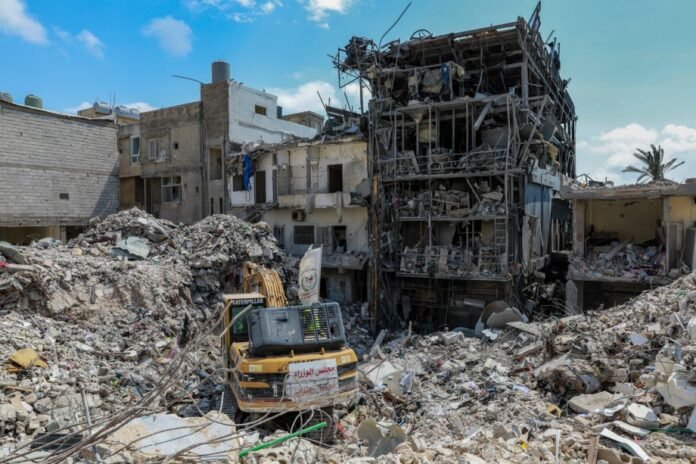
Lebanon said Saturday that five people were killed and six others wounded over the past 24 hours, raising the death toll from Israeli attacks to 2,496 killed and 7,725 injured since March 2, Anadolu reports.

The figures were published in a report by the Lebanese Cabinet’s Disaster Risk Management Unit, as reported by the National News Agency (NAA).

The update comes as Israel continues to violate a temporary ceasefire in Lebanon that began on April 17.

The previous official toll stood at 2,491 killed and 7,719 injured, in addition to more than 1 million displaced, before the updated figures were released.

READ: UK, Finland condemn ‘unacceptable’ Israeli attacks on journalists in Lebanon

The unit did not provide further details on how the figures were calculated.

According to field sources and local media, authorities continue to recover bodies of victims killed before the ceasefire took effect, while the rise in injuries is attributed to data updates and newly reported cases from recent days.

On April 17, US President Donald Trump announced a 10-day ceasefire in Lebanon between Israel and Lebanon, later extending it on Thursday by an additional three weeks.

Since March 2, Israel has continued to violate the fragile ceasefire, resulting in casualties and widespread destruction, while Hezbollah has responded by targeting Israeli military positions in southern Lebanon and Israeli communities.

READ: Israeli army warns civilians against returning to southern Lebanon villages despite ceasefire

Trump’s war: the kind of military misadventure that ends empires

0
trump’s-war:-the-kind-of-military-misadventure-that-ends-empires
Trump’s war: the kind of military misadventure that ends empires

Writing more than 2,000 years ago, the Greek historian Plutarch gave us an eloquent description of what modern historians now call “micro-militarism.”

When an imperial power like Athens then, or America now, is in decline, its leaders often react emotionally by mounting seemingly bold military strikes in hopes of regaining the imperial grandeur that’s slipping through their fingers.

Instead of another of the great victories the empire won at its peak of power, however, such military misadventures only serve to accelerate the ongoing decline, erasing whatever aura of imperial majesty remains and revealing instead the moral rot deep inside the ruling elite.

There is mounting historical evidence that America is indeed an empire in steep decline, while President Donald Trump’s war of choice against Iran is becoming the sort of micro-military disaster that helped destroy successive empires over the past 2,500 years — from ancient Athens to medieval Portugal to modern Spain, Great Britain, and now the United States.

And at the core of every such ill-fated war-making decision lay a problematic leader, often born into wealth and prestige, whose personal inadequacies reflected and ramified the many irrationalities that make imperial decline such a painful process.

During that demoralizing downward spiral, imperial armies, so lethal in an empire’s ascent, can err by plunging their countries into draining, even disastrous “micro-military” misadventures—psychologically compensatory efforts to salve the loss of imperial power by trying to occupy new territories or display awe-inspiring military might.

Although such micro-militarism often chose targets that proved strategically unsustainable, the psychological pressures upon declining empires are so strong that they all too often gamble their prestige on just such misadventures.

Not only did such disasters add financial pressures to a fading empire’s many troubles, but in a humiliating fashion, they also invariably exposed its eroding power while exacerbating the destabilizing impact of imperial decline in the capitals of empire (whether Athens, Lisbon, Madrid, London, or Washington, DC).

In our moment, when the bombs stop falling and the rubble is finally cleared from the streets of Tehran and Beirut, the impact on US global power of such a de facto defeat will become all too clear—as alliances like NATO atrophy, American hegemony evaporates, legitimacy is lost, global disorder rises, and the world economy suffers.

Let me now turn from the disasters of the present imperial moment to the lessons of history to explore the sort of lasting damage that Donald Trump’s micro-military misadventure in the Middle East might be inflicting on this country’s declining imperium.

Defeat of Athens in Sicily

The date was 413 BC. The place was ancient Athens, then the seat of a powerful empire, long dominant around the rim of the Aegean Sea but losing influence to a sustained military challenge by Sparta.

At the port of Piraeus, a “certain stranger,” as the historian and philosopher Plutarch recalled, “took a seat in a barber’s shop, and began to discourse [on] what had happened as if the Athenians already knew all about it.” Stunned by this stranger’s report of a military debacle in far-off Sicily, the barber “ran at the top of his speed to the upper city” of Athens, where the news sparked “consternation and confusion.”

What that stranger described was the greatest military disaster in the history of the Athenian empire. Two years earlier, in the midst of the protracted Peloponnesian Wars, the aristocrat Nicias — an indifferent, indecisive leader who used his inherited wealth to court popularity with lavish spectacles — persuaded the citizens of Athens to deliver a theoretically bold blow against a rival imperial power, Sparta, by attacking its ally Syracuse in Sicily in hopes of crippling the enemy, capturing riches, and recovering Athens’ ebbing hegemony.

Instead of victory, however, Athens’ vast armada of 200 ships and some 12,000 soldiers suffered a devastating defeat. Not only was the fleet destroyed (largely because Nicias proved “an incompetent military commander”), but his surviving soldiers were captured, confined on a starvation diet in a stone quarry, and sold into slavery. Athens never recovered.

Within a decade, the city had been starved into submission by Sparta’s impenetrable blockade of a naval choke point in the Dardanelles Strait, stripped of its empire, and subjected to autocratic rule by a pro-Spartan oligarchy.

Portugal’s debacle in Morocco

Our next date is 1578. The place is Portugal, the seat of a lucrative empire that had controlled commerce across the Indian Ocean for decades but now found its hegemony challenged by Muslim merchant princes allied with the Ottoman Empire.

In its capital, Lisbon, a headstrong young king, Sebastian, suffered from sexual impotence and a fiery temperament that made him a fanatical “captain of Christ.” With the idea of striking a lethal blow in his country’s global war against Islam, the young king persuaded the flower of his nation’s aristocracy to follow him on a latter-day crusade across the Mediterranean Sea to Morocco.

There, at the fateful Battle of Alcacer Quibir, Portugal’s army was slaughtered by local Muslim forces. Some 8,000 Portuguese troops were killed, 15,000 captured, and only 100 escaped.

The defeat was so devastating that it not only destroyed the king and his court but also precipitated the country’s incorporation into the Spanish empire for the next 60 years. In the aftermath of such reverses, the Portuguese Estado da India (or state of India) at Goa was reduced to selling permits to any ship captain who could pay, whether Hindu, Muslim, or Christian. With Portuguese commercial dominance removed from the Indian Ocean, Muslim merchants and pilgrims could once again move across it unimpeded.

Though the Portuguese empire would survive for another three centuries, it would never recover the commercial hegemony that had once allowed it to dominate the world’s sea lanes from the Spice Islands of Indonesia, across the Indian Ocean and the South Atlantic to the coast of Brazil.

Spain’s disaster in the Atlas Mountains

And now to jump several centuries, another significant date for imperial disasters is 1920. The place was Madrid, where Spain’s leaders were already reeling from the psychological stress of their country’s long imperial decline, culminating in the loss of its last colonies, Cuba, Puerto Rico, and the Philippines in the Spanish-American War of 1898 with the rising United States.

Seeking regeneration through further colonial conquest, Spain’s conservative leaders reacted to that demoralizing defeat against America by expanding their small coastal enclaves in northern Morocco to establish a protectorate over the whole region and its arid Atlas Mountains.

Spain’s inept monarch Alfonso XIII, who liked to play soldier, cultivated a clique of military favorites who shared his passion for the recovery of lost imperial glory by pacifying that rugged terrain. As resistance to Spanish rule by Berber Muslims escalated into the bloody Rif War of 1920, one of the king’s favorite generals led his troops into the Battle of Annual, where Berber fighters slaughtered some 12,000 of them.

Nonetheless, through the influence of the king and his military cronies, Spain clung desperately to those profitless Moroccan mountains. The Spaniards would, in fact, dispatch 125,000 more troops there, including its Foreign Legion led by the man who, in the 1930s, would become the leader of a fascist Spain, Francisco Franco, for a protracted pacification campaign that featured both mass slaughter and military innovation.

In a desperate quest for a victory that defied both economic and strategic rationality, Spain produced some 400 metric tons of lethal mustard gas to conduct history’s first aerial bombardment using poison gas, raining mass death down upon Berber villages.

And in military history’s first successful amphibious operation, the Spanish navy also landed 18,000 troops and a squadron of light tanks at Al Hoceima Bay in September 1925 to flank and soon defeat the Berber guerrillas there.

Such micro-militarism, however, not only plunged Spain into a protracted pacification campaign with soaring costs, heavy casualties, and mass atrocities, but also unleashed political forces that would destroy its struggling democracy.

As the masses protested that misbegotten war, King Alfonso backed a military favorite, General Primo de Rivera, in imposing a decade of dictatorship that finally gave way to a short-lived Second Republic.

In 1936, however, only a decade after the Rif War ended, General Franco flew his Army of Africa back from Morocco over the Mediterranean Sea, launching a Spanish civil war that would defeat the Republic and establish a fascist dictatorship that would rule the country for nearly 40 dismal years of economic stagnation.

End of the British Empire at Suez

Arguably, when it came to imperial decline, however, the most revealing date was 1956.

The place was London, the seat of the once-proud British Empire, where the suffocating stress of a painful, protracted global imperial retreat had pushed British conservatives into a disastrous micro-military intervention at Egypt’s Suez Canal, leading to what one British diplomat would term the “dying convulsion of British imperialism.”

In July 1956 (as described in my recent book Cold War on Five Continents“), Egypt’s charismatic president Gamal Abdel Nasser nationalized the Suez Canal, ending British colonial control there, electrifying the Arab world, and elevating himself to the first rank of world leaders.

Although British ships could still pass freely through the canal, the country’s conservative prime minister, Anthony Eden, a vain aristocrat and determined defender of empire, would be deeply unsettled, if not unhinged, by Nasser’s assertive nationalism. Indeed, his leadership throughout the crisis would prove so unbalanced that senior Foreign Office officials would become convinced “Eden has gone off his head.”

In response to the news of the canal’s nationalization, an apoplectic Eden would immediately convene a council of war at 4:00 in the morning. Calling Nasser a “Muslim Mussolini,” a reference to the former fascist ruler of Italy, Eden ordered “him removed and I don’t give a damn if there’s anarchy and chaos in Egypt.”

Making his meaning perfectly clear, Eden asked his foreign minister: “What’s all this nonsense about isolating Nasser or ‘neutralizing’ him as you call it?” He then added pointedly: “I want him destroyed, can’t you understand? I want him murdered.”

With the British secret service MI6 failing in multiple assassination attempts, however, Eden’s government began plotting with the French and Israelis to launch a secret, two-phase invasion of the Suez Canal Zone.

On October 29, the Israeli army led by the dashing General Moshe Dayan swept across the Sinai Peninsula, destroying Egyptian tanks and bringing his troops within 10 miles of the canal. Using that fighting as a pretext for its own intervention (supposedly to restore peace), in just three days, an armada of six Anglo-French aircraft carriers smashed the Egyptian air force, destroying 104 of its new Soviet MIG jet fighters and 130 additional aircraft.

With Egypt’s strategic forces destroyed and its military virtually helpless before the might of that imperial juggernaut, Nasser deployed a geopolitical strategy brilliant in its simplicity. He had dozens of rusting cargo ships filled with rocks and then scuttled them at the canal’s northern entrance, quickly closing one of the world’s main maritime choke points and so cutting off Europe’s oil lifeline to the Persian Gulf.

By the time 22,000 British and French forces began storming ashore at the canal’s north end on November 6, their objective of securing the free movement of ships had already been snatched from their grasp.

By the end of that micro-military disaster, Britain would be reprimanded by the United Nations; its currency would require an International Monetary Fund bailout to save it from utter collapse; its aura of imperial majesty would have evaporated; and the once mighty British Empire would be on the road to extinction.

In retrospect, the Suez Crisis would not only expose the full-scale decline of British power, but also show the world that the country’s ruling Conservative establishment, with its illusions of imperial and racial superiority, was no longer capable of global leadership.

America’s defeat in the Strait of Hormuz

Another date likely to prove all too significant when it comes to the history of imperial decline is February 28, 2026. The place was Washington, DC, home to what had been history’s most powerful imperial state that had dominated much of the globe for nearly 80 years through a mixture of military alliances, deft diplomacy, and economic leadership.

By then, however, cracks had distinctly begun to appear in its edifice of power as US global hegemony faced an increasingly strong economic challenge from China, its massive military suffered two searing defeats in Afghanistan and Iraq, and its economic globalization produced an angry populism at home.

After a populist campaign based on promises to restore both working-class prosperity and America’s global power, Donald Trump took office a second time in January 2025 promising a “golden age of America,” a “thrilling new era of national success” in which the country would “reclaim its rightful place as the greatest, most powerful, most respected nation on Earth, inspiring the awe and admiration of the entire world.”

Born to wealth and privilege himself, Trump returned to office convinced of his unique “genius” for leadership and believing that “I was saved by God to make America great again.”

Wielding raw economic and military might to compel obeisance from friend and foe alike, the president, inspired by a delusional sense of divine mission, began attempting to bend the world to his will.

But during his first year in office, nothing seemed to work as planned. Indeed, most of his initiatives produced the sort of backlash that only served to show how far the United States had fallen from 1991, when the break-up of the Soviet Union made it the world’s sole superpower.

On April 2, 2025, on what he called “Liberation Day,” Trump announced a roster of punitive tariffs to protect domestic manufacturing largely from Chinese imports that faced an initial duty of 34%—later raised to a fully punitive 100%. But at their October 2025 meeting in South Korea, China’s leader Xi Jinping forced Trump to back down by cutting US access to his country’s storehouse of strategic rare earth minerals.

In January, with his tariff initiative losing its luster, Trump plunged the NATO alliance into crisis by demanding that Denmark give him the island of Greenland, threatening to impose new tariffs on European allies unless they complied. Within a week, however, vociferous European resistance had led him to retract that threat at the Davos economic summit, claiming he was satisfied with NATO’s offer of a “framework of a future deal.”

On February 28, 2026, with his tariff initiative failing and his Greenland gambit checkmated, Trump joined Israel in a seemingly bold strike on Iran that soon had the makings of the sort of fateful “micro-military” maneuver that appears to go with imperial powers in decline.

In the first few days of war, US and Israeli bombing killed Iran’s leadership, destroyed its navy, and eliminated its air defenses, leaving the country seemingly prostrate before the might of America’s air-power juggernaut.

After a week of devastating bombardment that seemed to stun the world with its lethality and precision, on March 6 Trump demanded that Iran offer an “unconditional surrender” and signal its capitulation by “the selection of a GREAT & ACCEPTABLE Leader.” In exchange, he promised that the US would “work tirelessly to bring Iran back from the brink of destruction.”

But much as Nasser had done at Suez in 1956, Iran’s leadership reversed the war’s geostrategic balance by closing a critical maritime choke point in the Strait of Hormuz. By striking five freighters with drones in the first week of war, Iran’s leaders, taking a leaf from Nasser’s geopolitical playbook, effectively shut the Strait of Hormuz to tanker traffic, cutting off gas, fertilizer, and oil shipments that plunged the world economy into an unprecedented energy crisis. By the end of March, Iran’s chokehold over the strait was so tight that it began collecting “tolls” from freighters to permit passage.

Blindsided by the strait’s unexpected yet utterly predictable closure, on April 5, Easter Sunday, an unsettled Trump posted a social media message saying: “Tuesday will be Power Plant Day, and Bridge Day, all wrapped up in one, in Iran. There will be nothing like it!!!”

He added: “Open the Fuckin’ Strait, you crazy bastards, or you’ll be living in Hell—JUST WATCH. Praise be to Allah.” Two days later, Trump threatened that, unless Iran opened the Strait of Hormuz, he would attack its civilian infrastructure so severely that “a whole civilization will die tonight, never to be brought back again.”

After the collapse of subsequent negotiations between the two sides at Islamabad, Pakistan, on April 12, Trump plunged ever deeper into the Iran quagmireordering the US Navy to “begin the process of BLOCKADING any and all Ships trying to enter, or leave, the Strait of Hormuz,” and “interdict every vessel in International Waters that has paid a toll to Iran.” With characteristic bluster, he added: “We are fully ‘LOCKED AND LOADED,’ and our Military will finish up the little that is left of Iran!”

Even if Trump destroys Iran’s infrastructure or eventually negotiates a face-saving peace deal, by every metric that really matters, Washington has already lost its war with Iran. Like all weaker powers in asymmetric warfare, Tehran has been willing to absorb relentless punishment, while inflicting pain that the dominant power can ill sustain.

The US will soon run out of targets in Tehran, but Iran has a whole world of damage that its cheap drones can do to the elaborate, exposed petroleum infrastructure on the south shore of the Persian Gulf.

Like Britain at Suez in 1956, Washington will likely pay a heavy price for its “micro-militarism” in the Strait of Hormuz. Close allies, the bedrock of US global power for 80 years, have refused any military support for Washington’s war of choice, prompting Trump to call them “cowards.”

In response to his thundering threats of civilian and civilizational destruction (both war crimes), Trump has been condemned by world leaders. Oblivious to the dangers of war in a region that is the epicenter of global capitalism, Washington is now proving ever more dangerously disruptive of the global economy, making China look like a far more stable choice for world leadership. Moreover, while the US military has proven its tactical agility in destroying targets, it clearly can no longer capture meaningful strategic objectives.

With its alliances in tatters, its world leadership forfeited, and its aura of military might evaporating, the only trajectory for US global hegemony now seems to be downward (like so many great powers of the past).

By the time Trump’s micro-military misadventure in the Strait of Hormuz is over, the decline of US global power will have accelerated drastically and the world will be trying to move beyond the old Pax Americana toward a new, distinctly uncertain global order.

Alfred W. McCoy is professor of history at the University of Wisconsin-Madison is the author of “In the Shadows of the American Century: The Rise and Decline of U.S. Global Power”. Previous books include: “Torture and Impunity: The U.S. Doctrine of Coercive Interrogation” (University of Wisconsin, 2012), “A Question of Torture: CIA Interrogation, from the Cold War to the War on Terror (American Empire Project)”, “Policing America’s Empire: The United States, the Philippines, and the Rise of the Surveillance State”, and “The Politics of Heroin: CIA Complicity in the Global Drug Trade”

Originally published by Tom Dispatch and republished by Common Dreams, this article is republished under a Creative Commons license.
0FansLike
0FollowersFollow
0FollowersFollow
0SubscribersSubscribe
- Advertisement -
Google search engine

Recent Posts