Missile attacks, maritime tensions, and the collapse of the June ceasefire are increasing pressure on Gulf governments to balance security with diplomacy
Renewed US-Iran fighting drew Jordan and Bahrain deeper into the regional fallout over the weekend, as Iran launched another wave of missiles and drones toward US military facilities and countries hosting American forces following large-scale US strikes inside Iran.
The latest escalation marked a significant expansion of the fighting that resumed on July 8 and 9, further undermining the memorandum of understanding Washington and Tehran signed on June 17. Iran again declared the Strait of Hormuz closed, while the United States said commercial traffic continued and carried out strikes against Iranian missile sites, naval assets, communications infrastructure, and other military targets.
Iranian attacks and alerts were reported across Bahrain, Kuwait, Qatar, Oman, the United Arab Emirates, and Jordan. Tehran said it was striking US military infrastructure, although many of its claims about specific targets and damage could not be independently confirmed.
The renewed confrontation followed an Iranian attack on a Cyprus-flagged container vessel in the Strait of Hormuz. The ship was seriously damaged and one Indian crew member was reported missing. The United States responded with an extensive series of strikes intended, according to US officials, to reduce Iran’s ability to threaten commercial shipping.
Jordan had already confronted a direct threat during the previous round of fighting. The kingdom’s state news agency, Petra, reported that Jordanian air defenses intercepted and shot down eight missiles launched from Iran toward Jordanian territory on Thursday, July 9, citing a military source at the General Command of the Jordan Armed Forces-Arab Army.
Missile debris fell in several areas, but no casualties or property damage were reported, the source said.
For Jordan, the incident reinforced a message Amman has repeated throughout the conflict: The kingdom is not a party to the war, but it will respond when its airspace, territory, or civilians are threatened.
Jordan has made its position clear: it is not a party to this conflict and will not allow its sovereignty or the safety of its citizens to be compromised
“Jordan has made its position clear: it is not a party to this conflict and will not allow its sovereignty or the safety of its citizens to be compromised,” Mai Anati, managing editor of The Jordan Times newspaper in Amman, told The Media Line.
She said the interception of the missiles “demonstrates the kingdom’s capability and unwavering commitment to defending its airspace and protecting its people.”
Anati said Jordan’s priority remains safeguarding its national security while preventing the conflict from spreading into its territory.
“The kingdom has long maintained a high level of military readiness, with the Jordan Armed Forces fully prepared to confront any threat to national security. However, Jordan’s priority remains preventing further escalation,” she said.
Jordan’s position illustrates the dilemma facing countries within range of Iranian missiles and drones but formally outside the US-Iran confrontation. Amman has sought to avoid being treated as a belligerent while making clear that it will intercept projectiles directed at Jordan or entering its airspace.
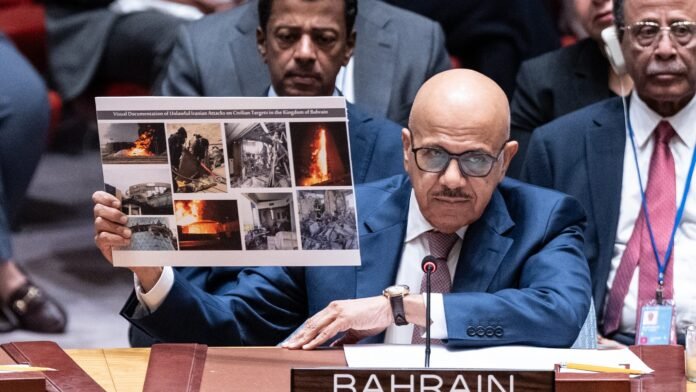
Bahrain faces a related but more persistent risk. The Gulf state hosts the headquarters of the US Navy’s 5th Fleet and has repeatedly faced Iranian missile and drone attacks since the conflict began in February.
Manama must contend with both the immediate military danger and the possibility that temporary diplomatic understandings will repeatedly break down while the central US-Iran dispute remains unresolved.
The MOU reduced tensions but did not resolve the underlying strategic causes of the conflict, making renewed escalation a realistic possibility
“In my assessment, the renewed attacks are not surprising,” a former Bahraini diplomat who requested anonymity told The Media Line. “The MOU reduced tensions but did not resolve the underlying strategic causes of the conflict, making renewed escalation a realistic possibility.”
The former diplomat said Bahrain had faced sustained military pressure despite not participating directly in the US offensive and supporting diplomatic efforts to contain the conflict.
“Bahrain has faced hundreds of missile and drone attacks from Iran and its proxies, despite avoiding direct participation in the military campaign and supporting diplomatic efforts to contain the crisis,” he said. “Yet daily life and economic activity have largely continued. Compared with the initial phase of the conflict, both institutions and the public appear better prepared and more resilient.”
The Media Line could not independently verify the number of attacks cited by the former diplomat. It was also unclear whether his estimate referred to individual projectiles, separate attack waves, or incidents involving Iran-aligned armed groups.
Bahrain appears unlikely to abandon its defensive and diplomatic posture in favor of direct military involvement.
“[Bahrain] is likely to continue relying on diplomacy and multilateral engagement, consistent with its role as a non-permanent member of the UN Security Council, including its sponsorship of Security Council Resolution 2817 (2026), which condemned Iran’s attacks against Bahrain and other Gulf states,” the former diplomat said.
The Security Council adopted Resolution 2817 on March 11. Bahrain presented the measure on behalf of the Gulf Cooperation Council, and it passed by a vote of 13-0, with China and Russia abstaining.
The resolution condemned Iranian attacks against Bahrain, Kuwait, Oman, Qatar, Saudi Arabia, the United Arab Emirates, and Jordan. It also affirmed the affected countries’ rights under international law.
The renewed fighting has again placed the Strait of Hormuz at the center of the conflict. Iran says it has the authority to regulate or restrict traffic through the waterway, while Washington maintains that freedom of navigation must be preserved.
For Gulf countries, the danger extends beyond attacks on military installations or civilian territory. Continued fighting could disrupt shipping, oil and gas exports, supply chains, trade, and foreign investment.
The June memorandum had extended the ceasefire and provided a 60-day framework for negotiations, including arrangements intended to restore maritime traffic. It did not settle the underlying dispute over Iran’s role in administering passage through the Strait or the possibility that Tehran might eventually demand fees from ships.
The former diplomat said further escalation remained likely because Washington and Tehran continue to pursue incompatible objectives, particularly over control of the waterway. Any new ceasefire, he said, would probably be another temporary pause rather than a lasting political settlement.
Iran appears to be trying to pressure Washington by threatening American military facilities and regional partners while avoiding an unrestricted direct confrontation with the United States, he said.
Iran appears determined to sustain pressure on the United States by threatening its strategic presence and partners across the Gulf instead of engaging in direct confrontation
“Iran appears determined to sustain pressure on the United States by threatening its strategic presence and partners across the Gulf instead of engaging in direct confrontation,” he said. “This approach places Gulf states, including Bahrain, on the front line of regional retaliation despite their preference for deescalation and diplomacy.”
Using Bahrain and other Gulf countries as leverage against Washington could further damage Tehran’s relations with its neighbors, he added.
“On the contrary, it risks further damaging Iran’s relations with its Gulf neighbors and deepening regional mistrust,” he said.
The latest exchanges demonstrate that the June memorandum was unable to resolve disputes over the US military presence in the Gulf, Iranian deterrence, the security of Washington’s regional partners, and control of strategic maritime routes.
Diplomatic contacts have continued, including efforts involving Oman, but the ceasefire established in June has effectively collapsed under successive rounds of attacks.
The former diplomat said prolonged escalation would damage regional stability, freedom of navigation, shipping, energy markets, and investor confidence without advancing Iran’s long-term interests.
Jordan and Bahrain represent two aspects of the same regional problem. Jordan is defending its sovereignty while trying to prevent the conflict from crossing its borders. Bahrain is absorbing repeated security pressure while attempting to preserve diplomatic channels and domestic stability.
Neither country has sought direct confrontation with Iran. Both nevertheless remain exposed whenever the US-Iran dispute returns to military action.
The immediate question is no longer merely whether the June understanding will survive. It is whether continuing diplomatic contacts can produce another pause before attacks on regional countries and shipping broaden into a more sustained Gulf conflict.