9.5 C
London
Monday, November 9, 2026
Home Blog

America’s AI backlash is Asia’s design challenge

0
america’s-ai-backlash-is-asia’s-design-challenge
America’s AI backlash is Asia’s design challenge

<

article id=”post-952666″>

An AI server can meet every specification and still sit idle, waiting for electricity or local approval. For Asia’s suppliers, the US midterms have made those constraints harder to ignore. Their response should begin before the next specification is written.

Political pressure is bringing the conditions for data center expansion into sharper focus. A faster server has less value if a site cannot power or cool it. Asia’s hardware and infrastructure suppliers can turn their manufacturing knowledge into a design advantage.

Across the November 4-6 trading sessions, South Korea’s KOSPI lost 10.4% and Taiwan’s TAIEX 8.3%, calculated cumulatively from their November 3 closes. Japan’s Nikkei 225 fell 9.0%, using November 2 as the baseline because Tokyo was closed on November 3.

The Nasdaq Composite dropped 5.5% on November 5. Valuation and financing worries were already weighing on AI shares before the results. The selloff sharpened the stakes, but falling prices are not canceled orders.

There is not yet evidence that the election has rewritten customer specifications. But for suppliers, it raises a consequential question: what will customers need next?

For the power and cooling a site can provide, how much useful work can an AI system deliver? One test would compare how many inference requests systems complete per megawatt-hour under the same workload, power limit and standards for quality, response time and reliability.

The electricity measurement should cover computing, power conversion and cooling, with water use reported separately. Saving power must not come at the cost of electrical safety.

The election gives that question urgency. Using preliminary November 4 results, Data Center Watch examined 393 elected congressional candidates and 34 elected governors while some races remained undecided.

Among congressional Democrats, 23% supported data-center bans or moratoriums, compared with 3% of Republicans. Among governors, the report identified restrictive positions among 50% of Democrats and 8% of Republicans. Support for oversight crossed party lines; Democrats more often favored tighter restrictions. Those positions still have to become policy.

Texas hints at what the emerging bargain could look like. The Texas Tribune reported that Governor-elect Gina Hinojosa had called for a moratorium on all data-center approvals until lawmakers established protections for Texans.

She has argued that economic development and protection for Texans can go together. More efficient equipment cannot answer every community concern. But it can help developers do more within the power and water constraints that communities and utilities must confront.

The new Democratic-controlled Congress takes office in January, but much of that bargaining will happen closer to the sites themselves. States shape utility rules and incentives, while local authorities often control zoning and siting. Federal energy approvals also matter. Each project’s existing approvals, financing and grid access will determine how exposed it is.

The pressure predates the Democratic victories. Republican Governor Greg Abbott had already halted new data-center environmental permits and grid connections in Texas.

President Donald Trump’s voluntary Ratepayer Protection Pledge, announced in March, sought commitments from technology companies to fund additional electricity supplies and grid upgrades. When developers carry those costs, equipment that needs less power for a given task becomes more valuable.

Singapore offers a preview of how such pressures can reach the drawing board. The application criteria for its second data-center capacity allocation round, DC-CFA2, include Green Mark platinum certification for facilities, IT equipment meeting the SS 715:2025 efficiency standard and at least 50% of power from eligible green-energy pathways. In this allocation round, resource performance is already part of the price of admission.

The capabilities did not begin with the election. But the political climate gives suppliers a reason to put them to work in different ways. For suppliers, the real contest is over who helps write the test.

Taiwan’s packaging, server and power-electronics firms should enter joint design with cloud customers while the architecture is still open. They can propose how a rack should distribute power, remove heat and sustain useful output within a site’s limits. That gives manufacturing knowledge a place in the specification itself.

At Computex in June, Delta Electronics presented a prefabricated AI data-center solution alongside power and cooling technologies. The company says factory assembly and testing can shorten deployment by up to 60% compared with traditional technologies. Factory preparation addresses the part of the timetable that engineering controls; permitting and grid connections remain separate challenges.

AMD’s Taiwan partnerships offer another route into design. Its May announcement described work with packaging partners including ASE and SPIL, alongside system manufacturers, aimed at better power efficiency and faster deployment.

Such collaborations give suppliers an opportunity to influence how packaging choices affect the power and cooling needs of the whole system.

The opportunity reaches beyond Taiwan and beyond new buildings. Japan’s Mitsubishi Heavy Industries has reported cooling optimization at Fujitsu’s operating Akashi data center using equipment from multiple vendors.

In October, South Korea’s LG Electronics signed a long-term chiller agreement with AIR Control Concepts for North American projects exceeding five gigawatts of capacity.

Together, they show how Asian firms can contribute to the cooling and integration of AI infrastructure. For suppliers, the value of long-term supply plans will still depend on whether projects secure power and proceed on schedule.

Who captures the value still depends on bargaining power. Chip scarcity and infrastructure bottlenecks can coexist: foundries or memory makers with scarce capacity have different leverage from assemblers and cooling vendors facing more substitutes. Research can improve that position.

A supplier that demonstrates more useful computing within a customer’s power limit has a stronger claim to early involvement and a better basis for competing on something other than cost.

That claim needs evidence beyond a brochure. Taiwan could fund independent laboratories to work with utilities, science parks and cloud customers on common test conditions. Building on existing workload benchmarks, they should measure equipment together with power and cooling, producing results that customers can use in trials and procurement.

Proof is not enough if suppliers cannot get paid for it. Competition may pass efficiency savings straight to hyperscalers, although verified gains can support differentiated pricing or service agreements.

Payment for engineering value and responsibility for deployment delays require separate negotiations. A factory in Texas gives a supplier no control over a customer’s utility connection date. Better products should not make their makers finance delays they cannot control.

Nor can efficiency settle the public bargain. Cheaper computing can encourage greater use, a rebound effect that erodes energy savings; total electricity demand may still rise. Communities will judge projects by their effects on bills, water and surroundings.

Efficiency cannot replace local consent or grid investment, and innovation cannot offset every lost order if AI investment falls. It can help customers operate within tighter constraints.

A good AI server will increasingly be judged by the useful work it can sustain within the power and cooling a site can secure. Suppliers that wait for finished specifications risk remaining cost competitors.

Those that help define that performance have a stronger basis for differentiation and bargaining power.

Chih-Cheng Meng is a Taiwan-based political scientist specializing in international political economy, US-China-Taiwan relations and public policy. He holds a PhD from the University of Texas at Austin.

Source: Iwpost.com

Scientists predict 2026 hottest year on record

0
scientists-predict-2026-hottest-year-on-record
Scientists predict 2026 hottest year on record
cde.news desk · 3 min read

The world is on course for its hottest year on record as the planet is hit with warming from climate change and El Niño, scientists have told BBC News.

The warning comes as world leaders and negotiators gather in Turkey on Monday for the opening of COP31, the latest UN climate summit.

Berkeley Earth, the independent US research group behind the forecast, said that even with two months of the year left it is 95% confident that 2026 will surpass the previous record set in 2024.

The impact of rising heat has been felt acutely in recent months by countries attending COP, with extensive wildfires across Europe and the sudden glacier collapse in Nepal which killed more than 1,000 people.

“We have had a run of record warm years,” said Dr Robert Rohde, of Berkeley Earth. “That is what we expect as global warming progresses… glaciers collapsing, record-breaking heatwaves and droughts.”

On Friday, the EU’s Copernicus climate service confirmed that October was the hottest on record.

But Rohde warned this was just the start. “There is potential for much larger and much more dramatic changes down the line,” he said.

The main driver of rising global temperatures has been the increasing concentration of carbon dioxide in the atmosphere, largely caused by burning fossil fuels.

The UN’s World Meteorological Organization (WMO) published its own report on Monday, and although more cautious than Berkeley, it has forecast that 2026 will be among the four warmest years on record.

It said that 2027 will provide no let-up, as an unusually powerful El Niño will continue into next year, pushing temperatures higher.

WMO Secretary-General Celeste Saulo said it “gives new meaning to the phrase off the charts”.

Wes Streeting pointed to wildfires this summer and record heat, which the Met Office has said was made 130 times more likely by climate change, as well as increased risk of flooding this winter as a result of El Niño.

Stephen Belcher, chief scientist at the Met Office, told BBC’s Panorama: “We’re designed for a climate of the 20th century that we don’t live in any longer, so it’s going to change all aspects of our lives.”

The additional greenhouse gases being added to the atmosphere have trapped additional heat and about 90% of that has been absorbed by the oceans.

That’s where El Niño comes in, said Saulo. “It doesn’t add new heat to the planet. It releases heat from the ocean, which is the warmest ever measured. There is simply more heat available to release.”

This natural climate pattern is pushing global temperatures even higher.

The world is currently on track for 2.8C of warming above pre-industrial levels by the end of the century – all but guaranteed to exceed the goal of 1.5C set under the Paris Agreement to avoid the worst effects of climate change.

Read more via BBC

Source: Iwpost.com

Boxing Champion Suffers Medical Emergency at Concert

0
boxing-champion-suffers-medical-emergency-at-concert
Boxing Champion Suffers Medical Emergency at Concert


Former boxing superstar Adrien Broner sparked serious concerns Saturday night after appearing unresponsive backstage at a Los Angeles concert, prompting emergency medical workers and friends to help carry him out of the venue.

The frightening incident unfolded November 7 during rapper Skilla Baby’s concert in downtown Los Angeles, with disturbing footage captured during a livestream hosted by rapper Blueface.

Broner, 37, appeared disoriented while sitting on a backstage couch before slumping over, according to video footage reported by TMZ. His condition prompted an emergency medical worker to intervene as people nearby attempted to help him.

The situation grew increasingly concerning when Broner appeared unable to leave the backstage area without assistance.

An EMS worker and several of his friends lifted the former champion from the couch and helped carry him toward a staircase. As they made their way downstairs, Broner appeared to drift in and out of responsiveness before eventually regaining enough composure to walk with assistance.

Once downstairs, emergency personnel and friends helped Broner into a wheelchair and escorted him outside to a waiting vehicle.

It remains unclear what caused the alarming episode, whether Broner was hospitalized or what his current condition is. TMZ reported that it contacted his booking agent for comment but had not received a response.

The incident comes just months after another troubling episode involving the former champion.

In August, Broner was reportedly hospitalized after an incident during a livestream. His streaming partner, DeenTheGreat, subsequently said the boxer had been diagnosed with pancreatitis and warned that his drinking had become a serious health concern.

Broner later publicly discussed taking a break from alcohol and working toward improving his health. However, there has been no confirmation that Saturday’s incident was connected to his previous medical problems or alcohol use.

Once among boxing’s brightest stars, the Cincinnati native captured world championships in four weight divisions, earning a reputation for his explosive fighting style and outspoken personality.

His achievements made him one of the sport’s most recognizable personalities, although his career has also been marked by personal difficulties and controversies outside the ring.

Saturday’s troubling footage has once again placed the former champion’s well-being in the spotlight.

As of Monday, November 9, no verified public update establishing the cause of the incident or Broner’s current medical condition was found in the reporting reviewed.

Source: Iwpost.com

Paraguay’s bank collapse brought down a president – and exposed as myth the nation’s status as a ‘Dubai of South America’

0
paraguay’s-bank-collapse-brought-down-a-president-–-and-exposed-as-myth-the-nation’s-status-as-a-‘dubai-of-south-america’
Paraguay’s bank collapse brought down a president – and exposed as myth the nation’s status as a ‘Dubai of South America’
It started on Nov. 3, 2026, when millions of Paraguayans trying to access the Ueno banking app found they could no longer get their money. In a matter of days, the financial situation escalated into political crisis, in which the country’s president was ousted, placed under house arrest and charged with several corruption-related crimes.

The political and financial crisis exposes a central contradiction in Paraguay’s recent economic development. Ueno, a bank celebrated for expanding financial access to ordinary Paraguayans, grew through unusually close relationships with political elites and public institutions. And while the Ueno crisis came as a shock, there were clear warning signs.

As scholars with expertise in various aspects of Paraguay’s contemporary political, economic and environment development, we believe the collapse raises troubling questions about who benefits from financial modernization, who controls it and who bears the risks when it fails. The political relationships through which financial institutions grow, regulators exercise authority and public resources are entrusted to private companies are crucial national concerns, especially in a country that has presented itself internationally as a model of economic stability.

A bank that grew faster than scrutiny

Founded as a digital lender in 2021, Ueno attracted customers with mobile banking and cash-back offers. Its expansion brought useful services to people underserved by conventional banks, including rural customers. Ueno also expanded the credit card market to low-income customers, an unprecedented move compared to previously restricted banking practices.

As Ueno expanded, Paraguay increasingly attracted investors drawn by its low taxes, economic stability and business-friendly policies. Promoted by some as a “Dubai of South America,” the country also became a magnet for conservative influencers, particularly from Brazil, who contrasted Paraguay’s economic model with the purported mismanagement of left-wing governments elsewhere in the region. Indeed, under President Santiago Peña, Paraguay has been one of Latin America’s most enthusiastic allies of the Trump administration and its expansive regional vision.

But beneath the financial stability, Ueno stood at the precipice of a much deeper problem.

Two men in suites embrace hands.

Congress President Basilio Núñez places the presidential sash on Pedro Alliana as he takes office as Paraguay’s new president on Nov. 6, 2026. AP Photo/Jorge Saenz

The central bank finally acted after accounting adjustments left Ueno’s solvency ratio below half the legal minimum. But problems had surfaced earlier. That included a supervisory report put out by the bank regulators in June 2026 that described roughly US$146 million in loans to three companies linked to Grupo Vázquez, Ueno’s controlling shareholder. Some companies had been transferred to group employees; supervisors questioned the collateral and ultimate use of the funds.

That these warning signs went unheeded raises a related question of why regulators didn’t have a better handle on the situation and were not better able to contain the exposure.

In any case, Ueno’s problems were exposed in dramatic fashion on Nov. 2, when the central bank placed Ueno into resolution, a process similar to bankruptcy but managed directly by Paraguay’s central bank. The lender, which says it has nearly 3 million customers – about half of the country’s population – halted transactions.

The crisis quickly ensnared the governing party. Peña, an economist by training who was elected president in 2023 and had close ties to the bank, resigned on Nov. 5. The Senate then voted unanimously to remove him from office, thereby stripping Peña of his parliamentary immunity. He was swiftly put under house arrest, charged with corruption and succeeded by his Vice President Pedro Alliana, who was sworn in to serve until 2028.

Meanwhile, the crisis has led to widespread protests, including outside Congress, with citizens accusing Peña and the ruling Colorado Party of “stealing” their savings.

When the regulator knows the regulated

Part of the story of Ueno is a tale of the closeness between political and financial elites in Paraguay.

Carlos Carvallo chaired Ueno’s predecessor bank before Peña appointed him Paraguay’s central bank president in 2023. Carvallo resigned on Nov. 3 and has since been charged with the same corruption crimes as Peña. For its part, the Paraguayan central bank says Carvallo recused himself from any Ueno decisions.

Yet the potential conflicts of interest ran much deeper. Peña previously directed Banco Basa, linked to Colorado Party leader and former President Horacio Cartes, who retains considerable influence and was instrumental in helping push Peña out of office. Finance Minister Carlos Fernández Valdovinos also served on Basa’s board. Local reporters had documented these revolving-door relationships early in Peña’s term.

Peña reportedly held a 1.58% stake in Ueno Holding, which shared its principal shareholder, Grupo Vázquez, with Ueno bank. His brother Francisco held shares in Luxembourg-based U Holdings, an indirect shareholder in the bank. Another shareholder was Juan Carlos López Moreira, Cartes’ former chief of staff. Both brothers exited in 2025.

Peña has denied any wrongdoing, while prosecutors are examining allegations concerning his former business interests and his administration’s financial supervision.

The inclusion of significant reserves of public funds made these connections especially consequential. Ueno held approximately $850 million in public funds, including $355 million from the country’s social security system, IPS, including health and retirement funds. It amounted to roughly 9% of IPS’s investment portfolio.

Under Peña-appointed chairman Jorge Brítez, IPS relaxed eligibility requirements for bank deposits in 2023 and removed a capital-based exposure limit in 2024. Over the same period, its deposits at Ueno rose sharply. Grupo Vázquez’s technology firm ITTI won at least $2.3 million in state contracts after Peña took office, versus $675,000 before. ITTI attributed the increase to business expansion and denied a conflict of interest.

Together these ties and regulatory changes raise important questions about regulatory capture and other potential conflicts of interest.

What the growth figures leave out

Paraguay’s economic gains are real. In August, the International Monetary Fund projected 4.4% growth in 2026 following 6.6% in 2025. Moody’s granted the country’s debt investment-grade status in 2024, and S&P followed in 2025. Hydroelectric power exports, agriculture and new infrastructure continue to underpin the economy.

People throw cards in a burning pile.

Demonstrators burn Ueno bank cards during a protest after Paraguay’s central bank took over the bank amid a solvency crisis on Nov. 5, 2026. AP Photo/Jorge Saenz

Washington is also drawing Paraguay more firmly into its regional economic strategy. On Oct. 23, the country became the 26th signatory to the Pax Silica Declaration, an initiative involving critical minerals, hydropower and advanced computing infrastructure. While the announcement did not specify financing commitments, it shows how Paraguay’s resources and perceived political predictability are being positioned as strategic assets.

But growth figures and credit ratings say little about who shapes financial oversight or bears the costs of banking failures. Paraguay’s legacies of political patronage make it necessary to examine political and corporate connections and changes to public-fund investment rules.

The social toll and the Colorado question

Paraguay has been here before. Between 1995 and 1998, 13 banks and 35 financial firms closed, with direct costs estimated by the IMF at 10% to 13% of the country’s GDP. This preceded a smaller bank crisis in the early 2000s. Both ordeals exposed weak supervision and connected lending.

Paraguay’s deposit guarantee, which covers balances up to about $38,000, is meant to limit depositor losses, and the Paraguayan Central Bank insists that failure is isolated in the latest case. Yet account transfers have already strained the system, producing outages at several banking institutions.

Yet for most Paraguayans, the crisis was experienced not through technical financial or macroeconomic indicators but at the stark level of seeing from their phones that they couldn’t access their money. Wages, pensions and savings froze simultaneously. Young Ueno employees burned their company cards outside the Labor Ministry, demanding unpaid wages.

Riot police used pepper spray and rubber bullets against depositors marching on Congress. For small businesses that banked and paid staff through Ueno, the real economy stopped.

This widespread anger challenges the ruling party’s claims to the economic vision they cite as the engine for future growth. Whether it leads to institutional change or a reshuffle within the Colorado Party remains an open question. The test is how Paraguayan legislators and regulators will move forward and whether they separate banking supervision and public deposits from partisan and business networks.

In any case, the myth of the “Dubai of South America” has come under serious scrutiny. While the protests were noteworthy, the Colorado Party has for now managed to resolve its own internal crisis by quickly sacrificing key political elites, including the president.

Marco Castillo Ph.D., Paraguayan sociologist, recent graduate and former director of research at the Center for Latin American, Latino and Caribbean Studies at Graduate Center CUNY, and Sheyla Rios Galeano, a Ph.D. Student in human dimensions of natural resources, Colorado State University, contributed to this article.

Source: Iwpost.com

Trump blames ‘great dislike’ for Israel for election defeat and says ‘Israel would not exist except for Donald Trump’

0
trump-blames-‘great-dislike’-for-israel-for-election-defeat-and-says-‘israel-would-not-exist-except-for-donald-trump’
Trump blames ‘great dislike’ for Israel for election defeat and says ‘Israel would not exist except for Donald Trump’
US President Donald Trump has claimed that Israel owes its survival to him, saying the countries the United States protected during the war on Iran will repay its full cost, and admitting that “a great dislike, incredibly, for Israel” among American voters helped sink the Republicans in last week’s midterm elections.

Trump spoke to Ross Douthat on 60 Minutes, the CBS News current affairs programme, in an interview broadcast last night. It was his first major interview since Democrats took control of both chambers of Congress on 3 November.

Asked how the war on Iran would end, Trump said the US-protected countries “are going to pay us back any and all costs that we’ve had for the war. Because without us, they wouldn’t exist. Without us, Israel wouldn’t exist.”

טראמפ לתוכנית ’60 דקות’: לא רואה סיבה להסלים את המלחמה באיראן. ישראל תפצה אותנו על עלויות המלחמה, כי בלעדינו היא לא הייתה קיימת@nathanguttman pic.twitter.com/uUBJtCS9LF

— כאן חדשות (@kann_news) November 9, 2026

He went further. “Israel would not exist except for Donald Trump,” he said, pointing to the US strikes on three Iranian nuclear sites in June 2025, when “we went in with those beautiful B2 bombers.” He added: “If I didn’t do that, there would be no Israel right now.”

Reports after those strikes found that the US bombs failed to destroy the Fordow nuclear facility. Douthat also pointed out that Iran still has nuclear material. Trump dismissed this, saying, “They have nothing. It’s buried under thousands of tons of rock.”

Trump said the Republicans lost because he was not on the ballot himself and because his supporters had been asked to back “candidates that they didn’t like.” But he said voters had other reasons too. “They didn’t like the war, they didn’t like the fact that gasoline went up, ’cause I had it down at a low,” he said. “And there’s a great dislike, incredibly, for Israel.”

Trump says there is an enormous dislike for Israel among the American public and he lost the election because his policy could not reflect that dislike pic.twitter.com/o9LJjvQu6s

— Bruno Maçães (@MacaesBruno) November 9, 2026

Trump’s comments follow a remarkable post-mortem by Vice President JD Vance. In a long post on X the day after the election, Vance wrote: “The reason we lost is the war.” He said many people who had voted for Trump and Vance in 2024 switched to the Democrats this year. He also cited polling which found that two of the top four things these voters wanted were to “end the war” and to “change our relationship to Israel.”

“If you’d like to argue it was worth it, that losing the Senate for the next six years was worth it, then do so,” Vance wrote.

Israel’s ambassador to the UN, Danny Danon, has rejected attempts to blame Israel. “The decision to attack Iran was the decision of the United States. It wasn’t our decision,” he told the Israeli broadcaster i24NEWS, calling it “unfortunate” that people had linked rising oil prices to Israel.

American voters’ anger over Israel has become a major election issue. An internal Democratic Party review earlier this year found that backing Israel during the Gaza genocide cost the party the 2024 election.

Source: Iwpost.com

From Making Music to Detecting Drones, Israeli Startups Bet on Sound  

0
from-making-music-to-detecting-drones,-israeli-startups-bet-on-sound  
From Making Music to Detecting Drones, Israeli Startups Bet on Sound  


At Sound Forward in Tel Aviv, founders presented applications for care, security, and music production, alongside questions about privacy, artists’ rights, and access to overseas markets

Efrat Bar-Or’s pitch starts with a familiar irritation: a crying baby on an airplane. Her company, William, is developing software intended to let passengers turn down that particular sound through their headphones while continuing to hear what is happening around them. For the baby’s parent, she points out, the priorities would be different. The software is meant to accommodate both.  

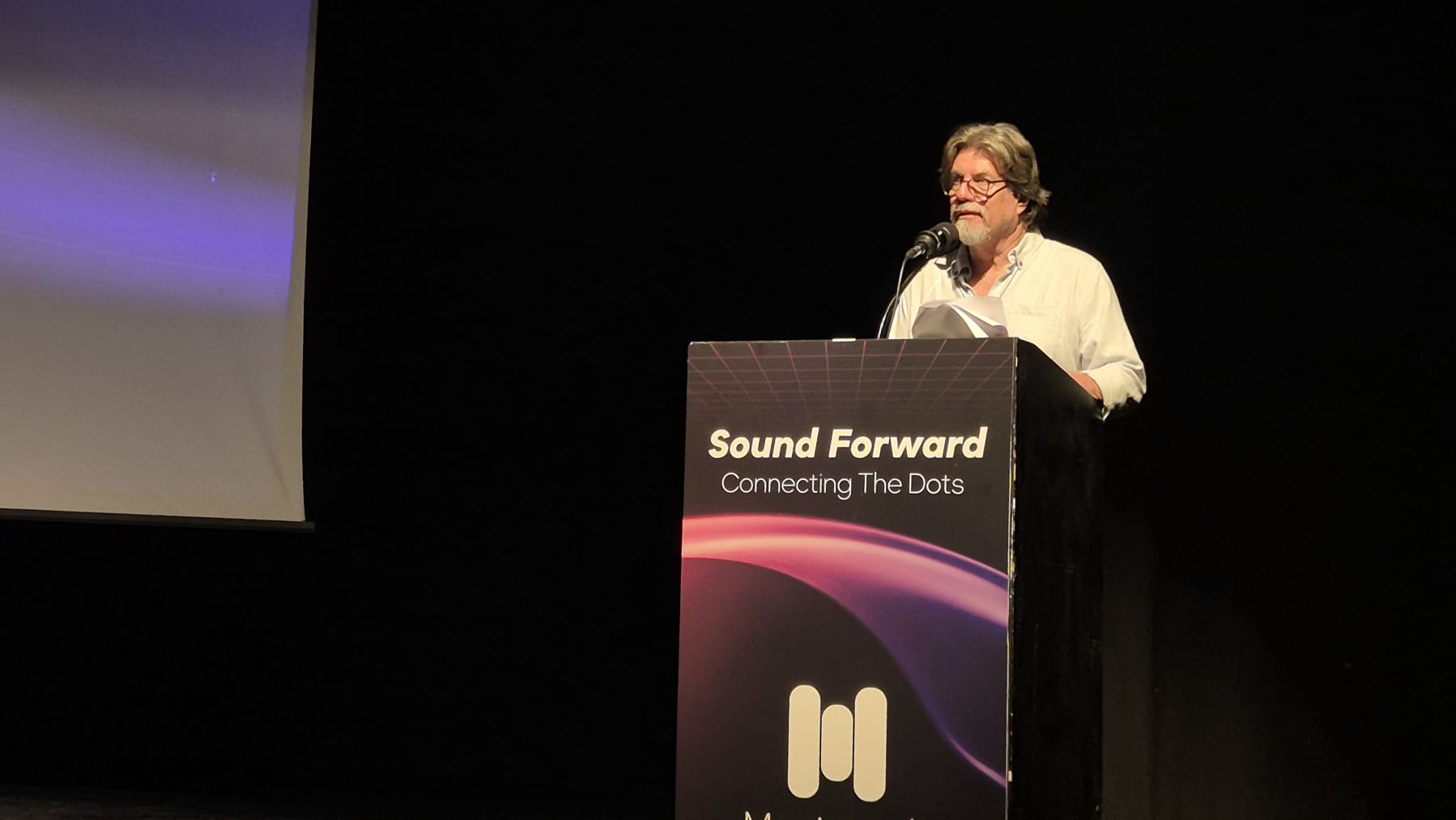
That distinction between blocking noise and deciding what to hear was on display at MusicTech Tel Aviv 2026–Sound Forward, held November 5 at MUZA, the Eretz Israel Museum. The conference brought together music software companies and developers working on underwater surveillance, voice authentication, miniature speakers, and home care. Their businesses serve different customers and meet different requirements, but all depend on producing, interpreting, or modifying sound.


“We want to reduce only a specific sound,” Bar-Or, William’s founder and CEO, told The Media Line. She described a system trained to recognize specific sounds rather than simply lower the volume of one’s surroundings. Bar-Or said the software could isolate a dog’s bark even when another sound occupied the same frequency. William wants to get the technology into headphones and earbuds, including for people with heightened sensitivity to sound. The company says it has a working proof of concept, and its materials cite early validation with 18 sound-sensitive participants.  

Ilan Levy – MusicTech. (Gabriel Colodro / The Media Line)

For Ilan Levy of the MusicTech Innovation Lab, a sound tech hub and innovation platform, bringing these businesses together was part of the job. “We are trying to build a community,” he told The Media Line, describing a portfolio of about 30 companies. The program placed startup presentations alongside discussions involving investors, health care specialists, established audio businesses, and government representatives.  

Some of the advances described involved changing the physical equipment that makes sound. SonicEdge CEO and co-founder Moti Margalit presented silicon speakers designed to occupy less space in earbuds and other electronics. Instead of relying on a relatively large moving membrane, he described a miniature pumping mechanism operating at high speed. SonicEdge has raised about $11 million and received $1.5 million in grants, according to Margalit. He said three companies were working to put its speakers into their products. He outlined the first applications as earbuds, with speakers planned for 2027; smart glasses would follow.  

Audisea CEO and co-founder Yair Yanovice said his company was using off-the-shelf underwater microphones to listen for threats to ports, offshore installations, and subsea infrastructure. Those microphones, called hydrophones, form a network that listens without transmitting sound. AI models analyze what they pick up, separating targets from the sea’s background noise. Yanovice said advances in AI and energy-efficient communications had made this approach possible with simple hardware. He also identified environmental monitoring and predictive maintenance as potential future uses.  

Other companies are trying to determine whether a voice is genuine. Multikol product and business development manager Sam Nabwany presented software intended to authenticate speakers and identify synthetic voices, with financial services as its principal market. He described extracting characteristics from a voice to determine whether it belongs to an actual person and whether it has been artificially generated. The company was seeking both investors and customers, he said.  

Bringing microphones into a home creates another set of demands. During the health panel, Sensi.AI Vice President of Research and Development Ido Shahar described using speech and acoustic events to identify changes in the condition of older adults and their interactions with caregivers. He acknowledged the intrusion into privacy and said home care agencies served as the bridge of trust with users.  

Panel on sound in healthcare. (Gabriel Colodro / The Media Line)

Noam Uzrad, director of the Israel Med Innovation Center at Ichilov Hospital, urged early-stage developers to collaborate with clinical partners to gather evidence demonstrating the effectiveness of their technologies. Dr. Yuval Avni, managing general partner at Crescendo Venture Partners, highlighted the challenges of persuading physicians to adopt new medical technologies and the importance of specialized expertise in overcoming those barriers. 

For music businesses, AI is already part of daily production. Waves CEO Mick Olesh estimated that 70% of the company’s products were AI-based. “The technology needs to supplement something that you feel is the right output for yourself,” he told The Media Line. He described tools that could speed up work or offer creative options previously unavailable to a songwriter, instrumentalist, or producer working from a bedroom studio.  

Olesh expects easier tools to bring more people into music production by reducing the technical training needed to execute an idea. Waves operates across music software, live sound, and technology embedded in consumer electronics. Those businesses share a research and development core, he said, allowing audio technology to reach users through several kinds of products.  

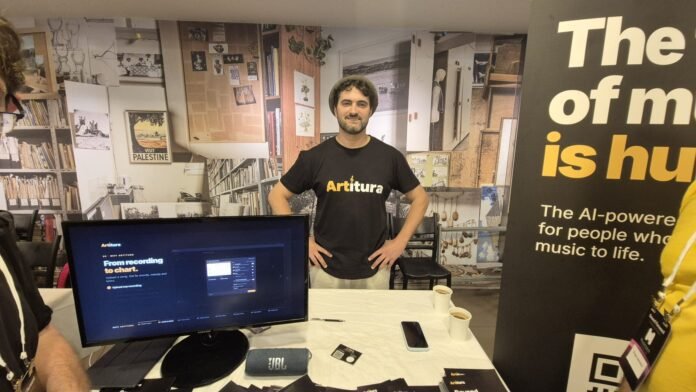
Artitura is pursuing a more immediate problem for working musicians: turning audio into material they can rehearse and perform. “You can convert any audio file into a chart,” its CEO, Avihai Peretz, told The Media Line. He said musicians could generate harmonic, melodic, and drum charts through the website. About 200 people were using the product, including some paying customers, as the company collected feedback on its initial version. Users can access the platform for free but must purchase credits to use certain services. 

Singer Anna Bashan has found a limit to the assistance she wants. Preparing her first album, she said she writes and composes before working with a producer. She has experimented with asking ChatGPT for help when lyrics become difficult but decided against making it part of her writing process. “It takes the soul out,” she told The Media Line. For her, music is a means of processing emotion, and the appeal of a quick answer does not outweigh that purpose.  

Anna Bashan. (Gabriel Colodro / The Media Line)

For Bashan, easier production does not solve the problem of reaching potential fans. She writes in English and is trying to build an audience before releasing her completed singles, using social media to find listeners. “The common thing that happens is you publish a song and it just disappears into the world,” she said. “Nothing happens with it.”  

The question of who owns and benefits from music also figured in the acquisition panel. Participants discussed Insignito’s acquisition by Ondas, Aiode’s acquisition by BandLab Technologies, and Revelator’s acquisition by Warner Music Group. The discussion described buyers seeking acoustic sensing expertise, music generation technology, and infrastructure for distribution and royalties.  

Aiode CEO and co-founder Idan Dobrecki said his company’s advantage included generating music with less training data, enabling an approach based on material the company has the legal right to use. He argued that ignoring rights holders and musicians’ compensation was commercially hazardous. 

For Warner, the attraction was software it could put to work quickly, according to Revelator Vice President of Marketing Ahuvah Berger-Burcat. She said the platform handled catalogs, distribution, royalties, and analytics, and that buying it saved Warner development time. At Insignito, CTO and co-founder Yarden Eilat compared the sale to raising a Series A funding round. Ondas provided resources to grow, he said, while Insignito kept its offices and management.  

Lior Spindel and Rudy Benet – Ministry of Economy and Industry. (Gabriel Colodro / The Media Line)

Lior Spindel, head of marketing for the Foreign Trade Administration at the Ministry of Economy and Industry, came to the conference to connect with young companies and explain how the state could help them export. He said the administration operated 55 economic missions abroad, whose staff could find potential customers, partners, and investors. Their local teams also help companies understand business practices and navigate regulatory issues.  


Our main goal is to support Israeli companies and help them export

“Our main goal is to support Israeli companies and help them export,” Spindel told The Media Line. He said companies could apply for financial assistance toward entering new markets, including exhibition booths, overseas hiring, or promotion. The administration’s free services include assessing a company’s needs and arranging introductions, with government representatives helping establish an initial connection.   

British investor Graeme Dickson, who said he had invested in eMusic, pointed to fractional ownership of music rights and remote concert experiences as areas of interest. At the conference, he was looking for ideas and speaking with exhibitors, including developers of collaborative music tools and selective sound modulation. “I’m here to listen to what the Israelis have got to say,” he told The Media Line.   


Source: Iwpost.com

Know thy AI pessimists

0
know-thy-ai-pessimists
Know thy AI pessimists

<

article id=”post-952673″>

(A quick note before we begin: GenInnov is hosting a call this Wednesday, November 11, for investors interested in discussing a range of innovation investment themes. Details and registration are here.)

Markets lately look like a protest march against AI, a coalition of people who agree on very little beyond the thing they are marching against.

The pacifist walks beside the man with the pitchfork. Some came for the cause, some for the spectacle and a few only because the march happened to pass their door. The chant is the same. The reasons behind it could hardly be further apart.

Marches end. The crowd goes home. What remains is the damage and the question of what comes next. That question depends on which burning issues get picked up for servicing. As of now, we deal with the slogans that fit placards. The genuine reasons fill a library. The march is a ladder of gloom. To know what survives requires an attempt to parse the pessimism.

The ladder starts with those who see gloom in whatever happens. It ends with those who see gloom in anything that keeps money away from what they already hold. In between come those who think AI does nothing and those who think it does too much.

Then come the worriers over jobs, cyberattacks and power lines, the auditors of spending and of egos, and two quieter breeds of market bear: those who doubt the profits and those who doubt the prices.

The stakes are real. In their zeal, pessimists could push the US into outsourcing its compute, the way it once outsourced manufacturing and then software development. That road ends with the frontier in other hands and another Sputnik moment. Much of the gloom rests on bad data, fast-moving data, and numbers hallucinated by accident or on purpose.

That does not make the fear harmless. Fear needs no accuracy to move markets. In an era this dependent on confidence, its effect on mood, financing, and prices can be enormous, whatever started it. Parsing pessimism, camp by camp, is the only way to tell the dangers apart.

Once again, during the march, like right now through the gyrations of financial markets, these differences are hard to see. Afterward, which fears prevail decides the course ahead, with its own unique set of opportunities and threats.

In the write-up below, each camp gets a short description, then advice for three audiences. The Waverers are pessimists, but with an open mind, so they get a list of what to watch. Optimists get what the camp should teach them and the signals they cannot afford to ignore.

The Devotees need no further data or evidence. They get a harder question: how to stay in the marketplace, and what their own scenario would mean for the economy if it came true. Before joining the march, it helps to know which future the banner is asking for.

Doom collectors

The Camp. Some pessimists have been waiting for World War III since before the Berlin Wall fell. They have warned about government debt-to-GDP and financial repression for three decades. Now the collection has a fresh piece: AI ending humanity. Every path they examine ends in a vicious cycle.

Every short-term fix only stores up longer-term pain. If they expect bond yields to reach 5.5%, they will happily add that 5.5% solves nothing, so 6.5% must follow, then 8.5% or 20.5%. Ask them to find a single hopeful route through their interlinked gloom. They struggle in earnest. Some hold portfolios that match their forecasts, including a bunker.

The Waverers’ Watch. There is little to watch. Their arguments are time-invariant and event-invariant. If doom has not arrived today, it will only be more brutal when it does. No data point can confirm the thesis early or refute it late. With no date attached, the forecast becomes a hobby wearing the costume of a prediction.

The Optimists’ Watch. Optimists can trim a position or two if signs of the end appear. Beyond that, the scenario sets them no useful homework. If hellfire is coming to burn everything, no asset, country, or bunker will offer shelter.

The Devotees’ Path. Logic says the true believer should pray for delay. Every year the fire holds off is one more year of ordinary life, which their own thesis says is the best they can get. Yet most in this camp seem to want the show to start at once, on the grounds that anything later will only hurt more.

Of all the camps in this essay, it is the only one whose happiest ending is the worst one for everyone, its members included.

Parrot purists

The Camp. For them, the technology has no utility, or so little that the difference hardly matters. It is a statistical parrot repeating what it has read, with no new intelligence anywhere. They may accept every ROI argument higher up the chain, for chipmakers, memory makers, and cloud operators. None of it survives at the final user. The company or household paying the bill gets a higher cost and no return. In their eyes, the industry is selling lemons, pure and simple.

The Waverers’ Watch. The waverer should keep a tally of the moments that jar. Work across codebases running to millions of lines counts. So do tasks that once took whole teams and now take an afternoon. Buyers who taste the lemon and then order a crate count most of all. Plenty of people, ourselves included, find genuine utility in almost every dollar spent on AI. Some keep raising that spending at the cost of everything else in their budgets. The real exercise is to multiply such users across hundreds of millions of people and companies worldwide. The total may or may not justify the buildout. It should at least retire the claim that end users find nothing of value.

The Optimists’ Watch. The optimist’s real work is steady observation, statistical and anecdotal, of whether people keep taking AI into new tasks. Today that means agents handling multi-step work. Tomorrow it should mean the physical world. The question is whether the range of uses keeps widening or starts to stall. Anecdotes can glow while the aggregate sags. The aggregate is the test that counts.

The Devotees’ Path. Suppose the purist is entirely right: AI spending is digging holes and filling them up again. The money still pays engineers, electricians, and builders. It still lays power lines and fiber. It comes from the most concentrated pools of wealth and cash in the world, at a time when many governments have little room left to spend.

Useless activity funded by idle fortunes is an old Keynesian remedy. Its removal would leave a hole of its own. Wishing it away means idling the busiest construction crew on earth and getting nothing in its place.

Off-switch brigade

The Camp. The Parrot Purists have an exact mirror image. The two camps rarely seem to notice each other. Both are sure the shares should fall. For the Brigade, AI does far too much. Models improve with every release. AGI may have arrived. Progress runs at double speed. If one Navier-Stokes-class problem falls today, a dozen will fall tomorrow. Humanity is handing its decisions to machines whose reasoning it cannot follow and may never comprehend. The only sane response is to throttle the technology before it outruns us.

The Waverers’ Watch. The waverer should track what the new intelligence actually does with its power. Calculators did things beyond human ability, too. The same test applies to drug discovery, scientific research, and the administrative and economic grind of daily life. Each case where superhuman ability turns into human benefit is a small argument against the off-switch.

The Optimists’ Watch. For optimists, this camp matters through regulations. A growing public sense that AI works beyond human comprehension can sit alongside excellent business results. This is likely to be a perpetual watch, though, as the topic is unlikely to ever vanish from economic and political arguments from here on, as we explained in this article months ago.

The Devotees’ Path. The fully convinced should join every protest and every forum on AI control. They should also face the practical arithmetic we laid out in Speaking Plainly. Rules take years to write. Competitors rarely sign up. Any policy worth backing has to survive a map. A country that pauses alone will hear about the next breakthrough from someone else’s laboratory.

Pink slip prophets

The Camp. After the two extremes come the practical in-betweeners. Whether AI is a parrot or a coming superintelligence matters less. It is already pushing people around. Whole professions are under pressure. In this camp’s view, no policy ends the story. Universal basic income, retraining schemes, and every other remedy will, at best, change the shape of the problem. Displacement has joined the political and economic conversation for good.

The Waverers’ Watch. Some of the displacement is already visible, so the useful work lies in splitting it. Where governments try to restrict displacement, the waverer should check whether those policies have any genuine effect, whether the damage keeps growing anyway, and what else follows from it.

The Optimists’ Watch. Optimists cannot afford to treat the social side of AI as background noise. The arguments will keep changing form. Because AI touches almost everything we do, policy events around it will only multiply in the coming years. An optimist who models the technology carefully and the politics lazily is holding half a thesis. The signal that should give an optimist pause is a backlash strong enough to slow adoption itself.

The Devotees’ Path. For the fully convinced, the first question is whether the fear of displacement, and whatever policy it provokes, will actually slow AI down. If it will, what they do in policy recommendations or their own financial investments will differ from the countercase. Displacement that is real and beyond the reach of any regulator calls for adjustments in daily life: in skills, in careers, in what children study, and in how savings are held. The aim is to shield what one holds dear, because the law moves slower than the layoff.

Firewall fretters

The Camp. The Fretters worry about a single bad weekend. Cyberattacks are rising quietly, week after week. Those who follow them closely see the world drifting toward a breach large enough to cause real chaos. One such event could change overnight what societies decide to control and how. Unlike the Doom Collectors, the Fretters have a specific fear with a specific trigger. They just cannot name the date.

The Waverers’ Watch. The waverer should notice who is best placed to stop the breach. Fighting AI increasingly takes AI. Defenders without the latest tools are already outgunned. At least once this year, limits meant to keep powerful models from attackers also kept them from defenders at the worst moment, while the attackers faced no limits at all. Rising attacks may lift demand for AI more than they dent it. The same tools are also shrinking the scope of older software and slower technology innovators.

The Optimists’ Watch. Optimists should expect every major incident to bring more talk of regulation and more controls, including the risk of arbitrary shackles after a massive event.

The Devotees’ Path. The fully convinced should follow that belief to its target. A major event would likely hurt ordinary life far more than the technology companies themselves. Banks, hospitals, utilities, and logistics run on old systems with thin defenses. The sharpest repricing could hit traditional sectors and whole economies through a sudden rise in their risk premium. The Fretter who sells AI stocks to prepare may be hedging the wrong half of the portfolio.

Spreadsheet scolds

The Camp. The Scolds concede that AI works. Their quarrel is with the arithmetic. Hundreds of billions go into chips, buildings, and power every year, while revenue from AI services remains a fraction. Hardware loses value fast. Cash piles shrink. The marginal builders borrow from private credit funds and through special vehicles. The camp’s cousin draws circles on the revenue chart: money looping among the same few firms. We took that claim apart in an earlier essay. The Scolds will disagree with almost everything there.

The Waverers’ Watch. The waverer should judge the spending the way an owner would, across an asset’s working life: what customers pay, what running it costs, and what replacement will demand. A single year’s AI revenue set against a single year’s spending says little about either. Much of the payoff also hides inside older businesses, in sharper advertising, better search, and cheaper internal work. Lately, the chip and memory makers collecting the cash have been putting it back into owning and leasing hardware themselves. The circle drawers will file that under circularity. A landlord buying more buildings while the waiting list grows is the plainer reading.

The Optimists’ Watch. Optimists should watch where the leverage sits. The largest operators will not pause their buildout over the free cash flow line unless the leverage ratios become too high for comfort. The weak links are elsewhere: smaller cloud operators, developers with land and power but little experience, and lenders who priced the risk for a world without delays. Spreads, covenants, and refinancing terms at these names will crack long before anything at the giants does. A fully booked machine can still earn too little for the price paid to own it.

The Devotees’ Path. Suppose the return never comes. The Purists’ consolation applies here with more force, since the spending still built grids, fabs, and skills. The sharper question is who bears the loss. Most of it would land on shareholders of cash-rich companies. Private credit funds would take the next share. Their investors signed up for exactly this risk. That is capitalism doing its job. The exposure of deposit-taking banks, by all accounts, appears small. That leaves little room for the kind of systemic contagion seen in earlier financial crises. The believer’s real watch is whether that ever changes.

Ego auditors

The Camp. The Scolds blame the arithmetic. This camp has found a culprit. It sits in a boardroom. In its telling, data center spending is decided by a handful of hyperscalers and neocloud operators, funded by greater-fool-believing parts of financial markets and fueled by ego. Every profit at the chip and memory makers hangs on those few signatures. The camp rarely looks past them to the people actually using AI. The story rarely addresses how much of the spending rests on real consumption by companies and households. When financial stress gets called the next choke point, this confusion is usually where it starts.

The Waverers’ Watch. The waverer should separate the layers of decision. Users come first. Whatever surveys or outsiders say about them, hundreds of millions of people and companies now use AI. That number keeps growing in everything we track. Watching that demand matters more than second-guessing the intermediaries. A hyperscaler can misread demand for a while. If the demand is real and supply is short, the intermediaries will have genuine reasons to continue doing what they have been doing.

The Optimists’ Watch. Optimists should remember that a cycle needs no oversupply. Fear alone can freeze financial markets. A freeze can force a downturn, whatever the eventual demand. Strong demand may only keep it shallow. Spending cuts announced while usage is still climbing would be the sign that this kind of cycle has arrived.

The Devotees’ Path. Those convinced that everything hinges on a few big spenders will want them restrained by regulators or by shareholders demanding discipline. They should consider who fills the space. Competitors are not standing still. A rival with a patient owner, or with a state as its owner, will happily take the share a disciplined company gives up. The technology’s potential is understood everywhere now. Throttling one country’s spenders hands the field to companies and countries that face no such brakes.

Grid NIMBYs

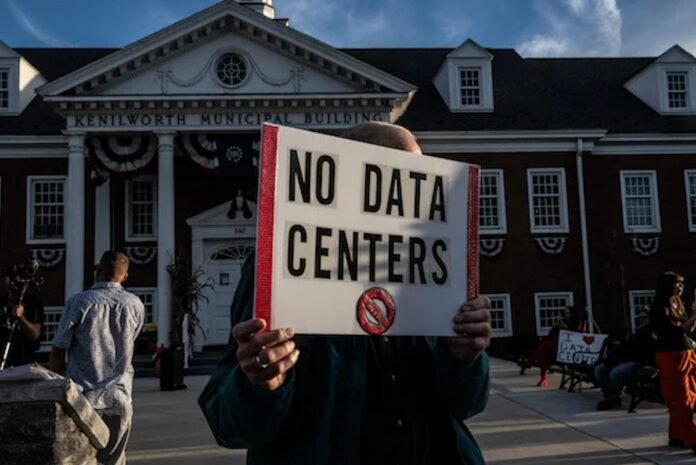
The Camp. From the boardroom, the argument moves to the neighborhood. The NIMBYs accept that AI works and that people want it. They simply want it built somewhere else. Theirs is NIMBYism with a power cord. For them, local electricity bills climb, impacting the cost of living, because of data centers. For some, there are other environmental concerns. The most committed NIMBYs oppose the buildout everywhere, from the county next door to the plans for data centers in orbit.

The Waverers’ Watch. The waverer should track where the blocked capacity goes. Data centers are less rooted than factories. Governments in Central Asia, the Middle East, and North Asia are eager to take the load, often with cheap power, fast permits, and land already cleared. Every project refused at home is one someone else can approve within months. The real question is how much of the work can travel, and how quickly the receiving countries can switch it on. The local fight may be won while the global buildout carries on unbothered.

The Optimists’ Watch. Optimists should note what the NIMBYs rarely mention. Demand has never been part of their argument. New hardware fills up almost as soon as it is switched on. The real risk lies in the timing. A data center canceled in one country takes years to reappear in another. In the gap, markets may read every cancellation as proof of a slowdown. Optimists should watch the extent of any displacements against the ongoing work to estimate the true demand and supply balance at other choke points.

The Devotees’ Path. Suppose the NIMBYs win everywhere. Demand keeps climbing while supply stays stuck behind choke points that were already tight. The shortage would show up as a new kind of inflation: rationed model access, rising compute prices, and waiting lists for intelligence. Public opinion would then turn. Sustainable investing went from virtue to villain within a few years. A shortage of AI could flip the mood on data centers even faster.

Assumption artists

The Camp. Some pessimists need no single thesis. They live off the fog. How many data centers will be built, when, where, and which of them can move? How short is memory? How tight is packaging? How much efficiency will the next model or chip squeeze out? Who will finance any of it? Nobody knows, which suits this camp perfectly. Every gap becomes a number. Every number becomes a scare. We hear that most of the world’s tokens are paid for with borrowed money, sometimes more than 90% of them. We hear that a credit freeze would shrink the buildout to a tenth of its plans. Neither figure comes with a source. The numbers change daily. The fear stays constant.

The Waverers’ Watch. The waverer should doubt every data point. The more frightening a claim, the more checks they need. Most are invalid or unprovable in a world where nobody can arrive at what data center capacity is planned or should be expected in the US next year, with the bottom-up ranges varying by over 100%. The rest move too fast to hold.

The Optimists’ Watch. Optimists need one tool: the choke point ladder. The buildout runs through many choke points at once. The tightest sets the pace for all the others. Without a doubt, they will also suffer from a lack of forward-looking data, but there could be a lot in the actual information on prices, plans, and buyer-seller contracts without the aggregates for what is coming next.

The Devotees’ Path. Those certain that everything is imbalanced will be right about one or the other bad outcome. Knowing what kind of imbalance could still be important, as long as they are not a Doomer discussed in the first section. That could be the reason for them to verify the data they come across.

Good-enough gang

The Camp. The scaling-law pessimists have mostly gone quiet. Two years of models that refused to plateau saw to that. Their heirs have moved the argument from the lab to the desk. The models may keep getting smarter, they concede, but nobody needs them to. Most companies cannot absorb what last year’s models already offer. Change is outrunning the people meant to use it. Demand for frontier intelligence will saturate. Model makers will then grind each other down on price.

The Waverers’ Watch. The waverer should look at what actually happens to old models. We covered this in the section titled “Nobody Sells iPhone 3 Currently” in The World of Zero Visibility. Models are retired almost as fast as new ones arrive. Whether last year’s model was good enough is beside the point. Newer models, open or closed, take most of the use and most of the compute. How intensely they are used sets total demand. A retired model, frozen on old information and old methods, may linger in some corner. It barely moves the overall compute bill.

The Optimists’ Watch. Optimists should track whether model makers keep finding new products, services, and methods. If the newest models end up confined to exotic applications, saturation will reshape what model makers sell. Demand would feel it, though not at once. The opposite can happen just as fast. The agentic tools launched in the past two months show how a single new use can send demand for the latest sharply higher, the way it has been happening with smartphones. As of now, the replacement cycle remains short, but it may not forever.

The Devotees’ Path. Those fully convinced that smarter models are unnecessary should ask who wins in their world. Cheap, open, often years-old models would gain the upper hand. That matters well beyond hardware. Much of the open-source frontier comes from makers some governments would rather keep out. A world settling for good enough would run increasingly on their models and dated technologies, with economic and geopolitical consequences the Gang rarely prices in.

Profit pallbearers

The Camp. The Pallbearers are half convinced. On today’s numbers, many AI stocks look like some of the best value in the market. They simply refuse to trust the numbers. The E in the P/E is borrowed from a cycle that can turn overnight. If capacity runs ahead of demand, earnings collapse and take the bargain with them.

The Waverers’ Watch. The waverer should start with the choke point ladder. Many choke points are tight enough to keep supply short even if a good share of planned data centers is canceled or delayed. This year’s shortages came with a smaller buildout than next year’s. Corporate behavior matters even more. Companies that have tasted pricing power rarely give it away. Software makers have held their prices for years with no capacity limit at all. Hardware makers are unlikely to slash theirs because demand dips a little.

The Optimists’ Watch. Optimists should read the ladder from the other side. A tighter rung upstream can tip the next segment into oversupply almost overnight.

The Devotees’ Path. Those certain the cycle will turn should ask what is still a commodity. We have written increasingly about markets once treated as interchangeable that no longer are. Memory made to one customer’s design behaves less like a commodity every year. Commodity cycles punish commodities. The devoted pessimist should track where commoditization has stopped, because the old cycle may never return there.

Gravity faithful

The Camp. The Pallbearers at least look at earnings. The Faithful do not bother. For them, a sector that has grown far more important than the rest of the market deserves to shrink back, whatever its ratios say. They see risks gathering in bond markets, geopolitics, politics, and policy. When markets finally price those risks, the sector that rose the most is expected to fall the most. In this decade, that sector is AI.

The Waverers’ Watch. The waverer should ask whether the rule is really that simple. When markets correct, do the biggest risers always fall the furthest, or do events and growth still separate winners from losers? The real test lies outside the volatile weeks. Over one, three or five years, does a stock’s next move depend on its last one, or on the growth it delivers?

The Optimists’ Watch. Optimists should concede that the Faithful tend to be right in the short run. In almost every correction of recent years, whether from a tariff announcement, a new war, or a bond scare, the highest-momentum sectors took the hardest hit. That is the perpetual watch for anyone who owns them.

The Devotees’ Path. Those expecting a major correction from outside events, with AI merely standing in the way, should think about where to hide. Real estate, bonds, and other assets would be under pressure too. In a world of high inflation, even cash offers poor shelter. The Faithful may be right about the fall and still find nothing worth holding on the way down.

Reallocation lobby

The Camp. The last camp cares least about AI itself. Its members hold something else dear: a portfolio built elsewhere, a business that AI has pushed out of the spotlight, or a career that predates the new intelligence. For those things to win back the attention they believe they deserve, AI has to stumble. The reason hardly matters. This month it is circularity, next month regulation, the month after that hype. Any argument will do, as long as AI ends up looking shoddy or fraudulent. The argument is rented. The position is owned.

The Waverers’ Watch. Unlike the Doom Collectors, these pessimists aim their gloom at a single target. One question matters most: if AI does fall over, does the money actually move to what they hold? An AI selloff makes no promise to benefit everything it leaves behind, even if reallocation briefly brings mean reversion and absolute gains simultaneously for the beneficiaries. Money leaving one trade still needs a reason to enter the next. A fire in the market’s busiest factory rarely leaves the rest of the street untouched.

The Optimists’ Watch. For optimists, this camp matters because it adds weight to all the others. When the Lobby joins the Purists, the Scolds, the Brigade, and the rest, their combined force can turn the market mood. A turn in mood brings the cyclical risk the Ego Auditors and Pallbearers describe. It also feeds the fog the Assumption Artists live on. Our portfolios give us an interest in this argument too. Resentment deserves the same inspection as enthusiasm.

The Devotees’ Path. Those who need AI to fail, with or without a reason, should picture what victory looks like. Even in the bad case, the relative winners may still sit inside innovation, as the cyclical weakness could accelerate rather than slow down many displacements discussed above.

Parsing pessimism

In recent weeks, we have sat through many conversations about AI that went nowhere. One worry comes up. Before anyone can make a claim or a counterclaim, the talk has moved to another worry, then another. The polite listeners who do not argue back have usually moved on in their heads as well. Nothing gets weighed. Nothing gets settled.

Read the list above in one sitting and the worries seem endless, so many that it hardly matters which one keeps a person awake. Look closer. Many of them work at cross purposes. The Purists cancel the Brigade.

If the NIMBYs win, the Pallbearers’ glut never arrives. Pessimism does not add up in a single column. Between the data fog and arguments flying in every direction, most of us in a fearful market cannot say exactly what we fear. Parsing pessimism is the only way to think about risk systematically.

Most of us belong to more than one camp, at least in part. Optimists like us are no exception. A forecast can retire without taking its author with it. The moving parts are real. Memory looks short at today’s pace of construction, and shorter still if next year’s building grows even modestly. That holds only if the building does not fall sharply. A deep enough downturn would turn the choke point ladder. Today’s scarcity could then vanish within months.

That is why fear matters, whatever its source. This is something we wrote about in our previous article analyzing risks: the immense need for optimism for the innovation segment that is now capex-heavy.

If the mood turns dark enough, the tightest chokepoint becomes people declining to make decisions. Power, memory, and funding all queue behind it. Capital spending and innovation both run on optimism. Once it drains away, outcomes follow that no simple supply-and-demand model could forecast.

Meanwhile, innovation keeps going. Had markets not demanded this essay, there was plenty else to write about. This week, an outside assessment with rare internal access found Anthropic’s pace of progress roughly doubling, mostly because its researchers now work alongside their own models.

In the same week, OpenAI described its models finding and reproducing flaws across the Linux kernel at a pace few security teams could match. The new intelligence works relentlessly. The cost of trying a new idea falls by the month.

Read the camps side by side. One pattern keeps returning. In nearly every case, opting out costs the defector far more than it costs the system. Those expecting a return to investing in companies that sell a little more of the same each year are underestimating the forces now in motion.

A country can opt out of the race. Races have a way of finishing anyway. A company can retreat. A market can rotate for a while. Innovation may slow. It will not stop. The marchers will go home. The builders are staying. That new intelligence, the one that got built last month, is working on converting text to proteins.

Nilesh Jasani is the founder and CEO of GenInnov Pte Ltd, Singapore. Originally published by GenInnov, this article is republished with permission.

Source: Iwpost.com

Tons of “Bunker-Buster” Bomb Parts for Israel Go Through JFK Airport

0
tons-of-“bunker-buster”-bomb-parts-for-israel-go-through-jfk-airport
Tons of “Bunker-Buster” Bomb Parts for Israel Go Through JFK Airport


An Israeli airline shipped thousands of pounds worth of parts for controversial “bunker-buster” bombs through John F. Kennedy International Airport in New York during the height of the Israeli–U.S. war against Iran, according to a new investigation by a left-wing research group.

Challenge Airlines, a cargo hauler based in Israel, made three flights this spring carrying the bomb casings for BLU-109s — a 2,000-pound munition that has been tied to numerous mass-casualty attacks on civilian neighborhoods in the Gaza Strip, Lebanon, and Iran in recent years — according to open-source data obtained by the Movement Research Unit and reviewed by The Intercept.

The airline also made more than 100 shipments of guidance kits known as joint direct attack munitions, or JDAMs — which are used to convert so-called “dumb bombs” into GPS-guided munitions capable of striking a specific target — according to data shared with The Intercept. Many of the guidance kits were marked for use on the MK-84, another 2,000-pound bomb Israel used in its campaign to level Gaza, where fragments of JDAMs have repeatedly been found at the site of airstrikes.

The 2,000-pound bombs present a serious risk of civilian casualties, according to Josh Paul, a former State Department official who resigned at the outset of the war in Gaza to protest the Biden administration’s sale of weapons to Israel.

“If you look at historic U.S. use of 2,000-pound bombs, in the entire counter-ISIS campaign, there were just two that were dropped in the vicinity of the city of Mosul precisely because there is no way to use a 2,000-pound bomb discriminately in an urban environment,” Paul said, referring to an American air war during the final years of the Obama administration to end the Islamic State’s control of the Iraqi city of Mosul.

Israel hasn’t shared the United States’s reservations. The country made extensive use of the weapons to attack targets in Gaza and Lebanon, including a deadly strike on Gaza’s Jabaliya refugee camp that killed dozens of civilians, according to an analysis by the New York Times.

“If you look at a picture of Gaza right now, I would say Israel’s use of these weapons is functionally indistinguishable from indiscriminate bombing,” Paul said.

“There is no way to use a 2,000-pound bomb discriminately in an urban environment.”

Challenge Airlines, and the Israeli military did not respond to request for comment.

“We work closely with all airport partners to ensure the safety of public, neighboring communities, and airport personnel,” said a spokesperson for the Port Authority of New York and New Jersey, which operates JFK Airport. “The federal government and commercial airlines have primary responsibility as to what is allowed to be shipped on aircraft. We are pre-empted under federal law from interfering with these activities.”

While the shipments of JDAMs and bomb bodies for BLU-109s did not include active munitions, previous shipments of weapons through JFK have included explosives, including 14 tons of nitrocellulose bound for Israel in May 2025.

The Intercept verified the data showing all three shipments of bunker-buster bomb bodies, and verified a portion of the data showing shipments of JDAM kits. Movement Research Unit, an investigative outlet whose prior work has uncovered shipments of drone tech to Israel and the transport of fighter jet parts by United Airlines onboard civilian passenger flights, shared the data on the condition that some specifics of its methods be withheld to prevent a crackdown on the availability of such data.

In response to the flow of weapons and materiel through JFK, the New York City chapter of the Democratic Socialists of America has been organizing a campaign to stop the flow of weapons to Israel through the airport.

“This is another example of a growing body of reporting that shows how civilian infrastructure is used for the genocide in Gaza,” said a DSA member named Henry, who asked to be identified without his last name in order prevent retaliation from his employer. “Civilian air travel should prioritize passengers, travelers, and the international community — not weapons — and no worker should be forced to serve the militarized supply chain.”

Tons of Pressure

Challenge Airlines shipped the bunker-buster bomb bodies on flights leaving JFK for Tel Aviv on March 12, April 30, and May 6, according to the data shared with The Intercept.

They shipped the guidance kits far more frequently, with 109 shipments leaving JFK for Tel Aviv between December 22, 2024, and June 7, 2026. Cargo documents indicate that most of the shipments were of JDAM kits designed for 2,000-pound MK-84 bombs but also included at least one shipment of kits for bunker-buster bombs.

In total, the airline shipped 175,884 pounds of BLU-109 casings and more than 5 million pounds of JDAM kits between December 22, 2024, and June 7, 2026, according to the data obtained by Movement Research Unit.

JFK Airport is the main export hub for such munitions flying by air to Israel, according to federal data: More than half of all Israel-bound air shipments of weapons that fit the government export category for bombs and missiles was sent abroad from JFK.

It was not immediately clear where the bunker buster and JDAM shipments originated, but sales of military hardware to Israel typically either come from deals between the Israeli and U.S. governments or direct commercial purchases under a special export license made by the Israeli military from private companies.

In the first two years of Israel’s war on Gaza, the U.S. spent $21.7 billion on military aid to Israel, according to a study by analyst William Hartung. That has included multiple shipments of 2,000-pound bombs like the BLU-109 and the MK-84, as well as JDAM kits to equip the weapons with GPS guidance.

The Biden administration in May 2024 halted the shipment of MK-84 2,000-pound bombs to Israel, citing the potential harm to civilians, but President Donald Trump resumed shipments of the heavy munitions within weeks of retaking the White House.

News of the shipments comes just over a month after the Associated Press revealed plans in the works for the U.S. to ink a vast $2.8 billion arms sale to Israel that would include thousands of 2,000-pound bombs.

The ongoing sale of such heavy weapons to Israel underscores the need for a federal solution, according to Rep. Delia Ramirez, D-Ill., who sponsored last year legislation dubbed the “Block the Bombs Act,” that would bar the U.S. from selling BLU-109s, JDAMs, and other munitions central to Israel’s war effort.

“It’s good that people are putting pressure locally, but ultimately it is Congress’s responsibility to make that happen.”

“It’s the only bill that prohibits these weapons transfers from happening, and the only bill that creates a comprehensive process of oversight,” Ramirez told The Intercept. “There’s been a big push, particularly in New York and around JFK, to block these transfers and it’s good that people are putting pressure locally, but ultimately it is Congress’s responsibility to make that happen.”

First introduced in May 2025, the bill has gathered more than 80 co-sponsors but has thus far languished in legislative limbo. With the House of Representatives soon to be under Democratic control, Ramirez said she plans to bring the bill to the floor next session.

Source: Iwpost.com

Firm Linked to Trump’s Sons Got Nearly $40 Million in Federal Contracts to Screen for Ebola and Other Diseases

0
firm-linked-to-trump’s-sons-got-nearly-$40-million-in-federal-contracts-to-screen-for-ebola-and-other-diseases
Firm Linked to Trump’s Sons Got Nearly $40 Million in Federal Contracts to Screen for Ebola and Other Diseases
The Trump administration awarded a small biosecurity company nearly $40 million to screen for Ebola and other infectious diseases just months after a firm linked to President Donald Trump’s elder sons invested in its parent company, according to records and interviews.

The contracts, one to screen for Ebola in several U.S. airports and the other to respond to disease outbreaks in the Democratic Republic of Congo, are seven times the total value of government contracts the company had directly received before. 

The company, XpresTest, has years of experience monitoring for COVID-19 and other diseases for the government at U.S. airports. That makes its parent, XWELL, an unusual hybrid, selling both spa treatments and biosecurity services. Last year, it made most of its money from waxing salons and airport spas that offer manicures, massages and “chakra beds.” 

The contracts are the latest example of the president’s family benefiting financially from his administration’s actions. And the stakes for these deals are particularly high. In the Democratic Republic of Congo, an Ebola outbreak has killed more than 5,000 people this year, and the federal government is trying to stop the pathogen from coming to the U.S.

XpresTest has never worked with Ebola or provided biosecurity services abroad, let alone in the kind of volatile locales it’s now expected to work in. The CEO of its parent company, Ezra Ernst, said XpresTest won both contracts in a competitive bidding process and pointed to its years of experience doing screening for COVID-19 and other pathogens at American airports. But even he acknowledged that working internationally is “a new thing for us” and expressed uncertainty about being able to complete the work in the Democratic Republic of Congo.

“This is a risky contract. I’m not sure we can do it,” Ernst said in an interview. 

Jeremy Konyndyk, who helped oversee the U.S. government’s response to a 2014 Ebola outbreak in West Africa, said there are some parallels between monitoring for COVID-19 and Ebola at airports, but he said it’s concerning that the government would award such a lucrative contract to a company that has no experience in Africa. 

“There are countless organizations in the world that have decades of experience doing this work,” Konyndyk said. “I have to wonder why the hell they’re not going with someone who has actually done this before.”

Under previous administrations, the U.S. government addressed international disease outbreaks in partnership with the World Health Organization. But Trump withdrew from the group last year, dismantled the U.S. Agency for International Development, which handled much of this work, and dramatically scaled back the global presence of the Centers for Disease Control and Prevention. 

At the same time, the State Department launched the America First Global Health Strategy, which calls for the U.S. to use aid to foreign countries to “promote American companies and American innovations abroad.” This March, the State Department announced it would be giving up to $4.5 billion in funding for various purposes, including responding to infectious disease outbreaks. 

Under that program, XPresTest was awarded $20 million. Other funding went to better-known global aid nonprofits, including International Medical Corps, Save the Children and the International Federation of Red Cross and Red Crescent Societies, whose awards ranged from $25 million to $35 million.

The CDC also awarded XPresTest a contract, for $18.8 million.

In response to questions from ProPublica about XPresTest and its parent company, XWELL, the State Department noted the firm’s previous work screening for diseases at airports under a contract with the CDC and said its own award was made “through a competitive process that builds on this successful model.”

The CDC did not respond to a request for comment.

A spokesperson for the president’s sons Donald Jr. and Eric Trump said that they are “merely passive, minority investors in a fund that invested in this company,” and that they had no “involvement in or knowledge regarding the negotiation or procurement of any of its contracts, including any government contracts.” 

“Both are private citizens who hold no government positions, broken no laws and who have every right to pursue lawful business and investment opportunities,” the spokesperson said.

The Trump sons’ connection to XWELL was established in February, when a fund called American Ventures invested in the company. The fund was launched by Dominari Holdings, a small financial firm with offices inside Trump Tower in New York. The leaders of Dominari hired the Trump sons as advisers after their father was elected to a second term and granted them a stake of more than 10% in Dominari.

Anthony Hayes, the CEO of Dominari Holdings, told ProPublica, “We have never seen or even heard of Don or Eric using their family name to influence the granting of a government contract.”

American Ventures has taken stakes in other companies that have benefited from Trump administration actions. The Florida-based drone company Powerus got a contract worth up to $90 million from the U.S. Air Force five months after the Trumps’ involvement was announced. Through American Ventures, Donald Jr. and Eric Trump also are acquiring a stake in a critical minerals group that has received U.S. government support to mine for tungsten in Kazakhstan. The Trumps have described themselves as passive investors who do not advocate for the companies they have stakes in before their father’s government.  

XWELL was founded in 2006 as a line of airport-based spas that provided massages and facials. During the pandemic, the company, then known as XpresSpa Group, got $5.5 million from the CDC to offer travelers COVID-19 testing. It also collected waste from airplane toilets to check for new viral strains. It has done similar work for at least one other company that has received government contracts. 

In January, XWELL announced that it was hiring a former senior adviser at the CDC who created and led the agency’s traveler surveillance program. The firm said the move was part of a plan to expand “its traveler-based pathogen surveillance capabilities to support international travel hubs and large-scale mass gathering events worldwide.”

The following month, American Ventures invested about $30 million in XWELL. The company had lost money the previous year. “We were so cash-strapped, close to bankrupt,” its CEO said. 

Its valuation before the cash infusion was just $3 million. In exchange, American Ventures got a roughly 10% stake in the company to start, with an option to essentially print and sell millions of shares in the future. 

Why American Ventures would invest so much in XWELL is unclear. In other cases, when the fund has invested in similar tiny publicly traded companies, some of those firms have moved into hot new sectors and drawn publicity for their connection to the Trumps, then Dominari has offloaded shares. In this case, there is no indication it has sold any of its stake yet.

In June, XpresTest was awarded the CDC contract for what a public notice about the grant said was “Ebola entry screening services.”

XpresTest then received the State Department grant for “rapid, effective, and coordinated outbreak response” to infectious disease threats in the Democratic Republic of Congo, which began in September, according to a government database. The company is also planning to work in Kenya and Morocco. XWELL’s website shows it is now hiring specialists in Ebola response training and biosecurity in the U.S.

Several individuals walk past a brightly lit wellness business in an airport.
An XpresSpa at Miami International Airport Karston Tannis/Monmouth Media House

In July, after XpresTest was awarded the CDC contract, XWELL announced plans to sell the subsidiary along with its line of spas to a private facial spa company. Ernst, the CEO, said the government contracts played a role in the $13 million sale price and will follow XpresTest to the new company. 

That means XWELL, the company that the Trump-linked investment fund took a stake in, will benefit financially from the Trump administration contracts if the sale closes, even though it won’t be involved in doing the work for the government. 

XWELL said in a public filing that the sale was part of an effort “to pursue a new direction in the national security sector.” Ernst said he didn’t know the exact plans but thought the parent company might be looking to work with the Department of Defense.

XWELL did not announce either of XpresTest’s biosecurity contracts, which recently became public in federal contracting disclosures. Public companies like XWELL are required to report so-called material events, developments that could affect their share price, such as a large government contract. XWELL has publicized previous work for the federal government, including a $2 million, eight-week pilot program for testing COVID-19 in 2021.

When asked why his firm didn’t announce the awards, Ernst gave various reasons, including the possibility that XPresTest might wind up not being able to do the work — either because of its own inexperience working internationally or because the Trump administration might suddenly shift priorities and only pay for a fraction of the contract. 

“None of these contracts are guaranteed,” he said.

The biosecurity awards add to the questions about the Trump family’s enrichment during his second term. The Trump family’s business activities extend far beyond Dominari and American Ventures. The president himself has made more than $1 billion from cryptocurrency ventures whose value has ballooned as his administration has taken a friendly stance to the industry. And other companies backed by his sons Donald Jr. and Eric have received billions of dollars in federal deals. Earlier this year, ProPublica reported that the Pentagon granted a small North Carolina startup linked to Trump Jr. a $620 million loan after a top aide to the president intervened on the company’s behalf. The Pentagon denied preferential treatment, and a spokesperson for Trump Jr. said he played no role.

The Trumps’ financial ties to government deals and actions are expected to be a primary focus of Congress in the coming months after Democrats won control of both the Senate and the House in last week’s midterm elections. 

“When the government is corrupted for personal gain over the public interest, Americans lose trust and taxpayer dollars are wasted,” Robert Garcia, the top Democrat on the House Oversight Committee, wrote in a letter to colleagues last week.

Source: Iwpost.com

New Democratic Congress will likely strip the gilding from Trump’s Golden Dome

0
new-democratic-congress-will-likely-strip-the-gilding-from-trump’s-golden-dome
New Democratic Congress will likely strip the gilding from Trump’s Golden Dome

Two of the top lawmakers backing the Pentagon’s Golden Dome missile defense shield are among the wave of Republicans leaving Congress in the coming Democratic takeover, raising questions about the future of President Donald Trump’s signature second-term defense initiative.

The shakeup on Capitol Hill comes after military officials signaled in recent months that they might backpedal from one element Trump asked for in Golden Dome: the capability to shoot down missiles in their initial boost phase shortly after launch.

The Golden Dome has escaped serious congressional scrutiny since Trump announced the program in January 2025, one week into his second term in the White House. That lack of scrutiny will change as Democrats take responsibility for writing the Pentagon’s budget, introduce limits on funding, and put forth bills to strip out Golden Dome’s most controversial component and give the program a new name.

That’s the opinion of a half-dozen current and former officials in industry and government. Ars spoke with sources before and after last week’s congressional elections to get a sense of how a new Democratic Congress might make its imprint on missile defense.

It’s important to know that much of what the Trump administration calls “Golden Dome” was already in development (or in some cases, operational) when Trump signed the executive order outlining the initiative 22 months ago. Trump’s order created a new program to consolidate the Pentagon’s existing missile defense efforts, accelerate work already underway on new Ground-Based Interceptors (GBIs), and deploy a new layer of orbiting sensors and Space-Based Interceptors (SBIs) to defend the US homeland against both traditional ballistic missiles and new emerging threats like drones and hypersonic weapons.

Ramming it through

The Golden Dome was immediately politicized. The first tranche of its funding—approximately $24 billion—was part of Trump’s so-called “One Big Beautiful Bill,” along with some of the White House’s other contentious policy priorities. The bill passed Congress on a party-line vote. This meant the budget for Golden Dome was not part of the normal military budgeting process in Congress, which usually involves both parties. Instead, it passed Congress through a controversial shortcut known as reconciliation.

Sen. Mike Rounds (R-S.D.) said in a September hearing that the White House’s decision to link Golden Dome’s first tranche of funding to a partisan reconciliation bill was unnecessary. “This should have been on a bipartisan basis,” Rounds said. Indeed, Capitol Hill Republicans refused the Trump administration’s effort to add $350 billion to the Pentagon’s budget this year through a similar reconciliation mechanism.

Lawmakers also formed an all-Republican “Golden Dome Caucus” soon after the unveiling of Golden Dome. Seven House members of the caucus either lost their reelection bids or did not run for reelection at all in the 2026 midterms. These include the caucus’s co-chair, Rep. Jeff Crank (R-Colo.), and the chair of the House subcommittee overseeing Golden Dome, Rep. Scott DesJarlais (R-Tenn.). Both are among the Golden Dome’s biggest cheerleaders in Congress.

The Democratic ranking member of the House Subcommittee on Strategic Forces, Rep. Scott Moulton (D-Mass.), is retiring from Congress. That leaves Rep. John Garamendi (D-Calif.) as the next-senior Democrat on the subcommittee, with a path to becoming chairman when the new Congress convenes in January. In remarks earlier this year, he called Golden Dome a “massive, extraordinarily expensive, and ultimately inadequate defensive system.”

John Plumb, then-assistant secretary of defense for space policy, testifies before a subcommittee of the House Armed Services Committee on March 30, 2023.

John Plumb, then-assistant secretary of defense for space policy, testifies before a subcommittee of the House Armed Services Committee on March 30, 2023. Credit: Alex Wong/Getty Images

“When you use the words Golden Dome, now it’s political, and when you politicize national security, you get a political response, so it is damaging,” said John Plumb, who supervised military space policy for the Biden administration, in a panel discussion at the CyberSat conference this week.

The Trump administration projects Golden Dome will cost $185 billion over the next 10 years, a figure that’s hard to verify with the scarce information military officials have released about how the system will work.

Other cost estimates are significantly higher. The Congressional Budget Office concluded that a national missile defense system meeting the requirements set out in Trump’s executive order would cost about $1.2 trillion. The American Enterprise Institute released a report last year with a menu of potential Golden Dome architectures, ranging from a quarter-trillion dollars (without SBIs) to $3.6 trillion at the high end.

Pentagon officials chafe at these numbers, claiming they do not take into account the military’s assumptions for low-cost launches and mass-produced satellite networks.

The shiny new thing

The military envisions at least hundreds, and perhaps thousands, of Space-Based Interceptors in the uppermost layer of Golden Dome. These interceptors would loiter in orbit to wait for a missile attack. SBIs have never been placed into orbit before, despite decades of research and development. The idea has been around at least since the 1980s, when former President Ronald Reagan pushed the Strategic Defense Initiative, or “Star Wars,” weapons program.

“The most ambitious element of Golden Dome is the Space-Based Interceptor layer, and that is going to face significant technical challenges,” said Sen. Mark Kelly (D-Ariz.), in a congressional hearing earlier this year.

“The cost, the physics, the likely reliability, in my view, do not support a full-scale space-based intercept architecture,” said Kelly, a former Navy combat pilot and astronaut. “This means that we could spend more than a trillion dollars and end up with a system that’s not going to work, and it’s not going to meaningfully improve our security.”

Some critics call out Golden Dome’s potential negative impact on global stability, fearing it could spark an arms race driving the world’s other nuclear powers to expand their arsenals. “It motivates the other side to just build more missiles because the easiest way to overcome a defense like that is just to buy more,” said Frank Kendall, who served as secretary of the Air Force in the Biden administration.

Others point to the risks of weaponizing space—a similar argument used against the Reagan-era Star Wars program. Secretary of the Air Force Troy Meink lifted that taboo in September with the first public disclosure that the US Space Force already has weapons in orbit.

A ground-based Terminal High Altitude Area Defense (THAAD) interceptor is launched from the Reagan Test Site, Kwajalein Atoll in the Republic of the Marshall Islands, on a flight test on August 30, 2019. THAAD interceptors are currently operational, but they’re expensive, estimated to cost about $13 million per shot.

A ground-based Terminal High Altitude Area Defense (THAAD) interceptor is launched from the Reagan Test Site, Kwajalein Atoll in the Republic of the Marshall Islands, on a flight test on August 30, 2019. THAAD interceptors are currently operational, but they’re expensive, estimated to cost about $13 million per shot. Credit: Missile Defense Agency

But there’s more to the story than SBIs. The satellites and radars that detect and track missile launches are either in use today or were already in development during previous administrations. The same goes for Ground-Based Interceptors, which have been deployed for decades to take out missiles as they approach their targets. Under President Biden, the Pentagon’s Missile Defense Agency awarded Lockheed Martin a $17 billion contract to develop a next-generation Ground-Based Interceptor to defend against more sophisticated missile threats.

Optimism meets skepticism

The $24 billion Congress approved for Golden Dome last year was a one-time allocation for fiscal year 2026, which ended on October 1. The program’s funding dried up last month because the government is currently operating under a continuing resolution—an extension of last year’s regular military budget, which, of course, did not include the $24 billion Golden Dome infusion routed through reconciliation. The preliminary funding bills in the House and Senate for fiscal year 2027, if passed as-is, would provide only a fraction of the more than $17 billion the Trump administration requested for Golden Dome in this budget cycle.

That’s because the Trump administration again separated a significant part of its record $1.5 trillion topline military budget request into a reconciliation package outside of the normal congressional appropriations process. The supplemental $350 billion funding request—which included funds for Golden Dome—went nowhere in the Republican-controlled Congress. And it won’t happen when Democrats take the gavels next year, either.

It’s impossible to judge the realism of the Pentagon’s aim to get a first draft of Golden Dome up and running by the end 0f 2028, before the end of Trump’s presidency, because so much of the system is classified—but skepticism is the safer bet. Military officials have said little about Golden Dome’s design, architecture, or concept of operations, citing a national security imperative for secrecy.

One thing we do know is that a homeland defense shield like Golden Dome will need international partners to host radar sensors, ground stations, and missile batteries. Canada is an obvious target for such a partnership, and a fully deployed Golden Dome would notionally provide protection over all of North America.

However, this part of the program is off to a slow start. Michael Guetlein, the four-star Space Force general in charge of Golden Dome development, said earlier this year that tariffs—a core Trump administration policy—were limiting his interactions with foreign governments.

Gen. Michael Guetlein, direct report program manager for Golden Dome for America in the Office of the Secretary of Defense, appears before the House Armed Services Strategic Forces subcommittee on April 15, 2026, in Washington, DC.

Gen. Michael Guetlein, direct report program manager for Golden Dome for America in the Office of the Secretary of Defense, appears before the House Armed Services Strategic Forces subcommittee on April 15, 2026, in Washington, DC. Credit: Luke Johnson/Getty Images

The hardest problem

So what can we expect when the next Congress convenes with Democratic majorities in January? The consensus among the experts Ars interviewed is that military leaders will still push for new options in missile defense, a need they say is underscored by their experience during the US war with Iran and Russia’s persistent missile strikes on Ukraine.

Modern missiles and drones can easily dodge existing defense systems. The stark expense of existing Western interceptors compared to the cost of Iranian missiles and drones can make defenders think twice about whether to shoot or keep their powder dry for a future attack.

“I feel like the entire effort would benefit from a better problem statement,” one former military space official told Ars. “Why do we think we need something that we don’t currently have? What’s changed? What’s different? What is it?”

This official offered some answers to these questions: “We are not in the 1970s or 1980s anymore, where it was us and the Soviet Union. The vast share of strategic threats to us were strategic ballistic missiles that we could see coming. That’s how things used to be.”

“Today’s environment is different,” he continued. “You have a host of strategic threats that are making classic ballistic missiles shrink in share. You’ve got hypersonic weapons. You’ve got endo-atmospheric hypersonic vehicles. You have increasingly accurate and harder to detect cruise missiles. It’s no longer just Russia. It’s China now, and to a lesser extent, North Korea and Iran.”

These new missile threats and the ubiquity of one-way attack drones make US and allied bases more susceptible to attack, the official said.

“What do we do about it? Do we just build more Mutually Assured Destruction platforms, or is there something else we can do? I think that’s what gets you to maybe we should look at ways to at least interfere with a potential attack against us.”

But some parts of Golden Dome, if followed to the letter of Trump’s executive order, simply may not work, at least at the scale required for global coverage, the official told Ars. One of them is a requirement to develop SBIs that can destroy enemy missiles during their boost phase soon after launch. This is in contrast to midcourse intercept in space or terminal intercept as the missile homes in on its target.

“The boost-phase intercept is a much bigger challenge,” the former military official said. “I’m probably going to have to have an interceptor that can survive reentry, track through reentry, and hit something while it’s still in the atmosphere. Hitting something in midcourse, as it’s left the atmosphere and is in space is just an easier problem… The original executive order talked about boost-phase intercept, and I was always skeptical about that one.”

An SBI aimed at a boost-phase ballistic missile would have to look down toward the Earth, not up toward space. The interceptor would have to distinguish the missile it’s tracking against the background of Earth, with clouds, cities, land, and water. It’s much easier to do that against the cold blackness of space. There are some benefits to a boost-phase intercept. For example, the ballistic missile is traveling slower soon after launch, and you might have another shot to intercept it if you miss.

The window for intercepting a missile in boost phase is also exceptionally narrow. The time from a launch detection to a shoot-down decision might be less than a minute, and a commander charged with making a “kill decision” would likely want more time to understand what’s happening before pulling the trigger on an interceptor.

“When does the person who has the authority for weapons engagement release the weapon? If your answer is it’s all automated, that’s interesting, but it’s also a little scary,” the former military official said. “Now I’m going to explain to the president why you just killed three taikonauts (Chinese astronauts) coming off a launch pad because no human was there. If you do need a human to say, ‘OK, I authorize release of the weapon,’ then that’s a time gap.”

Guetlein, the man in charge of Golden Dome, has acknowledged this challenge.

“I do believe that the technology exists to get after that threat today, and we believe we can solve it, but… can I do it at scale, and can I do it affordably? That’s going to be the huge challenge for boost-phase intercept,” Guetlein told lawmakers in an April hearing. “I will tell you, because we are so focused on affordability, if we cannot do it affordably, we will not go into production.”

This infographic produced by the German Institute for International and Security Affairs illustrates the elements of a space-based missile defense system.

This infographic produced by the German Institute for International and Security Affairs illustrates the elements of a space-based missile defense system. Credit: German Institute for International and Security Affairs (SWP), 2025/CC BY 4.0

There are other ways to take down missiles if engineers can’t close the case for boost-phase intercept, Guetlein said. “If boost-phase intercept from space is not affordable and [doesn’t] scale well, we will not produce it because we have other options to get after it.”

If proven feasible, directed-energy weapons using microwave or laser beams would provide US forces near-endless “magazine depth” in responding to massive salvos of missiles and drones, eschewing the need for “kinetic” SBIs for missile defense. Sen. Angus King (I-Maine) said in a hearing earlier this year that the Space Force should spend more on directed-energy research than on space-based kinetic kill vehicles.

Plumb, the former Biden military space policy chief, pointed to bipartisan support for the Pentagon’s existing missile defense programs, along with new initiatives to improve tracking hypersonic missiles. “I think any administration, Republican or Democrat, is going to continue to improve missile defenses for the US, 100 percent,” he said, adding that it is “probably unlikely” that SBIs survive the coming cull.

So what do the people actually building Golden Dome think? Their answer is similar. Some missile defense priorities will survive, but maybe with a new name.

The name Golden Dome is a “brand,” said Dylan Taylor, chairman and CEO of Voyager Technologies, which works with Anduril on SBIs. “It’s a proxy for layers of a protective onion, if you will, and there are elements of what is being called Golden Dome, where the technology is very advanced, and it works. The systems work. They’re more functional than I think people have reported on or have indicated.”

“Golden Dome is a lot more than SBIs,” said another executive at a space company working on the project. “It’s one layer and element. We believe that there’s bipartisan support for this capability because it is a required capability for national security. The question is whether it can be achieved at a price that makes it executable and palatable. The technical aspect of this closes, and there’s just a question about scalability and cost.”

The executive told Ars that newer, smaller space companies can do the job for less money than the Pentagon’s legacy contractors. Many companies are spending private capital on Golden Dome-related research and development with the promise of future Pentagon business. Military leaders have added stops on Wall Street and with venture capital firms to their usual tours of bases, command centers, and test ranges.

“There’s real hardware being built by all the players,” the official said, suggesting optimism about fielding a working preliminary version of Golden Dome by 2028. “From us, on our execution to date, we’ve conducted engine tests and thermal tests and communications tests.

“My fiduciary responsibility is to turn our investment into these critical technologies into future value, and I wouldn’t have made that call had I not been comfortable with the survivability of the program, assuming we can achieve the technical and financial targets, which we’ve convinced ourselves we can,” the official said.

Rocket Lab is another company with business ties to Golden Dome. The company’s founder and CEO, Peter Beck, told Ars he was convinced missile defense will remain a priority no matter who controls Congress or the White House.

“Is it a national security imperative that we go to the Moon? Probably not. Is it a national security imperative that we can protect the nation from incoming missile threats? Yes,” Beck said. “With these sorts of things, I’d say it’s what shape and scale they are, not whether they survive.”

“There are elements of Golden Dome that I don’t think are going to be politically vulnerable, and there will be other parts of Golden Dome that, of course, will be,” Taylor said. “The point I want to emphasize is people who say, ‘Well, Golden Dome is dead; the whole thing is dead,’ they don’t necessarily understand that there are four or five or six layers to the system, and some are vulnerable and some are not.”

Voyager’s expertise for missile defense is in advanced propulsion, and Taylor said those technologies are relevant for a range of systems, not just Golden Dome.

“There’s no doubt that whatever it’s going to be called, it won’t be called Golden Dome, and there will definitely be machinations in the system, but it won’t be a ‘throw the baby out with the bath water’ approach,” Taylor said. “Given the risk profile, I don’t see that happening.”

President Donald Trump speaks alongside Secretary of Defense Pete Hegseth in the Oval Office at the White House on May 20, 2025, in Washington, DC.

President Donald Trump speaks alongside Secretary of Defense Pete Hegseth in the Oval Office at the White House on May 20, 2025, in Washington, DC. Credit: Chip Somodevilla/Getty Images

In a Senate hearing in September, Tom Karako, director of the Missile Defense Project at the Center for Strategic and International Studies, proposed the idea of a name change as one option to “depoliticize” the missile defense issue.

“It is no secret that the ‘Golden Dome’ moniker has contributed to political polarization around the effort,” Karako said in his testimony. “Several options exist to depolarize and depoliticize the effort. It belongs to Congress to name or rename executive departments—witness the pending proposal to rename the Department of Defense as the Department of War. Congress likewise has legislative power to rename the Golden Dome initiative in a future national defense authorization act.”

“There are things in the program that make sense,” said Sen. Kelly, who serves on the Senate Subcommittee for Strategic Forces. These include new capabilities for “detecting launches,” he said. “The Space-Based Interceptor part is really, really hard, and the physics clearly favors the offense,” Kelly said. “We could go down this road, spend hundreds of billions of dollars, and not get any return on that investment, and missile defense is too important to pursue this just based on aspiration alone.”

Kathy Warden, the CEO of Northrop Grumman, acknowledged last year that with SBIs, “more invention is required than other parts of the [Golden Dome] architecture.”

The most recent trends in warfare, as seen in the Middle East and Ukraine, highlight the need for cheaper, mass-produced countermeasures to use against massive drone and missile attacks. In other words, it requires magazine depth, as some military commanders like to say. Democrats seem likely to conclude that the path to magazine depth does not include SBIs.

Source: Iwpost.com

0FansLike
0FollowersFollow
0FollowersFollow
0SubscribersSubscribe
- Advertisement -
Google search engine

Recent Posts