10.6 C
London
Monday, March 2, 2026
Home Blog

Pete Hegseth roasted for claiming ‘We didn’t start’ war on Iran

0
pete-hegseth-roasted-for-claiming-‘we-didn’t-start’-war-on-iran
Pete Hegseth roasted for claiming ‘We didn’t start’ war on Iran

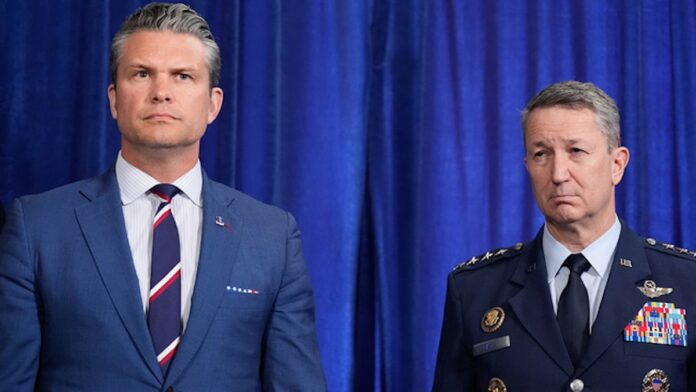
US Defense Secretary Pete Hegseth and Joint Chiefs of Staff Chair General Dan Caine hold a press conference March 2, 2026. Photo: ABC News

In the Trump administration’s first public remarks to reporters on the strikes the US and Israel launched in Iran over the weekend, Defense Secretary Pete Hegseth blamed the Middle Eastern country for the attacks that have killed at least 555 people there as well as at least four US soldiers – and suggested Iran posed an imminent threat because of its defensive military capabilities.

Hegseth said the strikes that began early Saturday morning and included deadly attacks on children attending school were “retribution” for Iran’s “savage, one-sided war against America” that has played out for “47 long years” as the country has waged proxy attacks on the US.

“We didn’t start this war, but under President Trump we’re finishing it,” said Hegseth.

Hours before President Donald Trump announced the US and Israeli attacks, the Omani Foreign Minister Badr Albusaidi reported that diplomatic talks he was mediating were making significant progress toward a peace deal.

Pentagon officials said in a congressional briefing Sunday that Iran had not been planning to strike any US military targets in the region unless it was attacked first, according to CNN.

But Hegseth asserted that Iran had held a “conventional gun to our head” and suggested the US had no choice but to wage war.

The defense secretary also claimed Monday that Iran was “not negotiating” and said it was “stalling” in the talks with the aim of rebuilding missile stockpiles.“

“To be clear,” said journalist Jeremy Scahill of Drop Site News, “he is claiming the US went to war because Iran has ballistic missiles and drones it has used as a deterrent or to respond to US/Israeli attacks.”

Drop Site noted that Hegseth made no mention of “the 1953 US-backed coup in Iran,” US support for autocratic rule there from 1953-79, “or that the US and Israel launched the February 28 strikes.”

On the UK talk radio show “Leading Britain’s Conversation,” British journalist Jon Sopel said Hegseth was making “the exact argument that [former President] George W. Bush made in 2003 with the weapons of mass destruction and ‘They could be launched in 45 minutes.’”

Promises to end the US government’s penchant for embarking on endless regime change wars, added Sopel, were part of “what propelled Donald Trump to the presidency, and yet Donald Trump and [Israeli Prime Minister Benjamin] Netanyahu have launched these strikes against Iran.”

The defense secretary attempted to contrast the operation in Iran – dubbed Operation Epic Fury by the US military – to protracted wars like those the US has waged in Iraq and Afghanistan.

The conflict will not be an “endless war,” Hegseth said.

He claimed at one point in the briefing that the clear-cut objective of the attacks is to “destroy the missile threats, destroy the navy, no nukes” and scoffed at a reporter’s question about Trump’s Sunday statement in which the president said he expected the conflict to be resolved in “four weeks or less.”

“President Trump has all the latitude in the world to talk about how long it may or not take. Four weeks, two weeks, six weeks. It could move up, it could move back,” said Hegseth.

Hegseth spoke alongside Joint Chiefs of Staff Chairman Gen. Dan Caine, who appeared to temper expectations of a quick resolution to the war started by the US and Israel.

“To be clear … this is not a single overnight operation,” Caine said. “The military objectives [US Central Command] and the Joint Force have been tasked with will take some time to achieve, and in some cases will be difficult and gritty work.”

Caine added that the military objective is “to protect and defend ourselves and, together with our regional partners, prevent Iran from the ability to project power outside of its borders.”

Law professor Jennifer Taub denounced Hegseth’s remarks as “utter nonsense” and condemned his claim that the US and Israel are hitting military targets “surgically.”

“Shameless,” she said. “We or Israel bombed a girl’s school on Saturday when school was in session, killing 175.”

Along with Hegseth’s claim that Iran was to blame for the strikes launched by the US and Israel, his comment that the US will expedite the operation by not getting bogged down in “stupid rules of engagement” alarmed observers.

“’No stupid rules of engagement’ means no Geneva Conventions or other international humanitarian laws, which the US signed and supported for more than a century,” said journalist Mark Jacob. “Hegseth and Trump are pro-war crimes.”

Originally published by Common Dreams, this article is republished under a Creative Commons license.

The attacks on Iran are by no means a victory “for civilisation”.

0
the-attacks-on-iran-are-by-no-means-a-victory-“for-civilisation”.
The attacks on Iran are by no means a victory “for civilisation”.

The Iranian dictator is dead, his repressive regime is being bombed into submission, and now the world can look forward to peace and stability. It all sounds so simple when scripted in the manner of a Netflix action drama and – as multiple armchair foreign policy hawks are now insisting – the sudden obliteration of Ayatollah Ali Khamenei in his office on a Saturday morning can only be a time for rejoicing.

The problem, of course, is that there are always consequences to a riotous weekend of death and destruction, and the true cost of the American-Israeli strikes on a sovereign country is far from being known. As was apparent following similar executions this century – whether of Saddam Hussein in Iraq in 2006 or Muammar Gaddafi in Libya in 2011, for example – taking out leaders detested by the West is never a quick fix. On the contrary, even more instability, including murderous violence, is all we can be certain of.

The weapons-grade gaslighting accompanying this war on behalf of “the brave Iranian people” – as Israel puts it – is off the scale: Iranian civilians, including schoolgirls, apparently approve of being slaughtered and having their homes destroyed, just like the Palestinians.

Casualty figures caused by war, occupation, insurgencies, and civil conflict in post-Saddam Iraq are well into seven figures, while the cost of illegal regime change in Libya has also been enormous. The North African country remains full of militias who – just like America and Israel – think nothing of destroying human life with impunity. Having the best weapons is the key to power, and who cares what anybody else thinks, is the warlord rationale.

A key difference between the murderous outlaws in countries such as Iraq and Libya, and the USA and Israel, however, is that the latter use recognised state armies and employ reams of propagandists to try and convince the world that they are in fact the fictional TV-style “good guys” doing what has to be done “for civilisation”.

The weapons-grade gaslighting accompanying this war on behalf of “the brave Iranian people” – as Israel puts it – is off the scale: Iranian civilians, including schoolgirls, apparently approve of being slaughtered and having their homes destroyed, just like the Palestinians.

It was less than two years ago, during his 2024 election campaign, that U.S. President Donald Trump pledged to stay out of “forever wars”, but now he has triggered all-out conflict in the Middle East, without the approval of Congress, let alone any kind of democratic debate beforehand.

Cynical expressions such as “pre-emptive action” are bandied about to try and pretend that Iran was still on the verge of developing nuclear capabilities. This is despite the Pentagon itself currently identifying no immediate threat from Iran and last June’s Twelve-Day War, when Trump heralded a flawless operation to destroy three Iranian atomic plants.

No matter that Israel is the only nuclear power in the region and that the US is the sole nation to have dropped A-bombs on another country, ongoing negotiations towards a US-Iran deal deemed successful by an Omani mediator were also abandoned.

It is impossible to think of a more obvious example of “forever wars” prosecution than attacking a country in the summer, giving up on peace talks, and then going straight back in the winter to inflict even more carnage. Khamenei’s death will certainly not end anything. Iran is already carrying out retaliatory strikes, Israel and America are hitting back… and so the cycle of violence goes on and on.

No matter that Israel is the only nuclear power in the region and that the US is the sole nation to have dropped A-bombs on another country, ongoing negotiations towards a US-Iran deal deemed successful by an Omani mediator were also abandoned.

What is also absolutely certain is that Israeli prime minister Benjamin Netanyahu – an indicted criminal suspect facing trial for unspeakable crimes linked to the genocide in Palestine – is the key instigator of the onslaught against Iran. He is shaping U.S. foreign policy to his own liking, ensuring, as always, that his country is backed up by the multi-billion-dollar American military-industrial complex as it sets fire to most of its near neighbours.

Meanwhile, Netanyahu’s propagandists turn night to day, as they offer endless excuses for the horror. All the repugnant tactics used to try and whitewash the ongoing monstrous crimes in Gaza and the Occupied West Bank are already being deployed around the subject of Iran – death toll figures are disputed constantly, to the extent that even when numerous children are among some 180 killed and 100 wounded in an attack on an Iranian school, they mock and sneer. All of their claims are made with calm assurance and certainty, and when anybody disputes them, they are branded terrorist supporters.

Thus, we have the grotesque spectacle of Netanyahu actually preaching to the Iranian people on his X account, saying: “Do not let this opportunity slip away. This is an opportunity that comes only once in every generation.” In a video published in Persian and produced with artificial intelligence, Netanyahu continues: “The moment when you must take to the streets, come to the streets in your millions to finish the job, to overthrow the regime of terror that has embittered your lives. Your suffering and sacrifices will not be in vain.”

This all fits in with the overall Netanyahu gaslighting. The warped narrative is that death and destruction are fundamentally a good thing, because they make the world a better place for him and his ultra-extremist supporters to assert their U.S.-backed supremacy. No matter that his victims include tens of thousands of infants, mothers, fathers, aid workers, and multiple other innocents – the key point is that Netanyahu’s view of  “civilisation” is that it is absolutely centred on perpetual conflicts. These ceaseless military campaigns also suit Netanyahu as he avoids domestic corruption charges.

Countries such as Britain are now providing logistical help too while – that double speak again – saying they will support “defensive strikes” only.

Such evil is ably assisted by a geopolitical landscape that has altered massively over the past few years, not least of all thanks to the emergence of Donald Trump as an alleged politician. The convicted criminal with a background in business and showbiz is a supreme populist who has subjugated his country’s own judiciary, severely weakened the rule of law, ridiculed objective journalism, and promoted discrimination and hatred using a range of methods, including rambling monologues, social media algorithms, and his notoriously brutal Immigration and Customs (ICE) forces. Illiberalism and authoritarianism are Trump’s triumphs, and they extend into an increasingly reckless foreign policy.

Such is the double-speak, that the Americans and Israelis have even managed to persuade compliant allies in Europe to issue statements blaming Iran for starting the current spate of violence. Countries such as Britain are now providing logistical help too while – that double speak again – saying they will support “defensive strikes” only.

As Trump said at the White House while standing next to the leering Netanyahu last September: “It’s a big day, a beautiful day, potentially one of the biggest days ever in civilisation.” He wasn’t simply talking about Israeli’s ongoing mass killing and dispossession of Palestinians either. Trump instead said he was looking “much beyond Gaza. The whole deal. Everything. Getting solved. It’s called peace in the Middle East.”

The truth is that Trump’s only interest in the Middle East is what comes with the Netanyahu seal of approval. This has led to numerous conspiracy theories, including claims that Israel has intelligence about Trump’s personal life, and it is linked to the late convicted paedophile Jeffrey Epstein, who was once a close friend of the American president. Hence expressions such as “The Diversionary War”, and even “The Epstein War”.

Whatever the truth of the matter, we can be certain that attempted regime annihilation by foreign powers does not work. This is the case whether military personnel are deployed on the ground – as in Iraq – or – as in Iran so far – by firing missiles and dropping bombs from on high.

The truth is that Trump’s only interest in the Middle East is what comes with the Netanyahu seal of approval. This has led to numerous conspiracy theories, including claims that Israel has intelligence about Trump’s personal life, and it is linked to the late convicted paedophile Jeffrey Epstein, who was once a close friend of the American president. Hence expressions such as “The Diversionary War”, and even “The Epstein War”.

Whether you were a regime dissident, or firm supporter of those in charge, there was still the constant threat of being wiped out by foreign aggressors, and nothing has changed in this respect. Ayatollah Ali Khamenei’s 37 years in power was thus defined by its intense hatred of Israel and America, and this will not simply evaporate. The Islamic Revolutionary Guard Corps (IRGC) – the main security force in Iran – will not instantly disband, either, and, crucially, there is no unified opposition ready and able to take over from Khamenei.

Instead, we are looking at yet another disaster in Iran, just like the ones in Iraq, Libya, Afghanistan, and all those other Muslim majority countries that the West thinks nothing of pulverising in the name of “civilisation”. Devious ghouls such as Trump, Netanyahu and their legions of supporters around the world will say otherwise, while their savagery continues unabated.

The views expressed in this article belong to the author and do not necessarily reflect the editorial policy of Middle East Monitor.
Clueless cops post seized crypto wallet password. $5M quickly stolen.

0
clueless-cops-post-seized-crypto-wallet-password-$5m-quickly-stolen.
Clueless cops post seized crypto wallet password. $5M quickly stolen.

Soon after South Korean police posted a press release boasting about seizing $5.6 million worth of cryptocurrency from 124 wealthy tax evaders, cops realized that they had mistakenly posted images that made it possible for a thief to quickly steal most of the seized assets.

Eventually, the press release was removed, but not before it was grabbed by local media outlets and tech publications covering the theft.

Bleeping Computer shared a screenshot of the retracted images, which showed a handwritten note next to a Ledger device that’s used as a so-called “cold wallet” to store crypto out of reach of online threats. Clearly legible in the photo, the note contained a complete mnemonic recovery phrase that anyone can use as a master key to move assets off the cold wallet to a new wallet without any additional PIN or permissions required.

A blockchain analysis expert, Cho Jae-woo, told a South Korean news site that 4 million PRTG (Pre-Retogeum) tokens—worth approximately $4.8 million—were in the wallet when the thief struck. The Block reported that on-chain data from Etherscan indicated that “the party who moved the funds first deposited a small amount of ETH into the wallet to cover transaction fees, then transferred the 4 million PRTG tokens out in three transactions.”

On Sunday, officers with South Korea’s National Tax Service posted another press release, “deeply” apologizing for the leak compromising the seized assets.

In it, cops explained that they included the images to make the release more eye-catching, but they were careless in failing to redact the crypto wallet password from the images. They acknowledged there was no excuse for the error and confirmed they were launching an investigation with national police, attempting to trace the transfer and retrieve the lost funds.

Because the press release was widely circulated online, the thief could be anyone. South Korea’s National Tax Service has no clear suspects, Gizmodo suggested, and no easy way to claw back funds.

The officials’ best bet might be if the thief tries to move the stolen tokens through a regulated exchange, but The Block noted that the thief might struggle to convert that much cryptocurrency into cash under current market conditions. So seemingly, the thief, who likely wasn’t expecting the big payday anyway, may be motivated to lie low and avoid major exchanges.

Cho suggested that cops could have easily prevented the theft, likening posting any image of the mnemonic recovery phrase to leaving a wallet wide open. He noted that the original holder of the Ledger wallet was following best practices by only recording the phrase on a handwritten note and not storing the password online. Cops should have known to check the images for the recovery phrase, Cho said, and their mistake will likely cost the national treasury billions of won.

It’s possible that whoever took the cryptocurrency just seized on an opportunity after seeing the cops’ failure to redact the images while scrolling through the National Tax Service’s press releases at dawn. It’s also possible that bad actors are closely monitoring South Korean police cryptocurrency announcements, following what The Block reported was “a series of crypto custody lapses.”

In January, officials in Gwangju had to investigate after “a substantial quantity of seized bitcoin was lost,” The Block reported. That was believed to be linked to a phishing attack targeting Coinbase but perhaps signaled that police weren’t always adequately securing seized assets.

Even more disturbingly, last month, police in Seoul’s Gangnam district had to launch an internal investigation after 22 seized bitcoins went missing, The Block reported. That case also involved a cold wallet suddenly drained without the physical device leaving police control, possibly indicating that some sensitive information isn’t handled securely.

In the latest press release, the National Tax Service officer said they are strengthening internal controls and job training to prevent future leaks.

ProPublica Sues Education Department for Withholding Records About Discrimination in Schools

0
propublica-sues-education-department-for-withholding-records-about-discrimination-in-schools
ProPublica Sues Education Department for Withholding Records About Discrimination in Schools

ProPublica has sued the U.S. Department of Education in federal court in New York, accusing it of withholding public records about how it’s enforcing civil rights protections for millions of American students.

The Education Department has failed to provide public records related to its investigations, communications and other work that ProPublica sought through four Freedom of Information Act requests filed last year.

The Education Department’s civil rights arm for decades has investigated allegations of discrimination in schools. It historically has kept an online list of its open investigations and posted the findings of completed inquiries. But under Education Secretary Linda McMahon, who was appointed by President Donald Trump, the Office for Civil Rights has been decimated and the work of its remaining investigators is largely cloaked in secrecy.

ProPublica submitted three FOIA requests — the first of them more than a year ago — seeking records about civil rights investigations that have been opened or closed, notices sent to institutions being investigated and previous findings of discrimination that have been reversed under the Trump administration. A fourth request sought communication between top Education Department officials and conservative groups that have criticized public schools. Some of the groups have urged the OCR to investigate specific school districts and have met often with McMahon.

The department has not responded to the requests other than to acknowledge that it received them.

“Actions by the Department of Education have real consequences for millions of students and families,” said Alexandra Perloff-Giles of the law firm Davis Wright Tremaine, which is representing ProPublica.

“The public deserves to understand how executive authority is being exercised so that it can hold government accountable,” she said. “Congress enacted FOIA to offer the public that necessary transparency, and we’re asking the court to enforce it.”

Spokespeople for the department did not respond to a request for comment about the lawsuit. The department has not yet responded to the complaint in court.

The lawsuit, filed Wednesday, argues that since Trump took office, the work of the OCR — once one of the federal government’s largest enforcers of the Civil Rights Act of 1964 — has become significantly more opaque. Though each presidential administration has its priorities, OCR has consistently worked to uphold constitutional rights against discrimination based on disability, race and gender.

But the focus of the OCR under Trump has shifted to investigations relating to curbing antisemitism, ending participation of transgender athletes in women’s sports and combating alleged discrimination against white students. Complaints about transgender students playing sports and using girls’ bathrooms at school have been fast-tracked while cases of racial harassment of Black students last year were ignored.

And although some documents that detail how cases were resolved are being posted online, some older resolution agreements have been terminated. Those terminations have not been disclosed to the public.

“The public interest in this information is substantial and ongoing. Since there are approximately 49.6 million students in the U.S., changes to the ED and its policies affect millions of families,” the lawsuit says.

Trump has been working to shutter the department. Hundreds of department workers have been laid off and official employee counts at the OCR went from 568 in 2024 to 403 as of December 2025. McMahon closed seven of the 12 regional OCR offices that handled discrimination complaints across the country. Amid the staffing difficulties and the shift in priorities at the OCR, families’ discrimination complaints have piled up.

When President Joe Biden left office, about 12,000 investigations were open; by December 2025, there were nearly 24,000. ProPublica reporting has found that new complaints as well as older ones included in the backlog often are dismissed without investigation. OCR workers have said they feel as if they’re working in a “dismissal factory.”

In the past year, ProPublica has filed several other lawsuits seeking to force transparency in courts and the federal government. That includes a lawsuit filed in May against the State Department. ProPublica also has joined other media organizations in lawsuits.

Qatar Shoots Down 2 Iranian Warplanes, Joining Arab Nations Against Iran

0
qatar-shoots-down-2-iranian-warplanes,-joining-arab-nations-against-iran
Qatar Shoots Down 2 Iranian Warplanes, Joining Arab Nations Against Iran


Saudi Arabia, Bahrain, Jordan, Kuwait, Qatar, the United Arab Emirates, and the United States issued a joint statement condemning Iran’s missile and drone campaign, calling the actions a dangerous escalation

As the Middle Eastern War, which began as a joint operation between the US and Israel with the goal of taking down the Iranian regime, enters its third day, Gulf nations are being pulled into the conflict as Iran attacks oil infrastructure, army bases, hotels, and airports across the region. Iran has attacked nine countries, including Israel, since the war began.  

On Monday, Qatar shot down 2 Su-24 Iranian fighter jets. Qatar, which served as a mediator during the hostage negotiations between Hamas and Israel and offered to serve a similar role in Iran-US nuclear talks, warned that recent Iranian attacks would have “catastrophic consequences for international peace and security.”

Authorities said Iranian attacks targeted both energy and civilian infrastructure. QatarEnergy, the country’s state-run energy company, suspended liquefied natural gas production due to what it described as “military attacks” on its facilities, NBC reported Monday.

Qatar also intercepted Iranian strikes aimed at civilian targets, including the country’s international airport, a spokesperson for the Qatari Foreign Ministry told CNN. Spokesperson Majed Al Ansari said such attacks would not go unanswered and added that Qatar was not currently engaging with Iran.

In Oman, an oil tanker was targeted Monday by an unmanned boat in the Gulf of Oman, northwest of Sultan Qaboos Port, according to Oman’s Maritime Security Center. The center said a fire broke out on board the Marshall Islands-flagged tanker MKD YOM, forcing the evacuation of its 21 crew members. One Indian crew member was killed in an explosion in the engine room. The tanker was carrying about 59,463 metric tons of cargo.

A vessel from the Royal Navy of Oman was deployed to monitor the damaged tanker and issue safety warnings to ships transiting the area. The incident occurred amid heightened tensions around the Strait of Hormuz, after Iran warned vessels not to transit the waterway following US-Israeli strikes.

Saudi Arabia reported damage to one of its most critical energy facilities on Monday morning. Saudi Aramco temporarily shut its Ras Tanura refinery after an Iranian drone strike hit the sprawling complex on the kingdom’s eastern coast, an industry source told Reuters.

The shutdown was described as a precautionary measure, and a spokesperson for Saudi Arabia’s defense ministry said there were no casualties. No details were provided on the extent of the damage or the expected duration of the shutdown. Media reports said a fire broke out at the site following the strike, with social media footage showing flames rising from part of the complex and workers evacuating Aramco installations. Ras Tanura is one of the Middle East’s largest refining facilities, with a capacity of 550,000 barrels per day, and also serves as a major crude export terminal.

Amid the turmoil, oil markets reacted sharply to the damage to energy infrastructure and growing concerns over shipping disruptions. Brent crude rose about 10% to roughly $80 a barrel in over-the-counter trading on Sunday, Reuters reported, after reaching $73 on Friday, its highest level since July.

Analysts cited the risk of prolonged disruption in the Strait of Hormuz, through which more than 20% of global oil flows, with many tanker operators suspending shipments following Iranian warnings. Despite a modest OPEC+ output increase, analysts said a sustained closure or slowdown of the waterway could push prices significantly higher.

Separately, the Pentagon said Monday that three US fighter jets were downed over Kuwait in what it described as “apparent friendly fire” during Operation Epic Fury, confirming an earlier statement by the Kuwaiti Defense Ministry.

According to the Pentagon and US Central Command, the three F-15D Strike Eagle aircraft were mistakenly hit by Kuwaiti air defense systems during active combat that included Iranian aircraft, ballistic missiles and drones. “All six aircrew ejected safely, have been safely recovered, and are in stable condition,” the Pentagon said, adding that Kuwait had acknowledged the incident. CENTCOM said the cause remains under investigation.

Earlier in the conflict, Iranian drone attacks were reported across the United Arab Emirates. Fires and damage were recorded at multiple sites in Dubai and Abu Dhabi late Saturday and early Sunday, according to official statements and media reports. In Dubai, social media footage showed fires near the Fairmont hotel on Palm Jumeirah, flames on the facade of the Burj Al Arab, and smoke rising near the Burj Khalifa.

The Dubai Media Office said debris falling at Jebel Ali Port caused a fire. Dubai International Airport was damaged, with four employees injured. Reports said Terminal 3 was struck by a drone and evacuated, and that a second attack hit the airport early Sunday, sending thick smoke above the city. In Abu Dhabi, Zayed International Airport was hit, killing one person and seriously injuring four others across the city.

In Bahrain, a senior civil aviation official said Bahrain International Airport was targeted in a drone attack on Sunday, causing minor material damage. The Bahraini News Agency said authorities had activated emergency plans in advance, including evacuating the passenger terminal.

Separately, the United Kingdom Maritime Trade Operations said a ship in a Bahrain port caught fire after being struck by two projectiles. The crew was unharmed and evacuated safely, according to the statement.

After the attacks, Saudi Arabia, Bahrain, Jordan, Kuwait, Qatar, the United Arab Emirates and the United States issued a joint statement condemning Iran’s missile and drone campaign. The countries said the strikes targeted sovereign territory, endangered civilians and damaged civilian infrastructure, calling the actions a dangerous escalation that violated the sovereignty of multiple states and threatened regional stability.

They said they “strongly condemned Iran’s indiscriminate and reckless missile and drone attacks,” reaffirmed their right to self-defense and praised coordinated air and missile defense efforts for preventing far greater casualties and destruction.

Why did Kuwait shoot down 3 US F-15s?

0
why-did-kuwait-shoot-down-3-us-f-15s?
Why did Kuwait shoot down 3 US F-15s?

Three US F-15E fighter jets were shot down over Kuwait on Sunday, March 1, by Kuwaiti air defense systems. No deaths were reported.

While an accidental shootdown can happen at any time in a complex warfighting environment, shooting down three F-15s suggests the Kuwaiti air defense operators shot at anything and everything.

Whether that is the case, of course, depends on US Central Command’s investigation, but CENTCOM may not be willing to criticize an ally openly, assuming that is what happened.

Kuwait has modern air defense systems, including Patriot PAC-3 MSE and upgraded PAC-2. Kuwait also operates HAWK (MIM-23), an older air defense system, NASAMS, the National Advanced Surface-to-Air Missile System also known as Norwegian Advanced Surface-to-Air Missile System (possibly deployed), and SPADA, an Italian air defense system that uses Aspide interceptor missiles made by a European consortium (MBDA).

A screengrab from the videos showing an F-15 spinning towards the ground in flames. Image: X

PAC-3 is a hit-to-kill kinetic interceptor while PAC-2 (including the GEM and GEM-T versions) uses blast fragmentation warheads. A PAC-3 missile must directly hit the enemy missile or aircraft. The PAC-2 explodes near the target and spews out metal fragments as it explodes.

At least one video of an F-15 in free fall after it was hit shows that the missile that hit it destroyed the vertical stabilizer of the F-15, making it inoperable. This could suggest a terminal heat-seeking missile instead of a radar guided one, but this is speculative.

Both PAC-3 and PAC-2 are guided to their target by ground radar. The same is true for HAWK, which uses an illuminator radar for target acquisition.

Kuwait has other shorter-range air defense systems. One of them is SPADA 2000, which is a low-to-medium-altitude air defense system that uses Aspide 2000 surface-to-air missiles. This missile has a blast fragmentation warhead. It is not known if Kuwaiti SPADA is integrated with their Patriot systems.

Spada 2000 (MBDA)

Another system is NASAMS (National Advanced Surface-to-Air Missile Systems). Export of this system to Kuwait from the US was approved in 2022. How many are currently deployed, if any, is not public knowledge. NASAMS (a joint Norwegian-US system) repurposes air-to-air missiles such as AMRAAM (AIM-120) and AIM-9 into ground-based air defenses. These interceptors use blast fragmentation warheads and track targets at the terminal stage using infrared seekers.

Iran attacked Kuwait with ballistic missiles (Khaybar) and cruise missiles (Qadr 380) and two types of drones (Arash-2 and Shahed 136). No Iranian fighter aircraft were involved. According to the Kuwaiti Ministry of Defense, Kuwait engaged 97 Iranian ballistic missiles and 283 drones.

We do not know the exact role of the F-15s, but it is highly likely that the F-15s were launched to take down Iranian drones and possibly Iranian cruise missiles. This means that the local air defenses should have focused on the incoming ballistic missiles. However, this was not the case as Kuwait’s air defenses were shooting at both drones and missiles. This suggests questionable coordination between US assets and Kuwait.

One of the shortcomings of the Patriot, at least when actual intercepts are viewed, is that it mostly engages ballistic missiles very close in to their actual targets, and at reasonably low altitude, the same air space where the F-15s were operating.

To guard against friendly fire incidents, Patriot and other US air defenses are equipped with IFF (Identification Friend or Foe) systems. These are transponders that broadcast an encrypted signal that IFF equipped ground radars can read, indicating the aircraft is a friend and marking it on radar displays as such.

Mark XIIA IFF transponder (BAE Systems)

Kuwait’s air defenses are supposed to be linked to CENTCOM’s IFF command center, which is in Qatar. US aircraft would not operate in friendly airspace unless the area’s air defenses had IFF with updated codes.

Kuwait has carried out a major upgrade of its Patriot IFF components, hardware and software. While not complete, the upgrade and the existing structure should have been good enough to prevent a friendly fire incident.

The CENTCOM investigation is supposed to be looking into the possibility that Iran could have jammed Kuwait’s radars, rendering the IFF inoperative. Iran had a significant jammer in Bandar Abbas, which is around 1,000 miles away from where the F-15s were hit.

There were three Iranian jamming systems that were allegedly operating at the time of the shootdown, all located on Iran’s territory. These were the Cobra V8, a truck-based platform deployed near coastal regions like Bandar Abbas. It has a reported range of 250 kilometers and is designed specifically to jam airborne radar and satellite signals; Sayyad-4 Radar units which have been repurposed in a non-kinetic role to broadcast interference that disrupts foreign navigation and Avtobaza-M (Electronic Intelligence) systems that can track and jam the control links of drones and aircraft. All these systems seem to have been too far away to jam Kuwait’s IFF.

Avtobaza-M Jammer supplied by Russia to Iran

Assuming the IFF systems were not jammed, how did it happen that Kuwait shot down three F-15s?

Part of the answer could be reckless operation by Kuwait of its air defenses. Shooting down one F-15 is an accident, but shooting down three could well be reckless operation. F-15’s fly much faster than drones, but are considerably slower than missiles, even missiles in the terminal phases. Even without IFF the Kuwaiti operators should have been able to distinguish the types of targets by their radar signature and operating profile. Instead it seems the operators fired at everything, leading to the loss of the F-15s.

It remains possible that there was a technical or operational glitch that caused the loss of the three F-15s. Word coming out of the Pentagon already points in this direction with suggestions IFF units were possibly jammed. But could this be to protect an ally?

There are yet other possible explanations including poor integration of different kinds of air defense systems. A lack of integration and firing at just about everything in the sky in a period of maximum confusion could have cause the loss of the F-15s.

Let’s see if we can learn more after CENTCOM completes its investigation.

Stephen Bryen is a former US deputy under secretary of defense. This article, originally published on his Substack newsletter Weapons and Strategy, is republished with permission.

$599 M4 iPad Air is a lot like the old one, but with a substantial RAM boost

0
$599-m4-ipad-air-is-a-lot-like-the-old-one,-but-with-a-substantial-ram-boost
$599 M4 iPad Air is a lot like the old one, but with a substantial RAM boost

As expected, Apple has announced a mild update for the iPad family’s middle child today. The new iPad Air is a lot like the old one, but it replaces the Apple M3 chip with an M4. That M4 also comes with a less-expected upgrade: a jump from 8GB of RAM to 12GB, which should be helpful for those using iPadOS 26’s multi-window multitasking features.

The iPad Air still comes in 11-inch and 13-inch versions that start at $599 and $799, respectively; the only disappointment is that these entry-level models still come with 128GB of storage. A 256GB storage upgrade will run you $100, and 512GB (+$300) and 1TB (+$500) versions are also available. Preorders go live on March 4, and the tablet will be available on March 11.

The M4 iPad Air uses the same design as the M2 version from 2024 and the M3 version from last year. The M2 version of the Air was a gently tweaked version of the M1 iPad Air, but it was different enough not to be compatible with all the same accessories; most notably, the M2-and-later Airs use the Apple Pencil Pro accessory and aren’t compatible with the second-generation Pencil.

This version of the Apple M4 is slightly cut down compared to the version that ships in Macs or that came with the M4 iPad Pro. It has only 8 CPU cores—3 high-performance cores and 5 efficiency cores, down from a maximum of  and 4 and 6. It also uses 9 GPU cores instead of 10, and there isn’t an Air variant with 16GB of RAM. A 16GB RAM configuration was available for M4 iPad Pros with 1TB or 2TB of storage. The cellular versions also pick up Apple’s in-house Apple C1X modem, plus the Apple N1 chip for Wi-Fi and Bluetooth connectivity.

Otherwise, very little has changed about the new iPad Air. It still comes in four relatively muted color options (space gray, blue, purple, and a pale gold “starlight”), still uses a regular 60 Hz LCD display rather than an OLED or ProMotion screen, still uses a power button-mounted TouchID sensor rather than FaceID, and still includes a single-lens 12MP rear camera with no flash. Apple continues to not offer its nano-texture display coating for the Air, either—that’s reserved exclusively for higher-end iPad Pro configurations.

The new iPad Air is part of a string of announcements that Apple is planning in the run-up to a “special experience” event on Wednesday morning. The company also announced a new iPhone 17e today and is widely expected to debut a new low-end iPad and a new MacBook that’s substantially cheaper than the MacBook Air.

This piece was updated at 11:15am on March 2 to add details about the M4 chip’s CPU core configuration, and to mention the Apple N1 and C1X wireless chips. 

Man Who Once Held a Gun to Paula Deen’s Head is Found Dead

0
man-who-once-held-a-gun-to-paula-deen’s-head-is-found-dead
Man Who Once Held a Gun to Paula Deen’s Head is Found Dead


A man tied to one of the most disturbing moments in Paula Deen’s past has been found dead in New York City, nearly four decades after he terrified the future TV star during a violent bank robbery.

Eugene Thomas King Jr., the man who once held a gun to Deen’s head during a 1987 bank heist, was discovered unconscious inside his Brooklyn apartment. Emergency responders arrived at the scene, but he was pronounced dead there.

According to the medical examiner, King died of natural causes. His official cause of death was listed as hypertensive and arteriosclerotic cardiovascular disease.

Long before she became a household name, Deen was working as a bank teller when the terrifying robbery unfolded. In her statement to police at the time, she said the gunman kept the weapon directly in her face throughout the ordeal.

King was later convicted and served time for the crime. He reportedly told police he never meant to hurt anyone and even asked that Deen be told he was sorry.

The decades-old robbery returned to the spotlight in 2013 during Deen’s career-damaging racism scandal. During a deposition in a lawsuit accusing her of sexual and racial harassment, Deen was asked whether she had ever used racist language, including the N-word.

Her response immediately sparked outrage.

“Yes, of course,” Deen said, before referencing the bank robbery and claiming the remark had been made in anger after a Black man put a gun to her head during the heist.

The fallout was swift and brutal. Deen’s admission triggered a massive public backlash that helped derail her once-booming empire. She lost major endorsement deals, a book agreement, and her television show, as criticism exploded nationwide.

King himself later weighed in on the controversy, saying he felt sorry for Deen and suggesting she was being harshly judged over a single lapse in judgment.

Deen has since insisted the situation was taken out of context. In later interviews, she said being labeled a racist deeply wounded her and claimed the full story was never properly told.

She also addressed the scandal in the documentary Canceled: The Paula Deen Story, saying she never wanted that accusation to define her legacy.

The damage to her business, however, was lasting. In the years after the scandal, Deen’s brand took a major hit. Her long-running Savannah restaurant, The Lady & Sons, eventually closed, along with nearby sister spot The Chicken Box.

Even so, Deen said she and her family remain committed to Savannah while focusing on her remaining Paula Deen’s Family Kitchen locations in Pigeon Forge, Myrtle Beach, Nashville, and Branson.

Now, with King’s death, a dark chapter from Deen’s past is suddenly back in the spotlight — reviving the haunting robbery that would later become entangled in one of the biggest controversies of her career.

The oil price surge is just one symptom of a supply chain network that is not fit for this age of global tensions

0
the-oil-price-surge-is-just-one-symptom-of-a-supply-chain-network-that-is-not-fit-for-this-age-of-global-tensions
The oil price surge is just one symptom of a supply chain network that is not fit for this age of global tensions

The escalating conflict between Iran, the US and Israel has taken a critical turn. The strait of Hormuz – one of the most important shipping routes for oil and gas – is facing significant disruption. The strait is the main route connecting Persian Gulf ports in Iran and some of the region’s other oil producers to the open ocean.

The strikes on Iran are already having tangible effects: energy flows are slowing, markets are reacting and supply chains are under pressure. This is not just a regional conflict – it is a global supply chain crisis unfolding in real time.

As an expert on supply chains, I am acutely aware of how central the strait is – not only for the stability of the region but also to the functioning of the global economy.

This narrow corridor is one of the world’s most critical chokepoints – around a fifth of the world’s oil passes through the strait daily. Its sudden disruption represents a “chokepoint failure” – a breakdown at a critical node that triggers cascading effects across global systems.

Tanker traffic has dropped sharply, with vessels waiting in surrounding waters as ship owners reassess the risks. Oil prices surged in response to the strikes and the threat to shipping routes. Analysts have warned that prices could climb significantly higher if the disruption persists.

But crucially, this reaction was not driven solely by actual shortages. Markets respond to uncertainty itself. The mere possibility that several million barrels per day could be disrupted is enough to push prices up, even before supply is properly hit. This reflects a broader feature of geopolitical risk: expectations and perceptions can be as economically powerful as material disruptions.

Because energy underpins almost every sector, these price increases transmit rapidly through supply chains. Higher fuel costs raise transportation expenses, increase production costs and ultimately feed into inflation across goods and services that eventually land with consumers.

The strategic importance of the Gulf states

The disruption is not confined to the strait. Instability across the wider Gulf region also affects the United Arab Emirates, as well as other strategically important energy producers and logistics hubs, such as Qatar, Kuwait and Saudi Arabia.

This dimension matters because the Gulf functions not only as an energy supplier but also as a crossroads in global trade and logistics.

Ports such as Dubai handle vast volumes of international shipping, linking Asia, Europe and Africa. As tensions spread, the reliability of these logistics systems is increasingly called into question.

The result is a shift to more widespread insecurity, where both energy flows and trade infrastructure – things like major container ports, shipping lanes, export terminals and storage facilities – are simultaneously at risk.

Energy is the heart of global supply chains. Manufacturing depends on electricity and fuel, transport relies on oil-based logistics and agriculture depends heavily on natural gas-derived fertilisers. When energy flows are disrupted or become more expensive, the effects propagate across entire networks.

Research on geopolitical crises shows that disruptions to key inputs such as oil and gas quickly translate into broader supply chain instability. This affects production, trade and the availability of goods far beyond the conflict zone. The Iran crisis reflects this dynamic. What begins as disruption in a maritime corridor can become a global economic issue within days.

For decades, global supply chains have been optimised for efficiency. This means that they concentrate sourcing and production in regions that minimise costs. This model has delivered large economic benefits, but it has also created weaknesses in the structure.

map of the strait of hormuz

The crisis in the strait of Hormuz is a prime example of a chokepoint failure. AustralianCamera/Shutterstock

The concentration of energy flowing through a single chokepoint such as the strait of Hormuz exemplifies this trade-off. When it is disrupted, the system lacks resilience.

In response, supply chains are likely to accelerate efforts to diversify and invest in alternative energy routes and sources. Countries that are heavily dependent on oil transiting through the Gulf will seek to expand strategic reserves, diversify their import routes and invest in pipelines that bypass maritime chokepoints.

But at the same time, geopolitical instability strengthens the case for renewable energy, electrification and regional energy integration. Expanding solar, wind and green hydrogen capacity reduces exposure to concentrated fossil fuel corridors. And cross-border electricity connections can improve flexibility during shocks. In this sense, resilience is also an energy transition issue.

At the same time, instability in conflict-hit regions can fuel the rise of informal and illegal supply chains, particularly where governance is weakened. These can include things like unregulated oil trading, goods being smuggled through informal maritime routes and labour exploitation hidden within subcontracting chains.

What’s more, supply chains themselves are increasingly shaped by geopolitical forces, as states use trade, energy and logistics networks as instruments of power.

For consumers, this could mean greater price volatility, shortages and reduced choice as firms adjust sourcing strategies in response to sanctions, trade restrictions or security risks. In some cases, it may also mean higher costs over the long term, as businesses prioritise resilience over efficiency.

A turning point for globalisation?

The situation in the strait of Hormuz may mark a turning point in how global supply chains are understood. It has shone a light on a fundamental tension at the heart of globalisation. Efficiency depends on sourcing and production being concentrated in a few locations, but resilience depends on diversification. When critical links in the chain fail, the consequences extend far beyond their immediate location.

This war demonstrates that supply chains are not merely economic systems. They are deeply embedded in geopolitical realities. The challenge ahead is not simply to manage disruption, but to redesign supply chains and energy sources for a world in which geopolitical risk is no longer exceptional, but structural.

Ayatollah Ali Khamenei’s killing plays into Shiite Islam’s reverence for martyrs, but not for all Iranians

0
ayatollah-ali-khamenei’s-killing-plays-into-shiite-islam’s-reverence-for-martyrs,-but-not-for-all-iranians
Ayatollah Ali Khamenei’s killing plays into Shiite Islam’s reverence for martyrs, but not for all Iranians

The day Ayatollah Ali Khamenei was killed, the Iranian government called for 40 days of public mourning in line with Shiite tradition. It also praised the supreme leader for his martyrdom – a concept considered sacred and significant in the Islamic Republic and Shiite Islam.

While some Iranians came out to commemorate Khamenei, others celebrated his demise. The scenes reflected the contradictions in how Khamenei was perceived: by some as a martyr, and by others as an oppressor.

Women in headscarves hold portraits of Ayatollah Ali Khamenei.

Demonstrators mourn the death of Ayatollah Ali Khamenei outside the Israeli consulate in Istanbul, on March 1, 2026. AP Photo/Khalil Hamra

The theology of martyrdom

The roots of Shiite reverence for martyrdom date back centuries. After the death of the Prophet Muhammad in 632, a dispute emerged over who would inherit the leadership of the Muslim community. On one side was the prophet’s senior companion and father-in-law, Abu Bakr. On the other was his cousin and son-in-law, Ali ibn Abi Talib, who became the first Shiite imam.

In 680, the Battle of Karbala took place in present-day Iraq between Hussain ibn Ali – the grandson of the Prophet Muhammad and the third Shiite imam – and Yazid ibn Mu’awiya. Yazid was the second Umayyad caliph, which means deputy of God, and the ruler of the early Islamic empire.

Before the battle, negotiations had failed between Hussain and Yazid’s governor. Hussain refused to swear allegiance to Yazid, believing him to be unjust and not the rightful successor. In a 10-day battle that followed, most of Hussain’s army, including some of his closest companions and relatives, was slain. Hussain’s followers, who believed him to be the third Imam – after his father Ali and older brother Hasan ibn Ali – came to be called Shiites. Since then, martyrdom has held a central place among Shiites. They comprise the smaller of the two main branches of Islam, with Sunni being the larger one.

Iran has become the epicenter of Shiite Islam, which is the official state religion. Ninety to 95% of the population identify accordingly.

Every year on the 10th of Muharram, the first month of the Islamic calendar and the same day as the Battle of Karbala, Shiite Muslims inside and outside of Iran observe Ashura and commemorate the slaying of Hussain by reenacting his death and performing self-flagellation, among other rituals.

Iranian political rhetoric

In Iran and other parts of the Muslim world, contemporary politics is often framed in this seventh-century language of moral resistance.

After the Islamic Republic of Iran was established under Ayatollah Ruhollah Khomeini in 1979, martyrdom appeared as a central theme. This was particularly the case during and after the Iran-Iraq War, which lasted eight years in the 1980s and was perceived and portrayed as a holy war.

During the war, the Islamic Republic suffered hundreds of thousands of casualties. After Khomeini reluctantly accepted a United Nations-brokered ceasefire, he compared the decision to drinking a “poisoned chalice.” In other words, he considered the compromise a crushing defeat that contradicted his goal of overthrowing Iraqi President Saddam Hussein, even if it enabled the Iranian regime to survive.

After the war, public space in Iran was increasingly filled with revolutionary and religious symbols related to wartime sacrifice and martyrdom. They included street signs named after prominent people who died in the war, murals and posters of the fallen, and media programs and publications dedicated to the conflict – symbols which were still prominent when I visited Iran between 2009-2011.

The Islamic Republic’s Foundation of Martyrs and Veterans Affairs – Bonyad-e Shahid va Omur-e Ithargaran – provided services for veterans and families of the fallen in the war and other conflicts. Like other foundations under the purview of Khamenei, who succeeded Khomeini after his death in 1989, it also participated in profit-seeking activities.

It is against this backdrop that Khamenei’s actions leading up to the American and Israeli strikes on Feb. 28 that cost him his life must be seen.

During the three rounds of U.S.-Iran negotiations in Oman and Geneva before the current conflict, Khamenei refused to capitulate to President Donald Trump’s demands. They comprised curbing not only Iran’s nuclear enrichment, but also its missile program and support for its regional proxies. Khamenei directed his negotiators not to yield ground, particularly on those last two points, seen as red lines in Tehran – even as Trump amassed the most military assets in the region since the U.S. invasion of Iraq in 2003.

Authoritarianism, protests, polarization

Demonstrators carry Iranian flags and chant slogans during a rally.

Iranian demonstrators living in Cyprus attend a protest outside the presidential palace in Nicosia on Feb. 14, 2026. AP Photo/Petros Karadjias

For over three decades, Khamenei subjected Iranians to severe authoritarianism and repression, culminating in him ordering the security forces to shoot and kill thousands of Iranians during the protests in January 2026, not to mention those in previous years.

He deprived the families of deceased protesters from holding funerals for their loved ones. His regime also reportedly required them to pay for the ammunition that had been used to kill their relatives before receiving the body for burial.

And despite recurrent waves of protests – the January unrest followed similar waves in 2017-18, 2019-20 and 2022-23 – Khamenei refused to listen to the demands of demonstrators for political, economic and social change. The furthest he was willing to go was to make cosmetic concessions while ruthlessly repressing citizens.

He also refused to reform the system from within and placed the political elites who pushed him in that direction under house arrest or in prison.

During his almost 37-year rule, Khamenei accumulated massive power and wealth. As supreme leader, he commanded the armed forces, appointed the head of the judiciary, supervised the state media, and possessed a parallel body that vetted electoral candidates and vetoed parliamentary legislation.

Although Khamenei appeared austere in public, he held sizeable assets. Setad, a quasi-state organization under his direct control, was estimated to be worth US$95 billion as of 2013.

He continued support for regional proxies, such as Hamas and Hezbollah, while maintaining a confrontational rhetoric toward the U.S. and Israel. Since 2024, these actions led to Israeli and American intervention in Iran that brought death and destruction to the country, and ultimately the strikes that killed him. The strikes also killed some of his closest relatives, including his daughter, son-in-law, grandchild and daughter-in-law.

In the end, some Iranians will remember Khamenei as a martyr – someone who stood firmly by his principles and faced a more powerful enemy, even if it meant losing his life.

But others, now rejoicing in the streets, will remember him as an oppressor who put personal power and profit above the public interest.

0FansLike
0FollowersFollow
0FollowersFollow
0SubscribersSubscribe
- Advertisement -
Google search engine

Recent Posts