7 C
London
Tuesday, March 3, 2026
Home Blog

Iran’s targeting of airport, ports and hotels in reaction to US strikes has forced Gulf nations onto front lines of a war they want no part in

0
iran’s-targeting-of-airport,-ports-and-hotels-in-reaction-to-us-strikes-has-forced-gulf-nations-onto-front-lines-of-a-war-they-want-no-part-in
Iran’s targeting of airport, ports and hotels in reaction to US strikes has forced Gulf nations onto front lines of a war they want no part in

Washington’s allies in the Persian Gulf have found themselves in a position they have long sought to avoid: on the front line and bearing the brunt of a widening Middle East conflict.

Having been dragged into a war of choice by the U.S. – one which many around the world are calling a war of aggression – all six Gulf Cooperation Council nations have been struck by Iranian retaliatory attacks in response.

Military facilities in Bahrain, Kuwait, Oman, Qatar, Saudi Arabia and the United Arab Emirates have all been hit. But the missiles and drones from Iran have been aimed at civilian infrastructure, too, including airport, ports and hotels in the opening days of U.S. and Israeli operations against Iran.

In scale and scope, the barrage marks a major departure from Iran’s previous response to being attacked by U.S. and Israeli airstrikes. In contrast, during a 12-day war in June 2025, Tehran only attacked one base in Qatar, and even then forewarned authorities in Doha.

Instead, what is occurring in the region is a scenario that planners in Persian Gulf capitals have long warned about: a deliberate attempt by Tehran to widen conflict and hit nations it sees as allied to the West.

As an expert on Gulf dynamics, I see the unfurling events as undoing years of work to de-risk the region and placing in jeopardy the unique selling point and business models that have underpinned the Gulf states’ global rise.
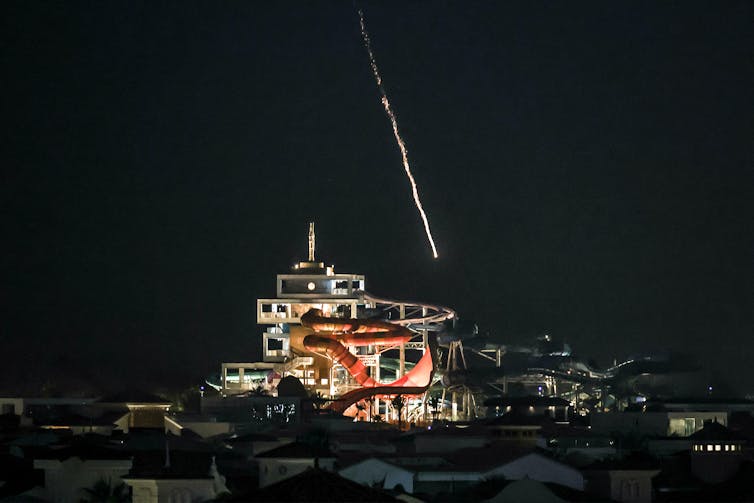
an entertainment building can be seen as a missile falls from the night sky, leaving a trail

An intercepted projectile falls into the sea near Dubai’s Palm Jumeirah archipelago on March 1, 2026. Fadel Senna/AFP via Getty Images

A cornered regime fighting for survival

Ever since the Oct. 7, 2023, attacks by Hamas and other Palestinian militants on Israel, policymakers in the Gulf nations have sought to avoid the regionalization of conflict.

Qatar led the way in mediating between Israel and Hamas, while Oman has done the same with the U.S. and Iran. Meanwhile, Saudi Arabia has maintained regular dialogue with Iran to de-escalate regional tensions.

Each of the successive escalations between Israel and Iran – in April and October 2024 and then in June 2025, with the joint U.S.-Israeli strikes – brought the region closer to, without tipping over into, all-out war.

But Iran’s actions in the opening days following what Washington has named “Operation Epic Fury” have signaled that the comparative restraint it showed during the 12-day war is firmly off the table.

The Islamic Republic is now a cornered regime fighting for its survival. As such, it is lashing out and seeking to spread the pain to regional neighbors. The logic in this approach is that Gulf nations could put pressure on the U.S., which may fear the cascading costs of a prolonged regional conflict.

Gulf nations are also obvious targets for Iran. With Iran lacking the capability to hit the U.S. mainland through conventional weapons, the American military bases that dot the Gulf region are within the reach of Tehran’s ballistic arsenal.

Psychological impact on Gulf nations

The scale of the Iranian attacks on targets in the Gulf nations in the opening two days of the current conflict underscores the extent to which Iran’s response now differs from that of June 2025: In the first two days of the conflict, Iran had fired at least 390 ballistic missiles and 830 drones at the Gulf states. By comparison, the Iranian strike on the Al-Udeid air base in Qatar last year involved 14 ballistic missiles and was a one-off attack on a single target.

Air defense systems in Gulf nations have neutralized most of the incoming Iranian missiles, to date, and actual damage and casualties have been limited to a handful of deaths and injuries in the dozens.

But it is the intangible and psychological impact on Gulf cities under attack that threatens to inflict profound damage on the reputation and image of cities such as Dubai, Abu Dhabi and Doha. In recent years, Gulf Cooperation Council nations have presented the Gulf as an oasis of stability and havens to live and work.

This is especially the case for Dubai, which has marketed itself strongly as a hub for business and tourism. But it is also applicable to other Gulf nations as well, such as Qatar, which relies heavily on a steady stream of large-scale meetings and events.

Iran’s attacks on civilian infrastructure and soft targets – airports in Bahrain, Dubai, Abu Dhabi and Kuwait, and hotels in Bahrain and Dubai – serve to puncture this image of safe and secure Gulf capitals.

This choice of targets by Iran likely reflects a calculation that leaders in the Gulf countries would immediately feel the full impact of the war and push Washington hard to find a resolution and quick.

The subsequent targeting by Tehran on oil and gas facilities, including Ras Laffan in Qatar and Ras Tanura in Saudi Arabia, serves as a further and highly consequential step. It has already triggered a forceful response from Qatar, which shot down two Iranian jets on March 2.

There is concern among Gulf nations that the next step in the ladder of escalation could involve targeting the desalination plants that are so vital to overcoming water scarcity in the region.

Vulnerable to escalation

As critical hubs in the global economy by virtue of their reserves of oil and gas and centrality to international shipping and aviation, the Gulf nations are uniquely vulnerable to further escalation by Iran.

Dubai, Abu Dhabi and Doha have invested heavily in creating airlines that function as “super-connectors” capable of linking any two destinations worldwide with a stop in the Gulf. A Feb. 28 drone strike on Dubai International Airport, the world’s busiest for international travel, illustrated the impact that Iran’s asymmetric responses could have on the global hub model that has come to dominate world air travel.

Already, closure of airspaces over Qatar and the UAE, as well as in Bahrain and Kuwait, has stranded tens of thousands of passengers and created the biggest disruption to global travel since the COVID-19 pandemic.

In addition, cargo operations essential to local supply chains have been heavily impacted, at the same time that seaborne trade through the Strait of Hormuz has been similarly interrupted.

Whereas initial spikes in oil prices and insurance premiums at the start of the 12-day war last year fell away as it became clear that energy infrastructure was not significantly targeted, the opposite has happened this time.

Peril and uncertainty

But the short-term shock to the global economy is not what will be of primary concern to the Gulf Cooperation Council members. Not since the Gulf crisis of 1990-91, with the Iraqi invasion of Kuwait and subsequent Gulf War, has the region faced so much peril and uncertainty.

And that is what Iran’s leaders are banking on. The attacks across the Gulf by Tehran are not, after all, without strategy. The intent is to expand the conflict, thereby significantly raising costs to the U.S. and its partners in the Gulf.

Tehran’s hope is that the economic impact will encourage Gulf leaders to press Trump for an endgame. But in attacking capitals across the region, Iran risks perhaps doing the opposite: rupturing any chance of bettering ties with rivals in the region and instead pushing them further back into Washington’s orbit after a period of drift.

Pentagon strong-armed AI firms before Iran strikes

0
pentagon-strong-armed-ai-firms-before-iran-strikes
Pentagon strong-armed AI firms before Iran strikes

In the lead-up to the weekend’s US and Israeli attacks on Iran, the US Department of Defense was locked in tense negotiations with artificial intelligence (AI) company Anthropic over exactly how the Pentagon could use the firm’s technology.

Anthropic wanted guarantees its Claude systems would not be used for purposes such as domestic surveillance in the US and operating autonomous weapons without human control.

In response, US President Donald Trump on Friday directed all US federal agencies to cease using Anthropic’s technology, saying he would “never allow a radical left, woke company to dictate how our great military fights and wins wars!”

Hours later, rival AI lab OpenAI (maker of ChatGPT) announced it had struck its own deal with the Department of Defense. The key difference appears to be that OpenAI permits “all lawful uses” of its tools, without specifying ethical lines OpenAI won’t cross.

What does this mean for military AI? Is it the end for the idea of “ethical AI” in warfare?

Last week’s events came at what was already a worrying time for AI ethics. The Trump administration last year banned states from regulating AI, claiming that it threatens innovation.

Meanwhile, many AI companies have aligned themselves with the administration, with executives including OpenAI boss Sam Altman making million-dollar donations to Trump’s inauguration fund. (Altman noted at the time that he had also donated to Democratic politicians.)

Anthropic has been less effusive, working on national security while warning that AI can sometimes undermine democracy and that current systems are not reliable enough to power fully autonomous weapons.

Emerging international consensus

Much of the concern around military applications of AI has focused on lethal autonomous weapons systems. These are devices and software which can choose targets and attack them without human intervention.

Just a few years ago, an international consensus about the risks of these weapons seemed to be emerging among governments and technology companies.

In February 2020, the US Department of Defense announced principles for the use of AI across the entire organization: it needed to be responsible, equitable, traceable, reliable and governable. Likewise, in 2021, NATO formulated similar principles, as did the United Kingdom in 2022.

The US plays a unique leading role among its international allies in shaping global norms around military conduct. These principles signalled to countries such as Russia, China, Brazil and India how the US and its allies believed military use of AI should be governed.

Military AI and private enterprise

Military AI has relied extensively on partnerships with private industry, as the most advanced technology has been developed by private companies.

Project Maven, which set out in 2017 to increase the use of machine learning and data integration in US military intelligence, relied heavily on commercial tech companies.

The US Defense Innovation Board noted in 2019 that in AI the key data, knowledge and personnel are all in the private sector.

This is still the case today. However, the norms around how AI should be used are shifting rapidly, both in government and in much of the industry.

Trump and Silicon Valley

When Trump was re-elected in 2024, many in Silicon Valley welcomed the prospect of less regulation. Billionaire venture capitalist Marc Andreessen, author of The Techno-Optimist Manifesto, claimed Trump’s victory “felt like a boot off the throat.”

Joe Lonsdale, cofounder of AI-powered data analytics company Palantir, has been another vocal Trump backer. OpenAI president and cofounder Greg Brockman personally gave US$25 million to a Trump-supporting organization last year.

We are a long way from the days of 2019 and 2020.

AI ethics assumes democratic norms

The question of whether an AI-enabled system is ethical or not is often seen as a question about the technology itself, rather than how it is used.

In this view, with the right design you can make an inherently ethical AI system. This often includes “algorithmic transparency” – being clear and honest about the rules the system uses to make decisions. The idea here is that ethics can be “baked in” to these rules.

The idea of ethical military AI also assumes it is operating under democratic principles. The idea behind algorithmic transparency is that “the people” should know how these systems work, because “the people” ultimately hold power in a democracy.

However, in an autocratic regime it doesn’t matter how transparent the algorithms are. There is no sense that civilians have a stake, and deserve to know what their government is doing, that its activities are in accordance with the law.

Free and public discussion is often seen as a key feature of liberal democracies. While eventual consensus may be valued, constructive disagreement and even conflict can be signs of a healthy democracy.

Decisions and consequences

In this light, Anthropic’s desire to have genuine discussions with the government about ethical red lines is an example of democratic practice in action. The company signalled both a desire for reasoned communication and the value of constructive disagreement.

In return, the Trump administration on Friday labelled Anthropic a “supply chain risk”, a rare designation previously only given to foreign companies, with US Secretary of Defense Pete Hegseth writing that:

effective immediately, no contractor, supplier or partner that does business with the United States military may conduct any commercial activity with Anthropic.

Anthropic plans to challenge the declaration in court, as it may have profound economic and reputational consequences for the company.

Meanwhile, OpenAI has largely conceded that it will have no ethical limits, only legal ones. As a result, it is open for business with the US government – but faces reputational consequences of its own as consumer backlash mounts.

AI in a world without democratic norms

What does it all mean for ethical AI in the military?

One hard-to-avoid conclusion is that if we want military AI to be used in an ethical way – following transparent rules and laws – we need strong democratic norms, which are in peril as the rules-based international order crumbles.

So far, little has changed in practice. Mere hours after Trump’s denunciation of Anthropic, the US launched strikes on Iran – reportedly planned with the aid of the company’s software.

Bianca Baggiarini is lecturer of international relations, Deakin University

This article is republished from The Conversation under a Creative Commons license. Read the original article.

Middle East evacuations on the table if nuclear sites targeted, says UN atomic watchdog head

0
middle-east-evacuations-on-the-table-if-nuclear-sites-targeted,-says-un-atomic-watchdog-head
Middle East evacuations on the table if nuclear sites targeted, says UN atomic watchdog head


The mass evacuation of cities across the Middle East may be necessary if civil nuclear power stations are attacked leading to radiological release, Rafael Grossi, the director general of the IAEA UN nuclear inspectorate, warned on Monday at the opening of the quarterly board meeting of the IAEA.

He admitted “a strong sense of frustration” that an agreement between the US and Iran over Iran’s nuclear program had eluded the parties in their recent negotiations. Grossi had attended the talks providing technical assistance.

Opening the board meeting, he said diplomacy “is hard and never impossible. The use of force has been present in international relations since times in memorial. This s a reality, but it is always the least preferred option.”

“I remain convinced that the lasting solution to this long existing discord lies on the diplomatiic table when it comes to nuclear matters, a crystal clear understanding of the scope and verifiability of an agreement is of the essence.

“Diplomacy is hard, but it is never impossible. Nuclear diplomacy is even more difficult, but it’s never impossible. It is not a matter of if, but of when we will again gather at the diplomatic table. We simply must do so as quickly as possible.”

Turning the impact of the current fighting across the Middle East he said: “We cannot rule out a possible radiological release with serious consequences, including the necessity to evacuate areas as large or larger than major cities.”

“Let me underline that the situation today is very concerning. Iran and many other countries in the region that have been subject to military attacks have operational nuclear power plants and nuclear research reactors, as well as associated fuel storage sites, increasing the threat to nuclear safety.

He added: “The United Arab Emirates has four operating nuclear reactors. Jordan and Syria have operational nuclear research reactors. Bahrain, Iraq, Kuwait, Oman, Qatar, and Saudi Arabia have also been attacked. These countries all use nuclear applications of some sort or the other. We therefore urge utmost restraint in all military operations.”

Discussing Iran’s remaining nuclear installations, he said: “We have no indication that any of the nuclear installations, including the Bushehr nuclear power plant, the Tehran research reactor, or other nuclear fuel cycle facilities have been damaged or hit. Efforts to contact the Iranian nuclear regulatory authorities continue with no response so far.”

Arab Media Split as Gulf States Condemn Iran While Iran-Aligned Actors Denounce US-Israel Strikes

0
arab-media-split-as-gulf-states-condemn-iran-while-iran-aligned-actors-denounce-us-israel-strikes
Arab Media Split as Gulf States Condemn Iran While Iran-Aligned Actors Denounce US-Israel Strikes


Gulf governments emphasize sovereignty and civilian protection as Iran-aligned actors frame the confrontation as external aggression

As Iranian missiles and drones crossed multiple airspaces and the United States and Israel launched coordinated strikes against the Iranian regime, official media across the Arab world moved into crisis mode.

Responses have varied. While Gulf governments have issued sharp condemnations of Iranian attacks on their territory and civilian infrastructure, other Arab actors—including factions aligned with Tehran—have framed the US-Israeli operation as aggression. Between these poles lies a third category: states emphasizing de-escalation while quietly reinforcing air defenses and diplomatic channels. Taken together, the messaging reveals a region recalibrating in real time.

In the Gulf, official outlets have centered their coverage on territorial integrity and civilian protection.

Saudi Arabia’s state news agency, SPA, published statements condemning what it described as “blatant” Iranian attacks and reaffirmed that Saudi territory would not be used as a launch platform against Iran. The framing focused on violations of sovereignty and the right to defend airspace, rather than endorsing the broader US-Israeli campaign.

The United Arab Emirates, through the Emirates News Agency, WAM, and official defense briefings, emphasized successful interceptions of drones and missiles. The tone was operational and technical, stressing containment capacity rather than political alignment.

Qatar’s QNA news agency reported Iranian drone strikes targeting state facilities in Mesaieed and Ras Laffan, noting the absence of casualties while emphasizing the seriousness of targeting critical infrastructure. Editorial commentary in Qatari newspapers described Iran’s actions as an attempt to widen the conflict to “peaceful countries.”

Al Arabiya, a state-owned Saudi outlet, reported that “US, Saudi Arabia and Arab allies slam Iran’s ‘reckless attacks,’ vow self-defense,” emphasizing that the United States and multiple Gulf states issued a joint condemnation of Iranian missile and drone strikes and affirmed their right to defend sovereign territory. Saudi Arabia also summoned Iran’s ambassador over “blatant” Iranian attacks on its territory, reinforcing the diplomatic protest. Gulf states have said they reserve the right to respond to Iranian aggression if necessary.

After Iran’s salvo hit their skylines, will Gulf states enter the war?

Al Jazeera English, a state-supported Qatari outlet, has covered the strikes with a focus on regional impact and strategic uncertainty, noting “explosions across Qatar, UAE, Kuwait as Iran’s retaliatory strikes continue.” In its analysis, Al Jazeera asked, “After Iran’s salvo hit their skylines, will Gulf states enter the war?” reflecting how Gulf capitals are trying to balance airspace defense with avoiding deeper involvement in a conflict they did not initiate.

The New Arab, a London-based, Qatari-owned outlet, reported that “Iran continues to strike Gulf states in retaliation to US-Israel war,” observing that several Gulf capitals that host US military assets have been hit by Iranian missiles or drone barrages. The coverage framed the attacks as part of an escalating conflict spreading beyond the initial US-Israel operation.

Kuwait’s KUNA news agency framed Iranian attacks as violations of international law and the UN Charter, reinforcing a legalistic narrative consistent with prior Gulf responses to cross-border threats.

Bahrain’s BNA amplified regional condemnations and stressed solidarity among Gulf states.

Beyond the political framing, Gulf coverage has also reflected economic concerns. Energy infrastructure, shipping lanes, and liquefied natural gas production facilities have featured prominently in reporting, given the proximity of strikes to strategic export hubs and renewed discussion of risks to maritime routes in the Strait of Hormuz. The economic dimension, while not always foregrounded, helps explain why Gulf outlets have adopted an urgent language of sovereignty.

Still, none of these governments publicly celebrated or overtly endorsed the US-Israeli strike on the Iranian leadership. The support expressed was defensive, not offensive, with the emphasis on protecting national territory and civilians.

Oman, long positioned as a diplomatic intermediary, adopted a more cautious tone. Its Foreign Ministry called for an “immediate halt” to missile strikes across the region while expressing regret over the expansion of military operations.

Muscat’s messaging reflects a balancing act: condemnation of attacks on Arab states alongside resistance to full-scale regional escalation.

In Iraq, official statements condemned the US-Israeli strike and warned against further escalation, positioning Baghdad as wary of regional spillover. The state-owned Iraqi News Agency carried statements from political and militia-linked figures mourning Iranian leadership and describing the strike as aggression, illustrating how segments of Iraq’s official and semiofficial media space framed the event in solidarity with Tehran.

Yemen illustrates the Arab world’s internal fragmentation. The internationally recognized Yemeni government condemned Iranian attacks on Gulf states, aligning with Saudi Arabia and the UAE. In contrast, the Houthi-controlled Saba news agency framed the US-Israeli operation as “American-Israeli aggression,” echoing Tehran’s rhetoric.

That divide underscores how alignment within the Arab world remains closely tied to local power structures and armed-group affiliations.

Lebanon’s government response focused on internal stability. Officials reiterated that only the state can decide on war and peace and signaled an intent to prevent any armed group from launching unilateral attacks from Lebanese territory without government approval. The framing signals concern over regional spillover, not an ideological stance.

Jordan occupies a particularly sensitive position. Iranian drones and missiles have crossed its airspace, and Amman has previously experienced missile debris in populated areas.

Political analyst Amer Sabaileh described the kingdom’s predicament to The Media Line: “Jordan … has always tried to avoid this conflict, but this war scenario unfortunately has a geographical reality that involuntarily involves the kingdom,” he said.

Sabaileh explained that Amman has consistently attempted to position itself as neutral and to avoid becoming a battlefield, even seeking diplomatic engagement with Tehran in recent months.

“Jordanian politics has wanted to send messages to almost everyone to be considered a neutral country … to explain that in the end the Jordanian territory will not be a theater of war by anyone,” Sabaileh noted.

At the same time, he argued that the broader regional architecture Iran has established over recent years is now unraveling. “The concept that Iran has created with the unity of fronts over time against Israel is now living its last days,” he said.

Sabaileh said Israel has spent the past two and a half years, since October 7, gradually weakening those interconnected fronts—in Gaza, the West Bank, Lebanon, Syria, and Yemen—culminating in direct confrontation with Iran itself. “Today, I believe that Israel thinks that this is the right time to get to this confrontation. Since the regime has been weakened and with the help of the US, it is the perfect timing,” he explained.

I believe that we are experiencing a very historic moment and in a couple of months we are going to face a completely new Middle East

He also suggested the timing reflects both regional shifts and internal pressures inside Iran. “I believe that we are experiencing a very historic moment and in a couple of months we are going to face a completely new Middle East,” he said.

On Jordan’s direct security risks, he pointed to years of hostile policy and operational pressure from Iranian-aligned networks. He cited infiltration attempts, weapons and drug smuggling, and the positioning of hostile armed groups along Jordan’s northern border as part of that sustained pressure.

Regarding civilian protection, he said Jordan now has only one choice: to defend its airspace and try to protect its citizens to the maximum capacity of the country.

While emphasizing the experience and preparedness of the Jordanian military, Sabaileh warned of inherent unpredictability in a missile-and-drone environment. “There is always the risk that this is an uncontrollable situation in terms of being able to control the impacts. … Few hits were reported already in Amman and in the north and south of the country, but likely due to debris,” he noted.

He also cautioned that Iran’s ballistic missile capability extends beyond immediate theaters of confrontation. “Ballistic missiles in Iran can threaten everyone, not only in the region but beyond; they can even reach Europe,” he said.

Sabaileh argued that Arab governments’ months-long caution—or silence—on developments in Iran may not last if Iranian strikes keep expanding. “I believe that this silence, little by little, must change … the aggressive Iranian policy towards the Gulf countries and Jordan … will force these countries to adopt a clearer policy towards Iran. The silence over the killings of the regime was a hopeful way to avoid direct confrontation, but now it is evident that it didn’t work,” he explained.

He further warned that escalation may not remain confined to the Middle East. “There is a risk in Europe and in the US with terrorist cells as well … because this regime thinks that by increasing the risk and spreading the chaos all over is the only way to destabilize the entire world while they fall,” he said.

Across official Arab media, three patterns emerge. First, Gulf states are publicly united in condemning Iranian attacks on their territory, emphasizing sovereignty and civilian safety. Second, Iran-aligned actors frame the US-Israeli operation as external aggression. Third, mediator states stress de-escalation while quietly reinforcing defense coordination.

Sabaileh summarized the potential transformation bluntly: “I believe that for the Middle East the 7th of October is like the 11th of September in the world. It is a new reality, and we are witnessing it as we speak,” he concluded.

Whether this escalation remains contained or evolves into a broader confrontation will depend on developments in the coming days. For now, the Arab world is neither uniformly aligned nor entirely divided. It is recalibrating—balancing deterrence, diplomacy, and domestic stability in a moment many officials privately describe as historic.

Apple’s new iPhone 17e has an A19 chip, MagSafe, and 256GB of storage for $599

0
apple’s-new-iphone-17e-has-an-a19-chip,-magsafe,-and-256gb-of-storage-for-$599
Apple’s new iPhone 17e has an A19 chip, MagSafe, and 256GB of storage for $599

Apple’s biggest iPhone announcements usually happen in September, but for the second year in a row, the company is also introducing a new iPhone in March. The iPhone 17e is a new version of Apple’s basic no-frills iPhone, replacing last year’s iPhone 16e. The phone will be available to preorder on March 4 and will be available on March 11, starting at $599.

The new iPhone includes an Apple A19 chip similar to the one in the more-expensive iPhone 17—both phones have six CPU cores, but the 17e only gets four GPU cores instead of five. The phone’s cellular modem is also upgraded, from the original Apple C1 to an Apple C1X capable of faster speeds. Like the A18 in the iPhone 16e, the iPhone 17e also supports Apple Intelligence, implying that it has the same 8GB of RAM as the iPhone 17. Apple says the new Ceramic Shield 2 front glass (also used in the iPhone 17) will be more durable and that the “Apple-designed coating” on the display is three times more scratch-resistant than the coating on the iPhone 16e and better at reducing reflections and glare.

But there are two more-noticeable upgrades that help close the gap between the iPhone 17e and the regular iPhone 17. The first is support for MagSafe charging, a notable omission from the iPhone 16e. The second is an upgrade from 128GB to 256GB of storage in the base model, which makes the $599 version of the phone a more attractive deal. A 512GB version of the phone is available for $799.

The iPhone 17e will support MagSafe, which was notably absent from the 16e.

The iPhone 17e will support MagSafe, which was notably absent from the 16e. Credit: Apple

The 17e comes in three color options: black, white, and a pastel pink. It still includes a USB-C port, a notched display rather than a Dynamic Island, an Action Button, a 6.1-inch 60 Hz OLED display without ProMotion or always-on support, and a single 48 megapixel rear camera (which is still capable of taking 2x telephoto images by cropping a 24 MP chunk out of the middle of the image sensor).

The biggest problem with the iPhone 17e is still that it’s just $200 cheaper than the iPhone 17, which is an exceptionally strong version of Apple’s default phone. That $200 gets you a better main camera, a wide-angle lens, a slightly larger 6.3-inch display with ProMotion support and a Dynamic Island, and marginally faster graphics performance. But the 17e’s 256GB storage upgrade and the new chip do make it more appealing than the $699 iPhone 16, which also lacks a ProMotion display and only has 128GB of storage.

The new phone is part of a string of announcements that Apple is planning in the run-up to a “special experience” event on Wednesday morning. The company also announced a new iPad Air with an M4 chip today and is also widely expected to debut a new low-end iPad and a new MacBook that’s substantially cheaper than the MacBook Air.

Prince William was ‘Ready for War’ Over Kate’s Topless Photo Scandal

0
prince-william-was-‘ready-for-war’-over-kate’s-topless-photo-scandal
Prince William was ‘Ready for War’ Over Kate’s Topless Photo Scandal


Prince William reportedly drew a hard line after topless photos of Kate Middleton were secretly taken and published during the couple’s private 2012 getaway in France.

According to reporting tied to a new royal book, William saw the images as a massive invasion of privacy and was determined to fight back in a way the palace could not ignore. The photos were snapped with long-lens cameras while the couple relaxed at a secluded estate in Provence ahead of an overseas royal tour celebrating Queen Elizabeth II’s Diamond Jubilee.

What should have been a quiet break quickly turned into an international royal crisis when the French magazine Closer published the pictures. The release reportedly sent shockwaves through the palace, with aides describing the moment as one that left William and Kate feeling deeply violated.

Even as the couple continued smiling through official appearances during their trip, behind the scenes William was said to be furious. He reportedly contacted then-Prince Charles and Queen Elizabeth II, pushed for a public statement condemning the publication, and insisted the palace pursue legal action to the fullest extent possible.

The palace soon blasted the publication over what it called a gross breach of privacy, while legal teams rushed to stop the photos from spreading further. But despite those efforts, other European outlets followed, including Italy’s Chi, which reportedly ran an extended spread featuring the controversial images. An Irish edition of the Daily Star also published them.

The scandal became one of the most explosive royal privacy battles in years, with insiders saying William was determined to draw a line in the sand over what was described as monstrous behavior by the press.

In the U.K., the photos were never published. And just months later, the story was largely overtaken by major personal news from the royal couple: Kate’s pregnancy with Prince George. The early announcement came after she was hospitalized with hyperemesis gravidarum, a severe form of morning sickness, making it impossible to keep the pregnancy private.

The legal fight, however, did not end there. In 2017, a French court convicted six people connected to the case, including magazine executives and photographers, over breach of privacy and related charges. Closer was fined 100,000 euros, while additional fines were handed down to the publisher, editor, and photographers. The defendants were also ordered to cover the couple’s legal costs.

At the time, Kensington Palace said William and Kate were pleased with the ruling and considered the matter closed, while making clear they believed it was essential to pursue every legal remedy available.

Post-Khamenei turmoil puts China’s energy security at risk

0
post-khamenei-turmoil-puts-china’s-energy-security-at-risk
Post-Khamenei turmoil puts China’s energy security at risk

Beijing is now placing energy security at the top of its strategic agenda following the February 28 confirmation of Iranian Supreme Leader Ayatollah Ali Khamenei’s death.

China now faces a halt, enforced by Iran’s Revolutionary Guards, to shipping through the Strait of Hormuz – a route through which transits a substantial share of its crude imports. The result will be sharply increased shipping risks, inflated insurance premiums and higher costs of oil deliveries to the world’s largest manufacturing economy.

A potential change of regime in Tehran also threatens the opaque flow of discounted Iranian crude to China, according to some Chinese commentators. 

US sanctions have limited Iran’s official exports, so much of its oil has been sold to China at discounted prices, they say. Without this cheaper supply, many of China’s so-called “teapots” – small and mid-sized independent refineries in Shandong province – would struggle to keep costs low. Energy and manufacturing prices across the economy would rise.

Chinese commentators warn that any regime change, social unrest or civil war in Iran could threaten China’s energy security. They also acknowledged that China has imported Iranian oil via third countries in recent years, and that this supply channel, carried by the so-called “Iranian shadow fleet” of US-sanctioned oil tankers, is now at risk.

“Since 2022, US sanctions have forced China to stop formally disclosing Iranian oil imports in customs data, with shipments instead routed through third countries such as Malaysia,” says a Henan-based columnist writing under the pen name Keke. 

He says China imported about 1.38 million barrels per day of Iranian oil in 2025, roughly 13.4% of its seaborne crude imports, making Iran China’s third-largest supplier after Russia and Saudi Arabia. He added that China buys about 80-90% of Iran’s crude exports.

“Iranian oil is important not only for volume but for price,” he writes. “It is typically discounted by 10 to 20 dollars per barrel compared with global benchmarks. This advantage is crucial for China’s independent refineries, which account for about a quarter of national refining capacity and rely heavily on discounted crude to stay competitive.”

He adds that most Iranian crude is shipped through the Strait of Hormuz, a global oil chokepoint, so any disruption would seriously affect China’s energy supply.

Besides worrying about energy security, China is also concerned that its long-term investment in Iran could be affected if social unrest escalates.

Keeping a cautious distance

All these factors are prompting Beijing to criticize the United States only in high-profile terms while maintaining a cautious distance from deeper involvement in the Iranian crisis.

“The US-Israeli strikes have no United Nations Security Council authorization and violate international law. China is deeply concerned about the regional spillover,” Foreign Ministry spokesperson Mao Ning said at a regular media briefing in Beijing on Monday. “China believes that the sovereignty, security and territorial integrity of the Gulf states should likewise be fully respected. We urge parties to stop the military operations and prevent further spread of the conflict.”

China is one of the five permanent members of the UN Security Council, alongside France, Russia, the United Kingdom and the US. Any of them can veto action, making approval for strikes on Iran highly unlikely.

“The Strait of Hormuz and its adjacent waters are an important international trade route for goods and energy,” Mao Ning said. “To keep the region secure and stable serves the common interests of the international community.” 

She said China urges relevant parties to immediately stop military operations, avoid further escalation and prevent regional turmoil from causing greater damage to global economic growth.

Mao also moved to rebut a Reuters report from February 24 that said a deal for Chinese-made CM-302 missiles for Iran was near completion. 

“The report is not true. As a responsible major country, China always abides by its international obligations,” she said. “China opposes ill-intentioned association and the spread of disinformation, and hopes relevant sides will choose the course of action conducive to de-escalating the tense situation.”

Iranian shadow fleet

China’s reliance on Iranian heavy crude has grown since the US captured Venezuelan president Nicolás Maduro in a January 3 military operation in Caracas, disrupting a major source of discounted heavy crude for China’s teapots.

The Iranian crisis deepened on February 28 when US and Israeli airstrikes killed Khamenei, triggering a widening regional conflict and immediate disruption to oil flows. 

Following the closure of the Strait of Hormuz, Brent crude jumped 7.6% to US$78.41 a barrel early Monday, while US West Texas Intermediate rose more than 7.4%  to US$72.01. 

(The strait’s closure has been too toughly enforced, even from Tehran’s standpoint. On March 1 – by mistake – Iran attacked a tanker under US and EU sanctions near Oman’s Musandam Peninsula, injuring four crew members. The vessel, Skylight, is owned by Sea Force Inc and managed by Red Sea Ship Management LLC. Both Sea Force and Red Sea Ship Management are based in the UAE. Last December, the US Treasury sanctioned both the company and the tanker for operating a shadow fleet transporting Iranian oil in the Persian Gulf.)

According to United Against Nuclear Iran (UANI), a New York-based organization, ghost fleet tankers transported about US$45.7 billion worth of sanctioned Iranian oil to buyers in China last year. The group said the trade relies on ship-to-ship transfers in waters within Malaysia’s exclusive economic zone, with tankers sailing daily through the Malacca Strait and anchoring off eastern Johor with little scrutiny.

Last August, the US State Department sanctioned two China-based oil terminals for assisting in the import of Iranian oil on US-designated tankers. It was the fourth round of sanctions targeting Chinese operators in Iran’s oil supply chain. Last September, the US Treasury sanctioned a network of shipping companies and vessels led by an Iraqi-Kittitian businessman for smuggling Iranian oil disguised as Iraqi crude.

Some Chinese commentators said Pakistan’s Gwadar port has become strategically more important amid the Iranian crisis. Connected to China’s Xinjiang region through the China-Pakistan Economic Corridor, the deep-water port could help bypass both the Strait of Hormuz and the Malacca Strait. In practice, Saudi Arabia could redirect some oil exports through its East-West pipeline to the Red Sea and onward to Gwadar.

US-China relations

The elimination of Khamenei is also politically sensitive for relations between Washington and Beijing, coming only a month before Trump is expected to meet President Xi Jinping in Beijing. Some analysts say China is unlikely to sacrifice ties with the US over Iran.

“China will maintain strategic composure. Despite close China-Iran relations, the likelihood of direct Chinese military involvement is extremely low,” says Zhang Jiuzhen, a Chinese commentator studying at the S. Rajaratnam School of International Studies at Nanyang Technological University. “China will not completely rupture relations with the US over Iran, especially ahead of Trump’s visit.”

Zhang says Beijing is likely to offer Iran diplomatic and limited economic or technical support while maintaining communication with Washington to prevent escalation and preserve room for maneuver if Iran’s political situation changes.

“In 2021, China and Iran signed a 25-year, US$400 billion comprehensive cooperation plan. China is Iran’s largest oil buyer and has invested heavily in its energy and infrastructure projects,” he says. “If the conflict spreads, these projects worth tens of billions of dollars could face suspension, damage or even total loss.”

A Shandong-based writer says China’s top priority now is to minimize losses and protect its core interests in Iran. 

He says China must keep necessary communication with the US to prevent the situation from spiraling out of control and leave diplomatic room for all possible outcomes, including a change of regime in Iran. 

Read: China warns of retaliation as Trump unveils new tariff plan

Follow Jeff Pao on Twitter at @jeffpao3

Research roundup: Six cool science stories we almost missed

0
research-roundup:-six-cool-science-stories-we-almost-missed
Research roundup: Six cool science stories we almost missed

It’s a regrettable reality that there is never enough time to cover all the interesting scientific stories we come across each month. So every month, we highlight a handful of the best stories that nearly slipped through the cracks. February’s list includes the revival of a forgotten battery design by Thomas Edison that could be ideal for renewable energy storage; a snap-on device to turn those boxers into “smart underwear” to measure how often we fart; and a dish of neurons playing Doom, among other highlights.

Reviving Edison’s battery design

An illustration symbolizes new battery technology: Proteins (red) hold tiny clusters of metal (silver). Each yellow ball in the structures at center represents a single atom of nickel or iron.

Credit: Maher El-Kady/UCLA

At the onset of the 20th century, electric cars powered by lead-acid batteries outnumbered gas-powered cars. The internal combustion engine ultimately won out, in part because those batteries had a range of just 30 miles. But Thomas Edison believed a nickel-iron battery could extend that range to as much as 100 miles, while also having a long life and recharging times of seven hours. An international team of scientists has revived Edison’s concept of a nickel-iron battery and created their own version, according to a paper published in the journal Small.

The team took their inspiration from nature, specifically how shellfish form their hard outer shells and animals form bones: Proteins create a scaffolding onto which calcium compounds cluster. For the battery scaffolding, the authors used beef byproduct proteins, combined with graphene oxide, and then grew clusters of nickel for positive electrons and iron for negative ones. The team superheated all the ingredients in water followed by baking them at very high temperatures. The proteins charred into carbon, stripping away the oxygen atoms in the graphene oxide and embedding the nickel and iron clusters in the scaffolding. Essentially, it became an aerogel.

The folded structure limited the clusters to less than 5 nanometers, translating into significantly more surface area for the chemical reactions fueling the battery to occur. The resulting prototype recharged in mere seconds and endured for more than 12,000 cycles, equivalent to about 30 years of daily recharging. However, their battery’s storage capacity is still well below that of current lithium-ion batteries, so powering EVs might not be the most promising application. The authors suggest it might be ideal for storing excess electricity generated by solar farms or other renewable energy sources.

Small, 2026. DOI: 10.1002/smll.202507934 (About DOIs).

Vanishing star became a black hole

In 2014, NASA’s NEOWISE project picked up a gradual brightening of infrared light coming from a massive star in the Andromeda galaxy, an observation that was confirmed by several other ground- and space-based telescopes. Astronomers kept monitoring the star, so they also noticed when it quickly dimmed in 2016. Once one of the brightest stars in that galaxy, it effectively “vanished” from sight; it would be like Betelgeuse suddenly disappearing. It’s now only detectable in the mid-infrared range.

The obvious explanation was that the star was dying and had collapsed into a black hole, but if so, it didn’t go through the supernova phase that usually occurs with stars of this size. That makes it an intriguing object for further study. After analyzing archival data from NEOWISE, a team of astronomers concluded that this was indeed a case for direct collapse, according to a paper published in the journal Science.

Theoretical work from the 1970s provided a possible explanation. As gravity begins to collapse the star, and the core first forms a dense neutron star, the accompanying burst of neutrinos typically creates a powerful shock wave strong enough to rip apart the core and outer layers, leading to a supernova. But some theorists suggested that the shock wave might not always be powerful enough to expel all that stellar material, which instead falls inward, and the baby neutron star directly collapses into a black hole without ever going supernova.

Convection, it seems, is key. It occurs because the matter near the star’s center is hotter than the outer regions, so the gases move from hotter to cooler regions. The authors of this latest paper suggest that as the core collapses, gas in the outer layers is moving rapidly, which prevents them from falling into the core. The inner layers orbit outside the new black hole and eject the outer layers, which cool and form dust to hide the hot gas still orbiting the black hole. The dust warms in response into mid-infrared wavelengths, giving the object a slight glow that should last for decades.

This work has already led the team to re-evaluate a similar star first observed a decade ago, so this may constitute a new class of objects—ones that are harder to detect because they don’t go supernova and because of the faintness of the afterglow. At least now astronomers know to look for that distinctive signature.

Science, 2026. DOI: 10.1126/science.adt4853 (About DOIs).

Smart undies measure the gas you pass

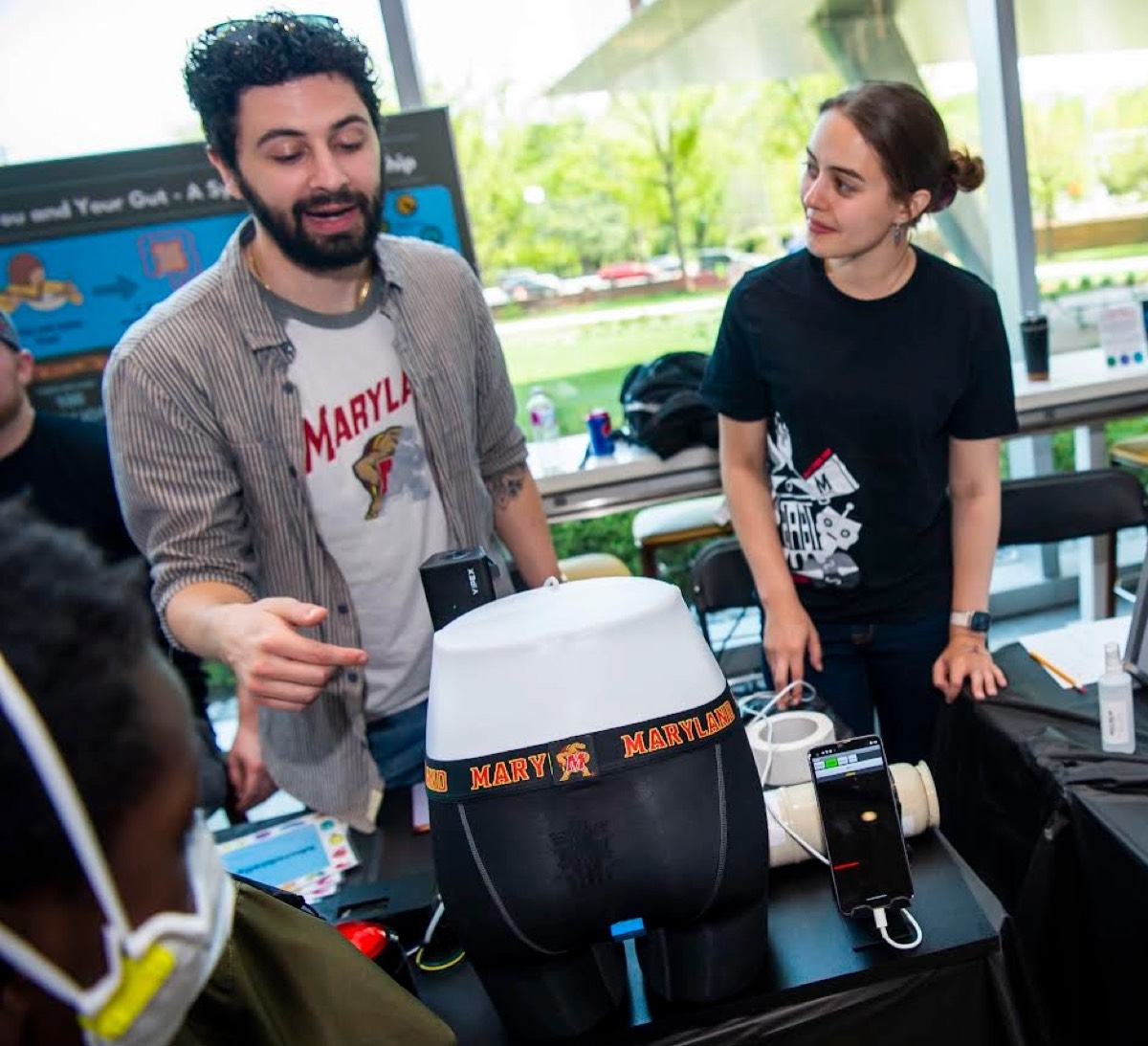
research team demos a prototype of the Smart Underwear.

Credit: University of Maryland.

Let’s face it, everybody farts, and those suffering from conditions that produce excess gas fart more than most. But physicians don’t have a reliable means of quantifying just how much gas people produce each day. In other words, they lack a baseline of what is normal—like we have for blood glucose or cholesterol—which makes it difficult to determine whether the farting in any given case is excessive. To address this, scientists at the University of Maryland have devised “smart underwear” to measure the wearer’s flatulence, according to a paper published in the journal Biosensors and Bioelectronics.

Brantley Hall and his cohorts developed a small device with electrochemical sensors that snaps onto one’s underwear; those sensors track any emitted farts around the clock, including as the wearer sleeps. In the past, fart frequency relied on small studies using invasive methods or unreliable self-reports. So perhaps it’s not surprising that Hall et al. recorded much higher farting estimates in their study: healthy adults pass gas on average 32 times per day, compared to just 14 times per day reported in past studies.

There was also considerable variation among individuals, with a lowest fart rate of just four times per day and a highest rate of 59 per day. This is a first step to determining a healthy baseline, which the team hopes to do via their Human Flatus Atlas program. People can volunteer to don the smart underwear 24/7 in hopes of correlating the flatulence patterns with diet and microbiome composition across a much larger sample size. You can enroll in the Human Flatus Atlas here; you must live in the US and be 18 years or older to participate. (Fun bonus fact: noted gastroenterologist Michael Levitt was apparently known as the “King of Farts” because of his extensive body of research on the subject.)

Biosensors and Bioelectronics, 2026. DOI: 10.1016/j.biosx.2025.100699 (About DOIs).

Do you wanna build a snowman?

This image was taken by NASA's New Horizons spacecraft on Jan. 1, 2019 during a flyby of Kuiper Belt object 2014 MU69, informally known as Ultima Thule. It is the clearest view yet of this remarkable, ancient object in the far reaches of the solar system – and the first small

Credit: NASA/Public domain

Just past Neptune lies the Kuiper Belt, a band littered with remnants from the early formative period of our Milky Way, including dwarf planets and smaller bodies known as planetesimals. Roughly 10 percent of those planetesimals consist of two connected spheres resembling a rudimentary snowman, called contact binaries. In a paper published in the Monthly Notices of the Royal Astronomical Society, Michigan State University researchers reported evidence for a process by which these contact binaries may have formed.

Planetesimals are the result of dust and pebbles gradually packing together into aggregate objects in response to gravity, much like forming a snowball. Every now and then, these nascent objects get ripped in two by the rotating cloud and form two separate planetesimals that orbit each other. Most theories of how the unusual snowman-shaped contact binaries formed rely on rare events or exotic phenomena, which would not account for the large number of contact binaries that we observe.

Prior computational simulations modeled colliding objects in the Kuiper Belt as fluid-like blobs that merged into spheres, but this did not result in conditions conducive to forming the snowman configuration. These new simulations retained the colliding objects’ strength and allowed them to rest against each other. This revealed that after two colliding planetesimals begin to orbit one another, gravity causes them to spiral inward until they eventually make contact and fuse. Because the Kuiper Belt is relatively empty, it is rare for the contact binaries to crash into another object, so they are less likely to break apart.

Monthly Notices of the Royal Astronomical Society, 2026. DOI: 10.1073/pnas.1802831115  (About DOIs).

Is this carved rock a Roman board game?

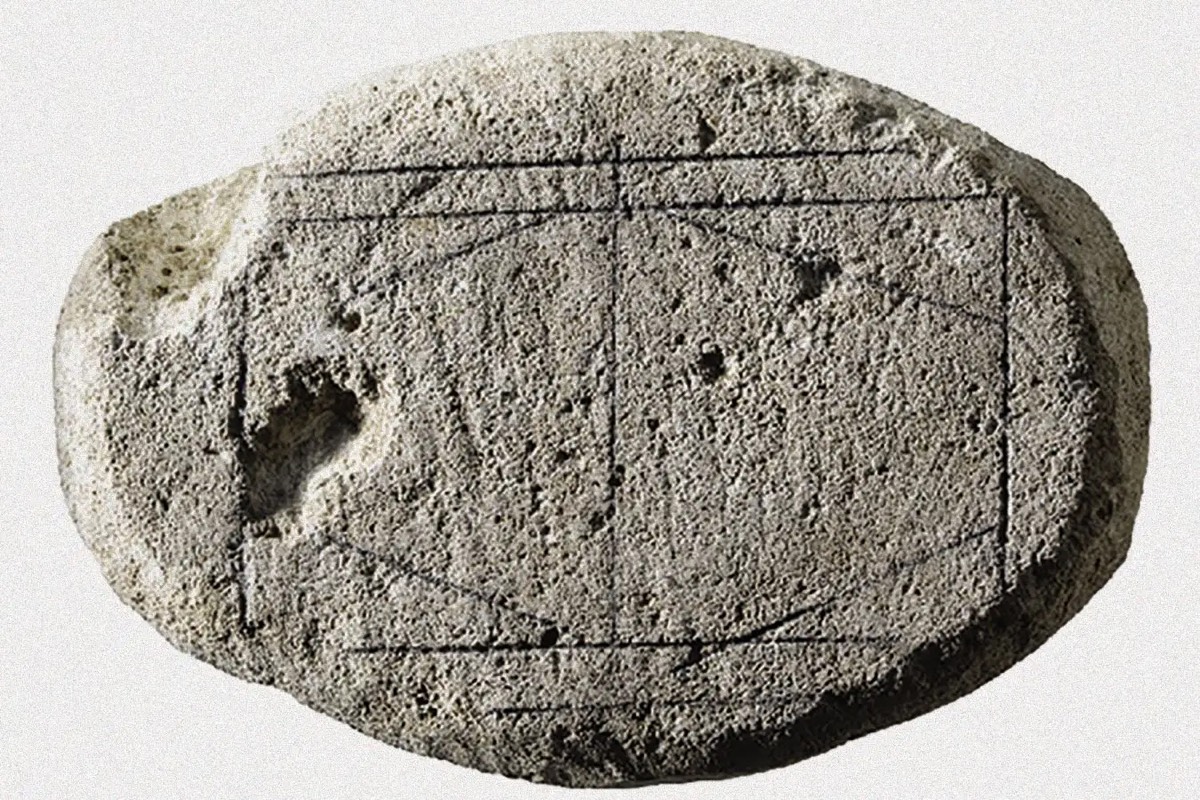
image of a carved rock, he possible game board with pencil marks highlighting the incised lines

Credit: Het Romeins Museum

There is archaeological evidence for various kinds of board games from all over the world dating back millennia: Senet and Mehen in ancient Egypt, for example; a strategy game called ludus latrunculorum (“game of mercenaries”) favored by Roman legions; a 4,000-year-old stone board discovered in 2022 that just might be a precursor to an ancient Middle Eastern game known as the Royal Game of Ur; or a Bronze Age board game that might be the earliest form of Hounds and Jackals, originating in Asia, which challenges the longstanding assumption that the game originated in Egypt.

There may be other ancient games that archaeologists still don’t know about, nor is it always possible for them to tease out what the rules of play might be. AI is emerging as a useful tool for determining the latter. Most recently, researchers have used AI tools to work out the rules of what they believe might be another ancient Roman game board, according to a paper published in the journal Antiquity. The object in question is a flat stone housed in the Roman Museum in Heerlen, the Netherlands, with a distinctive geometric pattern carved on one side. Walter Crist of Leiden University noticed some visibly uneven wear consistent with pushing stone game pieces across the surface, with the most wear along one particular diagonal line.

Crist thought this might be a Roman game board and decided to pit two AI agents against each other in thousands of “games” to test different variations in possible rules, gleaned from known ancient board games from around the world. Crist and his co-authors identified nine possibilities, all so-called blocking games, in which a player with more pieces tries to stop their opponent from moving. They have dubbed this potentially new game Ludos Coriovalli. There is not yet any means of knowing for sure, since no other carved slabs with that particular pattern have been found, but it might be a prototype game, per Crist.

Antiquity, 2026. DOI: 10.15184/aqy.2025.10264 (About DOIs).

Brain cells in a dish play Doom

In 2022, a company called Cortical Labs managed to get brain cells grown in a dish—dubbed DishBrain—electrically stimulated in such a way as to create useful feedback loops, enabling them to “learn” to play Pong, albeit badly. This provided intriguing evidence that neural networks formed from actual neurons spontaneously develop the ability to learn. Now the company is back with a video (see above) showing DishBrain playing Doom—technically the open-sourced Freedoom, which lacks some of the copyrighted demon and weapon elements.

Like four years ago, we’re talking about a dish with a set of electrodes on the floor. When neurons are grown in the dish, these electrodes can do two things: sense the activity of the neurons above them or stimulate those electrodes. But the team has added a new interface that makes the system easier to program, using Python. Teaching DishBrain to play Pong took years of painstaking effort; getting it to play Freedoom took just one week—a significant improvement.

DishBrain still can’t come close to matching the performance of the best Doom players, but it learned faster than conventional silicon-based machine learning. But it’s also not comparable to a human brain. “Yes, it’s alive, and yes, it’s biological, but really what it is being used as is a material that can process information in very special ways that we can’t re-create in silicon,” Brett Kagan of Cortical Labs told New Scientist. In fact, in 2024, scientists taught hydrogels—soft, flexible biphasic materials that swell but do not dissolve in water—to play Pong, inspired by the company’s earlier research. (Hydrogels can also “learn” to beat in rhythm with an external pacemaker, just like living cells.)

Democratic Leaders Avoid Criticizing Trump’s Iran War. Now Voters Will Have a Say.

0
democratic-leaders-avoid-criticizing-trump’s-iran-war-now-voters-will-have-a-say.
Democratic Leaders Avoid Criticizing Trump’s Iran War. Now Voters Will Have a Say.


If Democratic voters wanted party leaders to give a strong, unanimous condemnation of President Donald Trump’s war on Iran, they would probably be disappointed. Leaders of the liberal party have instead sought to criticize the process leading up to Trump’s multiday onslaught, rather than the onslaught itself.

Soon enough, however, primary elections will give voters their say on that approach.

Starting Tuesday, a series of primaries will serve as referenda on candidates who have either given ambivalent responses to the war or who have drawn past support from the American Israel Public Affairs Committee, the pro-Israel lobbying flagship that backed Trump’s strikes.

The first big test will come in North Carolina, where Democratic Congressional Campaign Committee-backed incumbent Rep. Valerie Foushee is under attack from challenger Nida Allam over prior ties to AIPAC.

Allam, a Durham County commissioner hoping to topple Foushee in the 4th Congressional District, chose to make the U.S. strikes on Iran the subject of her final pitch to voters in a video ad where she condemned the war.

“I have opposed these forever wars my entire career.”

“I will never take a dime from defense contractors or the pro-Israel lobby,” Allam said. “I have opposed these forever wars my entire career, and I hope to earn your vote to be your proudly uncompromised pro-peace leader in Washington.”

Taking heat from Allam, Foushee says she also opposes the war.

“I will go on record right now: I do not support Trump’s illegal war with Iran and will do everything I can in Congress to support War Powers Resolutions to stop it,” Foushee said on social media Saturday morning, hours after the bombs began dropping.

A super PAC affiliated with AIPAC gave Foushee crucial support during her 2022 race. With the lobbying group’s brand becoming increasingly toxic within the Democratic Party, she has sworn off support from the organization this time around — but a group tied to an AIPAC donor has nonetheless flooded the race with ads on her behalf.

The North Carolina candidates’ stances reflect the overwhelming sentiment of Democratic voters, according to a pair of polls conducted over the weekend. Only 27 percent of Americans and 7 percent of Democrats approve of the attacks, according to a Reuters/Ipsos poll that lined up with the results of a Washington Post survey.

Avoiding the Underlying Issue

Democratic leaders in Congress have taken a different tack. Before the strikes, they dragged their feet on forcing a vote on a war powers resolution meant to block launching strikes without congressional approval.

After the attack, many top Democrats criticized Trump’s decision to launch the war without congressional approval, while being vague on the substantive question of whether it was right to go to war.

House Minority Leader Hakeem Jeffries, D-N.Y., for instance, tied the attacks to the Democratic campaign theme of affordability and blasted Trump for failing to ask Congress for approval.

Senate Minority Leader Chuck Schumer, D-N.Y., has also stopped short of directly criticizing the idea of attacking Iran. In his statement, he invoked the threat of Iran attaining nuclear weapons, cited the public’s fear of “another endless and costly war,” and called on Congress to pass a war powers resolution.

Those positions allow Democratic leaders to focus their criticism on Trump’s violation of the U.S. Constitution, which grants Congress the sole power to declare war, rather than the underlying issue of whether the war is warranted.

Democrats should be doing more than merely criticizing the process leading up to the war, said Hannah Morris, the vice president of government affairs for J Street, a liberal pro-Israel group that is lobbying members of Congress to support a war powers resolution that blocks Trump from launching further attacks without congressional approval.

“This is not just about process, this is about a reckless war by choice.”

“Process plus. This is not just about process, this is about a reckless war by choice, and it completely flies in the face of what President Trump ran on,” Morris told the Intercept.

One congressional candidate was blunt in her critique of the response from Democratic leaders.

“As we plunge headlong into another catastrophic war, Sen. Schumer and Rep. Jeffries’ throat clearing and process critique only serves Trump and the war machine. Democrats should speak clearly and with one voice: no war,” said Claire Valdez, a state assembly member who is running in New York’s 7th Congressional District with the blessing of New York City Mayor Zohran Mamdani.

Only a few Democratic members of Congress have given their outright support to the war — most notably Sen. John Fetterman, D-Pa.

Even in congressional races where none of the candidates have given the war their blessing, however, there have important distinctions in whether they focus Trump’s wrecking ball approach to the Constitution or the wisdom of the war itself.

In Illinois, a Democratic primary election in the 9th Congressional District on March 17 will give voters a test on whether they want candidates more forthrightly opposed to the conflict.

State Sen. Laura Fine, a top candidate in that race who has drawn the backing of AIPAC donors, supported Israel’s attacks on Iranian nuclear facilities last year. She was one of the candidates centering Trump in her response to the attack over the weekend.

“Donald Trump is leading us into another military conflict to distract from his own failures that puts American lives at risk and threatens to send the Middle East into further chaos,” she said. “He simply cannot be trusted and must be impeached.”

Two candidates vying for the progressive vote, Daniel Biss and Kat Abughazaleh, have both come out against the war. Biss called it “reckless and illegal.” Abughazaleh, a social media influencer, also called out Democrats who were willing to go along with the attacks in a video post.

“The problem is that many lawmakers on both sides of the aisle love playing into the idea of Iran as a boogeyman, and so they’re willing to bomb them to hell. Especially if it lines their pockets or gets them more donors from the military–industrial complex,” she said.

In Maine, firebrand oyster fisher Graham Platner was far ahead of popular two-term Gov. Janet Mills in a recent primary poll.

Platner, a Marine combat veteran, called an emergency protest over the weekend and called the war “tragic, stupid, ill-conceived.”

In her statement, Mills criticized Trump’s “unilateral” decision to go to war while adding that Iran could not be allowed to develop a nuclear weapon.

“The American people have had enough of forever wars,” Mills said, “that put the lives of American servicemembers and civilians in danger, that do not protect the American people, that hurt our alliances and escalate global tensions.”

Oil surges 8% as Iran conflict disrupts Middle Eastern flows

0
oil-surges-8%-as-iran-conflict-disrupts-middle-eastern-flows
Oil surges 8% as Iran conflict disrupts Middle Eastern flows


Oil surged 9% on Monday after retaliatory Iranian attacks disrupted shipping in the crucial Strait of Hormuz following the weekend’s bombing by Israel and the United States that killed Iranian Supreme Leader Ali Khamenei.

A sustained jump in prices would threaten a global economic recovery, spur inflation and could push up U.S. retail gasoline prices, a risky result for President Donald Trump ahead of midterm elections this November.

The price surge on the restart of trading after the weekend, however, was less than some analyst predictions.

Brent crude futures rose as much as 13% to $82.37 a barrel, their highest since January 2025, before retreating to trade up $6.00, or 8.2%, at $78.87 a barrel by 0919 GMT.

U.S. West Texas Intermediate crude climbed to an intraday high of $75.33, up more than 12% and its highest since June, though it later pared gains and was up $5.15, or 7.7%, at $72.17.

“The latest move reflects uncertainty around the scale and duration of the current conflict and recognises that Iran’s political future may have major implications for the stability of the Middle East,” said James Hosie of Shore Capital.

On Sunday, some analysts had predicted oil would open on Monday at over $90 a barrel and closer to $100.

Prices jumped as an exchange of counterattacks damaged tankers and disrupted shipments in the Strait of Hormuz between Iran and Oman that connects the Gulf to the Arabian Sea.

On a typical day, ships carrying oil equal to about one-fifth of global demand from Saudi Arabia, the UAE, Iraq, Iran, and Kuwait sail through the Strait along with tankers hauling diesel, jet fuel, gasoline and other fuels from their refineries to major Asian markets including China and India.

More than 200 vessels including oil and liquefied gas tankers have dropped anchor outside the Strait, shipping data showed on Sunday. Three tankers were damaged and one seafarer was killed in attacks in Gulf waters.

PRICES PARE GAINS

Oil pared gains after its steep surge in early Asian trade, a move that analysts attributed to buyers already factoring a risk premium into prices in anticipation of the conflict.

Brent had risen over 19% this year until Friday’s close, while WTI was trading about 17% higher.

“Markets are acknowledging the seriousness of the conflict, but are also signalling that, for now, this is a geopolitical shock, not a systemic crisis,” said Priyanka Sachdeva, senior analyst at Phillip Nova.

OPEC+ agreed on Sunday to an oil output boost of 206,000 barrels per day for April. Every OPEC+ producer is essentially producing at capacity except for Saudi Arabia, RBC Capital analyst Helima Croft said.

The International Energy Agency is in touch with major producers in the Middle East, director Fatih Birol said on Sunday. The energy watchdog coordinates the release of strategic petroleum reserves from developed countries during emergencies.

Globally, visible oil inventories stood at 7.827 million barrels, enough for 74 days of demand, which is near a historical median, Goldman Sachs wrote in a note.

Citi analysts expect Brent to trade between $80 and $90 a barrel this week amid the ongoing conflict.

“Our baseline view is that the Iranian leadership changes, or that the regime changes sufficiently as to stop the war within 1-2 weeks, or the U.S. decides to de-escalate having seen a change in leadership and set back Iran’s missiles and nuclear program over the same timeframe,” Citi analysts led by Max Layton wrote.

Analysts are also warning retail gasoline prices in the U.S., the world’s biggest fuel consumer, may break above $3 a gallon because of the conflict, a potentially risky result for Trump and his Republican Party ahead of midterm elections.

U.S. gasoline futures surged by as much as 9.1% to $2.496 a gallon, their highest since July 2024, and were last up 4.3%.

Source:  Reuters

0FansLike
0FollowersFollow
0FollowersFollow
0SubscribersSubscribe
- Advertisement -
Google search engine

Recent Posts