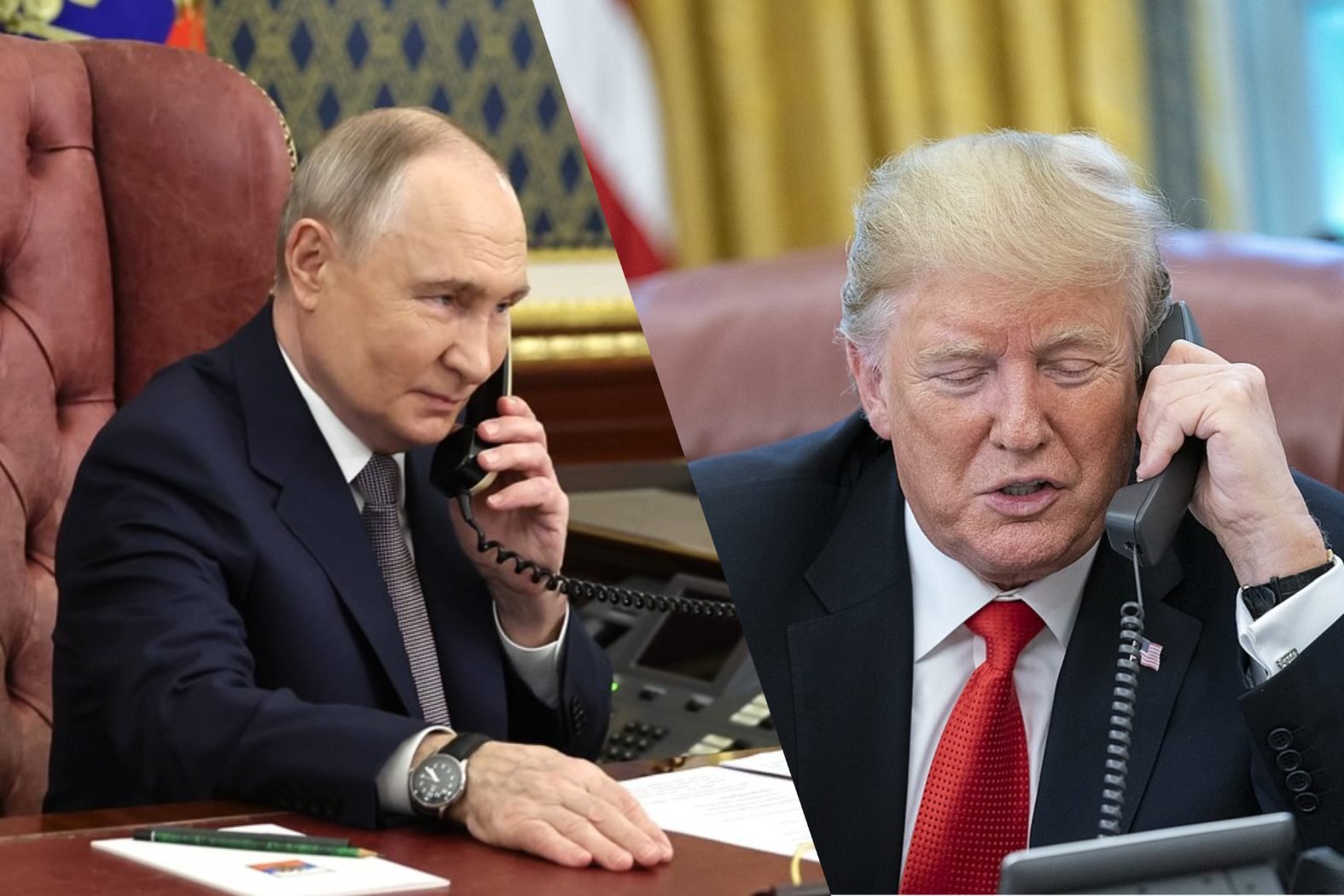
President Donald Trump telephoned Russian President Vladimir Putin on Monday, March 10. In the hour-long conversation the two leaders discussed the Iran and Ukraine conflicts. Trump told Putin he wants to see progress on a Ukraine settlement.
Putin surely understood that President Trump was speaking from a strong position in light of the tremendous success so far in Iran (something Russian propaganda is trying to falsify, pushing the absurd idea that the US and Israel are losing.)
According to news reports, and the little we actually know about the conversation, apparently Trump told Putin that the Iran war was likely to end soon as a result of overwhelming US and Israeli firepower, and that it was time to end the fighting in Ukraine. Putin, Russian sources said, offered a mediatory role with Iran. we don’t know what he told Trump about Ukraine.
Ukraine has been a bit on the back burner since the start of the Iran hostilities. There are, however, some emerging trends that could lead to a settlement, although we are still far from one at present.
The Ukrainians have cut off Russia’s Druzhba oil that transits Ukraine, causing serious problems for Hungary and Slovakia. Hungary is in the midst of presidential elections and Hungary’s Orban is strongly opposed by the EU and Ukraine, but one result is that Hungary (and now, possibly Slovakia) are blocking a $98 billion “loan” to Ukraine. The Druzhba blockade, therefore, may backfire on both the EU and Ukraine.

The map of the Druzhba pipeline. Photo: Savchenko Review @ X
Meanwhile, Ukraine’s infrastructure is still being pounded by Russian air strikes, the latest attacks on gas distribution in the Odessa area. Europe has responded by sending additional electricity to Ukraine and providing diesel-powered generators to keep key facilities running.
While Russia continues to carry out infrastructure strikes, the war itself is not going well for Russia. With over 700,000 troops committed over a nearly 1,000-mile line of contact, Russian forces have been tied down by Ukrainian drones and excellent targeting work by NATO, strengthened by superb battlefield communications thanks to Elon Musk’s Starlink system.
Russia’s battle strategy is based on a slow building of small and large cauldrons to partially surround Ukrainian forces and cut off their supply lines. Ukraine’s drone strategy coupled with NATO intelligence has weakened the Russian approach, making it difficult for Russia to stop Ukraine from supplying its forces, and hard for Russian troops to complete a cauldron because of incessant drone attacks.
In turn, the slowdown has enabled Ukraine to move its reserves around, pretty much at will (suggesting Russian intelligence is not too good, or Russia lacks the possibility of stopping Ukraine’s reserve movements), so it is very hard for Russia to focus its operations on any target.
Consequently, Russia’s war effort is being diluted and the Russian army does not seem to have in hand any immediate solution.
The fallout is that Russia’s strategy of wearing down the Ukrainian army until it collapses, which was working, now looks less effective. What this means is that Ukraine has time to rebuild its forces while fighting.
It is not clear what Putin actually knows about the war, but even he can figure out that there is little chance right now for Russia to defeat Ukraine’s army or force Kyiv into any capitulation, even a partial one. So the practical question for the Kremlin is what is next.
Russia can persist in banging away at Ukraine, hoping that Europe will run out of guns and America will be unwilling to keep selling arms to Ukraine (with European funding). But the Iran war may have changed the equation that Russian planners hoped would solve their problem.
The Iran war, at least so far, suggests that the US is aggressive and unlikely to tolerate the blood letting in Ukraine for long. Consequently, at any moment Trump could give up on any possible Ukraine deal, consider cooperation with Russia a dead end, and throw American resources more boldly into the conflict, especially US air power.
The collapse of Russian and Chinese air defenses in Iran is bad news for Russia when it comes to Ukraine.
All of this leads to the question of reinvigorating the Ukraine negotiations. At the present time, Russia and Ukraine are at loggerheads. Ukraine wants a ceasefire and won’t compromise on territory. Russia wants recognition of its claim to the five territories it has annexed (Crimea, Kherson, Zaphorize, Donetsk and Luhansk) including their traditional borders.
The US and Russia have discussed buffer zones and other similar ideas, but without Ukraine’s agreement, and with a hardline set of Russian demands, seemingly there is nowhere to go.
The US also has tried to sweeten the pot, vis a vis Russia, by offering various economic incentives, but at least so far that has not been enough to sway Moscow to reconsider its demands.
This leaves the US with little it can do, since the Russian demands go too far and make it impossible for any Ukrainian leader to accept.
It is unfortunate some creative intermediate solutions are not on the table. The most important of these is territorial. Is there a solution that allows Russia to keep effective control of some territories for a period of time, followed by a series of arrangements that permit economic reintegration with Ukraine and other humanitarian measures? A deal like this could be offset by Ukraine removing restrictions on Russian cultural expression in Ukraine, including agreeing to protect the Russian Orthodox church.
If Russia was more flexible in its demands, Ukraine’s case to hold the line in an uncompromising manner would be weakened, and European enthusiasm for continuing the war also might be impacted.
The US has considerable leverage, not only in the big stick of military intervention without any deal, to the more pliable and sensible linkage of existing sanctions tied to performance in reaching a negotiated solution.
Europe itself is in a precarious position. Some, like the British and French, can’t continue to complain about the US-Israel war with Iran while at the same time promoting the war in Ukraine.
The argument that Russia is a military threat to Europe is undermined by what has happened in Ukraine. While Russia has a large army, it is not large when NATO forces are combined, assuming US participation. The Russian air force has not been up to snuff in Ukraine, and its navy has frequently been victimized by Ukrainian drones and missiles. More to the point, Russian air defenses are poorly integrated and vulnerable to US and allied stand off weapons, jammers, and stealth assets, as Syria and Iran amply demonstrate.
Russia also is facing a communications crisis. The Russians have no system that comes close to matching Starlink, and the Russian army is relying on Telegram, a social media app, for critical communications. As the Russian government knows, this is a major vulnerability.
Worse still, Russia is a technological backwater. When your weapons are full of foreign parts, some Chinese and some American, you risk an uncertain supply chain for your own national security. In a bigger conflict, there is no assurance China will continue to ship supplies to Russia, nor is it likely the black and gray markets would survive if the US actually tried to shut them down.
Putin needs to make a choice on where to go. He can end the Ukraine war on more or less favorable terms, provided Russia takes a more flexible approach, or tough it out with burgeoning losses and casualties and face the loss of markets for Russian products, especially oil.
Trump picked a good time to call Putin. What we don’t know is whether the Russians will really listen.
Senior Asia Times correspondent Stephen Bryen is a former US deputy under secretary of defense. This article first appeared on his Substack newsletter Weapons and Strategy.