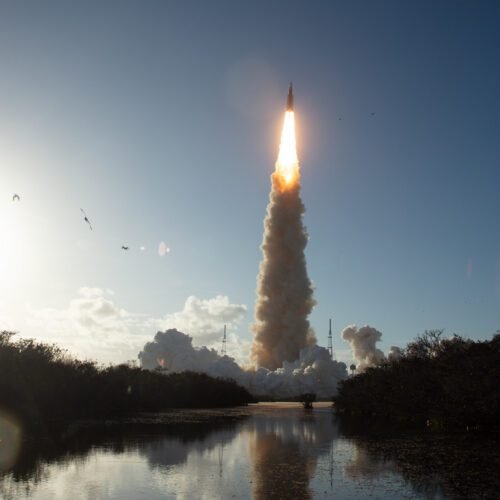
KENNEDY SPACE CENTER, Fla.—The first time NASA launched humans toward the Moon, in December 1968, the United States was a deeply fractured nation.
The historic flight of three people into the unknown brought a measure of solace to a country riven by assassinations, riots, political discord, and a deeply unpopular foreign war.
If history does not repeat itself, it certainly rhymes. Today, four humans are on the way to the Moon, Reid Wiseman, Victor Glover, Christina Koch, and Jeremy Hansen. They do so, once again, amid a troubled world.
Will Artemis II have a similar impact? Does it even matter?
Artemis II was not a global event
The world of today is, of course, incredibly different from that of the 1960s, especially the landscape of media competing for public attention. Just three US television networks graced the airwaves then, compared to hundreds today and a bazillion more online through viewing options like YouTube and social media. And increasingly, younger generations are as interested in creating content as they are in consuming it.
The world population in 1968 was about 3.5 billion people, or a little less than half of today’s. Yet an estimated one-quarter of them watched broadcasts from the Moon. The stunning “Earthrise” photo, which poetically illustrated how humanity was all in this together, captured worldwide attention.
We don’t have concrete viewer numbers of the Artemis II launch. Based on preliminary estimates, though, the total viewership of NASA’s livestream reached about 16 million people, with perhaps that many more watching television broadcasts and online streams. Undoubtedly millions of people will see snippets on social media accounts. But by any measure, the launch of Artemis II does not seem to have been a global event.
Anecdotally, it also does not appear that the Artemis II launch captured the cultural zeitgeist. My wife is interested in space; she kind of has to be given that she’s married to a space nerd. She’s been to launches. She listens to me ramble on about the things I’m writing about. She’s invested in the personalities in this zany industry. But when I asked whether her friends were aware that NASA was launching people to the Moon this week, she said the answer was mostly no.
We also had a conversation about why NASA was flying this mission at all. If we’ve already been to the Moon, why is it a big deal if we’re flying back after so long? She genuinely wanted to understand.
Why are we doing this again?
Following Wednesday evening’s launch, NASA Administrator Jared Isaacman quipped about the long break in human flights to the Moon since Apollo 17. “After a brief 54-year intermission, NASA is back in the business of sending astronauts to the Moon,” he said at a post-launch news conference.
Humor aside, the space agency has struggled to deal with the widespread sentiment that NASA has “been there, done that” with the Moon. And it’s a legitimate question. In the 1960s, NASA had a clear purpose: beat the Soviets to the Moon and claim an important geopolitical victory.
What’s the purpose today?
History does indeed rhyme. NASA, and various presidential administrations, have struggled for more than three decades—dating to the administration of the first George Bush—to design, fund, and execute a cohesive program for human exploration of deep space. The first Trump administration, with NASA Administrator Jim Bridenstine, did a credible job of putting NASA’s near-term focus properly on the Moon and building an international coalition to accomplish that. But Bridenstine’s Artemis program lacked funding and a clear vision for what we would do on the Moon. This persisted through the Biden administration.
It’s only in the last year that the threat of China landing humans on the Moon before the United States has become a clear and present danger to US supremacy in space, and this reality has become widely accepted by the politicians in Congress who write space policy.
China’s rise and the timely arrival of Isaacman as NASA’s leader have allowed him to forge an alignment between the White House and Congress, including bipartisan elements, to get NASA and its contractors moving. In short order, Isaacman has turned up the heat on the SLS rocket and Orion spacecraft programs and pushed to eliminate roadblocks that have slowed commercial contractors. He has eliminated superfluous programs such as the Lunar Gateway and Exploration Upper Stage, and he told NASA’s workforce to bend all their efforts toward the lunar surface.

For the first time since I’ve been covering the space agency, it has exceptionally clear marching orders for a return to deep space, a path to execute them, and a leader who (sorry, I can’t resist) is all ears regarding concerns and suggestions for breaking down barriers. Isaacman and his team appear to want to hear about problems so they can solve them, not sweep them under the rug for someone else to find later.
Maybe it doesn’t matter if the public cares
At the beginning of 1968, the administration of Lyndon B. Johnson told the American public that the communist forces in Northern Vietnam were weak and that the American-backed South was winning the war. Then came the Tet Offensive at the end of January. In the middle of the year, the assassinations of Martin Luther King and Robert F. Kennedy spurred further disquiet. College campuses and cities were covered in protests.
Humanity’s first visit to the Moon came as a tonic. As they basked in the gray glow of Luna, the astronauts were not enthralled so much by the mysterious surface as by their newfound perspective on home. During the Christmas Eve broadcast, Jim Lovell tried to express what it felt like to watch the Moon fly by, saying, “It makes you realize just what you have back there on Earth.”
When they returned, much of the world cheered. A divided America was given a reason to feel pride in itself.
It would be naive to expect such an effect across a similarly divided country today. I believe interest in Artemis II will pick up with ongoing news and social media mentions of mission highlights, including Thursday evening’s translunar injection and the undoubtedly cool moments as the crew flies by the Moon on Monday. These are exceptional people doing brave things, and it’s easy to cheer them on. By the time the mission reaches its crescendo during the return through Earth’s atmosphere on April 10, certainly the most nerve-racking portion of the mission, I expect a much larger audience.
But still, the United States is at war. A significant part of the population is very unhappy with a president who will undoubtedly bask in the glow of Artemis. In the end, success with Artemis II may provide a short blip of public bonhomie, but I don’t expect it to last. And with the turbulent news cycle of 2026, I expect Artemis II to be largely forgotten by most Americans before the end of April.
And you know what? That’s totally fine. If we do this Moon stuff right, the public does not need to really understand what is happening.
Although there are parallels between Apollo and Artemis, and the years 1968 and 2026, when we look deeper, there are meaningful differences in Artemis that most Americans won’t grasp. That’s fine, too, because most polls show that as many as 90 percent of Americans don’t care about returning to the Moon or establishing a presence there.
For far too long, NASA hoped in vain that if it showed competence, Congress would bend to a mythical public will and double or triple agency funding for a deep space program. That was never happening, and it probably never will. So NASA has had to find a new way by bringing on commercial and international partners.
Artemis only works because private companies like SpaceX, Blue Origin, and Axiom Space are trying to make a business out of spaceflight and are investing in it big-time. We still don’t know whether they’ll succeed. But NASA and Artemis will only go as far—and last as long—as the companies working with it to make access to the Moon cheaper and more frequent. Lower costs enable a sustainable, long-term lunar future. Repeating Apollo has been a non-starter for decades.
The good news is that NASA, its political stakeholders, and commercial partners are fully aligned on these goals. For once, everyone is more or less rowing the boat in the same direction, with a determined coxswain at the front. No longer are politics or funding the real hurdles facing NASA. Instead, it will come down to execution.
Seeing a successful opening to the Artemis II mission is a good start.