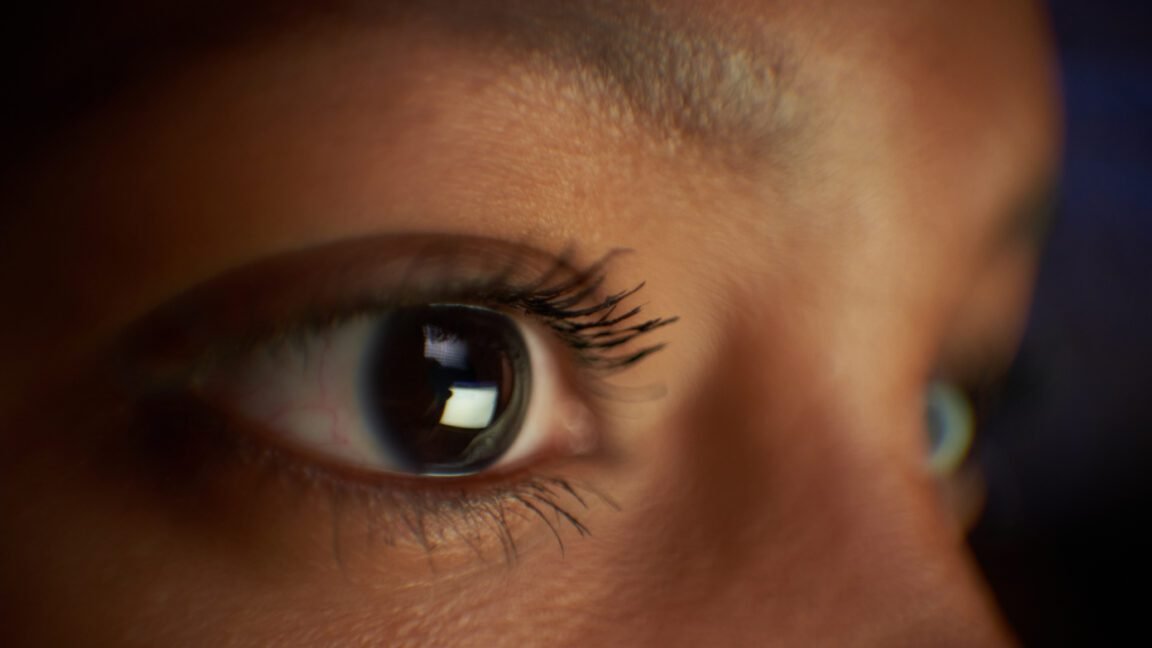
After losing its original eyes, one of our distant ancestors may have done what evolution does best: tinkered with what was available, reshaping a single central visual organ into two new eyes.
That’s the idea behind a new theoretical synthesis published in Current Biology. According to the data considered by its authors—a team from the University of Sussex (UK) and Lund University (Sweden)—vertebrate eyes, ours included, may not descend directly from the paired eyes of early bilaterian animals. Instead, they may have been “reinvented” from what was once a single light-sensitive organ that survived an evolutionary detour.
Strange eyes
“Vertebrate eyes are so fundamentally different from the lateral eyes of other animal groups,” explains Dan-Eric Nilsson, senior author of the study from Lund University and a leading expert in eye evolution. “The key difference is the identity of the main photoreceptor, which is of ciliary nature in the vertebrate eye but rhabdomeric in other animal groups, such as arthropods and cephalopods,” he adds.
To understand what Nilsson is getting at, we need to unpack a few key concepts.
There are two major classes of light-sensitive photoreceptor cells—rhabdomeric and ciliary—that differ in shape, in the visual pigments (opsins) they contain, and in their electrical responses to light.
Most invertebrates rely on rhabdomeric photoreceptor cells for vision, while ciliary cells mediate light sensing but not vision—they generally help regulate internal biological clocks. Vertebrates, however, brought both types of photoreceptors into the same organ.
In the vertebrate retina, ciliary photoreceptor cells—rods and cones—carry out image-forming vision, while the rhabdomeric component both monitors ambient light levels and relays visual information from rods and cones to higher brain centers.
The authors argue that the invertebrate, rhabdomeric-based arrangement represents the ancestral state of eyes, inherited from the common bilaterian ancestor and shared by present invertebrates.
How did vertebrates end up on a different evolutionary path?
After the bilaterian lineage split—one branch giving rise to insects, crustaceans, and mollusks, the other leading to a group called deuterostomes that includes chordates and vertebrates—one of our distant ancestors appears to have become more sedentary.
“The ancestral deuterostome adopted a burrowing lifestyle, either living sessile on the seafloor or partially burrowed, with only parts of its body protruding,” says George Kafetzis, research fellow at the University of Sussex. Under those conditions, two lateral eyes may have become more of a liability than an advantage. “Neural tissue in general is very expensive to maintain and function,” Kafetzis explains.
As a result—an idea already proposed in the literature—the lineage may have gradually lost its paired eyes.
Make do with what you’ve got
If that ancestral deuterostome had stayed buried in the mud, we wouldn’t be here to worry about eye evolution. But some of its descendants returned to a free-swimming existence, one where paired lateral eyes once again became a clear advantage. For a swimming animal, two eyes are essential for steering: by comparing light input from each side, the nervous system can determine whether it needs to maintain course or turn.
By then, however, the rhabdomeric lateral eyes were gone. So what was left to work with? Fortunately, that ancestral deuterostome still needed to monitor ambient light to distinguish day from night and whether it was in open water or in shadow. To do so, the people behind the hypothesis suggest that it had retained a single, centrally located cyclopean organ.
“We think that in this early deuterostome, the median eye contained both ciliary and rhabdomeric cells,” Kafetzis explains. As a result, both cellular lineages were incorporated into a single, ancient, cyclopean eye, which later evolved into the vertebrate eyes.
The vertebrate third eye
A trace of this transformation may still survive in the pineal complex at the base of the brain—often referred to as a vertebrate “third eye.” Scientists have long recognized striking similarities between the retina and the pineal organ, leading many to suspect that the two evolved from a single ancestral structure, with the pineal representing a more rudimentary version.
Kafetzis and his colleagues see it differently.
Many researchers suspect that one class of neurons—the bipolar cells—is unique to the retina and represents a key evolutionary innovation of the vertebrate eye. Bipolar cells connect rods and cones to ganglion cells (hence the name “bipolar”). “We think that these bipolar-like cells already exist in the pineal,” says Kafetzis. “It’s just that they don’t look like the typical bipolar—they don’t have a cell before and a cell after.”
For this reason, Kafetzis and his colleagues argue that bipolar neurons are not a de novo evolutionary invention but instead have a chimeric origin, blending features of both rhabdomeric and ciliary cells and bridging the two photoreceptor lineages.
Though grounded in existing ideas and data, the new proposal offers a potentially far-reaching synthesis. Several aspects still require firmer evidence. The idea that the ancestral chordate adopted a burrowing lifestyle remains debated, and the claim that early bilaterians already possessed paired lateral eyes is still speculative.
The authors acknowledge that their model now needs testing. In the paper, they lay out several ways to do so—from molecular comparisons of pineal and retinal cells to developmental studies and broader sampling of eye development in other species of deuterostomes.
“We want to put forward some literature-based and inspired hypotheses that are testable, and now we can go out and test them,” concludes Kafetzis.
Cell, 2026. DOI: 10.1016/j.cell.2025.12.056
Federica Sgorbissa is a science journalist; she writes about neuroscience and cognitive science for Italian and international outlets.