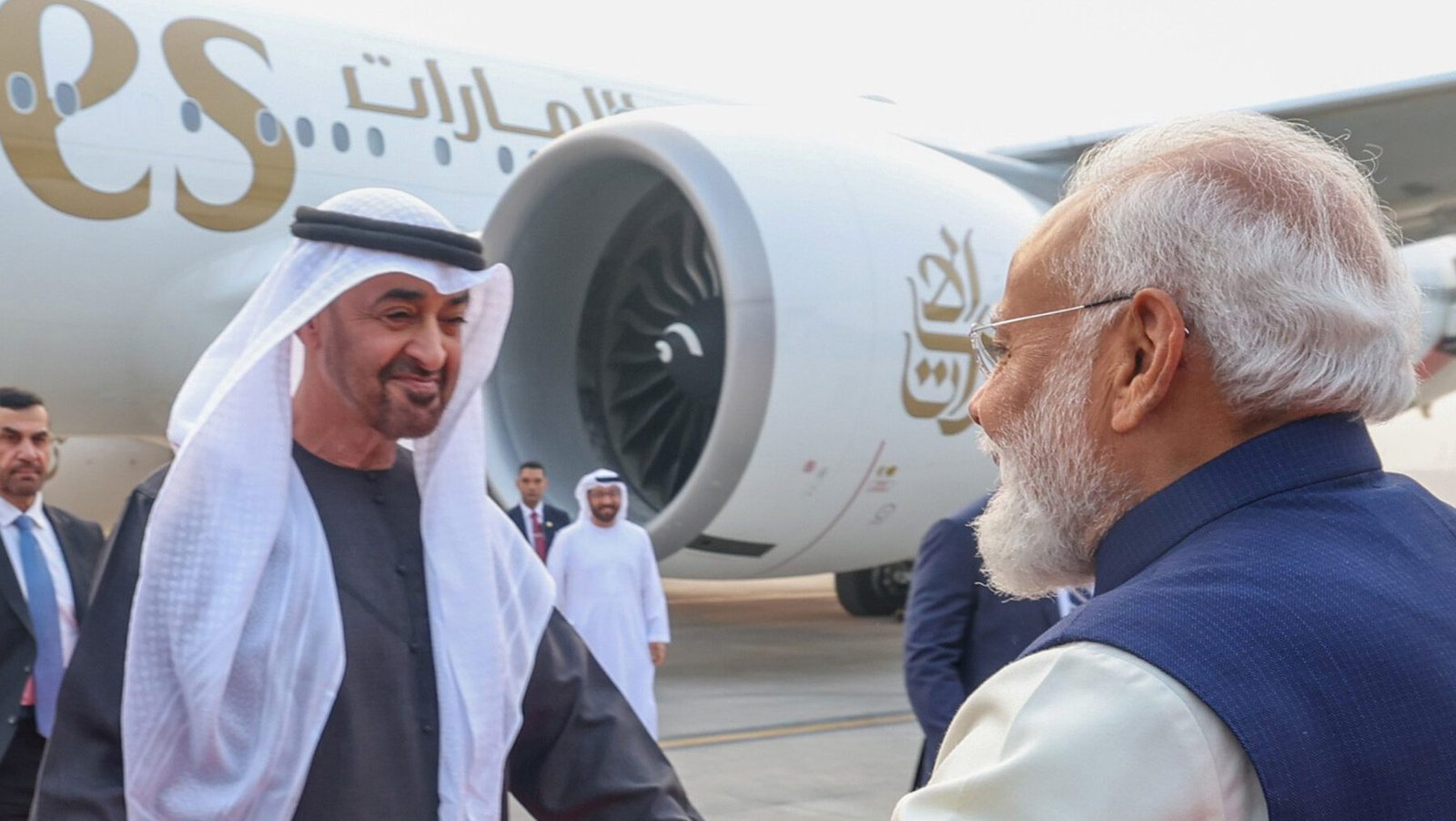
The UAE-India free trade deal, the Israel-UAE agreement that followed the Abraham Accords, and the EU-India pact signed in January have opened new commercial routes across the region
[MUMBAI] The war reshaping the Middle East has raised a pressing question in diplomatic and business circles: Will it derail the emerging economic architecture linking India, Israel, and the Gulf? Those working inside that system argue that the opposite may be happening. In their view, the conflict is revealing how deep those ties already run—and how difficult they will be to unwind.
Ayush Singh, founder of the New Delhi-based cyber intelligence firm ARPSyndicate, said the relationship is no longer dependent on any one government or political moment.
“This partnership is not dependent on political leadership,” Singh told The Media Line. “It’s going to continue, and honestly, we can’t even predict how deep it will go.”
This partnership is not dependent on political leadership. It’s going to continue, and honestly, we can’t even predict how deep it will go.
Part of that structure is visible. The UAE-India free trade deal, the Israel-UAE agreement that followed the Abraham Accords—the 2020 normalization agreements between Israel and several Arab states—and the EU-India pact signed in January have opened new commercial routes across the region. Singh said the deeper layer runs through older and less visible channels: defense ties, procurement systems, ministry approvals, and networks of trust built over years.
He said those connections predate the Abraham Accords. Indian security officials worked alongside Israeli counterparts in joint operations, developed operational trust, and later carried those ties into the private sector after retirement.
Israeli firms hired some of those officials, and technology transfers followed. Singh said these were not symbolic gestures or startup experiments. They grew out of existing professional relationships and took place with the approval of Israel’s Ministry of Defense, which must authorize exports of offensive cyber capabilities.
That process has helped create a distinct market in India. Singh said between 15 and 20 lawful interception vendors—firms that sell surveillance and communications-monitoring technology to governments—are now competing there. He said Israeli companies remain preferred suppliers in part because they have spent years solving specific operational problems for Indian agencies.
“Every ministry, every agency has a gap in what they can do,” he said. “Not everyone knows about these gaps. Only people at the leadership level know. But when you share one of those gaps with an Israeli vendor, they will pour money and resources into solving it, because they take the challenges Indians face seriously in a way that domestic vendors or American companies simply don’t match.”
If Singh describes the existing foundation, Israeli investor and entrepreneur Erel Margalit is trying to build something larger on top of it.
War cannot be won just on the battlefield. You need a diplomatic move at the end
“War cannot be won just on the battlefield,” Margalit told The Media Line in a phone interview. “You need a diplomatic move at the end.”
Margalit’s idea is to scale bilateral ties into a broader India-Israel-UAE economic bloc linking technology, capital, and infrastructure. He argues that India, Israel, and the UAE could form the core of a wider regional network combining Israeli innovation, Indian engineering, and Gulf capital.
“India, Israel, and the UAE hold the key to the next phase of the region,” he said.
Two months before the war began, Margalit brought 450 entrepreneurs, investors, and technology executives from Israel, Europe, the United States, and the UAE to Dubai to discuss that vision. The delegation included founders and leadership teams from Israeli AI and cybersecurity firms, including ControlUp, ThetaRay, Chain Reaction, and Quali. He said what stood out most was the role Indian participants were already imagining for themselves.
India, Israel, and the UAE hold the key to the next phase of the region
“The one thing that really stuck out was that in a lot of these conversations, we had Indian partners who said, ‘Yes, and we need to tie this to an ecosystem here. It’s a three-and-a-half-hour flight to India,’” Margalit said. “I found the conversations very engaging and eye-opening about what can be done.”
For Margalit, this was part of a longer process, not a one-off event. He recalled that shortly after the Abraham Accords, before commercial flights between Israel and the UAE were even operating, he chartered a plane and flew there with his companies.
“We didn’t come for symbolism,” he said. “We came to bring real value through technology and business.”
His focus now is on what he calls micro-vertical AI: specialized systems built for sectors such as banking, insurance, cybersecurity, and critical infrastructure. In plain terms, he is talking about tailored AI systems built into the core operations of major industries, not consumer-facing tools. India’s engineering scale, he said, makes it a natural partner, while Abu Dhabi offers a practical route for expanding commercial ties even without full political normalization between India and Israel.
Some of that expansion is already visible. Jonathan Zanger, chief technology officer of Israeli cybersecurity firm Check Point Software Technologies, told The Media Line that India has become a major hub in the company’s global engineering operation, with Israeli and Indian engineers collaborating on core products.
“India is a central engineering and capability-building hub for us,” Zanger said.
The relationship is also moving beyond cybersecurity. Earlier this year, more than 550 representatives from international infrastructure companies gathered in Tel Aviv to discuss tenders for the $50 billion Tel Aviv Metro project. Several Indian firms participated, including the Delhi Metro Rail Corporation, pointing to a broader shift from technology cooperation to physical infrastructure.
That same logic is driving interest in the India-Middle East-Europe Economic Corridor, or IMEC, a proposed network of ports, railways, energy links, and digital infrastructure designed to connect India to Europe through the Gulf and Israel. In the context of war and threats to major shipping lanes, the project has taken on greater strategic weight as governments look for secure alternative routes.
Speaking at the Raisina Dialogue, the annual geopolitical conference hosted by India’s Observer Research Foundation, former Indian Ambassador to the UAE Sanjay Sudhir said momentum behind the corridor remains real. An intergovernmental framework agreement has already been signed, a digital trade platform to streamline customs is operational, and feasibility studies are underway for projects including undersea power links between India and the Gulf.
Harsh Pant, vice president for studies and foreign policy at the Observer Research Foundation, said the war has slowed execution but not changed the larger direction.
“We have not seen a declining commitment,” Pant said. “It’s just that things have happened in the region.”
The war, though, is not only testing physical trade routes. Corridors such as IMEC depend as much on digital systems as on ports, rail, and power links. That is where the conflict is exposing another layer of risk. Zanger warned that geopolitical tensions are increasingly spilling into the cyber domain, where attacks can cripple the systems modern economies depend on.
“I don’t think the world is very protected,” he said. “This mega cybersecurity incident based on AI has not happened yet. But my concern is that it is going to happen.”
I don’t think the world is very protected. This mega cybersecurity incident based on AI has not happened yet. But my concern is that it is going to happen.
Singh offered a more concrete example. He said Iran has spent years studying exploits in surveillance cameras, most of which are manufactured in China. If those vulnerabilities are being shared, he said, Tehran can buy access rather than build reconnaissance capability from scratch.
“They can buy a single exploit and gain visibility into a location,” Singh said. “We’ve seen this in practice.”
In his view, that kind of attack matters not only militarily but economically. Cheap cyber tools and low-cost reconnaissance methods can force governments to respond with far more expensive defenses.
“They’re using very cheap methods. They fail a lot. But when they succeed, they succeed cheaply, and you’re countering those cheap weapons with expensive ones. Economically, you’re the one taking the hit.”
He argued that India cannot treat this conflict the way it treated the Russia-Ukraine war—as a major international crisis with limited direct exposure. India’s ties to the Middle East are deeper, touching workers, services, trade routes, and supply chains.
“In wars, that kind of damage rarely gets counted,” he said. “But it’s real.”
Singh said only the United States and Israel currently offer the modeling tools India needs to understand that exposure in real time.
“They’re the ones who can model actual collateral—if we do X and it goes wrong, what’s the damage? That’s not a calculation a person makes anymore. It requires algorithms, advanced systems. India can’t go anywhere else for that.”
Asked whether the war will ultimately speed up or complicate the regional integration he has spent years promoting, Margalit said the answer will depend on whether political and business leaders treat the moment as an opening rather than simply a crisis.
“Military victory is only the first step,” Margalit said. “Wars are ultimately won through diplomatic clarity, agreements, and alliances that can move the region forward.”
He said the next phase must rest on new alliances, economic cooperation, and a shared strategic horizon linking the UAE, Saudi Arabia, Bahrain, Kuwait, Jordan, and Egypt with Israel and the United States.
That argument is being echoed in Europe as well. Italian Foreign Minister Antonio Tajani, speaking after a Monday call with India’s Foreign Minister S. Jaishankar about the partial Hormuz blockade, said the crisis showed why secure infrastructure and alternative routes matter. He pointed to IMEC as the model and is set to open an IMEC forum in Trieste on Tuesday.
For Margalit, the strategic logic is already moving faster than the diplomacy. Since Iran began striking Gulf infrastructure, Israel has found itself in active security cooperation with states with which it has no formal relations.
“The next step is to take it to more of a formal alliance,” Margalit said. “I think it is already being discussed.”
In that sense, the war may not be dismantling the India-Israel-Gulf network at all. It may be increasing the pressure to formalize relationships that, in business, technology, and security, already exist in practice.