In Washington, every war eventually produces its “Mission Accomplished” moment — that triumphant declaration, banner unfurled or truth-social post composed, that allows policymakers to declare victory and head for the exits before reality reasserts itself.
The two-week ceasefire announced on April 7 between the United States and Iran, brokered at the last minute by Pakistan and forged under the twin pressures of a presidential deadline and a global oil crisis, is already being celebrated in some quarters as just such a moment.
But before the confetti settles, it is worth asking a simple question: what, exactly, has the US won?
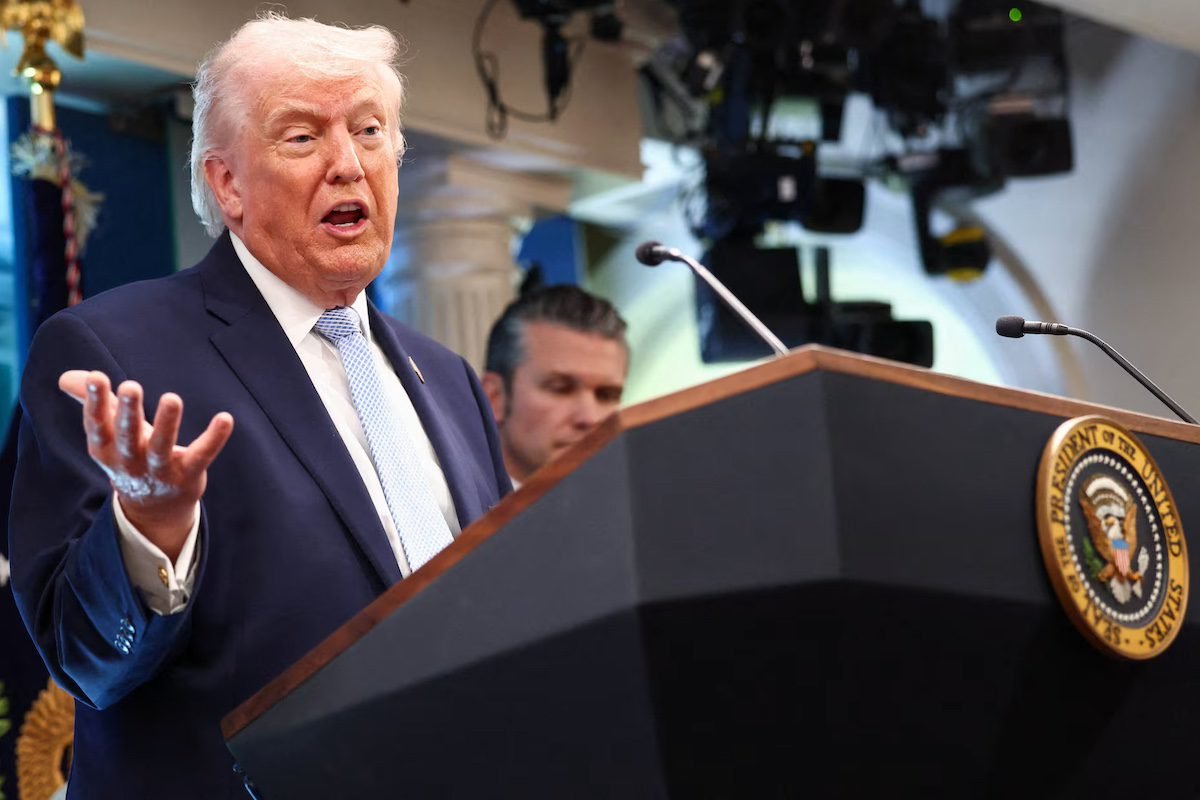
The White House’s answer, delivered by press secretary Karoline Leavitt, is that “President Trump’s powerful military got Iran to agree to reopening the Strait of Hormuz.” Trump himself, never one for understatement, called it a “big day for world peace” and predicted a “Golden Age of the Middle East.”
Iran’s Supreme National Security Council, for its part, claimed victory as well, saying “nearly all war objectives have been achieved.” When both belligerents simultaneously proclaim victory after 40 days of war, a wise observer reaches not for champagne but for a history book.
Let us begin with the nuclear question — the ostensible casus belli. The Trump administration justified the February 28 strikes on Iran partly on the grounds that Tehran was on the verge of acquiring a nuclear weapon. Yet the International Atomic Energy Agency said that while Iran has an “ambitious” nuclear program, there was no evidence of a structured nuclear weapons program when the 2026 war began.
More damning still, a preliminary report from the US Defense Intelligence Agency assessed that Iran had moved much of its stockpile of enriched uranium before US strikes took place and that the strikes set back Iran’s ability to produce nuclear weapons by only a matter of months.
For this, the US launched the largest military operation in the Middle East since the 2003 invasion of Iraq — with all the attendant costs to American prestige, the global economy and the innocent civilians who happened to live near facilities deemed as strategic.
The Strait of Hormuz crisis alone should give pause to anyone tempted to call this a clean strategic success. Brent crude surpassed US$100 per barrel, rising to $126 at its peak — the largest disruption to the energy supply since the 1970s oil crisis. American motorists felt that pain at the pump, and Trump — who had campaigned on keeping energy costs low — found himself politically cornered by a war partly of his own making.
The ceasefire was not a negotiated peace so much as a pressure release valve, leaving a backlog of around 1,000 ships stranded, with only 10–15 expected to pass through the strait per day under Iranian military coordination — a pace that will leave the bulk of the disruption unresolved long after the two-week truce expires.
And then there is the matter of Iran’s 10-point peace proposal, which Trump first hailed as a “workable basis for negotiation” and then, within hours, called fraudulent. In the Persian-language version of the plan, Iran included the phrase “acceptance of enrichment” regarding uranium — a phrase conspicuously absent from English versions shared with journalists.
One does not need to be a professional diplomat to recognize that when the two sides cannot agree on the text of the document that supposedly ended their war, the war has not really ended. What we have, in short, is a pause — and a fragile one at that.
Attacks took place in Israel, Iran and across the Gulf region early Wednesday, even after the ceasefire came into force. Netanyahu confirmed that the ceasefire does not include Lebanon, where Israel continues military operations. The region is not at peace. It is catching its breath.
This pattern should be familiar to anyone who has observed American policy in the Middle East over the past four decades. The US enters a conflict with ambitious, often contradictory objectives — in this case, destroying Iran’s nuclear program, achieving regime change, securing oil resources and deterring Iranian retaliation, all simultaneously.
Trump administration officials offered diverse and changing explanations for starting the war, which is usually a sign that the strategy was invented to justify the action rather than the other way around.
Military force is applied with overwhelming tactical efficiency. And then the hard questions — What comes next? Who governs Iran? What prevents reconstitution of the nuclear program in five years? — are left unanswered, to be inherited by whoever comes next.
I wrote in 1992 that America was stumbling into a “quagmire” in the Middle East. I wrote in 2005 about a “sandstorm” of policy failure. The names change, the administrations change, the targets change. The pattern does not. The US wins the battle and then loses its way in the aftermath.
The test of whether the US has “won” the Iran war will not be found in the Truth Social posts of April 8, 2026. It will be found in the answers to questions that nobody in Washington is yet asking with sufficient seriousness: Is Iran’s nuclear knowledge destroyed, or merely its centrifuges?
Does the current Iranian government — whatever shape it takes after the assassination of Khamenei — emerge from this war more or less hostile to US interests? Does the region stabilize, or does the destruction of the old Iranian power structure simply create a vacuum filled by chaos, as it did in Iraq and Libya?
As Karim Sadjadpour of the Carnegie Endowment noted last June, this was “more likely to open a new chapter of the 46-year-old US-Iran war than conclude it.” A two-week ceasefire and a meeting in Islamabad do not refute that judgment.
The Strait of Hormuz may reopen. Stock markets may rally. The president will almost certainly declare a historic triumph. But history, as it has a habit of doing, will reserve judgment for a longer horizon than a Truth Social post — or a two-week ceasefire — can capture.
This article was originally published on Leon Hadar’s Global Zeitgeist and is republished with kind permission. Become a subscriber here.