China may be preparing to take Taiwan, but not through a near-term invasion, as new US intelligence suggests it is prioritizing coercion, pressure and political absorption over outright war.
The March report, entitled 2026 Annual Threat Assessment of US Intelligence Community, says China has no fixed timetable for forcible unification and instead prefers to achieve it without force, even as the People’s Liberation Army (PLA) continues to build capabilities for a cross-strait campaign.
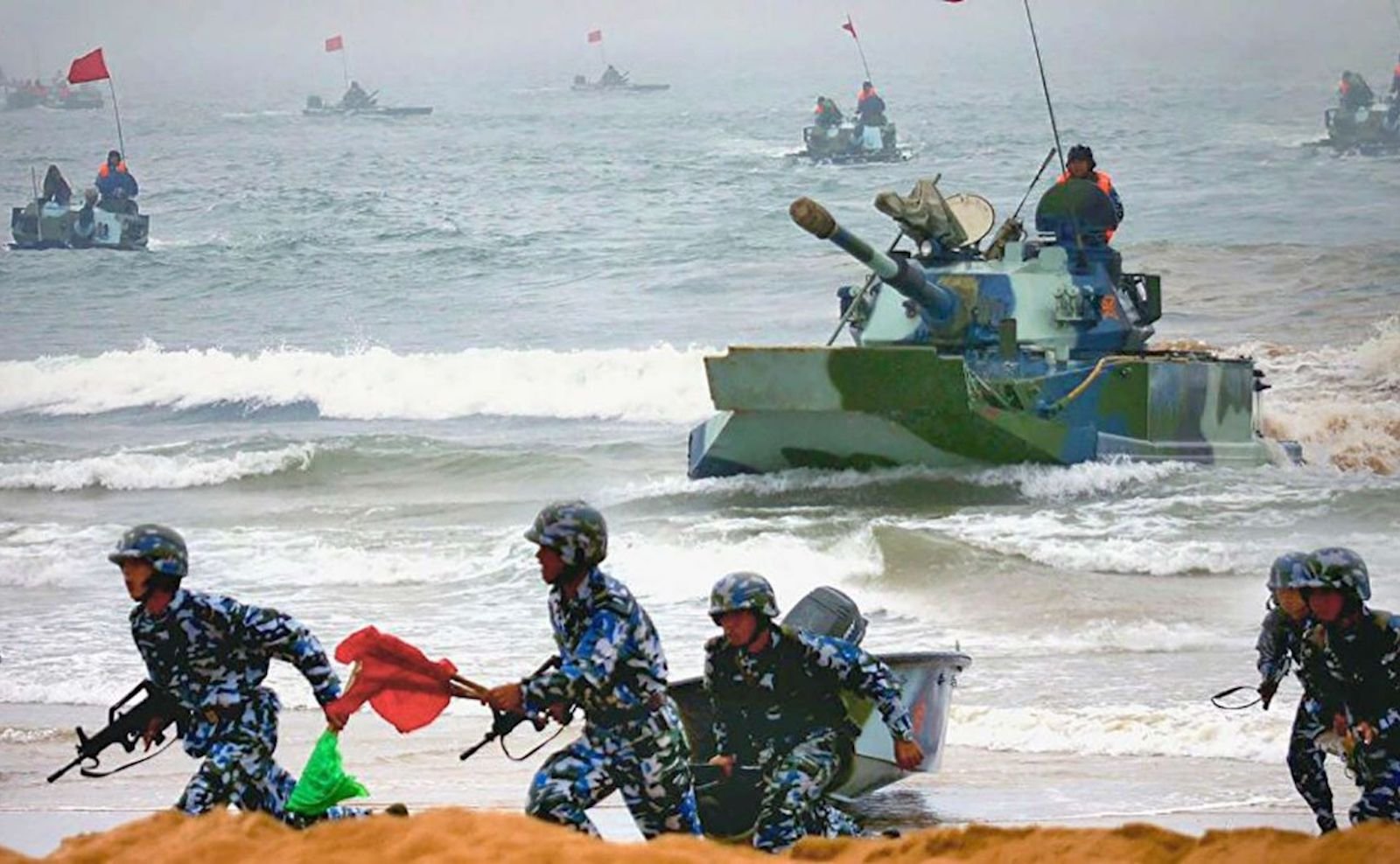
It assesses that Chinese officials view an amphibious assault as highly risky and complex, particularly given the likelihood of US intervention. China’s approach is shaped by PLA readiness, Taiwan’s domestic politics and uncertainty over US response, with conflict carrying major global economic consequences.
While China maintains its goal of unification by 2049, it appears focused on gradually shifting the strategic balance while retaining military options as a deterrent. These constraints point to the political, military and economic risks that underpin China’s reluctance to pursue a near-term invasion of Taiwan.
The political costs for China of a failed invasion of Taiwan would be huge, with massive military casualties damaging the relationship between the PLA and the Chinese Communist Party (CCP), one of the pillars of regime stability.
Economic hardships could lead to dissent and protests, prompting increased surveillance, censorship and security measures. In terms of military casualties, a January 2023 report by the Center for Strategic and International Studies (CSIS) suggests heavy Chinese losses in such a scenario, with tens of thousands of troops captured and large numbers likely killed as the invasion falters.
The report notes that China’s navy could be left “in shambles” and its core amphibious forces broken, undermining its ability to sustain operations ashore. It also highlights the broader scale of the conflict, with US and allied forces losing dozens of ships and hundreds of aircraft, pointing to a high-cost, attritional campaign that would severely degrade all sides’ combat power.
Even so, the ongoing Iran war—often compared to the 1956 Suez Crisis, when a Western power used military force to control a key global energy route and suffered political and strategic setbacks—has revived debate over US power, with Chinese analysts warning against accepting narratives of American decline.
As Zheng Yongnian mentions in a South China Morning Post (SCMP) article this month, the US “retains formidable economic strength and possesses unparalleled military power globally,” and that “despite numerous issues within its political and social spheres, [we] absolutely must not underestimate America’s capabilities,” he said.
In the same article, Shi Yinhong argues that US operations in Venezuela and Iran demonstrate continued military superiority, while Zhu Feng highlights the rapid application of advanced military technologies and warns that US policy unpredictability—particularly under Donald Trump—remains widely underestimated.
Alongside that caution, ongoing corruption scandals and the arrests of top-level PLA generals may have weakened China’s military readiness for a Taiwan operation. As Xuan Dong writes in a June 2025 article for the Institute for Security and Development Policy (ISDP), corruption undermines China’s military readiness by degrading equipment quality, reducing efficiency and weakening command cohesion.
Dong points to procurement scandals involving faulty systems, including missiles filled with water and defective silos, raising doubts about combat capability. He notes that corruption inflates defense spending while diminishing effectiveness, while bribery and favoritism distort promotions, undermining morale and professionalism.
Dong adds that frequent purges of senior officers disrupt continuity, while a fear-driven political climate suppresses initiative. He argues that these factors collectively weaken operational effectiveness and erode confidence in the PLA’s true capabilities.
Aside from the potential for massive casualties, US military power and corruption, economic costs also act as a major constraint on an invasion of Taiwan. As T.J. Pempel argues in a September 2022 article for Global Asia, China’s interest in Taiwan lies less in basic trade than in its strategic industrial value.
He notes that control of Taiwan would allow China to absorb advanced manufacturing, particularly high-end semiconductors produced by firms such as TSMC and ASE Technology, along with critical engineering and managerial talent.
However, Pempel argues that a war would likely damage these very assets, destroying infrastructure, disrupting chip production and driving away skilled personnel. He adds that conflict would also disrupt vital sea lanes carrying energy, food and technology inputs, prompting foreign firms to relocate and inflicting broad economic losses.
Taiwan’s changing political climate may also be a factor in China’s invasion calculus. As Joshua Freedman writes in a December 2025 article for the Foreign Policy Research Institute (FPRI), the Kuomintang (KMT) has gained momentum as the Democratic Progressive Party (DPP) faces declining public support and electoral setbacks.
Freedman notes that a failed recall campaign in July 2025 targeting 24 KMT legislators ended with all remaining in office, a major rebuke to Taiwanese President Lai Ching-te and the ruling DPP. He adds that by November 2025, Lai’s approval rating had fallen to 39%, with more than 50% disapproval, while the KMT holds a narrow legislative edge.
Freedman notes that Chinese leaders have shown greater willingness to engage a KMT-led government, which could either ease tensions or expand avenues for Chinese influence over Taiwan.
Given these factors, China appears to be pursuing alternative pathways to achieve its objectives. As Vincent So argues in a May 2025 article for The Interpreter, China could absorb Taiwan without an invasion by applying a “Beiping model” of gradual political surrender rather than battlefield conquest.
So writes that China employs gray-zone pressure—airspace incursions, cyberattacks, disinformation and economic coercion—to normalize pressure, fragment decision-making and foster a sense that unification is unavoidable.
At the same time, he notes that China can leverage Taiwanese elites’ commercial exposure to mainland markets, encouraging quiet accommodation over confrontation.
According to So, China would seek to surround Taiwan, cut off its lifelines and shape narratives so that concessions appear orderly and constitutional rather than coerced. In this model, resistance is not crushed, but politically absorbed.
China’s challenge, therefore, is not whether it can take Taiwan by force, but whether it can sustain a long-term strategy of coercion and political absorption without triggering resistance, external intervention or systemic shocks it seeks and arguably needs to avoid.