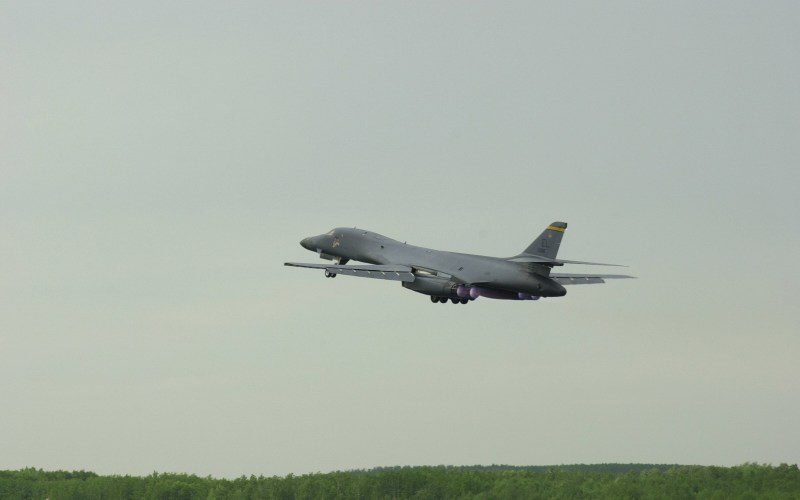
Nearly a dozen U.S. strategic bombers and supporting aircraft have arrived at bases across Europe as Washington signals an escalation of air operations against Iran under Operation Epic Fury, according to defence officials and open-source flight tracking data.
Several B-1B Lancer bombers landed at RAF Fairford in the United Kingdom, while others diverted to Ramstein Air Base in Germany due to poor weather. The deployment was reinforced on March 9 with the arrival of three B-52H Stratofortress bombers, bringing the number of U.S. strategic bombers currently positioned in Europe to around eleven.
The aircraft movements follow remarks by U.S. Defense Secretary Pete Hegseth, who warned that strikes on Iranian targets were set to “surge dramatically,” with additional bomber rotations and expanded military capabilities expected in the coming phase of operations.
UK bases reopen for U.S. operations
The renewed deployments come after the United Kingdom reversed an earlier decision and allowed U.S. forces to operate from British installations following an Iranian drone attack on a British military base in Cyprus.
RAF Fairford, one of the few European airfields capable of hosting heavy strategic bombers, has long served as a forward operating location for the U.S. Air Force. Basing aircraft there significantly shortens flight times to the Middle East compared with missions launched from the continental United States, which previously required flights lasting up to 37 hours with multiple aerial refuelling stops.
The Pentagon has described the use of British bases as part of “specific defensive operations” aimed at preventing further missile attacks in the region.
Bombers central to widening air campaign
Strategic bombers have played a central role in the early phase of Operation Epic Fury. U.S. Central Command said the aircraft have already conducted hundreds of strikes against Iranian military infrastructure, including missile launch sites and command facilities deep inside the country.
The B-1B Lancer, the fastest bomber in the U.S. inventory, can carry up to 75,000 pounds of weapons, while the B-52 serves as the Air Force’s principal long-range cruise missile carrier.
Alongside the bombers, the U.S. Air Force has deployed a wide range of additional platforms to support the campaign, including F-35 and F-22 stealth fighters, F-15 and F-16 strike aircraft, A-10 ground-attack jets, MQ-9 Reaper drones, airborne surveillance aircraft, and aerial refuelling tankers.
Washington is also expected to position assets at Naval Support Facility Diego Garcia in the Indian Ocean, another strategic base that would reduce transit times for long-range strike missions.
The forward deployments signal a sustained air campaign as the United States seeks to degrade Iran’s missile and drone capabilities and protect allied forces and shipping routes across the region.
Read more via Stars & Stripes/ Air & Space Forces Magazine