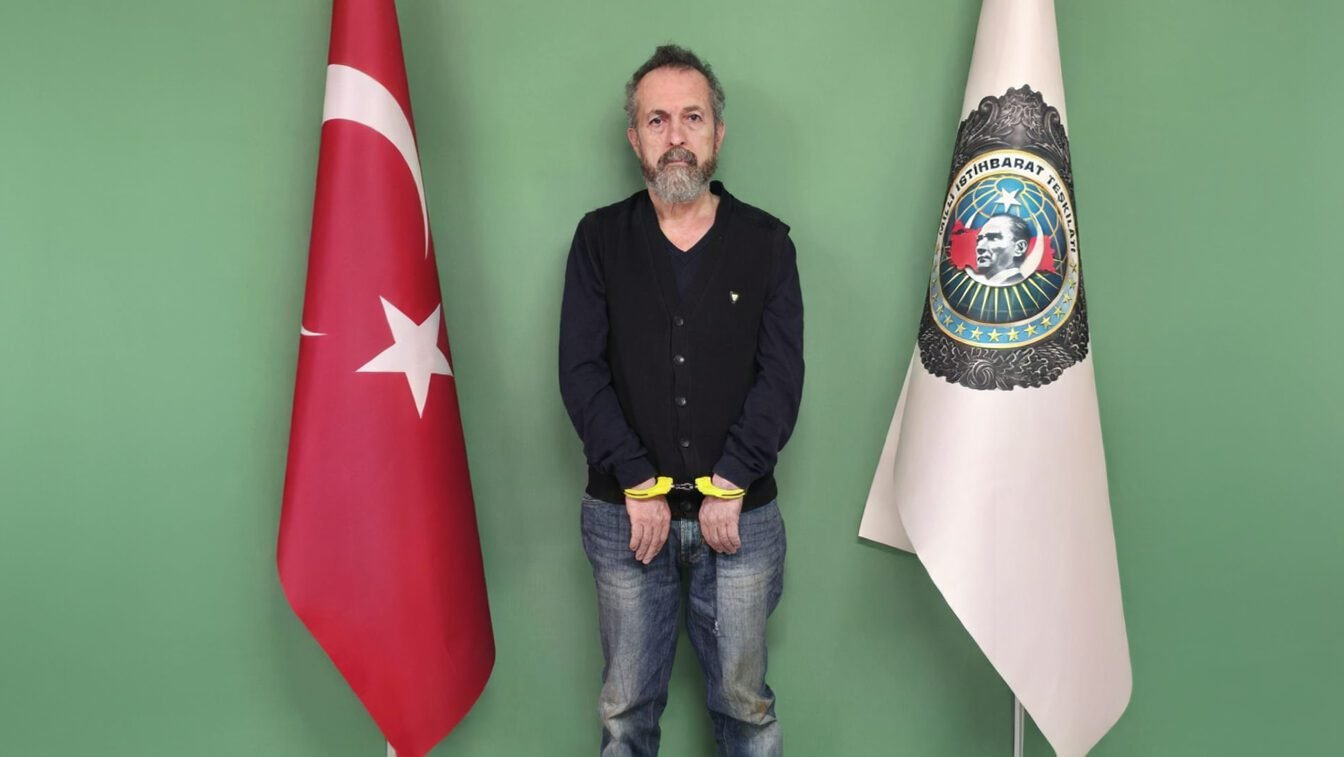
[DAMASCUS] Turkish authorities have rearrested a fugitive convict tied to one of the earliest and most consequential cross-border abduction cases of the Syrian uprising, reviving questions about how defected Syrian officers were seized on Turkish soil and handed back to Bashar Assad’s security apparatus. Turkish and Syrian media reported this week that Önder Sığırcıkoğlu, a Turkish national convicted in connection with the 2011 kidnapping of defected officers Hussein Harmoush and Mustafa Qassoum, was captured in a joint operation on the Syria-Lebanon border after 12 years on the run.
The case still resonates because Lt. Col. Harmoush was one of the first senior Syrian army officers to defect after the 2011 uprising began. He went on to found the Free Officers Brigade, one of the earliest armed anti-Assad formations. His disappearance from Turkey in August 2011 quickly became a defining scandal for the Syrian opposition, which accused pro-regime networks of infiltrating refugee and defector circles across the border.
Turkish reporting has long held that Harmoush was abducted together with Syrian defector Mustafa Qassoum, whose name appeared in the original Turkish case files as the second victim in the operation. In February 2012, a Turkish court ordered the arrest of five suspects, including a member of the National Intelligence Organization, over what prosecutors described as the forced transfer of the two Syrians from shelters in Hatay to Syrian government forces.
According to Turkish media, Sığırcıkoğlu was later sentenced in 2013 to 20 years in prison for deprivation of liberty, though the sentence was reportedly reduced, and he escaped from an open prison in 2014. Turkish security-linked reporting now says he was protected for years by the Assad regime and was recaptured while trying to cross from Lebanon into Syria.
Against that backdrop, Qassoum’s account has taken on renewed importance. In an interview with The Media Line, he described himself not as a bystander to Harmoush’s disappearance but as one of the two men abducted in the same operation. Qassoum said that in August 2011, while staying on the Turkish side of the Syrian border, he arranged to meet a Turkish officer he knew as “Officer Omar” in Antakya.
He said, “In the eighth month of 2011, I contacted a Turkish officer responsible for camp security, who identified himself as Officer Omar, and we agreed to meet in the city of Antakya. When we met, I got into his car and drove out of the city, but suddenly armed men appeared in front of us. They forced me out of the car and left the officer behind, which indicated that he was in collusion with them.”
Qassoum said he was taken to a house, then placed in a car where Harmoush was already being held.
He continued, “They took me to an old house, and after two hours, they put me into a car where Hussein Harmoush was already inside. We greeted each other, and I asked him what was happening. He said that we were going to be handed over to Syrian intelligence. At that moment, I laughed and said, ‘Impossible.’”
Qassoum said the men were then taken to the coast near Iskenderun and transferred by boat to Latakia before being flown onward to Damascus. What he first dismissed as impossible, he said, quickly became real. “We were later transferred to what I believe was the Iskenderun beach. After several hours, they put us in a boat. Following a journey of about one to two hours, we arrived in the city of Latakia, and we started hearing Arabic, which meant we had entered Syria.”
Once in Damascus, he said, he and Harmoush were separated. Qassoum said he later saw Harmoush only once, in court, after both had been tortured.
He said at the beginning of his interview with The Media Line, “During the investigation, they told us our names were forgotten. My name became Number 6, and Hussein Harmoush became Number 8.”
Qassoum said he was sentenced to five years in prison on charges of “spreading news against the state” and was later released after his family paid money to Syrian authorities. Harmoush disappeared.
For years, his fate remained the subject of rumor and contradiction. Syrian state television aired what appeared to be a forced confession by him in September 2011 after he vanished from Turkey. Much later, activists and relatives said they identified him among the victims documented in the Caesar photographs.
The Caesar archive, smuggled out of Syria in 2013 by a military defector code-named Caesar, contained 53,275 images. Human Rights Watch said 28,707 of those photographs appeared to show at least 6,786 detainees who died in custody or after transfer from detention. The organization has also documented more than 117,000 arrests and detentions in Syria since 2011.
Enab Baladi reported this week that Harmoush’s family was told by eyewitnesses that he was killed in Saydnaya prison on January 19, 2012, though for many Syrians his case remains emblematic of the regime’s broader system of disappearance, torture, and denial.
Lawyer and legal expert Ranim Al-Hashimi told The Media Line that Sığırcıkoğlu’s rearrest could become an important step toward clarifying one of the least-resolved episodes from the conflict’s early months, when the Syrian opposition was still organizing and documentation was limited.
Turkey has remained central to the Syrian file since 2011, both as host to millions of refugees and as a rear base for opposition activity. That made the Harmoush-Qassoum abduction especially explosive at the time and remains politically sensitive today.
For many Syrians, the importance of the case goes well beyond one man’s rearrest. It raises unresolved questions about collusion, cross-border renditions, and the fate of defectors who believed Turkey was a place of refuge. For the family of Hussein Harmoush, it may yet offer a chance—if not for justice, then at least for a fuller account of how one of the uprising’s first defectors disappeared.