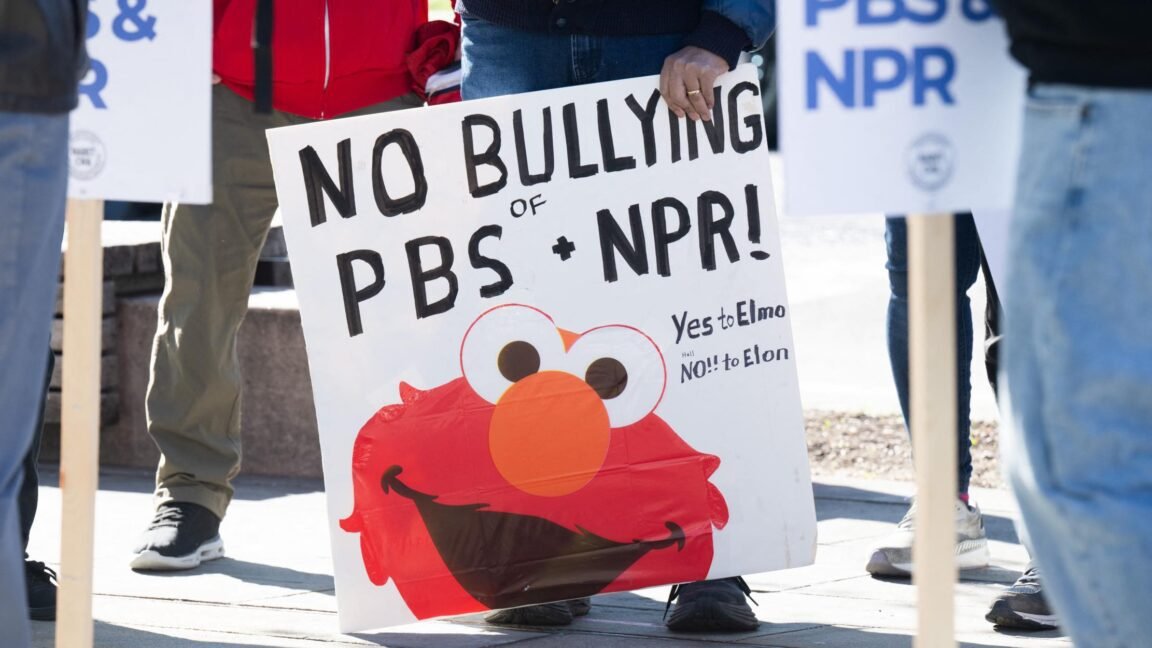
A federal judge ruled that President Trump’s executive order defunding NPR and PBS violated the First Amendment and issued a permanent injunction stating that executive branch agencies cannot enforce it.
The Trump order’s “instruction that all federal agencies stop funding NPR and PBS constitutes a penalty for engaging in speech disfavored by the President and cannot be lawfully implemented by any executive department or agency,” Judge Randolph Moss, an Obama appointee in US District Court for the District of Columbia, ruled yesterday.
The ruling against Trump in the case filed by NPR, PBS, and several stations may not have much practical impact. Trump’s May 2025 executive order was followed by Congress rescinding the entire Corporation for Public Broadcasting (CPB) budget of $1.1 billion for fiscal years 2026 and 2027.
The CPB voted to dissolve itself in January 2026 after distributing all remaining funds provided by Congress. NPR, PBS, and member stations continue to operate with other funding sources but had to make budget cuts. Federal agencies could cite yesterday’s court ruling in future actions to fund public media, but that’s unlikely to happen under the Trump administration.
Moss said the executive order sent a clear message that “NPR and PBS need not apply for any federal benefit because the President disapproves of their ‘left wing’ coverage of the news.” Noting that the Trump order purported to apply “regardless of the nature of the program or the merits of their applications or requests for funding,” Moss said that “viewpoint discrimination and retaliation of this type” violates the First Amendment.
A PBS article yesterday pointed out that public media suffered budget cuts from Trump’s executive order right away, months before Congress decided to end its annual funding for the CPB. “Trump’s executive order immediately cut millions of dollars in funding from the Education Department to PBS for its children’s programming, forcing the system to lay off one-third of the PBS Kids staff,” the PBS article said.
White House angry about “ridiculous ruling”
Moss wrote that Trump’s “extreme” executive order did not simply withdraw funding for NPR and PBS journalism or impose conditions on participation in specific federal programs. Instead, it directed all federal agencies to eliminate all funding to NPR and PBS.
“The Federal Defendants fail to cite a single case in which a court has ever upheld a statute or executive action that bars a particular person or entity from participating in any federally funded activity based on that person or entity’s past speech,” Moss wrote. “Perhaps that is because neither Congress nor any prior Administration has ever attempted something so extreme, or perhaps it is because any prior effort to do so has failed. But the most obvious reason is that any such individual ban, based on past speech, would almost certainly constitute the type of retaliation that the First Amendment prohibits.”
The ruling can be appealed. “This is a ridiculous ruling by an activist judge attempting to undermine the law,” a White House spokesperson said in a statement provided to Ars. “NPR and PBS have no right to receive taxpayer funds, and Congress already voted to defund them. The Trump administration looks forward to ultimate victory on the issue.”
NPR CEO Katherine Maher called the ruling “a decisive affirmation of the rights of a free and independent press… The court made clear that the government cannot use funding as a lever to influence or penalize the press, whether as a national news service or a local newsroom.” She said that NPR and member stations “will continue delivering independent, fact-based, high-quality reporting to communities across the United States, regardless of the administration of the day.”
PBS said yesterday that it is “thrilled with today’s decision declaring the executive order unconstitutional. As we argued, and Judge Moss ruled, the executive order is textbook unconstitutional viewpoint discrimination and retaliation, in violation of longstanding First Amendment principles.”
Judge: Trump illegally targeted “disfavored viewpoint”
The judge’s ruling strikes down Section 1 of the executive order, which instructed the CPB and all federal agencies to cease federal funding for NPR and PBS. Moss also struck down Section 3(a), in which Trump directed all agency heads to “identify and terminate, to the maximum extent consistent with applicable law, any direct or indirect funding of NPR and PBS.”
“Any agency action implementing Sections 1 and 3(a) would injure Plaintiffs anew by retaliating against them for their exercise of First Amendment rights,” Moss wrote. He declared the sections “unlawful and unenforceable because they are viewpoint discriminatory and retaliatory in violation of the First Amendment’s Free Speech Clause.”
Moss criticized the Trump executive order and a White House fact sheet that attempted to justify the executive order, saying that the documents make it clear the government action “targets a disfavored viewpoint” in violation of the Constitution. Moss wrote:
The Order instructs federal agencies to deny Plaintiffs funding because “neither entity presents a fair, accurate, or unbiased portrayal of current events to taxpaying citizens.” The Fact Sheet, in turn, denounces Plaintiffs for “fuel[ing] partisanship and left-wing propaganda,” and it includes bullet points identifying specific instances of purportedly biased speech. These include NPR’s failure “to cover the Hunter Biden laptop story,” NPR’s insistence that “COVID-19 did not originate in a lab,” NPR’s “Valentine’s Day feature around ‘queer animals,’” PBS’s “negative coverage” of “congressional Republicans” and comparatively “positive coverage of congressional Democrats,” PBS’s more frequent use of the phrase “far-right” than its use of the phrase “far-left,” and PBS’s negative “coverage of the 2024 Republican National Convention” and more positive “coverage of the 2024 Democratic National Convention.”
A White House press release similarly characterized NPR and PBS news coverage as “trash” and provided examples of articles allegedly showing that “NPR and PBS have zero tolerance for non-leftist viewpoints,” Moss noted.
“It is difficult to conceive of clearer evidence that a government action is targeted at viewpoints that the President does not like and seeks to squelch,” Moss wrote. “The Executive Order seeks to exclude NPR and PBS from receiving federal grants or other funding because they have provided more positive coverage of his political opponents than of his party and allies, because their news coverage, in his view, tips left, and because they were critical of him.”
Revival of CPB still “highly unlikely”
Trump is entitled to criticize any reporting, but he may not “use his governmental power to direct federal agencies to exclude Plaintiffs from receiving federal grants or other funding in retaliation for saying things that he does not like,” Moss wrote. The executive order, Moss wrote, did not “define or regulate the content of government speech or ensure compliance with a federal program” or “set neutral and germane criteria that apply to all applicants for a federal grant program. Instead, it singles out two speakers and, on the basis of their speech, bars them from all federally funded programs.”
Trump’s action cut off funding “without regard to whether the federal funds are used to pay for the nationwide interconnection systems, which serve as the technological backbones of public radio and television; to provide safety and security for journalists working in war zones; to support the emergency broadcast system; or to produce or distribute music, children’s or other educational programming, or documentaries,” Moss wrote. “And it applies to grants from the (now defunct) Corporation for Public Broadcasting (‘CPB’), the Federal Emergency Management Agency (‘FEMA’), the Department of Education, the National Endowment for the Arts (‘NEA’), and all other federal agencies.”
Although Congress has since gotten on board with Trump’s defunding of NPR and PBS, the Trump order violated congressional directives in place at the time it was issued, Moss wrote. When “Congress decides to fund a category of First Amendment activity, the executive branch ‘violates the First Amendment when it denies access to a speaker solely to suppress the point of view [it] espouses on an otherwise includible subject,’” Moss wrote, quoting a 1985 Supreme Court ruling.
Trump’s order also directed the CPB to stop all funding for NPR and PBS, but Moss decided that the plaintiffs’ request for injunctive or declaratory relief against the CPB itself is now moot. The CPB told the court that it decided to dissolve because Congress rescinded its funding, not because of the executive order, he wrote.
Moss said there’s little reason to think the CPB will be reconstituted. A new CPB’s board members would have to be appointed by the president and confirmed by the Senate and “would have no reason to seek to re-incorporate the CPB absent congressional funding—a prospect that also seems highly unlikely in the foreseeable future,” Moss wrote.