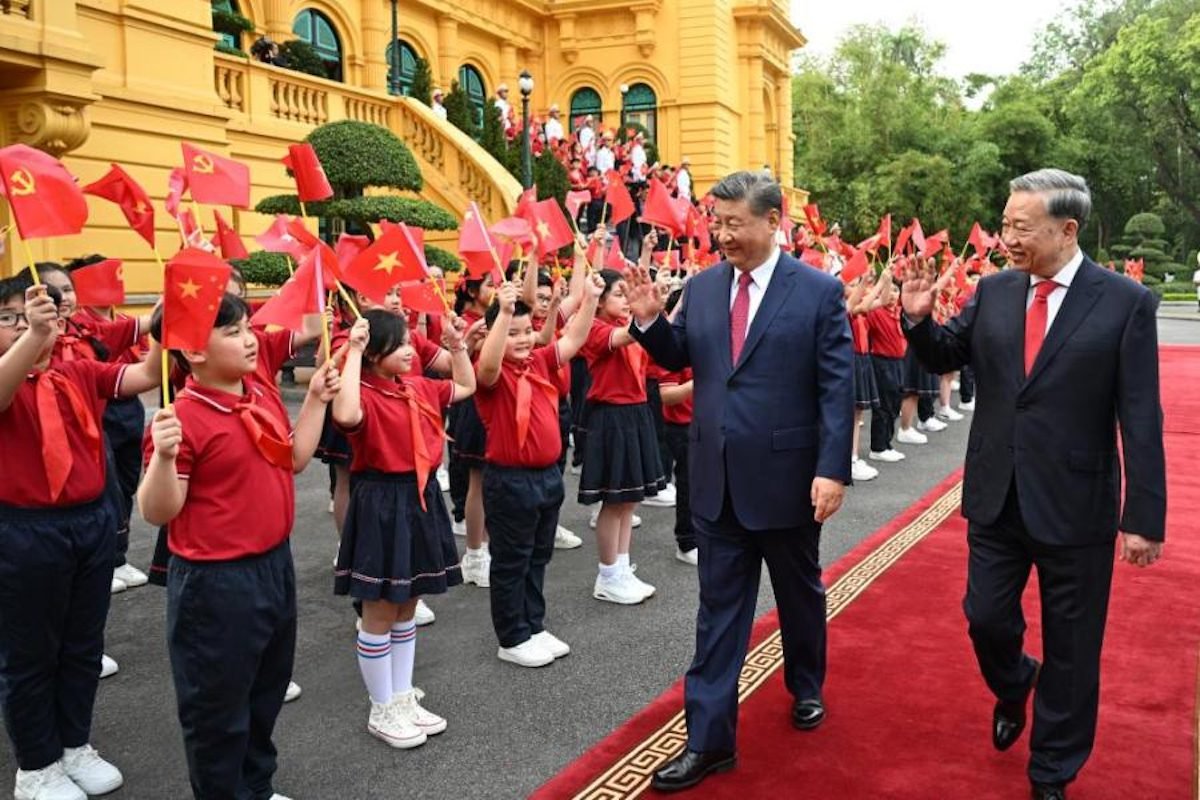
Within days of securing the state presidency, Vietnamese leader To Lam confirmed a state visit to China on April 14–17, his first overseas trip in the new dual role.
It mirrors the pattern he set after becoming general secretary in August 2024, when he also traveled north first. He will likely seek a meeting with US President Donald Trump to follow, reprising the familiar choreography: Beijing first for strategic depth, Washington next to demonstrate balance.
With both the party leadership and the state presidency now in his hands, To Lam has removed the protocol friction that once complicated Vietnam’s top-level diplomacy. When Nguyen Phu Trong visited the White House in 2015, Washington had to improvise around the fact that he held no state title.
To Lam can now engage Chinese President Xi Jinping and Trump on equal terms — as both head of party and head of state — streamlining the mechanics of the balancing act on which Vietnam’s security depends.
Early signals, however, suggest this balance is under strain. On March 16, Vietnam and China held the inaugural meeting of their “3+3” strategic dialogue, a ministerial mechanism bringing together the foreign affairs, defense and public security ministers of both countries.
The format is unprecedented in Vietnam’s bilateral relationships and goes well beyond standard diplomatic engagement. It embeds security cooperation — including counter-“color revolution” coordination — into the institutional architecture of the relationship.
For a leader who rose through the public security apparatus, this mechanism is built to To Lam’s strengths. It is also one that deepens Vietnam’s institutional entanglement with Beijing in ways that may be difficult to unwind.
On the American side, To Lam’s February meeting with Trump at the White House was symbolically important — reportedly requiring three prior attempts to arrange — but produced no big breakthrough. The trade imbalance and the transshipment problem, in which Chinese goods are routed through Vietnam to evade US tariffs, remain unresolved.
The contrast with Beijing is telling. Meetings with Xi reliably produce institutional frameworks and concrete commitments — the “3+3” mechanism itself was agreed during Xi’s state visit to Vietnam in April 2025 — while engagements with Trump have produced announcements on export controls and procurement whose implementation remains uncertain and conditional on a volatile US political environment.
The regional picture compounds the imbalance. The ISEAS State of Southeast Asia 2026 survey found that a slim majority of Southeast Asian respondents would now side with China over the US if forced to choose, with Vietnam and the Philippines as notable exceptions still preferring Washington.
Yet the Anatomy of Choice Alignment Index, which measures actual policy behavior across 20 indicators over 30 years, places Vietnam in the China-leaning camp. Only the Philippines remains clearly US-aligned.
Taking these two studies’ findings at face value, the gap between what Vietnamese elites say they prefer and what Vietnam’s policy choices reveal is significant in itself: it suggests that the structural tilt toward Beijing is advancing regardless of stated preferences.
That tension reflects Vietnam’s particular circumstances. It faces the most extensive and direct territorial disputes with China of any claimant in the South China Sea. Its growth model depends on being perceived as an alternative to China for foreign investors — the “China plus one” logic that has driven waves of manufacturing FDI from Japan, South Korea and the West.
And its domestic politics carry a deep historical wariness of Chinese influence that even a tightly controlled information environment cannot fully suppress. In 2018, a proposed law allowing 99-year land leases in new special economic zones triggered mass protests across the country, fueled by fears that Chinese investors would dominate.
The government shelved the bill. To Lam may be consolidating power, but no Vietnamese leader can afford to be seen leaning overtly toward Beijing. The anti-China sentiment that runs through Vietnamese society is a real political constraint, one that pushes Hanoi to maintain at least the appearance of balance even as structural conditions tilt.
These factors have underpinned Vietnam’s so-called “bamboo diplomacy” — the practice of bending with prevailing winds while remaining rooted in strategic independence, maintaining productive ties with all major powers without committing to any. The question is whether Vietnam’s alternatives are narrowing faster than Hanoi can manage.
This is a moment of acute pressure. The war between the US-Israel coalition and Iran has disrupted energy supplies through the Strait of Hormuz, and subsequent bans by China and Thailand on refined fuel exports have left Vietnam, which imports over two-thirds of its jet fuel, facing a supply crunch.
Hanoi has turned to Japan and South Korea for crude oil assistance and is seeking alternative jet fuel suppliers, though securing new sources in the current market has proven difficult. The episode underscores both the risks of narrow dependency and the practical value of diversified partnerships.
Moving closer to Beijing carries compounding risks. The most immediate is exposure to US punishment: the closer Vietnam appears to be a node in Chinese supply chains, the more vulnerable it becomes to tariff action and transshipment investigations by Washington.
In March 2026, the US Trade Representative launched Section 301 investigations targeting Vietnam along with 15 other economies over structural excess manufacturing capacity.
Vietnam recorded a historic US$178 billion trade surplus with the US in 2025. Beyond that, the Japanese, South Korean, European and American firms that have driven Vietnam’s FDI boom invest in no small part because they perceive Vietnam as distinct from China. That perception is the product. If it erodes, the investment rationale weakens regardless of what Washington does.
Deeper dependency on Beijing also reduces Hanoi’s leverage in the relationship itself. With China as Vietnam’s largest trading partner for over 20 years, bilateral trade reached a record $256.4 billion in 2025, a 25% increase year on year.
That integration brings benefits but also exposure, particularly in the South China Sea. When China deployed an oil rig into Vietnamese-claimed waters in 2014, international pressure contributed to its withdrawal. The more Vietnam’s alternatives narrow, the harder it becomes to generate that pressure when the next test comes.
Institutional mechanisms like the “3+3” dialogue add a further layer, signaling to Western partners that Hanoi’s regime security calculations are increasingly intertwined with Beijing’s, complicating engagement on governance, human rights and civil society, which are already friction points. Choices about digital infrastructure and cross-border railways risk locking Vietnam into Chinese systems that are harder to reverse than trade patterns.
The deeper risk is structural. Bamboo diplomacy works because it is believed. Once Hanoi is perceived as having tilted, the strategic value of its neutrality diminishes. Other partners begin to calibrate their engagement accordingly, narrowing the diversification that sustains Vietnam’s room to maneuver. The tilt becomes self-reinforcing: reduced alternatives push Hanoi closer to Beijing, which further reduces alternatives.
The most effective insurance against this dynamic is diversification beyond Washington and Beijing. Japan, South Korea, India, the EU and Australia all have strategic and economic reasons to keep Vietnam in play.
Japan is Vietnam’s largest official development assistance (ODA) provider and is expanding into defense transfers and energy cooperation. India offers defense diversification as disruptions to Russia’s defense exports leave Vietnam seeking new suppliers, with a $700 million BrahMos missile deal that will inevitably raise antennae in Beijing nearing finalization.
The EU-Vietnam Free Trade Agreement and Vietnam’s membership in the CPTPP provide institutional trade commitments that run through neither superpower. None of these individually matches what Beijing or Washington can offer, but taken together, they give bamboo diplomacy its roots.
To Lam’s consolidation of power gives him the authority to manage this balancing act with fewer domestic constraints than any Vietnamese leader in recent memory. He will deepen institutional ties with Beijing because China delivers consistently, and he will court Washington because the economic and strategic stakes are too high to let the relationship drift.
The risk is not that he chooses one over the other — it is that Beijing’s engagement deepens structurally while Washington’s remains transactional and subject to domestic political shifts, gradually tilting the balance in ways that are difficult to reverse.
How far To Lam invests in diversifying Vietnam’s partnerships beyond the two superpowers may ultimately matter more than how he manages either one. Multilateralization and diversification have long been core principles of Vietnamese foreign policy. They have arguably never mattered more or been as urgent.