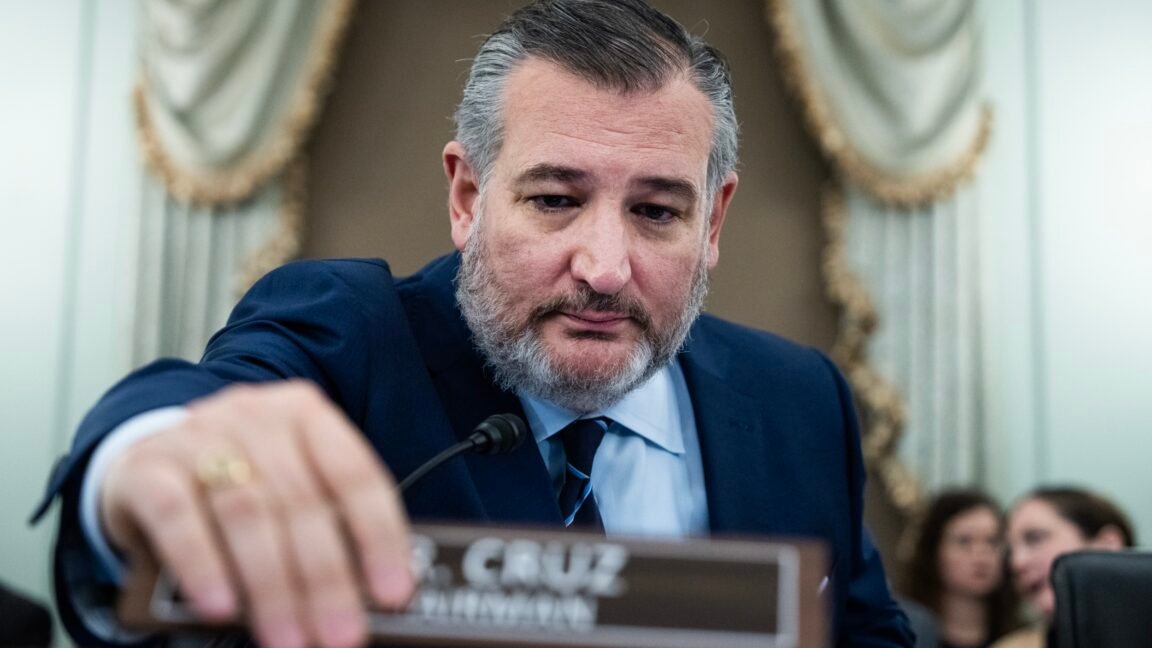
During a brief hearing on Wednesday morning, the Senate Committee on Commerce, Science, and Transportation spent only a few minutes “marking up” new legislation that provides guidance to NASA for its various initiatives, including the Artemis program to land humans on the Moon.
“Our bill authorizes critical funding for, and gives strategic direction to, the agency in line with the priorities of administrator Isaacman and the Trump administration,” said the committee’s chairman, Sen. Ted Cruz, (R-Texas).
The duration of the hearing, however, seems to be the inverse of its significance.
Elements of the legislation, now branded as The NASA Authorization Act of 2026 (see full text), have undergone significant revisions since just last week. The sweeping changes follow NASA Administrator Jared Isaacman’s announcement on Friday that he was shuffling the Artemis program to ensure that the US space agency would beat China back to the Moon and establish a long-term presence at the lunar south pole. In large part, the Senate’s bill endorses Isaacman’s plan of action.
“NASA faces a series of challenges,” Cruz said Wednesday. “Those challenges culminated in an announcement last Friday that NASA was making major changes to the Artemis missions and our eventual return to the lunar surface. Today, the Commerce committee will help guide those changes.”
Major changes to Artemis approved
With the revised legislation, Cruz and the Senate committee have empowered Isaacman and NASA to make significant changes to the Artemis Program. The revised plan for the space agency will likely lead to more launches and a much greater emphasis on the lunar surface.
Among the key Artemis changes in the reauthorization legislation:
- It notes the Space Launch System rocket “has not met” its intended flight rate and that the Exploration Upper Stage is “behind schedule and over budget.” It allows Isaacman to identify alternatives for a new upper stage and gives him a green light to “standardize” the SLS rocket to fly it more often. This effectively cancels future upgrades, as Isaacman sought.
- The legislation does not mention the Lunar Gateway. Notably, a version of this legislation authored just last week said a lunar orbiting Gateway was “critical” for future deep space exploration in section 206. Now that language is gone, replaced by a request for Isaacman to brief Congress on plans for a “lunar outpost” in 60 days.
- Later in the legislation, on page 34, it states, “The Administrator may repurpose, reprogram, reconfigure, or reassign existing programs, platforms, modules, or hardware originally developed for other programs.” Essentially, this allows Isaacman to use elements of the Lunar Gateway and a second mobile launch tower for other purposes.
The legislation contains a lot of other notable elements. For example, a provision championed by former NASA Administrator Jim Bridenstine to cap the space agency’s ability to procure commercial launch services was stripped out. And the bill also extends the lifetime of the International Space Station until 2032 to give commercial space station providers more time to bring their private facilities online.
But the big picture here is that the US Senate has put out one of its most important pieces of spaceflight legislation in decades: Senators have instructed Isaacman to go fly the Artemis program with all due speed, to do so as he deems best, and to focus on building a Moon base rather than a space station in lunar orbit.
Isaacman’s vision seems to have resonated
In the past, reauthorization bills have often been laden down with parochial priorities, with individual legislators seeking to ensure that their states and districts get financial boons. There is some of that in this bill, of course. But there is also a sense that senators want to give Isaacman and his leadership team room to work with Artemis with a loosening of the reins and an increase in resources.
Some of this is undoubtedly due to the recognition that China presents a real threat to not just beat the United States back to the Moon, but also to establish a dominant position there if NASA and its partners continue to stumble along.
However, the major text changes in just the last week indicate that the Committee members also have confidence in Isaacman and his vision. The private astronaut and successful businessman, who was only confirmed to his position in charge of NASA in late December, has displayed considerable political acumen in both navigating a fraught nomination process and then securing critical language in the authorization bill in such a short time.
It may not be apparent to those outside the space policy bubble, but these are indeed very significant changes that Senators have resisted for years at the behest of traditional space lobbying and NASA field center politics. And Isaacman got it done in weeks.
This legislation must still be approved by the full Senate and the US House, but the fact that these key senators were able to approve the revisions so quickly on Wednesday suggests that full approval is likely.